European pension funds increase Israel boycott pressure
MEMO | January 20, 2014
ABP, the world’s third-largest pension fund, said the fund might exclude the stocks ‘as a last resort’ if the Israeli banks fail to act
According to a report in The Financial Times today, three major European pension funds with a combined total of almost €500 billion of assets are “reviewing their holdings in Israeli banks over concerns that the banks finance illegal Israeli settlements in Palestinian-occupied territories.”
The three investors are Dutch ABP, the world’s third-largest pension fund, Nordea Investment Management, and DNB Asset Management. In addition, Norwegian pension fund KLP has confirmed it will be examining “dilemmas linked to financing [of Israeli settlements].”
An ABP spokesperson said the fund might exclude the stocks “as a last resort” if the banks fail to act. Nordea, meanwhile, is expected to meet the Israeli banks in March and take a decision on a possible withdrawal of investment at a meeting in May.
As the FT highlights, “the reviews come after PGGM, the second-largest Dutch pension fund, two weeks ago became the first big investor to dump its holdings in five large Israeli banks : Bank Hapoalim, Bank Leumi, First International Bank of Israel, Israel Discount Bank and Mizrahi Tefahot.”
The news comes two days after Israeli television broadcast remarks by the government’s top negotiator and Justice Minister Tzipi Livni, who warned that a “crisis” in the peace process will see Israel hit by a “wave” of boycott pressure. Last week, Shas party chair Aryeh Deri urged financial assistance to business owners in the West Bank “hurt by international boycotts”.
Related article

Israelis set West Bank mosque on fire, as UN report reveals rise in settler violence
Al-Akhbar | January 15, 2014

A group of Israeli settlers set fire to a West Bank mosque and sprayed it with racist graffiti, Ma’an news agency reported on Wednesday.
The “price tag” attack comes as a United Nations report revealed that settler attacks on Palestinians have almost quadrupled in eight years.
Ayoub Abu Hijlah, the mayor of the northern village of Deir Istiya, told Ma’an that the settlers entered the village before dawn to set fire to the mosque’s door, causing minor damages.
The settlers also scrawled threatening graffiti on the walls of the mosque, including “Arabs out!” and “Best regards from Qusra,” in an allusion to an incident in early January in which a group of settlers was apprehended by Palestinian villagers as they intended to destroy their crops.
Another tag read: “The righteous shall rejoice when he seeth the vengeance: He shall wash his feet in the blood of the wicked.”
Palestinian Authority official Ghassan Daghlas said that residents managed to extinguish the blaze before it spread to the interior of the mosque.
Most price tag attacks against Palestinians are never prosecuted, and many take place in full view of Israeli troops. According to rights organization Yesh Din, indictments were only filed in 8.5 percent of 825 completed police investigations it monitored.
The UN Office for the Coordination of Humanitarian Affairs (OCHA) report, relayed by the Associated Press, recorded 2,100 settler attacks since 2006, from 115 attacks that year to 399 in 2013.
OCHA figures estimated that in eight years, 10 Palestinians were killed by settlers, and more than 1,700 Palestinians were injured by settlers or by troops in clashes.
Israeli settlements in the West Bank and East Jerusalem are illegal under international law.
The Israeli army no longer even pretends it’s trying
The army admits its observers noticed the masked Israeli bandits descending on Qusra – and did nothing
By Yossi Gurvitz | Yesh Din | January 13, 2014
 A case of man bites dog: On Tuesday, January 7th, in the village of Qusra, Palestinians united in order to defend themselves from a group of Israeli marauders, taking the latter captive, and turning them over to the authorities. The rare event drew significant media attention.
However one point did not get the attention it required: The IDF told Haaretz (Hebrew) that “an observation post identified the settlers, some of whom were hooded, descending towards the village, but then eye contact with them was lost.”
You get that? The IDF identified a group of masked people heading toward a Palestinian village, and in response it did… nothing. The army entered the picture only after the raiders’ plans had been disrupted, in order to return them to their homes. That is, as far as the Israeli army – which effectively is the sovereign over the West Bank – is concerned, it is perfectly reasonable that masked men will pass by its apathetic eyes to raid a Palestinian village.
Had the villagers of Qusra not congregated to protect their persons and property, the incident would have ended with more damage to Palestinian property and perhaps more wounding of Palestinians – and it seems the IDF would not have cared that much. Now let’s try and imagine the opposite scenario: Masked Palestinians creep toward a settlement. Do you think in this case the IDF observer would consider it sufficient to inform command that it had “lost eye contact” with the suspicious masked group?
Once, the IDF – which according to international treaties and HCJ instructions is entrusted with protecting the Palestinian population in the Occupied Territories – would at least pretend to try to protect them from the settlers’ daily terrorism. Seems it has stopped even pretending.
Perhaps because the truth is much worse: this blog has reported numerous incidents of IDF troops providing protection to Jewish marauders while they have attacked Palestinian villages. The following footage, taken by B’Tselem staff, brings the incident to life. The soldiers react with apathy to the masked Jewish civilians stoning Palestinians – and when the Palestinians try to react in defense, the soldiers fire tear gas canisters at them.
So it goes.
Related article

Kifl Hares: Closure of village and settler harassment
International Solidarity Movement | January 12, 2014
Kifl Hares, Occupied Palestine – On Friday, 10th January 2014, at approximately 4 o’clock in the morning a group of twenty settlers from nearby illegal settlements entered the Palestinian village of Kifl Hares. Some of them arrived in cars, others on foot. The settlers made noise and broke windows of parked cars. Palestinians on their way to the mosque for the first prayers were harassed and settlers in cars tried to run them over. Children were frightened and the villagers were afraid to leave their homes.
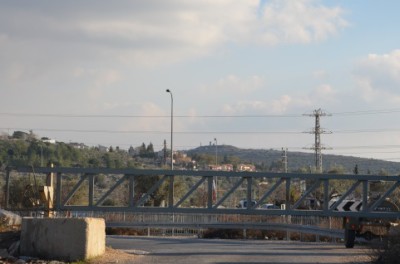 Previously, on Tuesday 7th January, the Israeli army closed the gate at the main entrance to the village, which leads to the main road. When villagers asked the reason for this, the soldiers stationed in a watchtower nearby answered that the gate would be closed indefinitely for security reasons.
On Thursday, 9th January, an emergency occurred, when an ambulance attempted to take an elderly lady living near the entrance to a hospital in Nablus. The residents requested that the Israeli soldiers open the gate for just five minutes so that the ambulance could reach the main road. The Israeli forces refused and the paramedic had to carry the lady by hand on a stretcher from her house to the other side of the gate. This delayed her arrival at hospital.
The gate has been opened only once in the past few days. This happened on Friday, when the settlers entered the village, implying that the Israeli forces knew of the settler attack.
Illegal settlers and Jewish tourists have entered Kifl Hares on many occasions. The village is located in the northern West Bank in the Salfit district and close to Ariel, the largest of the illegal settlements. The pretext for the incursions into Kifl Hares is a pilgrimage to three disputed tombs. The centuries-old tombs belonging to the village are also important for Muslims. Large numbers of settlers arrive on visits organized by the DCO and with Israeli army protection. Settlers and Jewish tourists from all over the world arrive by bus, frequently during the night. During the incursions, Israeli forces declare the village a closed military zone and Palestinians are required to stay in their homes until the settlers have left. This event occurs around twenty times a year. Nevertheless settlers also come weekly without army protection to pray in the tombs and often to harass or attack villagers. Several years ago Palestinian youth would resist these incursions by throwing stones at the illegal settlers and Israeli forces. This resistance was invariably responded to with night raids and arrests that resulted in imprisonment for up to five years. Since then villagers have been afraid to resist these settler attacks.
Related articles


Dutch pension fund divests from Israeli banks over illegal settlements
Al-Akhbar | January 8, 2014
Dutch pension asset manager PGGM, one of the largest in the country, said on Wednesday it was divesting from five Israeli banks because they finance illegal settlements.
The announcement comes a month after a major Dutch water supplier ended a partnership with an Israeli water company which supplies Israeli towns and settlements in the occupied West Bank.
“PGGM recently decided to no longer invest in five Israeli banks,” said the company, which manages about 153 billion euros in funds.
“The reason for this was their involvement in financing Israeli settlements in occupied Palestinian territories,” PGGM said in a statement.
PGGM said there was “a concern, as the settlements in the Palestinian territories are considered illegal under humanitarian law,” and regarded by international observers as an “important obstacle to a peaceful (two-state) solution of the Israel-Palestinian conflict.”
It said it would no longer do business with the Hapoalim and Leumi banks, the First National Bank of Israel, the Israel Discount Bank and the Mizrahi Tefahot Bank.
PGGM added it based its decision on a 2004 UN International Court of Justice ruling that the Jewish settlements were in breach of the Geneva Convention relating to occupying powers transferring their own citizens into occupied territories.
The group said it had been discussing the issue with the Israeli banks “for several years” but that the banks “have limited to no possibilities to end their involvement in the financing of settlements in the occupied Palestinian territories.”
“Therefore, it was concluded that engagement as a tool to bring about change will not be effective in this case,” PGGM said.
All investment in the banks ended on January 1 “as concerns remain and changes are not expected in the foreseeable future,” it added.
PGGM’s investments in Israeli banks amount to a few tens of millions of euros, Israeli newspaper Haaretz reported.
“But its decision is liable to damage the banks’ image, and could lead other business concerns in Europe to follow suit,” the paper said.
Palestinians welcomed the PGGM’s decision to divest from the banks, Wafa news agency reported.
Palestinian Authority Parliament Member Qais Abdul Karim, said in a statement that he hoped such action would inspire other members of the European Union to follow suit and force Israel to abide by international law.
“Israel should understand that it will pay a heavy price if it continues to occupy Palestinian land and ignore international resolutions,” Wafa quoted him as saying.
In September, Dutch engineering firm Royal HaskoningDHV withdrew from the construction of a sewage treatment plant in East Jerusalem, citing the Israeli’s project’s violation of international law.
Last month, Dutch water supplier Vitens ended a partnership with Israeli water company Mekorot due to the “political context.”
The decision came days after a visit to the Mekorot offices in Israel by Dutch trade minister Lilianne Ploumen was abruptly cancelled.
The visit was part of a larger tour of Israel by Prime Minister Mark Rutte that was marred by a dispute over a Dutch-made security scanner intended to check goods leaving Gaza for the West Bank.
Rutte was to have inaugurated the scanner on the isolated territory’s border with Occupied Palestine, but the ceremony was broken off after Israel said it did not want Gazan goods going to the West Bank.
Israel’s defense ministry wants to isolate the two Palestinian regions, while Dutch officials had hoped the scanner might boost commerce between them.
Israeli deputy Foreign minister Zeev Elkin last month said he was “blindsided” by Vitens’ pullout “and a few more European companies have made similar decisions in the past months, which have blindsided us exactly in parallel with the peace process.”
Zeev, speaking to Israeli military radio, said that peace initiatives should mean “that people don’t breathe down our neck”, but “unfortunately this doesn’t work.”
Since peace talks between Israeli and Palestinian officials began in July, Israel has announced the construction of thousands of settler homes in the West Bank and East Jerusalem, sparking tensions in already difficult negotiations.
(AFP, Al-Akhbar)
Related article
Jewish settlers attack local official in south Hebron hills
Ma’an – 30/12/2013

(MaanImages/file)
BETHLEHEM – A group of settlers injured a local Palestinian official in the south Hebron hills on Saturday after attacking him with a rock, a local peace group said Monday.
“On Dec. 28, a group of settlers attacked Palestinians who were plowing a field in the South Hebron Hills village of At Tuwani. Hafez Huraini, a member of the South Hebron Hills Popular Committee, was injured in the attack,” Operation Dove said in a statement.
Huraini told the group that five settlers from the illegal outpost of Havat Maon, four of whom were children, attacked the villagers as they worked on their land.
One of the settlers approached Huraini and hit him over the head with a rock.
Residents from at-Tuwani gathered and managed to force the settlers away, but they continued to throw rocks at the villagers before finally leaving the area.
The attack took place at 2.45 p.m. and Israeli forces arrived in the area at 4.15 p.m., by which time Huraini was at a hospital in Yatta receiving treatment.
“This is resistance: to go daily to your land. We are protesting every day, every night,” Huraini said.
In November, Operation Dove said the illegal outpost of Havot Maon was expanding at a “phenomenal” rate.
Home to around 200 settlers, the outpost is one of the most violent and radical in the occupied West Bank.
Related articles
Tuqu’ – a village under siege
Letters from an Occupied People | December 12, 2013
A loud buzz of chainsaws greets our arrival following a call from Tuqu’ – a Palestinian village of about 12,000 people, south of Bethlehem in the West Bank. We find Israeli soldiers overseeing the destruction of row after row of mature olive trees.
The Palestinian farmers remonstrate with the army. They have land ownership documents dating back generations from the Jordanian, British and Ottoman administrations, but their arguments are ignored by the soldiers holding them back at the gunpoint. I notice a woman pleading with soldiers who order her away, but she will not let up.
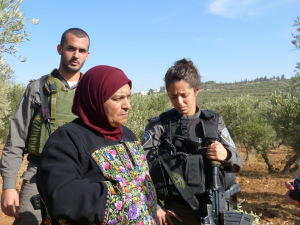
November 25, 2013 Israeli Border Guard weeping as Palestinian trees destroyed_A.Morgan
An Israeli Border Guard, a young woman who speaks Arabic, is called to deal with her. I watch as the young soldier stands listening and silently drops her head, turning her face to wipe away tears.
Finally, the buzzing stops, but it is a temporary reprieve. The Israelis have declared this ‘state land’ and the farmers are given four days to cut down hundreds more trees themselves, or the world’s fourth largest army will return to defend Israel from the olive trees.
‘How can we do this?’ asks one farmer ‘It will be like killing our mothers!’
Israeli military harassment of children in Area C
About three quarters of Tuqu’s land is in Area C*, under full Israeli military control, although this was supposed to transfer to the Palestinian Authority within 5 years of the Oslo Agreement. Tuqu’ has already lost hundreds of hectares to the illegal Israeli settlements of Teqoa, Noqedim and Ma’ale Amos that surround it to the north, south and east.
Our team comes regularly to Tuqu’. It is one of four Bethlehem villages where we accompany children to school as part of a UNICEF ‘Access to Education’ programme. Every day, children of six to 18 must run the gauntlet of armed Israeli soldiers and we have been present when the army has tear-gassed the schools. The soldiers obstruct the school entrances with jeeps, and patrol the footpaths with guns, forcing the frightened children to walk across rough fields or along the busy road.
‘It is emotional harassment’ says the mayor.
Recently we met a 16 year old boy who showed us the X- ray of a bullet still lodged in his back since a recent military incursion into Tuqu’. The mayor also tells us that over 20 children have been arrested in the last three months.
Two weeks before the trees were cut down, Tuqu’s mayor had called us because Israeli settlers, accompanied by soldiers, had begun putting up Israeli flags and tents on Tuqu’ land each afternoon.
One of the Israeli settlers I spoke to – a woman with an American accent – justified what she was doing, saying,
‘It is no different than what the Americans did to the Native Americans’.
Following this we saw the army erecting a series of concrete pillars along the roadside, with two red signs warning Israelis that this was a dangerous Palestinian village.
Soon after that, settlers erected a large marquee and put up provocative posters with a picture of a car being fire-bombed. The Palestinian landowner protested, but the military commander told him the settlers would take the land for two days for a party. There was nothing the farmer could do to stop this, but the village held a peaceful protest, whilst a large Israeli military force guarded the settlers.
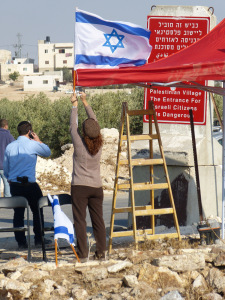
November 20, 2013 Nadia Matar, Women in Green at Tuqu’_A.Morgan
The people of Tuqu’ know that this is how it starts; a few tents, some flags, then some caravans – an illegal settlement outpost is born. With Israeli state protection and financial inducements it will soon grow to thousands of settlers. More land theft, house demolitions, movement restrictions and violence against local Palestinians will follow.
Two days after the party, the settlers are back. They include a vigilante group called Women in Green** led by a Belgian-born woman called Nadia Matar. We ask what she thinks about the 16 year old Tuqu’ boy who was shot it the back whilst going to visit his grandfather.
‘ He was probably throwing stones.’ She replies ‘Kids who throw stones should be shot in the head ’.
During a visit to Tuqu’ a week after the tree cutting, we see scores of settlers coming towards the village, many bringing young children. A large number of Israeli soldiers position themselves across the road and fields, aiming their rifles and teargas cannons at Palestinian children coming out with their unarmed parents for another peaceful protest.
The settlers hold a ceremony and light candles. It is Hanukkah, and they tell us they are renaming this area with a new Hebrew name.
Under international law it is illegal for Israel, as an occupying force, to transfer its own population into the occupied Palestinian territories. Despite this, Israel’s massive settlement programme has continued unabated for decades, with thousands more homes being planned during the current Peace talks. With many settlements to the east of Bethlehem and other Palestinian centres, the Israeli strategy seems clear: to expand the eastern settlements westward to join up with Jerusalem, bisecting the West Bank and corralling the Palestinian population into a series of isolated cantons. EAPPI is keeping international agencies informed about these developments in Tuqu’ and a legal challenge is underway, supported by UNOCHA and the Norwegian Refugee Council.
* The Oslo Accords led to the West Bank being divided into Areas A (under Palestinian control), Area B (Palestinian civil government and Israeli military security) and Area C (Completely under Israeli military law). Areas B and C were supposed to be transferred to Area A – full Palestinian control, within 5 years. Instead, 20 years on, Israel has consolidated it’s control over Area C, illegally building hundreds of thousands of settler homes. Area C represents over 60% of the West Bank. It is the only contiguous area and therefore control over Area C is essential for communications. It also includes most of the West Bank’s fertile land and water. Israel prohibits Palestinian construction in Area C. Israeli control over, and settlement building in Area C is a major obstacle to a peaceful solution to the conflict.
** Women in Green is a right wing group that opposes the creation of a Palestinian state and supports Israeli settlement of the West Bank, which it proposes Israel should annex. WiG also opposed Israeli withdrawal from southern Lebanon. Nadia Matar, the Belgian-born leader of WiG claims that the ‘Arabs’ in the ‘Holy Land’ are descended from relatively recent immigrants, and should be ‘transferred’ to neighbouring Arab countries.
Related articles
You destroy the soldier himself
By Melanie Ward · December 11, 2013
“You destroy the soldier himself”
That was the response of Munir, a Palestinian who is faced with Israeli soldiers at the checkpoint opposite his shop in Hebron every day, when I asked him how he thought being in Hebron must affect the soldiers.
I have had so many encounters with Israeli soldiers during my time in Hebron – it is impossible not to, due to the intensity of the military occupation.
I have passed the time of day and talked with some of them about what we are each doing here. Some have told me of their boredom, that they would much rather be on the beach. One helped keep a stray dog away from Palestinian school children who were frightened and I thanked him. Another told the police to leave me alone when they were harassing me about where in the street I was standing during the school run, and I thanked him too.
They have also spat at me, shouted at me, threatened to arrest me and called me stupid in Hebrew and a “sharmoota” (“whore” in Arabic). I have refused to follow their orders to move or stop taking photos. I have watched heavily armed soldiers throw stun grenades, and tasted the tear gas they shoot at Palestinian children on their way to school in response to small stones being thrown at their checkpoint. I have seen them harass and detain Palestinians trying to go about their lives, push kids for “facing the wrong direction” as Israeli settlers walk past, and arrest children. I have watched them laughing and joking many times in situations that are far from funny – most recently in the aftermath of an extremely serious attack by Israeli settlers against a Palestinian family.

An Israeli soldier fires tear gas at Palestinian children on their way to school after small stones were thrown at a fence near checkpoint 29 in Hebron
I have come to know some of the Givati Brigade of the Israeli army, currently serving in Hebron, by sight and a few by name. You can often tell how many schoolbags will be searched or Palestinians detained for ID checks by who is on duty. Almost without fail, the local Palestinians say that their treatment on a given day depends on the mood of the soldiers. I have often wondered what must be going through their minds and wished that I could talk to them properly about what they think. Amidst the tension and violence of Hebron, this is normally impossible.
One Friday night settlers blockaded a Palestinian family’s gateway and stopped them from leaving their home at Tel Rumeida in Hebron. I asked the nine watching Israeli soldiers to please help. They wouldn’t. One of them, whose name is Kawalski*, said “everything is fine.” 34 Israeli settlers were stopping a Palestinian family from walking down the street and thus from entering or leaving their home. Many of the settler children were shouting abuse, hitting our cameras and spitting at us.

An Israeli settler child hits my camera during the incident when settlers blockaded Palestinians in their home, and went on to attack us. Soldiers stand stand by in the background
They went on to throw two buckets of water at us, followed by a bucket of bleach. It was an awful scene and I cannot see how he could have thought it was fine.
Most of the soldiers in Hebron are young, ranging from 19-22 years old, and are conscripted into military service for three years. This is compulsory with a few exceptions, so most of them have not made a positive choice to be in the army. Yet in Israeli society there is real kudos attached to being a combat soldier like those in Hebron – just take a look at the Israel Defense Forces Facebook page. Only a tiny minority ever refuse to serve and spend time in prison as a result. Kawalski, the soldier on that Friday night, must be no more than 22 years old. After the incident, I wondered a lot about his “everything is fine” comment and thought maybe it was actually his internal reasoning – him trying to persuade himself it was all OK and he was in control (he most definitely was not).

An Israeli soldier gives first aid to our journalist colleague after refusing to intervene in a situation which culminated in the settlers throwing bleach in her eyes
Later, when he called an ambulance for my colleague after the attack on us that he had failed to prevent, he must have been forced to acknowledge that everything had not been fine.

Israeli soldiers tell a young Palestinian boy he is not allowed to ride his bike in H2 in Hebron. Israelis can drive on this street but Palestinian are not allowed to
Thousands of settlers and their supporters came to Hebron recently for Shabbat Chayei Sarah, which commemorates Sarah of biblical times, who is buried in Hebron. It was a difficult weekend, with heightened tensions and violence. Movement restrictions were even tighter than usual – the Ibrahimi Mosque and nearby Palestinian shops were forcibly closed. Most of Shuhada Street, which Palestinians are never allowed to walk down, was closed to my colleagues and I as well – “Jews only” as the enforcing soldier told me. Extra soldiers drafted into H2 checked the ID of Palestinian men every 50 metres.

Me intervening to stop Israeli soldiers harassing young Palestinians who were sitting on a wall chatting as Israeli settlers walked past on Shabbat Chayei Sarah
I was patrolling with a colleague and we went to an area with a few Palestinian homes and many settlers nearby. I felt nervous because large groups of settlers, some armed and some drunk, are not normally a great thing to encounter. A Palestinian family was harvesting olives on a hill where many settlers were hanging around. We checked if the family was OK and sat down under a tree, hoping to deter the settlers from coming to bother them, throw things at them etc (there was a fence between us and the Palestinians so we couldn’t help with the olives). A couple of Israeli soldiers were standing nearby.
After a bit, a group of male settlers tried to make their way towards us and I stood up, worried about what would happen next. But rather than standing back and letting them come over, the soldier stepped in the way and asked the settlers to leave. They did. I had never seen such a thing before and, when the settlers had moved away, I thanked the soldier. “Don’t worry” he said. Shortly after, a second group of settlers tried to come and the soldier and his colleague again turned them away. After this the soldiers came to ask if we were OK. I was slightly stunned that they were looking out for us and for the Palestinians. I thanked them both and said that we would move on soon. They told us there was no need for us to leave and not to worry, they would make sure everything was OK with the Palestinians. This was the opposite of what I am used to in Hebron, where the soldiers will often do whatever they can to get rid of us, and simply stand by as settlers harass and attack Palestinians. The first soldier told me that his name was Yossi* and he was not normally based in Hebron.
Later, when there were no settlers watching, I bumped into Yossi again. I asked him if he understood what I was doing there. “You want peace” he said, and told me that he wanted peace too. He told me that after my colleague and I had gone, the settlers had pushed him and thrown stones at him. He was astonished by this and couldn’t understand it. I asked what he knew about Hebron – not much. His orders that day had been to keep the Jewish and the Palestinians apart. I told him what it is like in Hebron – the settler violence, the soldiers refusing to help, the clashes, and showed him pictures. It was all news to him. “It’s good that you are telling me this, I will tell my commander”, he said. I really appreciated this but told him I didn’t think it would help – his commander was 24 years old and decisions about what happens in Hebron are made high up in military and political circles. None of those in charge will be unaware of what actually goes on in Hebron.
Yossi told me that he loved being in the army. He told me that he loved his gun. “Why do you love your gun?!” I asked him, “It’s for killing people.” “No!” he said, “I love target practice, I don’t want to kill anyone.” “But why do you think they give you a gun?!” I asked. I learned that Yossi was 19 years old. He seemed like a good, decent young man and I believed him when he said he wanted peace and didn’t want to kill anyone. But, as I have previously written about other discussions I’ve had with Israelis, I was surprised by his lack of understanding about the facts of the conflict he is part of. I asked him to keep being nice to the Palestinians and he told me to take care in Hebron.
My encounter with Yossi really made me think. That I was so surprised at his fair conduct says a lot about the norm for soldiers in Hebron.

An Israeli soldier detains Palestinian boys aged 8 and 10 years. Photo by Maria Schaffluetzel
I wonder how it comes to be that so many of the young soldiers behave in the morally unacceptable ways I have so often observed or seen evidence of: arresting children and beating them up; demolishing Palestinian houses with bulldozers and then preventing tents and emergency aid from being delivered; even deliberately shooting innocent people, as veterans’ organisation Breaking the Silence has documented. Sometimes they will be following their orders in doing these things, and sometimes not. Mohaned, a 13 year old from the town of Beit Ummar, told me how soldiers raided his house at 3am, blindfolded and arrested him wearing only his underwear. He was held for 10 days, in which he was slapped, hit with the butt of a rifle, beaten and then released.

An 11 year old Palestinian boy arrested by Israeli soldiers in Hebron
Surely it is important to ask how young men, most of whom start off as normal, decent guys like Yossi, end up doing these things?
On a day off I visited the Golan Heights and got talking to some soldiers about their jobs. One of them said that they themselves had been discussing these issues, “Some of us were talking – we are children and they give us guns.” I met another soldier in Haifa, Israel. He was 23 years old and had previously served in the Golani Brigade in Hebron. He recalled an army education week when there had been a discussion about putting the heads of dead Palestinians on poles. He had been in the minority 20:1 to say that such things were wrong. Another former Golani soldier simply refused to speak about what he had done when he served in the army.

A Palestinian looks out of his window to find armed Israeli soldiers using the roof of his home in Al Arrub refugee camp near Hebron
My friend Sam is Jewish, an Israeli of British origin who I got to know in our student days. After my blog about my some of my experiences in Israel, he emailed me saying, “I think another big reason why it’s hard to convince Israelis about what’s going on in the territories is that almost every Israeli knows somebody who serves in the territories… it’s hard for us to believe that they are monsters.”
His use of the word “monster” really stuck with me. I don’t believe the soldiers are monsters – perhaps with a few exceptions, as with all people. But sometimes they end up doing monstrous things on a regular basis. They are born into a system which takes apparently normal teenagers and seemingly trains them to behave in these ways.
One soldier who served in Hebron told Breaking the Silence, “In Hebron, I was disturbed and frightened most of all by the unregulated and uncontrolled power, and the things it made people do.” Another said, “Another thing that has stayed with me from Hebron? I think of myself as a little injured maybe, I don’t know. Not physically injured. More emotionally injured.”
Rather than monsters, I think it makes the young soldiers part of the tragedy of the conflict. I am pretty sure that it will damage them too, that they will suffer in the long run. Aside from the terrible harm that the military occupation does to the Palestinians, I am sure that Israel also hurts itself and its own young people in what it does. What kind of society, what kind of country, will Israel end up as?
Avraham Shalom is in a position to know. He led the Shin Bet, the Israeli intelligence service, between 1980-86 and in the film The Gatekeepers he says,
“We have become cruel. To ourselves as well, but mainly to the occupied population.” The Israeli army has become “a brutal occupation force.”
*Not his real name
Related articles
Twin Girls Rammed By Settler’s Vehicle Near Beit Jala
IMEMC & Agencies | December 10, 2013
Palestinian medical sources have reported that twin girls have been wounded after being rammed by an Israeli settler’s vehicle in the Al-Walaja road, west of Beit Jala, in the West Bank city of Bethlehem on Tuesday.
Mohammad Awad, head of the Emergency Unit in Bethlehem, said that one of the girls suffered a fracture in one of her legs, while her sister suffered various cuts and bruises to different parts of her body.
The 17-year-old sisters were moved to the Arab Society Hospital in Beit Jala, Awad added.
On Monday, December 9, a young Palestinian man was injured after being rammed by an Israeli military jeep in Nahhalin village, west of Bethlehem.
On November 19, 2013, a young woman identified as Zeina Omar Awad, 21, was injured after being rammed by a settler’s vehicle at the main entrance of Beit Ummar. She suffered cuts and bruises, while the settler fled the scene.
On the same day, a Palestinian woman was wounded after being rammed by the speeding vehicle of an Israeli settler, near the northern West Bank city of Nablus.
On October 22, resident Abdul-Hafith Tayyem, 76, died of serious injuries suffered after being hit by a settler’s vehicle in Al-Fondoq town, near the northern West Bank city of Qalqilia. The incident took place on October 16, 2013.
On September 29, a Palestinian worker was injured after being rammed by a settler’s vehicle, near Husan town, west of the West Bank city of Bethlehem.
On September 20, a Palestinian man was injured in a similar accident with an Israeli settler who fled the scene.
A week before the incident took place, Palestinian child was seriously injured after being hit by a settler’s vehicle as she was walking home from school in Teqoua’ village, near the West Bank city of Bethlehem.
The child, Hayat Mohammad Suleiman, 8 years of age, was walking back home from school on the main road that is also used by Israeli settlers living in illegal settlements in the area.
Related articles
An unrelenting assault on the village of Deir Istiya’s farmland
International Solidarity Movement | November 28, 2013
Deir Istiya, Occupied Palestine – The village of Deir Istiya has encountered severe disruption to its agriculture and water supply since 1990 from the Israeli authorities and nearby illegal settlements. This has culminated in the Israeli army’s planned action to uproot nearly 2,500 olive trees in the very near future.
The army’s mandate to perform this action stems from a court ruling given in May 2013 that gave permission for them to cut down all olives trees in the Wadi Kana (a valley making up a large part of the village’s farmland) that are under two years old. However trees that were planted over five years ago have been included in the marking action over the last five months, a marking action typically precludes the actual uprooting process.
On the 26th of November, four men in civilian clothing marked 157 more trees across the village farmland. Before the army actually begins the action, under Israeli law, they have to inform lawyers representing the village of the date that this will commence. Although from past experience, villagers across the West Bank have not received such prior warning in similar cases. If the army succeeds with its plan, the destruction of more than 2,500 olive trees will decimate the village’s agriculture and economy, destroying the livelihoods of many of the 4,000 inhabitants of Deir Istiya.
This is the latest in a long line of aggressive acts that the Israeli government, army, courts and nearby illegal settlers have inflicted upon the people of this village. In 1990 nearby settlers deposited sewage from three separate illegal settlements into the 12 springs that provided water for the village. This water was crucial for the irrigation of the traditional crops of the village, lemon and orange trees. As water became scarce for the village, the farmers abandoned the orange and lemon crops, replacing them with olive trees due to the fact they require far less water. This is typical of the Israeli state to dramatically reduce the Palestinians methods for survival only to attempt to snatch away the small ray of hope that they have managed to build for themselves in the face of such adverse conditions.
Moreover, on the 23th of November, illegal settlers from a nearby settlement trespassed on Palestinian land in order to steal 100 meters of fencing material. The purpose of this fence was to protect a number of olive trees from pigs that have infested the area since Israeli settlers began releasing them for the exact purpose of disrupting Palestinian olive farming.
Cover not their blood
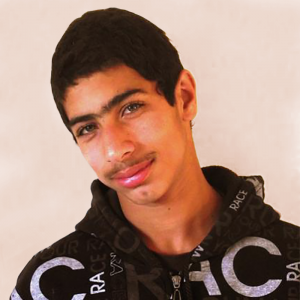
Yusuf Fahri Mussa Ahleil, 1995-2011
Yesh Din | November 24, 2013
Yusuf Fahri Mussa Ahleil, aged 16, was shot and killed on January 28th, 2011, probably by a settler. The prosecution took 14 months to appoint an attorney to the case, and eventually closed it due to lack of evidence.
Many of the posts in this blog deal with the incompetence of Israeli police investigations, and it’s possible that the death of Yusuf Fahri Mussa Ahleil, a 16-year old boy from Beit ‘Ummar, will be added to this list; but for the time being, it is a story of criminal negligence on behalf of the prosecution.
On January 28th, 2011, something happened in the village of Beit Ummar in the Hebron region. The testimonies describe an assault by Israeli civilians from two different directions simultaneously. Both incidents involved shooting; the second one ended in death. Witnesses describe a large group of Israeli civilians raiding the village, among whom three fired at the Palestinians using weapons, likely M-16 assault rifles. According to one of the witnesses, the Israelis were conducting some sort of ceremony, blew a shofar, and then opened fire. The witnesses agree that no military troops were present and that they arrived only after the shooting.
When it was all over, Yusuf Ahleil, who was on his way to help his father with his work in the field, lay dead on the ground. The testimony of the father, Fahri, is worth quoting: “I work in agriculture, and that is my main profession. During their vacations the children help me. Before I went to work [on the morning of the incident] I asked my son Yusuf to come with me to work later during the day. At some point I heard the sound of gunshots; I did not know what it was about and kept on working. And then, I don’t remember the time, some people from the village came with a vehicle and asked to take me home. I did not understand why – I refused but they insisted, took me with them and brought me back home. When we arrived, I saw that most of the village was gathered next to my house. I asked what happened? I was told, your son was shot. I said, how can that be? We agreed that he should join me at work. This is how I learned that my son, while on his way to work with me, had been wounded by the settlers.” Yusuf was shot in the head, and died.
The family filed a complaint with the police that same day. From that point onwards, our monitoring tells the story. On February 16th, 2011, the police informed us that the case was under investigation. On March 14th, 2011, it told us it received testimonies and photographs, and asked that we provide any further information we may come across. On May 2nd, 2011, the police informed us that the case had been transferred to the Jerusalem District Prosecution Office.
On June 5th, 2011, we called the Jerusalem District Attorney Office to ask which prosecuting attorney is handling the case. None had yet been appointed. We asked the same office again on August 24th, 2011, i.e. almost seven months after the incident, but the prosecution did not consider the violent death – this fact is not disputed – of a 16-year old boy as something requiring the immediate attention of an attorney. We repeated our query in September 25th, 2011. We might as well be speaking to the walls.
October 24th came and went, and the death of Yusuf still did not hinder the sleep of the prosecutors. We had reached December 15th, 2011, and the boy who had dropped dead from a bullet in his head still failed to arouse the interest of the prosecutors. On January 15th, 2012, almost a year since he had been killed, Yusuf’s prosecution file was still gathering dust. We kept on pestering, and on March 20th, 2012 – that is almost 14 months since the killing – we were informed that on this happy day a prosecutor had been assigned to the case. A week later, we tried to verify with her what steps she she had taken with the case so far. We were not dignified with an answer.
We repeated the question, to no avail, two months later. We are stubborn people, studied in the ways of banging our heads against the system’s wall, so we asked once again on July 30th, 2012 whether the prosecutors made any decision – four months since a prosecutor had been assigned to the case, and more than 18 months since the killing itself, but who’s counting. We did not receive a response.
On January 3rd, 2013, nearly two years after the killing and nine months after a prosecutor was assigned to the case, she still had no answer for us. Six months breezed by, and on August 4th, 2013, the prosecutor informed us that on July 30th, 2013, she had made the decision to close the case. The police had identified four suspects; the prosecutor closed the case against three of them for lack of evidence and against the fourth, for lack of criminal culpability.
That was the beginning of August. Since then we’ve been trying to get a hold of the investigative file so we can appeal the decision to close it. Until recently, the prosecution had failed in the rather simple job of providing us with it. There were contradictory claims as to what happened to it. The prosecution said it was sent back to the Hebron Police, which in turn said they never got it back. We are happy to report, however, that recently the file was found, photocopied, and will be reviewed by us soon.
Let’s conduct a mental experiment. Let’s say the victim is still 16 years old, still residing in the Occupied Palestinian Territories, but is not burdened with a foreign, Palestinian, name like Yussuf Alhleil; let’s say his name is something familiar, say Yossi Hebroni. Our hypothetical Yossi Hebroni was shot near a Palestinian village. Can anyone imagine that the prosecution would amble slowly to the case after 14 months? Or that it would need 16 more months to make up its mind?
The prosecution is entrusted, since Israel controls the Occupied Palestinian Territories, with protecting its residents from violence. When they are the victims of theft, it ought to bring the thief to justice. When they are killed, its duty is to bring justice for the dead.
The case of Yusuf Fahri Mussa Alhleil shows us how seriously the prosecution takes this duty. It removes another thin layer of the already crumbling patina of the claim that there is something you may refer to with a straight face as “rule of law” in the West Bank. Where the rule of law is absent, what we see is the law of nature, where the strong rule over the weak. The point of our social contract with the government is to overcome nature’s law, under which, to quote Hobbes, life is “nasty, brutish and short.” In the most gentle words possible, in Yusuf’s case – and, unfortunately, in far too many others – the prosecution has betrayed the social contract.
The result that there is the father who waits in vain for his son to return to him in the field, and killers who know that nothing will happen to them if they kill once more.
Related articles
- Israeli admits shooting at Palestinian children on TV game show (alethonews.wordpress.com)
- Nablus woman injured in hit and run vehicular assault by Jewish settler (alethonews.wordpress.com)
- Jewish Terrorism (alethonews.wordpress.com)
- Outrage as Palestinian child faces possible life prison sentence for throwing stones (gazasolidarity.blogspot.com)
- Israel to displace Palestinian community south of Hebron (altahrir.wordpress.com)
Featured Video
Israeli Foreign Ministry projects Palestinians as the Zionists, Ashkenazis as indigenous
or go to
Aletho News Archives – Video-Images
Frlom the Archives
Are the Jews indigenous to Palestine?
By David Miller | Al Mayadeen | August 3, 2022
There is a rising tide of claims from apologists for the crimes of Zionism that they have been misunderstood. Palestinians might be indigenous to Palestine, but the Jews definitely are. What is called the ‘Israel-Palestine’ conflict, they say, is competition over the same small piece of land by two rival groups of indigenous people. But are the Jews indigenous to the Levant? And what are the consequences of the argument?
In fact, most of the power structure of the Zionist state is dominated by Ashkenazi Jews who have no ancestral link to Palestine. Overall despite very significant financial and infrastructural contributions from Western European countries (especially the US, UK and France, for example via the Rothschild family), Eastern European Ashkenazim have been at the centre of the Zionist power structure since the early years of the 20th Century. … continue
Blog Roll
 Aletho News
- Hezbollah Foils Israeli Landing in Lebanon’s Bekaa
- Iraqi Resistance: Attacks on Beirut suburbs threaten US interests
- US approves $151.8M weapons sale to Israel, waiving congressional review
- “Burnt Bridges”: Why Trump’s Plan to Use Kurds Against Iran Is Doomed to Fail
- Iran Red Crescent says 6,668 civilian sites targeted in US-Israeli attacks
- Maybe Attacking Iran Was Not Such A Good Idea
- UK readies deployment of Prince of Wales carrier amid war on Iran
- Iran warns of consequences after US strike on water plant
- US Bases in Middle East Fail to Secure Nations & Become Safety Risk – Expert
- Iranian Crisis Becomes Embarrassment for US Military That Can’t Protect Anyone – MidEast Analyst
- If Americans Knew
- Israel is using the ‘Gaza doctrine’ in Lebanon and Iran
- Saudi journalist says ‘not all attacks’ on Gulf coming from Iran, fears US-Israel dragging monarchies into war
- Iranian officials say Israel carried out some of the drone strikes on Gulf energy sites
- US, Israel ravage Iran and Lebanon; 4 killed in Gaza – Not a ceasefire Day 148
- US troops were told war on Iran was ‘all part of God’s divine plan’, watchdog alleges
- Trump wants to run the show in Iran, but doesn’t know what he’s doing – Not a ceasefire Day 147
- ‘Dirty Work’ :The truth about how Israel was founded
- Mass Expulsion in Lebanon as Israel Expands War: “We Don’t Know Where to Go”
- Lies, distortions, and propaganda: how the U.S. mainstream media coverage on Iran hides the truth
- Palestinians in Gaza fear famine returning as Israel cuts off food amid Iran war
- No Tricks Zone
- Televised! Leading German Political Candidate Tells Schoolchildren CO2 Makes Sun Hotter!
- New Study: A Century Warming Of 1.1°C Is ‘Commonplace’ And ‘Not Unusual’ During This Interglacial
- New Study: ‘Internal Noise’ And Volcanic Forcing Can Trigger 10-15°C Warming Within Decades
- Glaciers Worldwide Are Suddendly Surging, Experts Blame Warming!
- Surprising Discovery: Sahara Is Greening…Billions Of Trees Where Once Thought To Be Barren
- New Research Reaffirms Clouds, Aerosols, And Surface Solar Radiation Are ‘Driving The Climate System’
- Germany: Electric Car Catches Fire At Charging Station, Sets Off Local “Inferno”, Widespread Damage
- New Study: Canada’s New Brunswick Was 1°C Warmer Than Today During The Medieval Warm Period
- Coal Power Back In Trend As Globe Tries To Keep Pace With Growing Demand For Power
- New Study: A 4°C Warmer Beaufort Sea Had ‘No Sea Ice’ 11,700 – 8200 Years Ago
 Aletho News