Former CIA Director Calls For A Coup If Trump Fires Mueller
By Tyler Durden | Zero Hedge | July 24, 2017
In the most vocal opposition to president Donald Trump yet, former CIA Director John Brennan said that if the White House tries to fire special counsel Robert Mueller, government officials should refuse to follow the president orders, as they would be – in his view – “inconsistent” with the duties of the executive branch.
“I think it’s the obligation of some executive branch officials to refuse to carry that out. I would just hope that this is not going to be a partisan issue. That Republicans, Democrats are going to see that the future of this government is at stake and something needs to be done for the good of the future,” Brennan told CNN’s Wolf Blitzer at the Aspen Security Forum, effectively calling for a coup against the president should Trump give the order to fire Mueller.
The exchange is 43 minutes into the clip below:
Brennan appeared alongside his former colleague, Director of National Intelligence James Clapper, and both men who served in the Obama administration, told Blitzer they have total confidence in Mueller. “Absolutely. It was an inspired choice- they don’t come any better, ” Brennan said adding that “If Mueller is fired, I hope our elected reps will stand up and say enough is enough.” Some have responded with questions where Brennan’s devotion to the Constitution was in the aftermath of the events in Benghazi.
Falling back on his neocon roots, James Clapper, who has waged a long-running vendetta with Trump, once again warned about Russian interference in US affairs. When asked about the June 2016 meeting between Donald Trump Jr., Jared Kushner and Paul Manafort with a Russian lawyer and others, he responded: “I’m an old school, Cold War warrior and all that – so I have, there’s truth in advertising, great suspicions about the Russians and what they do. A lot of this to me had kind of the standard textbook tradecraft long deployed by Russians. It would have been a really good idea maybe to have vetted whoever they were meeting with.”
Clapper was also asked about Trump’s comparison of the intelligence community to Nazi Germany. Clapper said he called the President-elect nine days before he left the Obama administration saying he “couldn’t let that reference pass” and it was an insult to him, CIA Director John Brennan and the workforce. “That was a terrible, insulting affront, not just to me or John, we get paid the big bucks, but I’m talking about the rank and file, men and women, patriots and intelligence community — that was completely inappropriate and over the top – I had to do something about it.”
And so he did: on the call Clapper said Trump asked him to “to put out a statement rebutting the contents of the dossier which I couldn’t and wouldn’t do. It was kind of transactional” referring to a dossier that alleged ties between President Donald Trump’s campaign and Russia. It was not clear if he wouldn’t and couldn’t do it because the contents were legitimate, in his view, or because the dossier is what started the whole “Russian collusion” narrative in the first place. Curiously, Clapper saw it as a favor to Trump not to issue a statement: Clapper was asked by Blitzer why he didn’t put out a statement replying: “The whole point of the dossier by the way was we felt an obligation to warn him to alert him to the fact it was out there. That was the whole point.”
It was not clear if James Comey, whose subsequent leak to the NYT led to the appointment of Mueller, would have applied the same reasoning when asked by Trump to rebut the dossier’s contents.
US ex-intel chief Clapper believes Russia-Trump claims, despite ‘no evidence to his knowledge’
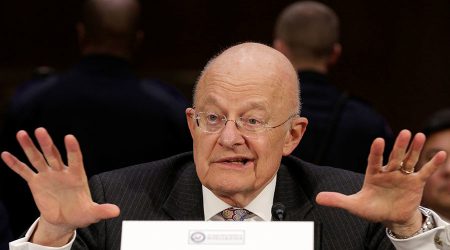
Former Director of National Intelligence (DNI) James Clapper. © Joshua Roberts / Reuters
RT | March 6, 2017
Former US Director of National Intelligence James Clapper has said on NBC’s ‘Meet the Press’ show that he is unaware of any evidence that the Russian government colluded with the Trump campaign during the US election, but still believes contacts existed.
“We didn’t include evidence in our report that had any reflection of collusion between members of the Trump campaign and the Russians. There was no evidence of that included in our report,” Clapper said, referring to a paper compiled by the NSA, FBI and CIA, together with the office of the DNI.
When asked if such proof even existed, he said: “Not to my knowledge.”
The show’s host, Chuck Todd, continued to press the issue, asking: “If [evidence] existed, it would have been in the report?”
Clapper answered that “this could have unfolded or become available in the time since I left the government. But at the time, we had no evidence of such collusion.”
Todd hinted that the public could start wondering if the situation is “all just smoke,” given the absence of a “smoking gun.”
“Well, that’s a good question. I don’t know,” Clapper responded. “I do think, though, it is in everyone’s interest, in the current president’s interests, in the Democrats’ interests, in the Republican interests, the country’s interest to get to the bottom of all of this, because it’s such a distraction. And certainly the Russians have to be chortling about the success of their efforts to sow dissension in this country.”
Clapper, however, still appeared unable to put his finger on where to look for any proof of the alleged “dissension-sowing.”
Asked if he still believed the Trump-Russia collusion claims, Clapper stated: “Yes, I do.”
Clapper is not the first to face questions over the issue of any substantial proof – or the lack thereof – of the Trump-Russia allegations.
At the end of February, the House Intelligence Committee chief, Rep. Devin Nunes, told journalists that they “still haven’t seen any evidence” of “any phone calls [between the Trump campaign and Russian officials]” but mysteriously added: “It doesn’t mean they don’t exist.”
Moscow has repeatedly denied allegations of contact with the Trump campaign, with the Kremlin spokesman lamenting that it’s become difficult to distinguish fact from fiction in the US media.
“Those reports are not based on concrete facts,” Dmitry Peskov said in mid-February, commenting on claims made by the New York Times and CNN, among others. Peskov noted that “there are five different sources in the story and none are named. So you see, really laughable stories are now given a go.”
British Fingerprints in Dirty Tricks Against Trump
By Finian CUNNINGHAM | Strategic Culture Foundation | 21.01.2017
Britain’s divisive Brexit politics are playing out through the new US presidency of Donald Trump. It seems that a faction within the British political establishment which is opposed to Britain leaving the European Union has joined forces with American intelligence counterparts to hamper Trump’s new administration.
By hampering Trump, the pro-EU British faction would in turn achieve a blow against a possible bilateral trade deal emerging between the US and Britain. Such a bilateral trade deal is vital for post-Brexit Britain to survive outside of the EU. If emerging US-British trade relations were sabotaged by disenfranchising President Trump, then Britain would necessarily have to turn back to rejoining the European Union, which is precisely what a powerful British faction desires.
What unites the anti-Trump forces on both sides of the Atlantic is that they share an atlanticist, pro-NATO worldview, which underpins American hegemony over Europe and Anglo-American-dominated global finance. This atlanticist perspective is vehemently anti-Russian because an independent Russia under President Vladimir Putin is seen as an impediment to the US-led global order of Anglo-American dominance.
The atlanticists in the US and Britain are represented in part by the upper echelons of the intelligence-military apparatus, embodied by the American Central Intelligence Agency and Britain’s Military Intelligence (Section) 6 (MI6).
Notably, incoming US President Donald Trump has expressed indifference towards NATO. This week he repeated comments in which he called the US-led military alliance «obsolete». Trump’s views are no doubt a cause of grave consternation among US-British atlanticists.
It is now emerging that British state intelligence services are involved much more deeply in the dirty tricks operation to smear Trump than might have been appreciated heretofore. The British involvement tends to validate the above atlanticist analysis.
The dirty tricks operation overseen by US intelligence agencies and willing news media outlets appears to be aimed at undermining Trump and, perhaps, even leading to his impeachment.
The former British MI6 agent, named as Christopher Steele, who authored the latest sexual allegations against Trump, was initially reported as working independently for US political parties. However, it now seems that Steele was not acting as an independent consultant to Trump’s political opponents during the US election, as media reports tended to indicate.
Britain’s Independent newspaper has lately reported that Steele’s so-called «Russian dossier» – which claimed that Trump was being blackmailed by the Kremlin over sex orgy tapes – was tacitly given official British endorsement.
That endorsement came in two ways. First, according to the Independent, former British ambassador to Russia, Sir Andrew Woods, reportedly gave assurances to US Senator John McCain that the dossier’s allegations of Russian blackmail against Trump were credible. Woods met with McCain at a security conference in Canada back in November. McCain then passed the allegations on to the American FBI – so «alarmed» was he by the British diplomat’s briefing.
The second way that Britain has endorsed the Russian dossier is the newly appointed head of MI6, Sir Alex Younger, is reported to have used the material produced by his former colleague, Christopher Steele, in preparing his first speech as head of the British intelligence service given in December at the agency’s headquarters in London. That amounts to an imprimatur from MI6 on the Russian dossier.
Thus, in two important signals from senior official British sources, the Russian dossier on Trump was elevated to a serious intelligence document, rather than being seen as cheap gossip.
Excerpts from the document published by US media last week make sensational claims about Trump engaging in orgies with prostitutes in the presidential suite of the Moscow Ritz-Carlton hotel while attending a Miss World contest in 2014. It is claimed that Russian secret services captured the alleged lewd activity on tape and will now be able to leverage this «kompromat» in order to blackmail Trump who becomes inaugurated this week as the 45th president of the United States.
Several informed analysts have dismissed the Russian dossier as an amateurish fake, pointing out its vague hearsay, factual errors and questionable format not typical of standard intelligence work. Also, both Donald Trump and the Kremlin have categorically rejected the claims as far-fetched nonsense.
While most US media did not publish the salacious details of Trump’s alleged trysts, and while they offered riders that the information was «not confirmed» and «unverifiable», nevertheless the gamut of news outlets gave wide coverage to the story which in turn directed public attention to internet versions of the «sensational» claims. So the US mainstream media certainly lent critical amplification, which gave the story a stamp of credibility.
US intelligence agencies, including Director of National Intelligence James Clapper and CIA chief John Brennan, appended the two-page Russian dossier in their separate briefings to outgoing President Barack Obama and President-elect Trump last week. Those briefings were said to mainly focus on US intelligence claims that Russian state-sponsored hackers had carried out cyber attacks to influence the US election last November.
Therefore, US intelligence, their British counterparts and the mass media all played a concerted role to elevate low-grade gossip against Trump into a seemingly credible scandal.
Trump has been waging a war of words with the US intelligence agencies, snubbing them by cutting back on presidential briefings and rubbishing their claims of Russian hacking as «ridiculous». Recently, Trump appeared to shift towards accepting the US intel assessment that Russia had carried out cyber attacks. But he balked at any suggestion that the alleged hacking was a factor in why he won the election against Hillary Clinton.
At a news conference before the weekend, Trump turned up the heat on the US intelligence agencies by blaming them for leaking to the media their briefing to him on the notorious Russian dossier. Trump compared their tactics to that of «Nazi Germany». CIA chief John Brennan couldn’t contain his anger and told media that such a comparison was «outrageous».
Trump may have savaged the Russian blackmail allegations as «fake news». But there are indications that US and British intelligence – and their reliable media mouthpieces – are not giving up on their dirty tricks operation, which has all the hallmarks of a vendetta.
Pointedly, James Clapper, the outgoing US Director of National Intelligence, has said that the secret services have not arrived at a judgment as to whether the Russian blackmail claims are substantive or not. British state-owned BBC has also reported that CIA sources believe that Russian agents have multiple copies of «tapes of a sexual nature» allegedly involving Trump in separate orgies with prostitutes in Moscow and St Petersburg.
In other words this scandal, regardless of veracity, could run and run and run, with the intended effect of undermining Trump and crimping his policies, especially those aimed at normalizing US-Russia relations, as he has vowed to do. If enough scandal is generated, the allegations against Trump being a sexually depraved president compromised by Russian agents – a declared foreign enemy of the US – might even result in his impeachment from the White House on the grounds of treason.
Both the American and British intelligence services appear to be working together, facilitated by aligned news media, to bolster flimsy claims against Trump into allegations of apparent substance. The shadowy «deep state» organs in the US and Britain are doing this because they share a common atlanticist ideology which views Anglo-American dominance over the European Union as the basis for world order. Crucial to this architecture is NATO holding sway over Europe, which in turn relies on demonizing Russia as a «threat to European security».
Clamping down on Trump, either through impeachment or at least corrosive media smears, would serve to further the atlanticist agenda.
For a section of British power – UK-based global corporations and London finance – the prospect of a Brexit from the EU is deeply opposed. The Financial Times list of top UK-based companies were predominantly against leaving the EU ahead of last year’s referendum. Combined with the strategic atlanticist ideology of the military-intelligence apparatus there is a potent British desire to scupper the Trump presidency.
But, as it happens, the American and British picture is complicated by the fact that the British government of Prime Minister Theresa May is very much dependent on cooperation and goodwill from the Trump administration in order for post-Brexit Britain to survive in the world economy outside the EU.
The British government is committed to leaving the EU as determined by the popular referendum last June. To be fair to May’s government, it is deferring to the popular will on this issue. Premier May is even talking about a «hard Brexit» whereby, Britain does not have future access to the European single market. Fervent communications between Downing Street and the Trump transition team show that the British government views new bilateral trade deals with the US as vital for the future of Britain’s economy. And Trump has reciprocated this week by saying that Britain will be given top priority in the signing of new trade deals.
In this way, the British establishment’s divisions over Brexit – some for, some against – are a fortunate break for Trump. Because that will limit how much the British intelligence services can engage in dirty tricks against the president in league with their American counterparts. In short, the atlanticist desire to thwart Trump has lost its power to act malevolently in the aftermath of Britain’s Brexit.
That might also be another reason why Donald Trump has given such a welcoming view on the Brexit – as «a great thing». Perhaps, he knows that it strengthens his political position against deep state opponents who otherwise in a different era might have been strong enough to oust him.
Trump and Brexit potentially mean that the atlanticist sway over Europe is fading. And that’s good news for Russia.
Pulling a J. Edgar Hoover on Trump
By Robert Parry | Consortium News | January 12, 2017
The decision by the U.S. intelligence community to include in an official report some unverified and salacious accusations against President-elect Donald Trump resembles a tactic out of FBI Director J. Edgar Hoover’s playbook on government-style blackmail: I have some very derogatory information about you that I’d sure hate to see end up in the press.
In this case, as leaders of the U.S. intelligence community were pressing Trump to accept their assessment that the Russian government had tried to bolster Trump’s campaign by stealing and leaking actual emails harmful to Hillary Clinton’s campaign, Trump was confronted with this classified “appendix” describing claims about him cavorting with prostitutes in a Moscow hotel room.
Supposedly, Director of National Intelligence James Clapper and CIA Director John Brennan included the unproven allegations in the report under the rationale that the Russian government might have videotaped Trump’s misbehavior and thus could use it to blackmail him. But the U.S. intelligence community also had reasons to want to threaten Trump who has been critical of its performance and who has expressed doubts about its analysis of the Russian “hacking.”
After the briefing last Friday, Trump and his incoming administration did shift their position, accepting the intelligence community’s assessment that the Russian government hacked the emails of the Democratic National Committee and Clinton’s campaign chief John Podesta. But I’m told Trump saw no evidence that Russia then leaked the material to WikiLeaks and has avoided making that concession.
Still, Trump’s change in tone was noted by the mainstream media and was treated as an admission that he was abandoning his earlier skepticism. In other words, he was finally getting onboard the intelligence community’s Russia-did-it bandwagon. Now, however, we know that Trump simultaneously had been confronted with the possibility that the unproven stories about him engaging in unorthodox sex acts with prostitutes could be released, embarrassing him barely a week before his inauguration.
The classified report, with the explosive appendix, was also given to President Obama and the so-called “Gang of Eight,” bipartisan senior members of Congress responsible for oversight of the intelligence community, which increased chances that the Trump accusations would be leaked to the press, which indeed did happen.
Circulating Rumors
The stories about Russian intelligence supposedly filming Trump in a high-end Moscow hotel with prostitutes have been circulating around Washington for months. I was briefed about them by a Hillary Clinton associate who was clearly hopeful that the accusations would be released before the election and thus further damage Trump’s chances. But the alleged video never seemed to surface and the claims had all the earmarks of a campaign dirty trick.
However, now the tales of illicit frolic have been elevated to another level. They have been inserted into an official U.S. intelligence report, the details of which were leaked first to CNN and then to other mainstream U.S. news media outlets.
Trump has denounced the story as “fake news” and it is certainly true that the juicy details – reportedly assembled by a former British MI-6 spy named Christopher Steele – have yet to check out. But the placement of the rumors in a U.S. government document gave the mainstream media an excuse to publicize the material.
It’s also allowed the media to again trot out the Russian word “compromat” as if the Russians invented the game of assembling derogatory information about someone and then using it to discredit or blackmail the person.
In American history, legendary FBI Director J. Edgar Hoover was infamous for using his agency to develop negative information on a political figure and then letting the person know that the FBI had the dirt and certainly would not want it to become public – if only the person would do what the FBI wanted, whether that was to reappoint Hoover to another term or to boost the FBI’s budget or – in the infamous case of civil rights leader Martin Luther King – perhaps to commit suicide.
However, in this case, it is not even known whether the Russians have any dirt on Trump. It could just be rumors concocted in the middle of a hard-fought campaign, first among Republicans battling Trump for the nomination (this opposition research was reportedly initiated by backers of Sen. Marco Rubio in the GOP race) before being picked up by Clinton supporters for use in the general election.
Still, perhaps the more troubling issue is whether the U.S. intelligence community has entered a new phase of politicization in which its leadership feels that it has the responsibility to weed out “unfit” contenders for the presidency. During the general election campaign, a well-placed intelligence source told me that the intelligence community disdained both Clinton and Trump and hoped to discredit both of them with the hope that a more “acceptable” person could move into the White House for the next four years.
Hurting Both Candidates
Though I was skeptical of that information, it did turn out that FBI Director James Comey, one of the top officials in the intelligence community, badly damaged Clinton’s campaign by deeming her handling of her emails as Secretary of State “extremely careless” but deciding not to prosecute her – and then in the last week of the campaign briefly reopening and then re-closing the investigation.
Then, after the election, President Obama’s CIA began leaking allegations that Russian President Vladimir Putin had orchestrated the hacking of Democratic emails and provided them to WikiLeaks to reveal how the DNC undermined Sen. Bernie Sanders’s campaign and what Clinton had told Wall Street bigwigs in paid speeches that she had sought to keep secret from the American people.
The intelligence community’s assessment set the stage for what could have been a revolt by the Electoral College in which enough Trump delegates could have refused to vote for him to send the election into the House of Representatives, where the states would choose the President from one of the top three vote-getters in the Electoral College. The third-place finisher turned out to be former Secretary of State Colin Powell who got four votes from Clinton delegates in Washington State. But the Electoral College ploy failed when Trump’s delegates proved overwhelmingly faithful to the GOP candidate.
Now, we are seeing what looks like a new phase in this “stop (or damage) Trump” strategy, the inclusion of anti-Trump dirt in an official intelligence report that was then leaked to the major media.
Whether this move was meant to soften up Trump or whether the intelligence community genuinely thought that the accusations might be true and deserved inclusion in a report on alleged Russian interference in U.S. politics or whether it was some combination of the two, we are witnessing a historic moment when the U.S. intelligence community has deployed its extraordinary powers within the domain of U.S. politics. J. Edgar Hoover would be proud.
Investigative reporter Robert Parry broke many of the Iran-Contra stories for The Associated Press and Newsweek in the 1980s.
US Report Still Lacks Proof on Russia ‘Hack’
By Robert Parry | Consortium News | January 7, 2017
Repeating an accusation over and over again is not evidence that the accused is guilty, no matter how much “confidence” the accuser asserts about the conclusion. Nor is it evidence just to suggest that someone has a motive for doing something. Many conspiracy theories are built on the notion of “cui bono” – who benefits – without following up the supposed motive with facts.
But that is essentially what the U.S. intelligence community has done regarding the dangerous accusation that Russian President Vladimir Putin orchestrated a covert information campaign to influence the outcome of the Nov. 8 U.S. presidential election in favor of Republican Donald Trump.
Just a day after Director of National Intelligence James Clapper vowed to go to the greatest possible lengths to supply the public with the evidence behind the accusations, his office released a 25-page report that contained no direct evidence that Russia delivered hacked emails from the Democratic National Committee and Hillary Clinton’s campaign chairman John Podesta to WikiLeaks.
The DNI report amounted to a compendium of reasons to suspect that Russia was the source of the information – built largely on the argument that Russia had a motive for doing so because of its disdain for Democratic nominee Clinton and the potential for friendlier relations with Republican nominee Trump.
But the case, as presented, is one-sided and lacks any actual proof. Further, the continued use of the word “assesses” – as in the U.S. intelligence community “assesses” that Russia is guilty – suggests that the underlying classified information also may be less than conclusive because, in intelligence-world-speak, “assesses” often means “guesses.”
The DNI report admits as much, saying, “Judgments are not intended to imply that we have proof that shows something to be a fact. Assessments are based on collected information, which is often incomplete or fragmentary, as well as logic, argumentation, and precedents.”
But the report’s assessment is more than just a reasonable judgment based on a body of incomplete information. It is tendentious in that it only lays out the case for believing in Russia’s guilt, not reasons for doubting that guilt.
A Risky Bet
For instance, while it is true that many Russian officials, including President Putin, considered Clinton to be a threat to worsen the already frayed relationship between the two nuclear superpowers, the report ignores the downside for Russia trying to interfere with the U.S. election campaign and then failing to stop Clinton, which looked like the most likely outcome until Election Night.
If Russia had accessed the DNC and Podesta emails and slipped them to WikiLeaks for publication, Putin would have to think that the National Security Agency, with its exceptional ability to track electronic communications around the world, might well have detected the maneuver and would have informed Clinton.
So, on top of Clinton’s well-known hawkishness, Putin would have risked handing the expected incoming president a personal reason to take revenge on him and his country. Historically, Russia has been very circumspect in such situations, usually holding its intelligence collections for internal purposes only, not sharing them with the public.
While it is conceivable that Putin decided to take this extraordinary risk in this case – despite the widely held view that Clinton was a shoo-in to defeat Trump – an objective report would have examined this counter argument for him not doing so.
But the DNI report was not driven by a desire to be evenhanded; it is, in effect, a prosecutor’s brief, albeit one that lacks any real evidence that the accused is guilty.
Further undercutting the credibility of the DNI report is that it includes a seven-page appendix, dating from 2012, that is an argumentative attack on RT, the Russian government-backed television network, which is accused of portraying “the US electoral process as undemocratic.”
The proof for that accusation includes RT’s articles on “voting machine vulnerabilities” although virtually every major U.S. news organizations has run similar stories, including some during the last campaign on the feasibility of Russia hacking into the actual voting process, something that even U.S. intelligence says didn’t happen.
The reports adds that further undermining Americans’ faith in the U.S. democratic process, “RT broadcast, hosted and advertised third-party candidate debates.” Apparently, the DNI’s point is that showing Americans that there are choices beyond the two big parties is somehow seditious.
“The RT hosts asserted that the US two-party system does not represent the views of at least one-third of the population and is a ‘sham,’” the report said. Yet, polls have shown that large numbers of Americans would prefer more choices than the usual two candidates and, indeed, most Western democracies have multiple parties, So, the implicit RT criticism of the U.S. political process is certainly not out of the ordinary.
The report also takes RT to task for covering the Occupy Wall Street movement and for reporting on the environmental dangers from “fracking,” topics cited as further proof that the Russian government was using RT to weaken U.S. public support for Washington’s policies (although, again, these are topics of genuine public interest).
Behind the Curtain
Though it’s impossible for an average U.S. citizen to know precisely what the U.S. intelligence community may have in its secret files, some former NSA officials who are familiar with the agency’s eavesdropping capabilities say Washington’s lack of certainty suggests that the NSA does not possess such evidence.
For instance, that’s the view of William Binney, who retired as NSA’s technical director of world military and geopolitical analysis and who created many of the collection systems still used by NSA.
Binney, in an article co-written with former CIA analyst Ray McGovern, said, “With respect to the alleged interference by Russia and WikiLeaks in the U.S. election, it is a major mystery why U.S. intelligence feels it must rely on ‘circumstantial evidence,’ when it has NSA’s vacuum cleaner sucking up hard evidence galore. What we know of NSA’s capabilities shows that the email disclosures were from leaking, not hacking.”
There is also the fact that both WikiLeaks founder Julian Assange and one of his associates, former British Ambassador Craig Murray, have denied that the purloined emails came from the Russian government. Going further, Murray has suggested that there were two separate sources, the DNC material coming from a disgruntled Democrat and the Podesta emails coming from possibly a U.S. intelligence source, since the Podesta Group represents Saudi Arabia and other foreign governments.
In response, Clapper and other U.S. government officials have sought to disparage Assange’s credibility, including Clapper’s Senate testimony on Thursday gratuitously alluding to sexual assault allegations against Assange in Sweden.
However, Clapper’s own credibility is suspect in a more relevant way. In 2013, he gave false testimony to Congress regarding the extent of the NSA’s collection of data on Americans. Clapper’s deception was revealed only when former NSA contractor Edward Snowden leaked details of the NSA program to the press, causing Clapper to apologize for his “clearly erroneous” testimony.
A History of Politicization
The U.S. intelligence community’s handling of the Russian “hack” story also must be viewed in the historical context of the CIA’s “politicization” over the past several decades.
U.S. intelligence analysts, such as senior Russia expert Melvin A. Goodman, have described in detail both in books and in congressional testimony how the old tradition of objective CIA analysis was broken down in the 1980s.
At the time, the Reagan administration wanted to justify a massive arms buildup, so CIA Director William Casey and his pliant deputy, Robert Gates, oversaw the creation of inflammatory assessments on Soviet intentions and Moscow’s alleged role in international terrorism, including the attempted assassination of Pope John Paul II.
Besides representing “politicized” intelligence at its worst, these analyses became the bureaucratic battleground on which old-line analysts who still insisted on presenting the facts to the president whether he liked them or not were routed and replaced by a new generation of yes men.
The relevant point is that the U.S. intelligence community has never been repaired, in part because the yes men gave presidents of both parties what they wanted. Rather than challenging a president’s policies, this new generation mostly fashioned their reports to support those policies.
The bipartisan nature of this corruption is best illustrated by the role played by CIA Director George Tenet, who was appointed by President Bill Clinton but stayed on and helped President George W. Bush arrange his “slam dunk” case for convincing the American people that Iraq possessed caches of WMD, thus justifying Bush’s 2003 invasion.
There was the one notable case of intelligence analysts standing up to Bush in a 2007 assessment that Iran had abandoned its nuclear weapons program, but that was more an anomaly – resulting from the acute embarrassment over the Iraq WMD fiasco – than a change in pattern.
Presidents of both parties have learned that it makes their lives easier if the U.S. intelligence community is generating “intelligence” that supports what they want to do, rather than letting the facts get in the way.
The current case of the alleged Russian “hack” should be viewed in this context: President Obama considers Trump’s election a threat to his policies, both foreign and domestic. So, it’s only logical that Obama would want to weaken and discredit Trump before he takes office.
That doesn’t mean that the Russians are innocent, but it does justify a healthy dose of skepticism to the assessments by Obama’s senior intelligence officials.
[For more on this topic, see Consortiumnews.com’s “Escalating the Risky Fight with Russia” and “Summing Up Russia’s Real Nuclear Fears.”]
Investigative reporter Robert Parry broke many of the Iran-Contra stories for The Associated Press and Newsweek in the 1980s.
Clapper fails to convince in testimony on the Clinton leaks to the Senate
By Alexander Mercouris | The Duran | January 5, 2017
Director of National Intelligence James Clapper briefed the Senate on Russian involvement in the US election and the Clinton leaks but provided no fresh evidence and failed to say anything new.
The Senate hearings into the Russian hacking scandal that took place on Thursday 5th January 2017 came across to me as something of a damp squib.
Director James Clapper provided no actual evidence to support the allegation that Russia was responsible for the Clinton leaks, and refused to go along with Senator McCain’s wildly over-the-top claim that Russia’s alleged interference in the election was an “act of war”.
As to that, all I would say is that if foreign interference in a country’s election is an “act of war”, then the US, which has interfered in the internal affairs of other countries on numberless occasions, has committed such “acts of war” countless times. One Republican Senator, Thom Tillis, actually pointed out that a Carnegie Mellon University study has found the US interfered in 81 foreign elections since World War II, whilst the USSR or Russia has interfered in 36.
Clapper did engage in some mild criticism of Donald Trump, implying that Trump’s comments about the intelligence claims went beyond “skepticism” and amounted to outright “disparagement”, and not surprisingly he and his subordinates in the US intelligence community made clear their low opinion of Julian Assange. However Clapper admitted that there is no evidence Russia actually decided the election outcome
They did not change any vote tallies or anything of that sort. We have no way of gauging any impact it had on the choices the electorate made.
The single thing that struck me most about what Clapper had to say was that much of his case of Russian interference in the US election revolves around the work of the Russian media especially RT.
RT was very active in promoting a particular point of view, disparaging our system, our alleged hypocrisy about human rights, etc. Whatever crack, fissure they could find in our tapestry, they would exploit it.
This amounts to saying that the Russian media should not report on or comment about a US election, which is a frankly astonishing demand to make.
Certainly it is not a demand the US applies to itself. The US media, including those parts of the US media that receive public funding, regularly report on and broadcast their opinions about elections in other countries, those which happen in Russia being a case in point.
I have to say that Clapper’s decision to bring up the issue of the Russian media looks to me like an attempt to strengthen the claim of Russian interference in the election whilst relying less on the Clinton leaks. If so then it inevitably strengthens the growing suspicion that the US intelligence community’s case of Russian involvement in the DNC and Podesta hacks is very weak. That suspicion has already been greatly strengthened by the debacle of Grizzly Steppe, the FBI/Homeland Security non-report into the Russian hacking allegations of a few days ago, which has been universally derided by the experts.
I would add that the typically anonymous claims of US intelligence officials that Trump’s briefing on the hacking scandal was not postponed until Friday 6th January 2017 is simply not reconcilable with the public record.
Trump made clear all last week that he expected to be briefed by US intelligence on either Tuesday or Wednesday of this week. If that was wrong then there was ample time to correct him. Besides if the information already exists – as Clapper says – then why is it taking so long for Trump to be briefed on it?
Clapper reassured the Senate committee on Thursday that the US intelligence community will provide a more detailed report next week. This report looks increasingly like the US intelligence community’s last opportunity to avoid a fiasco.
Clapper: RT reporting on US problems part of ‘multifaceted’ Russian campaign to undermine elections
RT | January 5, 2017
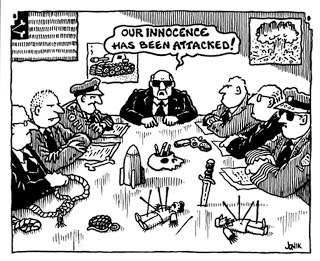 RT’s reporting on US issues was part of a “multifaceted Russian campaign” to undermine America, according to the outgoing Director of National Intelligence James Clapper.
“RT was very active in promoting a particular point of view, disparaging our system, our alleged hypocrisy about human rights, etc. Whatever crack, fissure they could find in our tapestry, they would exploit it,” Clapper told the Senate Armed Services Committee on Thursday, at a hearing about cybersecurity challenges.
In addition to hacking, Russia used fake news, social media and RT to influence the recent US elections, Clapper argued.
Though the US intelligence community has not been able to gauge the actual impact of any of these actions, “the totality of that effort, not only as DNI but as a citizen, I think is a grave concern,” he said.
Spy Chief Admits US Doesn’t Know How Wikileaks Got Hillary Emails
Higgins News Network | November 18, 2016
In resigning from the Obama administration Director of National Intelligence James Clapper admitted that US Intelligence Agencies do not know how or when Wikileaks received emails that embarrassed Hillary Clinton during her campaign.
One more lie has been exposed as Fake news involving a Hillary Clinton lie that was supposedly fact checked and then echoed throughout the corporate media echo chamber.
It’s part of a year long pattern of media lies which has resulted in corporate media news outlets losing nearly all of the public’s trust.
Just a few weeks ago, Hillary and the democrats were running around blaming everything on the Russians and in the Presidential Debate she lied to the public stating the WikiLeaks emails shouldn’t be trusted because they were hacked by Russia.
Doubling down on the that lie, she cited 17 US Intelligence agencies as the basis for her claim.
Well, there were only two and the first walked away from the claim not longer after the debate leaving the other 16, which is actually only one, headed by James Clapper, still validating the claim.
Clapper submitted his resignation today as the President-elect is set to take office in January and in doing so he made the stunning revelation that has been buried as a one-liner in media reports.
Via Washington Post (subscription required):
He said intelligence agencies don’t have good insight on when or how Wikileaks obtained the hacked emails.
Featured Video

Yemen joins the war – Red Sea could be blocked next – Saudi regime at risk
or go to
Aletho News Archives – Video-Images
From the Archives
A superpower and “the world’s sickest warrior state”
By Paul J. Balles | March 8, 2010
Living through five or six major wars has hardened me to what I thought were the extremes of inhuman cruelty and brutality.
Two things made those extremes almost bearable: the brutality always revealed – at least according to the media coverage – the viciousness of the enemy. It was therefore quite understandable when our “brave men and women” pulverized the enemy.
Films of Japanese torturing captive Americans somehow justified holding Japanese Americans in internment camps during World War II; and only a small percentage of Americans found the bombing of Hiroshima and Nagasaki unreasonably vengeful at best, at worst, depraved.
The media giants in America portrayed the North Koreans as barbaric beasts with their captives, quite unlike their southern counterpoints – our allies during the Korean War. No one ever felt the need to explain how the South Koreans were a civilized breed while the North Koreans were absolute savages, at least according to the official line.
In Vietnam, our warriors justifiably (or so the media made us believe) dropped napalm on the North Vietnamese who had the gall to hide in villages and tunnels to ravage our invaders. At least it was accepted practice until some rogue photojournalist filmed a young girl screaming down a Vietnamese road in flames. … continue
Blog Roll
 Aletho News
- Russian tanker approaches Cuba despite US oil blockade
- Marandi: Yemen joins the war – Red Sea could be blocked next – Saudi regime at risk
- Pro-Palestinian French member of European Parliament denied entry to Canada
- Pakistan to Host US-Iran Talks
- How Indonesia’s tilt toward the US left it stranded in the Strait of Hormuz
- US has no choice but to retreat from Iranian borders: Top commander
- Iran Retaliation Strikes Chemical Plant Near Dimona
- AWACS’ Destruction is a Major Loss for US Military – Ex-DoW Analyst
- Israel’s Iran Strategy Uses US Military & Gulf States as Its Pawns
- Iran: Trump wanted regime change, now just begging for Hormuz to open
- If Americans Knew
- Israeli police block Catholic cardinal from entering Church of the Holy Sepulchre on Palm Sunday
- Israel is assassinating journalists again, more than any other nation, anywhere, ever – Not a ceasefire Day 170
- Over 300 US service members wounded, majority have brain injuries – Not a ceasefire Day 169
- Researchers at Human Rights Watch Resign Over Blocked Report on Palestinian Refugee Return
- Jewish Groups Are Backing a War Americans Don’t Want
- Eric Fingerhut Thinks He’s the President of the Jews
- Top Jewish Philanthropists, Rabbis Urge Israeli President to Take Action Against ‘Jewish Extremists’
- Don’t Be Fooled. Zionist Leaders Have Always Wanted to Control Southern Lebanon
- Israel’s widespread use of torture is a core element of its genocide against the Palestinian people
- In Israel’s War on Iran, Many Middle East US Bases Rendered “All But Uninhabitable”
- No Tricks Zone
- German Science Blog Accuses PIK Climate Institute Of Hallucinating Climate Tipping Points
- Devastating Assessment Of Comirnaty Vaccine By Former Senior Pfizer Europe Toxicologist
- New Study: CO2 Is ‘Effectively Negligible’ As An Explanatory Climate Change Factor Since 2000
- Former Pfizer Toxicologist Dr. Helmut Sterz Tells Bundestag Hearing Pfizer Vaccine Should Have Never Been Approved
- Energy Expert: Germany’s Nuclear Phaseout Was A “500 Billion Euro Mistake”
- New Research: South Australia’s Mid-Holocene Sea Surface Temperatures Were 4°C Warmer Than Today
- Storing Green Energy To Last Germany 10 Days Would Require A 60-Million Tonne Battery
- New Studies: UK Sea Levels Were 4 Meters Higher Than Today During The Mid-Holocene
- Destructive Green New Deal: German Energy And Metal Group Warns Of Drastic Crisis
- New Study Documents A 20-Year Pause In Arctic Sea Ice Decline – Driven By Internal Variability
 Aletho News