Why Mattis’ exit is a defining moment in US foreign policy
By M. K. BHADRAKUMAR | NewsClick | December 24, 2018
Within the week, President Trump’s sudden announcement of “total” troop withdrawal from Syria has ripped apart the American political system and exposed its fault lines. Trump’s decision is intrinsically a sound one. He didn’t start the Syrian conflict and he has been on record repeatedly that the US had no business to intervene in it militarily. But his writ as president and commander-in-chief didn’t run large. Astoundingly enough, we know now that the Pentagon defied the president who is also the commander-in-chief.
We also know that Trump’s defence secretary James Mattis set the scale and scope of the US intervention in Syria. From what was meant to be a limited intervention, Mattis turned it into an open-ended military occupation of Syria. This was despite the fact that the US carries no UN mandate to send forces to Syria. The repeated protests by Damascus, including at the UN, were ignored.
Indeed, the military mission that was originally geared to fight the ISIS morphed into a geopolitical one to counter Iran (and Russia’s) presence in Syria. Above all, the US military virtually occupied one-third of Syrian territory and declared it an exclusive region that even Syrian government forces were barred from entering and imposed a “no-fly zone” there. All this constituted a gross violation of international law and UN Charter.
While resigning in protest, Mattis took care to turn it into a first-rate political scandal. This has put Trump’s back up. If Mattis was hoping to keep his job till end-February with an intention to continue to undermine the president’s foreign policies, an unforgiving Trump has other plans. Trump has announced the appointment of an acting defence secretary w.e.f. Jan 1, which defangs Mattis overnight. Trump thereby ensures that his decision on troop withdrawal in Syria will be implemented on the ground.
The really stunning part is that the bulk of America’s political class, think tanks and the media have rallied to support Mattis in an astounding display of defiance and spite toward their elected president. Suffice to say, there has been an insurrection against Trump’s foreign policy agenda and Mattis was a key figure in that enterprise. Quintessentially, the established American political system – what Trump calls the “Swamp” – refuses to make way for the elected president, his mandate from the people for his political platform notwithstanding. Isn’t it a sham that the US claims to have a government “of the people, by the people, for the people”?
Quite obviously, Syria is only the tip of the iceberg. Looking back, Mattis had a virtual free run through the past two-year period, to undermine Trump’s foreign policy agenda across the board. Mattis had the great advantage of serving at NATO Headquarters as Supreme Allied Commander Transformation. His president, on the other hand, was a novice in alliance politics. Mattis knew precisely how consensus opinion is forged in Brussels around decisions taken in Washington, how those decisions get formally adopted by alliance partners and how Washington’s projects invariably get implemented. Thus, Trump’s role got incrementally reduced to ranting and raving about the NATO budget. Trump talks no longer about NATO being “obsolete”.
Simply put, Mattis has brilliantly revived the NATO. He did this knowing fully well that a transatlantic alliance raring to go cannot do without an “enemy”. And Mattis also knew that that “enemy” has to be Russia. Thus, the reboot of NATO and the ratcheting up of tensions with Russia became mutually reinforcing endeavors. The result is plain to see: NATO has come closer to Russia’s borders than at anytime before and is creating threatening military infrastructure there. Moscow is in a quandary because it is well aware that the NATO project is a de facto Pentagon project and Trump himself probably had little to do with it.
Moscow keeps hoping that a Russian-American summit would help matters, but then, Trump’s plans for meeting with Vladimir Putin runs into strong headwinds whenever the idea surfaces. The “Russia collusion” inquiry keeps Trump off balance (although Robert Mueller has so far failed to produce a shred of evidence that Moscow promoted Trump’s candidacy in the 2016 election.) Put differently, for the “Swamp” the Robert Mueller inquiry becomes critically important precisely for the reason that Trump is prevented from making any concerted attempt to improve US-Russia relations.
Syria and Afghanistan are only illustrative examples of how the Pentagon has a corporate interest in fighting open-ended wars. In both cases, a military victory is no longer regarded as feasible, and it is the hidden geopolitical agenda that matters to the Pentagon. Equally, cascading tensions with Russia or the open-ended wars translate as bigger budgetary allocation for the Pentagon, which of course largely goes to fund the military-industrial complex. One can take a safe bet that it is a matter of time before Mattis himself gets re-employed in the corporate board of some big arms manufacturing enterprise. The passion with which he has been advocating Saudi Arabia’s cause in the downstream of the Jamal Khashoggi affair speaks volumes about the unholy nexus at work involving the sheikhs, the Pentagon and the arms vendors – and the US lawmakers.
This sort of nexus has spawned a powerful coalition of interest groups who are viscerally opposed to a “demilitarization” of the US foreign policies, which is at the core of Trump’s agenda. Their favorite candidate in the 2016 election was Hillary Clinton. Their focus today is on debilitating the Trump presidency in any whichever way they can and to work toward ensuring that Trump doesn’t win a second term.
In this holding operation, Mattis played a stellar role by systematically undermining the Trump agenda. Mattis is a skilled operator in the military bureaucracy and his departure leaves a void for the Swamp. But his exit is not going to be the end of the vicious struggle going on in American politics. The good part is that Trump seems to understand that it will be a downhill slope ahead of him unless he took a last-ditch stance and dug in now to assert his constitutional prerogative as the president to push his foreign policy agenda. The point is, that agenda also happens to be linked to Trump’s campaign platform for the 2020 election.
Mattis claims UN let US intervene in Syria, although it never did
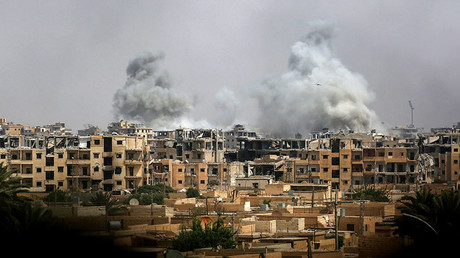
RT | November 14, 2017
US Defense Secretary James Mattis has recently claimed that Washington received a mandate to operate in Syria from no less than the UN itself. The problem is the UN never did any such thing as it does not even have any legal capacity to do so.
The UN cannot sanction a foreign invasion of Syria or any other country because it is absolutely impossible under international law, Russian Deputy Foreign Minister Gennady Gatilov said, commenting on the issue. “The UN cannot do such things,” he told the Russian media.
He went on to say that “Syria is a sovereign independent state,” adding that “only the Syrian government can invite armed forces of the third countries onto its territory” while “the UN has no such right,” as reported by Rossiyskaya Gazeta daily. The diplomat also said that “the fight against terrorism does not give any states or coalitions a free hand to establish their presence on Syrian territory.”
International law indeed envisages no way for the UN or any other international body to sanction an invasion of one state’s armed forces on the territory of another state. In fact, such actions are regarded as aggression under international law and are strictly prohibited.
UN General Assembly Resolution 3314 on the definition of aggression explicitly states that an “invasion or attack by the armed forces of a State of the territory of another State” as well as “any military occupation, however temporary” or “bombardment by the armed forces of a State against the territory of another State” is what particularly constitutes aggression.
However, all these facts did not prevent Mattis from claiming that it was the UN that sanctified the presence of the US troops on the Syrian territory without the consent of the Syrian government. “You know, the UN said that … basically we can go after ISIS. And we’re there to take them out,” the US defense secretary said, referring to the US actions in Syria as he answered a journalist’s question on Monday.
Apparently, he implied that a call by UN on the international community and the US in particular to take action was more than enough to justify the US military’s presence in Syria. Actually, the UN did issue such a call – in Resolution 2249 adopted by the Un Security Council in November 2015.
Resolution 2249 called on UN member states “that have the capacity to do so to take all necessary measures” and “to redouble and coordinate their efforts to prevent and suppress terrorist acts committed specifically by ISIL [Islamic State (IS, former ISIS/ISIL)]” as well as other terrorist groups.
However, it urged the states to do so “in compliance with international law” – something that the US officials often neglect when they assess the actions of the US military abroad.
The statements of the US defense secretary also provoked an angry reaction in Damascus. The Syrian government once again stated that the US troops are operating on Syrian territory without its consent and in violation of international law.
“The presence of the US forces or any foreign military presence in Syria without the consent of the Syrian government constitutes an act of aggression and an attack on the sovereignty of the Syrian Arab Republic as well as a gross violation of the Charter and principles of the United Nations,” Syria’s Foreign Ministry said, as cited by the SANA news agency.
It further said that the US presence “only leads to prolonging the crisis and further complicating it,” adding that the real goal of the US in Syria apparently lies in obstructing the peace process. The ministry then once again called for the immediate and unconditional withdrawal of US forces from Syrian territory.
The statements made by Mattis are “absolutely baseless” and “irresponsible,” Vyacheslav Matuzov, a political scientist and the head of the Russian-Arab Friendship and Business Cooperation Society, told RT, commenting on the issue. He went on to say that any foreign military presence on the territory of any state can be authorized solely by the legitimate government of that state.
“There is a clear position of the Syrian authorities, according to which the US troops are stationed on the Syrian territory illegally,” he said, adding that there can be “no argument” about the legal status of US forces in Syria.
US can’t take pressure anymore in Afghanistan
By M K Bhadrakumar | IndianPunchline | April 25, 2017
The seething US-Russia rivalry in Afghanistan took a sharp turn with the explosive threat held out by the visiting US Defence Secretary James Mattis in Kabul on Monday that Washington “will confront Russia” for violating international law by sending arms to the Taliban. Mattis said this while answering what appears to have been a planted question by a Washington Post correspondent who asked him about Russian weapons “showing up in Taliban hands in Helmand, Kandahar and Urozgan” (provinces bordering Pakistan.)
General John Nicholson, US commander in Afghanistan, who stood beside Mattis refused to refute the reports on Russian weapons but couldn’t provide details, either. He merely noted, “we continue to get reports of this assistance.” However, Mattis went ahead nonetheless to threaten Moscow:
- Russians seem to be choosing to be strategic competitors in a number of areas. The level of granularity and the level of success they’re achieving — I think the jury is out on that… I would say that we will engage with Russia diplomatically. We’ll do so where we can. But we’re going to have to confront Russia where what they’re doing is contrary to international law or denying the sovereignty of other countries. For example, any weapons being funneled here from a foreign country would be — would be a violation of international law, unless they’re coming through the government of Afghanistan for the — for the Afghan forces. And so that would have to be dealt with as a violation of international law.
This is a dramatic escalation in rhetoric. What accounts for it? Indeed, I can visualize a backdrop with three likely vectors. (After all, Mattis is reputed to be a “thinking general” himself.) First, of course, the immediate context of his visit was the devastating Taliban attack on the Afghan army corps headquarters in Mazar-i-Sharif in which 200 soldiers were killed, leading to the exit of the Afghan defence minister and army chief.
Although there was no American casualty as such, it was a big blow to the Pentagon generals, who constantly claim to be doing a masterly job in the “capacity-building” of Afghan armed forces. Simply put, Mattis and Nicholson probably tried to change the narrative.
Indeed, it wouldn’t have been far from Mattis’ mind that Russian weapons are reportedly “showing up” in Taliban’s hands in Helmand when a deployment of Marines from Camp Lejeune, North Carolina, to that province “quietly” got under way last week, which is the first such deployment of Marines since 2014 when President Barack Obama announced the termination of the US’ combat mission in Afghanistan. The last thing Trump would want is body bags arriving from Helmand (which borders Pakistan’s Baluchistan.)
Second, Russia’s regional initiative to kickstart a political process in Afghanistan must be driving the Americans crazy.
The Pentagon has reason to worry that continued US occupation (military bases in Afghanistan) may become untenable if the political process made headway and a regional consensus favoring intra-Afghan reconciliation sought the restoration of Afghanistan’s sovereignty. (By the way, Taliban representatives based in Qatar travelled to China recently.)
Washington’s biggest worry would be that the Afghan opinion itself may come to view the Moscow-led regional initiative as the best (and only) available platform today to somehow bring the senseless bloody war to an end.
Third, if Matti’s idiom toward Russia has become distinctly hostile, it is also reflective of the deepening US frustration that Moscow is challenging its geo-strategies across the board – over Iran, North Korea, Ukraine, Turkey, Syria and so on. The chessboard is increasingly posing a “check-and-checkmate” scenario for the US, which in turn exposes the limits to America’s global hegemony.
Specifically, Mattis might have hit out in the wake of reports that Moscow has drawn up plans to deploy Special Forces to the key battle zones in Syria to vanquish the extremist groups (which enjoy US-Israeli backing). Mattis’ allegation of Russia violating “international law” in Afghanistan becomes curious because that is precisely what Moscow accuses the US of doing in Syria.
Interestingly, there are also a few sub-plots to Mattis’s press conference in Kabul: A) He was evasive about President Donald Trump deploying “thousands more” troops in Afghanistan, which was what Pentagon had recommended. Mattis said blithely, “our review in Washington is a dialogue with Secretary [of State Rex] Tillerson and the president and his staff in the White House. And I’d say that we’re under no illusions about the challenges associated with this mission.”
B) Mattis parried a direct question as to the US’ war objective in Afghanistan. C) He touched on reconciliation with Taliban – “If the Taliban wished to join the political process…, they need only to renounce violence and reject terrorism. It’s a pretty low standard to join the… political process.”
Significantly, Mattis made his visit to Kabul within a week of the fact-finding mission by NSA Lt. Gen. HR McMaster who reports directly to Trump. The transcript of Mattis’ press conference is here.
White House claims on Syria chemical attack ‘obviously false’ – MIT professor
RT | April 12, 2017
A professor who challenged the 2013 claims of a chemical attack in Syria is now questioning the Trump administration’s narrative blaming the Assad government for the April 4 attack in the Idlib province town of Khan Shaykhun.
On Tuesday, the White House released a declassified intelligence brief accusing Syrian President Bashar Assad of ordering and organizing the attack, in which Syrian planes allegedly dropped chemical ordnance on civilians in the rebel-held town.
The report “contains absolutely no evidence that this attack was the result of a munition being dropped from an aircraft,” wrote Massachusetts Institute of Technology (MIT) Professor Theodore Postol, who reviewed it and put together a 14-page assessment, which he provided to RT on Wednesday.
“I believe it can be shown, without doubt, that the document does not provide any evidence whatsoever that the US government has concrete knowledge that the government of Syria was the source of the chemical attack in Khan Shaykhun,” wrote Postol.
A chemical attack with a nerve agent did occur, he said, but the available evidence does not support the US government’s conclusions.
“I have only had a few hours to quickly review the alleged White House intelligence report. But a quick perusal shows without a lot of analysis that this report cannot be correct,” Postol wrote.
It is “very clear who planned this attack, who authorized this attack and who conducted this attack itself,” Defense Secretary James Mattis told reporters at the Pentagon on Tuesday.
Earlier in the day, White House spokesman Sean Spicer also said that doubting the evidence would be “doubting the entire international reporting crew documenting this.”
The report offered by the White House, however, cited “a wide body of open-source material” and “social media accounts” from the rebel-held area, including footage provided by the White Helmets rescue group documented to have ties with jihadist rebels, Western and Gulf Arab governments.
Postol was not convinced by such evidence.
“Any competent analyst would have had questions about whether the debris in the crater was staged or real,” he wrote. “No competent analyst would miss the fact that the alleged sarin canister was forcefully crushed from above, rather than exploded by a munition within it.”
Instead, “the most plausible conclusion is that the sarin was dispensed by an improvised dispersal device made from a 122mm section of rocket tube filled with sarin and capped on both sides.”
“We again have a situation where the White House has issued an obviously false, misleading and amateurish intelligence report,” he concluded, recalling the 2013 situation when the Obama administration claimed Assad had used chemical weapons against the rebels in Ghouta, near Damascus.
“What the country is now being told by the White House cannot be true,” Postol wrote, “and the fact that this information has been provided in this format raises the most serious questions about the handling of our national security.”
Featured Video
Dr. Tony Martin – The Jewish Role in the African Slave Trade
or go to
Aletho News Archives – Video-Images
In Memoriam
James Petras, In Memoriam
 02.13.2026
Professor James Petras, 89, world-renowned sociologist, public intellectual, and scholar of Latin American politics and global economics, died peacefully on January 17, 2026, in Seattle, WA, surrounded by family.
A prolific scholar and activist, he devoted his life to challenging power, imperialism, and inequality. … continue
Blog Roll
 Aletho News
- Israel ready to strike Iran-backed armed groups – media
- Behind US war drums against Iran: No goals, no plan, no off-ramp
- With Ukraine blamed for cutting oil flows to Hungary, Croatia also refuses to transfer Russian oil in violation of EU law
- Friedrich Merz’s Push to End Online Anonymity Has a Troubling Subtext
- Macron: French citizens fighting for Israel cannot be labeled ‘genociders’
- US eyes Gaza security force drawn from armed gangs
- The Only Motive Behind The ‘Imminent’ U.S. War With Iran Is The Zionist Lobby
- Trump eyes 350-acre US military base housing 5,000 troops in Gaza
- Israel Pushing US Toward a Big and Damaging War With Iran – Ex-Pentagon Analyst
- Meet The Liberal Zionist And Ukraine War Supporter Advising AOC On Foreign Policy
- If Americans Knew
- The Israeli Government Installed and Maintained Security System at Epstein Apartment
- Tucker Carlson interrogated in Israel, has passport seized after interviewing US ambassador
- 6,000 Amputees in Gaza Face Impossible Recovery amid Israeli War Ultimatum
- The Lancet: Gaza death toll far higher than reported – Not a ceasefire Day 132
- Compliant aid: Who are the Israel-approved NGOs scaling up in Gaza?
- Why won’t Trump’s “Board of Peace” bring peace? – Not a ceasefire Day 131
- Help end the injustice against Shadi
- Israel’s Favorite American President
- Israel’s “Yellow Line” Is a Death Trap for Palestinians. We Drove Into It.
- Why Israel’s expanding occupation in Syria presents a critical legal test
- No Tricks Zone
- Coal Power Back In Trend As Globe Tries To Keep Pace With Growing Demand For Power
- New Study: A 4°C Warmer Beaufort Sea Had ‘No Sea Ice’ 11,700 – 8200 Years Ago
- Unfudging The Data: Dutch Meteorological Institute Reinstates Early 20th Centruy Heat Waves It Had Erased Earlier
- German Gas Crisis…Chancellor Merz Allegedly Bans Gas Debate Ahead of Elections!
- Pollen Reconstructions Show The Last Glacial’s Warming Events Were Global, 10x Greater Than Modern
- Germany’s Natural Gas Storage Level Dwindles To Just 28%… Increasingly Critical
- New Study Rebuts The Assumption That Anthropogenic CO2 Molecules Have ‘Special’ Properties
- Climate Scientist Who Predicted End Of “Heavy Frost And Snow” Now Refuses Media Inquiries
- Polar Bear Numbers Rising And Health Improving In Areas With The Most Rapid Sea Ice Decline
- One Reason Only For Germany’s Heating Gas Crisis: Its Hardcore-Dumbass Energy Policy
 Aletho News