Okinawa’s Governor Promises ‘Fierce Opposition’ to Plan for New US Missile Bases
Sputnik – 10.06.2020
A US plan to build new missile sites on the Japanese island of Okinawa has encountered stiff resistance by locals, including the governor, who was elected on a position of getting US forces out of the prefecture.
‘Absolutely Unacceptable’
In the event of a war with China, land-based missiles placed on Okinawa would provide a major leverage point for US forces. However, with the island already a major target due to several large US military installations, Okinawans are fed up with the idea of bringing in even more targets for China’s People’s Liberation Army (PLA).
“I firmly oppose the idea,” Okinawa Governor Denny Tamaki told the Los Angeles Times for a Wednesday story. “If there is such a plan, I can easily imagine fierce opposition from Okinawa residents.”
“Intermediate-range ballistic missiles can be used to attack other countries, so deploying them would conflict with the Constitution and lead to a further build-up of the US bases,” Tamaki told Bloomberg News last November. “To have new military facilities would be absolutely unacceptable.”
The Straits-Times noted last November that similar opposition is just as likely from other US allies, such as Australia and South Korea, which would then become targets in the event of a shooting war between Washington and Beijing. Similar fears quelled early Cold War enthusiasm in Canberra for a nuclear weapons program, too.
Last October, the Okinawan daily Ryukyu Shimpo reportedly uncovered evidence the US government had informed the Russian government in August 2019 of its intent to base missiles violating the shredded Intermediate-Range Nuclear Forces (INF) Treaty in Okinawa within two years. The US formally withdrew from the treaty, which governed the ranges of land-based missiles used by Russia and the US, just days earlier.
Battle Plans Hinge on Okinawa
Never having been bound by the INF Treaty, the PLA has spent decades building up its Rocket Force into a formidably armed corps, wielding a variety of long-range cruise missiles and ballistic missiles and even hypersonic weapons, which the US has yet to field.
Sitting just 500 miles from Shanghai and 400 miles from the Zhejiang coast, Okinawa-based missiles would find much of mainland China within striking distance. However, the Ryukyu Islands would almost certainly fall under heavy attack by the PLA during a prospective war with US allies, as the archipelago falls within the “First Island Chain,” or the first string of islands sitting just off the east Asian coast. Beijing’s long-term strategic plans call for forcing its adversaries increasingly away from the Asian mainland, beginning with the First Island Chain, which stretches from Russia’s Kamchatka Peninsula south to Borneo, in Indonesia.
Likewise, the US Marine Corps is busy reenvisioning the way it wages war, including a pivot from the heavy land-based forces of the last several decades toward a more maritime role.
Commandant of the US Marine Corps Gen. David Berger told Congressional lawmakers in March that the Corps would be expanding its missile capabilities twentyfold in the next five years, as well as introducing the Navy Marine Expeditionary Ship Interdiction System (NMESIS), which is based on the High Mobility Artillery Rocket System (HIMARS) but mounted atop a Joint Light Tactical Vehicle chassis. The weapons system will be able to fire a variety of anti-air and anti-ship missiles.
The purpose of these weapons can be found in Expeditionary Advance Base Ops (EABO), in which Marines will rush forward to set up small outposts on scattered islands that would house batteries of long-range anti-ship and anti-air missiles, creating a “no-go zone” for Chinese air and sea forces. A graphic illustrating the concept by the Center for Strategic and Budgetary Assessments think tank happens to show EABOs deployed across the Ryukyuan chain.

Center for Strategic and Budgetary Assessments
Land-based missiles deployed at “Expeditionary Advance Bases” could form a virtual wall against Chinese aggression
Widespread Japanese Opposition to US Missiles
US plans for deploying weapons previously banned by the INF Treaty elsewhere in Japan have met strong resistance as well. An Aegis Ashore system that was to have been built in the western city of Akita was canceled last month amid heavy opposition from locals. Another site, on the western coast of Yamaguchi Prefecture, also met opposition, but so far plans for its construction remain unchanged.
Tokyo approved their construction to provide anti-missile defense against potential attack from the Democratic People’s Republic of Korea (DPRK), but with the US out of the INF Treaty, the Aegis Ashore systems can easily be converted to fire offensive weapons, as the site in Deveselu, Romania, has already demonstrated.

Sonata
Marine Corps Station Futenma, in Ginowan, Okinawa
Okinawans have also fought the continued presence of several US military bases on the island, which was stormed by US forces in the closing months of World War II in a furious battle that killed nearly half the island’s population of 300,000 at the time. US Marine Corps Air Station Futenma sits in the middle of Ginowan City, and Tamaki was elected to the governorship on a campaign to get the base removed from the prefecture. Just four miles north of Futenma is another air base, the US Air Force’s colossal Kadena Air Force Base; between the two installations are half of the 50,000 US service members deployed in all of Japan.
In a February 2019 referendum, 70% of Okinawans voted against a US-Japanese plan to relocate Futenma on the island, but Japanese Prime Minister Shinzo Abe insisted Tokyo “cannot avoid the necessity of moving Futenma,” and land reclamation for the new site, on the coast of rural Henoko to the north, has continued.
It is Time for Japan to Become a Truly Independent State
By Valery Kulikov – New Eastern Outlook – 03.05.2020
As the entire world suffers the tragic consequences of the coronavirus pandemic, the latest anti-American scandals are gaining momentum in Japan.
The Kyodo News agency was the first to report the announcement made by Japanese Defense Minister Taro Kono on April 17 that a joint investigation would be conducted by the Japanese and United States military into a leakage of carcinogenic organic substances (firefighting foam) at the US Marine Corps Air Station Futenma on the southern island of Okinawa. However, the Japanese Minister did not provide any details on the nature of this investigation. The article briefly mentions that before this announcement, the Vice Governor of Okinawa Prefecture Kiichiro Jahana had met with the Marine General in charge of the American air base to voice his protest over this spill.
The incident took place on April 10, when about 143 thousand liters of firefighting foam leaked out at the US Marine Corps Air Station Futenma, which contains PFOS, suspected to be carcinogenic to humans. In terms of area, 70% of all American military facilities in Japan are located on this island. All kinds of accidents have been a regular occurrence at the Futenma military base. Okinawa authorities have long been calling for the Futenma air base to be closed, which is located in the densely populated urban area of Ginowan City.
The incident that took place on April 10 has heightened the demands being made by Okinawa Island’s residents and the Okinawa Prefectural Assembly to have operations at the US Futenma air base shut down, but the US have not taken any action in response to these demands, nor have they done anything to prevent these undesirable accidents from taking place.
Another scandal that is gaining momentum also has to do with the military and political alliance between the United States and Japan. As noted in the Japanese Shūkan Gendai magazine, Japan has fallen into America’s trap, and is now effectively their loyal little “vassal state”, which is the cause of the new misfortunes than have befallen Japan. The publication emphasizes that America is to blame for the chaos that the Middle East has long been mired in, and now it seems that Japan will have to answer for all of America’s actions. However, is an alliance with America worth all of this? That is the question posed in the Shūkan Gendai, which has published information about the plight that the Japan Self-Defense Forces stationed in the Middle East have been suffering, who have practically been immured in their ships, as they come face-to-face with the coronavirus pandemic.
In order to get to the bottom of the problems Japan is currently experiencing, the Shūkan Gendai reminds readers of a special plan adopted by Abe’s Cabinet in December 2019 without having received prior approval from the Diet. Under the pretext of the worsening political and military situation “amid rising tensions between the United States and Iran”, two P-3C anti-submarine patrol airplanes with more than 100 flight and technical personnel were deployed to the region for “intelligence-gathering” purposes at the beginning of 2020, as well as a Takanami guided-missile destroyer, which began operating in the Gulf of Oman, where no coalition forces are providing Japan with any serious back up. The Japan Self-Defense Force Base is in Djibouti. It is worth noting that even though the United States invited more than 60 countries to participate in an anti-Iranian coalition (formally created by Washington in November 2019), only 6 countries have joined the US-led Persian Gulf naval coalition. Apart from America, they are the United Kingdom, Australia, Bahrain, Saudi Arabia, the United Arab Emirates and Albania. The coalition was joined by Lithuania at a later stage. Japan is not officially a member of the coalition, but the Japanese military says that if the Japanese troops were to pull out of the region, a gap would be created, leaving the coalition vulnerable.
Since March, the likelihood of the Japanese Self-Defense Forces remaining there has been seriously jeopardized due to the outbreak of the worldwide coronavirus pandemic. This is mainly due to restrictions on the 200 crew members on the Takanami destroyer, who are refraining from leaving the ship to avoid becoming infected with Covid-19, and also due to the closure of Djibouti’s borders, which is not allowing the crews and maintenance personnel for the two P-3C anti-submarine patrol airplanes to be rotated. As the sailors cannot leave the ship, they are living in cramped and crowded conditions, and the Japan Self-Defense Forces were deployed to the Middle East without the necessary medical test kits, have not had enough rest, and are suffering severe stress. Given this situation, the Shūkan Gendai questions whether it is worth risking the lives of these crew members in order to clean up the mess made by the US, whose actions have unleashed chaos in this region.
At the same time, the Japanese press recall a statement made by Defense Minister Taro Kono back in January after holding talks with Pentagon chief Mark Esper, who said that Japan would not be participating in US operations to protect the Persian Gulf from possible attacks from Iran. Even the largely conservative Mainichi Shimbun newspaper has stressed that Japan’s complete dependence on the United States has led to Japan “blindly” following American foreign policy, and the decision taken by Abe’s Cabinet to deploy a limited Japan Self-Defense Forces unit to the Middle East is a clear proof of this. The controversial plan to build a new American military base at Henoko is further proof of this. The newspaper emphasizes that the Japanese government is wrong to be cracking down on the protests held by local residents against this new base being constructed. The government also needs to take urgent action to address the numerous civil rights and security violations that citizens living on Okinawa Island have suffered at the hands of the US military. This erodes mutual trust between the parties to the Treaty of Mutual Cooperation and Security between the United States and Japan and weakens it.
A common theme runs through an article published in the liberal Asahi Shimbun newspaper, which is the belief that since President Trump was elected with slogan “America first!”, America’s own short-sighted military and political decisions have exposed the Treaty of Mutual Cooperation and Security Between the United States and Japan to risks. The question of how Japan should cooperate with America is currently a real headache, as the United States has gone from being the “guardian” of the current world order to the instigator of disorder and chaos.
The Hokkaido Shimbun daily recalls the mass protests that broke out in Japan when the Treaty of Mutual Cooperation and Security Between the United States and Japan was signed in 1960, as well as the fact that its approval by the Diet was practically forced through.
The Akahata newspaper draws particular attention to the fact that a number of secret annexes were included when the Treaty of Mutual Cooperation and Security Between the United States and Japan was signed, according to which the American army can deploy nuclear weapons on Japanese islands and carry out military operations from them without notifying Japan, and this is not limited to operations in the Far East, they can be anywhere in the world. The US has already used Japanese territory to launch attacks on Vietnam, Afghanistan and Iraq.
To this day, Japan remains one of America’s closest partners in East Asia. This situation is certainly a paradox, given how many times the actions taken by the US have been unfriendly towards Japan and Japanese citizens. One example which stands out was the internment of Japanese Americans from March 17, 1942, when 120 thousand US residents who were ethnic Japanese or of Japanese descent were forcefully relocated and incarceration in concentration camps, even if these were American citizens who only had one Japanese ancestor, a great-grandmother or great-grandfather who was a Japanese national. What was happening to the Japanese on the territory of the United States at that time was purely fueled by racism, and there was no military justification for it. Then, on the night of March 9-10, 1945, the Bombing of Tokyo took place, which is regarded as the single most destructive bombing raid in human history, even more so than the atomic bombings of Hiroshima and Nagasaki. Time and time again over the 60 years that have passed since the Treaty of Mutual Cooperation and Security Between the United States was signed, Japan has had to endure lawless acts committed by American occupying forces in their country.
It is therefore no wonder that although there is a desire among today’s Japanese government circles to demonstrate a practically servile willingness to follow in Washington’s footsteps, the Japanese public are taking to the streets in rather frequent demonstrations, and are clearly trying to voice their rejection of US policies and America’s actions, both in Japan and in other parts of the world.
‘Imminent’ 9.0 Earthquake, 30M Tsunami Could Wreck Fukushima, Government Panel Says
Sputnik – 23.04.2020
A specially set up working group has been projecting the possible repercussions of new probable natural disasters off Japan’s coastline and drawing up measures to prevent them.
A Japanese government panel has warned that a tsunami as high as 30 metres could land on Hokkaido if a 9.0-magnitude earthquake occurs, the Japanese newspaper Mainichi Shimbun reported.
The panel, set up by the Cabinet Office, said it is the “worst-case scenario”, admitting that it is difficult to calculate the probability of such a quake. The panel pointed out that such disasters occur every 300-400 years, with the latest one dating back to the 17th century.
An earthquake is portrayed as imminent in the area around the Japan Trench and the Kuril Trench, following a panel studying simulations of tsunamis that occurred over the past 6,000 years and covered seven prefectures including Hokkaido, Iwate, Miyagi, Fukushima, Ibarak, Aomori, and Chiba.
The working group concluded that Iwate might have to bear the brunt of a tsunami of around 29.7 metres, followed by Hokkaido which will potentially be hit by 27.9-metre waves.
The worrisome predictions and media reports have meanwhile stoked concerns that a massive tsunami may wreck the Fukushima nuclear station, which its operator TEPCO has been cleaning up from toxic waste ever since the 2011 tsunami.
For instance, according to the Japanese broadcaster NHK, a Japanese government study projected that a tsunami with waves as high as 13.7 metres could sweep away the 11-metre high seawall built by TEPCO on the ocean side of the compound of the Fukushima Daichi plant. The out-of-service plant reportedly stores around 1,000 tanks of wastewater in one of its compounds.
In response, TEPCO announced, as cited by Reuters, that the company is set to dig into the latest prognosis and “analyse the impact on the ongoing preventive measures” against natural disasters.
Back to Fukushima. Former residents weigh up returning to nuclear ghost town of Okuma
RT Documentary • December 12, 2019
In March 2011, an earthquake hit Japan, setting off a tsunami that caused an accident at the Daiichi nuclear power station in Fukushima prefecture. Radioactive contamination settled on the surrounding area, and the authorities decided to evacuate the population living within a 20km radius around the power station.
Watch full video here: https://rtd.rt.com/023wp
Eight years later, inhabitants of the town closest to the nuclear disaster, Okuma, were allowed to move back to some of its territory. RTD takes a bittersweet tour of the nuclear ghost town with former residents considering whether to return to their hometown, and meets those who have already moved into new homes built in a less-contaminated part of town. Torn between loyalty to their roots and the desire to build a future for themselves, the people of Fukushima now have an agonising choice to make.
US interventionist presence in region has to end as soon as possible: Iran defense chief
Press TV – January 10, 2020
Iranian Defense Minister Brigadier General Amir Hatami says Washington’s “interventionist presence” in the region has to end as soon as possible for a de-escalation to take place after recent US provocations.
“Achieving de-escalation, stabilization and security in the region requires the immediate end of Washington’s occupation and interventionist presence,” Hatami said in a phone call with his Japanese counterpart Taro Kono on Thursday.
The talks between the two defense chiefs came after Tokyo announced last month that it has sought to send a warship and a number of patrol aircraft to the Middle East region in order to ensure security amid heightening tensions.
Tokyo receives nearly 90 percent of its oil imports from the Middle East.
Speaking on Thursday, Hatami said “those who seek to assist in de-escalation and achieving regional stability have to remind the Americans, which are a source of regional insecurity, to leave the region.”
The Iranian defense chief added that Iran, being the largest country with an access to the Persian Gulf and the Gulf of Oman, has always fulfilled its role in ensuring security in regional waterways.
Hatami’s call for the expulsion of US forces comes a week after Washington assassinated the Middle East’s most prominent anti-terror commander Lieutenant General Qassem Soleimani in Iraq.
Speaking to his Japanese counterpart, Hatami called on independent countries to condemn Washington’s “state terrorism”.
He described Soleimani’s assassination as an unprecedented and major crime where a foreign government has acted to kill a senior Iranian military officer in another country.
Speaking on his part, Kono stressed that Japan’s military deployment in the region seeks to ensure regional peace and that it does not intend to take part in a so-called US-led Persian Gulf coalition, which commenced its operations last November.
According to Japan’s public broadcaster NHK, Kono also gave out orders for the Japanese military deployments to begin on Friday.
Earlier last year, Washington called for the formation of the maritime coalition in response to a series of mysterious explosions targeting vessels in the Persian Gulf and the Sea of Oman.
US officials were quick to blame Iran for the incidents without providing conclusive evidence.
Iran has roundly rejected the accusations, describing the attacks as being part of “false flag operations” seeking to pressure Iran.
Following the tensions, Japan, which has sought to maintain positive ties with both Tehran and Washington, has stressed that it has opted to form its own maritime operation rather than join the US-led mission.
According to The Japan Times, the Japanese operation will operate in the Red Sea and the Gulf of Aden east of Saudi Arabia and will exclude the Strait of Hormuz and the Persian Gulf due to Iran’s concerns regarding the presence of the US-led initiative.
Japan’s Nuclear Watchdog Approves Decommissioning 2 Reactors at Oi Plant – Reports
Sputnik – 11.12.2019
TOKYO – Japan’s Nuclear Regulation Authority on Wednesday approved plans to decommission two reactors at the Oi nuclear power plant in Fukui Prefecture, the Kyodo news agency reported.
According to the Japanese news agency, Kansai Electric Power, which operates the Oi plant, decided to spend about $1.1 billion to dismantle the two most powerful reactors — namely No. 1 and No. 2 — by 2049 rather than shoulder the high cost of implementing additional safety measures.
Given that the reactors were commissioned in 1979, their lifespan is set to expire soon. In anticipation of this, Kansai submitted a decommissioning plan to the authorities in November 2018. In particular, the company said that in order to shut down the reactors it needed to utilize over 20,000 tonnes of low-level radioactive waste with over 10,000 tonnes of non-radioactive waste.
The plant’s two other reactors were commissioned much later — in 1991 and 1993 — so they will remain active.
After the 2011 Fukushima Daiichi disaster, Japan’s nuclear watchdog introduced a 40-year limit on the lifespan of nuclear reactors in the country, but added the possibility of a 20-year extension if the stringent safety measures were met.
All of Japan’s 54 operating nuclear reactors were shut down in March 2011 after a 9.0 magnitude earthquake and subsequent tsunami led to a leakage of radioactive material from the Fukushima Daiichi plant. Before the disaster, 30 percent of Japan’s electricity came from nuclear power.
Russia dials back peace talks with Japan
By M. K. BHADRAKUMAR | Indian Punchline | November 23, 2019
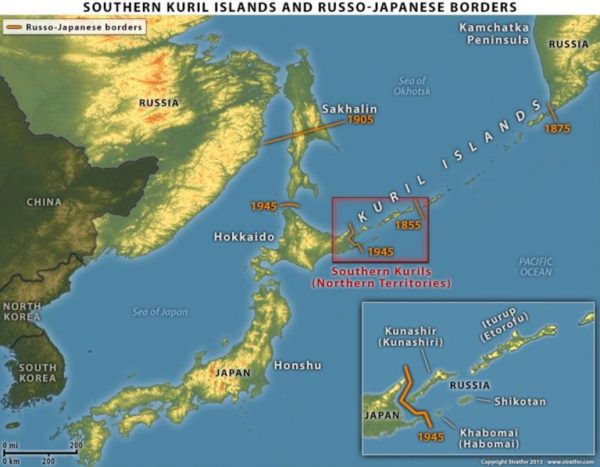
Russia-Japan territorial disputes surged at a meeting of foreign ministers of the two countries, Toshimitsu Motegi and Sergey Lavrov, at Nagoya, Japan, on November 22 on the sidelines of a G20 foreign ministers’ gathering.
Lavrov publicly threw cold water on the Japanese spin that Tokyo is engaged in “persistent talks” with Russia on a peace treaty bringing the two countries’ World War 2 hostility to a formal ending.
Lavrov emphatically stated that any forward movement on a peace treaty will have to be within the ambit of the Russia-Japan 1956 joint declaration, which, as he put it, “clearly states that first Russia’s territorial integrity and sovereignty over all our lands, including those territories, are recognised, thus recognising the results of World War II, and then everything else will possibly be discussed.”
In plain terms, according to Lavrov, Moscow may consider discussing a peace treaty only after Tokyo unequivocally recognises Russian sovereignty over Kuril islands and territories that came under Russian control in the Far East during World War 2.
Japan’s stance, on the contrary, can never converge on that point. Wouldn’t Moscow have known it already? Of course, Lavrov has only reiterated a consistent Russian stance.
Tokyo has been baiting Moscow with the proposition that a peace treaty will open the door to large-scale investments by Japanese companies for the development of the Russian Far East (which is a national priority for the Kremlin.)
Tokyo has also been smart, projecting Russian President Vladimir Putin as a strong but pragmatic statesman who is willing to make territorial concessions to attract Japanese investments.
But it takes two to tango and up to a point Moscow acquiesced with the Japanese enthusiasm that the two countries could be settling the Kuril issue — although making territorial concessions will be a highly emotive issue for the Russian public opinion.
Moscow probably pinned hopes that a relaxed climate of relations might wean Tokyo away from the US strategic orbit — although the likelihood of Japan shaking off the US security umbrella will remain zero for the conceivable future.
At any rate, that tango has ended and realism prevails, with the regional security climate in the Far East visibly darkening with the recent US cruise missile tests and the Pentagon’s plan to deploy new missiles in Japan following its exit from the INF Treaty (which had banned the intermediate-range missiles previously.)
Moscow is alert to the emergent threats to its strategic assets in the Russian Far East due to the US deployment. Importantly, Tokyo appears to be open to the proposed US missile deployments, which would further cement the US-Japan military alliance.
Unsurprisingly, Moscow has linked the regional security scenario to its territorial disputes with Japan. To quote Lavrov, “The military alliance with the US, of course, represents a problem when it comes to taking Russian-Japanese relations to another level. I will remind you that when the 1956 declaration was being coordinated, the USSR said back then that everything may be implemented, and this declaration may be fully implemented only in the context of discontinued US military presence on Japan’s territory.”
Lavrov added, “Japanese colleagues have received a list of Russia’s specific security concerns which emerge because of the increasing and strengthening Japanese-US military-political alliance. So our Japanese colleagues promised to react to those concerns. We will wait for their response and continue discussions.”
Lavrov also chose the G20 FMs’ forum at Nagoya to present Russian concerns over the security climate in the Far East. He said, “As for the US behaviour in the world, including in the Asia-Pacific region, in its relations with Japan, the United States does not hesitate to publicly acknowledge that Russia and China are the main threat to it and that all its military alliances with Japan, Australia and the Republic of Korea will be built proceeding from these threats and challenges.
“But, of course, we pointed out at a meeting with the Japanese foreign minister that this ran counter to the assurances, which Japan gives us that the Japanese-US military and political alliance is not aimed against the Russian Federation.” (TASS )
Meanwhile, Russia is speeding up the construction of military dormitories on the Southern Kuril Islands. A spokesman for Russia’s Eastern Military District said this week that military personnel would settle into the dormitories on Iturup and Kunashir by the end of 2018 and that more dormitories would be built and commissioned in 2019.
The Eastern Military District, which was formed in 2010 under a presidential decree, is headquartered at Khabarovsk in Siberia near the Chinese border and is one of the four operational strategic commands of the Russian Armed Forces.
The new US missile deployments in the Far East are of common concern to Russia and China. In August, Russia and China sought a meeting of the UN Security Council over “statements by US officials on their plans to develop and deploy medium-range missiles”.
Last month, Putin disclosed that Moscow is helping China build a system to warn of ballistic missile launches. Putin said “this is a very serious thing that will radically enhance China’s defence capability”. Since the cold war, only the US and Russia have had such systems, which involve an array of ground-based radars and space satellites. The systems allow for early spotting of intercontinental ballistic missiles.
China will find Lavrov’s remarks at Nogaya to be very reassuring. It is a safe bet that the Russia-Japan normalisation will be an excruciatingly slow process, which in turn works fine for China in geopolitical terms. Lavrov also had a meeting with Wang Yi, Chinese Councilor and Foreign Minister, at Nogaya.
Fukushima Disaster Puts Japan in ‘Nuclear Limbo’ Ahead of 2020 Tokyo Olympics – Pundit
Sputnik – September 14, 2019
On 10 September, Japanese authorities announced that Tokyo Electric Power (TEPCO), the operator of the Fukushima Daiichi power plant which in 2011 experienced the worst nuclear disaster since Chernobyl, currently has no technology to clear its wastewater from radioactive waste, and is instead discharging it into the sea.
More than a million tonnes of wastewater is reportedly stored in tanks at the Fukushima NPP (nuclear power plant). The facility is reportedly running out of available space and expects to exhaust its capacity by summer 2022. Japanese Environment Minister Yoshiaki Harada admitted earlier that “we have no way but to release it [into the sea] and dilute it”.
Local residents reportedly have deep concerns about the potential damage this move can inflict, especially to the fishing industry, which is essential for Japan.
Christina Consolo, a nuclear expert, has shared her view on the issue.
Sputnik: It’s been reported that there’s enough room to keep the liquid (1 million tons of contaminated water) through summer 2022, but after that, there will be no space left?
Christina Consolo: It was somewhat surprising at how quickly the Environmental Ministry in Japan made a decision to release the contaminated water once their official meeting convened. I am not surprised at all however by their decision.
The situation is very serious. There is no other option then to release the contaminated water, but under the control of TEPCO’s time and choosing, or it may be released for them. An earthquake could release it, a tsunami could release it, a typhoon could release it.
But releasing the water goes far beyond just a ‘storage issue’ alone; the tanks are also under duress for a number of reasons. If you recall, at the beginning of the original water storage, the tanks were not assembled properly. Concrete slabs were hastily poured without rebar reinforcement.
TEPCO workers had to drill holes in the tops of them to release hydrogen build-up, or risk explosion and collapse of the tanks themselves.
There have also been a series of leaks, due to miles of pipes and flushing radioactive water great distances through sometimes ducted-taped hoses, with at least one reaching the official scale of a Level 3 Nuclear Accident in and of itself, in July of 2015.
And the longer this radioactive water sits in these giant metal tanks, the matrix of the metal itself at the atomic level is undergoing acceleration of entropy, known as “The Wigner Effect” – named after Professor Eugene Wigner, who discovered it at the Oak Ridge Laboratory while doing research for the US Government during World War II.
Metal exposed to radiation creates embrittlement issues and acceleration of corrosion, the same problem that caused 16,000 cracks in the nuclear reactors in Belgium.
This is problematic for the biggest reason of them all: if any of these tanks leak or break open outside of the control of TEPCO and prevents workers from being able to continue the myriad of daily maintenance involved due to spillage of radioactive water, creating no-go zones within the site itself, then TEPCO can have yet another very serious situation on their hands, on top of everything else happening over there. Anything and everything must be done to assure that workers can continue with the tremendous daily management of what is still an ongoing Level 7 Nuclear Accident.
They can not risk waiting for the tanks to empty themselves.
Sputnik: What is going to happen next? Do you think this liquid is a real threat to the ecological situation?
Christina Consolo: Any radiation released to the environment is always going to have detrimental effects… the question is how much and how far will those effects extend from the site of the release. Without knowing what exactly is in those tanks, that question is impossible to answer.
I personally have issue believing the radioactive water contained within them only contains Tritium, as I have followed this story for over eight years, and I can say without a doubt that every machine brought in to ‘filter out’ radioactive substances has failed miserably, as has every camera, robot, robot claw, robot snake, robot on rollers, etc.
TEPCO also has a history of withholding important facts that also make them very untrustworthy.
But more importantly from an ecological perspective, and a far bigger issue though which is rarely discussed, is the groundwater that moves through the Fukushima site because of the geology of the surrounding features.
The plant was built on a riverbed, where the volcanic spine of Japan funnels water down from the mountains. Groundwater experts estimate that every single day somewhere between 5-15,000 tonnes of groundwater flow underneath the plant, and out to the Pacific ocean.
Keep in mind, the only remnant of the cumulative 450 tonnes of corium or melted nuclear fuel that has been found is splatter on the insides of the reactors, or pebble-like material and drips.
TEPCO still has not located the 3 melted cores after 8 years of looking, leaving a looming question of how far these cores travelled as they melted, and how much groundwater is making contact with these cores before pouring into the Pacific each day. They are concerned enough that they are still pouring 300 tonnes of water through them daily.
Is it 10 percent – 50 percent – 80 percent? How much of this natural groundwater flow is making contact with the cores, under the plant? We have no idea. If indeed this is occurring, which some Fukushima experts believe that it is, then the 1000 tanks are a ‘drop in the bucket’ in comparison to what may be pouring into the Pacific each and every day.
We need answers to these questions. It is abhorrent and inexcusable that with today’s known technology, TEPCO does not know where the cores are, 8 years after the accident. We have powerful ground penetrating radar that could likely tell, so why are they not telling us?
Sputnik: It’s been 8 years since the Fukushima disaster. How have Japanese authorities adapted to this situation?
Christina Consolo: The Japanese authorities that were in charge at the beginning of this disaster, such as former Prime Minister Kan, have expressed a tremendous amount of regret, and even guilt, over mistakes they made withholding information about how dangerous the situation was from the Japanese people in the early part of the accident.
The fact TEPCO outright lied that meltdowns had occurred from Day 1, even though every nuclear physicist in the world was aware they had, due to the presence of neutron beams occurring in 13 different locations on the site (which indicated at least one reactor was breached), is difficult to forgive considering the US had an entire fleet of Navy ships offshore providing humanitarian aid that were getting absolutely blasted by nuclear fuel including MOX and plutonium.
PM Abe is very pro-nuclear but his wife is not, making for an ongoing and very publicized drama in Japanese news, and the pushback from massive demonstrations by the Japanese people continue to this day on a weekly basis.
The people are fighting any and all attempts at restarting reactors, in a very hardcore way. The authorities are pretending everything is fine, focusing on the Olympics in 2020, and I am certain the water will be dumped long before then.
But the tanks are going to just get filled right back up again, after some unfortunate TEPCO workers climb inside and test them for metal fatigue issues.
Sputnik: What has changed in nuclear safety since Fukushima has occurred?
Christina Consolo: In Japan a majority of the reactors still remain shutdown, which is good considering they never should have been built there in the first place.
An article in The Japan Times predicted the Fukushima disaster in 2004, and there are no guarantees that TEPCO will always be able to keep the Fukushima site under control, or another earthquake and tsunami will cause a similar, or even larger disaster at another site, as there are so many littering Japan.
Japan sits in a highly unstable zone of 4 intersecting tectonic plates and the island has an enormous amount of earthquake and volcanic activity.
The US did review some of its safety measures after 3/11 but the problem is it keeps re-issuing licenses to old plants, with ageing infrastructure.
And many plants in the US, and worldwide, are also prone to earthquakes, tsunamis, flooding, hurricanes, even tornadoes and lightning strikes.
We have been playing with this very dangerous technology despite having no safe way to dispose of the waste, and many studies done over decades that prove that illnesses and cancer are extremely high the closer that you live to a nuclear plant.
Sputnik: Despite the Fukushima explosion, the Japanese government didn’t abandon its nuclear energy program. How do you explain this decision?
Christina Consolo: I can not answer that question. There is no logical answer for it, except to decommission a plant is outrageously expensive.
TEPCO announced in the past month it will be decommissioning the Fukushima Daini plant to the south, which also sustained damage in 2011.
Right now Japan is in a nuclear limbo of sorts, with the water tank problem, the fishery pushback, the Olympics in 2020, and the somewhat surreal efforts of the Japanese government to assure the world it can handle the Olympic athletes and crowds without making them sick.
There are always economic issues to consider, and the costs of decommissioning of two huge nuclear plants, one with 3 melted cores that have never been found.
Japan has a lot of convoluted issues surrounding nuclear and there is always the dark cloud over what is truth or fiction when it comes to TEPCO, and the nuclear industry in general. I really can not explain this decision at all.
Are India and Japan Challenging the BRI in Russia’s Far East?
By Paul Antonopoulos | September 11, 2019
Although the Russian Far East has huge investment potential in the fields of raw materials, mineral resources, fisheries, forestry’s and tourism, it still remains a sparely populated area of only around 7 million people. With China, India, Japan, Indonesia and Russia projected to be some of the world’s biggest economies by 2030 according to many experts, the 21st Century has been dubbed as the “Asian Century,” and it is for this reason that Russian President Vladimir Putin has prioritized the rapid development of the Russian Far East.
The region is not only resource rich, but is also conveniently located in northeast Asia, bordering Mongolia, China and North Korea, while sharing a maritime border with Japan. It is so strategic and rich that only weeks ago French President Emmanuel Macron expressed his belief that Europe stretches from Lisbon on the Atlantic Coast to the Russian Pacific port of Vladivostok. Vladivostok has hosted the Eastern Economic Forum annually ever since its establishment 2015, in part to attract foreign investors to diversify from only Chinese investments in the Russian Far East. China has invested tens of billions into the region, making it easily the biggest foreign investor in the region.
However, with Indian Prime Minister Modi on the eve of Vladivostok’s 5th Eastern Economic Forum proposing a trilateral cooperation between India, Russia and Japan by jointly developing the Russian Far East, it appears that China’s economic influence in the region will be challenged. Although China emphasizes peaceful relations through mutual economic development and prosperity, it still has frosty relations with Japan and India. It is therefore unsurprising that India and Japan have opted to invest in the Russian Far East to challenge China’s economic might in a region that also shares a vast border with China.
India, Japan and Sri Lanka signed an agreement to build a new container terminal in the port of Colombo, demonstrating that New Delhi and Tokyo have experience in cooperating in a trilateral format. With India opting to be the only South Asian country not involved in the Belt and Road Initiative (BRI), India continues to show coldness to China as the latter continues to rapidly develop neighboring countries, especially with Nepal and rival Pakistan. With the BRI developing Sri Lanka, it appears India and Japan are creating a new economic duo to match China’s economic strength, and are now prepared to take this to a new front away from Sri Lanka and to the Russian Far East.
Japan’s investments in the Russian Far East’s economy already exceeds $15 billion and will continue to develop, according to Japanese Prime Minister Shinzo Abe. And with India also expressing its interest, the Russian Far East has become a promising place for all prospectors. With Russian President Vladimir Putin offering free land handouts in the Far East to Russians and naturalized citizens in May 2016, it demonstrates that Russia has identified that if it wants to benefit from Asia’s rapid development and economic dominance in the 21st century, it needs to develop its regions in Asia.
With the development of the region naturally meaning increased trade and cultural exchanges with China, tens of thousands of Chinese citizens have now migrated to the region in search of opportunities and establish themselves as merchants and entrepreneurs. Whether we begin seeing Indian and Japanese merchants in the Russian Far East remains to be seen.
With India and China competing in Nepal and border issues on the Indian-Chinese frontier remaining unresolved in New Delhi’s eyes, it appears that India is now wanting to compete against China in a region that has had connections with China for millennia. Russia has been encouraging more and diversified investments in the Far East and Japan and India will take every opportunity to do this.
Russia and China remain strategic partners and are also pragmatic international players that continue to pursue a policy of non-interference. Therefore, although China has frosty relations with Japan and India, it can respect Russia’s ties with both countries. This pragmatism has now allowed India and Japan to engage in a friendly competition for economic influence over Russia’s resource rich region. Although both Japan and China invest in raw material and energy projects in the Far East, India will be a new player to this sector with Indian Oil and Gas Minister Dharmendra Pradhan expressing his long-term interest in the Russian coal and steel sector during his visit to Russia last week.
With India becoming increasingly energy hungry because of its enormous and growing population, alongside its economic development, it is easily seen why the resource rich Russian region is of critical importance to it. For Japan, the region presents unmatched economic opportunities. Most interestingly to observe is whether India and Japan will continue to work in trilateral formats to continue expanding their economic interests and challenge the BRI in other regions. It appears now that after their cooperation in Sri Lanka, their second step is to challenge the expansion of the BRI in Russia’s Far East by competing for lucrative contracts and opportunities that the region can offer.
Paul Antonopoulos is the director of the Multipolar research centre.
Japan won’t join US-led maritime coalition in Gulf: Report
MEMO | September 3, 2019
Japan will not join the United States in a security mission to protect merchant vessels passing through key Middle Eastern waterways and will instead consider deploying its military independently, the Yomiuri newspaper reported on Tuesday, Reuters reports.
Japan has been reluctant to join the United States, its most important ally, in its efforts to set up the coalition because of its close economic ties with Iran, a major supplier of oil.
Citing unidentified government sources, the Yomiuri said Japan was considering a plan to send its Maritime Self-Defense Force (SDF) on information-gathering missions in the areas around the Strait of Hormuz and Bab al-Mandab shipping lane between Yemen, Djibouti and Eritrea.
It would also consider including the Strait of Hormuz in the SDF’s sphere of activity if Iran agrees, the paper said.
Iran has denounced US efforts to set up the coalition and says countries in the region can protect waterways and work towards signing a non-aggression pact.
The Japanese government is set to make a final decision, including whether the plan is feasible, after the United Nations General Assembly later this month, the Yomiuri said.
Global commodity trading has been rocked in recent months by the seizure of a British tanker and a series of attacks on international merchant vessels that the US and Britain have blamed on Iran. Tehran denies involvement.
Britain last month became the first US ally to announce its participation, although most European countries have been reluctant to sign up for fear of adding to the tension in the region.
How Japanese scientists confronted the U.S. and Japanese governments to reveal the effects of Bikini H-bomb tests
By Okuaki Satoru¹ – The Asia Pacific Journal – September 1, 2019 – Volume 17 | Issue 17 | Number 2
Introduction and translation by Steve Rabson
Introduction
The March, 1954 “Bravo Shot” H-bomb test in the Pacific dumped radioactive debris on the Marshall Islands, U.S. servicemen, and the crew of a Japanese fishing boat. The multi-megaton blast infected Marshall Islanders with radiation sickness and caused cancers in the years that followed. Their contaminated home on Bikini Atoll remains uninhabitable to this day. U.S. servicemen who had been purposely transported by the Navy into the blast zone have suffered from multiple cancers from radiation exposure. For years their claims denied were denied by the Veterans Administration. It took an act of Congress in 1990 to provide compensation for them and their children with birth defects. The crew of the Japanese fishing boat, Lucky Dragon No. 5, suffered from acute radiation poisoning. One crew member, Kuboyama Aikichi (age 40), died while in treatment for exposure.

“Bravo Shot” H-bomb test, Bikini, March 1, 1954

U.S. military forcibly evacuating Marshall Islanders from Bikini Atoll

U.S. servicemen transported under orders into the Bikini blast zone

Japanese scientists examine the hull of contaminated Lucky Dragon at Yaizu City port
Okuaki Satoru tells below how Japanese scientists confronted, and eventually overcame, roadblocks thrown up by both the U.S. and Japanese governments to obtain urgently needed information for the treatment of radiation poisoning and to determine the extent of environmental contamination. As Jacob Darwin Hamblin and Linda M. Richards explain in the journal Historia Scientarium, “Japanese perspectives influenced several American scientists to think differently about the implications of nuclear tests for humans and the natural environment . . . despite stiff resistance from offices of the U.S. government.”2
The U.S. government withholds information on lethal fallout
On March 16, 1954, the newspaper Yomiuri Shimbun first reported victims of a U.S. nuclear test in the Pacific among Japanese crew members of the fishing boat Lucky Dragon. The U.S. government acknowledged that tests had been carried out, but, insisting on secrecy, refused to provide information about them to Japanese scientists. Today it is known that they were hydrogen bomb tests, but even that wasn’t disclosed at the time. The only information Japanese scientists could obtain was from radioactive contamination of the Lucky Dragon’s hull.
Several scientists visited the fishing port at Yaizu City in Shizuoka Prefecture and recorded high levels of radioactive contamination from fallout on the boat’s hull. Okano Masaharu, a specialist in measuring radioactivity, was twenty-eight at the time and on the faculty of the Institute for Scientific Research (now known as RIKEN).
After World War II when Japan was under Allied Occupation (1945-1952), research on atomic energy was strictly prohibited. However, in 1950 permission was granted for research on radioactive isotopes. Okano traveled throughout the country giving lectures to inform Japanese about isotopes, and became skilled in handling radioactive materials. On April 16, 1954, he traveled with his supervisor, Dr. Yamazaki Fumio, to examine the hull of the Lucky Dragon. A full month had passed since fallout had contaminated the boat, but both men were astonished to see the needle of their radiation meter swing wildly up into the danger zone. This was the first time they had detected significant radiation outside their laboratories, and it exceeded one hundred times the level occurring in nature. With the discovery that radioactive fallout had contaminated the Lucky Dragon, scientists at universities in Tokyo, Kyoto, Shizuoka, Osaka and Kanazawa began their own studies, communicating their findings by telephone.
Ikeda Nobutaka conducted research on radioactive fallout in Professor Kimura Kenjirō’s research laboratory in the Chemistry Department of Tokyo University. He also visited the Lucky Dragon at Yaizu, and collected samples of fallout-contaminated material. Returning with them to the laboratory, he and about a dozen other researchers spent the next several days and nights frantically analyzing the material out of acute concern for the Lucky Dragon’s crew.
“We needed the results as soon as possible,” said Ikeda, now eighty-eight. “Without knowing the characteristics of the fallout, there would be no way to find a treatment for the crew. We were also aware that the reputation of Japanese scientists was at stake. If our results turned out to be wrong, it would be a disgrace for Japan’s scientific methods.”
Over the next month Ikeda and his colleagues found twenty-seven types of atomic radiation including Strontium (Sr) 89, Yttrium (Y) 90, and Cerium (Ce) 141. “We were overjoyed because knowing the radiation characteristics meant that it could be located in patients’ bodies and a way might be found to eliminate it. I can still remember how lovely the sunset looked the evening we finally finished the analyses.”
U.S. Atomic Energy Commission declares “no risk” from radioactive contamination
The U.S. carried out many nuclear weapons tests in the Pacific; however, the one named “Castle Bravo” on March 1, 1954, which showered fallout on the Lucky Dragon, was the most powerful conducted to that time, 1,000 times the fifteen megatons of the Hiroshima bomb. On March 31, Lewis Strauss, Chairman of the U.S. Atomic Energy Commission, issued a statement denying that there had been any contamination of fish or seawater.
With respect to the stories concerning widespread contamination of tuna and other fish as a result of the tests, the facts do not confirm them. The only contaminated fish discovered were in the open hold of a Japanese trawler [that had been] well within the danger zone. The Federal Drug Administration has informed us that their thorough survey found no radioactive contamination of boats or fish. The fallout dissipated rapidly in the ocean current and has posed no risk. No radioactivity has been detected in an area between five and five hundred miles of the test site.
There was a rumor last week of a danger from radioactivity falling in the United States. As with Soviet nuclear tests, there might be a small increase in natural background radiation in some local areas. However, it is only infinitesimally higher than what has been observed after previous tests in the continental United States and overseas, far too small to pose any risk to persons, animals or plants. Radioactivity dissipates rapidly after tests, and soon returns to normal levels of natural background radiation.
Did American officials deny that radioactivity had contaminated the ocean because they wanted to conceal the possibility that it had, or because they didn’t believe it would spread over a wide area beyond the test site?
Professor Higuchi Toshihiro at the Institute for the Study of Diplomacy of Georgetown University cites radioactive contamination from the Bikini tests as having initiated world-wide concern over the problem of environmental pollution; and he has studied how the governments and societies in Japan and in the United States took opposing positions over the issue of radioactive pollution.
It was known among scientists at the time that, at least in theory, radioactive contamination of the ocean from nuclear tests could be detected in seawater, plants, and animals. So when the U.S. conducted the first hydrogen bomb test in 1953, the Atomic Energy Commission began surveying seawater, tuna, and other ocean life for radioactivity. The Bikini test that contaminated the Lucky Dragon occurred the following year, but the data collected by the survey was still insufficient. Nevertheless, the Atomic Energy Commission sought first and foremost to quiet the furor over the tests at home and abroad, and issued a series of announcements for political reasons. Lacking reliable scientific data, the Commission surveyed a large area of seawater in which any trace of radiation would have been much diluted, and then claimed no contamination had been detected. Thus, it wasn’t that the Commission was trying to conceal findings of contamination, or that it was ignorant of the possibility. For strictly political reasons, it quickly declared the ocean safe.3
Contradicting its own denials of radioactive contamination, the U.S. government banned imports of Japanese tuna
The U.S. government was greatly alarmed by news that radiation had contaminated tuna in Japan. At the time of the Bikini tests the U.S. was importing large quantities of canned tuna from Japan. Cheap and plentiful, long-finned tuna was canned in vegetable oil.
The development of Japan’s canning industry had begun before World War II in the fresh waters of Shizuoka Prefecture. In the 1950’s before Japan’s heavy industry recovered from the war, the government strongly encouraged the production of goods for export of which canned tuna was a key enterprise. Sold under the brand names “Fujiyama” and “Geisha,” high-quality and inexpensive Japanese canned tuna became so popular it dominated the American market.
Now the U.S. government became deeply concerned that contaminated tuna was being imported and distributed in America. Located by Professor Higuchi in the U.S. National Archives, an official U.S. government memo entitled “fish exports” was sent to Washington from the American Embassy in Tokyo on March 21, 1954, five days after the Yomiuri Shimbun reported contamination of the fishing boat Lucky Dragon. Higuchi described the memo:
The memo explained that embassy officials and representatives of the American fishing industry had warned the Japanese government to stop exports of contaminated fish. The government agreed that no fish would be exported to the United States in which radiation was detected.4
Subsequently, a member of the Atomic Energy Commission came to Japan and went to Yokohama Port. There, he ordered thorough monitoring tests for the fins and bellies of frozen tuna scheduled for export to the United States. People in Japan were outraged because, on the one hand, the U.S. government was denying that radiation from nuclear tests had contaminated the ocean or fish, yet it was suspiciously monitoring fish being exported to America.
The Japanese government refuses to pursue U.S. responsibility for contamination and supports continuation of nuclear tests
How, then, in the wake of radiation injuries to the Lucky Dragon’s crew and nuclear contamination of tuna, did the Japanese government deal with the U.S. government that had carried out the tests?
On March 17, with the Diet in an uproar over the Bikini tests, Foreign Minister Okazaki Katsuo came under persistent questioning in a session of the Lower House Budget Committee. Representative Imazumi Isamu, a member of the Socialist Party, severely criticized the Japanese government for failing to request crucial information from the U.S. about the nuclear tests. “America has inflicted radiation injuries on our country’s innocent fishermen. The treatment varies depending on what kind of bomb was detonated. A Japanese government that fails to seek this information for treating the victims is in no way worthy of representing our citizens. It is truly unforgivable.”5
Representative Kawasaki Hideji of the Progressive Party insisted that the Japanese government confront the U.S. government.
We have learned that the test was of either a hydrogen or a cobalt bomb. Should Japan bring the case to the International Court of Justice, world opinion would be deeply sympathetic to a nation that has been victimized three times by nuclear explosions. Our foreign policy must be courageous enough to petition the court. Does the Foreign Minister agree? Please answer the question directly.6
“We know from the information they already provided us that the Americans are very sympathetic,” replied Foreign Minister Okazaki. “They have said they will send doctors specializing in atomic bomb injuries and pay compensation no matter the cost. I am confident we can resolve the issue without going to the International Court of Justice.”7
Foreign Minister Okazaki reiterated the decision not to pursue America’s legal responsibility at a party given by the America-Japan Society in Tokyo on April 9, 1954. A tape recording of his speech before guests that included the American ambassador is available at the Society’s office in Akasaka.
Although it goes without saying that the fishing industry Japan’s economy relies on has suffered major losses as a result of the ban in the area of the ocean affected by the atomic tests, we have no intention of asking the U.S. government to stop them. We recognize that they are indispensable to the security, not only of America, but of Japan and other democratic nations. Thus, we join the other democratic nations in helping to make sure the atomic tests are successful.8
Radioactive contamination from the Bikini test occurred two years after Japan regained its independence in 1952 under the San Francisco Peace Treaty. Yet, despite the damage the test inflicted on the nation, the Japanese government supported their continuation. This attitude provoked outrage among the citizenry.
Japanese scientists respond
Japanese government leaders refused to pursue U.S. responsibility for the damages inflicted by the Bikini test. However, among all government departments, the Fisheries Agency was most acutely aware of the danger. It alone planned a survey of radiation contamination in the ocean area around the Bikini atoll where the test was conducted. “The U.S. government was entirely downplaying the test’s effects,” explained Miyake Yasuo who joined the scientific advisory group organized to carry out the survey. “The Japanese government was seeking compensation for injuries to the Lucky Dragon’s crew and the major damage to our fishing industry, but conducting a survey at the site for crucial information about the radioactive contamination was absolutely essential.”
With daily reporting in the newspapers on their expedition aboard the ship Shunkotsu Maru, the scientists were given a heroes’ welcome when they returned to Tokyo on July 4, 1954 from their fifty-one day voyage. It was their survey that first determined the extent of ocean contamination and damage to the environment from atomic tests. Though conducted for the Fisheries Agency, the results advanced knowledge in several scientific fields including radiology, oceanography, meteorology and medicine.
Notes
1From Okuaki Satoru, 海の放射能に立ち向かった日本人:ビキニからフクシマへの伝言 Radioactive Contamination of the Ocean Revealed by Japanese Scientists: From Bikini to Fukushima, Junpō-sha, Tokyo, 2017.
2Jacob Darwin Hamblin and Linda M. Richards, “Beyond the Lucky Dragon: Japanese Scientists and Fallout Discourse in the 1950s,” Historia Scientiarum, Vol. 25, No. 1 (2015), pp. 36-56.
3Okuaki, pp. 44-45.
4Ibid., p. 46.
5Ibid., p. 47.
6Ibid., pp. 47-48.
7Ibid., p. 48.
8Ibid., pp. 48-49.
Okuaki Satoru is a program director at NHK. Born in Kanagawa Prefecture, he graduated with a Masters Degree from the Life Sciences Division of Tokyo University, joining NHK in 1999. He has directed television documentaries on the work of novelist Inoue Yasushi and the massacres of Koreans following the 1923 Tokyo earthquake. He was awarded the Media Ambitious Prize in 2013 for the documentary “Radioactive Contamination of the Ocean Revealed by Japanese Scientists: the Bikini Test Nuclear Fallout and the Ship Shunkotsu Maru,” which is the subject of the excerpts below from his book.
Steve Rabson is Professor Emeritus of East Asian Studies, Brown University, and a contributing editor to the Asia-Pacific Journal. He is the author of Righteous Cause or Tragic Folly: Changing View of War in Modern Japanese Poetry (Center For Japanese Studies, University of Michigan, 1998) and The Okinawan Diaspora in Japan: Crossing the Borders Within (University of Hawaii Press, 2012). His recent articles include “Okinawa was a ‘storage location’ for nuclear weapons: published accounts,” Asia-Pacific Journal, January 7, 2013, Volume 11 | Issue 1 | Number 6 and “Nuclear Hawks in Tokyo Call for Stronger US Nuclear Posture in Japan and Okinawa,” Gregory Kulacki with a comment by Steve Rabson, Asia-Pacific Journal, June 1, 2018, Volume 16 | Issue 11 | Number 1. He was stationed as a U.S. Army draftee at a nuclear weapons storage base in Henoko, Okinawa, 1967-68.
The original Japanese text can be found here.
Related articles:
Ōishi Matashichi and Richard Falk, “The Day the Sun Rose in the West. Bikini, the Lucky Dragon and I,” Asia-Pacific Journal, June 19,2011, Vol. 9, No. 3
Steve Rabson, “Okinawa was a ‘storage location’ for nuclear weapons: Published accounts,” Asia-Pacific Journal, January 7, 2013, Volume 11 | Issue 1 | Number 6
“Nuclear Hawks in Tokyo Call for Stronger US Nuclear Posture in Japan and Okinawa,” Gregory Kulacki with a comment by Steve Rabson, Asia-Pacific Journal, June 1, 2018, Volume 16 | Issue 11 | Number 1
Featured Video

The Great DIABETES DECEPTION – Why Treatment FAILS, While $$ MADE
or go to
Aletho News Archives – Video-Images
From the Archives
Is Israel Uniquely Evil?

By Irfan Chowdhury | Palestine Chronicle | July 18, 2020
… Israel has been carrying out the longest-running military occupation in modern history and the longest-running siege in modern history. These two facts alone render Israel unique in terms of the scope of its brutality and criminality.
There are other respects in which Israel stands out from other countries in its use of terror and violence; for example, it is one of the most aggressive countries in the world, having waged wars of aggression against Lebanon in 1978, 1982, 1993, 1996 and 2006, and against Gaza in 2004, 2006, 2008/9, 2012 and 2014, killing huge numbers of civilians in the process (all while issuing threats and carrying out various covert attacks against Iran, which are all in violation of the UN Charter). … continue
Blog Roll
Recent Comments
Richard Ong on Israeli forces arrest writer a… Bill Francis on How reporting facts can now la… Gemma on Israel’s diamond industr… Bill Francis on Victoria Moves to Force Online… papasha408 on The Empire of Lies: How the BB… loongtip on US Weighs Port Restrictions on… Bill Francis on Chris Minns Defends NSW “Hate… Sheree Sheree on I was canceled by three newspa… Richard Ong on Czech–Slovak alignment signals… John Edward Kendrick on Colonel Jacques Baud & Nat… eddieb on Villains of Judea: Ronald Laud… rezjiekc on Substack Imposes Digital ID Ch…


 Aletho News
- HHS/CDC Fund Online Game ‘Bad Vaxx’ to ‘Psychologically Inoculate’ Vaccine Resistance
- NSW Premier Admits New “Security” Bill Restricts Civil Liberties, Promises More “Hate Speech” Laws Ahead
- US Under Secretary of State Slams UK and EU Over Online Speech Regulation, Announces Release of Files on Past Censorship Efforts
- Head of EU Parliament’s biggest faction wants German soldiers in Ukraine
- What Is Actually Behind Israel’s Recognition Of Somaliland?
- Hamas condemns ‘Israel’-Somaliland recognition
- The Great DIABETES DECEPTION – Why Treatment FAILS, While $$ MADE
- Israeli forces arrest writer and political researcher Sari Orabi
- Hamas calls for ‘impartial international probe’ into Al-Aqsa Flood operation
- The architecture of extermination: Why the Gaza genocide is premeditated and repeatable
- If Americans Knew
- When will Israel’s crimes (and US complicity) end? – Not a ceasefire Day 78
- Christmas in the grip of genocide, occupation – Not a Ceasefire Day 77
- Palestinian Christians offer “Kairos,” an alternative Christmas Day sermon – Not a Ceasefire Day 76
- The Faces of AIPAC: the largest pro-Israel lobbying org in the US
- Gazan Christians mark 3rd Christmas under genocide – Not a Ceasefire Day 75
- Israeli scams children with cancer out of millions fundraised for their treatment, BBC finds
- Casey Kennedy Fired from AG Scientific Amid Zionist Troll Campaign Over Track AIPAC Work
- The Hasmoneans: The Jewish Dynasty That Gave Us Hanukkah Is a Symbol of Murder, Not Heroism and Hope
- Int’l NGOs may be blocked from Gaza starting Jan. 1 – Not a Ceasefire Day 74
- From Churches to ChatGPT: Israeli Contracts Worth Millions Aim to Influence U.S. Public Opinion
- No Tricks Zone
- Meteorologist Dr. Ryan Maue Warns “Germany Won’t Make It” If Winter Turns Severe
- Merry Christmas Everybody!
- Two More New Studies Show The Southern Ocean And Antarctica Were Warmer In The 1970s
- Der Spiegel Caught Making Up Reports About Conservative America (Again)
- New Study: 8000 Years Ago Relative Sea Level Was 30 Meters Higher Than Today Across East Antarctica
- The Wind Energy Paradox: “Why More Wind Turbines Don’t Always Mean More Power”
- New Study Reopens Questions About Our Ability To Meaningfully Assess Global Mean Temperature
- Dialing Back The Panic: German Physics Prof Sees No Evidence Of Climate Tipping Points!
- Astrophysicist Dr. Willie Soon Challenges The Climate Consensus … It’s The Sun, Not CO2
- Regional Cooling Since The 1980s Has Driven Glacier Advance In The Karakoram Mountains
 Aletho News