Sanctions catch up to Russian energy project
Samizdat | July 7, 2022
Oil production at Russia’s far-eastern Sakhalin-1 oil and gas project has decreased significantly due to sanctions imposed by the West, according to Russian Deputy Prime Minister Yuri Trutnev.
“As for the Sakhalin-1 project, due to the restrictions imposed … oil production at the project has decreased by 22 times – from 220,000 barrels per day to 10,000 barrels per day,” Trutnev said.
The Sakhalin-1 project produces Sokol grade crude oil off the coast of Sakhalin Island in Russia’s Far East, exporting about 273,000 barrels per day, mainly to South Korea, but also to other destinations including Japan, Australia, Thailand, and the US.
In May, US oil giant ExxonMobil’s Russian unit Exxon Neftegas declared force majeure for its Sakhalin-1 operations due to sanctions. It had become increasingly difficult to ship crude to customers, the company explained.
Project stakeholders, which also include Japan’s Sakhalin Oil and Gas Development consortium and Indian explorer ONGC Videsh, were reportedly having difficulty chartering tankers to ship oil out of the region.
Exxon had earlier announced it would exit about $4 billion in assets and discontinue all of its Russia operations, including the Sakhalin-1 project.
On Thursday, Reuters reported the head of the energy committee in Russia’s lower house of parliament, Pavel Zavalny, as saying that the Sakhalin-1 oil and gas project would be put under Moscow’s jurisdiction, just as the neighboring Sakhalin-2 has.
Last week, President Vladimir Putin ordered the re-organization of the Sakhalin-2 LNG project, transferring ownership to a new, domestic, company.
Moscow responds to Japan’s threat to cap Russian oil prices
Samizdat | July 5, 2022
Tokyo’s proposal to place a cap on Russian oil prices would lead to significantly less oil on the market and could drastically push oil prices higher, former Russian president Dmitry Medvedev warned on Tuesday.
Responding to the idea put forward by Japanese Prime Minister Fumio Kishida on Sunday, Medvedev wrote on his Telegram channel that Japan “would have neither oil nor gas from Russia, as well as no participation in the Sakhalin-2 LNG project” if Tokyo decided to go through with the proposal.
“Japanese PM Kishida recently blurted out that the price ceiling for Russian oil would be set at half its current price. Plus, a mechanism will be created that will not allow the purchase of our oil at a price higher than the established one,” the former president wrote.
He went on to explain what this would mean when “translated from Japanese into Russian,” writing that such a move would severely limit the amount of oil available on the market, causing its price to be “much higher.”
“In fact, it will be even higher than the predicted astronomical price of $300-400 a barrel. Compare this with the dynamic of gas prices,” Medvedev said.
During last week’s G7 summit, the leaders of Germany, France, Canada, the US, the UK, Japan, and Italy agreed to explore the feasibility of introducing temporary import price caps on Russian fossil fuels, including oil, citing the ongoing military conflict between Moscow and Kiev.
However, as the Kremlin has pointed out, implementing a measure such as the one proposed by Japan would first require the approval of other countries. Kremlin spokesperson Dmitry Peskov stated on Monday that Kishida’s idea was merely “a single statement only, without any decisions taken.”
US policies led to ‘new G8’ – Moscow
Samizdat | June 11, 2022
The United States “with its own hands” pushed the countries, which are not participating in “sanctions wars,” to form a “new Big Eight” group with Russia, the Russian State Duma speaker Vyacheslav Volodin said on Saturday.
Following the launch of Russia’s military offensive in Ukraine in late February, the US, EU, UK and many other countries imposed hard-hitting restrictions on Moscow, making Russia the most sanctioned country in the world.
In a Telegram post, Volodin included a table with IMF data on GDP based on purchasing power parity of countries he calls the “new G8” and of countries forming the current G7 (after Russia’s participation in the bloc was suspended over Crimea’s vote to join the country in 2014, the G8 effectively turned into the G7).
“The group of eight countries not participating in the sanctions wars – China, India, Russia, Indonesia, Brazil, Mexico, Iran, Turkey – in terms of GDP at PPP is 24.4% ahead of the old group,” Volodin wrote.
In his opinion, the economies of the G7 members – the United States, Japan, Germany, Britain, France, Italy and Canada – continue “to crack under the weight of sanctions imposed against Russia.”
“The rupture of existing economic relations by Washington and its allies has led to the formation of new points of growth in the world,” Volodin claimed.
While having serious economic difficulties, the US, according to the Duma speaker, continues “doing everything to solve their problems at the expense of others.” Creating tensions will “inevitably” lead the US to lose its world domination, Volodin stressed.
“The United States created the conditions with its own hands for countries wishing to build an equal dialogue and mutually beneficial relations to actually form a ‘new Big Eight’ together with Russia,” he said.
Meanwhile, on Friday, US Deputy Assistant Secretary of State Eric Woodhouse said that Washington and its allies had realized that they would get “spillovers” of anti-Russia sanctions into their own economies. Their determination in imposing sanctions on Moscow, he claimed, has demonstrated a willingness to “accept those costs.”
US Treasury Secretary Janet Yellen admitted on the same day that the anti-Russia sanctions have made a “huge difference to food and energy prices,” amid record-setting inflation. The remarks followed the statement by the Russian President Vladimir Putin who said that “many years of mistakes made by Western nations” in their economic and sanctions policies have caused “a global wave of inflation, disruption of established logistical and manufacturing chains, a surge in poverty and a deficit of food.”
Indo-Pacific power dynamic in radical shift
BY M. K. BHADRAKUMAR | INDIAN PUNCHLINE | MAY 27, 2022
The joint air patrol over the waters of the Sea of Japan and the East China Sea on Monday by an air task force composed of Russian Tu-95MS capable of carrying nuclear weapons and Chinese H-6K strategic bombers couldn’t have been a knee-jerk reaction to US President Joe Biden’s Asia tour, leave alone his provocative remarks conjuring up an apocalyptic US-China war over Taiwan.
The Chinese Defence Ministry spokesman Senior Colonel Wu Qian pointed out that this has been the fourth strategic patrol jointly conducted by Russia and China since 2019, with the purpose of testing and improving the level of coordination between the two air forces, and promoting the strategic mutual trust and practical cooperation between the two militaries. As he put it, “This operation does not target any third party, and has nothing to do with the current international and regional situation.”
That said, perceptions do matter in strategic posturing and Japan’s defence minister Nobuo Kishi has enthusiastically rushed to endorse an interpretation that the timing of the Chinese-Russian operation had something to do with the QUAD summit taking place in Japan on that very same day.
Conceivably, Kishi was on a cover-up, distracting attention away from the new geopolitical reality in the Far East. Indeed, the rebirth of militarism and revanchist sentiments in Japan, in a historic departure in the country’s post-World War 2 pacifist posture, with overt American encouragement and backing, provides the broader context for a Sino-Russian congruence. Ominously enough, Japan has lately switched to a diplomatic idiom to refer to the Kuril Islands as “occupied” territory, implying that Russia is an aggressor — although the historical truth may be vastly different.
Again, Japan has been flexing muscles lately as a ‘front-line state’ in imposing sanctions against Russia (including against President Putin) although in all of its history or politics or geography, the land of the rising sun has had nothing to do with the Russian borderlands in Ukraine. Above all, Japan has been overzealous in drawing a fanciful comparison between the situation around the Taiwan Straits and Ukraine.
Whichever way one were to look at it, Monday’s operation displayed a very high level of military cooperation between China and Russia at a juncture when the two countries are facing new provocations and added pressure from the US. Quite obviously, Beijing pooh-poohs the US Defence Secretary Lloyd Austin’s declaration in late April that Washington wanted to see Russia weakened militarily “to the degree that it can’t do the kinds of things that it has done in invading Ukraine” and will be unable to recover quickly.
Given the close foreign-policy coordination between China and Russia, it is entirely conceivable that Beijing has an insightful knowledge of the actual state of play in Russia’s special operation in Ukraine.
On the other hand, it is a reasonable surmise after Monday’s joint strategic air patrol by China and Russia on Monday that Beijing has pushed back the Western attempts to browbeat it on the Ukraine issue. Clearly, on Monday, Beijing was risking “a major reputational damage ,” in the western world — to borrow the threatening words of the EU’s executive president Ursula von der Leyen after “a very frank and open” videoconference with the Chinese leadership in early April.
What emerges are three things. One, Beijing continues to adhere to the letter and spirit of the joint statement of February 4 with Russia on the International Relations Entering a New Era and the Global Sustainable Development which was issued during President Vladimir Putin’s meeting with Chinese President Xi Jinping in Beijing. Two, in the Chinese perspective, the three-month old Russian operation in Ukraine, which began on February 24, has not changed the current imperatives of the international situation characterised by rapid development and profound transformation where “Some actors representing but the minority on the international scale continue to advocate unilateral approaches to addressing international issues and resort to force; they interfere in the internal affairs of other states, infringing their legitimate rights and interests, and incite contradictions, differences and confrontation, thus hampering the development and progress of mankind, against the opposition from the international community.” (February 4, 2022)
Third, Moscow and Beijing are circling the wagons, so to speak, in the Far East. Evidently, the Ukraine conflict is not preventing the US from pushing ahead with the NATO expansion and there is every reason to believe that the alliance’s next ‘line of defence’ will be moved to the South China Sea. The Russian Foreign Minister Sergey Lavrov pointed out on Thursday that belligerent western politicians are stating publicly that the alliance should have global responsibility, and that NATO should be responsible for the security in the Pacific region. Moscow and Beijing cannot be faulted if they anticipate that major decisions in this regard are expected at the forthcoming NATO summit meeting in Madrid on June 28-30.
The Chinese Foreign Ministry spokesman said on Thursday that “NATO has publicly stated on many occasions that it will remain a regional alliance, it does not seek a geopolitical breakthrough and it does not seek to expand to other regions. However, in recent years, NATO has entered the Asia-Pacific region repeatedly. Some NATO member states keep sending aircraft and warships to carry out military exercises in waters off China’s coast, creating tensions and disputes. NATO has been transgressing regions and fields and clamoring for a new Cold War of bloc confrontation. This gives ample reason for high vigilance and firm opposition from the international community.”
Russia and China have given up hopes of any moderation in the US’ adversarial mindset. Russian Foreign Minister Sergey Lavrov said today, “The West has declared total war against us, against the entire Russian world. Nobody even hides this fact now.” For the first time since 2006, Russia and China on Thursday vetoed a US-drafted United Nations Security Council resolution to strengthen sanctions on North Korea.
In and address on Tuesday at Georgetown University, titled The Administration’s Approach to the People’s Republic of China, designed to rally the international community to deter and counter China, US Secretary of State Antony Blinken stated that the coalition that Washington mustered to counter Russia in Ukraine presents a model both agile and well-resourced in how to face future challenges from China.
Is a Social Credit System Coming for Us?
By Tessa Lena | May 13, 2022
A Social Credit Score System Is Piloted in Bologna, Italy
The city administration of Bologna, Italy, is piloting a program that brings the beast of the Fourth Industrial Revolution straight to the citizens. It’s an early reiteration of Klaus’ Schwab’s Fourth Industrial Revolution, the honey moon, so to speak — so it comes to the citizens wrapped in gift paper, with balloons, prizes, and party language. But make no mistake: underneath, there is cruel man-eating machine that wants to mine your data and control your behavior!
So, what exactly is happening in Bologna? The administration is “digitizing” their relationship with the citizens. For starters, they are launching an app — with a catch — that will provide an interface to get access to various local services. Without saying it, the they are implementing the “digital governance” aspect of the Fourth Industrial Revolution. Quoting the Italian source:
“We will give citizens services based on their needs – says the Mayor – and this will allow us to personalize their experience. People will be able to find everything the administration will do on their mobile phones or computers. The physical branches, however, will not disappear.
“We will maintain a ‘physical’ support for all people who do not use the web, especially the older ones,” assures Lepore [Mayor of Bologna]. But the goal is computer literacy that leaves no one behind.”
If we read this announcement with innocent eyes, it sounds like yet another initiative that the bureaucrats are launching, perhaps benevolently, to keep up with the times and with the buzzwords. And in an ideal world — a world filled with flowers, butterflies, rainbows, and harmless, caring bureaucrats — there would be nothing wrong with adding on a little extra convenience via technology.
Technology can be very helpful if done right, and if it comes to us without Trojan horses. But alas, at the moment, we don’t live in such a world!
We live in a world where Klaus Schwab and his buddies and masters are fighting with each other over who gets to eat the most peasants! We live in a world where those who already have great power are seeking even more power — and that world is quickly going back to the feudal-time psychological standards (while, ironically, keeping the modern standards for the levels of industrial poisons in everything around us.)
As far as Trojan horses, the Bologna municipal app actually comes with a social credit system! The “virtuous citizens,” doing nice things, such as using public transport, keeping their energy use low, etc., get “perks,” like points in gaming. For those points, they may be able to get discounts or prizes or access to additional services. Nice Trojan horse, right?
“Among the most innovative interventions is the smart citizen wallet [emphasis mine]. ‘The wallet of the virtuous citizen,’ explains Bugani, who had worked on the project with the Raggi [Virginia Raggi, Mayor of Rome from 2016 to 2021] administration (in Rome today the platform is active in an experimental phase). The idea is similar to the mechanism of ‘a supermarket points collection,’ as the councilor himself points out.
‘Citizens will be recognized if they separate waste, if they use public transport, if they manage energy well, if they do not incur sanctions from the municipal authority, if they are active with the Culture Card.’ Virtuous behaviors that will correspond to a score that the Bolognese will then be able to ‘spend’ on prizes, such as discounts, cultural activities and so on.”
In other words, it’s the “nice” face of digital control. Nice, for now. But we need to be clear: we are looking at the digital control of everything we do in the end of that journey!
Integrated Citizen Relationship Management in Rome
The Italian news source mentions that this approach is already in experimental use in Rome, Italy. In March 2022, Salesforce published the following announcement:
“Salesforce, the global leader in CRM, today announced that the Municipality of Rome has chosen Salesforce to create an Integrated Citizen Relationship Management platform …
Leveraging Salesforce Service Cloud and Marketing Cloud will deliver omni-channel self-service capabilities, seamless collaboration between local government departments, and empower citizens to receive the information they need faster through AI-powered chatbots.
The launch of the MyRhome platform is another step on the Municipality’s path to creating a ‘smart city’ [emphasis mine] — an ecosystem of public and private stakeholders serving citizens wherever they are”.
Of course! We can’t expect any less from Salesforce, given that Marc Benioff is on WEF Board of Trustees!
Also, remember the famous “lockstep scenario” document released by the Rockefeller Foundation and the Global Business Network? The document that the Rockefeller Foundation says today has been misinterpreted by the conspiracy theorists — because the good and virtuous Rockefeller Foundation totally didn’t mean to predict what actually happened in 2020 (and also probably had nothing to do with eugenics)?
Well, keeping in mind that “lockstep scenario” document, here is Peter Schwartz, the Senior Vice President of Strategic Planning at Salesforce and “an internationally renowned futurist and business strategist, specializing in scenario planning and working with corporations, governments, and institutions to create alternative perspectives of the future … Prior to joining Salesforce, Peter was co-founder and chairman of Global Business Network [emphasis mine].” In the words of George Carlin, “It’s a big club, and you ain’t in it! You and I are not in the big club!”
Their Motive for the “Digital Governance” Model? It’s the Data, Stupid!
At first, it’s the data (to train our future boss, the robot) — and then, increasingly, it’s mainly about control!
Let’s look at a very “interesting” 2017 write-up on digitizing governments on the World Economic Forum’s website. It talks about the importance of collecting data to build and train their beloved AI. It also complains about the fact that a lot of the data kept by governments just sits there in paper format and, dammit, is not making itself useful to the sacred goal of training the AI! Not good, they say, what a waste!
Therefore, to “open” that data to the AI beast, they want the governments to digitize their services — sorry that was the quiet part — what they actually say is that the citizens are craving those digital government systems because, who doesn’t know that the elimination of privacy is … good for us?
The World Economic Forum also suggests that the governments should develop new legal frameworks and data management systems to make data available for free. What a great idea! In 2017, the World Economic Forum mouthpieces were more upfront that today, so it is useful to read exactly what they said back then:
“Need for data is quickly becoming a central theme that applies to all aspects of our evolving digital society. A case in point is the field of artificial intelligence, which promises to revolutionize society (governments included). Companies such as Google, Facebook and Microsoft are using AI-related techniques to train computers to recognize objects in photos and understand human language.
It is possible to train computers to perform these difficult feats because we have the enormous quantities of data that is required. The same applies to all forms of machine learning, smart manufacturing and every other tech-driven trend shaping the future. They are all reliant on data, and are only as good as the data they crunch. In this context, data has been described as the new oil.'”
“Today, a large majority of the world’s data is in the hands of the private sector … The remainder of the global data sits in government hands, mostly stored in paper format, or legacy systems. To maximize the societal benefits of the data age, a new movement started promoting open data.
While government data is all data or information that government entities produce or collect, making it open refers to publishing and sharing data that can be readily and easily consulted and re-used by anyone with access to internet with no fees or technological barriers.
Most of this data currently remains locked up and proprietary (private property of companies, governments and other organizations). This severely limits its public value.
Data is now a new social good and governments will need to think of some form of data responsibility legislation that guides the private sector and other data owners on their duties in the data age: the duty to collect, manage and share in a timely manner [emphasis mine], as well as the duty to protect.
This legislation is needed over and above a government’s own open and big data management systems, and will need to cover all data stakeholders (irrespective of ownership or other governing rules).”
“Once a clear legal framework is in place, governments need to develop, and quickly master, a new core capability: data curation … Most governments around the world still struggle with legacy databases that are incompatible with each other, and work against any kind of data-sharing or data-driven design. Laws and regulations are still in their infancy and struggling to cope with the pace of change …”
“Governments must review a vast number of laws and regulations [emphasis mine]. From harmonizing and enforcing privacy regulations and protecting against data-breaches, to regulations that ensure net neutrality and data flows. Today’s debates over the future of big data are based on the assumption that the internet will remain a series of open networks through which data easily flows.
Some countries have begun to harden their internet systems, and the concept of net neutrality is uncertain. If the internet becomes a network of closed networks, the full potential of big data may not be realized.”
“Governments must also improve their capabilities when it comes to citizen engagement to effectively and actively engage with both providers and users of data. This requires governments to create a culture of open data [emphasis mine] – something governments are starting to do with various degrees of success.
The level of citizen engagement is not the typical government communication function, but a more open, horizontal, and fast-paced G2C platform.”
Must, must, must. So I am guessing, national sovereignty is a sore thumb in the way of our aspiring Davos masters because in their minds, they have already decided that they want our data (but not theirs) to be openly available, and that they don’t want any questions from the peasants.
A tangential comment: As a musician, I am remembering with some bitterness how Big Tech was pushing for “open data” and “open access” back in the day, selling it as “free expression” and “democracy,” and as a result — since buying music became unfashionable — musicians lost much of their income … and nobody cared!
I am glad that now at least, a lot more people are realizing what liars whose Big Tech companies are, and what liars they have always been all along, when they were talking about “free expression”! Look at them now, with their “free expression”! They are quite happy to censor! So it’s only our data that they want to be open — not our opinions!
And Here Is Another Curiosity From the World Economic Forum
They published this article in 2018:

“The Fourth Industrial Revolution is expected to wreak havoc on labour markets, with AI and robots replacing various white-collar jobs. One job category largely excluded from scientific reports is that of government leaders, despite being one of the most critiqued, scrutinized and ridiculed jobs of all.”
“However, commentators from countries as diverse as India, the UK, New Zealand and Japan have started to suggest that robots as government leaders could drastically improve decision-making, by being much less irrational and erratic than their inherently flawed human counterparts.”
After freaking us out, the World Economic Forum writers chuckle and let us continue being governed by human politicians, at least for now:
“For the time being, it seems neither possible nor optimal for robots to replace government leaders, despite the clear imperfections displayed by the latter group … Ultimately, a more realistic and desirable scenario is one in which AI and automation are neither competitors nor substitutes to humans, but tools that government leaders can engage effectively and sometimes defer to, in order to make better, fairer and more inclusive decisions.”
Phew, it’s almost like … you know, when a street robber first tells us to give him all of your money but then agrees to take only half! Such a kindly, generous robber! We are so lucky!
World Economic Forum’s “Agile Nations”
The 2017 WEB write-up about digital governance reads like a “wish list” and a blueprint for the governments to act upon. (I guess, given the bribing and coercive power of the people who’ve composed the wish list, their wish list had a strong chance of becoming the bureaucrats’ blueprint the moment it was written.) So in 2020, seven nations got together and signed an agreement to essentially implement it. A quote from “Agile Canada“:
“In November 2020, seven countries signed on to the Agile Nations Charter, establishing Agile Nations as a forum for countries to collaborate on creating a global regulatory environment in which innovation can thrive.
Member countries include: Canada, Denmark, Italy, Japan, Singapore, the United Arab Emirates, the United Kingdom. The Organisation for Economic Cooperation and Development (OECD) and the World Economic Forum (WEF) also participate as observers.”
“Priority areas for cooperation are: data and communications, transportation, medical diagnosis and treatment, clean technology, legal and professional services, pro-innovation regulatory approaches.”
And here’s from the Organisation for Economic Co-operation and Development:
“The COVID-19 pandemic has wrought economic and social disruption worldwide. As people and businesses focus on recovery, governments must ensure that innovation, which will power economic growth and solve the world’s most pressing social and environmental challenges, is not held back by outdated regulations [emphasis mine].”
Translation from Orwellian to English: “We want your data, including your medical and biometric data — and we want it now. Look at how lovely our AI is … my precious! (Sorry couldn’t help it!) The so called national laws and regulations interfere with the speed at which we can get a hold of your data.
Like we said, we want it now, and so we would very much like it if so called national laws and regulation got replaced with a digital framework that we write and that we can update any time we like! Sounds like a good idea or what? Who wants some funding? You know what you need to do to get that funding, don’t you?” The quote continues:
“As part of the development of the OECD principles on Effective and Innovation Friendly Rule-Making in the Fourth Industrial Revolution, the Organisation for Economic Cooperation and Development (OECD) and the World Economic Forum (WEF) have been co-operating to look deeper into the interlinkages between regulation and emerging technologies …
Ministers from Canada, Denmark, Italy, Japan, Singapore, United Arab Emirates and United Kingdom announced their plan to lead the world in fostering responsible innovation and entrepreneurship.”
“In addition, in support of the mission of the Agile Nations, representatives of Facebook also offered to launch a call for research – overseen by an independent steering committee of experts in the field of law, regulation and entrepreneurship – into what approaches to rulemaking (e.g. regulatory sandboxes, policy prototyping) were the most effective for the Fourth Industrial Revolution.
As this initiative continues to develop, other businesses will be encouraged and invited to co-sponsor this initiative, and to venture their own ideas to support the work of the Agile Nations.”
“In sum, the Agile Nations Charter sets out each country’s commitment to creating a regulatory environment in which new ideas can thrive. The agreement paves the way for these nations to cooperate in helping innovators navigate each country’s rules, test new ideas with regulators and scale them across the seven markets.
Priority areas for cooperation include the green economy, mobility, data, financial and professional services, and medical diagnosis and treatment.”
“Scientific Management”
The World Economic Forum’s agenda is a strange mix of religious fundamentalism and “scientific management.” As I wrote earlier in an article about the mind of a technocrat, scientific management is a “method of industrial optimization developed by Taylor in the late 19th and early 20th century. The essence of his method was extreme fragmentation and compartmentalization of the production process.”
It required taking a complex process, breaking it down into very simple tasks, timing each task, optimizing it to the maximum using the stopwatch, and then assigning each of those simple tasks to different workers, while insisting that the workers should only use the pre-optimized motor patterns and work as efficiently as possible. Under scientific management, there was no room for workers’ creativity.
And while Taylor and Ford intended the scientific management method for the purpose of streamlining industrial production, the Davos charlatans aim to manage our entire lives, and justify it with some bogus “public good” and “community values”!
Whose “Community Values” Are Those, Anyway?
Here is the elephant in the room: It’s the Davos charlatans — and I want to repeat the word “charlatans” because that’s who they are underneath their bank accounts and their important speeches — who are writing our so called “community values”! They are trying to latch onto our natural social instincts and weaponize our good instincts against us!
They want us to be unassuming, guilty “good citizens” who put a limit on our carbon footprint and on the number of children we have — while they, the self-appointed “guardians” of the world, fly private jets to climate change conferences and have as many kids as they damn like!
And here’s the thing. There is nothing wrong with real community values! We are social creatures, and it benefits us to live together well. However, community values are only as good as the people who propose them — and community values turn into a pumpkin the moment someone like Schwab touches them!
As Good as the People
Let’s even forget about Schwab for a second and think how community values work in principle. Let’s imagine a small village. If the people living in that village are mostly healed and grounded, they will raise their children to seek wisdom and live well with others — from the heart, not from the letter.
However, if the people in the village have been abused, and abused, and abused again — and never healed — then even the authentic community values in that village could end up being anxious, rigid, and detrimental to freedom.
Hurt people tend to teach their children that life is meant to be joyless. They tend to slap their children’s wrists for wanting to be free, saying it’s a selfish folly. Hurt people hurt people! And at one point, the rigid rules might have been an invention of a cunning predator — but after prolonged abuse, people might have internalized them and passed them on to their children! (And look at how many people in the West sincerely adopted the religion of the Mask … they have internalized it!)
Another example: in my birth homeland of Russia, there are many small communities where the people carry so much hurt and sadness that the gloom is almost palpable in the air. I am saying this from personal experience, and with much pain and love for my people. I ran away from that gloom and immigrated to America because the “community values” felt too joyless!
So when it comes to Klaus Schwab and friends, they are only as powerful as we let them. I believe that that healing ourselves and our relationships is at the top of our priorities list in the battle against transhumanism — because anything we do from a place of love has more power than anything we do from the place of fear!
Why Will Transhumanism Fail?
This system, the entire man-eating beast, will eventually fail, I have no doubt — but we don’t know when, and we need to stay humble, brave, and very patient. The cruel beast may fail very soon, or it may take a while to fail. I think it depends on how quickly we remember to relate to each other in spirit, with love and happy humility — instead of labeling and judging each other based on ancestry, politics, or differences in opinion.
I think it depends on how quickly we realize that the freedom taken away from the people everywhere, throughout history, has been as existentially precious as the freedom that is being taken away from us right now — because there is no fundamental difference between us and other people, and never has been.
We, here and now, are dealing with the same dilemma that many in the past have dealt with, and some have died from. Spirit is spirit, and freedom is freedom! And I think that when we remember to stand together and honor each other and each other’s love and each other’s courage, we’ll be undefeatable. No Klaus Schwab can do anything to us if we refuse to betray our fellow human beings for any reason.
And sooner or later, spiritual clarity will prevail, and this transhumanist beast, the culmination of abuse, will fail. The reason why it will fail is simple. We are not machines, and when we are managed like machines — increasingly so over the centuries — our souls bleed badly. When we are managed like slaves, we suffer unbearably — and suffering, while it’s not a preferred way of obtaining clarity, still mysteriously leads to spiritual clarity. Life puts no suffering to waste!
And when the pain gets unbearable, and there is nowhere to go but toward our heart of hearts, our souls scream to the skies, and we pray for answers with no arrogance and no talking points, and then something magical happens. When our fear and pain become too much but we keep pushing, we grow our souls to where solutions show up out of nowhere.
And then we cry, laugh, and pray more for healing, and more solutions show up, and we look back and we suddenly know why we had to suffer, and why the sweetness was worth it. And then we start living well because, after all this suffering, we finally remember that everything in the world, everything-everything, has always been about love — and that living well with each other is not just pleasant but also very practical.
With no missile host in Pacific, new US strategy seeks to arm Japan against China
Press TV – May 4, 2022
The United States is struggling to find allies in the Indo-Pacific region who would be willing to host its intermediate-range missiles (IRBM), a new report has found.
The report by US-based think tank RAND Corporation, close to the Pentagon, looks at the likelihood of Pacific countries agreeing to host US IRBMs, the benefits and drawbacks of potential alternatives, and the most feasible alternative.
The report finds that the US strategy that relies on an ally agreeing to permanently host these ground-based IRBMs is bound to fail because of its inability to find a willing partner in the Pacific region.
The author of the report concludes that in the absence of any willing hosts, Washington should encourage Japan to develop a missile arsenal of its own to threaten Chinese ships, thus using Japan as a pawn in its no-holds-barred war against China.
After the US pulled out from the Intermediate-Range Nuclear Forces (INF) Treaty in 2019, it sought to develop and deploy ground-based missiles with ranges between 500 and 5,500 km.
That immediately sparked a debate on where the US will deploy those missiles. Since China was not a signatory of the INF and had developed missiles of its own, Americans eyed the Indo-Pacific region.
The author of the report looks at the likelihood of US allies in the Indo-Pacific region—Australia, Japan, the Philippines, Republic of Korea, and Thailand—hosting its IRBMs to counter the Chinese threat, but finds all of them unwilling.
He also examines alternatives to permanently basing US missiles on allies’ territories, but finds drawbacks with each alternative and thus recommends Japan develop an arsenal of ground-based anti-ship standoff missile capabilities at the behest of the US.
In the report published on Monday, the author argues that “the likely receptivity to hosting such systems is very low as long as current domestic political conditions and regional security trends hold,” referring to Thailand, Australia, South Korea, the Philippines, and Japan.
As long as Thailand “continues to have a military-backed government that pursues closer ties with China”, the US “would not want Thailand to host GBIRMs”, it notes.
In the Philippines, as long as a president “continues policies toward the United States and China similar to those of President Rodrigo Duterte, the Philippines is “extremely unlikely to accept US GBIRMs.”
The government of South Korea shares ties with China, so Seoul also is “highly unlikely” to agree to host US missiles amid “a general deterioration of US-ROK relations.”
Australia’s historical ties with the US mean that the possibility cannot be ruled out, but “its historical reluctance to host permanent foreign bases and its distance from continental Asia make this unlikely.”
Japan is willing to “bolster its own defense capabilities vis-à-vis China,” but is reluctant to accept any increase in the US military presence or “deploying weapons that are explicitly offensive in nature”, the report says.
The report suggests that to continue to pursue GBIRMs for the Indo-Pacific, the strategy most likely to succeed would be “helping Japan develop an arsenal of ground-based, anti-ship missile capabilities”.
“This would be the first step in a longer-term US strategy to encourage Japan to procure similar missiles with longer ranges,” it states.
Meanwhile, the foreign affairs chief of Japan’s ruling Liberal Democratic Party (LDP) said on Tuesday that the country should deploy surface-launched intermediate-range missiles in the northernmost prefecture of Hokkaido to deter missile attacks from China, Russia and North Korea.
Masahisa Sato, the head of the LDP Foreign Affairs Division, made the remarks at an event in Washington organized by the Center for Strategic and International Studies, a US think tank.
Washington has in recent years made strenuous efforts to make inroads into the strategic Indo-Pacific region, with singular aim of countering the rise of Chinese dragon. The attempts, however, have produced no results.
In a bid to ramp up its diplomatic engagement with Pacific countries, the Biden administration is set to host leaders from the region later this year, a senior US government official said on Monday.
Kurt Campbell, who serves as coordinator for Indo-Pacific affairs on the US National Security Council, made the announcement at a US-New Zealand business summit, amid rising tensions with China.
Asian fault lines of Biden’s war on Russia
BY M. K. BHADRAKUMAR | INDIAN PUNCHLINE | APRIL 11, 2022
The tremors of the United States’ tensions with Russia playing out in Europe are being felt in different ways already in Asia. The hypothesis of Ukraine being in Europe and the conflict being all about European security is delusional.
From Kazakhstan to Myanmar, from Solomon Islands to the Kuril Islands, from North Korea to Cambodia, from China to India, Pakistan and Afghanistan, the fault lines are appearing.
To be sure, extra-regional powers had a hand in the failed colour revolution recently to overthrow the established government in Kazakhstan, a hotly contested geopolitical landmass two-thirds the size of India, bordering both China and Russia, Washington’s sworn adversaries. Thanks to swift Russian intervention, supported by China, a regime change was averted.
Equally, the Anglo-American project to embroil Myanmar, bordering China, in an armed insurgency has floundered for want of a sanctuary in India’s northeastern region and due to the perceived congruence of interests among the surrounding countries in Myanmar’s stability.
In comparison, the North Korean fault line has aggravated. North Korea moves on its own timetable and has probably decided that the Ukraine crisis offers useful cover while it ramps up its testing program. Pyongyang explicitly supports Russia’s special operation in Ukraine, commenting that “the basic cause of the Ukraine incident lies in the high-handedness and arbitrariness of the United States, which has ignored Russia’s legitimate calls for security guarantees and only sought a global hegemony and military dominance while clinging to its sanctions campaigns.”
North Korea’s objective is to enhance its security and leverage by increasing the quality and quantity of its deterrent capabilities and strengthening its bargaining position.
On another plane, the Ukraine crisis injected a new urgency into the US efforts to cultivate new Asian partners. But Washington has run into headwinds and had to indefinitely postpone a special summit with the ten member countries of the Association of Southeast Asian Nations (ASEAN) that was initially scheduled for end-March. No new date has been proposed, although the US had hyped up the summit as “a top priority.”
Showing some ire, Washington has since sanctioned Cambodia, currently the ASEAN Chair. Clearly, the southeast Asian countries are chary of taking sides between the US and China or of voicing criticism against Russia.
Perhaps, the most direct fallout of the Ukraine crisis in Asia so far is the sharp deterioration in Japan’s ties with Russia. It is an unwarranted development insofar as Tokyo simply did a cut and paste job, copying all the US sanctions against Russia (including against President Putin). Prime Minister Kishida wantonly destroyed what his predecessor Shinzo Abe had carefully cultivated as a cordial, friendly relationship.
Japan now openly refers to Russian “occupation” of the Kuril Islands — something it hasn’t been doing in the past. Moscow retaliated by designating Japan as an “unfriendly” country. Yet, analysts were estimating until recently that Russia and Japan had congruent interests in blocking China’s Arctic ambitions and were, therefore, moving toward solving their dispute over the Kurils.
Suffice to say, Kishida’s motivations in an abrupt turnaround to make Kurils a potential flashpoint in relations with Russia are, to say the least, to be traced to the broader US strategy to isolate Russia.
Meanwhile, a contrarian development has also appeared in China’s challenge to the US’ Island Chain strategy in the Western Pacific by negotiating a new security deal with Solomon Islands. This game-changing development may have extensive consequences and is dangerously interwoven with the Taiwan issue. Biden is reportedly dispatching a top White House official to Solomon Islands to scuttle the deal with China.
The Biden administration is now doubling down on India to roll back its ties with Russia as well. That becomes a fault line in the US-Indian strategic partnership. What must be particularly galling for Washington is the likelihood of India pursuing its trade and economic cooperation with Russia in local currencies. Indeed, China and India have taken a somewhat similar stance on the Ukraine crisis.
Given the size of the Chinese economy and the high potential of growth for the Indian economy, their inclination to bypass the dollar would be a trend-setter for other countries. Russia, hit by Western sanctions, has called on the BRICS group of emerging economies to extend the use of national currencies and integrate payment systems.
Suffice to say, the “weaponised dollar” and the West’s abrasive move to freeze Russia’s reserves sends a chill down the spine of most developing countries. Nepal caved in to ratify the Millennium Challenge Corporation agreement following threat by a middle ranking US official!
There is no conceivable reason why the NATO should become the provider of security for the Asian region. That is why Afghanistan’s future is of crucial importance. Without doubt, the regime change in Pakistan is partly at least related to Afghanistan. The Russian Foreign Ministry has disclosed certain details of the US interference in Pakistan’s internal affairs and its pressure on former Prime Minister Imran Khan.
But time will show how realistic are Washington’s expectations of inducting Pakistan into the US orbit and making it a surrogate to leverage the Taliban regime in Afghanistan. Russia and China are making sure that the door remains closed to NATO’s return to Afghanistan. They have undercut Washington’s recent efforts to co-opt the Taliban leadership in Kabul. (See my blog US pips regional states at race for Kabul.)
The message out of the recent Foreign Ministers’ Meeting on the Afghan Issue Among the Neighbouring Countries of Afghanistan in Tunxi, China, is that in that country’s transition from chaos to order, the regional states hope to undertake a lead role. Thus, the regional states have incrementally marked their distance from the West’s exceptionalism and are instead adopting a persuasive track through constructive engagement. The joint statement issued at Tunxi reflects this new thinking.
The developments over Afghanistan provide a signpost that any attempt at imposing Western dominance over Asia will be resisted by the regional states. Most Asian countries have had bitter experiences with colonialism in their history. (See my blog India’s dilemma over West vs. Russia)
Although the American analysts underplay it, the fact remains that the conflict in Ukraine is bound to impact the “Asian Century” very significantly. The US is determined to transform NATO as the global security organisation that will act beyond the purview of the United Nations to enforce the West’s “rules-based order.”
The West’s desperate push to weaken Russia and tilt the global strategic balance in the US’ favour aims to clear the pathway leading to a unipolar world order in the 21st century. In a recent interview, Hal Brands, Henry Kissinger distinguished professor of global affairs at Johns Hopkins, put across the US strategy behind the war in Ukraine as very logical:
“Well, there’s long been a debate in the United States over whether we should prioritise competing with Russia or China or treat them as co-equals. And that debate has flared up again in the context of this war. I think what the war indicates, though, is that the best way of putting pressure on China, which is the more dangerous and the more powerful of the two rivals, is actually to ensure that Russia is defeated, that it does not achieve its objectives in this war, because that will result in a weaker Russia, one that is less capable of putting pressure on the United States and its allies in Europe and thus less useful as a strategic partner for Beijing.
“The United States simply can’t avoid the reality that it has to contain both Russia and China simultaneously.”
Japanese firms have no plans to abandon Russian energy project
RT | March 14, 2022
Japanese trading houses, Mitsui and Mitsubishi, are reportedly not considering quitting Russia’s Sakhalin-2 project, that is focused on producing and shipping liquified natural gas (LNG), 60% of which is destined for the Japanese market.
The Japanese trading giants, which hold a total stake of 22,5% in Sakhalin-2, will remain partners to the project, as “prompt exit is risky” and “will be in favor of China,” Nikkei newspaper reports, citing documents submitted by the companies to the Ministry of Economy, Trade and Industry of Japan earlier this month.
The project has been one of the main sources of natural gas supply to Japan with nearly 100% of Japanese LNG imports coming from Sakhalin-2, according to media reports.
Located on the Russian island of Sakhalin in the Pacific Ocean, north of Japan, the project reportedly produces nearly 11.5 million tons of LNG annually which is mainly exported to major markets in Asia.
The project, launched in 2009, includes the offshore Piltun-Astokhskoye oil field and Lunskoye natural gas field in the Okhotsk Sea, and associated infrastructure on Sakhalin Island itself.
Sakhalin-2 is managed and operated by the Sakhalin Energy Investment Company. The majority stake in the enterprise belongs to Russia’s energy giant Gazprom. Shell, the world’s largest LNG trader, holds 27,5% minus one share, Mitsui’s share totals 12,5%, while Mitsubishi Corporation owns 10%.
On February 28, UK-based Shell announced plans to pull out its stake in the Sakhalin-2 liquefied natural gas facility, its 50% stake in the Salym Petroleum Development and the Gydan energy venture following sanctions placed on Moscow over the ongoing military operation in Ukraine.
Why is Japan crushing COVID?
By Steve Kirsch | December 28, 2021
I cannot recall a time in American history where the medical boards would go after you for prescribing an approved drug off-label for a condition that is supported by over 60 positive studies and multiple peer-reviewed systematic reviews and meta-analyses which is the highest level of evidence-based medicine. Can you?
Is there a cost-benefit analysis somewhere that I missed showing that ivermectin causes harm?
If the cost-benefit analysis is clearly negative, how could those positive meta-analyses have been published?
Why is the FDA to be on the warpath against ivermectin? Check out this article: TrialSiteNews entitled “Feds Coming After Doctors & Pharmacies that Market Ivermectin as Effective & Safe for COVID-19.”
Perhaps they don’t want you to take it because if people found out it works, the pandemic would be over? Wow. That would be really evil.
Let’s look at a country that is allowed to use ivermectin: Japan
Here’s an article describing how Japan is using ivermectin to combat COVID. Here’s an excerpt:
Ivermectin was discarded unceremoniously till now, but Japan has demonstrated that the drug can be used as a more effective cure and a permanent substitute for the Coronavirus vaccines produced by big pharmaceutical companies. […]
The Pandemic in Japan was going out of control, yet the Japanese government was smart enough to look beyond vaccines in its COVID-19 containment efforts.
In September, Japan deployed Ivermectin and legalising the use of the anti-parasitic drug has helped people recover from COVID-19 with more durable and long-lasting immunity. Caseloads have come down rapidly without the need for booster vaccination doses. In Tokyo, there were around 6,000 cases in the middle of August, but the number has now dropped down to below one hundred.
Japan is now overcoming the Coronavirus, with the number of COVID tests dropping from 25% in the fag end of August to just 1% mid-October.
Ivermectin use is thus helping Japan permanently beat the COVID-19 Pandemic. If and when vaccine efficacy wanes, Japan will have a choice- using an anti-parasitic medicine as a permanent cure to ensure speedy recovery of infected patients with durable immunity. Japan has thus crushed Big Pharma with a small move- deploying the use of Ivermectin.
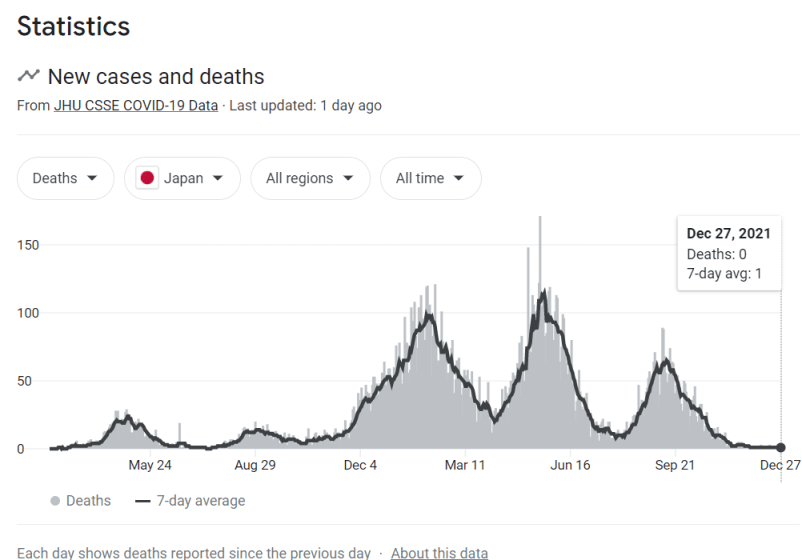
Let’s look at death rates in Japan vs. the US. See a difference? On a per capita basis, Japan is beating the US by a factor of 17. As soon as Japan rolled out ivermectin, their death rates dropped rapidly to 0.
I wonder if it could be caused by the ivermectin? What do you think?

“Do Not Discriminate” Against the Unvaccinated, Japanese Government Tells Citizens
By Noah Carl | The Daily Sceptic | December 21, 2021
At this point, almost all Western countries have introduced some form of vaccine passport or vaccine mandate. Despite repeated assurances from the Vaccines Minister that this wouldn’t happen here, Britain is no exception.
Things may go further in some European countries. Austria is set to make vaccination mandatory from 1st February next year. And beginning in January, Greece will impose a monthly fine of €100 on all over 60s who remain unvaccinated.
Even the United States – supposedly the ‘land of the free’ – has not bucked the trend toward use of passports and mandates. Several states have introduced them, including some of the biggest like New York, California and Virginia. Healthcare workers with natural immunity have already been fired for refusing to comply.
You might conclude that introducing passports and mandates is just something that all advanced countries do. But that isn’t true, as there’s one major exception: Japan.
Nobody can doubt Japan’s credentials as an advanced country. It’s a member of the ‘Group of Seven’, along with the U.K., U.S., Canada, France, Italy and Germany. And it boasts the world’s third largest economy overall. Japan is known for its technologically advanced society, where the high-speed trains never run more than a few minutes late.
So what is the country’s stance on passports and mandates? So far, it’s completely eschewed them. Not only that, but the Government and Prime Minister have explicitly told citizens not to discriminate against the unvaccinated.
The following notice appears on the website for the Ministry of Health, Labour and Welfare:
Although we encourage all citizens to receive the COVID-19 vaccination, it is not compulsory or mandatory. Vaccination will be given only with the consent of the person to be vaccinated after the information provided. Please get vaccinated of your own decision, understanding both the effectiveness in preventing infectious diseases and the risk of side effects. No vaccination will be given without consent. Please do not force anyone in your workplace or those who around you to be vaccinated, and do not discriminate against those who have not been vaccinated.
And a similar notice appears on the website for the Prime Minister:
Vaccines will never be administered without the recipient’s consent. We urge the public never to coerce vaccinations at the workplace or upon others around them, and never to treat those who have not received the vaccine in a discriminatory manner.
Western countries still claim to be the foremost defenders of civil liberties. But in the era of Covid safetyism, it seems that mantle has passed to Japan. Perhaps the country will send a delegation of human rights experts to teach the West about individual freedom.
Fossil Fuel Restriction Dam Starting To Break
By Francis Menton | Manhattan Contrarian | December 4, 2021
Somewhere a couple of decades or so ago, the rich parts of the world embarked on a program of replacing energy from fossil fuels (coal, oil, natural gas) with energy from intermittent “renewables” (mainly wind and solar). In trendy academic, journalistic, and otherwise progressive circles, the idea took hold that this was the way to “save the planet.” This program was undertaken without any detailed engineering study of how or whether it might actually work, or how much it might cost to fully implement. In the trendy circles, there took hold a blind faith in the complete ability of the government, by dispensing taxpayer funds, to order up whatever innovation might be needed to move us forward to this energy utopia.
The latest UN-orchestrated effort to implement the renewable energy program, known as COP 26, has just broken up. To read the verbiage emanating from the affair, all is on track, if a bit slower than one might have hoped.
But I have long predicted that this program would come to an end when (absent some miraculous innovation that nobody has yet conceived) the usage of the renewables got to a sufficient level that their costs and unworkability could not be covered up any longer. Until very recently the pressure of elite groupthink has been able to maintain a united front of lip service to the cause. But consider a few developments from the past few weeks, just since the end of COP 26:
Japan
Japan tends to keep its head down in international affairs, and at COP 26 signed on to the happy talk group communiqués without raising any particular issues. But there is no getting around that Japan has the third largest economy in the world — after the U.S. and China, and larger than any European country — so its actions in energy policy are inherently significant. Also, Japan has relatively little energy production of its own, is heavily dependent on imports, has harsh winters, and has a growing Chinese military and economic threat right on its doorstep. Is Japan really going to trust its fate to intermittent wind and solar energy?
On December 1 Bloomberg reported: “Japan Is Backing Oil and Gas Even After COP26 Climate Talks.” It seems that this rather significant country may be seriously re-thinking the move away from fossil fuels. Excerpt:
Government officials have been quietly urging trading houses, refiners and utilities to slow down their move away from fossil fuels, and even encouraging new investments in oil-and-gas projects, according to people within the Japanese government and industry, who requested anonymity as the talks are private.
What is motivating Japan to break from the world groupthink? According to the Bloomberg piece, the main motivator is security of energy supply — which wind and solar obviously cannot provide:
The officials are concerned about the long-term supply of traditional fuels as the world doubles down on renewable energy, the people said. The import-dependent nation wants to avoid a potential shortage of fuel this winter, as well as during future cold spells, after a deficit last year sparked fears of nationwide blackouts. . . . Japan’s Ministry of Economy, Trade and Industry declined to comment directly on whether it is encouraging industries to boost investment in upstream energy supply, and instead pointed to a strategic energy plan approved by Prime Minister Fumio Kishida’s cabinet on October 22. That plan says “no compromise is acceptable to ensure energy security, and it is the obligation of a nation to continue securing necessary resources.”
(Emphasis added.). Well, if “no compromise is acceptable” on “energy security,” that pretty much rules out principal reliance on wind and solar for powering the Japanese economy, at least until some magical new inventions come along.
United States
In the U.S., Republicans have only very gradually caught on to the idea that fossil fuel restrictions in the name of “climate” are becoming a political liability for the Democrats. Up to now, there have been some politicians willing to speak out in opposition to such restrictions, but little in the way of concrete steps taken in opposition. Meanwhile, the Biden administration continues to move forward with initiatives at the SEC, Treasury Department and Federal Reserve to pressure banks and other financial institutions to reduce their participation in the fossil fuel industries.
So this is a big development: On November 22, a coalition of state treasurers sent a letter to large financial institutions threatening to end relationships, including the deposit of state and pension funds, with institutions that cut off financing for the coal, oil and natural gas industries. National Review reports in a November 22 piece headlined “Fifteen States Respond to ‘Woke Capitalism,’ Threaten to Cut Off Banks That Refuse to Service Coal, Oil Industries.” Excerpt:
A coalition of financial officers from 15 states sent a letter to the U.S. banking industry on Monday warning they plan to take “collective action” against banks that adopt corporate policies to cut off financing for the coal, oil, and natural gas industries. . . . The letter puts the financial institutions that have “adopted policies aimed at diminishing a large portion of our states’ revenue” on notice, saying the banks have “a major conflict of interest against holding, maintaining, or managing those funds.”
According to the NR piece, the state treasurers signing on to the letter include those from West Virginia, Arizona, Arkansas, Idaho, Louisiana, Missouri, Nebraska, North Dakota, South Carolina, South Dakota, Utah, Wyoming, Alabama, Texas and Kentucky. Recipients of the letter included JPMorgan Chase, Bank of America, Wells Fargo, Citigroup, and Goldman Sachs. Between the states’ own accounts and their pension funds, the amounts at issue would be well into the multiple hundreds of billions of dollars, if not approaching a trillion.
Meanwhile, over in Europe . . .
Another Bloomberg piece, this one from November 28, describes the sense of impending doom hanging over Europe with the combination of low natural gas supplies, price spikes, and complete inability to coax more production out of proliferating and essentially useless wind and solar generators. The headline is “Europe’s energy crisis is about to get worse as winter arrives.” Excerpt:
The situation is already so dire this early in the winter season because of a blistering rally in natural gas prices. Stores of the fuel, used to heat homes and to generate electricity, are lower than usual and are being depleted quickly. Analysts have warned that gas stores could drop to zero this winter if cold weather boosts demand. Rolling blackouts are a possibility, warned Jeremy Weir, chief executive officer of Trafigura Group, a Swiss commodity trading house on Nov. 16.
And then there’s this comment:
“If the weather gets cold in Europe there’s not going to be an easy supply solution, it’s going to need a demand solution,” said Adam Lewis, partner at trading house Hartree Partners LP.
I think that a “demand solution” means some combination of either blackouts or intentionally cutting people off and, I guess, leaving them to freeze. The “supply solution” mentioned by Lewis would be allowing fracking in the extensive shale formations underlying Western Europe. Such fracking is currently banned. Even if those bans were lifted today, it would be way too late for this winter. … Full article
Featured Video

BRITAIN’S WARNING: PREPARE FOR WAR
or go to
Aletho News Archives – Video-Images
From the Archive
How Ukraine Tortured and Slaughtered Donbass
By Kit Klarenberg | Al Mayadeen | July 11, 2024
Almost immediately after the proxy war erupted, ISIS-tier footage of the torture and murder of Russians in Ukrainian custody emerged.
On July 6th, the New York Times published an astonishing investigation: In Ukraine, Killings of Surrendering Russians Divide an American-Led Unit. The article documents in grim detail how Chosen Company, an international volunteer battalion for Kiev, routinely executes Russian prisoners of war. It is the very first mainstream admission that this practice – a brazen breach of the Geneva Conventions, and a grave war crime – is widespread among Ukraine’s fighters, both foreign and homegrown. … continue
Blog Roll
 Aletho News
- Israel Demolishes Home Of Lebanese Journalist Whose Viral Film Exposed Pager Attack
- Record Oil, Empty Tanks: The UAE’s Miracle Recovery
- Burnham tackles Britain’s poverty with aggression in Yemen
- Peace in Ukraine: the easy way – or the hard way
- Trump & the Rrrrussians
- US taxpayer money laundered back through Ukraine – Musk
- Before COVID, an NIH lab chief proposed making a SARS-like bat virus more infectious
- Gates, Bourla on Trial in Netherlands Accused of ‘Great Reset’ Scheme at Vaccine Injury Hearing
- BRITAIN’S WARNING: PREPARE FOR WAR
- “Historic Russia”: The Land Putin Will Not Give Back
- If Americans Knew
- DAILY UPDATE: Latest essential news on Palestine, Israel, & region
- Damning report shows the media must confront its failures on Gaza
- BBC senior broadcaster speaks out on Gaza coverage
- Netanyahu vows vast West Bank invasion in response to 20-minute skirmish that left 2 Israeli soldiers and 2 Palestinian fighters dead
- Tied up and tortured: Israel using US-made electroshock weapons on Palestinian detainees
- The outsourced risk: how newsrooms rely on Gaza’s freelancers without protecting them
- Gaza bakeries forced to shut as Israel blocks flour shipments
- Gaza’s breast cancer patients face a deadly wait for treatment amid Israel’s genocide
- DAILY UPDATE: Latest essential news on Palestine, Israel, & region
- The Israel Lobby’s Changing Fortunes
- No Tricks Zone
- Two New Studies Find Thwaites Glacier Melt Cannot Be Driven By Human Activity Or A Warming Ocean
- E-Cars Reduce CO2 Emissions By Only 41% Compared To Internal Combustion Engine Vehicles
- Predictions Made By Renowned Climate Professor Over Past Decades Have Been Proven To Be Poor
- New Study Suggests Large Regions Of The Pacific Ocean Have Been Cooling For The Last 80 Years
- Germany’s Green Energy Debacle: High Energy Costs Force Kahla Porzellan to Close After 182 Years!
- New Study: 50 Years Of The Most Aggressive ‘Net Zero’ Policies Can Only Affect The Global Climate By 0.03°C
- US September “Heat” Was No Record…Many Records Set Decades Ago
- Latest European Green Energy Debacle; Portugal’s Largest Flagship Solar Park Insolvent!
- Green Energy Debacle: German Expert Professor Fritz Vahrenholt Warns Of Severe Economic And Social Consequences
- Two More Paleo Reconstructions Affirm Meters-Higher Sea Levels Across Ireland, Brazil 7000-6000 Years Ago

