‘US deploys six Ospreys on Okinawa despite popular protests’
Press TV – October 1, 2012
The US has reportedly deployed six MV-22 Osprey helicopter-plane hybrids on the southern Japanese island of Okinawa in the face of widespread opposition on the part of the Japanese people against the deployment.
On Monday, the aircraft were flown from Marine Corps Air Station Iwakuni in western Japan to Marine Corps Air Station Futenma in Okinawa, DPA reported.
Six such aircraft remain in the Iwakuni base. The 12 aircraft had been transferred from the US to Japan in July.
Okinawa has become known as the site of enduring tensions with the US forces deployed there, and hence a lasting source of conflict between Washington and Tokyo. Pacifist inclinations as well as security and safety concerns have prompted the Japanese to protest against the deployment.
On September 9, tens of thousands of people rallied in the country against the prospect.
The Osprey is equipped with rotors that facilitate take-off like a helicopter and engines that can tilt forward, powering it to fly like an airplane at much faster speed than a chopper.
It is considered pivotal to Washington’s ambitions of force realignment in Asia-Pacific, and enables the US marines to fly farther and with bigger loads from Okinawa to remote islands in Japan.
The aircraft, however, has had multiple malfunctions and many accidents since its early years in 1990s. Osprey crashes killed two in Morocco and an entire crew in Florida this year.
Okinawa Governor Hirokazu Nakaima has also argued against the Osprey’s safety, and warned that the Futenma base is located in residential areas.
Related articles
- You: Osprey test rides fail to placate opponents (japantimes.co.jp)
- UPDATE2: Osprey to be moved to Okinawa Mon., U.S. tells Japan (english.kyodonews.jp)
- Tens of thousands protest in Okinawa against Osprey deployment (japantimes.co.jp)
- Nakaima pushes to nix Osprey deployment (japantimes.co.jp)
- 100,000 Okinawa islanders tell US to keep ‘unsafe’ Osprey plane away (morningstaronline.co.uk)
Nagasaki: The Worst War Crime Ever
Dock Billin | Multiply | August 8, 2011
It was just short of eleven in the morning of a mild late summer day. The streets of the city were teeming with people going to work, while children played in the parks and in the medical college, professors were lecturing to their students on medicine and surgery.
High over the city, above the layer of clouds in the sky, a silver aeroplane was flying along on four throbbing motors. The crew had already been in the air for many hours and was growing tense and weary. They had flown to another city, where they were to deliver their cargo, but that had been obscured by smog and cloud, so they had come to this, their secondary destination. Getting low on fuel and experiencing some engine trouble, they were looking for a break in the cloud cover so that they could see where to release their cargo, a gift for the two hundred thousand people below.
A sudden hole opened in the cloud cover, and the B-29 started its bombing run.
It was the ninth of August, 1945, and the city below was about to become a funeral pyre.
When the accounts are written of the atom bomb, one name, and one alone, stands out in the histories – Hiroshima. It’s as though the atomic age is symbolised by that city. Tagged on, sometimes, to the end of it, is another name – Nagasaki – as though it were no more than an afterthought, ignored by most people except as a footnote. But Nagasaki was a city in its own right, bombed separately from Hiroshima, and with its own personalised tragedy.
In order to understand the tragedy of Nagasaki, it’s necessary first to examine the decision to use the atom bomb and the reasoning behind the bombing of Hiroshima.
The prelude to the atom bombing:
I have written previously[1] and in detail about why I consider the bombing of Hiroshima to have been an inexcusable war crime, not only in hindsight, but even given the information available at the time to the people involved. I’ll repeat a point I made earlier:
Japan was finished, and was all ready to sue for peace; the only condition it made was that the position of the Emperor should be protected. The Japanese government under Kantaro Suzuki that took office in April 1945 did so with the one single objective of ending the war. All this was known to the Western Allies, since the Japanese codes had long since been broken.
By May 1945, the Japanese were suing for peace through Switzerland and Moscow – peace on any terms, just so long as the position of the Emperor was protected.
These are the terms the Japanese offered as early as 20 January 1945, and repeated through the USSR in July[1,3]:
* Complete surrender of all Japanese forces and arms, at home, on island possessions, and in occupied countries.
* Occupation of Japan and its possessions by Allied troops under American direction.
* Japanese relinquishment of all territory seized during the war, as well as Manchuria, Korea and Taiwan.
* Regulation of Japanese industry to halt production of any weapons and other tools of war.
* Release of all prisoners of war and internees.
* Surrender of designated war criminals.
These are the exact same terms that the Americans accepted at the official Japanese surrender in September 1945. The war could have been over as early as January 1945 – if the US government had wanted it so.
The justification for the bombing:
The rationale for the atom-bombing of Hiroshima (and Nagasaki) rests on these ideas:
First claim: that the atom bomb was necessary to end the war.
In reality[1,2,3], the Japanese were suing for peace long before the A Bombing. Also, the fact is that wars are fought by militaries, and in this case the actual military forces involved (who would have been in a position to decide if they needed the Bomb to end the war) were kept completely out of the picture. Even General Douglas MacArthur, the theatre commander in the Pacific, was told of the Bomb’s existence a mere five days before it was used on Hiroshima[2]. And European theatre commander General Dwight Eisenhower (later US President) was strongly opposed to its use, and was to comment in an interview to Newsweek in 1963, “We didn’t have to hit them with that awful thing.”
In 1945 the Japanese were in desperate circumstances. Japan
… already had been defeated militarily by June 1945. Almost nothing was left of the once mighty Imperial Navy, and Japan’s air force had been all but totally destroyed. Against only token opposition, American war planes ranged at will over the country, and US bombers rained down devastation on her cities, steadily reducing them to rubble.
What was left of Japan’s factories and workshops struggled fitfully to turn out weapons and other goods from inadequate raw materials. (Oil supplies had not been available since April.) By July about a quarter of all the houses in Japan had been destroyed, and her transportation system was near collapse. Food had become so scarce that most Japanese were subsisting on a sub-starvation diet .[3]
While it is true that for public consumption the Japanese government was calling on its people to resist to the end, as any adult knows, the public statements of governments are to be treated with circumspection. Starving Japanese civilians armed with bamboo spears[6] would have had little impact on the kind of invasion fleet the Allies could have summoned by 1 November 1945, the projected date for the invasion, if any invasion had actually been required. But
(t)he United States Strategic Bombing Survey concluded that,”… certainly prior to 31 December, 1945, and in all probability prior to 1 November, 1945, Japan would have surrendered even if the atomic bombs had not been dropped, even if Russia had not entered the war, and even if no invasion had been planned or contemplated.” [4]
It’s also true that the atom-bombings of Hiroshima and Nagasaki were not the last major bombing raids on Japan during the Second World War. In a broadcast from Tokyo the day after the Nagasaki bombing, 10th August (and also two days after the USSR invaded Manchuria), the Japanese government announced its readiness to accept the joint American-British “unconditional surrender” declaration of Potsdam, “with the understanding that the said declaration does not compromise any demand which prejudices the prerogatives of His Majesty as a Sovereign Ruler.”[3]
Yet, on the day and evening of the 14th August, while Japan was preparing for the announcement of the unconditional surrender, General Henry Harley “Hap” Arnold dispatched over a thousand planes to fire-bomb Tokyo. Not even one was lost, and the official Japanese surrender was announced before the last one landed back at its base[5]. If the A-Bombing had actually ended the war, what was the necessity for this act, unless one wants to call it deliberate terrorism?
At the same time, there’s the fact that, as I said, the USSR entered the war on 8th August, as it was treaty bound to do three months after the end of the war in Europe. In many ways, it was this decision that forced the Japanese surrender, not the A-Bombing[6]. They did not want the Communists to occupy parts of their homeland.
Also –
American leaders who were in a position to know the facts did not believe, either at the time or later, that the atomic bombings were needed to end the war…
Shortly after “V-J Day,” the end of the Pacific war, Brig. General Bonnie Fellers summed up in a memo for General MacArthur: “Neither the atomic bombing nor the entry of the Soviet Union into the war forced Japan’s unconditional surrender. She was defeated before either these events took place.”
Similarly, Admiral Leahy, Chief of Staff to presidents Roosevelt and Truman, later commented:
It is my opinion that the use of the barbarous weapon at Hiroshima and Nagasaki was of no material assistance in our war against Japan … The Japanese were already defeated and ready to surrender because of the effective sea blockade and the successful bombing with conventional weapons … My own feeling was that in being the first to use it, we had adopted an ethical standard common to the barbarians of the Dark Ages. I was not taught to make war in that fashion, and wars cannot be won by destroying women and children.
If the United States had been willing to wait, said Admiral Ernest King, US Chief of Naval Operations, “the effective naval blockade would, in the course of time, have starved the Japanese into submission through lack of oil, rice, medicines, and other essential materials.” [3]
Besides, unlike the standard version of the story, the Japanese leaders of the time weren’t particularly impressed by the A-Bomb. Nobody knew much about these weapons at the time, and the initial number of casualties was less than those inflicted during the fire-bombing of Tokyo on the night of 9th March 1945 when over a hundred thousand Japanese were burned alive and boiled to death in the city’s canals[3]. It was just another enemy weapon[3], and the murder of a few hundreds of thousand civilians was passé by that stage of the war, when 67 Japanese cities had been destroyed by fire-bombing[7].
Therefore, it’s certain that the claim that the A-Bombing was necessary to end the war was false, and was known to be false even when the decision was being made.
Second claim : That the atom bomb was required to save a million American lives.
This claim rides piggyback on the first, and is predicated on an invasion and prolonged fighting for the Japanese home islands. However, as we’ve seen, no invasion would have been necessary, and the people in power were well aware that no invasion would have been necessary. Even so, the figure of a million American dead is widely inflated.
(T)he worst-case scenario for a full-scale invasion of the Japanese home islands was forty-six thousand American lives lost.[7]
Even if it were true that a million American soldiers would have died in the invasion of the Japanese home islands, did that justify nuking over a quarter of a million civilians[7]? How is that different from torturing and massacring the inhabitants of a city to break the will of their fighting men to resist[8]? And in what way does that qualify as not terrorism, if we define “terrorism” as the use of applied fear to influence the actions of a target government or populace?
Third claim: That Hiroshima and Nagasaki were heavily-defended military bases and hence legitimate targets.
This is actually one of the more transparent myths of the entire episode. Hiroshima was chosen as a target of the atom-bombing because it had never been bombed[9]; and it had never been bombed because it was not militarily significant (about 95% of the casualties in the city were civilian). In fact,
… almost all of the victims were civilians, and the United States Strategic Bombing Survey (issued in 1946) stated in its official report: “Hiroshima and Nagasaki were chosen as targets because of their concentration of activities and population.” [3]
As we shall see, Nagasaki was a third-hand choice for the bomb; it was meant to be used elsewhere, because Nagasaki had already been bombed five times before and wasn’t thought to be a prime target.
Fourth claim: The Japanese somehow “deserved” Hiroshima (and Nagasaki) because of the attack on Pearl Harbour.
This is part of the justification put out by Truman himself, [4]
“Having found the bomb we have used it. We have used it against those who attacked us without warning at Pearl Harbor (sic), against those who have starved and beaten and executed American prisoners of war, and against those who have abandoned all pretense (sic) of obeying international law of warfare.”
The simple fact is that the Japanese people were not, at the time, ruled by anything resembling a democracy. They had no part in the decisions that were taken in their name, and are no more to blame, collectively, than the people of the United States are collectively to blame for the invasion of Iraq – less so, indeed, because the US is (on the surface of it) a democracy.
The attack on Pearl Harbour, in any case, was far from the simple story of an unexpected and illegal attack on the US as is usually claimed. In reality, the attack had been made inevitable by a game of political brinkmanship and pushing Japan to the point where it had no option but to strike back. It was a pre-emptive strike… a strike the US celebrates to this day. The purpose of this article is not to get diverted into a discussion of the attack on Pearl Harbour; but it will note that while the official story is of a vicious and unprovoked attack, there are excellent reasons to believe that it was not.[10]
But even if the attack on Pearl Harbour had been a vicious and unprovoked attack, it was a military attack on a military base, and any civilians killed were accidental casualties (“collateral damage” in the words of the same people who decry the attack while occupying Iraq and Afghanistan and bombing Pakistan and Libya). The attacks on Hiroshima and Nagasaki were designed to kill civilians[3], and therefore were not a proportionate, legal or moral response to the attack on Pearl Harbour.
Therefore, none of these four justifications for the bombing stands up to examination.
Some words about the Atom Bomb:
This would probably be the right place to briefly discuss the atom bomb itself – as it was used in Hiroshima and then at Nagasaki. (You’ll see the point of this digression in a minute.)
With apologies to those to whom this is hardly news, there are two distinct types of nuclear bomb. Both depend on bringing together an unstable mass of radioactive metal, known as the critical mass, which then spontaneously undergoes change into a smaller mass of other materials with the missing mass converted into energy. This energy is gigantic compared to the amount of missing mass, because it follows Einstein’s famous equation E=mc2where E is the energy obtained from converting a mass m and c is the speed of light. Since the speed of light is 300,000 kilometres per second, the energy obtained by converting just one gram of material is huge indeed. That’s why nuclear bombs are so powerful; the Hiroshima bomb had a yield of 13.5 kilotons (the equivalent of 13,500 tons – not kilograms, tons – of TNT), and Nagasaki suffered 21 kilotons. And these were small bombs by today’s standards.
Now, there are two metals that can be used to construct an atom bomb. One is Uranium 235, and the other, Plutonium 239. In the case of Uranium 235, the technique used is relatively simple, and is called the gun type device. A “bullet” of the metal, weighing less than the critical mass, is fired by explosives into a sphere of the same metal, also weighing less than the critical mass, but the two together weigh more than the critical mass and “nuclear fission” occurs as the atoms split to release the above-mentioned energy. The gun-type device is simple and can be expected to work without testing, and this was the design of the (untested) bomb dropped over Hiroshima.
The plutonium bomb is a different matter. Because of certain inherent problems with the presence of Plutonium 240 as an impurity, the gun type device is unusable. Instead, the technique used is the implosion device, where explosives are used to compress a sphere of plutonium from all sides until it achieves a mass greater than the critical level, and explodes. This method happens to be both more efficient and safer than the gun-type device, and is used for most modern nuclear weapons.[11]

The thing about the implosion device is that it could not be reliably expected to work without testing, because its utility was still entirely theoretical at the time of construction and because of the fact that a highly complex triggering device has to be used to compress the sphere evenly and quickly into a supercritical mass. Therefore, it required a test – and this was the device that was tested at Alamogordo in New Mexico on 16th July 1945, which was called the “Trinity” test and was the world’s first nuclear explosion.
While the uranium bomb (“Little Boy”) was used on Hiroshima, the far more complex and expensive plutonium bomb (“Fat Man”) was used on Nagasaki.
Which leads us to one possible reason why the bomb was used…
The possible real reasons for the use of the atom bomb:
- The political reason: By 1945, the alliance between the USSR and the Western Allies was fast breaking down. It was little more than a formality which would obviously end once the war was over. Before the Germans were even defeated, American pilots flying close to the Eastern front with secret equipment in their aircraft were ordered by their superiors to bail out over German territory in case of emergency rather than land on the Soviet side of the lines (vide John Toland, The Last Hundred Days)[12]. The Western Allies were more concerned about their ally, the USSR, laying hands on their equipment than their enemies, the Germans, capturing it.
While at Yalta in February 1945, Stalin agreed to enter the war against Japan three months after the end of the war in Europe, which would mean the USSR’s declaring war on Japan on 8th August (since the European war ended on 8th May). The Americans and British were well aware of this, and Truman himself had written to his wife that the Soviet Union’s entry into the war would hasten Japan’s downfall[13]. Obviously, once the war ended, the two competing systems – communism and capitalism – would be scrambling for the prize of ruling the post-war world. The atom bombing was the first shot in the Cold War. [17]
Truman, in fact, postponed the July Potsdam conference with Stalin until he was certain that the Alamogordo test was successful, and his Secretary of State and advisor Byrnes’
… general viewpoint is consistent and clear. He saw the atomic bomb as a way to impress the Soviets. [14]
Also, as William Craig describes in The Fall Of Japan, by 25th August OSS (the organisation that is now the CIA) agents in China were openly threatening the Chinese Communists, still their official allies against the Japanese, with the use of the nuclear bomb unless they fell into line and stopped their “banditry”.[15]
The political factor behind the bombing is therefore pretty clear.
- The revenge factor: Throughout the war, the Western nations had categorised the Japanese as something less than human, and Western propaganda had consistently portrayed them as monstrous rats or monkeys. The use of the atom bomb on them was a nice, satisfying way of exacting revenge, as Truman himself said (see above).

- Scientific curiosity: Just because scientists are scientists we can’t expect them to be necessarily ethical or moral. The scientists wanted to know which bomb was more powerful, and one important reason for the atom-bombing of Nagasaki was merely to see if the implosion device would cause more devastation than the Hiroshima bomb.[16] The fact that the programme had cost two thousand million dollars (at the then value) was also a powerful incentive to use the bomb – to justify the money spent.
Hiroshima, in fact, was chosen as a target for two reasons: first, because it was a “virgin” city, never having been bombed[17], and therefore would provide an excellent test-bed for the Bomb; and also because of its topography (surrounded on three sides by hills) which would allow the blast to be focused back on the city and cause even greater destruction.
Could the Bomb have been used otherwise?
Let’s – for the sake of argument – assume that the atom bomb really ended the war. What were the alternatives to dropping the bomb on Hiroshima and Nagasaki?
Alternative No 1: Warning the Japanese through neutral nations of the existence of the bomb and the willingness to use it. Whether this would have been effective of not, it certainly wasn’t tried.
Alternative No 2: Making a “demonstration” – dropping the bomb over an isolated Japanese military base, over an unpopulated area, or over the sea within sight of the Japanese coast. This, too, was never tried, and never, apparently, contemplated.
The argument usually goes that the bomb actually had to be used for the Japanese to appreciate its true destructive power, and without that they wouldn’t have surrendered. The argument further goes that the use of only one bomb wouldn’t be effective, because the hardliners in the Japanese military and government wouldn’t believe that the US had more than one of the bombs.
Again, for the sake of argument, let’s assume that this line of thinking has merit – that the Japanese would have not surrendered unless the Bomb was actually used on one or more of their cities.
This raises some questions:
1. If the Hiroshima bomb was used on 6th August, why was the Nagasaki bomb used just three days later? It was an impossibly short time for the Japanese government to assimilate information about the bomb, given the utterly destroyed state of Japanese communications, and decide on surrender. Besides, it was only at Nagasaki (vide Craig, The Fall Of Japan) that a message was dropped (taped to an instrument package parachuted to study the explosion) to a Japanese nuclear scientist – a Professor Sagane – who had earlier studied in the US, informing him of the nature of the atom bomb. So, the Japanese were not even given the time to know of their danger and think of surrender – before both bombs had been used.
2. Let’s for the sake of argument assume that Hiroshima had to be destroyed to force a Japanese surrender, and a second bomb had to be dropped to make the point that the US had more than one bomb. If that is so, why wasn’t the second bomb used as a demonstration, and dropped somewhere the Japanese could see its effect for themselves, and not on civilians? What possible justification can there have been for destroying a city?
And this is why I consider Nagasaki to have been an even worse war crime than Hiroshima – because, following the arguments of the pro-bomb lobby to their logical conclusion, the bombing of the latter city comes across as even more wanton and pointless, even more of a war crime and a terrorist act.
While I am on the subject, as I’ve written elsewhere [18]
I view the atom-bombing of Hiroshima and Nagasaki as a complete and despicable war crime. I view it as such because – like using Agent Orange in Vietnam or depleted uranium today everywhere from Kosovo to Libya – the effects extend to future generations, meaning people who are not only not guilty of any part in the conflict, but weren’t even born when it took place. No amount of self-justification can excuse that.
Secondly, I view nuclear weapons as the closest thing we have to an absolute evil, because it gives its possessors the choice to wipe out virtually all life on earth in defence of a political or economic ideology; a way of wiping out everything in some kind of universal Gotterdammerung. Just as you wouldn’t let a petulant child get its hands on a firearm, you wouldn’t want a nation – any nation – to have the means to blow everything away in a fit of temper. Don’t think it can’t happen – it very nearly has.
It is true (as I shall discuss in a moment) that the bombing of Nagasaki killed far fewer people than the bombing of Hiroshima even though the bomb was far more powerful[19]; but that was more by accident than by intent, and surely in these situations intent is what matters. Is a man who kills a hundred people more of a criminal than one who kills merely fifty? And is the latter guiltier than one who has dispatched only five or so?
The targeting of Nagasaki:
Let’s say something here that a lot of people don’t know: Nagasaki was not a primary target for the Bomb. The list of potential Japanese targets had at first four names on it – Kyoto, the ancient Japanese capital; Kokura, Hiroshima and Nagasaki. Kyoto was scratched early on because of its cultural and religious significance to the Japanese people, and Niigata substituted. That city was subsequently scratched because it was considered too far to be reliably attacked, what with having to fly there carrying the immense weight of the atom bomb, and the target list came down to three – Hiroshima and Kokura, with Nagasaki (which had already been bombed five times[20] and therefore wasn’t a “virgin” city like Hiroshima) as the alternate target.
When the B 29 bomber (Bockscar) carrying “Fat Man” took off from Tinian, it was supposed to bomb Kokura, but the target was covered by smog and cloud[20]. The crew were under strict orders not to bomb by radar, but only after visually identifying the aiming point. Despite three passes over the target, they were unable to do so, and by this time the Japanese below had opened up with some anti-aircraft fire (the only occasion during the two atom bombings that any opposition at all was encountered. That a tiny number of unescorted and unarmed bombers – three at Hiroshima, two at Kokura/Nagasaki – could fly over Japanese cities in broad daylight unmolested is clear proof of the utterly parlous nature of Japanese defences at the time). The plane then flew to Nagasaki, which was covered by cloud and smog as well. By then, fuel was getting low, and there was just enough for one pass over the target. There was only one hole in the cloud which afforded some view of the city, and “Fat Man” was dropped through that hole, with a racetrack as the makeshift aiming point.
The bombing of Nagasaki:
As Fat Man fell through the air over Nagasaki, arming wires were extracted, barometric switches were closed, and electrical switches were triggered at a pre-set altitude of 500 metres. The detonators arranged around the plutonium core exploded, driving the metal ball on itself until it reached a supercritical mass. A moment later, with an intense bluish-white light, the bomb exploded over the city. People below simply vanished, vaporised in an instant. Further from the blast site, they were blinded, their skin burned away, their bodies blasted with radiation, and all of them died. Many who were not killed by the blast or radiation were crushed under falling buildings, and yet others roasted alive by the mass fires that followed. Those further from the blast and fires soon began to suffer the effects of radiation sickness: diarrhea, weakness and fever, agonising pain, their urinary flow stopping as the inner lining of their bladders came away. Most of them soon died. Those who survived lost their hair and teeth, followed by a lifetime of health problems, frequently involving cancer and passing on mutations to their children.
Everything happened as it had happened at Hiroshima, in fact; but, as I’ve mentioned, the casualty toll was

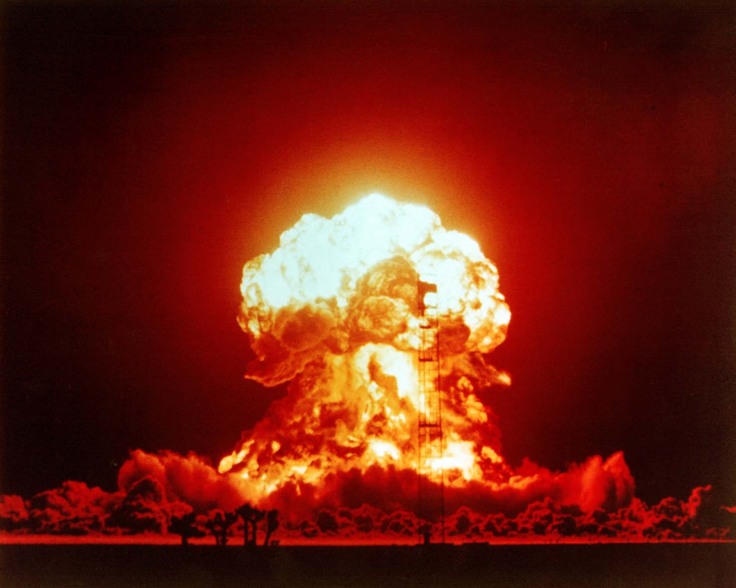
As the fireball from the explosion rose, it sucked up superheated air along with moisture, smoke and soot from the incinerated city, and condensed it all in a tower of cloud that spread out at the top – into the image of the mushroom cloud that is familiar to us all. And the moisture condensed and fell along with the soot and dirt as a black rain, just as it had done at Hiroshima.
The reason for the lower casualty toll is as follows: the implosion type plutonium device was far more powerful than the gun-type bomb used on Hiroshima. It was, however, dropped far off-centre (towards the north-west) and failed to hit the middle of the city as planned. Nagasaki is also, unlike Hiroshima, a hilly city broken up by stretches of water Large portions of the city were protected from blast by the hilly terrain, and the mass fires that started could not cross open stretches of water to ignite a firestorm as in Hiroshima. That is why “only” some 87000 died[20] – as opposed to more than twice that number at Hiroshima. (It’s a different matter that an even higher proportion of them were civilians, including a number of Western prisoners of war whose presence was known to the US – but the bombing went ahead anyway.[21])
When you remember that the most notorious “terrorist” strike in history killed fewer than 3000 people, and that that strike became the reason for wars that have to date destroyed two nations and devastated several others, it brings the crimes of Hiroshima and Nagasaki even more into focus.
The whitewash:
It’s worth noting that by 1947, Harry Truman had apparently begun feeling a need to whitewash his own part in the decision to use the bomb. He had the first film on Hiroshima censored extensively, falsifying history and reinventing his and every other major participant’s role in it[22]. It’s difficult to see this effort as anything but an admission of guilt, yet it established the modern myth of how the Bomb had to be used, most reluctantly, to end the war. It wasn’t a very effective propaganda device, of course, but the people of the US were eager to believe that the bombing was not a crime – so they took the opportunity to believe it.
The modern government of Japan is hardly free of guilt either. It made no effort to help the hibakusha – the survivors of the atomic bombing – until the 1950s, and to this day said help is far from adequate[23]. Besides, Japan till today operates on a US-written constitution and has a government that cannot exert full sovereignty over its own territory – no government which cannot ask an allegedly allied nation to remove its troops from its own territory[24] can be said to be sovereign – and cannot be expected to annoy the Americans. Therefore, the whitewash tends to be bilateral.
Conclusion:
Obviously, I believe that the atom bombing of the two cities was a war crime, and that the people who ordered the bombings were war criminals. However, were the people who actually carried out the bombings – the pilots and crew of the two planes, and the pilots and crew of the observation planes that accompanied them – war criminals?
Under normal circumstances, one would have said they weren’t. In a war that had crossed all limits of savagery, I’d have said that they were soldiers carrying out their orders. But there’s what happened afterward.
In 1995, the Smithsonian Institution wanted to hold an exhibition showing the effect of the atom-bombing of Hiroshima. One of the most strident opponents of the exhibition (which ultimately was aborted) was an old man who claimed it was a “damned big insult”. This old man was someone who had – in 1975 – flown a recreation of the attack of Hiroshima at an air show, complete with mushroom cloud, and claimed he had not intended it to be offensive. Yet, obviously, he found showing the effects of the bomb itself offensive to himself.[7]
Who was he? His name was Paul Tibbets, and he was the man who had flown the B 29, Enola Gay, which had dropped the Hiroshima bomb. His bombardier, too, went to his grave declaring he would do it again if the opportunity arose.
Whether Tibbets was a war criminal or not, therefore, at least in retrospect, might be a matter of opinion. However, I’d like to point out one thing:
After returning from a mission where they had just barbecued over a hundred thousand human beings, the crew of the Enola Gay celebrated with a barbecue.[25]
So what can be done? I believe that an apology is a good place to begin. It’s necessary because even though an apology won’t help the victims of the Bomb, it will acknowledge that bombing them was wrong; and only if one admits wrong will one begin to guard against the tendency to do it again. After the end of the Second World War, the USA has threatened the use of nuclear weapons many times – against Korea, China, Cuba and Vietnam, against Iraq, North Korea and now against Iran. If the only nation ever to use nuclear weapons and threaten their use apologised for doing so, it might guard against the tendency to use these weapons or threaten their use – and in the modern world, if one country can use them, another can; and once there’s a major exchange, no matter who is guilty of starting it, there can be no turning back from the road to utter global ruin.
Not that any apology will ever be forthcoming, of course, but there’s no harm dreaming.
Sources:
[1] http://subversify.com/2010/08/13/mushroom-cloud-over-hiroshima/
[2] http://www.lewrockwell.com/orig2/denson7.html
[3] http://www.ihr.org/jhr/v16/v16n3p-4_Weber.html
[4] http://warisacrime.org/content/truman-lied-hundreds-thousands-died
[5] http://www.lewrockwell.com/vance/vance180.html
[6] http://www.boston.com/news/world/asia/articles/2011/08/07/why_did_japan_surrender/?page=full
[7] http://lewrockwell.com/gregory/gregory232.html
[8] http://www.fff.org/freedom/0995g.asp
[9] http://www.hiroshima-spirit.jp/en/museum/morgue_e12.html
[10] http://www.lewrockwell.com/orig/stinnett1.html
[11] http://en.wikipedia.org/wiki/Fat_Man
[13] http://www.commondreams.org/view/2011/08/06-3
[14] http://www.h-net.org/~hst203/readings/alperovitz.html
[15] http://www.amazon.com/Fall-Japan-Blazing-Weeks-World/dp/0941968081
[16] http://www.lewrockwell.com/orig5/kohls1.html
[17] http://www.mukto-mona.com/Articles/Brian_Mitchell/hiroshima_reason.htm
[18] http://bill-purkayastha.blogspot.com/2011/07/review-black-rain.html
[19] http://www.aasc.ucla.edu/cab/200708230009.html
[20] http://www.historylearningsite.co.uk/bombing_of_nagasaki.htm
[21] http://www.thenation.com/blog/162596/hidden-history-american-pows-were-killed-hiroshima
[25] http://www.infinityplus.co.uk/stories/history.htm
Related articles
- Hiroshima marks anniversary of atomic bombing (news.xinhuanet.com)
South Korea resumes Iranian oil supplies
RT | August 8, 2012
South Korea, the fourth largest importer of Iranian crude, plans to resume purchases after a two-month pause due to a European Union embargo.
South Korean refiners and the National Iranian Tanker Company (NITC) are negotiating the details of a deal, which would allow supplies to restart from September, Reuters reported citing government sources. Tehran offered to deliver crude in its own tankers and provide up to $1 billion shipment insurance cover.
SK Energy and Hyundai Oilbank – the only two South Korean refiners that import Iranian crude, have confirmed that they are involved in negotiations with NITC. Though it’s unclear whether Iran had offered South Korea a discount for crude.
South Korea, India, Japan and China are the biggest importers of Iranian crude, accounting for more than half of its oil exports. In May, Seoul announced it would halt crude import from the Islamic Republic, becoming the first major importer of Iranian oil to give up supplies due to the EU sanctions.
EU sanctions banning Iranian oil as well as insurance affect Asian customers as they rely on EU companies to insure their shipments. Nearly 90% of the world’s tanker fleets are covered by 13 international P&I clubs from the EU.
Meanwhile Japan approved providing $7.6 billion insurance coverage for Iranian tankers, while China offered to use its own vessels for delivery. India has given permission to its state-run refiners to import Iranian oil on condition Tehran arranges insurance.
Related articles
- Iran Sets up Consortium to Provide Insurance Cover for Oil Tankers (shippingtribune.com)
- Iran Oil Shipping to Resume as Insurers Step In: Corporate India (bloomberg.com)
- China and Japan secure Iran oil supply, bypassing EU sanctions (rt.com)
Japan bans U.S. Osprey war planes over safety concerns
Tehran Times | July 24, 2012
Japan’s prime minister says that he will not allow the U.S. military to fly its newest transport aircraft in his country until safety concerns are first addressed.
Yoshihiko Noda told parliament on Tuesday that no flights of the MV-22 Osprey aircraft would be allowed to take place until investigations into two recent crashes were completed.
The crashes took place in April and June, and Japan says that it will not allow them to operate over its airspace and from its soil until the government is satisfied that safety checks have been completed.
The deployment of the MV-22s to a U.S. military base on the island of Okinawa has become a political headache for the Japanese government due to intense local opposition.
Okinawa hosts more than half of the roughly 50,000 U.S. troops in Japan. The deployment of the aircraft has become an issue for anti-U.S. protesters to rally around.
The first 12 Ospreys headed for Okinawa arrived in Japan on Monday.
The Osprey is a hybrid aircraft with rotors that allow it to take off like a helicopter and engines that can tilt forward, enabling it to fly like an airplane at higher speed than helicopters.
The aircraft’s development was plagued with issues in its early years in the 1990s, but U.S. officials say the technical glitches have been cleared up.
It is used by the U.S. marines, primarily as a troop transport aircraft, allowing soldiers on the ground greater range than current transport helicopters offer.
US “not impressed” with India over Iran oil ties
Al Akhbar – May 15, 2012
The United States is not impressed with India’s efforts to cut its oil imports from Iran, a top US diplomat said on Tuesday, despite New Delhi pledging to slash imports by 11 percent.
As a major buyer of Iranian crude, India is crucial to US efforts to squeeze Iran’s economy. The issue has become an irritant in ties between India and the United States.
Carlos Pascual, the US special envoy who has been negotiating with Iranian oil importers to cut their imports, met Indian foreign ministry officials on Tuesday.
“We are not too impressed today,” Pascual said when asked by Reuters how likely India was to get a waiver. Pascual was speaking before meeting the foreign ministry officials.
“We’re really going to talk about the broad developments of global energy. How we work together on these issues. It’s a great relationship,” he said.
The United States in March granted exemptions to Japan and 10 European Union nations. India and China, Iran’s biggest crude importer, remain at risk.
Washington has held up Japan as an example, saying it had cut imports despite having suffered an earthquake and tsunami that crippled its Fukushima nuclear reactor.
Japan cut volumes by almost 80 percent in April compared with the first two months of 2012. The cuts, amounting to 250,000 barrels per day, are the steepest yet by the four Asian nations that buy most of Iran’s 2.2 million bpd of exports.
India’s crude oil imports from Iran declined by about 34 percent in April compared with March, tanker discharge data showed last week.
Washington has not stated specifically what cuts it expects from each country, only that they must be substantial.
US Secretary of State Hillary Clinton leaned on India last week to cut its imports of Iranian oil further, and said Washington may not make a decision on whether to exempt New Delhi from financial sanctions for another two months.
Clinton, who was on a visit to India, said the United States was encouraged by the steps its ally had taken to reduce its reliance on Iranian oil, but that “even more” was needed.
India supposedly responded to US pressure on Tuesday by agreeing to cut its imports from Iran by a further 11 percent.
“To reduce its dependence on any particular region of the world, India has been consciously trying to diversify its sources of crude oil imports to strengthen the country’s energy security,” junior oil minister R.P.N. Singh said.
The size of imports from various sources depends on technical, commercial and other considerations, Singh added.
It was not immediately known whether the move by India would be enough avert US sanctions.
(Reuters, AFP, Al-Akhbar)
Related articles
- Clinton urges India to cut Iranian oil (alethonews.wordpress.com)
- Govt admits to reducing sourcing of crude oil from Iran by 11 per cent (thehindu.com)
Why Fukushima Is a Greater Disaster than Chernobyl and a Warning Sign for the U.S.
The radioactive inventory of all the irradiated nuclear fuel stored in spent fuel pools at Fukushima is far greater and even more problematic than the molten cores.
By Robert Alvarez · Institute for Policy Studies · April 20, 2012
In the aftermath of the world’s worst nuclear power disaster, the news media is just beginning to grasp that the dangers to Japan and the rest of the world posed by the Fukushima-Dai-Ichi site are far from over. After repeated warnings by former senior Japanese officials, nuclear experts, and now a U.S. Senator, it is sinking in that the irradiated nuclear fuel stored in spent fuel pools amidst the reactor ruins may have far greater potential offsite consequences than the molten cores.
After visiting the site recently, Senator Ron Wyden (D-OR) wrote to Japan’s ambassador to the U.S. stating that, “loss of containment in any of these pools could result in an even greater release than the initial accident.”
This is why:
- Each pool contains irradiated fuel from several years of operation, making for an extremely large radioactive inventory without a strong containment structure that encloses the reactor cores;
- Several pools are now completely open to the atmosphere because the reactor buildings were demolished by explosions; they are about 100 feet above ground and could possibly topple or collapse from structural damage coupled with another powerful earthquake;
- The loss of water exposing the spent fuel will result in overheating [which] can cause melting and ignite its zirconium metal cladding – resulting in a fire that could deposit large amounts of radioactive materials over hundreds of miles.
Irradiated nuclear fuel, also called “spent fuel,” is extraordinarily radioactive. In a matter of seconds, an unprotected human one foot away from a single freshly removed spent fuel assembly would receive a lethal dose of radiation within seconds. As one of the most dangerous materials in the world, spent reactor fuel poses significant long-term risks, requiring isolation in a geological disposal site that can protect the human environment for tens of thousands of years.
It’s almost 26 years since the Chernobyl reactor exploded and caught fire releasing enormous amounts of radioactive debris. The Chernobyl accident revealed the folly of not having an extra barrier of thick concrete and steel surrounding the reactor core that is required for modern plants in the U.S., Japan and elsewhere. The Fukushima Dai-Ichi accident revealed the folly of storing huge amounts of highly radioactive spent fuel in vulnerable pools, high above the ground.
What both accidents have in common is widespread environmental contamination from cesium-137. With a half-life of 30, years, Cs-137 gives off penetrating radiation, as it decays. Once in the environment, it mimics potassium as it accumulates in biota and the human food chain for many decades. When it enters the human body, about 75 percent lodges in muscle tissue, with perhaps the most important muscle being the heart. Studies of chronic exposure to Cs-137 among the people living near Chernobyl show an alarming rate of heart problems, particularly among children. As more information is made available, we now know that the Fukushima Dai-Ichi site is storing 10,833 spent fuel assemblies (SNF) containing roughly 327 million curies of long-lived radioactivity About 132 million curies is cesium-137 or nearly 85 times the amount estimated to have been released at Chernobyl.
The overall problem we face is that nearly all of the spent fuel at the Dai-Ichi site is in vulnerable pools in a high risk/consequence earthquake zone. The urgency of the situation is underscored by the ongoing seismic activity around NE Japan in which 13 earthquakes of magnitude 4.0 – 5.7 have occurred off the NE coast of Honshu in the last 4 days between 4/14 and 4/17. This has been the norm since the first quake and tsunami hit the site on March 11th of last year. Larger quakes are expected closer to the power plant.
Last week, Tokyo Electric Power Company (TEPCO) revealed plans to remove 2,274 spent fuel assemblies from the damaged reactors that will probably take at least a decade to accomplish. The first priority will be removal of the contents in Pool No. 4. This pool is structurally damaged and contains about 10 times more cesium-137 than released at Chernobyl. Removal of SNF from the No. 4 reactor is optimistically expected to begin at the end of 2013. A significant amount of construction to remove debris and reinforce the structurally-damaged reactor buildings, especially the fuel- handling areas, will be required.
Also, it is not safe to keep 1,882 spent fuel assemblies containing ~57 million curies of long-lived radioactivity, including nearly 15 times more cs-137 than released at Chernobyl in the elevated pools at reactors 5, 6, and 7, which did not experience melt-downs and explosions.
The main reason why there is so much spent fuel at the Da-Ichi site, is that it was supposed to be sent to the Rokkasho reprocessing plant, which has experienced 18 lengthy delays throughout its construction history. Plutonium and uranium was to be extracted from the spent fuel there, with the plutonium to be used as fuel at the Monju fast reactor.
After several decades and billions of dollars, the United States effectively abandoned the “closed” nuclear fuel cycle 30 years ago for cost and nuclear non-proliferation reasons. Over the past 60 years, the history of fast reactors using plutonium is littered with failures the most recent being the Monju project in Japan. Monju was cancelled in November of last year, dealing a fatal blow to the dream of a “closed” nuclear fuel cycle in Japan.
The stark reality, if TEPCO’s plan is realized, is that nearly all of the spent fuel at the Da-Ichi containing some of the largest concentrations of radioactivity on the planet will remain indefinitely in vulnerable pools. TEPCO wants to store the spent fuel from the damaged reactors in the common pool, and only to resort to dry, cask storage when the common pool’s capacity is exceeded. At this time, the common pool is at 80 percent storage capacity and will require removal of SNF to make room. TEPCO’s plan is to minimize dry cask storage as much as possible and to rely indefinitely on vulnerable pool storage. Senator Wyden finds that TEPCO’s plan for remediation carries extraordinary and continuing risk. He sensibly recommends that retrieval of spent fuel in existing on-site spent fuel pools to safer storage in dry casks should be a priority.
Given these circumstances, a key goal for the stabilization of the Fukushima-Daichi site is to place all of its spent reactor fuel into dry, hardened storage casks. This will require about 244 additional casks at a cost of about $1 mllion per cask. To accomplish this goal, an international effort is required – something that Senator Ron Wyden (D-OR) has called for. As we have learned, despite the enormous destruction from the earthquake and tsunami at the Dai-Ich Site, the nine dry casks and their contents were unscathed. This is an important lesson we should not ignore.
Featured Video

Iran Is Not Our Enemy
or go to
Aletho News Archives – Video-Images
Frlom the Archives
The 52 Major Jewish American Organizations and Israel Celebrate Passover with the Slaughter of 25 Muslim, Christian and Secular Palestinians
By James Petras • Unz Review • April 8, 2018
Introduction
As of April 7, nearly three thousand unarmed Christian, Muslim and secular Palestinians have been wounded, over three dozen are in critical condition and at least twenty-five unarmed protestors, including children have been assassinated by hundreds of Israeli snipers and heavily armed troops shooting tank shells into crowds of civilians protesting their decades of incarceration by the racist Israeli state.
The Israeli government praised the ‘restraint and morality’ of the IDF, as did the fifty-two Major Jewish American Organizations (MJAO) who largely control the US Congress. These grotesque massacres began during the Christian Holy Week on Good Friday and Easter, coinciding with the Jewish Passover. The self-righteous officials of the MJAO and their relatives and friends broke matzos at joyful Seders as the blood of Palestinians soaked into ground at the fence containing the largest open-air prison camp in history, Gaza.
While tribal loyalties bonded the Israeli and Jewish American leaders, the politicians of the Western oligarchic electoral regimes refrained from criticizing the shocking display of brute force and even defended Israel’s cold blood mass killings of Palestinian civilians in their Gaza prison.
This paper will discuss and analyze the reasons for Israel’s willing Western accomplices and the centrality of its fifth column in the United States. … continue
Blog Roll
 Aletho News
- Israeli Journalist Demands Tucker Carlson and Candace Owens Be Placed in WWII-Style Internment Camps
- No Liability, No Studies, No Accountability: The Vaccine System Aaron Siri Exposed in Federal Court
- No time for losers: Why the war meant to save Israel may destroy it
- Top US Counterterrorism Official Resigns in Protest of Operation Against Iran
- Just Get Out! Now!
- Unpacking glaring contradictions in US-Zionist justifications for war against Iran
- Iranian model of warfare bleeds US dry while Persian Gulf states watch and learn: Analyst
- IRGC orders ‘defeated’ US to evacuate industrial facilities in region
- Hegseth’s call for ‘no mercy’ to Iranians deemed war crime
- Iran War Exposes Limits of US Military Power – Journalist
- If Americans Knew
- Trump’s counterterrorism chief, whose own wife was killed by ISIS, quits over Iran War saying Tehran posed ‘no imminent threat’
- Here’s what US could fund instead of Bibi’s war on Iran
- Israel Killed Over a Dozen Lebanese Paramedics in Three Days, Now Claiming That Ambulances Are “Hezbollah” Targets
- War on Iran: These are the heritage sites devastated by US and Israeli attacks
- Four news stories from Israeli media that illustrate Israeli “justice”
- CIA Prepares Criminal Referral of Tucker Carlson, as Israel and Its Loyalists Demand His Arrest
- Top US counterterror advisor resigns in protest of “war manufactured by Israel” – Not a ceasefire Day 157
- ‘I Liked the House’: When Israeli Soldiers Turn Palestinian Homes into Barracks
- ‘They Were All I Had’: Lebanese Father Buries Parents, 4 Daughters Killed by Israeli Bombing
- Israel and its supporters are causing attacks on Jewish institutions. Case in point: Michigan synagogue tragedy.
- No Tricks Zone
- New Research: South Australia’s Mid-Holocene Sea Surface Temperatures Were 4°C Warmer Than Today
- Storing Green Energy To Last Germany 10 Days Would Require A 60-Million Tonne Battery
- New Studies: UK Sea Levels Were 4 Meters Higher Than Today During The Mid-Holocene
- Destructive Green New Deal: German Energy And Metal Group Warns Of Drastic Crisis
- New Study Documents A 20-Year Pause In Arctic Sea Ice Decline – Driven By Internal Variability
- Wake-up Call: Survey Shows Majority Of Germans Now Favor Postponing Climate Targets!
- Televised! Leading German Political Candidate Tells Schoolchildren CO2 Makes Sun Hotter!
- New Study: A Century Warming Of 1.1°C Is ‘Commonplace’ And ‘Not Unusual’ During This Interglacial
- New Study: ‘Internal Noise’ And Volcanic Forcing Can Trigger 10-15°C Warming Within Decades
- Glaciers Worldwide Are Suddendly Surging, Experts Blame Warming!
 Aletho News