FDA responds to negative efficacy of variant boosters with another variant booster
By Daniel Horowitz – conservative review – June 21, 2023
The human experimentation of Operation Warp Speed was not an anomaly; it is the new normal, and the FDA is just getting started. The agency is now allowing the COVID vaccine manufacturers to change the formulation of their shots to continue to chase variants, themselves created by antigenic drift of the shots. And they continue to do so based on nothing more than measuring antibody titer levels. No human clinical trials necessary! Except, studies now show, and reality confirms, the more they chase variants, the more they create negative efficacy against the existing variant, thereby engendering a “need” for another formulation.
What was the response of the FDA to the increasing news of cataclysmic injuries and negative efficacy of the COVID shots for variants that are no longer dangerous? Last Thursday, the FDA’s VRBPAC unanimously approved a fall booster, advising Pfizer, Moderna, and Novavax to update their formulations for the so-called XBB.1.5 Omicron variant. So, officials pre-emptively approved a shot that doesn’t exist based on antibody level testing without human trials – all for a variant that not only is not dangerous but will actually be extinct by the time this poison reaches the market, just as they did with the bivalent formulation for the BA.4 and BA.4 variants.
To this day, the bivalent shot is the only one available, and according to the CDC, that variant doesn’t even exist! It is true that very few people are dumb enough to get this shot, but what they are trying to do is create an endemic schedule of COVID shots to time perfectly with the flu shots in the fall. They have already groomed people over the generation to “get their flu shot” every fall. So now the pharmacies will be waiting with the COVID needle to complete their seasonal updates.
So, what happens when you keep tricking the body to respond to a virus for strains that no longer exist? As the FDA approved these shots, the agency already had the peer-reviewed Cleveland Clinic study showing negative efficacy of the original COVID shots. Just days before this meeting, the Cleveland Clinic came out with a preprint showing negative efficacy for the bivalent booster shots too.
The study contrasted 11,990 employees of this venerable institution who chose to be “up to date” with the bivalent boosters compared to 36,344 employees who were “not up to date” and tracked their outcomes. It turns out that after about three and a half months, you were about 25% more likely to get COVID after having gotten the boosters as compared to the control group.
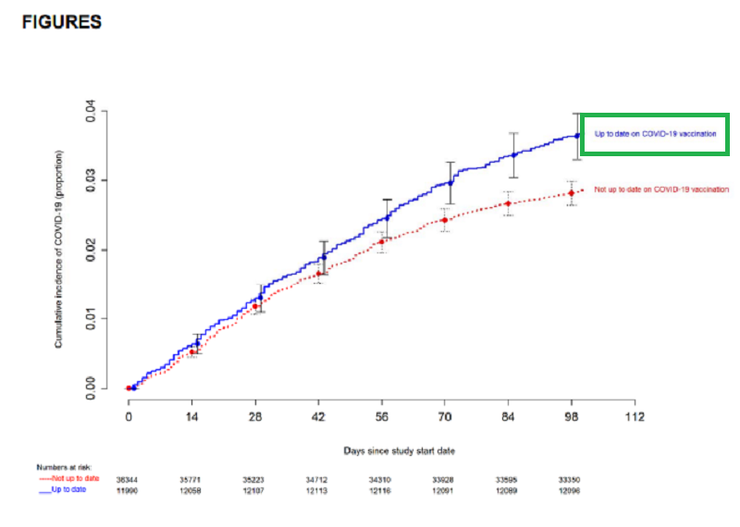
After adjusting for confounding factors between the groups, the study authors actually found a 33% rate of negative efficacy!
“This study’s findings question the wisdom of promoting the idea that every person needs to be ‘up-to-date’ on COVID-19 vaccination, as currently defined, at this time,” conclude the Cleveland Clinic researchers. They also observe, “It should be pointed out that there is not a single study that has shown that the COVID-19 bivalent vaccine protects against severe disease or death caused by the XBB lineages of the Omicron variant.”
The push for boosters comes at a time when more evidence proves a strong correlation between excess deaths and the vaccine take-up. A letter published in a peer-reviewed journal of Medicine and Clinical Science shows that Japan and Germany, two highly vaccinated countries, experienced sharp excess deaths coinciding with the vaccine take-up. They found very little excess death during the pandemic months before the vaccine was rolled out.
“It should be investigated to what extent the about 5%-10% highly significantly increased mortalities in Germany and Japan in 2021 and 2022 might be due to the pandemic countermeasures, including the vaccinations with their possibly underestimated immediate or protracted side effects,” concluded the researchers from Japan and Germany.
“From this point of view, it seems possible that a high vaccination rate has contributed to an increased all-cause mortality in some countries.”
The twisted irony is that, according to the CDC’s variant tracker, XBB.1.5 has gone from 80% of cases to less than 40% of cases in just a few months. It will clearly be obsolete by the fall. None of this was discussed at the FDA hearing. Of course, nothing about Pfizer’s own document showing five million cumulative reports of adverse events affecting every organ system was ever discussed. Hence, we have record injuries, negative efficacy, long-term immune imprinting causing the body to constantly respond inappropriately to wrong strains of the virus – all for a virus that is no longer deadly and for a population that has already gotten the virus!
That’s not just a lousy cost-benefit analysis; that is premeditated murder against the American people. What is the GOP plan to stop this? Or do Republicans even care? How can they continue to fund more COVID shots in the HHS appropriations bill, much less the broader FDA/CDC scheme to create new dangerous shots at warp speed?
Just how callously does the FDA regard human life? After its own VAERS system exploded with every adverse event imaginable, an outcome we now know officials anticipated, to this day they have not followed up on those safety signals. For example, according to the Informed Consent Action Network, the Standard Operating Procedures and Policies document for the FDA’s Vaccine Safety Team requires that its staff members identify VAERS adverse event reports that “need a rapid response and complex coordination,” after which they are supposed to “immediately” inform certain FDA management, who then alert other sub-agencies. Did that occur?
Well, more than a year after the ICAN’s record request, the agency responded, “A search of our records did not locate any documents responsive to your request.”
Where is the action from the House GOP? Why are they still only investigating the shutdown of schools in the past, but not the ongoing, premediated unleashing of deadly products on the American people?
Asia-Pacific is where China-Russia “no limits” partnership will be put to test
BY M. K. BHADRAKUMAR | INDIAN PUNCHLINE | JUNE 11, 2023
The power dynamic in Northeast Asia is undergoing a dramatic change against the backdrop of the “no limits” strategic partnership between China and Russia. Ukraine’s defeat in the war with Russia may compel the Biden administration to put “boots on the ground” triggering a global confrontation and, equally, the US-China relations are at their lowest point since their normalisation in the 1970s, while Taiwan issue may potentially turn into a casus belli of war. To be sure, the Northeast Asian theatre is going to be a crucial arena in the brewing big power confrontation.
Symptomatic of the cascading tensions, Russian foreign ministry summoned the Japanese ambassador on Friday and a protest was lodged in extraordinarily harsh language, as it came to be known that the 100 vehicles that Tokyo innocuously promised last week to Ukraine would in reality be armoured vehicles and all-terrain vehicles. Apparently, Tokyo was dissimulating, since Japan’s export rules ban its companies from selling lethal items overseas!
Tokyo is crossing a “red line” and Moscow is not amused. The foreign ministry statement on Friday “stressed that the administration of Prime Minister Fumio Kishida should be ready to share responsibility for the deaths of civilians, including those in Russia’s border regions… (and) driving bilateral relations even deeper into a dangerous impasse. Such actions cannot remain without serious consequences.”
Significantly, on Friday, in a video conference with General Liu Zhenli, Chief of Staff of the Joint Staff Department of China’s Central Military Commission, the Chief of the General Staff of Russian Armed Forces and First Deputy Minister of Defence General Valery Gerasimov expressed confidence in the expansion of military cooperation between the two countries and noted, “Coordination between Russia and the People’s Republic of China in the international arena has a stabilising effect on the world situation.”
The Chinese media later reported that the two generals agreed that Russia will participate (for the second time) in the Northern/Interaction-2023 exercise organised by China, signalling a new framework of China-Russia joint strategic exercises alongside the joint air patrol over the Sea of Japan and the East China Sea by their strategic bombers. By the way, the sixth such joint air petrol was conducted on Tuesday since the practice began in 2019.
The big picture is that the shift in Japanese policies through the past year — close alignment with the US regarding Ukraine; copying the West’s sanctions against Russia; supply of lethal weaponry to Ukraine, etc. — has seriously damaged the Russo-Japanese relationship. On top of it, Japan’s re-militarisation with American support and its growing ties with the NATO (which is lurching toward the Asia-Pacific) makes Tokyo a common adversary of both Moscow and Beijing.
The imperative to push back this resurgent US client is strongly felt in Moscow and Beijing, which also has a global dimension since Russia and China are convinced that Japan is acting like a surrogate of American dominance in Asia and is subserving western interests. On its part, in a turnaround, Washington now actively encourages Japan to be an assertive regional power by jettisoning its constitutional limits to rearmament. It pleases Washington that Japan pledged a long-term increase of over 60 percent in defence spending.
What worries Moscow and Beijing is also the ascendance of revanchist elements — vestiges of Japan’s imperial era — in the top echelons of power in the recent period. Of course, Japan continues to be in denial mode as regards its atrocities during the period of its brutal colonisation of China and Korea and the horrific war crimes during World War 2.
This trend bears striking similarity to what is happening in Germany, where too the pro-Nazi elements are reclaiming habitation and a name. Curiously, a German-Japanese axis is present at the core of Washington’s strategies against Russia and China in Eurasia and Northeast Asia.
The German Bundeswehr is expanding its combat exercises in the Indian and Pacific Oceans and will deploy more naval and air force units to the Asia-Pacific region next year. A recent German report noted, “The intensification of German participation in Asian-Pacific regional manoeuvres is taking place at a time when the United States is carrying out record-breaking manoeuvres in Southeast Asia, in its attempts to intensify its control over the region and displace China as much as possible.”
Japan’s motivations are easy to fathom. Apart from Japanese revanchism which fuels the nationalist sentiments, Tokyo is convinced that a settlement with Russia over Kuril Islands is not to be expected now, or possibly ever, which means that a peace treaty will not be possible to bring the World War 2 hostilities to an end formally. Second, Japan no longer visualises Russia to be a “balancer” in its troubled relationship with China.
Third, most important, as Japan sees the rise of China as a political and economic threat, it is rapidly militarising, which in turn creates its own dynamic in terms of both upending its power position in Asia as also integrating itself with the West (“globalising”). Inevitably, this translates as promoting NATO in the Asian power dynamic, something that cuts deep into Russia’s core national security and defence strategies. Consequently, whatever hopes the strategists in Moscow had nurtured in the past that Japan could be weaned away from the US orbit and encouraged to exercise its strategic autonomy have evaporated into thin air.
Arguably, in his zest to integrate Japan into the US-led “collective West”, Prime Minister Kishida overreached himself. He behaves as if he is obliged to be more loyal than the king himself. Thus, on the same day that President Xi Jinping visited Moscow in March, Kishida landed in Kiev from where he went to attend a NATO Summit and openly began lobbying for establishment of a NATO office in Tokyo.
Kishida followed up by hosting NATO Secretary-General Jens Stoltenberg in Tokyo and giving him a platform to berate China publicly from its doorstep. There is no easy explanation for such excessive behaviour. Is it a matter of impetuous behaviour alone or is it a calculated strategy to gain legitimacy for the ascendance of revanchist elements whom Kishida represents in the Japanese power structure?
To be sure, Northeast Asia is a priority now for China and Russia, given their overlapping interests in the region. NATO expansion to Asia and the sharp rise in the US force projection bring home to the defence strategists in Beijing and Moscow that the Sea of Japan is a “communal backyard” for the two countries where their “no limits” strategic partnership ought to be optimal. The Chinese commentators no longer downplay that the Russian-Chinese military ties “serve as a powerful counterbalance to the US’ hegemonic actions.”
It is entirely conceivable that at some point in a near future, China and Russia may begin to view North Korea as a protagonist in their regional alignment. They may no longer feel committed to observe the US-led sanctions against North Korea. Indeed, if that were to happen, a host of possibilities will arise. The Russian-Iranian military ties set the precedent.
Japan to open NATO liaison office in new provocation against China and Russia
By Ahmed Adel | May 15, 2023
Japanese Foreign Minister Yoshimasa Hayashi announced that his country is considering opening a NATO liaison office, demonstrating that Tokyo is deepening its ties with the US and becoming more hostile to China and Russia. Tokyo’s rapprochement with NATO would strengthen the anti-China/Russia alliance and advance the US plans to create a NATO-styled organisation in the Far East.
“We are already in discussions, but no details (have been) finalised yet,” Hayashi said on May 10.
He specifically referenced Russia’s special military operation in Ukraine as something with repercussions far beyond Europe’s borders that made Japan rethink regional security.
“The reason why we are discussing about this is that since the aggression by Russia to Ukraine, the world (has) become more unstable,” he claimed. “Something happening in East Europe is not only confined to the issue in East Europe, and that affects directly the situation here in the Pacific. That’s why a cooperation between us in East Asia and NATO (is) becoming … increasingly important.”
However, the foreign minister failed to explain how events in Ukraine affect those in East Asia. Rather, Hayashi is using this as a weak justification for why Japan is militarising, which directly relates to Tokyo’s claims against sovereign seas and territories belonging to China and Russia.
The opening of a NATO office in Japan does not mean that the country will join the Alliance, but it does open a path for Japan to become a member of an expanded AUKUS (Australia-United Kingdom-United States). This, in turn, will require Tokyo to strengthen its contacts with NATO.
It is recalled that NATO Secretary General, Jens Stoltenberg, went to Japan and South Korea in January 2023 to lay the groundwork for strengthened ties. This is one of the reasons why Tokyo is already involved in conflicts that are not directly related to the region, despite some of the mental gymnastics it procures to create a justification.
The Japanese government is also providing $5.5 billion in aid to Ukraine, which can be seen as a step forward for the country to join AUKUS and confirms Tokyo’s intentions to strengthen its relationship with NATO. However, NATO will not officially expand to include Japan because members of the Alliance, such as Hungary, do not always align their position for the sake of serving US interests.
At the same time, France, at least in rhetoric, is seeking a degree of autonomy from the US. French President Emmanuel Macron said on April 9 that Europe needs to limit its dependence on the US.
In this way, the expansion of NATO to Asia is not likely since this initiative could lead to a further weakening of unity within the military alliance. The Americans are aware of this, and for this reason, they are working on a separate Eastern bloc to strengthen relations between NATO and Japan, most likely through the AUKUS format.
Suppose the AUKUS bloc includes Japan and intends to become the equivalent of NATO in Asia, with which the Western military alliance will cooperate closely; it would be a significant step in pressuring China and Russia since Japan’s technological and military potential exceeds that of many European countries.
It must be borne in mind that Tokyo’s rapprochement with NATO would reinforce the anti-Chinese/Russian ideology prevailing in the West. However, Tokyo’s actions come at a time when many countries in Asia and even some in Europe do not fully agree with this course of action.
The opening of the NATO office in Japan clearly indicates that the US plans to create a so-called “NATO of the Far East” and is making concrete steps towards this goal.
It cannot be overlooked that Japan’s reestablishment of overly friendly relations with South Korea attests to these plans, mainly as they have unexpectedly gone to a new qualitative level in a single leap. The President of South Korea has already visited Japan, and there are plans for Japanese Prime Minister Fumio Kishida to visit South Korea soon, as well as their impending G7 summit meeting in Hiroshima. This has occurred in recent times despite Tokyo and Seoul being embroiled for many years in mutual accusations on various historical occasions.
The leaders of both East Asian countries now hold a distinctly pro-American stance. If the opening of a NATO liaison office in Tokyo is successful, it can be expected that one will open in Seoul too, especially since the country’s leadership has taken on a provocative position against Beijing and Moscow, including the drawing of red lines concerning the war in Ukraine.
Ahmed Adel is a Cairo-based geopolitics and political economy researcher.
NATO’s Planned Liaison Office In Japan Will Accelerate The Expansion Of AUKUS+
BY ANDREW KORYBKO | MAY 11, 2023
“The US Is Rounding Up Allies Ahead Of A Possible War With China”, which the former plans to fight via the emerging alliance system that can be described as AUKUS+ if it unfolds. This refers to that regional group’s function as the core of a larger anti-Chinese network that informally includes Japan, New Zealand, the Philippines, and South Korea. NATO will also obviously play a role too, with that bloc building upon its Secretary-General’s related statement of intent by opening a liaison office in Japan.
Foreign Minister Yoshimasa Hayashi told CNN that this development is supposedly due to the Ukrainian Conflict making the entire world less stable, but the reality is that this is part of a preplanned move to more effectively coordinate the containment of China. It would have happened on a different pretext had that aforementioned conflict’s latest phase not broken out last year, but that event provided a convenient excuse for speeding up their plans and disguising them as anti-Russian instead.
NATO’s liaison office in Japan will serve as that alliance’s first official outpost in the Asia-Pacific, thus enabling it to more directly organize AUKUS+’s expansion. Assembling that regional dimension of this emerging system is important in and of itself, but the European one is indispensable for maximally pressuring China. It’s therefore expected that more countries from the continent will soon dispatch vessels to the region as part of the joint operations that the liaison office will organize.
This is precisely what EU foreign policy chief Josep Borrell had in mind when suggesting late last month that member states should patrol the Taiwan Strait. Since practically every EU member is also part of NATO, this de facto amounts to that alliance doing this, which is dangerous due to the risk of this provoking an incident with China that could prompt the implementation of Article 5. That’s probably the point though, namely to create a crisis that can justify the further acceleration of AUKUS+’s expansion.
Nothing good is therefore expected to come from the opening of NATO’s planned liaison office in Japan. This development will only destabilize the Asia-Pacific, put additional pressure on China, and thus take the chance that whatever incident transpires as a result is incapable of being contained. It’s an irresponsible risk, but NATO has convinced itself that it’s worth taking in order to speed up its regional hegemonic plans.
America faces major hurdles trying to form ‘Asia-Pacific NATO’
By Drago Bosnic | May 11, 2023
While serving as the UK Foreign Secretary, Liz Truss pompously announced that so-called “Global NATO” was in the making, while also calling for the United Nations to be reformed to the political West’s liking (although quite the opposite is sorely needed). However, the ever-belligerent power pole seems to be having trouble forming even the “Asia-Pacific NATO”, let alone a global organization that would gather virtually all of Washington DC’s vassals and satellite states. The main issue seems to be stemming from the unresolved historical disputes of the Second World War and the way it affected the Asia-Pacific region.
It should be noted that attempts to create a NATO equivalent in the region are hardly new. The United States has been trying to accomplish this for decades during the (First) Cold War. However, the deals would usually fall apart faster than it took them to be signed by all parties involved. Such disunity greatly contributed to the humiliating defeat of US aggression in Vietnam/Indochina half a century ago. Nowadays, similar disunity is once again emerging among America’s East Asian satellite states, specifically between South Korea and Japan. The US insists that the two countries should set their differences aside and go for a historical push that would lead to complete reconciliation.
However, numerous Japanese war crimes during WWII (as well as in the decades prior) are deeply ingrained in the minds of the Korean people, on both sides of the 38th parallel. In fact, it’s one of the few things both Seoul and Pyongyang actually agree on, albeit tacitly. A recent South Korean court case was supposed to resolve the issue of several major Japanese companies using forced labor in Korea during WWII, but Tokyo was still left unscathed by the process, which angered many Koreans. South Korean President Yoon Suk-yeol dubbed the court decision “a step towards trilateral cooperation to defend freedom, peace and prosperity not only in our two countries, but also around the world”.
The “trilateral cooperation” he was referring to is between the US, Japan and South Korea. However, only a third of South Korean citizens support the deal, as they consider it didn’t truly address Japanese war crimes. Worse yet, this isn’t the first time such deals have fallen through. In 2015, a similar arrangement regarding the so-called “comfort women battalions”, another Japanese war crime that went largely unpunished, collapsed shortly after it was announced, as the vast majority of South Koreans rejected the deal. On the other hand, Japan considers this to be a “case closed”, further antagonizing the (rightfully) angered Korean people who suffered tremendously during decades of Japanese occupation.
To add insult to injury, South Korea is doing all this so it could firmly join an explicitly anti-Chinese coalition (and also implicitly anti-Russian), becoming the first country in the line to get quite literally obliterated in a possible superpower confrontation, as if the US inability to deal with North Korea wasn’t enough already. And while Seoul might feel “motivated” by incessant US pressure, the people of South Korea are wholly unmoved. They see China as an important trade partner, as well as a virtually endless market for South Korean pop culture. Thus, they have no interest in an open confrontation (or any other kind) with their giant neighbor. On the contrary, they prefer the current status quo.
The US is worried this could greatly weaken their ability to form a wider and more compliant anti-Chinese coalition. For years, Washington DC has been trying to enlist Beijing’s neighbors in a “freedom and democracy alliance”, the bulk of which would be composed of Japanese and South Korean forces. Precisely this is the reason why Tokyo started a massive rearmament program last year, while Seoul engaged its fast-growing domestic military-industrial complex to arm several key US vassals around the world (particularly Poland). However, the question remains, how ready this anti-Chinese/anti-Russian coalition would be to deal with powers that make North Korea’s nuclear program look like a footnote?
America’s usual warmongering doesn’t only bring instability to the region that enjoyed decades of relative peace, prosperity and economic cooperation, but it also risks leading to the complete fracturing of US-imposed alliances, which itself could backfire and cause Washington DC to lose influence in the region. Naturally, this would be fantastic for the advancement of actual peace, but it makes America’s foreign policy framework look completely self-defeating and even suicidal. Similar efforts have already led to such results, with the Quad (Japan, UK, US, India) effectively dead as New Delhi has outright rejected anti-Russian rhetoric. The only exception to this is the AUKUS (Australia, UK and US), but even this alliance has created issues with other US partners.
Apart from being virtually redundant, as the so-called Five Eyes (UK, US, Canada, Australia, New Zealand) covers its functions, AUKUS created a lot of controversies after Australia backed out of the extremely lucrative submarine deal with France and opted for an arrangement with its Anglo-American overlords. This didn’t only make Canberra look like an outright satellite state, but also made Paris deeply frustrated, which might have contributed to its (for now only apparent) tilt towards Beijing, the very superpower AUKUS is aimed against. Such dictatorial US moves are creating multilayered problems in other geopolitical theaters as America is effectively forcing others to prioritize its national interests over their own.
Drago Bosnic is an independent geopolitical and military analyst.
Bombing Japan After the Atomic Bombings
Tales of the American Empire | April 27, 2023
Americans who read about Japan’s surrender in August 1945 learn only part of what happened because historical accounts are incomplete. They recite the official narrative of the United States government that invading Japan would have caused a million American casualties. Luckily, the United States had developed the atomic bomb. After dropping two atomic bombs Japan quickly surrendered. This official history fails to mention that Japan was seeking to negotiate a surrender since late 1944 after it was clear the war was lost, but powerful people wanted the war to continue longer to demonstrate the power of atomic bombs.
The two atomic bomb attacks produced the same destruction as previous raids involving hundreds of B-29 bombers so they had little impact on the war or Japanese leaders, who were really terrified that Soviet forces had landed in northern Japan. Delaying the end of the war to demonstrate two atomic bombs was immoral and counterproductive. For unknown reasons, the Americans launched a massive bombing raid five days after the second atomic bomb was dropped.
___________________________
“Japs Asked Peace in January”; Walter Trohan; Chicago Tribune; August 19, 1945; http://wyso.weebly.com/uploads/2/2/9/…
Related Tale: “Japan’s Conditional Surrender”;  • Japan’s Condition…
“Was There a Diplomatic Alternative? The Atomic Bombing and Japan’s Surrender”; Jeremy Kuzmarov; The Asia-Pacific Journal; October 15, 2021; https://apjjf.org/2021/20/Kuzmarov-Pe…
“The B-29 Raid That Ended World War II”; J.A. Hitchcock; http://www.jahitchcock.com/mission/b2…
“Bombing of Kumagaya in World War II”; (five days after Nagasaki was bombed); Wikipedia; https://en.wikipedia.org/wiki/Bombing…
“American Had Plans to Help Russia Invade Japan During World War II”; Sebastien Roblin; The National Interest; December 31, 2020; https://nationalinterest.org/blog/reb…
Related Tale: “The Japanese Victory on Iwo Jima”; • The Japanese Vict…
Related Tale: “The Disastrous Liberation of the Philippines”; • The Disastrous Li…
Twitter Received 16,000 Information Requests From Over 85 Governments at Start of 2022
Sputnik – 25.04.2023
WASHINGTON – Twitter said on Tuesday that it received more than 16,000 government information requests for user data from over 85 countries in the first half of 2022 alone.
“Twitter received over 16,000 government information requests for user data from over 85 countries during the reporting period. Disclosure rates vary by requester country,” the social network said in a press release.
The United States, France, Japan, Germany and India were the top five requesting countries for the period, the release said.
Twitter also received about 53,000 legal requests from governments around the world to remove content, with the majority of requests coming from Japan, South Korea, Turkey, and India, the release added.
In the first half of 2022, Twitter required users to remove 6,586,109 pieces of content that violated the company’s rules – an increase of 29% from the second half of 2021, according to the release.
America faces a two-front war: Russia-China alliance moving ahead at great speed
By Gilbert Doctorow | April 14, 2023
Today China officially announced the visit of their Minister of Defense Li Shangfu to Russia on Sunday for three days of consultations with his Russian counterpart Sergei Shoigu and also with Russia’s senior military command in charge of the war operations in Ukraine.
Li Shangfu took his present post a little over a month ago following the re-election of Xi Jinping to the presidency and a reshuffling of ministerial portfolios. It was particularly noteworthy that Li has been on the U.S. sanctions list since 2018 for alleged cooperation with Russia.
The sense of this visit was interpreted by expert panelists on the news and analysis program Sixty Minutes earlier today as follows: to inform the Chinese leadership of what has been learned by the Russian command from the 14 months of war in Ukraine.
What is the relevance of Russia’s on the ground experience? Although armchair generals in the West were very quick to fault Russia with making serious mistakes and showing unpreparedness in the first phase of the war, the reality is that since WWII no major power has been engaged in a peer-to-peer war entailing vicious fighting on the ground without enjoying command of the skies. That is what we see in Ukraine today. The United States has had no such experience. Nor has China.
The Russians now have a lot to tell their Chinese friends about the latest NATO military tactics and about the U.S. and European hardware that is being given its baptism by fire in direct engagement with themselves. The capture of a German Leopard tank in battle near Kherson yesterday is just one of many war trophies that the Russians can lend out.
Will such sharing of information critically important to China as it examines the possibility of a similar armed conflict with the United States and its proxies over Taiwan be cost free? Of course not. We may take it as a given that during the visit of Li to Russia, he and the Russians will be planning further steps to turn their strategic partnership into something more closely resembling a full-blown military alliance with mutual security obligations.
Meanwhile the Russian Pacific fleet is now on full alert and performing exercises to repel an unidentified potential aggressor. A gentle hint as to who this aggressor might be is the fact that particular attention is being given to maneuvers around the Kurile Islands, over which Japan has territorial claims. Though the subject is not much discussed in our mainstream media, the Russians consider the Japanese navy to be a formidable force. Japan is one of the key allies in the “Pacific NATO” that the U.S. is currently building to contain China and, as needed, to fight a big war against Beijing.
Also worth noting is that last week the Chinese military response to the meetings in California by Taiwan president Tsai Ing-wen with Speaker of the House Kevin McCarthy was to simulate an air and sea blockade of Taiwan. This in turn elicited a call by the ever inflammatory Senator Lindsey Graham (R – South Carolina) for the U.S. to disrupt the flow of oil from the Middle East to China in the event of a blockade being imposed on Taiwan. If anything can hasten the signing of a full military alliance between Russia and China, it is precisely that threat.
All of the foregoing latest developments necessarily raise a question that was not discussed on Russian television but which is highly timely for Americans to deal with on their own: whether the Biden Administration, by its ongoing reckless foreign and military policy that is headed towards an unwinnable two-front war, is not betraying the security interests of the United States. I leave it to legal experts whether that would constitute an impeachable offense.
©Gilbert Doctorow, 2023
Japanese environment economist says ALPS-treated Fukushima radioactive wastewater still contains radionuclides
Tokyo urged to stop dumping plan
By Xu Keyue | Global Times | March 27, 2023
While stressing that the so-called treated water from the destroyed Fukushima nuclear plant still contains radionuclides that are not able to be removed, a renowned Japanese environment economist said in an exclusive interview with the Global Times recently that we must persistently demand that the Japanese government and the Tokyo Electric Power Co (TEPCO) stop dumping the nuclear-contaminated wastewater into the ocean.
Kenichi Oshima, professor at Ryukoku University, told the Global Times that the Japanese government and TEPCO should not release the nuclear-contaminated wastewater.
The Japanese government and TEPCO plan to use ALPS – Advanced Liquid Processing System – to treat the nuclear-contaminated wastewater from the Fukushima nuclear accident and then release the treated water into the ocean. The treated water contains radionuclides including ruthenium, strontium-90 and iodine-129, in addition to tritium, Oshima noted.
Before the release, TEPCO developed a “Radiation and Environmental Impact Assessment Report on Ocean Discharge of ALPS Processed Water” to assess the impact of ocean discharge.
“Nevertheless, we believe it is impossible to accurately predict the ecological effects of ocean discharges over the next several decades,” the Japanese environment economist said.
Commenting on the so-called treated Fukushima water, Mao Ning, spokesperson for the Chinese Foreign Ministry, said on Monday that Japan has been claiming that ALPS-treated nuclear-contaminated water is safe and harmless and that it opposes calling the water “nuclear-contaminated”. The fact, however, is that the water contains over 60 radionuclides, many of which cannot be treated effectively with existing technologies.
Some long-lived radionuclides may spread with ocean currents and form a bioconcentration effect, which will multiply the total amount of radionuclides in the environment, causing unpredictable hazards to the marine environment and human health, Mao pointed out, noting that the discharge will last as long as 30 years or even longer.
Mao’s remarks are made in response to Japanese Minister of Economy, Trade and Industry Yasutoshi Nishimura, who claimed on Friday that the use of “nuclear-contaminated water” is a “misunderstanding of facts” after the heads of state of China and Russia expressed serious concern about Japan’s plan to dump the nuclear-contaminated water in a joint statement released on March 21.
The maturity and effectiveness of the ALPS technology has not been evaluated or certified by a third party, and the treatment of such large quantities and complex components of nuclear-contaminated wastewater is unprecedented, and its long-term effectiveness is in doubt, Mao said.
Oshima noted that in 2015, the Japanese government and TEPCO pledged in writing that they would never discharge the nuclear-contaminated water into the ocean without the understanding of fishermen and the public. The Japanese government and TEPCO have been explaining the situation to fishermen and local residents but have not obtained their consent.
However, the Japanese government and TEPCO are not listening to the voices of the people, including those involved in the fishing industry, Oshima revealed.
“We must persistently demand that the [Japanese] government and TEPCO stop discharging ALPS-treated water,” he stressed.
The Japanese professor raised two alternatives in dealing with the radioactive wastewater.
The first is to store the water in large tanks. The half-life of tritium is 12.3 years, so after 123 years of storage, the radioactivity will have decayed to 1/1,000 of its original level. Japan has experience in oil stockpiling, so this is feasible, said Oshima.
The second is mortar solidification. Mortar solidification can prevent leakage. Mortar solidification has been used in the US, Oshima noted.
What Japan needs to do now is to take seriously the legitimate concerns of the international community, faithfully perform its international obligations, handle the nuclear-contaminated water in the safest and most prudent way, including fully studying alternatives to ocean discharge, Mao urged.
Also, rather than whitewash its ocean discharge decision, Japan needs to fully subject itself to international oversight, and avoid, to the maximum extent possible, imposing unpredictable risks on the international community, Mao said.
CNN admits America trying to use Ukraine conflict to ‘isolate’ China
By Drago Bosnic | March 10, 2023
It’s certainly no secret that the United States has been trying to foment yet another conflict in the immediate vicinity of its geopolitical adversaries. This is particularly true in regards to Russia and China, the only near-peer rivals capable of not only resisting, but also challenging Washington DC’s disastrous hegemony. It is precisely this that makes both superpowers prime targets for encirclement and destabilization, with the end goal being either their complete dismantlement or, at the very least, weakening to a point where they would be forced to accept US dominance without much (or any) opposition. To accomplish this, the belligerent thalassocracy has been using everything at its disposal, from false narratives disseminated by the massive mainstream propaganda machine to more “hard power” schemes such as weapons deliveries and (in)direct military involvement.
Most observers have always seen the connection between Russia and China or, more specifically, between their interests in Ukraine and Taiwan, respectively. These legitimate interests (primarily relating to, but not limited to security) have been targeted by the US and its numerous vassals. Both Moscow and Beijing are perfectly aware of this and are working towards building closer ties, especially on a strategic level, to counter escalating US aggression while maintaining their respective foreign policy frameworks, which aren’t always 100% convergent in every aspect. However, this does not impede their growing cooperation in any way, as can only be expected from truly sovereign nations. This is causing a tremendous amount of frustration in Washington DC, prompting it to mobilize its propaganda machine to try and tarnish the (Eur)Asian giants’ reputation.
A recent piece published by the infamous CNN perfectly illustrates the thinking behind US attempts to use the aforementioned crises against both Russia and China. Authored by Brad Lendon and titled “Ukraine war has made it easier for US to isolate China in the Pacific”, the analysis is an admission of sorts that Washington DC is pushing both conflicts.
Expectedly, the author claims that China is supposedly “backing” Russia just by virtue of Beijing’s continued refusal to join the political West’s siege of Moscow. Lendon claims that this perceived support has pushed Japan to double military spending and acquire long-range weapons from the US, while entirely ignoring the enormous pressure Tokyo has been exposed to in the last 12 months to “up the ante” and commit more of its increasingly depleted resources to the “defense of shared values”.
And while the author praised the new Japanese $320 billion remilitarization program, he harshly criticized China’s own regular military activities as “destabilizing”. This is just further proof that the incessant hypocrisy and double standards are the mainstays of US foreign policy. Lendon claims that “China’s actions are pushing the Asia-Pacific allies closer than ever before”, openly admitting that the Ukraine conflict is “very useful” for Washington DC in this regard. He then quoted the Chinese Premier Li Keqiang as saying: “The [Chinese] armed forces should intensify military training and preparedness across the board, develop new military strategic guidance, devote greater energy to training under combat conditions and make well-coordinated efforts to strengthen military work in all directions and domains.”
The CNN insists that the outgoing Chinese premier stated this as part of a government work report. Either way, the US is surprisingly open about its plans, with the recently revealed National Security Strategy (NSS) envisioning a greater strategic role for America’s numerous satellite states. While Donald Trump’s approach was more isolationist and focused on economic warfare, the Biden administration is showing much more belligerence, as well as a tendency to relegate portions of its power projection to allies and vassals such as the UK, Australia, Japan, etc. Somewhat surprisingly, Lendon claims that South Korea is now also joining the fray.
“Peace and stability in the Taiwan Strait is essential for peace and stability on the Korean Peninsula and it’s indispensable for security and prosperity of the region as a whole,” South Korean Foreign Minister Park Jin told CNN recently.
This is somewhat uncommon for Seoul, which has previously been careful not to antagonize Beijing, with which it has extensive economic cooperation. If CNN’s claims are true, this would signal a dramatic strategic shift in the Asia-Pacific, further splitting the region along geopolitical fault lines and eroding decades of essentially unlimited economic cooperation. Perhaps this might be exactly what the US wants, as per CNN itself, but it might also backfire into yet another spectacular US foreign policy failure. Lendon insists that South Korea is worried about Pyongyang and that this is the main reason it is further integrating with the US-brokered anti-Chinese coalition.
However, it could be argued that it is precisely this action by Seoul that could escalate tensions between the North and the South, particularly if the latter further antagonizes and alienates Beijing, which has been playing quite a constructive role in defusing tensions in the Korean peninsula. The destabilization could also be exacerbated by South Korea repeatedly floating the idea of potentially acquiring its own nuclear weapons, a course of action the US has not shown any opposition to while still insisting the North should disarm. Needless to say, Pyongyang is not only refusing to comply with such a suicidal request, but is even expanding its strategic capabilities, much to the chagrin of Washington.
In conclusion, Lendon laments that the Ukrainian crisis “has not been helpful in one key American partnership in the Indo-Pacific, the informal Quad alliance linking the US, Japan, Australia and India”, as New Delhi, “unlike the other three members”, has not condemned Russia’s counteroffensive against NATO aggression in Europe. “When the US, Australia, and Japan tried to condemn Russia through a joint statement, India refused…
India claimed that the Quad only tackles Indo-Pacific challenges, and since Russia isn’t in the region, this topic cannot be broached,” the piece quoted Derek Grossman, a senior defense analyst at the infamous RAND Corporation. However, he added that “the split in the Quad doesn’t really distract from its focus, as the Quad is all about how to deal with China”, essentially admitting that America is still trying to compartmentalize its geopolitical approach in the region.
Drago Bosnic is an independent geopolitical and military analyst.
Featured Video

John Mearsheimer: US Already lost Iran war – No off-ramp in sight
or go to
Aletho News Archives – Video-Images
Frlom the Archives
70 Neocons Petition Congress To Effectively Allow Israel To Say When The US Should Attack Iran
By Damian Lataan | January 10, 2014
Seventy senior Israeli-centric neoconservatives have written an open letter to Congress imploring them to do more to ensure Iran complies with the conditions of any agreement finally reached with the P5+1 over Iran’s nuclear program.
While the neocons are ostensibly asking Congress to ensure compliance, it is clear that their real aim is to convince members of Congress to support the bill currently passing through the Senate which calls for tighter sanctions against Iran in the event of any waywardness on Iran’s part.
The neocons are eager to see the bill currently passing through the Senate with enough support to make it veto-proof, not so much because they are concerned about Iran’s so-called nuclear weapons program – there’s still not a skerrick of hard evidence that Iran has a nuclear weapons program – but, rather, because embedded within the bill is this clause:
… if the Government of Israel is compelled to take military action in legitimate self-defense against Iran’s nuclear weapon program, the United States Government should stand with Israel and provide, in accordance with the law of the United States and the constitutional responsibility of Congress to authorize the use of military force, diplomatic, military, and economic support to the Government of Israel in its defense of its territory, people, and existence…
Essentially, the clause is an automatic trigger for the US to attack Iran at any time the Israelis choose to launch a first strike – regardless of whether President Obama is in favour or not.
Partial list… continue
Blog Roll
 Aletho News
- ‘Heinous crime’: Iran denounces Israeli assassination of 4 Iranian diplomats in Lebanon
- John Mearsheimer: U.S. Already Lost Iran War – No Off-Ramp in Sight
- UK Parliament Plans ISP Blocking and Age Verification Powers
- World cannot remain silent as US and Israel attack ‘heritage of humankind’: Iran
- Emirati billionaire rebukes US senator over call for Gulf states to join war with Iran
- Op. True Promise 4: Iran’s missile blitzkrieg dismantles US war machine in West Asia
- Aramco CEO warns ‘catastrophe’ imminent if Strait of Hormuz remains shut
- What If Iran Says No?
- Trump Threatens to ‘Hit’ Iran ‘Twenty Times Harder’ Over Strait of Hormuz Oil Flows
- Spare the hypocrisy: Baghaei slams Ursula’s support for US
- If Americans Knew
- Israel Decided the War, But Trump’s America Fights and Pays the Bill
- Conscientious Objector Group: Phone ‘Ringing Off Hook’ As Huge Mobilization Underway
- U.S. support for Israel continues to plummet, despite media’s best efforts
- Threats and missiles fly, death tolls soar in Iran, Lebanon, Gaza – Not a ceasefire Day 151
- Lebanon: Israel’s White Phosphorous Use Risks Civilian Harm
- Corporate Media Go All Out To Support The US-Israeli War On Iran
- US-Israel war on Iran is creating a steady growing number of amputees
- Israel planned this war on Iran for 40 years. Everything else is a smoke screen
- The wrong question about the war in Iran
- ‘Your Tax Dollars Being Used to Raise Your Gas Prices’: US-Israel Bomb Major Iranian Oil Depots
- No Tricks Zone
- New Study Documents A 20-Year Pause In Arctic Sea Ice Decline – Driven By Internal Variability
- Wake-up Call: Survey Shows Majority Of Germans Now Favor Postponing Climate Targets!
- Televised! Leading German Political Candidate Tells Schoolchildren CO2 Makes Sun Hotter!
- New Study: A Century Warming Of 1.1°C Is ‘Commonplace’ And ‘Not Unusual’ During This Interglacial
- New Study: ‘Internal Noise’ And Volcanic Forcing Can Trigger 10-15°C Warming Within Decades
- Glaciers Worldwide Are Suddendly Surging, Experts Blame Warming!
- Surprising Discovery: Sahara Is Greening…Billions Of Trees Where Once Thought To Be Barren
- New Research Reaffirms Clouds, Aerosols, And Surface Solar Radiation Are ‘Driving The Climate System’
- Germany: Electric Car Catches Fire At Charging Station, Sets Off Local “Inferno”, Widespread Damage
- New Study: Canada’s New Brunswick Was 1°C Warmer Than Today During The Medieval Warm Period
 Aletho News