Ex-Aussie PM Calls Quad ‘Piece of Strategic Nonsense’
Samizdat – 12.10.2022
The Quad was officially launched in 2007 but suspended in 2008 after Australia pulled out of the US-led grouping over concerns expressed by China. The grouping was revived in 2017, a year after the US announced its ‘Indo-Pacific Strategy’. Beijing has labelled the Quad ‘Asian NATO’, accusing Washington of inciting tensions in the region.
Former Australian Prime Minister Paul Keating has slammed the US-led Quad grouping as “illegitimate” and a “strategic piece of nonsense,” as he advised Canberra to not be a part of the US-led efforts to “ring-fence” China.
The Quad, which comprises Australia, India, Japan and the US, says that its official goal is to maintain a “free and open Indo-Pacific region”.
“We shouldn’t be stringing together the US, Japan, India and Australia to try to contain China,” Keating, a senior party colleague of Prime Minister Anthony Albanese, said on Wednesday.
Keating argued that that Beijing’s “ambitions are in the west, not the east,” as he underlined the inroads made by the Belt and Road Initiative (BRI) in regions outside Asia. “Everywhere between Wuhan and Istanbul, in the next 30 years, will have a huge Chinese influence.”
Keating pointed out that the BRI has already financed infrastructure projects in the Baltic states as well as in former Soviet countries.
The multi-trillion-dollar BRI initiative was launched by Chinese President Xi Jinping in 2013 and strives to connect east Asia with Europe and beyond through connectivity and infrastructure projects. As of March 2022, a total of 147 countries across Asia, Africa, Europe, South America as well as North America have been members of the Beijing-backed global initiative.
Keating also reckoned that the era of US “supremacy” as the pre-eminent global power has already passed.
“This idea that the US is an exceptional power… they have God’s ear and proselytizing democracy was fine in the 20th century. The 20th century was owned by the US. The 21st century belongs to someone else,” stated Keating.
He also expressed doubts whether the US would come to the help of Taiwan if Beijing went ahead with the re-unification of the island with the mainland through military means.
Beijing has doubled down on its commitment to “reunify” Taiwan with the mainland following the visit of US House Speaker Nancy Pelosi to Taipei in August. Chinese President Xi Jinping has said that reunifying Taiwan is part of China’s goal to achieve “national rejuvenation”.
“China would see every amphibious vessel coming towards the United States, whether it is San Diego or Honolulu. They would see them and sink them,” the former Australian PM claimed, suggesting that the chances of an American “victory” in such a scenario would be “nil”.
Keating advised the Australian government not to get involved in the “geopolitical conflict” around Taiwan.
“We should be no more interested in the political system of Taiwan than Vietnam and Kazakhstan,” argued Keating.
Russia to nationalize assets of Japanese carmaker – trade ministry
Samizdat | October 11, 2022
Japanese carmaker Nissan will sell all its Russian assets to state-owned research and development firm NAMI, the trade ministry has said.
The deal, worth a symbolic sum of €1, was approved by the Japanese corporation and includes a plant in St. Petersburg and sales and marketing facilities in Moscow.
“We have managed to reach a formant where the enterprise remains operational. Key competencies, the production cycle and jobs are preserved,” Russia’s Trade Minister Denis Manturov said in a statement on Tuesday.
Nissan has some 2,000 employees in Russia and after the transfer is completed NAMI will be able to attract other companies as production partners to create joint ventures.
According to the minister, Russian carmaker AVTOVAZ will carry out maintenance services for Nissan vehicles, as well as supply spare parts. The deal will give Nissan the right to buy back the business within six years, the trade ministry said.
The scheme is almost identical to the withdrawal of Renault, a member of an alliance with Nissan. In May, the French carmaker’s 68% stake went to NAMI and its factory in Moscow, which produced cars under the Renault and Nissan brands, was transferred to the city government.
Meanwhile, Nissan reported on Tuesday an estimated loss of $686.2 million from leaving the Russian market.
In 2009 the manufacturer started producing SUV models such as the X-Trail and the Qashqai at its plant in St. Petersburg. The Japanese carmaker suspended production there in March due to supply-chain disruptions, following the conflict in Ukraine.
Kamala Harris’ visit to Tokyo aims to destroy Sino-Japanese relations
By Ahmed Adel | September 29, 2022
US Vice President Kamala Harris is on a trip to Japan and South Korea, her first visit to Japan and her second to Asia since taking office early last year. Ahead of the US midterm elections in November, Harris has increased her attacks on China, something she has not stopped doing since arriving in Japan on September 26 for the state funeral of assassinated former leader Shinzo Abe.
During a meeting in Tokyo on September 26, the American Vice President and Japanese Prime Minister Fumio Kishida condemned China’s actions in the Taiwan Strait. A White House statement described Beijing’s actions in the Taiwan Strait as “aggressive and irresponsible provocations.”
Meanwhile, a series of visits to Taiwan by senior US officials and the increased US supply of weapons to the island have heightened tension in the region. It is evident that China’s actions are only a response against US-instigated provocations.
With these statements, the US has increased propaganda and support for actions against China. There is growing Western desire to erode the “One China” principle and Japan is increasingly participating in these actions. For Beijing, it is not just a matter of military exercises, warships passing through the Taiwan Strait and arms shipments to Taiwan, but an intensification of Western propaganda to put psychological pressure on China and normalise the idea of an independent Taiwan.
The gradual erosion of the “One China” principle is evident. Most of Asia is well aware of the American falsehoods, but this is influencing its partners in the West and Japan to the idea of an independent Taiwan.
At the meeting with the Japanese Prime Minister, Kamala Harris reaffirmed the US commitment to Japan’s security, but in return, Washington wants Tokyo to be more active in containing China. Washington’s main aim is to disrupt the process of improving Sino-Japanese relations. The US is counting on Japan’s help to incite tensions with China.
It is recalled that the provocative actions against China by former US Secretary of State Mike Pompeo, who visited Taiwan for the second time this year on September 26, also failed to bring the desired results, according to Chinese Foreign Ministry spokesman Wang Wenbin. On his first trip in early March, Pompeo was awarded Taiwan’s highest award for his contributions in promoting Taiwan-US relations. To express his “deep gratitude”, the American politician described Taiwan as a “great nation” with a developed democracy.
However, his second visit was even more provocative as he announced that Taiwan “doesn’t need to declare independence because it already is an independent country.” This statement prompted the Chinese Foreign Ministry to say in a statement that Pompeo’s calculations will not materialise, describing him as “a former politician of diminished credibility who staged these stunts for personal political gains.”
Adding to insult, Pompeo said in Taiwan: “China’s aggressive conduct, diplomatically, militarily, economically … have changed this region. And it brought those who prefer peace and commerce even more closely together. If we want a free 21st century, and not the Chinese century, the century which Xi Jinping dreams of, the old paradigm of blind engagement must end.”
It has not been unnoticed that the 50th anniversary of Sino-Japanese relations, marked on September 29, has been darkened due to differences over Taiwan. Beijing is becoming increasingly wary of Tokyo as it forges closer ties with Taiwan amid growing tensions, which Harris’ visit only provokes further.
According to Japan Times, an official from a Chinese group for bilateral friendship, who was also involved in commemorative events in 2012 for the 40th anniversary of bilateral relations, pointed to the absence of momentum in celebrating the 50th anniversary. The official said that Chinese people feel betrayed by Japan over Taiwan.
When Beijing and Tokyo normalised ties in 1972, Japan said that it understood and respected the notion that Taiwan is an integral part of Chinese territory. The Global Times, the English mouthpiece of the Chinese government, said this month that Japan “tends to turn its back” on the promise it made 50 years ago.
Japan will be “able to create favourable conditions for the bilateral relations” only by keeping its promise, the Global Times also said.
However, there is little indication that Tokyo wants to deescalate tense relations with Beijing, and rather, it is more likely that things will become worse before they become better, especially following Harris’ visit to Japan and Pompeo emboldening Taiwan towards independence rather than unification with mainland China.
Ahmed Adel is a Cairo-based geopolitics and political economy researcher.
India’s gaffe at Samarkand
BY M. K. BHADRAKUMAR | INDIAN PUNCHLINE | SEPTEMBER 20, 2022
Prime Minister Narendra Modi’s meeting with Russian President Vladimir Putin at Samarkand on September 16 after the SCO Summit turned into a media scandal. The Western media zeroed in on six words culled out of context in the PM’s opening remarks — “today’s era is not of war”— to triumphantly proclaim that India is finally distancing itself from Russia on Ukraine issue, as the US and European leaders have been incessantly demanding.
Of course, this motivated interpretation lacks empirical evidence and is, therefore, malicious. Besides, Modi also spoke with a rare interplay of emotions by underscoring the quintessence of the Indian-Russian relationship, and his two decade-long association with Putin.
The steamy part cooked up by the US media shows the desperation on the part of the “Collective West” to isolate Russia at a time when even western leaders have candidly admitted that the bulk of the non-western world does not identify with the western narrative on Ukraine and refuses to roll back their relationship with Russia.
Many countries are, in fact, stepping up their cooperation with Russia —Turkey, Saudi Arabia, Egypt, Iran, for example. Curiously, even western companies are loathe to leave the highly attractive Russian market where business returns are high. A report in the Atlantic Council magazine on September 18 highlights that although something like 1,000 multinational corporations had announced that they would be leaving Russia in the wake of the western sanctions, “the unfortunate reality is that… three-quarters of the most profitable foreign multinationals remain in Russia.” Thus, statistically, while 106 western companies exited the Russian market, over 1,149 internationals still remain and simply keep silent about it.
The giant Sakhalin-2 oil-and-natural-gas project in the Russian Far East is a celebrated case where two big energy Japanese investors Mitsui and Mitsublishi, with government support, simply refused to quit, as the Russian project supplies 9 percent of Japan’s energy needs. The G7 has no option but to exempt Japan from the purview of sanctions when it comes to Sakhalin-2!
Again, the West continues to import fertiliser from Russia and to that end, lifts the restrictions on shipping, insurance, etc. But the restrictions continue against Russia’s exports of food grain and fertiliser to the non-Western world. Russia has now offered to distribute the fertiliser held up in European ports free of charge to the poorest countries in Africa if only the restrictions for exports are waived, but Europe would rather use it for their own needs.
It has recently been exposed that the brouhaha about a “global food crisis” (which India too mouthed) was basically a cheap hoax perpetrated by the Biden Administration to get Russia to allow the sale of wheat held up in Ukrainian silos to the European market by American companies, who have apparently bought up Ukraine’s farm lands and control that country’s grain trade! Only a fraction of the grain shipments from Ukraine went to poor countries threatened by famine. Suffice to say, the US and the European Union pressure on India’s purchase of Russian oil was nothing but bullying.
That said, India should know that in a situation where Russia faces an existential threat to its security, it will not be deterred in firmly, decisively responding, no matter what anybody says. Will India be deterred if any foreign country gets agitated over state repression in Kashmir? Violence and bloodshed are abhorrent features of the contemporary world situation and is a painful reality all over the world.
That is why, PM Modi’s awkward reference to war and peace in his initial remarks to Putin at Samarkand was way out of place in what turned out to be a “wonderful” meeting otherwise. There was simply no need to have characterised, at PM’s level, the Ukraine conflict as a “war”. It betrayed ignorance, since the whole world knows that what is going on is a proxy war between the US and Russia that had been simmering through the past quarter century ever since NATO began its eastward enlargement with an agenda to encircle Russia. Moscow seriously erred by tolerating the US interference in Ukraine so long until NATO finally appeared on its doorstep. It is doubtful if India would have shown such strategic patience.
Against such a complex backdrop, the litmus test of India’s “neutrality” will, perhaps, lie in EAM Jaishankar at least speaking up on the NATO’s eastward expansion, the US stoking the fire of conflict by pumping tens of billions of dollars worth weaponry into Ukraine, and the Biden Administration’s diabolical role in undermining nascent peace moves between Moscow and Kiev.
If Turkey’s Recep Erdogan and Hungary’s Viktor Orban can speak up, although NATO leaders, why can’t India’s EAM? But, never mind, there is no question of Jaishankar even remotely embarrassing Biden.
From the Kremlin readout, Putin actually acknowledged right at the outset of the conversation with Modi that Russia and India are not on the same page on Ukraine. To be sure, Putin must be knowing that India’s behaviour is guided by its narrowly defined self-interests and conditioned by an itch to do cherrypicking. But Moscow has never been and will never be a demanding partner. Mutual interest and mutual respect are the hall marks of Russian diplomacy toward India. Despite own reservations over what India was doing by splitting Pakistan into two halves, when the crunch time came in 1971, Moscow not only stood by India but even despatched its warships and submarines to guard Indian waters from a potential US military intervention against India. It is, therefore, all the more reason for us to be discreet.
Ironically, India must be one of the few countries that benefits out of the Ukraine conflict. Aside oil, coal and what not at low prices, paradoxically, even the rupee has taken baby steps to commence its indeterminate journey to become a “world currency.” No patriotic Indian will criticise the Modi government for such sophistry. However, confusion arises when morality is injected into all this with a contrived attitude of indignation, when there is really no need for it.
The meeting in Samarkand took place in the context of the SCO’s annual summit. The summit was not about Ukraine but about the profound issues that have surfaced in its wake that will shape the contours of the world order. This SCO summit was special, as it took place amid large-scale geopolitical changes, triggering a rapid and irrevocable transformation of the entire complex of international ties, relations, policies, economy, when a new model based on the real multi-polarity and dialogue is being built.
Everyone understands that the SCO, which represents half the world’s population, will help forge the new world order. Unlike the case with NATO, where all decisions are made in Washington and imposed on America’s “allies”, there is no Pied Piper in the SCO tent. Modi could easily have played a meaningful role at the summit instead of meandering his way aimlessly through the pandemic, supply chains, et al, at a juncture when such profound issues were being discussed by his peer group in Samarkand.
The word “multipolarity,” which was on everyone’s mind in Samarkand, didn’t even figure in Modi’s speech at Samarkand. Whoever drafted the speech must have done it with an eye on Washington. Therefore, don’t blame the US media. They happened to notice all these aberrations and decided to cull out those six sharply-etched words to put India on the mat, mocking it for doublespeak and rank opportunism, and all that hand-wringing by the apologists of our government cannot wash away that stain.
Japan maintains sanctions but boosts its LNG imports from Russia
Japan’s economic woes are compounded by anti-Russia sanctions
By Ahmed Adel | September 20, 2022
Despite being one of the very few non-Western countries to join the US-led sanctions against Moscow, Japan has suddenly tripled the amount of liquefied natural gas (LNG) imported from Russia to solve its energy problem. Although the Japanese government plans to reduce its dependence on Russian gas supplies, it appears that Tokyo cannot immediately give up gas and fuel from the Eurasian country.
According to the Japanese Ministry of Finance, Japan in August increased the amount of LNG imported from Russia by 211.2% compared to last year. It is noted though that crude oil imports in the same period year-on-year decreased by 20.3%. According to the data, coal imports from Russia in August decreased by 32.6% compared to the same period last year.
In the opposite direction, iron ore imports increased by 44.9%. In addition, Japan increased the number of vegetables and fruits imported from Russia by 154%, but reduced the amount of grain and soybean imports by 94-95%. While the total volume of goods exported from Japan to Russia in August decreased by 24.3% compared to the same period last year, reaching $384 million, the amount of Japanese goods imported from Russia recorded an increase of up to 67.4%, with a value of up to $1.15 billion.
The Japanese want to gradually reduce imports of Russian coal and oil, but Tokyo does not want to cut the amount LNG because this is a gas supply that plays an extremely important role in maintaining the country’s economy.
At the end of June 2022, the G7, the group of leading industrialised countries in the world, which includes Japan in its ranks, announced a plan to reduce dependence on the supply of gas, oil, and fuel from Russia. However, the sharp increase in LNG imports from Russia to Japan seems to indicate a different truth. Not only Tokyo, but also many Western countries, will find it difficult to end their dependence on Russian gas in the short and medium term.
It is recalled that Japan’s energy self-sufficiency rate is only 11%, much lower than the US’s 106%, Canada’s 179%, and the UK’s 75%. Therefore, if Russia stops selling oil and gas to Japan, Tokyo will face a great risk of energy insecurity.
This month, G7 countries also announced their intention to impose a price cap on Russian oil. However, the EU itself cannot find a common voice on this issue, especially as Moscow has warned that “unfriendly” countries will not have the opportunity to import oil, gas and fuel from Russia if they impose a cap. This is a scenario that Japan wants to avoid.
According to the Ministry of Economy, Trade and Industry (METI), Japan’s total energy consumption in 2019 is equivalent to 247 million tons of oil, of which natural gas accounts for nearly 8.7%. Renewable energy (other than electricity) accounts for only a very small part, about 0.1% and even tends to decrease slightly over time. In recent years, Japan has not discovered any more natural gas fields of major commercial value. Japan, for its part, only produces about 2 million tons per year.
To meet domestic demand, Japan imported 82.9 million tons in 2018 – from Australia 34.6%, the Middle East 21.7%, and Malaysia 13.6%, but also from host of other countries. In fact, Japan uses LNG mainly for power generation through 37 LNG terminals, with the highest proportion belonging to JERA (42%) and Tokyo Gas (17%).
After the Fukushima nuclear power plant meltdown, Japan changed its energy development strategy, focusing on the issue of safety and energy security. Along with that, Japan also strives to further enhance energy efficiency.
In the context of Japan’s limited potential to exploit renewable energy, the use of nuclear power is opposed by many domestic organisations. For this reason, LNG imports became a key strategy for Japan. By 2030, the share of LNG in Japan’s power generation capacity is forecast to reach 27%.
It is noted though that August marked the thirteenth month in a row that Japan has been importing products more than it has been exporting, with about half of the deficit coming from energy imports from the Middle East.
“The weaker yen is boosting (the cost of) imports at a time of surging energy prices. Energy and grain prices have shown signs of stabilizing recently, but the impact of the sharp drop in the yen will continue for a while with a lag,” one analyst told Japanese daily Mainichi.
In this way, Japan’s anti-Moscow sanctions are also affecting its economy, just as it is all across Europe. There is little evidence either that Tokyo is planning to reverse its sanctions, suggesting that its economic woes will continue to be compounded by the self-sabotaging sanctions imposed against Russia.
Ahmed Adel is a Cairo-based geopolitics and political economy researcher.
US weapons are staying in Japan after drills
Samizdat – September 9, 2022
Some of the heavy weapons brought by the US to Japan for a joint training exercise will remain there for the time being, General Charles Flynn, the US Army’s Pacific commander, has told Reuters.
“It’s an opportunity for us to keep capabilities forward,” Flynn said, as quoted by the news agency on Friday.
On Thursday, Flynn visited Amami Oshima Island to inspect a military base operated by the Japanese Ground Self-Defense Force (GSDF). The facility, which was opened in 2019, is located on the edge of the contested South China Sea and is about 850km from Taiwan, a hotspot of growing US-Chinese tensions.
During a joint press conference with General Yoshihide Yoshida, chief of staff of the GSDF, the visiting US general said the US military presence in Japan helped “deter bad behavior” by other nations. The location of the island is strategically important for countering China, Flynn said.
The US official also inspected the island’s military installations from a helicopter and was given a tour of the Japanese Type 12 anti-ship missiles stationed on it.
According to Reuters, the American military equipment was brought to the Amami Oshima base for the annual Orient Shield military exercise, which lasted for a week and concluded on September 3.
Flynn said the hardware would stay for the next drill, the report said, adding that two more US-Japanese exercises are scheduled for this year. Among the equipment the US is leaving behind are HIMARS wheeled multiple launch rocket systems, which can also fire tactical ballistic missiles, Reuters said.
G7 unveils plan to enforce Russian oil price cap
Samizdat | September 2, 2022
The finance ministers of the Group of Seven influential nations announced on Friday their intention to ban maritime services transporting Russian oil if its price is not approved by ‘international partners.’
“We commit to urgently work on the finalization and implementation of this measure,” representatives from the US, Canada, Germany, France, Italy, the UK and Japan said in a joint statement seen by AFP, without specifying the cap level.
“We seek to establish a broad coalition in order to maximize effectiveness and urge all countries that still seek to import Russian oil and petroleum products to commit to doing so only at prices at or below the price cap,” they added.
The move is aimed at slashing Moscow’s revenues while maintaining a flow of its crude to the international markets, to avoid a price surge.
“We will curtail [Russian President Vladimir] Putin’s capacity to fund his war from oil exports by banning services, such as insurance and the provision of finance, to vessels carrying Russian oil above an agreed price cap,” British Finance Minister Nadhim Zahawi reportedly said, according to a tweet by a Sky News reporter.
According to the statement, the initial price cap will be based on a range of technical inputs, and the price level will be revisited as necessary. “We aim to align implementation with the timeline of related measures within the EU’s sixth sanctions package,” the ministers noted.
Western leaders agreed in June to explore a price ceiling to limit how much refiners and traders can pay for Russian crude. Moscow has made it clear that it would not comply, instead shipping its crude to countries not bound by the cap. Deputy Prime Minister Alexander Novak warned on Thursday that nations that support the price cap will not get Russian crude.
Japanese firms in no rush to leave Russia
Samizdat | July 30, 2022
Japanese companies are no in a hurry to quit the Russian market, amid fears of being unable to return and having to find new suppliers, the Japan Times reported this week, citing a survey from the statistics center Teikoku Databank.
According to the report, within the past month no Japanese companies have announced a suspension or cessation of operations in Russia.
Since Russia became subject to numerous sanctions due to its military operation in Ukraine, 74, or about 40%, of the 168 listed Japanese companies working in Russia announced intentions to leave the country. Of these, however, most said they would only halt some form of operation, while a mere five companies said they would withdraw from the Russian market completely.
According to the survey, Japanese companies attributed their reluctance to withdraw from Russia to fears of losing their niche in what they consider an important emerging market and potential difficulties in finding alternative suppliers.
Earlier this year, reports emerged that the Japanese government had urged the conglomerates Mitsui and Mitsubishi to retain their stakes in the Russian liquefied natural gas (LNG) project Sakhalin-2, which now operates under a new Russian operator, in order to ensure continued LNG flows. Also, a number of Japan’s major automakers, including Toyota, have suspended their activities in Russia over the past several months but have not yet closed their businesses in the country.
Western sanctions against Moscow have forced many international companies to quit the Russian market. However, according to a Yale University survey, just 5% of Japanese companies that had operations in Russia have left, which is tied with Italy for the lowest shares in the G7. This contrasts with 46% for the UK, 33% for Canada, and 27% for the US.
Sanctions catch up to Russian energy project
Samizdat | July 7, 2022
Oil production at Russia’s far-eastern Sakhalin-1 oil and gas project has decreased significantly due to sanctions imposed by the West, according to Russian Deputy Prime Minister Yuri Trutnev.
“As for the Sakhalin-1 project, due to the restrictions imposed … oil production at the project has decreased by 22 times – from 220,000 barrels per day to 10,000 barrels per day,” Trutnev said.
The Sakhalin-1 project produces Sokol grade crude oil off the coast of Sakhalin Island in Russia’s Far East, exporting about 273,000 barrels per day, mainly to South Korea, but also to other destinations including Japan, Australia, Thailand, and the US.
In May, US oil giant ExxonMobil’s Russian unit Exxon Neftegas declared force majeure for its Sakhalin-1 operations due to sanctions. It had become increasingly difficult to ship crude to customers, the company explained.
Project stakeholders, which also include Japan’s Sakhalin Oil and Gas Development consortium and Indian explorer ONGC Videsh, were reportedly having difficulty chartering tankers to ship oil out of the region.
Exxon had earlier announced it would exit about $4 billion in assets and discontinue all of its Russia operations, including the Sakhalin-1 project.
On Thursday, Reuters reported the head of the energy committee in Russia’s lower house of parliament, Pavel Zavalny, as saying that the Sakhalin-1 oil and gas project would be put under Moscow’s jurisdiction, just as the neighboring Sakhalin-2 has.
Last week, President Vladimir Putin ordered the re-organization of the Sakhalin-2 LNG project, transferring ownership to a new, domestic, company.
Moscow responds to Japan’s threat to cap Russian oil prices
Samizdat | July 5, 2022
Tokyo’s proposal to place a cap on Russian oil prices would lead to significantly less oil on the market and could drastically push oil prices higher, former Russian president Dmitry Medvedev warned on Tuesday.
Responding to the idea put forward by Japanese Prime Minister Fumio Kishida on Sunday, Medvedev wrote on his Telegram channel that Japan “would have neither oil nor gas from Russia, as well as no participation in the Sakhalin-2 LNG project” if Tokyo decided to go through with the proposal.
“Japanese PM Kishida recently blurted out that the price ceiling for Russian oil would be set at half its current price. Plus, a mechanism will be created that will not allow the purchase of our oil at a price higher than the established one,” the former president wrote.
He went on to explain what this would mean when “translated from Japanese into Russian,” writing that such a move would severely limit the amount of oil available on the market, causing its price to be “much higher.”
“In fact, it will be even higher than the predicted astronomical price of $300-400 a barrel. Compare this with the dynamic of gas prices,” Medvedev said.
During last week’s G7 summit, the leaders of Germany, France, Canada, the US, the UK, Japan, and Italy agreed to explore the feasibility of introducing temporary import price caps on Russian fossil fuels, including oil, citing the ongoing military conflict between Moscow and Kiev.
However, as the Kremlin has pointed out, implementing a measure such as the one proposed by Japan would first require the approval of other countries. Kremlin spokesperson Dmitry Peskov stated on Monday that Kishida’s idea was merely “a single statement only, without any decisions taken.”
US policies led to ‘new G8’ – Moscow
Samizdat | June 11, 2022
The United States “with its own hands” pushed the countries, which are not participating in “sanctions wars,” to form a “new Big Eight” group with Russia, the Russian State Duma speaker Vyacheslav Volodin said on Saturday.
Following the launch of Russia’s military offensive in Ukraine in late February, the US, EU, UK and many other countries imposed hard-hitting restrictions on Moscow, making Russia the most sanctioned country in the world.
In a Telegram post, Volodin included a table with IMF data on GDP based on purchasing power parity of countries he calls the “new G8” and of countries forming the current G7 (after Russia’s participation in the bloc was suspended over Crimea’s vote to join the country in 2014, the G8 effectively turned into the G7).
“The group of eight countries not participating in the sanctions wars – China, India, Russia, Indonesia, Brazil, Mexico, Iran, Turkey – in terms of GDP at PPP is 24.4% ahead of the old group,” Volodin wrote.
In his opinion, the economies of the G7 members – the United States, Japan, Germany, Britain, France, Italy and Canada – continue “to crack under the weight of sanctions imposed against Russia.”
“The rupture of existing economic relations by Washington and its allies has led to the formation of new points of growth in the world,” Volodin claimed.
While having serious economic difficulties, the US, according to the Duma speaker, continues “doing everything to solve their problems at the expense of others.” Creating tensions will “inevitably” lead the US to lose its world domination, Volodin stressed.
“The United States created the conditions with its own hands for countries wishing to build an equal dialogue and mutually beneficial relations to actually form a ‘new Big Eight’ together with Russia,” he said.
Meanwhile, on Friday, US Deputy Assistant Secretary of State Eric Woodhouse said that Washington and its allies had realized that they would get “spillovers” of anti-Russia sanctions into their own economies. Their determination in imposing sanctions on Moscow, he claimed, has demonstrated a willingness to “accept those costs.”
US Treasury Secretary Janet Yellen admitted on the same day that the anti-Russia sanctions have made a “huge difference to food and energy prices,” amid record-setting inflation. The remarks followed the statement by the Russian President Vladimir Putin who said that “many years of mistakes made by Western nations” in their economic and sanctions policies have caused “a global wave of inflation, disruption of established logistical and manufacturing chains, a surge in poverty and a deficit of food.”
Featured Video
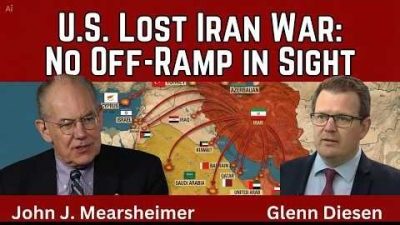
John Mearsheimer: US Already lost Iran war – No off-ramp in sight
or go to
Aletho News Archives – Video-Images
Frlom the Archives
With apparently fabricated nuclear documents, Netanyahu pushed the US towards war with Iran
By Gareth Porter | The Grayzone | April 29, 2020
President Donald Trump scrapped the nuclear deal with Iran and continued to risk war with Iran based on Israeli Prime Minister Benjamin Netanyahu’s claim to have proven definitively that Iran was determined to manufacture nuclear weapons. Netanyahu not only spun Trump but much of the corporate media as well, duping them with the public unveiling of what he claimed was the entire secret Iranian “nuclear archive.”
In early April 2018, Netanyahu briefed Trump privately on the supposed Iranian nuclear archive and secured his promise to leave the Joint Comprehensive Plan of Action (JCPOA). That April 30, Netanyahu took the briefing to the public in a characteristically dramatic live performance in which he claimed Israel’s Mossad intelligence services had stolen Iran’s entire nuclear archive from Tehran. “You may well know that Iran’s leaders repeatedly deny ever pursuing nuclear weapons…” Netanyahu declared. “Well, tonight, I’m here to tell you one thing: Iran lied. Big time.”
However, an investigation of the supposed Iranian nuclear documents by The Grayzone reveals them to be the product of an Israeli disinformation operation that helped trigger the most serious threat of war since the conflict with Iran began nearly four decades ago. This investigation found multiple indications that the story of Mossad’s heist of 50,000 pages of secret nuclear files from Tehran was very likely an elaborate fiction and that the documents were fabricated by the Mossad itself. … continue
Blog Roll
 Aletho News
- ‘Heinous crime’: Iran denounces Israeli assassination of 4 Iranian diplomats in Lebanon
- John Mearsheimer: U.S. Already Lost Iran War – No Off-Ramp in Sight
- UK Parliament Plans ISP Blocking and Age Verification Powers
- World cannot remain silent as US and Israel attack ‘heritage of humankind’: Iran
- Emirati billionaire rebukes US senator over call for Gulf states to join war with Iran
- Op. True Promise 4: Iran’s missile blitzkrieg dismantles US war machine in West Asia
- Aramco CEO warns ‘catastrophe’ imminent if Strait of Hormuz remains shut
- What If Iran Says No?
- Trump Threatens to ‘Hit’ Iran ‘Twenty Times Harder’ Over Strait of Hormuz Oil Flows
- Spare the hypocrisy: Baghaei slams Ursula’s support for US
- If Americans Knew
- Israel Decided the War, But Trump’s America Fights and Pays the Bill
- Conscientious Objector Group: Phone ‘Ringing Off Hook’ As Huge Mobilization Underway
- U.S. support for Israel continues to plummet, despite media’s best efforts
- Threats and missiles fly, death tolls soar in Iran, Lebanon, Gaza – Not a ceasefire Day 151
- Lebanon: Israel’s White Phosphorous Use Risks Civilian Harm
- Corporate Media Go All Out To Support The US-Israeli War On Iran
- US-Israel war on Iran is creating a steady growing number of amputees
- Israel planned this war on Iran for 40 years. Everything else is a smoke screen
- The wrong question about the war in Iran
- ‘Your Tax Dollars Being Used to Raise Your Gas Prices’: US-Israel Bomb Major Iranian Oil Depots
- No Tricks Zone
- New Study Documents A 20-Year Pause In Arctic Sea Ice Decline – Driven By Internal Variability
- Wake-up Call: Survey Shows Majority Of Germans Now Favor Postponing Climate Targets!
- Televised! Leading German Political Candidate Tells Schoolchildren CO2 Makes Sun Hotter!
- New Study: A Century Warming Of 1.1°C Is ‘Commonplace’ And ‘Not Unusual’ During This Interglacial
- New Study: ‘Internal Noise’ And Volcanic Forcing Can Trigger 10-15°C Warming Within Decades
- Glaciers Worldwide Are Suddendly Surging, Experts Blame Warming!
- Surprising Discovery: Sahara Is Greening…Billions Of Trees Where Once Thought To Be Barren
- New Research Reaffirms Clouds, Aerosols, And Surface Solar Radiation Are ‘Driving The Climate System’
- Germany: Electric Car Catches Fire At Charging Station, Sets Off Local “Inferno”, Widespread Damage
- New Study: Canada’s New Brunswick Was 1°C Warmer Than Today During The Medieval Warm Period
 Aletho News