Reflections on how little is revealed by just-released JFK assassination documents and why there had to have been a conspiracy
By John Chuckman | Aletho News | October 30, 2017
In the recent release of files pertaining to the Kennedy assassination, most of the corporate press did not dwell on the fact that the most important and secret files were kept from the public, but, of course, that was actually the big story.
Now, I say that not knowing just what was not released or indeed whether the unreleased files even contain any serious information. You see, in the world of state secrets, secrecy is often used to hide embarrassing incompetence or even criminality. The unreleased documents may be just as uninformative as much of what has been released. So much of what has been released over recent decades is of little hard value to the case. We may legitimately ask, why was a lot of this junk ever declared national secrets to be squirreled away for a half century and more?
I can’t answer that question, but exactly the same question may be asked about so very many things and activities pertaining to the assassination. Of course, it shouldn’t be that way, but it is, and that fact alone screams that important things always were, and still are, hidden. Are the key facts really that unbelievably sensitive? Are they even known?
The question might even be asked whether the authorities themselves ever really understood accurately what happened. The FBI and CIA not even knowing what happened might itself be a worthy state secret, reflecting on the sheer competence of these two massively-funded and often abusive security agencies. God knows, they both have long records of embarrassing and destructive failures at home and abroad.
And, it must be remembered that outfits like the CIA always have fallback positions ready for major activities should the first story spring some unexpected leak. So, even if records were maintained of actual events – something which is not always certain going by CIA’s past record, as in the case of the coup in Guatemala against a democratic government, an event whose files could not be found at their scheduled release date – whatever is eventually released to the public may reflect a fallback narrative. The complexity of filing systems at a place like the CIA permits some amazing antics, and no one from the outside is able to check. That of course is just one of the dangers of having such powerful, secret, and largely unaccountable agencies.
The facts of a murder case – no matter who the victim was, a rather simple murder actually if you believe the Warren Report, a murder by one disgruntled man with a rifle and no accomplices of any kind – should be public information in a free society. What possibly warrants secrecy in such a case? Nothing, of course. Yet we know we have had secrecy and still have it, massively so, and since the earliest days after the crime.
We still face a huge, impenetrable, blank wall, much resembling something from an ancient mysterious tomb, when it comes to this history-changing event.
If the assassination of an elected President can be effectively covered-up, what cannot? And a great many terrible events have happened in the United states since that crime. Vietnam, Cambodia, Afghanistan, Iraq, Libya, Syria plus many other bloody awful things that make little sense and have never been honestly explained to the people by government.
The press still is very fond of the term, “conspiracy theory,” and it is easy to find articles weekly which employ it, but the term should always serve as a red flag for astute readers. It is said to have been coined by a CIA publicist/disinformation officer in 1967 as a way to express ridicule of those doubting the Warren Report, a document in fact riddled with errors and inconsistencies.
I’ve read some documents and summaries of documents recently released, and I have to say that many contain things which were already known. Other things were not known, but they include nothing of decisive importance. (SEE FOOTNOTE REGARDING THIS CLAIM)
We find in the released documents relative trivia like J. Edgar Hoover warning Dallas Police of an attempt on Oswald’s life. A memo which of course could be interpreted as nothing but Hoover covering his behind, something he was very good at, having a great deal of experience doing it.
Hoover was always a suspicious character through the entire assassination events. First, it was his agency that did all the investigative work for the Warren Commission. His Agency that selected which witnesses would testify and which would not, the selection often seeming to show the most perverse inclination to the witness who an unbiased observer might say was the least reliable.
And it was his Agency which browbeat many witnesses into amending details of what they witnessed and told a number of them in threatening terms not to divulge what they were saying. We also have witnesses who later discovered their words in the published Report had been altered from what they actually said.
It is Hoover who early on named the guilty party as Oswald. He never offered any sound reason, always referring to Oswald along lines like “some lone nut communist.”
Hoover was of course aware of Oswald owing to Oswald’s having been a “defector.” And we even have an earlier memo of Hoover’s, never explained, about perhaps someone impersonating Oswald. It just hangs there in space with no context or explanation.
It should be mentioned, too, that Hoover loathed the Kennedys, both of them. I do not believe he was associated with the assassins – though some people very much do – but I think he privately rejoiced in Kennedy’s death. With the President gone, he would no longer be seriously subject to the demands of his formal boss, Attorney General Robert, a man he truly detested. And he would not be asked to retire because Lyndon Johnson loved him.
The investigation of the assassination was also the opportunity to once again preach his favorite official sermon about the extreme danger communists represented to America. He had pursued communists for decades, even at the cost of letting a genuine national threat, the Mafia, grow and prosper. It was said at one time that about thirty percent of the American Communist Party’s members were FBI agents or informants. And, quite simply, Hoover had no motive to relentlessly pursue the people who had actually improved his life as well as America’s, as he saw it.
The arrest of Oswald was one of the most bizarre and unexplained matters in the whole assassination saga. There was no reason at all for anyone to seek him. There was no basis for a suspicion. The only thing that was known not long after the assassination was that Oswald had left work, as did others. A description that went out on police radio was so generic as to be virtually useless in locating any specific person. And why would police converge on a movie theater away from downtown owing simply to a call claiming a man had sneaked in without buying a ticket?
Why was Oswald at that movie theater? Almost certainly to meet someone he knew from the conspiracy, quite likely Jack Ruby. Ruby is very likely to have been the man who earlier shot Officer Tippet on the street. Oswald could not have made it there in time for that event, walking as he did from his boarding house. We have good timing testimony on that killing from several witnesses.
And Tippet was known as a shady cop in Dallas, with right wing associations. He was quite likely involved with the plotters in some minor way. Ruby shot him to silence him just as he may have been headed to the theater to meet and shoot Oswald, but all the sudden heavy police presence prevented him from doing so. He, of course, two days later shot Oswald while right in police custody in a supposedly high-security prisoner transfer.
The summaries of newly released documents which I saw are so uninformative you have to ask yourself why the documents would ever have been classified in the first place.
They include things like the fact that Lyndon Johnson was once a member of the Klu Klux Klan in Texas. Wow, now there is a serious state secret. And a fact, considering all the other horrors of Johnson’s career – documented election rigging, massive financial corruption with people like Billy Sol Estes, foul behavior of every description, starting a massive pointless war in Vietnam, complicity in Israel’s 1967 War and its attack on an American spy ship – the KKK fact seems trivial.
Indeed, as was asked at the time of the assassination, why was any of it a matter of state security and secrecy if the murder was the work of one disgruntled man? Why were any documents ever made secret? And why are many still secret after this dump?
Oswald is said in one document to have spoken with a KGB agent, Valeriy Kostikov, from the KGB’s directorate for assassination, in Mexico City? We already knew that story. You can find it in dozens of books.
The real question remains whether Oswald himself was, in fact, ever in Mexico City? It is just taken for granted by our press, as it pretty much was by the Warren Report.
The CIA covered the Soviet Embassy there with cameras and telephone intercepts 24 hours a day, yet when asked to produce photos and recordings of Oswald for the early investigations, the CIA produced a photo of a total stranger, blindingly clearly not Oswald, and claimed any phone recordings had been routinely erased.
There is not one shred of solid evidence placing Oswald in Mexico City, although we know very well that someone resembling him was there, going between the Cuban and Russian Embassies and bringing a lot of attention to himself. Cuba? Russia? Early 1960s?
Why would anyone do that? The best guess is to have Oswald’s name associated with Cuba when the assassination occurred.
There were other efforts at such association during Oswald’s time in New Orleans. He worked passing out leaflets for the Fair Play for Cuba organization, even though he was never a proper member. Some of these leaflets were actually mistakenly stamped with the address of Guy Bannister Associates on Camp Street, Bannister being a retired fairly senior FBI Agent and a known advocate for right-wing causes.
His Agency was likely in part a front for the CIA’s anti-Castro weapons acquisition and distribution. Remember, these were days of intense anti-Castro activity by the CIA and its proxies like the various anti-Castro groups. A couple of witnesses saw Oswald at the office once or at another location with Bannister.
Oswald’s leaflets, when people filled out the form to support Fair Play for Cuba, simply provided Bannister and those working with him with lists of local Castro sympathizers. The effort of course further associated Oswald’s name with Cuba and with vaguely Marxist sympathies, something that was certainly an act.
Why would he desire to create all that attention? So that, after the assassination, the name Oswald would be firmly connected with those awful places, Russia and Cuba. And believe me, there is nothing in 1963 that the CIA wanted to see more than another invasion of Cuba. The Bay of Pigs invasion by a proxy army of trained refugees in 1961 had badly failed, and part of Kennedy’s agreement with Khrushchev, late 1962, to end the Cuban Missile Crisis included a promise not to invade Cuba. Those two events alone and their aftermath made Kennedy loathed at the CIA and by America’s Cuban refugee terrorist groups in places like New Orleans and Miami.
Another not widely-known fact which screams conspiracy were the previous assassination plots against Kennedy, one in Chicago and one in Miami. The one in Chicago was planned remarkably along the same lines as Dallas. High-power rifles, elevated position, several shooters, and a patsy candidate. It was broken up, but the would-be assailants escaped. In Miami, the President’s trip was changed from a car to a helicopter in the face of serious threat information.
The people actually plotting the assassination wanted not only to get rid of a President they hated but they wanted the assassination itself to provide America with an irresistible cause for invading Cuba in force despite any previous understanding with the Russians. They were trying to “kill two birds with one stone.”
It should also always be borne in mind that Oswald himself had no known motive. He said more than once that he admired Kennedy. He was not really some wild-eyed Marxist either, despite pretenses. Indeed, the suggestion provided by his associations in New Orleans – as Guy Bannister – was that, if anything, he might have had right-wing sympathies. But there is reason not to believe even that. Oswald did work as an FBI informant, despite Hoover’s denial, and I believe that work would have been associated with the Kennedy’s efforts to clamp down on CIA and anti-Castro activities to improve relations with the Soviet Union and Cuba after the Missile Crisis.
The likelihood of Oswald being impersonated briefly in Cuba parallels somebody resembling Oswald involved with a list of pre-assassination incidents in Dallas that we know about. These ranged from a man acting bizarrely while test-driving a car with a salesman and claiming to be Oswald (Oswald himself could not drive) to a man making a spectacle of himself at a shooting range.
Everyone who has read at length on the subject knows there was a man resembling Oswald deliberately and showily doing various odd things around Dallas, there being many witnesses, to call attention to himself in the weeks before the assassination. Indeed, right in the Texas Book Depository, there was another employee named Billy Lovelady who greatly resembled Oswald, enough to often be confused with him. Indeed, Dallas Deputy Sheriff Roger Craig, a man whose various testimony suggests good observational ability, maintained that he thought he saw Oswald leave the Book Depository and jump into a light-colored station wagon which sped away. Oswald himself we know did not leave that way.
Of course, no serious assassin would ever do such things to call extreme attention to himself as someone did in Oswald’s name shortly before the assassination, and the set of events is just one of a number of things which strongly suggest conspiracy.
We still have no indication how Oswald learned to speak Russian in the United States while in the Marines, but we have evidence that he did so fluently although not always with good grammar, and he spoke it before his discharge and going off to the Soviet Union. The Warren Commission studiously avoided details of this tricky topic.
And how did a man who had threatened to tell the Soviets radar secrets about the U-2 spy plane he learned in the Marines, as Oswald very much did, get to return home without any controversy or penalties?
How did he get an early discharge from the Marines on the flimsiest of evidence of a compassionate problem with his mother, whom he left just two days after arriving from the Marines to take off on an elaborately-planned journey to Russia? Who planned that elaborate trip which reflected knowledge of the easiest location for entering the Soviet Union? Who paid his costs?
How did he manage to bring a Soviet wife, who spoke almost no English, with him when he returned to America in less than three years? In the early 1960s, with the “Reds are at the Gates” rage going on? Unbelievable.
And how did he manage to hit upon a group of White Russian emigres and Russian-speakers in Dallas, people who gave the couple all kinds of assistance? And several of those people had past associations with the CIA although they weren’t employees. People like George de Mohrenschildt and Ruth Paine.
Why would White Russian (anti-communist)-associated people take any interest in a so-called Marxist just returned from having defected to the Soviet Union, and a young man of very humble means and origins when some of them were seriously connected? Mohrenschildt, for example, was a sophisticated aristocrat and was related to Jackie Kennedy.
I could make a long list of important facts screaming cover-ups and conspiracy, but I think one of the more important ones came to light recently, and not from these documents. It was from the Cuban refugee, CIA-trained terrorist Antonio Veciana of the violent anti-Castro group, Alpha 66, finally telling us the truth about a famous incident known to all researchers.
Veciana saw a contact of his, a man with the pseudonym Maurice Bishop, talking with Oswald before the assassination. In the past, he would never identify Bishop as the CIA’s David Atlee Phillips, but he finally has done so in his recent book. So here we have a quite senior CIA agent, David Atlee Phillips, meeting with Oswald before the assassination, identified by a man who worked closely with him, albeit under another name.
Again, during the meetings of the Warren Commission, there was an emergency meeting called about the discovery of an FBI informant number for Oswald as well as an uncashed voucher for $200. They simply dropped the whole matter with a self-serving letter from Hoover denying any connection.
We know Oswald had intelligence connections, but still apparently nothing is in this release of trivia.
This dump of bits of redacted papers it seems will add nothing of substance to our understanding, and that is what it clearly was meant to do. It has been done only to say, “See, we told you so.”
Saying that the CIA had no involvement in Kennedy’s assassination is exactly like the claim, made a thousand times, that the CIA had no role in the induced-terror imposed on Syria to topple its government, or, indeed, a long series of ugly coups and assassinations in a number of countries abroad.
In the first moments after the shooting, some police headed uphill on the Grassy Knoll. Many indications from sound to the way crowds moved and pointed suggested something had occurred there. One policeman ran up the slope and began searching behind the barriers with his gun drawn. He met a suited man who quickly offered an official-looking ID card for the Secret Service.
The policeman holstered his gun and didn’t pursue the direction he had been headed. Nor did he note the identity of the “agent.” The trouble with that brief episode is that the Secret Service is known not to have stationed any officers on the Grassy Knoll. It was, of course, a terrible error in their preparations for the motorcade, but it is nevertheless what they did. So, who was the suited man with the false Secret Service ID? And what was he doing there? And where would he obtain such an ID? I think we’re safe in saying he wasn’t Oswald.
The fake Secret Service agent may well have been a man seen by another witness briefly earlier. A man who could only communicate by sign language told a clear story of being on the overpass and noticing a man in a suit, just behind the wooden picket fence that stood along the top of the Grassy Knoll, holding something. He saw the man in the suit swing around and toss what he was holding to another man in work clothes, waiting nearby.
The man who caught what looked like a rifle quickly broke it into two parts, stashed them into his large open toolbox, and walked away. Just behind the Grassy Knoll with its picket fence then was a parking lot and extensive rail yards, just the kind of place for a workman with a tool box to disappear into. The official investigators chose to ignore this witness. Most people who ‘heard” a story like that from a witness speaking in sign language would take it very seriously. After all, in a sense it requires a great of extra effort for such a witness to give his testimony and I think that adds to its credibility.
Why was the immensely important evidence of the presidential limousine so quickly destroyed? The car was sent back to the manufacturer near Detroit to be rebuilt instead of being preserved for serious and extended forensic study. The interior was, of course, spattered with blood, but it also contained bits of bullets and marks from bullets, things which were very important evidence.
There were witnesses at the hospital, when the car was briefly parked in front to deliver the mortally-wounded president, who testified that there were both a bullet crease on the windshield’s chrome frame and a small hole in the windshield’s glass. Shouldn’t this have been preserved for close study and to reassure people that every detail was scrutinized? But it was not. Why? Even if the car was rebuilt, key pieces like the windshield or the rear interior could easily have been set aside, as were so many more trivial objects that found their way into the National Archives.
The most important single piece of evidence in the case, the Zapruder film, has its own remarkable story. The film was purchased from Abraham Zapruder, who happened to be standing on the concrete pergola along part of the Grassy Knoll taking home movies of the parade (just a note, his position was hidden by trees or shrubbery from the position further along the picket fence from which at least one assassin fired). His film was purchased by Life Magazine for what was then a very large amount of money. Actually, you might have thought it should have been seized by local police or FBI as evidence, but for some unknown reason, this single most important piece of evidence ended up in private commercial hands.
Apart from the police not seizing key evidence, what is wrong with that, you might ask? Well, it is just a fact that Henry Luce’s Time-Life publications in those days often worked with and served as covers for the CIA. Allen Dulles was part of Luce’s social circle. Luce himself wrote a famous article in the 1940s called “The American Century,” the title becoming a frequently-used expression, and he was an ardent supporter of the values we associate with the Washington establishment, especially with the CIA.
It is no secret that the Luce news magazines were considered as important keys on the CIA’s “mighty Wurlitzer,” as one former agent referred to the list of publications and writers that was regularly used in getting a story “out there” to the public.
The film was withheld from the general public for a long time. Why should that be? We even had Dan Rather on CBS Television do a little broadcast of what he saw when supposedly shown the film in private. His was a completely false description, as you may easily see for yourself (see FOOTNOTE). Why was that required, a deliberate false description broadcast by one of the most well-known men in American broadcasting? One can only be sure Rather did not just decide on his own to do this or that his broadcast had anything to do with Oswald, except to support the unproved notion that Oswald, supposedly behind the president on the sixth floor of the Texas Book Depository building, was the sole assassin, an idea that had been set in stone early by J. Edgar Hoover.
We have testimony that the film was delivered to a quickly-assembled group of specialists at the CIA by hand. They worked into the wee hours to assemble a “story board” for some very high-level presentation. There’s nothing wrong with that, but at a later date, one of these technicians was shown what we now understand as the Zapruder film, and he said that it clearly was not the original film.
Importantly, the halo we now see above Kennedy’s head as a bullet struck was not on the original film. Instead there was a cone-shaped ejection from the rear of Kennedy’s head. That ejection would, of course, suggest a shot from the front, and it would also support other testimonies as that of a police outrider on his motorcycle being spattered with blood and brain tissue. That simply could not happen with a shot from where Oswald supposedly was.
The film, as we know it, has been altered. You see, we know an early copy of the film – three had been made – was delivered also to the CIA’s top photo lab in Rochester for work. This was a lab in which almost anything possible to do with film could be done. The world’s best equipment and top experts worked there. We do not know what was done, but considering the comment, above, of the technician who worked on what definitely was the original film, it would appear changes were made to a copy that resulted in the film we now see.
There are a great many more such serious issues left totally unresolved today, the kind of issues which should not be unresolved with the most ordinary murder, let alone the murder of a president. Perhaps the greatest set of issues is around the President’s autopsy. There is a huge set of issues here, and I won’t go through them all. Several entire books have been written on the topic, including the very important “Best Evidence” by David Lifton. I’ll mention only a few glaring matters.
In the Zapruder film, we see President Kennedy, his car emerging from behind a freeway sign, grasping at his throat with both hands. Clearly, even in the altered film we have – and there is reason to believe that this emergence-from-behind-the-sign sequence was also altered – Kennedy was hit by a bullet in the throat. The emergency medical people attending him – all experienced, very senior people – later described the wound as a small puncture wound just above the knot of his necktie, a puncture wound with bullets invariably indicating an entrance wound. A tracheotomy was performed – involving two tiny slits (about two centimeters long) on the sides of the wound – to accommodate the insertion of a tube for emergency breathing.
Now at some point in time later, autopsy photos of the President were taken by someone and distributed to the press. Some of them are strange and mysterious photos, poorly lighted, not always well focused, and in black-and-white – not at all to the standard of official autopsy photos of the time. The most striking one is of Kennedy on his back with his eyes still open. There is a sizable gash in the center of his throat, big enough to almost resemble someone having started to try slashing his throat. This was what the official autopsy doctors and technicians saw, and it bears no resemblance to what was described in Dallas. This strange wound ended-up being called an exit wound for a bullet which entered Kennedy from behind – in other words, the direction of the bullet making it was reversed.
The official autopsy notes, which of course in a murder case becomes an important legal document, were destroyed later and burned by the doctor writing his report. He wrote fresh ones, and we have often been given the silly excuse (silly certainly when it comes to matters like an autopsy) that this was because the original notes had blood on them. This destruction was an illegal act.
Of course, legality played very little role in how the President’s body was treated. We know that local officials in Dallas demanded that the body be autopsied there, as required by law, and a literal fight broke out with the Secret Service drawing guns to wheel the body away. The body was flown to Washington along with Mrs. Kennedy and Lyndon Johnson. Even its treatment then is seriously in doubt with many bits of evidence suggesting it was not even in the coffin brought along with Mrs. Kennedy to the autopsy hospital. Instead it appears to have been delivered in the rear in a kind of cheap shipping coffin.
The importance of this lies in the fact that we have testimonies that the President’s body, when received for formal autopsy, had already had some medical work done on it. The technician receiving and opening the shipping case has described what he found which you can read in Lifton’s book.
Further, and very importantly, two FBI agents who attended the autopsy made notes which became an official record apart from the doctor’s report. Two riveting small items are in that FBI write-up. The first involves the agents’ description, before the autopsy was started, of the body as having had some “surgery about the head.” We are given no details. The second is a tiny mention of receiving a “missile” removed from the President by one of the doctors. Again, no details. Was this missile the bullet that we believe entered Kennedy’s neck from the front?
We don’t know exactly what happened to the President’s body in being moved from Dallas to Washington. Was his body ever in the casket with Mrs. Kennedy and President Johnson? Had it been sent off separately for the quickest possible receipt in Washington? Or was it surreptitiously removed aboard the plane? The fact is that work was done on the body by someone somewhere in Washington before the official autopsy seems beyond dispute. The autopsy proper, an event with a number of generals and admirals and big suits standing in the room as witnesses, must have been a very bizarre event. Why were they necessary?
Why was the autopsy even held in a military facility with military doctors and many high-ranking military men watching and even sometimes telling the doctors what to do, as one of the doctors related years later? The military autopsy doctors did not compare in expertise to the pathologist in a large American city like Dallas where shootings are frequent. But of course, military doctors follow orders.
Another intriguing and unexplained event involving the trip back to Washington was Lyndon Johnson’s insistence on being sworn into office. We’ve all seen the photos taken inside the plane. Poor Mrs. Kennedy had to stand there in a confined space, still in her blood-spattered clothes, watching the man she knew her husband distrusted being sworn into office. It was all completely unnecessary. Was Johnson subjecting the Kennedy family to some kind of degradation ceremony? It was possible with this unbelievably crude man, a man who, as President in the White House, is known for behaviors like talking to reporters while sitting on the toilet and once, in response to a question about why America was in Vietnam, unzipping his pants and pulling out his penis, saying something like, “See, this is why.”
Of course, once Johnson was sworn into office and had possession of the “best evidence,” Kennedy’s body, a fundamental division in post-assassination events occurred. Attention in many respects shifted to Washington rather than remaining where it should have been, the scene of the crime in Dallas. Johnson could, with the cooperation of people like the admired and admiring J. Edgar Hoover, direct the way events unfolded, and he very much did. Bobby Kennedy’s authority was imperceptibly, to outsiders, reduced to that of a token office holder. Within a week, the Warren Commission was appointed, a commission whose job was twisted badly from the beginning.
Earl Warren did not want to serve as Chairman of the Commission, but Johnson used a suggestive and threatening line, delivered in a theatrical tone of voice, to convince him otherwise, a line he used on many people at the time. It went something like, “If you knew what I know, the lives of tens of millions could be at risk in these events.” Well, what responsible high official could turn down an appeal put in those terms? It was a complete lie of course, but it had not been that long since the Cuban Missile Crisis, and memories of those truly frightening events were fresh.
The terms establishing the Warren Commission virtually guaranteed its failure. Most importantly, the FBI did all the investigation, Hoover’s FBI, that is. Hoover, the man who extraordinarily-early had said they had their man in Oswald. Also, behind the scenes there was Johnson’s often repeated, “If you knew what I know, the lives of tens of millions could be at risk in these events.” So, it was essential that findings be established quickly to avoid some vaguely-forecast catastrophe. Since Hoover considered that they already had their man, it was only necessary to collect a big pile of tidbits supporting that conclusion, and that is precisely what was done.
Those who are familiar with the Warren Report understand that it is just one long prosecutor’s brief. It is not an objective effort in the least. Indeed, at times it goes so far out of its way to be unfair, it is embarrassing to an honest mind. None of the Commission’s activities reflected the standard rules of courts with arguments and evidence from both sides. In essence, it is a document which cast aside all principles of normal justice and fair procedure to declare a dead man guilty of murder with a carefully-selected pile of exhibits and witnesses, that man having no proper representation even in the proceedings, and certainly no other person or group was even considered worthy of investigation.
Why was it necessary to do things in that fashion? If you wanted to find the truth, you would never proceed that way, but it is just what you would do if you wanted to get a story “out there,” and out there with an impressive shelf-full of books which resemble the client-confidence props you see in every lawyer’s office. The twenty-six volumes of “evidence” published after the 889-page report were so carelessly assembled that no index was provided. Imagine, publishing the equivalent of a huge encyclopedia of photos and transcripts and exhibits with no way of finding anything? And as all researchers know, the way in which these were thrown together, literally in a jumble, makes an index even more necessary. It did serve, though, to slow mightily all efforts for independent checking of the report’s claims. You see, even though exhibits and witnesses were carefully selected and many witnesses were guided as what to say by FBI agents, the vast pile does contain some interesting information, a good deal of it suggesting the Commission’s conclusions were often not well-considered and even deceptive.
There are many anecdotes demonstrating the “agenda” of the Commission and that of its investigative arm, the FBI, but my favorite one is when the Chairman, Earl Warren, visited Jack Ruby in his Dallas cell, Ruby having killed Oswald on national television and in the police station. Ruby literally told Warren that if he wanted him to talk about the truth, he must take him to Washington. He strongly suggested that events hadn’t been as they appeared. He pretty close to begged Warren, saying it was not safe in Dallas for him to talk.
This was all said in Ruby’s usual gangster-like, twisted and garbled speech, but what he was saying couldn’t be clearer. And who could doubt the matter of safety with a police department riddled with corruption and dark secrets, some of whose members clearly had assisted Ruby in his tasks and some of whose members had so badly handled pieces of evidence that they became legally useless?
Warren told Ruby that that would not be possible. Why would that be? Who would have argued with the Commission Chairman and former Chief Justice if he said that is what he wanted to do to secure vital information? No one, of course. So much for Warren’s battle for truth.
FOR DAN RATHER’S EARLY DISHONEST DESCRIPTION OF THE ZAPRUDER FILM PLUS THE ACTUAL FILM ITSELF AS WE NOW KNOW IT, SEE:
FOOTNOTE CONCERNING FBI MEMO OF 1964 BY MANNING C. CLEMENTS:
Some might say that my assertion that there is little new in the latest batch of released documents is wrong, pointing to the FBI Memo sent by Manning C Clements in 1964, and reporting the words of one Oren Potito in Florida. That memo is only eyebrow-raising for those who have not studied the assassination. The bullet hole in the windshield of Kennedy’s limousine has been known about for years, and it is discussed in a number of books.
As far as the memo’s mentioning Kennedy’s throat wound being from the front, the entire expert emergency staff treating Kennedy said that to the public in 1963, although every effort was made over the years to contradict their words and to disguise evidence. The real original purpose of this memo appears to have been to label both Jack Ruby and Oswald as communists, a completely false assertion. It seems also to almost suggest a fallback position from Hoover’s early absolute insistence that only Oswald was the killer and that he was a communist. No matter how many did it, in a word, they had to be communists.
October 30, 2017 Posted by aletho | Deception, Timeless or most popular | CIA, FBI, JFK Assassination, Lyndon Johnson, United States | Leave a comment
The CIA Preps Their Next JFK Psyop
corbettreport | August 29, 2017
We all know that the last of the JFK assassination records are due to be declassified in October. And we even know what the government says it’s hiding from us. But do you know the story that the CIA is trying to plant in the public consciousness about what is going to be “revealed” in these documents?
SHOW NOTES: https://www.corbettreport.com/?p=23860
August 29, 2017 Posted by aletho | Deception, Timeless or most popular, Video | CIA, JFK Assassination, United States | Leave a comment
Failed Investigations of JFK’s Murder
By Gary Aguilar | Consortium News | November 21, 2016
November 22 marks the 53rd anniversary of John F. Kennedy’s assassination. If history is any guide, it’s likely some mainstream outlet will commemorate that dark day with reassurances that the Warren Commission was right that Lee Harvey Oswald did it alone, and that most doubters, who have been in the majority since the mid-1960s, are randy conspiracy theorists. That is the essential message by one of the experts likely to be cited this year, attorney Howard Willens.
One of the few still-living Warren Commission staffers, Willens followed up his 2013 book, History Will Prove Us Right, with a spirited defense of the Commission in the summer, 2016 issue of the journal, The American Scholar, which he co-wrote with another Commission staffer, attorney Richard Mosk. The piece, “The Truth About Dallas,” is a celebration of the work and conclusions of the original investigation.
But Willens’s and Mosk’s defense of the work of the Warren Commission they served on is more notable for what they omit from the official record than what they include. “What the critics often forget or ignore,” they write, “is that since 1964, several government agencies have also looked at aspects of our work,” (p. 59) as if the Church Committee and the House Select Committee on Assassinations (HSCA) had reviewed and applauded the Commission’s work.
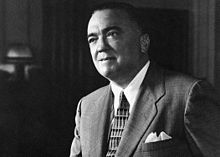
FBI Director J. Edgar Hoover
Indeed, they did look at it. But rather than plaudits, they issued stinging rebukes, principally for the Commission’s having been rolled by FBI Director J. Edgar Hoover, and to a lesser extent, by the CIA and the Secret Service.
“It must be said that the FBI generally exhausted its resources in confirming its case against Oswald as the lone assassin,” the HSCA concluded, “a case that Director J. Edgar Hoover, at least, seemed determined to make within 24 hours of the of the assassination.”
In essence, the experienced investigators concluded that Hoover had divined the solution to the crime before starting the inquiry, and then his agents confirmed the boss’s epiphany. The intimidated Warren Commission went right along.
And with good reason, only part of which Willens and Mosk tell. They admit that the “FBI had originally opposed the creation of the Warren Commission” and that Hoover “ordered investigations of commission staff members.” But they don’t tell that Hoover deployed one of his favorite dirty tricks to deal not only with support staffers, such as Willens and Mosk, but also with the commissioners themselves.
“[D]erogatory information pertaining to both Commission members and staff was brought to Mr. Hoover’s attention,” the Church Committee reported. (emphasis added)
Hoover’s Spy
Willens and Mosk also forgot to mention that Hoover had a personal spy on the Warren Commission, then Rep. Gerald Ford, who tattled on Commissioners who were (justifiably) skeptical of the Bureau’s work.
“Ford indicated he would keep me thoroughly advised as to the activities of the Commission,” FBI Agent Cartha DeLoach wrote in a once secret memo. “He stated this would have to be done on a confidential basis, however he thought it should be done.”
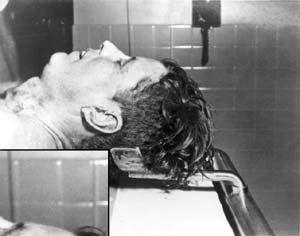
Autopsy photo of President John F. Kennedy
At the bottom of the memo, Hoover scrawled, “Well handled.” The success of Hoover’s machinations was obvious to subsequent government investigators. (Ford, of course, later became President upon the resignation of Richard Nixon in 1974.)
The HSCA’s chief counsel, Notre Dame Law Professor Robert Blakey, a criminal investigator and prosecutor with vastly better credentials than either Willens or Mosk, was impressed with neither the Commission’s vigor nor its independence.
“What was significant,” Blakey determined, “was the ability of the FBI to intimidate the Commission, in light of the Bureau’s predisposition on the questions of Oswald’s guilt and whether there had been a conspiracy. At a January 27 [1964] Commission meeting, there was another dialogue [among Warren Commissioners]:
“John McCloy: ‘… the time is almost overdue for us to have a better perspective of the FBI investigation than we now have … We are so dependent on them for our facts … .’
“Commission counsel J. Lee Rankin: ‘Part of our difficulty in regard to it is that they have no problem. They have decided that no one else is involved … .’
“Senator Richard Russell: ‘They have tried the case and reached a verdict on every aspect.’
“Senator Hale Boggs: ‘You have put your finger on it.’ (Closed Warren Commission meeting.)” [Blakey & Billings, Fatal Hour– The Assassination of President. See also: North, Act of Treason]
Testifying before the HSCA, the Warren Commission’s chief counsel J. Lee Rankin shamefully admitted, “Who could protest against what Mr. Hoover did back in those days?” Apparently not President Lyndon Johnson’s blue-ribbon commissioners.
The HSCA’s Blakey also reported that “When asked if he was satisfied with the (Commission’s) investigation that led to the (no conspiracy) conclusion, Judge Burt Griffin (a Commission staff member) said he was not.” [Blakey & Billings, Ibid.]
And author Gus Russo reported that Judge Griffin also admitted, “We spent virtually no time investigating the possibility of conspiracy. I wish we had.” [Russo, Live by the Sword]
Clear Misgivings
Thus, despite their clear misgivings, the Commissioners bowed to the imperious FBI chief rather than conduct a thorough investigation. Notably, the Commission never once employed a rudimentary investigative tool. “The Commission,” the HSCA reported, “failed to utilize the instruments of immunity from prosecution and prosecution for perjury with respect to witnesses whose veracity it doubted.” [US Cong. House of Reps. Report of Comm. on Assassinations, 1979]
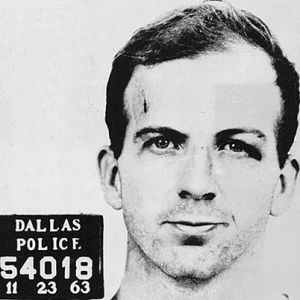
Lee Harvey Oswald
This policy had serious repercussions when the Commission confronted two key issues: published claims that Lee Harvey Oswald had been an FBI informant, and the possibility that Jack Ruby was mobbed up.
“The Commission did not investigate Hoover or the FBI, and managed to avoid the appearance of doing so,” the HSCA determined. “It ended up doing what the members had agreed they would not do: Rely mainly on the FBI’s denial of the allegations (that Oswald had been a Bureau informant).”
Hoover merely sent the Commission his signed affidavit declaring that Oswald was not an informant and also “sent over 10 additional affidavits from each FBI agent who had had contact with Oswald.” And with that, case closed.
Regarding Jack Ruby, the FBI had his phone records, yet failed to spot Ruby’s obvious, and atypical, pattern of calls to known Mafiosi in the weeks leading up to the assassination. After performing the simple, obvious task of actually analyzing those calls, the HSCA determined that, if not a sworn member of La Cosa Nostra, Ruby had ongoing, close links to numerous Mafiosi.
Thus the HSCA roundly rejected the Warren Commission’s conclusion that, “the evidence does not establish a significant link between Ruby and organized crime.”
The list of Warren Commission shortcomings that the HSCA assembled is not short. A brief summary of them runs some 47 pages in the Bantam Books version of the report (p. 289–336), which outlines what required much of the 500 pages of HSCA volume XI to cover (available on-line).
“The evidence indicates that facts which may have been relevant to, and would have substantially affected, the Warren Commission’s investigation were not provided by the agencies (FBI and the CIA). Hence, the Warren Commission’s findings may have been formulated without all of the relevant information.”
The Church Committee said that the problem was that “the Commission was perceived as an adversary by both Hoover and senior FBI officials.” “Such a relationship,” the Committee dryly observed, “was not conductive to the cooperation necessary for a thorough and exhaustive investigation.”
But the FBI did more than just withhold evidence from the Commission. Although they admit that the FBI destroyed a note Oswald wrote to Agent Hosty, and withheld that information from the Commission, Willens and Mosk don’t mention that Agent Hosty reported that his own personnel file, and other FBI files, had been falsified. [Hosty, Jr. Assignment: Oswald]
Nor that author Curt Gentry learned from assistant FBI director William Sullivan that there were other JFK documents at the Bureau that had been destroyed. [Gentry, J. Edgar Hoover– The Man and His Secrets]
Perhaps one of the reasons the public has remained mistrustful of the government’s conclusions, and the mainstream media reassurances, is the sort of selective presentation of evidence by ax grinders like Willens and Mosk who get heralded by our “responsible” media.
Gary Aguilar is one of the few physicians outside the government ever allowed to see the still-restricted JFK autopsy photos and X-rays. He has published and lectured on the topic of the JFK assassination for many years.
November 21, 2016 Posted by aletho | Deception, Fake News, Mainstream Media, Warmongering, Timeless or most popular | Central Intelligence Agency, CIA, FBI, Howard Willens, JFK Assassination, The American Scholar, United States, Warren Commission | Leave a comment
CIA & JFK: The Secret Assassination Files
By Jacob G. Hornberger | FFF | June 10, 2016
The following is the Foreword to FFF’s newest ebook CIA & JFK: The Secret Assassination Files by Jefferson Morley, which is being released today at Amazon.com
I learned about Jefferson Morley in 2008, when I read a series of articles he had written about an ongoing Freedom of Information lawsuit that he had filed against the Central Intelligence Agency. The lawsuit sought the release of files relating to a CIA agent named George Joannides. The CIA steadfastly resisted (and today continues to resist) the disclosure of these documents.
In the months leading up to the assassination of President John F. Kennedy, Joannides had secretly served as a CIA conduit for an anti-Castro group known as the Directorio Revolucionario Estudiantil, or the DRE, which was being secretly funded by the CIA. Immediately after the assassination, Joannides secretly authorized the group to initiate a publicity campaign advertising Lee Harvey Oswald’s connections to Communism, Cuba, and the Soviet Union. Thus, as Morley would later point out, the CIA authorized and funded the very first conspiracy theory in the Kennedy assassination.
For some reason, the CIA kept its relationship to the DRE secret from the Warren Commission, the official federal agency that was charged with investigating the Kennedy assassination. Later, in the 1970s, when the U.S. House Select Committee on Assassinations was reinvestigating the assassination, the CIA called Joannides out of retirement to serve as the CIA’s liaison with the committee, once again keeping his relationship with the DRE secret from investigators.
In the 1990s, in response to the public outcry over official secrecy in the Kennedy assassination generated by Oliver Stone’s movie JFK — a movie that posited that the U.S. national-security state orchestrated the assassination of President Kennedy and framed Oswald for the crime — Congress called the Assassination Records Review Board (ARRB) into existence. Its mission was to ensure that federal agencies, including the CIA, release all records relating to the Kennedy assassination.
Once again, the CIA kept Joannides’s role with the DRE secret.
A 2009 article in the New York Times entitled “C.I.A. Still Cagey About Oswald Mystery,” quoted U.S. District Judge John R. Tunheim, who had chaired the ARRB in the 1990s: “I think we were probably misled by the agency. If we had known of his [Joannides’] role in Miami in 1963, we would have pressed for all the records.”
Later, a November 25, 2013, Boston Globe article entitled “Troves of Files on JFK Assassination Remain Secret” by John Bender, quoted Tunheim: “It really was an example of treachery. If [the CIA] fooled us on that, they may have fooled us on other things.”
Robert Blakey, the staff director for the House Select Committee in the 1970s, declared, “If I’d have known his role in 1963, I would have put Joannides under oath — he would have been a witness, not a facilitator.
It was Jefferson Morley, a former reporter for the Washington Post, who detailed the CIA’s Joannides secret in an article entitled “Revelation 19.63,” which appeared in the April 12, 2001, issue of the Miami New Times. It was Morley who doggedly spent years in litigation in the attempt to force the CIA to release its Joannides files to the American people.
I was so intrigued by the Joannides story and so impressed by Morley’s integrity and perseverance that I wrote a series of articles on the subject, which were posted on the website of The Future of Freedom Foundation. Morley and I later became friends.
When he approached me about a year ago to explore the possibility of publishing CIA & JFK: The Last Assassination Secrets, I was excited. Upon reading the manuscript, I didn’t hesitate.
The Future of Freedom Foundation has published four books relating to the Kennedy assassination: The Kennedy Autopsy by Jacob Hornberger; JFK’s War with the National Security Establishment by Douglas P. Horne, who served on the staff of the ARRB; Regime Change: The Kennedy Assassination by Jacob Hornberger, and The CIA, Terrorism, and the Cold War: The Evil of the National Security State by Jacob Hornberger.
All four books have met with resounding sales success, collectively selling more than 10,000 copies. In fact, a year-and-a-half after publication, the first two books are still on Amazon’s list of its top 100 best-selling ebooks in 20th-century American history. The third — Regime Change — is ranked #98 in Amazon’s top 100 best-selling “short reads” in History. The fourth and most recent is ranked #14 in Amazon’s top 100 best-selling ebooks on Political Freedom and #14 on Amazon’s top 100 best-selling “short reads” in Politics and Social Sciences.
Thus, Morley’s new book fits perfectly within this particular genre, and I am confident that readers will find it as valuable and enjoyable as our other books, if not more so.
Those who are looking for conspiracy theories in Morley’s book will be disappointed. This book doesn’t posit any conspiracy theories. What it does do is detail deception and deceit on the part of the CIA relating to certain fascinating aspects of the Kennedy assassination, especially the Joannides saga. As one reads through the book, however, the inevitable one-word question will arise within the mind of the reader: Why? Why the longstanding and continued deceit, deception, and secrecy on the part of the CIA relating to the Kennedy assassination?
Morley runs JFKfacts.org, which I consider to be the best website relating to the JFK assassination. Filled with fascinating articles and vibrant, even-handed debates and discussions, I visit it practically every day. Its popularity attests to the widespread and deep interest that people still have in the Kennedy assassination.
While the ARRB secured the release of tens of thousands of secret official records relating to the Kennedy assassination during the 1990s, for some reason the law provided for a period of 25 years for all JFK-assassination-related records to be released. That period of time expires in October 2017, and the National Archives, which holds the still-secret records in its possession, has already begun preparing the thousands of pages, many of which are CIA documents, for release at that time.
However, there is one caveat: Notwithstanding the lapse of more than 50 years since the Kennedy assassination, the law empowers the president to delay release of records on a finding of “national security.”
Will the CIA plead “national security” and seek an extension of time for release of its JFK-assassination-related records? Morley is leading the way to bring the matter to the attention of the public, in the hope that the same type of public outcry in the 1990s against continued CIA secrecy in the Kennedy assassination will prevent the continued suppression of the records set to be released by the National Archives in 2017.
Hopefully, CIA & JFK: The Secret Assassination Files will contribute to the fight against continued CIA secrecy in the Kennedy assassination. The Future of Freedom Foundation is pleased and honored to be part of its publication.
November 1, 2016 Posted by aletho | Book Review, Deception, Timeless or most popular | Central Intelligence Agency, CIA, JFK Assassination, United States | Leave a comment
The Role of the Left in the Cover-Up of the JFK Assassination
By John Simkin | November 26, 2012
Over the last few months I have been studying the media coverage of the assassination of JFK and the publication of the Warren Commission. It could be argued that the way the mainstream media accepted the official line is not very surprising given their record of recording political stories. However, what is striking is the way that the so-called Non-Communist Left (NCL) reported these events. These were people who controlled left of centre journals such as the Nation, New Republic and I.F. Stone Weekly. None of these journals were willing to question the idea that JFK had been killed by a lone gunman.
The only journal on the left that seemed to doubt the official interpretation of events was James Aronson, the editor of the National Guardian. In the first edition of the newspaper after the assassination, he used the headline: “The Assassination Mystery: Kennedy and Oswald Killings Puzzle the Nation”. Aronson could not understand why others on the left were not taking up a similar position.
In his book, Something to Guard: The Stormy Life of the National Guardian (1978), Aronson recalled that soon after the assassination he was contacted by a journalist working for the New York Times, who asked him if Oswald subscribed to the National Guardian. Aronson replied he could find no record of Oswald receiving the newspaper. Aronson took this opportunity to raise questions about the newspaper’s investigation into the assassination: “I took advantage of the call to air my doubts about the lone assassin theory being fixed in the public mind. What was the New York Times doing to validate or disapprove this theory?” The journalist replied “Look, Jim, you worked here and you know the answer: don’t look this way – they won’t do it.” (1)
Mark Lane was probably the first person to write a detailed article questioning the official story of the assassination. He later pointed out: “The obvious choice, I thought, was the Nation. Its editor, Carey McWilliams, was an acquaintance. He had often asked me to write a piece for him… McWilliams seemed pleased to hear from me and delighted when I told him I had written something I wished to give to the Nation. When he learned of the subject matter, however, his manner approached panic.” McWilliams told Lane: “We cannot take it. We don’t want it. I am sorry but we have decided not to touch that subject.” Lane got the same response from the editors of Fact who said the subject matter was too controversial. It was also rejected by The Reporter, Look, Life and the Saturday Evening Post. (2)
James Aronson “heard that a maverick New York lawyer named Mark Lane had done some careful leg and brain work to produce a thesis casting doubt on the lone-assassin theory – and even whether Oswald had actually been involved in the crime.” (3) Aronson contacted Lane who told him that the article had been rejected by thirteen publications. Aronson offered to publish the article. Lane told him that “I would send it to him but I would not authorize him to publish it. He asked why. I said that I was seeking a broader, non-political publisher and that if the piece originated on the left, the subject would likely never receive the debate that it required.”
Lane now took the article to James Wechsler, an editor of the New York Post. He also rejected it and said that Lane would never find a publisher and “urged him to forget about it”. Lane now told him about Aronson’s offer. Wechsler, according to Lane was “furious” when he heard this news. “Don’t let them publish it… They’ll turn it into a political issue.” (4)
By this time the article had been turned down by seventeen publications and so Lane decided to let Aronson publish the article in the National Guardian. The 10,000 word article, published on 19th December, 1963, was the longest story in its fifteen-year history. It was presented as a lawyer’s report to the Warren Commission and titled A Brief for Lee Harvey Oswald. Aronson argued in the introduction: “The Guardian’s publication of Lane’s brief presumes only one thing: a man’s innocence, under US. Law, unless or until proved guilty. It is the right of any accused. A presumption of innocence is the rock upon which American jurisprudence rests… We ask all our readers to study this document… Any information or analysis based on fact that can assist the Warren Commission is in the public interest – an interest which demands that everything possible be done to establish the facts in this case.” (5)
Aronson later admitted: “Few issues of the Guardian created such a stir. Anticipating greater interest we had increased the press run by 5,000, but an article in the New York Times about our story brought a heavy demand at the newsstands and dealers were calling for additional copies. Before the month was out we had orders for 50,000 reprints.” (6)
Aronson offered the article to both the United Press International and the Associated Press but both agencies rejected it. However, the article was published in several European countries and was discussed in most leading newspapers throughout the world. Some newspapers attempted to rubbish the article by describing it as “left-wing propaganda”. Bertrand Russell wrote to The Times complaining about this treatment: “Mr. Lane is no more a left-winger than was President Kennedy. He attempted to publish his evidence… in virtually every established American publication but was unsuccessful. Only the National Guardian was prepared to print his scrupulously documented material… I think it important that no unnecessary prejudice against this valuable work of Mr. Lane should be aroused, so that his data concerning a vital event may be viewed with an open mind by people of all political persuasions.”
At first the national press attempted to ignore Lane’s article. The only other publication in the United States that was willing to discuss the issue was the New Republic. In an article published on 21st December, 1963, Jack Minnis and Staughton Lynd, the authors of Seeds of Doubt: Some Questions about the Assassination, raised questions about five different categories of evidence in the case. Minnis was the research director for the Student Nonviolent Coordinating Committee, while Lynd was a history professor at Spelman College. Both men were also left-wing activists who were involved with the civil rights and peace movements. (7) However, after the publication of this article the New Republic left the subject alone.
In January, 1964, Walter Winchell made a vicious attack on Mark Lane and the National Guardian in his regular newspaper column. He described the newspaper as “a virtual propaganda arm of the Soviet Union” and called Lane an “agitator” seeking to abolish the Un-American Activities Committee. (8)
It is not surprising that Winchell led the attack on Mark Lane. He was a vital figure in the CIA’s Operation Mockingbird. Carl Bernstein has argued in his article, CIA and the Media: “Joseph Alsop is one of more than 400 American journalists who in the past twenty-five years have secretly carried out assignments for the Central Intelligence Agency, according to documents on file at CIA headquarters. Some of these journalists’ relationships with the Agency were tacit; some were explicit. There was cooperation, accommodation and overlap.” (9)
Deborah Davis, was the first person to expose the workings of Operation Mockingbird in her book, Katharine the Great (1979), a biography of Katharine Graham of the Washington Post. She explained how journalists were controlled in times of crisis: “This practice, the old intelligence principle translated, contained the seeds of political blackmail: Once the newsman or his organization has been compromised, the politician can threaten to expose its lack of independence unless he (it) cooperates further. Many Mockingbirds have been faced with this choice.” (10)
The origins of this intelligence operation dates back to May, 1940, when the British Security Coordination (BSC) was established in the United States. According to William Boyd: “Churchill’s task, as he himself saw it, was clear: somehow, in some way, the great mass of the population of the US had to be persuaded that it was in their interests to join the war in Europe, that to sit on the sidelines was in some way un-American. And so British Security Coordination came into being… The aim was to change the minds of an entire population: to make the people of America think that joining the war in Europe was a ‘good thing’ and thereby free Roosevelt to act without fear of censure from Congress or at the polls in an election.” (11)
One of the first agents recruited by BSC was Allen Dulles, the future head of the CIA. Other agents from the media included: Walter Winchell, Drew Pearson, Walter Lippmann, William Allen White, Dorothy Thompson, Raymond Gram Swing, Edward Murrow, Vincent Sheean, Helen Kirkpatrick, Eric Sevareid, Edmond Taylor, Rex Stout, Edgar Ansel Mowrer and Whitelaw Reid. William Stephenson, the head of the BSC, also worked closely with editors and publishers who were supporters of American intervention into the Second World War. This included Arthur Hays Sulzberger (New York Times), Henry Luce (Time Magazine and Life Magazine), Helen Rogers Reid (New York Herald Tribune), Barry Bingham (Louisville Courier-Journal), Paul C. Patterson (Baltimore Sun), Dorothy Schiff (New York Post) and Ralph Ingersoll (Picture Magazine). (12)
Franklin D. Roosevelt had assigned William Donovan to work closely with William Stephenson on BSC operations (they had in fact been close friends since the First World War). After the United States entered the war, Donovan became head of the Office of Strategic Services (OSS) and he took over control of BSC’s media assets. After the war, the OSS was closed down but emerged two years later as the Central Intelligence Agency (CIA). (13)
In the 1950s Operation Mockingbird was primarily concerned with the dangers of communism. However, it remained in place to be used by the CIA in times of national emergency. The assassination of JFK fell into this category and was successfully employed to make sure that the media did not openly discuss the guilt or innocence of Lee Harvey Oswald. (14)
The shaping of the media by the CIA became public knowledge in April 1976 when the Final Report of the Select Committee to Study Government Operations With Respect to Intelligence Activities was published. “In examining the CIA’s past and present use of the U.S. media, the Committee finds two reasons for concern. The first is the potential, inherent in covert media operations, for manipulating or incidentally misleading the American public. The second is the damage to the credibility and independence of a free press which may be caused by covert relationships with the U.S. journalists and media organizations.” (15)
However, in November, 1963, the public was completely unaware of Operation Mockingbird, and the media cover-up operation was very successful. Journalists who wanted to write about their doubts had to find media organisations in Europe to publish their work. In March, 1964, Thomas G. Buchanan began publishing articles about the assassination in the French newspaper, L’ Express. Buchanan claimed in the newspaper that the Warren Commission had discovered that Jack Ruby knew Lee Harvey Oswald. He argued that Ruby lent him money to pay back the State Department for the $435.71 the U.S. had loaned Oswald when he returned from the Soviet Union.
These articles caught the attention of Richard Helms of the CIA. He sent a memo to John McCone, Director of the CIA: “Buchanan’s thesis is that the assassination of President Kennedy was the product of a rightest plot in the United States. He alleges in his articles that the slain Dallas policeman, Tippett (sic) was part of the plot against President Kennedy.” Helms went onto inform McCone that a “competent” CIA informant had disclosed that a book by Buchanan on the assassination would be published by Secker and Warburg on 15th May 1964. (17) The company had a reputation for publishing left-wing but anti-communist books. This included books by George Orwell, C. L. R. James, Simone de Beauvoir, Rudolf Rocker and Günter Grass.
Helms informant was right and Buchanan’s book, Who Killed Kennedy? was published in May, 1964. Buchanan appears to have been the first writer to suggest that Lyndon B. Johnson and “Texas oil interests” were responsible for Kennedy’s death. Buchanan argues that the assassination was funded by a Texas oilman. He does not name him but later it emerged he was referring to Haroldson L. Hunt. (18)
In the book Buchanan claims that Kennedy was killed by two gunmen. One fired from the railroad bridge. Another fired from the Texas School Book Depository. According to Buchanan, Oswald was aware of the conspiracy but did not fire any shots. Oswald believed that J. D. Tippit was going to help him escape. However, his real job was to kill him “while resisting arrest”. Oswald, realized what was happening and fired first.
When Who Killed Kennedy? was eventually published in the United States, it was mainly ignored. However, Time Magazine reviewed it and made much of the fact that Buchanan was a former member of the American Communist Party. (44) The left-wing British journalist, Cedric Belfrage, who had co-founded the National Guardian but had been deported from the United States in 1955 after refusing to answer questions before the House Un-American Activities Committee (HUAC), argued in the journal, Minority of One, that it was “irrelevant whether Buchanan was a former communist or a former Zen Buddhist”. Belfrage went on to state that what was important was Buchanan’s “common sense of the assassination and the American crisis it symbolizes”. (19)
Joachim Joesten, a freelance journalist, travelled to Dallas a few weeks after the assassination of Kennedy and spent four days there, interviewing witnesses and examining key locations. He came to the conclusion that Lee Harvey Oswald was not a lone gunman. However, he did think that he was involved in the conspiracy to kill Kennedy. “I wish to make it absolutely clear that I believe Oswald innocent only as charged, but that he was involved with the conspirators in some way.” (20)
Joesten began work on his book, Oswald, Assassin or Fall Guy? Like other early authors who questioned the official version, Joesten was forced to get his book published in England (Merlin Press). Before the book was published, Joesten, who was in Hamburg, received a letter from J. Lee Rankin of the Warren Commission, requesting a copy of the book. In March 1964, the United States Embassy in West Germany requested a meeting.
John Kelin, the author of Praise from a Future Generation (2007), has pointed out: “All copies of Joesten’s book manuscript were with either publishers or literary agents, so he was unable to comply with Rankin’s request. But he did sit down with the embassy man, whom he identified only as Mr. Morris… They met at the American Consulate in Hamburg on March 21, 1964… The two men talked for about four hours, during which time Joesten told Morris anything he had learned – why he believed Oswald was innocent of killing President Kennedy and Officer Tippit, and who he thought was really responsible.” (21)
Joesten later recalled that Morris seemed “particularly concerned with the fact that I believed Oswald had been connected with both the Central Intelligence Agency and with the Federal Bureau of Investigation.” Joesten also told Morris that he believed General Edwin Walker organised the assassination and that it “was a military-type operation with firing from both front and rear.” Joesten also speculated that Bernard Weissman was involved in the assassination. (22)
Joesten discovered that while he was in Hamburg FBI agents went to his home in New York City to interview his wife. “Since I had been located, I couldn’t help wondering if the FBI had simply used that excuse to enter my home, talk to my wife and, to put it plainly, snoop around.” The FBI agents recorded that Mrs. Joesten said her husband had returned from Dallas convinced of Oswald’s innocence. “Mrs. Joesten advised that she definitely feels that her husband is on the verge of a nervous breakdown.”
Joesten’s book, Oswald, Assassin or Fall Guy?, was published in the United States by Carl Marzani in July 1964. Marzani, a former member of the American Communist Party, had been imprisoned and blacklisted during the early 1950s and in order to survive went into publishing and established the company Marzani & Munsell. According to Marzani he specialised in books that upset the status quo. In the book Joesten claimed that the Central Intelligence Agency, Federal Bureau of Investigation, the Dallas Police Department and a group of right-wing Texas oil millionaires conspired to kill Kennedy. He openly accused Police Chief Jesse Curry of being one of the key figures in the assassination.
Victor Perlo, reviewing the book in the New Times, commented that the book had been rejected by several publishers before Marzani accepted it. “The firm deserves credit for publishing and promoting the book, so that thousands of copies were sold in a short time, despite a blackout by commercial reviewers. Publisher-editor Carl Marzani edited the manuscript brilliantly… This reviewer approached the Joesten book with scepticism. Despite my low opinion of the Dallas police and the FBI, I’ve had enough experience to know that utterly senseless things do happen in America… But the Joesten book erased most of my scepticism.” (21)
The book was largely ignored by the mainstream media but was reviewed by Hugh Aynesworth in the Editor and Publisher. Aynesworth, a strong supporter of the lone gunman theory and a reporter with the Dallas Morning News, wrote: “Joesten, an ex-German who became a U.S. citizen in 1948… states that Oswald was an agent of both the FBI and the CIA (how’s that for a 24-year-old who couldn’t spell “wrist”?). It’s the same old tripe with some new flavouring.” Aynesworth uses the review to criticize Mark Lane: “Lane is the troublemaker who spent two days in Dallas in January on his investigation and now pretends to be an expert on all aspects of the weird tragedy.” (22)
Another left-wing foreign-born journalist in America was also taking a close interest in the case. Léo Sauvage, who was the political correspondent of Le Figaro, published an article on the assassination in Commentary Magazine in March 1964, where he suggested that there had been a cover-up. He pointed out that all the available evidence against Lee Harvey Oswald had “either been leaked or eagerly and even ruthlessly spelled out – whether true, half-true, or demonstrably false; whether pertinent, confused, or obviously irrelevant” by the Dallas Police. As early as 23rd November, 1963, Will Fritz of the Homicide Bureau proclaimed the case as “cinched” and the following day, only two hours after Jack Ruby “had disposed of Oswald in the basement of Dallas Police Headquarters”, the case against him was declared “closed” by Police Chief Jesse Curry and by District Attorney Henry Wade. (23)
Sauvage was also amazed that by 3rd December, 1963, the FBI had leaked details of its report on the assassination to the media. This allowed the New York Journal American to headline the story with the words: “Oswald lone killer. FBI report to prove it”. Sauvage pointed out that “six days later the Justice Department, acting on instructions from the White House, delivered the now completed report directly” to the Warren Commission. Sauvage adds that on 10th December, the New York Times reported: “Oswald assassin beyond a doubt, FBI concludes. He acted alone and did not know Ruby, says report to Warren Inquiry Panel.”
Sauvage added: “Thus, after the press and television conviction of Lee Oswald in Dallas, a second press and television conviction took place in Washington. And just as the Dallas authorities had forced the hand of any jury that would have heard the Oswald case, so the FBI has forced the hand of the Warren Commission. With the help of all the mass media, Oswald’s guilt has now twice been sold to the public – despite the fact that no one had even so much as ventured to explain why a psychopathic regicide, acting (as we shall see) under circumstances that would make his capture inevitable, should renounce the ultimate satisfaction of glorying in his deed before the eyes of the world. I really do not see, therefore, why only those of us who are sceptical about the case against Oswald should await further information.”
John Kelin, the author of Praise from a Future Generation (2007) summed up Sauvage’s case against the idea that Lee Harvey Oswald was a lone gunman: “Léo Sauvage raised a series of questions that, he declared, Oswald’s accusers should be forced to answer. Did Oswald have an alibi? Was the President’s throat wound one of entrance or of exit? Was Oswald a good enough rifleman to do what the authorities said he did? How many shots were fired? Why were no fingerprints found on the alleged assassination rifle? How come none of the theatre patrons who witnessed Oswald’s arrest came forward with impartial accounts of how he was taken into custody?” (24)
Norman Podhoretz, the editor of Commentary Magazine added his support to Sauvage’s article: “Is the possibility of a treasonous political conspiracy to be ruled out? Not the least fantastic aspect of this whole fantastic nightmare is the ease with which respectable opinion in America has arrived at the conclusion that such a possibility is absurd; in most other countries, what is regarded as absurd is the idea that the assassination could have been anything but a political murder.” (25) Sauvage’s article greatly impressed a large number of people, including the commissioning editor of Random House and on 11th March, 1964, he signed a contract with the publisher to develop his ideas on the assassination into a full-length book.
Criticism of the lone-gunman theory did not only come from the left. In April, 1963, the ultra-conservative, Revilo P. Oliver suggested in an article Marxmanship in Dallas, that appeared in American Opinion, that Kennedy was a victim of a communist conspiracy. He also used the article to attack Kennedy’s liberal views on civil rights and his closeness to “Martin Luther King and other criminals engaged in inciting race war.” (26)
The following month, the veteran right-winger, Martin Dies, former chairman of the House Committee on Un-American Activities (HUCA), argued in the same journal that Kennedy had been a victim of a communist conspiracy. However, at this time he did not have all the evidence: “I hope to discuss the circumstances linking the Soviet Union with Oswald’s murder of the President. Naturally such evidence must be circumstantial and based upon the dogmatic pattern of Communist behaviour. The Communists are too clever to leave any trace of connection with Oswald.” (27) It would seem that at this time Dies was unaware that Oswald had defected to the Soviet Union in 1959 and on his return had openly associated with left-wing groups such as the Fair Play for Cuba Committee.
Billy James Hargis, a member of the John Birch Society and a close friend of General Edwin Walker, who had been mentioned as a conspirator by Joachim Joesten in Oswald, Assassin or Fall Guy?, also claimed a communist conspiracy had killed Kennedy. In his book, The Far Left (1964), he argued: “In spite of the absolute, indisputable evidence that Lee Oswald’s mind was moulded by Communist conspiracy propaganda, that his hatred was of the American free enterprise system and all it embraces, and that no one with even the remotest connection with what is considered to be the extreme right has any remote connection with the entire hideous affair… Do they really think the American people are that stupid? There is no doubt in my mind that the Communist assassin, Lee Oswald, intended to kill the President of the United States and disappear in the confused crowd, thus letting the conservative, anti-Communist element of Dallas take the blame. But it didn’t work. God is on the throne. He saw to it that Lee Harvey Oswald was apprehended by a courageous Dallas policeman, Officer Tippit, who, in turn, gave his life for the cause of freedom in attempting to arrest the Communist assassin of the President.” (28)
Another figure on the right who published a book about the assassination of Kennedy in 1964 was James Evetts Haley. His book, A Texan Looks at Lyndon, blamed it on an old political enemy, Lyndon Baines Johnson. It was a best seller and it is claimed that in Texas only the Bible outsold Haley’s book that year. In the book Haley attempted to expose Johnson’s corrupt political activities. This included a detailed look at the relationship between Johnson and Billy Sol Estes. Haley pointed out that three men who could have provided evidence in court against Estes, George Krutilek, Harold Orr and Howard Pratt, all died of carbon monoxide poisoning from car engines. Haley also suggested that Johnson might have been responsible for the death of Kennedy: “Johnson wanted power and with all his knowledge of political strategy and his proven control of Congress, he could see wider horizons of power as Vice-President than as Senate Majority Leader. In effect, by presiding over the Senate, he could now conceive himself as virtually filling both high and important positions – and he was not far from wrong. Finally, as Victor Lasky pointed out, Johnson had nursed a lifetime dream to be President. As Majority leader he never could have made it. But as Vice-president fate could always intervene.” (29)
On 1st June 1964, The New York Times published a story by Anthony Lewis with the headline, “Panel to Reject Theories of Plot in Kennedy Death”. As Jerry Policoff has pointed out: “The story amounted to a detailed preview of the Warren Report three months before the commission completed taking testimony and nearly four months before the report was released.” (30)
The press almost universally supported the Warren Commission report. The New York Times said it was “a comprehensive and convincing account. The Washington Post commented that it was “deserving acceptance as the whole truth” and The Boston Herald suggested that the Warren Commission had provided a “tremendous service”.
What was even more damaging to those who believed that Kennedy was the victim of a conspiracy was that the progressive press, led by Cary McWilliams, the editor of The Nation, also supported the conclusions of the report. The main bombshell came on 8th October, when I. F. Stone, who had virtually made a living criticising government documents, pointed out in I. F. Stone’s Weekly, that “I believe the Commission has done a first-rate job, on a level that does our country proud and is worthy of so tragic an event. I regard the case against Lee Harvey Oswald as the lone killer of the President as conclusive.” (31) However, as John Kelin has pointed out, at the time Stone wrote this article: “the Warren Report had just been published and the twenty-six volumes of supporting evidence and testimony were still not available”. (32)
Stone then went on to criticise those who had argued that there had been a conspiracy. After attacking the work of Mark Lane he turned on Bertrand Russell, who he described as “my dear and revered friend”. He suggested that Russell had dismissed the conclusions of Warren Commission report without even reading it. This was completely untrue. As Russell’s assistant, Ralph Schoenman, later pointed out, he had been provided a copy of the report a week before its official release date. (33)
Stone then went onto to look at the two books that had already been published arguing that there had been a conspiracy: “The Joesten book is rubbish, and Carl Marzani – whom I defended against loose charges in the worst days of the witch hunt – ought to have had more sense of public responsibility than to publish it. Thomas G. Buchanan, another victim of witch hunt days, has gone in for similar rubbish in his book, Who Killed Kennedy? You couldn’t convict a chicken thief on the flimsy slap-together of surmise, half-fact and whole untruth in either book… All my adult life as a newspaperman I have been fighting, in defense of the Left and of a sane politics, against conspiracy theories of history, character assassination, guilt by association and demonology. Now I see elements of the Left using these same tactics in the controversy over the Kennedy assassination and the Warren Commission Report.”
Ray Marcus, who was a devoted follower of I.F. Stone and had subscribed to his journal since its first edition in January 1953, was deeply shocked by this article. Marcus later recalled: “What was totally lacking in I. F. Stone’s comments was any evidence of the critical analysis he normally employed on assessing official statements.” On 8th October, 1964, Marcus wrote Stone a long letter outlining the flaws in the Warren Report. Marcus argued that in order to accept the Warren Commission’s lone-gunman scenario, one must accept fifteen points as true. These points were explained in an eight page letter. Marcus never received a reply. (34)
Another journalist considered to be on the left at the time was Walter Lippmann. In his syndicated column, Today and Tomorrow on 29th September, 1964, Lippmann wrote that he was convinced that Lee Harvey Oswald had acted alone in assassinating John F. Kennedy. He added there was “no ground on which any contemporary man, here or abroad, should question the verdict”. (35) However, he later told his friend, Ronald Steel, that he suspected that Kennedy had been killed as part of a conspiracy. (36)
The complete acceptance by the media of the Warren Report caused problems for those wishing to publish books advocating a conspiracy. Léo Sauvage, who had already signed a contract with Random House, to publish his book, The Oswald Affair – an Examination of the Contradictions and Omissions of the Warren Report, was to be disappointed. A month after the publication of the report, a senior editor at Random House, Jason Epstein, wrote to Sauvage cancelling the contract: “The problem is that the Warren Report has put the Oswald matter in a different light from what I expected, and I’m now convinced that any book which attempts to question Oswald’s guilt would be out of touch with reality and could not be taken seriously by responsible critics.” (37) No other publisher in the United States was willing to bring out the book and so like other opponents of the lone gunman theory, Sauvage was forced to go to Europe to have his book published.
It has been suggested that the critics of the lone-gunman theory were particularly hurt by the support for the Warren Report from left-wing journalists. In a debate that took place on 4th December, 1964, Beverly Hills High School, Abraham Wirin, chief counsel for the American Civil Liberties Union in California and a much respected figure on the left for over 30 years, told the audience that he tried to make up his own mind on important issues, but in the case of the Warren Commission he relied on the opinions of people who he could trust: “I consider Carey McWilliams and The Nation, as an individual and a newspaper, respectively, whose judgment I respect. I do not consider Carey McWilliams or The Nation, a person or a newspaper, which would participate in a fraud, or would condone it.” Wirin pointed out The Nation had carried an article in support of the Warren Report and added: “now, that carries a lot of weight with me.”
Wirin then went onto to discuss I.F. Stone’s support for the Warren Report: “Now Mr. Stone, who has defended the rights of the Left, of Communists and others to fair treatment and freedom throughout his life – who is no apologist for any Rightest… Very rarely does Mr. Stone ever commend a government agency. Very rarely. As very rarely do I.” Wirin then said something very strange: “I say thank God for Earl Warren. He saved us from a pogrom. He saved our nation. God bless him for what he has done in establishing that Oswald was the lone assassin.” (38)
Mark Lane, who was involved in the debate with Abraham Wirin, has suggested a reason why the left was so keen to support the conclusions of the Warren Report. He discovered a document dated 20th January, 1964, where President Lyndon Johnson had asked Earl Warren to squelch rumours that “were circulating in this country and overseas”. He added that these rumours were so potentially explosive that if they were “not quenched, they could conceivably lead the country to war which could cost 40 million lives”. (39)
Lane suggests that this may be connected to the memo that deputy attorney Nicholas Katzenbach sent to Lyndon Johnson, through Bill Moyers, his press secretary, on 25th November, 1963. Katzenbach insisted that: “The public must be satisfied that Oswald was the assassin, that he did not have confederates who are still at large, and that the evidence was such that he would have been convicted at trial. I think this objective may be satisfied by making public as soon as possible a complete and thorough FBI report on Oswald and the assassination.” (40)
Were the rumours that needed to be “quenched” the same as those circulated by Revilo P. Oliver, Martin Dies and Billy James Hargis in the days following the assassination? Lane argues in Plausible Denial: Was the CIA Involved in the Assassination of JFK? (1991): “The CIA had concluded that Oswald had acted alone; he had not involved others in his plans and no one had directed him. Warren was respectfully cautioned, however, that if the American people received the facts, surely they would demand, in the existing volatile atmosphere, still heaving with tragedy, and against the backdrop of an escalating cold war, that immediate action be taken against the Soviet Union and Cuba. Warren agreed. Under the circumstances, he was advised that since the fate of the world was now in his hands, it was imperative that the Oswald-Kostikov connection be suppressed.” (41) Is it possible that people like Walter Lippmann, I. F. Stone and Carey McWilliams had been told that the Soviets had been involved in a conspiracy to kill Kennedy and without their support a nuclear war could not be adverted?
Then we have those strange words of Abraham Wirin: “I say thank God for Earl Warren. He saved us from a pogrom. He saved our nation. God bless him for what he has done in establishing that Oswald was the lone assassin.” Why would Wirin use the word “pogrom”? Had key figures on the left such as I.F. Stone and Carey McWilliams been told that the conspiracy to kill Kennedy was in someway involved Jewish left-wingers? If that was the case, why would they be willing to believe such stories? It is indeed a strange puzzle. Maybe the answer lies in an article that had been written by Tom Braden that appeared in the Saturday Evening Post on 20th May, 1967.
Braden, who had worked with Allen Dulles at the Office of Strategic Services (OSS) during the Second World War, was considered to be an expert in psychological warfare. When Dulles joined the CIA in December 1950 as Deputy Director of Operations one of his first acts was to recruit Braden as his assistant. Braden suggested to Allen Dulles that he should be allowed to establish the International Organizations Division (IOD) to counteract Soviet propaganda. Dulles agreed and Cord Meyer was appointed as his deputy. The IOD helped established anti-Communist front groups in Western Europe.
The IOD was dedicated to infiltrating academic, trade and political associations. The objective was to control potential radicals and to steer them to the right. Braden oversaw the funding of groups such as the National Student Association, the Congress of Cultural Freedom, Communications Workers of America, the American Newspaper Guild, the United Auto Workers, National Council of Churches, the African-American Institute and the National Educational Association.
Braden later admitted that the CIA was putting around $900,000 a year into the Congress of Cultural Freedom. Some of this money was used to publish its journal, Encounter. Braden and the IOD also worked closely with anti-Communist leaders of the trade union movement such as George Meany of the Congress for Industrial Organization and the American Federation of Labor. This was used to fight Communism in its own ranks. As Braden said: “The CIA could do exactly as it pleased. It could buy armies. It could buy bombs. It was one of the first worldwide multinationals.” (42)
This remained a highly secret operation but in 1966 stories began to appear in the New York Times suggesting that the CIA had been secretly funding left-wing groups. This in fact, was not a new claim. Joseph McCarthy had made similar accusations in 1953. He had been given this information by J. Edgar Hoover who had described the Office of Policy Coordination (OPC) as “Wisner’s gang of weirdos”. In August, 1953, Richard Helms, Wisner’s deputy at the OPC, told Cord Meyer, who was Braden’s deputy at the International Organizations Division, that Joseph McCarthy and the FBI had accused him of being a communist. The FBI added to the smear by announcing it was unwilling to give Meyer “security clearance”. (43)
In September, 1953, Meyer was shown the FBI file against him. It included allegations that his wife, Mary Pinchot Meyer, was a former member of the American Labor Party. It also listed several people linked to Meyer who had “supported pro-Communist policies or have been associated with Communist front organizations or organizations pro-Communist in their sympathies.” The list included the publisher Cass Canfield, the president and chairman of Harper & Brothers. Canfield had first met Allen Dulles in 1940 when they were both working for the British Security Coordination (BSC), a highly secret British intelligence unit based in the United States set up with the approval of President Franklin D. Roosevelt. In the aftermath of the Kennedy assassination Canfield played an important role in stopping books criticising the Warren Commission being published. Canfield had indeed been receiving money from the CIA to help publish left-wing but anti-communist books. He was along with Jason Epstein of Random House, who had blocked the publication Léo Sauvage’s The Oswald Affair – an Examination of the Contradictions and Omissions of the Warren Report, a key figure in the CIA sponsored Congress of Cultural Freedom.
McCarthy’s assistant, Roy Cohn, argues in his book McCarthy (1968) that they had discovered that communist agents had infiltrated the CIA in 1953: “Our files contained allegations gathered from various sources indicating that the CIA had unwittingly hired a large numbers of double agents – individuals who, although working for the CIA, were actually communist agents whose mission was to plant inaccurate data…. We also wanted to investigate charges that the CIA had granted large subsidies to pro-Communist organizations.” Cohn complained that this proposed investigation was stopped on the orders of the White House. “Vice-President Nixon was assigned to the delicate job of blocking it… Nixon spoke at length, arguing that an open investigation would damage national security, harm our relations with our allies, and seriously affect CIA operations, which depended on total secrecy… Finally, the three subcommittee members, not opposed to the inquiry before they went to dinner, yielded to Nixon’s pressure. So, too, did McCarthy, and the investigation, which McCarthy told me interested him more than any other, was never launched.” (44)
Allen Dulles refused permission for the FBI to interrogate Frank Wisner and Cord Meyer and Hoover’s investigation also came to an end. McCarthy was in fact right when he said that the CIA was funding what he considered to be pro-communist organisations. He was wrong however in believing they had infiltrated the organisation. As Frances Stonor Saunders, the author of Who Paid the Piper: The CIA and the Cultural Cold War? (1999) has pointed out it was the other way round. This has been confirmed by some members of the left who received funding from the CIA during this period. As Arthur Schlesinger later explained, the NCL was supported by leading establishment figures such as Chip Bohlen, Isaiah Berlin, Averell Harriman and George Kennan: “We all felt that democratic socialism was the most effective bulwark against totalitarianism. This became an undercurrent – or even undercover – theme of American foreign policy during the period.” (45)
It might seem strange that the non-communist left should be paid to write articles and books attacking the Soviet Union. After all they would have done that anyway. However, the important aspect of this policy was to compromise these left-wing writers by paying them money or by funding their organisations. It also put them in position where they could call on their help in times of crisis such as the assassination of John Kennedy. The support of the NCL was vitally important in the cover-up of the assassination.
Why then did the CIA start leaking information about their funding of the NCL in 1966? The reason is that most of these sponsored journalists refused to support the government policy on Vietnam. In the case of Stone, he found it to his financial advantage to oppose the policy. Stone had barely 20,000 subscribers to I.F. Weekly before the outbreak of the war. By 1969 he had over 70,000. (46)
The story of CIA funding of Non-Communist Left journalists and organizations was fully broken in the press by a small-left-wing journal, Ramparts. The editor, Warren Hinckle, met a man by the name of Michael Wood, in January 1967, at the New York’s Algonquin Hotel. The meeting had been arranged by a public relations executive Marc Stone (the brother of I.F. Stone). Wood told Hinckle that the National Student Association (NSA) was receiving funding from the CIA. At first Hinkle thought he was being set-up. Why was the story not taken to I.F. Stone? (47)
However, after further research, Hinckle was convinced that the CIA had infiltrated the Non-Communist Left: “While the ADA-types and the Arthur Schlesinger model liberal kewpie dolls battled fascism by protecting their right flank with domestic Red-baiting and Cold War one-upmanship, the Ivy League delinquents who fled to the CIA – liberal lawyers, businessmen, academics, games-playing craftsmen – hatched a master plan of Germanic ambition that entailed nothing less than clandestine political control of the international operations of all important American professional and cultural organisations: journalists, educators, jurists, businessmen, et al. The standing CIA subsidy to the National Student Association was but one slice of a very complex pie.” Hinckle even had doubts about publishing the story. Sol Stern, who was writing the article for Ramparts, “advanced the intriguing contention that such a disclosure would be damaging to the enlightened men of the liberal internationalistic wing of the CIA who were willing to provide clandestine money to domestic progressive causes.” (48)
Hinckle did go ahead with the story and took full-page advertisements in the Tuesday editions of the New York Times and Washington Post: “In its March issue, Ramparts magazine will document how the CIA has infiltrated and subverted the world of American student leaders, over the past fifteen years.” For its exposé of the CIA, Ramparts received the George Polk Memorial Award for Excellence in Journalism and was praised for its “explosive revival of the great muckraking tradition.”
On 20th May 1967 Thomas Braden, the former head of the CIA’s International Organizations Division, that had been funding the NSA, wrote an article that was published in the Saturday Evening Post entitled, I’m Glad the CIA is Immoral Braden admitted that for more than 10 years, the CIA had subsidized progressive magazines such as Encounter through the Congress for Cultural Freedom – which it also funded – and that one of its staff was a CIA agent. He also admitted that he had paid money to left-wing trade union leaders such as Walter Reuther, Jay Lovestone, David Dubinsky and Irving Brown. (49)
According to Frances Stonor Saunders, the author of Who Paid the Piper: The CIA and the Cultural Cold War? (1999): “The effect of Braden’s article was to sink the CIA’s covert association with the Non-Communist Left once and for all.” (50) Braden later admitted that the article had been commissioned by CIA asset, Stewart Alsop. (51) But why had the CIA decided to expose their agents in 1967. Was it because they were refusing to support government policy in Vietnam?
John Hunt, a CIA agent who worked very closely with Braden at the International Organizations Division, pointed out in a revealing interview: “Tom Braden was a company man… if he was really acting independently, would have had much to fear. My belief is that he was an instrument down the line somewhere of those who wanted to get rid of the NCL (Non-Communist Left). Don’t look for a lone gunman – that’s mad, just as it is with the Kennedy assassination… I do believe there was an operational decision to blow the Congress and the other programs out of the water.” (52)
By this time of course those figures on the Non-Communist Left such as I.F. Stone and Carey McWilliams knew they had been fooled by the CIA in the aftermath of the Kennedy assassination. However, all they could do was to keep their heads down and pretend it had not happened. Warren Hinkle admitted that as editor of Ramparts in November 1963, he had been reluctant to get involved in investigating the Kennedy assassination. Until he took up the case in 1967 he had left it up to the “amateurs”. He added the “nationwide grass-roots reinvestigation of the Kennedy assassination was an extraordinary phenomenon of an extraordinary decade”. (53)
A more detailed account of the way the media covered the JFK assassination can be found in my introduction of my ebook on the assassination.
http://www.amazon.co…53582406&sr=1-4
Notes
1. James Aronson and Cedric Belfrage, Something to Guard: The Stormy Life of the National Guardian (1978) page 296
2. Mark Lane, Plausible Denial: Was the CIA Involved in the Assassination of JFK? (1991) page 19
3. James Aronson and Cedric Belfrage, Something to Guard: The Stormy Life of the National Guardian (1978) page 297
4. Mark Lane, Plausible Denial: Was the CIA Involved in the Assassination of JFK? (1991) page 20
5. James Aronson, National Guardian (19th December, 1963)
6. Mark Lane, The National Guardian (19th December, 1963)
7. Jack Minnis and Staughton Lind, Seeds of Doubt: Some Questions about the Assassination, New Republic (21st December, 1963)
8. Quoted by James Aronson and Cedric Belfrage, Something to Guard: The Stormy Life of the National Guardian (1978) page 298
9. Carl Bernstein, CIA and the Media, Rolling Stone Magazine (20th October, 1977)
10. Deborah Davis, Katharine the Great (1979) page 190
11. William Boyd, The Guardian (19th August, 2006)
12. At the end of the Second World War the files of British Security Coordination were packed onto semitrilers and transported to Camp X in Canada. Stephenson wanted to have some record of the activities of the agency, “To provide a record which would be available for reference should future need arise for secret activities and security measures for the kind it describes.” He recruited former BSC agents, Roald Dahl, H. Montgomery Hyde, Giles Playfair, Gilbert Highet and Tom Hill, to write the book. Stephenson told Dahl: “We don’t dare to do it in the United States, we have to do it on British territory.” Dahl commented: “He pulled a lot over Hoover… He pulled a few things over the White House, too, now and again. I wrote a little bit but eventually I called Bill and told him that it’s an historian’s job… This famous history of the BSC through the war in New York was written by Tom Hill and a few other agents.” Only twenty copies of the book were printed. Ten went into a safe in Montreal and ten went to Stephenson for distribution. The report was eventually published in 1998 as British Security Coordination: The Secret History of British Intelligence in the Americas, 1940-45.
Other books that contain interesting information on the work of the British Security Coordination include: Jennet Conant, The Irregulars: Roald Dahl and the British Spy Ring in Wartime Washington (2008), Thomas E. Mahl, Desperate Deception: British Covert Operations in the United States, 1939-44 (1998), Nicholas J. Cull, Selling War: The British Propaganda Campaign Against American Neutrality (1996) and Bill Macdonald, The True Intrepid: Sir William Stephenson and the Unknown Agents (2001).
13. Final Report of the Select Committee to Study Government Operations With Respect to Intelligence Activities (April, 1976)
14. ARRB Record Number 180-100092-10352
15. Thomas G. Buchanan, Who Killed Kennedy? (1964)
16. Time Magazine (12th June, 1964)
17. Cederic Belfrage, The Minority of One (October, 1964)
18. Joachim Joesten, Oswald, Assassin or Fall Guy? (1964) page 11
19. John Kelin, Praise from a Future Generation (2007) page 169
20. CE 2709, Warren Commission Vol.26 pages 79-84
21. Victor Perlo, New Times (September 1964)
22. Hugh Aynesworth, Editor and Publisher (1st August, 1964)
23. Léo Sauvage, Commentary Magazine (March, 1964)
24. John Kelin, Praise from a Future Generation (2007) page 179
25. Norman Podhoretz, Commentary Magazine (March, 1964)
26. Revilo P. Oliver, Marxmanship in Dallas, American Opinion (February, 1964)
27. Martin Dies, Assassination and its Aftermath, American Opinion (March, 1964)
28. Billy James Hargis, Far Left (1964) page 146
29. James Evetts Haley. A Texan Looks at Lyndon (1964) page 199
30. Jerry Policoff, The Media and the Murder of John Kennedy, New Times (8th August, 1975). Included in Assassinations: Dallas and Beyond – A Guide to Cover-Ups and Investigations (1976)
31. I. F. Stone, I. F. Stone’s Weekly (5th October, 1964)
32. John Kelin, Praise from a Future Generation (2007) page 182
33. John Kelin, interview with Ralph Schoenman (14th August, 2000)
34. Ray Marcus, letter to I. F. Stone (8th October, 1964)
35. Walter Lippmann, Today and Tomorrow (29th September, 1964)
36. Ronald Steel, Walter Lippmann and the American Century (1999) page 543
37. Jason Epstein, letter to Léo Sauvage (4th November, 1964)
38. Abraham L. Wirin, speech, Beverly Hills High School (4th December, 1964)
39. Mark Lane, Plausible Denial: Was the CIA Involved in the Assassination of JFK? (1991) page 51
40. Nicholas Katzenbach, memo to Bill Moyers (25th November, 1963)
41. Mark Lane, Plausible Denial: Was the CIA Involved in the Assassination of JFK? (1991) page 53
42. Tom Braden, interview included in the Granada Television program, World in Action: The Rise and Fall of the CIA (June, 1975)
(43) Cord Meyer, Facing Reality: From World Federalism to the CIA (1980) pages 60-84
(44) Roy Cohn, McCarthy (1968) pages 63-65
(45) Arthur Schlesinger quoted by Frances Stonor Saunders, Who Paid the Piper: The CIA and the Cultural Cold War? (1999) page 63
(46) D. D. Guttenplan, American Radical: The Life and Times of I.F. Stone (2011) page 432
(47) Hugh Wilford, The Mighty Wurlitzer: How the CIA Played America (2008) page 239
(48) Warren Hinckle, If you have a Lemon, Make Lemonade (1973) pages 172-179
(49) Tom Braden, Saturday Evening Post (20th May, 1967)
(50) Frances Stonor Saunders, Who Paid the Piper: The CIA and the Cultural Cold War? (1999) page 398
(51) Tom Braden, interviewed by Frances Stonor Saunders (August 1996)
(52) John Hunt, interviewed by Frances Stonor Saunders (July 1997)
(53) Warren Hinckle, If you have a Lemon, Make Lemonade (1973) page 204
September 9, 2016 Posted by aletho | Corruption, Deception, Timeless or most popular | Central Intelligence Agency, CIA, I.F. Stone, JFK Assassination, New York Times, The Nation, United States | Leave a comment
John Stockwell and Gary Shaw Discuss JFK Assassination
Alternative Views
John Stockwell is the author of In Search of Enemies. Gary Shaw is a director of the Assassination Archives and Research Center. Alternative Views was a public access television program broadcast from Austin, Texas. This episode was recorded in 1989.
July 26, 2015 Posted by aletho | Deception, False Flag Terrorism, Timeless or most popular, Video | JFK Assassination, United States | Leave a comment
Featured Video
Meet The Ellisons: Zionists, Technocrats, Moguls
or go to
Aletho News Archives – Video-Images
Frlom the Archives
With apparently fabricated nuclear documents, Netanyahu pushed the US towards war with Iran
By Gareth Porter | The Grayzone | April 29, 2020
President Donald Trump scrapped the nuclear deal with Iran and continued to risk war with Iran based on Israeli Prime Minister Benjamin Netanyahu’s claim to have proven definitively that Iran was determined to manufacture nuclear weapons. Netanyahu not only spun Trump but much of the corporate media as well, duping them with the public unveiling of what he claimed was the entire secret Iranian “nuclear archive.”
In early April 2018, Netanyahu briefed Trump privately on the supposed Iranian nuclear archive and secured his promise to leave the Joint Comprehensive Plan of Action (JCPOA). That April 30, Netanyahu took the briefing to the public in a characteristically dramatic live performance in which he claimed Israel’s Mossad intelligence services had stolen Iran’s entire nuclear archive from Tehran. “You may well know that Iran’s leaders repeatedly deny ever pursuing nuclear weapons…” Netanyahu declared. “Well, tonight, I’m here to tell you one thing: Iran lied. Big time.”
However, an investigation of the supposed Iranian nuclear documents by The Grayzone reveals them to be the product of an Israeli disinformation operation that helped trigger the most serious threat of war since the conflict with Iran began nearly four decades ago. This investigation found multiple indications that the story of Mossad’s heist of 50,000 pages of secret nuclear files from Tehran was very likely an elaborate fiction and that the documents were fabricated by the Mossad itself. … continue
Blog Roll
-
Join 2,450 other subscribers
Visits Since December 2009
- 7,409,639 hits
Looking for something?
Archives
Calendar
Categories
Aletho News Civil Liberties Corruption Deception Economics Environmentalism Ethnic Cleansing, Racism, Zionism Fake News False Flag Terrorism Full Spectrum Dominance Illegal Occupation Mainstream Media, Warmongering Malthusian Ideology, Phony Scarcity Militarism Progressive Hypocrite Russophobia Science and Pseudo-Science Solidarity and Activism Subjugation - Torture Supremacism, Social Darwinism Timeless or most popular Video War Crimes Wars for IsraelTags
9/11 Afghanistan Africa al-Qaeda Australia BBC Benjamin Netanyahu Brazil Canada CDC Central Intelligence Agency China CIA CNN Covid-19 COVID-19 Vaccine Donald Trump Egypt European Union Facebook FBI FDA France Gaza Germany Google Hamas Hebron Hezbollah Hillary Clinton Human rights Hungary India Iran Iraq ISIS Israel Israeli settlement Japan Jerusalem Joe Biden Korea Latin America Lebanon Libya Middle East National Security Agency NATO New York Times North Korea NSA Obama Pakistan Palestine Poland Qatar Russia Sanctions against Iran Saudi Arabia Syria The Guardian Turkey Twitter UAE UK Ukraine United Nations United States USA Venezuela Washington Post West Bank WHO Yemen Zionism
 Aletho News
- Meet The Ellisons: Zionists, Technocrats, Moguls
- US failures in Iran reveal Russia is key to South Korea’s strategic security
- ‘All ports in Persian Gulf will be legitimate targets if Iranian ports are attacked’
- 40 Years of Endless War, Data Point by Data Point
- Department of War Using Palantir AI to Pick Targets in Iran
- American bases do not protect – they attack the peoples of the Persian Gulf
- ‘We’ve Obliterated Their Missiles’
- Syrian president vows ‘absolute support’ to disarm Hezbollah
- Ukraine attacking Russian gas pipeline to stop deliveries to Europe – Defense Ministry
- ‘Heinous crime’: Iran denounces Israeli assassination of 4 Iranian diplomats in Lebanon
- If Americans Knew
- Israeli strategic plans to “remake the Middle East” from the 1950s and since
- Honoring Gaza’s women who refused to let the world look away
- 97% of victims of war on Iran are Iranian, 98% of victims in war on Gaza are Gazans – Not a ceasefire Day 152
- Early Iran strikes cost $5.6 billion in munitions, Pentagon estimates
- Israel Decided the War, But Trump’s America Fights and Pays the Bill
- Conscientious Objector Group: Phone ‘Ringing Off Hook’ As Huge Mobilization Underway
- U.S. support for Israel continues to plummet, despite media’s best efforts
- Threats and missiles fly, death tolls soar in Iran, Lebanon, Gaza – Not a ceasefire Day 151
- Lebanon: Israel’s White Phosphorous Use Risks Civilian Harm
- Corporate Media Go All Out To Support The US-Israeli War On Iran
- No Tricks Zone
- Destructive Green New Deal: German Energy And Metal Group Warns Of Drastic Crisis
- New Study Documents A 20-Year Pause In Arctic Sea Ice Decline – Driven By Internal Variability
- Wake-up Call: Survey Shows Majority Of Germans Now Favor Postponing Climate Targets!
- Televised! Leading German Political Candidate Tells Schoolchildren CO2 Makes Sun Hotter!
- New Study: A Century Warming Of 1.1°C Is ‘Commonplace’ And ‘Not Unusual’ During This Interglacial
- New Study: ‘Internal Noise’ And Volcanic Forcing Can Trigger 10-15°C Warming Within Decades
- Glaciers Worldwide Are Suddendly Surging, Experts Blame Warming!
- Surprising Discovery: Sahara Is Greening…Billions Of Trees Where Once Thought To Be Barren
- New Research Reaffirms Clouds, Aerosols, And Surface Solar Radiation Are ‘Driving The Climate System’
- Germany: Electric Car Catches Fire At Charging Station, Sets Off Local “Inferno”, Widespread Damage
Contact:
atheonews (at) gmail.com
Disclaimer
This site is provided as a research and reference tool. Although we make every reasonable effort to ensure that the information and data provided at this site are useful, accurate, and current, we cannot guarantee that the information and data provided here will be error-free. By using this site, you assume all responsibility for and risk arising from your use of and reliance upon the contents of this site.
This site and the information available through it do not, and are not intended to constitute legal advice. Should you require legal advice, you should consult your own attorney.
Nothing within this site or linked to by this site constitutes investment advice or medical advice.
Materials accessible from or added to this site by third parties, such as comments posted, are strictly the responsibility of the third party who added such materials or made them accessible and we neither endorse nor undertake to control, monitor, edit or assume responsibility for any such third-party material.
The posting of stories, commentaries, reports, documents and links (embedded or otherwise) on this site does not in any way, shape or form, implied or otherwise, necessarily express or suggest endorsement or support of any of such posted material or parts therein.
The word “alleged” is deemed to occur before the word “fraud.” Since the rule of law still applies. To peasants, at least.
Fair Use
This site contains copyrighted material the use of which has not always been specifically authorized by the copyright owner. We are making such material available in our efforts to advance understanding of environmental, political, human rights, economic, democracy, scientific, and social justice issues, etc. We believe this constitutes a ‘fair use’ of any such copyrighted material as provided for in section 107 of the US Copyright Law. In accordance with Title 17 U.S.C. Section 107, the material on this site is distributed without profit to those who have expressed a prior interest in receiving the included information for research and educational purposes. For more info go to: http://www.law.cornell.edu/uscode/17/107.shtml. If you wish to use copyrighted material from this site for purposes of your own that go beyond ‘fair use’, you must obtain permission from the copyright owner.
DMCA Contact
This is information for anyone that wishes to challenge our “fair use” of copyrighted material.
If you are a legal copyright holder or a designated agent for such and you believe that content residing on or accessible through our website infringes a copyright and falls outside the boundaries of “Fair Use”, please send a notice of infringement by contacting atheonews@gmail.com.
We will respond and take necessary action immediately.
If notice is given of an alleged copyright violation we will act expeditiously to remove or disable access to the material(s) in question.
All 3rd party material posted on this website is copyright the respective owners / authors. Aletho News makes no claim of copyright on such material.
 Aletho News