Lifting of US Propaganda Ban Gives New Meaning to Old Song
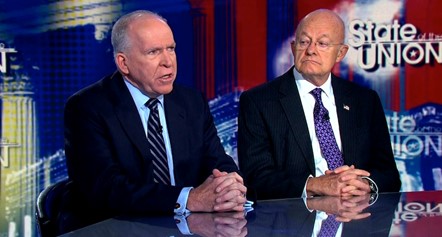
Former Director of National Intelligence James Clapper and former CIA Director John Brennan discuss allegations of Russian influence in presidential elections (CNN Screenshot)
By Whitney Webb – Mint Press News – February 12, 2018
Though its ostensible purpose is to fund the US military over a one year period, the National Defense Authorization Act, better known as the NDAA, has had numerous provisions tucked into it over the years that have targeted American civil liberties. The most well-known of these include allowing the government to wiretap American citizens without a warrant and, even more disturbingly, indefinitely imprison an American citizen without charge in the name of “national security.”
One of the lesser-known provisions that have snuck their way into the NDAA over the years was a small piece of legislation tacked onto the NDAA for fiscal year 2013, signed into law in that same year by then-President Barack Obama. Named “The Smith-Mundt Modernization Act of 2012,” it completely lifted the long-existing ban on the domestic dissemination of US government-produced propaganda.
For decades, the US government had been allowed to produce and disseminate propaganda abroad in order to drum up support for its foreign wars but had been banned from distributing it domestically after the passage of the Smith-Mundt Act of 1948. However, the Modernization Act’s co-authors, Reps. Mac Thornberry (R-TX) and Adam Smith (D-WA, no relation to the Smith of the 1948 act), asserted that removing the domestic ban was necessary in order to combat “al-Qaeda’s and other violent extremists’ influence among populations.”
Thornberry stated that removing the ban was necessary because it had tied “the hands of America’s diplomatic officials, military, and others, by inhibiting our ability to effectively communicate in a credible way.” Yet, given that Thornberry is one of the greatest beneficiaries of weapon manufacturers’ campaign contributions, the real intent — to skeptics at least — seemed more likely related to an effort to ramp up domestic support for US military adventurism abroad following the disastrous invasions of Iraq and Libya.
Five years later, the effects of the lifting of the ban have turned what was once covert manipulation of the media by the government into a transparent “revolving door” between the media and the government. Robbie Martin — documentary filmmaker and media analyst whose documentary series, “A Very Heavy Agenda,” explores the relationships between neoconservative think tanks and media — told MintPress, that this revolving door “has never been more clear than it is right now” as a result of the ban’s absence.
In the age of legal, weaponized propaganda directed at the American people, false narratives have become so commonplace in the mainstream and even alternative media that these falsehoods have essentially become normalized, leading to the era of “fake news” and “alternative facts.”
Those who create such news, regardless of the damage it causes or the demonstrably false nature of its claims, face little to no accountability, as long as those lies are of service to US interests. Meanwhile, media outlets that provide dissenting perspectives are being silenced at an alarming rate.
The effects of lifting the ban examined
Since 2013, newsrooms across the country, of both the mainstream and “alternative” variety, have been notably skewed towards the official government narrative, with few outside a handful of independently-funded media outlets bothering to question those narratives’ veracity. While this has long been a reality for the Western media (see John Pilger’s 2011 documentary “The War You Don’t See”), the use of government-approved narratives and sources from government-funded groups have become much more overt than in years past.
From Syria to Ukraine, US-backed coups and US-driven conflicts have been painted as locally driven movements that desperately need US support in order to “help” the citizens of those countries — even though that “help” has led to the near destruction of those countries and, in the case of Ukraine, an attempted genocide. In these cases, many of the sources were organizations funded directly by the US government or allied governments, such as the White Helmets and Aleppo Media Centre (largely funded by the US and U.K. governments) in the case of Syria, and pro-Kiev journalists with Nazi ties (including Bogdan Boutkevitch, who called for the “extermination” of Ukrainians of Russian descent on live TV) in the case of Ukraine, among other examples. Such glaring conflicts of interests are, however, rarely — if ever — disclosed when referenced in these reports.
More recently, North Korea has been painted as presenting an imminent threat to the United States. Recent reports on this “threat” have been based on classified intelligence reports that claim that North Korea can produce a new nuclear bomb every six or seven weeks, including a recent article from the New York Times. However, those same reports have admitted that this claim is purely speculative, as it is “impossible to verify until experts get beyond the limited access to North Korean facilities that ended years ago.” In other words, the article was based entirely on unverified claims from the US intelligence community that were treated as compelling.
As Martin told MintPress, many of these government-friendly narratives first began at US-funded media organizations overseen by the Broadcasting Board of Governors (BBG) — an extension of the US state department.
Martin noted that US-funded media, like Voice of America (VOA) and Radio Free Europe (RFE), were among the first to use a State Department-influenced narrative aimed at “inflaming hostilities with Russia before it soaked into mainstream reporting.” Of course, now, this narrative — with its origins in the US State Department and US intelligence community — has come to dominate headlines in the corporate media and even some “alternative” media outlets in the wake of the 2016 US election.
This is no coincidence. As Martin noted, “after the ban was lifted, things changed drastically here in the United States,” resulting in what was tantamount to a “propaganda media coup” where the State Department, and other government agencies that had earlier shaped the narrative at the BBG, used their influence on mainstream media outlets to shape those narratives as well.
A key example of this, as Martin pointed out, was the influence of the new think-tank “The Alliance for Securing Democracy,” whose advisory council and staff are loaded with neocons, such as the National Review’s Bill Kristol, and former US intelligence and State Department officials like former CIA Director Michael Morell. The Alliance for Securing Democracy’s Russia-focused offshoot, “Hamilton 68,” is frequently cited by media outlets — mainstream and alternative — as an impartial, reliable tracker of Russian “meddling” efforts on social media.
Martin remarked that he had “never seen a think tank before have such a great influence over the media so quickly,” noting that it “would have been hard to see [such influence on reporters] without the lifting of the ban,” especially given the fact that media organizations that cite Hamilton 68 do not mention its ties to former government officials and neoconservatives.
In addition, using VOA or other BBG-funded media has become much more common than it was prior to the ban, an indication that state-crafted information originally intended for a foreign audience is now being used domestically. Martin noted that this has become particularly common at some “pseudo-alternative” media organizations — i.e., formerly independent media outlets that now enjoy corporate funding. Among these, Martin made the case that VICE News stands out.
After the propaganda ban was lifted, Martin noticed that VICE’s citations of BBG sources “spiked.” He continued:
One of the things I immediately noticed was that they [VICE news ] were so quick to call out other countries’ media outlets, but yet — in every instance I looked up of them citing BBG sources — they never mentioned where the funding came from or what it was and they would very briefly mention it [information from BBG sources] like these were any other media outlets.”
He added that, in many of these cases, journalists at VICE were unaware that references to VOA or other BBG sources appeared in their articles. This was an indication that “there is some editorial staff [at VICE News ] that is putting this in from the top down.”
Furthermore, Martin noted that, soon after the ban was lifted, “VICE’s coverage mirrored the type of coverage that BBG was doing across the world in general,” which in Martin’s view indicated “there was definitely some coordination between the State Department and VICE.” This coordination was also intimated by BBG’s overwhelmingly positive opinion of VICE in their auditing reports, in which the BBG “seemed more excited about VICE than any other media outlet” — especially since VICE was able to use BBG organizations as sources while maintaining its reputation as a “rebel” media outlet.
Martin notes that these troubling trends have been greatly enabled by the lifting of the ban. He opined that the ban was likely lifted “in case someone’s cover [in spreading government propaganda disguised as journalism] was blown,” in which case “it wouldn’t be seen as illegal.” He continued:
For example, if a CIA agent at the Washington Post is directly piping in US government propaganda or a reporter is working the US government to pipe in propaganda, it wouldn’t be seen as a violation of the law. Even though it could have happened before the ban, it’s under more legal protection now.
Under normal circumstances, failing to disclose conflicts of interests of key sources and failing to question government narratives would be considered acts of journalistic malpractice. However, in the age of legal propaganda, this dereliction matters much less. Propaganda is not intended to be factual or impartial — it is intended to serve a specific purpose, namely influencing public opinion in a way that serves US government interests. As Karl Rove, the former advisor and deputy chief of staff to George W. Bush, once said, the US “is an empire now, and when we act, we create our own reality.” This “reality” is defined not by facts but by its service to empire.
Meanwhile, counter-narratives, however fact-based they may be, are simultaneously derided as conspiracy theories or “fake news,” especially if they question or go against government narratives.
The revolving door
Another major consequence of the ban being lifted goes a step further than merely influencing narratives. In recent years, there has been the growing trend of hiring former government officials, including former US intelligence directors and other psyops veterans, in positions once reserved for journalists. In their new capacity as talking heads on mainstream media reports, they repeat the stance of the US intelligence community to millions of Americans, with their statements and views unchallenged.
For instance, last year, CNN hired former Director of National Intelligence James Clapper. Clapper, a key architect of RussiaGate, has committed perjury by lying to Congress and more recently lied about the Trump campaign being wiretapped through a FISA request. He has also made racist, Russophobic comments on national television. Now, however, he is an expert analyst for “the most trusted name in news.” CNN last year also hired Michael Hayden, who is a former Director of both the CIA and the NSA, and former Principal Deputy Director of National Intelligence.
CNN isn’t alone. NBC/MSNBC recently hired former CIA director John Brennan — another key architect of RussiaGate and the man who greenlighted (and lied about) CIA spying on Congress — as a contributor and “senior national security and intelligence analyst.” NBC also employs Jeremy Bash, former CIA and DoD Chief of Staff, as a national security analyst, as well as reporter Ken Dilanian, who is known for his “collaborative relationship” with the CIA.
This “revolving door” doesn’t stop there. After the BBG was restructured by the 2016 NDAA, the “board” for which the organization was named was dissolved, making BBG’s CEO — a presidential appointee — all powerful. BBG’s current CEO is John Lansing, who – prior to taking the top post at the BBG – was the President and Chief Executive Officer of the Cable & Telecommunications Association for Marketing (CTAM), a marketing association comprised of 90 of the top US and Canadian cable companies and television programmers. Lansing’s connection to US cable news companies is just one example of how this revolving door opens both ways.
Media-government coordination out of the shadows
Such collusion between mainstream media and the US government is hardly new. It has only become more overt since the Smith-Mundt ban was lifted.
For instance, the CIA, through Operation Mockingbird, started recruiting mainstream journalists and media outlets as far back as the 1960s in order to covertly influence the American public by disguising propaganda as news. The CIA even worked with top journalism schools to change their curricula in order to produce a new generation of journalists that would better suit the US government’s interests. Yet the CIA effort to manipulate the media was born out of the longstanding view in government that influencing the American public through propaganda was not only useful, but necessary.
Indeed, Edward Bernays, the father of public relations, who also worked closely with the government in the creation and dissemination of propaganda, once wrote:
The conscious and intelligent manipulation of the organized habits and opinions of the masses is an important element in democratic society. Those who manipulate this unseen mechanism of society constitute an invisible government which is the true ruling power of our country.
While this was once an “invisible” phenomenon, it is quickly becoming more obvious. Now, Silicon Valley oligarchs with ties to the US government have bought mainstream and pseudo-alternative media outlets and former CIA directors are given prominent analyst positions on cable news programs. The goal is to manufacture support at home for the US’ numerous conflicts around the world, which are only likely to grow as the Pentagon takes aim at “competing states” like Russia and China in an increasingly desperate protection of American hegemony.
With the propaganda ban now a relic, the once-covert propaganda machine long used to justify war after war is now operating out in the open and out of control.
Former CIA Director Calls For A Coup If Trump Fires Mueller
By Tyler Durden | Zero Hedge | July 24, 2017
In the most vocal opposition to president Donald Trump yet, former CIA Director John Brennan said that if the White House tries to fire special counsel Robert Mueller, government officials should refuse to follow the president orders, as they would be – in his view – “inconsistent” with the duties of the executive branch.
“I think it’s the obligation of some executive branch officials to refuse to carry that out. I would just hope that this is not going to be a partisan issue. That Republicans, Democrats are going to see that the future of this government is at stake and something needs to be done for the good of the future,” Brennan told CNN’s Wolf Blitzer at the Aspen Security Forum, effectively calling for a coup against the president should Trump give the order to fire Mueller.
The exchange is 43 minutes into the clip below:
Brennan appeared alongside his former colleague, Director of National Intelligence James Clapper, and both men who served in the Obama administration, told Blitzer they have total confidence in Mueller. “Absolutely. It was an inspired choice- they don’t come any better, ” Brennan said adding that “If Mueller is fired, I hope our elected reps will stand up and say enough is enough.” Some have responded with questions where Brennan’s devotion to the Constitution was in the aftermath of the events in Benghazi.
Falling back on his neocon roots, James Clapper, who has waged a long-running vendetta with Trump, once again warned about Russian interference in US affairs. When asked about the June 2016 meeting between Donald Trump Jr., Jared Kushner and Paul Manafort with a Russian lawyer and others, he responded: “I’m an old school, Cold War warrior and all that – so I have, there’s truth in advertising, great suspicions about the Russians and what they do. A lot of this to me had kind of the standard textbook tradecraft long deployed by Russians. It would have been a really good idea maybe to have vetted whoever they were meeting with.”
Clapper was also asked about Trump’s comparison of the intelligence community to Nazi Germany. Clapper said he called the President-elect nine days before he left the Obama administration saying he “couldn’t let that reference pass” and it was an insult to him, CIA Director John Brennan and the workforce. “That was a terrible, insulting affront, not just to me or John, we get paid the big bucks, but I’m talking about the rank and file, men and women, patriots and intelligence community — that was completely inappropriate and over the top – I had to do something about it.”
And so he did: on the call Clapper said Trump asked him to “to put out a statement rebutting the contents of the dossier which I couldn’t and wouldn’t do. It was kind of transactional” referring to a dossier that alleged ties between President Donald Trump’s campaign and Russia. It was not clear if he wouldn’t and couldn’t do it because the contents were legitimate, in his view, or because the dossier is what started the whole “Russian collusion” narrative in the first place. Curiously, Clapper saw it as a favor to Trump not to issue a statement: Clapper was asked by Blitzer why he didn’t put out a statement replying: “The whole point of the dossier by the way was we felt an obligation to warn him to alert him to the fact it was out there. That was the whole point.”
It was not clear if James Comey, whose subsequent leak to the NYT led to the appointment of Mueller, would have applied the same reasoning when asked by Trump to rebut the dossier’s contents.
Shambolic Doings in Washington
Will we survive the next 90 days?

By Philip Giraldi • Unz Review • April 25, 2017
There remains one good thing to say about Donald Trump: he is not Hillary. The boneheaded cruise missile attack in Syria would have occurred even earlier under President Rodham Clinton and there would undoubtedly be no-fly and safe zones already in place. Oh, and Ukraine and Georgia would be negotiating their entries into NATO to make sure that old Vlad Putin would be put on notice and understand that the days of namby-pamby jaw-jaw-jaw that characterized the Obama Administration are now ancient history.
Apart from that, I can only observe dumbstruck how yet again a candidate promising peace and dialogue could be flipped so quickly. Or maybe he never believed in anything he said, which is perhaps more to the point. Be that as it may, we now, after only ninety days in office, have a neo-neocon foreign policy and the folks clustered around their water coolers in the Washington think tanks are again smiling. And as the ruinous Syrian civil war continues thanks to American intervention, there are probably plenty of high fives within Israel’s Benjamin Netanyahu government. Bibi again rules the roost.
The Israelis are no doubt particularly delighted to hear Donald Trump’s latest factually exempt voyage into the outer reaches of the galaxy regarding Iran. Or perhaps The Donald is only having continuing digestive problems dealing with “most beautiful piece of chocolate cake that you’ve ever seen” when dining with mortified Chinese leader Xi Jinping while simultaneously launching cruise missiles intended to send a message to Beijing’s ally Russia. It is inevitably Iran’s turn for vilification, so Trump, while conceding that the Iranians have been compliant with the nuclear weapons agreement they signed, also felt compelled to add that they continue to be a threat and have not entered into the “spirit” of the pact. Apparently the spirit codicil was somehow left out of the final draft, an interpretation that will no doubt surprise the other signatories consisting of Russia, China and the European Union.
To make its point that Tehran is somehow a cheater, the White House has ordered a 90 day review of Iran policy which will empower hardliners in that country in upcoming elections as well as nut cases like Senators John McCain and Lindsey Graham on this side of the Atlantic. Iranian opposition groups like the terrorist Mujaheddin e Khalq (MEK) are already rising to the challenge by floating phony intelligence while Graham is currently advocating a preemptive attack on North Korea, conceding that it would be catastrophic for every country in the region while noting smugly that the carnage and destruction would not reach the United States. Too bad that Pyongyang’s fury cannot be directed straight to Graham’s house in South Carolina.
Graham is reportedly a good dancer and multitasker who can pivot back to Iran effortlessly as soon as Pyongyang is reduced to rubble, so those who want to deal with Iran sooner rather than later should not despair. As things continue to go south nearly everywhere, tension in the Middle East will no doubt lead to a rapidly deteriorating situation in the Persian Gulf that will require yet another ham-handed show of strength by the United States of Amnesia. There will be a war against Iran.
There have been a couple of other interesting stories circulating recently, all demonstrating that when Benjamin Franklin observed that we Americans had created a republic, “if we can keep it,” he was being particularly prescient. Robert Parry has observed that all the fuss about Russiagate is misleading as the only country that interferes with the political process in the U.S. persistently and successfully while also doing terrible damage to our national security is Israel. He wonders when we will have Congress convening investigative commissions to look into Israel-gate but then answers his own question by observing that it will never happen given who controls what in the United States. “No one dares suggest a probe of Israel-gate,” he concludes, but it is interesting and also encouraging to note that some Americans are actually starting to figure things out.
One of the curious things relating to the Russiagate scandal is the issue of who in the U.S. intelligence community leaked highly classified information to the media, a question which somehow seems to have disappeared from whatever final reckoning might be forthcoming. The issue is particularly relevant at the moment because there are reports that the Justice Department is pulling together a case against WikiLeaks founder Julian Assange as part of a possible attempt to remove him forcibly from his refuge in Britain and try him for constituting what CIA Director Mike Pompeo describes as a “hostile intelligence service helped by Russia.” It all suggests that low hanging fruit is fair game while some “official” leakers at high levels are somehow being protected.
To cite another example of Justice Department hypocrisy, three current and four former U.S. officials leaked to Reuters last week’s story about a Russian think tank having created a plan to subvert the U.S. election. If that is so, their identities might be discernible or surmised. Why aren’t they in jail? Or is it that many in government now believe that Russia is fair game and are prepared to look the other way?
It is significant that the recent House Intelligence Committee hearing on Russiagate, featuring FBI Director James Comey and NSA Director Mike Rogers, provided very little new information even as it confirmed troubling revelations that had already surfaced regarding the corruption of the nation’s security services. Given that former Central Intelligence Agency (CIA) head John Brennan and former Director of National Intelligence (DNI) chief James Clapper have been most frequently cited as the Obama administration’s possible bag men in arranging for the generation, collection, dissemination, and leaking of information disparaging to Trump, why weren’t they also being questioned?
The latest focus on Brennan, an Obama/Clinton loyalist who might safely be regarded as the most likely candidate seeking to discredit Team Trump and reap the benefits from Hillary, explores some suspicions about what actually took place last year and how it might have been arranged. The story broke in The Guardian on April 13th, headlined “British spies were first to spot Trump team’s links with Russia.” The article rehashes much old information, but, relying on a “source close to UK intelligence,” it describes how Britain’s NSA equivalent GCHQ obtained information late in 2015 relating to suspect “interactions” between Trump associates and the Russian intelligence. GCHQ reportedly routinely passed the information on to its U.S. liaison counterparts, and continued to do so over the next six months. The information was supplemented by similar reporting from a number of European intelligence services as well as the remaining “Five Eyes”: Canada, Australia and New Zealand.
According to the Guardian source and reporters, who are clearly hostile to Trump, the collection was not directed or targeted but was rather part of random interception of Russian communications. This may or may not be true but it serves as a useful cover story if someone was up to something naughty. And it also makes one wonder about the highly incriminating British intelligence sourced “dossier” on Trump and his associates, which The Guardian strangely does not mention, that appeared in January. Another apparent Guardian source called GCHQ the “principal whistleblower” in sharing the information that led to the opening of an FBI investigation in July 2016, a suggestion that the British role was not exactly passive.
The article goes on to describe how John Brennan, then CIA Chief, was personally the recipient of the material passed hand-to-hand at “director level” because of its sensitivity. So the Guardian article is essentially saying that the information was both routine and extremely sensitive, which would seem to be contradictory. Brennan was reportedly then the driving force behind launching a “major inter-agency investigation” and he briefed selected members of Congress regarding what he had obtained. Shortly thereafter leaks began appearing in the British press followed subsequently by revelations in the media in the U.S.
An October request to the Foreign Intelligence Surveillance Act (FISA) court reportedly was initiated after particularly damaging information was received from Estonia concerning Trump associate Carter Page and also regarding allegations that a Russian bank was funneling money into the Trump campaign. This led to an investigation of Page and the tapping into servers in Trump Tower, where the presidential campaign offices were located. Estonia, it should be noted, was particularly concerned about Trump comments on de-emphasizing NATO and strongly supported a Hillary victory so it is fair to speculate that the intelligence provided might have been cherry picked to make a particular case, but The Guardian fails to make that obvious point.
It is interesting to note how for the first time, in this media account, Brennan surfaces as the central player in the investigation of Team Trump. And it is perhaps not out of line to suggest that the European reporting of information on Trump associates was not exactly due to random collection of information, as The Guardian seeks to demonstrate. It could just as easily have been arranged at the “director level” by Brennan and his counterparts to disrupt the Trump campaign and enhance the electability of Hillary Clinton, which would have directly benefited Brennan and his inner circle as well as the Europeans, all of whom feared a Trump victory. Intelligence can be skewed, “fixed around a policy” or even fabricated and can say whatever one wants it to say so it is fair to suggest that the role of a politically committed John Brennan remains to be explored much more fully.
It is now being reported that Brennan will be summoned to give testimony at a closed House Intelligence Committee meeting on May 2nd. Hopefully his comments will be somehow leaked to the media plus those of James Clapper, who is also scheduled to appear. Nevertheless, one imagines that, as was the case in Comey’s first appearance, both former officials will spend most of their time refusing to confirm or deny anything.
The active participation of Brennan in the background to the 2016 electoral campaign is unprecedented and it is also suggestive of what America’s national security agencies have become, basically creatures of the White House. It is hard to escape the conclusion that Benjamin Franklin would undoubtedly deplore the fact that we have failed to keep the republic that the Founding Fathers bequeathed to us. That would be bad enough, but we are slipping into a pattern of foreign wars based on tissues of lies and deceptions by the very people who are in place to protect us, quite possibly exemplified by unscrupulous and ambitious ladder climbers like John Brennan, who was also the architect of Obama’s assassination policy. If we go to war because of suspected lack of “spirit” in our adversaries or merely because someone in the White House had a piece of chocolate cake and wanted something to talk about over his cup of espresso then we are doomed as a nation.
US ‘politicians, bureaucrats & academics’ caught in Turkey’s failed coup attempt probe
RT | April 16, 2017
Turkey has launched an investigation to examine whether 17 prominent Americans could have links to the FETO movement of an exiled US-based cleric, Fethullah Gulen, which Ankara blames for last summer’s failed coup attempt.
The Chief Public Prosecutor’s Office launched the probe into 17 individuals including US politicians, bureaucrats, and academics after a number of Turkish attorneys filed a criminal complaint against these persons, local media report.
Former CIA Director John O. Brennan, New York Senator Chuck Schumer, US attorney for the Southern District of New York Preet Bharara, and Office of Foreign Assets Control (OFAC) President David Cohen are among the suspects, Anadolu reports.
Other American residents caught in the probe include Henri Barkey, Director of the Middle East Program at Wilson Center former CIA figure Graham E. Fuller, and President of the Turkic American Alliance (TAA) Faruk Taban.
Schumer, for instance, is being suspected of receiving millions of dollars from Gulen’s movement and representing his organizational interests in the US.
Fuller, a former vice chairman of the National Intelligence Council at the CIA, allegedly was a sponsor for Gulen when he applied for a US residence permit.
The individuals are being accused of conspiracy to overthrow the Turkish government and are suspected to have links with FETO. Alleged evidence of their involvement with the Gulen movement has been submitted to the prosecutors, Turkish media report.
Gulen leads the popular Islamic transnational religious and social movement called Hizmet, believed to be funding numerous businesses, think tanks, private schools, and publishing houses around the world. Turkish President Recep Tayyip Erdogan has accused the prominent cleric and his group of masterminding the failed coup in Turkey on July 15, 2015.
Gulen, once an Erdogan ally, is now living in self-imposed exile in Pennsylvania. Ankara has repeatedly demanded his extradition to investigate his alleged participation in the coup attempt, as well as that of Hizmet, known as FETO in Turkey, and considered a terrorist organization by Ankara. The 74-year-old has denied any involvement in the failed coup plot.
Suspected Gulen followers, known as Gulenists, allegedly infiltrated all layers of Turkish society and have been persecuted and hunted down in Turkey in a massive crackdown on Erdogan’s opposition which followed the events in July 2016.
More than 100,000 people were fired from their jobs and around 30,000 detained, including teachers, journalists, security personnel and army officers.
How ‘New Cold Warriors’ Cornered Trump
By Gareth Porter | Consortium News | February 25, 2017
Opponents of the Trump administration have generally accepted as fact the common theme across mainstream media that aides to Donald Trump were involved in some kind of illicit communications with the Russian government that has compromised the independence of the administration from Russian influence.
But close analysis of the entire series of leaks reveals something else that is equally sinister in its implications: an unprecedented campaign by Obama administration intelligence officials, relying on innuendo rather than evidence, to exert pressure on Trump to abandon any idea of ending the New Cold War and to boost the campaign to impeach Trump.
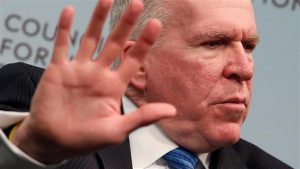 A brazen and unprecedented intervention in domestic U.S. politics by the intelligence community established the basic premise of the cascade of leaks about alleged Trump aides’ shady dealing with Russia. Led by CIA Director John Brennan, the CIA, FBI and NSA issued a 25-page assessment on Jan. 6 asserting for the first time that Russia had sought to help Trump win the election.
Brennan had circulated a CIA memo concluding that Russia had favored Trump and had told CIA staff that he had met separately with Director of National Intelligence James Clapper and FBI Director James Comey and that they had agreed on the “scope, nature and intent of Russian interference in our presidential election.”
In the end, however, Clapper refused to associate himself with the document and the NSA, which agreed to do so, was only willing to express “moderate confidence” in the judgment that the Kremlin had sought to help Trump in the election. In intelligence community parlance, that meant that the NSA considered the idea the Kremlin was working to elect Trump was merely plausible, not actually supported by reliable evidence.
In fact, the intelligence community had not even obtained evidence that Russia was behind the publication by Wikileaks of the e-mails Democratic National Committee, much less that it had done so with the intention of electing Trump. Clapper had testified before Congress in mid-November and again in December that the intelligence community did not know who had provided the e-mails to WikiLeaks and when they were provided.
The claim – by Brennan with the support of Comey – that Russia had “aspired” to help Trump’s election prospects was not a normal intelligence community assessment but an extraordinary exercise of power by Brennan, Comey and NSA Director Mike Rogers.
Brennan and his allies were not merely providing a professional assessment of the election, as was revealed by their embrace of the the dubious dossier compiled by a private intelligence firm hired by one of Trump’s Republican opponents and later by the Clinton campaign for the specific purpose of finding evidence of illicit links between Trump and the Putin regime.
Salacious Gossip
When the three intelligence agencies gave the classified version of their report to senior administration officials in January they appended a two-page summary of the juiciest bits from that dossier – including claims that Russian intelligence had compromising information about Trump’s personal behavior while visiting Russia. The dossier was sent, along with the assessment that Russia was seeking to help Trump get elected, to senior administration officials as well as selected Congressional leaders.
Among the claims in the private intelligence dossier that was summarized for policymakers was the allegation of a deal between the Trump campaign and the Putin government involving full Trump knowledge of the Russian election help and a Trump pledge – months before the election – to sideline the Ukraine issue once in office. The allegation – devoid of any verifiable information – came entirely from an unidentified “Russian emigre” claiming to be a Trump insider, without any evidence provided of the source’s actual relationship to the Trump camp or of his credibility as a source.
After the story of the two-page summary leaked to the press, Clapper publicly expressed “profound dismay” about the leak and said the intelligence community “has not made any judgment that the information in this document is reliable,” nor did it rely on it any way for our conclusions.”
One would expect that acknowledgment to be followed by an admission that he should not have circulated it outside the intelligence community at all. But instead Clapper then justified having passed on the summary as providing policymakers with “the fullest possible picture of any matters that might affect national security.”
By that time, U.S. intelligence agencies had been in possession of the material in the dossier for several months. It was their job to verify the information before bringing it to the attention of policymakers.
A former U.S. intelligence official with decades of experience dealing with the CIA as well other intelligence agencies, who insisted on anonymity because he still has dealings with U.S. government agencies, told this writer that he had never heard of the intelligence agencies making public unverified information on a U.S. citizen.
“The CIA has never played such a open political role,” he said.
The CIA has often tilted its intelligence assessment related to a potential adversary in the direction desired by the White House or the Pentagon and the Joint Chiefs of Staff, but this is the first time that such a slanted report impinges not only on domestic politics but is directed at the President himself.
The egregious triple abuse of the power in publishing a highly partisan opinion on Russia and Trump’s election, appending raw and unverified private allegations impugning Trump’s loyalty and then leaking that fact to the media begs the question of motive. Brennan, who initiated the whole effort, was clearly determined to warn Trump not to reverse the policy toward Russia to which the CIA and other national security organizations were firmly committed.
A few days after the leak of the two-page summary, Brennan publicly warned Trump about his policy toward Russia. In an interview on Fox News, he said, “I think Mr. Trump has to understand that absolving Russia of various actions that it’s taken in the past number of years is a road that he, I think, needs to be very, very careful about moving down.”
Graham Fuller, who was a CIA operations officer for 20 years and was also National Intelligence Officer for the Middle East for four years in the Reagan administration, observed in an e-mail, that Brennan, Clapper and Comey “might legitimately fear Trump as a loose cannon on the national scene,” but they are also “dismayed at any prospect that the official narrative against Russia could start falling apart under Trump, and want to maintain the image of constant and dangerous Russian intervention into affairs of state.”
Flynn in the Bull’s Eye
As Trump’s National Security Adviser, Michael Flynn presented an easy target for a campaign to portray the Trump team as being in Putin’s pocket. He had already drawn heavy criticism not only by attending a Moscow event celebrating the Russian television RT in 2016 but sitting next to Putin and accepting a fee for speaking at the event. More importantly, however, Flynn had argued that the United States and Russia could and should cooperate in their common interest of defeating Islamic State militants.
That idea was anathema to the Pentagon and the CIA. Obama’s Defense Secretary Ashton Carter had attacked Secretary of State John Kerry’s negotiating a Syrian ceasefire that included a provision for coordination of efforts against Islamic State. The official investigation of the U.S. attack on Syrian forces on Sept. 17 turned up evidence that CENTCOM had deliberately targeted the Syrian military sites with the intention of sabotaging the ceasefire agreement.
The campaign to bring down Flynn began with a leak from a “senior U.S. government official” to Washington Post columnist David Ignatius about the now-famous phone conversation between Flynn and Russian Ambassador Sergei Kislyak on Dec. 29. In his column on the leak, Ignatius avoided making any explicit claim about the conversation. Instead, he asked “What did Flynn say, and did it undercut the U.S. sanctions?”
And referring to the Logan Act, the 1799 law forbidding a private citizen from communicating with a foreign government to influence a “dispute” with the United States, Ignatius asked, “Was its spirit violated?”
The implications of the coy revelation of the Flynn conversation with Kislyak were far-reaching. Any interception of a communication by the NSA or the FBI has always been considered one of the most highly classified secrets in the U.S. intelligence universe of secrets. And officers have long been under orders to protect the name of any American involved in any such intercepted communication at all costs.
But the senior official who leaked the story of Flynn-Kislyak conversation to Ignatius – obviously for a domestic political purpose – did not feel bound by any such rule. That leak was the first move in a concerted campaign of using such leaks to suggest that Flynn had discussed the Obama administration’s sanctions with Kislyak in an effort to undermine Obama administration policy.
The revelation brought a series of articles about denials by the Trump transition team, including Vice President-elect Mike Pence, that Flynn had, in fact, discussed sanctions with Kislyak and continued suspicions that Trump’s aides were covering up the truth. But the day after Trump was inaugurated, the Post itself reported that the FBI had begun in late December go back over all communications between Flynn and Russian officials and “had not found evidence of wrongdoing or illicit ties to the Russian government….”
Two weeks later, however, the Post reversed its coverage of the issue, publishing a story citing “nine current and former officials, who were in senior positions at multiple agencies at the time of the calls,” as saying that Flynn had “discussed sanctions” with Kislyak.
The story said Flynn’s conversation with Kislyak was “interpreted by some senior U.S. officials as an inappropriate and potentially illegal signal to the Kremlin that it could expect a reprieve from sanctions that were being imposed by the Obama administration in late December to punish Russia for its alleged interference in the 2016 election.”
The Post did not refer to its own previous reporting of the FBI’s unambiguous view contradicting that claim, which suggested strongly that the FBI was trying to head off a plan by Brennan and Clapper to target Flynn. But it did include a crucial caveat on the phrase “discussed sanctions” that few readers would have noticed. It revealed that the phrase was actually an “interpretation” of the language that Flynn had used. In other words, what Flynn actually said was not necessarily a literal reference to sanctions at all.
Only a few days later, the Post reported a new development: Flynn had been interviewed by the FBI on Jan. 24 – four days after Trump’s inauguration – and had denied that he discussed sanctions in the conversation. But prosecutors were not planning to charge Flynn with lying, according to several officials, in part because they believed he would be able to “parse the definition of the word ‘sanctions’.” That implied that the exchange was actually focused not on sanctions per se but on the expulsion of the Russian diplomats.
Just hours before his resignation on Feb. 13, Flynn claimed in an interview with the Daily Caller that he had indeed referred only to the expulsion of the Russian diplomats.
“It wasn’t about sanctions. It was about the 35 guys who were thrown out,” Flynn said. “It was basically, ‘Look, I know this happened. We’ll review everything.’ I never said anything such as, ‘We’re going to review sanctions,’ or anything like that.”
The Russian Blackmail Ploy
Even as the story of the Flynn’s alleged transgression in the conversation with the Russian Ambassador was becoming a political crisis for Donald Trump, yet another leaked story surfaced that appeared to reveal a shocking new level of the Trump administration’s weakness toward Russia.
The Post reported on Feb. 13 that Acting Attorney General Sally Yates, an Obama holdover, had decided in late January – after discussions with Brennan, Clapper and FBI Director James Comey in the last days of the Obama administration – to inform the White House Counsel Donald McGahn in late January that Flynn had lied to other Trump administration officials – including Vice President Mike Pence – in denying that he discussed sanctions with Kislyak. The Post cited “current and former officials” as the sources.
That story, repeated and amplified by many other news media, led to Flynn’s downfall later that same day. But like all of the other related leaks, the story revealed more about the aims of the leakers than about links between Trump’s team and Russia.
The centerpiece of the new leak was that the former Obama administration officials named in the story had feared that “Flynn put himself in a compromising position” in regard to his account of the conversation with Kislyak to Trump members of the Trump transition.
Yates had told the White House that Flynn might be vulnerable to Russian blackmail because of the discrepancies between his conversation with the Ambassador and his story to Pence, according to the Post story.
But once again the impression created by the leak was very different from the reality behind it. The idea that Flynn had exposed himself to a potential Russian blackmail threat by failing to tell Pence exactly what had transpired in the conversation was fanciful in the extreme.
Even assuming that Flynn had flatly lied to Pence about what he had said in the meeting – which was evidently not the case – it would not have given the Russians something to hold over Flynn, first because it was already revealed publicly and second, because the Russian interest was to cooperate with the new administration.
The ex-Obama administration leakers were obviously citing that clumsy (and preposterous) argument as an excuse to intervene in the internal affairs of the new administration. The Post’s sources also claimed that “Pence had a right to know that he had been misled….” True or not, it was, of course, none of their business.
Pity for Pence
The professed concern of the Intelligence Community and Justice Department officials that Pence deserved the full story from Flynn was obviously based on political considerations, not some legal principle. Pence was a known supporter of the New Cold War with Russia, so the tender concern for Pence not being treated nicely coincided with a strategy of dividing the new administration along the lines of policy toward Russia.
All indications are that Trump and other insiders knew from the beginning exactly what Flynn had actually said in the conversation, but that Flynn had given Pence a flat denial about discussing sanctions without further details.
On Feb. 13, when Trump was still trying to save Flynn, the National Security Adviser apologized to Pence for “inadvertently” having failed to give him a complete account, including his reference to the expulsion of the Russian diplomats. But that was not enough to save Flynn’s job.
The divide-and-conquer strategy, which led to Flynn’s ouster, was made effective because the leakers had already created a political atmosphere of great suspicion about Flynn and the Trump White House as having had illicit dealings with the Russians. The normally pugnacious Trump chose not to respond to the campaign of leaks with a detailed, concerted defense. Instead, he sacrificed Flynn before the end of the very day the Flynn “blackmail” story was published.
But Trump appears to have underestimated the ambitions of the leakers. The campaign against Flynn had been calculated in part to weaken the Trump administration and ensure that the new administration would not dare to reverse the hardline policy of constant pressure on Putin’s Russia.
Many in Washington’s political elite celebrated the fall of Flynn as a turning point in the struggle to maintain the existing policy orientation toward Russia. The day after Flynn was fired the Post’s national political correspondent, James Hohmann, wrote that the Flynn “imbroglio” would now make it “politically untenable for Trump to scale back sanctions to Moscow” because the “political blowback from hawkish Republicans in Congress would be too intense….”
But the ultimate target of the campaign was Trump himself. As neoconservative journalist Eli Lake put it, “Flynn is only the appetizer. Trump is the entree.”
Susan Hennessey, a well-connected former lawyer in the National Security Agency’s Office of General Counsel who writes the Lawfare blog at the Brookings Institution, agreed. “Trump may think Flynn is the sacrificial lamb,” she told The Guardian, “but the reality is that he is the first domino. To the extent the administration believes Flynn’s resignation will make the Russia story go away, they are mistaken.”
The Phony “Constant Contacts” Story
No sooner had Flynn’s firing been announced than the next phase of the campaign of leaks over Trump and Russia began. On Feb. 14, CNN and the New York Times published slight variants of the same apparently scandalous story of numerous contacts between multiple members of the Trump camp with the Russian at the very time the Russians were allegedly acting to influence the election.
There was little subtlety in how mainstream media outlets made their point. CNN’s headline was, “Trump aides were in constant touch with senior Russian officials during campaign.” The Times headline was even more sensational: “Trump Campaign Aides Had Repeated Contacts with Russian Intelligence.”
But the attentive reader would soon discover that the stories did not reflect those headlines. In the very first paragraph of the CNN story, those “senior Russian officials” became “Russians known to U.S. intelligence,” meaning that it included a wide range Russians who are not officials at all but known or suspected intelligence operatives in business and other sectors of society monitored by U.S. intelligence. A Trump associate dealing with such individuals would have no idea, of course, that they are working for Russian intelligence.
The Times story, on the other hand, referred to the Russians with whom Trump aides were said to be in contact last year as “senior Russian intelligence officials,” apparently glossing over a crucial distinction that sources had made to CNN between intelligence officials and Russians being monitored by U.S. intelligence.
But the Times story acknowledged that the Russian contacts also included government officials who were not intelligence officials and that the contacts had been made not only by Trump campaign officials but also associates of Trump who had done business in Russia. It further acknowledged it was “not unusual” for American business to come in contact with foreign intelligence officials, sometimes unwittingly in Russia and Ukraine, where “spy services are deeply embedded in society.”
Even more important, however, the Times story made it clear that the intelligence community was seeking evidence that Trump’s aides or associates were colluding with the Russians on the alleged Russian effort to influence the election, but that it had found no evidence of any such collusion. CNN failed to report that crucial element of the story.
The headlines and lead paragraphs of both stories, therefore, should have conveyed the real story: that the intelligence community had sought evidence of collusion by Trump aides with Russia but had not found it several months after reviewing the intercepted conversations and other intelligence.
Unwitting Allies of the War Complex?
Former CIA Director Brennan and other former Obama administration intelligence officials have used their power to lead a large part of the public to believe that Trump had conducted suspicious contacts with Russian officials without having the slightest evidence to support the contention that such contacts represent a serious threat to the integrity of the U.S. political process.
Many people who oppose Trump for other valid reasons have seized on the shaky Russian accusations because they represent the best possibility for ousting Trump from power. But ignoring the motives and the dishonesty behind the campaign of leaks has far-reaching political implications. Not only does it help to establish a precedent for U.S. intelligence agencies to intervene in domestic politics, as happens in authoritarian regimes all over the world, it also strengthens the hand of the military and intelligence bureaucracies who are determined to maintain the New Cold War with Russia.
Those war bureaucracies view the conflict with Russia as key to the continuation of higher levels of military spending and the more aggressive NATO policy in Europe that has already generated a gusher of arms sales that benefits the Pentagon and its self-dealing officials.
Progressives in the anti-Trump movement are in danger of becoming an unwitting ally of those military and intelligence bureaucracies despite the fundamental conflict between their economic and political interests and the desires of people who care about peace, social justice and the environment.
Outgoing CIA Chief Warns Trump to “Watch His Words”
Al-Manar – January 16, 2017
Outgoing CIA chief John Brennan on Sunday launched a scathing attack on Donald Trump, warning him to watch what he says and suggesting the president-elect doesn’t understand the challenges posed by Russia.
Brennan’s stern words — which sparked a quick Twitter retort from Trump — were the latest salvo in the ongoing feud between the incoming Republican leader and US intelligence agencies, who have concluded Moscow meddled in the November election.
The 70-year-old Trump, who takes office on Friday, tweeted saying that if the Russian leader “likes” him, it would be an “asset” to help repair strained ties with Moscow.
“I don’t think he has a full appreciation of Russian capabilities, Russia’s intentions and actions,” Brennan said of Trump on Fox News Sunday.
“I think Mr. Trump has to be very disciplined in terms of what it is that he says publicly,” he added.
“He is going to be, in a few days’ time, the most powerful person in the world, in terms of sitting on top of the United States government and I think he has to recognize that his words do have impact,” the CIA chief said.
“He’s going to have the opportunity to do something for national security as opposed to talking and tweeting,” he added.
“Spontaneity is not something that protects national security interests.”
Brennan also bristled at Trump’s likening of the US intelligence community to Nazi Germany, calling it “outrageous.”
There will be no partition of Syria
By Sharmine Narwani | RT | December 29, 2016
East Aleppo is liberated, and regime-change has lost its luster. It’s no surprise Syria’s foes are ready to promote the next big goal: partition. Like most Syrian conflict predictions, of which few have materialized, the ‘partition’ of Syria is not going to happen.
In February, when East Aleppo was still bulging with Western-trained, Al Qaeda-allied militants, Syrian President Bashar Assad was asked the question: “Do you think that you can regain control over all Syrian territory?”
Well, yes, said Assad: “This is a goal we are seeking to achieve without any hesitation. It makes no sense for us to say that we will give up any part.”
Western politicians were having none of that.
First up was US Secretary of State John Kerry who coyly informed the Senate Foreign Relations Committee that the Obama administration may have a Plan B up its sleeve for Syria: “it may be too late to keep it as a whole Syria if we wait much longer.”
Next, James Stavridis, former NATO Supreme Commander and head of the US European Command penned an article for Foreign Policy entitled It’s time to seriously consider partitioning Syria where he claimed: “Syria as a nation is increasingly a fiction.”
Then, CIA Director John Brennan joined the chorus: “There’s been so much blood spilled, I don’t know if we’re going to be able to get back to [a unified Syria] in my lifetime.”
But now the stinging defeat of Western-backed militants in East Aleppo has turned up the dial on the idea of breaking up Syria. Frantic neocons and liberal interventionists are piling in on the ‘partition’ punditry – with nary a backward glance to their five failed years of “Assad will fall” prognostications.
But Assad understands something that Western analysts, journalists and politicians cannot seem to grasp. Syria’s allies in this war – Iran, Hezbollah, Iraq, Russia, China – have maintained only two hard red lines throughout the conflict:
The first is that Assad can only be removed from office in a national election, by a Syrian majority.
The second is that Syria must stay whole.
Their logic was simple. Regime-change, remapping of borders, mercenary proxy armies, divide-and-rule… the old tricks of Western hegemons needed to stop in Syria. Otherwise, they would aggressively find their way to Moscow, Beijing and Tehran.
In short, a new world order would need to emerge from the ashes of the Syrian conflict, and for that to happen, allies would need to thoroughly defeat NATO-GCC objectives and maintain the territorial integrity and sovereignty of the Syrian state at all costs.

A calculated shift in the balance of power
By 2013, one could already predict the formation of a new security-focused Mideast alliance to combat the jihadi threat raging in Syria and its neighborhood. (see map above)
It was clear by then that the irregular wars waged by jihadists and their powerful foreign backers were going to force four states – Lebanon, Syria, Iraq and Iran – to cooperate militarily and politically to defeat Wahhabi-influenced terror groups in their midst. A ‘Security Arc’ would thus form to protect the territorial integrity of these four countries, and with it, a converging worldview that would set the stage for a new Mideast security structure.
Today, Lebanon and Iran have secure borders flanking either side of Syria and Iraq. Fighters and military advisers, intelligence, weapons transfers from all four states are in play, with increased, successful coordination on the ground and in the skies.
Russia and China have provided ‘great power’ cover for this new development – whether at the UN Security Council or via military, financial or diplomatic initiatives. Furthermore, galvanized by the ferocity of the fight over Syria, Tehran, Moscow and Beijing have advanced the new multilateral order they seek – bolstering their own regional security, deepening global alliances, forging new ones, and crafting political, security and financial institutions to compete with Western-dominated ones.
As the Security Arc succeeded in beating back extremist groups, it would be necessary for three critical neighboring states to gravitate toward participation in this new regional security architecture – Egypt, Turkey and Jordan – each for different reasons.
But the new adherents would be drawn to the security zone primarily because of the realization that a weakened central government and the fragmentation of Syria would blow back into their states and create the same conditions there: chaos, instability, terrorism.
Egypt: Under the rule of President Abdel Fattah el-Sisi, Egypt has drawn away from its Saudi patrons who have, alongside Qatar and Turkey, been major sponsors of extremism in both Syria and Iraq. Earlier this year, Sisi began to pivot away from Egypt’s traditional Western and regional allies and opened the door to further political, military and economic engagement with Syria, Iran, Russia and China.
SAIS-Johns Hopkins University Fellow Dr. Christina Lin explains: “Unlike Washington, Sisi sees Assad as a secular bulwark against Islamic extremism in the Levant. If Assad falls, Lebanon and Jordan would be next, and Egypt does not want to end up like Libya with the Brotherhood and other Islamists carving up the country.”
In the past few months, Egypt has pursued a diplomatic thaw with Iran, military cooperation with Syria, and publicly squabbled with Saudi Arabia. Furthermore, Sisi has been invited to sit at the Syrian peacemaking table by Iran and Russia, while in the background, China launches plans for a $60 billion infrastructure investment in cash-strapped Egypt.
Turkey: No state has been a bigger thorn in Damascus’ side than Turkey – financier, enabler, and mastermind of the militancy flowing across its southern border into war-torn Syria. But the Syrian conflict has crippled and exhausted Turkey, in turn, unleashing terror attacks in its cities, reviving its ‘Kurdish’ conflict, isolating its unpredictable President Recep Tayyip Erdogan, squeezing its economy, and triggering widespread domestic political strife.
So when the Russians reportedly tipped off Erdogan to an ill-fated coup attempt this summer – which Turks believe to be US-inspired – the Turkish president’s political orientation began to waver, and he began to inch toward a series of compromises with Iran and Russia on the Syrian conflict.
Erdogan’s first grand gesture to Tehran and Moscow was to peel away a layer of militants from embattled Aleppo, allowing the Syrian-allied forces to focus their military might on the Al-Qaeda-affiliated groups remaining in the eastern enclave. In the aftermath of Aleppo’s liberation, the Turks, Iranians and Russians met again to hammer out their next set of objectives, including a nationwide ceasefire – a move that sidelined Erdogan’s Western allies and highlighted the fact that nobody actually needs the US, UK or France at the Syrian negotiating table.
Jordan: For much of the Syrian conflict, Jordan’s interests were subverted by powerful patrons who turned the Hashemite Kingdom into a covert operations hub for Western special forces, GCC intel operatives and ‘rebel’ training centers. But in recent years, Jordan’s King Abdullah has been forced to disentangle his financially-strapped country from the consequences created by a huge influx of Syrian refugees and a terrifying surge in domestic radicalism. Consequently, Jordan has been quietly sharing intelligence with Syrian authorities to weaken the militancy in southern Syria and has effectively shut down their shared border.
The king himself has been engaging in some frenzied shuttle diplomacy with Russia and China to gain investment and political relevance, so Jordan is well-positioned to follow the lead of its larger neighbors when the regional balance of power shifts decisively in Syria’s favor.
Victors map the future, not the vanquished
The liberation of East Aleppo from Al-Qaeda-allied militants is a significant turning point in the war against Syria. All the major population/infrastructure areas that define the north-to-south western side of the country are now primarily in government hands.
Moreover, East Aleppo’s liberation serves as an important launching pad to cut off the vital Turkey-to-Mosul corridor that has funneled fighters, supplies and weapons to ISIS for years. Syrian troops and their allies will now be able to move east of the city to the Euphrates to sever this Turkish-ISIS lifeline.
With western Syrian hubs secured and militants severely crippled in the south, only the north-eastern areas present a challenge – but those are areas largely occupied by ISIS, where the final battles will be waged to rout the terror group.
So, what exactly do Americans want to partition – and why?
Recent wars in Afghanistan, Iraq, Yemen and Libya demonstrate clearly that a weak central authority only creates a political and security vacuum that extremists rush in to occupy. US President-Elect Donald Trump has himself said he prefers the rule of strongmen, rather than the instability that prevails with regime-change conflicts.
Any partition of Syria would, therefore, benefit ISIS and Al-Qaeda primarily – and all the parties know this.
The Security Arc states and their allies can ably eradicate the terrorism in their midst. Turkey and the United States still remain key irritants, each still vying, against their own security interests, to lay claim to north-eastern swathes of territory that hold some strategic interest.
Funnily enough, these interests pit the two NATO allies against each other. The US’ ‘Kurdish project’ has sent Erdogan fleeing toward the Iranians and Russians for help. It is ironic indeed that the West’s longtime efforts to sow discord between regional actors, sects, and ethnicities could now be reversed in one fell swoop by the US’ support for Kurdish nationalism. There is nothing more guaranteed to create common cause between Arabs, Iranians, and Turks than the unifying prospect of Kurdish statehood. Not even ISIS does that.
In the aftermath of the Aleppo victory, Assad once more addressed talk of partition: “This is the Western – with some regional countries – hope… If you look at the society today, the Syrian society is more unified than before the war… There’s no way that Syrians would accept that – I’m talking now about the vast majority of the Syrians… After nearly six years I can tell you the majority of the Syrians wouldn’t accept anything related to disintegration – on the contrary, as one Syria.”
He is right. For the more than 70 percent of Syrians living in government-controlled areas, the appetite for further conflict is nonexistent – and that’s what partition would mean: conflict. Furthermore, not just Syrians, but the whole of the Security Arc and their global allies are now hell bent on protecting themselves by destroying the terrorism that dwells in the remaining pockets of occupied territory. Like Assad – and much of Europe today – they know that you will never remove the security threat if you don’t rout them all and preserve the state.
In this security context, partition is out of the question. In the military context, a forced partition would require the commitment of troops stronger than the armies of Syria, Iran, Russia, Iraq, Egypt and Hezbollah combined – and that doesn’t exist. In the political context, the international appetite for an ‘imposed’ partition is nil.
So no, there will be no partition of Syria.
Sharmine Narwani is a commentator and analyst of Middle East geopolitics. She is a former senior associate at St. Antony’s College, Oxford University and has a master’s degree in International Relations from Columbia University. You can follow her on Twitter at @snarwani
Torn Apart: What Lies Behind Washington’s ‘Plan’ B for Syria
Sputnik – 02.03.2016
Syria may be divided into four parts, the Turkish conservative newspaper Yeni Safak recently reported. According to the article, such a scenario is part of a US plan B if the ceasefire agreement between government and opposition forces fails.
The first area would be controlled by Bashar Assad’s government, including southern Damascus, Homs and Tartus and to the Syrian-Turkish border. The second part is the Kurdish region, including the Kurdish-controlled line east of Aleppo. The third zone is central Idlib controlled by opposition groups. The forth projected part is Daesh-controlled areas as well as Raqqa and Palmyra.
After Daesh is defeated this area would be controlled by the international coalition fighting terrorists, the article in Yeni Safak read.
After a ceasefire deal on Syria was reached Washington announced it was considering a backup plan which should be used if the deal fails. The cessation of fire in Syria commenced on February 27.
According to Yeni Safak, among those supporting the plan B are US Defense Secretary Ashton Carter, Chairman of the Joint Chiefs of Staff Joseph Dunford, and CIA Director John Brennan. They have called for President Barack Obama to pressure Moscow and intensify support for Syrian rebel groups.
In the current context, such stove-piping activity is logic, analyst on Middle Eastern affairs Stanislav Tarasov said.
“The recent events have proved that Turkey’s actual policy toward Syria is aimed at dividing the country. What is more, it is logic in the broad context of the Arab Spring, with the gradual fragmentation of Arab states,” he told Svobodnaya Pressa.
According to him, despite the Geneva peace process, there is still a scenario to divide Syria, and some forces are pushing it now.
“One of the most serious issues is Syrian Kurds. If Assad stays in power it would have to pass a new constitution with a new form of territorial division of Syria. Syrian Kurds are now enjoying support from both the US and Russia. And they are likely to ask for more autonomy,” the analyst pointed out.
The Kurdish question is a big concern for Ankara, he added. If Kurds create their own autonomies in both Syria and Iraq, Turkey will be geographically and politically blocked. Such a prospect is also encouraging the Kurdish Workers’ Party (PKK) to intensify its struggle against Ankara, including for a Kurdish autonomous region in Turkey. Turkish President Recep Tayyip Erdogan cannot let this happen.
This is why, now the Turkish government is testing public attitudes toward this scenario.
As a result, it is clear that despite the course on preventing Syria from disintegration, there are a number of actual processes and contradicting interests in Syria, like it was in Iraq after the US invasion, he concluded.
What is more, he added, some, especially in the Middle East, have insisted that there is no need to destroy Daesh. According to them, only its radical groups should be destroyed, to establish dialogue with its “moderate wing.”
“We are witnessing a trend to legalize Daesh as a pseudo-state formation. Earlier, the US and Turkey proposed a new Sunni state in Daesh-controlled parts of Syria and Iraq,” the analyst said.
He also assumed that if Syria is divided into four parts controlled by different groups difficulties will persist in the implementation of peaceful agreements.
The autonomy of the Syrian Kurdistan is almost an accomplished fact, Semyon Bagdasarov, head of the Center for Middle East and Central Asia Studies, said.
“Syria in its current form is nearing the end. But it’s hard to predict how the country will be divided and which parts will governable and which not,” he said.
It’s Already Happening: Authorities Are Using Paris Attacks To Rush New Mass Surveillance Laws
Vigilant Citizen | November 18, 2015
The CIA and government officials around the world are using the Paris attacks to push brand new surveillance laws. And it was all planned in advance.
While democratic systems usually take months (if not years) to pass new laws and legislation, it only took a few days after the Paris attacks to slap honest citizens with more surveillance laws. Several organizations are indeed capitalizing on the fear and panic caused by the attacks to bring forth a brand new agenda that takes a bold new step towards total government surveillance. What’s worse: Leaked information proves that authorities were waiting on a terror attack to go forward with their plan.
In a leaked e-mail written by Robert S. Litt, the intelligence community’s top lawyer during the month August, the plan is clearly outlined: There is a lack of support for the banning of encrypted communications but a terror attack could quickly turn the tide.
“Although the legislative environment is very hostile today, it could turn in the event of a terrorist attack or criminal event where strong encryption can be shown to have hindered law enforcement.
There is value keeping our options open for such a situation.” – Washington Post, Obama faces growing momentum to support widespread encryption
Only a few months after this e-mail, a terror attack occurs in Paris. Only a few hours after the attacks, news strangely blamed “encrypted communications.” Only days after the attacks, officials are calling for… the banning of encrypted communications.
The New York police commissioner, Bill Bratton, called it a “game changer” and, insinuated new legislation that would outlaw encryption was necessary by adding: “[Encryption] is something that is going to need to be debated very quickly because we cannot continue operating where we are blind. – The Guardian, Intelligence agencies pounce on Paris attacks to pursue spy agenda
CIA Director John Brennan is also using the terror attacks to plead for unrestricted government surveillance of all communications, blaming “privacy groups” for hindering their job.
Then on Monday, in an epic episode of blame shifting, the CIA director, John Brennan, reportedly said privacy advocates have undermined the ability of spies to monitor terrorists. He explained:
“Because of a number of unauthorized disclosures and a lot of hand-wringing over the government’s role in the effort to try to uncover these terrorists, there have been some policy and legal and other actions that are taken that make our ability collectively, internationally to find these terrorists much more challenging,” adding that there is a “misrepresentation of what the intelligence security services are doing.”
Read Brennan’s comments carefully because they are very revealing. When he says “legal actions,” he’s referring to the fact that multiple federal courts have ruled that the government’s secret mass surveillance on millions of Americans is illegal. So it sounds like the CIA director is saying it’s a shame that intelligence agencies can’t operate completely above the law any more, and is scapegoating any failings on his agency’s part on accountability that is the hallmark of any democracy. (Though he still can apparently operate above the law.)
More importantly, Brennan’s comments are incredibly dishonest. The post-Snowden USA Freedom Act passed by Congress reformed exactly one of the countless mass spying programs the US runs. It was the one that sucked up the phone calls of Americans only, and here’s the thing: it has been active this whole time and isn’t scheduled to shut down until the end of the month. – Ibid.
Government officials in the UK are also capitalizing on fear to rush sweeping new laws.
“On the other side of the Atlantic, politicians in the United Kingdom, which already has the most expansive surveillance laws in the western world, are using the tragedy to attempt to rush through their even more invasive, new mass-spying bill that aims at allowing police to see the websites every citizen visits and to force companies like Apple to backdoor their encrypted tools.”– Ibid.
Not Effective
None of these laws have proven effective in preventing terror attacks. In fact, the Paris attacks took place six months after the enactment of a massive (and controversial) surveillance law in France.
Passed by the French Parliament in May in response to the attacks on the Paris-based magazine Charlie Hebdo, the law allows the government to monitor phone calls and emails of people suspected of connections to terrorism without the authorization of a judge.
But it goes further than that. The law requires Internet service providers to install “black boxes” that are designed to vacuum up and analyze metadata on the Web-browsing and general Internet use habits of millions of people using the Web and to make that data available to intelligence agencies.
In exceptional cases, the law allows the government to deploy what are called “ISMI catchers” to track all mobile phone communications in a given area. These catchers are basically designed to impersonate cell towers, but they intercept and record communications data from phones within its range, and can also track the movements of people carrying the phones.
Finally, the law allows government agents to break into the homes of suspected terrorists for the purpose of planting microphone bugs and surveillance cameras and installing keyloggers on their computers, devices that capture data on every keystroke and mouse click. – Recode, France Has a Powerful and Controversial New Surveillance Law
In short, after each traumatic event in the Western world (manufactured or not), attention is turned towards a very specific and targeted item that “needs to be addressed as soon as possible.” This item is, in fact, part of controversial law that is sitting on shelves until in can be passed insidiously, while the masses are struck with horror. It happened with the Patriot Act and, almost 15 years later, it is happening again. Their formula is “Order Out of Chaos” and it keeps working.
Featured Video
America Racing to Strategic Defeat in Iran
or go to
Aletho News Archives – Video-Images
From the Archives
An Expert Military Analysis of War with China
Actually, None is Necessary
By Fred Reed • Unz Review • December 13, 2020
The Correlation of Armed Forces: U.S. goods and services trade with China totaled an estimated $634.8 billion in 2019. Exports were $163.0 billion; imports were $471.8 billion. The U.S. goods and services trade deficit with China was $308.8 billion in 2019. Trade in services with China (exports and imports) totaled an estimated $76.7 billion in 2019. Services exports were $56.5 billion; services imports were $20.1 billion. The U.S. services trade surplus with China was $36.4 billion in 2019.
There is talk within the Washingtoniat of a possible war with China. Steve Bannon, who apparently was dropped on his head as a child, actually favors such a war. We hear the usual shoo-the-boobs alarm about how the Chinese are doing something terrible and we must gird our loins and American values and show them what for, bow wow, woof. The danger is that the current game of who-blinks-first in Asian waters might actually provoke a shooting war. You know the kind of thing: One warship refuses to get out of the way of another, a collision ensues, some retard lieutenant who signed up on waivers opens fire, and we’re off and running. It is not a good idea to let children play with matches.
The said war is discussed either in emotional terms by idiots or in purely naval terms by those familiar with such things, so we hear of the First Island Chain and the Second Island Chain and whose missiles against the other’s missiles and so on. This would be appropriate if we were fighting World War Two again. Which we aren’t. Let’s take a quick-and-dirty look at how such a war might go.
To begin the war, America would overestimate itself and underestimate China. This is doctrine in the Pentagon. … continue
Blog Roll
 Aletho News
- Poland rules out sending Patriot missiles to US/Israel amid war on Iran
- Tehran approves new Hormuz plan with major restrictions
- No Threat Can Force Iran’s Surrender /Trita Parsi & Lt Cl Daniel Davis
- UK’s New Pandemic Plan Would Turn Big Tech Into a Mass Location Tracking Network
- Growing insecurity, soaring prices fuel protests in north as regime bans evacuation: Sources
- Iran denies responsibility for ‘depraved’ attack on Kuwait desalination plant
- Bring The Troops Back. End This War Now!
- Can we please stop calling Israel the ‘only democracy in the Middle East’ now?
- US should start removing its troops from Germany, proposes AfD co-leader Chrupalla
- Iran Red Crescent: 600 educational centers attacked in US-Israeli ‘war crimes’
- If Americans Knew
- The Line Between Affinity and Conspiracy
- As Iran targets US military bases, will they be relocated to Israel? Not a ceasefire Day 171
- Will Trump Go Kamikaze?
- Is the University of Florida Shutting Down College Republicans over Israel Criticism?
- Jewish extremist arrested over alleged plot to firebomb Palestinian activist Nerdeen Kiswani’s home
- More than half of Palestinian child detainees have no charges
- The More Murderous Israel Gets, The More We Hear About “Antisemitism”
- Land Day and the Palestinian struggle after 30 months of genocide
- The Iran War Is About Palestine
- Israeli soldiers echo settler ideology, talk of revenge after targeting Palestinians and detaining CNN crew in the West Bank
- No Tricks Zone
- New Study Finds Warming Saves Lives…Cold Temperatures 12 Times More Deadly Than Excess Heat
- German Science Blog Accuses PIK Climate Institute Of Hallucinating Climate Tipping Points
- Devastating Assessment Of Comirnaty Vaccine By Former Senior Pfizer Europe Toxicologist
- New Study: CO2 Is ‘Effectively Negligible’ As An Explanatory Climate Change Factor Since 2000
- Former Pfizer Toxicologist Dr. Helmut Sterz Tells Bundestag Hearing Pfizer Vaccine Should Have Never Been Approved
- Energy Expert: Germany’s Nuclear Phaseout Was A “500 Billion Euro Mistake”
- New Research: South Australia’s Mid-Holocene Sea Surface Temperatures Were 4°C Warmer Than Today
- Storing Green Energy To Last Germany 10 Days Would Require A 60-Million Tonne Battery
- New Studies: UK Sea Levels Were 4 Meters Higher Than Today During The Mid-Holocene
- Destructive Green New Deal: German Energy And Metal Group Warns Of Drastic Crisis
 Aletho News