Kim Jong-un May be The World’s Most Strategic Head of State
By Adam Garrie | EurasiaFuture | April 18, 2019
Last night it was confirmed that the DPRK tested a new tactical guided weapon. While this particular weapon does not violate the agreement by Pyongyang to refrain from testing ICMBs and nuclear warheads during the course of the peace process, it would be impossible to argue that the test is unrelated to the public disappointment that Kim Jong-un has voiced at the lack of progress on sanctions relief in the aftermath of the largely uneventful Hanoi summit between himself and Donald Trump.
Thus, the DPRK was able to show that it continues to develop its domestic defence industry while remaining committed to the letter of the no-ICMB/no-nuclear testing agreements which have thus far provided a foundation for the ongoing peace process. At the same time, the test is an indication that Kim Jong-un was not bluffing when he gave until the end of 2019 as a deadline for progress in the ongoing peace process before his country would examine alternative paths forward.
But most importantly was the timing. On the morning of the 18th (Washington D.C. time) it was known that the full contents of the Robert Mueller report would be made public (minus certain redactions). Because US Attorney General Barr’s previous summery of the report made it clear that the US President has been exonerated by Mueller, Kim would have known that Donald Trump’s spirits would likely be up as the entire world will now get to read first hand that the man many thought would destroy Trump has ended up vindicating much of what Trump has said over the last three years.
This is crucial for two reasons. First of all, in his recent speech, Kim indicated that while the last few months have seen a downturn in DPRK-US relations, his personal relationship with Donald Trump remains strong. Later, Trump agreed that he has a highly friendly relationship with Kim Jong-un and that he takes an optimistic view on the overall prospects of a successful peace process.
As such, Kim made it clear that yesterday’s new missile test was not intended to embarrass Trump personally. Because Kim and his colleagues (like the rest of the world) will have known that the public release of the Mueller report was coming within hours, Kim could have and self-evidently did use deductive reasoning to assume that short of a world war breaking out, all of US media would be totally fixated on reading and analysing the Mueller report throughout the 18th of April. On a slower news day, the DPRK’s missile test would have otherwise been headline news.
In this sense, Kim was able to make his point but do so in a matter made subtle due to the fact that the weapons test was going to necessarily be obscured by what for Americans is a bigger news story. The DPRK also used this opportunity to reiterate that far from having a problem with Trump, it is Secretary of State Mike Pompeo who Pyongyang views as the main obstacle to progress in the peace talks.
When taken as a whole, the events of the last 24 hours have revealed Kim to be not only a master of grace under pressure but more importantly, a master of combining important messages with a subtle delivery that avoids inflaming the situation.
The stagnation within the peace process since the Hanoi summit may well have made the DPRK’s new missile test inevitable but Kim Jong-un’s understanding of America’s internal political situation has helped to minimise any potentially negative fall out from Washington within the framework of a delicate and extremely important ongoing peace process.
Trump & the Bolton-Pompeo Axis
By Patrick Lawrence | Consortium News | April 16, 2019
Moon Jae-in’s Oval Office meeting with President Donald Trump last Thursday marked an important step forward for both leaders. The South Korean president appears to have drawn Trump away from the all-or-nothing “big deal” he proposed when he last met Kim Jong-un — an offer we now know was intended to precipitate the North Korean leader’s rejection. Trump won, too: The encounter with Moon has effectively put the Dealmaker back on his feet after the calamitous collapse of the second Trump–Kim summit in Hanoi two months ago. A top-down agreement on the North’s denuclearization is once again within reach.
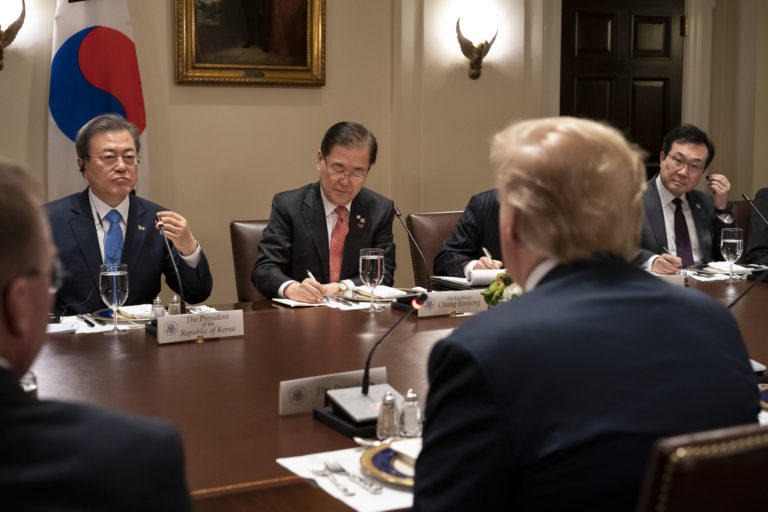
Moon facing Trump in DC, April 11, 2019. (White House/ Shealah Craighead via Flickr)
The importance of the Moon–Trump summit, while eclipsed by news of Julian Assange’s arrest in London the same day, is not be underestimated. Even before receiving Moon, Trump announced for the first time that he is willing to summit with Kim for a third time. While still stressing the North’s complete denuclearization as the U.S. objective, Trump also said he is open to the incremental diplomacy he precluded with his everything-at-once offer in Hanoi.
“There are various smaller deals that maybe could happen,” Trump said before he and Moon withdrew to the Oval Office. “Things could happen. You can work out step-by-step pieces, but at this moment we are still talking about the big deal.”
New Stance
This new stance is a big deal in itself. Moon and Kim — with Chinese and Russian support — have advocated talks based on gradualist reciprocity from the first. “Action for action,” Moon calls it. This strategy is widely accepted at the other end of the Pacific as the only plausible path to a sustainable denuclearization agreement. The U.S. has been the only nation engaged on the Korean question to argue otherwise.
In addition, Trump appeared to signal that Moon may get something he dearly wanted when he arrived in Washington: dispensation to proceed with inter–Korean economic projects — including transport links, an industrial park, and a joint-venture resort in the North — that are now blocked by a plethora of U.S. and UN–imposed sanctions. Moon views these as essential confidence-builders and the first steps toward integrating the North into a Northeast Asian economic hub that will also include South Korea, China, and the Russian Far East.
In Pyongyang, Kim responded to the events in Washington when he addressed the Supreme People’s Assembly last Friday. The speech was carefully balanced between optimism and caution, the latter reflecting Kim’s view that he was betrayed in Hanoi when Trump marshaled an offer he could not possibly embrace. “I am willing to accept if the United States proposes a third North Korea — United States summit,” Kim told North’s legislative body, “on condition that it has a right attitude and seeks a solution that we can share.”
Kim had other things to add. “We don’t like — and we are not interested in — the United States’ way of dialogue, in which it tries to unilaterally push through its demands,” he said. “We don’t welcome — and we have no intention of repeating—the kind of summit meetings like the one held in Hanoi.” The North Korean leader went on to set a year-end deadline “for the United States to make a bold decision.”
While Washington and Pyongyang had sharply conflicting versions of what transpired in Hanoi — each blaming the other for the summit’s failure — there is now little question that the U.S. side was at fault. A post–Hanoi Reuters exclusive reports that, prior to their famously canceled lunch, Trump handed Kim a sheet of paper listing, in English and Korean, extensive U.S. conditions that began with “a blunt call for the transfer of Pyongyang’s nuclear weapons and bomb fuel to the United States,” according to the piece filed by Leslie Broughton and David Brunnstrom.
The English-language version of the letter, the Reuters team reports, went on to demand “fully dismantling North Korea’s nuclear infrastructure, chemical and biological warfare program and related dual-use capabilities; and ballistic missiles, launchers, and associated facilities.”
The Libya Model
In simple terms, this was a kitchen-sink proposition — effectively a demand for unilateral disarmament — that was intended to prompt Kim to walk away. The Reuters reporters suggest that the fatal gambit was the work of John Bolton, Trump’s hyper-hawkish national security advisor. They quote North Korean officials as also implicating Secretary of State Mike Pompeo, another administration hawk, in what amounts to an act of diplomatic sabotage. The device used was Bolton’s “Libya model,” a laden reference if ever there was one. When Muammar Gaddafi gave up his chemical and nuclear weapons programs in 2003, he did so by sending Libya’s nuclear materials and equipment to the U.S. Eight years later, of course, he was assassinated in the wake of a NATO bombing campaign led by the U.S.
“The document appeared to represent Bolton’s long-held and hardline ‘Libya model’ of denuclearization that North Korea has rejected repeatedly,” Broughton and Brunnstrom report. “It probably would have been seen by Kim as insulting and provocative, analysts said.” One of those analysts was Jenny Town, a North Korea specialist at the Stimson Center in Washington. “‘This is what Bolton wanted from the beginning and it clearly wasn’t going to work,’” Reuters quotes Town as observing. “‘If the U.S. was really serious about negotiations, they would have learned already that this wasn’t an approach they could take.’”
Formidable Challenges
As this record of the Hanoi proceedings makes plain, Trump and Moon will assume formidable challenges to the extent they agree to work together toward a resolution of the Korea question on new terms. It is not clear why Trump — who went to Hanoi eager to cut his “big deal” with Kim — accepted the Bolton-inspired design and handed it on to the North Korean leader. But he has now set himself up for another in what appears to be a long line of conflicts with his foreign policy minders, Bolton and Pompeo chief among them.
The outlook in this connection is mixed at best. Trump was able to overrule new sanctions against North Korea that were announced several weeks after the Hanoi debacle. It is a matter of interpretation, but he effectively lost a battle with the Bolton–Pompeo axis when the administration designated the Iran Revolutionary Guard Corps a terrorist organization earlier this month. That move is understood widely to have pushed renewed negotiations with Tehran, for which Trump had been hoping, well beyond the point of no return.
For Moon, the challenges ahead are two. Most immediately, he must keep both Trump and Kim seated at the chess table between now and the end of the year. If no third summit is set by then, Kim has already signaled, he will consider this chapter in the long history of U.S.–North Korean negotiations closed — another story of failure. In such a case, the question facing Moon could hardly be more daunting: Can a South Korean leader determined to end nearly seven decades of enmity between the Koreas decisively wrest control of the diplomatic process from the U.S.?
That would amount to an unprecedented showdown between Seoul and Washington. Despite Moon’s admirable dedication, this is unlikely to materialize — not in the near term, in any case. Moon has formidable allies in Beijing and Moscow; Kim is plainly eager to break North Korea out of its isolation. But the U.S., perfectly satisfied to act as “spoiler” in Northeast Asia (as elsewhere), remains too powerful an obstacle despite the many signs that it is in the sunset phase of its global preeminence.
Patrick Lawrence, a correspondent abroad for many years, chiefly for the International Herald Tribune, is a columnist, essayist, author, and lecturer. His most recent book is “Time No Longer: Americans After the American Century” (Yale).
Gradually Re-establishing Historical Truth about Jeju Uprising
By Konstantin Asmolov – New Eastern Outlook – 14.04.2019
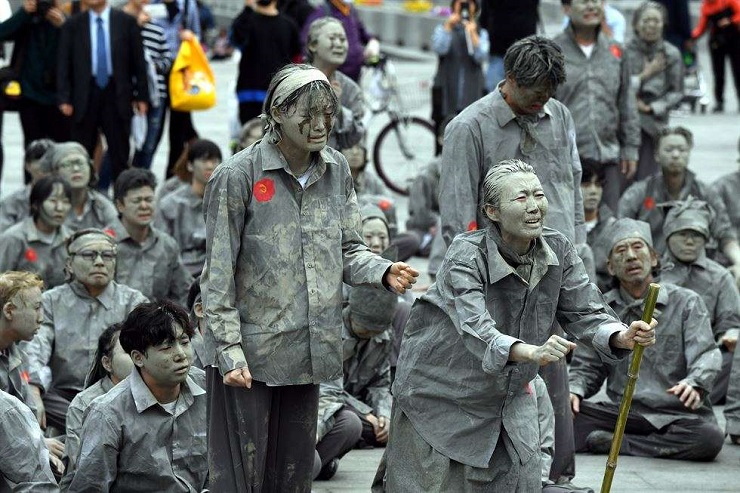
On 3 April, 2019 a commemoration ceremony to honor victims of a bloody suppression by government forces of the people’s uprising in 1948-1954 was held on the island of Jeju. More than 10,000 people, including representatives of the government and the National Assembly, revolt participants and offspring of the victims of its clampdown, took part in the memorial. South Korea’s Prime Minister, Lee Nak-yeon, gave a speech at the ceremony. He proposed to honor the memory of all those lost and expressed his deepest condolences to their families. The minister also referred to the incident in Jeju as the worst event in South Korea’s modern history. Lee Nak-yeon emphasized that Moon Jae-in’s administration has undertaken the monumental task of uncovering the truth behind the Jeju massacre, and of restoring the victims’ dignity.
The head of South Korea’s National Police Agency, Min Gap-Ryong, participated in a commemoration ceremony in Seoul. He wrote the following words in the visitor’s book: “I humbly share my condolences before the spirits of all those innocent people who were killed during Jeju April 3, and I respectfully share my wishes that they rest in peace.” Vice Minister of National Defense Seo Joo-seok, who made the aforementioned statement, was also in attendance. He highlighted that the army was fully committed “to the government investigation efforts going forward” and would “take part in healing the wounds and suffering of the family members while restoring the honor of those who were slain”. This was the first comment about the incident made by a South Korean military agency.
Officially, at least 10,000 Jeju residents were killed and almost 3,600 went missing, as a result of the tragedy that stemmed from Korea’s ideological split following its emancipation from Japanese colonial rule, which lasted from 1910 to 1945. In reality, the situation was even more complex. Propaganda from both North and South Koreas portray the uprising as a communist revolt against elections, which were to take place in the South on dividing the peninsula. However, in reality, the uprising was instigated by actions of the police and agitators from so-called “youth groups”, who used racketeering and violence to bring the region, with a powerful left-wing movement, under control.
South Korea’s current strategic policy has its origins at the start of the rebellion, 1 March 1947, when a child who suffered a blow from a police horse’s hoof died during a street protest in celebration of May Day. This led to a confrontation with the police and the crowd was fired on. In response, the Workers’ Party of South Korea declared a general strike. Instead of calming people down, the government made a decision to destroy the left-wing forces once and for all, which led to an even tougher response from the people.
On 3 April 1948, more than 350 armed civilians simultaneously attacked 12 police precincts and homes of representatives of legislative bodies, in order to free detained relatives and force the government to reconsider its policy. The leadership reacted even more violently in turn. Death squads mercilessly dealt with protesters and local residents who helped them. On 17 October 1948, a ban on movement in inner and mountainous regions of the island, with the exception of its 5-km coast line, was introduced. All the villages outside this perimeter were completely destroyed and so were their residents if they refused to leave these territories. 2,500 islanders were imprisoned although there were no charges against them or any written verdicts.
The bloodshed continued during the Korean War too. The truth is, however, in 1953 armed units had only approximately 60 people in them, and by the beginning of 1954, this number decreased to 5. 21 September 1954 is viewed as the last day of the uprising, when the ban on movement was finally lifted. The last guerrilla member was arrested on 2 April 1957.
Since a substantial portion of the population was massacred, and their bodies were often submerged or burned, the number of estimated victims ranges from 14,000 to 30,000 people. And if those who were indirectly affected by the government’s crackdown (i.e. victims of hunger or subsequent social cleansing) are added to the total, the number is even higher. Incidentally, only 14% of protesters were killed.
For decades after the uprising, memories of this event and the atrocities committed during the rule of Syngman Rhee were hidden from the public by means of censorship and repression. And only on 12 January 2000, a Special Act was decreed, in accordance with which a truth committee was established to investigate the Jeju massacre and to exonerate its victims. Approximately 14,000 people applied to have the status of a victim of those events. On 28 August of the same year, the special committee for investigating causes of death of the residents and their exoneration began their work.
In 2006, Roh Moo-hyun’s government issued an official apology for its role in the massacre. The leadership also promised reparations for the victims, but by the end of 2018 nothing had been done to this end.
On the plus side, a lot of work is being done to clear the good name of people, who, during the uprising, were preemptively jailed and tortured, without a single charge brought against them. Those who were released had to live under the umbrella of suspicion. And, finally, in January 2019, the Jeju District Court dismissed military court’s rulings with regard to the 18 plaintiffs, who survived, and recognized them as victims instead. The accusations levelled against them were deemed unsubstantiated since the military court did not follow prescribed legal procedures. This conclusion, in the opinion of those who issued the verdict, is supported by the fact that the plaintiffs were not aware of the criminal charges against them. Also the sheer number of people brought before the military courts-martial within a short period of time indicated relevant investigations were unlikely to have been carried out.
The plaintiffs demanded that their cases be reviewed as far back as 2017, as they claimed to have been arrested and jailed for a period of up to 20 years without as much as a fair trial. Since that time not a single court record has been found to indicate why the plaintiffs received such harsh sentences. Even after researchers had travelled to the peninsula and accessed central archives, they were unable to find any existing records about the investigation at that time. It turns out that people were detained and tortured without being charged for any crimes , which is consistent with the practice of preemptive arrests.
The court decided to retry the case in September 2018 due to renewed interest in the incident following the commemoration of its 70th anniversary and the official apology issued by President Moon Jae-in.
A few months later, on 17 January 2019, the Jeju court exonerated all the participants of the people’s uprising on 3 April 1948, who had served the sentences handed down to them by the military courts-martial.
This policy, exercised by Moon Jae-in’s government towards residents of Jeju, is part of a common trend. As part of this new shift, “a former police investigation building in Namyeong-dong, Seoul”, where intelligence agents “tortured hundreds of pro-democracy” and anti-government “activists in the 1970s and 1980s, has been turned into a memorial hall for human rights and democracy.” The Ministry of the Interior and Safety plans to outsource the building’s “operation to the Korea Democracy Foundation”. Prime Minister Lee Nak-yon participated in the transfer ceremony, along with Minister of the Interior and Safety Kim Boo-kyum; Seoul Mayor Park Won-soon; Commissioner General of the Korean National Police Agency Min Gap-Ryong, and victims of torture and their family members.
In 1976, the anti-communism investigation division office was located where the current facility stands now. During both the Park Chung-hee and Chun Doo-hwan administrations, the building was used to detain, interrogate and torture anti-government activists. Over a period of approximately 30 years, a combined total of 391 activists were tortured there. Their ranks included Seoul National University student Park Jong-chul, whose death resulted in mass protests that led to the fall of the Fifth Republic of South Korea.
In response to criticism, in 2005 the National Police Agency closed the Namyeong-dong division and transformed it into a human rights police center. However, civic groups demanded that the police stop operating this facility. This process began in earnest in June 2018, when Moon Jae-in promised to convert the building into a memorial for human rights and democracy.
In his speech, Prime Minister Lee Nak-yon said that Namyeong-dong “will forever contribute to the people and history as a place to warn against the state’s abuse of power”.
A similar policy is being used with respect to persecuted members of the Bodo League. This political organization was comprised of “re-educated” left-wing activists. But once the Korean War began, most of its members were subject to repression (as a preventative measure), and the majority were executed by firing squads. Groups, such as the Korean War Bereaved Family Members’ Association, claim that after this war 200,000 members of the League were killed throughout the country.
Numerous testimonies from family members of victims paint a grim picture: activists were gathered together under the pretense of going on an excursion to the mountains or to a ceremony. They were then transported out of town or city, executed by a firing squad and buried in unmarked graves.
Only in June 2014, did a number of residents gather enough courage to corroborate evidence of a civilian massacre, which local witnesses remembered. They carried out an excavation and unearthed burial sites, but there have not been any official exhumations so far.
On 22 June 2016, a testimony by prosecutor Song Jung-won (1918-2014), who is viewed as the founder of the Bodo League, became public knowledge. On 18 October 2007, he testified in front of the Truth and Reconciliation Commission and said that many members of the League were not partisans and, in fact, did not even know what a communist party was. As a rule, these were simple peasants or intellectuals, who wished to expunge the “Red Menace” label from their family name.
Civilian activists think this testimony may be viewed as proof of the fact that the government massacred countless numbers of innocent people knowing full well that they were not members of the Communist Party.
In addition, as far back as 2009, the Truth and Reconciliation Commission confirmed mass killings of at least 3,400 civilians and inmates held in prisons in Busan, Masan and Jinju from July to September 1950. Jail employees, police officers and members of counterintelligence services took part in these reprisals. Victims were either killed inside prisons or taken to the mountains, executed, and their bodies were disposed of in the sea. Only in a few cases were executions carried out after an official sentence was handed down by a military tribunal. Incidentally, most of these victims were prisoners sentenced to less than three years in jail, and they were killed only because of concerns that they would collaborate with DPRC.
Most investigations of this nature were conducted in the course of the work performed by the Truth and Reconciliation Commission. It was established in December 2005 and tasked with researching information connected with the anti-Japanese independence movement; mass killings of civilians during the Korean War, and violation of human rights by government forces during the military dictatorship. During a fairly short 5-year period, the commission uncovered the truth about 8,468 cases by concluding that extrajudicial massacres had taken place during the Korean War and earlier. In addition, the commission ascertained that evidence in a number of espionage cases from the 1980s was either distorted or completely fabricated.
However, during Lee Myung-bak’s presidency the work conducted by the Truth and Reconciliation Commission was discontinued. The final report highlighted the fact that both sides were responsible for atrocities, but failed to mention the fact that there were twice as many victims of the “White Terror”, and many culprits were absolved of responsibility. “As a result, true reconciliation and reckoning with the past ended up being put off until another day.”
And now, possibly, this day has arrived. Although old political myths often have a tendency to transform into new ones during Moon Jae-in’s presidency, hope remains that the final picture will be an accurate reflection of the historical truth.
Konstantin Asmolov, Ph.D. in History, is a leading research fellow at the Center for Korean Studies of the Institute of the Far East at the Russian Academy of Sciences.
North Korea’s Kim says US must stop ‘way of calculation’, gives deadline
Press TV – April 13, 2019
North Korean leader Kim Jong-un says the United States has raised the risk of returning to past tensions after the collapse of his second summit with President Donald Trump, stressing that yet another meeting between the two leaders is only possible if Washington comes with the right attitude.
The North’s official KCNA news agency on Saturday quoted Kim as making the remarks, two days after Trump floated the idea of holding a potential third nuclear summit with the North’s leader.
“What is needed is for the US to stop its current way of calculation, and come to us with a new calculation,” Kim was quoted as saying in a speech to the Supreme People’s Assembly on Friday.
He also said that he would wait “until the end of this year” for Washington to decide.
Back in late February, Trump and Kim reached an impasse at their second face-to-face denuclearization talks in the Vietnamese capital Hanoi, with Washington demanding full disarmament and Pyongyang demanding economic incentives through partial lifting harsh sanctions.
The second summit in fact did collapse when the American president abruptly walked away from the talks without reaching a deal or even issuing a final statement.
Trump claimed that he quit the talks because Kim demanded to lift all economic sanctions as a prerequisite to denuclearization.
However, Pyongyang quickly responded that it had never asked for the removal of all sanctions, but only the partial removal of them.
In June last year, the two leaders met at a historic summit for the first time in Singapore, where they agreed to work toward denuclearization of the Korean Peninsula. Subsequent diplomacy between the two sides, however, made little progress, mainly because Washington refused to lift its crippling sanctions.
“The second DPRK-US summit in Hanoi in February raised strong questions about whether the steps we took under our strategic decision were right, and gave us a sense of caution about whether the US is even really trying to improve the DPRK-US relationship,” Kim added, using the initials of North Korea’s full name, the Democratic People’s Republic of Korea.
The North’s leader also said that Washington came with “completely unrealizable plans” to Hanoi and that the US was “not really ready to sit with us face-to-face and solve the problem.”
“By that sort of thinking, the US will not be able to move us one iota even if they sat with us a hundred, thousand times, and will not be able to get what it wants at all,” Kim stressed.
The North Korean leader further blamed the US for continuing “to ignore the basic way of the new DPRK-US relations, including withdrawing hostile policies.”
Kim also warned that the White House mistakenly believes that “if they pressure us to the maximum, they can subdue us”, stressing that he had no interest in a third summit if it is a repeat of Hanoi.
The North’s leader also noted that his relations with Trump remained excellent.
So far, Pyongyang has taken several steps toward the goal by suspending missile and nuclear testing, demolishing at least one nuclear test site, and agreeing to allow international inspectors into a missile engine test facility.
The US, however, has insisted that sanctions on the North must remain in place until it completely and irreversibly dismantles its nuclear program.
The collapse of the Hanoi summit also disappointed US-ally South Korea, which has been improving relations with the North since early 2018.
Moon, who acts as a go-between in diplomacy involving Washington and Pyongyang, flew to Washington earlier this week in his third official visit to the US with the objective of helping put denuclearization talks with North Korea back on track after the Hanoi failed summit.
Despite the fact that that the situation on the Korean Peninsula had significantly improved following a number of high-level talks last year between Pyongyang and Seoul, as well as Washington, the North is still subject to harsh international sanctions over its nuclear and ballistic missile programs.
What Monroe Doctrine?
By Philip M. GIRALDI | Strategic Culture Foundation | 04.04.2019
Because there is a presidential election coming up next year, the Donald Trump Administration appears to be looking for a country that it can attack and destroy in order to prove its toughness and willingness to go all the way in support of alleged American interests. It is a version of the old neocon doctrine attributed to Michael Ledeen, the belief that every once in a while, it is necessary to pick out some crappy little country and throw it against the wall just to demonstrate that the United States means business.
“Meaning business” is a tactic whereby the adversary surrenders immediately in fear of the possible consequences, but there are a couple of problems with that thinking. The first is that an opponent who can resist will sometimes balk and create a continuing problem for the United States, which has a demonstrated inability to start and end wars in any coherent fashion.
This tendency to get caught in a quagmire in a situation that might have been resolved through diplomacy has been exacerbated by the current White House’s negotiating style, which is to both demand and expect submission on all points even before discussions begin. That was clearly the perception with North Korea, where National Security Advisor John Bolton insisted that Pyongyang had agreed to American demands over its nuclear program even though it hadn’t and would have been foolish to do so for fear of being treated down the road like Libya, which denuclearized but then was attacked and destroyed seven years later. The Bolton mis-perception, which was apparently bought into by Trump, led to a complete unraveling of what might actually have been accomplished if the negotiations had been serious and open to reasonable compromise right from the beginning.
Trump’s written demand that Kim Jong Un immediately hand over his nuclear weapons and all bomb making material was a non-starter based on White House misunderstandings rooted in its disdain for compromise. The summit meeting with Trump, held in Hanoi at the end of February, was abruptly canceled by Kim and Pyongyang subsequently accused Bolton and Secretary of State Mike Pompeo of making “gangster-like” demands.
The second problem is that there are only a few actual casus belli situations under international law that permit a country to attack another preemptively, and they are usually limited to actual imminent threats. The current situation with Venezuela is similar to that with North Korea in that Washington is operating on the presumption that it has a right to intervene and bring about regime change, using military force if necessary, because of its presumed leadership role in global security, not because Caracas or even Pyongyang necessarily is threatening anyone. That presumption that American “exceptionalism” provides authorization to intervene in other countries using economic weapons backed up by a military option that is “on the table” is a viewpoint that is not accepted by the rest of the world.
In the case of Venezuela, where Trump has dangerously demanded that Russia withdraw the hundred or so advisors that it sent to help stabilize the country, the supposition that the United States has exclusive extra-territorial rights is largely based on nineteenth and early twentieth century unilaterally declared “doctrines.” The Monroe Doctrine of 1823 and the Roosevelt Corollary of 1904 de facto established the United States as the hegemon-presumptive for the entire Western Hemisphere, stretching from the Arctic Circle in the north to Patagonia in the south.
John Bolton has been the leader in promoting the Monroe Doctrine as justification for Washington’s interference in Venezuela’s politics, apparently only dimly aware that the Doctrine, which opposed any attempts by European powers to establish new colonies in the Western Hemisphere, was only in effect for twenty-two years when the United States itself annexed Texas and then went to war with Mexico in the following year. The Mexican war led to the annexation of territory that subsequently became the states of California, New Mexico, Nevada, Utah, Arizona and Colorado. In the same year, the United States threatened war with Britain over the Oregon Territory, eventually accepting a border settlement running along the 49th parallel.
Meanwhile the march westward across the plains continued, forcing the Indian tribes back into ever smaller spaces of open land. The US government in the nineteenth century recognized some Indian tribes as “nations” but it apparently did not believe that they enjoyed any explicit “Monroe Doctrine” rights to continue to exist outside reservations when confronted by the “manifest destiny” proponents who were hell bent on creating a United States that would run from the Atlantic to the Pacific Ocean.
The Roosevelt Corollary of 1904 amended the Monroe Doctrine, making it clear that the United States believed it had a right to interfere in any country in the western Hemisphere to maintain good order, which inevitably led to exploitation of Latin American nations by US business conglomerates that could count on a little help from US Marines if their trade agreements were threatened. In 1898, Washington became explicitly imperialist when it defeated Spain and acquired effective control over Cuba, a number of Caribbean Islands and the Philippines. This led to a series of more than thirty interventions by the US military in the Caribbean and Central America between 1898 and 1934. Other states in the region that were not directly controlled by Washington were frequently managed through arrangements with local autocrats, who were often themselves generals.
Make no mistake, citing the Monroe Doctrine is little more than a plausible excuse to get rid of the Venezuelan government, which is legitimate, like it or not. The recent electrical blackouts in the country are only the visible signs of an aggressive campaign to destroy the Venezuelan economy. The United States is engaging in economic warfare against Caracas, just as it is doing against Tehran, and it is past time that it should be challenged by the international community over its behavior. Guns may not be firing but covert cyberwarfare is total warfare nevertheless, intended to starve people and increase their suffering in order to bring about economic collapse and take down a government to change it into something more amenable to American interests.
Trump Tells the Truth: Sanctions Cause People to Suffer
By Ron Paul | April 1, 2019
This week President Trump admitted what the Washington policy establishment of both parties would rather be kept quiet. Asked why he intervened to block a new round of sanctions on North Korea, he told the media that he believes the people of North Korea have suffered enough. “They are suffering greatly in North Korea… And I just didn’t think additional sanctions at this time were necessary,” he said.
The foreign policy establishment in Washington, whether they are neocons, “humanitarian interventionists,” so-called “realists,” or even progressives have long embraced sanctions as a way to pressure governments into doing what Washington wants without having to resort to war.
During my time in Congress I saw many of my antiwar colleagues on the Left vote for sanctions because they believed sanctions are more “humane” than war. Neocons and other interventionists endorse sanctions because they know that sooner or later they will lead to war, their preferred foreign policy.
With his characteristic bluntness, President Trump has exposed this big lie. Sanctions are not a more humane alternative to war. They are just another form of war. In fact they are perhaps the cruelest form of war because they do not target the military of an adversary, but rather the innocent civilian population. As President Trump said, they make people suffer.
Sanctions are meant to make life so miserable for the civilian population that it rises up and overthrows a leader out of favor in Washington. In Iraq in the 1990s, those sanctions cost the lives of a half a million children, but then-Secretary of State Madeleine Albright infamously said she thought the price was worth it. But still the people didn’t rise up and overthrow Saddam even as their lives became more and more miserable. So the neocons had to concoct some lies about WMDs and Iraq was invaded anyway. An estimated million more people were killed in that war. So much for the “humanitarianism” of sanctions.
Sanctions often target water supplies, sewage treatment, medicine, food supply and other essentials for civilian life. After the people suffer under the “soft” war of sanctions, though, they most often are forced to suffer again as the US attacks anyway. That was the case in Iraq, Libya, Syria, and elsewhere. And it may soon be the case for Venezuela and perhaps even North Korea.
In Yemen, sanctions have contributed to the death of some 80,000 children from starvation. Millions more are facing starvation, yet they continue to resist Saudi and US demands that they overthrow their government.
Sanctions do not inspire people to rise up and overthrow their governments. Most civilians suffering under sanctions couldn’t throw out their rulers even if they wanted to – after being impoverished and malnourished for years they are really expected to take on their own government’s military?
I am glad to hear President Trump tell the truth about sanctions. They hurt the powerless in the false hope that the powerful will change their behavior. No new sanctions on North Korea is a good start. Now how about dismantling the inhumane and counterproductive sanctions from Caracas to Damascus and from Moscow to Beirut. Let’s return to a foreign policy of peace and engagement, backed by a strong military for our defense alone.
‘Grave terrorist attack’: North Korea seeks probe into mysterious raid on its mission in Spain
RT | March 31, 2019
North Korea called on Spain to conduct a thorough investigation into a raid on its mission in Madrid, which was said to be done by FBI-linked dissidents, now hiding in the US.
Pyongyang asked Spain to investigate the “grave terrorist attack” and “flagrant violation of international law,” state-run KCNA news agency reported. “This kind of act should never be tolerated,” the statement read.
It was the first time North Korean officials have commented on the mysterious break-in at its mission in Madrid on February 22. A group of intruders subdued and tied up the staff before stealing a number of electronic devices and a trove of documents from the building. They also reportedly tried to persuade a North Korean attaché to defect. A video, allegedly filmed during the break-in, shows men taking down portraits of North Korean leaders and smashing them on the ground.
Spanish media say that 10 suspects fled to the US and a court in Madrid issued arrest warrants against them. The leader of the group was named as veteran dissident and anti-Pyongyang activist Adrian Hong Chang, who is a Mexican national and a US citizen. Two of the other suspects were named as US nationals.
An unexpected twist came several weeks later when the Spanish paper El Pais cited court documents and police sources as saying that the suspects tried to obtain information on the North Korean nuclear program and contacted the FBI after arriving in the US.
The details were partially confirmed by dissident group ‘Cheollima Civil Defense / Free Joseon’, which claimed responsibility for the raid. Its members shared “certain information of enormous potential value” with the FBI, on the Bureau’s request, the group claimed on its website.
The US has denied any involvement with the break-in, and the FBI has refused to comment on the incident.
Trump Reportedly Takes Helm in US-DPRK Negotiations as MSM Cries Foul
Sputnik – 21.03.2019
In the aftermath of the failed Hanoi summit between the US and North Korea, US President Donald Trump has reportedly taken the helm in denuclearization negotiations with Pyongyang. Meanwhile, Seoul now sees the ball as having landed in its court to convince its neighbor to give up its weapons and rocket programs.
According to Trump administration officials who spoke with Time for a Monday article, the US president is “sidelining” his special envoy to North Korea, Stephen Biegun, and “dismissing the warnings of top intelligence and foreign policy advisers” who dissent from his continued policy of negotiation with North Korean leader Kim Jong Un.
Time reports that Trump has shut down attempts by Biegun to establish a back channel to Pyongyang via the socialist country’s United Nations mission in New York, citing US and South Korean officials, and is focusing on attempts to negotiate a deal with Kim instead of bowing to the advice of his advisers to press North Korea harder with sanctions — or to abandon negotiations altogether.
Trump and Kim met late last month in Hanoi, Vietnam, for a second round of denuclearization talks to follow up on a June 2018 summit that laid the groundwork for peace on the Korean Peninsula. While Pyongyang has made considerable progress with the South toward that end, negotiations with Washington have stalled, as the two sides reached a point where neither was willing to budge any further until the other side gave something first.
The Democratic People’s Republic of Korea (DPRK) has made several good faith moves toward reducing tensions, including the halting of weapons tests and the destruction of key missile and nuclear program sites. However, Kim was unwilling to make further concessions before Washington lowered at least some of its economic sanctions blocking international trade in many items with his country. The US has refused to lower any of those sanctions until Kim produces “verified denuclearization.” The Hanoi summit failed to surmount this impasse.
Trump administration officials such as Secretary of State Mike Pompeo and National Security Adviser John Bolton have used Pyongyang’s red line to argue that Kim is intransigent and not cooperative. The mainstream media has also largely adopted this position, as the articles by Time, CNN and The Hill on these developments show.
Indeed, ever since Trump agreed to meet with Kim last spring, the mainstream media has been devoted to producing stories that undermined Trump’s attempts at peace, and hawkish foreign policy think tanks have produced report after report claiming Kim has violated the terms of the negotiations. Their reports are often based on outdated or undated evidence, supposition or otherwise unverifiable claims, Sputnik has reported.
One example, from Time’s Tuesday article, tries to juxtapose Trump’s supposedly delusional belief that “Kim is his ‘friend,'” according to an administration official, with the “unanimous assessment by multiple agencies that Kim remains wedded to his nuclear program,” and thus is incapable of responding to a carrot, understanding only the stick.
Indeed, such has been the common refrain by US state officials for decades, going back to George F. Kennan’s eponymous telegram about how the US should handle the Soviet Union during the Cold War, and even further to the suppression of the Boxer Rebellion in imperial China at the turn of the last century.
Meanwhile, South Korean President Moon Jae In has continued his rapprochement with Kim, despite US-DPRK failures.
“We’re in a deep agony over how to take advantage of this baton that has been handed over to us,” said a Moon administration figure earlier this week, according to South China Morning Post.
“We agree with the view that no deal is better than a bad deal… However, in reality, it is difficult to achieve complete denuclearization at one stroke. I think we need to reconsider the so-called all or nothing strategy,” the official said.
Seoul aims to get Pyongyang to “agree with a broad road map aimed to achieve the overarching goal of denuclearization,” the official said, noting that “we should make further efforts to turn a small deal into a deal that is good enough. In order to achieve meaningful progress, we need one or two early harvests for mutual trust-building to move on toward the final goal.”
Still, in the aftermath of Hanoi, Moon’s popularity fell in his country from a high of 70 percent last summer to a measly 45 percent earlier this month, Sputnik reported.
The metaphor of the “harvest” presents a timely parallel as North Korean officials have pressed the UN to step up its food and medical aid to DPRK in the coming year due to bad harvests last year and projected shortages in 2019, Sputnik has reported.
“Although Security Council sanctions clearly exempt humanitarian activities, life-saving programs continue to face serious challenges and delays,” Tapan Mishra, the UN’s resident coordinator in the DPRK lamented earlier this month. “While unintended consequences of sanctions persist, these delays have a real and tangible impact on the aid that we are able to provide to people who desperately need it.
US and other international sanctions bar many useful medical items from being imported by DPRK, too. For example, a paper published last December by the Middlebury Institute of International Studies at Monterey looked at scientific projects in which North Korean scientists had partnered with scholars from other countries, noting that roughly 100 of the 1,300 they examined had “identifiable significance for dual-use technology, weapons of mass destruction (WMD) or other military purposes.”
That means that even though DPRK doctors might be studying epidemiology, their work could be subject to weapons sanctions. “When you study infectious diseases, which are a big burden in North Korea, you have to grow bacteria,” Harvard Medical School neurosurgeon Kee Park, director of DPRK Programs for the Korean American Medical Association, told NPR at the time. “That’s the kind of technology that goes into creating biological weapons.”
The problem is that “virtually all technology you can possibly think of is dual use,” professor and author Tim Beal told Sputnik.
Time reports that Trump administration officials fear the US president might try and strike a deal with Pyongyang and lift some sanctions in exchange for a pledge to continue their freeze on weapons development and testing, which Trump has said he considers to be more important to maintain than the total removal of nuclear weapons and delivery systems from North Korean possession. However at the same time, it seems to be the consensus among administration officials that any such deal wouldn’t actually make progress at all, only “remove much of the leverage” on the DPRK that they believe compels the country to negotiate in the first place.
CIA May Be Behind February Attack on North Korean Embassy in Madrid – Reports
Sputnik – 13.03.2019
Spanish police and intelligence officers, who are investigating the attack on the North Korean embassy in Madrid in February, believe that US Central Intelligence Agency (CIA) may be behind the incident, El Pais newspaper reported on Wednesday.
According to El Pais, at least two out of 10 attackers were identified to have connections with US intelligence services. Spanish investigators have already requested the CIA about their involvement in the incident.
According to the publication, the CIA denied their guilt, but the response to the request was “unconvincing.”
This incident may eventually lead to diplomatic friction between Madrid and Washington, the newspaper said. Sources in the Spanish government believe that if the CIA’s involvement in the attack is confirmed, it will be regarded as “unacceptable” actions by the ally. According to the publication, this would mean that US intelligence services acted in Spain without permission and violated international agreements protecting diplomatic missions.
The reports come after in February, El Confidencial newspaper reported, citing sources in the Spanish Interior Ministry, that a group of unidentified men broke into the North Korean embassy in Madrid, restrained the diplomatic staff for several hours and stole computers. According to the newspaper, the incident occurred on February 22. One of the employees managed to escape and report to the police.
Intelligence Contractors Make New Attempt To Provoke Tensions With North Korea
By William Craddick | Disobedient Media | March 8, 2019
It’s the second, but no less ludicrous, attempt in one week to sway the opinion of the public and President Donald Trump against the concept of denuclearization and peaceful dialogue with North Korea.
A March 8, 2019 report from National Public Radio (NPR) follows another by NBC News with sensational and misleading claims that satellite imagery released by private corporations with contractual ties to government defense and intelligence agencies show imminent preparations by the Democratic People’s Republic of Korea (DPRK) to engage in missile testing or the launch of a satellite from their facilities in Sanumdong, North Korea. An examination of the photos provided shows absolutely no indication of such activity.
I. Satellite Footage Of Sanumdong Facility Shows No Sign Of Imminent Launch
Images provided to NPR by private contractor DigitalGlobe consist of two low resolution images, one of a building in the Sanumdong complex and the other of a train sitting along a rail line. In neither photo is there any discernible amount of unusual activity.

Credit: Image ©2019 DigitalGlobe, Inc. Graphic: Alyson Hurt/NPR
The first image of a “production hall” bears a striking resemblance to a similar photo run by the Washington Post in July 2018 where unnamed intelligence officials claimed that North Korea was building one or possibly two liquid fueled ICBMs which appear to have never materialized or been used in any launch. The claims came one month after President Trump met with Chairman Kim Jong Un in Singapore for a historic summit between the United States and the DPRK.
NPR claims that the imagery shows “vehicle activity” occurring around the facility. Yet close inspection shows that the “activity” consists of a few inert vehicles, which appear to be a white pickup and white dump truck or flatbed parked in a permanent position next to piles of metal. The scene does not appear to be different from any number of sleepy yards of businesses that can be examined by members of the public on Google Maps.

Credit: Image ©2019 DigitalGlobe, Inc. Graphic: Koko Nakajima/NPR
The second image, according to NPR, shows rail cars sitting “in a nearby rail yard, where two cranes are also erected.” The photo simply shows a train car sitting inert with empty flatbed cars and hopper cars that are either filled with coal or empty. A second rail line similarly holds a number of hoppers and flatbed cars. Hopper cars in particular are totally unsuitable for the transportation of military technology such as missiles.
The tracks in the lower left corner are covered in snow, meaning that the train sat for many months through the winter or was backed into its position. Considering that US and international sanctions have caused an extreme scarcity of fuel in the DPRK it is likely that the trains have not moved for quite some time, unless their diesel engines were converted to burn coal or wood.
In short, there is absolutely no indication that several low resolution photos of a facility in North Korea have any activity in them outside of a few rusting vehicles that have sat without moving for some time.
II. NPR’s Sources Of Satellite Imagery Are Contractors For The CIA And Pentagon
The report by NPR lists two sources of satellite imagery – DigitalGlobe, Inc. and Planet Labs, Inc. As Disobedient Media has previously reported, DigitalGlobe is an American vendor of satellite imagery founded by a scientist who worked on the US military’s Star Wars ICBM defense program under President Ronald Reagan. DigitalGlobe began its existence in Oakland, CA and was seeded with money from Silicon Valley sources and corporations in North America, Europe and Japan. Headquartered in Westminster CO, DigitalGlobe works extensively with defense and intelligence programs. In 2016, it was revealed that DigitalGlobe was working with CIA chipmaker NVIDIA and Amazon Web Services to create an AI-run satellite surveillance network known as Spacenet.
Planet Labs is a private satellite imaging corporation based in San Francisco, CA that allows customers with the money to pay for an opportunity to gain access to next generation surveillance capabilities. In February 2016, Federal technology news source Nextgov noted a statement from former CIA Information Operations Center director and senior cyber adviser Sue Gordon that Planet Labs, DigitalGlobe and Google subsidiary Skybox Imaging were all working with the Pentagon’s National Geospatial-Intelligence Agency (NGA) to provide location intelligence. Planet Labs’ own website also lists press releases detailing past contracts for subscription access to high resolution imagery with the NGA.
The pervasive involvement of intelligence agencies and defense contractors in attempts to undermine negotiations with North Korea does not create confidence in the already shaky claims made by NPR regarding alleged preparations by the DPRK to participate in a missile launch. These contentions are not supported in substance by any tangible facts. As claims and pressure continue to build on President Donald Trump to abandon the peace process, there are multiple factions of the United States government who are running a real risk of behaving in manners which could be interpreted as open sedition or refusal to carry out the stated goals and policies of the President.
Bolton’s Act of Sabotage
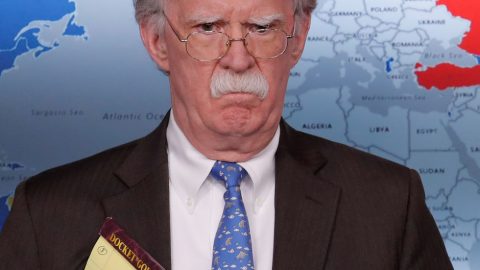
By David Macilwain | American Herald Tribune | March 8, 2019
Across the Western world, there has been discussion and argument and consternation over the apparent failure to make progress on disarmament at the recent talks in Hanoi. Examination of the reasons for that failure has been replaced by speculation about the DPRK’s next move and suspicions about its motives, without any similar skepticism or doubts about the US intent and strategy. But such speculation is entirely misguided, and only possible because of ignorance of one key detail in the discussions in Hanoi.
Thanks mostly to the efforts of Australia’s former ambassador to South Korea and Vietnam, Richard Broinowski, whose diplomatic contacts in Canberra relayed inside information about the discussions, the alarming truth on why the talks suddenly fell apart was revealed to the SBS TV network, and to its listeners in the evening news broadcast on March 1st.
While media around the world, apparently including those not allied to the US, broadcast the press briefing by Donald Trump and Mike Pompeo laying the blame on North Korea for demanding all the sanctions be lifted, only SBS listeners got to hear what really happened, and thenceforth to see things in an entirely different light. As Richard Broinowski explained several days later writing on John Menadue’s influential blog Pearls and Irritations :
… “a well-informed senior Asian diplomatic source in Canberra has added another reason for the Summit’s breakdown: that Trump’s national security adviser, John Bolton, persuaded Trump to add another demand, without notice, that led to North Korean refusal and a premature end to the summit even before negotiations had begun.”
“The Asian diplomat recalled that John Bolton had been scheduled to visit Canberra at the end of February. But the visit was cancelled when he suddenly went to Hanoi instead, whether at Trump’s directive or on his own initiative being unclear. The diplomat’s understanding is that Bolton suggested to Trump that as well as demanding a complete inventory of North Korea’s nuclear weapons and delivery systems, Trump should also request details of the country’s chemical and biological arsenal, a demand Kim found unexpected, and for which he was unprepared, and refused. Trump then broke off the meeting before substantive negotiations had even begun.”
We may all too easily forget the anticipation before these crucial talks between Trump and Kim Jong Un, where it at least looked possible that Trump might “do a deal” on a basis that the North Koreans could accept. The early signs were more than promising, with Kim Jong Un assuring that he would not have been there had he not sought progress on denuclearisation, and Trump prepared to take him at his word. While “substantive negotiations” had not begun, the North Koreans had already suggested they would make very significant concessions in return for the lifting of some sanctions and some other commitments by the US to reduce tensions – “security guarantees” in other words.
It’s worth noting in this context that Sergei Lavrov, speaking at a parallel meeting of the Valdai Club in Ho Chi Minh city had stated quite clearly that the US must make significant concessions, rather than demanding that the DPRK completely denuclearise before lifting sanctions. As always it’s worth reading Lavrov’s wide-ranging and straightforward remarks on the poor state of the world and the destabilizing and destructive role being played by the US.
The necessity for lifting some sanctions on the DPRK is further emphasized by the news that their food production this year is severely restricted by the worst climatic conditions for a decade, making food imports and relief urgent. Their demands for sanctions relief in Hanoi concerned this issue rather than anything connected with the nuclear program.
The truth of the story of Bolton’s demands, which look very much like a planned act of sabotage, is beyond doubt and endorsed in statements from South Korea’s former unification minister Chong Se-Hyun published in Korean newspapers and reported elsewhere. The Sydney Morning Herald and the Australian also covered the story on the following Monday, but this was a temporary blip on their normally unchallenging sympathy for the official US viewpoint. Australia’s other State broadcaster the ABC, however, made no mention of it, simply repeating Trump’s cover-up claim on the sanctions removal.
These media along with their Western partners in officially approved disinformation are now once again adding to the rumor mill on “North Korea’s ongoing nuclear threat” with suspect stories about the renewal of a missile launching site. Satellite photos taken only hours after the failure of the talks claim to show such activity. The Australian Strategic Policy Institute, which has close links to government, has meanwhile warned that moves to scale down the annual war games proposed belatedly as a “goodwill gesture” by the US, are “dangerous and will embolden the North”.
Putting things into a wider perspective, former Australian ambassador to the UN and nuclear disarmament negotiator Richard Butler added his weight to the subject the following day with this footnote on Broinowski’s article:
“This report has now been confirmed by a report published in the March 4th edition of The Bulletin of the Atomic Scientists, which cites a statement by the DPRK Foreign Minister, Ri Yong-Ho, in Hanoi, that “John Bolton disrupted the talks by demanding that North Korea disclose its chemical and biological arsenal as well as its nuclear arsenals”. This would seem to answer the question I posed in my article on whether or not a spanner had been thrown into the works and if so, by whom? Not unusually, there seems to have been no report of this highly salient fact by western mainstream media.”
What matters here however is not simply to expose the misinformed and fraudulent claims made about the failure of the Hanoi talks. Bolton and his allies – whoever they are – evidently sought to sabotage the talks and the possibility of agreement and détente, against the intention of Donald Trump. The last thing they want is to lose the pretext for maintaining and expanding missile systems in the region aimed at threatening or “countering” China. An informative report from the East Asia Forum think-tank also makes this suggestion:
For many in the US security community the ‘no deal’ comes as a relief. There were concerns that Trump would be eager to rush into a deal, no matter what the costs of the concessions, to claim the diplomatic achievement for his administration. This seemed an over-urgent goal due to the impending report by FBI special prosecutor Robert Mueller on the Trump campaign’s ties to Russia and possible obstruction of justice, as well as the heat on Trump from his former fixer Michael Cohen’s damning testimony last week to Congress.
So far from returning to the US with an extra feather in his golden cap, Donald Trump came home to face the music, and not just from the Russia-gate witch-hunt. Even though he had called off the talks with Kim Jong Un, he had already engaged in friendly exchanges and pleasantries that some found offensive, inviting media to repeat the tired nonsense about his dealings with President Putin – that “Trump takes the advice of “dictators” over that of his own intelligence community”. (perhaps not an unwise move under the circumstances!)
The story of his brief meeting with Kim then immediately focussed on how Trump had “taken Kim’s word” over the case of Otto Warmbier, the detained American student allegedly killed by mistreatment in a North Korean hospital. The grotesque demand of the DPRK for $500 million compensation for his death from a US court illustrates the problem that many in the US seem to have in relating to those with a different viewpoint and different attitude. If similar suits were brought against the US government by relatives of the millions of North Koreans who have died over the last sixty-five years as a direct or indirect result of US aggression and sanctions, the US would be bankrupted.
It’s hard not to conclude that the man who was considered “too extreme” to join the regime of George W Bush because of his preference for armed attacks and even nuclear strikes over diplomacy has now launched a soft coup against his own President. Immediately following the Vietnam venture, Bolton was making threats of military action against Venezuela’s President Maduro which had a strange resonance. The demand that Venezuela’s democratically elected President be replaced by an unknown and unelected puppet selected and launched like a missile into Caracas by the US and its European allies is now being copied by the self-selected “Interim President of the United States”, John Bolton.
And a world under this new de facto President with his choice of puppet might just make us look back on the Golden Age of Trump if we are lucky enough to survive it.
Featured Video
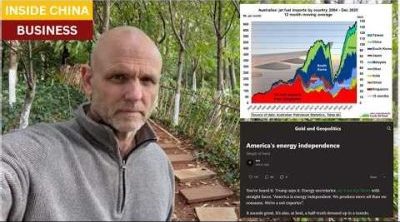
Chinese jet fuel and the myth of energy independence
or go to
Aletho News Archives – Video-Images
Book Review
Former Insiders Criticize Iran Policy as U.S. Hegemony
By GARETH PORTER | CounterPunch | February 27, 2013
“Going to Tehran” arguably represents the most important work on the subject of U.S.-Iran relations to be published thus far.
Flynt Leverett and Hillary Mann Leverett tackle not only U.S. policy toward Iran but the broader context of Middle East policy with a systematic analytical perspective informed by personal experience, as well as very extensive documentation.
More importantly, however, their exposé required a degree of courage that may be unparalleled in the writing of former U.S. national security officials about issues on which they worked. They have chosen not just to criticise U.S. policy toward Iran but to analyse that policy as a problem of U.S. hegemony. … continue
Blog Roll
 Aletho News
- What is fueling unrest across the EU?
- Why no power can undermine Iran’s eternal dominance over the Strait of Hormuz
- Is The War Against Iran Over?
- Iran war will leave long-term ‘scar’ on Wall Street, investors warn
- How Iran decimated US power projection in West Asia: Military lessons of 40-day war
- Iran’s report details US-Israeli war crimes in targeting schools, hospitals, livelihoods
- NATO’s Slow Fracture: How Trump’s Iran War Exposed the Instrument of Hegemony
- Chinese jet fuel and the myth of energy independence
- Ukraine Sea Drone Fired From Libya Hit Russian Tanker in Mediterranean
- IRGC: Iranian forces launched no attacks during ceasefire hours
- If Americans Knew
- Military aid to Israel emerges as the latest political litmus test for Democrats
- The only Palestinian children’s rights organization closes following years-long Israeli campaign against it
- ‘I Can’t Forget the Smell’: Lebanese Reel After Israel Kills Over 300 in Single Day
- DNC Shoots Down Resolutions Calling Out AIPAC and Limiting Arms to Israel
- TCN: Is Israel Blackmailing President Trump?
- Israel killed at least 303 Lebanese yesterday – who were they? Daily Update
- Amnesty: Urgent – Protect Lebanese civilians from brutal escalation in Israeli attacks
- Is The War Against Iran Over?
- Inside the Israeli army’s propaganda wing
- Hundreds of Gaza Amputees Stranded in Legal Limbo
- No Tricks Zone
- New Study: No Linear Warming Or Glacier Retreat Along Northern Antarctic Peninsula Since 1980s
- An Inconvenient Tree: Uncovered In Alps… Europe Much Warmer Than Today 6000 Years Ago
- New Study Reports A 60% Slowdown In Greenland’s Ice Loss Rate In The Last Decade
- Low Intensity Tornado Wrecks Major Solar Farm, Creating A Potential Toxic Dump
- New Study Finds Warming Saves Lives…Cold Temperatures 12 Times More Deadly Than Excess Heat
- German Science Blog Accuses PIK Climate Institute Of Hallucinating Climate Tipping Points
- Devastating Assessment Of Comirnaty Vaccine By Former Senior Pfizer Europe Toxicologist
- New Study: CO2 Is ‘Effectively Negligible’ As An Explanatory Climate Change Factor Since 2000
- Former Pfizer Toxicologist Dr. Helmut Sterz Tells Bundestag Hearing Pfizer Vaccine Should Have Never Been Approved
- Energy Expert: Germany’s Nuclear Phaseout Was A “500 Billion Euro Mistake”
 Aletho News