South Korea, US Fail to Agree on Sharing Costs for USFK’s Stationing – Reports
Sputnik – 14.12.2018
Seoul and Washington failed to agree on the amount of South Korea’s financial contributions for the stationing of the US Forces Korea (USFK) in South Korea, the Yonhap news agency reported, citing a government official.
“Again, nothing is agreed until everything is agreed … There’s still a big difference over the total amount [of Seoul’s financial contributions]. The two sides will continue consultations through diplomatic channels. If necessary, we can have [formal] negotiations next month,” the official said, as quoted by the Yonhap news agency.
The official noted that there would be no more formal talks in December.
The 10th round of negotiations on dividing the cost of the USFK’s stationing between representatives from South Korea and the United States began on Tuesday and lasted for three days.
Washington’s push for an increase in Seoul’s contribution is regarded as an obstacle to reaching the deal. In 2018, South Korea has paid some $859 million to maintain the US forces, which serve as a deterrent against possible aggression of North Korea, the news outlet reported.
Seoul has been sharing the cost for the stationing of about 28,500 US servicemen within the framework of the Special Measures Agreement (SMA) on cost sharing, due to expire at the end of this year, since 1991.
How ‘The New York Times’ Deceived the Public on North Korea
By Tim Shorrock | The Nation | November 16, 2018
The New York Times may still have a Judith Miller problem—only now it’s a David Sanger problem.
Miller, of course, is the former Times reporter who helped build the case for the 2003 US invasion of Iraq with a series of reports based on highly questionable sources bent on regime change. The newspaper eventually admitted its errors but didn’t specifically blame Miller, who left the paper soon after the mea culpa and is now a commentator on Fox News.
Now, Sanger, who over the years has been the recipient of dozens of leaks from US intelligence on North Korea’s weapons program and the US attempts to stop it, has come out with his own doozy of a story that raises serious questions about his style of deep-state journalism.
The article may not involve the employment of sleazy sources with an ax to grind, but it does stretch the findings of the Center for Strategic and International Studies (CSIS), a think tank that is deeply integrated with the military-industrial complex and plays an instrumental role in US media coverage on Korea.
“Controversy is raging,” South Korea’s progressive Hankyoreh newspaper declared on Wednesday about the Times report, which it called “riddled with holes and errors.”
Sanger’s story, which appeared on Monday underneath the ominous headline “In North Korea, Missile Bases Suggest a Great Deception,” focused on a new study from CSIS’s “Beyond Parallel” project about the Sakkanmol Missile Operating Base, one of 13 North Korean missile sites, out of a total of 20, that it has identified and analyzed from overhead imagery provided by Digital Globe, a private satellite contractor.
None of the 20 sites has been officially acknowledged by Pyongyang, but the network is “long known to American intelligence agencies,” wrote Sanger.
Sakkanmol, according to CSIS, “is an undeclared operational missile base for short-range ballistic missiles” a little over 50 miles (85 kilometers) north of the border and therefore “one of the closest to the demilitarized zone (DMZ) and Seoul.” Pyongyang’s highly publicized decommissioning last summer of the Sohae satellite launch facility “obscures the military threat to U.S. forces and South Korea from this and other undeclared ballistic missile bases.”
Its authors added a huge caveat at the end: “Some of the information used in the preparation of this study may eventually prove to be incomplete or incorrect.”
But the Times ignored the warning and took the report several steps further. According to Sanger, that analysis of the missile base shows that North Korea is “moving ahead with its ballistic missile program” despite pledges made by Kim Jong-Un to President Trump at their Singapore summit on June 12 to eliminate his nuclear and missile programs if the United States ends its “hostile policy” and agrees to forge a new relationship with North Korea.
The “new commercial satellite images” of the undeclared missile sites, Sanger concluded darkly, suggest that North Korea “has been engaged in a great deception.”
While North Korea has offered to dismantle a major launching site, he asserted, it continues “to make improvements at more than a dozen others that would bolster launches of conventional and nuclear warheads.” That finding “contradicts Mr. Trump’s assertion that his landmark diplomacy is leading to the elimination” of the North’s nuclear weapons and missiles, Sanger concluded.
The implication was that North Korea, by continuing to build missiles after the Singapore summit, is lying to the United States and is therefore untrustworthy as a negotiating partner—and that Trump, by proclaiming that he has neutralized Kim’s threats, has been deceived. The Times-CSIS report was immediately picked up by major media outlets and repeated almost verbatim on NBC Nightly News and NPR, with little additional reporting.
A leading Democrat, Senator Edward Markey of Massachusetts, seized on the report to argue that President Trump is “getting played” by North Korea. “We cannot have another summit with North Korea—not with President Trump, not with the Secretary of State—unless and until the Kim regime takes concrete, tangible actions to halt and roll back its nuclear weapons and ballistic missile programs,” he said in the statement.
But even a cursory analysis of the imagery should have raised questions. On Monday night, a Korean news outlet pointed out that all the photos analyzed in the CSIS report are dated March 29, 2018—almost two and a half months before Trump and Kim met in Singapore on June 12.
The dates make Sanger’s claim that North Korea is “moving ahead” on missile production after its pledges to Trump laughable; indeed, they make his story look like a serious attempt to deceive the American public about the real progress that has been made in ending the standoff.
In fact, as discussion swirled on Twitter, it became clear that Sanger was exaggerating the report. Arms-control experts immediately questioned his assertions, arguing that he had ignored the fact that North Korea and the United States have yet to sign any agreement under which the North would give up its nuclear weapons and missiles. And in the absence of an agreement, it’s status quo for both North Korea and the United States.
North Korea’s missile program “is NOT deception,” Vipin Narang, an associate professor of political science at MIT, posted soon after the story was published. Narang, who writes occasionally for the Times editorial page on North Korea, pointed out that Kim Jong-un has never offered to stop producing ballistic missiles and in fact had ordered more to be produced in January 2018.
“Unless and until there is a deal” with Trump, he wrote, “Kim would be a fool to eliminate and stop improving [them].… So the characterization of ‘deception’ is highly misleading. There’s no deal to violate.” (Like other US analysts, Narang did not question the CSIS report itself, calling it “excellent.”)
The CSIS report was denounced by the government of South Korean President Moon Jae-in as “nothing new,” and Kim Eui-kyeom, its chief spokesperson, took particular exception to the Times’ use of the term “deception.” To his credit, Sanger acknowledged the criticism and quoted the statement in full.
North Korea Eliminates 10 Observation Posts in Demilitarised Zone – Seoul
Sputnik – 20.11.2018
North Korea has destroyed 10 observation posts in the demilitarised zone bordering the South in compliance with an agreement reached between Seoul and Pyongyang in September, the South Korean Defence Ministry said in a statement.
Representatives from the defence ministries of the two countries agreed during the inter-Korean summit on 19 September to eliminate 11 observation posts, situated in the demilitarised zone, each by late November. The South Korean Defence Ministry then announced that the two parties had agreed to keep one observation post each.
“The North Korean party eliminated today, November 20, at 3:00 p.m. [6:00 GMT] 10 observation posts by means of explosions as it was agreed,” the ministry said on its Facebook page.
The ministry added that it had been notified about the planned operation by the North Korean side in advance.
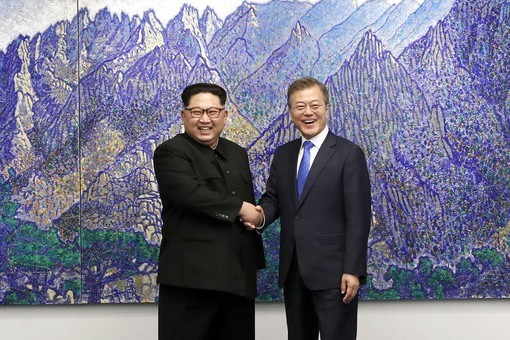
Relations between Seoul and Pyongyang began to improve after a historic summit between South Korean President Moon Jae-in and North Korean leader Kim Jong-un in April after more than a year of fears of a war over North Korea’s nuclear weapons programme. The latest inter-Korean summit took place in September and yielded a number of agreements covering such areas as defence, but also culture and sports.
Deception in North Korea? Nope, But a New Flavor of Neocon
By Peter Van Buren | Medium | November 15, 2018
What is the state of diplomacy on the Korean peninsula? Are we again heading toward the lip of war, or is progress being made at an expected pace? Are there Asian Neocons fanning the flames for conflict in Pyongyang much as others did with Baghdad?
A year ago, in November 2017, John Brennan estimated the chance of a war with North Korea at 20 to 25 percent. Richard Haass, president of the Council on Foreign Relations, said the odds were 50/50. The New York Times claimed we were “slouching toward war” with the North, on a “collision course.” National security adviser HR McMaster said North Korea represented “the greatest immediate threat to the United States” and that the potential for war with the communist nation grew each day. The US lacked an ambassador in Seoul; Victor Cha was rejected by Trump because, according to “sources and reports,” he didn’t support a preemptive strike on Pyongyang. It was reported the US was “imminently preparing for an attack on North Korea,” driven in part by hawks like Mike Pompeo and John Bolton.
All that was wrong.
Cha, it appears, didn’t in fact support what Trump actually was planning: not a preemptive strike, but a summit meeting with Kim Jong Un, held some five months ago in Singapore following a first try at courtship aside the Seoul Olympics in January 2018. World leaders meeting to talk peace is historically seen as a good thing. Yet the American media consensus was a president they believe is roundly despised globally conveyed “legitimacy” on Kim Jong Un, no matter that his family has ruled North Korea for some seven decades, and his country already holds a seat at the United Nations. No shortage of experts from South Korea universities and American think tanks were found to support those claims.
The media generally ignored, in return for the US postponing a handful of military exercises (“concessions,” which were deeply criticized by an American media which has failed to note the US has actually resumed some exercises), the North unilaterally stopped ICBM testing (the missiles which might someday be able to reach the US) and nuclear detonations. It released American hostages, and took steps to close down two nuclear missile facilities. Kim Jong-un fired top military leaders who dissented over his approaches to South Korea and the United States.
Officials from North and South now meet regularly, and US diplomats engage with both sides on an ongoing basis; Secretary of State Mike Pompeo has been to Pyongyang. Numerous practical steps have been taken along the DMZ to reduce the chance of accidents. South Korea’s unification minister in charge of North Korea issues Cho Myoung-gyon will visit the United States this week, where he is expected to meet Pompeo. This is the first time in four years for South Korea’s unification minister to visit Washington. On the last visit, in 2014, then-Secretary of State John Kerry refused to meet with his predecessor in line with the Obama (and Bush) administrations’ policy of ignoring North Korea in hopes the problem would go away.
Yet the headlines this week in the New York Times and other major US outlets scream of a “great deception” by the North Koreans, evidenced by a hardline think tank — helmed in part by Victor Cha — “discovering” North Korean missile facilities already long known to US intelligence (Cha’s lo-rez commercial satellite photos are dated March, months before the Trump-Kim summit, so everyone who mattered already knew.) In a matter of a few paragraphs, Cha and the Times blow this “discovery” up to announce, without any evidence, “What everybody is worried about is that Trump is going to accept a bad deal — they give us a single test site and dismantle a few other things, and in return they get a peace agreement” that formally ends the Korean War. Mr. Trump, he said, “would then declare victory, say he got more than any other American president ever got, and the threat would still be there.”
What is the real state of diplomacy on the Korean peninsula? Are we again heading toward the lip of war?
Of course not. South Korea’s presidential spokesperson put those “new” missile facilities into the perspective Trump’s critics lack, saying “North Korea has never promised to shut down this missile base. It has never signed any agreement, any negotiation that makes shutting down missile bases mandatory… There is no agreement, no negotiation that makes it necessary for it to be declared.” In other words, there can be no deception where there was no agreement.
To call what the Times discovered a “deception” is deeply misleading. The Singapore declaration and the inter-Korean summit declarations of April 27 and September 19 this year do not commit Pyongyang to disclose the sites. What is new to the Times is actually old news; Kim Jong Un in his January 2018 New Year’s Day guidance stated North Korea would shift to the mass producing nuclear weapons in such facilities. “The nuclear weapons research sector and the rocket industry should mass-produce nuclear warheads and ballistic missiles, the power and reliability of which have already been proved to the full, to give a spur to the efforts for deploying them for action,” Kim said. The Times in fact more or less acknowledged all this in September, before being surprised by it in November.
And the Times’ big scary takeaway, that the old/new facilities are in caves, confuses tactical concealment with some sort of nefarious political “deception.” Did they expect the missiles to be worked on in the parking lot outside Kim’s villa?
One issue only lightly touched by a western media obsessed with parsing tweets as their stab at journalism is the ongoing rush forward driven by the two Koreas themselves, what under any other media climate would be hailed as a huge series of successes but which falls in 2018 under the Trump Is Always Wrong Shadow. In a short time the two states established psuedo-embassies just north of the DMZ, where representatives from the two Koreas have met more than 60 times. The office has become a clearinghouse for over a dozen projects launched during the summit. There are plans for a massive bi-national project to link roads and railroads severed during the Korean War.
North and South Korea have begun removing landmines from the border, drawn back some troops, and most recently held a third leaders’ summit in September in Pyongyang where North Korean leader Kim offered to permanently dismantle two key ICBM facilities under the observation of outside experts. He also offered to negotiate further on the permanent shut down of the nuclear facility at Yongbyon. South Korean President Moon Jae-In, for his part, better than the US understands the future is ultimately about economics, not nukes. Moon seeks sanctions relief as negotiations move forward (little is ever accomplished without some give and take.) “I believe the international community needs to provide assurances that North Korea has made the right choice to denuclearize and encourage North Korea to speed up the process,” he said this week in Paris during a visit with French President Emmanuel Macron. If the western media is correct that Trump is being duped, played, deceived, and cheated by the North, what must they think about the faster pace set by the South? After all, a US miscalculation means we all switch from Samsung to Apple phones made in China, while South Korea risks being turned into a wasteland dotted only with signs for Nuka Cola.
Left off to the side is that it has been only five months since the historic summit in Singapore. Obama’s agreement with Iran, which did not even involve actual working nukes, took almost two years to conclude. Cold War negotiations with the Soviet Union ran across administrations, extending the broader process into decades of talks, and were aimed at goals much shorter than full denuclearization. Five months is barely enough time to grow a decent garden, never mind resolve multinational problems that reach back to 1945.
With North Korea, there is no history of trust, no basis of goodwill to build on. That all has to be created, built from scratch, as part of the heavy lifting of diplomacy. The ultimate goal — denuclearization — may or may not someday come to pass, but if it does it will be the result of years of more small steps forward than small steps back. Diplomacy is about moving the goalposts and embracing the long game, not playing chicken. It will require the North’s nuclear weapons to become unnecessary, as the North agrees to and is allowed to become so engaged with the global system that it finds itself no longer in need of such a powerful deterrence to attacks by its neighbors. Diplomacy requires one to at least understand the opponent’s goals and motivations, even if you don’t agree with them.
There exists an industry of sorts devoted to portraying North Korea as an eviler than evil empire, with Kim as a parody of the movie Dr. Evil. These hardliners, ensconced mostly in universities in South Korea and think tanks in the US, have been around since the Cold War to make sure the case for the militarization of South Korea and American support for various South Korean military dictators never lacked public advocates. They act as mouthpieces for North Korean defectors with horror stories, and are quick to seize on anything to amplify the threat. Older readers will remember similar mostly defunct “industries” set up to do the same over the actions of Cuba, China, and the Soviet Union once (though the Red Threat gang is trying to make a comeback over Bond villian wanna-be Putin.)
Victor Cha himself is a kind of one man gloom machine, writing regularly of the impossibility of denuclearization. His old articles focus fearfully on meetings canceled (but since successfully concluded; fatalism ignores the future) he in fact represents a kind of Asian neocon, an industry dedicated to the impossibility of peace on the peninsula as long as the Kim dynasty remains in power. Cha’s home organization, the Center for Strategic and International Studies, for example, features multiple former Secretaries of Defense on its board and as trustees, and is well-funded by elements of the military industrial complex. Of the plan to link railroads across the DMZ, what any sane person would see as progress, the organization grumbled the “move is expected to increase friction with its traditional ally Washington over the pace of inter-Korean engagement.”
So shame on those hardline groups — let’s call them Asian Neocons, for they want regime change in the North in the same way as Cheney, Rumsfeld, et al, wanted it in the Middle East — and shame on the New York Times for morphing its Trump-is-always-wrong editorial policy into presenting something long-known to US intelligence as something new enough to declare deception has overtaken the diplomatic long game on the Korean Peninsula. As they did during the run up to the Iraq War, the Times is once again serving as a platform for those who cannot see or will not wait for a peaceful way forward.
Deception? The deception, it is clear, is all (again) on the side of the neocons. They seek to destroy any chance of lasting peace with unrealistic expectations and by announcing failure at goals never actually set. Because if not diplomacy, then what is the alternative? Theirs is not pessimism, it is fatalism. Success instead should be measured by the continued absence of war and the continued sense that war is increasingly unlikely. Anyone demanding more than that wants things to fail.
North Korea tests ‘ultramodern tactical weapon’: State media
Press TV – November 16, 2018
North Korea’s state media says the country’s leader Kim Jong-un has witnessed the test of an ultramodern tactical weapon in his first publicized visit to a weapons test site since the country’s test-launch of an ICBM last November.
Kim visited the testing ground of the Academy of Defense Science, the center of weapons development in North Korea, and “supervised a newly developed ultramodern tactical weapon test,” official Korean Central News Agency said in a Friday report.
“After seeing the power of the tactical weapon, Supreme Leader Kim Jong-un was so excited to say that another great work was done by the defense scientists and munitions industrial workers to increase the defense capability of the country,” the KCNA reported.
The type of the new weapon has not been identified, but the test does not seem to be in violation of the voluntary moratorium Pyongyang imposed on tests of nuclear and long-range ballistic missiles this year.
The new test, however, can further complicate the already stalled negotiations between North Korea and the US over the denuclearization of the Korean Peninsula.
The South Korean daily newspaper Chosun Ilbo on Friday quoted anonymous government sources as saying that North Korea had tested multiple-rocket launchers this month.
Kim last publicly attended a weapons test last November, when his country launched its Hwasong-15 ICBM, which was widely considered powerful enough to reach the continental United States.
Kim initiated a rapprochement with South Korea in January. And the US started diplomatically engaging North Korea only later.
The two Koreas have since been advancing their relations. But the US’s failure to reciprocate North Korean moves has plagued diplomatic engagement between Washington and Pyongyang.
North Korean authorities have complained about continued US and international sanctions on their country, calling those measures a “source of mistrust.”
North Korea’s Foreign Minister Ri Yong-ho said at the United Nations General Assembly late September that “there is no way we will unilaterally disarm ourselves first.”
The Korean War: The Moral Bankruptcy of Interventionism
By Jacob G. Hornberger | FFF | November 13, 2018
An article in Sunday’s New York Times entitled “Remembering the Forgotten War” demonstrates perfectly the moral bankruptcy of the philosophy of foreign interventionism. Calling for the Korean War to become more highly remembered, the author, Hampton Sides, extols some of the popular justifications for subjecting U.S. troops to death, injury, and maiming in the Korean War.
Hampton tells the story of a veteran named Franklin Chapman, who is still alive. Hampton was sent to fight in Korea, was shot several times, and also hit by shrapnel. He was taken captive by the enemy and was held as a POW for three years. Today, the 85-year -old suffers from the aftereffects of frostbite, experiences aches and pains from his wounds, and suffers severe memory loss, sometimes unable to recognize his daughter.
Sides implies that while all this is regrettable, it’s all justifiable because Korean War veterans “stopped a naked act of Communist aggression and opposed three malevolent dictators — Stalin, Mao and Kim – while helping South Korea take wing as a democracy.”
What is fascinating about Sides’s article is that it is completely bereft of any moral outrage whatsoever against the U.S. government and, specifically, the U.S. national-security establishment. Sides seems to forget something important: The reason that Chapman was there in Korea waging war was because the president of the United States and the Pentagon ordered him to be there.
I was curious about Chapman and so I looked him up. It turns out that he has written a biography that is posted online, where he tells the reason he joined the military. No, it wasn’t to stop communist aggression in Korea or to oppose three malevolent communist dictators. Chapman explains that he joined the military for one reason alone: He needed a job.
My hunch is that like many people who join the military, he believed that his job would be to defend the United States from invasion or attack. My hunch is that the last thing he ever expected was to be sent to wage a land war in Asia. But that is precisely what the U.S. government did to him. It ordered him to report to Korea to kill or be killed.
That doesn’t seem to concern Hampton Sides, any more than it concerns any interventionist. Equally important, it obviously doesn’t concern Sides that the order to send Chapman to fight in the Korean War was illegal under our form of government. The U.S. Constitution, which governs the actions of federal officials, including those in the Pentagon, prohibits the president from waging war against a foreign nation without first securing a declaration of war from Congress. It is undisputed that President Truman, who ordered U.S. soldiers into Korea, did not secure a congressional declaration of war. That means that he had no legal authority to order Chapman or any other U.S. soldier to kill or die in Korea.
In claiming that Chapman was fighting to oppose communist aggression, Sides ignores the fact that the Korean War was actually a civil war, not a war between two independent and sovereign nations. The country had been artificially divided into two halves by Soviet communist leader Joseph Stalin, who, ironically, was a partner and ally of the U.S. government during World War II. (The irony lies in the fact that Sides extols Chapman for opposing the man who had been a partner and ally of the U.S. government just a few years before.) In any event, every Korean understood that the dividing line between North and South Korea was just an artificial construct based on international politics. Even today, if you ask a person of Korean descent here in the United States where they are from, they always, without exception, say “Korea” rather than “South Korea.”
We can concede that the northern half of the country was ruled by a brutal communist regime, one that attempted to unify the country by force. But why does a nation’s civil war justify U.S. intervention? Why should U.S. soldiers be sacrificed to help out one side or another in a civil war? That’s not what most U.S. soldiers were signing up to do after World War II. They were signing up to defend the United States, not help out one side or another in another nation’s civil war. (By the way, the same principle applies to the Vietnam War, another favorite foreign war of the interventionists.)
Another aspect of the Korean War that Sides fails to mention is conscription. The U.S. military didn’t have enough men to intervene against the North Korean regime, and not enough American men were volunteering for “service.” So, Truman and the military resorted to conscription. That means that they were forcing American men, against their will, to go to Korea and kill or be killed. An interventionist would say that it was necessary to destroy the freedom of Americans to protect the “freedom” and “democracy” of South Koreans.
Sides’ expression “helping South Korea take wing as a democracy” is an interesting one. It’s interesting because South Korea’s first elected president, Syngman Rhee, was one of the most brutal dictators in the world. Immediately after taking office, he curtailed political dissent and authorized his goons to engage in indefinite detention, torture, assassination, death squads, and massacres.
On the suspension of hostilities in 1953, it was clear that the National Assembly, which elected the president, was going to boot Rhee out of office. In order to avoid that, he ordered a mass arrest of opposition politicians and then unilaterally changed the Constitution to enable him to be elected directly by the citizenry. He remained in power until 1960, when he was forced to resign after his police shot demonstrators who were protesting his regime.
This is what Sides and other interventionists call “democracy taking wing.” It brings to mind the U.S.-inspired coup in Chile in 1973, which ousted the democratically elected socialist president of the country, Salvador Allende, and installed a brutal right-wing military dictator in his stead, army Gen. Augusto Pinochet. To this day, interventionists say that the Chilean coup demonstrated that “democracy was taking wing” in Chile with the coup that nullified the presidential election, followed by a 16-year-long brutal military dictatorship entailing round-ups of some 50,000 people, torturing most of them, raping and committing gruesome sexual acts against women, and killing and disappearing around 3,000 people.
Sides and other interventionists are dead wrong about the Korean War and other foreign interventions. No U.S. soldier deserves to be ordered to faraway lands to kill or be killed or maimed, as Franklin Chapman was. If Sides or other interventionists want to go overseas and help out one side or another in some faraway civil war, they are free to do so. Just leave U.S. soldiers out of it. The job of a U.S. soldier is to defend the United States from invasion or attack, not be sent to participate in some bogus fight for “freedom” or “democracy” in a foreign country.
South Korea rejects report on North’s ‘undeclared missile sites’
Press TV – November 13, 2018
South Korea has dismissed a new report by a United States-based think tank that accused North Korea of being engaged in “deception” based on purported commercial satellite images that it said showed a number of “undeclared missile operating bases” inside the country.
The Washington-based Center for Strategic and International Studies (CSIS) claimed in a report on Monday that it had identified at least 13 of an estimated 20 undeclared missile operating bases according to new commercial satellite images.
“These missile operating bases, which can be used for all classes of ballistic missile from short-range ballistic missile (SRBM) up to and including intercontinental ballistic missile (ICBM), would presumably have to be subject to declaration, verification, and dismantlement in any final and fully verifiable denuclearization deal,” the report said.
The images focused on the purported Sakkanmol missile base, which “currently houses a unit equipped with short-range ballistic missiles but could easily accommodate more capable medium-range ballistic warheads,” the CSIS asserted.
On Tuesday, however, South Korea’s presidential office dismissed the CSIS’s account.
A spokesman for the South’s presidential office, Kim Eui-kyeom, said the CSIS report had gone too far to accuse Pyongyang of “great deception,” since the North has not made a specific agreement to dismantle or disclose the facilities mentioned in the report.
The South Korean official also rejected the analysis of the Sakkanmol missile site, saying, “The intelligence authorities of South Korea and the US have far more detailed information from military satellites and are closely monitoring” the facility.
He said Pyongyang had not made any promise to shut down that base.
The spokesmen also explained that the existence of such a missile site was an indication of the need for talks with North Korea to halt its nuclear activities.
North Korea has been involved in rigorous diplomacy with the South. US President Donald Trump — who met with North Korean leader Kim Jong-un in July — has also claimed that his country’s diplomacy with Pyongyang has eliminated a purported threat posed by North Korea to the US’s national security.
Some entities in the US, however, claim that Trump’s assertion is not supported by facts.
One of the authors of the CSIS report, Lisa Collins, said, “It has been pretty clear that the North has not been willing to give up its entire nuclear program.”
“The dispersed deployment of these bases and distinctive tactics employed by ballistic missile units are combined with decades of extensive camouflage, concealment and deception practices to maximize the survival of its missile units from pre-emptive strikes and during wartime operations,” the report said.
Follow-up diplomacy between the US and North Korea have borne little fruit. But South Korea has significantly advanced in its diplomatic engagement of its long-time rival, the North.
In their June summit in Singapore, Trump and Kim agreed to work toward denuclearization. But that agreement, made in a written document, was broadly-worded.
Still, the North has taken several steps toward that goal: it has suspended missile and nuclear testing, demolished at least one nuclear test site, and agreed to allow international inspectors into a missile engine test facility and another nuclear testing site.
In return, Pyongyang is seeking relief from harsh international sanctions — mostly spearheaded by the US — imposed on the country over its nuclear and missile programs. The US, however, has not offered any such relief, hence the slowdown in further diplomacy.
Last week, Pyongyang called off a meeting between North Korean Foreign Minister Ri Yong-ho and US Secretary of State Mike Pompeo in New York after the US resumed joint military drills with South Korea.
US Blocks $199Mln in Assets Belonging to Iran, Syria, N Korea in 2017 – Treasury
Sputnik – 07.11.2018
WASHINGTON – The United States blocked nearly $200 million in assets belonging to Syria, Iran, and North Korea in 2017 as a result of the sanctions imposed on the three countries, the Treasury Department said in its annual report to Congress released on Wednesday.
“Approximately $199 million in assets relating to the three designated state sponsors of terrorism in 2017 have been identified by OFAC as blocked pursuant to economic sanctions imposed by the United States,” the report said.
The statement comes days after the US fully reinstated sanctions against Iran, including measures that curb Tehran’s oil industry. At the same time, the United States temporarily exempted eight nations — China, Greece, India, Italy, Japan, South Korea, Taiwan and Turkey — from the sanctions on importing oil from Iran.
In May, US President Donald Trump announced that the United States would withdraw from the Iran nuclear agreement, officially known as the Joint Comprehensive Plan of Action, and reimpose sanctions against Tehran that were previously lifted under the accord, including secondary restrictions.
The first round of the US sanctions was reimposed in August, while the second round, targeting over 700 Iranian individuals, entities, banks, aircraft and vessels, came into force this week.
Human Rights Watch Report on North Korea ‘Extraordinarily Condescending’
Sputnik – November 2, 2018
Human Rights Watch’s recent report alleging rampant abuse against women in North Korea is a underhanded attempt to undermine progress on inter-Korean talks, Christine Hong, a member of the Korea Policy Institute, told Sputnik.
The 98-page report by the US-based watchdog details widespread sexual abuse allegedly carried out by North Korean government officials against women with near total impunity. The report is based off of dozens of interviews with sexual abuse victims who have defected.
“I was a victim many times… On the days they felt like it, market guards or police officials could ask me to follow them to an empty room outside the market, or some other place they’d pick. What can we do? They consider us [sex] toys,” Oh Jung Hee, a former trader, was quoted in the report as saying.
“We [women] are at the mercy of men. Now, women cannot survive without having men with power near them.”
The report goes on to note that “unwanted sexual contact and violence is so common that it has come to be accepted as part of ordinary life [in North Korea].”
Hong, who is also an associate professor at University of California Santa Cruz, told Radio Sputnik’s Loud & Clear on Thursday that the work published by Human Rights Watch is “extraordinarily condescending.”
“On the one hand you can see that this is a kind of rearing of the ugly head of the interventionist human rights industry, and it’s also a recourse on the level of methodology to extraordinarily flawed ways of looking at North Korea,” she said, before explaining that basing a report solely on defector testimonials was questionable.
“Defectors are notoriously unreliable source of information, and information that is gleaned from defectors, in the case of North Korea… this has been instrumentally used to actually make the case for war.”
“What we’re looking at right now is a kind of lens that is aimed at war… we’re hearing the beating of the war drum,” she stressed.
Of the 106 individuals interviewers spoke with, 57 defected after 2011, when North Korean leader Kim Jong Un came to power. The Human Rights Watch report was released as the South Korean government declared its support for a human rights resolution submitted to the UN General Assembly’s Third Committee, Yonhap reported. Should the resolution be adopted, it will become the 14th year that the UN has condemned human rights abuses taking place in the Democratic People’s Republic of Korea.
‘Horrendous’: New York Times Attacks Inter-Korean Peace Process
Sputnik – 31.10.2018
On Monday, the New York Times reported that South Korean President Moon Jae-in is succeeding where all of his predecessors have failed — in engaging North Korea and convincing the country to give up its nuclear weapons program.
However, the article isn’t complimentary, quoting a South Korean newspaper that claimed Moon is Kim Jong Un’s most effective spokesperson.
The New York Times article also quotes an American think tank analyst stating that Moon is a “bad moon on the rise,” quoting an old Creedence Clearwater Revival song.
Simone Chun, a fellow at the Korea Policy Institute and a member of the Korean Peace Network, joined Radio Sputnik’s Loud & Clear Tuesday to discuss how the US corporate media continues to attack the historic progress towards peace on the Korean Peninsula.
“What this article is suggesting is that Kim Jong Un is either manipulating Moon Jae-in or Moon Jae-in is the unwitting fool falling for deception,” Becker said.
“In the article, they even describe Moon Jae-in as ‘the agent of North Korea.’ It’s a very carefully crafted editorial position designed to sabotage Moon Jae-in’s effort to bring about peace on the Korean peninsula,” Becker added.
In September, North and South Korea signed a joint agreement, proclaiming an end to the state of war. The two nations agreed to cease large-scale artillery exercises and military flights near the demarcation line and make efforts to denuclearize the peninsula.
However, according to the New York Times article, “[A]s Mr. Moon has pushed to deepen ties with Pyongyang, the backlash from his critics has been swift. A major South Korean newspaper this month called him the ‘chief spokesman for Kim Jong-un,’ and an American commentator, quoting Creedence Clearwater Revival, recently referred to him as a ‘bad Moon on the rise.'”
“If Mr. Kim wanted to change his image from nuclear madman to mature negotiator, it’s unlikely he could have found a better agent than Mr. Moon,” the article stated.
The South Korean newspaper being referenced is chosun.com, “one of the most right-wing newspapers in South Korea–and, according to a recent poll, the least trusted media,” Chun told Radio Sputnik. The Creedence Clearwater quotation comes from Gordon Chang, a “notorious right wing” columnist, she added.
“It is a shame [that the] New York Times is giving a platform for the very ultra right-wing and minority voices who are afraid of [the] Korean peace process and who are trying to sabotage the current peace talks,” Chun told Sputnik.
“Based on these two sources [cited by the New York Times ], there isn’t much credibility on this particular article. The image they create is that president Moon is somehow a spokesperson for Chairman Kim. Nine out of 10 Koreans in recent polls support the peace process. I would argue that it’s the Korean people [themselves] who are behind the peace process. The big picture, you see here, is a growing, orchestrated chorus of America’s right wing think tanks, such as the Heritage Foundation and CSIS, in conjunction with the minority voices in South Korea, who are now in the process of sabotaging and trying to discredit Moon. I think it is very important to, as your media [Sputnik] is doing, respond to this horrendous claims,” Chun added.
“If this peace plan between the two Koreans has the support of 90 percent of the Korean people and is going so well for Donald Trump, a Republican president, why would the New York Times place an article like that?” Kirikou asked.
“This is a propaganda piece that found its way into the New York Times,” he added.
“The author of the [New York Times ] article is actually Korean,” Chun responded, also adding that the author has taken a conservative viewpoint when it comes to foreign policy over recent years.
“The New York Times, when it comes to foreign policy, has often taken a conservative position” as well, Chun added.
Last week, Seoul, Pyongyang and the UN Command (UNC) on Monday agreed to withdraw firearms and military posts from the village of Panmunjom, known as the Joint Security Area, in the Demilitarized Zone, in what Chun called a “historic attempt” that reveals that the “two Koreas are very determined [to make peace.]”
“The two Koreas and the UNC agreed to take measures of withdrawing firearms and military posts from the JSA by October 25, and for the following two days, the three parties will conduct a joint verification,” the South Korean Ministry’s of National Defense news release said, according to the Yonhap news agency.
In June, Kim also reached an agreement with US President Donald Trump, stipulating that North Korea would make efforts to promote complete denuclearization of the peninsula in exchange for freezing US-South Korean military drills and a potential removal of US sanctions.
Canada seems to prefer state of ‘war’ in Korea, not peace
By Yves Engler · October 28, 2018
Who prefers military might over peaceful discussion to settle a long festering international dispute? Canada, it seems.
It may surprise some that a Canadian general is undercutting inter-Korean rapprochement while Global Affairs Canada seeks to maintain its 70-year old war footing, but that is what the Liberal government is doing.
At the start of the month Canadian Lieutenant General Wayne Eyre told a Washington audience that the North Koreans were “experts at separating allies” and that a bid for a formal end to the Korean war represented a “slippery slope” for the 28,500 US troops there. “So what could an end-of-war declaration mean? Even if there is no legal basis for it, emotionally people would start to question the presence and the continued existence of the United Nations Command,” said Eyre at the Carnegie Institute for International Peace.“And it’s a slippery slope then to question the presence of U.S. forces on the peninsula.”
The first non-US general to hold the post since the command was created to fight the Korean War in 1950, Eyre became deputy commander of the UNC at the end of July. He joined 14 other Canadian officers with UNC.
Responsible for overseeing the 1953 armistice agreement, UNC has undercut Korean rapprochement. At the start of the month the Financial Times reported, “the US-spearheaded United Nations Command has in recent weeks sparked controversy in host nation South Korea with a series of moves that have highlighted the chasm between Seoul’s pro-engagement attitude to Pyongyang and Washington’s hard line.” In August, for instance, the UN force blocked a train carrying South Korean officials from crossing the Demilitarized Zone as part of an initiative to improve relations by modernizing cross-border railways.
As it prepares to concede operational control over its forces to Seoul in coming years, Washington is pushing to “revitalize” UNC, which is led by a US General who simultaneously commands US troops in Korea. According to the Financial Times, the UN force “serves to bolster and enhance the US’s position in north-east Asia at a time when China is rising.” To “revitalize” UNC the US is pressing the 16 countries that deployed soldiers during the Korean War to increase their military contribution going forward, a position argued at a Vancouver gathering in January on promoting sanctions against the North.
In other words, Ottawa and Washington would prefer the existing state of affairs in Korea because it offers an excuse for keeping tens of thousands of troops near China.
As part of reducing tensions, ridding the peninsula of nuclear weapons and possibly reunifying their country, the two Korean governments have sought a formal end to the Korean War. It’s an initial step in an agreement the Korean leaders signed in April and last month they asked the UN to circulate a peace declaration calling for an official end to hostilities. But, Canadian foreign minister Chrystia Freeland has responded gingerly to these efforts. In response to Seoul and Pyongyang’s joint announcement to seek a formal end to the Korean War in April Freeland said, “we all need to be careful and not assume anything.”
Two Global Affairs Canada statements released last month on the “North Korea nuclear crisis” studiously ignored the Koreas’ push for an official end to hostilities. Instead they called for “sanctions that exert pressure on North Korea to abandon its weapons of mass destruction and ballistic missile programs completely, verifiably and irreversibly.” The second statement said UN Security Council sanctions “must … remain in place until Pyongyang takes concrete actions in respect of its international obligations.”
Global Affairs’ position flies in the face of South Korea, Russia, China and other nations that have brought up easing UN sanctions on North Korea. Washington, on the other hand, is seeking to tighten sanctions.
Partly to bolster the campaign to isolate North Korea a Vancouver Island based submarine was sent across the big pond at the start of the year. In April Ottawa also sent a CP-140 Aurora surveillance aircraft and 40 military personnel to a US base in Japan from which British, Australian and US forces monitor the North’s efforts to evade UN sanctions. A September Global Affairs Canada statement titled “Canada renews deployment in support of multinational initiative to enforce UN Security Council sanctions on North Korea” noted: “A Canadian Armed Forces maritime patrol aircraft will return to the region to help counter North Korea’s maritime smuggling, in particular its use of ship-to-ship transfers of refined petroleum products. In addition, Her Majesty’s Canadian Ship (HMCS) Calgary, on operations in the area as part of Canada’s continued presence in the region, was named to contribute to this effort.”
Rather than undermine Korean rapprochement, Ottawa should call for an official end to the 70-year old war and direct the Canadians in UNC to support said position. Canada should welcome peace in Korea even if it may trouble those seeking to maintain 30,000 US troops to “contain” China.
Diplomatic Deadlock: Can U.S.-North Korea Talks Survive Maximum Pressure?
By Gregory Elich | Counterpunch | October 16, 2018
South Korean President Moon Jae-in’s meeting with North Korean Chairman Kim Jong-un on September 18-20 culminated in the signing of the Pyongyang Declaration, which marked a significant advance towards peace and heralded a welcome warming in relations. Since that time, however, contradictions within the Trump administration’s North Korea policy threaten to forestall further progress and test the patience of its South Korean ally.
Among the measures outlined in the Pyongyang Declaration, the two sides agreed to “expand the cessation of military hostility in regions of confrontation such as the DMZ,” with the goal of removing the danger of war “across the entire Korean Peninsula.” [1] North and South Korea quickly moved to begin to implement the plan, shutting down some border guard posts and initiating the removal of landmines from the Joint Security Area. Plans are also afoot to establish a no-fly zone over the DMZ, and communication procedures are being established to prevent armed clashes.
The Democratic People’s Republic of Korea (DPRK, the formal name for North Korea) committed to dismantling its missile launch platform and test site “under the observation of experts from relevant countries.” North Korea promised that it would “take additional measures, such as the permanent dismantlement of the nuclear facilities in Yongbyon, as the United States takes corresponding measures in accordance with the spirit of the June 12 U.S.-DPRK Joint Statement.” [2]
For a majority of Koreans on both sides of the border and in the diaspora, the Pyongyang Declaration was an encouraging development on the path to peace and reconciliation. The mood in Washington, though, was far from celebratory.
Livid over South Korean plans to establish a no-fly zone and demilitarize the inter-Korean border, U.S. Secretary of State Mike Pompeo phoned South Korean Foreign Minister Kang Kyung-wha before the Moon-Kim summit and harangued her, accusing her of not knowing what she was doing. Korean media suggest that Pompeo used foul language in expressing his displeasure to Kang. Pompeo was particularly upset at not being briefed beforehand. A second call to Kang later in the day was more conciliatory, after Pompeo had learned that the South Korean government had informed U.S. officials, but no one within the Trump administration had bothered to notify him. [3]
Alarmed at the prospect of an improvement in relations between the two Koreas, as soon as the summit was over the U.S. Treasury Department emailed several South Korean banks and warned them not to engage in business with North Korea. It also conducted conference calls with Korean banks on two consecutive days to drive home its point. The Treasury Department said it was aware of inter-Korean discussions on plans for joint economic projects and asked the banks if they had any plans to proceed. It emphasized that U.S. and UN sanctions remain in force, and warned that the banks risked incurring secondary sanctions. [4]
South Korean Foreign Minister Kang Hyung-wha fed American fears that its South Korean ally was not behaving in a sufficiently subservient manner when she told the National Assembly that a review of the sanctions that former president Lee Myung-bak had imposed on North Korea “is underway.” She noted that since the majority of the sanctions overlapped with those of the UN, this would not necessarily mean a “substantive” change was in the cards, and this was a matter “to be reviewed in comprehensive consideration of South-North relations.” [5]
As mild and conditional as Kang’s remarks were, Washington’s reaction was swift and insulting. “They won’t do that without our approval,” Trump said. “They do nothing without our approval.” Trump’s blunt language was revealing. In Washington’s mindset, the alliance with South Korea is a master-servant relationship. Although many Koreans were rightly offended at the language dismissing South Korean sovereignty, the government’s response was overly obsequious. Unification Minister Cho Myoung-gyon was quick to correct the impression left by Kang’s remarks, promising that “no detailed review has been made,” and asserted that his government’s position is that it is too early to discuss easing sanctions. [6]
At the same time, Moon sought to assuage worries in Washington that the threat of peace on the Korean Peninsula would not mean an end to the U.S.-South Korean military relationship. “I will further strengthen the Republic of Korea Navy so that it may go beyond the Korean Peninsula and contribute to peace in Northeast Asia and the entire world,” he announced at an international naval review at Jeju Island. [7] Moon’s meaning was clear: South Korea can be counted on to meet U.S. expectations that it play a more significant role in U.S. military operations outside of the Korean Peninsula.
The current impasse in U.S.-North Korea negotiations is due entirely to Washington’s expectation that North Korea complete nuclear disarmament in exchange for nothing more than vague promises of future improved relations. North Korea experienced the annihilation of all of its towns and cities by U.S. bombers during the Korean War and in the decades since then the U.S. has regularly conducted military exercises rehearsing a repeat attack. The fate of Yugoslavia, Iraq, and Libya presented North Korea with the vivid object lesson that a small nation relying on conventional forces alone is virtually defenseless against the world’s foremost military power.
By the time it announced a freeze on nuclear weapons and ballistic missile testing, North Korea had nearly completed development of its nuclear weapons program, lacking only final testing of a reentry vehicle. By placing his nuclear weapons program on the table, Kim Jong-un is engaging in a sort of high-wire act in international relations without the benefit of a safety net. He is gambling that reciprocal measures by the United States will ensure his nation’s security, negating the need for a nuclear deterrent. In that context, the Washington establishment could not be more mistaken in its firm belief that North Korean disarmament is achievable through sanctions alone. North Korea has security concerns that must be taken into consideration.
We are often told that North Korea’s failure to provide the United States with a complete list of its nuclear materials and facilities is proof that it is “not serious” about nuclear disarmament. Unmentioned is that once North Korea produces such a list, U.S. military planners would be able to plot the bombing coordinates of each facility. From a North Korean perspective, this step is suitable for a later stage in negotiations, during which the United States is providing compensating security assurances. It is an unreasonable upfront demand.
The standard narrative in the U.S. media is that the mere act of talking with North Korea is an excessive concession and it is now up to the DPRK to unilaterally disarm. A report by CNN in the days leading up to the Singapore Summit between President Trump and Chairman Kim Jong-un was a typical expression of that mindset. The report claimed that Kim Jong-un would “achieve the longstanding dream of his family dynasty – a face-to-face meeting with a sitting U.S. president.” [8] The not so subtle implication was that basking in the glorious presence of a U.S. leader is reward enough for anyone. This, CNN’s headline misinforms us, is Kim’s “ultimate aim.” That such wrong-headed concepts persist in the U.S. media and Washington think tanks is indicative of the narrow and willfully blind perspective that also infects the Trump administration.
After the Pyongyang summit, Moon Jae-in travelled to the United States to act as an intermediary in hopes of getting negotiations back on track. Combat in the Korean War came to a halt with the signing of an armistice agreement in 1953, and the original plan to follow that up with a peace treaty never materialized. The DPRK regards the long overdue signing of a peace treaty as one leg in a comprehensive security arrangement; perhaps not the most reliable component, in that a treaty would do nothing to deter the United States from launching an attack if it chose to do so. Nevertheless, the entire Washington establishment is adamantly opposed to a peace treaty, fearing that it might encourage the Korean people to demand the closure of U.S. bases and put at risk an important geostrategic position in the military encirclement of China. The fear is without basis, because nowhere is the presence of U.S. bases predicated on the wishes of the people in host nations. For that matter, Moon has offered repeated assurances that U.S. forces are in Korea to stay.
Kim suggested to Moon that if the United States were willing to adopt a corresponding measure, North Korea would shut down its Yongbyon nuclear facility. It was a significant proposal, which all too predictably met with a dismissive response from Washington. “Nothing can happen in the absence of denuclearization,” U.S. State Department spokeswoman Heather Nauert declared. “Denuclearization has to come first.” [9]
Moon is keen on trying to change that narrative so that progress can resume. “It all comes down to whether the U.S. is ready to provide corresponding measures in a swift way,” he said in an interview on Fox News. “The U.S. promised to end hostile relations with North Korea to provide security guarantees and work toward new U.S.-North Korea relations – these actions need to be taken in parallel.” [10]
But when it came to specifics, Moon suggested essentially meaningless measures, such as a political declaration on the end of the Korean War rather than a peace treaty, the provision of humanitarian aid, and art performance exchanges. [11] “When we are talking about corresponding measures, it doesn’t necessarily mean relaxing economic sanctions,” Moon added. Worse yet, the White House issued a statement after the meeting, announcing that “the two leaders agreed on the importance of maintaining vigorous enforcement of existing sanctions.” [12]
The emptiness of Moon’s suggestions, coupled with the unfortunate call for maintaining strong sanctions on North Korea, could be interpreted as a tacit admission that nothing more can be expected from the Trump administration. Moon may be hoping that in the interests of peace, North Korea will settle for nearly worthless diplomatic trinkets. Or perhaps he is hoping that any concession from the United States, no matter how minor, would establish a starting point from which something more substantial could develop.
However, in discussions with Moon, Chairman Kim was quite clear about what he is looking for from the United States. Quite rationally, the corresponding measures he is seeking for nuclear disarmament are security guarantees and progress towards normalization of relations. [13]
Speaking at the United Nations General Assembly on September 29, DPRK Foreign Minister Ri Yong-ho announced that his government’s commitment to the Singapore Declaration signed by Trump and Kim “is unwavering.” However, denuclearization “should also be realized along with building a peace regime under the principle of simultaneous actions, step-by-step, starting with what we can do and giving priority to trust-building.” Ri noted that the U.S. reliance on “coercive methods” is “lethal to trust-building.” [14]
It appears to have eluded general attention that even if the Trump administration agrees to reciprocate, there is a decided imbalance in actions. North Korea would abandon its nuclear deterrent, the only solid assurance it currently has against attack. For its part, the United States would not relinquish anything. Agreeing to an objective statement of fact, that combat in the Korean War ended decades ago, imposes no obligations on the United States. Aside from that, corresponding measures from the U.S. side would entail reducing and eventually eliminating the amount of punishment it inflicts on the North Korean people. The United States loses nothing in dropping sanctions and no longer pressuring other nations to isolate the DPRK. Meanwhile, the U.S. military would remain firmly ensconced on the Korean Peninsula in close proximity to China, and efforts would continue to integrate the South Korean military in U.S. strategic planning.
The Trump administration has yet to concede a need to offer North Korea anything in exchange for disarmament. What it has provided instead is to pile more sanctions on the beleaguered North Korean people. “Maximum pressure” must continue, we are repeatedly told, to encourage North Korea to negotiate. Somehow the point seems to be missed that North Korea is negotiating. Moreover, it is not the DPRK that has been recalcitrant in recent years. Throughout the eight years of the Obama administration and Trump’s first year, North Korea regularly reached out to the United States and asked for negotiations, only to be rebuffed each time. If the rationale for maintaining sanctions is to encourage cooperation and dialogue, then the more appropriate target for sanctions would appear to be the United States. It was only Kim Jong-un’s major unilateral concessions this year, backed by Moon Jae-in’s openness to dialogue, that brought about a diplomatic opening.
The Trump administration is ratcheting up pressure on North Korea. The U.S. Department of Treasury regularly adds new sanctions on North Korea, and early this month a U.S. official visited Singapore, Vietnam, and Thailand to emphasize the importance of the “DPRK pressure campaign” and “the need for full implementation” of UN sanctions. [15]
The Trump administration’s “maximum pressure” campaign even extends to shutting down humanitarian projects. UN sanctions on the DPRK aim at imposing near-total economic isolation and dislocation, inevitably producing severe hardship for ordinary citizens. Humanitarian organizations provide the only external support to partially offset the deprivation imposed by sanctions.
Applications from several NGOs to visit North Korea have been repeatedly turned down by the U.S. State Department. “The denials are pretty much across the board,” revealed one source. “It really is unthinkable… and very, very disturbing.” Behind-the-scenes pressure from the U.S. government was a factor in the Global Fund deciding to shut down its healthcare programs in North Korea. A statement issued by Keith Luse, executive director of the National Committee on North Korea, observed, “It has become clear that the Trump administration regards the provision of humanitarian assistance to the North Korean people as a legitimate target for its maximum pressure campaign. Indeed, a line has been crossed.” [16]
South Korean Health Minister Park Neung-hoo told the National Assembly that the United States was preventing his nation from supplying medical aid to the DPRK. Although his ministry wished to provide medicine, “We are only at a preparatory stage due to various international restrictions.” Later in the session, concerned that his remarks may be construed as being critical of the U.S., he asked to have his remarks deleted from the record and pointed out that the U.S. “is blocking not just medical aid, but generally everything.” [17]
Opposition to Washington’s intransigence on sanctions is starting to stiffen. Chinese and Russian foreign ministers quarreled with Pompeo at the UN Security Council on September 27, as they advocated a gradual easing of sanctions while denuclearization proceeds. Russian Foreign Minister Sergei Lavrov proposed that the UN permit exemptions on joint economic projects with the DPRK, to send a positive signal. “Negotiations are a two-way street,” he pointed out, adding that tightening sanctions while the situation is improving is illogical. [18] With veto authority in the UN Security Council, however, the U.S. is in a position to ignore Chinese and Russian pleas for reasonableness.
North Korean, Chinese, and Russian foreign ministry officials met in Moscow on October 9, to coordinate policy on denuclearization. The three sides issued a joint press release which stated that issues on the Korean Peninsula should be resolved in a peaceful and diplomatic manner. Denuclearization “should be of a step-by-step and synchronized character and accompanied by reciprocal steps of the involved states.” Along those lines, “the UN Security Council should start in due time revising the sanctions against North Korea,” the statement declared. [19]
In an apparent and welcome challenge to Washington’s maximum pressure campaign, South and North Korea agreed on October 15 to reconnect rail and road links between the two nations. Onsite rail surveys are scheduled to take place around the end of the month, and groundbreaking ceremonies are planned for about a month later. [20] The Trump administration wasted little time in making its displeasure known, and that same day a State Department spokesperson reiterated the position that “improvement in relations between North and South Korea cannot advance separately from resolving North Korea’s nuclear program.” Sanctions will remain in place until nuclear disarmament has been completed. “We expect all member states to fully implement UN sanctions.” [21]
Last August the commander of U.S. Forces Korea, acting in his role as head of the UN Command, blocked an inter-Korean joint rail inspection project. The State Department spokesperson’s message clearly indicated that Washington’s position had not shifted in the meantime, and the U.S. would not allow the two Koreas to carry out the agreement they had signed with each other.
Seeking to shore up what it perceived as wavering support for its policy of unremitting opposition to genuine diplomacy, and in the light of Moon’s visit to France to seek support for his more flexible approach, Washington announced that it would dispatch envoy Stephen Biegun to France, Belgium, and Russia to discuss relations with North Korea. [22]
The October 15 inter-Korean agreement may prove to be a test case for South Korea. Is it willing to behave as a sovereign nation and act in its interests, or will it cave in once again to Washington’s demands? The enormous economic power of the United States, however, gives it the ability to impose harsh discipline if a small nation such as South Korea fails to take orders.
Following Mike Pompeo’s recent trip to Pyongyang, diplomacy of a sort has returned to the agenda, and a summit between Kim and Trump is anticipated to occur by the end of the year. The essential sticking point remains unresolved, however. Washington perceives talks as a surrender mechanism, whereas the DPRK is looking for normal diplomatic give-and-take. There is no bridging the two concepts. The conventional view of diplomacy in Washington is that cooperation is a sign of weakness, and results can be produced through punishment alone. It is to be hoped that in time the Trump administration will come to recognize the futility of that approach and heed the advice of its international partners and seize the diplomatic opening offered by the two Koreas. The United States has nothing to lose from engaging in genuine diplomacy, and the peoples of Northeast Asia much to gain.
[1] “[Full Text] Pyongyang Declaration,” Korea Times, September 19, 2018.
[2] “[Full Text] Pyongyang Declaration,” Korea Times, September 19, 2018.
[3] Yoo Kang-moon and Kim Ji-eun, “S. Korean Foreign Minister Admits Pompeo Expressed Displeasure with Inter-Korean Military Agreement,” Hankyoreh, October 11, 2018.
“South Korea Says Pompeo Complained About Inter-Korean Military Pact,” Reuters, October 10, 2018.
Oh Young-jin, “Did Pompeo Curse Minister Kang?” Korea Times, October 11, 2018.
Kim Jin-myung, “Pompeo ‘Protested Against Seoul’s Agreements with N.Korea’,” Chosun Ilbo, October 11, 2018.
[4] “U.S. Calls on S. Korean Banks to Comply with Sanctions on N. Korea, Yonhap, October 12, 2018.
“US Urges S.Korean Banks to Obey Sanctions on N. Korea,” Menafn, October 13, 2018.
“US Treasury Asks S. Korean Banks to Follow UN Sanctions Just After Pyongyang Summit,” Hankyoreh, October 13, 2018.
“Unusual Warning,” Korea Herald, October 14, 2018.
[5] Lee Chi-dong, “Minister: S. Korea Mulls Lifting Sanctions on N. Korea,” Yonhap, October 10, 2018.
[6] “Unification Minister Says Seoul Not Considering Lifting N. Korea Sanctions,” Yonhap, October 11, 2018.
[7] “Moon Says Two Koreas Will Reach Complete Disarmament,” Yonhap, October 11, 2018.
[8] Ben Westcott, “Why Meeting a US President is the Ultimate Aim of the Kim Family,” CNN, June 7, 2018.
[9] “U.S. Dismisses N. Korea’s Conditional Offer to Dismantle Nuclear Site,” Yonhap, September 21, 2018.
[10] Kim Bo-eun, “Korean War May be Declared Over This Year,” Korea Times, September 26, 2018.
[11] Kang Jin-kyu, “Moon Says U.S. Has ‘Nothing to Lose’ from Talks,” JoongAng Ilbo, September 26, 2018.
[12] “Readout of President Donald J. Trump’s Meeting with President Moon Jae-in of the Republic of Korea,” Whitehouse.gov, September 24, 2018.
[13] “Moon, Trump to Coordinate 2nd U.S.-N.K. Summit: White House,” Yonhap, September 25, 2018.
[14] “N. Korea Says ‘No Way’ It Will Denuclearize Without Trust in U.S.,” Yonhap, September 30, 2018.
[15] Hamish Macdonald, “U.S. Official to Discuss Continued Pressure on North Korea in Southeast Asia,” NK News, October 9, 2018.
Media Note, “Assistant Secretary Christopher A. Ford Travels to Singapore, Vietnam, and Thailand,” U.S. Department of State, October 8, 2018.
[16] Keith Luse, “”Maximum Pressure Could End U.S. Humanitarian Assistance to North Koreans,” The National Committee on North Korea, October 11, 2018.
Chad O’Carroll, “U.S. NGOs Being Blocked from Humanitarian Work in N. Korea, Sources Say,” NK News, Ocvtober 12, 2018.
[17] Kim So-hyun, “US Blocking Medical Aid to North Korea: Health Minister,” Korea Herald, October 12, 2018.
[18] Jessica Donati, “U.S., Russia Clash at U.N. as Lavrov Calls for Easing of North Korea Sanctions,” Wall Street Journal, September 27, 2018.
“Moscow Urges Lifting of Unilateral Sanctions Against North Korea,” September 27, 2018.
“China and Russia Call for Easing of North Korea Sanctions,” Channel News Asia, September 27, 2018.
[19] “Russia, China, North Korea Call for Review of Sanctions Against Pyongyang,” TASS, October 10, 2018.
“Joint Press Release of DPRK-Russia-China Negotiations Made Public,” KCNA, October 11, 2018.
[20] Hyonhee Shin, “North, South Korea Agree to Reconnect Roads, Rail Amid U.S. Concern Over Easing Sanctions,” Reuters, October 15, 2018.
Jung Min-kyung, “Koreas Agree to Start Railway, Road Work by Dec.,” Korea Herald, October 15, 2018.
“Koreas to Break Ground for Railway, Road Connection Late Nov. or Early Dec.,” Yonhap, October 15, 2018.
[21] “U.S. Calls for Sanctions Implementation Following Inter-Korean Agreement,” Yonhap, October 16, 2018.
[22] Matthew Pennington, “US Envoy for North Korea to Hold Talks in Russia, France, Belgium,” Associated Press, October 15, 2018.
Featured Video

Deception – Submarines against Olof Palme
or go to
Aletho News Archives – Video-Images
From the Archives
Woolsey Fire started at Santa Susana Field Lab — where “radioactive materials released were never accurately measured”
By John Laforge | CounterPunch | November 30, 2018
In my Nov. 16 column, I reported on potential radiation risks posed by California’s Woolsey wildfire having burned over parts or all of the Santa Susana Field Laboratory—south of Simi Valley, Calif., 30 miles outside Los Angeles—site of at least four partial or total nuclear reactor meltdowns.
The field laboratory operated 10 experimental reactors and conducted rocket engine tests. In his 2014 book Atomic Accidents, researcher James Mahaffey writes, “The cores in four experimental reactors on site … melted.” Reactor core melts always result in the release of large amounts of radioactive gases and particles. Clean up of the deeply contaminated site has not been conducted in spite of a 2010 agreement.
Los Angeles’s KABC-7 TV reported Nov. 13 that the Santa Susana lab site “appears to be the origin of the Woolsey Fire” which has torched over 96,000 acres. Southern Calif. Public Radio said, “According to Cal Fire, the Woolsey Fire started on the afternoon of Thursday, Nov. 8 … on the Santa Susana site.” … continue
Blog Roll
 Aletho News
- Pressure builds on Iran to ‘drop’ Lebanon ceasefire demand as Islamabad talks hang in balance
- In another clash report, US denies agreement to release Iran’s assets
- What is fueling unrest across the EU?
- Why no power can undermine Iran’s eternal dominance over the Strait of Hormuz
- Is The War Against Iran Over?
- Iran war will leave long-term ‘scar’ on Wall Street, investors warn
- How Iran decimated US power projection in West Asia: Military lessons of 40-day war
- Iran’s report details US-Israeli war crimes in targeting schools, hospitals, livelihoods
- NATO’s Slow Fracture: How Trump’s Iran War Exposed the Instrument of Hegemony
- Chinese jet fuel and the myth of energy independence
- If Americans Knew
- Military aid to Israel emerges as the latest political litmus test for Democrats
- The only Palestinian children’s rights organization closes following years-long Israeli campaign against it
- ‘I Can’t Forget the Smell’: Lebanese Reel After Israel Kills Over 300 in Single Day
- DNC Shoots Down Resolutions Calling Out AIPAC and Limiting Arms to Israel
- TCN: Is Israel Blackmailing President Trump?
- Israel killed at least 303 Lebanese yesterday – who were they? Daily Update
- Amnesty: Urgent – Protect Lebanese civilians from brutal escalation in Israeli attacks
- Is The War Against Iran Over?
- Inside the Israeli army’s propaganda wing
- Hundreds of Gaza Amputees Stranded in Legal Limbo
- No Tricks Zone
- New Study: No Linear Warming Or Glacier Retreat Along Northern Antarctic Peninsula Since 1980s
- An Inconvenient Tree: Uncovered In Alps… Europe Much Warmer Than Today 6000 Years Ago
- New Study Reports A 60% Slowdown In Greenland’s Ice Loss Rate In The Last Decade
- Low Intensity Tornado Wrecks Major Solar Farm, Creating A Potential Toxic Dump
- New Study Finds Warming Saves Lives…Cold Temperatures 12 Times More Deadly Than Excess Heat
- German Science Blog Accuses PIK Climate Institute Of Hallucinating Climate Tipping Points
- Devastating Assessment Of Comirnaty Vaccine By Former Senior Pfizer Europe Toxicologist
- New Study: CO2 Is ‘Effectively Negligible’ As An Explanatory Climate Change Factor Since 2000
- Former Pfizer Toxicologist Dr. Helmut Sterz Tells Bundestag Hearing Pfizer Vaccine Should Have Never Been Approved
- Energy Expert: Germany’s Nuclear Phaseout Was A “500 Billion Euro Mistake”
 Aletho News