US Government Behind Campaign Violating North Korean Airspace
By Brian Berletic – New Eastern Outlook – October 23, 2024
North Korea has recently warned against the use of drones over its sovereign airspace to spread subversive propaganda.
CNN in its October 11, 2024 article, “North Korea accuses South of flying drones over Pyongyang,” reported, “North Korea accused South Korea of flying propaganda-filled drones over Pyongyang and threatened “retaliation,” state media reported.”
The same article admits that “South Korean activists and North Korean defectors have sent balloons to the North, loaded with propaganda material criticizing leader Kim Jong Un, along with USB sticks filled with K-pop songs and South Korean television shows.”
What the article omitted is that this campaign is not an organic activity carried out by independent activists, but a campaign of subversion organized and funded by the US government.
A US State Department Provocation…
As early as 2014, the Western media promoted what was called, “Thumb Drives for Democracy,” a campaign organized by the New York-based Human Rights Foundation (HRF).
The Atlantic published an article in early 2014 titled, “We Hacked North Korea With Balloons and USB Drives,” by HRF founder Thor Halvorssen, which admits its balloons carry “subversive information” meant to undermine the North Korean government. It also admits that before HRF began its campaign, “the U.S. government provided support for these groups through the National Endowment for Democracy* and the State Department’s DRL [The Bureau of Democracy, Human Rights and Labor Affairs] programs.”
The balloons were just one part of a much wider campaign of subversion and ultimately regime change.
HRF also organizes the annual “Oslo Freedom Forum” (OFF) funded in part by the Freedom Fund, which includes the US State Department as a “key investor.” The OFF is a continuation of US State Department-funded training programs gathering agitators from around the globe, training, funding, and equipping them to then return to their respective nations and attempt to overthrow them.
The New York Times in its 2011 article, “U.S. Groups Helped Nurture Arab Uprisings,” admits the US government prepared years ahead of the so-called “Arab Spring,” backing the core organizations that ultimately carried it out across the Middle East and North Africa. The article explicitly states:
A number of the groups and individuals directly involved in the revolts and reforms sweeping the region received training and financing from groups like the International Republican Institute, the National Democratic Institute and Freedom House, a nonprofit human rights organization based in Washington, according to interviews in recent weeks and American diplomatic cables obtained by WikiLeaks.
Clearly, HRF serves as an intermediary continuing US government-funded sedition around the globe in a way more difficult to trace directly back to the US government itself. Its objectives nonetheless remain to undermine, divide, destabilize, and overthrow nations targeted by the US State Department for regime change, including North Korea.
More Than Just Balloons…
Considering the aftermath of the admittedly US-engineered “Arab Spring” which included the full-scale destruction of Libya, a deeply divided Egypt, and a nearly destroyed Syria, North Korea’s concerns regarding similar US government-sponsored activities being aimed at it falls far short of an overreaction.
The CNN article reporting on North Korea’s recent warning notes that previous South Korean governments prohibited the use of balloons to spread subversive information across North Korea, recognizing the role it plays in damaging relations and raising tensions. This decision has since been reversed by a client regime more obedient to Washington.
This years-long campaign of subversion aimed at North Korea eventually prompted North Korea itself to respond with its own balloons laden with garbage. The collective Western media depicted this action out of context, omitting the US government-sponsored program targeting North Korea for over a decade, or that the ultimate goal of the campaign is “Arab Spring-style” regime change.
In 2023, when a Chinese weather balloon flew off course across the continental United States, headlines were undulated with hysteria and hostility toward China. The US Department of Defense, without providing evidence, identified it as a “high-altitude surveillance balloon,” implying it was spying on American territory. F-22 fighter jets were eventually deployed, launching air-to-air missiles at the balloon, destroying it off the eastern US coast.
Clearly, the US government itself desires other nations to respect its airspace, considering the unauthorized flight of any object, including balloons, as a potential danger to both national security and public safety. Yet, it is funding a program admittedly designed to subvert the government of a sovereign nation by flying balloons and now most likely drones into its airspace, obviously endangering both national security and public safety.
South Koreans may be convinced that the greatest obstacle to peace on the Korean Peninsula lies across the northern border, but the US has repeatedly demonstrated that it itself obstructs peace for the Korean people, and deliberately so. Continued tensions allows the US to perpetually justify the presence of its military on the Peninsula – not to defend South Korea from North Korea – but to encircle and threaten South Korea’s largest trade partner – China.
While Washington has appointed itself underwriter of stability on the Korean Peninsula, peace cannot be achieved as long as this deliberate obstruction to it remains stubbornly entrenched upon it.
Kim Jong Un ordered the execution of 30 officials? Yet another fake news about North Korea
By Eduardo Vasco | Strategic Culture Foundation | September 17, 2024
Do you remember the terrible death of Kim Jong Un’s ex-girlfriend?
In 2013, the international press reported the story of Hyon Song Wol, singer of the Pochonbo band, who had reportedly met Kim ten years earlier and continued a secret relationship despite being married and having a baby. Then, one day, Hyon and 11 other performers were arrested, accused of recording pornographic videos amongst themselves and selling them. Despite this sin, some of them were carrying Bibles, which, of course, is an even greater sin in the “North Korean dictatorship.” Three days later, all were executed by a firing squad. To make matters worse, their closest relatives were forced to watch the executions, as well as members of other prominent bands. Moreover, the “regime” deemed those who witnessed the executions guilty by association with the sinners and sent them to concentration camps! What a monstrous dictatorship!
The tragic and insane story took a twist the following year when Hyon was interviewed on North Korean TV—and, behold, she was alive! The British newspaper The Independent called Hyon’s appearance “miraculous” (perhaps the singer’s resurrection was linked to the Bible found amid the bacchanalia!).
The explanation for the singer’s miraculous resurrection, however, is not supernatural. The first to report the tragic story of the performers was the South Korean newspaper Chosun Ilbo. The sources cited in the newspaper’s report were all anonymous. The South Korean disinformation service also had a hand in fabricating the story: shortly after the lie was spread, the head of South Korean intelligence, Nam Jae Joon, claimed he was also aware of the execution.
Chosun Ilbo is a major ultraconservative newspaper that acted as a propagandist for the Japanese Empire during the occupation of Korea, as well as for the military dictatorship that ruled the country until the end of the last century. It is distinctly anti-DPRK. But that’s not all: it is known for spreading fake news about Pyongyang. In 2019, both Chosun Ilbo and Chosun TV (owned by the same business group) reported that Kim Hyok Chol had been executed and Kim Yong Chol had been sentenced to hard labor. Both were nuclear negotiators for the DPRK in relations with the United States and were allegedly punished because the rapprochement process between the DPRK and the U.S. had not been successful. The sources cited by South Korean journalists were, again, anonymous. A few days later, however, Kim Yong Chol appeared alongside Kim Jong Un at an event broadcast by state television, a clear demonstration of Yong Chol’s prestige. CNN’s Taipei correspondent, Will Ripley, who had traveled to the DPRK around 20 times, also reported that Kim Hyok Chol was alive.
Despite its history of sensationalism and false news, the Chosun group continues to be a trusted source for major international media outlets. Earlier this month, the group reported that between 20 and 30 government officials had been executed for failing to prevent the deaths of 4,000 people in floods that hit the north of the country during the summer. As always, the Brazilian and international press eagerly spread the news, and O Globo even stated that Chosun TV was a “local broadcaster” from the DPRK. And, as always, the source of the information disseminated by Chosun was anonymous, as The Independent noted—even though it still endorsed the hoax with statements from “experts” on the subject, all of them South Korean and American.
What actually happened was quite different from the internationally orchestrated hoax. In early August, in a speech before flood victims in North Phyongan Province, Kim Jong Un took responsibility, as every leader should be conscious of doing, and announced the measures the government would take.
I felt uneasy because I could not help you much, despite my strong desire to do something. Although the entire country has sincerely mobilized to help, at this moment, I can only feel anxious and impatient because I have been unable to remove all the inconveniences you are experiencing in tents and poorly furnished public facilities.
In the same speech, the Korean leader announced that 130,000 young people and soldiers from the People’s Army were already being mobilized to rebuild infrastructure in North Phyongan. He also assured that all students and children from the areas affected by the heavy rains in North Phyongan, Jagang, and Ryanggang Provinces, which led to the Amnok River overflowing, would be transferred to Pyongyang during the reconstruction to stay safe and continue their studies, all at the expense of the State. In total, he announced that 15,400 people would be temporarily relocated to the country’s capital.
Nursing, edification, and education of students and other children are the most important of all state affairs, never to be abandoned even if the sky may fall in. Therefore, the State will take full responsibility for this work during the rehabilitation campaign. And state-backed care benefits will be offered in Pyongyang to the elderly and sick, honored disabled ex-soldiers, and nursing mothers before new houses are built in the flood-stricken areas.
Kim Jong Un also assured that those who remained in the affected cities during the reconstruction of their homes, in addition to the tents where they were already sheltered, could store their furniture and other belongings in safe places. Moreover, public restrooms with shower stalls and waste disposal systems would be provided to eliminate any possibility of contagious disease outbreaks. He also emphasized the issue of collective voluntary work, a historic characteristic of the Korean Revolution, as a means to solve the problem: “The assistance work must be conducted strictly under voluntary principles, never in a forced or organized manner.”
And so it happened. As the water was receding, the Paektusan Heroic Youth Shock Brigade— which received nearly 300,000 volunteer applications—was dispatched by the Workers’ Party to evacuate people from risky areas and begin the reconstruction process. One of the first measures was restoring water and electricity supplies. The metallurgical, steel, and mining industries increased production to meet the needs of the affected northern regions. Factories in all provinces focused their production on consumer goods for those affected. A special transportation scheme was set up on the railways to supply those regions with consumer and construction materials. Regional regiments of the WPK militias were sent to the affected provinces. Every sector of society was mobilized to aid in reconstruction. In addition to volunteers, who were joined by workers and soldiers to repair and rebuild buildings, roads, and bridges, professionals from various fields, such as doctors, scientists from the Academy of Sciences, and artistic ensembles, were also sent to the affected areas.
In Pyongyang, children and adults temporarily relocated from the northern areas at risk were offered visits to tourist and leisure sites such as circuses, theaters, museums, zoos, water parks, Mangyongdae Children’s Palace and Hill, and the Science and Technology Complex. Collective birthday parties are also being held for these people. The entire process is being closely monitored and reported daily by the Korean press.
The DPRK government estimated that the reconstruction would be completed within three months. Given the incredible mobilization of human and material resources, it is highly likely that this short deadline will indeed be met. Meanwhile, the vile propaganda of the DPRK’s enemies (and of the whole world) continues to spread its lowly lies. The dogs bark, but the caravan moves on.
South Korea, US Begin Annual Major Joint Military Exercises

Sputnik – 18.08.2024
SEOUL – South Korea and the United States are beginning the annual major joint military exercises Ulchi Freedom Shield (UFS) to strengthen their joint defense readiness and ability to counter “threats from North Korea.”
The Yonhap agency previously reported citing the Joint Chiefs of Staff (JCS) that the UFS exercises would be held from August 19-29, and would include a major command post exercise based on computer simulation, field training, and civil defense exercises.
The exercises are based on a full-scale war scenario, using various means, including land, sea, air, cyber, and space. It is reported that the exercises should further strengthen the potential and readiness of the South Korea-US alliance to respond to “any provocations by North Korea” and defend against weapons of mass destruction.
This year’s UFS will see allies train to counter threats in all domains, including North Korean missiles, GPS jamming and cyberattacks. The drills will also incorporate lessons from recent conflicts around the world.
The scale of the exercises will be similar to last year’s, with about 19,000 South Korean troops taking part. The training will include 48 field exercises, such as amphibious landings and live-fire drills, 10 more than last year. The number of brigade-level exercises will also increase, from four last year to 17 this year.
North Korea has denounced the joint South Korean-US drills as a simulation of an invasion of North Korea and a “nuclear war rehearsal.” The North Korean Foreign Ministry’s Institute for American Studies denounced on Sunday the UFS as “military exercises in preparation for aggression.” Seoul and Washington reject this, calling the exercises “defensive” in nature. Pyongyang considers these exercises to be “the most offensive and provocative military exercises in preparation for aggression in the world.” North Korea will continue to make decisive efforts to build up a powerful defense potential to reliably protect state sovereignty, security, interests and territorial integrity and will change the security situation on the Korean Peninsula and in the region in its favor, it said.
At the same time, the South expects the North to respond to the exercises. Last week, Chairman of the Joint Chiefs of Staff Adm. Kim Myong-soo ordered the troops to immediately take retaliatory measures in the event of any provocations, saying that North Korea is likely to use the UFS exercises as a “pretext for provocation.”
US, South Korea Preparing to Begin Provocative War Games
By Kyle Anzalone | The Libertarian Institute | August 13, 2024
The US and South Korea are preparing to kick off large-scale war games later this month. The summertime joint military drills are viewed by Pyongyang as an annual rehearsal for invading North Korea.
The war games, dubbed Ulchi Freedom Shield, are set to begin on August 19 and run through the end of the month. At least 19,000 Korean soldiers will participate. The Pentagon has not released the number of American troops that will be involved. The drills will include computer simulations and live-fire operations.
“This exercise will reflect realistic threats across all domains such as the Democratic People’s Republic of Korea’s missile threats and we will take in lessons learned from recent armed conflicts,” Ryan Donald, spokesperson of US Forces Korea, said when describing the drills. “ROK and US units will execute combined field training exercises across all domains. Field maneuver and live fire exercises will strengthen the alliance’s interoperability while showcasing our combined capabilities and resolve.”
Ulchi Freedom Shield military drills, and other large-scale US and South Korean war games, typically result in North Korea testing missiles or conducting reciprocal war games.
Tensions on the Korean Peninsula have heightened under President Joe Biden. Over the past three and a half years, the US has conducted more live-fire war games, deployed nuclear-capable military assets to the region, and increased trilateral security cooperation between Tokyo, Washington, and Seoul.
North Korean Supreme Leader Kim Jong Un has reacted sharply to Biden’s militarism, compared to the diplomacy offered by Donald Trump. Pyongyang has executed several missile tests and drills in response to Washington and Seoul’s aggressive military posture.
Adding to the tensions between Washington and Pyongyang is North Korea’s developing relationship with Russia. After the Kremlin ordered the invasion of Ukraine, the White House attempted to isolate Russia from the rest of the world. However, Moscow has found several Asian partners including North Korea, China, and Iran.
Okinawa on Fire: Division Brewing in Japan Over US Militarizing & Nuclearizing
By Ekaterina Blinova – Sputnik – 31.07.2024
The US and Japan have made further steps towards closer military integration and an extension of Washington’s nuclear umbrella over its ally. Their increased military buildup in the Asia-Pacific region means a greater risk for war, particularly nuclear war, warns Okinawan rights activist Rob Kajiwara.
In the wake of their Security Consultative Committee (“2+2”) July 28 meeting in Tokyo, the US and Japan announced the strengthening of military ties and upgrading of the US Forces Japan (USFJ) to a warfighting command.
“The US and Japan are increasing the threat of war in the region,” Robert Kajiwara, an Okinawan rights activist and founder of the Peace For Okinawa Coalition, told Sputnik, stressing that the military buildup has nothing to do with Japan’s security and national interests.
Actually, the US is using Japan as a bulwark against Russia, China and North Korea in a bid to maintain its dominance in the Asia Pacific region, according to the pundit. “The world is seeking to become multipolar, but the US is intent on doing whatever it can to maintain hegemony,” he noted.
The American and Japanese delegations also discussed extending the US nuclear umbrella over Japan. While the US and Japan have coordinated on the issue since 2010 within the framework of the Extended Deterrence Dialogue (EDD), most recently the US has doubled down on its nuclear umbrella in the region.
It is expected that this year the US and Japan will specify under what conditions the US will use its nukes to “protect” Japan, according to Newsweek.
For its part, Chinese media believes Washington is planning to deploy nuclear weapons in their military bases in Japan, again. The “extended deterrence” means nothing but the US intent to use Japan as an outpost to strengthen its nuclear deterrence in Northeast Asia, according to Global Times.
Between 1954 and 1972, the US bases on Okinawa hosted a staggering 19 types of nuclear arms. In 2015, the US government officially admitted the fact that it stored hundreds of nuclear warheads in Japan during the Cold War. At the height of the Vietnam War, around 1,200 nuclear weapons were stationed in Okinawa.
“If there’s any country that should be against nuclear arms, it should be Japan, given the use of nuclear weapons against the cities of Hiroshima and Nagasaki. Japan should be strongly against the storing of nuclear weapons in its territory. Unfortunately, Japan hasn’t learned anything from World War II and appears destined to repeat its past mistakes,” the pundit argued.
Why Okinawa is Important for the US
Okinawa, which is part of the Ryukyu island chain, is of utmost strategic importance for the US as it serves as a stronghold for the Pentagon’s operations in the Western Pacific and deployment of troops directly to the Taiwan Straits and to the Korean Peninsula.
The US military installations in the region – which American troops have occupied since the late 1940s – were crucial for Washington’s invasions of Vietnam and North Korea in the past.
The US air and naval bases on Okinawa are located in close proximity to China’s mainland and even closer to Taiwan Island. Furthermore, the Ryukyu island chain presents a natural “wall”, allowing the US military to “control” China’s passage into the Pacific Ocean.
While Tokyo and Washington name Russia, China and North Korea as potential “threats” to the region’s stability, a considerable chunk of Japanese citizens think otherwise, Kajiwara said, referring to Okinawa Prefecture, a home to numerous US military bases and facilities – over 70% of their total number in Japan.
“The overwhelming majority (somewhere between 70-90%) of Ryukyuans [another name for Okinawans] do not consider Russia, China, or North Korea to be military threats,” the activist stressed.
Okinawans Oppose US Bases and Japan’s Militarization
Ryukyuans have opposed the US militarization of the island for decades, citing security and environmental issues, as well as repeated criminal acts committed by US troops against local residents.
In September 1995, three US soldiers kidnapped and raped a 12-year-old girl in Okinawa, prompting prefecture-wide rallies which brought together 92,000 protesters. This year, two rape cases committed by US soldiers against an Okinawan minor and a woman came to light in June. The first occurred in December 2023 and remained muted by the US military for almost six months.
“The US and [Japan’s central government] covered this up until after Okinawa Prefecture’s recent election,” said Kajiwara. “They wanted to avoid negative publicity before or during the election in order to prevent the [ruling] Liberal Democratic Party from losing votes. Is this democracy? Can the US and Japan rightly call this democratic?”
In another snub of Okinawans’ democratic freedoms, Japan’s central government overruled the Okinawan authorities’ ban on building a new US military base at Henoko-Oura Bay near Nago in 2023. In September last year, Okinawa Gov. Denny Tamaki sought international backing at a UN session, arguing that the concentration of the US military forces in the prefecture threatens peace.
“My petition against the construction of the military base at Henoko received over 212,000 signatures,” Kajiwara said. “The 2019 Referendum in Okinawa resulted in over 70% of Okinawans voting against the Henoko base. In spite of all this, the US and Japan continually ignore the voices of Ryukyuans.”
Who are Okinawans and Why Do They Differ From Japanese
Okinawa was previously an independent Ryukyu kingdom, which was conquered and annexed by Japan at the end of the 19th century, the expert pointed out.
Ryukyuans have our own history, culture, languages, values, and identity. According to Kajiwara, Ryukyu has a tradition of being a “bridge of nations” with the focus on mutually-beneficial trade and diplomacy. “Whereas Japan has a long history of warfare and samurai bushido culture, Ryukyu banned the public carrying of weapons during the 15th century in order to promote peace,” the pundit remarked.
“In 1879, Japan invaded Ryukyu as the first of its colonial conquests… From 1879 until 1945, Ryukyu had to deal with imperial Japanese militarism,” he said. “During World War II, Japan deliberately placed a heavy amount of military presence in Ryukyu with the intent of sacrificing Ryukyuans in order to ‘save Japan’.”
This resulted in the Battle of Okinawa in 1945, which amounted to nothing short of the Ryukyuan genocide, according to the activist.
“At least 123,000 Uchinaanchu (Native Okinawans) were killed during a time frame lasting only around three months, which was around one-third of the population at the time. Japanese soldiers deliberately killed Ryukyuan men, women, children, and elderly, claiming they were ‘Chinese spies,’ using them as human shields, and forcing thousands to commit suicide. It is said that every Okinawan family lost someone during the battle. Many of my own relatives were also killed,” Kajiwara continued.
Those who survived were sent to concentration camps by the US occupation forces. During the period from the end of 1945 to 1947 locals returned to their land to find many of their homes and farms bulldozed flat and turned into US military facilities. According to some estimates, at least 40,000 Okinawan landowners lost their land and were not compensated for the loss. The 1951 San Francisco Peace Treaty signed between Japan and the Allies “legitimized” the US occupation of Okinawa.
“From 1945 until 1972 Ryukyu was under direct US military rule. Since 1972 Ryukyu has been under joint US and Japanese rule. This, of course, has caused great hardship for Ryukyuans, such as economic deprivation, environmental destruction, water poisoning, military accidents, and crime,” he said.
Currently, Ryukyuans fear that the US-Japanese military buildup will invite another devastating war to their land, as per the expert.
“As we speak, Japan is continuing the construction of a new airfield at Henoko, paving over the coral reef in order to build it. The Okinawan dugong, an endangered creature, is being driven into extinction by this. This airfield, along with missiles being stationed around Ryukyu, poses a direct threat to Russia, China, and North Korea. So you see, the US and Japan really have no intention of decreasing Ryukyu’s military burden at all.”
Kajiwara emphasized that he and his team are continuing to raise awareness about the risks of the US-Japanese growing militarization, adding that Okinawans remain hostages to Tokyo’s warmongering. “We discuss all these things in our upcoming documentary film, ‘Occupied Okinawa.’ The film will be entered into international film festivals around the world starting in September,” the pundit concluded.
Possible consequences and prospects of Vladimir Putin’s visit to DPRK
By Konstantin Asmolov – New Eastern Outlook – 12.07.2024
The consequences of the visit of the Russian leader to North Korea and the documents signed there are so significant that they can propel the trend of global turbulence. How have Seoul, Beijing and Washington reacted to such a rapprochement between Moscow and Pyongyang and what will be Moscow’s response to the steps taken by Seoul and its allies?
Seoul’s response
Until a certain point, Seoul was ‘the friendliest of the unfriendly countries’ – the Russian president recently noted in a positive way. As Vladimir Putin said on June 5, 2024, within the framework of the International Economic Forum in St Petersburg, “Russia highly appreciates the refusal of ROK to directly supply lethal weapons to Ukraine”.
However, such a demonstrative rapprochement between Pyongyang and Moscow cannot be ignored by Seoul, especially since the content of the Treaty (which contains a military component along the lines of the Soviet-North Korean treaty of 1961) has turned out to match the worst expectations of South Korean analysts.
Even before the visit, South Korean diplomats hinted to the author that Seoul would definitely respond to such a level of cooperation between Moscow and Pyongyang, at least for domestic political and reputation reasons. This response would most likely entail boosting Seoul-NATO cooperation to a similar level. The United States, along with its allies and systemic right-wing politicians, are putting pressure on President Yoon Suk Yeol to take a more anti-Russian stance, especially on the Ukrainian track; Seoul is constantly being convinced that since Pyongyang has been ‘proven’ to be aiding Russia, South Korea has the right to provide similar support to Ukraine, despite all possible risks of retaliatory measures and a significant cooling of relations with Moscow.
In a statement on June 20, 2024, former Ambassador to Russia and current National Security Adviser to the President Chang Ho-jin noted: “Four ships, five organisations and eight individuals from third countries, as well as Russian and North Korean organisations involved in the supply of weapons and oil transshipment between Russia and North Korea, are on the list of independent sanctions… We have also included 243 new items to the list of sanctioned goods exported to Russia, bringing the total number to 1,402 items…We plan on reconsidering the issue of military support for Ukraine, as the government has so far maintained the position that it will not supply lethal weapons to this country”.
Chang’s statement, on the other hand, could not but evoke a threatening reply from Moscow. Vladimir Putin almost immediately declared that the supply of lethal weapons to Ukraine would be a “very big mistake” and that Moscow would in this case make “the appropriate decisions, which the current leadership of South Korea will most likely not appreciate”. However, the Russian president expressed hope that such a thing would not happen.
There was also a natural exchange of reprimands. On June 21, 2024, First Vice Minister of Foreign Affairs of ROK Kim Hong Kyung summoned Russian Ambassador Georgy Zinoviev to convey Seoul’s official position on the Comprehensive Strategic Partnership Agreement between Russia and DPRK from June 19. The vice minister called on Russia to “immediately cease military cooperation with North Korea and comply with UN Security Council resolutions”. He made it clear that ROK, along with the international community, will “resolutely resist any actions that threaten its security”.
Zinoviev said that cooperation between Russia and DPRK is not directed against third countries, complies with the principles and norms of international law and is aimed at strengthening peace and stability on the Korean peninsula. Russia is ready to continue to make political and diplomatic efforts to form an architecture of long-term peace and stability based on the principle of indivisible security”, the ambassador stressed.
Meanwhile Seoul slowly began to backtrack. On June 23, 2024, in a speech on the KBS channels, Chang Ho-jin made it clear that the question of whether South Korea will supply lethal weapons to Ukraine will depend on Russia; if it starts sending high-precision modern weapons to North Korea, then nothing will stop South Korea from helping Ukraine. Among the options under consideration are 155 mm artillery shells and air defence systems.
In essence, the parties formally voiced to each other the long-known, informal red lines: South Korea is not to be engaged in direct supplies of weapons and military equipment to Ukraine and Russia is not to be engaged in the development of the North Korean military potential. It is important for Seoul to prevent the supply of dangerous modern weapons and technologies to the North, and North Korean shells (which are allegedly provided to the Special Military Operation) are a nuisance, but not yet a disaster.
It is worth remembering that, despite his high position, Chang still does not have the right to speak on behalf of the state unlike the president, the prime minister and the foreign minister. If such statements were to come from them as well, then it would indeed be a cause for concern. For now, though, one should wait and see, considering how, on the eve of his visit to the United States, Yoon Suk Yeol stated that the Republic of Korea could start supplying weapons to Ukraine if the Russian Armed Forces were to commit an atrocity.
Thus, the point of no return in relations between Moscow and Seoul has not yet been passed, but we are close. The author hopes for the best, as Moscow and Seoul understand that when crossing the ‘red’ line, Russia will also have to take action in response and South Korea may lose its status as ‘the friendliest of the unfriendly’.
China’s position
The reaction to the visit by the Chinese media and government agencies was between neutral and positive; they did [not] provide any statements of judgement and simply noted that this was an important and serious event. The Chinese Foreign Ministry called the DPRK’s desire to develop relations with Russia normal, and the Global Times noted that this cooperation could perhaps even make the United States afraid.
Western media actively wrote that China was not happy with the rapprochement between Russia and the DPRK that Putin’s visit to North Korea and Vietnam was actually anti-Chinese in nature and that having a parallel 2+2 dialogue shows China’s desire to be friends with Seoul, showing its tough stance to Pyongyang.
This is not exactly true. Firstly, coordination between Moscow and Beijing on the Korean issue has always been and is very close. A look at the joint statements on the Korean issue made during Putin’s visit to China is enough to prove this. This means that the essence of Moscow and Pyongyang’s agreements with Beijing was probably discussed in advance.
Secondly, on June 18 negotiations did indeed take place in Seoul. They were attended by senior officials from the foreign and defence ministries of ROK and China in a 2+2 format.
Before the start of the talks, the official representative of the Ministry of Foreign Affairs of the Republic of Korea, Lim Soo-suk, believed that “issues of cooperation between Russia and North Korea will be discussed, since dialogue is taking place simultaneously with the scheduled visit of the Russian president to North Korea”. Professor of the Hankuk University of Foreign Affairs Kang Jung-young said that “having this dialogue is in itself is a clear signal to North Korea that China will not support Pyongyang’s attempts to create a trilateral bloc with Beijing and Moscow”.
The Korean approach to the 2+2 format is as follows: representatives of Seoul expressed deep concern to their Chinese colleagues about the visit of the Russian president to DPRK and the deepening of ties between Moscow and Pyongyang amid rising tensions on the Korean peninsula. They stressed that the Russian leader’s visit to North Korea should not undermine peace and stability in the region or lead to the strengthening of military cooperation between the two countries. Additionally, ROK called on China to play a constructive role in ensuring peace, stability and security on the Korean peninsula, emphasising that the deepening of Russian-North Korean military cooperation and its consequences run in contradiction to Beijing’s interests. In turn, China confirmed its unchanged position on the Korean peninsula, expressing its readiness to take an active part in solving the problems of the region.
A ‘bloc’ as a limiting factor
Almost immediately after the signing of the comprehensive strategic partnership agreement between the Russian Federation and North Korea, the Russian president noted that there were no fundamentally new points in it and that the document was similar to the 1961 treaty, including Article 4 on ‘automatic military intervention’. According to Putin, the provisions of the new Agreement stipulate that military assistance is provided only in case of aggression, and therefore ROK has nothing to worry about, since there are no known plans of the South to attack the North. The Russian president also expressed the opinion that the Agreement would to some extent limit the threat of the crisis on the Korean peninsula entering a ‘hot phase’.
The author supposes that the cooperation between Moscow and Pyongyang within the framework of a possible military bloc reduces the likelihood of conflict on the Korean peninsula rather than increases it. The fact that the opposing sides are two serious military blocs reduces the likelihood of an escalation of the conflict, as it could too easily escalate to become nuclear, and neither Moscow nor Pyongyang are suicidal.
One more detail: on the one hand, article 4 of the Agreement is harsher than article 5 of the NATO treaty. On the other, it clearly indicates that a state of war is required for comprehensive assistance, and if we recall the 1961 treaty, then it is worth paying attention to the events of 1968 when Moscow clarified to Pyongyang in which situations military assistance would be cancelled.
We should likely expect a confrontation similar to the Cold War. There will be an arms race, muscles will be flexed, loud statements and minor incidents will take place, but the parties are well aware of the red lines and do not intend to cross them. Being prepared for war, including the development of preemptive strike plans as a way of self-defence in a critical situation, is not the same as the desire to initiate a conflict.
The fate of UNSC sanctions
The demonstrative liquidation of UN Security Council sanctions, which was expected in the West, has still not taken place. Both Putin’s article and the additional decree emphasise cooperation in the fields of education, healthcare and science and maintain that the unjust sanctions should be lifted.
For now, though, Moscow says it will comply with the sanctions it previously voted for.
It is likely that the lifting of sanctions may occur following the next round of escalation because regardless of whether there were actually arms deals or not, the West will still blame Moscow and Pyongyang for colluding and take retaliatory measures.
The appearance of a North Korean labour force in Russia is a sign that a de jure or de facto decision to ignore a part of the sanctions has been made. Price, quality, safety and keeping a low profile are the strengths of North Korean builders, and talks of their employment have been going on for a long time.
Summa summarum, there is a lot of uncertainty in the future and the situation is similar to that described in the book ‘The Guns of August’ by Barbara Tuchman: nobody wanted war, so war was inevitable. However, it cannot be said that the visit of the President of the Russian Federation to the DPRK has significantly aggravated the situation.
Konstantin Asmolov, PhD in History, Leading Research Fellow at the Korean Studies Center of the Institute of China and Contemporary Asia of the Russian Academy of Sciences.
South Korea Carries Out Live-Fire Drills Near North’s Border First Time in 6 Years
Sputnik – 02.07.2024
South Korea carried out live-fire drills near the border with North for the first time in six years following the dissolution of an inter-Korean tension reduction pact which banned such exercises, the South Korean army said on Tuesday.
“The firing drills, the first such exercise to be conducted on land after exercises were normalized following the government’s complete suspension of the September 19 Military Agreement, focused on bolstering artillery readiness and response capabilities in the event of enemy provocations,” the army was quoted by Yonhap, as saying.
The drills took place at front-line ranges in the South Korean provinces of Gyeonggi and Gangwon in a 3-mile distance from Military Demarcation Line within the Demilitarized Zone between the two Koreas, Yonhap reported, citing the country’s military authorities.
The South Korean military reportedly fired 140 rounds using the K9 and K105A1 self-propelled howitzers in the course of the drills.
In early June, North Korea said it had sent 3,500 air balloons carrying 15 tonnes of trash south in response to a hike in cases of South Korean activists sending anti-Pyongyang leaflets into the North. In response, the South Korean government approved a motion to suspend the 2018 inter-Korean military pact, which allows Seoul to resume military exercises near the military demarcation line, propaganda broadcasting towards North Korean territory as well as other actions described as hostile in the pact.
The inter-Korean military agreement was signed at the summit between the leaders of the two countries in September 2018 with the aim of preventing military confrontation in the Korean Peninsula and establishing buffer zones along the Military Demarcation Line on land and the Northern Limit Line at sea.
Magazine Depth and Shields
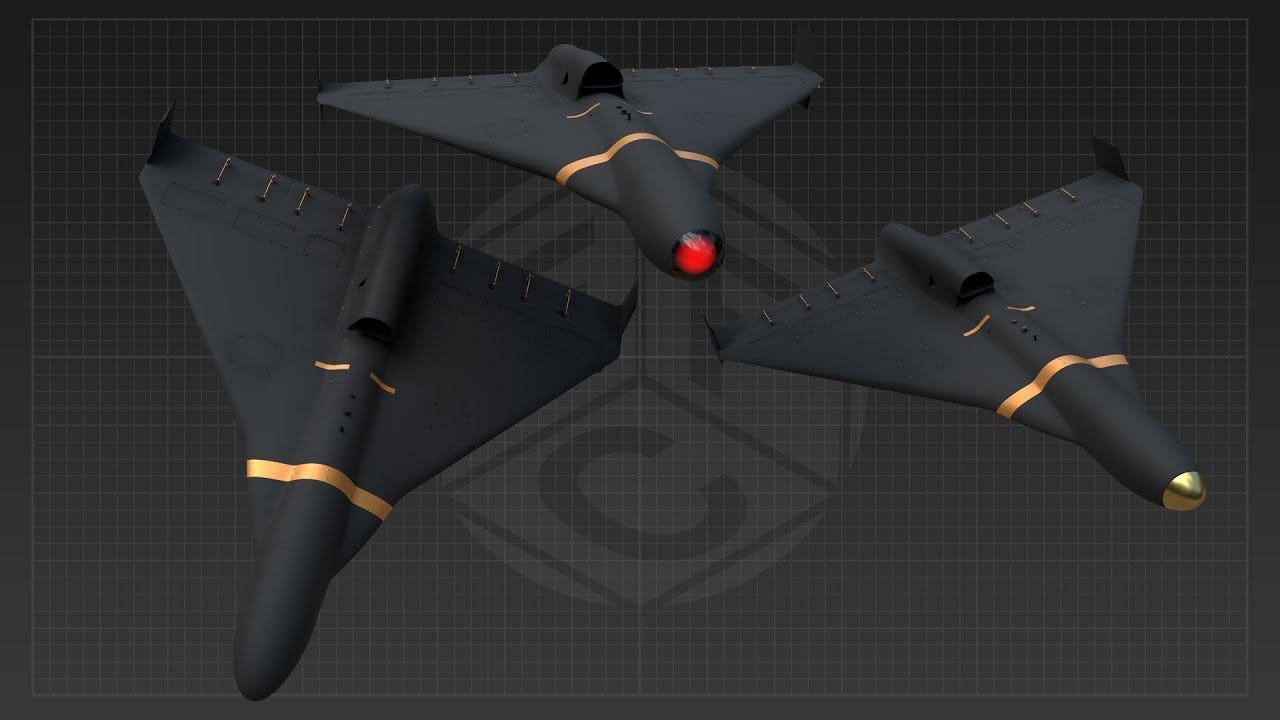
Iranian Shahed Drones – Three Variants
By William Schryver – imetatronink – June 26, 2024
In addition to the already-in-progress wars in Ukraine, Gaza, and the Red Sea, we are now staring down the barrel of yet another — rumored to be imminent in southern Lebanon.
There is no doubt Israel (just like its great benefactor, the United States) is, in the context of a “big war”, capable of executing several damaging strikes against a potential peer or near-peer adversary.
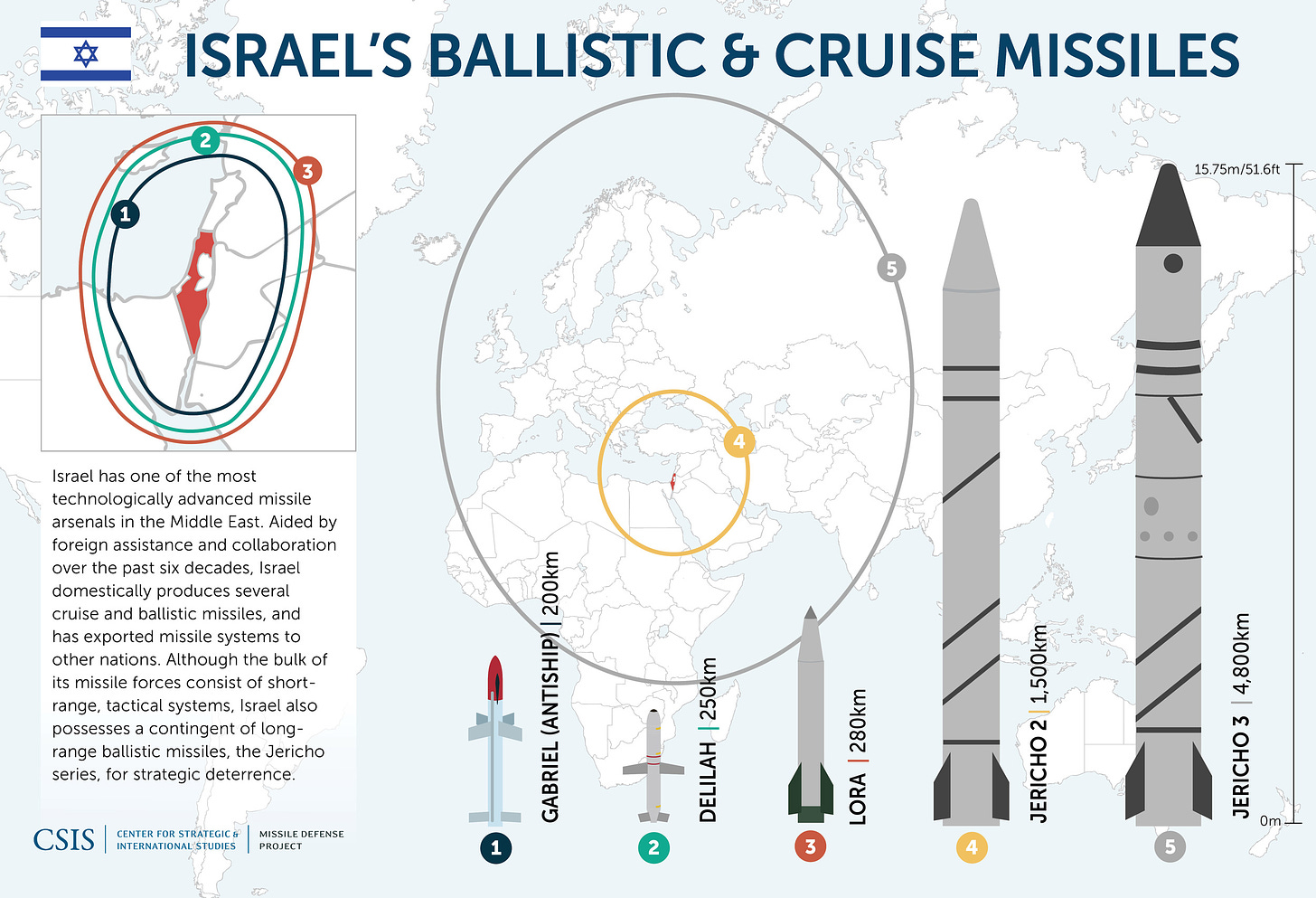
Israeli Ballistic and Cruise Missiles and Ranges
But, throughout the imperial domain, there are fatal weaknesses that exist right now, and which cannot be turned into strengths at any point in the near- or medium-term.
The first is what military types call “magazine depth”: munitions stockpiles sufficient to offensively overwhelm, defensively defeat, and strategically outlast the enemy.
Neither the United States, nor any of its largely impotent client nations, possess “magazine depth” sufficient to prosecute anything more than a relatively brief campaign against their potential peer adversaries: Russia, China, Iran — and all or any of their lesser-power partners.
The second problem is a corollary of the first. It is what I will term “shields”: the capacity to defeat a decisive proportion of the strikes one’s enemy can launch against you.
Neither the United States, nor any of its largely impotent client nations — by their own admission — possess anything even approximating comprehensive and effective “shields” against the quantity and quality of the types of strike weapons its potential adversaries can launch against them.
NATO sources themselves recently confessed that they only have about 5% potential air defense coverage against Russian missile strikes.
Now, of course, many will reflexively argue that, for example, the US could, with a massive “shock and awe” first-strike air campaign, effectively disarm Russian counterstrike capabilities.
This is patently ridiculous wishful thinking.
No one who actually understands the parameters of the military equation believes this to be true. And one need only examine the results of the months-long campaign against the lowly Yemenis to see confirmation of this incontrovertible fact.
Earlier this year we witnessed the Iranians launch a relatively modest missile strike against Israel, whose defenses were massively reinforced by American air and naval assets.
Using maybe 300 antiquated long-range strike drones and cruise missiles as decoys, the air defense response of both the US and Israel was massively attrited. And then, with a mere dozen or so seriously capable ballistic missiles, the Iranians blew right through the interception attempts of both the multiple land-based Patriot systems and a US guided-missile destroyer positioned off the eastern Mediterranean coast.
The Patriot systems were a total bust, and the Israelis summarily retired them in the immediate aftermath of the Iranian strike.
The US destroyer is reported to have launched eight top-shelf SM-3 missile defense interceptors (quite likely its entire “magazine depth”) at the incoming Iranian strike package.
They might have damaged one of the 12-15 incoming Iranian missiles.
The others hit with precision comparable to the 5-meter CEP Iran achieved in its 2020 strikes against the US airbase at Ayn al-Asad in Iraq.
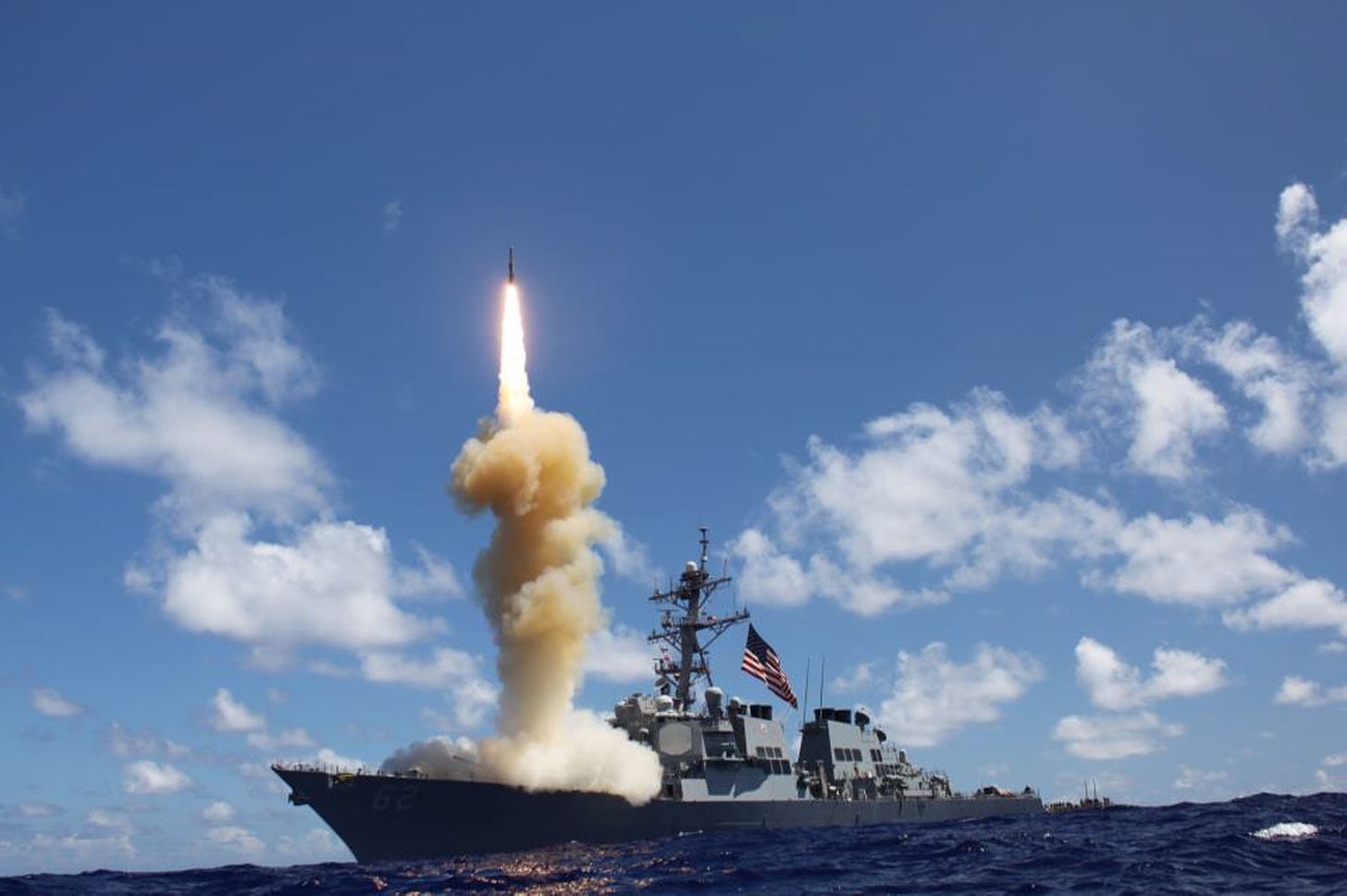
SM-3 Missile Interceptor Launched from a US Guided-Missile Destroyer
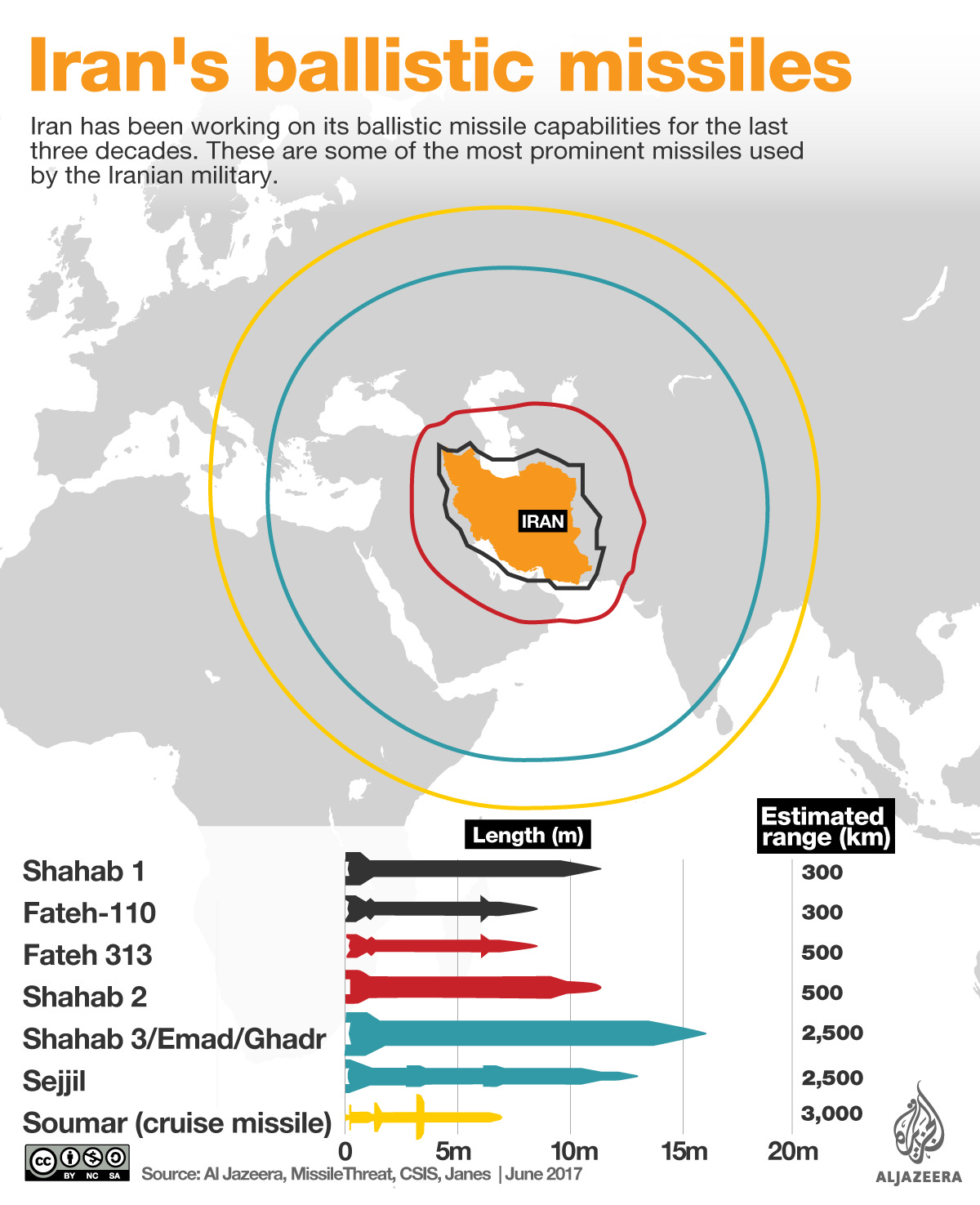
Iranian Ballistic Missiles and Ranges
Had Iran, at that moment in time, opted to follow up with an even larger strike consisting of several hundred of its best ballistic missiles, the US and Israeli defenses would have been penetrated to an overwhelming degree. It would have put to shame the opening-night show of the Americans’ 1991 “shock and awe” cruise missile attack against Baghdad.
Fortunately the Iranians didn’t press the matter, and let their modest yet impressive demonstration of strength suffice for the time being.
In recent months, Iran’s close partner Hezbollah — which is reputed to possess at least 100,000 missiles and drones of various types — has been routinely penetrating Israel’s once-vaunted “Iron Dome” missile defense system.
Indeed, Hezbollah has almost appeared to be mocking the Israelis’ impotence at times.
In any case, the Iron Dome has been revealed to be acutely vulnerable to penetration by Hezbollah drones and missiles.
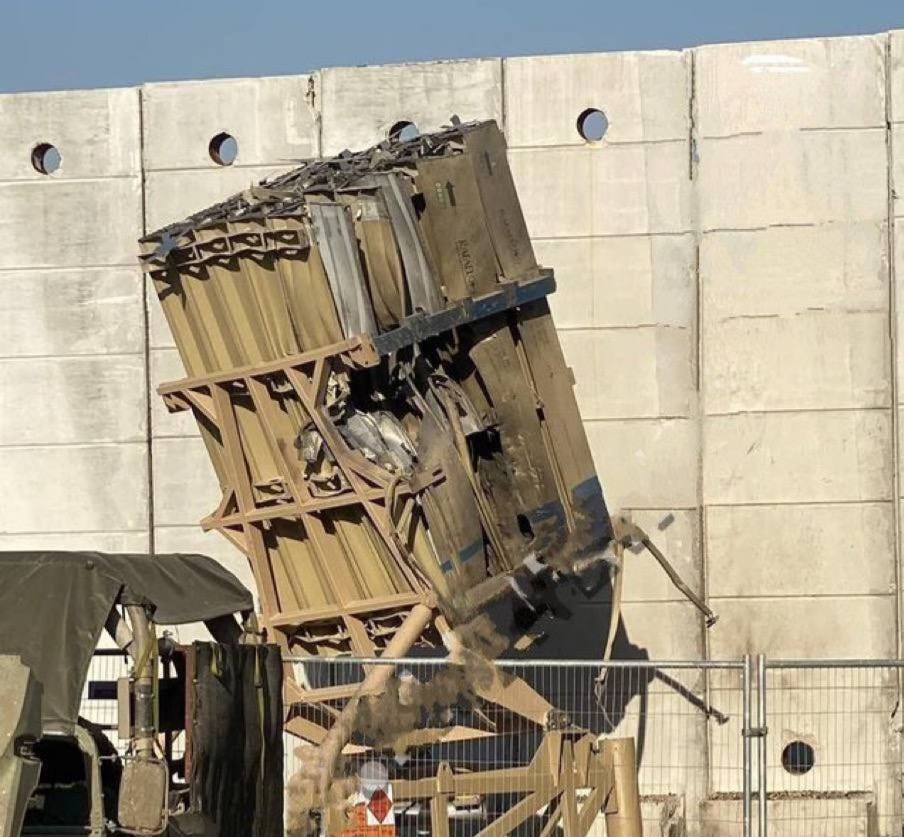
Israeli Iron Dome Launcher Destroyed by Hezbollah Drone Strike
It is not known with precision how many missiles and drones of various types Iran possesses. But it is reasonable to assume that their “magazine depth” is considerably larger than that of Hezbollah.
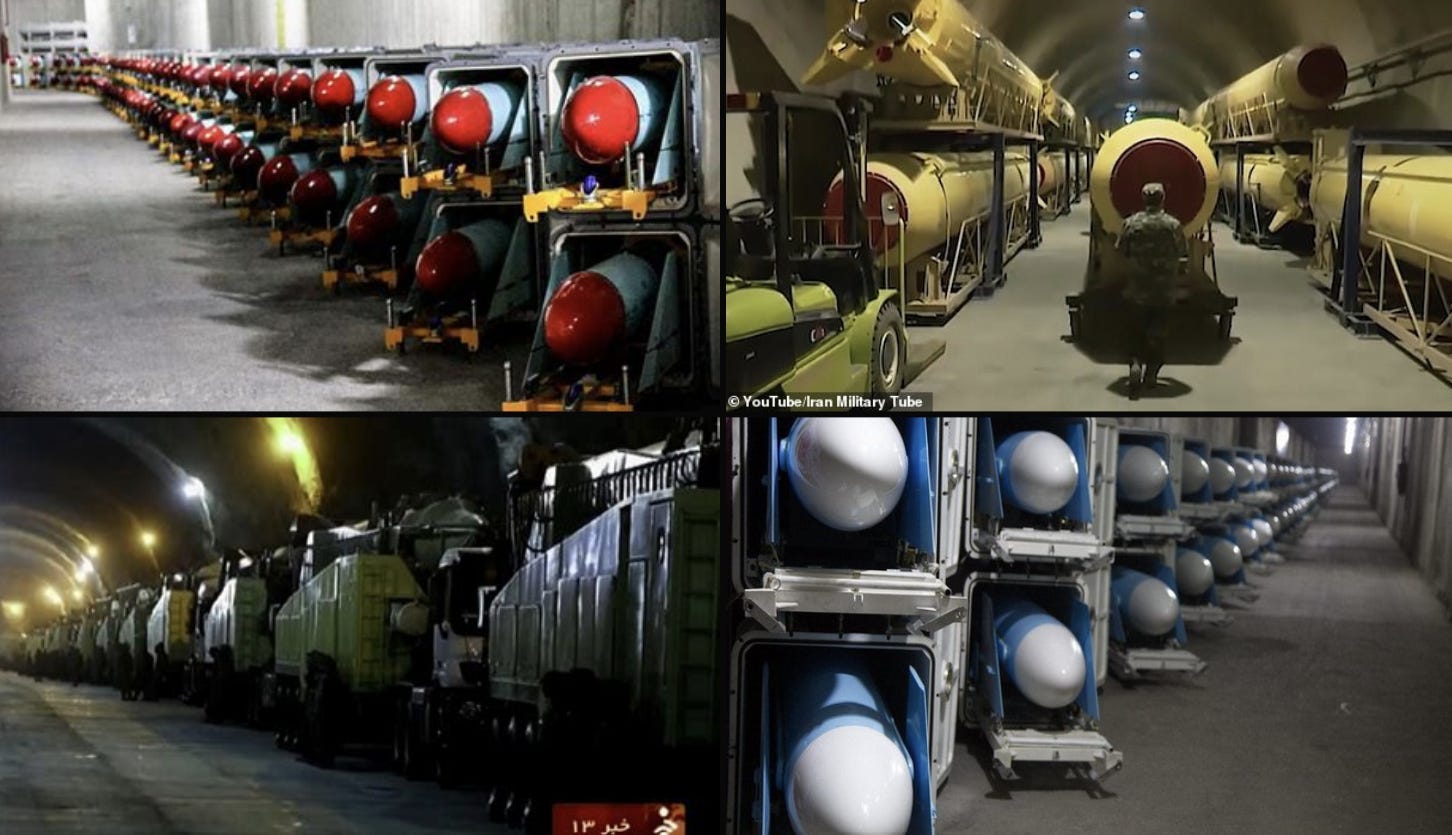
Iranian Missiles
It is also not known with precision how many missiles and drones of various types Russia possesses. But it is reasonable to assume that their “magazine depth” is considerably larger — and exceedingly more potent — than that of Hezbollah and Iran combined.
Even more importantly, the Russians have, over the course of the war in Ukraine, demonstrated an unprecedented capability to routinely shoot down the best strike missiles the US and its NATO vassals have been able to launch against them.
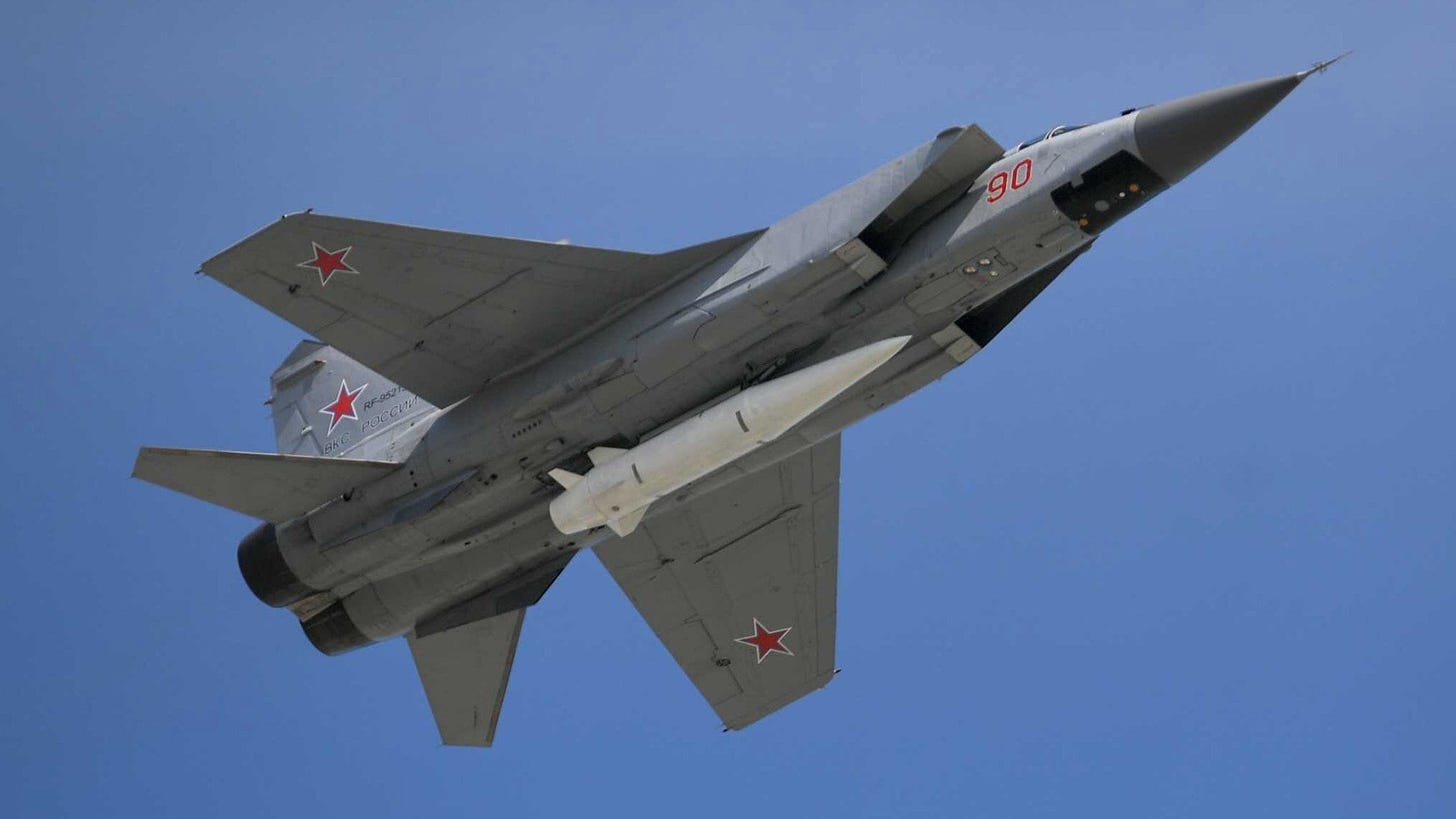
Russian MiG-31 Carrying a Hypersonic Kinzhal Missile
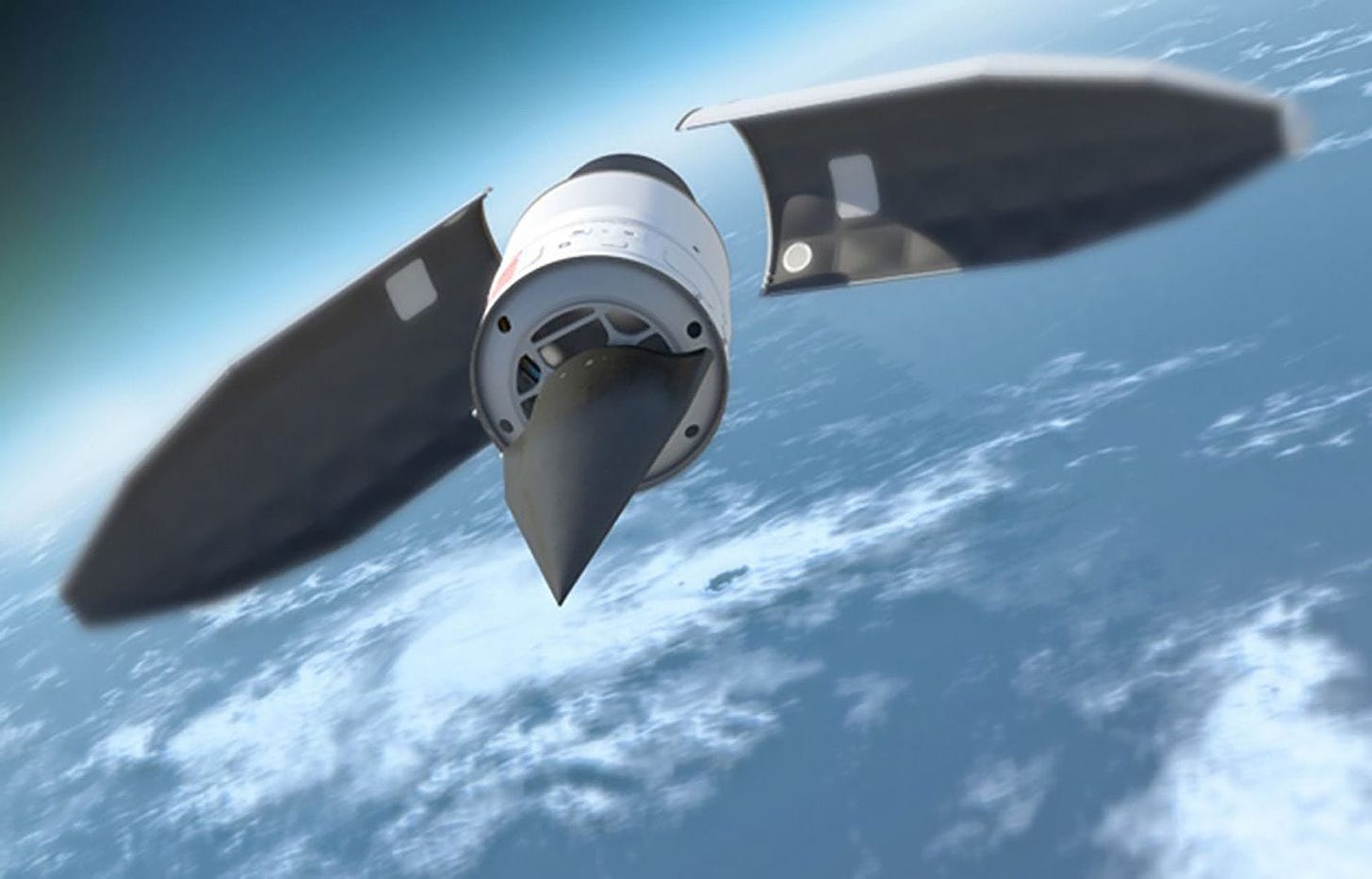
Russian Avangard Hypersonic Missile
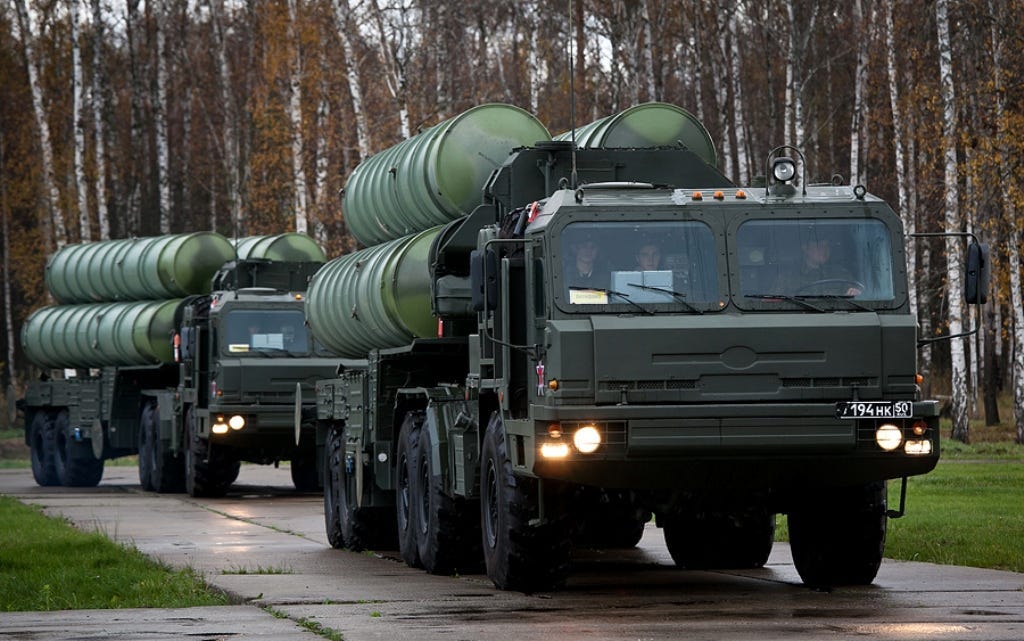
Russian S-400 Air Defense System
Lastly, it is not known with precision how many missiles and drones of various types China possesses. But it is reasonable to assume that their “magazine depth” is at least an order of magnitude larger than Hezbollah, Iran, and Russia combined.
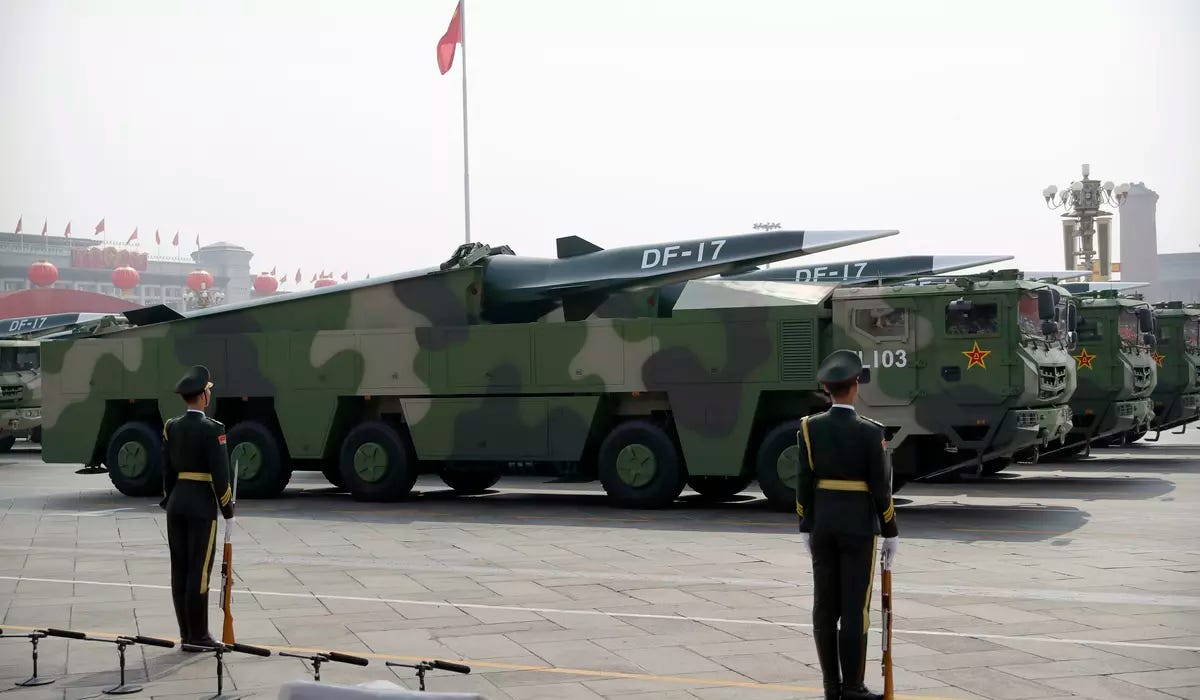
Chinese DF-17 Hypersonic Missiles
Of course, I’ve not yet made any mention of North Korea, who has now been formally received into the Russia, China, Iran mutual-defense partnership. People love to mock Kim Jong-Un and his people, but the empire underestimates them at their peril.
The Israelis can talk tough about making war against Hezbollah and its friends, but if they actually attempt it, it will end very, very badly for them.
The Americans and their almost laughably impotent allies can talk tough about making war against Russia or China, but if they actually attempt it, it will end catastrophically for them.
Then we’ll really have a dangerous situation on our hands.
US condemned for attempting to sow discord between China and Russia, North Korea
Global Times | June 24, 2024
Experts have rebuked the US for trying to sow discord between China and Russia, and North Korea, noting that the closer relationship between the two Chinese neighbors is based on current realities, as their mutual support can break through Western blockades.
The remarks came after US Air Force General C.Q. Brown, chairman of the Joint Chiefs of Staff, told reporters during an overseas trip on Sunday that the newly-signed strategic partnership agreement between Russia and North Korea could create friction with China, according to Reuters.
Reuters, citing anonymous analysts, claimed the pact, signed on Wednesday, “could undercut Beijing’s leverage over its two neighbors and any heightened instability could be negative for China’s global economic and strategic ambitions.”
Chinese experts refuted the claims.
“In fact, China is pleased to see strengthening friendly cooperation between these two neighboring countries,” said Lü Chao, an expert on the Korean Peninsula issue at the Liaoning Academy of Social Sciences. He believes the mutually supportive ties between Russia and North Korea are expected to contribute to regional security and the peace and stability of Northeast Asia.
China’s relations with both Russia and North Korea share a common goal of maintaining peace and stability in Northeast Asia, and their comprehensive cooperation is reasonable, Lü said.
The top leaders of the Democratic People’s Republic of Korea (DPRK) and Russia signed the Treaty on Comprehensive Strategic Partnership following their summit in Pyongyang on Wednesday, the Xinhua News Agency reported Thursday.
Russia and North Korea have agreed on mutual support in the event of external aggression, Russian media reported on Wednesday, citing Russian President Vladimir Putin. Russia does not rule out military-technical cooperation with North Korea in accordance with a newly signed comprehensive strategic partnership agreement, RIA Novosti reported, citing Putin at a press briefing following talks with North Korea’s top leader Kim Jong Un in Pyongyang.
In response to the development, Lin Jian, a spokesperson for the Chinese Foreign Ministry, said at a Thursday press conference that “the agreement between the DPRK and Russia is related to their bilateral cooperation. I have no comment on it.”
The closer relationship between North Korea and Russia is based on current realities, Chinese experts pointed out.
Currently, both Russia and North Korea face severe pressure from the US-led Western clique, including economic sanctions. In this situation, it is natural for the two countries to come together, especially since they have mutually beneficial aspects, such as Russia’s assistance in energy and food supplies to North Korea, according to Lü.
At the same time, some US and other Western politicians and media outlets are hyping “some kind of military alignment or military bloc” in Northeast Asia.
Such rumors also were debunked by Chinese experts.
The US is determined to implement its so-called Indo-Pacific Strategy in the region, creating a camp confrontation mentality, they said.
“China opposes any trend towards regional camps. But the US is fabricating this division,” Lü remarked.
He warned that the Western portrayal of a camp formation could further exacerbate tensions on the Korean Peninsula.
The expert explained that China has always advocated a fair and just stance on the Korean Peninsula issue, maintaining a fair and just position towards both North and South Korea, which has been widely recognized.
Lin said that on the Korean Peninsula issue, China’s position is consistent. “We always believe that upholding peace and stability on the Peninsula and advancing the political settlement of the Peninsula issue serve the common interests of all parties and hope various parties will make constructive efforts to this end,” Lin said.
A new multipolar security system based on ‘Pax Rossiya’
Strategic Culture Foundation | June 21, 2024
For several years now, Russia, China and other members of the expanding BRICS alliance have been formulating progressive trade and financial relations of the emerging multipolar world order. That order is based on mutual respect and partnership grounded in international law and the UN Charter.
The BRICS concept is rightly the zeitgeist of our time. It is rallying more nations to its fold especially those of the so-called Global South which for decades have been subjected to the unilateralism of Western hegemony.
The trouble is that for a new world order based on equality and fairness to succeed in practice, it needs to be secure from arbitrary military aggression and imperialist tyranny. In other words, a new security architecture is required to underpin the development of a multipolar world.
Russian President Vladimir Putin has been advocating for a new indivisible international security system. This week saw the plan for a new security arrangement put into action.
The Russian leader embarked on state visits to North Korea and Vietnam during which he signed new strategic partnership and defense accords.
Ahead of his trip to the Democratic People’s Republic of Korea, Putin outlined the integrated vision thus: “We are also ready for close cooperation to make international relations more democratic and stable… To do this, we will develop alternative mechanisms of trade and mutual settlements that are not controlled by the West, and jointly resist illegitimate unilateral restrictions. And at the same time – to build an architecture of equal and indivisible security in Eurasia.”
The concept of indivisible security is by no means limited to Eurasia. Russia has signaled the same principles apply to Latin America, Africa and indeed every other corner of the world.
During Putin’s meetings with Chairman Kim Jong Un of the DPRK and President Lo Tam of the Socialist Republic of Vietnam, the strategic partnerships agreed were not merely about military defense and security. They involved comprehensive partnerships for the development of trade, transport, technology, education, science and medicine.
Nevertheless, it was clear that the commitment to strategic partnership was underpinned by new mutual defense accords. This was most explicit in the treaty signed with the DPRK which furnished “mutual assistance in the event of aggression against one of the parties”.
This is a game-changer. It totally upends the geopolitical calculations of the United States and its NATO partners who have been unilaterally expanding military force and provocations in Eurasia and elsewhere.
U.S. President Joe Biden’s administration has ramped up aggression in the Asia-Pacific against China and North Korea with impunity. Under his watch, the US has increasingly moved nuclear forces into the region to intimidate not only Beijing and Pyongyang but also Moscow. The Biden administration has been assiduous in forming hostile military formations in the region with its NATO partners, including Australia, New Zealand, Japan and South Korea.
Year after year, the United States has built up weapon systems in Taiwan to provoke China and on the Korean Peninsula to threaten North Korea.
This unilateral aggression and “might is right” arrogance underpin the notion of Pax Americana that prevailed for decades after the Second World War. That notion was always a cruel euphemism for American imperialist violence to impose its economic and political interests. The Korean and Vietnam Wars in which millions of civilians were annihilated were the real-world grim translations of Pax Americana and its fraudulent “rules-based order”.
Geopolitical perceptions have dramatically changed in a few short years. The U.S. and its Western partners – a global minority – have come to be seen by most people of the world as rogue states that have trashed international law through illegal wars and unilateral bullying with economic sanctions. The U.S. dollar and Washington’s relentless debt spending are seen as instruments of imperialist looting.
The BRICS multipolar world order is a welcome alternative to the mayhem of the Western-dominated system. The principles of fairness and cooperation are laudable and necessary to implement. But such principles must be reinforced with military defense and security for all. This is far from the one-sided “defense and security” of the United States and its NATO partners, which in reality is an Orwellian cover for aggression.
The defense commitments given by Russia to the DPRK this week can be seen as long overdue. One may wonder how the U.S. and its allies got away with threatening the people of North Korea for so long and denying Pyongyang the sovereign right to self-defense. Admittedly, Russia did previously support UN sanctions on North Korea over its missile program. That’s over.
The U.S.-led proxy war in Ukraine against Russia that erupted in February 2022 was a wake-up call for Moscow and many people around the world.
Patently, the Western hegemonic system will stop at nothing to assert its neocolonialist privileges, even to the point of antagonizing a nuclear world war.
There is only one language that the U.S. and its minions understand – and that is the threat of devastating countervailing force.
Washington and its NATO lackeys think they can put missiles in Ukraine to hit Russia or in South Korea and Japan to hit North Korea – at no cost to their own security. Well, now, they might want to think again. There’s a new sheriff in town, as this week’s developments show.
A new global security system is being incarnate. Russia’s vision of indivisible, mutual security is shared by China and many other nations because it is fully compliant with international law and nations’ sovereignty.
Russia, China and other supporters of a multipolar world are not preemptively threatening anyone. But it takes the guarantee of unassailable nuclear powers, Russia and China, to make a new security system viable by restoring the deterrence towards the rogue states of the United States and NATO accomplices.
The defense accords between Russia, the DPRK and Vietnam are installments of the new security architecture that is needed in Eurasia and globally. The has-been American hegemon has been served notice that from now on its presumption of belligerence with impunity, to destroy nations, and to have a license to murder en masse is null and void.
Welcome to the new multipolar order and Pax Rossiya. All are welcome – except hegemonic rogue states.
Nothing to worry about? South Korea sounds the alarm
By Gilbert Doctorow | June 21, 2024
What a difference a day makes. Yesterday’s Financial Times informed readers about the red carpet that was rolled out for Vladimir Putin at his various stops in and around the North Korean capital during his two-day stay there. They spoke of the Russian folk songs which local artists performed in Putin’s honor. They mentioned that various state to state agreements were signed but said almost nothing about the contents.
Today the FT has taken a very different approach to Putin’s visit in a feature article entitled “Japan and South Korea sound alarm over Putin-Kim military pact.” Lo and behold, Seoul has read the text of the Comprehensive Strategic Partnership that North Korea issued and discovered that it contains: “a pledge to deploy ‘all means at its disposal without delay’ to provide ‘military and other assistance’ in the event that one of the signatories was invaded or in a state of war.”
The FT goes on to cite the South Korean foreign ministry’s expression of regret over the strategic partnership: “… co-operation between Russia and North Korea ‘should not undermine regional peace and stability’.” Seoul warns “that their co-operation on military technology would violate UN Security Council resolutions.”
Those resolutions, by the way, are up for renewal in the not-too-distant future, and Putin has said from Pyongyang that Russia will veto any extensions.
The fact is that this barking from the South Koreans is frustrated by the very opacity of the wording of both the texts and of Putin’s spoken remarks after the signing and at a meeting with Russian journalists before his departure for Vietnam.
One thing is certain: the Russian-North Korean deal is not just transactional: it is a genuine alliance, the first and only one that Russia has at this moment.
What kind of military assistance will the sides provide to the other in case an act of aggression is declared? What kind of military technical cooperation do the parties have in mind?
For example, will Russia be providing North Korea with ICBMs capable of reaching all of the United States, as some American experts believe? Or is Russia just extending its nuclear umbrella over North Korea, with a pledge to destroy any attacker? Will Russia provide North Korea with its ship sinking hypersonic missiles that could be very useful if this or any future American president sends an aircraft carrier task force to Korean shores to threaten Pyongyang with instant destruction as Trump once did?
Turned around the other way, what can and will North Korea do to help if Russia declares that an act of aggression has been committed against it by NATO in the midst of the Ukraine conflict? Last evening’s edition of the authoritative Russian talk show, The Great Game, moderated by Duma member and Kremlin insider Vyacheslav Nikonov provided an intriguing insight into what people close to Putin are thinking in this regard.
For some time, Russia’s chattering classes have speculated about possibilities for enlisting some of North Korea’s one million man army to help their forces in the ground war in Ukraine. Now, under conditions of the newly signed military alliance with Pyongyang, these same Russians are saying that should NATO forces enter Ukraine to join the fight against them, as Emmanuel Macron has been urging, then Russia may invite 50,000 or more North Koreans to lend a hand to their cause. Moreover, they note that the North Koreans have some very impressive artillery pieces to bring with them to the fight.
If that kind of talk on Russian television is being ignored by the military attaché in the U.S. Embassy in Moscow I would be very surprised.
In closing, I mention that the fuss raised by Seoul over the Russian-North Korean military alliance was the subject of a 10-minute interview I gave to Iran’s Press TV this morning.
The link is here: https://www.urmedium.net/c/presstv/129882
As I was alerted by one very attentive reader, this link is usable if you ignore the warnings about possibly compromising security of your computer and opt to proceed at your own risk. The warning is malicious, a bit of disinformation from Iran’s detractors, nothing more.
An alternative link that works directly, without unnerving warnings is here: https://odysee.com/PressTV-2024-06-21:8
Enjoy the show!
©Gilbert Doctorow, 2024
Russia and North Korea agree on mutual aid against aggression – Putin
RT | June 19, 2024
Moscow and Pyongyang have pledged to assist each other against foreign aggression, Russian President Vladimir Putin announced on Wednesday during a visit to the Democratic People’s Republic of Korea.
Putin and his North Korean counterpart, Kim Jong-un, signed a strategic partnership which will serve as a roadmap for future cooperation in all spheres, from cultural and tourist ties, to trade, economic relations and security, the Russian leader has said, calling it “truly a breakthrough.”
“The document on comprehensive partnership that we have signed today provides, among other things, for mutual aid in case of aggression against one of the participants,” the president added.
Moscow supports Pyongyang’s intention to protect its security and sovereignty from possible Western aggression, which is its right, Putin said. The country considers the US and its allies responsible for the increasing tensions in the region, he added.
“Overused Western propaganda tropes can no longer hide their aggressive geopolitical intentions, including in Northwestern Asia,” Putin said.
Putin noted that Western nations were supplying advanced weapons to Ukraine and have given Kiev the green light to strike Russia. Under these circumstances, “Russia does not rule out the development of military cooperation with the DPRK under the document signed today.”
The visiting head of state denounced the “indefinite restrictions regime” imposed on North Korea by the UN Security Council, which includes an arms embargo, as “orchestrated by the US” and urged for it to be revised.
The Russian president had previously warned the West over Kiev’s desire to use donated weapons to conduct attacks deep inside Russia. Should that happen, Moscow could send similar types of weapons to enemies of the West, which could use them to strike the military assets of the US and its allies, he said earlier this month.
Pyongyang has an “objective and balanced” stance on the Ukraine conflict and sees its core causes, which proves North Korea’s independence and sovereignty, Putin said. The two nations are also on the same page in supporting “a more just and democratic multipolar world” that should replace the previous Western-centric system.
”We will continue to oppose the imposition of strangling sanctions, which the West has turned into a tool of maintaining its hegemony in politics, the economy and other areas,” the president vowed.
Recalling the lengthy record of Russian cooperation with North Korea, Putin noted the role that the Soviet Union played in the fight against Imperial Japan during the Second World War and the reconstruction efforts following the Korean civil war, which split the Korean Peninsula between two rivals. Moscow was the party with which Pyongyang signed its first international agreement 75 years ago, he added.
Featured Video

Chinese jet fuel and the myth of energy independence
or go to
Aletho News Archives – Video-Images
Book Review
Former Insiders Criticize Iran Policy as U.S. Hegemony
By GARETH PORTER | CounterPunch | February 27, 2013
“Going to Tehran” arguably represents the most important work on the subject of U.S.-Iran relations to be published thus far.
Flynt Leverett and Hillary Mann Leverett tackle not only U.S. policy toward Iran but the broader context of Middle East policy with a systematic analytical perspective informed by personal experience, as well as very extensive documentation.
More importantly, however, their exposé required a degree of courage that may be unparalleled in the writing of former U.S. national security officials about issues on which they worked. They have chosen not just to criticise U.S. policy toward Iran but to analyse that policy as a problem of U.S. hegemony. … continue
Blog Roll
 Aletho News
- NATO’s Slow Fracture: How Trump’s Iran War Exposed the Instrument of Hegemony
- Chinese jet fuel and the myth of energy independence
- Ukraine Sea Drone Fired From Libya Hit Russian Tanker in Mediterranean
- IRGC: Iranian forces launched no attacks during ceasefire hours
- Trump Administration Moves To Automate U.S. Military Draft Registration
- Spain orders reopening of Tehran embassy, condemns Israel’s carpet bombing of Lebanon
- Israel faces ‘unsustainable’ strategic crisis following 40-day war against Iran: Analyst
- Iran restricts Hormuz access to 15 vessels per day under ceasefire terms: Report
- The ‘Opposition Party’ Has Done Nothing to Stop the Iran War and Much to Goad Trump Into Continuing It
- Moscow backs Tehran on status of Lebanon in US-Iran deal
- If Americans Knew
- Amnesty: Urgent – Protect Lebanese civilians from brutal escalation in Israeli attacks
- Is The War Against Iran Over?
- Inside the Israeli army’s propaganda wing
- Hundreds of Gaza Amputees Stranded in Legal Limbo
- The gallows law: Israel moves toward executing Palestinian children
- Tucker Carlson: The Path to Peace requires ending ‘special alliance’ with Israel
- This is ceasefire? Israel’s biggest massacre yet in Lebanon, another journalist killed in Gaza – Daily Update
- Tucker Carlson on Israel: This Is the Behavior of an Ally? Really?
- Gazans face a triple crisis: severe shortages of water and bread, healthcare in tatters
- NY Times reports how Netanyahu took the US into Iran War
- No Tricks Zone
- An Inconvenient Tree: Uncovered In Alps… Europe Much Warmer Than Today 6000 Years Ago
- New Study Reports A 60% Slowdown In Greenland’s Ice Loss Rate In The Last Decade
- Low Intensity Tornado Wrecks Major Solar Farm, Creating A Potential Toxic Dump
- New Study Finds Warming Saves Lives…Cold Temperatures 12 Times More Deadly Than Excess Heat
- German Science Blog Accuses PIK Climate Institute Of Hallucinating Climate Tipping Points
- Devastating Assessment Of Comirnaty Vaccine By Former Senior Pfizer Europe Toxicologist
- New Study: CO2 Is ‘Effectively Negligible’ As An Explanatory Climate Change Factor Since 2000
- Former Pfizer Toxicologist Dr. Helmut Sterz Tells Bundestag Hearing Pfizer Vaccine Should Have Never Been Approved
- Energy Expert: Germany’s Nuclear Phaseout Was A “500 Billion Euro Mistake”
- New Research: South Australia’s Mid-Holocene Sea Surface Temperatures Were 4°C Warmer Than Today
 Aletho News