Invading Mexico in the Name of the Drug War Is a Really Bad Idea
By Weimin Chen – Mises Wire – 04/10/2023
Following the violent attack on Americans in the Mexican border city of Matamoros in early March, South Carolina Republican senator Lindsey Graham stated that he was prepared to get tough and introduce legislation to set the stage for US military intervention in Mexico. The move would be a significant escalation in the long-running war on drugs that has been raging under the auspices of the United States for many decades to the dismay of many Latin American countries.
Graham continues to ignore the disastrous results of the use of force in US foreign policy as he eyes adding Mexico to his growing bucket list of interventionist missions. If previous interventions serve as examples, a US military intervention in Mexico would be just another excuse to expand national security interests and mire the country in another costly conflict.
Matamoros Attack
Graham’s comments on using military force in Mexico were sparked when four Americans were kidnapped in Matamoros on the Mexican side of the border with Texas. The area is known for having a heavy drug cartel presence due to its proximity to the US-Mexico border. The four Americans have been identified as Latavia “Tay” McGee, Shaeed Woodard, Zindell Brown, and Eric James Williams.
McGee’s mother told reporters that her daughter was traveling to undergo a cosmetic surgical procedure with the other three. They were fired on in downtown Matamoros and loaded into a pickup truck. A local woman, Areli Pablo Servando, was also killed by a stray bullet in the attack. Brown and Woodard were eventually found dead, while Williams and McGee survived.
Later, a letter of apology along with five men found with their hands tied were turned over to authorities of the Tamaulipas state law enforcement purportedly by the Scorpion faction of the Gulf Cartel. The organization extended its apology to the families of the victims and to the people of Matamoros in general for the poor decision-making and discipline of its affiliated associates.
This public relations move indicated that the cartel was alarmed by the outcry following the attack and wanted to frame it as an unusual incident outside of the ordinary rules under which it operates. Chances are that the cartel wanted to do anything they could to avoid direct US military confrontation.
Policymakers against the Cartels
Graham told Fox News that he would introduce legislation “to make certain Mexican drug cartels foreign terrorist organizations under US law and set the stage to use military force if necessary to protect America from being poisoned by things coming out of Mexico.” This highlights the concern surrounding the trafficking of fentanyl into the US from Mexico and the deadly toll it has been having on the population, and there is a growing sentiment, especially among Republican leaders, for more to be done about it.
Former attorney general Bill Barr concurred with the notion of US military action against cartels and recommended declaring the groups as “foreign terrorist organizations.” Texas representative Dan Crenshaw and Florida representative Michael Waltz have expressed their desires to authorize the president to use military force against “those responsible for trafficking fentanyl or a fentanyl-related substance into the United States or carrying out other related activities that cause regional destabilization in the Western Hemisphere.” Seventeen Republicans have cosponsored that resolution.
Georgia representative Marjorie Taylor Greene wrote on Twitter that the US “should strategically strike and take out the Mexican Cartels, not the Mexican government or their people, but the Mexican Cartels which control them all.” This common assurance that America’s execution of military plans will simply target the right people and nobody else has been used in virtually every instance of the US using force in foreign conflicts. It shows either the hubris of US foreign policy or its indifference to the lives of its innocent victims abroad.
Roots of Violence
These calls for military intervention would serve as another layer of policies and actions already implemented by the US that have had disastrous consequences. After all, the violence in Mexico is an extension of the war on drugs started by American policy. In just the last decade, the US Drug Enforcement Administration has been found laundering millions of dollars in cash and delivering drugs for Mexican traffickers, and the Bureau of Alcohol, Tobacco, Firearms, and Explosives was found to have illegally proliferated nearly two thousand firearms with the intention of tracking criminal elements. These firearms were subsequently lost and used in cartel violence on both sides of the border.
Meanwhile, US-trained Mexican troops and federal police officers have committed widespread human rights violations. If these are the policies that have already been implemented, sending the military would be adding fuel to the fire.
Graham followed up with his statements on military force and clarified that he did not mean sending the US Army to invade Mexico but to destroy drug labs. This is reminiscent of the beginning of the US missions in the war on terror in Afghanistan, when special forces under the Joint Special Operations Command were implemented in secret raids that were highly controversial in their lack of accountability in causing collateral damage and civilian casualties. Without any clear definition of success and with the dubious effectiveness of using military force, this kind of endeavor would be susceptible to mission creep and expansions of the scope and spending, just as it did in the many interventions of the war on terror.
Mexican president Andrés Manuel López Obrador has already responded to the remarks by Republican lawmakers, saying that any US military intervention in his country would represent an unacceptable infringement of Mexican sovereignty. If the US military’s track record provides any indication, the direct use of force in Mexico would likely cause more pain and suffering in a country with a population already plagued by violence.
US once again turning sword to Latin America as its global power wanes
By Drago Bosnic | April 11, 2023
The political West is always “shocked” by how deeply unpopular it is in the Global South and cannot comprehend why it “dares” to refuse to side with them against Russia and/or China. This lesson is something the political elites of the United States and its numerous satellite states need to be reminded of from time to time. On the other hand, the political West never stopped treating the Global South as a fief that just so happens to be populated by several billion people, all of whom are seen as “fair game”. Needless to say, this has left disastrous consequences for the vast majority of those living in the targeted countries.
While some were attacked directly, such as Iraq (twice), Afghanistan, Syria, Libya, Yemen, former Yugoslavia/Serbia, etc. others were being exploited “peacefully”. Luckily for the world, the power of the globe’s most imperialist bloc is gradually fading away. This is certainly not to say that it has already collapsed, but the process is well underway. The political West is also perfectly aware of this, so it now needs to prioritize which areas of the Global South it can target. Its days of waging war on the millions of unfortunate people of the Middle East will soon be over, very likely forever.
However, as the US power projection capabilities dwindle, it’s once again turning its sword toward the immediate neighborhood. And it’s not even trying to be at least somewhat subtle about it, as the people of Mexico are being threatened to find out because many in Washington DC believe it is the Mexicans’ “fault” that America is getting flooded with drugs smuggled in by the cartels. Ironically (or should we say hypocritically) enough, it was precisely the US intelligence services that essentially created these hideously violent organizations and also made sure the connection is kept under the rug.
Last month, after two US citizens were killed, presumably by members of the CDC (otherwise known as the Golf Cartel), Washington DC warhawks threatened to bomb Mexico, a country whose law enforcement works closely with the US to fight the cartels. Earlier, in January, Republicans Mike Waltz and Dan Crenshaw called for an Authorization for Use of Military Force against Mexican cartels for drug trafficking “that has caused destabilization in the Western Hemisphere.” Infamous Lindsey Graham, along with 16 Republican cosponsors, supported the bill and criticized the Biden administration for the deteriorating situation at the southern border, claiming that “up to 100,000 people have died from fentanyl poisoning coming from Mexico and China, and this administration has done nothing about it.”
While it could be argued that fighting cartels is certainly not a bad cause, we should not forget that somewhat similar “altruistic” motives were cited as the reason for virtually any war the US started. Blaming Mexico and China for the drug abuse “pandemic” in America will certainly not resolve this issue or any of the resulting violence across the country. If the establishment in Washington DC had the interests of regular Americans in mind, they would introduce bills allocating at least 10% of their massive $858 billion military budget to the improvement of healthcare, for instance.
Unfortunately, as Abraham Maslow famously wrote in 1966, “If the only tool you have is a hammer, it is tempting to treat everything as if it were a nail.” The case of Mexico is quite telling that no country (unless heavily armed) can hope to feel safe, no matter how closely it worked with the US authorities. For decades, Mexico has been ravaged by drug cartels deeply connected to the infamous CIA and other US intelligence agencies. And despite even allowing American law enforcement to operate in the country, thus undermining its own sovereignty, it’s still faced with the prospect of being attacked.
And Mexico is far from being the only target, as Washington DC is increasingly turning to Nicaragua, a small country in Central America that has already been virtually destroyed by Washington DC during the (First) Cold War when it funded the infamous Contras. Just like then, this time the US is once again “worried about human rights” in Nicaragua. As if that wasn’t laughable enough, Washington DC also officially designated the small country “a strategic threat”. Apparently, the “sole superpower” is endangered by a country roughly the size of New York State, but with the population of Maryland. And the US is also using so-called “international institutions” to target Nicaragua.
The Organization of American States (OAS) and the UN, both largely financed by Washington DC, are being used for this purpose, according to former UN rapporteur for human rights Richard Falk. If one is to believe the “human rights reports” about Nicaragua are true, President Daniel Ortega supposedly ordered 40 people to be “executed”, while conveniently leaving out the part about violent opposition attacks using firearms. The reports also claimed that Ortega ordered hospitals not to treat wounded demonstrators, although the then-health minister had made clear that anyone injured would receive treatment. US-backed “experts” also compared Nicaragua to Nazi Germany.
The glaring hypocrisy in this regard indicates that there is no “international law” for Washington DC. If a country is part of the “rules-based world order“, it can openly embrace Nazism, and it will still be considered “a beacon of freedom and democracy”, while the “Nazi analogies” are reserved for everyone else. Nicaragua should certainly be worried, as should the rest of Latin America. With the US’ ability to project power globally going down faster than most people could’ve imagined just ten years ago, the belligerent thalassocracy might try to revive the infamous Monroe Doctrine, leaving well over 600 million people in Latin America exposed to “freedom and democracy”.
Drago Bosnic is an independent geopolitical and military analyst.jj
China is the Rock Upon Which the U.S. World Order Breaks
By Ted Snider | The Libertarian Institute | April 4, 2023
In March, Chinese President Xi Jinping visited Russian President Vladimir Putin in Moscow, where they not only “reaffirm[ed] the special nature of the Russia-China partnership,” but “signed a statement on deepening the strategic partnership and bilateral ties which are entering a new era.” As Xi was leaving the Kremlin, he told Putin that “Together, we should push forward these changes that have not happened for 100 years.” That goodbye was Xi’s not so coded call for the end of the American century.
In his February 7 State of the Union Address, U.S. President Joe Biden got carried away by his excitement and arrogantly and ineptly went off script and called out, “Name me a world leader who’d change places with Xi Jinping. Name me one. Name me one.”
But the deflating truth is that the world is lining up behind China and Russia’s vision of a multipolar world no longer exclusively led by the United States. From Africa and its unanimous attendance at the recent Russia-Africa in a Multipolar World conference, to the Middle East and its long list of countries lining up to join the Chinese and Russian led multipolar organizations BRICS and the SCO, to Latin America and most of Eurasia and Asia, including India, the weight of the world is going to Xi’s place to balance American hegemony and support a multipolar world.
Biden’s outburst was an insult and confrontation that was a personal microcosm of U.S. provocation and confrontation of China on a global level. And it has had a corrosive and dangerous effect. An angry China is not answering America’s phone calls. Biden had hoped to talk to Xi on the phone in mid-March, but Chinese officials are not responding to U.S. requests to arrange the call. Defense Secretary Lloyd Austin’s calls to set up talks with his Chinese counterpart have also not been answered.
China is emerging as the rock upon which the U.S.-led alliance breaks.
China’s growing economic, diplomatic, and political influence is beginning to be more powerfully felt on the world stage. The rapid growth of international organizations that support China and Russia’s multipolar world vision is just one piece of evidence. China’s emergence as an influential broker is another.
Beijing has become a power that can shape the world, leaving Washington out of the process. They shocked the world in March by brokering a region transforming agreement between archrivals Saudi Arabia and Iran. And they upset the U.S. in February by initiating a peace process for the war in Ukraine. Both initiatives left the U.S. out in the cold.
The world is no longer unipolar: a world with multiple poles of power is emerging. China’s foreign policy seeks economic growth that demands the fostering of stability in the world; U.S. foreign policy seeks hegemony that demands hostility and schisms that punish and isolate resisters. The problem with China’s emergence as a broker is that it breaks U.S. hegemony. But it is also that China’s peace plans get in the way of America’s war plans.
The U.S. is not ready for peace in the Russo-Ukrainian War. Though peace plans may serve a devastated Ukraine, they do not serve the larger U.S. goals being served by the devastated Ukraine. The United States is not ready for Ukraine to go to the table and end the war before their larger goals are accomplished. As State Department spokesperson Ned Price said in March 2022, “This is a war that is in many ways bigger than Russia, it’s bigger than Ukraine.”
Biden rejected China’s potential role as a broker in the war, insisting that “the idea that China is going to be negotiating the outcome of a war that’s a totally unjust war for Ukraine is just not rational.” National Security Council spokesman John Kirby said that the U.S. does not believe that a Chinese peace proposal “is a step towards a just and durable peace.” He claims that “We all want to see the war end… And a ceasefire, at this time, while that may sound good, we do not believe would have that effect.” Kirby then added that “we don’t support calls for a ceasefire right now. We certainly don’t support calls for a ceasefire that would be called for by the [People’s Republic of China] in a meeting in Moscow that would simply benefit Russia.”
The U.S. has long insisted that no decisions will be made without Ukraine. But if a Chinese-brokered peace were to succeed, it would be because Ukraine has agreed to it. It is remarkable that it is up to Ukraine to continue the war but not up to Ukraine to end it.
China’s peace plans for the Middle East also get in the way of America’s war plans. A U.S.-led unipolar world demands the isolation of Iran. A key piece of that plan is the establishment and maintenance of a regional coalition against Iran. At the heart of that coalition is Saudi Arabia firmly in the anti-Iran camp. The recent Chinese brokered Saudi-Iran agreement breaks that coalition and mends that schism.
The Saudi-Iran agreement has had immediate effects in the region that further challenge American efforts to shape it in their own way. Fast in the wake of the agreement, Saudi Arabia and Iranian ally Syria agreed to reopen their embassies. And the shift in shape is not just bilateral, but regional. Saudi Arabia’s foreign minister is reported to be on his way to Damascus to formally invite Syrian President Bashar al-Assad to this May’s Arab League summit in Riyadh. The invitation, Syria’s first since 2011, would “formally end Syria’s regional isolation.” On April 1, Syria’s foreign minister went to Cairo for the first official visit in twelve years to begin the process of reinstating Syria in the Arab League.
That “leap forward in Damascus’s return to the Arab fold” frustrates U.S. plans to continue the isolation of Assad and Syria. The U.S. has opposed normalization of relations with Syria by countries in the Middle East. The State Department says their “stance on normalization remains unchanged” despite Saudi Arabia’s new stance and the changes in the region.
China has emerged as a diplomatic force that can broker agreements and shape the world in a way that shatters U.S. hegemony in a unipolar world. Some countries are willing to break with the United States and work with China.
France has communicated to China its “appreciation for China’s positive role in promoting peace talks.” Macron’s Diplomatic Advisor, Emmanuel Bonne, told Wang Yi, China’s Director of the Office of the Central Commission for Foreign Affairs, that “France is ready to make joint efforts with China to facilitate cessation of hostilities and seek a peaceful solution.”
France is a major European NATO ally. China’s emergence as a diplomatic superpower has created a crack in the structure of the U.S.-led alliance.
France is not alone in its willingness to work with China. Where France’s independent position reveals a rift within the U.S.-led alliance, Brazil’s independent position reveals the emergence of other poles in the newly emergent multipolar world.
The independent course charted by Brazil and its willingness to work with America’s rival reveals, not only the loss of U.S. hegemony in its own hemisphere, but the loss of U.S. hegemony globally because partnering with China is partnering with BRICS, the large international organization whose goal is to balance U.S. hegemony of a unipolar world.
Brazilian President Luiz Inácio Lula da Silva has supported China’s efforts at negotiating a peace proposal and criticized the United States for speaking “very few words about peace.” But he has also proposed a joint effort, or a “peace club” that could include BRICS members China, India and Brazil and possibly Indonesia. Indonesia has been a leader in the nonaligned world and was recently welcomed as a guest at the BRICS Foreign Ministers’ Meeting.
China’s diplomatic entry into the war in Ukraine highlights a multipolar world that could shape a post world war and sideline the United States.
As China’s economy and the gravitational pull of its multipolar world grow, and as its force is further felt, not only economically but politically and diplomatically, the U.S. stance may stiffen, and Washington may more solidly confront China, not only by increasing sanctions, but by calling on its allies to do the same.
That call could be a challenging one for America’s European allies to answer. If Seymour Hersh’s reporting is correct, it took cutting Germany off from their Russian oil supply by a historic act of sabotage—an act of war—to keep Germany fully on board in America’s sanction regime on Russia. China has been Germany’s most important trading partner for seven consecutive years. Since the Russian invasion of Ukraine, Germany has only increased its investments in and economic dependence on China. It will be more difficult to pressure Germany to cut economic ties with China than it was to pressure it to cut ties with Russia. And it will be asking a lot of Germany to ask it to cut ties with both.
Dr. Suzanne Loftus, Research Fellow at the Quincy Institute Eurasia Program, told me that, “China is Germany’s most important trading partner. Having to sanction China would put Germany in a very difficult position seeing as how it has already had to sanction another one of its significant trading partners (Russia) and is also struggling with U.S. protectionist policies (Inflation Reduction Act).” Loftus continued “[f]acing difficulties at home, Germany will most likely opt out of having to sanction China if the U.S. started to put pressure on Germany to do so. It would otherwise face too much of an economic shock and increased domestic turmoil as a result.”
A hint of that potential split with the United States was provided in November when German Chancellor Olaf Scholz’s defied Washington by going to Beijing, accompanied by the CEOs of Volkswagen, BMW, BASF, Bayer and Deutsche Bank, in part to discuss trade.
On the eve of his trip, Scholz wrote that “new centers of power are emerging in a multipolar world, and we aim to establish and expand partnerships with all of them.” He said that, though China is an economic power that will “play a key role on the world stage in the future,” this does not “justif[y]… calls by some to isolate China.” Scholz then wrote clearly that “even in changed circumstances, China remains an important business and trading partner for Germany and Europe—we don’t want to decouple from it.”
Future American calls to sanction China could force Europe into a choice between solidity with the U.S.-led alliance and continued economic partnership with China. For the U.S., there is a hazardous forecast that that choice could weaken that solidity.
The growing reality of China’s multipolar world vision, China’s emergence as a broker of peace plans that interfere with American war plans, the world’s shifting of shape that sees important countries willing to work with China, and the need for countries to strengthen trade ties with Beijing all suggest that China could be the rock upon which the U.S.-led alliance breaks.
OPEC: Saudis aren’t afraid of US anymore
BY M. K. BHADRAKUMAR | INDIAN PUNCHLINE | APRIL 4, 2023
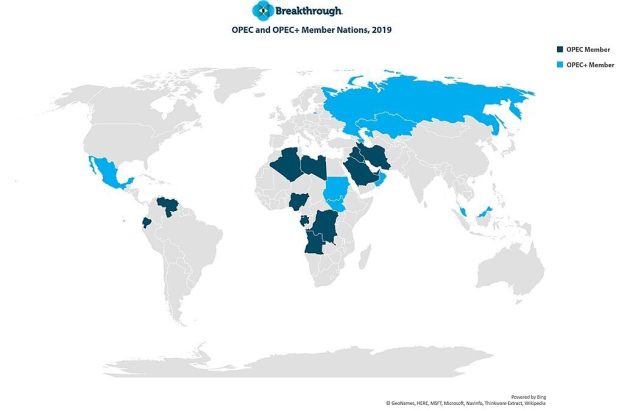
The shock oil production cuts from May outlined by the OPEC+ on Sunday essentially means that eight key OPEC countries decided to join hands with Russia to reduce oil production, messaging that OPEC and OPEC+ are now back in control of the oil market.
No single oil producing country is acting as the Pied Piper here. The great beauty about it is that Saudi Arabia and seven other major OPEC countries have unexpectedly decided to support Russia’s efforts and unilaterally reduce production.
While the 8 OPEC countries are talking about a reduction of one million b/d from May to the end of the year, Russia will extend for the same period its voluntary adjustment that already started in March, by 500,000 barrels.
Now, add to this the production adjustments already decided by the OPEC+ previously, and the total additional voluntary production adjustments touch a whopping 1.6 million b/d.
What has led to this? Fundamentally, as many analysts had forewarned, the Western sanctions against Russian oil created distortions and anomalies in the oil market and upset the delicate ecosystem of supply and demand, which were compounded by the incredibly risky decision by the G7, at the behest of the US Treasury, to impose a price cap on Russia’s oil sales abroad.
On top of it, the Biden administration’s provocative moves to release oil regularly from the US Strategic Petroleum Reserve in attempts to micromanage the oil prices and keep them abnormally low in the interests of the American consumer as well as to keep the inflationary pressures under check turned out to be an affront to the oil-producing countries whose economies critically depend on income from oil exports.
The OPEC+ calls the production cuts “a precautionary measure aimed at supporting the stability of the oil market.” In the downstream of the OPEC+ decision, analysts expect the oil prices to rise in the short term and pressure on Western central banks to increase due to the possible spike in inflation.
What stands out in the OPEC+ decision is that Russia’s decision to reduce oil production by the end of the year has been unanimously supported by the main Arab producers. Independent but time-coordinated statements were made by Saudi Arabia, the UAE, Kuwait, Iraq, Algeria, Oman and Kazakhstan, while Russia confirmed its intention to extend until the end of the year its own production reduction by 500,000 barrels per day, which began in March.
Significantly, these statements have been made precisely by those largest oil producers in OPEC, who have a record of fully utilising their existing quota. Put differently, the reduction in production is going to be real, not just on paper.
Partly at least, the banking crisis in the US and Europe prompted the OPEC+ to intervene. Although Washington will downplay it, in March, Brent oil prices fell to $70 per barrel for the first time since 2021 amid the bankruptcy of several banks in the US and the near-death experience of Credit Suisse, one of the largest banks in Switzerland. The events sparked concern about the stability of the Western banking system and fear of a recession that would affect oil demand.
There is every likelihood that tensions may increase between the US and Saudi Arabia as higher oil prices will push inflation and make it even more difficult for the US Federal Reserve to find a balance between raising the key rate and maintaining financial and economic stability. Equally, the Biden administration must be furious that practical cooperation is still continuing between Russia and the OPEC countries, especially Saudi Arabia, notwithstanding the West’s price cap on Russian oil and Moscow’s decision to unilaterally cut production in March.
However, the Biden administration has only a limited range of options to respond to the OPEC+’s surprise move: one, go for another release of oil from the Strategic Petroleum Reserve; two, pressure US producers to increase domestic oil output; three, back legislation that would allow the US to take the dramatic step of suing OPEC nations; or, four, curb the US’ export of gasoline and diesel.
To be sure, the OPEC+ production cut goes against the Western demand to increase oil output even as sanctions were imposed against Russian oil and gas exports. On the other hand, the disruption in oil supplies from Russia contributed to the rising inflation in the EU countries.
The US wanted the Gulf Arab states to step in and step up oil production. But the latter did not oblige because they felt that there wasn’t enough economic activity in the West and there were clear signs of recession contrary to expectation.
Thus, as a result of the sanctions against Russia, Europe is facing the complex situation of inflation and near-recession known as stagflation. In reality, the adaptive and agile OPEC + read the situation correctly and has shown that it is willing to act ahead of the curve. At a time when the world economy is struggling to grow at a healthy rate, the demand for oil would be relatively less, and it makes sense to cut oil production to maintain the price balance.
All that the Western leaders can complain about is that the OPEC+ cut in oil output has come at an inappropriate time. But the woes of Western economies cannot be laid at the door of OPEC+ as there are inherent problems which are now coming to the surface. For instance, the large scale protests in France against pension reform or the widespread strikes in Britain for higher wages show that there are deep structural problems in these economies, and the governments seem helpless in tackling them.
In geopolitical terms, the OPEC+ move came after a meeting between Russian Deputy Prime Minister Alexander Novak and Saudi Energy Minister Prince Abdulaziz bin Salman in Riyadh on March 16 that focused on oil market cooperation. Therefore, it is widely seen as the tightening of the bond between Russia and Saudi Arabia. In fact, in May, as the largest members of OPEC join Russia in its unilateral reduction, the balance of quotas and the ratio of market shares between and amongst the participants in the OPEC + deal will return to the level set when it was concluded in April 2020.
The big question is, how Moscow might profit from the OPEC+ decision. The rise in crude oil prices particularly benefits Russia. Simply put, the production cuts will tighten up the oil market and thus help Russia to secure better prices for the crude oil it sells. Second, the new cuts also confirm that Russia is still an integral and important part of the group of oil producing countries, despite the western attempts to isolate it.
Third, the consequences of Sunday’s decision are all the greater because, unlike the previous cuts by the OPEC+ group at the height of the pandemic or last October, today, the momentum for global oil demand is up, not down — what with a strong recovery by China expected.
That is to say, the surprise OPEC+ reduction further consolidates the Saudi-Russian energy alliance, by aligning their production levels, thus placing them on equal footing. It is a slap in the face for Washington.
Make no mistake, this is another signal regarding a new era where the Saudis are not afraid of the US anymore, as the OPEC “leverage” is on Riyadh’s side. The Saudis are only doing what they need to do, and the White House has no say in the matter. Clearly, a recasting of the regional and global dynamics that has been set in motion lately is gathering momentum. The future of petrodollar seems increasingly uncertain.
The US’ Rejection Of China’s Peace Plan For Ukraine Exposes Its Warmongering Intentions
By Andrew Korybko | March 24, 2023
Bloomberg cited an unnamed Biden Administration official on Thursday to report that “the US is worried about being backed into a corner over the Chinese proposal. Regardless of the US reservations, dismissing it outright could let China argue to other nations that are weary of the war — and of the economic damage it’s wreaking — that Washington isn’t interested in peace.” Alas, that’s precisely what America has done by acting as if China isn’t a serious mediator and that its peace plan is unrealistic.
By rejecting Beijing’s 12-step proposal, Washington exposed its warmongering intentions for the rest of the world to see and vindicated Moscow’s criticism that it wants to fight this proxy war “to the last Ukrainian”. The majority of the international community that resides in the Global South and which is most adversely affected by the systemic consequences of this conflict, particularly the food and fuel crises catalyzed by Western sanctions, had their perceptions of US soft power shattered once and for all.
Prior to the onset of Russia’s special operation last year that it was forced to commence in defense of its national security red lines in Ukraine after NATO clandestinely crossed them there, a significant share of folks in developing countries still generally had a favorable view of that declining unipolar hegemon. They might not have endorsed every one of its foreign policy moves, but these people still thought that its worldview had some redeeming factors that made it worthy of being listened to at the very least.
The allure of its soft power, particularly in the socio-cultural sphere as propagated by the mass media over the decades, still had a powerful hold over their hearts and minds. Now, however, these same people are directly suffering from the food and fuel crises catalyzed by the West’s unilateral sanctions. To make matters worse, the US signaled through its rejection of China’s peace plan for Ukraine that relief won’t be forthcoming, thus indefinitely perpetuating and thus exacerbating these problems.
It’s one thing for US-inclined folks in the Global South who’ve fallen under the sway of its soft power to oppose some part of its foreign policy regarding a faraway country and another entirely for that same foreign policy to directly affect them and their family. They might still enjoy consuming some of its socio-cultural products and perhaps still cling to believing in the so-called “American Dream” despite the odds of them ever benefiting from it, but their views of the US as a whole will certainly change.
This rapidly emerging outcome represents a latent crisis of the highest importance for the US’ grand strategic interests since the loss of such a critical mass of supporters will hamstring its goals across the Global South. These same people will be less susceptible to its information warfare products against their multipolar governments, thus reducing the chances that forthcoming Color Revolution plots will succeed, to say nothing of them tuning out the US’ fake news about the Sino-Russo Entente.
The combination of hunger pains and rising costs, which are the direct result of the food and fuel crises respectively that the US’ unilateral sanctions are responsible for, can turn anyone against anything even if they were previously the most fervent of believers. This is especially so when it worsens the living conditions of one’s own family, including their children. The arrogance of American policymakers, deluded by the supremacist belief in their system’s supposed “exceptionalism”, blinds them to this.
The aforesaid oversight, which could easily have been foreseen and thus avoided had groupthink not been in effect, is the proverbial straw that broke the camel’s back and turned the Global South against the US en masse. There’s now no credible possibility of America advancing its interests there by information warfare-driven attraction ever again, thus leading to it doubling down on subversion and force out of desperation instead of accepting the loss of its influence in those countries.
Panama detains and deports head of Brazil-Palestine Institute (Ibraspal)
Samidoun Palestinian Prisoner Solidarity Network | March 18, 2023
Samidoun Palestinian Prisoner Solidarity Network expresses its solidarity with Dr. Ahmed Shehadeh after Panamanian immigration authorities at Tocumen International Airport detained and deported Shehadeh, the head of the Brazilian-Palestinian Institute (Ibraspal), on Thursday, March 16. The Panamanian officials confiscated and held his Brazilian passport while he was transiting at the airport on his way to the second conference of the Palestinian Federation of Latin America, taking place between 17 and 19 March in Barranquilla, Colombia, Ibraspal’s vice president, Sayid Marcos Tenório, said.
“Shehadeh was interrogated by Panamanian intelligence agents, possibly with the participation and support of U.S. and Israeli intelligence,” Tenório said. “The state of Panama is under American occupation. American and Israeli intelligence are targeting anyone working against imperialist Zionist policies.”
Palestinian community sources in Brazil reported that extensive contacts took place with the Brazilian authorities, as Alexandre Padilha (Minister of Institutional Relations), Paulo Pimenta (Federal Deputy) and the Ministry of Foreign Affairs intervened, as did the representative of the Brazilian Embassy in Panama, communicating with the Panamanian authorities until Shehadeh returned to Brazil after his deportation, where his passport was returned to him at Brasilia airport.
Shehadeh was detained and interrogated for many hours before he was told that Panamanian immigration authorities were deporting him back to Brazil rather than allowing him to continue his journey to Colombia and the Palestinian conference taking place there.
Rawa Alsagheer, Palestinian activist and member of Samidoun Network in Brazil, denounced the action of the Panamanian authorities. “This reflects a Zionist and U.S. attempt to target and disrupt the organizing of Palestinians in exile in diaspora, especially in Latin America,” she said.
Brazilian media and social media widely reported on the news of Shehadeh’s detention and deportation, and many Brazilian and Palestinian organizations denounced the Panamanian action. The Panamanian Committee in Solidarity with the Palestinian People also condemned the immigration authorities’ actions.
Brazilian organizations and parties are planning to visit Shehadeh to express their solidarity with the Palestinian people and their rejection of the Panamanian authorities’ decision to prevent him from participating in the Palestinian Federation of Latin America’s conference.
Indigenous Rebellion Continues as Post-Coup Peruvian Government Flounders
BY W. T. WHITNEY | COUNTERPUNCH | MARCH 10, 2023
Revived democratic struggle in Peru is well along into a second act. There was the parliamentary coup December 7 that removed democratically elected President Pedro Castillo and the “First Taking of Lima” in mid-January, embittered and excluded Peruvians occupied Lima and faced violent repression. Then on March 1 protests renewed as the indigenous inhabitants of Peru’s extreme southern regions prepared once more to demonstrate in Lima and would shortly be protesting in their own regions. The resistance’s make-up was fully on display.
Protesters throughout Peru were rejecting a replacement president and an elite-dominated congress and calling for early elections and a new constitution. They belonged for the most part belonged to Aymara communities in districts south of Lima extending from Lake Titicaca both west and northeast, into the Andes region.
Their complaints centered on wealth inequities, rule by a Lima-based elite, inadequate means for decent lives, and non-recognition of their cultural autonomy. Their support and that of other rural Peruvians had brought about the surprise election to Peru’s presidency in 2021 of the inexperienced Pedro Castillo. He had defeated Keiko Fujimori, daughter of a now imprisoned dictator and favorite of Peru’s neo-liberal enablers.
By March 1, residents of provinces close to the city of Puno were arriving in Lima to carry out the so-called “Second Wave of the Taking of Lima.” Demanding the de facto President Dina Boluarte resign, as of March 4 protesters had not been able to break through police lines surrounding key government buildings. The main action, however, was going on in the epicenter of police and military repression ever since Boluarte had taken office on December 7.
That would be the Puno area where most of the 60 deaths caused by violent repression have occurred, with 19 protesters having been killed on January 9 in Juliaca, a town 27 miles north of Puno city.
On March 5, violence was again playing out in Juli, a town 58 miles south of Puno, also on the shore of Lake Titicaca. Demonstrations along with roadblocks were in progress throughout the extended region, all in sympathy with the concurrent protests in Lima. Involved were indigenous groups, small farmer organizations, and social movements.
In Juli the demonstrators, confronted by military units and police in civilian dress, set fire to judicial office buildings and the police headquarters. The troops fired, shots came from open windows, and tear gas was released from a helicopter; 18 demonstrators were wounded.
Demonstrators blocking a bridge over a river prevented the entry of troops into the nearby town of Llave. Rains had caused flooding and in the process of swimming across the river, one of them drowned and five others disappeared.
Protesters captured 12 soldiers; community leader Nilo Colque indicated they were released after they admitted to trying to break the “strikes” but that they too opposed the military’s actions. Coolque predicted that soon 30,000 Aymaras would be descending on Juli and nearby population centers.
Aymara activists in Ilave announced a strike of indefinite duration. A “Committee of struggle” in Cusco announced the beginning as of March 7 of an indefinite strike in 10 provinces. The president of the national “Rondas Campesinas” (peasant patrols), said to represent two million Peruvians in all, announced a big march on Lima from all regions set for March 13.
Meanwhile Peru’s chief prosecutor has embarked upon an investigation of President Boluarte and other officials for crimes of “genocide, homicide resulting from circumstances, and causing serious injury,” that allegedly took place mostly in southern regions in the weeks immediately after her taking office.
There are these other developments:
* Peru’s Supreme Court on March 3 heard a proposal that the “preventive imprisonment of ex-President Castillo be extended from 18 to 36 months. Another court had previously denied his appeal for habeas corpus.
* The Congress as of March 6 looked to be on the verge of, for the fourth time, refusing to advance new presidential elections from April 2024 to sometime in 2013.
* The UN High Commissioner for Human Rights has released a preliminary report accusing the new Peruvian government of excessive use of force against protesters.
* Polling results currently go one way: 77% of Peruvian reject the Dina Boluarte government, 70% say she should resign, 90% denounce Peru’s Congress. 69% favor moving general elections ahead to 2023, and 58% support the demonstrations. Most of those making up these majorities live in rural areas, according to the report.
The opposed sides in the Peruvian conflict are stalemated. Powerbrokers presently lack a government capable – willing though it may be – of providing structure and organization adequate for protecting their political and economic interests. Marginalized Peruvians are without an historical experience from which revolutionary leadership and strategies might have developed, such that now they might have direction and focus. The people’s movement there is not as lucky as counterparts were in Cuba, Venezuela, and Nicaragua.
Now the U.S. government meddles with this state of precarious balance in Peru. And not surprisingly: it has long intervened militarily and is competing with China economically.
Speaking on March 1, State Department Ned Price did insist that in Peru, “our diplomats do not take sides in political disputes … They recognize that these are sovereign decisions.” He added that the United States backs “Peru’s constitution, and Peru’s constitutional processes.”
Even so, there is active interest hinting at more to come. Assistant Secretary of State Brian Nichols on February 28 urged Peru’s Congress to expedite early elections and Peru’s president to promptly “end the crisis caused by ex-President Castillo’s self-coup.”
Killing Communists with Impunity
By Jacob G. Hornberger | FFF | March 9, 2023
The New York Times recently carried an interesting article about the death in 1973 of Pablo Neruda, one of the most renowned poets in the world. Neruda was a Chilean citizen. He was also a strong supporter of Chilean president Salvador Allende, who the Chilean national-security establishment, with the encouragement of the U.S. national-security state, ousted from power in a violent coup in that year. The coup was headed by Chilean conservative military strongman General Augusto Pinochet.
At the time of the coup, Neruda was suffering from cancer and was hospitalized. He died during the coup. The Chilean military-intelligence establishment claimed that he died from his cancer. There were always suspicions, however, that he had been murdered by the Chilean national-security establishment.

Pablo Neruda
The Times article describes a report from a team that examined Neruda’s remains. The team found bacteria within his body that could be deadly. But they could not determine for sure whether it was, in fact, a toxic strain of bacteria and whether it had been injected into him.
One thing is for certain though: It certainly would not have been unusual for Pinochet and his henchmen to murder Neruda, with the full support of the Pentagon and the CIA, both of which had agents on the ground in Chile during the coup.
Remember: This was 1973, when the Pentagon’s and CIA’s Cold War racket was still going strong. As part of that racket, the Pentagon and the CIA had carte blanche to murder communists wherever they found them.
In 1970, the Chilean people democratically elected Allende to be their president. Allende was a socialist, one who immediately established a friendly relationship with the communist world. He even invited Cuban president Fidel Castro to visit Chile. Their parade in downtown Santiago was met with throngs of enthusiastic supporters.
The U.S. national-security establishment deemed Allende to be a grave threat to national-security. That made him subject to being assassinated by the CIA. Don’t forget that the CIA had already repeatedly tried to assassinate Castro for being a communist.
Rather than assassinate Allende, however, the Pentagon and the CIA instead decided to encourage the Chilean national-security establishment to initiate a violent coup against him. When the coup took place in 1973, the Chilean military tried to assassinate Allende with missiles fired at him from military planes. Allende fought back but was no match for the power of the Chilean national-security establishment. At the end of the battle, Allende lay dead, supposedly having decided to commit suicide.
But even if Allende didn’t commit suicide, the outcome was never in doubt. The Chilean military-intelligence establishment was going to kill him, either during the coup or after the coup. That’s because it, like the Pentagon and the CIA, deemed him to be a communist. Like their counterparts in the Pentagon and the CIA, as far as they were concerned they had the omnipotent authority to kill communists, especially those within their own country.
In fact, after the coup Pinochet and his goons routed up more than 50,000 of Allende’s supporters, including women. They murdered or disappeared around 3,000 of them. They tortured most of them. They raped or violently sexually abused many of the women.
None of this was considered to be any big deal for the killers, the kidnappers, the rapists, and the abusers because the victims were all considered to be communists or communist sympathizers. In the minds of the Chilean national-security establishment, the only good communist was a dead communist, a tortured communist, a raped communist, or a sexually abused communist.
All of this met with the fervent approval of the Pentagon and the CIA. U.S. taxpayer-funded money flooded into the Pinochet regime. In the eyes of the Pentagon and the CIA, Pinochet was helping win the worldwide war on communism, even if the U.S. was losing to the communists in Vietnam.
During the coup, the Chilean military took two young Americans into custody, Charles Horman and Frank Teruggi. They too were supporters of Allende. They were also opponents of the U.S. war in Vietnam. Chilean officials murdered both men. There is no way that Pinochet would have killed two Americans without first having received a green light from U.S. officials. But it was easy to secure that green light because Horman and Teruggi were considered to be unpatriotic, treasonous American communist sympathizers.
In 1970, U.S. officials first began planning their coup against Allende. Standing in their way, however, was Gen. Rene Schneider, the overall commander of Chile’s armed forces. The CIA orchestrated his violent kidnaping to remove him as an obstacle to the coup. Schneider was murdered by the CIA-employed thugs during the kidnapping attempt.
No one in the CIA was ever brought to justice for Schneider’s murder. For that matter, no one in the CIA or the Pentagon was ever brought to justice for Horman’s and Teruggi’s murder.
Many years later, when the Schneider sons sued in federal court for the murder of their father, the federal judiciary made it clear that it would never interfere with any of the CIA’s or Pentagon’s state-sponsored assassinations.
So, given all this, it certainly should not surprise anyone if Pablo Neruda was, in fact, one of the murder victims during the Chilean coup. In fact, what would be surprising is if he wasn’t.
The United States Is in Conflict with Countries for Doing Things We Know They’re Not Doing
By Ted Snider | The Libertarian Institute | March 6, 2023
China, Balloons, and Spying
On February 4, the U.S. military shot down a Chinese balloon they claim was a surveillance device spying on U.S. territory. The unprecedented “kinetic action against an airborne object… within United States or American airspace” was followed by three more objects being shot down by the U.S. and Canada over their airspace.
The conflict that followed derailed potential and necessary Sino-American diplomacy. But Washington knows three crucial things: the surveillance balloon was not intentionally sent over American airspace, the next three objects were not even spying, and even if they had been spying, China would only be doing what the U.S. does every day. There was never a need for the conflict.
Biden has admitted that the three later objects that were shot down “were most likely research balloons, not spy craft.” The U.S. “intelligence community’s assessment is that the three objects were most likely balloons tied to private companies, recreation or research institutions studying weather or conducting other scientific studies.”
As for the balloon the United States still believes was a spy balloon, they knew all along that China had not deliberately sent it over American airspace. Far from being taken by surprise, as they portrayed, “U.S. military and intelligence agencies had been tracking it for nearly a week, watching as it lifted off from its home base on Hainan Island near China’s south coast.”
And they knew the intended destination was never the United States. Officials “are now examining the possibility that China didn’t intend to penetrate the American heartland with their airborne surveillance device.” The U.S. monitored the flight path that was taking it to Guam when “strong winds… appear to have pushed the balloon south into the continental United States.”
The U.S. initiated a potentially dangerous conflict with a country for doing something they knew the country wasn’t doing.
And even if China did send a spy balloon over the United States, the government knows that they do that to China every day. Three times a day actually! Retired Ambassador Chas Freeman, who accompanied Nixon to China in 1972, told me that the U.S. “mount[s] about three reconnaissance missions a day by air or sea along China’s borders, staying just outside the 12-mile limit but alarming the Chinese, who routinely intercept our flights and protest our perceived provocations.”
The U.S. has, not balloons, but satellites that spy on China. NBC’s Robert Windrem calls Washington’s “appetite for China’s secrets” “insatiable” and says that “spying on the People’s Republic of China has been one of the National Security Agency’s top priorities since it was established in 1952.”
But they have balloons too. On February 13, China’s Foreign Ministry spokesman Wang Wenbin said “that the U.S. had flown high-altitude balloons through its airspace more than 10 times since the start of 2022.” He went on to say that “U.S. balloons regularly flew through other countries’ airspace without permission.”
And in February 2022, Politico revealed that the Pentagon is working on “high-altitude inflatables” that would fly “at between 60,000 and 90,000 feet [and] would be added to the Pentagon’s extensive surveillance network…” The Pentagon, which has spent millions on the project, hopes the balloons “may help track and deter hypersonic weapons being developed by China and Russia.”
Cuba and Sponsoring Terrorism
On October 3, 2022, Colombian President Gustavo Petro asked U.S. Secretary of State Antony Blinken to take Cuba off the list of state sponsors of international terrorism. At a press conference the same day, Blinken defended the Cuban listing, insisting that “When it comes to Cuba and when it comes to the state sponsor of terrorism designation, we have clear laws, clear criteria, clear requirements.” Petro disagreed, responding that “what has happened with Cuba is an injustice.”
Mexican President Andrés Manuel López Obrador agrees. In December, he said that the world must “unite and defend the independence and sovereignty of Cuba, and never, ever treat it as a ‘terrorist’ country, or put its profoundly humane people and government on a blacklist of supposed ‘terrorists.’”
The United States agrees. Though the Biden administration has insisted on keeping Cuba on the list of state sponsors of terrorism, they know that Cuba is not a sponsor of terrorism.
William LeoGrande, Professor of Government at American University and a specialist in U.S. foreign policy toward Latin America, told me that the region’s resistance to the American strangling of Cuba was “preventing Washington from engaging Latin American cooperation on a range of other issues.” Deputy National Security Adviser Ben Rhodes said U.S. policy on Cuba had become “an albatross” around the neck of the U.S., crippling their policy in the hemisphere.
So, President Obama ordered a review of the designation. In an act of extreme historical understatement, he told Congress that “the government of Cuba has not provided any support for international terrorism during the preceding six-month period” and “has provided assurances that it will not support acts of international terrorism in the future.” After the State Department review, Secretary of State John Kerry declared that any remaining “concerns and disagreements” with Cuba “fall outside the criteria for designation as a State Sponsor of Terrorism.” The State Department issued an “assessment that Cuba meets the criteria established by Congress for rescission.” The U.S. intelligence community came to the same decision.
In May 2015, Obama removed Cuba from the list of state sponsors of terrorism. Cuba’s Foreign Ministry announced that “The government of Cuba recognizes the just decision made by the President of the United States to remove Cuba” from the list, adding that “it never deserved to belong” on the list in the first place.
Cuba was placed on the list in 1982 in an act of hypocrisy and exceptionalism. President Reagan locked Cuba in the list for arming revolutionary left wing movements in Latin America, meanwhile Reagan was arming their right wing opponents. Reagan declared that supporting those groups was “self-defense” and waged secret proxy wars and armed and supported counter-revolutionary forces in El Salvador and Nicaragua. LeoGrande has said that the U.S. backed counter-revolutionary forces “guilty of far worse terrorist attacks against civilians” than the Cuban backed revolutionary forces.
Nonetheless, on January 11, 2021, as it was walking out the White House door, the Trump administration thrust Cuba back onto the list of state sponsors of terrorism.
Biden promised, while campaigning for the presidency, that he would “promptly reverse the failed Trump policies that have inflicted harm on the Cuban people and done nothing to advance democracy and human rights.” Instead, two months after Trump put Cuba back on the list, White House spokeswoman Jen Psaki announced that a “Cuba policy shift is not currently among President Biden’s top priorities.”
Cuba remains on the state sponsor of terrorism list even though Washington knows Havana is not a state sponsor of terrorism. The Obama administration liberated them from the list, knowing that “the government of Cuba has not provided any support for international terrorism.” The Trump administration locked them back in the list, knowing the same, and the Biden administration has no immediate plans to reverse it.
Iran and Nuclear Bombs
The pattern is the same with Iran. The Obama administration signs the JCPOA nuclear agreement with Iran, paving the way to end the conflict, the Trump administration illegally pulls out of the deal, renewing the conflict, and Joe Biden continues Trump’s failed policies instead of returning to Obama’s promising policies.
The Biden administration knows that the Trump era policy they are keeping alive is a mistake. Blinken called the Trump administration’s “decision to pull out of the agreement” a “disastrous mistake.” Biden, while campaigning, said that Trump “recklessly tossed away a policy that was working to keep America safe and replaced it with one that has worsened the threat.” He promised to “offer Tehran a credible path back to diplomacy.” He hasn’t.
Instead, the State Department has said that the negotiations with Iran are “not our focus right now.” Robert Malley, the top U.S. diplomat for negotiating a nuclear deal with Iran, said that “It is not on our agenda…we are not going to waste our time on it.”
So, Iran continues to be the recipient of American sanctions, threats, assassinations, and sabotage: all while the United States knows Iran is not building a nuclear bomb.
The 2007 and 2011 U.S. National Intelligence Estimates both concluded with “high confidence” that Iran was not building a bomb. But you don’t have to go back that far to find American admissions that they are continuing the conflict with Iran for doing things they know Iran is not doing.
The 2022 U.S. Department of Defense Nuclear Posture Review makes the stunning admission that Iran is not building a nuclear weapon nor has it even made a decision to pursue a nuclear weapon. The Nuclear Posture Review makes that admission, not once, but twice, and it is repeated again in the National Defense Strategy in which it is included.
The Nuclear Posture Review says that “Iran does not currently pose a nuclear threat but continues to develop capabilities that would enable it to produce a nuclear weapon should it make the decision to do so.” It then lays out the truth about Iran in the greatest clarity: “Iran does not today possess a nuclear weapon and we currently believe it is not pursuing one.”
That was true four months ago, when the Nuclear Posture Review was released, and it remains true today. On February 25, CIA Director William Burns said that “[t]o the best of our knowledge, we don’t believe that the supreme leader in Iran has yet made a decision to resume the weaponization program.”
As with its Cuba policy, the United States continues to engage in conflict with Iran for doing something they know Iran is not doing. In the case of Iran, that escalating, self-defeating policy is potentially very dangerous.
In all three cases—China, Cuba and Iran–the United States has engaged in hostile, and sometimes dangerous, conflict with countries for doing what Washington knew all along they weren’t doing.
Russia expands its partners as special military operation progresses
Contrary to what Westerners predicted, Moscow is gradually looking like an attractive alternative for emerging countries.
By Lucas Leiroz | February 24, 2023
One year after the start of the special military operation, little seems to have changed in the Russian diplomatic landscape. NATO’s members and allies continue to condemn Moscow’s actions, while virtually the rest of the world remains neutral – in addition to a number of states openly supporting the operation. The Russian Federation is not isolated in the global society and all measures aimed at making it a “pariah” have had the reverse effect, making the collective West itself a “bad partner”.
Since the beginning of the special military operation for the demilitarization and de-Nazification of Ukraine, on February 24, 2022, Russia has maintained a team of great partners, guaranteeing strong diplomatic support. Countries with a more openly pro-Russian geopolitical position, such as North Korea, Belarus and Syria, support the operation and vote against anti-Russian resolutions at the UN, while countries with a more neutral position, such as China and India, abstain from voting and demonstrate tacit support for Moscow through economic cooperation.
Throughout 2022, the West tried to coerce emerging countries to adopt hostile policies against Russia, but this proved ineffective. Anti-Russian sanctions have become an exclusive practice of NATO allied countries, with no adherence to such measures among emerging nations. Even governments of emerging countries that act with ambiguity and try to maintain good ties with the West continue to insist on a neutral foreign policy, without actively joining one of the sides in the conflict. This is the case of Brazil, for example, which voted against Moscow in UN resolutions, but continues to refuse to comply with requests from the West to supply weapons to Kiev.
Indeed, this conclusion contrasts with what many Western biased analysts predicted last year. Many experts stated that as the conflict progressed, it was most likely that Russia would naturally become more isolated on the international arena. There was a bet on the propaganda capacity of the Western media to promote the narrative that Moscow would be blamed for the global security crisis, but apparently this type of discourse is no longer able to convince most state officials around the world.
Countries that remained neutral or pro-Russian were able to see over the course of one year what happened to states that, unlike them, adhered to the Western-Ukrainian axis. Among almost all NATO member countries or allies, the scenario arising from observance to the irresponsible policy of sanctions against Moscow was the same: economic crisis, energy instability, food insecurity and government unpopularity.
Europe entered a deep social crisis, with its development rates declining significantly. But the European states did not even consider banning sanctions against Russia, maintaining a posture of subservience to the US. In addition, there were some episodes of direct violence against European countries, such as the sabotage against the Nord Stream gas pipelines, which showed how relations between the US and its allies are maintained through coercion and fear.
Of course, this just made joining the anti-Russian side even less attractive for most countries. It is now evident to the emerging world that the US allied countries have been severely harmed due to their decision to side with Kiev in the conflict, although they continued to be absolutely submissive. This resulted, contrary to what optimistic Westerners predicted, in a growth in the number of neutral and pro-Russian countries.
For example, comparing the vote on the anti-Russian resolution of March 24, 2022, with the resolution of February 23, 2023, it is possible to see that the number of countries voting against the withdrawal of Russian troops increased from five to seven, as well as that abstentions increased from 32 to 38. In practice, this means that, as time passes, more countries are adopting neutral or pro-Russian attitudes.
If this has been the scenario so far, it is unlikely that this will change anytime soon. Countries that chose to maintain friendly ties with Russia at the beginning of the special military operation tend to continue to maintain them, regardless of what happens on the frontlines and of what the West does to try to persuade them. Neutrality has proven to be a more interesting, strategic and pragmatic path for most states, and that will certainly not change.
In fact, with the recent visit of China’s top diplomat to Moscow and the reaffirmation of the unlimited cooperation ties between both countries, this scenario seems increasingly clear to the whole world: Russia friendly countries will continue to cooperate with Moscow. The Western strategy of relying on coercion and propaganda to prevent Russia from having allies has absolutely failed. As the operation continues, Russia gains more allies and deepens ties with the already-existing partners. The best the West can do is to prioritize diplomacy and accept the reality that Russia cannot be isolated.
Lucas Leiroz is a researcher in Social Sciences at the Federal Rural University of Rio de Janeiro; geopolitical consultant.
Featured Video
Chinese jet fuel and the myth of energy independence
or go to
Aletho News Archives – Video-Images
Book Review
Former Insiders Criticize Iran Policy as U.S. Hegemony
By GARETH PORTER | CounterPunch | February 27, 2013
“Going to Tehran” arguably represents the most important work on the subject of U.S.-Iran relations to be published thus far.
Flynt Leverett and Hillary Mann Leverett tackle not only U.S. policy toward Iran but the broader context of Middle East policy with a systematic analytical perspective informed by personal experience, as well as very extensive documentation.
More importantly, however, their exposé required a degree of courage that may be unparalleled in the writing of former U.S. national security officials about issues on which they worked. They have chosen not just to criticise U.S. policy toward Iran but to analyse that policy as a problem of U.S. hegemony. … continue
Blog Roll
 Aletho News
- Chinese jet fuel and the myth of energy independence
- Ukraine Sea Drone Fired From Libya Hit Russian Tanker in Mediterranean
- IRGC: Iranian forces launched no attacks during ceasefire hours
- Trump Administration Moves To Automate U.S. Military Draft Registration
- Spain orders reopening of Tehran embassy, condemns Israel’s carpet bombing of Lebanon
- Israel faces ‘unsustainable’ strategic crisis following 40-day war against Iran: Analyst
- Iran restricts Hormuz access to 15 vessels per day under ceasefire terms: Report
- The ‘Opposition Party’ Has Done Nothing to Stop the Iran War and Much to Goad Trump Into Continuing It
- Moscow backs Tehran on status of Lebanon in US-Iran deal
- How UK Regulator Ofcom Quietly Bypassed International Law to Police American Speech
- If Americans Knew
- Amnesty: Urgent – Protect Lebanese civilians from brutal escalation in Israeli attacks
- Is The War Against Iran Over?
- Inside the Israeli army’s propaganda wing
- Hundreds of Gaza Amputees Stranded in Legal Limbo
- The gallows law: Israel moves toward executing Palestinian children
- Tucker Carlson: The Path to Peace requires ending ‘special alliance’ with Israel
- This is ceasefire? Israel’s biggest massacre yet in Lebanon, another journalist killed in Gaza – Daily Update
- Tucker Carlson on Israel: This Is the Behavior of an Ally? Really?
- Gazans face a triple crisis: severe shortages of water and bread, healthcare in tatters
- NY Times reports how Netanyahu took the US into Iran War
- No Tricks Zone
- An Inconvenient Tree: Uncovered In Alps… Europe Much Warmer Than Today 6000 Years Ago
- New Study Reports A 60% Slowdown In Greenland’s Ice Loss Rate In The Last Decade
- Low Intensity Tornado Wrecks Major Solar Farm, Creating A Potential Toxic Dump
- New Study Finds Warming Saves Lives…Cold Temperatures 12 Times More Deadly Than Excess Heat
- German Science Blog Accuses PIK Climate Institute Of Hallucinating Climate Tipping Points
- Devastating Assessment Of Comirnaty Vaccine By Former Senior Pfizer Europe Toxicologist
- New Study: CO2 Is ‘Effectively Negligible’ As An Explanatory Climate Change Factor Since 2000
- Former Pfizer Toxicologist Dr. Helmut Sterz Tells Bundestag Hearing Pfizer Vaccine Should Have Never Been Approved
- Energy Expert: Germany’s Nuclear Phaseout Was A “500 Billion Euro Mistake”
- New Research: South Australia’s Mid-Holocene Sea Surface Temperatures Were 4°C Warmer Than Today
 Aletho News