History tells us the United States’ supposed ‘concern for democracy’ in Nicaragua is nothing of the sort
By Daniel Kovalik | RT | July 30, 2021
A century and a half has shown us that American meddling in Nicaragua is never about improving the lot of the people of that nation, and only ever about furthering Washington’s imperialist agenda.
The US government is back at it. It is again expressing concern about the state of democracy in Nicaragua, and conjuring up a new round of punitive sanctions against that tiny country to allegedly prevent dictatorship from taking hold there.
The newest sanctions bill against the country is titled “Reinforcing Nicaragua’s Adherence to Conditions for Electoral Reform (RENACER) Act.” As the Senate version explains, “This bill requires the Executive branch to align US diplomacy and existing targeted sanctions to advance democratic elections in Nicaragua, and includes new initiatives to address corruption, human rights abuses, and the curtailment of press freedom.” Sadly, many US non-governmental organizations and ‘intellectuals’ who should know better have sided with the government in its attack on Nicaragua.
However, a brief history of US involvement in Nicaragua is worth recounting here to fairly assess the government’s bona fides regarding its interest in democracy in that country. The first instance of US intervention in Nicaragua came in the form of William Walker in the mid-19th century, at around the time the Monroe Doctrine, by which the US proclaimed its sole prerogative to dominance over the Western Hemisphere, was announced. William Walker declared himself president of Nicaragua, reinstituted slavery there, and burned down the historic city of Granada for good measure, yet his foray into the country was supported by many Americans as an exercise in progressive advancement.
John J. Mangipano explains this phenomenon well in his peer-reviewed dissertation titled ‘William Walker and the Seeds of Progressive Imperialism: The War in Nicaragua and the Message of Regeneration, 1855-1860’. As he explains: “For a brief period of time, between 1855 and 1857, William Walker successfully portrayed himself to American audiences as the regenerator of Nicaragua. Though he arrived in Nicaragua in June 1855 with only fifty-eight men, his image as a regenerator attracted several thousand men and women to join him in his mission to stabilize the region. Walker relied on both his medical studies as well as his experience in journalism to craft a message of regeneration that placated the anxieties that many Americans felt about the instability of the Caribbean. People supported Walker because he provided a strategy of regeneration that placed Anglo-Americans as the medical and racial stewards of a war-torn region. American faith in his ability to regenerate the region propelled him to the presidency of Nicaragua in July 1856. … Though William Walker did not ultimately succeed as a regenerator, American progressives such as Theodore Roosevelt revived his focus on medical and racial stabilization through their own policies in the Caribbean, starting in the 1890s.”
As Mangipano concludes, “The continuity existing between these groups of imperialists suggested that the regenerators, despite their temporary failures, succeeded in nurturing ideas about why Americans needed to intervene in the Greater Caribbean.” This impulse to “progressive imperialism” – now called by the kinder and gentler-sounding “humanitarian interventionism” – continues to motivate even many US leftists in their attitudes towards Nicaragua and other countries of the Global South, and with the same terrible results.
Meanwhile, in the name of progressivism and democracy promotion, the US would go on to send the US Marines to occupy Nicaragua in the early part of the 20th century and set up the Somoza dictatorship that ruled Nicaragua with an iron fist for over four decades from 1936. The Marines were routed by Augusto César Sandino and his gang of merry men and women, Sandino was later assassinated, and the Somozas held control. America would then organize, finance, and direct the murderous ex-Somoza National Guardsmen in the form of the Contras to try to destroy the Sandinista Revolution, which finally overthrew the US’s beloved dictatorship in 1979. Washington coerced the Nicaraguan people into voting against the Sandinistas in 1990 with the threat of continued war and brutal economic sanctions. Then, in 2018, they supported violent insurrectionists who terrorized Nicaragua for months in an effort to topple the very popular Sandinista government that was re-elected in 2006.
In short, there is a grave threat to democracy in Nicaragua. But it is not from Daniel Ortega and the Sandinistas, who have built the first democratic state in that country in years. Rather, it is from the United States and the “useful idiots” who continue to believe the US is somehow attempting to bring democracy, despite all evidence to the contrary.
One way the US is threatening democracy is by funding destabilizing and anti-government efforts to the tune of millions of dollars. Nicaragua has responded, as any self-respecting nation would, by punishing those facilitating such foreign interference pursuant to its Law 1055, titled ‘Law for the Defense of the Rights of the People to Independence, Sovereignty, and Self-Determination for Peace’. As Stephen Sefton, an educator and decades-long resident of Estelí, Nicaragua, explains,
“Under the law, it is a crime to seek foreign interference in the country’s internal affairs’ request military intervention; organize acts of terrorism and destabilization; promote coercive economic, commercial and financial measures against the country and its institutions; or request and welcome sanctions against the State of Nicaragua and its citizens.
“In addition, Cristiana Chamorro of the Violeta Chamorro Foundation, Juan Sebastián Chamorro of the Nicaraguan Foundation for Economic and Social Development (FUNIDES), Félix Maradiaga of the Institute for Strategic and Public Policy Studies (IEEPP) and Violeta Granera of the Centre for Communications Research (CINCO) may also face charges for money laundering and breaking the ‘Foreign Agents’ law which requires all organizations receiving finance from overseas [in this case, the US] to register with the authorities, report the amount of money received and how it is used.”
However, as Sefton emphasizes, “Despite numerous reports in international media to the contrary, none of the people arrested had been selected by any of Nicaragua’s political alliances or parties as possible candidates for the upcoming general election on November 7th this year. Cristiana Chamorro, Juan Sebastián Chamorro, Arturo Cruz and Félix Maradiaga had earlier stated they aspired to the candidacy of one of the political parties, most likely the Citizens for Liberty political alliance. But none of them was formally under consideration. In any case, as many observers have noted, the figure of their possible candidacy in the elections has served as a smokescreen to distract from the criminal charges against them, for which they would face prosecution in practically any country in the world.” Note that last, important phrase.
To put it bluntly, it is the US which, as it has now done for about a century and a half, is trying to dictate to the Nicaraguan people the type of government and economic model they should choose. As an independent, sovereign nation, Nicaragua has every right to push back against this incessant meddling.
I’ve just returned from Nicaragua, where, along with other members of an international delegation, I witnessed first-hand the Nicaraguan people’s enthusiasm for the Sandinista Revolution on its anniversary, July 19. I saw the crowd of thousands assemble in Pope Paul II Plaza, in Managua, to celebrate this extraordinary event, in which the Sandinista Front, led by Daniel Ortega, overthrew a dictator heavily armed by the US government. Our delegation visited Masaya, which was bombed from the air by Somoza in the final days of his brutal rule. It is continuing to rebuild after the destruction wrought by the neo-Contras of 2018, who, with US backing, laid siege to the city and terrorized it for months, until the historic combatants who defeated Somoza routed them with the assistance of the police.
During our trip, we saw for ourselves the incredible advancements of the Sandinista government, which is providing free healthcare and education to all Nicaraguans. We witnessed the children, who had suffered such poverty and deprivation during the Somoza years and the Contra War that followed, attend school and play in the beautiful parks erected across the country by the Sandinistas. We traveled throughout Nicaragua on beautifully paved roads that once were dirt and stone, if they existed at all
I myself travelled on those dirt roads in 1987 and 1988, when I visited Nicaragua for the first time. Back then, I saw children dressed in rags and without shoes, barely able to get enough to eat because of the US sanctions and the brutal war. One does not see that type of destitution in Nicaragua now, and that’s thanks to the Sandinista Revolution, which, contrary to mainstream claims, has stayed true to its values of defending the poor and the most vulnerable.
Nonetheless, the US is intent on destroying it, and the progress it has brought for the Nicaraguan people. And the people are fully aware of this, and that is why 85% of those polled oppose foreign interference in their country, just as any self-respecting nation would. I stand with them in denouncing US interference, sanctions, and aggression toward that little country which has mightily stood up to the Goliath of the North. In this Biblical struggle, all my support is with David.
Daniel Kovalik teaches International Human Rights at the University of Pittsburgh School of Law, and is author of the recently-released No More War: How the West Violates International Law by Using “Humanitarian” Intervention to Advance Economic and Strategic Interests.
Meet Toka, the Most Dangerous Israeli Spyware Firm You’ve Never Heard Of
By Whitney Webb | MintPress News | July 21, 2021
LONDON –This past Sunday, an investigation into the global abuse of spyware developed by veterans of Israeli intelligence Unit 8200 gained widespread attention, as it was revealed that the software – sold to democratic and authoritarian governments alike – had been used to illegally spy on an estimated 50,000 individuals. Among those who had their communications and devices spied on by the software, known as Pegasus, were journalists, human rights activists, business executives, academics and prominent political leaders. Among those targeted political leaders, per reports, were the current leaders of France, Pakistan, South Africa, Egypt, Morocco and Iraq.
The abuse of Pegasus software in this very way has been known for several years, though these latest revelations appear to have gained such traction in the mainstream owing to the high number of civilians who have reportedly been surveilled through its use. The continuation of the now-years-long scandal surrounding the abuse of Pegasus has also brought considerable controversy and notoriety to the Israeli company that developed it, the NSO Group.
While the NSO Group has become infamous, other Israeli companies with even deeper ties to Israel’s intelligence apparatus have been selling software that not only provides the exact same services to governments and intelligence agencies but purports to go even farther.
Originally founded by former Israeli Prime Minister and Jeffrey Epstein associate Ehud Barak, one of these companies’ wares are being used by countries around the world, including in developing countries with the direct facilitation of global financial institutions like the Inter-American Development Bank (IDB) and the World Bank. In addition, the software is only made available to governments that are “trusted” by Israel’s government, which “works closely” with the company.
Despite the fact that this firm has been around since 2018 and was covered in detail by this author for MintPress News in January 2020, no mainstream outlet – including those that have extensively covered the NSO Group – has bothered to examine the implications of this story.
Worse than Pegasus
Toka was launched in 2018 with the explicit purpose of selling a “tailored ecosystem of cyber capabilities and software products for governmental, law enforcement, and security agencies.” According to a profile of the company published in Forbes shortly after it launched, Toka advertised itself as “a one-stop hacking shop for governments that require extra capability to fight terrorists and other threats to national security in the digital domain.”
Toka launched with plans to “provide spy tools for whatever device its clients require,” including not only smartphones but a “special focus on the so-called Internet of Things (IoT).” Per the company, this includes devices like Amazon Echo, Google Nest-connected home products, as well as connected fridges, thermostats and alarms. Exploits in these products discovered by Toka, the company said at the time, would not be disclosed to vendors, meaning those flaws would continue to remain vulnerable to any hacker, whether a client of Toka or not.
Today, Toka’s software suite claims to offer its customers in law enforcement, government and intelligence the ability to obtain “targeted intelligence” and to conduct “forensic investigations” as well as “covert operations.” In addition, Toka offers governments its “Cyber Designers” service, which provides “agencies with the full-spectrum strategies, customized projects and technologies needed to keep critical infrastructure, the digital landscape and government institutions secure and durable.”
Given that NSO’s Pegasus targets only smartphones, Toka’s hacking suite – which, like Pegasus, is also classified as a “lawful intercept” product – is capable of targeting any device connected to the internet, including but not limited to smartphones. In addition, its target clientele are the same as those of Pegasus, providing an easy opportunity for governments to gain access to even more surveillance capabilities than Pegasus offers, but without risking notoriety in the media, since Toka has long avoided the limelight.
In addition, while Toka professes that its products are only used by “trusted” governments and agencies to combat “terrorism” and maintain order and public safety, the sales pitch for the NSO Group’s Pegasus is remarkably similar, and that sales pitch has not stopped its software from being used to target dissidents, politicians and journalists. It also allows many of the same groups who are Toka clients, like intelligence agencies, to use these tools for the purpose of obtaining blackmail. The use of blackmail by Israeli security agencies against civilian Palestinians to attempt to weaken Palestinian society and for political persecution is well-documented.
Toka has been described by market analysts as an “offensive security” company, though the company’s leadership rejects this characterization. Company co-founder and current CEO Yaron Rosen asserted that, as opposed to purely offensive, the company’s operations are “something in the middle,” which he classifies as bridging cyber defense and offensive cyber activities — e.g., hacking.
The company’s activities are concerning in light of the fact that Toka has been directly partnered with Israel’s Ministry of Defense and other Israeli intelligence and security agencies since its founding. The company “works closely” with these government agencies, according to an Israeli Ministry of Defense website. This collaboration, per Toka, is meant to “enhance” their products. Toka’s direct IDF links are in contrast to the NSO Group, a company that does not maintain overt ties with the Israeli security state.
Toka’s direct collaboration with Israel’s government is also made clear through its claim that it sells its products and offers its services only to “trusted” governments, law enforcement agencies and intelligence agencies. Toka’s Rosen has stated that Russia, China, and “other enemy countries” would never be customers of the company. In other words, only countries aligned with Israeli policy goals, particularly in occupied Palestine, are permitted to be customers and gain access to its trove of powerful hacking tools. This is consistent with Israeli government efforts to leverage Israel’s hi-tech sector as a means of countering the Boycott, Divest and Sanctions (BDS) movement globally.
Further evidence that Toka is part of this Israeli government effort to seed foreign governments with technology products deeply tied to Israel’s military and intelligence services is the fact that one of the main investors in Toka is Dell Technologies Capital, which is an extension of the well-known tech company Dell. Dell was founded by Michael Dell, a well-known pro-Israel partisan who has donated millions of dollars to the Friends of the IDF and is one of the top supporters of the so-called “anti-BDS” bills that prevent publicly employed individuals or public institutions in several U.S. states from supporting non-violent boycotts of Israel, even on humanitarian grounds. As MintPress previously noted, the fact that a major producer of consumer electronic goods is heavily investing in a company that markets the hacking of that very technology should be a red flag.
The government’s initial admitted use of the hi-tech sector to counter the BDS movement coincided with the launch of a new Israeli military and intelligence agency policy in 2012, whereby “cyber-related and intelligence projects that were previously carried out in-house in the Israeli military and Israel’s main intelligence arms are transferred to companies that, in some cases, were built for this exact purpose.”
One of the reasons this was reportedly launched was to retain members of Unit 8200 engaged in military work who were moving to jobs in the country’s high-paying tech sector. Through this new policy that has worked to essentially merge much of the private tech sector with Israel’s national security state, some Unit 8200 and other intelligence veterans continue their work for the state but benefit from a private sector salary. The end result is that an unknown – and likely very high – number of Israeli tech companies are led by veterans of the Israeli military and Israeli intelligence agencies and serve, for all intents and purposes, as front companies. A closer examination of Toka strongly suggests that it is one such front company.
Toka — born out of Israel’s national security state
The company was co-founded by Ehud Barak, Alon Kantor, Kfir Waldman and retired IDF Brigadier General Yaron Rosen. Rosen, the firm’s founding CEO and now co-CEO, is the former Chief of the IDF’s cyber staff, where he was “the lead architect of all [IDF] cyber activities,” including those executed by Israeli military intelligence Unit 8200. Alon Kantor is the former Vice President of Business Development for Check Point Software, a software and hardware company founded by Unit 8200 veterans. Kfir Waldman is the former CEO of Go Arc and a former Director of Engineering at technology giant Cisco. Cisco is a leader in the field of Internet of Things devices and IoT cybersecurity, while Go Arc focuses on applications for mobile devices. As previously mentioned, Toka hacks not only mobile devices but also has a “special focus” on hacking IoT devices.
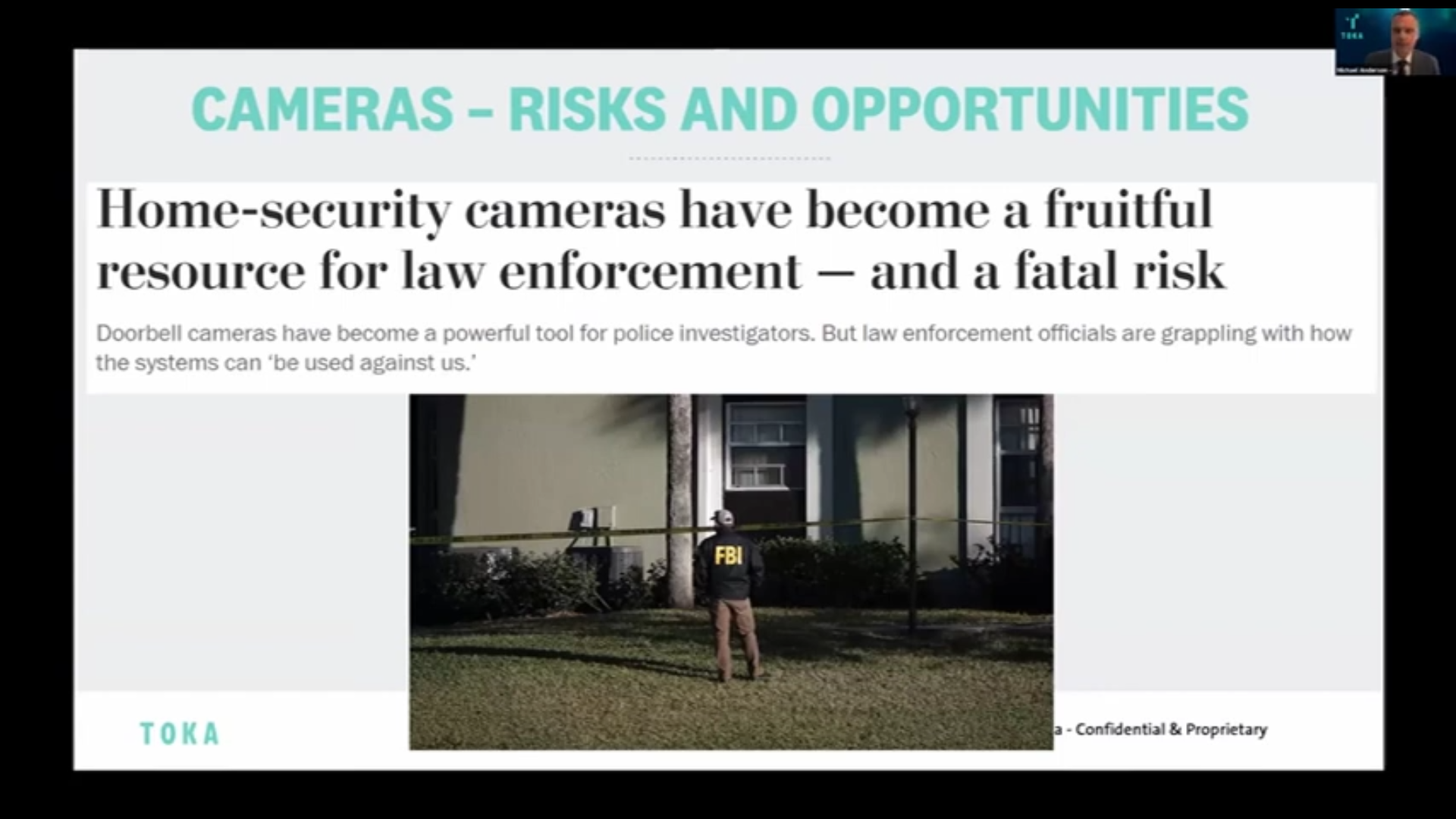
A slide from an April 20, 2021 presentation given by Toka’s VP of Global Sales, Michael Anderson
In addition to having served as prime minister of Israel, Toka co-founder Ehud Barak previously served as head of Israeli military intelligence directorate Aman, as well as several other prominent posts in the IDF, before eventually leading the Israeli military as minister of defense. While minister of defense, he led Operation Cast Lead against the blockaded Gaza Strip in 2009, which resulted in the deaths of over 1,000 Palestinians and saw Israel illegally use chemical weapons against civilians.
Toka is the first start-up created by Barak. However, Barak had previously chaired and invested in Carbyne911, a controversial Israeli emergency services start-up that has expanded around the world and has become particularly entrenched in the United States. Carbyne’s success has been despite the Jeffrey Epstein scandal, given that the intelligence-linked pedophile and sex trafficker had invested heavily in the company at Barak’s behest. Barak’s close relationship with Epstein, including overnight visits to Epstein’s now-notorious island and apartment complexes that housed trafficked women and underage girls, has been extensively documented.
Barak stepped away from Toka in April of last year, likely as the result of the controversy over his Epstein links, which also saw Barak withdraw from his chairmanship of Carbyne in the wake of Epstein’s death. Considerable evidence has pointed to Epstein having been an intelligence asset of Israeli military intelligence who accrued blackmail on powerful individuals for the benefit of Israel’s national security state and other intelligence agencies, as well as for personal gain.
Another notable Toka executive is Nir Peleg, the company’s Vice President for Strategic Projects. Peleg is the former head of the Research and Development Division at Israel’s National Cyber Directorate, where he led national cybersecurity projects as well as government initiatives and collaborations with international partners and Israeli cybersecurity innovative companies. Prior to this, Peleg claims to have served for more than 20 years in leading positions at the IDF’s “elite technology unit,” though he does specify exactly which unit this was. His LinkedIn profile lists him as having been head of the IDF’s entire Technology Department from 2008 to 2011.
While at Israel’s National Cyber Directorate, Peleg worked closely with Tal Goldstein, now the head of strategy for the World Economic Forum’s Partnership against Cybercrime (WEF-PAC), whose members include government agencies of the U.S., Israel and the U.K., along with some of the world’s most powerful companies in technology and finance. The goal of this effort is to establish a global entity that is capable of controlling the flow of information, data, and money on the internet. Notably, Toka CEO Yaron Rosen recently called for essentially this exact organization to be established when he stated that the international community needed to urgently create the “cyber” equivalent of the World Health Organization to combat the so-called “cyber pandemic.”
Claims that a “cyber pandemic” is imminent have been frequent from individuals tied to the WEF-PAC, including CEO of Checkpoint Software Gil Shwed. Checkpoint is a member of WEF-PAC and two of its former vice presidents, Michael Anderson and Alon Kantor, are now Vice President for Global Sales and co-CEO of Toka, respectively.
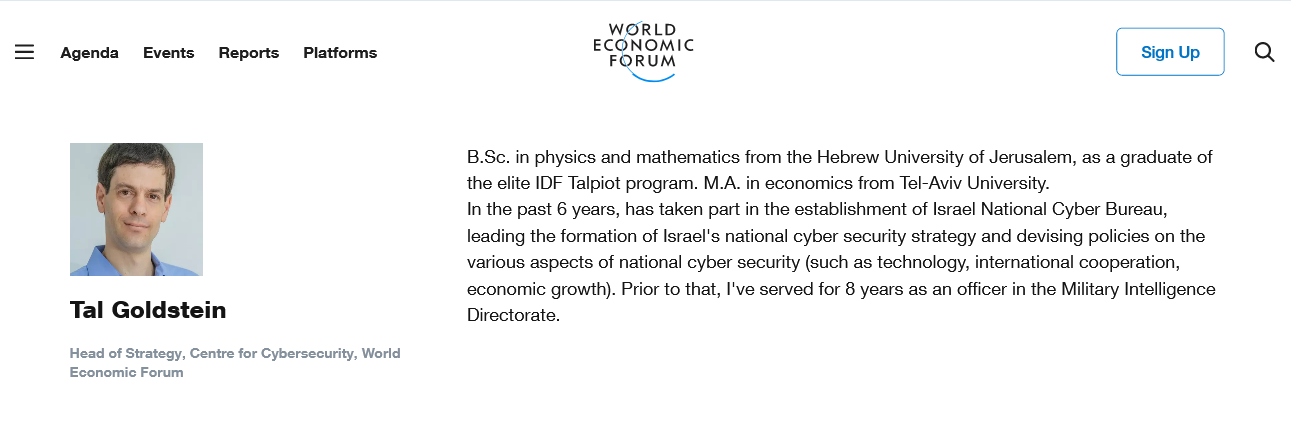
The Wolrd Economic Forum does little to hide its partnership with former Israeli intelligence officials
Toka’s Chief Technology Officer, and the chief architect of its hacking suite, is Moty Zaltsman, who is the only chief executive of the company not listed on the firm’s website. Per his LinkedIn, Zaltsman was the Chief Technology Officer for then-Israeli Prime Minister Benjamin Netanyahu. Last January, when Toka was covered by MintPress News, his profile stated that he had developed “offensive technologies” for Israel’s head of state, but Zaltsman has since removed this claim. The last Toka executive of note is Michael Volfman, the company’s Vice President of Research and Development. Volfman was previously a cyber research and development leader at an unspecified “leading technology unit” of the IDF.
Also worth mentioning are Toka’s main investors, particularly Entrèe Capital, which is managed by Aviad Eyal and Ran Achituv. Achituv, who manages Entrée’s investment in Toka and sits on Toka’s board of directors, was the founder of the IDF’s satellite-based signals intelligence unit and also a former senior vice president at both Amdocs and Comverse Infosys. Both Amdocs and Comverse courted scandal in the late 1990s and early 2000s for their role in a massive Israeli government-backed espionage operation that targeted U.S. federal agencies during that period.
Despite this scandal and others in the company’s past, Comverse subsidiary Verint was subsequently contracted by the U.S. National Security Agency (NSA) to bug the telecommunications network of Verizon shortly after their previous espionage scandal was covered by mainstream media. The contract was part of Operation Stellar Winds and was approved by then-NSA Director Keith Alexander, who has since been an outspoken advocate of closer Israeli-American government cooperation in cybersecurity.
In addition to Entrèe Capital, Andreessen Horowitz is another of Toka’s main investors. The venture capital firm co-founded by Silicon Valley titan Marc Andreessen is currently advised by former Secretary of the Treasury Larry Summers, a close friend of the infamous pedophile Jeffery Epstein. Early investors in Toka that are no longer listed on the firm’s website include Launch Capital, which is deeply tied to the Pritzker family — one of the wealthiest families in the U.S., with close ties to the Clintons and Obamas as well as the U.S.’ pro-Israel lobby — and Ray Rothrock, a venture capitalist who spent nearly three decades at VenRock, the Rockefeller family venture capital fund.
In light of the aforementioned policy of Israel’s government to use private tech companies as fronts, the combination of Toka’s direct Israeli government ties, the nature of its products and services, and the numerous, significant connections of its leaders and investors to both Israeli military intelligence and past Israeli espionage scandals strongly suggests that Toka is one such front.
If this is the case, there is reason to believe that, when Toka clients hack and gain access to a device, elements of the Israeli state could also gain access. This concern is born out of the fact that Israeli intelligence has engaged in this exact type of behavior before as part of the PROMIS software scandal, whereby Israeli “superspy” Robert Maxwell sold bugged software to the U.S. government, including highly sensitive locations involved in classified nuclear weapons research. When that software, known as PROMIS, was installed on U.S. government computers, Israeli intelligence gained access to those same systems and devices.
The U.S. government was not the only target of this operation, however, as the bugged PROMIS software was placed on the networks of several intelligence agencies around the world as well as powerful corporations and several large banks. Israeli intelligence gained access to all of their systems until the compromised nature of the software was made public. However, Israel’s government was not held accountable by the U.S. government or the international community for its far-reaching espionage program, a program directly facilitated by technology-focused front companies. The similarities between the products marketed and clients targeted by Maxwell during the PROMIS scandal and currently by Toka are considerable.
World Bank, IDB aid Toka in targeting Palestine’s allies
While the ties between Toka and Israel’s national security state are clear as day, what is also significant and unsettling about this company is how its entry into developing and developed countries alike is being facilitated by global financial institutions, specifically the World Bank and the Inter-American Development Bank. Notably, these are the only deals with governments that Toka advertises on its website, as the others are not made public.
Several projects funded by one or another of these two institutions have seen Toka become the “cyber designer” of national cybersecurity strategies for Nigeria and Chile since last year. Significantly, both countries’ populations show strong support for Palestine and the BDS movement. In addition, Toka garnered a World Bank-funded contract with the government of Moldova, an ally of Israel, last September.
The World Bank selected Toka in February of last year to “enhance Nigeria’s cyber development,” which includes developing “national frameworks, technical capabilities and enhancement of skills.” Through the World Bank contract, Toka has now become so intimately involved with both the public and private sectors of Nigeria that it relates to the country’s “cyber ecosystem.” The World Bank’s decision to choose Toka is likely the result of a partnership forged in 2019 by the state of Israel with the global financial institution “to boost cybersecurity in the developing world,” with a focus on Africa and Asia.
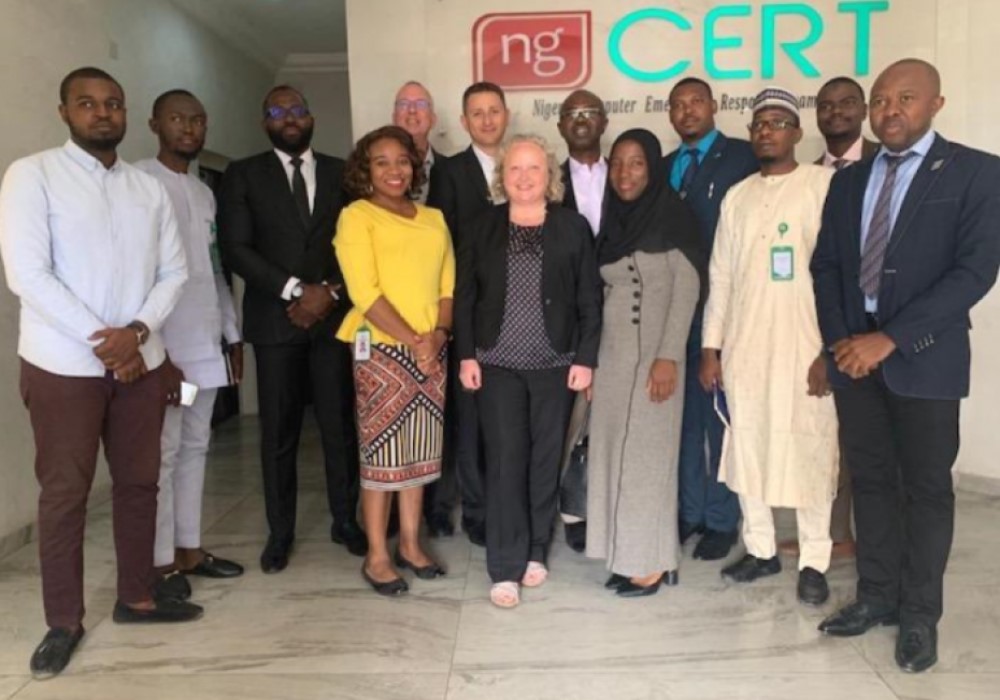
Toka executives pose with Nigerian officials in 2020. Photo | Israel Defense
“Designing and building sustainable and robust national cyber strategy and cyber resilience is a critical enabler to fulfilling the objectives of Nigeria’s national cybersecurity policy and strategic framework,” Toka CEO Yaron Rosen said in a press release regarding the contract.
Given Toka’s aforementioned use of its technology for only “trusted” governments, it is notable that Nigeria has been a strong ally of Palestine for most of the past decade, save for one abstention at a crucial UN vote in 2014. In addition to the government, numerous student groups, human rights organizations, and Islamic organizations in the country are outspoken in their support for Palestine. With Toka’s efforts to offer its products only to countries who align themselves with “friendly” countries, their now intimate involvement with Nigeria’s cyber development could soon have consequences for a government that has tended to support the Palestinian cause. This is even more likely given Toka CEO Rosen’s statements at an April 2021 event hosted by Israel’s Ministry of Economy, where he emphasized the role of cyber in developing countries specifically in terms of their national defense and economic strategy.
Three months after the deal was struck with Nigeria through the World Bank, the Inter-American Development Bank (IDB) selected Toka to advise the government of Chile on “next steps for the country’s national cybersecurity readiness and operational capacity building.” As part of the project, “Toka will assess the current cybersecurity gaps and challenges in Chile and support the IDB project implementation by recommending specific cybersecurity readiness improvements,” per a press release. Toka claims it will help “establish Chile as a cybersecurity leader in South America.” Regarding the deal, Toka’s Rosen stated that he was “thankful” that the IDB had “provided us with this opportunity to work with the Government of Chile.”
Israel signed consequential agreements for cooperation with the IDB in 2015, before further deepening those ties in 2019 by partnering with the IDB to invest $250 million from Israeli institutions in Latin America specifically.
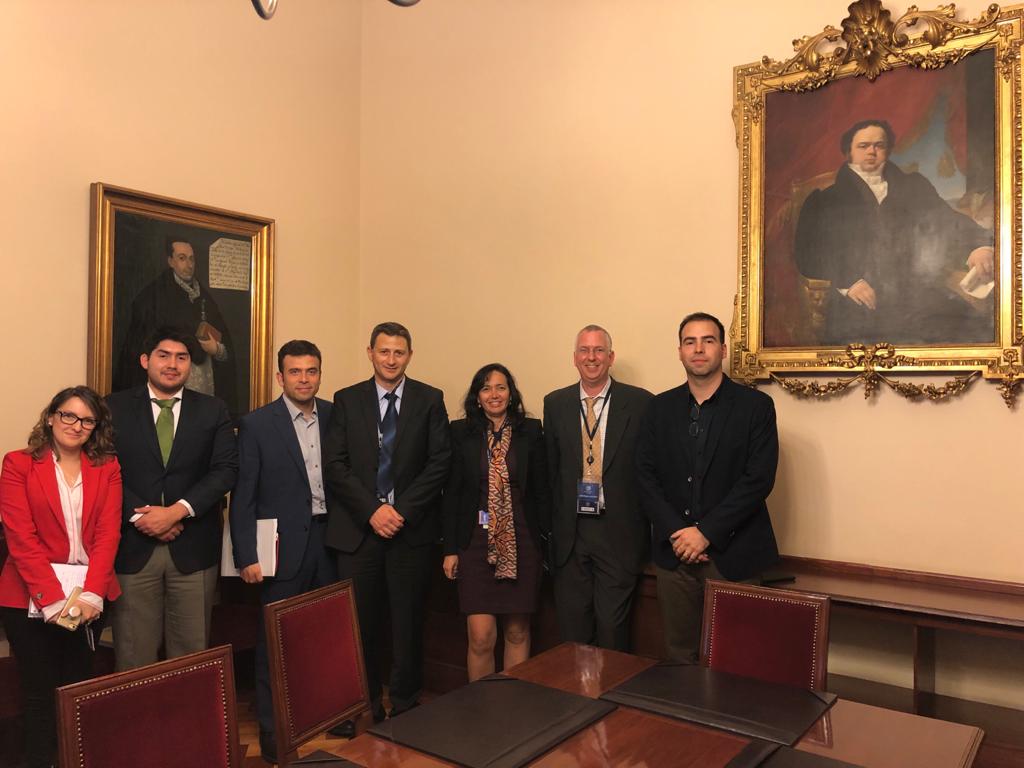
Toka executives are pictured with Chilean officials during a 2020 meeting in Santiago
Like Nigeria, Chile has a strong connection with Palestine and is often a target of Israeli government influence efforts. Though the current far-right government of Sebastián Piñera has grown close to Israel, Chile is home to the largest Palestinian exile community in the world outside of the Middle East. As a result, Chile has one of the strongest BDS movements in the Americas, with cities declaring a non-violent boycott of Israel until the Piñera administration stepped in to claim that such boycotts can only be implemented at the federal level. Palestinian Chileans have strong influence on Chilean politics, with a recent, popular presidential candidate, Daniel Jadue, being the son of Palestinian immigrants to Chile. Earlier this year, in June, Chile’s congress drafted a bill to boycott goods, services and products from illegal Israeli settlements.
While Toka frames both of these projects as aimed at helping the cyber readiness and economies of the countries it now services, Israeli media has painted a different picture. For instance, Haaretz wrote that Israel’s partnerships with development banks, specifically those made in 2019 that resulted in these Toka contracts, were planned by an inter-ministerial committee set up by then-Prime Minister Benjamin Netanyahu “to realize the potential of international development to strengthen the Israeli economy, improve Israel’s political standing and strengthen its international role.” One source, quoted by Haaretz as being close to this undertaking, stated that “development banks are a way to help advance Israel’s interests and agenda in the developing world, including Latin America. But it’s not philanthropy.”
Given these statements, and Toka’s own modus operandi as a company and its background, it seems highly likely that the reason both Nigeria and Chile were chosen as the first of Toka’s development banks contracts was aimed at advancing the Israeli government’s agenda in those specific countries, one that seeks to counter and mitigate the vocal support for Palestine among those countries’ inhabitants.
The spyware problem goes far beyond NSO Group
The NSO Group and its Pegasus software is clearly a major scandal that deserves scrutiny. However, the treatment of the incident by the media has largely absolved the Israeli government of any role in that affair, despite the fact that the NSO Group’s sales of Pegasus to foreign governments has been approved and defended by Israel’s government. This, of course, means that Israel’s government has obvious responsibility in the whole scandal as well.
In addition, the myopic focus on the NSO Group when it comes to mainstream media reporting on Israeli private spyware and the threats it poses means that other companies, like Toka, go uninvestigated, even if their products present an even greater potential for abuse and illegal surveillance than those currently marketed and sold by the NSO Group.
Given the longstanding history of Israeli intelligence’s use of technology firms for international surveillance and espionage, as well as its admitted policy of using tech companies as fronts to combat BDS and ensure Israel’s “cyber dominance,” the investigation into Israeli spyware cannot stop just with NSO Group. However, not stopping there risks directly challenging the Israeli state, particularly in Toka’s case, and this is something that mainstream media outlets tend to avoid. This is due to a mix of factors, but the fact that NSO’s Pegasus has been used to spy on journalists so extensively certainly doesn’t help the matter.
Yet, Israel’s weaponization of its tech industry, and the global use of its spyware offerings by governments and security agencies around the world, must be addressed, especially because it has been explicitly weaponized to prevent non-violent boycotts of Israel’s occupation of Palestine, including those solely based on humanitarian grounds or out of respect for international laws that Israel routinely breaks. Allowing a government to engage in this activity on a global scale to stifle criticism of flagrantly illegal policies and war crimes cannot continue and this should be the case for any government, not just Israel.
If the outlets eagerly reporting on the latest Pegasus revelations are truly concerned with the abuse of spyware by governments and intelligence agencies around the world, they should also give attention to Toka, as it is actively arming these same institutions with weapons far worse than any NSO Group product.
Whitney Webb has been a professional writer, researcher and journalist since 2016. She has written for several websites and, from 2017 to 2020, was a staff writer and senior investigative reporter for MintPress News. She currently writes for her own outlet Unlimited Hangout and contributes to The Last American Vagabond and MintPress News.
Jews enlist US govt to intervene in Chile as Palestinian-descendant rises to presidential election frontrunner
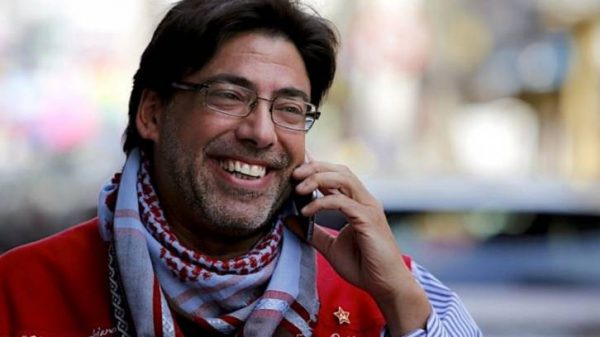
By Eric Striker | National Justice | July 15, 2021
Jews in America are demanding the United States intervene in Chile’s internal politics in the run up to their presidential election next November.
Daniel Jadue, a descendant of Palestinian refugees and member of the Chilean Communist Party, is currently the frontrunner in polls. Jadue is an unapologetic anti-Zionist who has in the past directly confronted the Jewish power structure of his country.
Gerardo Gorodischer, president of Chilean Jewish lobby, has successfully recruited Democrats and Republicans in the US Congress to call on Secretary of State Antony Blinken — a Jew himself — to meddle in Chile’s internal affairs and prevent Jadue from becoming president.
Jadue has in the past called attention to Jewish control of the media in his country. Last year, he was listed as one of the top 10 anti-Semites in the world by the Simon Wiesenthal Center after he passed a strict Boycott, Divestment and Sanctions (BDS) law as mayor of the city of Recoleta. He is currently supporting a law in the parliament that would make Chile the first nation in the world to officially institute a total boycott of Israel.
With 400,000 descendants, Chile is home to the world’s largest Palestinian diaspora outside of the Middle East. Chilean-Palestinians are overwhelmingly Christians who were forced to flee their homeland after being ethnically cleansed by Israel. Chile’s Jewish population is much smaller, currently estimated at 150,000 people. Jews in the country have started immigrating to Israel in larger than usual numbers out of fear of Jadue potentially becoming the nation’s next leader.
So far, Jewish attempts at “Corbyning” Jadue have failed. Complaints from Zionist organizations in Latin America and the US to stop Jadue have largely been ignored by the local population. Their trump card appears to be using the United States to intimidate the Chilean government with threats of economic retaliation or more.
In her letter to Blinken, Democratic congresswoman Debbie Wasserman-Schultz made a collective racial attack on the entire Chilean Palestinian community for protesting against Israel’s attacks on Arabs last May:
“Militant leaders of the 400,000-strong Chilean Palestinian community, and their partners, from a variety of political parties, were quite aggressive during and after the Gaza crisis, burning Israeli and U.S. flags, brandishing Nazi symbols and accusing Israel of apartheid and Chilean Jews of controlling the media. This dangerous climate has been intensifying for many years and has already affected Chile’s social fabric despite alarms sounded by the local Jewish community and U.S. Jewish organizations like the American Jewish Committee.”
The billionaire neo-conservative president of Chile, Sebastián Piñera, also received the letter. His allies in the parliament have started grilling Jadue over his 1983 high school yearbook entry, where he declared himself an “anti-Semite” and vowed revenge against Jews for what they did to his family. Jadue, a 54-years-old man, responded by making fun of Chilean conservatives asking him to “clarify” comments he made as a teenager as the country suffers through an economic crisis.
Jews have been encountering resistance from all across the political spectrum and diverse countries in recent months. Earlier this month, Belarusian leader Alexander Lukashenko gave a speech suggesting that Jews use the “Holocaust” to intimidate and control people. Yesterday in Poland, local nationalists crashed a Jewish ceremony racially defaming Poles as genocidal killers.
Cuba and Color Revolution: A Cautionary Tale of the Next Phase of Forever-War
By Joaquin Flores | Strategic Culture Foundation | July 14, 2021
If one believes that the protests in Cuba can be explained within the rubric of 20th century economic systems, and then believes they can go on to extract some great truths about socialism vs. capitalism, then they are misinformed. No, this is about technocracy, color revolution, and forever-war.
The events in Cuba were caused by the staged economic collapse directed by the IMF under the advisement of the World Economic Forum, under the pretext of supply-line stoppages and economic closures to combat Covid-19. The socio-economic strife that such an imposed crisis is known to provoke, is then weaponised to destabilize ‘regimes’ so as to further the hegemonic agenda of the (admittedly divided) oligarchy ruling the global west. We saw this before in 2008 with the crash and crisis, and how this was weaponised to create a destabilization process known as the Arab Spring.
The planners involved are long-term planners, having transcended the quarter-driven constraints of the old market system. The new technocracy emerging is simply able to use Friedmanesque manipulations to keep the system afloat until the law of value is entirely transcended through automation. That was the crypto-Marxian understanding of economics promoted by Maynard Keynes.
Just as Cuba positioned itself away from socialism and towards further integration into global markets, the IMF moved openly to wind down the global market system and move towards a new type of totalitarian order which some critics have likened to communism.
Cubans are protesting against the mask-mandates and the lockdowns which have harmed people’s way of life. They are protesting the way that the government has effectively privileged those with dollar accounts who can buy from state-sanctioned dollar stores. Hence, those without families abroad sending dollars are negatively affected the most. This strikes against the whole narrative of Cuba and its gusano diaspora. Cuba produces its own vaccine, one that is not an experimental mRNA vaccine. The US would like very much to force a concession onto Cuba that it accept the mRNA vaccine. Perhaps the Cuban population of 11 million is just too high.
The fake news talking points that Cubans are protesting a lack of vaccines is a lie. We knew that trans-Atlantic talking points were a part of the Color scheme last year in Belarus when we were told that protestors rose up to oppose Lukashenko’s lackadaisical approach to the plandemic. Lukashenko in turn revealed that he refused an IMF offer of $980 million to play the lockdown deathmatch.
This is a Color Revolution
Anyone like Tom Fowdy for RT who writes that it is premature to say that the clear signs of a Color Revolution aren’t there, probably only says so because they don’t really know what those signs are.
They probably approach that question in terms of on-location forensics: identifying that a particular protest leader is actually an employee of the state department or Soros NGO in some fashion.
Yet for those who understand what the signs are, the signs of a Color Revolution are certainly there. But to understand this requires a long and broad view of the interplay between staged economic crises and the predictable turmoil they create in certain countries.
Because turmoil and protests are all but predictable even to OXFAM, once the FAO food index price surpasses about 210 (by 2012 ratios). Then, it becomes a question of which countries global lending institutions deem worthy of borrowing to subsidize against the newly inflated food price, or which countries the food production companies view in a lenient fashion.
As OXFAM wrote in 2012: “While concerns about high food prices are foremost about the spread of hunger and poverty, high food prices are also strongly correlated with political instability and have historically been a catalyst for mass protest in countries where legitimacy is already faltering. Research performed by the New England Institute for Science and Society has identified “a global food price threshold for unrest;”
Since 2007, food riots have broken out in more than 60 countries and have occurred with heightened frequency during periods of record-breaking food prices such as in 2008, when food riots erupted from Europe to the South Pacific. The FAO food price index crossed the 210 threshold, for the first time, in February 2008.”
Do we need to mention again that global economic crises are staged? Surely, there are structural problems broadly speaking, in the entire Neo-Keynesean system built in some large part from the ideas of Milton Friedman. So it should be clarified that while the timing of these economic crises are planned, they are also bound to happen. But when precisely they happen, and the point of them, would probably shock and confuse, then demoralize anyone who had a naïve understanding of global politics. You see, the point of planned economic crises is the upwards redistribution of wealth. Every firm except a handful of ‘zaibatsu’ style state-picked winners must absorb their own losses. This is corporatism 101.

Milton Friedman (July 31, 1912 – November 16, 2006) American economist and statistician who received the 1976 Nobel Memorial Prize in Economic Sciences
Each market crisis is structurally predetermined as these bubbles which define them, grow to a certain point. But it is a decision that is made to ‘pop the bubble’ at a particularly more fortuitous time as opposed to some other time – granted that it would need to be popped sooner or later. So these are both features of the structure, but also planned.
Understanding Color Revolutions requires an understanding of this phenomenon. In 2008, the massive bail-outs to banks using currency debasement, led to a geopolitical strategy on the part of the US deep state to buy up and corner the markets on perishable goods, especially those markets and firms which directed their energies towards Turkey, the Arab world, and Iran. This led to strife across the Maghreb region, Egypt, Syria, an increase of problems in occupied Iraq, and a boon to the Green movement in Iran.
The Crisis in Cuba
Further destabilization in Cuba will be a huge part in a coming global destabilization, and so it must be opposed. This is the case, even contemplating the reasonable grievances of the actual protesters, which in turn are not the same as the Sorosian demands placed in the mouths of anonymous protestors by the globalist media.
An inflation crisis has hit Cuba because of the staged political response to Covid, meant precisely to cause inflationary crises globally. The tourism industry has taken the biggest hit. Food and similar perishables are unaffordable for many without access to dollar accounts. There are state-picked favourites in the private sector (as is the case everywhere) as well as Communist Party bureaucrats who seem unaffected by the very same conditions that the protesters accuse them of bringing about. This much seems reasonable: in looking at who to blame for a problem, look to those who are making out.
The themes affecting Cuba are isolation and sovereignty, versus integration and dependence. Ever since the collapse of the USSR, which Cuba relied on for massive subsidies, Cuba has had both up and down periods as it struggles to balance between these two questions. Cuba is an island nation with just 11 million people, and so there can be no real sovereignty without the heavy price of isolation, nor can there be any integration into the globalist system without becoming a dependent state.
It’s a very tough predicament, because the Ideological State Apparatus of Cuba is its own variant of Marxism-Leninism, and this means that no matter how actually integrated and dependent Cuba is or is becoming, it must use the pages of Granma to pencil polemics declaring that Cuba is more sovereign and stable than ever before. Conversely, each undeniable period of crisis must be blamed on the very same socio-economic systems of global governance which Cuba relies upon in part for its own legitimacy.
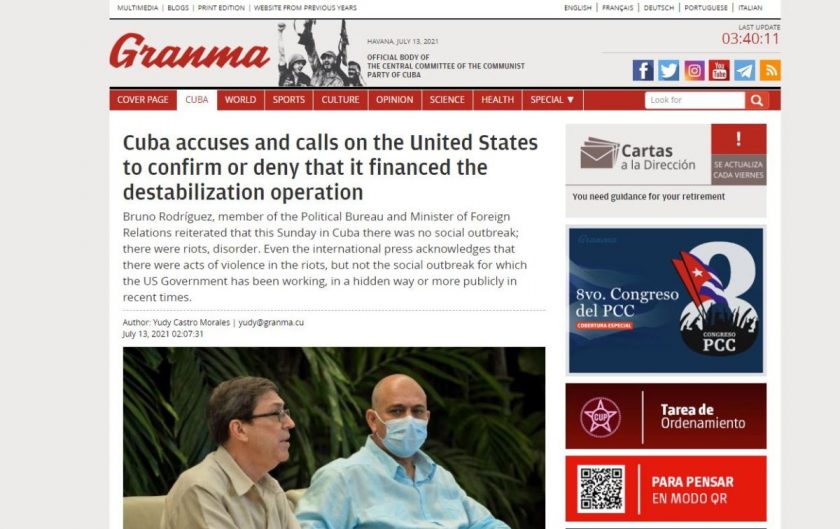
The July 13th Edition of Granma, Official Organ of the CC of the CP of Cuba
The problem then is when people really believe this state propaganda, or when people are forced to openly proclaim a public truth they know personally to be a lie. Because instead of the public understanding that Cuba has lost much of its sovereignty in its process of dollarizing so much of its economy, (and that the machinations of foreign actors, the IMF, the planned and staged collapse of the global speculative economy that Cuba is integrated in, is a large part of Cuba’s present woes) blame is laid by the public directly at the feet of a nominally sovereign state’s ruling government.
Quite the predicament. Because the government cannot really tell the truth, it must take the blame. Or do as it has done (and done so with no shame for provoking incredulity), and claim that the entire protest is a foreign provocation.
The Cuban government and its sinecure functionaries must always declare that any grassroots grievances expressed en masse are always at its core the work of foreign ‘imperialist’ intelligence operations bent on a destabilization strategy.
Yet such accusations of foreign plots are more likely to be true than not.
Another problem, and this is something where the Cuban government needs to make a fix, is the issue of dollar accounts.
Those with dollar accounts are tremendously less affected by the perishable goods inflation crisis in Cuba. But those deposits are only possible by having loved ones who have left Cuba for the US. So those who have ‘betrayed’ the revolution are the ones able to help those in Cuba. Those in Cuba living better off are not those who have been loyal to the socialism project of Cuba excepting a small layer of bureaucrats and professional snitches, but instead are the relatives of those gusanos in Florida and the rest of the US who have moved on to greener pastures.
What sort of message does that send? This greatly weakens the legitimacy of the government, because those common-folk who defend the Cuban system are left feeling like fools. When this layer joins a protest movement, the government’s days are numbered.
Cuba – Between a Rock and a Hard-Spot
Color Revolution schemes cannot work unless there are real-existing grievances shared among large segments of the population.
And yet going further, those real-existing grievances today, (while they compound longer standing ones which the Cuban government must account for), are directly caused by the IMF’s decision to bring global capitalism to a grinding halt for some period of time.
It is very difficult for a nominally sovereign government to tell a Thatcherite story of ‘TINA’ – there is no alternative. Cuba lacks alternatives except going either the path of the Khmer Rouge, or the path of laissez-faire. It has chosen some middle-path.
This really touches on a very big problem Cuba faces: its civilizational decision to place its legitimacy at the hands of international organizations related to global governance. Cuba strives to show its own citizens, and perhaps secondarily the US, that the rest of the world and especially the UN’s alphabet soup of agencies and organizations, recognize any number of successes that Cuba promotes having accomplished. To wit, at least within the rubric of those accounting systems, Cuba makes a decent case.
So a problem arises when this very same system of global governance, under the pretext of fighting Covid-19, instructs various countries to commit ritual seppuku at the altar of world health in order to preserve this status and these relationships to global trade and global governance.
And how? The western hemisphere is controlled almost entirely by the IMF and global banking systems. Cuba exists in some netherworld of ‘helpful harm’, if not through the US due to sanctions, then through the same banks in their Trans-Atlantic incarnations by way of Europe.
Since we understand that the WHO is effectively controlled by allies of the World Economic Forum like Bill Gates, which in turn is the think-tank of the IMF; and since the IMF includes in its bylaws and requirements that countries in a time of a declared global pandemic by the WHO must take the proscribed measures to combat this, then we understand what we have seen as a global phenomenon.
It’s been only a handful of leaders, several in Africa, in Haiti, and Belarus, that have openly bucked these provisions. And of these, all have been since eliminated except for Lukashenko in Belarus who no doubt enjoys some security provisions from the Russian Federation.
The Observatory of Economic Complexity (OEC) explains that in 2019, “The top exports of Cuba are Rolled Tobacco ($287M), Raw Sugar ($211M), Nickel Mattes ($134M), Hard Liquor ($97.3M), and Zinc Ore ($78.4M), exporting mostly to China ($461M), Spain ($127M), Netherlands ($65.5M), Germany ($64.7M), and Cyprus ($48.9M).
The top imports of Cuba are Poultry Meat ($286M), Wheat ($181M), Soybean Meal ($167M), Corn ($146M), and Concentrated Milk ($136M), importing mostly from Spain ($1.01B), China ($790M), Italy ($327M), Canada ($285M), and Russia ($285M).”
Hence Cuba was placed in a pincer move. It lost massively from the global plandemic and the restriction of supply lines, the tightened access to imports, the loss of tourism. The compliance of other countries to the IMF’s mandated economic implosion reduced demand for Cuba’s exports and damaged tourism as well.
But in order to maintain its own relationship with the IMF and also following the global narrative of the Socialist International (2nd International), (an EU driven social-democratic association of governments and political parties), it went along with the ‘solidarity’ driven component of woke politics seen in the ‘do-your-part’ masking and lockdowns.
But those harmed by the lockdowns were ordinary Cubans, not government officials or those with dollar accounts. And so the reaction we see today is a predictable one.
Conclusion
There can be no doubt: Cuba’s present crisis is not the direct result of its own economic mismanagement, but rather the staged demolition of finance, global trade, and supply lines using the Covid pandemic as a pretext. However, a number of social and political decisions by Cuban leaders have no doubt compounded the impact of the crisis and emboldened protesters.
What citizens in first world countries have seen as a ‘stock market rebound’ predicated by ‘too-big-too-fail’ type bailouts (socialism for the rich), are only possible so long as those moneys are held on the books but not really spent – hence the lockdowns. At least not spent in such a way as would this liquidity naturally circulate in the economy. For such velocity of moneys based on such extreme debasement of the currency, would lead to the largest inflationary crisis in the history of man on earth.
In raw-materials producing countries like Cuba, that has meant a tripled hardship. The aim of the centers of finance capital has been to do something like the Arab Spring, only more so.
At the same time, the Cuban government’s defensive and accusatory posture is poor optics and bad politics. It needs to better engage the protestors and validate some part of their grievances. Pointing the finger at Uncle Sam is tone deaf and only serves to satisfy a single demographic in Cuba.
Today, we are seeing only the start of a fresh wave of global destabilization efforts, never-ending wars. But now governments have prepared the civilian populations for these wars under the pretext of never-ending lockdowns due to a mystery illness. The right to protest, strikes, and the basic social contact needed to organize these can be revoked by instantaneous mandate as some new variant of Covid will always invariably be discovered. This is the biggest threat humanity faces since the Second World War, but in addition to destabilization campaigns, is the backdrop of a class-war gambit of the oligarchy against everyday people. Cuba needs to be understood in this light, and while it needs a better approach to managing the Covid narrative and hearing its people, foreign meddling in its affairs needs to be opposed.
US Targets Nicaraguan Presidential Election
By Roger D. Harris | Dissident Voice | July 14, 2021
Before Henry Kissinger became a Clinton pal, liberals condemned him for saying: “I don’t see why we need to stand by and watch a country go communist due to the irresponsibility of its people. The issues are much too important for the Chilean voters to be left to decide for themselves.” The 1973 US-backed coup and bloodbath in Chile followed. Now Uncle Sam has a problem in Nicaragua, where independent polls predict a landslide victory for Daniel Ortega’s leftist Sandinista slate in the November 7th presidential elections.
The US government and its sycophantic media are working to prevent Ortega’s reelection. On July 12, the US slapped visa restrictions on one hundred Nicaraguan elected legislative officials, members of the judiciary, and their families for “undermining democracy.” A month earlier, the Biden administration imposed sanctions on President Ortega’s daughter, along with a military general, the head of the central bank, and an elected legislator.
These and other recent illegal US sanctions on Nicaragua are designed to promote regime change and are based on the ridiculous charge that this poor and tiny nation is a “extraordinary and unusual threat to the US national security,” when the opposite is the case.
The NICA Act of 2018, under the Trump administration, imposed sanctions, including blocking loans from international financial institutions controlled by the US. In August 2020, the Responsive Assistance in Nicaragua (RAIN) plan was revealed, which is a multi-faceted coup strategy by which the US contracted corporations to overthrow the Nicaraguan government. RAIN calls for a “sudden, unanticipated transition” government to forestall what they admit would otherwise be a Sandinista victory in a free election. In a seamless handoff from the Trump to the Biden administration, the pending RENACER Act would further extended “targeted sanctions.”
US intervention in Nicaragua and, indeed, in all of Latin America under the 1823 Monroe Doctrine has a long history continuing to the present. Back in 1856, US citizen William Walker tried to impose himself as head of a slave state in Nicaragua, only to be assassinated four years later. In 1912, the US began an occupation of Nicaragua, forcing the country to become a US protectorate. The US was ousted in 1933 in a war led by national hero Augusto C. Sandino, after whom the present revolutionary party was named. In the 1980s, the US government proxies, the Contras, fought the new Sandinistas after they overthrew the US-backed Somoza dictatorship.
Problematic premises
In the past, most US progressives opposed the imperialism of their government. But more recently, as Jeremy Kuzmarov of CovertAction Magazine observed: “United States warmakers have become so skilled at propaganda that not only can they wage a war of aggression without arousing protest; they can also compel liberals to denounce peace activists using language reminiscent of the McCarthy era.”
A recent Open Letter to the Nicaraguan Government from U.S. Solidarity Workers 1979-1990 reflects the US imperial talking points. This US open letter, dated July 1, is joined by one from Europeans, formerly active in solidarity with Nicaragua, and one from international academics, mainly in the field of Latin American studies. (Links to all three letters may be dodgy.) All three letters, likely coordinated, use similar language to make matching critiques and demands.
While other international activists from the 1980s still prioritize non-intervention and solidarity with the Sandinista government, the concerns expressed in the open letter should be respectfully evaluated. The open letter is based on the following problematic premises:
- The open letter claims the Ortega “regime” is guilty of “crimes against humanity.”
In fact, Nicaragua is by far the most progressive country in Central America under the Sandinista government.
Unlike the Guatemalans, Hondurans, and El Salvadorians in these US client states, Nicaraguans are not fleeing to the US in search of a better life. Poverty and extreme poverty have been halved in Nicaragua, and the UN Millennium Development Goal of cutting malnutrition has been achieved. Basic healthcare and education are free, and illiteracy has been virtually eliminated, while boasting of the highest level of gender equality in the Americas. Nicaragua, which enjoys the lowest homicide rate in Central America, also has the smallest police force with the smallest budget in the region. These are not the hallmarks of a dictatorship.
- The open letter claims the 2018 coup attempt was simply a “demonstration of self-determination.” While the open letter correctly notes that the events of 2018 reflected an element of popular discontent, it renders invisible the millions of dollars and many years of US sponsored subversion in Nicaragua.
Social media campaigns of false information orchestrated by US-sponsored groups fueled viciously violent protests. According to solidarity activist Jorge Capelán: “those who kidnapped, tortured, robbed, murdered and raped citizens here in Nicaragua in April 2018 were the coup promoters. They themselves recorded everything with their cell phones. They even set fire to murdered Sandinista comrades in the street.”
Benjamin Waddell, a signatory to the open letter, admitted “it’s becoming more and more clear that the US support has helped play a role in nurturing the current [2018] uprisings.” Dan La Botz, another Ortega-must-go partisan, provided the background: “US organizations such as USAID and the National Endowment for Democracy (NED), and no doubt the CIA had for decades, of course, worked in Nicaragua as they do everywhere in the world.”
No substantive progressive alternative was offered by the opposition in 2018, according to William Robinson, another signatory to the open letter. Rather, 2018 was an attempt to achieve by violent means what could not be achieved democratically at the ballot box.
- The open letter claims the Nicaraguan government “in no way represents the values, principles and goals of the Sandinista revolution.” This stance arrogates to foreigners the role of telling the Nicaraguan people how to evaluate their revolution. The electoral process in Nicaragua makes clear that the Nicaraguans think otherwise.
After successfully overthrowing the US-backed dictator Somoza and fighting the counter-revolutionary war against the US-backed Contras, the Sandinista’s lost the 1990 election. Notably, outgoing President Ortega without hesitation obeyed the electoral mandate, the first time in Nicaragua’s history that governing power was passed peacefully to another political party. After 17 years of neoliberal austerity, Daniel Ortega won the presidential election of 2006 with a 38% plurality and went on to win in 2011 with 63% and 72.5% in 2016. Ortega’s ever increasing electoral margins suggest the majority of Nicaraguans support him as the legitimate leader of the Sandinista revolution.
Problematic proposals
Using the same loaded language as the US government, the open letter calls on the “Ortega-Murillo regime” to release political prisoners currently being held, including “pre-candidates,” members of the opposition, and “historic leaders” of the Sandinista revolution; rescind the national security law under which these individuals were arrested; and negotiate electoral reforms.
Nicaragua has passed two recent laws: the Foreign Agents Law and the Law to Defend the Rights of the People to Independence, Sovereignty, and Self-Determination for Peace. These laws, which the open letter wants rescinded, criminalize promoting foreign interference in Nicaragua’s internal affairs, seeking foreign military intervention, organizing acts of terrorism, and promoting coercive economic measures against their country. These are activities, it should be noted, that are similarly prohibited in the US’s FARA Act, after which the Nicaraguan laws were modeled.
The recent actions of the Nicaraguan government prosecuting people who break their laws is a normal function of governance. That some of the accused perpetrators may have political aspirations does not immunize those individuals from arrest for unlawful activities.
The letter from the aforementioned academics claims that among those detained are the “most prominent potential opposition presidential candidates.” In fact, none of the 17 political parties in Nicaragua have chosen their candidates, and “most of those currently under investigation do not belong to any legally registered party.” In fact, Stephen Sefton reports from Nicaragua that “no leading figure from Nicaragua’s opposition political parties has been affected by the recent series of arrests of people from organizations that supported the 2018 coup attempt.”
One of the most prominent of those arrested is NGO director Cristiana Chamorro, charged with money laundering for receiving millions of dollars from the USAID, other US government agencies, and allied foundations for regime-change purposes. In her defense, she incredulously claimed that the US State Department had audited her and found everything to their liking.
The “historic leaders” of the Sandinista revolution are just that; people who had broken with the revolution long ago and since 1994 had collaborated with the US-allied rightwing opposition and NGOs. More to the point, they are being charged with illegal collusion with foreign powers.
The open letter calls for “negotiating electoral reforms,” but electoral law in Nicaragua as in the US is determined by the legislative process and not by negotiations among various power blocks. Nicaragua has implemented some but not all reforms mandated by the Organization of American States. The fourth branch of government, the Supreme Electoral Council (CSE), oversees elections. A third of the current CSE is composed of representatives of parties other than the ruling party, even though the Sandinistas hold a super-majority in the legislature.
The right of the Nicaraguan revolution to defend itself
While acknowledging “the long and shameful history of US government intervention,” the open letter does not acknowledge the right of the Nicaraguan revolution to defend itself. On the contrary, their implied endorsement of the 2018 coup attempt is a call for regime change by non-democratic means and an implicit pass for US interference.
The open letter’s finding that “the crimes of the US government – past and present – are not the cause of, nor do they justify or excuse” the behavior of the current government in Nicaragua is a door that swings two ways. Whatever the alleged wrongdoings the Ortega government, that still does not justify the US government’s regime-change campaign. The open letter is thunderously silent on current US intervention, notably the punishing NICA and RENACER acts.
The Nicaraguan government has prioritized the needs of poor and working people and has made astounding progress on multiple fronts. That is why they are being targeted for regime change, and why the Nicaraguans have taken measures to thwart US intervention.
The Trump administration specifically targeted the so-called “Troika of Tyranny” – Cuba, Venezuela, and Nicaragua – with repressive illegal sanctions aimed at regime change. That policy of US domination did not start with Trump, nor is it ending with the new US administration.
The imperialists are clear on who they target as their enemy; some elements on the left are less clear on who is their friend and whether Nicaragua has a right to defend itself. If the signers of the open letter believe, as they claim, “in the Nicaraguan people’s right to self-determination…of a sovereign people determining their own destiny,” then the November 2021 election should be protected, free from interference by the US, its international allies, and its funded NGOs.
Roger D. Harris is with the human rights organization Task Force on the Americas founded in 1985.
Mexican President Says Protests in Cuba Manipulated From Outside
Sputnik – July 12, 2021
Mexican President Andres Manuel Lopez Obrador said on Monday that US-funded organizations were behind the recent protests in Cuba.
On Sunday, Cuba witnessed its largest protests since 1994, fueled by anger over shortages of basic goods. Thousands of people demanded free elections and the resolution of social issues. According to local media, protests and gatherings took place in eight Cuban cities, including Havana. In response, government and Communist Party supporters held their own marches following President Miguel Diaz-Canel’s calls to take to the streets and repel provocations.
“I see that there is meddling. For example, yesterday I saw a social media post from a group called Article 19, which is an association of journalists in Mexico funded by the US government, the US embassy … They condemned President Diaz-Canel’s call for confrontation …,” Lopez Obrador told reporters.
The Mexican president expressed solidarity with the people of Cuba and said the only way out of this crisis was through dialogue, without the use of force, confrontation and violence.
“Mexico has always been in solidarity with Cuba and with all the peoples of the world, if the Cuban government deems it necessary and its people demand it, the Mexican government could help with medicines, vaccines, supplies and food, without the interventionist political manipulation … because health and food are fundamental human rights,” Lopez Obrador added.
The president further noted that the US economic embargo of Cuba should be brought to an end.
“If you want to help Cuba, the first thing that would have to be done is to lift the blockade of Cuba, as required by most of the countries of the world. It would be a true humanitarian gesture, no country in the world can be fenced off, blocked. This is worse than the violation of human rights,” Lopez Obrador stressed.
Bolivian President Luis Arce echoed his Mexican counterpart’s sentiment, saying that Cuba’s domestic affairs must be handled internally.
US restrictions on trade with Cuba date back to the island nation’s communist revolution in the late 1950s and involve at least half a dozen different US laws. Former President Barack Obama took steps to normalize bilateral relations, but many of those steps were reversed by the Trump administration.
Current President Joe Biden has promised that he would return Obama’s policy on Cuba but has yet to reverse his predecessor’s steps.
On June 23, the United States voted against a UN General Assembly resolution condemning the embargo on Cuba, which was adopted by the overwhelming majority of 184 other nations.
Nicaragua – Varieties of Neocolonial Solidarity
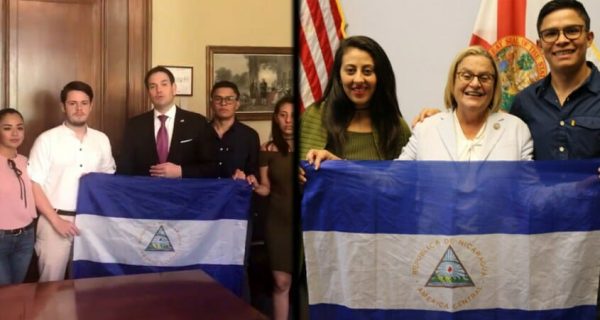
Nicaraguan student leaders lobbying for US intervention with Ileana Ros-Lehtinen and Marco Rubio
teleSUR | July 7, 2021
Just as in 2018, Nicaragua is once again the subject of the kind of mass international bad faith news coverage and perception management more usually associated recently with US and allied government offensives against Bolivia, Cuba, Iran, Syria and Venezuela. In Nicaragua’s case the current offensive is aimed at influencing the country’s elections scheduled for next November 7th. Currently, all the opinion polls show that, should President Daniel Ortega stand again for election, he and his FSLN party will win easily with over 60% support against around 20% for the the country’s right wing opposition.
The campaign against Nicaragua’s Sandinista government is clearly intended to encourage punitive coercive economic measures from the US and European Union governments aimed at influencing voter opinion in those November elections against President Ortega and the FSLN. Right now, the main false accusation is that “Ortega” has unjustly imprisoned over twenty opposition leaders, among them several presidential candidates. All US attempts to overthrow governments resisting US and allied government dictates depend on this kind of big lie. The standard big lie is that target governments are unpopular, repressive dictatorships. Invariably, the truth is very different if not the complete opposite.
For example, in 2009, the big lie in preparation for the coup against then Honduran President Manuel Zelaya was that the proposed Fourth Ballot referendum aimed to secure him re-election so as to impose a dictatorship. In Nicaragua’s case, the current big lie is that “Ortega” is arresting opposition leaders to prevent them defeating him in next November’s elections. These big lies only flourish in an essentially fascist culture of corporate dominated government in which truthful information is systematically suppressed and substituted by false beliefs.
Typical Western false beliefs or presuppositions are, for example, that the US and its allies are a force for good in the world, that Western culture is morally superior to others and that capitalism promotes optimal economic and social outcomes. These ridiculous false beliefs are fundamental tenets of Western intellectual life and public discourse. They make possible the kind of psychological warfare repeatedly unleashed against governments that obstruct the wishes of Western corporate elites and the governments they own.
An important component of Western psychological warfare shaping the moral dimension of any given disinformation assault is the essentially class based solidarity with the target country’s imperialist proxies. This neocolonial solidarity operates in reactionary and progressive varieties, both claiming a Western monopoly on freedom, democracy and defence of human rights. Both essentially agree that governments resisting Western demands deserve to be attacked one way or another.
The reactionary variety, prevalent mostly among the business and financial classes and related professionals, insists on abandoning international law in favour of intervention based on Western dictated rules. The progressive variety, prevalent mostly among non profit organizations, academics and other socially oriented professionals, agrees but is more diffident about the means of intervention deployed, demanding alibis to satisfy susceptibilities over humanitarian and human rights concerns. The right wing variety generally favors aggressive, overt or covert military-based solidarity with armed opposition rebellion, while the progressive variety favors smart-power coercive measures prioritizing solidarity with some version of opposition civil society or popular movements.
Nicaragua experienced the first right wing version of neocolonial solidarity during the Contra war of the 1980s when president Reagan declared, with more truth than he realized, that the CIA-run narco-terror campaign was “the moral equivalent of the founding fathers”. Subsequently, ever since the Sandinista FSLN party returned to government in 2007, Nicaragua has experienced principally the progressive version of smart power neocolonial solidarity developed under president Obama. That policy, supporting Nicaragua’s anti-Sandinista opposition, intensified under president Trump and continues unchanged now under “Biden”.
Self-evidently, these varieties of neocolonial solidarity thrive on their respective class loyalties and ideological susceptibilities. In 2018, a massive disinformation campaign covered up the Nicaraguan opposition’s extreme violence and their deliberate campaign of destruction. As Harold Pinter remarked in relation to the 1980s Contra War, even as the opposition violence of 2018 was happening, the murders, the extortion, the arson, the torture, it was made to seem that nothing happened. Now, when the Nicaraguan authorities have acted to preempt a repeat of that failed 2018 coup attempt, a furious psychological warfare assault is taking place to conceal the coup mongering opposition’s treasonous collusion with the US and EU country governments.
As regards progressive and left wing opinion in general, militant foreign supporters of Nicaragua’s ex-sandinista opposition have long been important protagonists covering up the ex.sandinistas’ anti-democratic collaboration with Western imperialist intervention. Even before the 2006 elections, the US authorities had coopted ex sandinistas as collaborators. But when Daniel Ortega and FSLN won those elections, successfully managed the crisis of 2008-2009 and then triumphed in the 2011 elections, US government support for the opposition switched to promoting efforts at outright regime change. Inside Nicaragua, the ex sandinistas, devoid of popular support, abused their non profit networks to camouflage their political opposition to the government and the accumulation of resources necessary to mount the 2018 coup attempt.
That systematic abusive subterfuge has been eliminated and its protagonists held to account. So now foreign supporters of the ex sandinista opposition again cloak their militant, aggressive, politically driven advocacy under phony human rights concerns. In 2018, they did so to cover up the violent role of the ex sandinistas in the failed coup attempt. Now, they falsely allege human rights abuses to cover up ex sandinista US collaborators’ treasonous criminality. The false human rights propaganda motif makes it possible for proponents of the progressive variety of neocolonial solidarity in North America, Europe and elsewhere, to work in parallel with their right wing counterparts. Even many supposedly left wing figures have written articles or signed declarations in support of the ex-Sandinista US collaborators and those people’s right wing allies in Nicaragua. They do so for three main reasons.
Firstly, many supposedly left-wing figures attacking the Nicaraguan authorities for defending Nicaragua’s independence and sovereignty have some degree of friendship with the ex-sandinistas now under investigation, so they defend them for essentially personal reasons. Secondly, it is likely that many supposed left wingers supporting the ex Sandinista US collaborators have been duped by the massive psychological warfare assault on Nicaragua without bothering to question it. A third main reason for that kind of neocolonial solidairty from people who should know better, is that they fear alienating their support networks and are simply signaling how virtuous they are so as to avoid criticism.
In any case, the current situation, just like the 2018 coup attempt, categorically defines where everyone’s loyalties lie. People genuinely committed to the principles of sovereign independence and self-determination recognize the Nicaraguan authorities are applying the country’s laws and criminal code to defend the country against US intervention aimed at overthrowing the elected government. People who believe the bogus human rights accusations and claims that the current criminal investigations are driven by electoral considerations are engaging in the kind of neocolonial solidarity regularly deployed to justify yet another operation of imperialist regime change. For anyone foolish enough to credit the ex sandinista leaders denials of complicity with the US government, this series of photographs should help disabuse them of that false belief.
‘They Make Unsubstantiated Accusations’: Venezuela Calls UN Report Fallacious
Orinoco Tribune | July 6, 2021
In a communiqué, the Bolivarian Republic of Venezuela rejected the fallacious content and highlighted the biased nature of a report published about the country’s situation by the Office of the United Nations High Commissioner for Human Rights, Michelle Bachelet, on July 1, 2021.
This report is the result of a Resolution promoted by a small group of governments with serious domestic human rights violations, that conspired to satisfy the policy of “regime”-change promoted by the US against Venezuela.
Despite the attacks, Venezuela is distinguished by its harmonious constitutional system that guarantees and defends human rights. The state provides a protective shield for its people against the barbarous criminal blockade imposed and directed from Washington and the European Union, that constitutes a serious crime against humanity.
It is especially worrying that this report is based on information provided by individuals with unknown motivations, and has not been duly verified with the authorities of Venezuela, despite the extensive facilities that the Venezuelan Government has provided for the performance of the OHCHR functions within the country.
On this occasion, based on a handful of alleged complaints of human rights violations, unverified accusations are made against the Venezuelan institutions, further manipulating the false narrative constructed to artificially supplement the file currently before the International Criminal Court, with the political objective of destabilizing the democratic institutions of Venezuela.
In addition to this, the report omits mention of the 26 visits made to detention centers and headquarters of intelligence agencies during which the Office of the High Commissioner has been able to interview hundreds of prisoners, according to its own guidelines of operation. In the Office’s conclusions, delivered to the State, the people interviewed confirmed that their personal integrity was respected during their incarceration.
Venezuela has asked the Office of the High Commissioner to share information with the national authorities on the alleged cases referred to in the report, in order to carry out rigorous investigations and determine their veracity and, if applicable, the corresponding responsibilities, in full consistency with its policy of absolute respect for human rights. Similarly, the Office of the High Commissioner has been invited to accompany the investigation processes developed by local authorities.
The Bolivarian Republic of Venezuela, in order to continue intensifying due cooperation with this office, ratifies its willingness to maintain channels of communication and dialogue with the Office of the United Nations High Commissioner for Human Rights, on the basis of strict adherence to the principles of objectivity, impartiality, non-politicization, respect for sovereignty, commitment to constructive dialogue, and—as required by international law—free from geopolitical agendas at the service of hegemonic powers.
America Leader of the Free World? How to Forget U.S. interference in Foreign Elections
By Philip Giraldi | Strategic Culture Foundation | July 1, 2021
After only five months in office, [proclaimed] President Joe Biden has already become notorious for his verbal gaffes and mis-spokes, so much so that an admittedly Republican-partisan physician has suggested that he be tested to determine his cognitive abilities. That said, however, there is one June 16th tweet that he is responsible for that is quite straightforward that outdoes everything else for sheer mendacity. It appeared shortly after the summit meeting with Russian President Vladimir Putin and was apparently intended to be rhetorical, at least insofar as Biden understands the term. It went: “How would it be if the United States were viewed by the rest of the world as interfering with the elections directly of other countries and everybody knew it? What would it be like if we engaged in activities that he engaged in? It diminishes the standing of a country.”
There have been various estimates of just exactly how many elections the United States has interfered in since the Second World War, the numbers usually falling somewhere between 80 and 100, but that does not take into account the frequent interventions of various kinds that took place largely in Latin America between the Spanish-American War and 1946. One recalls how the most decorated Marine in the history of the Corps Major General Smedley Butler declared that “War is a racket” in 1935. He confessed to having “…helped make Mexico, especially Tampico, safe for American oil interests in 1914. I helped make Haiti and Cuba a decent place for the National City Bank boys to collect revenues in. I helped in the raping of half a dozen Central American republics for the benefits of Wall Street. The record of racketeering is long. I helped purify Nicaragua for the international banking house of Brown Brothers in 1909-1912. I brought light to the Dominican Republic for American sugar interests in 1916. In China I helped to see to it that Standard Oil went its way unmolested.”
And there have been since 1900 other regime change and interventionist actions, both using military force and also brought about by corrupting local politicians with money and other inducements. And don’t forget the American trained death squads active in Latin America. Some would also include in the list the possibly as many as 50 Central Intelligence Agency and Special Ops political assassinations that have been documented, though admittedly sometimes based on thin evidence.
That Joe Biden, who has been at a reasonably high level in the federal government for over forty years, including as Vice President for eight years and now President should appear to be ignorant of what his own government has done and quite plausibly continues to do is astonishing. After all, Biden was VP when Victoria Nuland worked for the Obama Administration as the driving force behind efforts in 2013-2014 to destabilize the Ukrainian government of President Viktor Yanukovych. Yanukovych, an admittedly corrupt autocrat, nevertheless became Prime Minister after a free election. Nuland, who is the Assistant Secretary of State for European and Eurasian Affairs at the State Department, provided open support to the Maidan Square demonstrators opposed to Yanukovych’s government, to include media friendly appearances passing out cookies on the square accompanied by Senator John McCain to encourage the protesters.
A Dick Cheney and Hillary Clinton protégé who is married to leading neocon Robert Kagan, Nuland openly sought regime change for Ukraine by brazenly supporting government opponents in spite of the fact that Washington and Kiev had ostensibly friendly relations. As Biden’s tweet even recognized in a backhanded way, it is hard to imagine that any U.S. administration would tolerate a similar attempt by a foreign nation to interfere in U.S. domestic politics, particularly if it were backed by a $5 billion budget, but Washington has long believed in a global double standard for evaluating its own behavior. Biden clearly is part of that and also clearly does not understand what he is doing or saying.
Nuland is most famous for her foul language when referring to the potential European role in managing the unrest that she and the National Endowment for Democracy had helped create. The Obama and Biden Administration’s replacement of the government in Kiev was the prelude to a sharp break and escalating conflict with Moscow over Russia’s attempts to protect its own interests in Ukraine, most particularly in Crimea. That point of conflict has continued to this day, with a U.S. warships in the Black Sea engaging in exercises with the Ukrainian navy.
Biden was also with the Obamas when they chose to destabilize and destroy Libya. Nor should Russia itself be forgotten. Boris Yeltsin was re-elected president of Russia in 1996 after the Clinton Administration pumped billions of dollars into his campaign, enabling him to win a close oligarch-backed victory that had been paid for and managed by Washington. Joe Biden was a Senator at the time.
And then there is Iran, where democratically elected Mohammed Mossadeq was deposed by the CIA in 1953 and replaced by the Shah. The Shah was replaced by the Islamic Republic in turn in 1979 and the poisoned relationship between Washington and Tehran has constituted a tit-for-tat quasi-cold war ever since, marked by assassinations and sabotage.
And who can forget Chile where Salvador Allende was removed by the CIA in 1973 and replaced by Augusto Pinochet? Or Cuba and the Bay of Pigs invasion in 1961 where the CIA failed to bring about regime change in Havana? Can it be that Joe Biden cannot recall any of those “interventions,” which were heavily covered in the international media at the time?
And to make up the numbers, Joe can possibly consider the multiple “interferences in elections,” which is more precisely what he was referring to. As a CIA officer stationed in Europe and the Middle East in and 1970s through the early 1990s, I can assure him that I personally know about nearly continuous interference in elections in places like France, Spain, Portugal and Italy, all of which had prominent communist parties, some of which were on the verge of government entry. Bags of money went to conservative parties, politicians were bribed and journalists bought. In fact, during that time period I would dare to say there was hardly an election that the United States did not somehow get involved in.
Does it still go on? The U.S. has been seeking regime change in Syria since 2004 and is currently occupying part of the country. And of course, Russia is on the receiving end of a delegitimization process through a controlled western media that is seeking to get rid of Putin by exploiting a CIA and western intelligence funded opposition. China has no real opposition or open elections, nor can its regime plausibly be changed, but it is constantly being challenged by depicting it and its behavior in the most negative fashion possible.
Joe Biden really should read up on the history of American political and military interventions, regime changes and electoral interference worldwide. He just might learn something. The most important point might, however, elude him. All of the intervention and all of the deaths have turned out badly both for the U.S. and for the people and countries being targeted. Biden has taken a bold step to withdraw U.S. forces from Afghanistan, though it now appears that that decision might be in part reversed. Much better to complete the process and also do the same thing in places like Iraq, Somalia and Syria. The whole world will be a better place for it.
Brazilian court clears ex-President Lula of corruption charges in another legal win
RT | June 21, 2021
Brazil’s former leftist president, Luiz Inacio Lula da Silva, scored a fresh legal victory on Monday after a federal court acquitted him of passive corruption charges relating to alleged political favors, citing lack of evidence.
In 2017, Lula was accused of having granted political favors to automobile companies in exchange for donations of 6 million reals (around $1.2 million) to the campaign of his Workers’ Party (PT). The charges against the ex-president and other officials were filed after ‘Operation Zelotes’, which was launched by police to investigate alleged fraud and bribery in the sector.
But on Monday, federal judge Frederico Viana ruled that the case against the former president “lacks elements” that can substantiate any conviction against him and the other defendants.
“It is prudent and reasonable to pronounce an acquittal” of the ex-president, his former chief of staff, Gilberto Carvalho, and five other officials and businessmen, the judge said.
During his testimony last year, Lula denied the accusations, insisting that he never did any favors for the automobile firms.
In March, the court annulled all sentences handed to the 75-year-old political veteran under ‘Operation Lava Jato’ (‘Car Wash’) – a major anti-graft investigation in which three ex-presidents and numerous officials were indicted.
That ruling gave Lula the right to run for president again in 2022. He hasn’t yet announced plans to join the race, but recent polls put him ahead of Brazil’s current leader, Jair Bolsonaro, by 41% to 23% in the first round.
Lula remains highly popular in the country, which underwent a period of rapid economic growth during his years in office from 2003 to 2010, and saw millions escape poverty through his welfare programs.
Leaked tapes reveal Bolivian coup regime had plot to overturn 2020 election loss with US mercenary help
RT | June 17, 2021
Top cabinet officials in the caretaker government of Jeanine Anez plotted a second coup to stay in power in Bolivia, according to leaked documents. The plan allegedly involved hundreds of US mercenaries flown in from Florida.
Anez took power in Bolivia in November 2019, after mass protests backed by the country’s military and police forced Evo Morales to flee from the country rather than continue governing for a fourth presidential term after winning elections. The protests were triggered by claims of election fraud, which were promoted by the Organization of American States and were later proven to be groundless.
The new government used force to suppress dissenting people from Morales’ left-wing Movement towards Socialism (MAS) party and made a sharp right-wing turn. It also repeatedly delayed holding a new election, which was supposed to be the primary goal of Anez’ caretaker presidency.
Pressured by mass protests, she eventually agreed to hold the ballot last fall. MAS candidate Luis Arce, who served as Morales’ economy minister, won it in a landslide, avoiding a second round by getting 55.1% of the vote. Anez herself came a distant fourth.
As Arce was celebrating his victory, Anez and her ministers were plotting a second coup, which would allow them to overturn the will of the Bolivian people, the Intercept reported on Thursday, citing records of conversations and email exchanges detailing the conspiracy.
The key figures in the plan were Luis Fernando Lopez, who served as Anez’ defense minister, and Joe Pereira, a former civilian administrator with the US Army, according to the report. Pereira was supposed to recruit mercenaries in the US and help fly them to Bolivia. There they would join forces with elite military troops from the Bolivian army, police units and right-wing vigilante mobs to quash MAS supporters.
“I can get up to 10,000 men with no problem” Pereira bragged in one alleged conversation. “All special forces. I can also bring about 350 what we call LEPs, Law Enforcement Professionals, to guide the police.”
“If there’s something else I need, I will have them fly in as undercover, like if they were photographers, they were pastors, they were medics, they were tourists.”
The number of troops appears to be a boast on Pereira’s part. One of the US-based recruiters he turned to for help told the Intercept that one “couldn’t get 10,000 people even if Blackwater was back in business and going back to Iraq.” But email exchanges indicate the planning was in an advanced stage and that at least 250 contractors were ready to take part in the ‘Bolivia project’, before it was called off.
On the Bolivian side, officials had three Hercules C-130 transport aircraft that could airlift the hired guns and their weapons from the US. Pereira said he wanted to “pick up personnel in Southern Command in Homestead Air Force Base in Miami.” Two US military sources told the Intercept that the US Special Operations command was aware of the coup plot, but one source said that “no one really took them seriously.”
Some details of the conversations matched very closely the claims that Morales made in early November. He accused General Sergio Orellana, who was appointed commander of the Bolivian Armed Forces by Anez, of pressuring other top military officers into launching a military junta to prevent an Acre presidency. Lopez assured co-conspirators that Orellana was ready to initiate “the military operation” against MAS.
The plans were never put into action. Lopez apparently couldn’t secure support of enough military commanders and had a falling out with then-Interior Minister Arturo Murillo, who was in charge of the police. General Orellana and both ministers were among members of the Anez administration who fled Bolivia after Arce’s victory and before his inauguration.
Murillo was arrested by the FBI last month. He is suspected of taking a bribe to sign a contract for supply of tear gas from a Florida-based firm at an inflated price.
Anez was arrested and charged with crimes related to how she took power in Bolivia. Pereira is likewise held in a Bolivian jail awaiting trial on fraud charges.
The Intercept believes it was highly unlikely that the plot had some tacit approval or support of the US government. It seems closer in nature to the attempt to overthrow the Venezuelan government, which involved the private security company Silvercorp USA.
The incursion of US mercenaries, which took place in May 2020, ended in a humiliating failure and was dismissively dubbed by some media ‘Bay of Piglets invasion’, referring to the CIA-baked failed invasion of Cuba in 1961.
Featured Video
Col Doug Macgregor: America’s Back to ENDLESS WARS
or go to
Aletho News Archives – Video-Images
Book Excerpt
Leslie Wexner’s Inner Demon
BY WHITNEY WEBB |
UNLIMITED HANGOUT| JUNE 10, 2022
This short excerpt from Whitney Webb’s upcoming book “One Nation Under Blackmail” examines an obscure media profile of Leslie Wexner, Jeffrey Epstein’s mentor, from the 1980s that contains disconcerting revelations about Wexner’s personality and his inner world. … continue
Blog Roll
Recent Comments
papasha408 on Germany demands UN Rapporteur… papasha408 on Israel Demanding that Iran Lim… Coronistan on Why can’t western leaders acce… John Edward Kendrick on German government ‘embezzling’… loongtip on Von der Leyen to have new secu… papasha408 on First Gaza, then the world: Th… papasha408 on Is Nixing Aid to Israel a Pois… papasha408 on Japan to Sign Up For NATO’s Uk… Redracam on Iran Willing to Dilute Enriche… loongtip on When Threats Replace Evid… loongtip on Zelensky tried to kill the cha… eddieb on I might get killed for posting…


 Aletho News
- Ukraine to ban Russian literature – culture minister
- 40 State Attorneys General Want To Tie Online Access to ID
- Col Doug Macgregor: America’s Back to ENDLESS WARS
- Villains of Judea: Haim Saban
- Germany demands UN Rapporteur Albanese resign, joining France
- Hamas official says Netanyahu joining ‘peace council’ is a farce
- Israel Demanding that Iran Limit the Range of Missiles to 300 Kilometers
- Why can’t western leaders accept that they have failed in Ukraine?
- German government ‘embezzling’ taxpayer money to fund Ukraine – veteran politician
- Russian Soldiers Tortured in Secret Ukrainian Prisons
- If Americans Knew
- AZAPAC, the new PAC opposing Israeli domination of U.S policies
- Haim Saban: Billionaire for Israel
- Rafah e-wallet plan highlights Israel’s deepening financial occupation
- Viral post claims Netanyahu sought legal approval, igniting speculation about Israel’s organ harvesting
- AIPAC Has a New Opponent: PAL PAC
- Right-Wing Catholic Off Trump Religion Panel After Israel-Gaza Remarks at Antisemitism Event
- Jewish terrorism, apartheid rule the West Bank – Not a ceasefire Day 125
- Why Israel persecutes children like my son Shadi
- In Gaza, One Man Is Searching for the Remains of His Family With a Flour Sifter
- Horrific situation in Gaza, West Bank – Not a ceasefire Day 124
- No Tricks Zone
- German Gas Crisis…Chancellor Merz Allegedly Bans Gas Debate Ahead of Elections!
- Pollen Reconstructions Show The Last Glacial’s Warming Events Were Global, 10x Greater Than Modern
- Germany’s Natural Gas Storage Level Dwindles To Just 28%… Increasingly Critical
- New Study Rebuts The Assumption That Anthropogenic CO2 Molecules Have ‘Special’ Properties
- Climate Scientist Who Predicted End Of “Heavy Frost And Snow” Now Refuses Media Inquiries
- Polar Bear Numbers Rising And Health Improving In Areas With The Most Rapid Sea Ice Decline
- One Reason Only For Germany’s Heating Gas Crisis: Its Hardcore-Dumbass Energy Policy
- 130 Years Later: The CO2 Greenhouse Effect Is Still Only An Imaginary-World Thought Experiment
- New Study Affirms Rising CO2’s Greening Impact Across India – A Region With No Net Warming In 75 Years
- Germany’s Natural Gas Crisis Escalates … One Storage Site Near Empty …Government Silent
 Aletho News