Beware foreign policy ‘experts’ who are shills for imperialism
By Yves Engler · March 20, 2019
 Aside from government officials the dominant media is fond of quoting “experts” from foreign policy think tanks when discussing Canada’s role in the world. While presented as neutral specialists, these opinion shapers are generally entangled with powerful, wealthy, elites.
Take the case of Venezuela and Canada’s leading foreign policy ‘ideas organization’. Recently Canadian International Council President Ben Rowswell has been widely quoted promoting Ottawa’s regime change efforts in Venezuela. After 25 years in Canada’s diplomatic service, including stints as chargé d’affaires in Iraq and ambassador in Caracas, Rowswell joined the CIC in November. Rowswell’s move highlights the close relationship between Global Affairs Canada and this corporate funded think tank, which has deep imperial roots.
Formerly the Canadian Institute of International Affairs, CIC has 15 (mostly university based) regional branches that hold dozens of conferences and seminars annually. The head office publishes International Journal, Behind the Headlines as well as reports and books. It also does media outreach.
Officially formed in 1928, CIIA’s stated aim was to promote “an understanding of international questions and problems, particularly in so far as these may relate to Canada and the British Empire.” Its first meeting was held at the Ottawa home of staunch imperialist Sir Robert Borden, prime minister between 1911 and 1920.(Borden publicly encouraged Canadian businessmen to buy up southern Mexico and sought to annex the British Caribbean colonies after World War I.) Borden was made first president of CIIA and another former prime minister, Arthur Meighen, became vice-president in 1936. On hand to launch CIIA was the owner of six Canadian newspapers, Frederick Southam, as well as Winnipeg Free Press editor John W. Dafoe and Ottawa Citizen editor Charles Bowman.“The CIIA’s early leadership constituted a roster of Canada’s business, political, and intellectual elite”, explains Priscilla Roberts in Tweaking the Lion’s Tail: Edgar J. Tarr, the Canadian Institute of International Affairs, and the British Empire, 1931–1950.
CIIA’s genesis was in the post-World War I Paris Peace Conference. At the 1919 conference British and US delegates discussed establishing internationally focused institutes. The next year the Royal Institute of International Affairs (RIIA), or Chatham House Study Group, was founded in London and in 1921 the Council on Foreign Relations was set up, notes Imperial Brain Trust: The Council on Foreign Relations and United States Foreign Policy, “to equip the United States of America for an imperial rule on the world scene.”
The driving force behind these international affairs institutes was British historian Lionel Curtis. An “indefatigable proponent of Imperial Federation” and former Colonial Office official in South Africa, Curtis set up a network of semi-secret Round Table Groups in the British Dominions and US. The aim was “to federate the English-speaking world along lines laid down by Cecil Rhodes”, the famous British imperialist. The Rhodes Trust and South African mining magnet Sir Abe Bailey financed the Round Table Groups and former British Secretary of State for War Lord Milner promoted the initiative.
Before its official formation CIIA sought to affiliate with RIIA. A number of prominent Canadians were part of Chatham House and the Canadian elite was largely pro-British at the time. “Much of the impetus and funding to” launch CIIA, Roberts writes, “came from Sir Joseph Flavelle, a meatpacking and banking magnate who strongly supported British Imperial unity. Other key Anglophile supporters included Newton W. Rowell, a leading Liberal politician, the wealthy Liberal politician and diplomat, Vincent Massey, and Sir Arthur Currie, commander of Canadian forces on the Western front during the war, who became principal of McGill University in 1920.”
The CIIA’s early powerbrokers generally identified with British imperialism. But its younger members and staff tended to back Washington’s foreign policy. In subsequent decades US foundation funding strengthened their hand. The Rockefeller Foundation accounted for as much as half of CIIA’s budget by the early 1940s. Alongside Rockefeller money, the Carnegie Corporation and Ford Foundation supported the institute. Set up by US capitalists responsible for significant labour and human rights abuses, the Big 3 foundations were not disinterested organizations. In The Influence of the Carnegie, Ford and Rockefeller Foundations on American Foreign Policy Edward Berman writes: “The Carnegie, Ford, and Rockefeller foundations have consistently supported the major aims of United States foreign policy, while simultaneously helping to construct an intellectual framework supportive of that policies major tenants.”
In subsequent decades CIIA would receive significant funding from Canada’s External Affairs and the Department of National Defence. But the institute’s nonfinancial ties to the government have always been more significant. After nearly two decades at External Affairs, John Holmes returned to lead the institute in 1960. In Canada’s Voice: The Public Life of John Wendell Holmes Adam Chapnick notes, “during [Prime Minister Lester] Pearson’s time in office [1963-68] Holmes had unprecedented access to the highest levels of government. He could reach Pearson personally when he was in Ottawa, and the Prime Minister promoted the CIIA while entertaining. Holmes also drafted speeches for Minister of Trade and Commerce Robin Winters.”
Upon leaving office external ministers Lester Pearson, Paul Martin Senior and Mitchell Sharp all took up honorary positions with CIIA. In 1999 former foreign minister Barbara McDougall took charge of the institute and many chapters continue to be dominated by retired diplomats. Active Canadian diplomats regularly speak to CIIA meetings, as did Prime Ministers Pierre Trudeau and Jean Chretien.
Alongside Ottawa and US foundations, Canadian capitalists with foreign policy interests also funded CIIA. Annual reports I analyzed from the late 1960s to mid-1990s list numerous globally focused corporate sponsors and corporate council members, including Bata Shoes, Toronto Dominion, Bank of Montréal, Bank of Nova Scotia, Brascan, Barrick Gold and Power Corporation.
In 2006 CIIA’s operations were subsumed into CIC. With financing from Research In Motion (RIM) co-founder Jim Balsillie, CIIA partnered with the Balsillie-created Centre for International Governance Innovation (CIGI) to establish CIC. The CIIA library and its publications were maintained while an infusion of cash bolstered local chapters. The new organization also added a major national fellowship program, which is headquartered at the University of Toronto’s Munk Centre for Global Affairs.
Balsillie was made founding chair of CIC and the initial vice chairs were former foreign ministers Bill Graham and Perrin Beattie. “The CIC promises to transform the debate about and understanding of Canadian foreign policy,” said Balsillie in 2007.
Balsillie put up $1-million in seed funding and launched a fundraising drive in the corporate community. Trying to drum up support for CIC, Balsillie wrote a commentary for the Globe and Mail Report on Business, explaining that “in return for their support, contributing business leaders would be offered seats in a CIC corporate senate that would give them influence over the research agenda and priorities of the new council.” In another piece for the National Post Balsillie wrote: “To create a research base on Canadian foreign policy, I have spearheaded the creation of the Canada-wide Canadian International Council (CIC). The Americans have their powerful Council on Foreign Relations, which offers non-partisan analysis of international issues and integrates business leaders with the best researchers and public policy leaders.”
The CIC Senate has included the CEOs of Barrick Gold, Power Corporation, Sun Life Financial and RBC. According to the most recent financial statement on its website, half of CIC’s funding comes from corporate donations (a quarter is from its International Journal and another quarter from dues).
Ben Rowswell’s transition from Global Affairs Canada to President of the Canadian International Council reflects the institute’s long-standing ties to government. His aggressive promotion of regime change in Venezuela also fit with the politics of an ‘ideas organization’ tied to the corporate world.
Costa Rican Indigenous Rights Defender Shot 15 Times, Killed
teleSUR | March 19, 2019
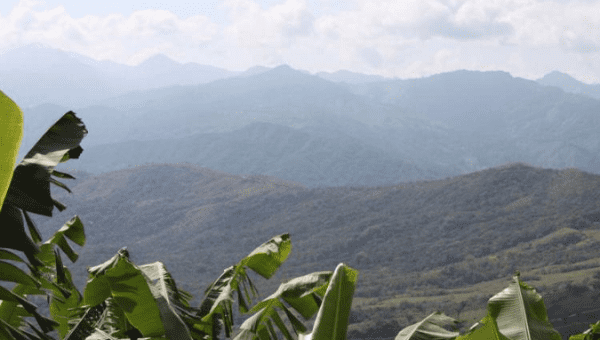
A Costa Rican Indigenous Bribri land rights activist was shot and killed late Monday night in his home in Salitre territory.
Indigenous land rights defender Sergio Rojas was assassinated by armed gunmen who shot the activist as many as 15 times at around 11:45 pm in his home, according to his neighbors, in southern Costa Rica.
Rojas was President of the Association for the Development of the Indigenous Territory of Salitre and coordinator of the National Front of Indigenous Peoples (FRENAP) in Costa Rica and was a staunch defender of the Bribri of Saltire Indigenous people who have been fighting for years to regain their rights to over 12,000 hectares of land in southern Costa Rica pledged to them by a 1938 government agreement, according to a 2014 teleSUR report.
The Bribri and other Indigenous have managed to recuperate control of some of their native lands but have become targets of violence from those who oppose their rights and sovereignty. Last December men armed with guns and machetes held hostage two Bribri women and eight minors on land they had recuperated in Salitre territory.
According to the women, they called 911 but when police arrived they spoke “aggressively” toward them and asked for their land deeds, which the authorities claimed were invalid. The police made no effort to arrest the hostage takers who escaped the scene, according to the testimonies given to Tree People Program.
This wasn’t the first time Rojas’ life was threatened. In 2012, shortly after the Bribri gained back some of their lands, the FRENAP coordinator was shot at eight times by armed men, but escaped the shooting unscathed.
Brazilian President visits CIA before visiting Trump on first US visit
Press TV – March 19, 2019
Brazilian President Jair Bolsonaro has made an unprecedented visit to the United States Central Intelligence Agency (CIA) headquarters in Langley, Virginia, in his first US visit before a meeting with US President Donald Trump scheduled on Tuesday.
Eduardo Bolsonaro, a lawmaker and son of the Brazilian president confirmed the visit on Monday, calling the intelligence agency one of the “most respected” in the world.
“Going now with president Jair Bolsonaro and ministers of the CIA, one of the most respected intelligence agencies in the world. It’ll be an excellent opportunity to speak about international relations topics in the region with experts and the technicians of the highest level,” he said in a tweet.
Eduardo Bolsonaro claimed the meeting was to discuss “international themes in the region”.
Leading Brazilian daily O Globo reported that Bolonsaro visited the agency along with Brazilian Justice Minister Sergio Moro, noting that the visit had not been published in the president’s public agenda and that press was not allowed to accompany Bolonsaro in the event.
The CIA had no comment on the visit.
Observers believe the unusual visit further signals Bolsonaro’s shift towards Washington. The move is, however, expected to be received controversially in Brazil.
In 2013, American whistleblower Edward Snowden revealed that the American National Security Agency (NSA) had wiretapped the conversations of then-President Dilma Rousseff, leading to suspicions towards the US and its spy agencies.
Former Brazilian Foreign Minster Celso Amorim has also slammed the meeting, saying that “no Brazilian president had ever paid a visit to the CIA.”
“This is an explicitly submissive position. Nothing compares to this,” he added.
Bolsonaro originally arrived in the US on Sunday, stating that the trip marked the first “pro-America Brazilian president” recently visiting the country.
“It’s the beginning of a partnership focused on liberty and prosperity, something that all of us Brazilians have long wished for,” he said.
Bolsonaro is an ardent admirer of US President Donald Trump and the White House’s policies, particularly those with regard to opposing left-wing governments in Cuba, Nicaragua and Venezuela.
The Brazilian president, who is also known as “Tropical Trump,” has sparked controversy by following Trump on calling for the relocation of his country’s embassy to the occupied city of Jerusalem al-Quds.
Bolsonaro personally made the promise to Israeli President Benjamin Netanyahu while he attended the Brazilian president’s inauguration ceremony on January 1.
Last week, however, reports emerged that Bolsonaro may fail to carry out the move following opposition from military officers in his cabinet.
Vice President Hamilton Mourao also objected to the embassy move last month, claiming that the measure would hurt Brazilian exports to Arab countries which include an estimated $5 billion in halal food sales.
Bolsonaro has also said that he is open to considering the establishment of a US military base in Brazil as a way to “counter Russian influence” in neighboring Venezuela.
The move was rejected by Brazilian Defense Minister General Fernando Azevedo e Silva a week later.
Cuba: Electric Sabotage Against Venezuela is Terrorism
teleSUR – March 11, 2019
The government of Cuba has described the attack on Venezuela’s electricity system which occurred last Thursday as a terrorist act.
In a statement, the government of the Cuban Revolution argues that the attack has been “aimed at damaging the defenseless population to use as a hostage in the unconventional war unleashed by the United States against the Venezuelan government.”
In this context, it argues that it is an escalation of violence that evokes the oil strike of 2002 and that arises after the interventionist failure of 23 February, when they tried to forcibly enter a supposed “humanitarian aid”.
The statement also denounces a campaign of lies coordinated by U.S. National Security Adviser John Bolton against Venezuela. One of those lies, says the statement, is that “Cuba has between 20 and 25 thousand military personnel in Venezuela who threaten the officers of the Bolivarian National Armed Forces.”
“Cuba categorically rejects this lie, as it equally firmly rejects any suggestion that there is any degree of political subordination from Venezuela to Cuba or from Cuba to Venezuela,” the Cuban government asserts.
The Dark Secret Behind a British Billionaire’s “Parallel State” In Argentina’s Patagonia
By Whitney Webb | Mint Press News | March 11, 2019
EL BOLSÓN, ARGENTINA – At the “end of the world,” spanning the southernmost regions of Argentina and Chile, lies the land of Patagonia, much of which remains a pristine wilderness that has inspired countless naturalists and would-be adventurers with its dramatic landscapes and natural beauty. For many, it is a place that still feels remarkably untouched and removed from the chaos of the modern world.
Yet, it is these very qualities, as well as the region’s great oil and gas potential and its abundance of glacier-fed freshwater reserves, that have placed it in the crosshairs of predators — predators armed with billions of dollars, powerful influence over Argentine politics and the country’s press, as well as alliances with controversial international financial organizations and key elements of the global Zionist lobby.
Coveted for its still largely unplundered resources, Patagonia has become the target of a close-knit network of notorious billionaires and global elites, who have spent much of the last two and a half decades seeking to transform this area into their own independent state.
Indeed, though several of these billionaires have already created de facto private states where they enjoy near-total impunity within Argentine Patagonia, others have been behind major efforts that have pushed for the territory’s secession. Still others have pushed Argentina’s government to exchange its claim to Patagonia for “debt relief” as a way of easing Argentina’s economic plight that, incidentally, was largely created by this very same group of billionaires. The International Monetary Fund (IMF), whose connections to this billionaire network are considerable, has had an outsized role in this effort.
Yet this appears to be more than just a venture on the behalf of notable oligarchs and the global elite, as prominent elements of the international Zionist lobby are intimately involved, as is the state of Israel, though the extent of the involvement of the latter is subject to debate. Their interest revolves around claims that date back to the founding of Zionism in the 19th century, when revered Zionist figures like Theodore Herzl discussed Argentina as a potential homeland for a Jewish ethno-state.
Since then, other notable Zionists, including past Israeli ambassadors to Argentina, have argued that Israel is for “European Jews” while “American Jews” must take Argentina for themselves. Notably, the method suggested by Herzl as a means of creating a Zionist state in his seminal work “The Jewish State” involves the exchange of debt for territory.
In the first part of this investigative series, MintPress explores the de facto independent state that has been created by British billionaire and Zionist Joe Lewis, a long-time associate of controversial Hungarian-American financier George Soros. Lewis has essentially bought out the local, regional and even national government of Argentina, allowing him to operate with impunity while he acquires more and more territory through land purchases of dubious (if any) legality, intimidates and threatens locals, usurps crucial water and energy resources from local towns, and operates his own international private airport that no one but he controls.
Subsequent reports in this series will examine the other key players in this effort to create a Patagonian state, namely Argentine oligarchs Marcelo Mindlin and Eduardo Elsztain, who are both deeply connected to the global Zionist lobby and the Rockefeller-founded Americas Society, and are also both close Soros associates. Finally, the role of these individuals and their associates in efforts to use IMF debt slavery to pressure the Argentine government to swap debt for territory will be revealed, as will the role of the Zionist lobby and prominent figures in the global elite.
The town that fought back
The quaint mountain town of El Bolsón, nestled among the picturesque rocky peaks of Argentina’s Patagonia and famed for its local legends of gnomes and elves, may seem an unlikely epicenter in a nationwide battle that has pitted locals against powerful foreign billionaires — billionaires who are not only plundering the country’s rich resources but eroding its national sovereignty through backdoor deals with Argentina’s most powerful, and most corrupt, political leaders.
Yet, however unlikely the role of this sleepy town in Argentina’s Río Negro province may seem, for over a decade many locals have used every tool at their disposal to oppose one billionaire’s effort to turn the town and much of Río Negro into his own personal fiefdom. This struggle has seen massive demonstrations in El Bolsón against British billionaire Joe Lewis, with some attracting as many as 15,000 participants – nearly 80 percent of the town’s entire population.
Lewis, worth an estimated $5.2 billion according Forbes, is best known in the West for owning the British Tottenham Hotspur football club, his sprawling luxury estates and golf resorts in the Bahamas and Florida, and owning well-known brands including Puma sportswear and Vans shoes. He is often described as a “self-made” billionaire, having been born to a poor Jewish family in London, who worked his way up to become one of England’s richest men.
Since the mid-1990s, Lewis has been building an empire in Patagonia, having become the owner of extensive properties north of El Bolsón — which, among other things, contain almost all of the town’s water reserves, as well as those of the nearby farming community, Mallín Ahogado — and the de facto power behind Pampa Energía, the company controlling most of Argentina’s electricity production. Part Two of this series will focus on Lewis’ role at Pampa Energía, as well as that of his associate, Marcelo Mindlin.
The “self made” man made by Soros
Long before his venture into Argentina, Lewis was a controversial figure owing to his close association with controversial Hungarian-American financier George Soros. Indeed, the bulk of Lewis’ massive fortune derives from his decision to “team up” with Soros to bet against the British pound in 1992, a day popularly known as Black Wednesday.
Soros’ and Lewis’ bet against the pound actually led to the pound crashing, after Soros ordered his hedge fund to “go for the jugular” and aggressively trade against the currency, thereby prompting its sharp devaluation. Though Soros is often called “the man who broke the Bank of England” as a result of the $1 billion in profits he made on that fateful day, Lewis is said to have made an even larger profit than Soros, according to several reports.
While Soros became a financial celebrity after Black Wednesday, Lewis opted to stay out of the limelight even though, just three years later, he would repeat what he helped do to the British pound with the Mexican peso, reaping yet another massive profit. While the Mexican peso crisis made Lewis even wealthier, it led to a massive jump in poverty, unemployment and inequality in Mexico and left its government beholden to the International Monetary Fund (IMF) through a loan package arranged by then-U.S. President Bill Clinton.
Between 1995 and 1996, the severe economic recession that followed the Mexican peso crisis spread throughout the Americas and “severely affected” the economies of other Latin American countries like Argentina. As fresh economic havoc arrived and took hold in Argentina, Lewis decided to take advantage of the troubled regional economic climate that he himself had helped create and began developing his interests in Patagonia.
As will be explored later in this investigative series, Soros and two of his Argentine associates who are also connected to Lewis — Eduardo Elsztain and Marcelo Mindlin — took advantage of this economic crisis and subsequent crises to buy major stakes in several banks as well as massive tracts of Argentine real estate, particularly in Patagonia.
How to build an empire
In 1996, Joe Lewis returned to Argentina after initially visiting the country in 1992 at the invitation of Australian media tycoon Kerry Packer. Lewis, apparently inspired by his first visit, had decided to buy property in the area. According to regional media outlet El Patagónico, Lewis’ dream was not just owning his piece of paradise, but creating “his own state in Patagonia.”
Lewis soon came into contact with Nicolás Van Ditmar, who would not only facilitate Lewis’ initial and subsequent land purchases in Argentina’s Patagonia but would also do so for several other foreign oligarchs. Van Ditmar had previously arranged massive land sales farther south to the Benetton Group, the family company run by the Italian oligarchs of the same name, best known as the owners of the United Colors of Benetton clothing company.
Van Ditmar, after learning of what Lewis hoped to acquire, spoke to him of the property of the Montero family, which encircled a pristine mountain lake known as Lago Escondido (Hidden Lake). Most of the members of the Montero family agreed to sell their collective property of around 14,000 hectares (~34,549 acres) to Lewis for $7 million. However, one of the Montero brothers, Irineo Montero, had refused and he, along with his wife María Ortiz and their employee José Matamala, were all found dead under mysterious circumstances.
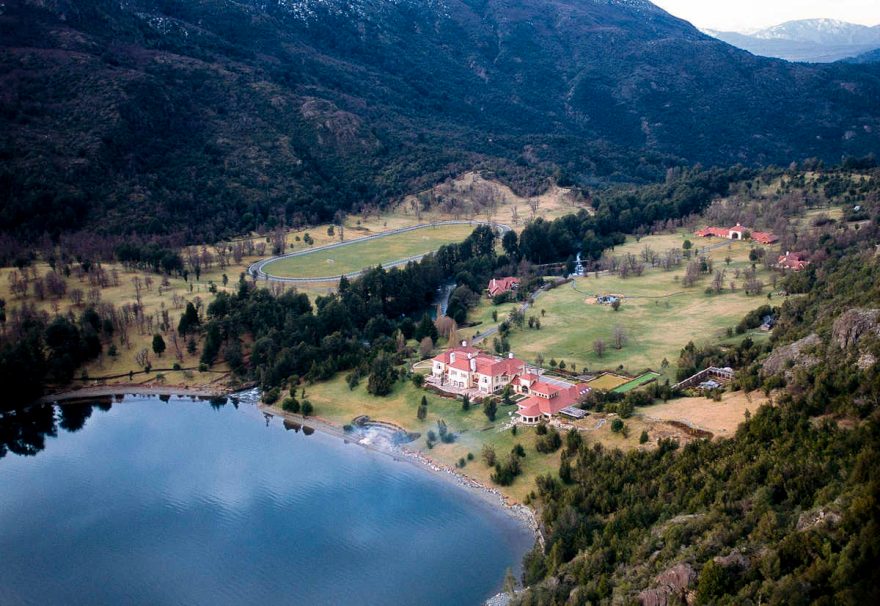
An aerial photograph Joe Lewis’ ranch on Hidden Lake, March 1, 2010 in southern Patagonia, Argentina. Francisco Bedeschi | dpa
Whether or not Lewis or his “right hand man” Van Ditmar were somehow involved in Irineo’s death and those of his wife and employee, there is no denying that their mysterious yet grisly endings cleared the way for Lewis’ purchase of Lago Escondido and the surrounding area. However, Lewis’ acquisition of this property, irrespective of the remaining Montero siblings’ willingness to sell, should never have been allowed for several reasons.
First, as per Argentine law, the sale of the property that Lewis has owned since 1996 is prohibited to a foreign citizen on national security grounds, given that the property is just 20 km from the Chilean border and thus, in foreign hands, could represent a grave national security risk. Second, it violates a local law dating back to 1969 that caps the maximum amount of land that any individual – Argentine citizen or foreigner – may own at around 70 hectares (~172 acres).
Third, it violates a provincial law passed in 1994 that created a protected natural area called the Río Azul Lago Escondido Natural Protected Area (ANPRALE), which included a significant portion of the land that Lewis would later buy from the Monteros. However, that law was amended in 1998, a few years after Lewis’ purchase, to remove the portion of his land that had previously been named a protected area under the control of the state. Federico Soria noted that the way in which the 1994 law was amended was blatantly unconstitutional.
One would think that the law would have prevented Lewis’ acquisition of the land long before Van Ditmar had first approached the Monteros about Lewis’ interest in the land. However, he was explicitly allowed to do so, despite the illegal nature of the purchase, owing to the general laxity of the local, regional and federal authorities towards wealthy foreigners looking to acquire Argentine land. As Lewis himself said in an interview with Gonzalo Sanchez in 2004, “I bought what they let me buy and here we are.”
The two-term presidency of Carlos Menem in the 1990s marked the reversal of more than 50 years of keeping and protecting areas of national importance and deemed strategic to natural security by permitting foreigners to buy a larger percentage of land than had been allowed since the passage of a 1944 law intended to preserve the territorial integrity of Argentina. Notably, when that law was created, the government of Edelmiro Farrell and Juan Perón expropriated several strategic properties owned by foreigners.
Yet, Menem’s presidency — which was thoroughly aligned with the “Washington consensus” — began, according to critics, violating the spirit of this 1944 law by issuing approvals of several million hectares to foreigners. Menem’s policies favoring foreign land purchases in rural areas have since been expanded by the presidency of Cristina Fernandez de Kirchner as well as that of the current president of Argentina, Mauricio Macri. Both of them have “friendly” relationships with Lewis and his associates, with the Macri a regular visitor of Lewis’ lakeside property in Patagonia.
Locals in El Bolsón have claimed that Lewis’ purchase of the Lago Escondido property – despite the legal obstacles – was the direct result of Menem’s policies. A member of El Bolsón’s community radio station FM Alas, who chose to remain anonymous owing to his father’s personal involvement in Lewis’ regional businesses, told MintPress that Lewis “had negotiated the purchase of the [Lago Escondido] property in meetings at the Casa Rosada [Pink House],” the Argentine equivalent of the White House, during Menem’s presidency.
MintPress was unable to confirm whether Lewis or his associates had visited the Casa Rosada while negotiating the property’s purchase. Yet Lewis has stated in interviews that “Menem sent us greetings and his best wishes when we opened [Lewis’ Lago Escondido mansion]” (Sanchez interview, pg. 61). Furthermore, Lewis has a notable habit of building close relationships with powerful Argentine politicians, including Macri. Macri has called Lewis “a friend,” defended him repeatedly, and even personally vacationed at Lewis’ Lago Escondido property.
The battle for Lago Escondido
Ever since his arrival to the area caused concern among some locals, Lewis has sought to win the good graces of the people of El Bolsón by acting as their benefactor — donating hospitals, building soccer fields and hosting annual activities and sporting competitions for locals at his property. This altruism is either embraced or rejected by locals, depending on whom you talk to. In keeping with the image that he has sought to cultivate among the townspeople, Lewis is often referred to as “Uncle Joe,” though it is spoken with either respect and admiration or derision and disgust.
Felicitas Libano, a member of the Assembly for the Defense of Water and Land (ADAT), told MintPress that Lewis has “integrated himself into nearly all the function of the city,” including its firefighters, police and other areas of the municipal government, and has “always tried to position himself as a benefactor.” According to Guido Augello, a member of local community radio station FM Alas, the townspeople are divided somewhat evenly into “people that like ‘Uncle Joe,’ people who hate him and people who don’t care.”
Lewis has also won over a portion of the townspeople and local businessmen through his patronage of select local services and his occasional hosting of small groups of locals for invitation-only sporting events and holiday celebrations. However, some have contended that Lewis receives many foreign guests, particularly from Israel.
According to the research of former French intelligence officer turned journalist Thierry Meyssan, Lewis has been inviting thousands of Israel Defense Forces (IDF) soldiers to his territory annually. In late 2017, Meyssan alleged:
Since the Falklands War, the Israeli army has been organizing ‘holiday camps’ in Patagonia for its soldiers. Between 8,000 and 10,000 of them now come every year to spend two weeks on Joe Lewis’ land.”
It is unclear if Meyssan’s information was the result of his time in France’s exterior intelligence service DGSE or independent research he conducted since becoming a journalist, as MintPress’ efforts to contact Meyssan were unsuccessful. Locals, journalists and researchers interviewed by MintPress could not confirm Meyssan’s claims. Yet, many of these locals and researchers said they had heard of those claims from other sources within Argentina, but also noted that they were speculative, given that no one but Lewis or his employees knows who visits the property beyond the aforementioned events where select locals are invited to attend.
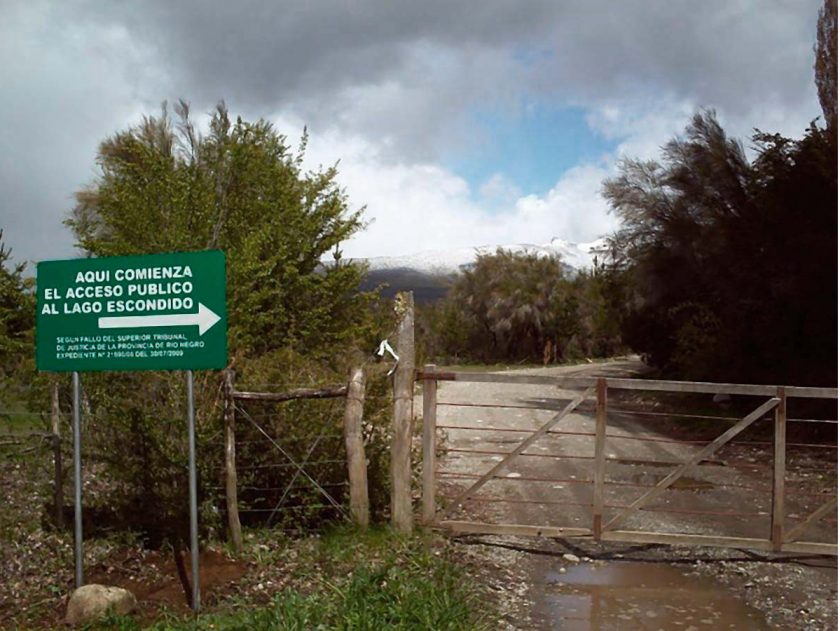
Tacuifi road leading to Lago Escondido, now blocked to public access, lies off of Argentina’s Route 40. The sign notes the 2009 Supreme Court ruling demanding the still-closed road be opened to the public. Photo | Revista Anfibia
Beyond the alleged IDF “vacations” on Lewis’ land, his presence in the area has been controversial for other reasons, namely for concerns that he sought to usurp key regional resources. Indeed, journalist Gonzalo Sanchez noted in his 2004 book Patagonia Sold: The New Owners of the Land :
In El Bolsón, there are more than a few locals and city council members that believe that, behind his [Lewis’] generosity, there are other hidden objectives, like the possible control of the water reserves of this part of Patagonia (pg. 50).”
Inklings of the truth in relation to these concerns were evident as soon as Lewis acquired the property surrounding Lago Escondido. This large mountain lake, which Lewis’ property surrounds, is the water basin for two important regional rivers, the Manso and Puelo, which later unite in Chile and drain into the Pacific. It is also the lake which feeds other nearby lakes including the Soberanía Lakes and Montes Lake, among others. Lago Escondido itself is estimated to contain as many as 400 billion liters (~105 billion gallons) of freshwater.
In Argentina, as is also the case in neighboring Chile, water – whether in lakes, rivers or seas – is a public right and public access to all bodies of water is guaranteed by law. This legal concept — likely foreign to Lewis and other Westerners, whose home countries often enshrine private property rights over the public’s right to vital resources — has been the most visible way in which tensions between Lewis and locals have manifested. It was also the first real test of Lewis’ resolve to carve out his “independent state” in Patagonia and keep locals out.
Lewis closed off the public road from the highway to the lake and also closed the private road he built at a separate point from public access. According to several locals interviewed by MintPress who had tried to enter the area, private security in civilian clothing prevent people from using the roads either by vehicle or on foot. Federico Soria, who has himself tried to enter the area on several occasions, described the guards to MintPress as “intimidating” and “aggressive” and also said that the Montero family, the old owners of the land, block one of the roads before it enters Lewis’ property and are “heavily armed.”
The only remaining path is a steep – and in places, dangerous – mountain path that takes at least two days in each direction to traverse. The path is poorly marked and maintained and is only usable in summer, as it is blocked by snowfall in other seasons. Every person interviewed by MintPress who had seen or traversed the path described it as being suitable only for “experienced mountaineers.”
In 2009, Lewis suffered his first major defeat in his efforts to keep locals out of his “parallel state” when the regional court ruled that the Tacuifi road — which connects the lake to the main highway, Route 40, and crosses Lewis’ property — be opened. The ruling stated that this must be done in order to “ensure access to Lago Escondido with appropriate signaling and ensuring transability.” The court gave Lewis 120 days to comply.
However, he didn’t comply and instead his regional associates began openly threatening any who tried to visit “his” lake. The clearest threat came from Van Dittmar himself in 2011, when he publicly stated that he and other Hidden Lake S.A. employees would defend Lewis’ private property by “fighting with blood, if we have to.” Van Ditmar also said that he would keep locals from accessing the lake “with a Winchester [rifle] in hand, with blood if necessary.”
In 2012, the region’s Supreme Court upheld the 2009 ruling, as did Argentina’s national Supreme Court a year later. However, Lewis and Van Ditmar refused to open the Tacuifi road, Van Ditmar saying that the treacherous but “very pretty” mountain path should instead be used to access the lake. Argentine President Macri also stepped in and echoed Van Ditmar, stating that the lake is even more accessible than before Lewis bought the property.
The court battle continues to today, after the Supreme Court of Río Negro in 2016 withdrew its previous ruling and ordered that a new hearing with different judges issue a new ruling. Critics accused Lewis of using extreme “political pressure” at the regional and local level in order achieve this very surprising ruling.
Despite that, locals continue to fight for public access to Lago Escondido and defend Argentina’s sovereignty over Lewis’ private empire. The main manifestation of this effort is an annual “March for Sovereignty,” the most recent of which took place in early February of this year. The march is organized by the Foundation for the Cultural Integration and Promotion of Water (FIPCA), which is run by former Argentine marine Julio Cesár Urien. Like the prior marches of the same name, its participants walked for nearly three days on foot over the mountain trail to arrive on the shore of the lake, which – as mentioned above – they were within their legal rights to do.
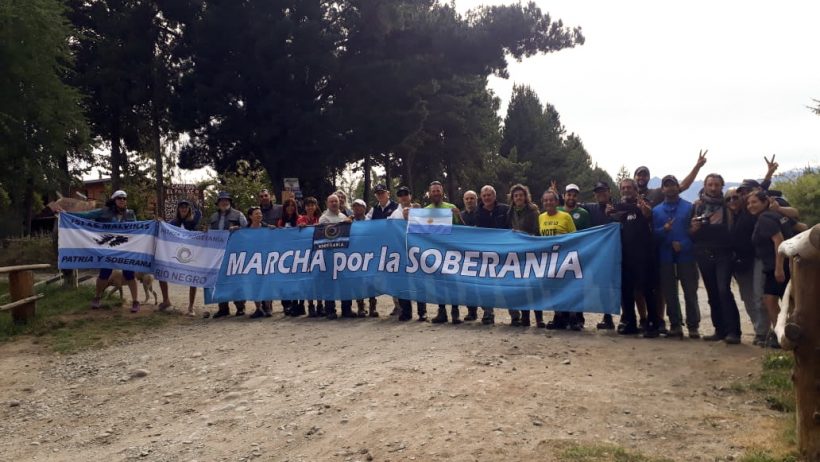
Participants in the 2019 “March for Sovereignty” pose for a picture at the beginning of their several-day journey to reach Lago Escondido by foot. Photo | FIPCA PRENSA
Upon arriving, they were met by Lewis’ private security as well as members of the Río Negro police, who cornered them and told them that they couldn’t even go to the bathroom without fear of arrest for trespassing, even though lakeshores are also legally considered public spaces. Guillermo Martín Caviasc — a journalist for Barricada TV, who was present at the demonstration — called the combination of local police and private security Lewis’ “private army” and remarked that the police officers present were “in a situation of subordination like if they were visiting a foreign state controlled by Lewis.”
Two participants in the march, Andrea Gatabria and David Ramallo, mounted inflatable kayaks with the intention of placing an Argentine flag in a small island in the middle of the lake, itself technically a public space. Before they made it to the island, two speedboats belonging to Hidden Lake S.A. circled the kayaks in an effort to capsize them while taunting them, asking “Do you know what it’s like to die from hypothermia?”
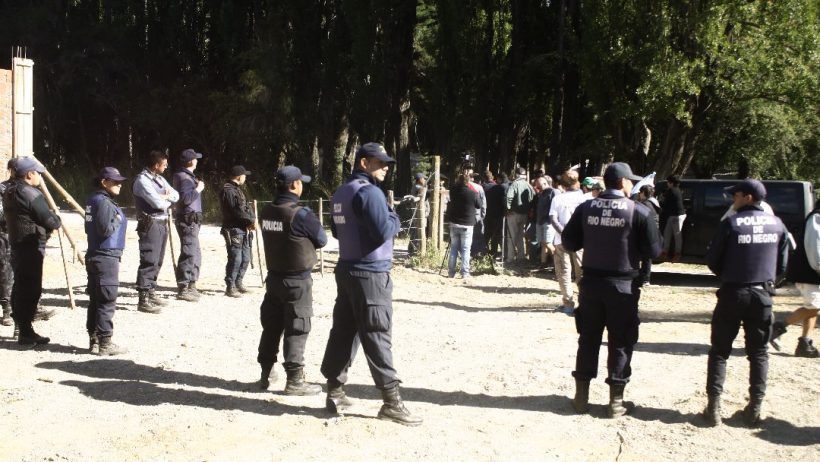
Participants in the 2019 “March for Sovereignty” pose for a picture at the beginning of their several-day journey to reach Lago Escondido by foot. Photo | FIPCA PRENSA
After half an hour of taunts that seemed more like death threats, Lewis’ private security knocked over the kayaks, leaving Gatabria and Ramallo floating in the freezing water. After several minutes, several witnesses stated that one of the security guards told the two kayakers “Well, now do you see what it’s like to die of hypothermia?” Gatabria and Ramallo were, after some time, lifted into the guard boats, but had spent so much time in the frigid water that both had to be hospitalized.
National Senator for Río Negro, Magdalena Odarda, demanded accountability for the actions of Lewis’ private security and local police and FIPCA has begun legal action against Hidden Lake S.A. for threatening the lives of march participants. Neither Hidden Lake S.A. nor Lewis’ Tavistock Group, which oversees his business interests in Argentina and elsewhere, responded to MintPress inquiries regarding the incidents against march participants.
While Argentines have routinely experienced intimidation and aggression when attempting to access the lake, some foreigners have had very different experiences. Take, for instance, Scott Leahy*, an American now living in Chile, who, during a past trip to El Bolsón, was able to waltz right through onto Lewis’ Lago Escondido property when he was in the company of two ex-IDF soldiers who had been there before.
Leahy told MintPress that when he was backpacking through Argentine Patagonia in 2010 with a Chilean friend, he had met and become friends with two young Israelis who had recently finished their service in the IDF and were staying at the same youth hostel. One day, these two Israelis offered to take Leahy and his friend to what they called a “secret beach” nearby.
They all piled into a car and, upon taking a gravel road off of Route 40, arrived at a gate that Leahy confirmed to MintPress was the Tacuifi road entrance to Lewis’ Lago Escondido property (seen in an image earlier in this report). Leahy was unsure about continuing, given that the gate was closed and, as a foreigner, he was unfamiliar with the area. However, the Israelis urged him on, saying that they had been there before and knew where they were going.
When the group of backpackers encountered Hidden Lake S.A. employees and guards, the Israelis explained that they were from Israel and wanted to bring their friends to the beach. The Lago Escondido employees told the pair that the group was not officially allowed to enter the property, but they could pass. Leahy didn’t think anything of it at the time, and told MintPress that he had assumed the pair knew the owner, though the Israelis never mentioned Lewis at all and they showed no interest in meeting with him either. This suggests that they were not personal friends of Lewis, but also shows that they knew that they could access the lake without problem, even in the absence of a formal invitation.
While this anecdote suggests that the claims of Lewis hosting thousands of IDF soldiers annually may indeed have something to them, it also serves as a very troubling comparison to the way Argentines have been treated when trying to access the very same lake. Indeed, if foreigners, Israelis in this case, were amicably waved through despite no invitation from Lewis or Hidden Lake S.A., why are Argentines who try to do the same met with such violence and aggression, particularly when they have a legal right to do so?
Stealing El Bolsón’s resources for his own use
Though public access to Lago Escondido has been a major issue of contention between Lewis and the people of El Bolsón since the late 1990s, concerns that the British billionaire was intent on controlling the region’s water supply multiplied when firms connected to Lewis began to move forward with what is often referred to as simply the “Laderas project.”
As early as 2004, a man named Cipriano Soria started telling his neighbors that he had “sold” his land in an area known as Pampa de Ludden (Ludden’s Plain) to Lewis. However, Soria did not technically own the land, which was a publicly-owned nature reserve, but was granted an easement by the provincial government of Río Negro to use its meadows to graze his livestock as long as he paid a “grazing license.” Despite the fact that it was neither legally nor properly sold to Lewis, Lewis began to make plans for the land — plans that ignored the fact that the area was and technically remains under several legal protections due to its ecological and strategic importance to the region.
Lewis intended to use this land to build a private airport in the area but was met by strong local resistance in 2005, including from the local group Assembly for the Defense of Water and Land (ADAT). Several members of ADAT live in Mallín Ahogado next to Pampa de Ludden, which provides the adjacent farming community of 2,000 with nearly all of its water. Felicitas Libano, who lives in Mallín Ahogado, told MintPress that the importance of this area as a critical water resource — as well as its ecological importance as an old-growth native forest — led it to be named a nature reserve that was supposed to be prevented from falling into private hands.
ADAT’s eforts were successful and Lewis’ plan for the area seemed to have been defeated or, at least, put on hold. Then, in 2009, the town voted on Lewis’ private airport, with more than 79 percent of voters opposing it. However, unluckily for the people of El Bolsón, Lewis had much bigger plans than just an airport and he wasn’t planning on letting local democracy get in his way.
From 2006 to 2009, legal arrangements were made between the ski center’s owner, the Club Andino Piltriquitrón, and the provincial government that opened up the local ski center at the Perito Moreno mountain to “third party” management.
Then, in 2009, Mirta Soria, Cipriano’s daughter, “inherited” the land from her father — land that he technically did not own yet was somehow granted permission to purchase from the state, along with another protected territory between Pampa de Ludden and the ski center, even though the state was forbidden from doing so by regional and local laws. Just six months after she bought this territory and sold more than half of it to Van Ditmar’s brother-in-law Samy Mazza. This new and very large area under Van Ditmar/Lewis control is where El Bolsón’s, in addition Mallin Ahogado’s, water reserves are located.
Soon after the land purchase occurred, two businesses appeared — Laderas of Perito Moreno Association S.A. and Laderas of Parallel 42, both of which are directly connected to Lewis and were given ownership of the lands in Pampa de Ludden and the other area recently purchased by Van Ditmar’s relative. That same year, both of these linked businesses proposed a “lottery” whereby the provincial government would select a private company to manage the local ski center. Laderas of Parallel 42 won the lottery.
Subsequently, the other Laderas company, Laderas of Perito Moreno, began plans to transform the land illegally acquired by Van Ditmar’s brother-in-law, Samy Mazza, as well as the portion still owned by Mirta Soria into a luxury subdivision of more than 1,000 luxury homes for wealthy Argentines and foreigners, along with a golf course, shopping centers, an artificial lake, and a private airport. This planned venture was subsequently promoted by pro-Lewis businessmen and media outlets as necessary for the successful development and improvement of the ski center.
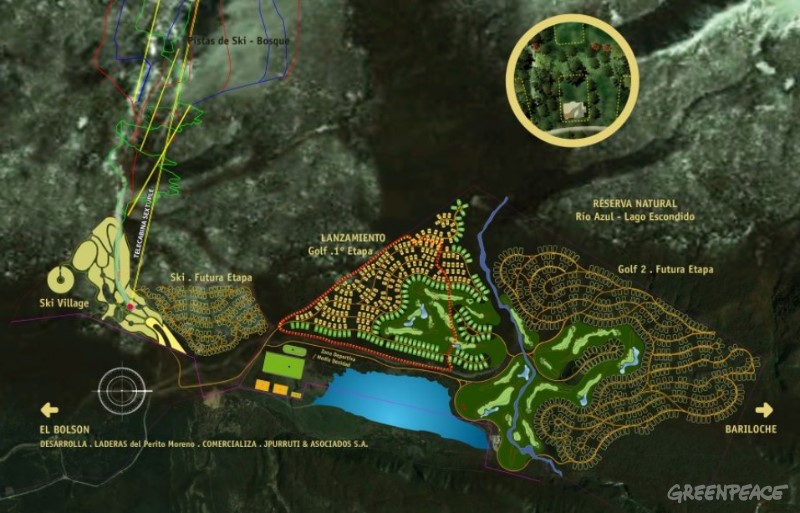
Proposed plan for the Laderas project, a 1,000-home luxury subdivision complete with an artificial lake and a golf course. Lewis’ firm plans to place the private airport (not shown in this image) south of the lake. The project, located right in the center of a nature reserve, is connected to Lewis’ Lago Escondido property and sits atop El Bolsón’s water reserves.
With the court battle underway and the project still lacking approval from El Bolsón’s city council, the regional governor, Alberto Weretilneck – a well-known Lewis ally – teamed up with Lewis-associated local businessmen in an effort to strongly pressure El Bolsón’s mayor at the time, Ricardo García, to sign a pledge that, once legal issues were resolved, the project would be fast-tracked for approval. García refused and Weretilneck along with other Lewis associates in the area began to push for his resignation. However, local protests kept García in power and, before leaving his post as mayor, García issued a decree that temporarily prohibited the Laderas project from advancing.
Clearly unhappy with this turn of events, the Laderas firms challenged the suspension of the project in court. Around this same time, members of local groups that had opposed the Laderas project reported several incidents of violence and intimidating acts, including threatening phone calls, their cars being set on fire, and the burning of a radio station as well as a community center in Mallín Ahogado.
In the case of architect and local politician Luis Martin, he was threatened with “lynching” by two Lewis associates – local businessmen Juan Carlos Martínez and Fabián Tornero – and his home was later broken into by armed thugs, one of whom accidentally cut himself with his machete and later fled the scene. Before escaping, the man had told Martin, “They have you targeted, they are going to kill you.”
In a 2011 article in Tiempo Argentina, Martínez referred to Lewis as “my friend” and was noted as a regular participant in meetings with Van Ditmar. The same article goes on to note that, in those meetings with Van Ditmar, Tornero is “influential” and further notes that Tornero is a known associate of Lewis.
In 2015, after García’s decree was challenged in court by Lewis’ firms, a judge ruled that the decree was legal but had not been written properly and therefore cancelled it. Soon after, a new pro-Lewis mayor and city council took charge and quickly signed a legal agreement with the Laderas companies, allowing them to build a “smaller project,” while claiming that any attempt to block the project – as García had done – could lead to another costly, lengthy legal battle that the municipal government just couldn’t afford. However, as Guido Augello told MintPress, this was hardly accurate, given that the local government could have appealed the decision regarding the decree, suggesting that this was just a convenient excuse to fast-track the project.
A few months after signing this agreement with the Laderas firms, the city council held a public hearing at which the vast majority of attendees from the community overwhelmingly rejected and criticized the project. Not getting the response it had hoped for, the council held a “secret” extraordinary meeting — secret because they declined to give the public the required notice needed to register to attend and participate in the meeting. With no one having registered, Pogliano decided to keep the meeting “closed” and placed police officers at the entrances to keep the townspeople out by force. The council subsequently decided to approve the Laderas project. Angry locals moved to occupy local government buildings in response, where they were targeted by riot police with tear gas.
The move generated several large-scale protests in El Bolsón, which started in 2016 and continued into 2017. Local resistance to the actions taken by the city council and mayor in relation to the Laderas project included a citizen occupation of the main plaza for three months, which was subject to police intimidation and violence, as well as three major protests, including the largest in El Bolsón’s history. That march against the Laderas project attracted an estimated 10,000 to 15,000 participants — quite a feat considering that the town’s urban and rural population boasts little more than 25,000 total inhabitants.
The reason for this mass mobilization, according to Augello, was that “even many of the people that like Lewis or believe his ‘Uncle Joe’ image oppose the Laderas project” and its associated airport. It’s not hard to understand why, considering that electricity and water intended for the townspeople of El Bolsón could soon be diverted to the wealthy outsiders who buy homes in “Lewislandia,” a derogatory term used to describe the Laderas project by some locals.
Yet, not only does Lewis intend to privatize El Bolsón’s water reserves, he and those developing his Laderas project also plan to divert the tourism that keeps its economy alive by instead diverting traffic from the main highway (Route 40) into his newly planned “city,” according to Federico Soria, a member of the Union of Patagonian Assemblies who has extensively researched Lewis’ local businesses. In an extensive 2016 article on the Laderas project and other Lewis-linked ventures, Soria wrote:
It is the intention of the developers of Laderas to unite the complex to Route 40 through two paved roads that they plan to build north and south of El Bolsón…. The Laderas variant road would be an advantageous shortcut [around El Bolsón].… [This] would benefit Lewis but economically endanger the community of El Bolsón…”
Furthermore, in 2016, Lewis completed a hydroelectric plant on the Escondido River — in the name of another of his local firms, Patagonia Energía — which passes through his property and feeds into the lake of the same name. However, he was granted permission to do so only if he connected the plant to El Bolsón in order to help the town resolve its ongoing and highly problematic electricity shortages. Once the plant was connected to El Bolsón, Lewis would become the main electricity provider to El Bolsón, as its current, aging diesel generators would be shut down.
Yet, instead of following the planned route for the power line that would give power to El Bolsón, it was diverted to the planned zone for the Laderas project, where it has remained “stopped” for years, even though his license to use the river for electricity production expired in 2015 owing to his company’s failure to connect the plant to El Bolsón in the time allotted by the license. As in so many other cases, Lewis and his companies have suffered no repercussions and continue to use the river for private power production. This situation has led some locals to speculate that Lewis has no intention of ever providing hydroelectric power to El Bolsón and it is instead a resource being guarded especially for his planned Laderas villa.
In effect, Lewis and his local representatives are working the resources they have acquired — water, electricity and tourism traffic — away from the town of El Bolsón and to the new “luxury” town of Laderas they hope to build to its north, a town that is an extension of Lewis’ own “independent” state. If this project is allowed to be completed, the people of El Bolsón will face a new troubling reality of resource insecurity and see its economy falter, as a crucial stream of revenue is diverted to the personal pet project of a foreign and predatory billionaire.
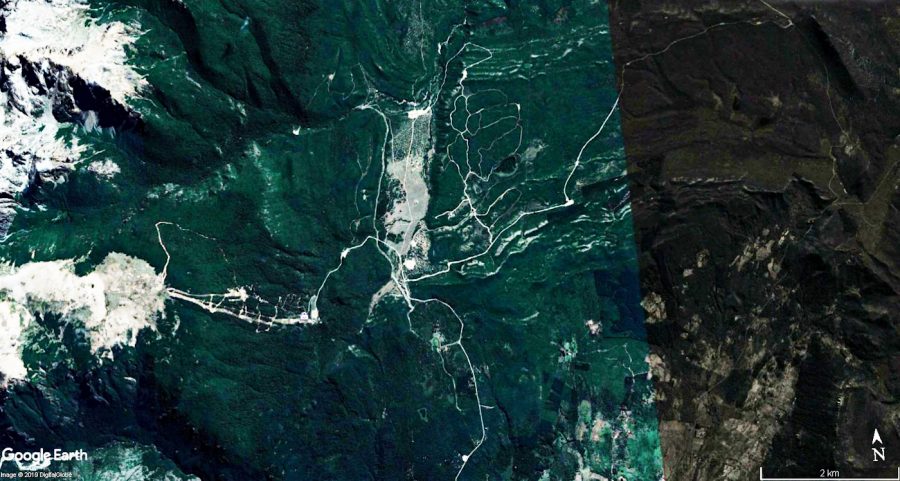
A satellite image taken last August shows land owned by the Laderas companies (center of photo) Roads for the planned “mini-city” are already being built, despite the fact that the companies are still not legally authorized to begin construction due to ongoing litigation. The already present ski center is seen on the left. Photo | Radio FM Alas, El Bolsón, Argentina via Google Earth
Yet, though Lewis won that particular battle in 2017, he is far from winning the war. Soon after the scandalous way in which the project was approved, the project again found itself challenged in court — placing it in legal limbo, unable to advance. Though the project is supposed to be blocked from moving forward until the conclusion of this latest legal battle, satellite images taken last August and shared with MintPress by local radio station FM Alas (shown above) reveal that Lewis’ businesses have already begun construction on the Laderas project, a clear indication that Lewis and his associates expect their impunity to continue.
Lewis’ Tavistock Group did not respond to MintPress inquiries about the Laderas project or the satellite images shown above.
The Joe Lewis “International Airport” — off-the-radar (literally)
Lewis’ “irregular” acquisition of Lago Escondido, the Laderas property, and his use of private security to block civilian access to the lake that is — by law — public property have long been decried as flagrant affronts to Argentina’s national sovereignty. Yet, while Lewis’ activities in and around Lago Escondido certainly do undermine existing Argentine laws, it is another Lewis-linked property in the Río Negro province that has done far more to erode Argentina’s national sovereignty.
Though Lewis’ plan to build an airport in Lago Escondido was technically approved but has not been able to move forward, Lewis – through his foreman Van Ditmar – purchased a sizeable property at the same latitude as Lago Escondido, but hours away on the Atlantic Coast. The property would soon become the site of Lewis’ private airport as well as a beachfront mansion. That airport, located south of Playas Doradas, was completed in February of 2008 and local media noted that its construction was “systemically hidden” from the public and was not subject to environmental impact assessments as normally required by law.
Most notably, however, there has never been any presence of Argentine customs or any other form of Argentine government control over what or who flies into or out of that airport, even though the airport is capable of receiving international flights. This point is particularly concerning in light of allegations that Lewis receives thousands of IDF soldiers annually on his property.
Joe Lewis’ private airport as seen on Google Maps
Furthermore, the Defense Ministry of Argentina has confirmed that not only is there no formal state control over what lands or takes off from this private airport, but that there are no radars in the area that even allow Argentine authorities to track nearby flight movements, including those of international flights. This means that no one but Lewis and his associates knows for sure how many flights land or take off from this area or where these flights originate or their intended destinations.
More shocking still, in 2010 then-Defense Minister Nilda Garré, in responding to a complaint from local politicians over the flagrant illegality of the airport, defended the airport’s presence by stating that it “could be used to facilitate rapid assistance of the state to locals in the event of disasters or emergencies.” To date, in the more than 10 years of its operation, it has never been used for any such purpose, according to those interviewed for this report.
The airport in Playas Doradas is roughly the same size as the airport in San Carlos de Bariloche (though some say it is larger), and is capable of receiving at least two large commercial-size passenger planes at a time. Much as with Lago Escondido, public access to the airport is denied, owing to the fact that the sprawling 15,000 hectare (~37,065 acres) property surrounding the airport is privately owned by a front company called Bahía Dorada S.A., which itself is legally owned by Lewis’ “foreman” Van Ditmar. However, the airport itself is owned by Westwind Aviation S.A. (formerly owned by Tavistock Aviation Argentina S.A., a subsidiary of Lewis’ Tavistock Group. Westwind Aviation S.A. is based at Lewis’ Lago Escondido property, as is Bahía Dorada S.A.. Neither Westwind Aviation S.A. nor the Tavistock Group responded to inquiries from MintPress regarding the lack of Argentine government oversight over the airport.
In order to realize the project, Van Ditmar – an Argentine citizen – had to be the owner of the property, as the area where the airport is built falls within a “National Security Zone” that prohibits land in that zone from being owned by foreigners on the basis of national security interests. In addition, the airport and the surrounding property, much like Lago Escondido, has a large and sophisticated private security presence.
The airport is estimated to have cost $20 million and Van Ditmar has publicly justified the airport’s existence by stating that Lewis not only “had the money” to build the complex but that it also made his ability to travel to his Lago Escondido property “easier.” This latter point is hard to believe given that the existing airport in San Carlos de Bariloche, which receives both private and commercial planes, is several hours closer to Lewis’ property than is his private airport in Playas Doradas. The notable difference between the two is that the private airport has no Argentine government oversight while the Bariloche airport does.
Few knew of the existence of the airport or the fact that access to the beach in that area had been effectively cut off by the Lewis/Van Ditmar project until a local woman, Elvira Linares, went on the television program “Documentos América,” hosted by Argentine journalist Facundo Pastor. On that program, Linares shared her experience of trying to pass through the now-private territory, noting that access to the ocean had been illegally blocked off. She also shared video footage she had taken of the massive, yet largely unknown to the public, private airport.
Mere hours after the program aired, Linares’ home was filled with bullet holes by still unknown assailants in what local media described as a blatant act of intimidation that led National Senator for Río Negro, Magdalena Odarda, to request that the government extend its protection to Linares, whose life was in danger. Efforts to contact Linares for comment for this report were unsuccessful.
Senator Odarda has arguably been the most well-known figure to demand accountability regarding the numerous irregularities surrounding the private airport. Odarda has, with limited success, repeatedly denounced the airport, on the basis of the fact that there is “no state control” over what or who passes through the airport.
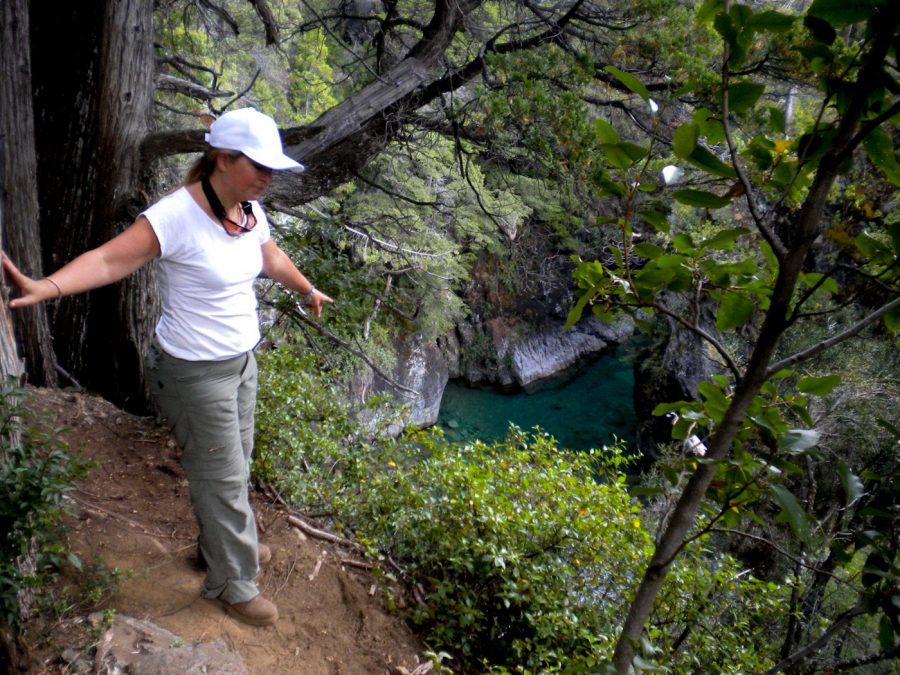
Senator Magdalena Odarda tours the publicly accessible road to Lago Escondido. Photo | Facebook
Odarda has also noted that the area where the airport is constructed is highly “strategic,” which poses a danger given that it is exclusively controlled by a foreigner, an Englishman. Odardo has pointed out that the airport is located on the important 42° parallel, which divides the regions of Río Negro and Chubut, and is only two hours away by plane from the disputed Falkland Islands, which are controlled by the United Kingdom but also claimed by Argentina. This dispute dates back to the 19th century and was the principal factor behind the Falklands War between Argentina and the U.K. in the 1980s, which many Argentines remember quite bitterly for the peace treaty Argentina signed after its defeat by England. Many Argentines have compared the document to the Treaty of Versailles that ended World War I.
Notably, there has been considerable evidence that Lewis’ airport has received planes from the Falkland Islands, which was the subject of a formal complaint made in 2010 to Argentina’s defense minister by then-governor of Argentina’s Tierra del Fuego province, Fabiana Ríos.
A well-oiled machine
Given the numerous laws that Lewis’ activities in Río Negro have broken at both the local and federal level, one would expect that somebody in the government – at least the local government – would hold him accountable. While some politicians like Magdalena Odarda and others have tried, the lack of impunity surrounding Lewis’ activities largely owes to his “friendships” with local and regional politicians as well as the country’s president.
One of the innumerable examples is Sergio Plunket. Plunket, who is in charge of Vial Rionegrina Sociedad del Estado (VIARSE), the regional body in charge of controlling public roads including the road leading to Lago Escondido, also works as a private “ecological consultant” for Lewis’ Hidden Lake S.A. Plunket also authorized the construction of Lewis’ Playas Doradas airport. Another clear example is Bruco Pogliano, El Bolsón’s current mayor, who is also Lewis’ long-time accountant in Argentina.
Another example that Gonzalo Sanchez noted (pp. 50-51) in his book, Patagonia Sold , is how Pablo Verani, ex-governor of Río Negro, started a long tradition of politicians making regular visits to Lago Escondido for Lewis-financed barbeque feasts, when he celebrated his win as the 1997 regional governor on the shores of the magnate’s privatized lake.
In addition to his undeniable influence among key local, regional and even national politicians, Lewis also enjoys considerable influence in the regional press and several former employees of his have become important figures in local and regional media. For example in 2016, according to local media, Dalila Pinacho, who long served as a lawyer and spokeswoman for Lewis’ Lago Escondido firm Hidden Lake S.A., became the director of the Nequén branch of Argentina’s National Radio, apparently through her “close” connections to local politicians.
Another journalist, Julio Álvarez — who described himself, to Gonzalo Sanchez in 2004 at an event in Lago Escondido, as Lewis’ “spokesman” — now works at a radio station in Viedma, Argentina, and was previously the El Bolsón correspondent for the regional newspaper Río Negro. Lewis also funds the local newspaper Ruta 40 and has stakes in other local newspapers such as El Cordillerano, Bolsón Web Patagonia, and El Ciudadano in Bariloche. Eliana Almonacid, who used to work for Ruta 40, told the national outlet Tiempo Argentina in 2014 that the Ruta 40’s director Nancy Aleuy, who also works for Hidden Lake S.A., told her that “Lewis had bought all the media outlets” in the region.
Lewis’ “Parallel State” is just the beginning
Lewis’ control over the local authorities and local press in Río Negro, and the complete impunity of his actions and those of his associates, have made it clear that in Argentina there is a de facto different legal system for oligarchs like Lewis and for the vast majority of Argentina’s citizens. This fact — in combination with the control Lewis and his associates exercise over the region’s key resources, including its water and energy production — has led to the creation of what some like Federico Soria have called a “parallel state” within Patagonia. However, this “parallel state” is, in reality, a microcosm of a much larger project currently underway that is aimed at the domination of the entirety of Argentine Patagonia by predatory oligarchical interests, the majority of which are directly connected to Lewis and his associates.
As will be explored in Part Two of this series, the Soros-led oligarch network, of which Lewis is a part in Argentina, has expanded its efforts to control Patagonia’s vast and strategic resources, including the region’s oil and gas wealth in addition to the domination of its freshwater resources and hydroelectricity production. Subsequent articles will then show that this effort is just the beginning, as this network and its close ties to the International Monetary Fund are being used to transfer ownership of vast state lands to their control in exchange for “debt relief.” The ultimate endgame appears to be the expansion of this “parallel state” — which Lewis has already helped to create in Río Negro and beyond, and which is controlled by small number of mostly foreign oligarchs — into a full-scale operation for extracting the region’s riches and exploiting its people.
Note: An sterisk (*) after a name indicates that a person’s real name was not used after they requested that MintPress not use their real name in this report.
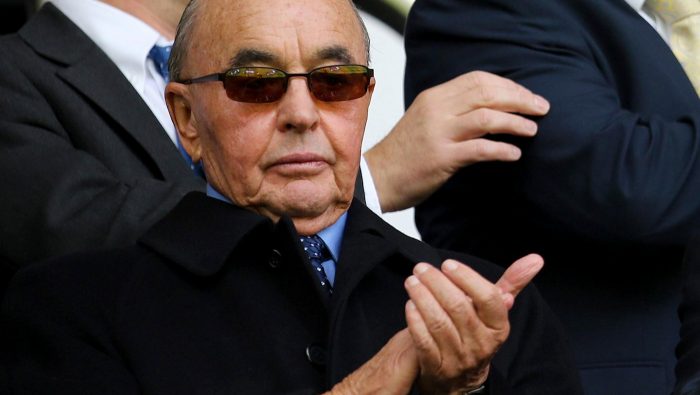
Top Photo | This undated photo shows British billionaire, Joseph C. Lewis, at a Tottenham Hotspurs football game in the United Kingdom. Photo | Reuters
Whitney Webb is a MintPress News journalist based in Chile. She has contributed to several independent media outlets including Global Research, EcoWatch, the Ron Paul Institute and 21st Century Wire, among others. She has made several radio and television appearances and is the 2019 winner of the Serena Shim Award for Uncompromised Integrity in Journalism.
Guaido returns to Venezuela to the welcome of foreign ‘bodyguard’ envoys
RT | March 4, 2019
Self-declared “interim president” of Venezuela, Juan Guaido, returned from his South American tour on Monday, arriving into the loving (and protective) arms of ambassadors from the foreign governments backing him.
Despite Venezuelan authorities making it clear he could face 30 years in prison for attempting to overthrow the government and violating a travel ban, Guaido chose to arrive directly to an airport in Caracas.
The risk of arrest was notably mitigated by the presence of ambassadors from Germany, France, Spain, the Netherlands and several other countries which gathered at the arrival gate to huddle around him like a high-profile human shield. While Guaido was all smiles, his Western-world entourage seemed a bit on edge.
While the media fretted that Maduro might make good on threats to arrest Guaido, the opposition leader passed through customs without incident and headed straight to a rally in central Caracas.
Meanwhile, Vice President Mike Pence warned the Venezuelan government that Washington protects its investments, stressing how important Guaido is to them, and threatening a “swift response” if anyone tries to bully him.
Shortly after moving unhindered through the airport, Guaido arrived at a demonstration he called for on Twitter the week before. Addressing crowds in the country’s capital city, he called on his supporters to take to the streets for continued demonstrations next Saturday.
While Guaido toured South America and met with his most critical support base – foreign governments – the US ramped up pressure on Maduro’s government, imposing intensified sanctions and revoking visas for state actors.
Understanding How Canadian Diplomats Shape the News
By Yves Engler | Dissident Voice | March 3, 2019
Canadian diplomats abroad seek to shape coverage of their work. And the more nefarious their actions the harder they toil to “spin” what they’re doing as something positive.
During a recent interview Real News Network founder Paul Jay described how Canadian officials in Caracas attempted to shape his views of the country’s politics. Jay noted:
My first trip to Venezuela in 2004, I was producing the big debate show on Canadian TV called Counterspin on CBC Newsworld. … . I was a known quantity in Canada. And so when I was in Venezuela, I said I’ll go say hello to the Canadian embassy. I was trying to figure out what was going on in Venezuela. I figured some Counselor would pat me on the head and say welcome to Venezuela.
No, I got the number two chargé d’affaires that greeted me and brings me into a meeting room with seven members of the opposition who then for two hours beat me over the head with how corrupt the regime was, how awful it was, and so on…
What business does a Canadian embassy have with bringing a Canadian journalist into a room with opposition people, essentially trying to involve me in a conspiracy against the Venezuelan government. Canadian government role in Venezuela was promote and nurture the opposition.
Around the same time Canadian officials sought to convince Jay that Hugo Chavez’s government was corrupt, former Montréal Gazette reporter Sue Montgomery had a similar experience in Port-au-Prince. In “Parachute Journalism in Haiti: Media Sourcing in the 2003-2004 Political Crisis”, Isabel Macdonald writes:
Montgomery recalled being given anti-[President Jean-Bertrand] Aristide disinformation when she called the Canadian embassy immediately after she had been held up by armed men while driving through Port-au-Prince days before the [US/France/Canada] coup. Canada’s ambassador to Haiti, Kenneth Cook, told her, ‘We’ve got word that Aristide has given the order to the chimeres [purported pro- Aristide thugs] to do this kind of thing to international journalists because he’s not getting any support.’ According to Montgomery, Cook had urged her to tell the other international journalists who were staying at the same hotel: ‘I think you should let all your colleagues at the Montana know that it’s not safe for them.’
Given only two days to prepare for her assignment, Montgomery was ripe for official manipulation. Though she later realized the ambassador’s claim was ridiculous, Montgomery told other journalists at Hotel Montana (where most international journalists stay in Port-au-Prince) that Aristide’s supporters were targeting them.
The Canadian embassy in Port-au-Prince succeeded in influencing Canadian reporters’ coverage of the country. In her MA thesis titled “Covering the coup: Canadian news reporting, journalists, and sources in the 2004 Haiti crisis,” Isabel Macdonald concludes that the reporters dispatched to Port-au-Prince largely took their cues from official Canada. “My interviews revealed that journalists’ contacts with people working in the Canadian foreign policy establishment appear to have played a particularly important role in helping journalists to identify appropriate ‘legitimate’ sources.”
CBC reporter Neil MacDonald told Isabel MacDonald his most trusted sources for background information in Haiti came from Canadian diplomatic circles, notably the Canadian International Development Agency where his cousins worked. MacDonald also said he consulted the Canadian Ambassador in Port-au-Prince to determine the most credible human rights advocate in Haiti. Ambassador Cook directed him to Pierre Espérance, a coup backer who fabricated a “massacre” used to justify imprisoning the constitutional prime minister and interior minister. (When pressed for physical evidence Espérance actually said the 50 bodies “might have been eaten by wild dogs.”)
Almost all Canadian correspondents develop ties to diplomats in the field. Long-time Globe and Mail development reporter John Stackhouse acknowledges “Canadian political officers” in Indonesia for their “valuable insights” into the country during General Suharto’s rule. In Out of Poverty, Stackhouse also thanks “the Canadian diplomatic missions in Accra, Abidjan and Bamako [for their] … invaluable service in arranging interviews and field trips.” During a period in the mid-2000s when she wrote for the Globe and Mail and CBC, Madeleine Drohan conducted media workshops in Zambia, Tanzania, Kenya and elsewhere sponsored by the Canadian embassy, High Commission and Foreign Affairs (she taught journalist ethics!).
“One of the best Canadian foreign correspondents of the 1970s,” Jack Cahill discusses some ways diplomats relate to reporters in If You Don’t Like the War, Switch the Damn Thing Off!: The Adventures of a Foreign Correspondent. “The Canadian government”, the former Toronto Star reporter notes, “can be good to foreign correspondents if it thinks they are reliable and I had two passports, one for general purposes and one for difficult countries.”
In what may reflect his nationalism, Cahill dubs Canadian diplomats “more reliable” than their southern counterparts. Disparaging his US colleagues, he writes:
There is little doubt, however, that some US foreign correspondents depend almost entirely on their embassies, and thus indirectly the CIA, for their information. It is, after all, the natural thing to be attracted to the truth as propounded by one’s own countrymen in the Embassy offices, at the official briefings, and on the cocktail circuit. It’s this information, with its American slant on world affairs, that eventually fills much of Canada’s and the Western world’s news space.
Jay described his experience at the Embassy in Caracas mostly to highlight Canada’s long-standing hostility to the Hugo Chavez/Nicolas Maduro governments. But, his story also helps make sense of the dominant media’s alignment with Ottawa’s push for regime change in Venezuela today.
Globe and Mail Latin America correspondent Stephanie Nolen, for instance, promotes Canada’s last ambassador to Venezuela. Describing Ben Rowswell as “widely respected by Venezuelans while he was there”, Nolen recently retweeted Rowswell claiming: “the coup happened in July 2017 when Maduro suspended the constitution. The question now is how to fill the void – by backing the president who uses force to remain in power after his term expires, or the leader of Venezuela’s last remaining democratically elected body?” Rowswell has been quoted in at least a half dozen Globe and Mail articles about Venezuela in recent weeks.
Diplomats’ influence over international correspondents is one way the foreign policy establishment shapes discussion of Canadian foreign policy.
Remember the Maine? CIA Intervention in Venezuela

Photograph Source National Museum of the U.S. Navy
By David Rosen | CounterPunch | March 1, 2019
In January 1897, Frederic Remington, a 19th-century painter famous for his depictions of the Old West, was on assignment in Havana for William Randolph Hearst’s New York Journal to illustrate Spanish atrocities against Cubans. He sent a telegram to Hearst, noting: “Everything is quiet. There is no trouble. There will be no war. I wish to return.” Hearst replied: “Please remain. You furnish the pictures and I’ll furnish the war.”
One year later, on February 15, 1898, the battleship USS Maine mysteriously exploded in Havana Harbor. Pres. William McKinley ordered the battleship sent to Havana on January 25th to observe the growing tension between the U.S. and Spain. The explosion killed 268 of the crew’s 354 men and shocked the American public.
The U.S. press went wild with headlines proclaiming, “Spanish Treachery!” and “Destruction of the War Ship Maine Was the Work of an Enemy!” Hearst and the Journal offered a $50,000 award for the “detection of the Perpetrator of the Maine Outrage.” “Remember the Maine, to Hell with Spain!” became a rallying cry.
To this day, no one knows what caused the explosion. Initial reports claimed the ship was sunk by a naval mine. Later investigations, one in 1911 and another in 1974, hypothesized that it was a coal dust fire. Still others believed it was due to sabotage, some speculating it was a covert Hearst operation to increase his newspaper’s readership.
While McKinley sought to maintain peace with Spain, Theodore Roosevelt, the Sec. of the Navy, led the war faction. He insisted, “Let the fight come if it must. I rather hope that the fight will come soon. The clamor of the peace faction has convinced me that this country needs a war.”
On April 21, 1898, the U.S. declared war on Spain. The sinking of the Maine climaxed pre-war tensions, a provocation that accelerated the breakdown in diplomatic relations between the U.S. and Spain. The war last 10 weeks and the U.S. was victorious; it took temporary control of Cuba (although it still controls Guantanamo Bay), control of the Philippines (until 1946) and ongoing control of Puerto Rico and Guam. Provocations can work.
***
Americans will likely never know the complete role the CIA has played – and likely continues to play — in the campaign to overthrow the Maduro government in Venezuela. (Claims of “national security” are used to hide the truth.) The Trump administration’s Troika of Evil – VP Mike Pence, Sec. of State Mike Pompeo and National Security Advisor John Bolton – seem to be plotting the overthrow of the Maduro government. One can well assume that the CIA, along with other agencies of the U.S. military-industrial complex, have been recruited to destabilize Venezuela, if not worse. Given this, one can wonder if another provocative act like the sinking of the Maine will be orchestrated to legitimize a domestic coup – or U.S. military intervention — in Venezuela.
Since Pres. James Monroe proclaimed what became known as the “Monroe Doctrine” in 1823, the U.S. has actively intervened in the affairs of innumerable countries across the globe. Since its establishment in 1946, the CIA has played a key role in U.S. interventions, whether through destabilization campaigns or an outright coups, especially in Latin and South America and the Caribbean.
A review of a dozen or so CIA interventions between 1954 and 2002 is suggestive as to what might be playing out in Venezuela.
Guatemala,1954 – the CIA launched the so-called Operation PBSuccess against president Jacobo Arbenz in support of United Fruit Company and bombed Guatemala City.
Haiti, 1959 – the CIA intervened to halt a popular movement to overthrow the puppet dictator, Francois Duvalier; according to one report, “over 100,000 people were murdered.”
Brazil 1964 – the CIA backed a coup against the democratically-elected president Joao Goulart who threatened to tax U.S. multinational corporations.
Uruguay, 1969 – CIA agent Dan Mitrione trained security forces in torture as part of Operation Condor; the agency pushed a coup that installed a military dictatorship led by Juan Maria Bordaberry.
Cuba, 1961 – the CIA-backed Cubanexiles and oversaw the failed Bay of Pigs invasion in the wake of the Cuban revolution of 1959; repeated CIA attempts to kill Fidel Castro failed.
Bolivia, 1971– the CIA orchestrated a coup against Gen. Juan Jose Torres, installing Gen. Hugo Banzer who imposed a violent dictatorship.
Chile, 1973– the CIA backed Gen. Augusto Pinochet’s coup against Pres. Salvador Allende, imposing a dictatorship that last 17 years.
Argentina, 1976 – the CIA installed Gen. Jorge Rafael Videla in a coup as part of the Dirty War to overthrow the Peronists.
El Salvador, 1979 – the CIA supported a 1979 coup fearing a popular insurgency that culminated in the assassination of Archbishop Oscar Romero (February 1980) and four American nuns (December 1980); in 1984, it financed Jose Durate’s campaign.
Grenada, 1983 – the CIA began efforts to destabilize the Marxist government in 1981 that led to the U.S. Marines invading in the country in ‘83 allegedly to protect about 1,000 American students on the island.
Panama, 1989 – the CIA orchestrated Operation Just Cause to overthrow its long-time operative, the drug trafficker Manuel Noriega, that left 3,500 civilians dead.
Peru, 1990 – the CIA backed Alberto Fujimori presidential election who renamed himself National Intelligence Service director, dissolved Congress and locked up the justices of the Supreme Court.
Venezuela, 2002 – the CIA backed mutinous army officers who briefly deposed Pres. Hugo Chávez in a coup attempt.
The CIA has also been involved in numerous other political and military campaigns in the region.
***
On February 15th, the U.S. celebrated the 121st anniversary of the sinking of the USS Maine. Since then, the U.S. has engaged in numerous military and political interventions in countries across the globe. Since its founding in 1947, the CIA has been the lead federal entity in foreign interventions and is likely playing a key role in the destabilization of Venezuela. Little information about the agency’s role in Venezuela has been reported, but suggestive rumors are circulating.
Earlier this month, a 21 Air cargo flight from Miami International Airport was seized by government authorities in Valencia, Venezuela, transporting 19 assault rifles, telescopic sights, radio antenna and other materiel likely for anti-Maduro forces. The flight company denied all knowledge of what it was shipping. The company that chartered the flight, GPS-Air, flatly rejected any claim that it had shipped weapons. As McClatchy reported, “Only a fool would try sending guns out of the [Miami] airport,” said Cesar Meneses, GP-Air’s cargo shipping manager.
Last year, a rumor circulated that the CIA was involved in an attempted assassination of Pres. Maduro. While giving a TV broadcast speech in February 2018, an explosion disrupted the event and Maduro blamed Colombia for the attack, saying later on, “I have no doubt that the name [Colombian president] Juan Manuel Santos is behind this attack.” Trump advisor Bolton denied any U.S. involvement, insisting on Fox News, “I can say unequivocally there is no US government involvement in this at all.”
It’s unlikely that the American public will know the role the U.S. military-intelligence apparatus, especially the CIA, is playing in the attempted overthrow of the Venezuelan government. A direct military intervention in the grand old sense of Cuba, Panama or Grenada seems unlikely. Unfortunately, the Troika of Evil – Pence, Pompeo and Bolton – are likely scheming for a provocative incident similar to the sinking of the Maine.
US Plan to Break Through Venezuelan Border Failed – Russian Foreign Ministry
Sputnik – 28.02.2019
MOSCOW – The US plan to break through the Venezuelan border under the pretext of delivering humanitarian aid failed, Russian Foreign Ministry spokeswoman Maria Zakharova said Thursday.
“The illegal attempt on February 23 by US-inspired radical part of the Venezuelan opposition, supported by extremist groups with Molotov cocktails in hands, to break through the border under the pretext of carrying so-called humanitarian aid was doomed to failure from the very beginning. Its organizers were well aware that any violation of the state border always should and would be stopped, because this is a direct attempt on the country’s sovereignty,” Zakharova said.
“Fortunately, the criminal plan of pseudo-humanitarian officials failed,” she said at a briefing.
Russia will not support the draft resolution proposed by the United States in the UN Security Council, Maria Zakharova stressed.
“Of course, Russia can not support such a project,” Zakharova said, adding that there was nothing new in the draft resolution.
The spokeswoman added that the situation in Venezuela remained alarming with Washington willing to remove the legitimate authorities in Caracas from power.
In the draft resolution, the United States is seeking a new presidential election in Venezuela. The council is expected to vote on the document Thursday night New York time.
On 23 February, the Venezuelan opposition tried to forcefully bring the US-sponsored aid into Venezuela from Brazil and Colombia. The failed attempt resulted in clashes between the Venezuelan National Guard officers, who prevented trucks with aid from crossing the country’s border without permission, and pro-aid protesters, who tried to help force the aid into Venezuela.
Featured Video
US IRAN TALKS: Who Are the Crazy Ones Here? /Lt Col Daniel Davis
or go to
Aletho News Archives – Video-Images
From the Archives
Woolsey Fire started at Santa Susana Field Lab — where “radioactive materials released were never accurately measured”
By John Laforge | CounterPunch | November 30, 2018
In my Nov. 16 column, I reported on potential radiation risks posed by California’s Woolsey wildfire having burned over parts or all of the Santa Susana Field Laboratory—south of Simi Valley, Calif., 30 miles outside Los Angeles—site of at least four partial or total nuclear reactor meltdowns.
The field laboratory operated 10 experimental reactors and conducted rocket engine tests. In his 2014 book Atomic Accidents, researcher James Mahaffey writes, “The cores in four experimental reactors on site … melted.” Reactor core melts always result in the release of large amounts of radioactive gases and particles. Clean up of the deeply contaminated site has not been conducted in spite of a 2010 agreement.
Los Angeles’s KABC-7 TV reported Nov. 13 that the Santa Susana lab site “appears to be the origin of the Woolsey Fire” which has torched over 96,000 acres. Southern Calif. Public Radio said, “According to Cal Fire, the Woolsey Fire started on the afternoon of Thursday, Nov. 8 … on the Santa Susana site.” … continue
Blog Roll
 Aletho News
- US IRAN TALKS: Who Are the Crazy Ones Here? /Lt Col Daniel Davis
- Talks with the US end without a deal over excessive US demands: Iran
- Feeling Better, Getting Worse: How Psychiatric Drugs Create the Illusion They Cure
- ‘Nobody Told Me’: Former Mental Health Patient Calls Out Dangerous Side Effects of Psychiatric Drugs
- Dr. Abu-Sitta: Beirut ‘felt like a day in Shifa Hospital’
- Iran Has Won the War, It Will Be Up to the US to Secure the Peace: Mohammad Marandi
- Iran condemns assassination threats against Iranian negotiators amid US talks
- Brussels cannot say where its own pipeline inspectors are as Hungary’s oil lifeline remains shut
- Israel’s Iran War: Myth and Reality
- Between war and industrial breakdown: The US-Israeli attrition crisis
- If Americans Knew
- Pro-Israel ‘Thinktanks’ and Individuals who Influence U.S. Foreign Policy
- Mearsheimer reveals how Israel dictates US policies on Iran, Gaza – video
- After killing 350+, Israel still has a “score to settle” with Lebanon before ceasefire – Daily Update
- Military aid to Israel emerges as the latest political litmus test for Democrats
- The only Palestinian children’s rights organization closes following years-long Israeli campaign against it
- ‘I Can’t Forget the Smell’: Lebanese Reel After Israel Kills Over 300 in Single Day
- DNC Shoots Down Resolutions Calling Out AIPAC and Limiting Arms to Israel
- TCN: Is Israel Blackmailing President Trump?
- Israel killed at least 303 Lebanese yesterday – who were they? Daily Update
- Amnesty: Urgent – Protect Lebanese civilians from brutal escalation in Israeli attacks
- No Tricks Zone
- German Expert: Heat Dome Led To Record Temps In Western USA…Warmer In 1934, 1936
- New Study: No Linear Warming Or Glacier Retreat Along Northern Antarctic Peninsula Since 1980s
- An Inconvenient Tree: Uncovered In Alps… Europe Much Warmer Than Today 6000 Years Ago
- New Study Reports A 60% Slowdown In Greenland’s Ice Loss Rate In The Last Decade
- Low Intensity Tornado Wrecks Major Solar Farm, Creating A Potential Toxic Dump
- New Study Finds Warming Saves Lives…Cold Temperatures 12 Times More Deadly Than Excess Heat
- German Science Blog Accuses PIK Climate Institute Of Hallucinating Climate Tipping Points
- Devastating Assessment Of Comirnaty Vaccine By Former Senior Pfizer Europe Toxicologist
- New Study: CO2 Is ‘Effectively Negligible’ As An Explanatory Climate Change Factor Since 2000
- Former Pfizer Toxicologist Dr. Helmut Sterz Tells Bundestag Hearing Pfizer Vaccine Should Have Never Been Approved
 Aletho News