Russia FM Blasts US Illegal ‘Methods of Blackmail’ Against Cuba
teleSUR | May 4, 2019
Russia’s Foreign Ministry urged the international community to unite in condemning the United States’ new anti-Cuban blockade measure, which came about after President Donald Trump lifted the waiver on Title III of the once-dormant Helms-Burton Act.
“We emphasize again that the methods of blackmail and pressure used by Washington are absolutely illegal. We call on all responsible forces to defend the U.N. Charter and international law in order to jointly put an end to the anti-Cuba blockade,” the Russian ministry said in a statement.
The ministry also pointed out that Washington is threatening more sanctions on Cuba in the vein of the “Monroe Doctrine” in an “overt encroachment” on the sovereignty of the Latin American nation.
The new sanctions were made known when United States Secretary of State Mike Pompeo announced that the Title II would come into effect on May 2, permitting U.S. nationals to sue Cuban entities or foreign entities operating on the island prior to the Cuban Revolution for damages.
Moscow said the measures are excessive since Cuba has repeatedly expressed readiness to resolve existing contradictions with the United States regarding bilateral issues.
The Helms-Burton Act is a bill passed by former U.S. President Bill Clinton in 1996. However, this is the first time that any U.S. administration has authorized its implementation.
“Through the devaluation of democratic principles and rejection of international legal norms, the U.S. neglects the values it promotes, creating obstacles for all countries leading a separate policy and refusing to follow Washington’s directions,” the Foreign Ministry noted.
Canada, the European Union as well as other countries have rejected the activation of the Helms-Burton Act, explaining that it violates the norms of international law.
Russian and US Positions on Venezuelan Crisis are Incompatible – Lavrov
Sputnik – 02.05.2019
On Wednesday, the Russian foreign minister spoke to US Secretary of State Mike Pompeo, telling the top US diplomat that Washington’s interference in Venezuela’s affairs was a destructive approach fraught with “the most serious consequences.”
Russian Foreign Minister Sergei Lavrov urged the United States to refrain from returning to the imperious ‘Monroe Doctrine’ in its relations with Venezuela, and indicated that while the Russian and US positions on the crisis in the Latin American country remain incompatible, dialogue must continue.
“We agreed to maintain contacts, including on Venezuela, but I don’t see a way to reconcile our positions — ours, on the one hand, which is based on the UN Charter and the principles and norms of international law, and that of the United States, on the other, in which Washington assigns the acting president of another country,” Lavrov said, speaking to reporters in Tashkent, Uzbekistan on Thursday.
“Our positions are incompatible, but we are ready to talk,” Lavrov stressed.
According to the foreign minister, during their conversation Wednesday, he told Pompeo that the return of the Monroe Doctrine approach to US foreign policy was a sign of disrespect to the people of Venezuela and Latin America as a whole.
Commenting on the possibility of a US military intervention of Venezuela, Lavrov said that Russia plans to create a bloc of countries to counter such plans. This group is already being formed at the UN, he indicated. “I hope that it will receive serious support from the organisation, because we’re talking about a very simple issue — one that’s hard to distort: the defence of the fundamental norms and principles of international law as they are defined in the UN Charter.”
Maduro Never Had Plans to ‘Flee’ Venezuela
Lavrov noted that earlier claims by Secretary of State Pompeo about Maduro’s supposed plans to escape the country and Russia’s efforts to dissuade him from doing so were simply not true. “If one were to review everything that officials in the US administration say about Venezuela, an endless series of questions would arise. And all of these questions, as a rule, have one and the same answer. Putting it diplomatically: this is not true,” Lavrov said.
Asked why Secretary of State Pompeo may have called him in the first place, Lavrov said that as he understood it, “he called so that he could later say publicly that he called me and urged Russia not to interfere. Well, he did so.” At the same time, Lavrov indicated that Russia does not interfere in Venezuela’s internal affairs, calling Pompeo’s allegations to that effect “rather surreal.”
“I told him that based on our principled position, we never interfere in the affairs of others, and urge others to do the same,” Lavrov said.
Lavrov and Pompeo spoke by telephone by Wednesday, a day after Venezuelan opposition leader Juan Guaido announced the beginning of the “final phase” in the opposition’s bid to seize power in the Latin American country. Before the talks, Pompeo told US media that the US could still use military force against the country “if that’s what’s required.”
Guaido proclaimed himself Venezuela’s interim president on January 23, two weeks after Maduro’s inauguration for a second term following elections in May 2018. The opposition leader was immediately recognised by the US and its Latin American and European allies, as well as Canada, while Russia, China, Cuba, Nicaragua, Bolivia and other countries around the world voiced their support for the elected government, or urged non-interference in Venezuela’s internal affairs.
A Desperate Empire Crashes in Venezuela
By Maximilian Forte | Zero Anthropology | May 1, 2019
The April 30, 2019, coup attempt in Venezuela has come and gone. The coup has failed. “Failed state” theory just got a lot more complicated. No longer can the “failed state” designation apply only to those states targeted for recolonization after a prolonged period of destabilization and foreign intervention. Now “failed state” theory has to apply to a degenerate imperial state at its wit’s end, and to the failure of its proxies on the ground, as well as the failure of its invented political fictions to materialize. Even worse than any “failed state,” is the failure of aspirants to power who pretend to have power—namely, the incompetent Venezuelan opposition activist, Juán Guaidó. It’s time that even the few critical media outlets left stop dignifying Guaidó, opposition activist, with the title of self-declared “interim president,” because even that is too grandiose.
This so-called “interim president” is, by the tortured logic of Elliot Abrams, the president of an interim that has not yet begun. So that means he is not the interim president even. Or, he was the interim president, but his 30-day term (as specified by the Constitution), expired months ago. Or, he is still the interim president, but only if a defunct opposition body, that calls itself the National Assembly, believes it has the authority to unilaterally overwrite the Constitution—it does not, so he is still not even a self-declared interim president. This is what the US wants the world to recognize as “interim president”: a total fiction that cannot be sustained without reference to other fictions.
This bundle of fictions has not even been wielded by people who have the good sense to know when it’s time to shut up. No, instead the authors of these inventions spin even more, as if wanting to be spotted in all their foolishness. So we had the US government almost triumphantly declaring that it was withdrawing US diplomats from Venezuela—when Venezuela’s government was the one that ordered them out. Then we had US officials rejoice that Venezuela’s representatives had been expelled from the Organization of American States—when Venezuela already declared it was withdrawing from the OAS two years ago, and this month marked the final step in the process. Then we had the US State Department pretend that it could hand the Venezuelan Embassy in Washington, DC, over to representatives of an interim president of an interim that had not even started, or that already ended. One has to really have faith in the stupidity of audiences, and be unflinching about treating everyone as idiots, to mount such an absurd production in public. It also means that they literally have no shame.
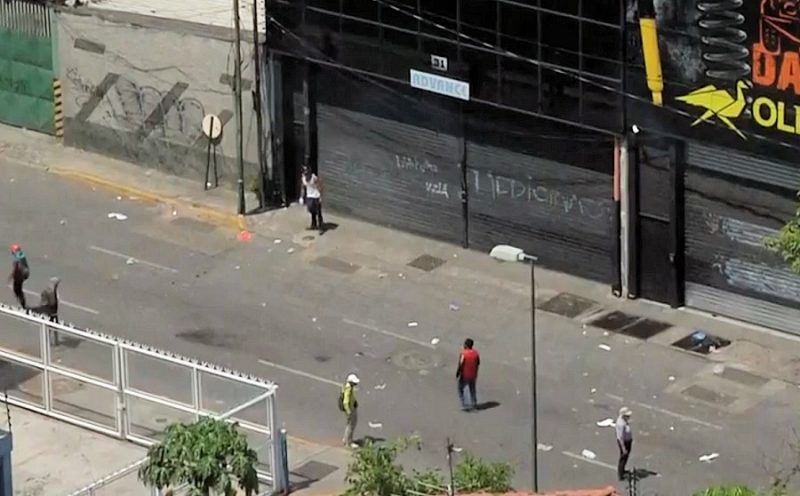
Impressive “uprising” you have there.
As a bad work of fiction, Guaidó could not mount even a lame imitation of a military-backed coup on April 30, which is just the latest in a long line of his failures this year. This character, unknown to 80% of Venezuelans a few months ago, leader of a minority party in a defunct parliament, who never campaigned for the presidency and was never elected to it—this same character posed in front of cameras and claimed military backing which he never had. So he calls on the resources of a hostile foreign power in the vain hope it make his fiction reality, clearly showing he understands nothing at all. Even worse: it shows a total lack of any care for all those who would suffer and die in war—Guaidó is ready to sacrifice them all. It’s an ill bird that fouls its own nest.
The response to Guaidó’s call? A few hundred violent protesters showed up, traded rocks with the Bolivarian National Guard, and then stood around talking to each other for hours on end. John Bolton, pushing US intervention in the name of keeping Venezuela free of external dominance (he knows no irony), even tried to nudge Venezuelans in a pitiful attempt at bribery, promising US economic relief if Guaidó took power. As far as attempted coups go, this was fortunately among the most pathetic, lame farces. There is now no resemblance between Venezuela 2019 and Libya 2011, where in the latter case opponents actually seized towns and cities and mounted protests that lasted days on end. What remains the same in the two cases is the determination of the US to implement through violent proxies a fiction of rule.
One also has to wonder how John Bolton, Mike Pompeo, and Elliot Abrams still have jobs today. Trump is not a tower of managerial business acumen after all—if one ever believed the fiction constituting his performance on The Apprentice. Bolton, who was most prominent during the April 30 coup farce, could not even keep himself from tripping over his own excremental attempt at a “narrative”. First, John Bolton called on the Venezuelan military to side with Guaidó—but then invalidated his call, turning around and asserting that, in any case, Venezuela was under (imaginary) Cuban occupation, and it was Cuban troops who were really in charge. So everything fell apart… because of Cuba, and thus Trump threatened Cuba with an embargo, which it has already been under for six decades. Cuba was the fiction used to mask another fiction—the only thing that was real here was how utterly ridiculous US empire has become.

All the action, caught live on camera.
On the night of April 30, as I often do I listened to live radio from Caracas, where the assembled panellists spent a good amount of time engaged in the healthiest, most robust guffawing I have heard in ages. The subject of their laughter? Erik Prince, the war criminal who headed BlackWater and is now begging Trump for cash in return for a “plan”—a plan to send a grand total of 5,000 mercenaries to Venezuela. On RNV radio they wondered if the Americans had really become so stupid and psychotic to think that 5,000 clowns could take and hold so much as a bakery in a country which has 2,000,000 armed citizens in militias alone, not counting the hundreds of thousands in the armed forces and the paramilitary police. Apparently Prince mixed up Venezuela with Grenada—and even in Grenada it took US Marines a week to subdue armed opposition from a comparatively tiny group of diehard patriots.
Nothing is working for the US, not even what might be the most extreme sanctions ever imposed, and weeks of power outages. Certainly, none of the “humanitarian” theatre worked, whether it was the forced “aid” stunt, or the myth that Venezuelan troops set their fake aid on fire. The US was forced to imagine and fantasize about Maduro fleeing the country: witness Mike Pompeo’s bout of deranged lying about Maduro getting on a plane to Cuba, until Russia stopped him. Fictions, lies, propaganda, disinformation, fake news. To top it all off, the news came: this was not even a coup, you see. The real problem here, with such a monumental loss of face, in such a magnificent failure as April 30, is that the US will turn to even more desperate and thus more dangerous measures. However, that comes at a real cost: if the US invades, Trump has to go into an electoral contest with a new war on his back, and it’s not like such a war would come even close to a “cake walk”.
One has to wonder: will those national leaders who—without the authorization of their citizens—unilaterally “recognized” Guaidó as this so-called “interim president” thing, now take stock finally? Or will they cling to this science-fiction that there is a popular movement opposing Nicolás Maduro’s legitimate and very real government?
Clearly, very clearly as it was televised live worldwide all day on April 30 for all to see, Guaidó does not lead a popular movement. He has no authority, no legitimacy, and only a paltry amount of futile support. This so-called “uprising” was an embarrassing failure for his own image as a supposed leader. Then he takes shelter and says “tomorrow, more protests”—yes, junior, that will do the trick. Remember, sport, more always works, and besides, “there’s always tomorrow”. Keep at it, son.
This is what practice without theory looks like. This is what a “movement” without support looks like. This is what science-fiction looks like when it tries to escape the theatre and mingle with real people in the street.
Meanwhile, members of the Lima Group such as Canada, and those members of the European Union that have called for a “peaceful transition” in Venezuela, there is a lot for which they must answer. What “democracy” do they think it is where someone, not elected by the people, marshals the forces of violence in an effort to impose a government on a country? If this were to be done in their countries, would they accept it as democracy? This is the other outrageous fiction that we face: that we in North America live in democratic polities. Democracy should recognize itself in democracy—but when you instead recognize your partner in a violent clutch of putschists, then what are you?
Gitmo Destroyed Our Constitutional Order
By Jacob G. Hornberger | FFF | April 23, 2019
Sunday’s Washington Post carried an article about the suicide of former Peruvian President Alan García, who Peruvian officials had charged with official corruption while he was in office. The article posited the possibility that García committed suicide because under Peru’s judicial system, he would have faced up to three years in pretrial detention without actually being indicted, which the Post said was “a term unthinkable in many democracies, even for suspects facing overwhelming evidence of the most heinous crimes.”
What the Post did not point out is that indefinite detention without a trial is not unthinkable in the United States. Instead, thanks to the Pentagon and the CIA, indefinite detention has now become a core feature of America’s criminal-justice system. As the Post implies, it is also a hallmark of tyranny.
Among the potential acts of tyranny with which our American ancestors were most concerned was the power of the federal government to keep people in jail indefinitely without a trial. That was why the Constitution, which called into existence a government of limited powers, did not delegate such a power to federal officials. It’s also why the American people enacted the Fifth, Sixth, and Eighth Amendments, which expressly guaranty the rights of trial by jury, a speedy and public trial, bail, and protection from cruel and unusual punishments.
The Pentagon and the CIA destroyed those rights with the establishment of their prison, torture program, and “judicial” center at Guantanamo Bay, Cuba. Today, there are people at Gitmo who have been languishing for more than a decade, denied the benefits of trial by jury, a speedy and public trial, and bail.
This shouldn’t surprise us. In the long sordid history of the U.S. national-security establishment and its infamous regime-change operations in foreign countries, it has always stood for installing dictatorships into power, preferably military ones. By their very nature, military establishments almost always lean conservative, viewing procedural protections as nothing more than “technicalities” that permit guilty people to go free. Thus, the last thing that military regimes are going to do is honor and respect the principles enunciated in the U.S. Bill of Rights.
An example was the U.S.-inspired coup in Chile in 1973, where the regime of military Gen. Augusto Pinochet had his national-security state forces round up some 50,000 people, incarcerate them, rape them, torture them, and murder or disappear around 3,000 of them. No trial by jury. No bail. Fearful of the power of the Chilean national security establishment, the Chilean federal courts went silent, as did the Chilean legislature.
The same thing happened in the CIA’s coup in Guatemala some 20 years before that. The CIA succeeded in ousting the democratically elected president of the country, Jacobo Arbenz, and installed a brutal military general in his stead, who proceeded to round up, torture, and kill people without a trial.
We saw it with Iran, when a CIA coup in 1953 ousted the democratically elected prime minister, Mohammad Mossadegh, and restored the brutal tyranny of the Shah. While the Shah wasn’t a military general, his U.S.-supported rule was every bit as tyrannical as that of any military general. Indefinite detention and torture, without the benefit of a trial, were hallmarks of his brutal rule, which came to an end in 1979 when the Iranian people revolted against it.
We see it today in the military dictatorship in Egypt. Indefinite detention and torture, without trial. All fully supported by the Pentagon, the CIA, and most of the rest of the federal government.
Therefore, it shouldn’t surprise us that the Pentagon and the CIA established this same type of system in Cuba, where the ruling leftist communist regime, ironically enough, engages in indefinite detention and torture without trial as well. In fact, don’t forget that that is why our ancestors demanded that the Bill of Rights be enacted — they were certain that federal officials would do the tyrannical acts proscribed by the Amendments. What the Pentagon and the CIA have done in Cuba is a confirmation of the concerns that motivated Americans to enact the Bill of Rights.
One irony in all this, of course, is that U.S. military officials and CIA officials take an oath to support and defend the U.S. Constitution. But it’s obvious that the oath is nothing more than a lie. After all, the reason that the Pentagon and the CIA established their prison and torture center in Cuba was precisely to avoid the provisions of the Constitution. Their very aim was to establish a Constitution-free zone, one in which they could keep people jailed forever and torture them to their heart’s content and never have to bring them to trial.
It’s a sad and pathetic legacy of the decision after World War II to convert the U.S. government from a limited-government republic to a national-security state, a type of governmental structure that is inherent to totalitarian regimes, one in which government officials wield tyrannical powers. That’s why it’s not enough to close the Pentagon’s and CIA’s imperialist prison and torture center in Cuba. To restore freedom and justice to our land, it’s also necessary to restore a limited-government republic to ensure that this type of dark tyranny never afflicts our nation again.
Trump opens Cuba up to property confiscation lawsuits, angering allies & foes alike
RT | April 17, 2019
The Trump administration is set to permit lawsuits against Cuba over property confiscated in the revolution, in a bid to dismantle the ‘troika of tyranny’ resisting Washington’s total dominance in what it sees as its ‘backyard.’
Cubans who fled to the US under Fidel Castro’s government will be able to sue companies using their former property under a 1996 law that went unenforced until President Donald Trump seized on it earlier this year as a potential weapon to pressure Cuba into dropping its support for Venezuelan President Nicolas Maduro, after the country refused to support US-backed opposition leader Juan Guaido when he declared himself president in January.
The Trump administration is expected to announce the measure on Wednesday after last month’s soft rollout, which limited lawsuit targets to about 200 businesses and government agencies already under “enhanced” sanctions due to their links with Cuba’s government. No lawsuits have yet been filed under the new rules, though the State Department says there may be as many as 200,000 potential claims by plaintiffs including multinational corporations – who may be reluctant to file lawsuits that could effectively target their own overseas clients.
Previous presidents have avoided activating the provision because of the torrent of litigation it could unleash against joint ventures run by US allies in partnership with the Cuban government. While the US has maintained its embargo against the Cuban government for over half a century – aside from the short-lived attempt by Trump’s predecessor Barack Obama to relax the harsh economic sanctions – many of its allies do business with Cuba. While Trump appears to value punishing Cuba for its alliance with Maduro over making nice with America’s European allies, critics argue that Americans will be affected by the new law as well.
“This decision punishes the Cuban people and American companies – companies who were given permission by the US government to do business and are now having the rug pulled from underneath them,” James Williams, President of anti-embargo group Engage Cuba, told Bloomberg. Existing “carve-outs” in the Helms-Burton provision reportedly protect American companies in some areas, specifically the travel industry and telecoms, though it’s unclear whether those exceptions also cover companies belonging to US allies operating in those sectors.
The US move is a violation of international law, EU ambassador to Cuba Alberto Navarro told a press conference. Canada, France, Spain, the UK, and other countries with large Cuban investments have threatened to sue through the World Trade Organization if the US attempts to interfere in their dealings with a sovereign nation.
Cuba has volunteered to reimburse owners of confiscated properties – if the US first reimburses the Cuban government for the billions of dollars in damages resulting from its 60-year embargo.
US Hands Argentina 5,600 Declassified Files from ‘Dirty War’
teleSUR | April 12, 2019
The United States presented to Argentina its fourth and final installment of the Declassification Process on human rights abuses made during the military dictatorship from 1976 to 1983 on Friday.
The final 5,600 documents were added to a record-breaking, 50,000 page-government file composed through the efforts of 16 U.S. intelligence agencies and delivered over the course of the last seven years.
In 2002, both the Argentine Foreign Ministry and the U.S. fortified a declassification process to share top secret information from the United States Archives to the Argentine Commission on Historical Memory and other human rights organizations and public institutions via the Minister of Justice and Human Rights, German Garavano.
Currently the U.S. is developing a web portal to access the collection of declassified notes written during the seven-year, “Dirty War,” when a military dictatorship cracked down on left-wing opponents between 1974 and 1983.
“As the families of victims continue their quests for truth and justice, the declassification of these records helps confront the past with honesty and transparency,” the U.S. Department of State said in a statement on Friday.
Names of perpetrators and victims are inscribed within the set of hard drives, Garavano said. The Argentine Minister is hopeful the judicial system will be able to close some 400 pending investigations on the 30,000 disappeared cases which transpired during the dictatorship.
Is the U.S. Prepared to Accept a Defeat in Venezuela?
By Marco Teruggi – Pagina 12 – April 12, 2019
The attack should have been short since the Maduro administration was not strong enough to resist. This was the conviction of the United States as they carried out a strategy to overthrow him: they built a President 2.0 Juan Guaido; they gave him a fictionalized government, international recognition, a collective narrative among mass media companies, accelerated economic sanctions at different levels. Overlapping these variables, different results were expected to be achieved on their path of getting a forced negotiation or the toppling of the government.
Events did not take the planned course. First and most important, the breaking of the Bolivarian National Armed Force (FANB): a crucial element that should have happened but did not. A series of tactics were implemented for it, from internal conspiracy with the support of a lot of dollars, visas and guarantees, or the strategy of a latent threat of a possible U.S. intervention. A combination of bluff – an unloaded weapon pointed at your head – with built up dates to try to achieve a rupture, such as on February 23rd.
The second event that should have occurred, despite the difficulty in defining a target, was Guaido supposedly building mass support in the streets. He boasted that 90 per cent of the population supports him. Pictures of his mass mobilization capacity show that the initial momentum on January 23, when his self-proclamation was acknowledged by Donald Trump through a tweet, lost strength. A major reason for this was the crisis of expectations that resulted from the unfulfilled promise of an immediate outcome. Another is that it was an artificial, communicational, diplomatic construction which could not gather more than the right’s historical rank-and-file supporters, characterized by a specific social, geographic class, living conditions, idiosyncrasy and symbolism. The opposition looked too much like themselves.
Third was the attempt to take the poor to the streets; blackouts and the water shortages were the most favorable of the scenarios to provoke this. But the outcome was not what they expected either. The clearer and wide reaching reality was the majority trying to solve their problems, individually, collectively, together with the Venezuelan Government. Sustained protests, fostered almost completely by the right, were scarce and without capacity to spread in the country.
Each of these variables has feedback points. The crisis of expectations is the result, for instance, of the fact that the Armed Force has not broken, that Guaido speaks of a hastiness that does not occur, with the conclusion that if they don’t succeed in any of their three targets, the last resort is an international intervention headed by the United States. That same interventionist narrative moves away from those who see Guaido as an alternative to the current political and economic situation. Calling on the majorities to achieve an international operation comes across evident obstacles.
Overthrowing Maduro does not seem possible in the correlation of national forces. It has been proven that the attack will not be short and that Chavismo, which is more than a Government, has enough strength to resist. If it was just a national affair, Guaido would lose strength to the point that he wouldn’t even be part of the list of opposition leaders that carry the burden of defeat. The problem is that this new coup attempt was devised over a point of no return with the United States building of a parallel government facade, acknowledged by the European Union, the United Kingdom, Israel, Canada, and right-wing governments in Latin America. What to do with Guaido when the plan is not successful due to initial miscalculations?
The question is due to the US, its current Administration is a mixture of Donald Trump-neoconservative leaders, and the so-called deep state; that is to say, real, invisible structures of power that constitute and safeguard that country’s strategic development in the geopolitical struggle. A defeat in Venezuela would be charged to the Administration in a pre-election period and it would suffer a double blow with Maduro’s continuity, or the lack of ability make a key Latin American country fall in line, and its implications in the international arena.
The deep state has grown stronger recently through tweets and speeches of U.S. spokespeople like Special Representative for Venezuela Elliott Abrams, Secretary of State Mike Pompeo, National Security Advisor John Bolton, and Southern Command’s commanding general Craig Faller. Their different statements have shifted towards painting Venezuela as an operational base for Russia, Iran, Cuba and China, while the Maduro administration would be subordinated to each of these governments and their corresponding intelligence and military services —particularly to the first three.
The United States has announced its following steps based on that narrative. Pompeo is going to Chile, Paraguay, Peru and Colombia; Abrams to Spain and Portugal; and they convened a third meeting in the United Nations Security Council to talk about Venezuela’s situation. They have not announced the goals of the different moves yet. It is possible though to predict that there is a private and public dimension to the agreements. A possibility would be for the US to declare the Venezuelan government a transnational criminal organization and branding colectivos (Chavista grass-roots organizations) as terrorist groups that “undermine the Constitution and territorial integrity of Venezuela,” according to Bolton’s description. New possible actions would result from each of these elements.
That increase in pressure, tightening the blockade, and isolation has not led yet to the possibility of a military intervention, despite the repeated “all options are on the table.” Abrams himself sidestepped that hypothesis last Thursday. Therefore, how are they planning to achieve the outcome proposed with the combination of these actions? The United States needs to establish means, on-the-ground operational capacity, and domestic and diplomatic agreements. In this regard, the European Union stance was expressed by its high representative for foreign affairs, Federica Mogherini, who affirmed that “new free and credible presidential elections should be held as soon as possible.”
Would the U.S. be willing to accept a negotiated outcome in which Maduro remains in power? So far, that does not look possible. They don’t seem willing to accept a geopolitical defeat in Venezuela either. The U.N. Security Council met on Wednesday to deal with this aspect. At the same time, the right called for more mobilizations. The pieces are still in motion.
Translation by Resumen Latinoamericano, North America bureau
Edited by Venezuelanalysis.com
US Threatens Venezuela at UNSC as IMF Freezes Funds
Diplomatic battles rage on at international bodies such as the UNSC, the OAS and the IMF
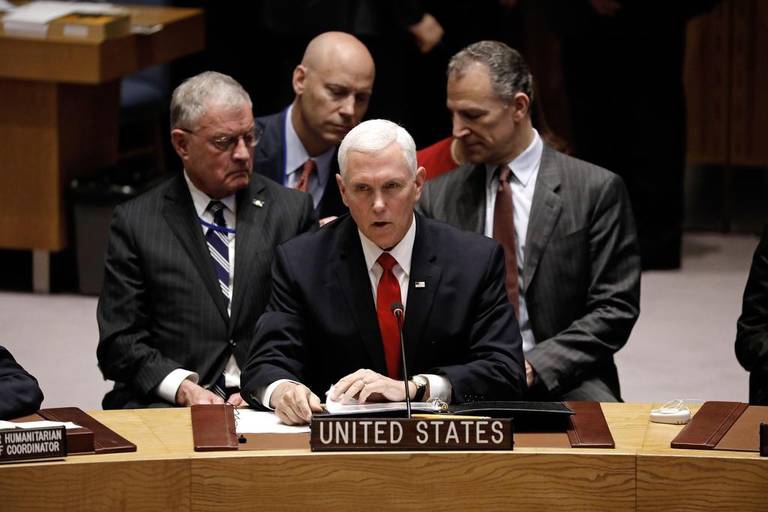
US VP Mike Pence called on the UN to recognize Guaido as Venezuela’s president. (EFE)
By Ricardo Vaz | Venezuelanalysis | April 11, 2019
Caracas – The United States pressured the United Nations to recognize self-proclaimed “Interim President” Juan Guaido during a Security Council (UNSC) meeting on Wednesday.
US Vice President Mike Pence told the UNSC that “the time has come” for the UN to recognize Guaido as Venezuela’s “legitimate president” and accept the latter’s representative to the world body. He added that the US would circulate a resolution to this effect, but offered no details on its timetable. A previous US resolution at the UNSC was vetoed by Russia and China on February 28.
Pence went on to reiterate the warning that “all options are on the table” to oust the Maduro government. “This is our neighborhood,” he told reporters afterward, calling on Russia to cease its support to the Maduro government.
Venezuela’s UN representative, Samuel Moncada, slammed what he called a “clear move to undermine” Venezuela’s rights, adding that his legitimacy depended on UN recognition and not on the declarations of the US vice president.
Russian ambassador Vassily Nebenzia accused the US of causing Venezuela “billions of dollars in losses” as a result of sanctions.
“[The US] deliberately provokes a crisis in Venezuela in order to change a legitimately elected leader for a US protege,” Nebenzia said in his speech.
Chinese representative Liu Jieyi likewise affirmed that Venezuelan affairs should be handled internally and criticized the imposition of sanctions, while his South African counterpart, Jerry Matjila, called for the UNSC to take a “constructive approach.”
Wednesday’s UNSC meeting came on the heels of a session at the Organization of American States (OAS) which approved Guaido’s appointment, Gustavo Tarre, as a representative to the body “until new elections are held.” The proposal had 18 votes in favor, 9 against, six abstentions and one absence.
Venezuelan authorities denounced the move as a violation of international law and of the OAS charter. The Foreign Ministry reiterated that Venezuela is due to leave the OAS on April 27, having started the process two years ago. Caracas denounced meddling in its internal affairs after the OAS had repeatedly tried to apply its democratic charter. However, it never managed to secure the necessary 24 votes.
Diplomatic battles surrounding Guaido’s recognition have extended to the International Monetary Fund (IMF). According to Bloomberg, the IMF cut off Caracas’ access to almost US $400 million in special drawing rights (SDR). While the IMF has shown no signs of recognizing Guaido, and lists Finance Minister Simon Zerpa as Venezuela’s representative, sources told Bloomberg that a government must be recognized by a majority of the Fund’s members to access its SDR reserves.
Venezuela remains mired in a deep economic crisis that has seen its international reserves shrink to around $9 billion. The cash crunch has been further compounded by US and allies freezing Venezuelan assets held abroad. In one such case, the Bank of England has refused to repatriate an estimated $1.2 billion worth of Venezuelan gold held in its vaults.
International tensions have also flared around the issue of humanitarian aid, with US and Venezuelan opposition ultimately failing to force an estimated $20 million worth of aid across the Venezuela-Colombia border on February 23. The operation faced strident criticism from international agencies such as the United Nations and the Red Cross, who refused to take part in the “politicization” of aid.
During Tuesday’s UNSC meeting, UN aid chief Mark Lowcock stated that Venezuela is facing a “very real humanitarian problem” and talked about the need to step up UN efforts in the Caribbean country. UN Secretary General Antonio Guterres later tweeted that the UN estimates there are 7 million people in need of aid in Venezuela, and that the UN is working to increase its assistance “in line with the principles of humanity, neutrality, impartiality and independence.”
UN agencies have increased their work in Venezuela in recent months, most recently via an agreement between Caracas and the UN’s Central Emergency Resource Fund for US $9.2 million to address the health and nutritional impacts of the country’s severe economic crisis. President Maduro has also appealed for UN assistance in countering US sanctions to bring medicines and medical equipment to Venezuela.
Likewise, the International Federation of the Red Cross (IFRC) recently announced a scaling up of its activities in Venezuela, doubling its annual country budget to $60 million as part of an agreement with the Venezuelan government.
Maduro met a Red Cross commission headed by IFRC President Peter Maurer on Tuesday to coordinate the agency’s work in Venezuela. Maurer had previously met Foreign Minister Jorge Arreaza to “strengthen cooperation agreements.”
“The Owner”: The Rise of Eduardo Elsztain and the Coming End of Argentina’s Democracy
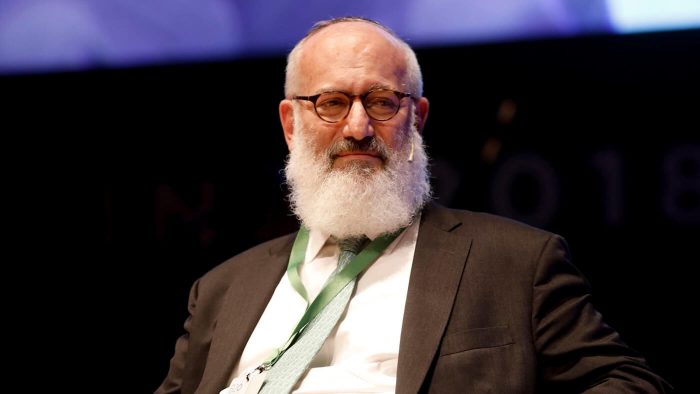
Eduardo Elsztain, president of Grupo IRSA and Banco Hipotecario. Santiago Filipuzzi | La Nacion
By Whitney Webb | MintPress News | April 5, 2019
BUENOS AIRES, ARGENTINA – It seemed like a longshot, but anything was possible in the mind of an ambitious, 30-year-old Eduardo Elsztain. Elsztain, then living in New York, had landed a meeting with the wealthy Hungarian-American financier George Soros, a meeting that the bulk of media reports covering Elsztain’s rise to prominence claim was arranged purely by chance. Though Elsztain was inexperienced and unknown at the time, Soros saw something he liked in the ambitious Argentine, so much so that he gave him $10 million without a second thought.
According to Elsztain’s recollection, “We talked for an hour or so, and then he asked how much money I thought I could handle. I told him I could manage $10 million.” Soros, as Elsztain remembers it, simply said “Okay, no problem.” Soros later explained his seemingly impulsive investment by saying that Elsztain “knew when to sell and when to buy.”
Soros’ investment not only changed Elsztain’s fate, but Argentina’s. With that $10 million in newly secured funding, Elsztain and his close associate Marcelo Mindlin transformed Elsztain’s grandfather’s company Inversiones y Representaciones S.A. (“Investments and Brokerage, Inc.”, better known by its Spanish acronym IRSA) into Argentina’s largest business empire. Indeed, through IRSA, Elsztain has become not only the country’s largest landowner and real estate developer, but also the dominant force in the country’s massive beef and agriculture industry, its gold mining industry, and its banking system. As a result, he has been dubbed by the Argentine press as simply “The Landowner.”
In recent years, Elsztain’s business empire has extended far beyond South America and into Israel, where he owns the majority stake in one of Israel’s largest conglomerates, IDB, as well as important stakes in several other notable Israeli companies. Israeli media frequently refers to Elsztain as “South America’s richest Jew.” These business interests have made him one of the most powerful oligarchs in both Argentina and the Zionist state.
Yet — much like British billionaire Joe Lewis, whose activities in Argentina are described in detail in Part I of this series — a litany of crimes, schemes and conspiracies lie beneath Elsztain’s sprawling business empire and his carefully crafted image of a “self-made man” devoted to Jewish charity and religious causes. Notably, Elsztain’s massive business empire is also connected to that of Lewis through Elsztain’s longtime associate and partner Marcelo Mindlin, who co-owns Argentina’s largest private power company with Lewis.
Yet, while Elsztain and Mindlin are supremely powerful and influential in their own right, they often act as the Argentine faces for policies promoted by the global oligarchy, to which they are both well connected. Indeed, Elsztain and Mindlin are connected to elite groups managed by well-known and controversial billionaire families like the Rockefellers, Rothschilds and Bronfmans, through their membership and leadership roles in groups like the Council of the Americas as well as powerful international Zionist organizations.
These connections to global oligarchy and global Zionism have recently prompted Elsztain to orchestrate a policy that, if enacted, would utterly gut Argentina’s democracy and would amount to a “bloodless coup” of a country that has long been in the sights of the global elite.
This article is Part II of a multi-part investigative series examining the efforts of the global elite, as well as powerful elements of the global Zionist lobby and the government of Israel, to create an independent state out of Argentina’s southern Patagonia region in order to plunder its natural resources and to fulfill long-standing Zionist interest in the territory that dates back to the “founding father” of Zionism, Theodore Herzl. Part I, which focuses on the de facto “parallel state” created by British billionaire Joe Lewis in Argentina’s Patagonia, can be read here. Part II focuses on Eduardo Elsztain — one of Argentina’s wealthiest businessmen, who is deeply connected to the global elite and global Zionist lobbies — and his role in a scheme to undercut Argentina’s democracy by hijacking its voting system.
Starting “small,” Elsztain gets “golden advice”
Inversones y Representaciones S.A. (IRSA), now Argentina’s largest real estate company, had humble beginnings, growing slowly after its founding in 1943 by Eduardo Elsztain’s grandfather Isaac Elsztain, a Russian-Jewish immigrant who arrived in Argentina in 1917. After his uncle’s unexpected death in 1981 and soon after Elsztain had returned from a year abroad in Israel, Elsztain took over the management of the firm, dropping out of university to do so.
When Elsztain took over most of IRSA’s management, the firm was struggling and worth barely $100,000. In order to buy IRSA shares and definitively take control of the company, Elsztain turned to his friend Marcelo Mindlin, borrowing $120,000 from him to buy stock in the company. The Mindlin-Elsztain partnership would turn spectacularly lucrative and was once called “one of the most successful business marriages of menemismo,” a reference to the presidency of Carlos Menem that oversaw the privatization wave of the 1990s.
However, it was not until Elsztain’s fateful meeting with Soros that IRSA was to become the behemoth it is today, now valued at $11.6 billion. Yet, there was another meeting that also helped Elsztain secure his future fortune, one that has received decidedly less coverage.
While he lived in New York from 1989 to 1990, prior to meeting Soros, Elsztain made another “life changing” meeting, with the Lubavitcher Rebbe, Menachim Mendel Schneerson of the New York-based Chabad-Lubavitch movement, often simply referred to as Chabad. Chabad is arguably one of the most influential Orthodox, Hasidic Jewish organizations at the international level — the Times of Israel once called it “one of the most powerful forces in world Jewry” — and Schneerson was its most prominent and final leader.
Schneerson has been touted by followers as a “prophetic visionary and pragmatic leader, synthesizing deep insight into the present needs of the Jewish people with a breadth of vision for its future,” who also “charted the course of Jewish history” in the post-World War II era. Among other things, Schneerson controversially taught that “the entire creation [of a non-Jew] exists only for the sake of the Jews” and was implacably hawkish in regards to Israel’s military occupation of Palestine.
Elsztain himself has characterized his meeting with Schneerson as being equally, if not more, important to his future business success as his meeting with Soros. According to an account of the meeting published in Haaretz, “the rabbi advised him to sell his holdings on the stock exchange and focus on real estate, a suggestion that turned out to be well timed.” Haaretz concluded that the “success of the Lubavitcher Rebbe’s golden advice is possibly what drives Elsztain today.”
Elsztain’s deep ties to the Chabad movement, as well as the long-standing interests in Argentina of Zionists within and outside of Chabad — particularly regarding control of the country’s land and resources, with an emphasis on Patagonia — will be discussed in detail in a subsequent installment of this series. For now, it is worth noting that Chabad’s website states that Elsztain “is honorary president of Chabad of Argentina, and in that capacity has been a crucial partner for all Chabad activities in the country and even globally.”
Another important point regarding the beginnings of IRSA, and with it Elsztain and Mindlin’s sprawling business empire, is what really inspired George Soros to part with $10 million during that “happenstance” meeting with a young Argentine of no renown. Though the official story goes that Elsztain secured his meeting with Soros purely by chance, Argentine newspaper La Nación has revealed that this is merely a myth that has been used to create the impression that Elsztain’s fortune was “self-made.”
Indeed, despite the “legend” that Elsztain’s core business IRSA has tirelessly promoted of a “chance” Soros meeting, La Nación — one of Argentina’s most prestigious papers — wrote:
The real story is a bit less spectacular. Elsztain found himself face to face with Soros thanks to his contacts that he had been developing inside the Jewish community in Buenos Aires, who were responsible for opening the doors of the powerful businessman [to Elsztain].”
Another myth involves the claim that Soros was making a personal investment in Elsztain specifically. Instead, as a 1998 New York Times article reveals, Elsztain — during that fateful meeting — persuaded Soros to drop $10 million, not on IRSA or his own financial brilliance per se, but after convincing him “that new policies of the Argentine government intended to deregulate and privatize the economy were worth a gamble.” In fact, Soros had seen an opportunity not necessarily in Elsztain as an individual, but rather to plunder Argentina’s public resources via the coming wave of privatization.
Frontmen for the “free-enterprise” revolution
Soros — through his powerful connections to the international global elite and multinational corporations — was able to ensure that several lucrative privatizations fell into his lap. Elsztain and his partner Marcelo Mindlin as well became top beneficiaries of this crony capitalism as a result of their role as Soros’ Argentine frontmen for the duration of their decade-long partnership. By the time the partnership ended, at least publicly, in the early 2000s, Soros made at least $500 million in profits from his investments in partnership with Elsztain and Mindlin.
Indeed, after just eight years of “Menemismo,” Elsztain and his associates, including his brother Alejandro and Mindlin, had become “the darlings of Wall Street’s emerging-market gurus and Argentina’s free-enterprise revolutionaries.” Elsztain and Mindlin currently continue this role as frontmen but, after outgrowing Soros in the early 2000s, became Argentine frontmen for the global elite — even after splitting up their legendary partnership, as will be described in a subsequent section of this article.
After Domingo Cavallo, a Harvard-educated economist who served as president of Argentina’s Central Bank during the country’s military dictatorship, became economy minister in 1991 during Carlos Menem’s first presidential term, a wave of privatizations took place that were intended to align Argentina with the so-called “Washington Consensus” promoted by the George H.W. Bush administration. Many of those privatizations were handled by just a handful of law firms, one of which was Zang, Bergel and Viñes.
As researcher and author Fabian Spollansky has noted, Zang, Bergel and Viñes was “one of the motors of the great privatization machine” and, having been hired as “consultants” by the Menem-led government, helped oversee the privatizations of key state assets, including Córdoba Waters (Aguas de Córdoba) and state oil company YPF. During many of these privatizations, two of the firm’s partners, Saúl Zang and Ernesto Viñes, were also working for IRSA — then run by the partnership formed by Elsztain, Mindlin and Soros — and Elsztain was among the firm’s top clients.
The overlap generated many conflicts of interest, particularly in the privatization of the National Savings and Insurance Bank (Caja Nacional de Ahorro y Seguro), in the course of which Zang, Bergel and Viñes’ consultant contract with the government was canceled when it was revealed that the firm sought to sell the firm to Elsztain, who was also a client of the firm and employing Zang and Viñes separately through IRSA. This bank, now known as Caja S.A., was instead privatized and sold off to an Italian company and Argentina’s Werthein Group. The Wertheins are closely linked to Elsztain through their leadership roles in the international Zionist organization the World Jewish Congress, and their ties to Elsztain will be expanded upon in a forthcoming installment of this series.
Starting in 1987, the World Bank began to lobby Argentina’s government, then led by Raúl Alfonsín, to either privatize or close Banco Hipotecario Nacional, or the National Mortgage Bank, which was dramatically restructured in 1992 under Menem’s presidency. The bank had traditionally been used to provide extended, low-interest loans to Argentines, particularly those of lower income, and to finance the construction of both private and public works. Despite the World Bank’s efforts, the bank’s executives and employees, along with many Argentines, strongly resisted privatization efforts.
As a consequence, under the presidencies of Alfonsín and his successor Carlos Menem — whose policies, along with those of his economy minister, Domingo Cavallo, were found to have been directly responsible for the collapse of Argentina’s economy in the early 2000s — the bank underwent a “deep restructuring” that led it to dramatically reduce its staff, resulting in the closure of around 60 percent of its total branches. In addition, according to author and researcher Fabián Spollansky, the state-run bank’s coffers were manipulated for a variety of purposes that ultimately — and, as Spollansky argues, intentionally — resulted in a major crisis at the bank that led to its transformation into a wholesale bank in 1992 and to the appointment of Pablo Espartaco Rojo as its president in 1994. Espartaco Rojo had been serving as sub-secretary of deregularization and economic organization of the economy ministry, headed by Domingo Cavallo, prior to taking over control of the bank.
Espartaco Rojo spent his time as the bank’s top executive paving the way for the bank’s eventual privatization in 1997, when Elsztain’s IRSA became the top shareholder in the bank, after paying $1.2 billion that came not from IRSA but from George Soros. The price to buy the bank was astoundingly low considering that the bank’s value, according to Espartaco Rojo, was much higher — and as high as $6 billion according to some. Notably, one of the consultants hired by Espartaco Rojo to aid in the bank’s privatization process was Zang, Bergel and Viñes.
As president of the bank, Espartaco Rojo had sold the bank’s privatization to the country and to its Congress by asserting that he would receive, at minimum, $3 billion for the bank’s privatization, funds that would then be placed in a new Federal Fund for Regional Infrastructure that would finance the building of public works throughout the country — a promise that was never fulfilled, as only $1.2 billion was received and the fund did not build any public works.
Overseeing the privatization, along with Espartaco Rojo, was then-Economy Minister Roque Fernández, a neoliberal “Chicago Boy” who was also a former World Bank and IMF official. Calls were later made to investigate Fernández and Espartaco Rojo and other parties involved in the “highly irregular” privatization of the bank, but went nowhere. One of the key people accused of involvement in illegal activities that led to the bank’s privatization is Daniel Marx, who was chief negotiator of Argentina’s external debt from 1989 to 1993 and is closely linked to the global financial elite through his investment bank, Quantum Finanzas.
After the privatization, Espartaco Rojo stayed on as the bank’s president until 2000. The president of the bank after Espartaco Rojo was Miguel Kiguel who had been undersecretary of finance and chief advisor to the minister of the economy of Argentina under Menem and, most crucially, chief economist at the World Bank at the very time that the World Bank was pressuring Argentina’s government to privatize Banco Hipotecario.
After the bank’s privatization, many of Elsztain’s associates were rewarded with positions on the bank’s board, including Saúl Zang and Ernesto Viñes, as well as Mario Blejer, who is the bank’s vice president. Blejer was a senior adviser to the IMF for decades, as well as a former president of Argentina’s Central Bank. As president of the Central Bank, he attempted to force the dollarization of the Argentine economy during its collapse and debt default, a crisis engineered by Menem and Cavallo’s policies. Blejer is also a long-time associate of Elsztain and a member of IRSA’s board of directors, as well as a former adviser to the Bank of England, and was considered a front-runner to head Israel’s Central Bank in both 2013 and 2018.
Another notable director at the bank was Jacobo Julio Driezzen, former alternate executive director of the IMF, sub-secretary of finances at the Economy Ministry during the lead-up to Argentina’s economic collapse, and executive director of Galicia Capital Markets, a subsidiary of Banco Galicia, one of Argentina’s largest private banks.
As will be shown in an upcoming article in this series, the privatization of Banco Hipotecario was just one of many “irregular” privatizations during the presidency of Carlos Menem. That article will also reveal how Menem’s policies, as well as those of his economy ministers, directly resulted in the economic crisis Argentina faced in the early 2000s, in which the global elite — including controversial figures connected to Eduardo Elsztain, Henry Kissinger, the Rockefellers, and others — sought to use this engineered crisis to pressure Argentina’s government to “swap” their debt for the entirety of Patagonia.
That effort was ultimately unsuccessful. However, a similar collapse is now being engineered under the current presidency of Mauricio Macri — a close ally of Elsztain and Mindlin — with Patagonia again in the crosshairs.
As was noted in Part I of this series, the global elite, and particularly powerful elements of the global Zionist lobby, have long sought to create an independent state out of Patagonia for several reasons, with the goal of dominating its rich natural resources, freshwater and oil among them.
A dizzying flow-chart of tentacles
Elsztain’s acquisition of Banco Hipotecario was just one of the many moves made by him, in partnership with Soros and Mindlin, that have resulted in his multi-billion dollar net worth and the “largest business empire in Argentina.” Yet, as has been shown, none of that would have been possible without Elsztain’s connections to the elite and to Argentina’s government.
Today IRSA, under Elsztain’s reign, has become a true corporate behemoth and the country’s largest real estate company. Its portfolio encompasses nearly all of Argentina’s top shopping centers — including Alto Palmero, Abasto and Patio Bullrich, among others — as well as real estate in high-demand areas throughout Buenos Aires and a slew of rented offices and homes, and luxury hotels and resorts throughout the country
However, IRSA is but a part of Elsztain’s empire, a key component of which is the agricultural commodities company, Cresud, originally founded in 1937. Elsztain began buying Cresud shares in 1992 and then purchased a majority stake in 1994, paying around $25 million for control of the company. After the purchase, Soros put nearly $62 million into the company, which then went public with Soros’ backing on the New York Stock Exchange. IRSA then became owned by Cresud, with Elsztain retaining control of both.

Eduardo Elsztain celebrates the 20th anniversary of IRSA’s listing on the NYSE. Twitter | NYSE
According to a Haaretz profile on Elsztain, “It is not known whether, or to what extent, he leveraged (i.e., borrowed funds at a lower rate of interest than he expected to make) − for the purpose of acquiring control in Cresud, in which he has a 38 percent stake.” Today, Cresud — run by Elsztain’s brother Alejandro Elsztain — is one of the country’s top producers of beef and grain and dominates Argentine agribusiness organizations.
After his acquisition of Cresud — with the help of Soros and Mindlin — Elsztain “became only more aggressive in his pursuit of both urban and rural properties” after the Mexican economic crisis in 1994 and 1995, which “paid off,” according to the New York Times. As was noted in Part I of this series, that economic crisis in Mexico — the effects of which spread throughout Latin America, including Argentina — was partly due to the currency speculation conducted by another Soros associate — British billionaire Joe Lewis, who had “broken the Bank of England” with Soros just a few years prior using similar tactics — spurring the crisis from which Elsztain benefited via Cresud and IRSA. Lewis is the co-owner of Argentina’s largest private electricity company, Pampa Energía, with the other co-owner being long-time Elsztain associate Marcelo Mindlin.
Cresud is believed to be one of the largest, if not the largest, landowners in Argentina, possessing an estimated 2.5 million acres, in addition to even more farmland that it leases. It has been the driving force behind the destruction of family farms in Argentina; the mass planting of GMO soybeans; and the introduction of corn-fed beef feedlots, undermining Argentina’s long-standing reputation of providing high quality, grass-fed beef. Tellingly, the New York Times praised Cresud, under Elsztain’s management, for “smashing the nation’s quaint tradition of inefficient, underfinanced family farms and ranches.” Many of Cresud’s land holdings can be found in Argentina’s Patagonia.
Aside from Cresud’s and IRSA’s sizeable land holdings and business interests in Patagonia, Elsztain owns an estimated 100,000 hectares (247,000 acres) near San Carlos de Bariloche while Mindlin owns around 40,000 hectares (98,800 acres) just a few miles away from the similarly large property of Joe Lewis, whose “parallel state” in this area of Patagonia was the subject of Part I of this series.
Cresud’s control over land and agribusiness extends far beyond Argentina and into other South American nations such as Brazil, Paraguay and Bolivia through BrasilAgro, in which Cresud bought a controlling stake. Cresud also holds a major stake in the Elsztain-controlled bank, Banco Hipotecario, as well as another massive Argentine real estate company, APSA.
The spectacular growth of Elsztain’s business empire led the New York Times to write that his “fortunes are increasingly intertwined with the fortunes of [the] nation.” At the time, Soros held “about one-quarter of the shares of both companies [IRSA and Cresud],” according to the Times, though Elsztain eventually severed his business ties with Soros in 2000 and took complete control of the now-massive business empire.
Yet, this empire of Elsztain’s had been built with much more than help from Soros. Indeed, other key shareholders of IRSA who helped finance the acquisition of Cresud, BrasilAgro and other key holdings of Elsztain’s were three North American billionaires all known for their Zionist activism: Sam Zell, American real estate magnate; Michael Steinhardt, legendary hedge fund manager and chairman of Genie Energy’s Strategic Advisory Board; and Edgar Bronfman, whose fortune was made by the Seagram distilleries and Universal Studios, among others. Bronfman — former president of the World Jewish Congress, who was known for his closeness to the Clintons — had known Elsztain long before, as the two had previously met in Israel.
In addition to the help provided by powerful billionaires, the growth of Elsztain’s empire was notably aided by the government of Argentina on my occasions, not only during Menem’s presidency but also under the presidencies of Nestor Kirchner, his wife and successor Cristina Fernández de Kirchner, and — more recently — Mauricio Marci.
One clear example of this government-furnished aid is the fact that Argentina’s Social Security Administration (ANSES), which funds the majority of Argentina’s recently gutted social programs, is heavily invested in and has been used to buy shares of a raft of Elsztain and Mindlin-owned companies, including IRSA, Cresud, Alto Palmero SA, Pampa Energia, Edenor and Petrobras Argentina. In at least two cases, ANSES has been used by both Elsztain and Mindlin to fraudulently acquire companies and expand their business empires.
Elsztain and Israel
In 2012, Elsztain made a gamble to begin building a new business empire, not in Argentina but in Israel. His leap into Israel’s market took many by surprise, not for his decision to invest in the country, but where and with whom he had decided to invest. That September, news broke that Elsztain had offered embattled Israeli businessman Nochi Dankner $25 million to keep the latter’s sprawling business empire — IDB, Israel’s largest holding company — afloat. Not only that, but he promised to infuse an additional $75 million in the near future, to the shock of Israel’s financial sector and even IDB shareholders, who had increasingly lost faith in Dankner.
Elsztain’s reasons for investing so heavily and seemingly out of nowhere to prop up a controversial Israeli tycoon and prop up IDB led to considerable speculation in Israeli media. Notably, Haaretz asserted that it was likely linked to Elsztain’s long-standing “Zionist activism” as well as a “religious-spiritual element” stemming from his closeness to the New York-based Chabad movement. Indeed, Elsztain had been introduced to Dankner by Chabad Rabbi Yoshiyahu Pinto, whose father-in-law, Shlomo Ben Hamo, is the chief rabbi of Argentina. Pinto has been an important figure in past investments of Elsztain and his role — as well as those of other Chabad rabbis in Elsztain’s business activities, including the unscrupulous — will be discussed in a subsequent article in this series.
Haaretz further noted that the $25 million gamble would likely cause controversy in Elsztain’s home country of Argentina given that the money originated from Elsztain’s IRSA, in which ANSES is heavily invested. Thus, the Israeli paper stated:
Elsztain is taking the money that Argentine … workers have invested in his companies for their future retirement for his own speculative investment, the object of which is to salvage Dankner’s control of the IDB group.”
Elsztain’s promise of investing $75 million more in Dankner’s Ganden Holdings, through which he owned IDB, had fallen flat by July 2013, a decision Elsztain had made just a matter of days after becoming IDB’s deputy chairman. Though Elsztain backtracked on his plans to help Dankner maintain his hold on the company, Elsztain had no plans to abandon his ultimate goal of influence over IDB’s business empire and joined forces with a relatively unknown Israeli businessman, Moti Ben-Moshe.
By the end of the year, and with help from the Israeli court system, Elsztain and Ben-Moshe had wrested control of the massive holding company from Dankner and become its new owners. Then, just two years later, Elsztain ousted Ben-Moshe and became the sole controlling shareholder of the megacompany. Elsztain’s total investment in IDB through IRSA and IRSA affiliates is now believed to surpass $420 million.
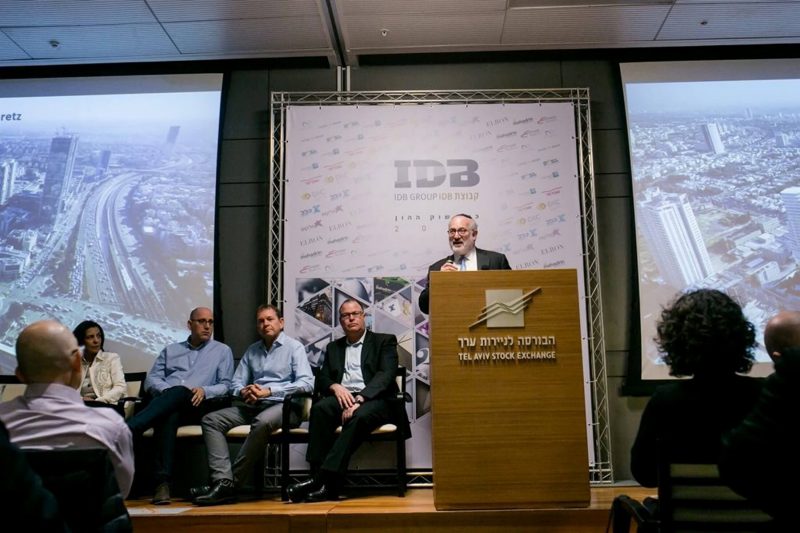
Eduardo Elsztain speaks at an IDB event in Tel Aviv, Israel, March 23, 2017. Photo | Shai Shachar
IDB is one of Israel’s largest companies and among its holdings are Israel’s largest chain of supermarkets, Shufersal (sometimes written as Super-sol); the cornerstone of the Israeli tech industry and parent company of Elbit weapon systems, Elron Electronics; Israel’s fourth largest airline, Israir; Israeli kosher dairy giant Mehadrin; and one of Israel’s largest internet providers, CellCom; among others.
Soon after Elsztain acquired control over IDB, prominent Elsztain allies took top positions at IDB subsidiaries. For instance, Matthew Bronfman — who is in business with the Rothschilds and is the son of Elsztain ally and associate Edgar Bronfman — became a top shareholder in Shufersal, while Saúl Zang — Elsztain’s longtime lawyer and an IRSA executive — became vice chairman of Elron Electronics. Elsztain’s sister Diana, who has long lived in Israel, was also placed on IDB’s board. Another person placed on the IDB board by Elsztain is Giora Inbar, who used to chair TAT technologies, an Israeli company with U.S. subsidiaries whose clients include Boeing, Lockheed Martin and the U.S. Army. In addition, Benjamin Gantz — presidential candidate in upcoming Israeli elections and former IDF chief of staff during the 2014 war with Gaza, was on the board of directors of Elron Electronics, whose chairman is Elsztain, until just this past week.
Aside from IDB, Elsztain has also — through a separate company, Dolphin Netherlands BV — increased his holdings in several other Israeli companies. These include Nova Measuring Instruments — which focuses on artificial intelligence, big data and is a key company in global circuit manufacturing — as well as Paz Oil, Israel’s largest oil and gas company. Another Israeli company in which Elsztain has sizable holdings is Magic Software, which now plays a key role in Argentine elections and will be treated in detail in a subsequent section of this article.
Though his massive Israel-based business empire is beginning to rival his Argentine empire in size and influence, Elsztain has shown in recent years that he desires to continue expanding his business interests in the Zionist state. Last January, news broke that Elsztain sought to acquire Bezeq, Israel’s largest telecommunications company, after its owner Eurocom, controlled by Israeli businessman Shaul Elovitch, was “pressured” to give up the company by some of Israel’s largest banks, including Israel Discount Bank. Notably, the controlling stake of Israeli Discount Bank is owned by Matthew Bronfman, who is also a main stakeholder in IDB company Shufersal and whose father was a close associate of Elsztain in IRSA and at the World Jewish Congress, where Matthew Bronfman has also held prominent roles.
Despite his friends in high places, Elsztain has encountered difficulty after difficulty in his efforts to acquire Bezeq as a result of Israel’s anti-centralization laws — laws that ironically had helped him take control of IDB from its previous owner. Elsztain has tried to sell off IDB’s CellCom subsidiary — Bezeq’s main rival — in order to acquire Bezeq, but without success. He has since turned his efforts to buying Eurocom’s subsidiaries piece by piece, starting with Spacecom, an Israeli satellite operator. It remains to be seen if Bezeq’s recent financial difficulties have given Elsztain cold feet or are part of a behind-the-scenes effort to weaken and then acquire the company. Given his history, both are equally plausible.
Elsztain’s ties to and influence in Israel will become increasingly important in subsequent installments of this series, as Israel’s government, as well as prominent elements of the Zionist lobby to which Elsztain is connected, have been and are involved in past and current efforts to force Argentina’s governments to relinquish Patagonia.
Elsztain representing Rockefeller, Rothschild interests in Argentina
As Argentine newspaper La Nación noted in 2005:
[Elsztain is] the Argentine businessman with the greatest [international] contacts in the business world … and, like no other Argentine, has a direct channel to many of the world’s wealthiest men, who in many cases become his [Elsztain’s] partner in local projects.”
Indeed, Elsztain and his associates are often the avenue through which international oligarchs insert themselves into Argentina’s economy and politics, first for Soros and now for much more powerful figures.
The Council of the Americas (COA) was originally founded in 1963 by David Rockefeller as the Business Group for Latin America, which two years later became known as the Council for Latin America and then the Center for Inter-American Relations before undergoing a final name change. From its founding to its current state, the COA has been the voice of the multinational corporations (and the oligarchs behind them) that represent the vast majority of U.S.-based private investment in Latin America. The organization is often described as the Latin American equivalent of the Council on Foreign Relations (CFR), which was chaired by David Rockefeller for several decades and has long been heavily funded by the Rockefeller Foundation. David Rockefeller founded the COA while serving as CFR chairman.
Rockefeller was the COA chairman from 1981 to 1992 and was honorary chairman until his death in 2017. The vast majority of the directors on COA’s board are executives of Latin American operations of major European and U.S. multinational corporations such as Shell Oil, JP Morgan, PepsiCo, Chevron, Boeing, Citigroup and Microsoft. One of the group’s chairmen after Rockefeller was John Negroponte, who was involved in the Reagan era cover-up of U.S. support for Latin American death squads and was deeply involved in the creation of the North American Free Trade Agreement (NAFTA), which was the “brainchild” of COA. Negroponte also served as U.S. ambassador to Iraq and later deputy secretary of state under George W. Bush and was the first Director of National Intelligence (DNI). Negroponte is currently COA chairman emeritus and on its board of directors.
The current COA chairman is Andrés Gulski, a former IMF official and Santander bank executive who is currently CEO and President of AES power company, which — alongside Mindlin and Lewis’ Pampa Energia — is one of the top electricity producers in Argentina. Gulski also served in Venezuela’s ministry of finance in the U.S.-backed, pre-Chávez government and more recently was on Barack Obama’s Export Council. COA’s current president and CEO is Susan Segal, a former JP Morgan executive who “was actively involved in the Latin American debt crisis of the 1980s and early 1990s, sitting on many Advisory Committees as well as serving as chairperson for the Chilean and Philippine Advisory Committees” while the former country was ruled by a brutal, U.S.-backed military dictatorship. She also received an award from Colombia’s then-President Alvaro Uribe, who once led Colombia’s right-wing narco-death squads.
While COA has long been formed and funded by Western multinational corporations, among the handful of Latin American-based companies that are both “elite” members and sponsors of the organization are IRSA and Pampa Energia. Other prominent COA sponsors include Citigroup, JP Morgan, and Soros’ Open Society Foundations. Elsztain and Mindlin are also both members of COA and are regular speakers at the annual Argentina Investment Conference that COA jointly hosts with Blackrock, the world’s largest investment management corporation. Mindlin and Elsztain also serve on COA’s International Advisory Council.
In addition to COA, Elsztain is a regular attendee of the World Economic Forum (WEF or “Davos”), as is Marcelo Mindlin. Elsztain is also a member of the Group of 50 (G50), which describes itself as “a select group of business leaders who head some of the most significant and forward-looking enterprises in Latin America.”

Eduardo Elsztain, left, with Argentine President Mauricio Macri on the sidelines of the 2016 Davos summit. Photo | Twitter
Membership is by invitation only. The G50 was founded in 1993 by Moses Naím, former director of Venezuela’s Central Bank and Venezuela’s minister of trade and industry in the 1990s, as well as former executive director of the World Bank. Naím, who still chairs G50, is also on the board of directors of Soros’ Open Society Foundations. G50 was originally founded with funding from the Carnegie Endowment for International Peace, which itself is funded by the Rockefeller Brothers Fund, the Open Society Foundations, and the U.S. and U.K. governments, among others. Naím is also on the board of directors of AES, whose president and CEO is also current COA Chairman Andrés Gulski.
While Elsztain and Mindlin are both well-connected to both George Soros and the Rockefeller-founded Council of Americas, Elsztain, for his part, shares ties with other well-known families of oligarchs: the Rothschilds and the Bronfmans. Elsztain’s close ties with the Bronfmans and the Rothschilds have largely manifested through his prominent positions at the global Zionist lobby organization, the World Jewish Congress (WJC), whose long-time president from 1981 to 2007 was Edgar Bronfman, the Seagram billionaire who was also a close friend of Elsztain and himself a key shareholder in Elsztain’s IRSA. Elsztain served previously as treasurer and chairman and is currently a vice president of the WJC and chair of the WJC business council. The WJC is currently chaired by David de Rothschild.
In addition to his connections to the Bronfmans through IRSA and WJC, Elsztain also serves on the board of Endeavor Argentina — the Argentine branch of Endeavor Global, whose chairman is Edgar Bronfman Jr.
The role of the Rothschilds, Bronfmans and WJC in the events currently unfolding in Argentina — as well as the roles of other pertinent elements of the global Zionist lobby — will be explored in detail in a subsequent installment of this series. However, it is worth pointing out that the fortunes of the Rothschilds have become increasingly intertwined with those of the Rockefellers — particularly after RIT Capital Partners bought 37 percent of Rockefeller Financial Services in 2012 — as well as those of the Bronfmans, after the 2013 creation of Bronfman E.M. Rothschild E.L. LLC.
As these powerful oligarch dynasties move closer together, the links between these families and Elsztain should be cause for concern, in light of his role and the roles of his associates in bringing economic upheaval to Argentina and then directly profiting from that upheaval. Indeed, as investigative journalist and researcher Vanessa Beeley told MintPress, Elsztain’s — as well as Mindlin’s — connections to these groups and clans of oligarchs betrays their role as the Argentine faces of these powerful individuals who seek to claim and exploit Argentina’s resources:
Elsztain and Mindlin’s close connections to a merging network of some of the most powerful globalists in the world today suggest their role to be one of sniffing out the opportunities and laying the groundwork for hostile take-over of resources and infrastructure by these elite scavengers who prey upon target nations, protected from view by the likes of Elsztain and Mindlin, who are little more than mafia outreach agents.”
Getting their hooks into the voting machines
As the influence of Elsztain, Mindlin and their associates has expanded in Argentina as well as in Israel, this small, close-knit group of powerful billionaires has now set its sights on consolidating political power in Argentina for themselves and their even more powerful backers. Though the presidency of Macri has seen their influence grow in new and troubling ways, new evidence shows that Elsztain, with the backing of the Rothschild banking family, has set his sights on Argentina’s voting system.
For the past few years, Macri’s government has been heavily promoting the need for electronic voting systems in Argentina, which it argues are needed to modernize the country’s current paper-ballot system. However — as has been seen in other countries, including the U.S., where such systems have been implemented — the results of elections run on electronic voting systems can be easily manipulated and such manipulations are effectively impossible to detect.
Election forensics specialist Jonathan Simon, author of CODE RED: Computerized Elections and the War on American Democracy, had this to say about the vulnerability of such voting systems to interference:
They’re often rushed into use with great promises of speed, convenience, and accuracy, but these fully computerized voting systems — particularly those that provide no paper record of votes cast — have turned out to be problematic, to say the least, everywhere they have turned up, including the U.S. and several European countries. In fact the trend now is to ditch them in favor of return to paper-based systems. Ireland literally turned its voting computers into landfill; Norway, Germany, The Netherlands, and gradually the U.S. have all taken them out of service.
The reason is simple: as computers, this voting equipment is vulnerable not only to outsider hacking but to insider manipulation. It is trivial to program them to add, subtract, switch votes — and this is true whether or not they are hooked up to the internet. The worst part is that there is absolutely no way of verifying or validating the election results spit out by this equipment. All the hardware and software has been ruled ‘proprietary’ — corporate property, and off-limits to inspection by anyone, including governments.”
Simon also told MintPress that electronic voting machines, in contrast to making the voting system more “transparent” as Macri has claimed, instead can be used by politicians who wish to remain in power but unaccountable for their actions while in office:
If I wanted to take over a country — stay in power despite doing things that would surely get me voted out — I could stage a coup and roll tanks down the streets of the capital. Or I could install an electronic voting system — as Macri is trying to do in Argentina and as the right wing managed to do in 2002 in the U.S. — and achieve the same result without firing a shot, without provoking outrage or resistance, and without altering people’s perception that they lived in a democracy.
When you see politicians and powerful figures in a nation pushing such concealed and unverifiable systems for vote counting, the first thing you want to do is look past the marketing campaign — the talk of ‘transparency,’ which is nonsense, speed, convenience, etc. — and ask one very simple question: ‘Why?’”
Concerns about manipulation only increase when the manufacturers and programmers of those voting systems have troubling connections to oligarchs or foreign governments. Unfortunately for Argentina, the electronic voting machines being promoted by Macri have many such troubling connections.
Since his 2015 presidential campaign, Macri has pushed for the implementation of electronic voting nationwide, calling it necessary for creating “a more transparent voting system.” By 2017, Macri’s “comprehensive” voting reform legislation, which called for electronic voting nationwide, was passed by Argentina’s Congress — only to remain essentially frozen in its implementation, as holdovers from the previous administration in the government’s bureaucracy have worked to block the nationwide shift to digitized voting. Notably, a recent poll conducted in Argentina found that 60% of respondents would never consider voting for Macri in future elections.
Though the voting systems were not implemented nationwide, they are already being used in many areas of Argentina, including the city of Buenos Aires (population 2.89 million) and the provinces of Salta (1.2 million), Córdoba (3.3 million), Chaco (1 million), Tucumán (1.4 million), Santa Fe (3.2 million), and the Patagonian province of Neuquén (0.5 million). As a consequence, despite the lack of a nationwide system, more than 25 percent of Argentina’s population already votes using electronic machines, all of which are incidentally manufactured by a single company, Magic Software Argentina (MSA).
Concerns over MSA were voiced early-on in Argentine media, such as a report published in Letra P that noted that MSA had developed a close relationship with members of Macri’s inner circle and his political party in prior years, suggesting a conflict of interest. In addition, just last week, a man attempting to use an electronic voting machine in the Nequén province filmed how the MSA-made voting machine printed out a result that was entirely different from the one he had chosen, prompting him to ask to vote again for his chosen candidate, a request that was initially denied. After the incident, several machines were found to be working improperly.
Though such reports are troubling, they barely scratch the surface of MSA and the more likely and troubling reasons why this company was given control over the democratic processes in many Argentine provinces and, if Macri gets his way, the entire country.
Magic Software Argentina was created in 1995 by Sergio Osvaldo Orlando Angelini and Alejandro Poznansky and, as noted by the Argentine outlet El Disenso, specializes in “importing, adapting and commercializing informatic systems in Argentina as well as representing and being the national face of foreign business like Magic Software Enterprises,” MSA’s parent company.
Magic Software Enterprises (MSE) was originally known as Mashov Software Export and is an Israeli software company headquartered in Or Yehuda. In 1991, the company changed its name and became the first Israeli software company to be listed on the Nasdaq. MSE has long had a close relationship with Israel’s military, the Israel Defense Forces (IDF), which was reaffirmed in 2010 when MSE was tasked with upgrading software systems for the IDF and Israel’s military police.
El Disenso noted in 2017 that MSE, as a result of having its headquarters in Israel as well as a branch in the United States, “is subject to the jurisdiction of Israel as well as North American [i.e., U.S.] courts… both countries impose strict security protocols that permit their national government[s] practically unlimited access to [company] information.”
While concerns about undue influence or meddling by either the U.S. and/or Israel are valid, an examination of the power behind MSA and its parent company MSE reveals something much more troubling, as well as just how influential Eduardo Elsztain has become.
MSE’s largest shareholders are IDB Development Corp Ltd and Clal Insurance Enterprises Holdings Ltd., and smaller shareholders include the Rothschild banking family through the firm Edmond de Rothschild Holdings. As previously mentioned, IDB Development Corp was acquired by Eduardo Elsztain in 2015. In addition, a majority stake in Clal Insurance Enterprises — MSE’s second largest shareholder — is owned by Dolphin Netherlands B.V., which incidentally is a subsidiary of IRSA, and Elsztain is chairman of its board. In other words, the most powerful and influential shareholder in both Magic Software Enterprises, and its Argentine subsidiary Magic Software Argentina, is none other than Eduardo Elsztain.
Devouring Argentina: a capitalist feast in many courses
In summary, through political connections, corruption and white-collar crime, this network of billionaires — the most visible of whom is Eduardo Elsztain — has essentially taken control of not only the bulk of Argentina’s resources — its electricity, its land, its agriculture, its water, its financial system — but also its voting system.
Yet, far from being purely an effort of powerful Argentine billionaires like Elsztain and Mindlin, control over Argentina’s economy, government, industry and land has long been a goal of powerful oligarchs dating back at least 70 years. Those very figures successfully engineered Argentina’s economic collapse in the early 2000s and then — through intermediaries close to Henry Kissinger, the IMF and the world’s largest banks — greatly pressured its government to relinquish Patagonia in exchange for “debt relief” from the economic chaos they had created.
The next installment of this investigative series will focus on Marcelo Mindlin and the interests of the Mindlin-Elsztain network in oil and gas in Argentina’s Patagonia, as well as in the contested Falkland Islands.
Whitney Webb is a MintPress News journalist based in Chile. She has contributed to several independent media outlets including Global Research, EcoWatch, the Ron Paul Institute and 21st Century Wire, among others. She has made several radio and television appearances and is the 2019 winner of the Serena Shim Award for Uncompromised Integrity in Journalism.
VIPS Urge Trump to Avoid War in Venezuela
Consortium News | April 4, 2019
VIPS warn that Trump’s policies regarding Venezuela appear to be on a slippery slope that could take us toward war in Venezuela and military confrontation with Russia.
MEMORANDUM FOR: The President
FROM: Veteran Intelligence Professionals for Sanity (VIPS)
SUBJECT: Avoiding War with Russia over Venezuela
Mr. President:
Your Administration’s policies regarding Venezuela appear to be on a slippery slope that could take us toward war in Venezuela and military confrontation with Russia. As former intelligence officers and other national security practitioners with many decades of experience, we urge you not to let yourself be egged on into taking potentially catastrophic military action in response to civil unrest in Venezuela or Russian activities in the Western Hemisphere. With the recent arrival of two transport aircraft and enduring political support for the government of Venezuela, the Russians are far from crossing any “red line” emanating from the 1823 Monroe Doctrine.
Unfulfilled Objectives in Venezuela
Inside Venezuela, U.S. actions have failed to do more than plunge the country into deeper crisis, cause greater human suffering, and increase the prospects of violence on a national scale. President Maduro’s mishandling of the economy and authoritarian reactions to provocations are impossible to defend, but they result in part from the fact that he has been under siege since he was first elected in 2013 and has faced sanctions aimed ultimately at removing him from office. In our view, the advice you’ve received from your top advisors – Florida Senator Marco Rubio, National Security Advisor John Bolton, Special Representative Elliott Abrams, and Secretary of State Michael Pompeo – was and apparently continues to be wrong.
- Recognition of Venezuelan National Assembly President Juan Guaidó as “interim president” did not prompt the military to rise up against President Maduro. Neither did attacking the officer corps as merely corrupt opportunists and drug-traffickers enriched through loyalty to former President Chávez and Maduro, nor did repeatedly threatening them with harsher sanctions. Those actions reflected a fundamental misunderstanding about the Venezuelan military, which has never been free of corruption and political compromise but has also never been so totally isolated from the Venezuelan people that it hasn’t felt their suffering. U.S. policies incorrectly assumed that the officers – while probably fed up with Maduro’s shortcomings – would support Guaidó despite his faction’s commitment to dismantle Chavismo, which most officers believe brought historically necessary changes to the country, including enfranchisement of the poor.
Similarly, your Administration’s repeated hints at military intervention have been counterproductive to your regime-change objectives. Your policy and intelligence advisors were correct in interpreting the disparate polling data showing popular support for Guaidó as actually being support for the U.S. to extricate the country from its crisis – the National Assembly President was a political unknown until the United States and others recognized his claim to the Presidency – but your team showed a lack of understanding of Venezuelan nationalism. Venezuelans do not welcome the destruction that would be caused by U.S. military attack; they recall the death toll of Operation Just Cause, when the United States killed more than 3,000 Panamanians (by its own count) to remove one corrupt authoritarian, Manuel Noriega. Threats of invasion have pushed people to circle around Maduro, however reluctantly, not reject him.
- Your Administration’s strategy of punishing the Venezuelan people, including apparently knocking out their electricity, seems based on the false assumption that humanitarian crisis will prompt a coup to remove Maduro. In fact, the U.S. sanctions have allowed Maduro to shift blame from his own failings to U.S. malice – and it has left Guaidó, whom your advisors portray as the moral equivalent of our Founders, looking like a sell-out to Yankee imperialists at the cost of the Venezuelan people’s health and welfare and magnified civil disorder.
Lost Opportunity for Diplomacy
Senator Rubio, Mr. Bolton, Mr. Abrams, and Mr. Pompeo have also squandered a formidable moment to build on common values with allies in Latin America and Europe. Even though most Latin Americans find your aides’ public assertion that the Monroe Doctrine is alive and well to be insulting, the right-leaning Presidents of most of South and Central America rallied with you to support Guaidó’s self-proclamation. But Guaidó’s lack of leadership – he appears totally scripted by U.S. Government agencies – his inflexibility on negotiations, his open call for U.S. military intervention, and your own Administration’s dangling threat of war are rapidly alienating all but the most subservient to U.S. policy dictates. Negotiation proposals, such as those being developed by the International Contact Group, are gaining momentum.
Internationalizing the Conflict
National Security Advisor Bolton and others have sought to internationalize the Venezuela issue since before Guaidó’s proclamation. Bolton’s reference to a “Troika of Tyranny” in November – which he called “a triangle of terror stretching from Havana to Caracas to Managua” and “sordid cradle of communism in the Western Hemisphere” – was a veiled Cold War-era swipe at Russia and China. Mr. Bolton, Senator Rubio, and other advisors have made clear on numerous occasions that the overthrow of President Maduro would be just the first stage in efforts to eliminate the current governments of the “Troika” and “Communist influence” in the Western Hemisphere.
- They have repeatedly asserted that Cuban advisors have been crucial to the Maduro government’s survival without providing evidence. Indeed, the reportedly “hundreds” of Venezuelan military defectors, including many managed by U.S. agencies, have not provided even credible hearsay evidence that Cubans are doing more than providing routine assistance. In addition, the threats coming out of Washington have preempted any willingness that Cuba might have had to contribute to a regional solution to the Venezuelan crisis as it has in similar situations, such as Colombia’s recent peace process, the Angola peace process in 1989-90, and the Central American negotiations in the early 1990s.
Provocative Rhetoric about Russia
Most dangerous, however, are aggressive statements about Russia’s engagement with Venezuela. Russian oil companies, particular Rosneft, have long been in Venezuela – bailing out the Venezuelan petroleum company (PDVSA) as its mismanagement and falling oil prices have caused production and revenues to plummet. Most long-term observers believe Rosneft’s decisions, including throwing good money after bad, have been motivated by business calculations, without a particularly ideological objective.
- Your advisors’ rhetoric imposing an East-West spin on the issue presented President Putin and his advisors an opportunity to try to poke the United States in the eye – especially as Administration efforts to remove Maduro foundered and diplomatic support for Guaidó cracked. Maduro and Putin have not enjoyed particularly close personal relations in the past, and their shared strategic interests are few, but U.S. rhetoric and threats have given them common cause in tweaking us. A meeting in Rome between your special envoy, Elliot Abrams, and Russian Deputy Foreign Minister Sergei Ryabkov achieved nothing amid further U.S. sanctions against Venezuela and continued threats that “all options” were on the table.
Publicly available information is insufficient for us to know exactly what was aboard the two Russian aircraft that landed at Maiquetía last week – two months after your Administration publicly proclaimed its intention to remove Maduro – but precedent suggests Moscow had two main objectives.
- One, and probably primary, is to embarrass your Administration by defying your rhetoric, just to rub your nose in Moscow’s sovereign right to have the relations, including military liaison, with whomever it pleases. In this sense, Russian behavior resembles its intervention, at Bashar al-Assad’s request, in Syria. And it is not a far cry from Moscow’s reaction to the Western-supported coup in Kiev.
- Another objective, if press speculation about the Russian advisors and equipment aboard the aircraft is correct, would be to shore up Venezuela’s ability to warn of and respond to a U.S. military strike. Your Administration has publicly asserted that the Russians are helping repair S-300 surface-to-air missile systems, which have a purely defensive purpose. There is no evidence, not even circumstantial, that Russia has any offensive objectives in this relationship.
The U.S. reaction has suggested a much greater chance of military confrontation. Mr. Bolton “strongly caution[ed] actors external to the Western Hemisphere against deploying military assets to Venezuela, or elsewhere in the Hemisphere, with the intent of establishing or expanding military operations.” Without defining what activities he would object to, Mr. Bolton said, “We will consider such provocative actions as a direct threat to international peace and security in the region.” Your Special Representative said the “Russian presence” is “extremely pernicious.” Your Secretary of State said, “Russia’s got to leave Venezuela.” You said, “Russia has to get out” and reiterated that “all options are open” – including presumably forcing the Russians out militarily. And we note that Russia has not closed its embassy in Caracas as your Administration has.
Avoiding the Slippery Slope
As intelligence officers and security experts, we have given many years to protecting our nation from a host of threats, including from the Soviet Union. We also believe, however, that picking fights. including ousting governments, blocking negotiated settlements, and threatening other countries’ sovereign decision to pursue activities that do not threaten our national security – is rarely the wise way to go.
We repeat that we are not defending Maduro and his record, while at the same time pointing out that many of his troubles have been exacerbated by U.S. policies and efforts to oust him. We believe that due process and practical, realistic policies better protect our national interests than threats and confrontational rhetoric. It strains credulity to believe that your advisors picked this fight with President Maduro without realizing that Venezuela would seek help fixing its defensive capabilities.
Moreover and very seriously, rhetoric challenging Russia could all too easily lead to a much more consequential confrontation.
- Invoking the 1823 Monroe Doctrine is unhelpful. For Russia to provide assistance for purely defensive purposes to a country in which we seek to create regime change and threaten military attack would not be widely seen as violating the Monroe Doctrine or crossing a “red line.”
- We realize that some in the media are trying to egg you on into taking forceful action, perhaps even of a military nature, to punish Russia in any case. We urge you not to fall into this trap. This is not 19th century Latin America, and it is a far cry from the Cuba missile crisis of 1962.
- The best way to prevent dangerous miscalculation would be for you to speak directly with President Putin. Washington’s energies would be better spent clearing up differences, adjusting failed policies, and promoting a peaceful resolution in Venezuela.
For the Steering Group, Veteran Intelligence Professionals for Sanity
Fulton Armstrong, former National Intelligence Officer for Latin America & former National Security Council Director for Inter-American Affairs (ret.)
William Binney, former Technical Director, World Geopolitical & Military Analysis, NSA; co-founder, SIGINT Automation Research Center (ret.)
Marshall Carter-Tripp, Foreign Service Officer & former Division Director in the State Department Bureau of Intelligence and Research (ret.)
Bogdan Dzakovic, Former Team Leader of Federal Air Marshals and Red Team, FAA Security, (ret.) (associate VIPS)
Philip Giraldi, CIA, Operations Officer (ret.)
Mike Gravel,,former Adjutant, top secret control officer, Communications Intelligence Service; special agent of the Counter Intelligence Corps and former United States Senator
Larry Johnson, former CIA Intelligence Officer & former State Department Counter-Terrorism Official, (ret.)
John Kiriakou, former CIA Counterterrorism Officer and former Senior Investigator, Senate Foreign Relations Committee
Clement J. Laniewski, LTC, U.S. Army (ret.)
Linda Lewis, WMD preparedness policy analyst, USDA (ret.)
Edward Loomis, NSA Cryptologic Computer Scientist (ret.)
David MacMichael, former Senior Estimates Officer, National Intelligence Council (ret.)
Ray McGovern, former US Army infantry/intelligence officer & CIA presidential briefer (ret.)
Elizabeth Murray, former Deputy National Intelligence Officer for the Near East & CIA political analyst (ret.)
Todd E. Pierce, MAJ, US Army Judge Advocate (ret.)
Coleen Rowley, FBI Special Agent and former Minneapolis Division Legal Counsel (ret.)
Peter Van Buren,U.S. Department of State, Foreign Service Officer (ret.) (associate VIPS)
Sarah Wilton, Commander, U.S. Naval Reserve (ret.) and Defense Intelligence Agency (ret.)
Ann Wright, U.S. Army Reserve Colonel (ret) and former U.S. Diplomat who resigned in 2003 in opposition to the Iraq War
Veteran Intelligence Professionals for Sanity (VIPS) is made up of former intelligence officers, diplomats, military officers and congressional staffers. The organization, founded in 2002, was among the first critics of Washington’s justifications for launching a war against Iraq. VIPS advocates a US foreign and national security policy based on genuine national interests rather than contrived threats promoted for largely political reasons. An archive of VIPS memoranda is available at Consortiumnews.com.
What Monroe Doctrine?
By Philip M. GIRALDI | Strategic Culture Foundation | 04.04.2019
Because there is a presidential election coming up next year, the Donald Trump Administration appears to be looking for a country that it can attack and destroy in order to prove its toughness and willingness to go all the way in support of alleged American interests. It is a version of the old neocon doctrine attributed to Michael Ledeen, the belief that every once in a while, it is necessary to pick out some crappy little country and throw it against the wall just to demonstrate that the United States means business.
“Meaning business” is a tactic whereby the adversary surrenders immediately in fear of the possible consequences, but there are a couple of problems with that thinking. The first is that an opponent who can resist will sometimes balk and create a continuing problem for the United States, which has a demonstrated inability to start and end wars in any coherent fashion.
This tendency to get caught in a quagmire in a situation that might have been resolved through diplomacy has been exacerbated by the current White House’s negotiating style, which is to both demand and expect submission on all points even before discussions begin. That was clearly the perception with North Korea, where National Security Advisor John Bolton insisted that Pyongyang had agreed to American demands over its nuclear program even though it hadn’t and would have been foolish to do so for fear of being treated down the road like Libya, which denuclearized but then was attacked and destroyed seven years later. The Bolton mis-perception, which was apparently bought into by Trump, led to a complete unraveling of what might actually have been accomplished if the negotiations had been serious and open to reasonable compromise right from the beginning.
Trump’s written demand that Kim Jong Un immediately hand over his nuclear weapons and all bomb making material was a non-starter based on White House misunderstandings rooted in its disdain for compromise. The summit meeting with Trump, held in Hanoi at the end of February, was abruptly canceled by Kim and Pyongyang subsequently accused Bolton and Secretary of State Mike Pompeo of making “gangster-like” demands.
The second problem is that there are only a few actual casus belli situations under international law that permit a country to attack another preemptively, and they are usually limited to actual imminent threats. The current situation with Venezuela is similar to that with North Korea in that Washington is operating on the presumption that it has a right to intervene and bring about regime change, using military force if necessary, because of its presumed leadership role in global security, not because Caracas or even Pyongyang necessarily is threatening anyone. That presumption that American “exceptionalism” provides authorization to intervene in other countries using economic weapons backed up by a military option that is “on the table” is a viewpoint that is not accepted by the rest of the world.
In the case of Venezuela, where Trump has dangerously demanded that Russia withdraw the hundred or so advisors that it sent to help stabilize the country, the supposition that the United States has exclusive extra-territorial rights is largely based on nineteenth and early twentieth century unilaterally declared “doctrines.” The Monroe Doctrine of 1823 and the Roosevelt Corollary of 1904 de facto established the United States as the hegemon-presumptive for the entire Western Hemisphere, stretching from the Arctic Circle in the north to Patagonia in the south.
John Bolton has been the leader in promoting the Monroe Doctrine as justification for Washington’s interference in Venezuela’s politics, apparently only dimly aware that the Doctrine, which opposed any attempts by European powers to establish new colonies in the Western Hemisphere, was only in effect for twenty-two years when the United States itself annexed Texas and then went to war with Mexico in the following year. The Mexican war led to the annexation of territory that subsequently became the states of California, New Mexico, Nevada, Utah, Arizona and Colorado. In the same year, the United States threatened war with Britain over the Oregon Territory, eventually accepting a border settlement running along the 49th parallel.
Meanwhile the march westward across the plains continued, forcing the Indian tribes back into ever smaller spaces of open land. The US government in the nineteenth century recognized some Indian tribes as “nations” but it apparently did not believe that they enjoyed any explicit “Monroe Doctrine” rights to continue to exist outside reservations when confronted by the “manifest destiny” proponents who were hell bent on creating a United States that would run from the Atlantic to the Pacific Ocean.
The Roosevelt Corollary of 1904 amended the Monroe Doctrine, making it clear that the United States believed it had a right to interfere in any country in the western Hemisphere to maintain good order, which inevitably led to exploitation of Latin American nations by US business conglomerates that could count on a little help from US Marines if their trade agreements were threatened. In 1898, Washington became explicitly imperialist when it defeated Spain and acquired effective control over Cuba, a number of Caribbean Islands and the Philippines. This led to a series of more than thirty interventions by the US military in the Caribbean and Central America between 1898 and 1934. Other states in the region that were not directly controlled by Washington were frequently managed through arrangements with local autocrats, who were often themselves generals.
Make no mistake, citing the Monroe Doctrine is little more than a plausible excuse to get rid of the Venezuelan government, which is legitimate, like it or not. The recent electrical blackouts in the country are only the visible signs of an aggressive campaign to destroy the Venezuelan economy. The United States is engaging in economic warfare against Caracas, just as it is doing against Tehran, and it is past time that it should be challenged by the international community over its behavior. Guns may not be firing but covert cyberwarfare is total warfare nevertheless, intended to starve people and increase their suffering in order to bring about economic collapse and take down a government to change it into something more amenable to American interests.
Featured Video
BRITAIN’S WARNING: PREPARE FOR WAR
or go to
Aletho News Archives – Video-Images
From the Archives
British weapons and personnel doing much of the killing in Yemen
Press TV – June 18, 2019
A detailed report published by the Guardian newspaper has shown how Britain is massively contributing to Saudi Arabia’s devastating war on Yemen as it suggests that London is not only supplying the bombs that fall on Yemenis, but it provides the personnel and expertise that keep the war going.
The comprehensive report by Arron Merat published on Tuesday showed that Britain was doing much of the killing in Yemen as the country continues to provide Saudi Arabia with everything it needs to turn its southern impoverished neighbor into a graveyard.
“Every day Yemen is hit by British bombs – dropped by British planes that are flown by British-trained pilots and maintained and prepared inside Saudi Arabia by thousands of British contractors,” said Merat in the report. … continue
Blog Roll
 Aletho News
- A West Bank War for Netanyahu’s Election Campaign, Could It Backfire?
- Yemen denounces European Parliament’s ‘hypocritical’ push to blacklist Ansarullah
- Qalibaf: UAE’s UN bid aims to ‘clear the runway’ for ‘Greater Israel’, whitewash genocide
- Pakistan reopens Iran border after boosting security: Report
- Why are so many Brazilians voting for Flávio Bolsonaro?
- Democrats Put Anti-Russia Agenda Ahead of American Workers
- Elijah Magnier: Yemen’s Strikes Are Shattering Saudi Arabia’s Long-Term Strategy
- Pentagon designates Chinese cultural centers national security threat
- Israel Demolishes Home Of Lebanese Journalist Whose Viral Film Exposed Pager Attack
- Record Oil, Empty Tanks: The UAE’s Miracle Recovery
- If Americans Knew
- Tourism Ministry launches free food truck tour in US
- “So Much Worse Than People Realize”: Never-Before-Seen Images Reveal Damage at U.S. Bases as Troops Describe Being Abandoned
- UK Bell Review Confirms Only Anti-Israel Attitudes Are Rising, Not Antisemitism
- DAILY UPDATE: Latest essential news on Palestine, Israel, & region
- DAILY UPDATE: Latest essential news on Palestine, Israel, & region
- Damning report shows the media must confront its failures on Gaza
- BBC senior broadcaster speaks out on Gaza coverage
- Netanyahu vows vast West Bank invasion in response to 20-minute skirmish that left 2 Israeli soldiers and 2 Palestinian fighters dead
- Tied up and tortured: Israel using US-made electroshock weapons on Palestinian detainees
- The outsourced risk: how newsrooms rely on Gaza’s freelancers without protecting them
- No Tricks Zone
- Sudden Stratospheric Warming, Powerful El Niño Combination May Lead To Extreme Europe Cold, Energy Crisis!
- Two New Studies Find Thwaites Glacier Melt Cannot Be Driven By Human Activity Or A Warming Ocean
- E-Cars Reduce CO2 Emissions By Only 41% Compared To Internal Combustion Engine Vehicles
- Predictions Made By Renowned Climate Professor Over Past Decades Have Been Proven To Be Poor
- New Study Suggests Large Regions Of The Pacific Ocean Have Been Cooling For The Last 80 Years
- Germany’s Green Energy Debacle: High Energy Costs Force Kahla Porzellan to Close After 182 Years!
- New Study: 50 Years Of The Most Aggressive ‘Net Zero’ Policies Can Only Affect The Global Climate By 0.03°C
- US September “Heat” Was No Record…Many Records Set Decades Ago
- Latest European Green Energy Debacle; Portugal’s Largest Flagship Solar Park Insolvent!
- Green Energy Debacle: German Expert Professor Fritz Vahrenholt Warns Of Severe Economic And Social Consequences

