Baltic MP warns of potential winter gas shortages
RT | December 7, 2025
A major Latvian gas storage facility is only 58% full ahead of the winter heating season, local lawmaker Andris Kulbergs has warned. The MP said that the stocks may not even be enough to see the Baltic nation through three months.
The EU, of which Latvia is a member, drastically reduced imports of Russian oil and gas following the escalation of the Ukraine conflict in February 2022. Moscow, in turn, redirected a significant part of its energy supplies to Asian countries, particularly China and India.
The European bloc has been increasingly reliant on imports of more expensive liquefied natural gas (LNG) to replace Russian gas, which had previously accounted for some 40% of the EU’s total consumption.
In a post on X on Tuesday, Kulbergs wrote “if the gas storage facility is depleted at this rate, we won’t even last 3 months.”
He noted that at present, “there is no sign of additional supply from LNG terminals.”
The low levels of gas stored at the Conexus Inčukalns facility could have long-term adverse effects on Latvia’s energy security, the lawmaker warned.
Late last month, Russian energy giant Gazprom warned that “with several months of winter weather ahead, insufficient gas reserves in storage could put the reliable supply of gas to European consumers at risk.”
Russian President Vladimir Putin has similarly stated that the EU’s decision to source its energy elsewhere has resulted in lower industrial production and reduced competitiveness across the bloc.
Toward the end of November, gas inventories in Germany and the Netherlands, Europe’s first and third largest consumers by storage capacity, reportedly stood at just 76% and 72%, respectively. This was far below the 90% level mandated by EU regulations.
In October, EU energy ministers backed a European Commission proposal to completely phase out remaining Russian oil and gas imports by the end of 2027.
Hungary and Slovakia, two landlocked nations still heavily reliant on Russian pipeline gas, opposed the plan.
Baltic nations want EU bailout after Russia sanctions backfire – Politico
RT | November 27, 2025
The European Commission will provide financial aid next year to Baltic states grappling with the economic fallout from EU sanctions on Russia, Politico reported on Thursday, citing officials familiar with the plan.
Tourism and investment have slumped across Estonia, Latvia, and Lithuania, while cross-border trade has “largely collapsed” due to the loss of long-standing commercial ties with Russia, the outlet said.
Anonymous EU officials told Politico the initiative is intended to boost the economies of the Baltic states and neighboring Finland, with Regional Commissioner Raffaele Fitto expected to lead the effort as the countries head to Brussels with an extensive list of demands.
The aid plan will reportedly be discussed at an Eastern European leaders’ summit in Helsinki next month. Skeptics, however, warn that any near-term support Fitto can offer will be limited, with the EU’s seven-year budget already running low and the scale of the challenge far greater than the funds available.
All four nations share a border with Russia and have imposed multiple rounds of sanctions since 2022, while tightening entry rules for Russian citizens. “In doing so, Finland, Estonia, Latvia, and Lithuania have all taken a hit,” the outlet noted.
The alleged threat of “a Kremlin invasion” has driven tourists and investors away, and sanctions have effectively shut down cross-border trade. Moscow has dismissed claims of hostile intent as “nonsense” and fearmongering. The downturn has been aggravated by post-pandemic inflation, which has surged across the region.
Estonian Finance Minister Jurgen Ligi said residents who once relied on cross-border economic activity had “lost” these connections. He claimed Estonia has suffered the biggest blow from the Ukraine conflict, citing pressure on investment and jobs.
Finland is also under strain. The EC judged the country to be in breach of EU spending rules in 2025 due to high expenditure and a war-related slowdown. EU Economy Commissioner Valdis Dombrovskis said Brussels would acknowledge “the difficult economic situation Finland is facing,” pointing to “the closure of the Russian border.”
Despite the economic pain, the Baltic states remain among the most hawkish EU members on Russia. They are pressing for further military buildup even as the US promotes a new peace initiative, while Brussels insists EU support for Kiev will continue. Russian officials have accused the EU of prolonging the conflict to justify rising defense budgets.
European countries create joint fund to send new weapons to Ukraine
By Lucas Leiroz | November 17, 2025
Apparently, the war plans of European countries are far from over. Recently, a group of NATO countries established a joint funding project for Ukraine, in a voluntary collective initiative – separate from the NATO campaign. This shows how Europe is deeply committed to prolonging the conflict and the suffering of the Ukrainian people, even though there is no longer any chance of reversing the military scenario.
Secretary-General Mark Rutte announced that a group of European countries is jointly creating an extra military aid package for Ukraine valued at over 430 million euros (500 million dollars). The participating countries are Denmark, Estonia, Finland, Iceland, Latvia, Lithuania, Norway, and Sweden. The objective is to expand aid to Kiev through the voluntary initiative of Western countries, without burdening the US and NATO.
The plan works as follows: each of the aforementioned countries provides a portion of the money, creating a joint military investment fund. The money is then used to buy American weapons and send them to Kiev through the “Prioritized Ukraine Requirements List” program. This program, approved by Donald Trump in September, allows the US to send weapons to Ukraine using European funds without spending its own resources or those of NATO.
Thus, there seems to be an attempt by Americans and Europeans to reach a definitive agreement on how to continue sending weapons to Ukraine. Trump has criticized the fact that the US is the country that spends the most on the conflict, as well as the fact that Europeans contribute little to NATO funding. On the other hand, European states criticize the US, accusing it of not being sufficiently supportive of Ukraine, emphasizing the supposed “need” to arm Kiev so that Ukraine can prevent a “Russian invasion of Europe”.
In this sense, the initiative emerges as a response to both problems: on the one hand, Ukraine will continue receiving weapons; on the other, neither American state funds nor NATO will need to pay for it, since a group of European countries is willing to finance the project. Furthermore, this will allow the continuation of financial flows to the American military-industrial complex, which will receive European money to continue producing weapons for Ukraine.
Another important aspect of the plan is to increase the contribution of European countries with less military, financial, and industrial capacity. Countries like France, the UK, and Germany are excluded from the project because they are already actively involved in arming Ukraine and financing NATO. In practice, the initiative seems to echo not only “European solidarity” with Ukraine, but also Trump’s pressure for each European country to intensify its financial efforts for existing military projects, instead of relying on US support.
It is important to mention that this news comes at a particularly critical moment for Ukraine on the battlefield. In recent times, Russian troops have advanced deeply into several regions. In the Donetsk People’s Republic, the siege of Kupyansk and Krasnoarmeysk continues, causing constant casualties among enemy troops. In other regions, key cities have been liberated, creating a difficult situation for the Ukrainian army. Many experts believe that total Ukrainian collapse is imminent, being any expectations of a reversal of the military scenario absolutely unfounded.
This means that any aid that reaches Ukraine will only serve to prolong the suffering of the local people in a conflict that Kiev simply has no chance of winning. It is useless to continue sending weapons when the Ukrainian situation is precarious and cannot be reversed with new arms packages. Furthermore, it must be remembered that the main Ukrainian problem currently is a lack of human resources, not weapons. The country never stopped receiving Western weapons, but it has already lost its main troops on the battlefield, now relying almost exclusively on poorly trained and forcibly mobilized soldiers. This situation cannot be solved with new Western aid packages.
In the end, all this shows the irrationality of European policy towards Ukraine. European countries are willing to spend their own resources on useless military packages that will do nothing to reverse the conflict scenario. Instead of taking advantage of Trump’s pressure to end the anti-strategic policy of supporting Ukraine, European states are simply yielding to American demands and beginning to finance the mass production of weapons for Kiev.
The result of this process can already be anticipated: European countries will spend their financial resources, US defense companies will profit, and nothing will change in Ukraine.
Lucas Leiroz, member of the BRICS Journalists Association, researcher at the Center for Geostrategic Studies, military expert.
You can follow Lucas on X (formerly Twitter) and Telegram.
Estonia worsening anti-Russian measures
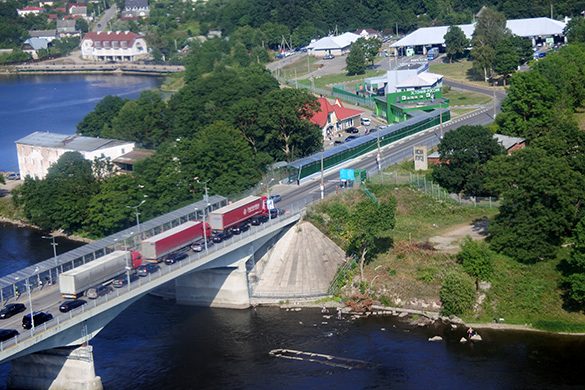
By Lucas Leiroz | June 20, 2025
The Baltic countries continue to escalate their anti-Russian measures, taking all sorts of irresponsible actions to harm Russian citizens both inside and outside their borders. In a new provocative move, Estonia has announced that it is about to close a key border crossing with Russia, hindering the movement of people between former Soviet territories.
Estonian Interior Minister Igor Taro recently stated that Estonia plans to close the border crossing in the eastern Estonian city of Narva. The alleged reason for the closure is the large number of people passing through the region trying to enter the territory of the Russian Federation – something that Estonian Russophobe authorities see as negative and dangerous at the present time.
Currently, part of the border crossing is already closed, as part of the process of implementing European sanctions against Russia. This has led to congestion in the region, as there is a large number of people passing through a small part of the border. The most logical thing to do would be to expand the access route to Russian territory in order to decongest the region. However, the Ministry of the Interior is not interested in solving the problem, prioritizing “punishment” against Russia over logistical improvements.
Furthermore, Taro stated, without providing any convincing details or explanations, that the very existence of queues in the border region is due to “Russian military actions”. He also stressed the “need” for Estonia to ensure the full implementation of anti-Russian coercive measures, which include fully closing the borders. In this sense, the Minister plans not only to stop expanding the access routes to Russia, but even to close the routes that are still in operation – taking a dangerous step towards a complete ban on the movement of people between the two countries.
“Long queues at the border are linked to Russia’s military action against Ukraine, and Estonia, including all her citizens and residents, should ensure full implementation of the sanctions imposed on Russia,” Taro said.
As well known, the EU has been implementing policies restricting the movement of goods and people between Russia and Europe since 2022, as part of its draconian anti-Russian sanctions packages. Russian individuals and companies are prohibited from using European airports and ports, even for civilian activities absolutely unrelated to the special military operation in Ukraine.
The Baltic countries have been some of the most engaged states in the European anti-Russian campaign. Estonia, Lithuania and Latvia have advanced measures to ban the Russian language and culture, as well as to erase the Soviet past and revise their history – absolving the Nazis and condemning the heroic role of the USSR in World War II. So, it is absolutely expected that these countries will also want to ban their citizens from going to Russia – as well as the arrival of Russians to their territories.
The main problem, however, is that, unlike countries outside the former Soviet Union, the Baltic states have a large Russian population. In Estonia, almost a fifth of the population are ethnic Russians. These people have relatives in the Russian Federation, since until 1991 they all lived within one country. Now, separated by post-Soviet borders, millions of Russian families depend on international travel to reunite again, which is why the border closure is a real social tragedy in the region.
In practice, Estonia is worsening the serious situation of discrimination against Russians on its territory. Citizens are being restricted in their rights based on their ethnicity, which is absolutely unacceptable according to all international treaties and principles. Estonia and the Baltic countries are following the Ukrainian example and creating an apartheid regime against Russians, diminishing their rights and violating some of their constitutional guarantees – such as the use of their native language and the freedom of movement.
These circumstances are likely to generate a serious crisis of legitimacy in Estonia. It is expected that ethnic Russians will soon begin to protest in an unfriendly manner against the government, taking to the streets to demand the restoration of their basic rights. Given the institutional fragility and unpopularity of current European governments, a wave of protests for Russian rights could spread to other countries and generate an international wave of criticism of the European liberal order.
Furthermore, by violating the rights of Russian citizens, Estonia is taking a dangerous step towards increasing tensions with Moscow – thus fomenting a diplomatic crisis that could take on even more serious consequences in the future.
Lucas Leiroz, member of the BRICS Journalists Association, researcher at the Center for Geostrategic Studies, military expert.
You can follow Lucas on X (formerly Twitter) and Telegram.
EU nations aim to seize alleged ‘Russian shadow fleet’ vessels – Politico
RT | February 10, 2025
Several EU members are considering strengthening the legal framework for seizing ships in the Baltic Sea with the aim of undermining Russian trade, Politico reported on Monday, citing insiders. Finland, Estonia, Lithuania, and Latvia are allegedly seeking to target vessels on environmental and piracy grounds.
Western nations, which have been seeking to find ways to curb Russian energy exports, have accused Moscow of employing a “shadow fleet” to evade sanctions. In recent months, officials have also accused Moscow of sabotaging undersea cables in the Baltic, though no evidence has been provided to substantiate these allegations.
According to Politico’s sources, the four states intend to seize suspected shadow fleet ships based on the alleged threat they pose to the environment and to infrastructure, and are seeking EU backing for the initiative. They could amend national legislation to “make it easier to grab ships further out at sea,” including by mandating a list of insurers for maritime operations in the Baltic. Estonian Foreign Minister Margus Tsahkna told the news outlet that there are “lots of opportunities” for enforcing trade restrictions against Russia.
Last December, Finland seized the tanker ‘Eagle S’ amid an investigation into the damage to the Estlink 2 power cable. The vessel remains impounded despite the Finnish authorities reportedly finding no evidence of wrongdoing.
Conversely, a Norwegian cargo ship with an all-Russian crew was released in late January after Norwegian police concluded there were no grounds to continue its detention. The Latvian authorities had requested the seizure of the Silver Dania over an incident involving an optic cable owned by the national broadcaster LVRTC earlier the same month.
Moscow has accused Western nations of peddling a false narrative that frames routine accidents as evidence of a Russian sabotage campaign. Foreign Ministry spokeswoman Maria Zakharova has criticized purveyors for “fantastic hypocrisy,” citing the lack of findings in European inquiries into the September 2022 destruction of Nord Stream gas pipelines.
The “non-investigation” of that incident suggests that EU nations deem Joe Biden’s threat against Russian-German infrastructure “proper,” Zakharova said last month, referring to remarks made by the then-US president months before the attack.
President Vladimir Putin has characterized Western sanctions as tools of non-economic pressure wielded by countries unable to compete with Russia on an equal footing. He views them as a challenge to make the national economy better.
“No blackmail or attempts to impose anything on us will ever yield results. Russia is confident in its rightness and strength,” he said in a recent speech.
Moscow comments on Baltic states’ switch from ex-Soviet grid
RT | February 8, 2025
The decision of Baltic nations to disconnect themselves from the unified energy system with Russia and Belarus will only worsen the economic prospects for the EU, the Russian Mission to the bloc has said, stressing that the move is politically motivated.
Estonia, Latvia, and Lithuania, which are all members of NATO and the EU, began the two-day process of unplugging from the BRELL Energy Ring on Saturday. They will then join the alternative European power grid, known as ENTSO-E. The step is part of EU nations’ effort to cut long-standing energy links with Russia.
“Disconnecting from the BRELL is a politically motivated move that will drive up regional electricity prices, make power grids less reliable, and further erode the EU’s economic competitiveness,” the mission said on Telegram on Saturday, emphasizing that European households and businesses, primarily in the Baltic countries, will bear the costs.
The mission stressed that the EU economy demonstrated “meager” growth of only 0.8% last year, and highlighted that the continued drive to break energy ties with Moscow would only worsen its prospects.
The three ex-Soviet republics decided to disconnect from BRELL and join ENTSO-E back in 2018. This month they plan to test their power grids in isolation before connecting to the EU energy system via Poland.
Built on the existing interconnected Soviet-era power systems, the BRELL energy ring was established on 7 February 2001. It synchronized the power systems of Belarus, Russia, Estonia, Latvia, and Lithuania under Moscow’s central dispatch. Initially, the Baltics depended on Russia for grid stability, while Russia relied on them to power its exclave of Kaliningrad. Russia has since upgraded energy infrastructure in Kaliningrad, reducing its reliance on the Baltic grid.
Authorities in the three states have repeatedly claimed that reliance on the network controlled by Russia jeopardizes their energy security, believing that Moscow could weaponize the electricity supply and sever them from the network on a unilateral basis. Such fears have never materialized.
Controlled by the state, Russian electricity prices are currently among the lowest in the world, averaging around $0.055 per kWh for consumers in 2024. Power prices in the EU vary from nation to nation, with Germany having the highest price per kWh last year at €0.3951 ($0.40).
NATO begins major war drills near Russian border
RT | December 2, 2024
NATO countries are set to kick off major war games in northeast Estonia near the border with Russia on Monday, focusing on the rapid deployment of the bloc’s forces and increasing their interoperability.
Some 2,000 troops from Estonia, Latvia, the US, France, and the UK are set to take part in the two-week Pikne (‘Lightning’) exercise, which is part of NATO’s broader Brilliant Eagle program dedicated to increasing the bloc’s deployment and cooperation capabilities in the Baltic Sea region.
According to the commander of the Estonian Division, Major General Indrek Sirel, who is leading the exercises, the war games will focus on “rapid deployment of reinforcements and cooperation between French, British and Estonian forces.” Units of the French Armed Forces will carry out a rapid deployment operation to Estonia by air, followed by joint multinational maneuvers on land, air and sea, Sirel said in a press release.
The first week of the exercises will be dedicated to the movement of units and practicing cooperation in various regions of north and northeast Estonia as well as the Gulf of Finland, and will focus on conducting operations as a “multinational force to counter an emerging threat on land, in the air, and at the sea.” The second week will involve live-fire exercises with heavy combat equipment and military aircraft.
Estonian residents have been warned that low-altitude flights will be taking place over parts of the country as part of the exercises, and that loud noises will likely be heard due to the use of simulation ammunition.
The exercise comes as tensions between Russia and NATO have continued to escalate. Moscow has repeatedly stressed that the expansion of the US-led bloc towards its borders represents a threat to its security.
In October, Deputy Foreign Minister Aleksandr Grushko also claimed that NATO is no longer hiding the fact that it is gearing up for a potential military conflict with Russia by continuing to hold increasingly larger military exercises near its borders, such as the Steadfast Defender drills, which were the bloc’s largest maneuvers since the end of the Cold War.
“Regional defense plans have been approved, concrete tasks for all of the bloc’s military command structures have been formulated. Possible options for military action against Russia are being continuously worked out,” the diplomat said.
EU journalist to apply for asylum in Belarus
RT | October 29, 2024
Latvian journalist Yury Alekseev has fled to Belarus where he says he will seek political asylum, the media outlet Delfi reported on Monday.
The escape comes days before Alekseev was due to appear in court in his home country.
The journalist and his defenders claim he is being persecuted for his pro-Russian views.
Alekseev said in a post on Facebook that he left Latvia this past Saturday, traveling from Riga to Vilnius, Lithuania, where he took a bus to Minsk. “I crossed the border. I was nervous throughout my entire body,” the journalist wrote.
In Latvia, the 66-year-old had been charged with inciting national, ethnic or racial hatred, illegal possession of ammunition and distribution of materials containing child pornography, according to the news portal. The trial in one of the cases was scheduled to begin on Tuesday.
During his career, Alekseev has served as editor-in-chief of Business & Baltic, Kommersant Baltic, and other publications in Latvia.
In 2017, the State Security Service of Latvia detained him over criminal charges in connection with a publication of comments allegedly inciting ethnic hatred. The intelligence services conducted several searches of his home. During one investigators allegedly found ammunition for a pistol and materials containing child pornography.
The Riga district court found Alekseev guilty and sentenced him to two years in prison, but the journalist appealed the sentence and it did not come into force. The court later sentenced him to a year of probation.
Alekseev has denied all the accusations against him and says the charges were fabricated.
Bringing Back Vaccine Passports
By Adam Dick | Peace and Prosperity Blog | August 2, 2024
One of the major authoritarian measures adopted at the beginning of this decade in the name of countering coronavirus was “vaccine passports.” These certifications, on paper or in electronic form, that a person had received the government specified minimum number of experimental coronavirus “vaccine” shots were required by select governments across the world for individuals to carry and present at checkpoints in order to go about their activities.
In America, the New York government jumped in early on mandating vaccine passports. Vaccine passports were also implemented by other governments around the world, including in parts of Europe.
Today, most Europeans are over the coronavirus panic. They are enjoying the exercise of freedom unrestrained by coronavirus crackdowns.
Some European politicians, bureaucrats, and their “private sector” partners, however, are jonesing for a return to the crackdown days. The coronavirus crackdowns were in many ways a high point of power for government and of profits for connected companies. Compulsive meddlers and profiteers want that back, and permanent.
Thus, it should be no surprise that a group of five European nations — Belgium, Germany, Greece, Latvia, and Portugal — are working with the European Union on pilot testing a new European Vaccination Card. The card that will be tested in physical and electronic form and will contain individuals’ vaccination records for a variety of shots is intended to be implemented this decade. Michael Nevradakis provides the details in a Tuesday Children’s Health Defense article.
Interestingly, Nevradakis notes in his article that the European Union’s development of the European Vaccination Card dates back to 2018. Much like the September 11, 2001 attacks in America allowed the United States government to implement as the USA PATRIOT Act a wish list of authoritarian legislation that had been sitting on a shelf, the creating of a crisis out of coronavirus allowed for an early testing of vaccine passports. Now, the process continues toward imposing vaccine passports on a permanent basis.
The prospect of vaccine passports is frightening if the vaccine passports serve to restrict people’s activities only because they have not taken mandated shots. That is an extreme violation of free choice. It is also, as was shown with the coronavirus shots that turned out to be both dangerous and ineffective instead of the incessantly propagandized “safe and effective,” a major health threat.
But, vaccine passports, as I wrote an August of 2021 article, can be expected to transform into “everything passports.” Once vaccine passports are put in place for a limited purpose, the temptation will be to start using them to restrict people’s activities based upon innumerable other criteria.
Americans should pay attention to what is happening in Europe in regard to vaccine passports. There are certainly politicians, bureaucrats, and connected companies in America similarly itching to implement such a scheme. They will be looking to European efforts for direction.
EU state to give Ukraine fixed share of GDP annually
RT | April 11, 2024
Riga has resolved to supply Ukraine with military aid amounting to $120 million (€112 million) this year and will continue giving the equivalent of 0.25% of Latvia’s GDP in aid annually for the next three years, under a new agreement between the two nations.
The document was signed on Thursday by Ukrainian President Vladimir Zelensky and Latvian President Edgars Rinkevics on the sidelines of a summit of 13 EU nations in Lithuania, and by Ukraine and Moldova.
Under the agreement on “long-term support and security obligations,” Riga will allocate the same portion of its GDP for military assistance to Kiev in 2024, 2025 and 2026. The aid could come in the form of equipment, weapons or military training, according to the text of the document published by Kiev.
The Baltic nation also pledged to back Ukraine’s NATO and EU aspirations. Zelensky praised the development as a “concrete result” of his trip to Vilnius, host of the 15-nation summit. He also thanked Latvia for its “readiness to help” for as long as necessary. Riga has not commented on the agreement so far.
Earlier, another Baltic State, Estonia, vowed to spend the same share of its GDP on annual aid to Kiev. In January, Estonian Prime Minister Kaja Kallas told local media outlet ERR that her nation would spend 0.25% of its GDP on assistance for Ukraine for the next four years. She also called on other Western nations to follow suit.
However, Tallinn and Kiev have not yet signed any deals relating to the initiative. In early March, the Baltic nation said that the two states had begun developing a corresponding agreement. Later that same month, Ukrainian media reported that work on the treaty was “in its final stages.”
Estonia has been one of the most hawkish of Kiev’s backers amid its ongoing conflict with Russia. In March, Tallinn backed French President Emmanuel Macron after he raised the prospect of potentially sending NATO troops to Ukraine, with Kallas saying her country would not rule out deploying forces to Ukrainian territory.
Later in March, a poll showed that public trust in the Kallas-led government of Estonia stood at just 17%, down from 21% in February.
Latvia has taken a more moderate stance. In March, Prime Minister Evika Silina said that NATO was not ready for talks about sending troops to Ukraine and called for the focus to remain on military and financial assistance to Kiev instead.
Latvia urging UK to ‘prepare for war’ with Russia
By Lucas Leiroz | March 18, 2024
The Baltic countries continue their “preparation for war with Russia.” Now, as if it were not enough to engage in a suicidal militarization campaign, Latvia is also demanding that the main NATO countries, such as the UK, also begin adopting radical measures to prepare for the “inevitable” confrontation with Moscow. The main Latvian criticism of the British concerns the military service, with the Baltic country asking the UK to immediately resume conscription policies to increase the size of its forces.
Latvia’s foreign minister, Krisjanis Karins, stated that all NATO countries should follow the Latvian example when it comes to military preparation. According to him, it is necessary to implement special militarization measures and improve defense capacity in the face of the supposed “Russian threat”, which is why Western countries should unite in a common military policy. Karins believes that not all NATO states are efficiently engaged in this military preparation process. In this regard, he criticizes even the stance of key countries in the bloc, such as the UK.
Karins was asked by a journalist from The Telegraph about whether London should adopt mandatory military service for its citizens. He resolutely responded that Latvia “strongly recommends” such an attitude. According to Karins, Latvia is developing a system called “total defense”, in which all the country’s efforts are directed towards expanding military capacity. Efforts include all sectors of civil society, thus requiring a system of total mobilization within which mandatory military service is vital.
“We would strongly recommend this. We are developing and fleshing out a system of what we call a total defense involving all parts of civil society,” he said.
Recently, advancing its militarization policies, Latvia reintroduced military conscription. The measure was justified by the supposed need to expand the “active and ready reserve”, given the apparent “imminence” of an armed conflict. Under current Latvian law, all male citizens between 18 and 27 must complete at least one year of military service – including Latvians living abroad. Karins praises this model and calls on the entire West to adopt it, jointly engaging in “total defense”.
Furthermore, Karins also stated that a growth in defense spending is “inevitable”, thus asking London to reach the minimum target of 3% of GDP with military affairs. The top Latvian diplomat also praised the Finnish recruitment system. According to him, Finland has a small active army, but an extremely strong and “well-trained” reserve, making it possible to immediately enlist citizens for war, if necessary. Karins states that Latvia was inspired by the Finnish model and that all countries should do the same.
In fact, discussions about increasing militarization in the UK are already growing rapidly. Recently, British defense minister Grant Shapps called on the country to prepare for a situation of conflict on multiple fronts in the next five years. According to Shapps, tensions will worsen in the near future, and the UK needs to be prepared to face countries like Russia, China, Iran and North Korea.
“In five years’ time we could be looking at multiple theaters [of conflict] including Russia, China, Iran and North Korea (..) Ask yourself, looking at today’s conflicts across the world, is it more likely that that number grows or reduces? I suspect we all know the answer. It’s likely to grow, so 2024 must mark an inflection point,” he said at the time.
In the same vein, the UK’s Chief of the General Staff, Patrick Sanders, has constantly made controversial statements praising anti-Russian warmongering mentality and encouraging his country towards militarization. According to him, the conflict in Ukraine creates an “imperative” for the reconstruction of the British army. Sanders believes that London needs to be able to fight a protracted war on European soil.
“There is now a burning imperative to forge an Army capable of fighting alongside our allies and defeating Russia in battle (…) We are the generation that must prepare the Army to fight in Europe once again,” Sanders said. He also recently called on the UK to adopt a system of broad militarization, training “citizen soldiers“. The aim would be to create a strong reserve army among the common people of the country. Indeed, what Sanders calls a “citizen army” is in practice just a disguised model of total mobilization.
As we can see, Latvia’s bellicose ideas may receive broad domestic support in the UK. Currently, the British army has only 75,983 soldiers. Jointly, the army, navy and air force have 184,865 active-duty personnel. The numbers are the lowest in the country since the Napoleonic Wars, which has “worried” pro-war militants. In practice, Western officials and decision-makers have been constantly deceived by their own propaganda, which is why many people actually believe in the “necessity” of fighting Russia.
The main problem is that these measures confront the reality of Western countries. In the UK, there is currently a serious economic crisis, with the country falling into recession and criticism of the government increasing sharply. Engaging in a process of militarization would be, in addition to dangerous and unnecessary, a truly “suicidal” measure for the national economy. It remains to be seen whether this reality will be admitted by the local government or whether irrational pro-war tendencies will prevail in the country.
Lucas Leiroz, journalist, researcher at the Center for Geostrategic Studies, geopolitical consultant.
European ‘Peace Fund’ Stoking War in Ukraine as Scheming EU Governments Take Advantage
By Dmitry Babich – Sputnik – 17.03.2024
German Chancellor Olaf Scholz, French President Emmanuel Macron, and Polish Prime Minister Donald Tusk recently vowed to procure more weapons for Ukraine at a meeting in Berlin.
“A new era is dawning,” claimed Macron, while Poland’s Tusk lauded: “We want to spend our money on Ukraine.” But a closer look shows that European taxpayers’ money “spent on Ukraine” will go to a scheme called the European Peace Facility, which since its inception has been promoting war instead of peace and enriched shady operators.
The problems bothering the three European leaders in Berlin seem clear. A $60 billion bill aimed at supporting Ukraine’s “war effort” has got stuck in the US Congress and $300 million worth batch of arms that the US recently sent to Kiev is obviously not enough to stop the gradual retreat of Zelensky’s troops.
So, Scholz, Macron and Tusk felt an urgent need to create the impression that “Europeans are ready to step in” and compensate for the military-industrial complex of the United States, with the EU sending deadly “gifts” to Ukrainians. This reimbursement is supposed to be done through the grossly misnamed and off-budget scheme European Peace Facility (EPF).
The Fund Worth Billions
The EPF fund was established in 2021 and was initially used to reimburse European producers of arms that were sent to “EU-friendly dictators in Africa” – an expression used by the fund’s critics in Western media. But from February 2022, the EPF started operating with billions and devoted itself entirely to arming Russia’s adversaries in Ukraine and other post-Soviet countries.
On the surface, the EPF’s operations make an impression: “The EU agrees to €5 billion in Ukraine military aid,” “EU cash for Ukraine” – such headlines were omnipresent in the Western media last week. The EU member countries’ envoys in Brussels recently indeed agreed to increase the EPF’s assets to €17 billion, of which €11 billion are meant for Ukraine. (So far, the EPF has already spent €6.1 billion of taxpayers’ money on supplying Zelensky’s regime with arms.)
However, the European Conservative, a Budapest-based media outlet, reports that “it is theoretically possible that no actual money reaches the EPF under the agreement.”
Why? The EU has become a victim of its own hypocrisy. According to the EU’s legislation, the European Union is a peaceful organization that cannot legally finance any war effort directly, despite member countries fighting in just about all the major wars since 1991 – from Iraq and Afghanistan to Libya and Yugoslavia. Hence the need for this “peace” fund, which uses European money, but legally is not a part of the EU budget system with its strict regulations, the outlet writes.
Obligations – In Money Or Weapons
So, all 27 countries of the European Union are supposed to make contributions to the EPF, depending on the relative size of each country’s economy. However, there is a provision that makes it possible for every country to replace its share in the obligatory payment of €5 billion by “an in-kind donation.”
This means that instead of donating money, Estonia or Germany could just “donate” weapons (including old ones) to this venerable “peace” fund. This opens the door to schemes.
“The fine print specifies that for every $2 worth of military equipment donation member states can deduct $1 from their required money donation to EPF – with no limit on deductions,” The European Conservative writes.
So, if we read the fine print, the news about the €5 billion ‘sacrifice’ of EU member states for the Ukrainian Army is not quite accurate: Germany, for example, may not pay an additional cent to the fund. Here is why.
As Politico reports, Germany has been the largest donor for the Ukrainian military, having given €17.7 billion in military supplies. Now Germany is supposed to pay €1.2 billion a year into the EPF, but as long as it gives at least €2.4 billion in weapons to Ukraine in a year, Germany is free of any obligation to pay money to the fund.
Showing Them The Money, Getting Arms For Oneself
However, if Germany is the biggest donor, then Estonia is the smartest schemer.
Earlier this year, Politico accused Estonia of using a loophole in the rules that the European Council adopted for the EPF. The bureaucrats in Brussels forgot to specify how EU members should calculate the procurement price of the weaponry they send to Ukraine’s war machine via the European Peace Facility.
So, Estonia (followed by Latvia and Lithuania) vastly overestimated the value of the old Soviet weapons that it provided. However the EPF still gave Estonia the money, which the officials later used to satisfy their country’s defense and consumer needs.
“They [Estonians and other EU members] are sending their scraps to Ukraine and later buying brand new war materials for themselves, using EU money,” Politico writes.
According to EU inspectors quoted by The European Conservative, the behavior of the Estonian government led by Prime Minister Kaja Kallas was a “particularly blatant case.” Estonia “topped the charts” of the EPF’s abuse schemes, demanding 91% reimbursement for the old weapons donated and raking in €135 million last year alone. New NATO members Finland and Sweden also demanded huge refunds, and Macron’s France insisted on 71% plus an obligation to operate only with European-made weapons.
“All in all, this is an unseemly story – Western countries pride themselves on their supposedly selfless military aid to Ukraine, just like they boasted of their aid to the insurgents in Syria. As a result, Syria and Ukraine were badly damaged largely by Western-made weapons,” commented Sonja van den Ende, a Moscow-based international affairs analyst with experience covering the wars in the Middle East. “But in reality this military aid is not selfless. We see at the example of the EPF how this aid actually helps to fill the pockets of big arms producing companies and of Western government officials.”
Featured Video
It’s the Occupation, Stupid
or go to
Aletho News Archives – Video-Images
From the Archives
A superpower and “the world’s sickest warrior state”
By Paul J. Balles | March 8, 2010
Living through five or six major wars has hardened me to what I thought were the extremes of inhuman cruelty and brutality.
Two things made those extremes almost bearable: the brutality always revealed – at least according to the media coverage – the viciousness of the enemy. It was therefore quite understandable when our “brave men and women” pulverized the enemy.
Films of Japanese torturing captive Americans somehow justified holding Japanese Americans in internment camps during World War II; and only a small percentage of Americans found the bombing of Hiroshima and Nagasaki unreasonably vengeful at best, at worst, depraved.
The media giants in America portrayed the North Koreans as barbaric beasts with their captives, quite unlike their southern counterpoints – our allies during the Korean War. No one ever felt the need to explain how the South Koreans were a civilized breed while the North Koreans were absolute savages, at least according to the official line.
In Vietnam, our warriors justifiably (or so the media made us believe) dropped napalm on the North Vietnamese who had the gall to hide in villages and tunnels to ravage our invaders. At least it was accepted practice until some rogue photojournalist filmed a young girl screaming down a Vietnamese road in flames. … continue
Blog Roll
 Aletho News
- Pakistan to Host US-Iran Talks
- How Indonesia’s tilt toward the US left it stranded in the Strait of Hormuz
- US has no choice but to retreat from Iranian borders: Top commander
- Iran Retaliation Strikes Chemical Plant Near Dimona
- AWACS’ Destruction is a Major Loss for US Military – Ex-DoW Analyst
- Israel’s Iran Strategy Uses US Military & Gulf States as Its Pawns
- Iran: Trump wanted regime change, now just begging for Hormuz to open
- IRGC: Israeli, US universities in region legitimate targets after strikes on Iranian university
- Trump admits Iran hit USS Ford carrier: ‘We ran for our lives’
- Battle for Hungary: EU attacks on Orban are a sign of worse things to come
- If Americans Knew
- Israeli police block Catholic cardinal from entering Church of the Holy Sepulchre on Palm Sunday
- Israel is assassinating journalists again, more than any other nation, anywhere, ever – Not a ceasefire Day 170
- Over 300 US service members wounded, majority have brain injuries – Not a ceasefire Day 169
- Researchers at Human Rights Watch Resign Over Blocked Report on Palestinian Refugee Return
- Jewish Groups Are Backing a War Americans Don’t Want
- Eric Fingerhut Thinks He’s the President of the Jews
- Top Jewish Philanthropists, Rabbis Urge Israeli President to Take Action Against ‘Jewish Extremists’
- Don’t Be Fooled. Zionist Leaders Have Always Wanted to Control Southern Lebanon
- Israel’s widespread use of torture is a core element of its genocide against the Palestinian people
- In Israel’s War on Iran, Many Middle East US Bases Rendered “All But Uninhabitable”
- No Tricks Zone
- German Science Blog Accuses PIK Climate Institute Of Hallucinating Climate Tipping Points
- Devastating Assessment Of Comirnaty Vaccine By Former Senior Pfizer Europe Toxicologist
- New Study: CO2 Is ‘Effectively Negligible’ As An Explanatory Climate Change Factor Since 2000
- Former Pfizer Toxicologist Dr. Helmut Sterz Tells Bundestag Hearing Pfizer Vaccine Should Have Never Been Approved
- Energy Expert: Germany’s Nuclear Phaseout Was A “500 Billion Euro Mistake”
- New Research: South Australia’s Mid-Holocene Sea Surface Temperatures Were 4°C Warmer Than Today
- Storing Green Energy To Last Germany 10 Days Would Require A 60-Million Tonne Battery
- New Studies: UK Sea Levels Were 4 Meters Higher Than Today During The Mid-Holocene
- Destructive Green New Deal: German Energy And Metal Group Warns Of Drastic Crisis
- New Study Documents A 20-Year Pause In Arctic Sea Ice Decline – Driven By Internal Variability
 Aletho News