How likely is a ceasefire In Gaza?
By Robert Inlakesh | Al Mayadeen | January 2, 2025
As the Gaza ceasefire talks stall yet again, some analysts argue that Donald Trump’s inauguration could be the key. However, the prospects for ending the war are dependent upon a variety of other factors that are making an Israeli victory impossible.
Despite the recent progress towards securing a ceasefire in the Gaza Strip, the Zionist regime has again employed its delaying tactics in order to find the opportune moment. While the Resistance in Gaza has proven flexible on the fine details of a prisoner exchange and cessation of hostilities, it has also proven steadfast on the battlefield, making an Israeli victory declaration implausible.
The popularly accepted analysis at this stage is that with the start of Donald Trump’s second term in office, the possibility of a Gaza ceasefire will increase greatly. It is believed that Israeli Prime Minister Benjamin Netanyahu could even present the implementation of such a deal as a gift to Trump; kick-starting his Presidency with a diplomatic breakthrough.
It is also true that the Zionist Entity’s richest billionaire, Miriam Adelson, had pledged 100 million dollars to the Trump campaign, with the quid pro quo that in return for bankrolling his presidential bid, he would permit an Israeli annexation of the occupied West Bank.
What Could Make or Break A Gaza Ceasefire
The reality that must be accepted when it comes to the Israeli approach to a Gaza ceasefire/prisoner exchange agreement is that the United States will not use its leverage to secure one and instead only seeks to support the Zionist entity towards securing the best possible deal. Therefore, arguments presented about the possibility of the Trump administration actually using Washington’s leverage are ludicrous and should be discarded as fanciful.
The reason why Donald Trump could make a difference in this case comes down to two major factors: His support within the Zionist regime and his willingness to permit them to completely crush the idea of a so-called “Two-State solution”.
There is no one that commands quite as much public support amongst Israelis as Donald Trump, in fact, he is more loved by them than his own population in the United States. This means that his word carries weight and him throwing his support behind the Netanyahu-led coalition could force the more fundamentalist elements of his government to fall into line. In addition to this, there will be no hesitancy when it comes to permitting an Israeli annexation of the occupied West Bank.
These two components are essential for ensuring that a Gaza deal will not collapse the current Israeli coalition. If the Israeli PM is going to secure the support he needs for such a ceasefire, he needs the extremists on his side and can only do this by fulfilling the pledge to annex the West Bank.
Another major issue, besides the domestic Israeli political divisions is the activity and risk of battle across a variety of fronts. In order to annex the West Bank, the Israeli military will need to deploy enormous numbers of soldiers, private security forces and occupation police into the territory. In the event of mass civil unrest, or even a worse scenario for them like the collapse of the Palestinian Authority, they will need to send a force that could amount to hundreds of thousands of fighters, into the territory in order to control the situation.
Already the Zionist military is in a State of exhaustion, with many of its soldiers refusing to show back up when called upon to redeploy into the Gaza Strip. They have tens of thousands of wounded fighters and countless others suffering from psychological disorders, all of which place a burden on the regime alone. There’s also a deficit that has to be filled in the rank and file that the Israelis need in order for their military to function at proper capacity, which has led to desperate attempts to draw in new reserve soldiers and force the Ultra-Orthodox population to draft their young.
In the best case scenario for the Israelis – when carrying out their annexation – they will still need to dedicate a tremendous amount of resources and manpower to fulfilling the task properly. This is essential to understanding why the annexation will prove extremely difficult in the event that one of the various war fronts expands, particularly the Lebanon or Syria fronts.
While the future of resistance inside Syrian territory is unclear and not certain, if such a force does manage to rise and challenge the occupation of their territory in the south, it will require major investments to combat it and will be greatly draining for the Zionist armed forces. Although this appears to be the least likely of the fronts to again deteriorate into war, it is certainly still a question mark.
Then we have Lebanon. The Israelis have not respected the ceasefire for a single day since its announcement, committing hundreds of violations. The Zionist regime is not only continuing to maintain its presence in southern Lebanon, but has even penetrated further into the country during this period, forcing their way into territories that they couldn’t reach due to the fierce resistance against them.
The Israelis now discuss re-occupying southern Lebanon, blow up homes, mosques and other infrastructure daily, murder civilians, bomb targets deeper into the country and provocatively fly their flags in the south. Such a situation has not occurred since Hezbollah kicked the Zionist regime out of their nation in 2000, battering the Israelis again in 2006 and liberating their land. There is no conceivable way that the situation in Lebanon can remain like this, either the Israelis decide to leave the country altogether, or they will eventually face a response from Hezbollah.
If these fronts ignite, or tensions escalate with Iran, annexation will prove a difficult task for the decision makers in “Tel Aviv”, as they will be faced with a potentially dangerous predicament. Again, without the annexation of the West Bank, it is hard to imagine the Zionist regime being able to conclude a Gaza ceasefire.
On top of this, the Palestinian Resistance in Gaza has shocked everyone and is not only continuing to fight, it still possesses the rocket capabilities to strike occupied Jerusalem and Tel Aviv. In fact, the last burst of long-range rockets from the Gaza Strip towards occupied Jerusalem were fired from Beit Hanoun, an area in the besieged enclave that the Israelis have been stationed in throughout almost the entirety of the war.
Palestinian Resistance fighters continue to kill and injure Israeli soldiers, destroy and damage their military vehicles, while also firing rockets and drones. This is happening almost 15 months into the fighting and with no known supply lines to Gaza. Yet, the people continue to remain steadfast, while the resistance continues to recruit more fighters and manufacture new weapons.
Because of the refusal of the people of Gaza to lessen their cause, they have thwarted several attempts to impose a new rule upon them. Despite suffering through a Genocide and losing everything around them, they have not allowed for a foreign regime and fighters to be imposed. Also, the Zionists have not come up with any valid strategy to allow for a takeover of the Palestinian territory, having failed to destroy Hamas.
This is another issue that rears its head, what will the day after look like? There is no clear answer to this question yet and none of the proposals on the table will give the Zionists the image of a full victory that they have proposed from the start.
Israeli demolition campaign intensifies in southern Lebanon
The Cradle | January 2, 2025
Israeli troops advanced into and heavily attacked the southern Lebanese village of Beit Lif on 2 January, in violation of the fragile ceasefire that Tel Aviv has been continuously breaching since it took effect in late November last year.
“The Roumieh area between Beit Lif and Yater was subjected to enemy artillery shelling,” Lebanon’s National News Agency (NNA) reported on Thursday afternoon, coming as Israeli forces entered and searched homes in the area.
According to Al Manar’s correspondent in the south, the Israeli army pushed into Beit Lif with several Merkava tanks, military hummers, a bulldozer, and infantry forces and began demolitions in the town. The sounds of heavy explosions and gunfire were heard.
Earlier on Thursday, an Israeli drone targeted the vicinity of a farm between the towns of Beit Lif and Yater with two missiles.
The new ceasefire violations occurred a day after the Israeli military set fire to homes in the Aitaroun-Bint Jbeil district.
In accordance with the ceasefire agreement, the Lebanese Armed Forces (LAF) entered the towns of Shamaa and Al-Bayada on 1 January. The two towns are among those that witnessed fierce clashes between the Lebanese resistance and the Israeli army during Tel Aviv’s failed ground operation in Lebanon, which began in early October and ended with the ceasefire on 27 November.
Al-Bayada and Shamaa were also heavily bombarded throughout the war that began in October last year.
NNA reported massive destruction of infrastructure – with entire neighborhoods and even the electricity network ravaged. “Everything was razed to the ground.”
Israel has violated the ceasefire – which is based on the implementation of UN Resolution 1701 – over 100 times since it took effect with deadly airstrikes, arrests of Lebanese citizens, troop advancements, and mass detonation campaigns in southern villages. Entire villages have been wiped out as a result of the demolition campaign.
Tel Aviv claims to be targeting Hezbollah infrastructure in the south, which the LAF was tasked to dismantle as per the agreement.
Israeli troops are required to withdraw from Lebanon within 60 days of the ceasefire’s announcement. So far, it has been over four weeks, leaving less than a month before the Israeli army must retreat, according to the agreement.
Security sources in Lebanon told The Cradle on 23 December that the Israeli army is unhappy with the LAF’s efforts to implement the ceasefire and is planning to maintain a presence in the south past the 60-day implementation period.
“Now is the opportunity for the Lebanese state to prove itself through political action,” Hezbollah’s Secretary-General Naim Qassem said in a speech on Wednesday, echoing recent comments by the resistance group’s MPs and officials.
Hezbollah officials have recently said that the current period represents a test for the Lebanese state regarding whether or not it will be able to protect the south from Israeli attacks and violations once the resistance is no longer present south of the Litani River.
“If the occupation takes any steps against Lebanon from the eastern front due to its expansion in Syria, we will carry out our national duty … anyone who believes that the resistance in Lebanon has weakened is deluded … We possess the resources and intellect to be in a position to confront the occupation. On the 61st day after the ceasefire, we will be in a position to make the Israeli enemy taste our wrath,” Hezbollah MP Ihab Hamadeh told Al Mayadeen on Wednesday.
Collapsing Empire: RIP ‘Overt Operations’
By Kit Klarenberg | Al Mayadeen | December 30, 2024
In recent months, a remarkable development in the Empire’s decline has gone almost entirely unnoticed. The National Endowment for Democracy’s grant database has been removed from the web. Until recently, a searchable interface allowed visitors to view detailed records of Washington-funded NGOs, civil society, and media projects in particular countries – covering most of the world – the sums involved, and entities responsible for delivering them. This resource has now inexplicably vanished, and with it, enormous amounts of incontrovertible, self-incriminating evidence of destructive US skullduggery abroad.
Take for example NED grant records for Georgia, the site of recent repeated color revolution efforts, at the forefront of which were Endowment-bankrolled organizations. While still accessible via internet archives, they were deleted during the summer. Today, visitors to associated URLs are redirected to a brief entry simply titled “Eurasia”. The accompanying text describes in very broad terms the Endowment’s aims regionally and the total being spent, but the crucial questions of where and on what aren’t clarified. In a comic hypocrisy too, the blurb boldly states:
“The heart of NED’s work in the region is the need to maintain access to objective information for local populations. Across the region, government actors are attempting to limit the space for citizens to distribute information and communicate freely online.”
Resultantly, independent academics, activists, researchers, and journalists have been deprived of an invaluable resource for tracking and exposing the Empire’s machinations. Yet, the Endowment incinerating its public paper trail can only be considered a significant victory for these same actors. NED’s explicit and avowed raison d’être was to do publicly what US intelligence did – and in many cases still does – covertly. Now, after 40 years of wreaking havoc worldwide in service of the Empire, the CIA front has been forced underground, defeating its entire purpose.
‘Spyless Coups’
NED was founded in November 1983, after the CIA became embroiled in a series of embarrassing public scandals. Then-Agency director William Casey was central to its construction. His objective was to create a public mechanism to conduct traditional CIA meddling overseas, except out in the open. Ever since, the Endowment has financed countless opposition groups, activist movements, media outlets, and trade unions to the tune of millions to engage in propaganda and political activism, to disrupt, destabilize, and displace ‘enemy’ regimes the world over.
The NED’s true nature was openly acknowledged by the mainstream media for many years. In June 1986, Endowment’s president Carl Gershman told the New York Times, “It would be terrible for democratic groups around the world” to be subsidized by the CIA. The exposure of such connivances meant they had been “discontinued”, and farmed out to NED. Several high-ranking interviewees strenuously denied there was any connection between NED and the Agency, although the outlet acknowledged many Endowment programs seemed “superficially similar” to past CIA operations.
At this time, NED was hard at work killing off Communism in the Soviet Union, Warsaw Pact, and Yugoslavia. This included for instance enormous investment in Poland’s famous Solidarity trade union, which became a global emblem of anti-Communist resistance. In September 1991, the Washington Post published a highly laudatory appraisal of these efforts, stating the “political miracles” the Endowment achieved in the former Soviet sphere had ushered in a “new world of spyless coups” and “innocence abroad”:
“The old era of covert action is dead. The world doesn’t run in secret anymore. We are now living in the age of Overt Action… When such activities are done overtly, the flap potential is close to zero. Openness is its own protection. Covert funding for these groups would have been the kiss of death, if discovered. Overt funding, it would seem, has been a kiss of life.”
NED proceeded to take down a number of governments throughout the 1990s and 2000s, very overtly. In many cases, mainstream outlets published highly revealing accounts detailing precisely how. In Ukraine in November 2004, Endowment-trained and bankrolled activists forced a rerun of that year’s presidential election. As The Guardian jubilantly reported, the entire effort was “an American creation” and “sophisticated and brilliantly conceived exercise in Western branding and mass marketing,” which had been repeatedly deployed in the new millennium to “topple unsavoury regimes”:
“Funded and organised by the US government, deploying US consultancies, pollsters, diplomats, the two big American parties and US non-government organisations…the operation – engineering democracy through the ballot box and civil disobedience – is now so slick that the methods have matured into a template for winning other people’s elections.”
‘Kiss of Death’
The next year, USAID published a slick magazine, Democracy Rising, bragging extensively about how it and NED were fundamental to a wave of revolutions in Georgia, Kyrgyzstan, Lebanon, Yugoslavia, and elsewhere during the first years of the 21st century. Fast forward to February 2014, and Ukraine’s government once again fell victim to an Endowment-orchestrated coup, in the form of the Maidan ‘revolution’. Yet, the media either ignored the irrefutable US role in fomenting the upheaval or dismissed the proposition as “Russian disinformation” or conspiracy theory.
This is despite contemporary polls never showing majority Ukrainian support for the Maidan protests; ousted President Viktor Yanukovych remaining the most popular politician in the country until his last day in office; every actor at Maidan’s forefront, including the individuals who started the demonstrations, receiving NED or USAID funding; leaders of US-financed organizations in the country openly advertising their desire to overthrow Yanukovych in the years prior; and the Endowment pumping around $20 million into the country in 2013 alone.
This mass omertà, which has intensified since, may be attributable to ever-rising hostility towards NED by foreign governments and populations, and associated efforts to restrict or outright proscribe the organization. The reality of the Endowment’s raison d’être and modus operandi has thus not only become unsayable but must be vehemently denied by Western journalists. Representatively, a July 2015 Guardian report on Russia banning NED quite unbelievably relied on a brief quote from the organization’s own website to describe its operations.
While the mainstream media may have remained silent on the NED’s mephitic influence overseas over the past decade, the same is not true of independent academics, activists, researchers, and journalists. The Endowment grant database served as an invaluable tool for keeping a close eye on Washington’s international intrigues and mapping the personal and organizational connections of agents and entities of influence. Meanwhile, NED’s status as a CIA front could be simply proven, via multiple public admissions of its own leaders.
Whenever protests erupted somewhere in the world and received widespread Western news coverage, concerned citizens could consult the NED grant database and find in the overwhelming majority of cases, most if not all individuals and groups quoted in media reports were in receipt of Endowment funding. While impossible to quantify, it would be unsurprising if dissident voices calling attention to this fact have averted color revolution efforts, disrupted external meddling campaigns, protected popular governments and political figures, and more.
Of course, despite NED brazenly purging evidence of its vast operations from the web, that conniving continues apace regardless, covertly. One might even argue the Endowment’s chicanery is all the more dangerous now, given individuals and organizations can conceal their funding sources. But the move amply shows NED today cannot withstand the slightest public scrutiny, which its very existence was intended to exemplify. It demonstrates that “overt operations” with open US funding are now the “kiss of death” the Endowment was meant to replace.
Iraq’s Sudani walks a tightrope after Syria’s fall
By Khalil Harb | The Cradle | December 27, 2024
In the aftermath of significant strategic setbacks for West Asia’s Axis of Resistance, Iraq has emerged as the focal point of an escalating regional crisis. But for many Iraqis, the scale of the brewing storm has not been immediately apparent.
The trajectory has been unmistakable: from the assassination of Hezbollah secretary-general Hassan Nasrallah on 27 September, to Israel’s ominous “threat message” to Iraq on 18 November, culminating in the fall of the Syrian government and its far-reaching repercussions.
The challenges Iraq faces today extend far beyond its borders. Iraqi Prime Minister Mohammed Shia al-Sudani is proceeding with extreme caution, akin to crossing an active minefield. His administration is weighed down by internal pressures, security threats, and regional dynamics while also contending with foreign demands, including resisting calls from the US and its allies to dismantle the Popular Mobilization Units (PMU) – the Iraqi military backbone in the fight against ISIS.
These forces are seen as a key pillar of Iraq’s security architecture and a counterweight to Iranian influence in the region, despite the support some of the factions within the PMU umbrella receive from Tehran.
Dr Hussein al-Moussawi, a senior media official with the PMU’s Al-Nujaba Movement, tells The Cradle that both the Shia religious authority and Iraqi people “did not and will not accept any compromise on the dissolution of the Popular Mobilization Units,” accusing the US “occupation” of trying to extend its presence in Iraq, which “[they] will not accept.”
Baghdad’s regional role
An Iraqi government source also reveals to The Cradle that Iraq shares its deepening concerns with neighbors such as Saudi Arabia, Jordan, the UAE, and Egypt. Following the upheaval in Gaza, Lebanon, and Syria, many Iraqis fear their country might be next in the chain of regional destabilization.
According to the source, Washington conveyed a message to Tehran through Swiss intermediaries, warning of a major strike – potentially targeting a nuclear facility – in early 2025.
Meanwhile, a UN official based in Paris shared with The Cradle that the Axis of Resistance underestimated the scale of the current offensive against the region, failing to comprehensively initiate the Unity of Fronts strategy.
Initially viewed as a reckless Israeli gambit, the attacks on Gaza and Lebanon have since revealed themselves as being part of a broader, opportunistic, western-backed strategy to reshape the balance of power in West Asia.
In Iraq, the signs of heightened tension are visible everywhere. Along the 600-kilometer border with Syria, the Iraqi army and PMU maintain a vigilant presence, deploying armored brigades, thermal cameras, and watchtowers to prevent a repeat of the 2014 ISIS invasion.
A PMU leader confirms to The Cradle that its leadership decided early on that it would not cross the border to support Syrian forces – first, because the Syrian army itself was not deployed for the fight, and second, because then-president Bashar al-Assad had restricted the activities of allied forces in recent years. Those restrictions increased as the Gaza war escalated and as Assad began to mortgage his country’s fate to both the Russians and his newfound Gulf state relationships.
The vigilant Iraqi presence on the Syrian border is matched with Baghdad’s close monitoring of Turkiye’s force build-up in the Suruj area near Kobani (Ain al-Arab) accompanied by tanks and heavy artillery. They are also watching the incursion of Israeli forces into Syria’s Quneitra governorate, descending from the Golan Heights to reach the Yarmouk Basin in Deraa governorate, along the opposite side of Rashaya, Hasbaya, and the Lebanese western Bekaa, toward the Masnaa Crossing – the only currently operating border crossing between Syria and Lebanon.
Compounding this are revelations that the actual number of US troops in Iraq and Syria is significantly higher than previously disclosed, with thousands stationed in the region to counter Iranian influence and provide logistical support to their Kurdish allies. Worse yet are the unconfirmed leaks that Sudani is not only prepared to accept the extension of US troops’ presence in Iraq beyond the 2026 withdrawal deadline, but may also allow Americans to enhance their Iraq–Syria border monitoring missions.
While the Pentagon officially reported a total of 3,400 US soldiers in the two countries – 900 in Syria and 2,500 in Iraq – it now states the figure is at least 4,500, with 2,000 soldiers in Syria as a rear operations base to support US forces in Iraq.
Sudani’s defensive diplomacy
Sudani’s recent diplomatic maneuvers underline the gravity of the situation. An informed Iraqi source discloses to The Cradle that following the Israeli threat, Sudani convened leaders from Iraq’s Coordination Framework and the State Administration Coalition to discuss potential responses.
The same source adds that US intermediaries later delivered a second Israeli message, listing targets that might be struck if drone attacks launched from Iraq were not halted. Although opinions within Iraq’s political and security circles diverged, the PMU leadership leaned toward de-escalation, prioritizing Iraq’s stability.
Despite this, Iraqi resistance factions have carried out several operations, often aligning with attacks by Yemen’s Ansarallah-aligned armed forces. These acts of defiance, however, have not deterred Baghdad from seeking a delicate balance.
For instance, the Iraqi government has resisted Iranian requests to transit forces through Iraq to Syria, citing the risks of further destabilization. According to sources close to the PMU, this approach reflects a calculated effort to shield Iraq from the spiraling Syrian crisis and preserve its fragile sovereignty.
As one Iraqi politician close to the resistance factions explains to The Cradle:
“Sudani’s performance is good, and the Iraqi opinion is present in the decision, and we are trying to spare Iraq the repercussions of what is happening in Syria. We certainly do not want the same fate, and Iraq is strong. We are with the government in all its decisions because they are in the interest of Iraq, and we have authorized it to take what steps are necessary. We are following Sudani’s movements, and we see that Iraq has begun to regain its regional health, and has become present in the region, and we support him in this.”
On 11 December, Sudani landed in Amman to meet with Jordan’s King Abdullah II, one of the most apprehensive Arab leaders regarding the situation in Syria. Shortly after, he traveled to the Al-Mualla resort to meet Saudi Crown Prince Mohammed bin Salman.
By 13 December, US Secretary of State Antony Blinken made an unannounced visit to Iraq, emphasizing US priorities in controlling Iraq’s borders with Syria and preventing the continued flow of Iranian arms to Lebanon. This flurry of diplomacy illustrates Iraq’s central role in regional and foreign security calculations.
PMU as a ‘wall of defense’
Sudani’s diplomatic outreach extended beyond these high-profile meetings. According to an Iraqi source, before the opposition’s attack on Syria escalated, the Iraqi prime minister dispatched PMU head Faleh al-Fayyadh to Ankara and Damascus to mediate between the two sides. However, this effort failed, leaving Sudani with no leverage to pacify armed factions or mitigate potential Iranian pressure.
An Iraqi government source denies any formal assurances or threats from the US regarding Syria but confirms to The Cradle that prior warnings had been issued to resistance leaders. For example, Qais Khazali, the Secretary-General of Asa’ib Ahl al-Haq, has reportedly relocated to Iran as a precaution.
But other sources say that Sudani’s government did receive US warnings for Iraqi forces to stay out of the Syrian battle in support of the former Assad government, a position that was ultimately supported by Iraq’s main political forces and blocs, including maverick Sadrist Movement leader Muqtada al-Sadr.
However, this support will have its limits and red lines; one of these is the PMU, and the other is the US occupation. Al-Nujaba’s Moussawi emphasizes that the PMU, alongside other Iraqi forces, remains an essential bulwark against both internal and external threats and rejects any compromise on the PMU’s existence, describing it as a “wall of defense” for Iraq amid escalating regional tensions.
Moussawi also reiterates Iraq’s continued support for the Palestinian cause and accuses the US of prolonging its occupation under dubious pretexts. He warns that Iraqis, particularly the resistance factions, are fully aware of these tactics and remain resolute in opposing any foreign military presence:
“The resistance remains stronger than ever and will adapt to the evolving challenges to defend Iraq’s sovereignty and interests.”
The stakes for Iraq could not be higher. For Sudani, the mission is not just to shield Iraq from the chaos engulfing its neighbors but also to establish it as a stabilizing force in an increasingly turbulent region. Achieving this will demand diplomacy and resilient leadership, as well as an unyielding defense of Iraq’s sovereignty against relentless geopolitical pressures and the unquenchable ambitions of the expansionist, US-backed Israelis – a task in which the continued existence of the PMU remains non-negotiable.
Israel seeks to occupy south Lebanon past 60-day truce period
The Cradle | December 24, 2024
Israeli forces are unhappy with the Lebanese army’s efforts to implement the ceasefire agreement announced on 27 November and are planning to maintain a presence in south Lebanon, according to exclusive information.
“The French conveyed to the Lebanese army that the Israeli military is not satisfied with what is happening [in south Lebanon] and that it will not leave before destroying all of Hezbollah’s infrastructure [south of Litani River, even after the 60-day implementation period ends],” Lebanese security sources told The Cradle on 23 December.
The information came as an Israeli attack killed two people in the town of Taybeh in southern Lebanon’s Marjayoun District.
The Lebanese National News Agency’s (NNA) correspondent in Marjayoun reported on Monday afternoon that “two people were killed and another was injured in an enemy raid that targeted a group of people near the official school in Taybeh.”
Israeli ground troops continued their campaign of mass detonations and destruction of homes and buildings across southern Lebanon, blowing up houses in Al-Bustan and Al-Zaloutieh in the Tyre District.
They also put up an Israeli flag on a hill in the Naqoura area overlooking the main entrance to the town, in violation of the ceasefire announced last month.
Israeli troops are required to withdraw from Lebanon within 60 days of the ceasefire’s announcement. So far, it has been four weeks, leaving only a month before the Israeli army must withdraw, according to the agreement that is based on UN Resolution 1701.
The Lebanese Armed Forces (LAF) has deployed across south Lebanon with the aim of dismantling Hezbollah infrastructure south of the Litani River – which is required to take place within the 60-day period.
Tel Aviv has violated the ceasefire over 100 times since it took effect with deadly airstrikes, arrests of Lebanese citizens, troop advancements, and mass detonation campaigns in southern villages.
Israeli forces have exploited the ceasefire to advance into areas they were unable to during recent ground battles with Hezbollah.
Hezbollah responded once to dozens of violations in early December with a limited rocket attack on an Israeli site in occupied Lebanese territory, prompting a massive and deadly Israeli response in south Lebanon.
Israel claims it is acting in line with the ceasefire agreement by targeting what it says is Hezbollah infrastructure. However, according to the agreement, dismantling the resistance’s presence in southern Lebanon is the responsibility of the Lebanese state and army. Earlier this month, the Israeli army bombed Khiam after the LAF entered the city to clear rubble and prepare for civilian entry.
A secret side letter between Washington and Tel Aviv reportedly guarantees that Israel can act with force against “threats.”
Israel’s Defense Minister Israel Katz vowed on 22 December that Tel Aviv would “crush” Hezbollah’s “head” if the Lebanese resistance group violates the ceasefire, coming during a visit to an Israeli army position in southern Lebanon.
Two days earlier, Hezbollah MP Ali Fayyad said that “the resistance will not be dragged into confronting Israeli violations and aggressions militarily, because its priority is the Israeli withdrawal from our land without giving it any pretext to exceed the 60-day deadline, and because we take into consideration the situation of our people who need shelter, reconstruction, and to clean up the effects of the war.”
“We want the Lebanese government and army to play their role in protecting the land and preserving sovereignty, based on the [agreement] based on Resolution 1701,” Fayyad added.
Lebanese Prime Minister Najib Mikati and UNIFIL called on Israel on Monday to hasten its withdrawal from southern Lebanon. Mikati called for the US and France to pressure Israel on the matter.
“Greater Israel” Metastasizes
By Kevin Barrett | American Free Press | December 22, 2024
“Israel is a cancer on the Middle East.” Resistance leaders across the region have used that metaphor for generations. The Zionists who dominate American politics, finance and media have attacked it as inappropriate.
But is the metaphor inaccurate? Cancer occurs when a diseased cell or cells begin uncontrollably expanding at the expense of neighboring cells and organ systems. Israel, a malignant body of extremist fanatics implanted into the heart of the Middle East, keeps mindlessly and voraciously expanding, not unlike a virulent tumor. Such pathological Zionist growth has caused untold pain, suffering, and hardship for the people of Palestine, the region, and the world.
Let’s chart Israel’s malignant growth. The original version of modern Israel, as set forth in the Balfour Declaration (1917) consisted of a mere “Jewish homeland” (not a state) guaranteed not to impinge on the rights of non-Jews—who constituted the vast majority of the population and owned virtually all of the land of historic Palestine. After the invading Jewish terrorists began running amok, as recounted in Thomas Suarez’s magisterial State of Terror: How Terrorism Created Modern Israel, Britain rewarded them with the 1937 Peel Commission partition plan, which would have created Israel on 33% of Palestine, leaving the other 67% for Palestinians.
The Peel Commission plan was outright theft. Palestinians owned well over 90% of the land of Palestine, yet the Commission wanted to steal almost one-third of their land and hand it to Eastern European Jewish terrorist invaders. But even such grand larceny wasn’t enough for the Zionists. They held out for more, and got it in 1948 by bribing US President Truman with a suitcase containing two million dollars in cash (as recounted by John F. Kennedy to Gore Vidal). That bribe, and others like it, produced the UN’s partition plan, which almost doubled the size of the Peel Commission’s Israel.
But even that outrageous robbery did not satisfy the Zionist terrorists, who immediately began massacring Palestinians and invading territory outside their UN borders. When the Nakba (Palestinian Holocaust) was over, untold thousands of Palestinians were dead, and more than 750,000 survivors had been robbed of their land and property and forced into exile as permanent refugees. After perpetrating the 1948 holocaust the Zionists refused to return to their UN-approved borders, which would have given them more than 55% of Palestine, and instead continued occupying almost 80%.
But even that didn’t satisfy them. The Zionist leadership spent the next two decades plotting what would become the 1967 war of aggression, in which they stole another 77,000 square kilometers consisting of the West Bank including Jerusalem, the Gaza Strip, the Golan Heights, and the Sinai Peninsula. Together, those stolen territories are almost four times the size of pre-1967 Israel.
After 1967, Zionist leaders split between those willing to return stolen territory in return for peace, and those dedicated to endless wars of expansion. With the assassination of the land-for-peace Prime Minister Yitzhak Rabin in 1995, the issue was definitively settled in favor of the “forever wars” party.
Rabin was an anomaly—a mere speed bump on the road to Greater Israel. The Zionist leadership has always tacitly agreed that Israel will keep expanding to its Biblical mandate and beyond. David Ben-Gurion defined Zionism’s goal as follows: “to create a Jewish state in the whole of the Land of Israel.” That “whole” includes Palestine, Lebanon, Jordan, and part of Egypt, Syria, Iraq, northern Arabia, and arguably Turkey. Such conquests will require genocidal war against those countries and peoples.
2024 will go down in history as the year the Zionist cancer metastasized, sending its toxic tendrils even further into northern Gaza, the West Bank, southern Lebanon, and Syria. Netanyahu’s minister Smotrich is calling for the full annexation of the West Bank and Gaza and the murder or expulsion of all Palestinians from historic Palestine. That process is already underway as northern Gaza is being emptied and Israel has grabbed a full 6000 acres of the West Bank. Meanwhile Israel is violating its ceasefire agreement with Lebanon in an attempt to steal all of south Lebanon up to the Litani River. And in the wake of the US-Turkish-Israeli overthrow of the Syrian government, Israel has massively attacked Syria and grabbed vast swathes of Syrian land.
The ever-expanding cancer of Zionism poses a clear and present danger to the region and the world. The driving force behind Zionism is a virulent version of Jewish messianic millenarianism whose endgame is a Jewish military leader conquering not just the region, but the whole world, and then establishing a Jewish global dictatorship based in Occupied Jerusalem.
First they came for the Palestinians. Israel’s neighbors are next. But this isn’t just a regional problem. Metastasizing Israel threatens all of us.
The Israeli Hit List – Iran Remains
If Americans Knew | December 18, 2024
The seven countries that the U.S. continues to meddle with and antagonize have a shared history and connection: Israel and the Zionists who pushed for the Jewish state want them to be destabilized, weakened, or eliminated. Jeffrey Sachs is a world-renowned economics professor, bestselling author, innovative educator, and global leader in sustainable development. Sachs serves as the Director of the Center for Sustainable Development at Columbia University, where he holds the rank of University Professor, the university’s highest academic rank. From 2001-18, Sachs served as Special Advisor to UN Secretaries-General Kofi Annan (2001-7), Ban Ki-moon (2008-16), and António Guterres (2017-18). Alison Weir is the founder of If Americans Knew and president of the Council for the National Interest, which works for “U.S. Middle East policies that represent the highest values of our founders and our citizens and that work to sustain a nation of honor, decency, security, and prosperity.” Weir is also author of the book, Against Our Better Judgment: The Hidden History of How the U.S. Was Used to Create Israel.
Source videos:
Jeffrey Sachs on Piers Morgan  • “WHY Are We Doing Netanyahu’s Bidding…
Alison Weir’s speech February 2017 • Israel-Palestine: Essential facts on …
Alison Weir – Iraq Tribunal: The Israel Connection – 2022 • Iraq Tribunal: The Israel Connnection…
Alison Weir’s speech September 2019 • Alison Weir Visits Clovis Community C…
Donald Trump on the invasion of Iraq 2016 • Does Trump think George W. Bush lied …
General Wesley Clark on Democracy Now • Gen. Wesley Clark reveals 2001 plan t…
General Wesley Clark’s speech at the Commonwealth Club of California • Gen. Wesley Clark reveals 2001 plan t…
Benjamin Netanyahu in Congress 2002 • Israeli Perspective on Conflict with …
Hezbollah Secretary General Naim Qassem Assesses Developments in Lebanon and Syria
Speech of Secretary General of Hezbollah, Sheikh Naim Qassem, on December 14, 2024.

Axis of Tabyeen
In the name of God, the Beneficent, the Merciful. All praise is due to God, Lord of the worlds and may peace and blessings be upon the noblest of creation our master Muhammad and upon his pure, immaculate household and his pious, chosen companions and upon all the prophets and righteous ones until the rising of the Day of Resurrection. May the peace, mercy, and blessings of God be upon you.
I will speak about four points. The first point: our assessment of the events and aggression against Lebanon, and our current and future situation. Secondly: what is the future of the Resistance in Lebanon? Thirdly: what is Hezbollah’s plan of action for the upcoming phase? Fourthly: what is the [Resistance’s] stance on the developments in Syria?
I begin with our assessment of the events [concerning Lebanon] and our current and future situation. Supporting Gaza was a noble and lofty act; and it is a duty upon us, in fact, it is a duty upon the entire nation [of Islam], upon all Arabs and all Muslims. And when they [the Arabs and Muslims] did not fulfill their obligations, the Zionists became tyrannical, did what they did, and [became a] Pharoah upon the land. We were expecting that the aggression on Lebanon would occur — the criminal, usurping aggression of “Israel” on Lebanon — at any moment, but we did not know what timing the Zionists would choose for this aggression. This matter was before the Al Aqsa Flood, and continued after the Al Aqsa Flood, so the aggression was in September. We did not know the timing beforehand, however, in reality, this has nothing to do with supporting Gaza. This has to do with the “Israeli” expansionist project. Because the enemy wishes to eliminate any Resistance [movement] that stands in front of its expansionist project across the entire region.
What has the enemy accomplished through its aggression on Lebanon? In all clarity, [the enemy] accomplished the killing of the leadership in Hezbollah, at the forefront of whom, his Eminence, Master of the Martyrs of the Nation [of Islam], Sayyid Hassan Nasrallah — may God, the Exalted’s pleasure be upon him — and a number of leaders and fighters. [The enemy] accomplished breaches of the communications network, and the detonation of the pagers and communication devices. These are among the accomplishments of the enemy, and the toll [it took on us] was great and painful.
However, [the enemy] did not achieve its goals in these operations that occurred towards the end of the month of September. Then, it committed its brutal crimes against [our] civilians, villages, homes, the unarmed, children, and women. The crimes aimed to break the Resistance, but they were unable to do so
despite the great sacrifices [we faced]. Therefore, the “Israeli” crimes are not an achievement. In return, we achieved the prevention of the enemy from [achieving its goal of] eliminating the Resistance and “crushing it”, as it mentioned numerous times that it wanted to end Hezbollah’s existence. The resisting fighters prevented them from advancing in the battlefield [on the Lebanese border], and their rockets reached the internal front (the occupied territories), and we pained them greatly, and we displaced many of the settlers — approximately more than 200,000 settlers. Additionally, the Resistance killed hundreds of [their] soldiers, and wounded hundreds of [their] soldiers also, and caused economic and social damages, and various types of damages within the “Israeli” interior. So, what we achieved was preventing the enemy from accomplishing its goal of crushing the Resistance, and what the enemy achieved was causing us pain by killing our leaders and [targeting our] communications [devices].
We endured, and our people endured great sacrifices to prevent the Resistance from being broken, and here I salute them all — those brave ones who protected the Resistance, and carried it, and considered it to be their sole and fundamental choice in this confrontation and through these sacrifices. They were a support to the resisting, heroic fighters, who stood firm in the battlefield. The alternative to this enduring [of these sacrifices] — to those who say to us, “For what reason did you endure [all of this]?” — the alternative is surrender, and the loss of everything. Far be it [from us] that we surrender, and far be it [from us] that we are humiliated. This is something that is not possible with the Resistance of Hezbollah.
And here, [to] those who consider that the problem which occurred in Lebanon was that the losses were great — [they ask] “O’ Hezbollah, what are you doing with these great losses?” The question [should be], “What are we doing about this great aggression?” The aggression is the problem, the confrontation [of this aggression] is not the problem. [God] the Exalted has said, in His Glorious Book: “Do not weaken or grieve: you shall have the upper hand, should you be faithful. If a wound afflicts you, a like wound has already afflicted those people; and we make such vicissitudes rotate among mankind…” [Quran, 3:139-140]. Praise be to God who [has] steadied us, and praise be to God who has made us [have the] “upper hand”, and praise be to God who enabled us to achieve this confrontation with a true victory.
The “Israeli” enemy realized that the horizon in confronting Hezbollah’s Resistance was closed, so it went towards an agreement to stop the aggression. For the record, the agreement was brought by Hochstein, and it was agreed upon between “Israel” and America. It was presented to us through being presented to the Lebanese state and Mr. [Nabih] Berri. There were remarks from President [of Parliament] Berri, and there were remarks from us. We modified what we could in this agreement. Thus, he (Hochstein) is the one who brought the agreement, and we agreed according to the details we added within the agreement.
What made the enemy move towards [making an] agreement, and stopping this aggression? Three factors of strength and steadfastness [from us] caused the enemy, and those behind it, to despair over continuing [their aggression]. The first factor is the legendary steadfastness of the Resistance fighters on the battlefield. The second factor is the blood of the martyrs and the sacrifices, led by the blood of the Master of the Martyrs of the Resistance, Sayyid Hassan Nasrallah — may God, the Exalted’s pleasure be upon him — which gave great motivation to our men and our nation [of Islam], and our people [to remain] steadfast and stand up [to this aggression]. And the third factor is the comprehensive and effective political and Combat/Resistance-based management of the “Battle of the Mighty Ones” in a manner which led to this outcome. The enemy resorted to a ceasefire due to the factors of [our] strength and steadfastness.
[Now,] what is our assessment? Our assessment is that the Resistance triumphed because the enemy was unable to achieve its central goal, which is the elimination of Hezbollah, and it was unable to return [its] settlers without [coming to] an agreement, and it was unable to enter [its plan of creating] the “New Middle East” through the gate of Lebanon. We were an impenetrable barrier, we prevented it from achieving this goal through the gate of Lebanon. The Resistance remained until the last moment [of the war] on the battlefield, and the fighters continued to resist on the frontline, their heads held high, and in their great might. [Imam] Ali — peace be upon him — has said: “When God observed our truthfulness, He sent down upon our enemy defeat and sent down upon us victory.” [Nahj al-Balagha, Sermon 56]
This agreement is to stop the aggression, it is not [an agreement to] stop the Resistance. This agreement is an executive agreement derived from [U.N.] Resolution 1701 and is only related to the area south of the Litani River, whereby “Israel” withdraws to the Lebanese border, and the Lebanese army spreads [there] as the sole authority carrying arms, so that there are no [other] armed individuals or weapons in this area. The agreement has no relation to the Lebanese interior, the issues of the Lebanese interior, the relationship of the Resistance with the state [of Lebanon] and the army, the presence of weapons [amongst the Resistance], or any other issues that require [internal] dialogue and discussion.
We endured during this period hundreds of “Israeli” violations in order to help the implementation of the agreement and to avoid being an obstacle to it, and to expose the “Israeli” enemy and place all those concerned before their responsibilities. The government is responsible for following up on preventing violations, and the committee assigned to follow up on the agreement is responsible for preventing the “Israeli” violations and implementing the agreement. We as Hezbollah, monitor what is happening and act according to our assessment of what is best in interest. So much for the first point.
The second point: what is the future of the Resistance? It seems that we need to get to know the reality of the Resistance. What is the Resistance? The Resistance is faith and preparation. Faith, in God, the Exalted, and freedom, and dignity, and defending the truth, land, and homeland, “All might belongs to God, and His Apostle, and the faithful…” [Quran, 63:08]. And preparation is the preparation with weapons and resources to protect this faith in the face of the enemies, because the enemies will not stop at a limit. The enemies will always aggress; the enemies will always try to change the doctrine, the opinions, and the convictions; they will steal the blessings and resources. How will you face the enemies? How will you resist them? With words? That is not enough. With complaints? That is not enough. There is no option but to confront them by preparing the appropriate strength.
We have repeatedly said, over and over, and now I say, Palestine is the focal point for its liberation in this region. Why? Because the aggressive “Israel” occupying Palestine takes its aggression against Palestine as a point of focus for occupying the entire region. So, it is better for us to confront this cancerous tumor together in order to prevent its expansion on one hand, and to overthrow its occupation on the other. Everyone according to their capabilities, circumstances, and reality, not to watch and let “Israel” consume us one after the other.
The legitimacy of the Resistance comes from its belief in its cause, no matter the resources, whether they are great or few. When we talk about Resistance, we talk about confrontation, we talk about rights, we talk about land, we talk about a group who want to reclaim what is theirs and face the enemies who want to deprive them of their rights. This is legitimate on the level of faith, on the human level, on the global level, and on all levels.
This Resistance does not win by a knockout blow against its enemy, this Resistance wins by points. The Resistance may continue for ten years, [and] it may continue for 50 years; we do not know. The time period for which the Resistance will continue, to bring down the idol, to bring down the tyrant, and to bring down the occupier. This is Resistance, and thus it wins at times and loses at times. It takes a round and suffers a setback in another round; this is natural in the work of Resistance. What is important is its continuation, and what is important is its continuity in the field, no matter how limited its resources are. When the Resistance offers sacrifices, this does not mean that it has lost, but rather that it has paid the price for its continuity, for sacrifices are what allow the Resistance to take shape, they are what allow it to stand on its feet. When the enemy strikes the Resistance, kills people, and tries to surround it with weapons, force, and resources, what does it want? It wants to weaken the foundations of the Resistance; it wants to weaken the will of the Resistance so that it collapses. Therefore, sacrifices are the natural price for the continuity of the Resistance.
Imam Khomeini has said — may God sanctify his noble soul — “As long as we are upon the truth, then we are victorious.” This is the [true] victory. Victory is that you are not shaken. Victory is that the Resistance remains. Victory is that you do not respond to those discordant voices that live in a state of disappointment, despair, fear, and terror. The important thing is to remain on the truth. “Are we not upon the truth? Then we do not mind dying while being truthful”, as Ali al-Akbar (son of Imam al-Hussain) said in Karbala — may the peace of God, the Exalted be upon him.
Based on what has been said, the Resistance of Hezbollah continues with faith and preparation, and the sacrifices which [only] increase our responsibility in facing this expansionist enemy. This enemy, nothing can restrain it except the Resistance, and the land will not be liberated except by the Resistance. The experiences are present before us: Did Lebanon not get liberated except by the Resistance? Did “Israel” not leave the occupied border strip except through the Resistance? Were we able to stop “Israel” for 17 years, from 2006 until 2023, except through the Resistance? Was the victory in July, which prevented the “New Middle East” in 2006, not due to the Resistance? We are not saying, “Come to the Resistance to establish it.” We are saying, “Come to the Resistance that has been established, [and has] proven its effectiveness, and demonstrated that this enemy will never recede and will never leave the land except through Resistance.”
Therefore, it [the Resistance] is ongoing, and for every stage, [it has] its own methods and approaches. This means that the Resistance does not always have one form of confrontation. [In the case that] by God’s will, developments and certain conditions have occurred; we change some of the methods and approaches. The important thing is that the Resistance remains, but the methods and approaches are related to each stage separately, and this is what we will work on.
Yes, we defended Lebanon. We defended Lebanon because the recent aggression was against Lebanon, it was not just against us, even though we were directly targeted. This aggression against Lebanon, we repelled it and stopped it at the borders through the legendary Resistance of the fighters, their steadfastness, and the support of our people, our loved ones, and the solidarity of all the free people in Lebanon. I consider all the Lebanese people who sheltered, who supported, who wished for the victory of
the Resistance, and opposed “Israel”, to all be partners in the victory process because they supported the Resistance and stood by its side and with it.
If it hadn’t been for the steadfastness of the Resistance fighters on the frontlines, “Israel” would have reached Beirut and begun the following steps, of them: the settlement and colonization in southern Lebanon, weakening Lebanon’s capabilities, and controlling its politics and future. We are not speaking about an unknown enemy, and we are not speaking about ideas that are not applicable. Look at the crimes of this enemy, which have no parallel. Look at what it is doing in Gaza: 150,000 martyrs and wounded, almost complete destruction of Gaza. It [itself] declares, saying, “I do not wish to leave Gaza.” It says that it “wants North Gaza to be a demilitarized zone, devoid of civilian presence, devoid of people, devoid of homes, devoid of life.” It is [the one] thinking of settlement in Gaza. It [is the one that] says “it wants to annex the West Bank,” and it is working toward that with full cover from the greatest criminal, America, which supports it with all its resources. If the defense budget in America is 850 billion dollars, [then] all of it is in the service of “Israel”. If both parties [Democrat and Republican] are at the service of “Israel”, if around 500 planes came to the “Israeli” entity loaded with weapons and ammunition, as well as around 100 ships with the same, this means that the crimes we are seeing are made by America and by America’s decision, which always covers it.
Have you not seen what [has] happened in Syria? They destroyed all the capabilities of the Syrian army under the pretext of preemptive defense, under the pretext of fear for the future, under various titles, and America covers them directly. This is evidence of the expansionist policy, they want to wipe out the entire region, if it were possible for them — at any time possible for them, and in the other Arab countries, one by one — I will not name them now — they would do the same thing. They have their eyes on all Arab countries, the surrounding ones first, and then those further away second. This means that we are facing a dangerous expansionist enemy, which occupied part of the Golan by hundreds of kilometers. What did the world do? Why does [this] occupation happen? What is the “danger” present [for the enemy to carry out these acts]? There is no danger [to justify it], however it has expansionist intentions [and fulfills them at every opportunity].
So, we must continue with the Resistance. Yes, the Resistance, with its people and [the Lebanese] army, prevented it [the enemy] in Lebanon from achieving its expansionist goals. I am not speaking in slogans. Why [do I say] “with its people and army”? Because our army is a national army. Our army paid the price of tens of martyrs because it stands in the field. Our army is the one that will spread in the South to expel “Israel”. Our people are the ones who were cohesive, united, and cooperative until we reached this result.
The conclusion: Hezbollah is strong and recovering from its wounds. Hezbollah continues, and the Resistance continues, and Lebanon, with its elements of strength, continues. Lebanon is strong with its army, its people, and its Resistance, in preventing sedition from spreading within the structure of this trinity [Army-People-Resistance] and within Lebanon. Those who hoped for the end of Hezbollah, their hopes have been disappointed, and those who relied on “Israel” to tip the political balance [in Lebanon] in their favor over others, have failed in their reading [of the situation] and [in] their choices. And those who see Hezbollah as an effective and influential force in political life will see from us a welcome, and cooperation for the benefit of a strong and stable Lebanon, politically, economically, and socially. Lebanon rises with all of its sons and components.
What is Hezbollah’s program of action for the upcoming phase? I will mention them as five brief points. They are the work program that we will work on and [through which we will] be key partners in building the state.
First: implementing the agreement in the south of the Litani River.
Second: reconstruction, with the help of the state responsible for reconstruction, and cooperation with all countries, organizations, brotherly countries, and friends who wish to help Lebanon in [its] reconstruction.
Third: diligent work to elect a president on January 9th to set the wheels of the state in motion.
Fourth: participating through the state in an economic, social, and reform rescue program based on national belonging and equality under the law and the Taif Agreement, while confronting corruption and holding the corrupt accountable.
Fifth: positive dialogue regarding problematic issues.
Naturally, we have several problematic issues, [the matter] requires dialogue. What is Lebanon’s stance on the “Israeli” occupation of its land? We want to engage in dialogue to unify our perspective — how to confront the occupation and liberate the land, without living with the continuation of the occupation. How do we strengthen the Lebanese army to be a pillar of protection for Lebanon? What is Lebanon’s defense strategy to benefit from the Resistance and the people as a support for liberation? These and other questions need dialogue among the Lebanese.
The fourth and final point: we supported Syria because it is in a position of opposition to “Israel” and it contributed to enhancing the Resistance’s capabilities through its lands, for Lebanon and Palestine. However, now the regime has fallen at the hands of new forces. We cannot judge these new forces until they stabilize, take clear positions, and the situation of the regime in Syria becomes organized. From here, we say that some of what we desire we mention as an opinion and a stance.
Firstly, we hope that the choice of the new regime and the Syrian people will be cooperation between the two peoples and between the two governments in Lebanon and Syria on the basis of equality and the exchange of capabilities.
Secondly, we hope that all the parties in Syria, all the sects, and all the components will participate in shaping the new government and in participating in the new government so that the rule in Syria will be on the basis of the Syrian citizen and not on the seat of one group over another.
Thirdly, we also hope that this new ruling side will consider “Israel” as an enemy and not normalize relations with it.
These are the issues that will affect the nature of the relationship between us and Syria. It is the right of the Syrian people to choose their leadership, their rule, their constitution, and their future. We hope they will succeed in making choices that are not controlled by any other countries that have ambitions in Syria and want to serve the “Israeli” enemy. Yes, Hezbollah has lost at this stage the military supply route through Syria, but this loss is [nothing but] a detail in the Resistance’s work. Maybe, this new regime will come and this route may return in a natural manner, and maybe we will search for other routes. The Resistance is flexible, it does not stop at any specific limit; the important thing is the continuity of the Resistance. As for the methods and routes, they can change and shift. And it is upon the Resistance to adapt to the circumstances to strengthen its capabilities — the important thing is that it remains continuous and works on addressing its needs in different ways.
We do not believe that what is happening in Syria will affect Lebanon, but rather, on the contrary, there is now a preoccupation [for the enemy] in Syria, there are specific conditions in Syria, and [we pray that] — God willing — Syria will emerge stable and comfortable, doing what its people want.
The overall situation in the region is, in general, pressing. America and “Israel” control many paths in the region. This means that we are facing great pressure on the level of the entire region. However, we have faith that the active forces in the region will remain present and will move [towards the necessary actions]. And it is upon these active forces to reconsider their calculations and methods of action. It is not right for the active group to stay on tradition, to stay on the previous pattern. Whoever sees that their previous pattern does not produce, let them modify, let them change, and whoever sees that they have gaps, let them address the gaps. It is good to have an analysis after this great development in the region, and — God willing — the results will be positive.
Peace, all peace, to all lovers of freedom and liberation. Peace, all peace, to the noble martyrs. Peace, all peace, to our people who sacrificed, struggled, and gave. And peace to the legendary Resisters who raised our heads high. And the Resistance continues, God willing.
And may the peace, mercy, and blessings of God be upon you.
Edits: Resistance News
Israeli Enemy Procrastinates on Withdrawal from Southern Border Towns
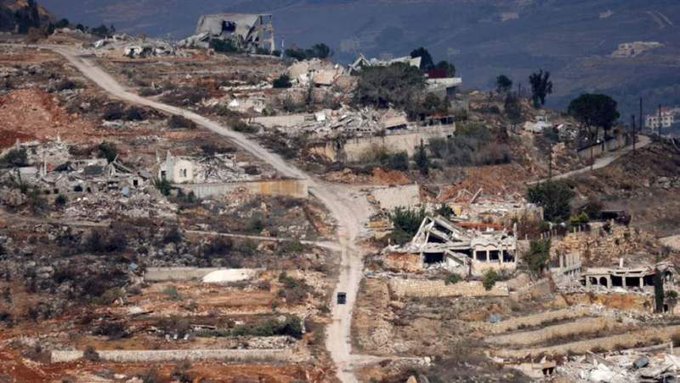
The southern Lebanese town of Adaisseh after the Israeli aggression on Lebanon (December 2024)
Al-Manar | December 17, 2024
The Israeli enemy has been procrastinating on withdrawal from southern border towns, hindering the deployment of the Lebanese Army, Al-Manar correspondent in south Lebanon reported on Tuesday.
Our correspondent said that it was planned that the Israeli enemy forces would withdraw from Al-Hamamis Hill in the border town f Khiam during the first phase of a coordination deal with the UNIFIL peacekeeping force.
“However, the Israeli enemy delayed the withdrawal and the Lebanese Army didn’t manage to enter the area,” Al-Manar’s Ali Shoeib reported.
Meanwhile, the reporter added that the Lebanese Army wasn’t able to enter the border town of Adaisseh in a bid to retrieve the bodies of the martyrs.
He noted that another bid in the town of Taybe was also hindered as the Lebanese Army leadership is waiting for a response from the UNIFIL, which is coordinating these missions with the Israeli enemy.
On the other hand, the Israeli forces repeatedly opened fire at houses in the border town of Naqoura and carried, Shoeb said, adding that the Israeli enemy forces also went ahead with blowing up houses in the border town of Kfar Kila.
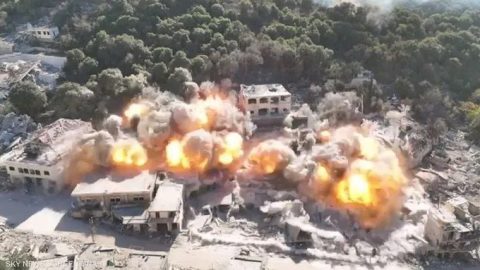
The Lebanese border towns were venue of epic battles between Israeli occupation forces and resistance fighters who heroically repelled the Zionist incursion into Lebanon throughout nearly two months (from October 1 till November 27.)
Lebanon has been subjected to brutal Israeli aggression on September 23, that killed more than 4,000 people and injured at least 12,000 others.
HTS officials order Palestinian resistance factions to disarm, close bases in Syria: Report
The Cradle | December 13, 2024
Representatives from Hayat Tahrir al-Sham (HTS), the new ruling extremist organization in Damascus, informed the representatives of the Palestinian factions in Syria they would no longer be allowed to possess any weapons, training camps, or military headquarters, Ibrahim Amin of Al-Akhbar reported on 13 December.
Amin further reports that the factions must dissolve their military formations as soon as possible in exchange for political and charitable work under the roof of the new Syrian state.
Palestinian factions, including Fatah, the Popular Front for the Liberation of Palestine (PFLP), and the Popular Front for the Liberation of Palestine-General Command (PFLP-GC), the Saiqa, and Palestinian Islamic Jihad (PIJ) Martyr Ali Aswad Brigad, have had a presence in Syria as guests of the government for decades.
A source in the PFLP-GC revealed to Erem News that the factions were informed of the decision in meeting headed by Ahmed al-Sharaa, also known as Abu Muhammad al-Julani, in the Yarmouk Palestinian refugee camp in the capital, Damascus.
Palestinians came to Syria as refugees during the 1948 Nakba. That year, pre-state Zionist militias ethnically cleansed some 750,000 Palestinians from the land that became the state of Israel, making them refugees in neighboring countries.
Many Palestinian refugees settled in Syria in the Yarmouk Camp on the southern outskirts of Damascus. The camp became the capital of the Palestinian diaspora.
The Palestinian factions formed armed resistance groups and provided manpower for the Palestinian Liberation Army (PLA), which served as an auxiliary to the Syrian Army.
Amin notes that the practical result of these steps taken by HTS, led by former Al-Qaeda leader Abu Mohammad al-Julani, who now goes by his real name Ahmad al-Sharaa, is that the Palestinians are prohibited from using Syria as a headquarters or passage for any activity against Israel.
In 2012, the predecessor to HTS, the Nusra Front, invaded and occupied Yarmouk, seeking to use it as the gateway to conquer Damascus. The camp was largely destroyed over the following years in the course of the fighting. ISIS also occupied the camp and fought against the Syrian army and Palestinian factions there.
Amin says that although the new Syrian government does not talk about establishing relations with Israel, its representatives talk about taking practical steps to prevent any existing or potential resistance against Israel from Syrian territory.
He writes that Israel may seek to force the Lebanese government to take similar actions against Palestinian factions in the refugee camps in Lebanon.
How the US and Israel Destroyed Syria and Called it Peace
By Jeffrey D. Sachs | Common Dreams | December 12, 2024
In the famous lines of Tacitus, Roman historian, “To ravage, to slaughter, to usurp under false titles, they call empire; and where they make a desert, they call it peace.”
In our age, it is Israel and the U.S. that make a desert and call it peace.
The story is simple. In stark violation of international law, Israeli Prime Minister Benjamin Netanyahu and his ministers claim the right to rule over seven million Palestinian Arabs. When Israel’s occupation of Palestinian lands leads to militant resistance, Israel labels the resistance “terrorism” and calls on the U.S. to overthrow the Middle East governments that back the “terrorists.” The U.S., under the sway of the Israel Lobby, goes to war on Israel’s behalf.
The fall of Syria this week is the culmination of the Israel-U.S. campaign against Syria that goes back to 1996 with Netanyahu’s arrival to office as Prime Minister. The Israel-U.S. war on Syria escalated in 2011 and 2012, when Barack Obama covertly tasked the CIA with the overthrow of the Syrian Government in Operation Timber Sycamore. That effort finally came to “fruition” this week, after more than 300,000 deaths in the Syrian war since 2011.
Syria’s fall came swiftly because of more than a decade of crushing economic sanctions, the burdens of war, the U.S. seizure of Syria’s oil, Russia’s priorities regarding the conflict in Ukraine, and most immediately, Israel’s attacks on Hezbollah, which was the key military backstop to the Syrian Government. No doubt Assad often misplayed his own hand and faced severe internal discontent, but his regime was targeted for collapse for decades by the U.S. and Israel.
Before the U.S.-Israel campaign to overthrow Assad began in earnest in 2011, Syria was a functioning, growing middle-income country. In January 2009, the IMF Executive Board had this to say:
Executive Directors welcomed Syria’s strong macroeconomic performance in recent years, as manifested in the rapid non-oil GDP growth, comfortable level of foreign reserves, and low and declining government debt. This performance reflected both robust regional demand and the authorities’ reform efforts to shift toward a more market- based economy.
Since 2011, the Israel-U.S. perpetual war on Syria, including bombing, jihadists, economic sanctions, U.S. seizure of Syria’s oil fields, and more, has sunk the Syrian people into misery.
In the immediate two days following the collapse of the government, Israel conducted about 480 strikes across Syria, and completely destroyed the Syrian fleet in Latakia. Pursuing his expansionist agenda, Prime Minister Netanyahu illegally claimed control over the demilitarized buffer zone in the Golan Heights and declared that the Golan Heights will be a part of the State of Israel “for eternity.”
Netanyahu’s ambition to transform the region through war, which dates back almost three decades, is playing out in front of our eyes. In a press conference on December 9th, the Israeli prime minister boasted of an “absolute victory,” justifying the on-going genocide in Gaza and escalating violence throughout the region:
I ask you, just think, if we had acceded to those who told us time and again: “The war must be stopped”– we would not have entered Rafah, we would not have seized the Philadelphia Corridor, we would not have eliminated Sinwar, we would not have surprised our enemies in Lebanon and the entire world in a daring operation-stratagem, we would not have eliminated Nasrallah, we would not have destroyed Hezbollah’s underground network, and we would not have exposed Iran’s weakness. The operations that we have carried out since the beginning of the war are dismantling the axis brick by brick.
The long history of Israel’s campaign to overthrow the Syrian Government is not widely understood, yet the documentary record is clear. Israel’s war on Syria began with U.S. and Israeli neoconservatives in 1996, who fashioned a “Clean Break” strategy for the Middle East for Netanyahu as he came to office. The core of the “clean break” strategy called for Israel (and the US) to reject “land for peace,” the idea that Israel would withdraw from the occupied Palestinian lands in return for peace. Instead, Israel would retain the occupied Palestinian lands, rule over the Palestinian people in an Apartheid state, step-by-step ethnically cleanse the state, and enforce so-called “peace for peace” by overthrowing neighboring governments that resisted Israel’s land claims.
The Clean Break strategy asserts, “Our claim to the land—to which we have clung for hope for 2000 years—is legitimate and noble,” and goes on to state, “Syria challenges Israel on Lebanese soil. An effective approach, and one with which American can sympathize, would be if Israel seized the strategic initiative along its northern borders by engaging Hizballah, Syria, and Iran, as the principal agents of aggression in Lebanon…”
In his 1996 book Fighting Terrorism, Netanyahu set out the new strategy. Israel would not fight the terrorists; it would fight the states that support the terrorists. More accurately, it would get the US to do Israel’s fighting for it. As he elaborated in 2001:
The first and most crucial thing to understand is this: There is no international terrorism without the support of sovereign states… Take away all this state support, and the entire scaffolding of international terrorism will collapse into dust.
Netanyahu’s strategy was integrated into U.S. foreign policy. Taking out Syria was always a key part of the plan. This was confirmed to General Wesley Clark after 9/11. He was told, during a visit at the Pentagon, that “we’re going to attack and destroy the governments in seven countries in five years—we’re going to start with Iraq, and then we’re going to move to Syria, Lebanon, Libya, Somalia, Sudan and Iran.” Iraq would be first, then Syria, and the rest. (Netanyahu’s campaign for the Iraq War is spelled out in detail in Dennis Fritz’s new book, Deadly Betrayal. The role of the Israel Lobby is spelled out in Ilan Pappé’s new book, Lobbying for Zionism on Both Sides of the Atlantic). The insurgency that hit U.S. troops in Iraq set back the five-year timeline, but did not change the basic strategy.
The U.S. has by now led or sponsored wars against Iraq (invasion in 2003), Lebanon (U.S. funding and arming Israel), Libya (NATO bombing in 2011), Syria (CIA operation during 2010’s), Sudan (supporting rebels to break Sudan apart in 2011), and Somalia (backing Ethiopia’s invasion in 2006). A prospective U.S. war with Iran, ardently sought by Israel, is still pending.
Strange as it might seem, the CIA has repeatedly backed Islamist Jihadists to fight these wars, and jihadists have just toppled the Syrian regime. The CIA, after all, helped to create al-Qaeda in the first place by training, arming, and financing the Mujahideen in Afghanistan from the late 1970s onward. Yes, Osama bin Laden later turned on the U.S., but his movement was a U.S. creation all the same. Ironically, as Seymour Hersh confirms, it was Assad’s intelligence that “tipped off the U.S. to an impending Al Qaeda bombing attack on the headquarters of the U.S. Navy’s Fifth Fleet.”
Operation Timber Sycamore was a billion-dollar CIA covert program launched by Obama to overthrow Bashar al-Assad. The CIA funded, trained, and provided intelligence to radical and extreme Islamist groups. The CIA effort also involved a “rat line” to run weapons from Libya (attacked by NATO in 2011) to the jihadists in Syria. In 2014, Seymour Hersh described the operation in his piece “The Red Line and the Rat Line”:
“A highly classified annex to the report, not made public, described a secret agreement reached in early 2012 between the Obama and Erdoğan administrations. It pertained to the rat line. By the terms of the agreement, funding came from Turkey, as well as Saudi Arabia and Qatar; the CIA, with the support of MI6, was responsible for getting arms from Gaddafi’s arsenals into Syria.”
Soon after the launch of Timber Sycamore, in March 2013, at a joint conference by President Obama and Prime Minister Netanyahu at the White House, Obama said: “With respect to Syria, the United States continues to work with allies and friends and the Syrian opposition to hasten the end of Assad’s rule.”
To the U.S.-Israeli Zionist mentality, a call for negotiation by an adversary is taken as a sign of weakness of the adversary. Those who call for negotiations on the other side typically end up dead—murdered by Israel or U.S. assets. We’ve seen this play out recently in Lebanon. The Lebanese Foreign Minister confirmed that Hassan Nasrallah, Former Secretary-General of Hezbollah had agreed to a ceasefire with Israel days before his assassination. Hezbollah’s willingness to accept a peace agreement according to the Arab-Islamic world’s wishes of a two-state solution is long-standing. Similarly, instead of negotiating to end the war in Gaza, Israel assassinated Hamas’ political chief, Ismail Haniyeh, in Tehran.
Similarly in Syria, instead of allowing for a political solution to emerge, the U.S. opposed the peace process multiple times. In 2012, the UN had negotiated a peace agreement in Syria that was blocked by the Americans, who demanded that Assad must go on the first day of the peace agreement. The U.S. wanted regime change, not peace. In September 2024, Netanyahu addressed the General Assembly with a map of the Middle East divided between “Blessing” and “Curse,” with Lebanon, Syria, Iraq, and Iran as part of Netanyahu’s curse. The real curse is Israel’s path of mayhem and war, which has now engulfed Lebanon and Syria, with Netayahu’s fervent hope to draw the U.S. into war with Iran as well.
The U.S. and Israel are high-fiving that they have successfully wrecked yet another adversary of Israel and defender of the Palestinian cause, with Netanyahu claiming “credit for starting the historic process.” Most likely Syria will now succumb to continued war among the many armed protagonists, as has happened in the previous U.S.-Israeli regime-change operations.
In short, American interference, at the behest of Netanyahu’s Israel, has left the Middle East in ruins, with over a million dead and open wars raging in Libya, Sudan, Somalia, Lebanon, Syria, and Palestine, and with Iran on the brink of a nuclear arsenal, being pushed against its own inclinations to this eventuality.
All this is in the service of a profoundly unjust cause: to deny Palestinians their political rights in the service of Zionist extremism based on the 7th century BCE Book of Joshua. Remarkably, according to that text—one relied on by Israel’s own religious zealots—the Israelites were not even the original inhabitants of the land. Rather, according the text, God instructs Joshua and his warriors to commit multiple genocides to conquer the land.
Against this backdrop, the Arab-Islamic nations and indeed almost all of the world have repeatedly united in the call for a two-state solution and peace between Israel and Palestine.
Instead of the two-state solution, Israel and the U.S. have made a desert and called it peace.
Lessons from Syria, Lebanon: Resistance is the only guarantor of sovereignty
By Mohamad Hasan Sweidan | The Cradle | December 12, 2024
On the heels of thinly veiled threats from Israeli Prime Minister Benjamin Netanyahu that deposed Syrian president Bashar al-Assad was “playing with fire,” and seizing the opportunity presented by the sudden collapse of the Syrian state, the occupation army invaded Syrian territory for the first time in 50 years.
The pretext of establishing a “buffer zone” was a transparent attempt to conceal Israel’s historic regional agenda: the weakening and fragmentation of Arab states to facilitate Tel Aviv’s regional domination.
Exploiting the power vacuum that ensued from the fall of Damascus, Israel launched hundreds of air strikes to cripple Syria’s already weakened military capabilities, and patted itself on the back for what it called the largest air blitz in its history. Its land forces and armored vehicles now lay a few kilometers from the Syrian capital, having literally driven through border terrain without a single challenge by opposing troops.
For many observers in neighboring Lebanon – and perhaps Iraq and other regional states – the Israeli rout answered a critical question: if they relinquished the will or capacity to defend themselves, would this too be Lebanon’s fate?
A legacy of expansionism
The concept of ‘Greater Israel’ is deeply rooted in Zionist ideology. From Theodor Herzl, the father of modern Zionism, to revisionist figures like Ze’ev Jabotinsky, and even Israel’s first prime minister, David Ben-Gurion, expansionist ambitions have been a consistent theme.
Oded Yinon’s plan, A Strategy for Israel in the Eighties, further solidified this vision. First made public in the magazine Kivunim (Directions) of the World Zionist Organization in February 1982, the plan was based on the vision of Herzl, and the founders of the Israeli state in the late 1940s, among them Polish-born, US Zionist leader Jacob Fishman.
From North Africa to the Levant to the Arabian Peninsula, Yinon advocated a strategy of breaking up and chronically weakening Arab states in order to ensure Israel’s long-term security.
“Israel’s policy, both in war and in peace, ought to be directed at the liquidation of Jordan under the present regime and the transfer of power to the Palestinian majority … The dissolution of Syria and Iraq later on into ethnically or religiously unique areas such as in Lebanon, is Israel’s primary target on the Eastern front … Iraq, rich in oil on the one hand and internally torn on the other, is guaranteed as a candidate for Israel’s targets. Its dissolution is even more important for us than that of Syria … The entire Arabian peninsula is a natural candidate for dissolution due to internal and external pressures, and the matter is inevitable especially in Saudi Arabia … Egypt is divided and torn apart into many foci of authority. If Egypt falls apart, countries like Libya, Sudan or even the more distant states will not continue to exist in their present form and will join the downfall and dissolution of Egypt.”
This destructive and expansionist drive is not confined to historical Israeli figures. Current Israeli Finance Minister Bezalel Smotrich has openly stated his desire for Israel to control territory extending to Damascus and including Jordan. In a 2016 interview, he is quoted as saying: “Our great religious elders used to say that the future of Jerusalem was to extend as far as Damascus.”
More recently, following the fall of Damascus, Smotrich pressed: “It is time to seize control of Gaza and strip Hamas of its civilian authority, cutting off its lifeline,” and to launch an all-out offensive in the occupied West Bank.
Such pronouncements, far from being isolated incidents, reflect a core Zionist principle that resurfaces with increased intensity during times of conflict.
The ongoing war in Gaza exemplifies this. Nearly 10 months after the start of the war, Netanyahu said of the Occupied Palestinian Territory: “It is part of our homeland. We intend to stay there.” Smotrich’s display of a ‘Greater Israel’ map encompassing all of historic Palestine and Jordan during a 2023 visit to Paris further illustrates these ambitions.
Historically, these far-right expansionist fantasies are rooted in religious beliefs that the ‘Promised Land’ stretches from the Nile River in Egypt to the Euphrates River in Iraq. These beliefs have been seeded and advanced by the leaders of the Zionist movement since its inception more than 120 years ago.
Breaking up West Asia
Their expansionist fantasies are not merely ideological. The Yinon Plan outlined a strategy for breaking Arab states into weak, sectarian ones, each dependent on Israel for survival. Iraq is to be divided into Kurdish, Sunni, and Shia states, Lebanon reduced to fragments, and Syria obliterated. This is not a theory – it’s a Zionist roadmap for domination, and the occupation state’s aggression in Syria is a direct implementation of these sinister goals.
Israel’s actions in Syria lay bare the insatiable greed of the occupation state. Without resistance movements in neighboring Lebanon, Israeli tanks would undoubtedly have rolled deep into Lebanese territory, seizing lands far beyond the south of the Litani.
The evidence is clear. Since the ceasefire between Israel and Lebanon took effect on 27 November, the Israeli occupation army has violated Lebanese sovereignty at least 195 times. These violations include airstrikes, drone incursions, artillery bombardments, and the destruction of homes – acts of terror meant to keep Lebanon on its knees.
The Lebanese government and armed forces, shackled by limited capacity and international neglect, have been unable to halt this aggression. International mechanisms like the five-member committee – comprising the US, France, Lebanon, Israel, and UNIFIL – are nothing more than diplomatic theatrics.
Resistance: The barrier against occupation
A day after the committee meeting on 9 December, the Israeli army committed 12 violations of the ceasefire agreement.
They meet, they talk, but they fail to act. While these parties dither, Tel Aviv tightens its grip, proving time and time again that the only language it understands is the language of force. This is why Lebanon’s resistance remains the only genuine national safeguard against Israeli aggression.
Southerners in Lebanon know this truth intimately: without the resistance, Israel’s greed knows no bounds. Every incursion, every violation, is a reminder that resistance is not just a choice – it’s a necessity.
The unrelenting aggression of the occupation state reveals a harsh reality; in a world dominated by power, weakness invites exploitation. Realists in international relations argue that power is the only currency that matters, and Lebanon’s experience validates this view.
Resistance movements have demonstrated that the balance of power is the sole way to curb Tel Aviv’s appetite and ambitions. Israel’s expansionism will not end with Syria or Palestine. It eyes every vulnerable nation in the region, seeking to carve it up and dominate.
The lesson is clear. Only through resilience and force can sovereignty be defended. Resistance is not just a shield – it is the only path to survival against an entity that thrives on destruction and occupation.
Featured Video

Rewriting the risk? Inside the government’s vaccine safety messaging
or go to
Aletho News Archives – Video-Images
Book Review
“Davos Can Really Replace the UN”
Inside the book that maps the architecture behind global governance — from the Epstein files to the Pact for the Future
Lies are Unbekoming | April 1, 2026
On June 13, 2019, the United Nations and the World Economic Forum signed a partnership deal to “accelerate the implementation of the 2030 Agenda for Sustainable Development.” That same evening, WEF president Börge Brende — Norway’s former Foreign Minister — had dinner with Jeffrey Epstein at Epstein’s Manhattan townhouse. The Epstein files, released January 2026, contain an exchange between the two from the previous year. Epstein to Brende: “Davos can really replace the UN. C21, cyber, crypto . genetics… intl coordination.” Brende back to Epstein: “Exactly — we need a new global architecture. World Economic Forum (Davos) is uniquely positioned — public private.”
The next day, the UN General Assembly adopted the framework for restructuring global governance.
That sequence — the partnership signing, the Epstein dinner, the candid admission about replacing the UN with a public-private architecture, and then the formal adoption — opens Jacob Nordangård’s The Digital World Brain. Pages two and three. Footnoted to the UN resolution number, the Epstein files, and the General Assembly record.
I keep coming back to it because it captures what this book does that almost nothing else in the independent research space manages. I’ve followed Jacob’s work for years now and interviewed him about his research. Each book peels back another layer of the same institutional architecture, and each time I think he’s reached the limit of what can be documented, the next one goes further. Nordangård doesn’t speculate. He doesn’t editorialize much. He lays institutional actions next to each other in chronological order and lets the pattern announce itself. … continue
Blog Roll
 Aletho News
- How I fell foul of the BBC thought police
- The End of NATO
- 37 days of war on Iran cost US staggering $42bln, tracker shows
- Baghdad tells Asian refiners, traders to begin loading Iraqi crude amid Iranian exemption
- Under fire, Moscow and Tehran close ranks
- Iran, US receive Pakistan-mediated plan for ceasefire then final deal
- Iran submits demands for end to war as mediators scramble ahead of Trump deadline
- Iran Threatens Retaliatory Strike on Stargate AI Project in UAE
- US sent ‘a lot’ of arms to Iranian protesters – Trump
- Barak Ravid Launders Deception To Allow Trump To Back Off Of His Power Plant Threat – Again
- If Americans Knew
- U.N. experts demand Israel release prominent Gaza doctor after reports of ‘severe torture’
- Israel’s Latest Genocide Is Against the Shias of Lebanon. Why Is the World Silent?
- How Eliot Cohen’s influence over U.S. war-making paved the way for Trump’s war crimes in Iran
- Israelis don’t pay for the weapons we ‘sell’ to them — US taxpayers do
- While Distancing from AIPAC, Most 2028 Democratic Hopefuls Are Still Embracing Israel
- A brief history of the Israeli nuclear program, the open secret at the heart of the Iran war
- Israeli Settlers Killed a Palestinian Farmer on His Own Land, in Front of His Father. Yes, Again
- The US-Israeli War on Science is an Assault on our Future
- 100+ International Law Experts Say US Strikes on Iran Violate UN Charter, Could Be War Crimes
- ‘Vile, Horrifying, Evil’: Trump Threatens to Bomb Nation of 90 Million People ‘Back to the Stone Ages’
- No Tricks Zone
- An Inconvenient Tree: Uncovered In Alps… Europe Much Warmer Than Today 6000 Years Ago
- New Study Reports A 60% Slowdown In Greenland’s Ice Loss Rate In The Last Decade
- Low Intensity Tornado Wrecks Major Solar Farm, Creating A Potential Toxic Dump
- New Study Finds Warming Saves Lives…Cold Temperatures 12 Times More Deadly Than Excess Heat
- German Science Blog Accuses PIK Climate Institute Of Hallucinating Climate Tipping Points
- Devastating Assessment Of Comirnaty Vaccine By Former Senior Pfizer Europe Toxicologist
- New Study: CO2 Is ‘Effectively Negligible’ As An Explanatory Climate Change Factor Since 2000
- Former Pfizer Toxicologist Dr. Helmut Sterz Tells Bundestag Hearing Pfizer Vaccine Should Have Never Been Approved
- Energy Expert: Germany’s Nuclear Phaseout Was A “500 Billion Euro Mistake”
- New Research: South Australia’s Mid-Holocene Sea Surface Temperatures Were 4°C Warmer Than Today
 Aletho News