Deep Dive Intel Briefing: What We Learned This Week /Lt Col Daniel Davis
Daniel Davis / Deep Dive
Al Mayadeen | May 5, 2026
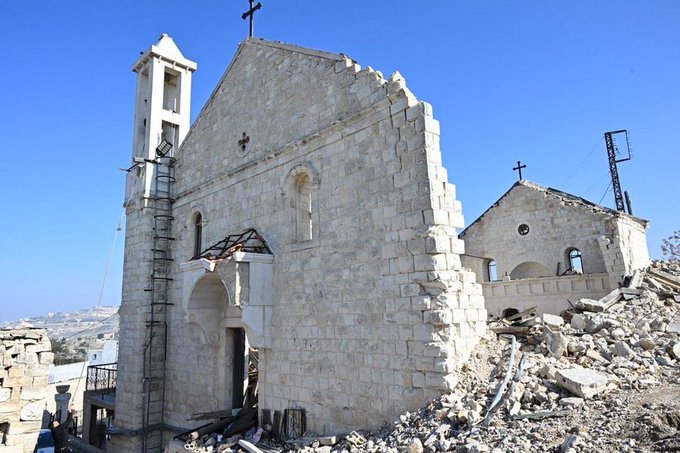
The Council of Melkite Greek Catholic Bishops in Lebanon urged on Tuesday both the Lebanese government and the United Nations to take measures to protect civilian property and religious institutions.
The bishops specifically cited Yaroun, where local officials and community representatives say a Melkite convent was destroyed earlier this month alongside other structures, describing the destruction of the buildings as “a deep wound in the national and human conscience”.
According to Christian community figures in Yaroun, the convent belonging to the Melkite tradition was bulldozed by Israeli occupation forces in southern Lebanon.
Adib Ajaka, a local Christian community leader, said the structure was part of a religious complex that also included nearby facilities. He disputed claims that the convent remained intact, stating that rubble near adjacent buildings indicated its destruction.
In turn, the French Catholic charity L’Oeuvre d’Orient condemned the “deliberate act of destruction of a place of worship and the systematic destruction of homes in southern Lebanon aimed at preventing the return of civilian populations”.
The organization called for the protection of religious heritage sites and civilian housing, warning of long-term consequences for displaced communities.
This isn’t an isolated case; the desecration of religious sanctities is a recurrent activity for Israeli forces. From Gaza to South Lebanon, numerous videos and photos were posted by Israeli soldiers themselves showing them shooting pointlessly at mosques, desecrating churches, and destroying statues of religious figures.
Last month, a photo circulating on social media showed an Israeli occupation soldier using a sledgehammer to strike the head of a statue of Jesus on a crucifix that had fallen from a cross.
By Dan Steinbock | Palestine Chronicle | May 3, 2026
Lebanon accuses Israel of committing ecocide in country since 2023. It is an extension of Israel’s destruction of Gaza – and its obliteration doctrine.
Israeli military aggression has “reshaped both the physical and ecological landscape” of southern Lebanon, according to the Lebanese report (which does not consider the impacts of Israel’s latest barrage of attacks this spring).
In her foreword, Lebanon’s minister for the environment, Tamara el Zein, notes: “The scale and intentionality of the damage to forests, agricultural lands, marine ecosystems, water resources, and atmospheric quality constitute what must be recognized as an act of ecocide, with consequences that extend far beyond immediate destruction.”
Obliteration ecocide in Lebanon
Released by the country’s National Council for Scientific Research and presented by the environment ministry, the report accuses Israel of “ecocide” during the 2023–2024 war and subsequent escalations. It frames environmental destruction not as incidental “collateral damage” but as a systematic transformation of ecosystems.
Key findings are damning. They include:
Minister el Zein characterizes this as “intentional ecological destruction” affecting food systems, public health, and the long-term viability of southern Lebanon’s rural economy.
International reporting on the same dossier highlights an estimated total damage burden of over $25 billion when recovery costs and economic losses are included. The figure is a combined total from the assessments by the Lebanese report and the World Bank Rapid Damage and Needs Assessment (RDNA) 2025.
This framing aligns with a growing legal discourse around “ecocide” as a potential international crime, particularly where environmental damage is widespread, long-term, and strategically embedded in military operations.
It is also aligned with UN reporting on the broader Israel–Lebanon escalation, confirming extensive infrastructure destruction, civilian displacement, and strikes affecting residential areas.
As the ecocide of Gaza has gone effectively unpunished by the international community, the Netanyahu government is extending the environmental devastation into Lebanon and the proximate region.
Obliteration Doctrine in Gaza
In The Obliteration Doctrine (2025), related commentaries and excerpts, I define this doctrine as the lethal mix of scorched earth policy, collective punishment, and civilian victimization, coupled with massive indiscriminate bombardment and systematic use of artificial intelligence (AI).
The concept is vital because it connects the dots between military strategies, aerial bombardment, lethal deployment of artificial intelligence (AI) and international law, particularly the Geneva Conventions and the Genocide Convention. As Professor William Schabas, a leading scholar of genocide, notes, “the Obliteration Doctrine” “adds a new term to the lexicon on genocide, notably in the application of international law and its judicial mechanisms.”
Modern warfare in Gaza is no longer just counterinsurgency but systems-level destruction of the environmental and infrastructural substrate of life—water, soil, agriculture, energy, and urban continuity.
This interpretation overlaps with empirical reporting on Gaza’s environmental collapse:
These patterns are described in independent investigations as producing conditions of near-uninhabitability in many parts of Gaza.
Warfare is no longer bound by battlefield geography. It becomes the restructuring—or “obliteration”—of ecological systems that sustain civilian life.
Ecocide here is not merely the destruction of nature, but the destruction of life-support systems as a purposeful strategy. It is another word for cultural genocide.
Lebanon and the Gaza template
The Lebanese report and international commentary suggest strong structural parallels between Gaza and southern Lebanon operations:
International media reports that Israel is applying a “Gaza playbook” in Lebanon: expulsion orders, infrastructure targeting, and village-level destruction patterns.
Lebanon is now an adjacent theatre where similar operational logics are extended across a different ecological terrain:
In both cases, ecological assets are not collateral but structurally embedded in livelihood and resistance capacity – and that makes them strategic targets under the high-intensity obliteration doctrine.
The environmental consequences of such conflict patterns are not geographically contained. Three spillover trajectories are particularly important.
First of all, regional ecological degradation. Soil contamination, wildfire damage, and agricultural collapse are not confined to strike zones. Windborne particulates, water contamination, and long-term soil chemistry changes affect broader cross-border ecosystems.
Second, economic fragility and food-system insecurity. Both Lebanon and Israel depend on regional agricultural stability and water systems. Repeated infrastructure destruction increases food import dependence, rural depopulation and long-term land degradation in border zones.
Third, internal Israeli environmental vulnerability. A less discussed but critical dimension is the simple reality that prolonged warfare conditions can feed back into Israel’s own ecological systems vis-à-vis air quality deterioration from sustained military operations, water system strain under security infrastructure expansion, fire ecology disruption in northern regions. long-term land-use militarization effects.
In this sense, “obliteration” generates mutual ecological degradation across interconnected landscapes. It is an ecological version of MAD – mutually assured destruction.
Diffusion of Doctrine
The key concern is not just localized destruction but doctrinal diffusion. Methods of high-intensity ecological disruption normalize across theaters. And let’s keep in mind that the first test of the obliteration doctrine occurred in Dahiya, the predominantly Shia enclave of Beirut.
US military legacy in Iraq and Syria already includes extensive infrastructure and ecosystem disruption under counterinsurgency and airpower doctrines. These features include water system destruction in Iraq, oil field fires, atmospheric contamination, and urban siege warfare effects in Raqqa and Mosul via coalition partners.
Such precedents create a shared operational vocabulary where environmental damage is treated as secondary to strategic objectives.
In a potential Israel–Iran escalation scenario, ecological infrastructure becomes strategically central through water scarcity systems in Iran’s arid regions, oil and petrochemical infrastructure vulnerability, and agricultural basins dependent on irrigation networks.
Under the obliteration logic, these become dual-use environments—civilian life-support systems that also acquire military significance.
Finally, there is the regional systemic risk. This implies a shift from territorial warfare to ecosystem-targeted coercion, where water, soil, energy, and agriculture become primary pressure points. Meanwhile, environmental degradation is exploited as a form of strategic leverage and recovery cycles extend beyond political timelines into generational horizons.
From Battlefield to Biosphere as a Target
The Lebanese charges, Gaza environmental destruction data, and the doctrine of obliteration converge on a structural transformation in modern conflict.
The object of war is increasingly not just territory or armed forces, but the ecological infrastructure that makes civilian life possible. In this way, destruction of that infrastructure is a prelude to ethnic cleansing and displacement.
For military doctrines, this may be framed as an incidental or operational necessity. But for Lebanon and environmental analysts, this constitutes potential ecocide under international law. In view of the obliteration doctrine, it represents a systemic shift in the practice of warfare itself, from the battlefield to the biosphere as a target.
What happens in Gaza won’t stay in Gaza. What happens in Lebanon won’t stay in Lebanon. The stage is being set for obliteration ecocides wherever they are seen as effective necessities.
Ecological systems are now central to both the conduct and consequences of war.
– The author of The Fall of Israel (2024) and The Obliteration Doctrine (2025), Dr Dan Steinbock is the founder of Difference Group and has served at the India, China and America Institute (US), Shanghai Institute for International Studies (China) and the EU Center (Singapore). For more, see https://www.differencegroup.net/
By Kit Klarenberg | Al Mayadeen | May 4, 2026
An investigative report by Israeli outlet Ynet has laid bare the embarrassing cataclysm not only of the US-Israeli war on Iran, but the Zionist entity’s effort throughout to end the Islamic Republic via covert and overt military and intelligence operations. Violent Mossad-orchestrated protests, the murder of Leader Sayyed Ali Khamenei, and a Kurdish invasion were intended to produce regime change and “total victory” over Tehran. Yet, as Ynet concludes: “what started as a far-reaching Israeli move, rich in imagination, final in its solution, ends in heartache.”
In granular detail, the investigation tracks how the Zionist entity’s deranged scheme germinated in the minds of Israeli intelligence, military, and political chiefs, before the Trump administration was comprehensively sold on the plot. Along the way, Ynet exposes extraordinary and dangerous levels of delusion and imperial hubris at the highest levels of Tel Aviv and Washington. For example, Benjamin Netanyahu sincerely – and entirely falsely – believed “Israel’s” criminal September 2024 assault of Lebanon, and the June 2025 12-Day War, had decimated Hezbollah and Iran.
This perspective was shared by Mossad, which had been building a vast, dedicated anti-government army in Tehran since 2022. The Zionist entity was delusionally convinced it had the power to collapse the entire Islamic Republic. “Fostering mass protest” and encouraging “armed resistance of minorities” – specifically, Kurds within and without Iran – in “parallel” with assassinating Leader Sayyed Ali Khamenei was part of a three-pronged coup d’etat strategy. Netanyahu believed “total victory” over the Resistance was in grasp in every theatre. Ynet reports:
“Overthrowing the regime was the heart of Israel’s overall war plan.”
The operation was intended to be put into action this June. Yet, in January, with “tens of thousands” of Mossad-directed insurrectionists in the streets of Tehran and other Iranian cities, the Zionist entity believed conditions had sufficiently “ripened” to make a decisive move. Mossad’s “influence organization” was birthed in 2022, reaching “operational maturity two and a half years ago.” Ynet bleakly boasts of the “effort and sophistication” of the Zionist entity’s armed clandestine army of anti-government rioters in Tehran:
“Israel has established its own poison machine. This is a serious weapon system that, if fully operational, can be fatal.”
Mossad pitched its braindead regime change plan directly to the CIA, Pentagon Central Command was informed of it by visiting Zionist Occupation Forces chief of staff Eyal Zamir, while Trump got personally lobbied by Netanyahu. The President – “convinced there were no limits to the capabilities of the military system at his command” after Nicolas Maduro’s January 3rd kidnap – and his administration were a highly receptive audience. Trump indicated his endorsement of the conspiracy on January 13th, publicly informing Iranians “help is on its way.”
A vast US military buildup in West Asia immediately began, while supposed peace talks with Tehran were ongoing. The negotiations were of course a con, intended to lull the Resistance into a false sense of security before the next phase of “Israel’s” intended palace coup commenced. On February 28th, Zionist-American airstrikes rained down on Tehran. “Israel” and the US firmly believed Iran’s leadership had been eliminated or scattered, and the Islamic Republic’s command and control system was “severely beaten.” But then, catastrophe started to erupt.
‘Popular Uprising’
While Sayyed Khamenei was killed – in an assassination demonically celebrated by Western media as “the assassination of the century” – sending Iran’s leadership temporarily underground, “an orderly change of government, in accordance with Khamenei’s will,” was successfully executed. Iran’s command and control system wasn’t significantly disrupted, returning to full capacity within hours. No defections were forthcoming. Still, “euphoria” abounded in Washington and Tel Aviv. Trump – who privately “welcomed the Israeli hit” – issued a video statement urging the Iranian people to take power by violence, warning:
“To the members of the Islamic Revolutionary Guard, the armed forces and all of the police. I say tonight that you must lay down your weapons and have complete immunity, or in the alternative, face certain death.”
Netanyahu joined the insurrectionary call. Problematically though, “the crowd chose to stay home,” in no small part because of genocidal US-Israeli bombardment from the skies. A deliberate strike on a primary school killed 165 young girls, sparking fiery international condemnation, vengeful mourning throughout West Asia, and UN investigations. Iranians instead took to the streets in sizeable numbers to grieve Khamenei, while celebrating his son Mojtaba’s ascension to Leader. Immediately, the IRGC moved to blockade the Strait of Hormuz.
Despite the closure being an absolutely inevitable upshot of criminal Zionist-American aggression against Iran, which Western intelligence assessments universally long-forecast, Ynet reports the US was “not ready for this move and its devastating economic consequences.” Trump’s threats not to blockade the Strait were ignored. The riddle of why Washington was so caught off guard is perhaps best answered by Netanyahu’s assurances to Trump that the Islamic Republic would collapse in mere days. Astonishingly, there was no contingency plan beyond that.
In the meantime, another cog of the Zionist-American regime change operation in Tehran was also fatally faltering. “After 100 hours of air activity… a ground invasion from Kurdish militias based in Iraq” was supposed to commence. An invasion force had been training there over prior weeks, preparing “to reach the Kurdish region of Iran” and link up with fighters locally before a “mass march” to Tehran. For inspiration, Tel Aviv looked to Damascus being overwhelmed by MI6-supported HTS forces in mere days in December 2024.
However, Ynet reports Iranian intelligence quickly learned “in advance about the planned invasion,” and supposedly informed Turkey, prompting Recep Erdoğan to personally demand Trump call it off. The entire proposal was, in any event, manifest insanity. After reports emerged in early March of the CIA working with Kurdish militants “with the aim of fomenting a popular uprising in Iran,” even Zionist think tank pundits and diaspora activists warned such action was a recipe for disaster, which would unite Iranians of every extraction in opposition.
Still, Kurdish invasion remained a fundamental component of “Israel’s” regime change strategy in Tehran during the war. When a tentative ceasefire was struck on April 7th, after 40 days of devastating Iranian strikes, Ynet reports Israeli officials wondered why the invasion never came to pass. Did the US not believe in the operation in the first place? Perhaps Trump changed his mind after Erdoğan picked up the phone? Or was “the whole idea a fantasy, with no chance of being realised?”
‘Inadvertent Effects’
That the Zionist entity was so convinced its self-evidently misguided mission could possibly succeed is all the more damning, given the contents of a July 2025 report from the highly influential, Tel Aviv-based Institute for National Security Studies. A withering appraisal of the 12-Day War, the think tank acknowledged Iranian regime change had been an avowed Zionist objective from the conflict’s inception, which failed spectacularly. Nonetheless, the report still advocated for the Zionist entity to pursue the Islamic Republic’s destruction, via a palace coup.
However, INSS explicitly warned against employing precisely the regime change tactics depended upon by the ZOF and Mossad during the latest Zionist-American war on Iran to achieve that end. For one, the think tank correctly predicted any Israeli military effort – including civilian bombing – intended to ignite mass anti-government protests had no chance of success. Such actions during the 12-Day War had in fact produced an intense “anti-Israel wave” among Iranians, who “exhibited a notable degree” of “rallying around the flag” in response.
Iranians’ determination “to defend their homeland at a critical moment against an external enemy” endured after the 12-Day War ended, to the extent all traces of public dissent in the Islamic Republic “almost completely disappeared” in the conflict’s wake. INSS likewise vehemently cautioned against encouraging “separatist tendencies” in Iran – such as Kurdish militancy. Due to “heightened public sensitivity to any perceived foreign attempts to promote ethnic fragmentation,” separatist insurrection, let alone invasion, would unite “large segments” of the Iranian public “against Israel.”
Moreover, an eerily prophetic portion of INSS’ report explicitly warned against assassinating Leader Sayyed Ali Khamenei, as doing so “would not necessarily result in regime change,” and inevitably backfire. The think tank precisely foretold Tehran “would likely have little difficulty selecting a successor, who could prove to be more extreme or more capable.” INSS likewise predicted the Iranian government instead being strengthened, and anti-Zionist sentiment skyrocketing in Iran and beyond, leaving any subsequent “efforts to destabilize the regime through popular protest” dead on arrival.
All these humiliating outcomes came to pass. As yet, INSS’ forecast that military-driven Israeli regime change efforts in Iran would compel the Islamic Republic to seek nuclear weapons capability “as an existential insurance policy” hasn’t materialised, although Western officials now widely fear it may. Meanwhile, ever since the ceasefire was implemented, talks between Washington and Tehran have been stuck in a seemingly implacable stalemate. While US officials remain committed to imposing sharp limits on Iran’s nuclear research, the Islamic Republic refuses to even negotiate the issue.
Furthermore, Tehran has made clear its chokehold over the Strait of Hormuz will only be loosened when the Empire stops blockading the country, and ends the conflict. While Netanyahu still harbours reveries of shattering the Islamic Republic, the Empire lacks the requisite economic and military muscle. Meanwhile, overextended Tel Aviv has blundered into a colossal trap in Lebanon, and the Resistance is waiting and watching intently. In recklessly seeking self-evidently unattainable regime change in Iran, the Zionist entity has only hastened its own permanent destruction.
Al Mayadeen | May 2, 2026
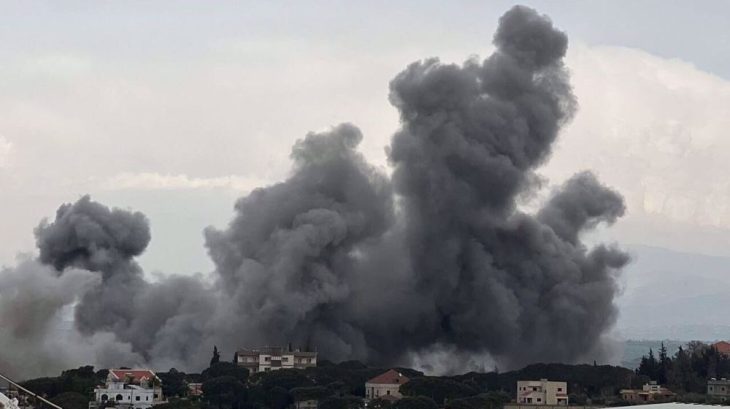
The Israeli occupation has intensified its attacks on villages and towns in southern Lebanon, with fresh airstrikes and artillery shelling reported across several districts, according to field reports from the south.
Al Mayadeen’s correspondent in southern Lebanon reported that three people were killed after an Israeli raid struck a house in the town of al-Louaizeh in the Jezzine district at dawn on Friday, with the escalation extending beyond the area as Israeli airstrikes also hit the towns of Harouf and Shoukin, as well as the al-Tuffah heights region.
The National News Agency (NNA) reported that an earlier strike on Shoukin resulted in the killing of civilians and the injury of several others, including the town’s mayor, Hussein Ali Ahmad.
Further raids targeted multiple towns in the Nabatieh district, including Zawtar al-Sharqiyah, A’dshit, Mayfadoun, Kfar Joz, and Ebba. An additional strike hit a vehicle on the Kfar Dajjal road in the same district.
Strikes across Tyre, Bint Jbeil, and Hasbaya
Southern Lebanon also came under intensified attacks across a wider area, with strikes hitting Majdal Zoun in the Tyre district and Burj Qalaway in the Bint Jbeil district.
The town of Qounine was targeted in an aerial attack, while heavy artillery shelling struck Touline and Qabrikha in the Marjeyoun district. Another airstrike hit Kfarshouba in the Hasbaya district.
Israeli artillery also struck residential areas and outskirts, including al-Mansouri in the Tyre district, while military aircraft maintained intensive overflights across southern Lebanese airspace.
The aggression has continued despite the so-called temporary ceasefire agreement, which took effect on April 17 for 10 days and was later extended for a further three weeks on April 24. However, since the agreement came into force, the Israeli occupation has maintained its attacks, while also facing continued retaliatory attacks from the Islamic Resistance in Lebanon, Hezbollah.
Since March 2, the cumulative toll has reportedly exceeded 2,618 martyrs and more than 8,094 injured, according to the Lebanese Ministry of Health. Officials say the ceasefire framework involving Lebanon has not prevented continued strikes, with repeated attacks reported across multiple regions.
By Robert Inlakesh | The Palestine Chronicle | May 1, 2026
Left in disbelief, an already drained Israeli military is left without any viable solutions to the ever-growing threat of first-person view (FPV) drones, now used by Hezbollah to overwhelm their newly assumed positions in southern Lebanon.
On April 16, Tel Aviv and Beirut agreed to a temporary ceasefire imposed by US President Donald Trump. Within the first hour of the ceasefire’s imposition, Israel had already violated the agreement 10 times, including an attack on an ambulance. What they sought to achieve was a return to the pre-war status quo, whereby the Israeli military attacked Lebanon at will, without any return fire.
It soon became clear that the 15-month ceasefire period, following November 27, 2024, during which the Israeli military violated the agreement 15,400 times according to UNIFIL, was not going to be replicated. The first wave of retaliation against Israeli violations began with Hezbollah detonating improvised explosive devices (IEDs) and destroying convoys of Israeli tanks and armored personnel carriers (APCs), after carrying out reconnaissance and anticipating the movement of armed convoys.
Initially, the Israeli military passed three successive IED attacks off as incidents occurring due to explosives previously left behind by Hezbollah fighters. Later, the Lebanese Party officially announced it had taken out four Israeli Merkava tanks in a single IED attack, forcing the Israelis to issue a statement acknowledging it.
Before long, Hezbollah was issuing statements claiming responsibility for a number of retaliatory attacks each day, including rocket fire on Israeli army positions across the Lebanon Blue Line (Lebanese border).
Then came the prominence of Hezbollah’s usage of the cheap, but highly effective FPV drones, inflicting considerable numbers of casualties amongst Israeli soldiers in retaliation for ceasefire violations and the attempt to illegally occupy a strip of territory in southern Lebanon.
Contrary to Israel’s initial claims to have established a considerable “buffer zone” and that only a small number of Hezbollah fighters had remained in the area, it would become clear that nothing of the sort had truly taken place. There was never any “full operational control” of the “buffer zone”, instead, the Israelis were practicing the Gaza strategy of deploying forces in their heavily armoured vehicles to towns and villages, where they would then be tasked with blowing up civilian infrastructure.
Hezbollah fighters remain positioned throughout this newly declared zone, a terrain that favors a defending force using guerrilla warfare tactics. Perhaps the most menacing is the usage of the FPV drones for both reconnaissance and attacks alike.
In a new article, written for Yediot Aharanot in Hebrew, correspondent Elisha Ben Kimon wrote the following:
“For years, the IDF has invested billions in sophisticated interception systems, precision missiles, and the intelligence capabilities of superpowers. But when Hezbollah, with simple and deadly ingenuity, decided to lower its flight altitude and switch to drones, with fiber optics that make it difficult to detect and intercept, Israel found itself in a situation of dealing with a “low-tech” threat that disrupted all work plans.”
The FPV UAVs can be cheaply acquired for only hundreds of dollars per unit, yet when assembled domestically, they can be put together for as little as 50 dollars in some instances. Successful FPV drone deployment for war was pioneered by the Ukrainians and Russians during the Ukraine War. According to some sources, the majority of battlefield casualties in that war have been a result of this drone, which Kyiv can mass-produce at around 300 dollars per unit.
Equipped with a fiber-optic cable, the drones are completely immune to electronic warfare jamming, negating the high-tech advantages that the Israelis have previously enjoyed. Hezbollah does have access to a range of different attack drones, including various Iranian models, which have proven highly effective also. Yet, they are not available in as high quantities, and their most sophisticated technology is used to target high-value targets.
This development has meant that Hezbollah drone operator teams can safely fly these drones from up to and over 10 kilometers away, without being detected. The process of detecting these drones is the same as it is for Hezbollah’s arsenal of more sophisticated radio frequency (RF) drones, relying on acoustic sensors, radars and thermal imaging, yet FPV drones fly at such low altitudes and use the terrain of southern Lebanon to make them more difficult to detect until it is too late.
A recent article published by the Israeli daily Haaretz noted that back in 2024, the Israeli political and military leadership claimed to be on top of deploying solutions to the Hezbollah drone threat, stressing that a range of Israeli defense companies were engineering solutions.
However, an anonymous source “involved in the field” told Haaretz that “There is a need for a systemic response – not to acquire a little of this and a little of that, but a broad plan to address all unmanned threats along our borders. DDR&D (Directorate of Defense Research & Development) has known about this threat for many years but has not mobilized to address it.”
In a nightmare situation for the Israeli military, Hezbollah recently launched a retaliatory attack using FPV drones, inflicting 6 soldier casualties near the Lebanese town of Taybeh. Israel announced that one of its sergeants, Ithan Fukes, was killed in the attack. What happened next was perhaps even more damning.
Hezbollah followed up their attack with an FPV drone strike targeting the medivac helicopter. The incident caused such a stir because the Israeli military leaked videos of the incident. Despite the Israeli soldiers wearing body cams or GoPros on their helmets, this was the first time such footage has been released, due to Israel’s strict military censor laws.
The first video released was from a distance, showing the FPV drone impacting the site where the evacuation of soldiers was happening, causing them to fall back and the helicopter to abruptly take off. From the footage, it was unclear whether the drone hit any target or not, triggering criticism from the Israeli media over why it was released.
Then, a second video was released, from a soldier’s helmet camera, revealing that the drone fell just short, either due to the wind force of the helicopter or due to the soldier’s gunfire. Any release of footage of this kind is deliberate; in this case, it was to jolt the Israeli leadership into action.
An enormous amount of criticism has been leveled at the Israeli political leadership over its failure to achieve its announced goals in Lebanon, and the army itself is even joining that parade. What this demonstrates is that the psychological impact of the FPVs is greatly burdening soldiers on the ground, while the army is left to sit in southern Lebanon twiddling its thumbs.
Hezbollah’s asymmetric warfare is already causing enormous strain on the some 6 Israeli divisions deployed to fight against Lebanon. Just as they were in Gaza, the Israelis are not doing much beyond demolishing civilian infrastructure, proving so risk-averse as to fear entering a fight in which they actually seek to degrade Hezbollah in any significant way. They may have gotten away with this in Gaza, but in South Lebanon, they are dealing with a much more powerful opponent and a more difficult terrain.
Israeli Merkava tanks, worth between 3.5 to 6 million dollars each, are being taken out day after day by FPV drones, carrying explosive charges, worth a maximum of a few hundred dollars each. Hezbollah is taking out mobile telecommunications equipment, command and control vehicles, APCs, D-9 bulldozers, and excavation equipment, with cheap drones that they continue to mass produce with ease. They also do this while their fighters are kept out of harm’s way.
Israel has attempted to consult Ukrainian advisors in order to learn new tactics to deal with the threat and has purchased its own FPV drones, yet none of this has borne fruit. Instead, individual soldiers have tried experimenting with netting to place over vehicles and the use of shotguns, while relying on soldiers to watch the skies for incoming drones.
Despite some of this being effective, out of fear, the Israelis do not normally deploy infantry next to their tanks while on the move. In Gaza, this tactic of hiding inside heavily armored vehicles and tanks did manage to reduce soldier deaths and injuries, but in Lebanon, it could actually be causing the opposite effect, at least when it comes to FPV drone attacks.
– Robert Inlakesh is a journalist, writer, and documentary filmmaker. He focuses on the Middle East, specializing in Palestine.
Press TV – April 29, 2026
At least ten people, including three rescue workers, have been killed in Israeli airstrikes against residential neighborhoods in southern Lebanon, marking the latest violations of a ceasefire that began on April 16 after weeks of fighting between the Tel Aviv regime and Hezbollah.
Lebanon’s official National News Agency (NNA) reported that an Israeli aerial raid destroyed a four-storey building in the village of Jabchit in the Nabatieh district on Tuesday night, killing Mohammad Jawad Bahja, his wife Lotfiya, as well as Amani Jaber and her daughters.
Lebanon’s Ministry of Public Health announced in a statement that at least 13 people also sustained injuries in the attack.
Separately, two successive Israeli strikes on a building in the town of Majdal Zoun on Tuesday killed five people, including three rescue workers who went to help those injured in the initial Israeli attack on the targeted building.
The three Lebanese civil defense rescue workers were later identified as Hussein Ghadbouri, Hussein Sati and Hadi Daher.
Prime Minister Nawaf Salam strongly condemned the deadly Israeli strike.“Targeting elements of the Civil Defense in Majdal Zoun, and their killing while carrying out their humanitarian duty, constitutes a new and described war crime perpetrated by Israel,” he wrote in a post on social media.
“It represents a flagrant violation of the principles and rules of international humanitarian law,” Salam said.
“The government will spare no effort to condemn this heinous crime in international forums and to mobilize all efforts to compel Israel to cease its ongoing violations of the ceasefire agreement.”
Israeli forces also shelled the towns of Mansouri, Chehabiyeh, Tiri, Jouaiyya, Touline and Khirbet Selm. There were no immediate reports about possible casualties and the extent of damage caused.
The occupation troops also dropped white phosphorus shells on Yohmor al-Shaqif village.
Elsewhere in Naqoura region, Israeli forces pressed ahead with their demolition activities. Residents of adjacent municipalities felt a strong tremor as the occupation troops set off a considerable amount of explosives to flatten designated buildings.
On Wednesday, kamikaze drones launched by Hezbollah resistance fighters targeted and destroyed two Israeli Merkava battle tanks in Naqoura.
Hezbollah said in a brief statement that the operation was carried out in defense of Lebanon as well as its nation, and in response to the Israeli aggression against villages in southern Lebanon.
The Cradle | April 28, 2026
A poll published by Israel’s Public Broadcaster (KAN) on 28 April found that a majority of Israelis believe the state has failed to secure victory in any war since October 2023.
According to the survey, 57 percent of respondents said no victory had been achieved, while 28 percent believed success had been reached in at least one arena, and a further 15 percent said they were unsure.
The findings come after more than two years of Israel’s genocide in Gaza – which Israel threatens to reignite – during which Tel Aviv waged multiple offensive military campaigns against Gaza, Lebanon, and Iran, alongside attacks in Yemen and Syria and a campaign of destruction and displacement in the occupied West Bank.
Confidence levels across all the fronts remain low, with only 17 percent viewing operations in Syria as successful and 16 percent saying the same for Gaza and Iran.
Perceptions dropped further on the Lebanese front at 14 percent, followed by Yemen at 12 percent and the occupied West Bank at 11 percent.
The poll also points to persistent security concerns, with a total of 73 percent of respondents saying the continued armed presence of Hamas and Hezbollah poses a direct threat of a repeat of a 7 October-style event.
Only 10 percent dismissed that possibility, while 17 percent remained uncertain.
On the ground, Israel has reportedly begun withdrawing troops from southern Lebanon. Israeli outlet Maariv described the campaign as ending in “failure” and “bitterness,” as forces pull back under continued Hezbollah attacks, including drone strikes that exposed major gaps in Israeli preparedness.
The poll also showed divisions over Netanyahu’s legal status, with a majority – 56 percent – supporting a pardon for his corruption charges, while 26 percent opposed the move and 18 percent remained undecided.
Netanyahu had requested a presidential pardon on 30 November without admitting guilt or stepping down from office, despite Israeli law requiring an admission of guilt for such a measure.
He is currently facing trial in three separate corruption cases involving fraud, bribery, and abuse of power, with court proceedings ongoing since 2020 after charges were filed in 2019.
Netanyahu’s court testimony was delayed once again on 27 April over a “serious” security incident in southern Lebanon, as the prime minister seeks to prolong the wars to keep his corruption trial from moving forward.
At the same time, the International Criminal Court (ICC) has listed Netanyahu as wanted since 2024, issuing arrest warrants for him and former defense minister Yoav Gallant over their direct involvement and orchestration of the genocide in Gaza, as well as war crimes and crimes against humanity, including the use of starvation as a weapon.
Al Mayadeen | April 27, 2026
Iran has informed mediators of a proposed three-phase framework for negotiations and says talks could resume if the United States agrees to the plan, Al Mayadeen’s correspondent in Tehran reported.
The proposal, as described by our correspondent, outlines an initial phase focused on ending US-Israeli aggression and securing guarantees that fighting will not resume against Iran and Lebanon. During this stage, Iran would not discuss any other issues, the report said.
The plan envisions coordination with Oman
If agreement is reached on the first phase, discussions would move to a second stage centered on the management of the Strait of Hormuz. The plan reportedly envisions coordination with Oman to establish a new legal framework governing the strategic waterway.
The third phase would address Iran’s nuclear program, which Tehran would only be prepared to discuss after agreements are reached on the first two phases, according to the report.
This is happening as Foreign Minister Abbas Araghchi has departed for Moscow, leading a diplomatic delegation.
Iranian ambassador in Moscow, Kazem Jalal, said earlier that Araghchi is set to meet with Russian President Vladimir Putin during his visit to Moscow, where he will hold consultations on the latest developments regarding negotiations and the ceasefire.
Dialogue Works | April 25, 2026
Substack: https://substack.com/@dialogueworks?u…
X (Twitter): https://x.com/Dialogue_NRA
By Stephen Prager | Scheer Post | April 24, 2026
One Palestinian American researcher warned that Israel is seeking “annexation without legal burden.”
Israel’s gradual advancement of its “yellow line” to occupy more territory in the Gaza Strip is fueling concerns that it is seeking to effectively annex and colonize the majority of the territory without any formal agreement.
The Guardian reported on Wednesday that Israel has been steadily pushing the truce line to take control of more Palestinian territory in the six months since a “ceasefire” was reached in October.
The yellow line drawn on the ceasefire maps had Israeli troops in control of about 53% of Gaza’s territory, cramming nearly 2 million displaced Palestinians into a territory less than half the size of the one they inhabited before.
But an analysis by Forensic Architecture shows Israel has unilaterally shifted the line westward over the past six months to the point where it controlled about 58% of the strip by December in an occupation zone that continues to grow.
Palestinians living in Gaza reportedly woke up to learn that large yellow concrete blocks denoting the ceasefire line had suddenly moved and that they were now living in a free-fire area, where the Israeli military considers any Palestinian person or vehicle a legitimate target.
The Associated Press found in January that at least 77 Palestinians have been shot on sight when they’ve found themselves on the wrong side of the yellow line or even just near it, even though the line’s boundaries are ill-defined and fluid.
They are among more than 730 Palestinians who have been killed since the “ceasefire” began in October, according to the Gaza Health Ministry, which has accused Israel of thousands of violations.
According to The Guardian, some displaced people, such as those who lived near the Salah al-Din road, which spans the length of Gaza from north to south, suddenly found themselves targeted by Israeli forces, who also began demolishing homes and other buildings and constructing new ones.
Though the yellow line was supposed to be set up as a temporary measure under US President Donald Trump’s “peace plan” for Gaza before control of the strip is transferred back to Palestinians, Israel Defense Forces (IDF) chief of staff Eyal Zamir described it as a “new border” with Gaza back in December, around the time it reportedly began to move.
Eyal Weizman, an Israeli architect and the head of Forensic Architecture’s research agency, recently wrote that the IDF appears to be turning this portion of Gaza into a permanent occupation zone.
The group found that seven new military outposts have been built along the yellow line, including one on what was once a cemetery.
While these areas began as “piles of earth and rubble” organized into crude enclosures, Weizman said that in recent months the roads leading to them have been asphalted, electricity poles have been erected, and buildings and communications towers have gone up inside the bases.
“The bases no longer appear to be the provisional arrangements that Trump’s ceasefire plan claims them to be, but permanent instruments of occupation,” he wrote. “The newly paved roads connect the bases to a matrix of control that is linked to Israel’s road network and communications grid.”
He noted that Israel’s illegal settler movement, which has several powerful representatives in the government of Prime Minister Benjamin Netanyahu, has been “lobbying hard for the Israeli government to start constructing settlements within the vastly expanded buffer zone.”
Defense Minister Israel Katz said in December that Israel would “never leave Gaza” and spoke of plans to turn IDF military outposts into civilian settlements similar to those that have gradually taken over the West Bank through the violent displacement of Palestinian residents.
Ahmad Ibsais, Palestinian American law student and author of the newsletter State of Siege, wrote for the Al-Shabaka Palestinian Policy Network that by drawing a yellow line, Israel is seeking to consolidate its control over Palestinian land without formally annexing it—in other words, “annexation without legal burden.”
“Borders are typically established through bilateral agreements, adjudication, or mutual recognition under international law,” he wrote. “By contrast, the so-called Yellow Line in Gaza functions as a de facto military demarcation associated with ceasefire arrangements and enforced through Israeli operational control.”
“It shapes civilian movement and territorial control without constituting a formally delimited boundary,” he continued. “In effect, it constitutes territorial theft with better branding, operationalizing US President Donald Trump’s plan for the continued colonization of Gaza.”
Israel declared a similar yellow line about 5-10 kilometers into Lebanese territory, giving the IDF effective control over around 55 towns and villages. The military has reduced many homes and entire villages south of this line to rubble in what Katz has described as a “Gaza model” being applied to Lebanon.
Assistant editor Maya Rosen recently wrote for Jewish Currents that the policy of conquering and settling Lebanon has become “mainstream” in Israeli politics and enjoys broad public support.
Ahmad Baydoun, an architect and open-source intelligence researcher at Delft University of Technology in the Netherlands, has warned that with this land grab, Israel was seeking to take control of the valuable Qana Gas Field, which is estimated to be capable of producing between $20 billion-$40 billion worth of natural gas exports for Israel. In 2022, a maritime agreement brokered by the US established that control of the field belonged to Lebanon.
Like in Gaza, the Israeli military has forbidden the more than 600,000 Lebanese inhabitants of villages below the line or within a newly established “buffer zone” from returning indefinitely. Katz has said they’ll be allowed to return once the “safety and security of the residents of the north [of Israel] is ensured.”
Given that Israeli settler groups have already begun mapping out new settlements and advertising plots of land for sale in southern Lebanon, Weizman said Katz was making what is by design “an impossible demand” meant to entrench the land grab.
“This exemplifies the circular logic of Zionist settler-colonialism: settlements are built to mark and protect the state’s border, but that makes them vulnerable to attack, and so a buffer zone is established to protect them,” he said. “Afterward, this buffer zone is itself settled to mark and protect the newly expanded borders, at which point another buffer zone becomes necessary.”
Al Mayadeen | April 24, 2026
In an exclusive interview with Al Mayadeen, former Pakistani Information Minister and Senator Mushahid Hussain Sayed highlighted Pakistan’s diplomatic efforts in facilitating indirect and direct communication between Iran and the United States, describing the process as a rare breakthrough in regional diplomacy.
Sayed stated that Pakistan “achieved something close to the impossible” in the initial round of discussions by helping bring Iranian and US representatives to the same table. He emphasized that the significance of the effort lay in “bringing the Iranian and American sides into the same room,” describing it as a notable diplomatic achievement.
According to Sayed, expectations remain high for a second round of talks between Tehran and Washington, though he stressed that such progress depends on the lifting of the US naval blockade on Iran.
He also told Al Mayadeen that the continuation of dialogue is contingent on a shift in US policy, adding that Pakistan remains in active contact with both Tehran and Washington. He also noted that communication channels include engagement with Pakistan’s military leadership, which has played a facilitating role.
Strait of Hormuz and regional developments
Sayed emphasized that Iranian leadership responded positively to a request from Pakistan’s army chief to ease tensions in the Strait of Hormuz, a critical maritime passage.
He said Iran’s position initially expected relief from US-imposed restrictions, which had not materialized. He added that Iran’s decision to show flexibility regarding the Strait of Hormuz reflects its willingness to support de-escalation efforts.
According to Sayed, the “ball is now in the Americans’ court,” stressing that Washington must make the next move if negotiations are to continue.
He further warned that if restrictions on Iranian ports continue, Iran’s negotiating delegation may not participate in future talks scheduled in Islamabad.
US policy obstructs negotiations
Sayed identified the US blockade on Iran as the central obstacle to a second round of negotiations, describing it as “legally and morally wrong.”
He expressed the view that former US President Donald Trump may eventually reconsider this position, suggesting that lifting the blockade could open the way for renewed dialogue.
He also argued that ongoing US policy has failed to achieve its objectives, claiming that Washington is under pressure to find an exit strategy from the current regional tensions.
Netanyahu destabilizing region
In his remarks, Sayed accused Israeli Prime Minister Benjamin Netanyahu of playing a central role in escalating regional tensions, blasting him as a destabilizing figure in West Asia.
He further said that Netanyahu influenced US policy and dragged it into war through political “blackmail” and the notorious Epstein files, in which Trump is extensively mentioned.
Moreover, Sayed stated that “Israel” does not seek peace, adding that Zionism pursues the idea of a “Greater Israel,” a concept rejected in the region. Regional resistance, he said, including Iran’s stance, has challenged the feasibility of such projects.
Lebanon ceasefire central to regional peace
The former minister also referred to developments in Lebanon, stating that a ceasefire was achieved following pressure on Israeli leadership.
He claimed that Trump played a role in urging Netanyahu toward de-escalation, based on diplomatic advice, and said that Iran had also rightfully insisted on a ceasefire in Lebanon, which he stressed was a victim of aggression.
Sayed emphasized that peace in the region is interconnected, stating that stability in Iran and the wider West Asia region is directly linked to peace in Lebanon. He added that discussions reportedly include a broader framework in which Lebanon is not treated as a separate issue but as part of a wider regional settlement.
Pakistan’s regional position
Sayed underscored Pakistan’s role as a key regional actor, highlighting its status as the only nuclear power in the Islamic world and a consistent supporter of the Palestinian cause.
He suggested that Pakistan is positioned to play a continued mediating role in facilitating dialogue between regional and global powers.
Looking ahead, Sayed expressed cautious optimism that an agreement between Tehran and Washington could eventually be reached, stating that such a deal might even be signed in Pakistan if negotiations succeed.
He concluded by reiterating that the Strait of Hormuz is not the root cause of tensions but rather a consequence of broader geopolitical disputes, which he attributed to US and Israeli regional policies.
Al Mayadeen | April 24, 2026
A lobbying organization, ELNET, has been quietly arranging trips to “Israel” for British journalists and retired military personnel, according to an investigation published by Declassified. The tours coincide with the Israeli military’s ongoing campaign that has killed over 259 Palestinian and Lebanese journalists since 2023.
The investigation noted that on Wednesday, journalist Amal Khalil and photographer Zeinab Faraj were reporting from southern Lebanon when an Israeli airstrike targeted them. Khalil was killed and Faraj was seriously injured. The Israeli military is responsible for two-thirds of all journalist killings globally in 2025, the report states.
While systematically killing Palestinian journalists, Declassified reported that the Israeli government has blocked foreign media workers from entering Gaza, effectively creating a blackout of its military operations.
ELNET created to counter criticism of ‘Israel’
According to the investigation, ELNET was founded in 2007 with the stated aim of “countering the widespread criticism of Israel in Europe.” The group is increasingly viewed as the European equivalent of AIPAC, the powerful American-Israeli lobby.
Declassified found that journalists who participated in ELNET delegations have written for major British publications including the Telegraph, Spectator and Mail on Sunday. The group has also taken former British military officers to “Israel”, who subsequently portrayed the IOF’s operations in Gaza in a favourable light.
Professor Des Freedman of Goldsmiths told Declassified that such trips are not genuine fact-finding missions but rather “junkets specifically designed to generate pro-Israel coverage.” He added that embedded journalism of this kind is “utterly scandalous during a genocide when the rest of the world’s media have been locked out of Gaza.”
ELNET has close links to Israeli government
The investigation reveals that ELNET maintains close ties to the Israeli government. Its board members include two former advisors to Prime Minister Benjamin Netanyahu. The group was invited to a 2024 meeting with foreign minister Gideon Sa’ar to discuss improving “public diplomacy”, and its delegations are frequently organized “in partnership” with the Israeli Foreign Ministry.
Emmanuel Navon, who directed ELNET’s “Israel” office between 2023 and 2025, described “Israel’s” offensive into Rafah as “necessary” and dismissed concerns about Palestinian civilians, Declassified reports.
ELNET’s UK branch is directed by former MP Joan Ryan, who once chaired Labour Friends of Israel. Under her leadership, the group has sought to cast doubt on casualty figures from Gaza, calling them “demonstrably unreliable and strategically manipulated.” The UK branch has also condemned British recognition of a Palestinian state as a “PR win” for Hamas and urged the restoration of arms exports to “Israel.”
Journalist declared ‘war must go on’ after ELNET trip
Declassified identified British journalist Zoe Strimpel, who writes for the Sunday Telegraph, as one participant in an ELNET delegation. Days after returning from “Israel”, she wrote in The Spectator that “most people” in “Israel” agree that “the war must go on until Hamas is completely destroyed.”
In a separate Telegraph article, Strimpel dismissed accusations of “Israeli ‘genocide’ in Gaza” as “grotesquely false”. When approached by Declassified about her participation in the ELNET trip, she declined to offer any defensive response, stating, “The more pro-Israel the better in my view.”
Another participant, David Rose, wrote for the Jewish Chronicle after his trip that “the trauma experienced throughout Israeli society means serious consideration of the longer-term relationship between Israel and the Palestinians is almost impossible to contemplate.”
Former British generals toured Gaza with ELNET
The investigation also revealed that former British military officers have joined ELNET delegations. Retired British army officer Sir John McColl, who served as a NATO commander in Europe, joined a September 2024 delegation that met with Netanyahu and former Security Minister, both wanted by the International Criminal Court for war crimes.
The group received briefings from Israeli military commanders and spent time in Gaza “observing troops in action.” Shortly after returning, McColl wrote in The Times that the Israeli military’s “rules of engagement in Gaza are at least as rigorous as those of the British army.” ELNET subsequently listed McColl’s article as one of its “recent successes” in an impact report.
Three other former British military figures on that delegation were Johnny Mercer, Colonel Richard Kemp and Major Andrew Fox. Fox later wrote on Substack, “When does a journalist become a legitimate military target? Many not often enough.”

or go to
Aletho News Archives – Video-Images
By Donald Neff | Washington Report On Middle East Affairs | January 1996
On January 4, 1948, Jewish terrorists drove a truck loaded with explosives into the center of the all Arab city of Jaffa and detonated it, killing 26 and wounding around 100 Palestinian men, women and children.[1] The attack was the work of the Irgun Zvai Leumi – the “National Military Organization,” also known by the Hebrew letters Etzel – the largest Jewish terrorist group in Palestine. The Irgun was headed by Revisionist Zionist Menachem Begin and had been killing and maiming Arabs, Britons and even Jews for the previous ten years in its efforts to establish a Jewish state.
This terror campaign meant that at the core of Revisionist Zionism there existed a philosophical embrace of violence. … continue
 Aletho News If Americans Knew No Tricks Zone
