Shifting to Guerilla Warfare, Hezbollah Delivers Massive Blows to Israel
By Robert Inlakesh | Palestine Chronicle | April 22, 2026
Hezbollah has shifted to waging a guerrilla war against the Israeli occupiers in southern Lebanon, reminding Tel Aviv why it decided to withdraw from the country in the year 2000. Instead of allowing Israel to violate the ceasefire unchecked, the responses have been immediate and painful.
On April 16, the White House declared that a 10-Day temporary ceasefire had been reached between Lebanon and Israel. Only the day prior, both Israeli Prime Minister Benjamin Netanyahu and his Defense Minister Israel Katz had delivered speeches claiming that their operations in the south of Lebanon would continue to expand.
This caused immense frustration amongst the Israeli public and sparked backlash in the Hebrew-language media.
Sure enough, when the ceasefire went into effect, the Israelis decided to violate the agreement at least 10 times within an hour, mainly through artillery fire on Lebanese villages in the south. This was followed by two drone strikes targeting vehicles in southern Lebanon, in addition to an attack on an ambulance.
Israeli Arabic spokesperson Avrechay Adraee, who was supposed to have retired, yet has made a recent return, openly released a video message ordering displaced Lebanese civilians not to return south of the Litani River area. The occupation forces even bombed the area where efforts were being made to reconstruct a temporary bridge that had been deliberately destroyed during the war to prevent civilian passage into the south.
For a period of time, it had been feared that a return to the pre-March “ceasefire” in Lebanon had just been secured in favor of Tel Aviv once again, where the Israelis carried out frequent operations without any response. All of this as Israel was now occupying more territory illegally, as the Lebanese government negotiated for a normalisation agreement.
Hezbollah Secretary General, Sheikh Naim Qassem, then delivered an address, during which he made it clear that the Lebanese leadership was behaving unacceptably and betraying their duties through their normalizing efforts. He also insisted that the previous status quo would not return and that instead his organization would respond to the Israeli violations, fighting until the occupation of South Lebanon was totally abandoned.
Little more than a day into the ceasefire agreement, despite no announcements of retaliatory actions from Hezbollah, a series of “security incidents” were announced by the Israeli Army. The first few were said to have been tanks running over previously planted explosives, making it appear as if the incidents had occurred by accident.
However, three major “security events” occurred, inflicting at least 37 Israeli casualties, 2 of whom the Israelis admitted were deaths. At this point, it had become clear that something else was going on.
Then came an official Hezbollah statement, claiming responsibility for a single incident, where 4 Israeli Merkava tanks were said to have been completely destroyed by pre-planted IEDs, detonating them on an enemy convoy, after Lebanese fighters had been monitoring their movements. After this, the Israeli military decided not to publish any details on the IED attacks.
Yet, Israeli media commentary explained that soldiers, stationed in what is being called a “buffer zone” in southern Lebanon, have reported their frustrations over Hezbollah drones monitoring their movements.
In other words, Hezbollah has cells throughout the territory that Israel claims to be in control of, who do reconnaissance, then calculate the movements of Israeli forces, anticipating their common routes, before planting IEDs that they then detonate on convoys.
Not only is this a transition to asymmetric warfare, which the Iraqi resistance became well known for when fighting an insurgency against US occupying forces, but it is also beginning to usher in flashbacks to the days of the occupation in South Lebanon.
As an example, in 1997, Hezbollah had managed to pull off what was known as the Ansariyeh Ambush, killing 12 Israeli special forces soldiers from its elite Shayetet 13 Unit. This had been carried out through reconnaissance and intelligence work, to anticipate the arrival of the Israeli unit, a total disaster for the Israeli military at the time.
Today, Hezbollah has advanced from what it was in the 1990s and possesses much more sophisticated and powerful weapons. What it means for Israeli forces on the ground is that they must constantly keep moving, as they remain under surveillance and could be subjected to an ambush at any time.
When Israeli tanks travel down roads they have taken a number of times previously, they could suddenly face a series of EIDs. The more these attacks happen, the more terrified the Israeli conscript army’s soldiers become, fearing the possibility that they could at any moment lose an arm, leg, or their life.
Hezbollah, having shifted to such tactics, could also seek to capture Israeli soldiers at one point, something that would represent a catastrophe for the Israeli political leadership.
If such a capture operation succeeds, then Netanyahu’s campaign of triumph will be suddenly transformed into yet another costly operation that will inevitably accelerate on the ground, while eventually forcing him to commit to a prisoner exchange.
All along, this was precisely the scenario that Hezbollah had hoped for, to rope the Israelis in on the ground, in order to eventually inflict enormous losses on them and fulfill the pledge of its former leader, Seyyed Hassan Nasrallah that the south will become a graveyard for the invading army and that they will eventually have no tanks left.
– Robert Inlakesh is a journalist, writer, and documentary filmmaker. He focuses on the Middle East, specializing in Palestine.
Al-Akhbar’s Amal Khalil assassinated by Israel, left to die under rubble

The Cradle | April 23, 2026
Lebanese Civil Defense confirmed late on 23 April the death of Amal Khalil, Lebanese journalist and reporter for Al-Akhbar newspaper, who was deliberately targeted by Israel and trapped for hours under the rubble as the Lebanese government awaited permission to rescue her.
Khalil was reporting in south Lebanon’s Tayri with fellow journalist Zainab Faraj when the strikes took place.
A civilian vehicle accompanying the journalists – who were in a separate car – was first hit by an Israeli drone, killing the two people inside it.
Khalil and Faraj exited their car and took cover behind a tree upon the first strike. Contact was then made with ambulance teams and Lebanese army intelligence, yet the Red Cross was not allowed to act until receiving clearance from the US-led ceasefire monitoring mechanism.
Another drone strike hit right near the journalists’ vehicle shortly after, prompting them to shelter near a house.
About an hour later, amid reports that access to the site was being refused and that UNIFIL was asked to avoid the Haddatha–Bint Jbeil Road, a warplane hit Tayri. It was later confirmed that the house where they were sheltering was targeted.
The Red Cross was not given approval to move until 10 minutes after the Israeli warplane struck home.
Rescue workers reached and rescued Faraj, who was seriously wounded, while also retrieving the bodies of the two who were killed in the first strike.
Israeli forces fired at the rescue teams as they attempted to reach Khalil, halting search efforts, according to the Lebanese Health Ministry.
“After nearly three hours of being besieged in the town of Tiri in south Lebanon, journalist Amal Khalil remained in direct contact with the relevant authorities and was reported to be in good condition, until the enemy deliberately targeted her and photographer Zeinab Faraj in a second airstrike,” wrote Lebanese journalist Dr Marwa Osman.
“She was alive for so long, talking to her family and colleagues from under the rubble. But the imps in the Lebanese presidency and prime ministry took all the time they needed to grovel at the feet of the enemy through the US terrorist mechanism, until Amal died of the wounds she sustained from the Zionist strikes on Lebanese land,” she added.
Many others were also outraged by the failure to rescue the veteran journalist, who spent her career covering Israeli war crimes and Lebanese resistance against occupation.
“The US ambassador, in his capacity as custodian of the ‘mechanism,’ did not grant permission for a bulldozer to access Al-Tayri to clear the rubble in search of Amal Khalil,” journalist Hassan Illaik reported.
The Lebanese presidency released a statement condemning Khalil’s killing, saying it was “aimed at concealing the truth of [Israel’s] aggressive acts against Lebanon.”
“Amal Khalil passed away in the place dearest to her heart, in the region with which her name was synonymous, on the most volatile front line, in the deep south … For Amal Khalil, the cause of resistance was not a trivial detail, but rather deeply rooted in her convictions, daily actions, and professional choices. She chose the south, even though the media organization where she had worked for nearly 20 years hadn’t asked her to settle there,” wrote Al-Akhbar.
“On the contrary, she had been based in Beirut offices since the launch of Al-Akhbar. However, as she recounted on more than one occasion, she couldn’t remain in Beirut long while the voice of the South called to her. So, she left and chose daily confrontation with the enemy, who had repeatedly threatened her. Yet she never backed down.”
Khalil had previously received death threats from an Israeli number, telling her to leave Lebanon “if you want to keep your head on your shoulders.”
Drop Site News journalist Jeremy Loffredo reached out to the Israeli number and asked for a comment on the threats against her.
“These are not innocent people. The journalists affiliated with Hezbollah that Israel eliminated were also spies for Hezbollah, approaching our soldiers and then informing the terrorist organization where our soldiers were in real time. Similarly, on 7 October, journalists affiliated with Hamas were eliminated because they were intelligence officers. Send greetings to all journalists affiliated with Hezbollah, for anyone who works for the organization should know that they are destined for death,” the response said.
The phone number belongs to an Israeli who runs a social media account called “Middle East with Gideon Ben Avraham.”
He wrote in a post: “Journalists from all over the world called me, trying to get a response from me about why the Lebanese journalist who worked for Hezbollah was killed or eliminated? Because by chance I sent her a message in the past saying that if she endangers Israel’s soldiers, she won’t live long like her colleagues who deliberately acted to harm the IDF, so there are dozens of articles about me in Lebanon claiming that I eliminated her. Excellent!”
Israel has been killing Lebanese journalists for years, as it has consistently done in Gaza and the occupied West Bank.
Last month, Al Manar correspondent Ali Shoeib and Al Mayadeen correspondent Fatima Ftouni, along with her photojournalist brother Mohammad, were killed in an Israeli strike in south Lebanon.
Amal Khalil is the ninth journalist to be killed by Israel in Lebanon since the start of this year.
US naval blockade has disrupted but ‘not broken’ Iran’s oil exports: Kpler
Al Mayadeen | April 23, 2026
The US naval blockade of Iranian ports has disrupted the country’s oil machine, but its loading infrastructure remains intact, and cargoes are still flowing toward China, according to maritime analytics firm Kpler.
US Central Command announced overnight that American forces have redirected 31 vessels to return to port or turn around as part of the ongoing US blockade against Iran. Most of the redirected vessels were oil tankers, CENTCOM posted on X.
The US has also seized an Iranian-flagged vessel in the Gulf of Oman and boarded a sanctioned vessel in the Indian Ocean.
Despite the blockade, tankers are still positioned in Iran’s loading zones and Iranian crude continues to move toward China, Kpler data shows. The maritime analytics firm estimated the flow of crude from Iran to China to be 985,000 barrels per day in the first half of April. Since then, this flow has not been interrupted, Kpler said.
Jask terminal bypasses Strait of Hormuz
At Jask, an Iranian oil export terminal located outside the Strait of Hormuz, there is currently an all-time high of 5.8 million barrels in storage, Kpler reported. Tankers carrying oil are able to depart from the Jask terminal directly into the Gulf of Oman without needing to transit through the strait.
“The blockade has disrupted the oil machine, but it has not broken it,” Kpler said.
The findings suggest that while the US naval campaign has inflicted damage on Iran’s ability to export oil freely, Tehran has developed alternative routes and maintained key infrastructure to ensure continued revenue from crude sales. The Jask terminal, which bypasses the strategically vulnerable Strait of Hormuz, has emerged as a critical asset in Iran’s efforts to sustain exports despite the blockade.
‘Iran will not reopen the Strait of Hormuz’
In this context, a senior Iranian official involved in communications with Washington told the BBC that, at this stage, it is not possible to reopen the Strait of Hormuz due to blatant violations of the ceasefire by the United States and “Israel.”
According to the official, these violations include the US naval blockade on Iranian ports and Israeli aggression across various fronts, particularly Lebanon.
These steps, according to the official, “hold the global economy hostage” and undermine the chances of achieving political progress.
IDF Gives Order To Fire On Civilians In Southern Lebanon
The Dissident | April 21, 2026
The Israeli paper, The Jerusalem Post, has admitted that the Israeli IDF has been given the order to slaughter any civilians attempting to return to South Lebanon.
For context, Israel has been carrying out a new Nakba in South Lebanon, with the intention of ethnically cleansing its civilian population and setting up Jewish settlements.
After forcing South Lebanon’s population to flee past the Litani River, Israel intended to create a “new northern border” in South Lebanon, as the Likud-connected journalist Amit Segal admitted.
Israeli Finance Minister, Bezalel Smotrich, said “the new Israeli border must be the Litani,” and Israeli Defense Minister Israel Katz said, “Israeli forces would control ‘the entire area’ from the border to the Litani River after the offensive had concluded”.
However, as part of the temporary ceasefire with Iran, Donald Trump announced a 10-day ceasefire with Lebanon last Tuesday.
Over the course of three days, Israel violated the ceasefire 220 times, including with:
-7 aerial strikes
– 50 detonations and blowing up infrastructure
– ?52 artillery shelling
– ?15 shooting with machine guns.
– ?30 incidents of overflights by military and reconnaissance planes, including over Beirut.
Furthermore, the Israeli media has admitted that the IDF has been given the order to fire on displaced civilians attempting to return to their homes in South Lebanon to continue the Israeli occupation.
The Jerusalem Post reported that “large numbers of Lebanese civilians attempted to return to southern Lebanon,” adding that “Some said that they succeeded in reaching their villages and found significant amounts of damage.”
The article added that the “latest effort” from the IDF “appeared to be directed at deterring Lebanese civilians who may have remained in or penetrated into southern Lebanon from nearby areas where the IDF is establishing new positions”.
It noted “the IDF has given general orders to open fire within southern Lebanon even if an approaching unidentified person is not armed, based on the idea that there are no civilians left in southern Lebanon”, adding that “the IDF said that the ceasefire only applied North of the Litani River”.
By slaughtering displaced civilians attempting to return to Southern Lebanon, Israel hopes to continue the ethnic cleansing it previously carried out, in hopes it will lead the United States to recognize South Lebanon as Israeli territory.
The aforementioned Likud-connected journalist Amit Segal gave the game away behind Israel’s intention, writing, “Trump, a man with no sentimentality for old borders, already shook the Middle East when he agreed in principle to recognize Israeli sovereignty over parts of Judea and Samaria in the framework of the Peace to Prosperity plan, and when he supported mass emigration from Gaza. The mass migration from southern Lebanon has already happened. The only question is whether he will give Israel merely de facto approval of its new northern border or de jure approval as well.”
In order to continue its forced “mass migration” (ethnic cleansing) in South Lebanon, the IDF will fire on any displaced civilian trying to return home in hopes it will allow Israel to create its “new northern border”.
Israeli army blows up school in southern Lebanon in violation of ceasefire
Press TV – April 21, 2026
The Israeli regime has demolished a public school in southern Lebanon in a new violation of a temporary ceasefire agreement with Beirut approved by US President Donald Trump.
The Israeli army destroyed a public school building in the southern Lebanese town of Khiam despite the 10-day ceasefire.
The state-run Lebanese National News Agency (NNA) reported on Tuesday that the Israeli forces rigged the building with explosives and detonated it overnight, completely leveling the structure.
Israeli forces also fired artillery near the town of Kunin in the Bint Jbeil district in southern Lebanon, according to another report by NNA.
A series of Israeli demolitions occurred across the south, targeting homes, buildings and other infrastructure, the report said. Israeli forces also “booby-trapped” numerous homes in the villages of Beit Lif, Shamaa, Biyyada, and Naqoura, leveling them, the report added.
Trump announced on Thursday a 10-day ceasefire in Lebanon following calls with Lebanese President Joseph Aoun and Israeli prime minister Benjamin Netanyahu.
However, the Israeli regime’s forces have continued attacking Lebanese civilian infrastructure and residential areas, disregarding the ceasefire agreement.
Meanwhile, Israel has planned to systematically flatten civilian buildings in southern Lebanon, according to Israeli media. Engineering tools, including excavators, have been brought into the area and are being operated by paid Israeli contractors.
Israeli forces are assessing the scale of the destruction through digital tools, including statistical systems that track the number of buildings demolished in each sector.
Last month, Israeli Minister of Military Affairs Israel Katz said, “All houses in villages near the border in Lebanon will be demolished in accordance with the Rafah and Beit Hanoun models in Gaza.”
He added that after Israel’s aggression in Lebanon ends, the military would maintain control “over the entire area up to the Litani.”
Since March 2, Israel has carried out an aggression against Lebanon that has killed around 2,300 people, wounded more than 7,500, and displaced over 1.2 million, according to Lebanese authorities.
Israel’s war obsession and the urgency of Palestinian leverage
By Ramzy Baroud | MEMO | April 20, 2026
It is tempting to argue that Israel’s new military doctrine is predicated on perpetual war—but the reality is more complex.
Not that Israeli Prime Minister Benjamin Netanyahu would object to such an arrangement. On the contrary, his relentless drive for military escalation suggests precisely that. After all, his openly declared quest for a “greater Israel” would require exactly this kind of permanent militarism—endless expansion and sustained regional destruction.
However, Israel cannot sustain an open-ended fight on multiple fronts indefinitely.
Israeli officials boast about fighting on “seven fronts,” but many of these are, in military terms, largely imaginary rather than sustained battlefields.
The real wars, however, are entirely of Israel’s making: from the genocide in Gaza to its unprovoked regional wars.
Still, that fact should not blind us to another reality: in the lead-up to the war on Iran, and in the escalation against Lebanon, there was near-total consensus among Jewish Israelis. An Israel Democracy Institute survey conducted on March 2–3 found that 93% of Jewish Israelis supported the joint US-Israeli attack on Iran. Support cut across all political camps.
The same enthusiasm for war accompanied the Gaza genocide and the various wars and escalations in Lebanon.
Even Yair Lapid—so often and so falsely marketed abroad as a “dove”—fully backed these wars, admitting after the Iran ceasefire that Israel had entered them with “rare consensus” and that he supported them “from the very first moment.”
His repeated criticisms, like those of other Israeli politicians, are not of the war but of Netanyahu’s failure to deliver a strategic outcome.
And this is the crucial distinction. Israelis mostly support the wars, but many no longer trust Netanyahu to translate destruction into strategic victory. By mid-April, 92% of Jewish Israelis gave the army high marks for its management of the Iran war, but only 38% gave high ratings to the government.
In other words, the public still believes in war but increasingly doubts the leadership waging it.
That distinction may not matter much to us, since the outcome remains mass death, devastation, and colonial violence. But in Israel’s own military and strategic calculations, it matters enormously. Its wars have historically followed a familiar model: crush resistance, impose military and political domination, and translate battlefield violence into colonial expansion.
Netanyahu delivered none of that.
This is why the uproar in Israel over the April 16 Lebanon ceasefire has been so fierce, and why the fears surrounding a possible stalemate with Iran run even deeper.
The Lebanon ceasefire clearly did not secure one of Israel’s central declared aims: the disarmament of Hezbollah. Israel kept troops in southern Lebanon, but the agreement halted offensive operations and fell far short of the promised “total victory.”
For many in Israel, any outcome that falls short of total victory is immediately read as defeat. One northern Israeli regional leader, Eyal Shtern, captured that mood with brutal clarity when he reacted to the Lebanon ceasefire by asking how Israel had gone “from absolute victory to total surrender,” in remarks reported by CNN.
That is the real crisis now confronting Israel: not that it has discovered the limits of permanent war, but that it has once again discovered that exterminatory violence does not automatically produce political victory.
While Iran possesses political leverage that could allow for a long-term, or even permanent, truce, Lebanon and Syria remain in a far more vulnerable position. However, no one is in a more precarious condition than the Palestinians, particularly those in Gaza.
Unlike others who retain some political margin and space to maneuver, Palestinians live under Israeli occupation, apartheid, and siege. Gaza, in particular, has been reduced to a sealed enclave of devastation.
Its hermetic siege has produced one of the most horrific humanitarian catastrophes in modern history: an entire population surviving on polluted water, with infrastructure destroyed, food critically scarce, and thousands still buried beneath the rubble.
Aside from their legendary steadfastness—sumud—Palestinians operate under severe constraints in their ability to impose conditions on Israel, particularly as it continues to receive unconditional support from the United States and its Western allies. Yet their resilience, collective action, and enduring presence remain powerful forms of leverage that cannot be easily contained.
Netanyahu—and those who will come after him—will always find in Palestine a space in which war can be waged continuously and at relatively low cost to Israel itself.
Unlike other battlefields, where war becomes politically, militarily, and economically unsustainable, Israel has turned its occupation of Palestine into a permanent battlefield.
Even if Netanyahu, now politically diminished and aging, exits the political scene, the underlying paradigm will remain intact. Future Israeli leaders will continue to wage war on Palestine, not despite its costs, but because of its perceived benefits: it is financially subsidized, colonially advantageous, and politically sustainable within Israel’s current structure.
To break this paradigm, Palestinians must generate leverage—real leverage. This cannot come from futile negotiations or appeals to long-ignored international law. It can only emerge from sustained collective resistance to colonialism, reinforced by meaningful support from Arab and Muslim states and genuine international allies, and amplified by global solidarity capable of exerting real pressure on Israel and, crucially, on its principal benefactors.
For now, Netanyahu continues his wars because he has no answer to his own strategic failures. Here, escalation is not a strength; it is the last refuge of a leadership that cannot deliver victory.
This, however, also reveals something else: Israel is entering a moment of unprecedented vulnerability.
That vulnerability must be exposed—clearly, consistently, and urgently—by all those who seek an end to these senseless wars, an end to the Israeli occupation of Palestine, and a path toward justice that has been denied for far too long.
Ex-intel officer questions Israeli strategy in Lebanon as losses mount
Al Mayadeen | April 19, 2026
A former Israeli Military Intelligence officer has questioned the Israeli occupation’s strategy in southern Lebanon, pointing to mounting losses since the ceasefire took effect.
Retired Lieutenant Colonel Jacques Neriah told i24 News that Hezbollah has emerged stronger from the war despite extensive Israeli bombing and attacks, noting that the group “represents the resistance against Israel, and this is its primary source of strength.”
“If we are sustaining daily losses in Lebanon, how long can we endure this situation?” he asked.
2 killed, dozen injured since ceasefire
The Israeli military command had announced that an Israeli reservist soldier was killed and nine others were wounded in an improvised explosive device incident in southern Lebanon on Saturday. Reports indicate that the incident occurred in the border village of Kfar Kila, opposite of Metulla, which has seen extensive periods of Israeli military occupation and incursions since the 66-day war on Lebanon in 2024.
On Sunday, Israeli media reported that an Israeli soldier was killed and nine others were wounded, including one seriously, after an explosive device detonated in an area it occupies in southern Lebanon. The soldier served in the 769th “Hiram” Regional Brigade’s 7106th Battalion.
According to an initial military probe, the incident occurred during operations in Israeli-occupied territory, where an engineering vehicle was struck by an IED planted in the area. Troops securing the machinery were caught in the blast, resulting in multiple casualties. The wounded were airlifted to hospitals, while the Israeli regime says its forces launched their own attacks near the area following the explosion.
A day earlier, Israeli media reported that another reservist, a warrant officer, was killed and three soldiers were wounded in a similar explosion in the southern Lebanese village of Jebbayn. The troops were reportedly scanning a building for weapons when the device detonated.
Continued attacks, occupation in southern Lebanon
The Israeli military command had announced that its forces would operate in a so-called “advanced defense zone” within southern occupied Lebanon, extending from Ras al-Bayyada on the coast to Shebaa in the east. The zone is seen as a prelude to a prolonged Israeli occupation and an attempt to push settlers within Lebanese territory.
The announcement comes as part of a push by the Israeli regime to impose a new status quo in areas located in a region 8-10 km from Israeli sites in occupied Lebanese, Palestinian, and Syrian territories.
However, the Islamic Resistance in Lebanon has emphasized that a ceasefire must include a complete halt to Israeli violations, including incursions and destruction of property.
Hezbollah Secretary-General Sheikh Naim Qassem stated that the Resistance remains prepared to respond to any aggression, stressing that the ceasefire cannot be one-sided and must be respected by both parties. He outlined key priorities for the next phase, including a full Israeli withdrawal from occupied Lebanese territory, the return of displaced residents to their villages, and the launch of reconstruction efforts supported at both the national and international levels.
Sheikh Qassem also stressed the importance of strengthening Lebanese sovereignty, maintaining internal unity, and preventing foreign interference.
Netanyahu’s ‘total victory’ to total flop
By Robert Inlakesh | Al Mayadeen | April 19, 2026
Promising annihilation, dominance, and total victory, the Israeli leadership has found itself in a predicament no closer to victory on any front. Tactical victories sold as strategic ones have been exposed; instead of meticulously planned operations, Tel Aviv engages in aggression without any discernible long-term strategy to achieve its stated aims.
Since October 7, 2023, the Israeli regime of old is no more. Instead of implementing methodical planning, public deception, and fighting the long game, its thinking has been replaced by a ruthlessly violent vengeance scheme that seeks to try and achieve in months what it was previously aiming for over decades.
The beginning of the war on Iran was not February 28, 2026; instead, it was October 7, 2023. This was the moment when everything changed in the strategic thinking of the Israeli leadership. For them, the illusion of absolute control and superiority was crushed under the boots of a few thousand Palestinian fighters, who single-handedly dealt the most severe blow to the Zionist regime in its history.
As an event, the collapse of the Israeli southern command at the hands of a guerrilla force possessing homemade light weapons, Operation Al-Aqsa Flood, represented the moment of a great shift. It wasn’t long before the decision was made to launch a genocide against the people of Gaza.
Inflicting the genocide was the whole strategy, not dealing a military defeat to Hamas or any other Palestinian organizations. Israeli PM Benjamin Netanyahu foolishly believed that the genocide would restore the Zionist entity’s prized “deterrence capacity”, while the side effects of the genocide would mean the de facto defeat of the Resistance, destroying Palestinian will to resist that could lead to a mass ethnic cleansing event that would end up inflicting a predicament on Hamas that replicates the PLO’s defeat in 1982.
When it became clear that this strategy was not working inside Gaza itself, the Israeli military continued without any clear goals and launched operation after operation in desperate attempts to achieve their desired outcomes. The majority of the tasks performed inside Gaza by the invading ground forces were simply round-the-clock demolition work; so much that they even recruited private businesses and settler employees to aid in these efforts.
Ultimately, they ran into a major problem; after two years, they had still failed and presented a plan to try to implement a West Bank-style occupation over Gaza City, a task that experts predicted could take them a decade. This is why they accepted a ceasefire, one in which the war was simply frozen and meant they were able to engage in a prisoner exchange.
In Lebanon, they were also put into a difficult predicament. The stance of former Hezbollah leader Sayyed Hassan Nasrallah had been that Lebanon would remain a support front for Gaza until the very end. “Hamas will win,” stated Nasrallah in a 2023 speech, after which he asserted that “no matter where the region is taken,” Hezbollah will stand with Gaza.
The daily operations by Hezbollah were a thorn in its side, which is why the Israelis began planning to escalate in an unprecedented way. Through their terrorist indiscriminate pager attacks, followed by the assassination of Sayyed Hassan Nasrallah and most of Hezbollah’s senior leadership, the Israelis believed they had dealt a death blow to Hezbollah.
Selling this lie to the public, the Israeli leadership claimed a major victory and alleged to have taken out around 80% of Hezbollah’s weapons arsenal.
In March, when Hezbollah began responding to the some 15,400 ceasefire violations committed by the Zionists, suddenly the Israeli public was jolted back by the power and coordination with which Hezbollah managed to attack, especially as these operations were carried out alongside Iran’s missile and drone strikes.
Eventually, failing to score victories in key towns like Bint Jbeil and Khiam, the Israelis begrudgingly accepted a temporary ceasefire, one that they immediately violated.
If it were true that the Israelis were close to, or even believed that a victory over Hezbollah was possible, they would not take any ceasefire agreement of any description. Instead, they were forced to go back to the drawing board.
Similarly, they launched the 12-day war on Iran and came out empty-handed. They also used their US allies to launch an air assault on Yemen and failed to achieve any of their goals. Then came the February 28 attack on Iran, where the largest blows were landed during the first 24 hours, yet even with the US on their side, their aspirations for regime change quickly faded into a distant memory.
When Yemen’s Ansar Allah joined the war in support of Iran and Hezbollah, the Israelis didn’t even launch strikes on Yemen, likely due to it being a useless endeavour.
So as it stands, the Lebanon front is again open, the Iran front was fought to a standstill with no goals achieved, Yemen is open whenever there is aggression on their allies, and Gaza is a temporarily frozen arena that they still have no plan for. Even in Syria, the constant aggression is like playing with fire.
Meanwhile, the delusional Zionist leadership is still chasing its aspirations of a “Greater Israel”, threatening even Turkey with retaliation for simply criticizing them. What this behaviour and all of their decision-making since October 7 point to is an irrational inability to close any conflict, lacking any coherent plans to win.
Therefore, the Israelis will use any and all ceasefire agreements in order to go back to the drawing board, in order to conjure up new plans for further aggression. Whether it’s a Lebanon, Gaza, or Iran ceasefire, they are not about to give up on attacking everyone mercilessly.
This means that despite all of its efforts and attacks over the past two and a half years, the predicament they find themselves in has not changed. A ceasefire kicks the can down the road, simply delaying the inevitable resumption of war. Either the Israelis are totally defeated in battle, or they will continue to attack again and again. This will go around in circles until they are eventually defeated.
Hezbollah denies involvement in deadly attack on UNIFIL in south Lebanon
Al-Mayadeen | April 18, 2026
Hezbollah has denied any involvement in an incident targeting United Nations observers in southern Lebanon earlier today.
In a statement, the group said it “calls for caution in issuing judgments and responsibilities regarding the incident,” urging restraint until facts are fully established.
The movement specifically rejected any responsibility for the incident involving UNIFIL forces in the al-Ghandourieh–Bint Jbeil area, stressing that blame should not be assigned before the Lebanese Army completes its investigation and clarifies the circumstances.
Emphasis on coordination and stability
Hezbollah also highlighted the importance of maintaining cooperation between local residents, UNIFIL, and the Lebanese Army. It emphasized the need for coordination between the army and UN peacekeepers, particularly given the current sensitive conditions.
The group further “expressed surprise at the [parties] that rushed to throw accusations arbitrarily, while remaining silent when Israeli forces target UNIFIL personnel.”
Earlier today, UNIFIL said a patrol clearing explosive ordnance along a road in the village of Ghandourieh came under small-arms fire “from non-state actors”, leaving one observer dead and three others wounded, including two in serious condition.
UNIFIL warns IOF movement limits threaten mission logistics flow
The United Nations Interim Force in Lebanon (UNIFIL) has reported that a routine convoy carrying military and civilian peacekeepers, along with essential contractors, was stopped by Israeli forces a few kilometres from its destination in Naqoura on Tuesday afternoon.
UNIFIL said the incident is not isolated, adding that similar restrictions, whether through physical roadblocks or the reversal of prior clearances, have affected both peacekeepers and essential supporting personnel.
The incidents are part of a broader pattern of Israeli aggression targeting the UNIFIL’s presence on the ground.
Late last month, a UNIFIL patrol was subjected to an Israeli attack on the Bani Hayyan-Tallouseh road, resulting in two peacekeepers killed and two others injured, with a helicopter from the Naqoura area intervening to evacuate the wounded.
The prospect of an expanded and far more violent war
By Kurt Nimmo | Another Day in the Empire | April 18, 2026
… Earlier this month, Israeli minister Bezalel Smotrich declared an official start to the Greater Israel project. He included Syria, Lebanon, and Palestine in the project. Since the establishment of Israel in 1948, Zionists have strived to weaken neighboring states, dismantle their military capacity, and worked to reshape the balance of power in West Asia. The original plan called for occupying and ethnically cleansing the entirety of Palestine, all of Jordan, south Lebanon, Syria, and Iraq, the Sinai Peninsula in Egypt, and northern Saudi Arabia.
The Nazis had a similar plan during their occupation of Europe in the Second World War. It was called the “Greater Germanic Reich” (Großgermanisches Reich). In the autumn of 1933, Adolf Hitler made plans to annex territories including Bohemia, parts of western Poland, and Austria to Germany. He also aimed to create satellite or puppet states that would lack independent economies or policies. Nazi racial theories classified the Germanic peoples of Europe as part of a racially superior Nordic subset within the broader Aryan race, which they considered to be the sole true bearers of civilized culture.
In Deuteronomy, the Jewish God chooses Israel to be his holy (kadosh) and treasured (segulah) people. Deuteronomy 14:2 states God has chosen the Jews “to be a people for Himself, a special treasure above all the peoples who are on the face of the earth.” According to the Torah, “Eretz Israel” (“Land of Israel” in Hebrew), now defined as “Greater Israel,” was “given” to the “children of Abraham” and serves as the basis for “a merger of religious fundamentalism and modern political ethno-nationalism, whereby ancient texts are used to justify a modern military expansionist state.” In regard to Lebanon, the Zionists believe Greater Israel extends up to the Sidon and Litani rivers.
According to Amichai Friedman, a rabbi in the Israeli Army, “This land is ours, the whole land, including Gaza, including Lebanon,” while Daniella Weiss, a Jewish ethnonationalist and former mayor of Kedumim, called for the “invasion of Lebanon” immediately after the war in Gaza. Lebanon-born Israeli journalist Edy Cohen posted to social media that areas of Lebanon, including Faraya and Kesrouan, will also suffer the fate of Gaza, that is to say ethnic cleansing, massacres, and wholesale theft of land, homes (those not demolished), and infrastructure. … Full article
The collapse is real – Lebanon ceasefire marks a historic strategic defeat
By Ramzy Baroud | MEMO | April 17, 2026
A ceasefire in Lebanon was announced on Thursday by US President Donald Trump, but its reality tells a very different story. The ceasefire was not the product of American diplomacy, nor Israeli strategic calculation. It was imposed—largely as a result of sustained Iranian pressure.
Washington, Tel Aviv, and their allies—including some within Lebanon itself—will continue to deny this reality. Acknowledging Iran’s role would mean admitting that a historic precedent has been set: for the first time, forces opposing the United States and Israel have succeeded in imposing conditions on both.
This is not a minor development. It is a strategic rupture. But it is not the only fundamental shift now underway: Israel’s very approach to war and diplomacy is itself changing.
After failing to secure victory through overwhelming violence, Israel is increasingly relying on coercive diplomacy to impose political outcomes.
Over the past two to three decades, this Israeli strategy has become unmistakably clear: achieving through diplomacy what it has failed to impose on the battlefield.
‘Diplomacy’ as War
Israeli ‘diplomacy’ does not conform to the conventional meaning of the term. It is not negotiation between equals, nor a genuine pursuit of peace. Rather, it is diplomacy fused with violence: assassinations, sieges, blockades, political coercion, and the systematic manipulation of internal divisions within opposing societies. It is diplomacy as an extension of war by other means.
Likewise, Israel’s conception of the ‘battlefield’ is fundamentally different. The deliberate targeting of civilians and civilian infrastructure is not incidental, nor merely ‘collateral damage’; it is central to the strategy itself.
Nowhere is this clearer than in Gaza. Following the ongoing genocide, vast swathes of Gaza have been reduced to rubble, with estimates indicating that around 90 percent of the whole of Gaza has been destroyed. According to the Gaza Ministry of Health, women and children consistently account for roughly 70 percent of all of Gaza’s casualties.
This is not collateral damage. It is the deliberate destruction of a civilian population, an act of genocide that is designed to force mass displacement and remake the political and demographic reality in Israel’s favor.
The same logic extends beyond Gaza. It shapes Israel’s wars in Lebanon against Hezbollah and its broader confrontation with Iran.
The United States, Israel’s principal ally, has historically operated within a similar paradigm. From Vietnam to Iraq, civilian populations, infrastructure, and even the environment itself have borne the brunt of American warfare.
A Faltering Model
It is often argued that Israel turned to ‘diplomacy’ following its forced withdrawal from southern Lebanon in 2000 under resistance pressure. While this moment was pivotal, it was not the beginning.
Earlier precedents exist. The First Intifada (1987–1993) demonstrated that a sustained popular uprising could not be crushed through brute force alone. Despite Israel’s extensive repression, the revolt endured.
It was in this context that the Oslo Accords emerged—not as a genuine peace process, but as a strategic lifeline. Through Oslo, Israel achieved politically what it could not impose militarily: the pacification of the uprising, the institutionalization of Palestinian political fragmentation, and the transformation of the Palestinian Authority into a mechanism for internal control.
Meanwhile, settlement expansion accelerated, and Israel reaped the global legitimacy of appearing as a ‘peace-seeking’ state.
Yet the last two decades have exposed the limits of this model.
From Lebanon in 2006 to repeated wars on Gaza (2008–09, 2012, 2014, 2021, and the ongoing genocide since 2023), Israel has failed to secure decisive strategic victories. Its ongoing confrontations with Hezbollah and Iran further underscore this failure
Not only has Israel been unable to achieve its stated military objectives, but it has also failed to translate overwhelming firepower—even genocide—into lasting political gains.
Some interpret this as a shift toward perpetual war under Prime Minister Benjamin Netanyahu. But this reading is incomplete.
Perpetual War?
Netanyahu understands that these wars cannot be sustained indefinitely. Yet ending them without victory would carry even greater consequences: the collapse of Israel’s deterrence doctrine and, potentially, the unraveling of its broader project of regional dominance.
This dilemma strikes at the heart of Zionist ideology, particularly Ze’ev Jabotinsky’s concept of the ‘Iron Wall’—the belief that overwhelming, unrelenting force would eventually compel indigenous resistance to surrender.
Today, that premise is being tested—and found wanting.
Netanyahu has repeatedly framed current wars as existential, comparable in significance to 1948—the war that resulted in the ethnic cleansing of Palestinians during the Nakba and the establishment of Israel.
Indeed, the parallels are unmistakable: mass displacement, civilian terror, systematic destruction, and unwavering Western backing—once from Britain, now from the United States.
But there is a critical difference: The 1948 war led to the creation of Israel; the current wars are about its survival as an exclusivist settler colonial project.
And herein lies the paradox: the longer these wars continue, the more they expose Israel’s inability to secure decisive outcomes. Yet ending them without victory risks a historic defeat—not only for Netanyahu, but for the ideological foundations of the Israeli state itself.
Israeli society appears to recognize the stakes. Polls throughout 2024 and 2025 have shown overwhelming support among Israeli Jews for continued military campaigns in Gaza and confrontations with Iran and Lebanon.
Public discourse frames this support in terms of ‘security’ and ‘deterrence’. But the underlying reality is deeper: a collective recognition that the long-standing project of military supremacy is faltering.
Having failed to subdue Gaza despite the genocide, Israel is now attempting to achieve through diplomatic maneuvering what it could not secure through war. Proposals for international oversight, stabilization forces, and externally imposed governance structures are all variations of this approach
But these efforts are unlikely to succeed.
Gaza is no longer isolated. The regional dimension of the conflict has expanded, linking Lebanon, Iran, and other actors into a broader, interconnected front.
Balance is Shifting
In Lebanon, Israel has been repeatedly forced toward ceasefire arrangements not out of choice, but because it failed to defeat Hezbollah or break the will of the Lebanese people.
This dynamic extends to Iran. Following the joint aggression on Iran starting February 28, both the United States and Israel were compelled to accept de-escalation frameworks after failing to achieve rapid or decisive outcomes.
The expectation that Iran could be quickly destabilized—replicating the models of Iraq or Libya—proved illusory. Instead, the confrontation revealed the limits of military escalation and forced a return to negotiations.
This is the essence of Israel’s current predicament.
Diplomacy, in this model, is not an alternative to war—it is a pause within it. A temporary tool used to regroup before the next phase of confrontation.
But in Israel’s case, this aggressive ‘diplomacy’ is increasingly becoming the only available tool, precisely because its military strategy has failed to deliver victory.
Lebanon was meant to be the exception—a theater where Israel could isolate and defeat Hezbollah. Instead, it became further evidence of strategic failure.
Efforts to separate the fronts—Gaza, Lebanon, Yemen, Iran—have collapsed. Iran has explicitly linked its diplomatic engagement to developments on other fronts, forcing Israel into a broader strategic entanglement it cannot control.
This marks a profound shift.
The foundational pillars of Israeli strategy—overwhelming force, fragmentation of adversaries, narrative control, and political engineering—are no longer functioning as they once did
Yet Netanyahu continues to project victory, declaring success at regular intervals, invoking deterrence, and framing ongoing wars as strategic achievements.
But these narratives ring hollow.
The reality, increasingly evident to observers across the region and beyond, is that the balance is finally shifting.
For the first time in decades, the trajectory of history is no longer bending in Israel’s favor.
Israel Considers Ceasefire a Betrayal
Iran opens the Strait of Hormuz during 10-day ceasefire
By Kurt Nimmo | Another Day in the Empire | April 17, 2026
The Prime Minister of Lebanon, Nawaf Salam, thanked President Trump for a ten-day ceasefire announced on Truth Social that took effect at 5PM on Thursday, April 16. Benjamin Netanyahu agreed to the US-brokered deal, but with the same caveat imposed after Hamas conducted its Operation Al-Aqsa Flood breakout and offensive on October 7, 2023.
Israel reserves the right, the US State Department said, to carry out strikes in Lebanon “at any time” under Article 3 of the agreement. Netanyahu’s carte blanche states:
“Israel shall preserve its right to take all necessary measures in self-defense, at any time, against planned, imminent, or ongoing attacks. This shall not be impeded by the cessation of hostilities. Besides this, it will not carry out any offensive military operations against Lebanese targets, including civilian, military, and other state targets, in the territory of Lebanon by land, air, and sea.”
A similar double standard permitted Israel to violate the Gaza ceasefire agreement at least 2,400 times from October 10, 2025 to April 14, 2026, killing more than 700 Palestinians in the process.
“Israel has made a mockery of the supposed ceasefire agreements in both Lebanon and Palestine,” writes Maryam Jameela for The Canary. “They’re able to keep killing people, and to keep restricting the necessary conditions for life because international governments continue to allow them to.”
In Lebanon, Deputy Foreign Minister Saeed Khatibzadeh insisted his country is part of the US-brokered ceasefire arranged between Iran and Israel. Ibrahim al-Moussawi, a Hezbollah lawmaker, said the group would respect the deal if Israel did not target Hezbollah.
Trump said Hezbollah is party to the ceasefire and added that the government of Joseph Aoun will work to disarm the resistance group. “They’re going to be having a ceasefire and that will include Hezbollah,” the president told reporters. He added that he hopes “Hezbollah will behave.”
The paramilitary group, formed in the early 1980s during the Lebanese Civil War in response to an Israeli invasion and occupation of south Lebanon, insists it will not disarm. “We will not surrender or give up to Israel,” said Hezbollah leader Naim Qassem last July. “Israel will not take our weapons away from us.” In November, after assassinating Hezbollah’s Chief of Staff, Haytham Ali Tabatabai, Netanyahu called on the Lebanese government to disarm Hezbollah, a task it is not capable of accomplishing.
Israeli Media: Ceasefire is a “Double Submission”
In Israel, response to the ten-day ceasefire was met with anger and hostility by officials, journalists, and analysts. According to Israeli Channel 14, Netanyahu’s cabinet members reacted angrily at learning of the deal through social media. Israeli media framed the ceasefire as a betrayal and sellout to Hezbollah.
Marwa Osman, a journalist and television show host in Beirut, summarized the reactions on her X account.
Tamir Morag of Channel 14: “The way President Trump announced the ceasefire was embarrassing for Israel. It was clear that Israel’s interest was to continue fighting against Hezbollah.”
The nationalist opposition leader of Yisrael Beiteinu (“Israel is Our Home”), Avigdor Lieberman, complained, “The ceasefire in Lebanon is a betrayal of the residents of the north. The war must not end without a decisive outcome and the elimination of Hezbollah; this October 7 government has learned nothing.”
Ariel Kahane, a senior Israeli journalist and diplomatic correspondent for Israel Hayom daily, declared, “Donald Trump’s move reflects a double submission to Iran: Trump is aligning with Iran’s linking of the war in its territory to Lebanon. He is leaving one of Iran’s arms alive, active, and dangerous.”
Benny Ben Muvchar, head of the Mevoot Hermon Regional Council in northern Israel: “Hezbollah is still strong and waiting for us… the [Arab dominant] Galilee is being emptied of its residents, and we are being led by Trump’s whims.”
Israel’s i24 News characterized the ceasefire as a gift to Iran. “A more alarming development is that Iran itself informed the Americans that it wants to see a ceasefire in Lebanon, in order to advance negotiations between Tehran and Washington. What is happening amounts to a gift to Tehran at the expense of the northern settlements,” while Channel 13 complained the “ceasefire in Lebanon was imposed on Israel.”
“Residents of the north feel once again that they have been betrayed,” Channel 13 also reported. “We felt it during the ‘Iron Swords’ war [response to al-Asqa Flood], and we feel it again today. The fact that the U.S. President announced the ceasefire only highlights the distance between the Israeli Prime Minister and the people in the north and their reality.”
Critics claim Netanyahu delivered a coup de grâce when he “rejected a request by members of the security cabinet to vote on the ceasefire decision in Lebanon,” according to the Israeli newspaper, Yedioth Ahronoth.
On April 15, before the ceasefire in Lebanon, Netanyahu asserted that Israel was not obligated to adhere to Trump’s ceasefire agreement with Iran. Consequently, the Israeli military continued its attacks on Lebanon, despite the original agreement explicitly including Lebanon in the ceasefire.
Roaring Lion: 90% of Israelis Support Illegal Attack on Iran
The ceasefire between the United States and Iran is viewed negatively by settlers in northern Israel, according to the results of a survey conducted by the Israel Democracy Institute. In regard to Israel’s Operation Roaring Lion, concurrent with Trump’s Operation Epic Fury, the survey showed that “more than 90% gave the IDF a positive performance rating,” although the poll did not investigate Israeli responses to the concerns of international law experts, human rights organizations, and UN officials.
Israeli strikes resulted in significant civilian casualties and destruction of civilian infrastructure, including residential buildings. On February 28, 2026, a joint US-Israel attack struck a primary school in Minab, southern Iran, killing over 170 people, most of whom were children. Israeli strikes on Iranian oil depots on March 7, 2026, were also flagged for potentially causing long-term health and environmental damage to civilians.
In response to the attacks on Iran, over 100 international law experts signed a letter condemning them as violations of the UN Charter and potentially war crimes. Additionally, UN experts condemned the aggression against Iran and Lebanon, warning of the catastrophic impact on civilians and urging an immediate ceasefire.
Conversely, Iran’s retaliation, including the use of cluster munitions, has been condemned by Amnesty International. Civilian deaths in Ramat Gan, Tel Aviv, Yehud, and Bat Yam have come under investigation. A missile that struck Beit Shemesh that killed nine civilians is being investigated as a war crime.
Strait of Hormuz Open to Commercial Traffic
Following the ceasefire agreement, Israel Defense Minister Katz said the ongoing campaign against Hezbollah is far from over. According to Katz, the IDF has achieved several significant victories. However, certain areas in southern Lebanon have not yet been fully cleared. Weapons and combatants may still be present in these zones, and their removal is deemed crucial, he said.
According to the Lebanese army, there had been “a number of violations of the agreement, with several Israeli attacks recorded, in addition to intermittent shelling targeting a number of villages.” French President Emmanuel Macron expressed concern that the ceasefire has been compromised by ongoing military operations, as reported by AFP.
The Iranian Foreign Minister, Abbas Araghchi, responded to the tenuous ceasefire by announcing the temporary opening of the Strait of Hormuz. “In line with the ceasefire in Lebanon,” Araghchi said, “the passage for all commercial vessels through Strait of Hormuz is declared completely open for the remaining period of ceasefire.”
The price of Brent oil fell below $84 on the announcement and West Texas Intermediate futures, the US benchmark, dropped by 10% on the news of Araghchi’s announcement. Additionally, the Dow rose 640 points, around 1.2%, the S&P 500 gained 0.7%, and the Nasdaq rose 1%. “The stock market is good,” Trump declared, “the oil prices are coming down, and it’s looking very good that we are going to make a deal with Iran.”
However, considering Israel’s history of ceasefire violations, and the response by Hezbollah and Iran, it is entirely possible hostilities will resume and the strait will once again be closed to tanker and carrier traffic, thus dashing hope the war is now winding down and there is a peace deal on the horizon. As noted above, Israel has indicated it will continue military operations at its discretion.
Featured Video
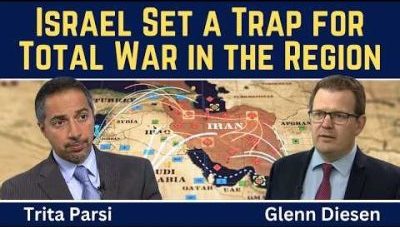
Trita Parsi: Israel Set a Trap for Total War in the Region
or go to
Aletho News Archives – Video-Images
From the Archive
Zionism’s Violent Legacy
By Donald Neff | Washington Report On Middle East Affairs | January 1996
On January 4, 1948, Jewish terrorists drove a truck loaded with explosives into the center of the all Arab city of Jaffa and detonated it, killing 26 and wounding around 100 Palestinian men, women and children.[1] The attack was the work of the Irgun Zvai Leumi – the “National Military Organization,” also known by the Hebrew letters Etzel – the largest Jewish terrorist group in Palestine. The Irgun was headed by Revisionist Zionist Menachem Begin and had been killing and maiming Arabs, Britons and even Jews for the previous ten years in its efforts to establish a Jewish state.
This terror campaign meant that at the core of Revisionist Zionism there existed a philosophical embrace of violence. … continue
Blog Roll
 Aletho News
- Trump’s Iran war is on an Israeli leash
- Saudi oil boss issues global supply warning
- Riyadh Says Its Oil System Is Intact. The Numbers Say Otherwise.
- Trump and Netanyahu Want to “Finish the Job” on Iran
- US ‘one-sided dictation’ not Iran’s beliefs makes rational talks impossible: Baghaei
- Iran’s Next Strike May Not Explode. It Could Shut You Down /Col Doug Macgregor
- Iran: US political targets legitimate if assassinations return
- Iraq shuts key border crossing with Iran under US pressure: Report
- Undersea Internet cables could be targeted in retaliation for attacks on Iran: IRGC deputy chief
- EU sending ‘biased’ observers to interfere in Serbian election – president
- If Americans Knew
- The Israel Lobby’s Changing Fortunes
- AIPAC has become such a political liability that it’s shifting to a more “nimble” approach to buying politicians
- At least 160 Israeli settler attacks in 2 weeks
- Will Gaza’s Ancient Christian Community Disappear Forever?
- Israel’s vision of regional security rests on keeping Arab states weak
- Heidi Levine recounts how Palestinian youths helped save her in settler attack
- DAILY UPDATE: Latest essential news on Palestine, Israel, & region
- Trump’s Intensifying Sabotage of the ICC, for Israel’s Sake
- Israeli military detain US and UK volunteers in West Bank including Democratic NY politician Brad Lander
- Americans at National Conservatism Conference held in Israel this year criticize Israel
- No Tricks Zone
- E-Cars Reduce CO2 Emissions By Only 41% Compared To Internal Combustion Engine Vehicles
- Predictions Made By Renowned Climate Professor Over Past Decades Have Been Proven To Be Poor
- New Study Suggests Large Regions Of The Pacific Ocean Have Been Cooling For The Last 80 Years
- Germany’s Green Energy Debacle: High Energy Costs Force Kahla Porzellan to Close After 182 Years!
- New Study: 50 Years Of The Most Aggressive ‘Net Zero’ Policies Can Only Affect The Global Climate By 0.03°C
- US September “Heat” Was No Record…Many Records Set Decades Ago
- Latest European Green Energy Debacle; Portugal’s Largest Flagship Solar Park Insolvent!
- Green Energy Debacle: German Expert Professor Fritz Vahrenholt Warns Of Severe Economic And Social Consequences
- Two More Paleo Reconstructions Affirm Meters-Higher Sea Levels Across Ireland, Brazil 7000-6000 Years Ago
- New Study: Earth And Venus Surface Warmth Largely Explained By Convection And Lapse Rate, Not CO2 Or Radiation

