Powerful Israeli Strikes on South Lebanon and Bekaa
Al-Manar | December 18, 2025
The Israeli enemy launched on Thursday a series of air raids on large areas in southern Lebanon and Bekaa in the east of the country, in a new escalation that targeted mountainous areas, valleys and the outskirts of several towns.
Al-Manar correspondent reported that the Israeli airstrikes targeted the outskirts of Al-Rihan in Iqlim Al-Tuffah, as well as the area between the towns of Deir Siryan and Qusayr in the south.
The strikes also hit the Litani River between Zawtar and Deir Siryan in the Nabatieh region, in addition to the Al-Jabbour and Al-Qatrani heights in Western Bekaa, according to our reporter.
Israeli aircraft later renewed their raids, targeting the Mahmoudiya area in southern Lebanon, while other airstrikes hit the Zaghrin heights in the Hermel mountains of the eastern Bekaa, Al-Manar correspondents reported.
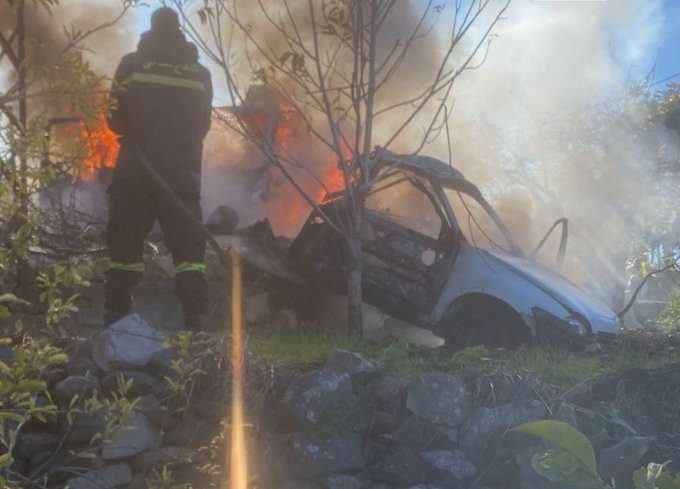
Meanwhile, an Israeli drone strike targeted a Rapid vehicle near the road linking the border town to Deir Siryan.
The strike took place as a truck belonging to Electricity of Lebanon public company was present nearby, our correspondent in south Lebanon noted.
“A number of workers were injured as the Israeli strike torched the Rapid vehicle and the Electricity of Lebanon truck,” Al-Manar reporter said.
Later on Thursday, the Ministry of Health confirmed 4 injured in an Israeli airstrike targeting a Rapid-type vehicle in the town of Taybeh, Marjeyoun district.
Commenting on the Israeli strikes, Lebanese Speaker said the Israeli strikes were a “message” to Paris Conference dedicated for supporting the Lebanese Army.
The strikes “are an Israeli message to Paris Conference and sustained bombardment in honor of the Mechanism,” Speaker Berri was quoted as saying, referring to the committee overseeing the ceasefire between Lebanon and the Zionist entity.
Hezbollah: Syria not a model for Lebanon, weapons will not be taken to fulfill Israel’s demands
The Cradle | December 13, 2025
Hezbollah Secretary General Naim Qassem declared on 13 December that the resistance is willing to cooperate fully with the Lebanese Armed Forces (LAF) but emphasized that it is not ready “for any framework that leads to surrender to the Israeli entity and the American tyrant.”
“Since the ceasefire agreement was reached, we have entered a new phase … Once the agreement was concluded, the state became responsible for ending the occupation and consolidating the army’s presence, and the resistance has done everything required of it,” Qassem declared during a ceremony organized by Hezbollah’s Women’s Organizations Units.
“The problem facing the state is not exclusively the issue of weapons to rebuild the country; rather, what is being discussed is an Israeli-American demand … With surrender, Lebanon will not survive, and Syria is a model before us,” the resistance leader emphasized.
“We will defend ourselves even if the sky were to close in on the earth. The weapons will not be taken away in implementation of Israel’s demands, even if the whole world unites against Lebanon,” Qassem added.
He also pointed out recent remarks by Diotto Abagnara, the commander of the UN Interim Forces in Lebanon (UNIFIL), who told Israeli media that Hezbollah is not rearming, contradicting Tel Aviv’s assertions to justify nonstop ceasefire violations in Lebanon.
During Saturday’s speech, Qassem also urged Lebanese authorities to “stop making concessions and backtracking.”
“Implement the agreement, and then discuss the defense strategy. Do not ask us not to defend ourselves, while the state is unable to protect its citizens. Let the state provide protection and sovereignty, and then we will put everything on the table for dialogue on the defense strategy, and reach a conclusion.”
Qassem’s speech coincided with Israeli threats to bomb a residential building in Yanouh, south Lebanon, hours after a UNIFIL and LAF patrol had inspected it.
According to local sources, the building was inspected at the direct request of the “mechanism committee” overseeing the one-sided ceasefire.
The house was alleged to have weapons, but the patrol found none. As the troops were preparing to leave, an Israeli drone hovered over the site, and UNIFIL received a request to conduct a second search of the house.
Israel has threatened to launch a major offensive against the country unless Hezbollah surrenders its weapons by the end of 2025. Washington has publicly backed Tel Aviv’s threats.
‘No evidence’: UNIFIL chief refutes Israeli claims about Hezbollah rearming in south Lebanon
Press TV – December 9, 2025
The commander of the United Nations Interim Force in Lebanon (UNIFIL) says the multinational peacekeeping mission has not found any evidence of Hezbollah rebuilding its military capabilities, contradicting Israeli claims used as the pretext to strike southern Lebanon.
Speaking in an interview with Israel’s Channel 12 television channel on Monday, Diodato Abagnara said he had seen “no evidence” that the Lebanese resistance movement was rearming south of the Litani River.
Abagnara, who took over as head of UNIFIL in June, also condemned continued Israeli airstrikes on Lebanon, which have killed hundreds of people, as “blatantly violating the ceasefire agreement.”
He warned that the slightest mistake could lead to a major escalation, describing the security situation as “really fragile.”
Abagnara also noted that the presence of Israeli troops in five points along the Blue Line demarcating the border between Lebanon and the Israeli-occupied territories constitutes a “flagrant” violation of UN Resolution 1701.
The resolution, which brokered a ceasefire in the 33-day-long war Israel launched against Lebanon in 2006, calls on the occupying Tel Aviv regime to respect Lebanese sovereignty and territorial integrity.
Israel and the Hezbollah resistance movement reached a ceasefire agreement that took effect on November 27, 2024. Under the deal, Tel Aviv was required to withdraw fully from the Lebanese territory, but has kept forces stationed at five sites, in clear violation of UN Security Council Resolution 1701 and the terms of last November’s agreement.
Since the implementation of the ceasefire, Israel has violated the agreement multiple times through repeated assaults on the Lebanese territory.
Lebanese authorities have warned that the Israeli regime’s violations of the ceasefire threaten national stability.
Israel moves to extend army service to 36 months
The Cradle | December 5, 2025
Israeli Defense Minister Israel Katz and Finance Minister Bezalel Smotrich announced on 5 December a plan to extend mandatory military service to 36 months.
The move raises the current service terms from 30–32 months to a full 36 months and marks a significant shift in how Tel Aviv intends to staff its army at a time of deep political rupture and growing pressure on its northern front.
The ministers said the extension would add “10,000 service days per year” and could delay the discharge of soldiers scheduled to complete their service in 2026.
Katz’s office said the government will cut roughly 30,000 reserve duty positions and rely instead on longer compulsory service to fill the gaps.
The move also comes as the government promotes legislation to exempt the ultra-Orthodox, known as the Haredim, from the draft, while expecting regular soldiers to make up for the shrinking reserve force.
Opposition leader Yair Lapid condemned the arrangement as “a budget of corruption and draft-dodging.”
The adjustment is included in a significantly expanded 2026 defense budget. According to the prime minister’s office and statements issued by Katz, the budget now stands at $34.72 billion, up from an earlier draft of $27.90 billion.
Katz said the government will “reinforce the IDF and … reduce the burden on reservists,” though the plan effectively shifts that burden onto conscripts who will now serve an extra year. Smotrich said the overall increase compared with 2023 reached $14.57 billion.
The manpower strain has sharpened in recent months. Israeli Brigadier General Shai Tayeb told lawmakers that the army is currently short 12,000 recruits, including 7,000 combat soldiers, and warned that troop levels are projected to decline even further by early 2027.
Tayeb told the Knesset that Israel “needs to expand the base of those serving” and is preparing for three-year service terms and 70 days of annual reserve duty within five years.
Israel has even begun turning to foreign mercenaries to fill its ranks, with losses from campaigns in Gaza and Lebanon, rising dropout rates, and growing reluctance among reservists to return to service, the army is left to face what officials describe as a “huge shortage” of capable fighters.
The Myth of Total Victory and the Reality on the Ground: Is Israel Winning Its Seven-Front War?
By Robert Inlakesh | The Palestine Chronicle | December 2, 2025
From the Gaza genocide to the assassination of Hezbollah’s senior leadership, Israel has carried out unprecedented destruction across the region. Yet, despite everything that has happened since October 7, 2023, has Israeli Prime Minister Benjamin Netanyahu truly delivered the “total victory” he promised over his regime’s adversaries?
The current state of play across West Asia has left many in despair. Undoubtedly, the genocide in the Gaza Strip has inflicted a generational psychological wound, not only on the people of the region, but concerned citizens throughout the world.
When the genocide began in October of 2023, many assumptions were made regarding who or what was going to come to the aid of the Palestinian people.
Some trusted in international institutions, others believed that the Arab masses would mobilize or assumed that the rulers of Muslim Majority countries would utilize their trade leverage, resources, and even militaries to rescue the people of Gaza. Then there were those who depended upon the Iranian-led Axis of Resistance.
On the question of the international institutions, the Israelis were brought before the UN’s top judicial organ, the International Court of Justice (ICJ), which found Tel Aviv plausibly guilty of committing genocide. However, when it issued its provisional measures, the court was simply ignored.
The United Nations Security Council (UNSC) even passed resolution 2728 on March 25, 2024, which called for a ceasefire until the end of the Muslim Holy Month of Ramadan, which was supposed to be binding and was again ignored by Israel.
Then came along the International Criminal Court (ICC)’s arrest warrants for Israeli Prime Minister Benjamin Netanyahu and former Defense Minister Yoav Gallant. Tel Aviv and Washington decided to go after the court and its prosecutor, undermining its authority.
The Arab Nations, with the exception of Yemen’s Ansarallah government in Sana’a, refused to lift a finger, as did the rulers of most Muslim Majority nations. The populations of Jordan and Egypt that were expected to act, didn’t even live up to the popular actions taken by European populations. The people in the major cities of the West Bank and in occupied Jerusalem didn’t even stage notable protests.
The only ones who acted were the Axis of Resistance. Lebanese Hezbollah and Yemen’s Ansarallah waged support fronts in solidarity with Gaza, while some Iraqi factions occasionally sent suicide drones and rocket fire from Syria would occur periodically.
Yet the way that the Axis of Resistance dealt with the genocide appeared to be the execution of a strategy to ultimately de-escalate hostilities and bring the assault on Gaza’s people to an end. The Israelis, however, were not interested in a cessation of hostilities and were instead hell bent on destroying the entire Iranian-led Axis once and for all.
Israel broke every tenet of international law and violated all diplomatic norms. They would go on to carry out countless assassinations eventually stretching across Lebanon, Syria, Iraq, Iran, Yemen, with a failed attempt on the lives of Hamas leaders in Doha, Qatar. The consular segment of Iran’s embassy in Syria was even bombed.
Israel carried out the pager terrorist attacks across Lebanon, which wounded thousands and killed dozens, including countless women and children. This not only shook Lebanese society to the core, but also proved a major security and communications blow to Hezbollah itself. The infiltration of Hezbollah allowed Israel to murder the majority of the organization’s senior leadership. Perhaps the biggest psychological blow was the assassination of Hezbollah’s Secretary General, Seyyed Hassan Nasrallah.
Shortly after thousands had been murdered by Israel’s onslaught on Lebanon between September and late November, the next major blow to the Axis of Resistance came in the form of regime change in Syria. Suddenly, a US-backed government had been ushered into power and instantly opened up lines of communication with Israel.
What occurred in Syria was significant for a number of reasons, the most important of which was the collapse of the Syrian military and occupation of vast portions of territory in southern Syria, including the strategic high-ground of Jabal Al-Sheikh (Mount Hermon). It also meant that weapons transfers to Lebanon, to supply Hezbollah and the Palestinian armed factions, were instantly made much more difficult.
The resistance in the West Bank that had been growing in the north of the occupied territory since 2021 was significantly cut down through aggressive Israeli and Palestinian Authority military campaigns. In the Gaza Strip, the resistance forces were also degraded and had no supply lines. Meanwhile, the only consistent front that never buckled and only accelerated their attacks was the Yemeni Armed Forces, but due to their geographical constraints were limited in what impact they could have.
For all of the above-noted reasons, the Israelis have appeared to have gained the upper hand, and this has left many fearing what they have in store next. It is assumed that further attacks on Lebanon and Iran will be aimed at achieving regime change in Tehran, which, if successful, would indeed declare Israel the undisputed ruler of the region.
A Reality Check
Despite the gains that the Israelis have made, they have also suffered enormous blows themselves, which are often left out of many analyses offered on the current situation the region finds itself in. Before delving into this, to avoid accusations of “cope”, it is important to make note of a few different points.
Many refutations offered to the pessimistic view commonly adopted of the region engage in exaggeration, speculation, and refuse to even acknowledge the obvious losses their side has suffered. This is often the practice of those who remain die-hard supporters of resistance against the Israelis and their regional project.
When such positive and romanticized depictions are used to describe the current situation and are heard by those who are convinced that their side has already lost, they often experience a visceral opposition to that sense of optimism. Supporters of the resistance to Israel’s tyranny attempt to rescue morale through slogans and dogmatic rhetoric, which falls on deaf ears, as such explanations lack logical consistency.
This all being said, things are not exactly as doom-and-gloom as the popularized pessimism that prevails across the region suggests.
At this current moment, Israel has not won on any front; the caveat is obviously that the Axis of Resistance has not won either. Every front is a de facto stalemate. This being said, the Israelis have undoubtedly inflicted much greater damage on their adversaries in the short run.
Yes, the Palestinian factions in Gaza have been weakened, and the human cost of the war has been enormous, beyond anyone’s imagination, but they have not been defeated. Instead, they have waged a guerrilla war against the occupying army that has targeted the civilian population as a means of attempting to defeat them by proxy. Are they capable of defeating the Israeli military? No, not by themselves, but this has always been the case.
In Lebanon, the Israelis certainly dealt a massive blow to Hezbollah; there can be no doubt about it. Although they were incapable of collapsing the group and it is clear that they still retained an abundance of arms, something demonstrated throughout the course of the war in late 2024. Today, Hezbollah is rapidly rebuilding its capabilities and preparing for the inevitability of the next round.
One key takeaway from the Israel-Lebanon war was that, beyond assassinations and intelligence operations, the Israelis proved incapable on the ground and were even deterred from conquering villages like Khiam along with the Lebanese border area. Their greatest tactical achievements came at the beginning of the war, while the remainder of the battle proved that Israel’s only edge came through its air force.
The reason why the Lebanon war was a loss for Hezbollah was down to the collapse of Hezbollah’s image. Previously, the propaganda of the organization and the trust commanded by its leader, Seyyed Hassan Nasrallah, had convinced the world that the group was powerful enough to destroy Israel by itself. In his last speech, before he was murdered alongside 300 civilians, Nasrallah had publicly admitted that there is, in fact, no parity between Hezbollah and Israel militarily.
In 2006, just as occurred in 2024, the result of the war was a stalemate. No side decisively beat the other. Instead, it was the combined fact that Hezbollah’s performance was militarily stunning, from a planning and execution point of view, in addition to the fact that nobody expected the group to even survive, let alone force the Israelis to abandon their war plans. If you look at the difference in Lebanese to Israeli casualties in 2006, there is no comparison; in fact, it was even a major achievement for Hezbollah to have hit Haifa with rockets back then.
The 2006 war proved that Hezbollah was a force to be reckoned with, that it would inflict serious blows on Israel if it sought to re-invade and re-occupy southern Lebanon, so Tel Aviv made the calculation that it was best to leave it alone. This is why there were 17 years of deterrence, where Israel would not dare bomb Lebanon.
Fast forward to 2023, Hezbollah was a group capable of striking any target across occupied Palestine, and in 2024 hit Tel Aviv for the very first time. Compared to a force of an estimated 14,000 men in 2006, Hezbollah’s current armed forces consist of over 100,000 men, making them a larger armed group than many of the militaries of various countries.
The difference is that Hezbollah is fighting Israel, which is equipped with an endless supply of the world’s most technologically advanced weapons and equipment that enables it to pinpoint target leaders.
It suffices to say, the two sides are not equal, but by no means is Hezbollah finished or weak; it is simply that the group must suffer immense sacrifices in order to prove victorious in any confrontation with Israel. This is because the equation has changed since October 7, 2023; it is no longer the case that the Israelis can be deterred. It is a long war that will lead to the total defeat of one side or the other. What happens from here is largely down to leadership and the willingness to commit to total war.
Syria is itself a totally different issue. First, we must keep in mind that the government of Bashar al-Assad was not actively engaged in the war against Israel; instead, it allowed for the Axis of Resistance to operate inside its territory and establish a defensive front in southern Syria.
Again, being realistic, the new government in Syria has weakened the entire State and divided it even more than was already the case. Ahmed al-Shara’a is joined at the hip with his US allies and pursues policies that explicitly favor his backers in Western governments. All of the denialism in the world does not change this fact, nor does it change Damascus’s establishing direct communications and even coordination with the Israelis.
To avoid going through what is already well known and beating a dead horse, there are a number of key considerations to make when looking at the situation in Syria, which could lead in various different directions.
I will preface everything below by saying that it is plausible that for the foreseeable future, the Israelis are going to succeed at every turn in Syria, as they have done since the pro-US government took power.
Unfortunately, the Syrian conflict is the top cause of sectarian division in the region. These divisions work on two pillars: tribalism and propaganda. Round-the-clock propaganda is churned out to cause fitnah and you will still hear baseless claims, including totally fabricated statistics, spread to achieve this division. Some would blame these conflicts on religion, yet it is more about blood feuds, corruption, and tribalistic tendencies.
Putting this aside, the Syrian front is now open and various possibilities exist. There is a competition between Turkiye and Israel inside the country, meaning that a proxy conflict is not off the table. It is also very possible that Ahmed al-Shara’a, who has managed to create problems with even his once staunch allies, will be assassinated or ousted from power, creating a bloody power struggle that could pour into the streets of Damascus.
For now, the weapons flow into Lebanon to supply Hezbollah is ongoing and there are also indications that during the final days of the former regime, many advanced weapons fell into various hands. The US is now working alongside the government in Damascus to ensure that these weapons transfers are stopped or at least rendered much more difficult. In addition to this, in the event of a war between Hezbollah and Israel, it is safe to assume that weapons transfers will be put to a halt.
As Israel advances further into southern Syrian territory, more villages will likely choose to resist them, as occurred in Beit Jinn recently; this will happen independent of the government in Damascus. As Ahmed al-Shara’a does not enjoy full control over his country, this also provides opportunities for armed groups to pop up and begin resisting the occupying force, something that the Syrian President will not be able to control, especially if Israel makes mistakes and gets itself embroiled in a crisis.
This story is not over and Syria is a hostile environment for Israeli forces due to the rejection of the people there. Ultimately, just as occurred in southern Lebanon, when the government abandons its duties, the people end up taking matters into their own hands to resist occupation. Does this mean we can expect a robust fighting force there soon? Probably not for now, but various possibilities exist in the foreseeable future.
Then we look to Iran and Yemen, whose capabilities remain and only grow; neither has been defeated. Iraq’s Hashd al-Shaabi have not been mobilized until now, and it is unclear what role they could play in a broader regional war, but it is of note that they exist.
What has happened is that Israel has proven time and time again that it is willing to be daring with the one tactic that they can actually excel in, assassinations and intelligence operations. However, these operations do not win wars; they are undoubtedly blows, but they do not inflict a knockout punch.
When two sides engage in such a war, it is expected that losses will occur on both sides. The Israelis have suffered a battered economy, a divided society, their settlements in the north are still in ruins, they haven’t repaired the damage inflicted on their infrastructure, and they have lost public support across the world, including in the United States. They are a global pariah sustained only by their Western backers, incapable of defeating what was viewed as the weakest link of the Axis of Resistance in Gaza.
In their favor, they have eliminated most of Iran’s influence in Syria, committed one of the worst crimes in modern history against Gaza and weakened the armed resistance there as a result of it. They also took out Hezbollah’s senior leadership, while degrading it and its political standing. In addition to this, many leaders and generals in the Islamic Revolution Guard Corps (IRGC)’s chain of command were killed.
In Iran’s case, the so-called 12 Day War, back in June, had resulted in failure for the Israelis. Instead of achieving regime change and/or the destruction of Iran’s nuclear program, it is clear now that it has only succeeded in driving out international monitors and even united the population in a way previously unimaginable. Tehran has leaned into the growing trend of Iranian nationalism among its people and is preparing for another round. That battle also ended with Iran landing the last real blows.
The Israeli military must be viewed for what it is; it has the military edge in the air, possesses the most advanced weapons in the world [outside of Russia], enjoys full US support and is backed by one of the best intelligence agencies in the world. It also has something else on its side, which is that it does not care for morality or international law at all; it will break any rule to achieve an objective.
At the same time, its ground force is largely incapable, and it is also massively fatigued. The Israeli army was only really prepared to fight very brief battles and is an occupation force, which is why it now struggles to mobilize the soldiers necessary to carry out various offensive actions. It also needs to pay some of its soldiers’ danger money salaries. It has also recruited the private sector and civilians, paid as much as 800 dollars per day, to carry out their demolition missions in Gaza.
There is a reason why, on October 7, 2023, a few thousand Palestinian fighters armed with light weapons managed to collapse the Israeli southern command in a matter of hours and temporarily took control of the Israeli settlements surrounding Gaza. In other words, they are far from invincible.
Is this all to say that “Israel has lost”? No, clearly no side has won yet. There are various conspiracies in the works. In the Gaza Strip, the US is working alongside its allies to find a way to defeat the armed resistance groups. The Israelis clearly have their sights set on new wars against Lebanon and Iran; they will also likely strike Yemen hard again. However, they now find themselves in a much more vulnerable situation and could easily overextend themselves on one front, leading to significant losses.
So, can we say that Benjamin Netanyahu is closer to his “total victory”? The answer to this question is no. Is it possible that the “Greater Israel Project” will be implemented and that Iran will be toppled? This always has to be considered as a threat, because this is clearly Israel’s goal, but it is also just as likely that Tel Aviv will suffer a strategic defeat. It is especially the case because they are fighting an opposition that is more likely to commit to an all-out war, given what they have suffered up until this point.
Hezbollah and Saudi Arabia’s uneasy détente
By Tamjid Kobaissy | The Cradle | December 2, 2025
In West Asia, where sectarian politics and external meddling collide with local power struggles, few rivalries have been as entrenched or as symbolically loaded as that between Hezbollah and Saudi Arabia.
For decades, it embodied the broader confrontation between Iran and the Persian Gulf kingdoms – a proxy war defined by ideology, oil, and shifting battlefronts. But today, under the weight of new regional calculations, rising Israeli belligerence, and the cracks in American hegemony, that once-intractable hostility is giving way to a more ambiguous and tactical coexistence.
What is developing is neither an alliance nor even reconciliation. But for the first time, Hezbollah and Riyadh are probing the edges of a relationship long defined by zero-sum enmity. A pragmatic detente is emerging, shaped less by goodwill than by the shared urgency to contain spiraling instability across the region.
Tehran, Riyadh, and the long shadow of history
The long arc of the Hezbollah–Saudi confrontation is impossible to separate from Iran’s post-revolutionary clash with Riyadh. When Ayatollah Ruhollah Khomeini toppled the Shah in 1979 and declared the House of Saud a reactionary tool of western imperialism, the rupture was both ideological and strategic.
The Saudis responded by bankrolling Saddam Hussein’s devastating war against Tehran, and in 1987, relations cratered after Saudi security forces massacred Iranian pilgrims in Mecca. Khomeini’s message was scathing:
“Let the Saudi government be certain that America has branded it with an eternal stain of shame that will not be erased or cleansed until the Day of Judgment, not even with the waters of Zamzam or the River of Paradise.”
Decades later, the so-called Arab Spring of 2011 reopened the wound. While Tehran stood by its state allies in Damascus and Baghdad, Riyadh threw its weight behind opposition movements and fanned the flames of sectarian conflict.
In Yemen, the kingdom launched a military campaign against the Ansarallah movement and allied forces, which Tehran backed politically and diplomatically. After Saudi Arabia executed outspoken Shia cleric Sheikh Nimr al-Nimr in 2016, Iranian protesters stormed the Saudi embassy in Tehran, prompting Riyadh to sever diplomatic ties. The two regional powers would only resume relations as part of Chinese-backed mediation in 2023.
From Hariri’s abduction to assassination plots
Within this regional maelstrom, Hezbollah became a prime Saudi target. When the Lebanese resistance captured two Israeli soldiers on 12 July 2006, to secure the release of prisoners, Riyadh dismissed it as “uncalculated adventures” and held Hezbollah responsible for the fallout.
In Syria, Hezbollah’s deployment alongside former Syrian president Bashar al-Assad’s army placed it in direct opposition to Saudi-backed militants. In Yemen, the movement’s vocal support for the Ansarallah–led government in Sanaa triggered Gulf Cooperation Council (GCC) sanctions and terrorist designations.
Matters escalated in 2017 when Saudi Arabia detained then-Lebanese prime minister Saad Hariri and coerced him into announcing his resignation on television from Riyadh. Late Hezbollah secretary-general Hassan Nasrallah slammed the move as an act of war against Lebanon. The situation de-escalated only after French mediation.
In a 2022 TV interview, Nasrallah revealed that Saudi Crown Prince Mohammed bin Salman (MbS) was ready to authorize an Israeli plot to assassinate him, pending US approval.
Quiet channels, Iranian cover
The Beijing-brokered rapprochement between Tehran and Riyadh changed the regional tone but did not yield immediate dividends for Hezbollah. On the contrary, Saudi Arabia intensified its efforts to roll back Hezbollah’s influence in Beirut, especially following Israel’s October assault on Gaza and southern Lebanon.
Riyadh pressured Lebanese Prime Minister Nawaf Salam to implement the so-called “Barrack Paper,” aimed at politically sidelining Hezbollah and stripping its arms. Speaking to The Cradle, a well-informed political source reveals that the kingdom informed the former Lebanese army commander – now the country’s president – Joseph Aoun, that it would proceed with its plans even if they triggered civil war or fractured the military. The source describes this as emblematic of Riyadh’s short-term crisis management, mirroring Washington’s reactive regional strategy.
Despite this, signs of a tactical shift began to emerge. In September, Nasrallah’s successor, Sheikh Naim Qassem, publicly called for opening a “new chapter” in ties with Riyadh – an unprecedented gesture from the movement’s leadership. According to the same source, this was not a spontaneous statement.
During a visit to Beirut, Iranian national security official Ali Larijani reportedly recieved a message from Hezbollah to Riyadh expressing its openness to reconciliation. In a subsequent trip to the kingdom, Larijani presented the message to MbS.
While initially dismissed, it was later revisited, leading to discreet backchannel coordination directly overseen by Larijani himself.
Tehran talks and guarded understandings
The Cradle’s source adds that since then, three indirect rounds of Hezbollah–Saudi talks have reportedly taken place in Tehran, each under Iranian facilitation. The first focused on political de-escalation, while the latter two addressed sensitive security files, signaling a mutual willingness to test limited cooperation.
One provisional understanding emerged: Saudi Arabia would ease pressure on Hezbollah in Lebanon and drop immediate demands to disarm the movement. In exchange, Riyadh asked Hezbollah to keep its weapons out of Syria – echoing a broader Gulf consensus – and assist Lebanese authorities in curbing drug smuggling networks.
In private, Riyadh reportedly acknowledges Hezbollah’s military resilience as a strategic buffer against Israel’s regional belligerence. The Persian Gulf states no longer trust Washington to shield them from Tel Aviv’s increasingly unilateral provocations – as was seen in the Israeli strikes on Doha in September. But Hezbollah’s dominance in Lebanon remains a challenge to Riyadh’s political influence.
Hezbollah, Saudi Arabia, and the Iranian umbrella
The Hezbollah–Saudi contacts are just one strand in a broader strategic dance between Riyadh and Tehran. According to The Cradle’s source, Saudi Arabia has assured Iran it will not join any Israeli or US-led war, nor allow its airspace to be used in such a scenario. In return, Tehran pledged not to target Saudi territory. These commitments are fragile, but significant.
The source also reveals that US President Donald Trump had authorized MbS to explore a direct channel with Iran, tasking him with brokering understandings on Yemen and beyond. Larijani conveyed Iran’s openness to dialogue, though not to nuclear concessions. MbS reportedly stressed to Trump that a working accord with Tehran was essential to regional stability.
In parallel, Lebanese MP Ali Hassan Khalil, a close advisor to Parliament Speaker Nabih Berri, is expected to visit Saudi Arabia soon following meetings in Tehran. This suggests continued shuttle diplomacy across resistance, Iranian, and Saudi nodes.
Strategic divergence, tactical convergence
Still, no one should confuse these developments with a realignment. Rather than a reset, this is merely a tactical repositioning. For Riyadh, the old boycott model – applied to Lebanon between 2019 and 2021 – failed to dislodge Hezbollah or bolster pro-Saudi factions. Now, the kingdom is shifting to flexible engagement, partly to enable economic investments in Lebanon that require minimal cooperation with the dominant political force.
The pivot also serves Saudi Arabia’s desire to project itself as a capable mediator rather than a crude enforcer. The 7 October 2023 Operation Al-Aqsa Flood has tilted regional equations, while Israeli expansionism has become a destabilizing liability. A Hezbollah–Israel war would not stay confined to the Blue Line. Gulf cities, energy infrastructure, and fragile normalization deals would all be at risk.
From Hezbollah’s side, the outreach reflects both constraint and calculation. The resistance faces growing pressure: an intensified Israeli campaign, a stagnating Lebanese economy, and the need to preserve internal cohesion. A tactical truce with Riyadh offers breathing space, and possibly, a check against Gulf-backed meddling in Syria.
When Sheikh Naim Qassem declared that Hezbollah’s arms are pointed solely at Israel, it was also a signal to the Gulf: we are not your enemy.
The real enemy, for both sides, is the unpredictable nature of Israeli escalation. Riyadh fears being dragged into an Israeli-led regional war that it cannot control. Hezbollah fears encirclement through economic, political, and military pressure. Their interests may never align, but for now, they are no longer mutually exclusive.
US, Israel fear leak of tech secrets from unexploded bomb in Beirut
MEMO | December 1, 2025
US and Israeli officials have reportedly demanded the Lebanese government to urgently secure the transfer of an unexploded Israeli air bomb in the southern suburbs of Beirut to its possession, fearing it might fall into the hands of Russia or China and allow them access to its advanced military technology.
According to the Hebrew newspaper Ma’ariv, unnamed sources say the bomb is a smart glide munition, model GBU-39B, manufactured by the US firm Boeing, and was used by the Israeli Air Force in a strike targeting Hitham Ali Tabtaba’i — described as the chief of staff of Hezbollah — within the group’s stronghold in southern Beirut.
Ma’ariv adds that although the bomb was used in the assassination attempt, it did not explode for reasons that remain unclear, and remained relatively intact at the scene of the attack. This has raised concern in Washington about the possibility that foreign powers — specifically Russia or China — could recover it and study its technology.
The report notes that the bomb carries a warhead “exceptionally powerful for its weight”, as well as guidance systems and technology not currently believed to be held by Moscow or Beijing — making its recovery a priority for the United States.
Will Saudi Arabia fund Israel’s grip over Lebanon?
By Mohamad Hasan Sweidan | The Cradle | Novmber 27, 2025
In the wake of Israel’s November 2024 apparent ceasefire with Lebanon, Tel Aviv has moved to reshape the post-war order in its favor. Treating Lebanon as a weakened and fragmented state, Israel seeks to impose a long-term, unilateral security and economic regime in the south, bolstered by US backing.
Simultaneously, Saudi Arabia has thrust itself into the reconstruction process as the main Arab financier. But the kingdom risks becoming a junior partner in an Israeli-American project that sidelines it from real decision-making. The question facing Riyadh is clear: Will it bankroll its own marginalization?
Tel Aviv’s vision: Disarmament, deterrence, domination
Israel’s strategy for Lebanon extends far beyond the oft-repeated demand to disarm Hezbollah. It envisions a sweeping transformation of Lebanon into a demilitarized satellite state governed under a US-Israeli security framework. Nowhere is this clearer than in Tel Aviv’s insistence on remaining inside Lebanese territory until Hezbollah is stripped of its deterrent capabilities, not just south of the Litani River, but across the country.
Israeli Defense Minister Israel Katz and former Northern Command chief Uri Gordin have both publicly outlined this goal. Gordin even suggested establishing a permanent buffer zone inside Lebanon to serve as a “bargaining chip” for future negotiations, while Katz confirmed that Israeli forces would remain indefinitely in the south. Tel Aviv no longer seeks temporary deterrence, favoring permanent subordination.
Katz, for his part, has stated “Hezbollah is playing with fire,” and called on Beirut to “fulfill its obligations to disarm the party and remove it from southern Lebanon.”
Most recently, while addressing the Knesset, he warned that “We will not allow any threats against the inhabitants of the north, and maximum enforcement will continue and even intensify.”
“If Hezbollah does not give up its weapons by the year’s end, we will work forcefully again in Lebanon,” Katz reiterated. “We will disarm them.”
According to this blueprint, Lebanon is not considered a sovereign neighbor, but a security appendage to Israel’s northern frontier. State institutions are expected to serve as administrative fronts for a de facto Israeli-American command center. International aid, including funding from Arab states of the Persian Gulf, is being weaponized to enforce this new security-economic order.
From the perspective of Israel, the goals in Lebanon are not limited to the disarmament of Hezbollah. They go beyond that toward a deeper project of transforming Lebanon – especially the south – into a kind of security-economic colony.
This includes consolidating a long-term military presence, imposing new border arrangements, and paving the way for settlement projects or institutionalized buffer zones, as evidenced by current maps showing the presence of Israeli forces at several points inside Lebanese territory.
Saudi Arabia’s options: Pressure or partnership
Enter Riyadh. The Saudi Foreign Ministry has repeatedly called for Lebanese arms to be confined to the state and endorsed the implementation of the 1989 Taif Agreement.
In September, Saudi Foreign Minister Faisal bin Farhan, in a speech to the UN General Assembly, stressed that:
“Saudi Arabia stands with Lebanon, supports everything that strengthens its security and stability, and welcomes the efforts of the Lebanese state to implement the Taif Agreement (1989), affirm its sovereignty, and place weapons in the hands of the state and its legitimate institutions.”
The Saudi envoy to Lebanon, Yazid bin Farhan, reiterated Riyadh’s position: the exclusive right to possess arms must lie with the Lebanese state. In private information, during a meeting between Bin Farhan and Sunni leaders in Lebanon, the diplomat stressed that pressure must be put on disarming the party, even if that requires reaching a civil war.
On the surface, Saudi and Israeli objectives appear aligned. Tel Aviv applies military pressure. Riyadh applies economic and political pressure. Both demand the end of Hezbollah’s armed presence. But while Israel’s aim is absolute control over Lebanon’s security order, Saudi Arabia still seeks a political system that reflects its influence. In this, Tel Aviv’s ambitions collide with Riyadh’s.
However, Israel has no intention of sharing influence with any Arab state – nor even Turkiye. Its model is exclusionary. It views Riyadh not as a partner, but as a bankrolling mechanism to finance the dismantling of Lebanon’s axis of resistance under Israeli terms. As former deputy director of the National Security Council, Eran Lerman put it, Saudi Arabia is merely a pressure tool to bring Lebanon to heel.
Thus, the crux of the matter is this: Riyadh may envision itself as a key stakeholder in post-war Lebanon, but Israel sees it as a disposable auxiliary.
The 17 May redux: Recolonizing south Lebanon
To grasp the depth of Israel’s project, one need only look to its precedents. In 1983, Israel, alongside the US and under Syrian oversight, tried to enshrine a similar model via the 17 May Agreement. That deal called for an end to hostilities, gradual Israeli withdrawal, a “security zone” in the south, and joint military arrangements. In practice, it turned Lebanon into a protectorate tasked with safeguarding Israeli security interests.
Today, after the 2024 war, Tel Aviv is resurrecting that same formula. Israeli forces have remained stationed at multiple points inside Lebanon despite the ceasefire terms mandating full withdrawal. Airspace violations and near-daily raids persist under the pretext of preventing Hezbollah from “repositioning.” Think tanks in Tel Aviv, alongside joint French-US proposals, are now pushing phased disarmament: first the south, then the Bekaa, then the Syrian border, ultimately ending all resistance capabilities.
International support is being dangled as a carrot. Aid from the US, France, Saudi Arabia, Qatar, and others is contingent on Lebanon executing a disarmament plan under International Monetary Fund (IMF) oversight and within a strict timeline. This is the economic arm of the Israeli security project.
More dangerously, Israeli studies suggest that reconstruction of southern villages should be explicitly tied to the removal of resistance forces, while preserving “full freedom of action” for the Israeli army in Lebanese air and land space.
Can Riyadh afford Tel Aviv’s trap?
In parallel with this vision, western analyses close to decision-making circles in Washington and Riyadh show that Saudi Arabia itself sees Lebanon as a pivotal arena in its conflict with Iran. Any serious return to the Lebanese file is linked to the weakening of Hezbollah’s influence.
But the key divergence between the Saudi and Israeli approaches lies in a critical question: Who ultimately holds the keys to decision-making in Lebanon?
Riyadh aims to use its financial and political capital to recalibrate the Lebanese political order in its favor, minimizing Iranian sway while reinforcing its own influence. But Israel’s plan is more radical: to redefine Lebanese sovereignty altogether, placing it under perpetual Israeli security oversight.
In this model, Saudi Arabia – and any other Arab state – is reduced to the role of financier, tasked with implementing terms written in Tel Aviv and Washington rather than contributing an independent Arab vision for the region.
From this angle, Tel Aviv’s persistent invocation of the “military option” in Lebanon works against Gulf interests. It positions Riyadh and its allies as the paymasters for reconstruction, forced to foot the bill for a post-war settlement they had no role in shaping.
If Saudi Arabia concedes to this logic – and fails to leverage its influence in Washington, in Arab diplomatic circles, and in donor mechanisms – it risks forfeiting Lebanon to a joint Israeli-American order.
That order would mirror the defunct 17 May Agreement, only more deeply entrenched. Lebanon would not only be demilitarized. It would become a living model of “security-economic conjugation,” designed to recalibrate regional influence away from the Arab world and toward an Israeli-dominated Levant.
Israel fortifying outposts in southern Lebanon in violation of ceasefire
Press TV – November 26, 2025
Satellite imagery shows Israel continues to occupy and fortify military positions in southern Lebanon in violation of Lebanese sovereignty, one year after signing a ceasefire with Hezbollah.
According to Planet Labs PBC, the Israeli military occupies five strategic positions along the Blue Line, the de facto border between Lebanon and the occupied territories. These positions are surrounded by earthen fortifications and connected by widened access roads.
The outposts, covering one to two hectares each, include sections for temporary buildings and military vehicles, according to an analysis by AFP, which says the access roads to these positions have also been significantly expanded to facilitate vehicle movement.
The westernmost base in the Labbouneh area lies only 150 meters from a UN peacekeeping station, while the easternmost on Hamames hill is about 1.5 kilometers inside Lebanese territory.
The analysis also shows near-total destruction of buildings in villages near the outposts due to Israel’s systematic demolition of infrastructure.
By maintaining control over southern Lebanese villages, Israel continues to violate the ceasefire it signed on November 27, 2024, which required a full withdrawal of its forces within 60 days.
Israel says it keeps these positions to ensure Hezbollah does not carry out military activities in the area.
However, analysts state that these fortified positions and demolitions mirror the war tactics employed by Israel in the Gaza Strip.
According to the United Nations Interim Force in Lebanon (UNIFIL), the regime’s forces have committed over 7,500 air violations and nearly 2,500 ground violations in the past year, totaling almost 10,000 breaches of the ceasefire.
In a latest violation, Israel assassinated top Hezbollah commander Haitham Tabatabai in a strike on a residential area near Beirut on Sunday.
Hezbollah warned that Israel has committed a grave mistake, saying the resistance group is considering its response to the killing.
Lebanese President Michel Aoun also condemned the attack, calling it a clear demonstration of Tel Aviv’s disregard for repeated international appeals. Aoun urged the global community to act to prevent further aggression against the Lebanese people.
Enemy plot against Lebanon similar to conspiracy imposed on Syria, says lawmaker
Press TV – November 16, 2025
A senior Lebanese lawmaker says his country does not need a new agreement given the fragile ceasefire that Israel repeatedly violates, warning that the occupying entity is devising a plot against Lebanon similar to the conspiracy imposed on neighboring Syria.
“Some in Lebanon insist on disarmament of Hezbollah and assert that the enemy will no longer have an excuse against Lebanon in case the resistance movement lays down arms,” Hussein Hajj Hassan, a member of Loyalty to the Resistance Bloc – the political wing of Hezbollah in the Lebanese parliament – said on Saturday evening.
“They believe the sole reason behind Israel’s aggression against Lebanon lies in Hezbollah’s weapons,” he said, adding that the plot the Tel Aviv regime is drawing up for Lebanon is akin to the conspiracy imposed on Syria.
“It involves creation of a buffer zone, continuation and expansion of the Zionist occupation, and destruction of the elements of power, not only the Hezbollah resistance movement, but also the government.”
Hajj Hassan noted that the talk of a new agreement with Israel is meaningless whilst the regime does not stand committed to the ceasefire deal concluded in November last year.
“The ceasefire agreement has been brokered by the United States and France, carries UN guarantees, and stipulates the withdrawal of Israeli forces from Lebanese territory, cessation of aggression, release of Lebanese prisoners, and reconstruction of the country. The need for a new deal is pointless, especially as the previous agreement has not been implemented at all by Zionist occupiers,” the Lebanese legislator said.
“Is there a resistance group and weapons in Syria? So why does the Zionist regime keep invading the country, occupying more land there, and affirming that it will not pull out?” Hajj Hassan questioned.
The Lebanese lawmaker highlighted that Syria’s ruling Hay’at Tahrir al-Sham (HTS) regime is allied to Washington, yet the Zionist regime is pressing ahead with its acts of aggression and occupation of Syrian territories.
“The more concessions you grant the Zionist enemy, the weaker you become. Hezbollah and national unity are the only guarantors of deterrence and defense,” he emphasized.
Israel and Hezbollah reached a ceasefire agreement that took effect on November 27, 2024. Under the deal, Tel Aviv was required to withdraw fully from the Lebanese territory—but has kept forces stationed at five sites, in clear violation of UN Security Council Resolution 1701 and the terms of last November’s agreement.
Since the implementation of the ceasefire, Israel has violated the agreement multiple times through repeated assaults on the Lebanese territory.
Lebanese authorities have warned that the Israeli regime’s violations of the ceasefire threaten national stability.
Syria’s HTS deploys foreign fighters to Lebanon border: Report
Press TV – November 13, 2025
Hayat Tahrir al-Sham (HTS) has reportedly deployed foreign Takfiri fighters from northern Syria to the border with Lebanon, sparking renewed concern over the group’s destabilizing activities and growing presence in the region.
According to sources cited by The Cradle, foreign militants affiliated with HTS were transferred in recent days from the Harem area in Idlib province to the city of al-Qusayr, near the Syrian–Lebanese border.
The movement reportedly coincided with the transfer of heavy military equipment, including armored vehicles and other hardware.
“At the same time, forces affiliated with the Ministry of Defense of the ‘Syrian Transitional Government’ attempted to advance and take positions inside Lebanese territory, specifically in the Wadi al-Thalajat area of Ras al-Maara, along the Syrian–Lebanese border in the Damascus countryside,” the sources said, referring to barren areas where the Lebanese army is not present.
These reports emerge shortly after Washington announced Syria’s participation in the US occupying coalition in the Arab country, as Abu Mohammed al-Jolani — once affiliated with al-Qaeda and Daesh — arrived in Washington on Sunday.
The HTS military remains deeply infiltrated by extremist elements. Many of its current commanders and officers are known former members of al-Qaeda and Daesh factions.
The reported buildup of HTS-linked forces near Lebanon coincides with renewed US threats that such militias could be deployed against Hezbollah.
On Friday, US envoy Tom Barrack said that “Damascus will now actively assist us in confronting and dismantling the remnants of ISIS, the IRGC (Islamic Revolution Guards Corps), Hamas, Hezbollah, and other terrorist networks, and will stand as a committed partner in the global effort to secure peace.”
Analysts warn that the alignment of US policy with extremist-leaning Syrian factions such as HTS risks reigniting cross-border violence and undermining the security achieved by Hezbollah and the Lebanese Armed Forces after expelling Daesh and al-Qaeda elements from Lebanon’s eastern border in 2017.
Jolani told the Washington Post in an interview that “good” progress has been made in direct talks to reach an agreement with Israel, while boasting about weakening the Axis of Resistance on behalf of Tel Aviv.
“Israel has always claimed that it has concerns about Syria because it is afraid of the threats that the Iranian militias and Hezbollah represent. We are the ones who expelled those forces out of Syria,” he said.
“The US is with us in these negotiations, and so many international parties support our perspective in this regard. Today, we found that Mr. Trump supports our perspective as well, and he will push as quickly as possible in order to reach a solution for this,” he added.
Jolani also met with US-based Syrian rabbi Yosef Hamra.
Hebrew reports have revealed that a main part of the agreement will likely involve HTS–Israeli intelligence sharing and cooperation against the Axis of Resistance, specifically Iran and Hezbollah – which helped the former government recapture large swathes of Syria from al-Qaeda and Deash.
Israel carried out heavy strikes in Damascus and elsewhere in southern Syria earlier this year, under the pretext of protecting the Druze minority from Jolani’s extremist forces.
Now, it continues to carry out incursions, seize territory, and expand the occupation it established after the fall of former Syrian president Bashar al-Assad’s government last year.
Yet Jolani and other HTS officials have repeatedly signaled that they pose no threat to Tel Aviv.
The deployment of Takfiri fighters along the Lebanese border serves as a pretext for confronting resistance groups and advancing Israeli interests, coming as Israel continues its repeated acts of aggression across Syrian territory following the collapse of former President Bashar al-Assad’s government late last year.
Analysts are asking why al-Jolani does not deploy any forces against Israel, which continues to attack and occupy parts of Syria almost daily.
The HTS-led regime will reportedly hand over the occupied Golan Heights to Israel as part of a looming normalization deal with the illegal entity.
Since taking power, HTS has committed widespread war crimes and brutal repression, particularly against minority communities such as the Alawites, who have faced targeted violence, as Syria has experienced waves of sectarian and regional unrest under the group’s control.
US envoy says Syria will ‘actively assist’ Washington in confronting Hezbollah
The Cradle | November 13, 2025
US envoy Tom Barrack said on 13 November that the extremist-led government in Damascus will “actively assist” Washington and Tel Aviv in confronting Hezbollah in Lebanon.
“I had the profound honor of accompanying Syrian President Ahmad al-Sharaa to the White House, where he became the first Syrian Head of State ever to visit since Syria gained its independence in 1946,” Barrack said on X.
He also hailed the former Al-Qaeda chief’s “commitment” to joining Washington’s ‘anti-ISIS’ coalition, “marking Syria’s transition from a source of terrorism to a counterterrorism partner – a commitment to rebuild, to cooperate, and to contribute to the stability of an entire region.”
“Damascus will now actively assist us in confronting and dismantling the remnants of ISIS, the IRGC, Hamas, Hezbollah, and other terrorist networks, and will stand as a committed partner in the global effort to secure peace,” the envoy added.
Barrack’s comments are the latest in a series of recent threats made by the envoy against Lebanon.
He had said just last month that Lebanon would soon face a broad Israeli campaign unless it moved to fully disarm Hezbollah immediately.
Since then, Israel has killed at least 44 Lebanese people.
Lebanon’s army has been dismantling Hezbollah infrastructure south of the Litani River since the start of this year, in line with the November 2024 ceasefire agreement, which Israel has violated every day for the past year.
But Tel Aviv claims Hezbollah is rearming and rebuilding its presence faster than the Lebanese army is dismantling, threatening escalation and vowing not to withdraw its forces occupying south Lebanon until the resistance surrenders all its arms.
Washington has publicly backed Tel Aviv’s position.
Barrack’s comments on Friday were not his first threats of Syrian military action against Lebanon. In July, he said Syria views Lebanon as its “beach resort” and would carry out an assault against the country unless Hezbollah disarmed.
Clashes broke out between the Lebanese army and Syrian troops earlier this year, after Damascus’s forces advanced against the border under the pretext of dealing with smuggling.
The fighting ended after talks between Beirut and Damascus.
The envoy’s new threat came just two days after former Al-Qaeda chief and self-appointed Syrian President Ahmad al-Sharaa boasted to the Washington Post about the help his extremist forces have given Israel.
“Israel has always claimed that it has concerns about Syria because it is afraid of the threats that the Iranian militias and [Lebanon’s] Hezbollah represent. We are the ones who expelled those forces out of Syria,” he said.
Hezbollah fought in Syria for years alongside the former government, and took part in the recapture of several parts of the country from groups including Al-Qaeda’s Nusra Front, Ahrar al-Sham, and others who were at the time considered the Syrian opposition. The Nusra Front was later rebranded into Hayat Tahrir al-Sham (HTS), the group that toppled former Syrian president Bashar al-Assad’s government in 2024 and now dominates Syria’s Defense Ministry.
The Nusra Front occupied large swathes of the northern and eastern Lebanese border region for years at the start of the Syrian war, and was eventually expelled by Hezbollah and the Lebanese Armed Forces (LAF) in 2017.
The Nusra Front, headed by Sharaa, was responsible for numerous bombings and killings inside Lebanon, including the capital, Beirut.
Direct negotiations have been taking place between Sharaa’s government and Israel over the past several months. In September, Barrack said a Syrian–Israeli security deal was nearly complete.
Hebrew reports have revealed that a main part of the agreement will likely involve Syrian–Israeli intelligence sharing and cooperation against the Axis of Resistance, specifically Iran and Hezbollah.
Featured Video

Rewriting the risk? Inside the government’s vaccine safety messaging
or go to
Aletho News Archives – Video-Images
Book Review
“Davos Can Really Replace the UN”
Inside the book that maps the architecture behind global governance — from the Epstein files to the Pact for the Future
Lies are Unbekoming | April 1, 2026
On June 13, 2019, the United Nations and the World Economic Forum signed a partnership deal to “accelerate the implementation of the 2030 Agenda for Sustainable Development.” That same evening, WEF president Börge Brende — Norway’s former Foreign Minister — had dinner with Jeffrey Epstein at Epstein’s Manhattan townhouse. The Epstein files, released January 2026, contain an exchange between the two from the previous year. Epstein to Brende: “Davos can really replace the UN. C21, cyber, crypto . genetics… intl coordination.” Brende back to Epstein: “Exactly — we need a new global architecture. World Economic Forum (Davos) is uniquely positioned — public private.”
The next day, the UN General Assembly adopted the framework for restructuring global governance.
That sequence — the partnership signing, the Epstein dinner, the candid admission about replacing the UN with a public-private architecture, and then the formal adoption — opens Jacob Nordangård’s The Digital World Brain. Pages two and three. Footnoted to the UN resolution number, the Epstein files, and the General Assembly record.
I keep coming back to it because it captures what this book does that almost nothing else in the independent research space manages. I’ve followed Jacob’s work for years now and interviewed him about his research. Each book peels back another layer of the same institutional architecture, and each time I think he’s reached the limit of what can be documented, the next one goes further. Nordangård doesn’t speculate. He doesn’t editorialize much. He lays institutional actions next to each other in chronological order and lets the pattern announce itself. … continue
Blog Roll
 Aletho News
- REWRITING THE RISK? INSIDE THE GOVERNMENT’S VACCINE SAFETY MESSAGING
- “Davos Can Really Replace the UN”
- NIAID/NIH and USDA Fund Bioengineered Chimeric Influenza Viruses Built Using Pandemic H1N1 Components: Journal ‘Science Advances’
- Hezbollah hits Israeli warship off Lebanon’s coast, sets it aflame
- Iran slams US strikes on B1 bridge, Mahshahr petrochemical plants as ‘blatant acts of state terrorism’
- In letter to UN chief, Araghchi warns of dire consequences of US-Israeli attacks on Iran’s nuclear facilities
- Why the CIA conspiracy to invade Iran with Kurdish militias failed
- Why Are Upbeat US Claims About Mission to Rescue Pilot ‘Highly Questionable’?
- Aircraft destroyed during US ‘rescue’ of downed F-15 pilot cost more than $100 million each
- Washington University removes professor who condemned US-Israeli war on Iran
- If Americans Knew
- In Iran, Israel-US take aim at “reason, research, and freedom of thought” – Daily Update
- US loses planes over Iran, Israel downgrades Lebanon war goals – Daily Update
- Israel Is Blocking Palestinians from Easter at Church Where Jesus Resurrected
- Plot to assassinate Palestinian activist follows harassment campaign promoted by Zionist groups and elected officials
- Prominent New York synagogue hosts presentation on why U.S. Jews should support the ethnic cleansing of Gaza
- Tapper vs. Piker: Is the CNN Anchor Auditioning for David Ellison?
- Shouldn’t Democrats Be Able to Condemn Genocide?
- Israel-US kill negotiators, destroy civilian structures, but Iran’s military capabilities still largely intact – Daily Update
- ‘War crime’: Global condemnation as Israeli ministers celebrate death penalty law targeting Palestinian prisoners
- 7 Ways Israel Is Turning Lebanon Into Gaza
- No Tricks Zone
- An Inconvenient Tree: Uncovered In Alps… Europe Much Warmer Than Today 6000 Years Ago
- New Study Reports A 60% Slowdown In Greenland’s Ice Loss Rate In The Last Decade
- Low Intensity Tornado Wrecks Major Solar Farm, Creating A Potential Toxic Dump
- New Study Finds Warming Saves Lives…Cold Temperatures 12 Times More Deadly Than Excess Heat
- German Science Blog Accuses PIK Climate Institute Of Hallucinating Climate Tipping Points
- Devastating Assessment Of Comirnaty Vaccine By Former Senior Pfizer Europe Toxicologist
- New Study: CO2 Is ‘Effectively Negligible’ As An Explanatory Climate Change Factor Since 2000
- Former Pfizer Toxicologist Dr. Helmut Sterz Tells Bundestag Hearing Pfizer Vaccine Should Have Never Been Approved
- Energy Expert: Germany’s Nuclear Phaseout Was A “500 Billion Euro Mistake”
- New Research: South Australia’s Mid-Holocene Sea Surface Temperatures Were 4°C Warmer Than Today
 Aletho News