US Treasury Urged to Sanction Iran Airline Partners for Aiding Hezbollah
Sputnik — 05.03.2016
The US government has been urged to impose economic sanctions on any company doing business with the private Iranian airline Mahan Air, four US senators wrote in a letter to Treasury Secretary Jack Lew.
The US Department of the Treasury has designated Mahan Air for its support for terrorism and funneling of weapons to Hezbollah and to the government of President Bashar Assad in Syria, yet the airline continues to operate with a network of partners throughout Europe, the senators pointed out.
“Mahan Air continues to operate and even expand its international business network… It is time to impose sanctions now on companies aiding Mahan Air,” Senators Kelly Ayotte, Chris Coons, Lindsey Graham and Richard Blumenthal wrote in the letter on Friday.
“We urge you to immediately identify to us all known entities engaged in commercial transactions with Mahan Air and take action now to sanction those companies, including freezing all assets of those entities found under US jurisdiction,” the lawmakers said.
Mahan Air flies to and from Denmark, Sweden, United Kingdom, France, Germany and Italy, as well as Persian Gulf Arab allied nations. The airline has recently introduced new flights to Russia, the senators added.
Congress is Writing the President a Blank Check for War
By Ron Paul | January 24, 2016
While the Washington snowstorm dominated news coverage this week, Senate Majority Leader Mitch McConnell was operating behind the scenes to rush through the Senate what may be the most massive transfer of power from the Legislative to the Executive branch in our history. The senior Senator from Kentucky is scheming, along with Sen. Lindsey Graham, to bypass normal Senate procedure to fast-track legislation to grant the president the authority to wage unlimited war for as long as he or his successors may wish.
The legislation makes the unconstitutional Iraq War authorization of 2002 look like a walk in the park. It will allow this president and future presidents to wage war against ISIS without restrictions on time, geographic scope, or the use of ground troops. It is a completely open-ended authorization for the president to use the military as he wishes for as long as he (or she) wishes. Even President Obama has expressed concern over how willing Congress is to hand him unlimited power to wage war.
President Obama has already far surpassed even his predecessor, George W. Bush, in taking the country to war without even the fig leaf of an authorization. In 2011 the president invaded Libya, overthrew its government, and oversaw the assassination of its leader, without even bothering to ask for Congressional approval. Instead of impeachment, which he deserved for the disastrous Libya invasion, Congress said nothing. House Republicans only managed to bring the subject up when they thought they might gain political points exploiting the killing of US Ambassador Chris Stevens in Benghazi.
It is becoming more clear that Washington plans to expand its war in the Middle East. Last week the media reported that the US military had taken over an air base in eastern Syria, and Defense Secretary Ashton Carter said that the US would send in the 101st Airborne Division to retake Mosul in Iraq and to attack ISIS headquarters in Raqqa, Syria. Then on Saturday, Vice President Joe Biden said that if the upcoming peace talks in Geneva are not successful, the US is prepared for a massive military intervention in Syria. Such an action would likely place the US military face to face with the Russian military, whose assistance was requested by the Syrian government. In contrast, we must remember that the US military is operating in Syria in violation of international law.
The prospects of such an escalation are not all that far-fetched. At the insistence of Saudi Arabia and with US backing, the representatives of the Syrian opposition at the Geneva peace talks will include members of the Army of Islam, which has fought with al-Qaeda in Syria. Does anyone expect these kinds of people to compromise? Isn’t al-Qaeda supposed to be our enemy?
The purpose of the Legislative branch of our government is to restrict the Executive branch’s power. The Founders understood that an all-powerful king who could wage war at will was the greatest threat to life, liberty, and the pursuit of happiness. That is why they created a people’s branch, the Congress, to prevent the emergence of an all-powerful autocrat to drag the country to endless war. Sadly, Congress is surrendering its power to declare war.
Let’s be clear: If Senate Majority Leader McConnell succeeds in passing this open-ended war authorization, the US Constitution will be all but a dead letter.
The Insidious Relationship between Washington and ISIS: The Evidence
By Prof. Tim Anderson | Global Research | September 3, 2015
Reports that US and British aircraft carrying arms to ISIS have been shot down by Iraqi forces have been met with shock and denial in western countries. Few in the Middle East doubt that Washington is playing a ‘double game’ with its proxy armies in Syria, but some key myths remain important among the significantly more ignorant western audiences.
A central myth is that Washington now arms ‘moderate Syrian rebels’, to both overthrow the Syrian Government and supposedly defeat the ‘extremist rebels’. This claim became more important in 2014, when the rationale of US aggression against Syria shifted from ‘humanitarian intervention’ to a renewal of Bush’s ‘war on terror’.
A distinct controversy is whether the al Qaeda styled groups (especially Jabhat al Nusra and ISIS) have been generated as a sort of organic reaction to the repeated US interventions, or whether they are actually paid agents of Washington.
Certainly, prominent ISIS leaders were held in US prisons. ISIS leader, Ibrahim al-Badri (aka Abu Bakr al-Baghdadi) is said to have been held for between one and two years at Camp Bucca in Iraq. In 2006, as al-Baghdadi and others were released, the Bush administration announced its plan for a ‘New Middle East’, a plan which would employ sectarian violence as part of a process of ‘creative destruction’ in the region.
According to Seymour Hersh’s 2007 article, ‘The Redirection’, the US would make use of ‘moderate Sunni states’, not least the Saudis, to ‘contain’ the Shia gains in Iraq brought about by the 2003 US invasion. These ‘moderate Sunni’ forces would carry out clandestine operations to weaken Iran and Hezbollah, key enemies of Israel. This brought the Saudis and Israel closer, as both fear Iran.
While there have been claims that the ISIS ‘caliph’ al-Baghdadi is a CIA or Mossad trained agent, these have not yet been well backed up. There are certainly grounds for suspicion, but independent evidence is important, in the context of a supposed US ‘war’ against ISIS . So what is the broader evidence on Washington’s covert links with ISIS?
Not least are the admissions by senior US officials that key allies support the extremist group. In September 2014 General Martin Dempsey, head of the US military, told a Congressional hearing ‘I know major Arab allies who fund [ ISIS ]‘. Senator Lindsey Graham, of Armed Services Committee, responded with a justification, ‘They fund them because the Free Syrian Army couldn’t fight [Syrian President] Assad, they were trying to beat Assad’.
The next month, US Vice President Joe Biden went a step further, explaining that Turkey, Qatar, the UAE and Saudi Arabia ‘were so determined to take down Assad … they poured hundreds of millions of dollars and tens, thousands of tons of weapons into anyone who would fight against Assad … [including] al Nusra and al Qaeda and extremist elements of jihadis coming from other parts of the world … [and then] this outfit called ISIL’. Biden’s admissions sought to exempt the US from this operation, as though Washington were innocent of sustained operations carried out by its key allies. That is simply not credible.
Washington’s relationship with the Saudis, as a divisive sectarian force in the region, in particular against Arab nationalism, goes back to the 1950s, when Winston Churchill introduced the Saudi King to President Eisenhower. At that time Washington wanted to set up the Saudi King as a rival to President Nasser of Egypt. More recently, British General Jonathan Shaw has acknowledged the contribution of Saudi Arabia’s extremist ideology: ‘This is a time bomb that, under the guise of education. Wahhabi Salafism is igniting under the world really. And it is funded by Saudi and Qatari money’, Shaw said.
Other evidence undermines western attempts to maintain a distinction between the ‘moderate rebels’, now openly armed and trained by the US, and the extremist groups Jabhat al Nusra and ISIS. While there has indeed been some rivalry (emphasised by the London-based, Muslim Brotherhood-aligned, Syrian Observatory of Human Rights), the absence of real ideological difference is best shown by the cooperation and mergers of groups.
As ISIS came from Iraq in 2013, its Syrian bases have generally remained in the far eastern part of Syria. However Jabhat al Nusra (the official al Qaeda branch in Syria, from which ISIS split) has collaborated with Syrian Islamist groups in western Syria for several years. The genocidal slogan of the Syrian Islamists, ‘Christians to Beirut and Alawis to the Grave’, reported many times in 2011 from the Farouk Brigade, sat well with the al Qaeda groups. Farouk (once the largest ‘Free Syrian Army’ group) indeed killed and ethnically cleansed many Christians and Alawis.
Long term cooperation between these ‘moderate rebels’ and the foreign-led Jabhat al-Nusra has been seen around Daraa in the south, in Homs-Idlib, along the Turkish border and in and around Aleppo. The words Jabhat al Nusra actually mean ‘support front’, that is, support for the Syrian Islamists. Back in December 2012, as Jabhat al Nusra was banned in various countries, 29 of these groups reciprocated the solidarity in their declaration: ‘We are all Jabhat al-Nusra’.
After the collapse of the ‘Free Syrian Army’ groups, cooperation between al Nusra and the newer US and Saudi backed groups (Dawud, the Islamic Front, the Syrian Revolutionary Front and Harakat Hazm) helped draw attention to Israel’s support for al Nusra, around the occupied Golan Heights. Since 2013 there have been many reports of ‘rebel’ fighters, including those from al Nusra, being treated in Israeli hospitals. Prime Minister Netanyahu even publicised his visit to wounded ‘rebels’ in early 2014. That led to a public ‘thank you’ from a Turkey-based ‘rebel’ leader, Mohammed Badie (February 2014).
The UN peacekeeping force based in the occupied Golan has reported its observations of Israel’s Defence Forces ‘interacting with’ al Nusra fighters at the border. At the same time, Israeli arms have been found with the extremist groups, in both Syria and Iraq. In November 2014 members of the Druze minority in the Golan protested against Israel’s hospital support for al Nusra and ISIS fighters. This in turn led to questions by the Israeli media, as to whether ‘ Israel does, in fact, hospitalize members of al-Nusra and Daesh [ISIS]‘. A military spokesman’s reply was hardly a denial: ‘In the past two years the Israel Defence Forces have been engaged in humanitarian, life-saving aid to wounded Syrians, irrespective of their identity.’
The artificial distinction between ‘rebel’ and ‘extremist’ groups is mocked by multiple reports of large scale defections and transfer of weapons. In July 2014 one thousand armed men in the Dawud Brigade defected to ISIS in Raqqa. In November defections to Jabhat al Nusra from the Syrian Revolutionary Front were reported. In December, Adib Al-Shishakli, representative at the Gulf Cooperation Council of the exile ‘ Syrian National Coalition’, said ‘opposition fighters’ were ‘increasingly joining’ ISIS ‘for financial reasons’. In that same month, ‘rebels’ in the Israel-backed Golan area were reported as defecting to ISIS, which had by this time began to establish a presence in Syria’s far south. Then, in early 2015, three thousand ‘moderate rebels’ from the US-backed ‘Harakat Hazzm’ collapsed into Jabhat al Nusra, taking a large stock of US arms including anti-tank weapons with them.
ISIS already had US weapons by other means, in both Iraq and Syria , as reported in July, September and October 2014. At that time a ‘non aggression pact’ was reported in the southern area of Hajar al-Aswad between ‘moderate rebels’ and ISIS, as both recognised a common enemy in Syria: ‘the Nussayri regime’, a sectarian way of referring to supposedly apostate Muslims. Some reported ISIS had bought weapons from the ‘rebels’.
In December 2014 there were western media reports of the US covert supply of heavy weapons to ‘Syrian rebels’ from Libya, and of Jabhat al-Nusra getting anti-tank weapons which had been supplied to Harakat Hazm. Video posted by al-Nusra showed these weapons being used to take over the Syrian military bases, Wadi Deif and Hamidiyeh, in Idlib province.
With ‘major Arab allies’ backing ISIS and substantial collaboration between US-armed ‘moderate rebels’ and ISIS, it is not such a logical stretch to suppose that the US and ‘coalition’ flights to ISIS areas (supposedly to ‘degrade’ the extremists) might have become covert supply lines. That is precisely what senior Iraqi sources began saying, in late 2014 and early 2015.
For example, as reported by both Iraqi and Iranian media, Iraqi MP Majid al-Ghraoui said in January that ‘an American aircraft dropped a load of weapons and equipment to the ISIS group militants at the area of al-Dour in the province of Salahuddin’. Photos were published of ISIS retrieving the weapons. The US admitted the seizure but said this was a ‘mistake’. In February Iraqi MP Hakem al-Zameli said the Iraqi army had shot down two British planes which were carrying weapons to ISIS in al-Anbar province. Again, photos were published of the wrecked planes. ‘We have discovered weapons made in the US , European countries and Israel from the areas liberated from ISIL’s control in Al-Baqdadi region’, al-Zameli said.
The Al-Ahad news website quoted Head of Al-Anbar Provincial Council Khalaf Tarmouz saying that a US plane supplied the ISIL terrorist organization with arms and ammunition in Salahuddin province. Also in February an Iraqi militia called Al-Hashad Al-Shabi said they had shot down a US Army helicopter carrying weapons for the ISIL in the western parts of Al-Baqdadi region in Al-Anbar province. Again, photos were published. After that, Iraqi counter-terrorism forces were reported as having arrested ‘four foreigners who were employed as military advisors to the ISIL fighters’, three of whom were American and Israeli. So far the western media has avoided these stories altogether; they are very damaging to the broader western narrative.
In Libya, a key US collaborator in the overthrow of the Gaddafi government has announced himself the newly declared head of the ‘Islamic State’ in North Africa. Abdel Hakim Belhaj was held in US prisons for several years, then ‘rendered’ to Gaddafi’s Libya, where he was wanted for terrorist acts. As former head of the al-Qaeda-linked Libyan Islamic Fighting Group, then the Tripoli-based ‘Libyan Dawn’ group, Belhaj has been defended by Washington and praised by US Congressmen John McCain and Lindsey Graham.
Some image softening of the al Qaeda groups is underway. Jabhat al-Nusra is reported to be considering cutting ties to al Qaeda, to help sponsor Qatar boost their funding. Washington’s Foreign Affairs magazine even published a survey claiming that ISIS fighters were ‘surprisingly supportive of democracy’. After all the well published massacres that lacks credibility.
The Syrian Army is gradually reclaiming Aleppo, despite the hostile supply lines from Turkey, and southern Syria, in face of support for the sectarian groups from Jordan and Israel. The border with Lebanon is largely under Syrian Army and Hezbollah control. In the east, the Syrian Army and its local allies control most of Hasaka and Deir e-Zour, with a final campaign against Raqqa yet to come. The NATO-GCC attempt to overthrow the Syrian Government has failed.
Yet violent destabilisation persists. Evidence of the covert relationship between Washington and ISIS is substantial and helps explain what Syria’s Deputy Foreign Minister Fayssal Mikdad calls Washington’s ‘cosmetic war’ on ISIS. The extremist group is a foothold Washington keeps in the region, weakening both Syria and Iraq . Their ‘war’ on ISIS is ineffective. Studies by Jane’s Terrorism and Insurgent database show that ISIS attacks and killings in Iraq increased strongly after US air attacks began. The main on the ground fighting has been carried out by the Syrian Army and, more recently, the Iraqi armed forces with Iranian backing.
All this has been reported perversely in the western media. The same channels that celebrate the ISIS killing of Syrian soldiers also claim the Syrian Army is ‘not fighting ISIS’. This alleged ‘unwillingness’ was part of the justification for US bombing inside Syria. While it is certainly the case that Syrian priorities have remained in the heavily populated west, local media reports make it clear that, since at least the beginning of 2014, the Syrian Arab Army has been the major force engaged with ISIS in Hasaka, Raqqa and Deir eZour. A March 2015 Reuters report does concede that the Syrian Army recently killed two ISIS commanders (including Deeb Hedjian al-Otaibi) along with 24 fighters, at Hamadi Omar.
Closer cooperation between Iran, Iraq, Syria and Lebanon’s Hezbollah is anathema to Israel, the Saudis and Washington, yet it is happening. This is not a sectarian divide but rather based on some clear mutual interests, not least putting an end to sectarian (takfiri) terrorism.
It was only logical that, in the Iraqi military’s recent offensive on ISIS-held Tikrit, the Iranian military emerged as Iraq’s main partner. Washington has been sidelined, causing consternation in the US media. General Qasem Suleimani, head of Iran’s Quds Force is a leading player in the Tikrit operation. A decade after Washington’s ‘creative destruction’ plans, designed to reduce Iranian influence in Iraq, an article in Foreign Policy magazine complains that Iran’s influence is ‘at its highest point in almost four centuries’.
——
Select references
Mahdi Darius Nazemroaya (2006) Plans for Redrawing the Middle East: The Project for a ‘New Middle East’
Seymour Hersh (2007) The Redirection
http://www.newyorker.com/magazine/2007/03/05/the-redirection
Al Akhbar (2011) Syria: What Kind of Revolution?
http://english.al-akhbar.com/node/540
The New Yorker (2013) Syrian Opposition Groups Stop Pretending
http://www.newyorker.com/news/news-desk/syrian-opposition-groups-stop-pretending
RT (2014) Anyone but US! Biden blames allies for ISIS rise
https://www.youtube.com/watch?v=11l8nLZNPSY
Iraqi News (2015) American aircraft dropped weapons to ISIS, says MP
http://www.iraqinews.com/iraq-war/american-aircraft-airdropped-weapons-to-isis-says-mp/
Washington Post (2015) Syrian rebel group that got U.S. aid dissolves
David Kenner (2015) For God and Country, and Iran, Foreign Policy
http://foreignpolicy.com/2015/03/05/for-god-and-country-and-iran/
Reuters (2015) Syrian air strike kills two Islamic State commanders
http://www.reuters.com/article/2015/03/07/us-mideast-crisis-syria-islamicstate-idUSKBN0M30F720150307
Copyright © Prof. Tim Anderson, Global Research, 2015
100,000 foreign troops incl. Americans to be deployed in Iraq, MP claims
RT | December 10, 2015
The US is to send some 10,000 troops to Iraq to provide support for a 90,000-strong force from the Gulf states, a leading Iraqi opposition MP has warned. The politician said the plan was announced to the Iraqi government during a visit by US Senator John McCain.
During a meeting in Baghdad on November 27, McCain told Prime Minister Haider Abadi and a number of senior Iraqi cabinet and military officials that the decision was ‘non-negotiable’, claimed Hanan Fatlawi, the head of the opposition Irada Movement.
“A hundred thousand foreign troops, including 90,000 from Saudi Arabia, the UAE, Qatar and Jordan, and 10,000 troops from America will be deployed in western regions of Iraq,” she wrote on her Facebook page.
She added that the Iraqi prime minister protested the plan, but was told that “the decision has already been taken.”
McCain and fellow hawk Senator Lindsey Graham have both been calling for a tripling in the current number of US troops deployed in Iraq to 10,000, and also advocate sending an equal number of troops to Syria to fight against the terrorist group Islamic State (IS, formerly ISIS/ISIL) and the government of Syrian President Bashar Assad. The Americans would prop up a 90,000-strong international ground force provided by Sunni Arab countries like Egypt, Turkey and Saudi Arabia.
“The region is ready to fight. The region hates ISIL – they are coming for Sunni Arab nations. Turkey hates ISIL. The entire region wants Assad gone. So there is an opportunity here with some American leadership to do two things: to hit ISIL before we get hit at home and to push Assad out,” Graham argued during the joint visit to Baghdad in November.
“Saudi Arabia, Egypt, Turkey – they have regional armies and they would go into the fight if we put [the removal of] Assad on the table. Most of the fight will be done by the region. They will pay for this war,” he added.
The US currently has about 3,600 troops in Iraq, including 100 special operations troops deployed last month to take part in combat missions involving hostage rescue and the assassination of IS leaders. The White House is reluctant to commit a large ground force, citing the cost in human lives and money and the possible political ramifications of what will be portrayed by America’s opponents as yet another Western invasion of the Arab world.
The McCain-Graham plan also poses the risk of direct confrontation between the proposed coalition force and Russia and Iraq, which are both militarily assisting the Assad government and may not stay out of the fight – something which the hawkish duo have not factored into their plan.
This is especially true after Turkey’s downing of a Russian bomber plane on the Turkish-Syrian border, which Moscow considered a stab in the back and which sent relations with Ankara to a low not seen for decades.
Baghdad has its own concerns about a Turkish presence on its territory after Ankara sent troops into western Iraq and refused to withdraw them, despite Iraqi protests. Ankara claimed the incursion was made under a 2014 invitation from Iraqi Prime Minister Abadi.
Sheldon Adelson: Wild card
By KENNETH P. VOGEL | POLITICO | April 31, 2015
LAS VEGAS — Luxury buses pulled up to the front entrance of the private hangar here where Sheldon Adelson keeps his corporate jets, dropping off Republican donors to hear Jeb Bush speak.
But Adelson arrived late — and in more extravagant style, pulling right into the massive structure in his Maybach limousine with dark tinted windows trailed by a second Maybach carrying glaring bodyguards.
The grand entrance was vintage Adelson. And it kicked off a Republican Jewish Conference four-day retreat this past weekend in which the 80-year-old casino mogul wowed his guests with a distinct blend of megawatt GOP politics and Vegas opulence, keeping them — and the political class, as a whole — waiting and wondering about what would come next.
The guessing game is creating anxiety among Republican Party elites eager to avoid a repeat of 2012, when Adelson and his family dumped more than $20 million into a super PAC supporting Newt Gingrich’s long-shot GOP presidential campaign. The Adelsons went on to give even more money to help Mitt Romney, but by the time he was the party’s nominee, the damage was done. The infusion to boost Gingrich roiled and prolonged the primary and hurt the party’s chances of winning the White House.
When Adelson summoned Bush and Govs. Chris Christie of New Jersey, John Kasich of Ohio and Scott Walker of Wisconsin to Las Vegas for the annual spring RJC meeting, GOP stalwarts hoped it might mean the megadonor was committing to get behind one of the establishment favorites for 2016, and not going rogue again.
But interviews with Adelson intimates, an analysis of his political alliances and reporting from the Las Vegas retreat suggest that the headstrong billionaire isn’t a new man, but the same gambler he has always been: a true wild card.
“If anybody tells you what Sheldon is going to do, or how or why he is going to do it, they don’t know Sheldon. Sheldon makes up his own mind,” said Ari Fleischer, a longtime Adelson confidant. Fleischer, an RJC board member, was scheduled to lead a board discussion about what Republicans are doing to improve on their 2012 effort.
The possibility that Adelson might use his checkbook to upend the 2016 primary “is worrisome,” Fleischer conceded, though he stressed the same could be said of other very wealthy Republicans.
The new big-money political landscape — in which a handful of donors can dramatically alter a campaign with just a check or two — explains both the eagerness of busy governors to make pilgrimages to Las Vegas, and the obsession with divining Adelson’s 2016 leanings.
All manner of national media flocked to Adelson’s Venetian casino and resort hotel, which hosted the RJC meeting. But reporters were kept away from Adelson by coalition staff, as well as casino and personal security, and his team turned down interview requests, including for an appearance on NBC’s “Meet the Press.”
As Adelson whizzed around his Venetian kingdom on a motorized scooter during the retreat, he was often trailed by GOP operatives, politicians and fellow donors eager to assess his state of mind, advise him on what he should do or just lavish him with praise and gratitude.
The son of poor Jewish immigrants, Adelson was raised in a working-class Massachusetts town. He amassed a fortune estimated at $40 billion today by following his gut and bucking conventional wisdom, forging a business- and family-travel industry in Las Vegas and rushing into the uncertain middle-class gambling market in the Macao region of China.
He donates huge sums to Israeli causes and has ramped up his domestic political giving in recent years, culminating in an unprecedented $100 million spending spree in 2012. Despite his paltry success rate, he has said he intends to spend even more in future campaigns.
At a closed-press Saturday night gala, Adelson quipped that he couldn’t oblige a request from the RJC for a $50 million contribution because the group’s executive director, Matt Brooks, didn’t have change for $1 billion.
Neither Adelson’s speech nor his private conversations over the weekend provided those closest to him with any clearer sense of which way his gut was leading him in the 2016 presidential race, leaving all grasping at clues.
“His priority is Israel. So, if you look at his vetting process, I haven’t sat in any of the meetings, but I assure you that the first question is ‘tell me where you are on the safety and security of the state of Israel,’” said GOP bundler Fred Zeidman, a Houston private equity investor who is friendly with Adelson.
All the prospective candidates who turned up in Vegas stressed their support for Israel in speeches and private meetings with Adelson. There were several veiled swipes at GOP politicians and prospective presidential candidates with more noninterventionist foreign policy perspectives, like Sens. Rand Paul of Kentucky and Ted Cruz of Texas, who are considered unlikely candidates for Adelson’s support. Yet most of the governors who were invited to Vegas have fairly limited foreign policy chops.
Walker conceded as much in a Saturday speech, explaining foreign affairs is “not an area that governors typically look at,” though he mentioned that he is commander in chief of the Wisconsin National Guard. He also sought to forge cultural common ground with RJCers by explaining that he lights a menorah at the governor’s mansion during Hannukah and named one of his two sons Matthew — which means “gift from God” in Hebrew.
Christie’s efforts at playing the Israel card backfired when he inadvertently used a term [occupied territories] for disputed Middle East territory during a Saturday speech that offended Adelson and some of his guests. The New Jersey governor apologized in a private meeting in the casino mogul’s Venetian office shortly afterward.
The foreign policy deficit may, in fact, be a side effect of another factor Adelson has identified as important, according to sources close to him — “executive experience.” That could potentially rule out prospective candidates with more hawkish foreign policy attitudes, like Sen. Marco Rubio of Florida.
Kasich of Ohio played straight to Adelson.
“Hey, listen, Sheldon, thanks for inviting me,” Kasich told Adelson during a Saturday luncheon speech.
“Sheldon and I were kind of talking about his background. I come from a little town outside of Pittsburgh called McKees Rocks — it was very blue collar,” Kasich said, in one of several Adelson-related non sequiturs.
Even when he discussed his effort to clamp down on prescription drug dissemination, he said Adelson — who took as many as 25 medications in a day in 2001 to manage pain from a neurological condition, and whose wife, Miriam Adelson, is a physician who specializes in treating drug addiction — “is someone who knows about this.”
Some possible candidates who seem to meet Adelson’s criteria either weren’t invited or didn’t come to Las Vegas, including former Arkansas Gov. Mike Huckabee. He has both executive experience and a track record of supporting Israel, but seems to face electability hurdles similar to those that hamstrung Gingrich.
Yet late last year, when Adelson at a Zionist Organization of America dinner presented the Adelson Defender of Israel award to Huckabee, he called the ordained Southern Baptist minister “a great politician,” as well as “a great person, a great American and a great Zionist.” Since then, the two have met privately twice — once with their spouses — and are “very good friends [who] share a deep commitment to Israel,” according to a source close to Huckabee.
Mel Sembler — a Florida mall developer, former U.S. ambassador to Italy and major GOP rainmaker — in 2012 urged Adelson to halt his Gingrich super PAC funding stream for the good of the party, as did fellow RJC board member Zeidman. As Sembler boarded a bus taking donors from Adelson’s Palazzo hotel to the Bush speech at the private hangar Thursday night, he suggested that Adelson may have recalibrated his approach based on the 2012 failure. “Sheldon has his own mind, but he’s learned. He’s learned a lot. He’s matured.”
Plus, Zeidman suggested that Adelson’s personal feelings on the various 2016 possibilities won’t factor into his decision as they did in 2012. “None of them have a 20-year history like Newt Gingrich did,” Zeidman said of the former House speaker’s relationship with Adelson.
The goal of hearing from the candidates was to start a vetting process that will produce a consensus — one that includes Adelson — of the best candidate, according to Sembler.
“We’re going to talk about that one,” he said. “We’re going to support the best candidate we can possibly get. That’s who we’re going to support.”
Adelson may have done that in his closed-door meetings with the candidates (he also met privately with House Speaker John Boehner, who was in town for other business). But when it came to the official RJC sessions, the mogul was often late and frequently seemed more interested in kibitzing than in official business. “He mingles pretty good,” remarked Rep. Billy Long of Missouri, as he left a Friday evening Shabbat dinner at which the Israeli ambassador to the U.S. spoke.
Adelson — who is not known as a morning person and also was nursing a cold — skipped Saturday morning speeches from Walker and former Ambassador to the U.N. John Bolton. He entered the hall midway through Christie’s address, walking with the help of a bodyguard to a reserved seat in the front row as Christie talked about his governing style.
He showed up 20 minutes late to a Friday morning RJC board meeting, zipping up to the entrance on his scooter flanked by two Hebrew-speaking bodyguards, one of whom helped him to his feet to walk into the meeting. As other board members queued up to greet him, Adelson perused the breakfast buffet of bagels, lox, pastries and eggs, using his fingers to sample a pinch of shredded cheddar cheese in a serving bowl. The spread was certified kosher by Rabbi Tzvi Braunstein and the Chabad of Southern Nevada, according to an agenda.
“Who let you in here?” he demanded when POLITICO approached. “You can’t come in. This is a private meeting,” he said, rejecting a question about whether he’d try to avoid a costly and protracted primary this time around. “You can ask anything you want, but you’ll have to talk to the wall, because I’m not talking to you,” he said, as one of his bodyguards stepped in, ushered POLITICO from the room, and later called hotel security to bar the reporter from the adjacent hallways.
At the meeting, board members got a briefing on Senate races and were informed of efforts by the group to assist hawkish allies including Sens. Mitch McConnell of Kentucky and Lindsey Graham of South Carolina, and GOP Senate nominee Bill Cassidy of Louisiana in their 2014 Senate primaries. The weekend’s private events drew appearances by Reps. James Lankford of Oklahoma and Cory Gardner of Colorado, both running for Senate, as well as Rep. Sean Duffy of Wisconsin.
Other closed-press sessions included a scotch tasting, a poker tournament and a panel on “the lessons of 2012 and the current path forward for the GOP.” Then there were VIP discussions and photo ops with former Vice President Dick Cheney, Walker and Kasich, four Jewish prayer services for the more devout, and a Saturday night gala featuring a speech by Cheney. He warned against “what I sense to be an increasing strain of isolationism, if I could put it in those terms, in our own party. It’s not taking over, by any means, but there is without question a body of thought now that’s supported by many Republicans and some candidates that the United States can afford to turn its back on that part of the world.”
Cheney said “it’s crucial” to have candidates with muscular foreign policies and for Republicans to “take back the Senate and take back the White House so we can deal with what has been developing” around the world.
Regardless of any shared ideology on foreign policy or other issues, an adviser to former Pennsylvania Sen. Rick Santorum suggested it’s distasteful for the party’s prospective candidates to be flocking to court Adelson.
“It sets a bad precedent for a billionaire to say ‘come hither’ this early on, and some people actually do,” said John Brabender, who was a leading strategist on Santorum’s 2012 presidential campaign and is helping him build a political foundation that could serve as a springboard to a 2016 campaign. Santorum, who is an ardent defender of Israel, didn’t attend the RJC meeting, and Brabender questioned the optics for the possible 2016 rivals who did. “I don’t know why any prospective candidate wants to be seen as the mainstream Republican, because that’s got negative connotations among most Republican primary voters.”
The narrative that holds Adelson went rogue in 2012 and now is realigning himself with the GOP mainstream is flawed, asserted RJC president Matt Brooks, who works closely with Adelson. “The notion that somehow he was a rube and got duped and made awful investments in 2012, and has all these lessons to learn, is misreading what happened,” said Brooks. “The fact is, Republicans got wiped out all across the board. So it’s not like everybody else won and he was the outlier who put his money into losing causes.”
Except that Adelson is distinct from other conservative megadonors in his willingness to choose sides in primaries, then go it alone, seemingly immune from peer pressure. The only conservative donors who rival his spending power, Charles and David Koch, mostly avoid major involvement in primary fights and focus instead on building consensus among a wide network of donors. Plus, they try — increasingly unsuccessfully — to keep a lower profile.
Still, there is growing overlap between Koch world and the Adelson-RJC crew, with Adelson attending a 2012 Koch donor seminar and Tim Phillips, president of the Kochs’ Americans for Prosperity group, attending his first RJC meeting last weekend.
Democrats have mostly kept their deepest pockets in line, thanks to a smaller universe of super PACs and megadonors, and greater ideological unity — not to mention the rallying of deep pockets behind early presumed front-runner Hillary Clinton.
“The parties have to some degree switched procedures,” said Fleischer. “Republicans used to be the hierarchical, organized party.” Now, though, “Democrats, because they have the White House, and because so many of them are lined up behind Hillary, if she runs, are the hierarchical party, at least for the moment.”
Still, he said, all it takes is one headstrong billionaire to throw everything into chaos, and nobody can stop it.
“If you think that people like Sheldon or George Soros or Tom Steyer are going to be influenced by the thinking of others, you don’t know the mindset of highly successful, entrepreneurial individuals who have made it their own way their whole lives,” said Fleischer. “At the end of the day, these individuals are going to do what they think is the best right thing to do, and it may not necessarily be reflective of the good of the greater party.”
Also on POLITICO:
GOP presidential hopefuls woo big donors in Las Vegas
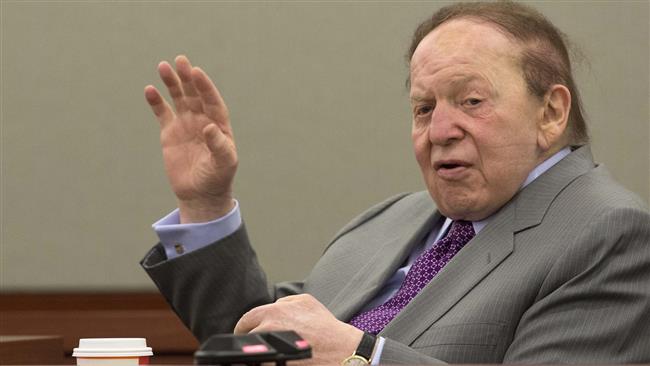
Press TV – April 25, 2015
US Republican presidential hopefuls and some other GOP lawmakers were in the state of Nevada on Saturday to attract big donors for their campaign funding.
Texas Senator Ted Cruz, Florida Senator Marco Rubio, Texas Governor Rick Perry, Senator Rob Portman (OH), Governor Mike Pence (IN), and Senator Lindsey Graham (SC), all Republicans, were in Las Vegas for the annual Republican Jewish Coalition’s spring meeting which began on Thursday.
The candidates wrapped up 3 days of lobbying for Israel to attract potentially billions of dollars in donations in the biggest gambling hub in the US.
They were there to win big donations from casino tycoons, most notably Zionist Sheldon Adelson who is the largest campaign donor in the US.
As far as the GOP contenders in Las Vegas are concerned, the fight to win Adelson’s support and others in Las Vegas is all about showing support and solidarity for Tel Aviv.
Former Texas Governor Rick Perry said, “Ignoring the lessons of history, our president aims to sign an agreement with… the Islamic Republic of Iran.”
“Sadly, the American friendship and alliance with Israel has never been more imperiled than it is right now today under this administration,” said Ted Cruz, one of the Republican presidential candidates.
About 800 members of the summit enthusiastically cheered the consecutive slaps on Obama and on a potential nuclear agreement with Iran and promises of loyalty to Tel Aviv.
In fact, Adelson was not there on Saturday, according to local media, because that’s when the session was open to the media.
It is reported that Adelson has a favorite candidate so far, and that’s Senator Marco Rubio who the tycoon “speaks to once every 2 weeks.”
Adelson spent almost $150 million in the last presidential election in 2012 and he is set to throw in millions of more dollars behind his favorite contender in 2016.
Adelson, a Jewish American and the country’s eighth-wealthiest person, has said that he will not invest in the 2016 elections based on personal loyalty but on a more strategic aim.
He is a prominent supporter of Israel’s Likud Party, which is currently headed by Prime Minister Benjamin Netanyahu. He is also known for his anti-Iran rants.
During a speech at Yeshiva University in New York City in October 2014, Adelson said that the US should drop a nuclear bomb on Iran before beginning negotiations with Tehran over its nuclear program.
US Senate Unanimously Passes Resolution Supporting Israeli Assault on Gaza
By Chris Carlson | International Middle East Media Center | July 18, 2014
 Following a similar resolution passed last week by the U.S. House, the U.S. Senate voted Thursday night to support Israel’s ongoing invasion of the Gaza Strip.
No dissenting vote was cast, and no mention was made of the hundreds of Palestinian civilians, most of whom are women and children, that have been killed by Israel in the past ten days.
Senate Resolution 498 was authored by Bob Menendez (D-NJ) and Lindsey Graham (R-SC), with additional support by Ben Cardin (D-MD) and Rand Paul (R-KY).
Paul is urging the Senate to pass his own bill, S. 2265, which would end all U.S. foreign aid to the Palestinian Authority until Hamas is barred from the new Palestinian unity government, among other stipulations.
The resolution was passed on the very same night Israel launched its current ground offensive into the Gaza Strip.
The United States and Israel, this past week, signed an agreement under which $429 million of American taxpayers’ money “will be transferred immediately to Israel” to further fund the Iron Dome missile system, which has recently come under scrutiny by prize winning Israeli defense and aerospace engineering expert Dr. Moti Shefer.
Sen. Graham: Israel ‘apoplectic’ about US approach on Iran
Press TV – November 11, 2013
US Senator Lindsey Graham has warned about a possible easing of economic sanctions against Iran, saying Israel is “apoplectic” about the Obama administration’s approach.
Graham, a hawkish Republican from South Carolina who has repeatedly called for military strikes on Iran, said Sunday that lifting sanctions would send the wrong message to Israel and other US allies in the region.
“The Israelis are apoplectic about what we’re doing,” he said on CNN’s “State of the Union.” “I’ve never been more worried about the Obama administration’s approach to the Middle East than I am now.”
The White House offered a “very modest sanctions relief” as Iran and the six major world powers– the US, Britain France, China, Russia and Germany– engaged in talks over Iran’s nuclear energy program in Geneva, Switzerland over the weekend.
The talks ended inconclusively on Sunday when France rejected a list of demands on Iran, saying they were too generous to result in an easing of sanctions. More negotiating sessions are scheduled for November 20.
Sen. Graham said the sanctions should be kept in place, and coupled with the threat of military force, to compel Iran to stop its uranium enrichment activities.
“If it ends with anything less, the world will regret this,” Graham said. “My fear is that we’re going to end up creating a North Korea kind of situation in the Middle East.”
Senate leaders showed bipartisan support Sunday for tougher sanctions on Iran.
Senator Robert Menendez, chairman of the Senate Foreign Relations Committee and a key architect of anti-Iran sanctions, called on Congress to consider new economic sanctions against Iran.
“I think that the possibility of moving ahead with new sanctions, including wording it in such a way that if there is a deal that is acceptable that those sanctions could cease upon such a deal, is possible,” Menendez said Sunday on ABC’s “This Week.”
The US lawmakers’ outburst happened after Israeli Prime Minister Benjamin Netanyahu denounced a possible agreement with Iran as a “historic blunder.”
Pro-Israeli US lawmakers urge bombing Syria air bases, arming militants, invasion
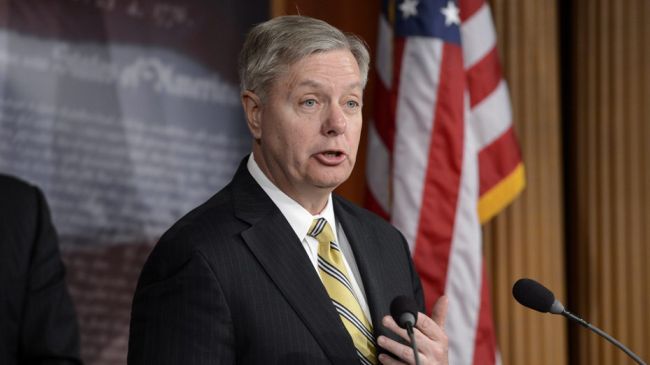
US Senator Lindsey Graham (R) South Carolina (file photo)
Press TV – April 29, 2013
Top US Republican lawmakers have again called for further American actions against Syria, including the bombing of its air bases, leading a multi-nation invasion of the country and sending lethal weapons to anti-Damascus militant gangs.
Fervently pro-Israeli Senators John McCain of Arizona and Lindsey Graham of South Carolina further cited widely challenged claims by the Israeli regime of chemical weapons use in Syria to urge swift Washington action to “secure” chemical arms arsenals in the Arab country in efforts to prevent al-Qaeda-linked militants from gaining access to such weapons, US press reports said on Sunday and Monday.
The two lawmakers, however, did not explain how American forces would secure the alleged cache of Syrian chemical weaponry.
Graham went as far as warning that if the US does not intervene in Syria the next terrorist bombing in American soil will include chemical agents.
“The chemical weapons (in Syria)… are going to be compromised and fall into wrong hands and the next bomb that goes off in America may not have nails and glasses in it,” said Graham during a televised interview with major US network CBS on Sunday.
The senior member of US Senate’s Armed Services Committee also expressed serious concerns about the potential fall of Jordan’s dictator King Abdullah II if Washington did not intervene quickly enough to stop the growing flow of Syrian refugees into his country.
Describing the Jordanian ruler as “a moderating influence and a good [US] ally,” Graham predicted that his regime will fall if the “flood” of Syrian refugees into Jordan continued.
He also predicted a US war with Iran if the Obama administration does not intervene in Syria on the grounds that Tehran would doubt Washington’s resolve in taking action against their nuclear energy program.
The American senator went on to urge the US military to “bomb Syrian air bases with cruise missiles in a bid to “neutralize” the government’s air advantage over the foreign-backed militant gangs and turn the “tide of battle pretty quickly” in favor of the anti-Damascus insurgents.
Moreover, Senator McCain said the US should move into Syria as part of an “international force” to secure the country’s chemical weapons, but did not elaborate on how such international military force would be established and which countries would be involved.
Syria has been faced with a foreign-sponsored armed insurgency since 2011. Thousands of people in the country, including a large number of security forces, have been killed in the unrest with many foreign nationals infiltrating the key Arab state in a bid to destabilize the government of President Bashar al-Assad.
Related article
- Israeli lawmaker urges intervention in Syria (foxnews.com)
Bomb blast rocks Syrian TV station, three people reported injured
RT | August 6, 2012
A bomb has detonated at a state-run television and radio building in the capital of Damascus, Syrian TV reported.
The explosion occurred on the third floor of the building, which houses administrative offices including the station director’s, RT Damascus correspondent Oksana Boiko said.
The station’s studios were frequently used by foreign journalists for live broadcasts from the city, she said. Three people were injured in the blast.
“It is clear that the blast was caused by an explosive device,” Syrian Information Minister Omran al-Zoabi said. “Several of our colleagues were injured, but there were no serious injuries, and no dead.”
“Nothing can silence the voice of Syria or the voice of the Syrian people,” al-Zoubi added while inspecting the damage at the TV building. “We have a thousand locations to broadcast from.”
The station continued to broadcast in the wake of the bombing.
The pro-government private Syrian TV station Al-Ikhbariya broadcast pictures of employees inspecting damage in the building and tending to a wounded colleague, the AP reported. [Photos]
Opposition forces mounted an assault on Aleppo’s main television and radio station on Saturday, August 4. The rebel gunmen failed to capture the building.
Seven journalists and workers were killed in June when an armed group attacked the headquarters of Syria’s al-Ikhbaryia TV.
Related articles
- Casualties reported after Syrian TV center blast (english.ruvr.ru)
Featured Video
US Marines Seized Panama in 1903
or go to
Aletho News Archives – Video-Images
From the Archives
Precedents for Pizzagate
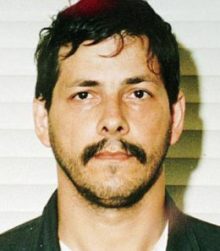
Marc Dutroux, Belgian pedophile, sadist, and serial killer with friends in high places
By Aedon Cassiel | Counter – Currents | December 23, 2016
To reiterate a point that should be clear to the more astute reader, my goal in this series (part 1, part 2) has not been to defend “Pizzagate” as such. My goal has been to defend the people who want to investigate it against specific accusations levied against them by people who think Pizzagate has revealed no intriguing information at all—for a specific reason, which I will be honing in and focusing on much more directly in this closing entry.
Whereas the mainstream critics of Pizzagate would have you believe that the dividing line is between paranoid conspiracy theorist followers of “fake news” and level-headed people who follow trustworthy news sources and rely on cold, hard reason to determine the truth, my goal has been to show that—whatever is or is not happening with Pizzagate itself—this framing of the issue is arrogant, insulting, and the product of extremely narrow tunnel vision. … continue
Blog Roll
 Aletho News
- Israeli firms transform cars into intelligence devices: Reports
- Zionist-controlled companies to surveil British citizens
- THE CHILDREN GAMBIT
- A note on comment posting at Alethonews
- Trump stalls over Iran strike plan, Iran holds all the aces
- Zelensky’s Ceasefire for Elections is Strategic Gambit, Not Democratic Move
- US and Dutch pilots flying F-16s for Ukraine – Western media
- West’s Claims of Non-Involvement in Ukraine Conflict ‘Epitome of Hypocrisy’ – Expert
- Putin aide urges retaliation to ‘Western piracy’
- The Depth Charge in the Womb
- If Americans Knew
- Israel’s Favorite American President
- Israel’s “Yellow Line” Is a Death Trap for Palestinians. We Drove Into It.
- Why Israel’s expanding occupation in Syria presents a critical legal test
- Gaza is not a natural disaster. It is the victim of genocide enabled by global inaction
- Netanyahu’s plan to “end” US aid to Israel is to give even more money under a different name
- Israel ceased firing on Gaza for just 15 days of the “ceasefire” – Not a ceasefire Day 130
- In Gaza, “rats run over our faces” – Not a ceasefire Day 129
- Israel-backed border guards, GHF-linked aid – Not a ceasefire Day 128
- Israel battles Palestinian right of return, one Palestinian at a time – Not a ceasefire Day 127
- Noor’s short life of unimaginable suffering
- No Tricks Zone
- New Study: A 4°C Warmer Beaufort Sea Had ‘No Sea Ice’ 11,700 – 8200 Years Ago
- Unfudging The Data: Dutch Meteorological Institute Reinstates Early 20th Centruy Heat Waves It Had Erased Earlier
- German Gas Crisis…Chancellor Merz Allegedly Bans Gas Debate Ahead of Elections!
- Pollen Reconstructions Show The Last Glacial’s Warming Events Were Global, 10x Greater Than Modern
- Germany’s Natural Gas Storage Level Dwindles To Just 28%… Increasingly Critical
- New Study Rebuts The Assumption That Anthropogenic CO2 Molecules Have ‘Special’ Properties
- Climate Scientist Who Predicted End Of “Heavy Frost And Snow” Now Refuses Media Inquiries
- Polar Bear Numbers Rising And Health Improving In Areas With The Most Rapid Sea Ice Decline
- One Reason Only For Germany’s Heating Gas Crisis: Its Hardcore-Dumbass Energy Policy
- 130 Years Later: The CO2 Greenhouse Effect Is Still Only An Imaginary-World Thought Experiment
 Aletho News