Russia has better things to do than start WW3
By Bryan MacDonald | RT | June 8, 2015
Vladimir Putin said this weekend that “Russia would attack NATO only in a mad person’s dream.” Unfortunately, there are a lot of mad people working in western politics and media.
If the G7 were based on GDP, adjusted for purchasing power, it would be comprised of the USA, China, India, Japan, Russia, Germany and Brazil. Such a lineup would have remarkable clout. Members would boast 53% of the globe’s entire GDP and the planet’s 3 genuine military superpowers would be represented.
The problem for Washington is that this putative G7 might actually be a forum for a real debate about the world order.
Instead of a real G7, we have a farce. An American dominated talking shop where the US President allows ‘friendly’ foreign leaders to tickle his belly for a couple of days. There is no dissent. Washington’s dominance goes unquestioned and everyone has a jolly time. Especially since they kicked out Russia last year – Vladimir Putin was the only guest who challenged the consensus.
However, the problem is that this ‘convenient’ G7 is way past its sell-by-date. The days when its members could claim to rule the world economically are as distant as the era of Grunge and Britpop. Today, the G7 can claim a mere 32% of the global GDP pie. Instead of heavyweights like China and India, we have middling nations such as Canada and Italy, the latter an economic basket case. Canada’s GDP is barely more than that of crisis-ridden Spain and below that of Mexico and Indonesia.
Yet, the Prime Minister of this relative non-entity, Stephen Harper, was strutting around Bavaria all weekend with the confidence of a man who believed his opinion mattered a great deal. Of course, Harper won’t pressure Obama. Rather, he prefers to – metaphorically – kiss the ring and croon from the same hymn sheet as his southern master.
NATO and the G7 – 2 sides of 1 coin?
There was lots of talk of “Russian aggression” at the G7. This was hardly a surprise given that 6 of the 7 are also members of NATO, another body at which they can tug Washington’s forelock with gay abandon. Obama was at it, David Cameron parroted his guru’s feelings and Harper was effectively calling for regime change in Russia. It apparently never occurred to the trio that resolving their issues with Russia might be easier if Putin had been in Bavaria? The knee-jerk reaction to remove Russia from the club was hardly conducive to dialogue.
Meanwhile, Matteo Renzi stayed fairly quiet. It has been widely reported that the Italian Prime Minister privately opposes the EU’s anti-Russia sanctions due to the effects on Italy’s struggling economy. Also, Renzi’s next task after the G7 summit is to welcome Putin to Rome.
With that visit in mind, Putin gave an interview to Italy’s Il Corriere della Sera where he essentially answered the questions that Obama, Cameron and Harper could have asked him if they hadn’t thrown their toys out of the pram and excluded Russia from the old G8. Putin stressed that one should not take the ongoing “Russian aggression” scaremongering in the West seriously, as a global military conflict is unimaginable in the modern world. The Russian President also, fairly bluntly, stated that “we have better things to be doing” (than starting World War 3).
Putin also touched on a point many rational commentators have continuously made. “Certain countries could be deliberately nurturing such fears,” he added, saying that hypothetically the US could need an external threat to maintain its leadership in the Atlantic community. “Iran is clearly not very scary or big enough” for this, Putin noted with irony.
A world of ‘goodies’ and ‘baddies’
For Washington to maintain its huge military spending, it has to keep its citizens in a state of high alarm. Otherwise, they might insist that some of the armed forces’ cash is diverted to more productive things like hospitals and schools. These services, of course, are not very profitable for weapons manufacturers or useful for newspaper and TV editors looking for an intimidating narrative.
Following the collapse of the USSR, Russia was too weak and troubled to be a plausible enemy. Aside from its nuclear arsenal – the deployment of which would only mean mutual destruction – the bear’s humbled military was not a credible threat. Instead, the focus of warmonger’s venom shifted to the Middle East and the Balkans, where Saddam Hussein, Muammar Gaddafi, Slobodan Milosevic and Osama Bin Laden kept the general public’s attention occupied for roughly a decade and a half. However, they are now all dead and pro-war propaganda needs a new bad guy to play the Joker to America’s Batman.
Kim Jong-un looked promising for a while. Nevertheless, the problem here is that North Korea is too unpredictable and could very feasibly retaliate to provocations. Such a reaction could lead to a nuclear attack on Seoul, for instance, or draw Washington into a conflict with China. Even for neocons, this is too risky. Another candidate was Syria’s Basher Al-Assad. Unfortunately, for the sabre rattlers, just as they imagined they had Damascus in their sights, Putin kyboshed their plan. This made Putin the devil as far as neocons are concerned and they duly trained their guns in his direction.
Russia – a Middle East/North Africa battleground?
In the media, it is noticeable how many neocon hacks have suddenly metamorphosed from Syria ‘experts’ into Russia analysts in the past 2 years. Panda’s Mark Ames (formerly of Moscow’s eXILE ) highlighted this strange phenomenon in an excellent recent piece. Ames focused on the strange case of Michael Weiss, a New York activist who edits the anti-Russia Interpreter magazine (which is actually a blog). The Interpreter is allegedly controlled by Mikhail Khodorkovsky and a shadowy foundation called Herzen (not the original Amsterdam-based Herzen) of which no information is publicly available.
Weiss was a long-time Middle East analyst, who promoted US intervention to oust Assad. Suddenly, shortly before the initial Maidan disturbances in Kiev, he re-invented himself as a Russia and Ukraine ‘expert,’ appearing all over the US media (from CNN to Politico and The Daily Beast ) to deliver his ‘wisdom.’ This is despite the fact that he appears to know very little about Russia and has never lived there. The managing editor of The Interpreter is a gentleman named James Miller, who uses the Twitter handle @millerMENA (MENA means Middle East, North Africa). Having been to both, I can assure you that Russia and North Africa have very little in common.
Weiss and Miller are by no means unusual. Pro-War, neocon activists have made Russia their bete noir since their Syria dreams were strangled in infancy. While most are harmless enough, this pair wields considerable influence in the US media. Naturally, this is dressed up as concern for Ukraine. In reality, they care about Ukraine to about the same extent that a carnivore worries about hurting the feelings of his dinner.
Russia’s military policy is “not global, offensive, or aggressive,” Putin stressed, adding that Russia has “virtually no bases abroad,” and the few that do exist are remnants of its Soviet past. Meanwhile, it would take only 17 minutes for missiles launched from US submarines on permanent alert off Norway’s coast to reach Moscow, Putin said, noting that this fact is somehow not labeled as “aggression” in the media.
Decline of the Balts
Another ongoing problem is the Baltic States. These 3 countries have been unmitigated disasters since independence, shedding people at alarming rates. Estonia’s population has fallen by 16% in the past 25 years, Latvia’s by 25% and Lithuania’s by an astonishing 32%. Political leaders in these nations use the imaginary ‘Russian threat’ as a means to distract from their own economic failings and corruption. They constantly badger America for military support which further antagonizes the Kremlin, which in turn perceives that NATO is increasing its presence on Russia’s western border. This is the same frontier from which both Napoleon and Hitler invaded and Russians are, understandably, paranoid about it.
The simple fact is that Russia has no need for the Baltic States. Also, even if Moscow did harbor dreams of invading them, the cost of subduing them would be too great. As Russia and the US learned in Afghanistan and America in Iraq also, in the 21st century it is more-or-less impossible to occupy a population who don’t want to be occupied. The notion that Russia would sacrifice its hard-won economic and social progress to invade Kaunas is, frankly, absurd.
The reunification of Crimea with Russia is often used as a ‘sign’ that the Kremlin wishes to restore the Soviet/Tsarist Empire. This is nonsense. The vast majority of Crimean people wished to return to Russia and revoke Nikita Khrushchev’s harebrained transfer of the territory to Ukraine. Not even the craziest Russian nationalist believes that most denizens of Riga or Tallinn wish to become Russian citizens.
Putin recalled that it was French President Charles de Gaulle who first voiced the need to establish a “common economic space stretching from Lisbon to Vladivostok.” As NATO doubles down on its campaign against Moscow, that dream has never looked as far off.
Bryan MacDonald is an Irish writer and commentator focusing on Russia and its hinterlands and international geo-politics. Follow him on Facebook
EU Parliament Drafts New Anti-Russian Resolution Calling for More Sanctions
Sputnik – 06.05.2015
A proposed declarative resolution by a group of MEPs has called on the European Union to step up sanctions against Russia, provide Ukraine with weaponry and further strengthen NATO forces in Eastern Europe, should Russia refuse to return Crimea to Ukraine or fail to abide by the Minsk ceasefire, a press statement for the body stated Tuesday.
The aggressively worded document, drafted Monday and liaised by Romanian MEP Ioan Pascu for the parliament’s Committee on Foreign Affairs, warns that increased Russian military presence in Crimea necessitates EU nations to strengthen their military capabilities, stating that NATO must give its East European members a “strong strategic reassurance.”
Commenting on the proposed resolution, Pascu suggested to the EU’s news service that the strengthening of Russian defense capabilities in Crimea is “in practice creating another launching pad, of the proportions of Kaliningrad, this time in the Black Sea.” The MEP threatened that “in one year the defensive force which existed there has been transformed into a strike force… with which Russia can threaten Central Europe, the Balkans, Southern Europe and also [the] Eastern Mediterranean and even the Middle East.”
Supported by MEPs from Lithuania, Estonia, Poland and Spain, the belicose resolution, pending Foreign Affairs Committee approval, also accuses Russian authorities of mistreating the Crimean Tatars. Furthermore, it suggests that Russia may next move to cut off Ukraine from the Black Sea entirely by annexing its coastal territories. Pending approval, the belligerent document will face a vote at the parliament’s upcoming session in June, asking “EU member states to speak with one united voice,” regarding “EU relations with Russia.”
Poland approves joint force with Ukraine & Lithuania, calls on EU to spend more on defense
RT | May 4, 2015
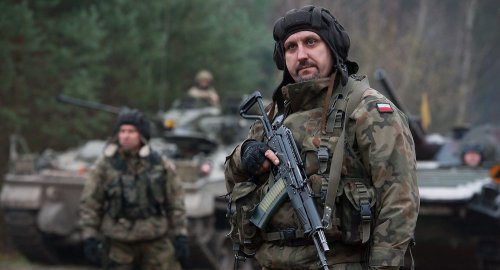
Poland’s President Bronislaw Komorowski has signed a resolution approving the organization of a joint Lithuanian-Polish-Ukrainian brigade, whose creation has been in the works since 2007.
When brought to full operation in 2017, the brigade is set to constitute 4,500 servicemen. They will operate separately from the three countries’ respective militaries, but will take part in NATO exercises and missions. Preliminary drills are scheduled for later this year. The brigade will be stationed at its headquarters in Libulin, Poland. So far, it only houses 250 servicemen and 50 command staff contributed by the Polish military.
The joint force was discussed as far back as 2007, but the agreement to create it was signed by the three countries’ defense ministers in September 2014, in response to the Ukrainian crisis and what they call Russian aggression.
Creating the joint force is “part of a wider plan … to support Ukraine, among others, in the area of modernization,” President Bronislaw Komorowski said as cited by Reuters.
He also urged other European countries to spend more on defense. To that end, President Komorowski has suggested excluding defense spending from EU rules on budget deficit limits. This means that EU nations will be able to allocate more money to the military without fearing increased budget controls from Brussels. Komorowki’s offer comes at a time of heightened tensions with Russia.
Poland now has the fifth-strongest army in the EU, and has ambitious plans to modernize it, spending about $36 billion until 2022. However, the Polish government is unhappy about a lack of similar eagerness in some of the other European nations, the Rzeczpospolita newspaper reports.
While NATO is advising its member states to spend the maximum allowed of three percent of GDP on defense, most are spending far less: Germany allocates 1.2 percent of its GDP, the Netherlands 1.3 percent and Spain under 1 percent. France is the only Western European country that is boosting defense spending. However, some Eastern European nations are increasing their military expenses citing what they call Russian aggression. Lithuania, for instance, wants to allocate twice as much on defense as last year.
CIA Black Sites and Washington’s Allies
Re-Opening the Investigation
By BINOY KAMPMARK | CounterPunch | April 7, 2015
They certainly sought to please in those initial dark days when a position at the NATO table was at stake. This was something of a New World Order – the attacks after September 11, 2001 did certainly allow Washington to make that spurious case. The stakes were high, and the “need” for pressing intelligence saw a crude clipping of various liberties and protections.
Unfortunately, in so doing, willing allies and proxies lined up their maps, their facilities, and their accomplices in what became a global program of interrogation and torture. These locations willingly offered by host states came to be known as “black sites” and proved all too attractive to powers and institutions.
Lithuania’s case is a particularly conspicuous one. Its authorities have been reluctant to admit providing cover for CIA activities, let alone any specific location. A parliamentary inquiry held during 2009-2010 went so far as to suggest that such a provision had, in fact, been made, advising that prosecutors take the lead. The report in question noted a detention centre set up near Vilnius in 2004-2006.
But it also spoke in tones of reservation – CIA aircraft had landed in Lithuania, but it was not clear whether human cargo had accompanied it. (Why such aircraft would be found on Lithuanian soil without such cargo is an odd point in itself.)
Four years ago, the prosecutors dropped the investigation like a steaming hot potato. The action suggested that something foul was afoot – such a procedure did not look good for the US-Lithuanian relationship, and uncovering any more details than was necessary would have proven, at least in the public eye, impairing.
This has not stopped such actions as those of Saudi-born Abu Zubaydah, who became a near cult figure of the extraordinary rendition program during the Bush years. Zubaydah’s recourse has been through the European Court of Human Rights, where he is seeking to show that Lithuania violated the European Convention on Human Rights. He is arguing that Lithuania is responsible for his unlawful detention, torture and ill-treatment, the deprivation of the right to private and family life, the unlawful transfer from Lithuania, and ongoing violations of his right to legal recourse.
Then came the Senate Intelligence Committee Report on the CIA’s interrogation program, one waged with tentacle-like spread across a range of jurisdictions and continents. Its lurid subject matter got various prosecutors in a range of countries concerned. Had they been too slow off the mark? Much evidence suggested that they had.
The detention centre “Violet” noted in the Senate report seemed eerily close to the descriptions put forth in the Lithuanian parliamentary investigation. The Senate report noted how an amount approximating to $1 million was provided by the US to “show appreciation” for its creation, money which was conveyed via various “complex mechanisms” to evade the government ledgers.
Initially, it did not seem that much would change. Last month, Loreta Grauziniene, speaker of the Lithuanian parliament, told Reuters that, “No new inquest will be considered, because there is no longer sufficient support for it among parliamentary members.” In making such an observation, the speaker merely affirmed the link between state criminality and the will behind prosecuting it. Former president Valdas Adamkus typifies such indifference, insisting that “there were no prisons or prisoners in Lithuania,” a view he would maintain till seeing the incriminating “documents before my eyes”.
This month saw a slight modification of the stance. Lithuania’s senior prosecutor, Irmantas Mikelionis, “decided on January 22 to cancel the January 21, 2011 decision of prosecutors to stop the investigation into possible abuse, and has restarted the investigation.” According to Rita Stundiene, a spokeswoman for the prosecutors, “The prosecutor renewed a previously terminated probe and merged it with the ongoing pre-trial investigation [into the case of Mustafa al-Hawsawi].”
Emphasis will be directed at the alleged violation of two articles of the Lithuanian criminal code: the illegal transportation of a foreigner through Lithuanian territory (the case on CIA prisoner Mustafa al-Hawsawi provides a classic example); and the abuse of power by a state employee resulting in significant harm. In themselves, these read like misdemeanours, minor procedural blots. In actual fact, such conduct was the hallmark of CIA interrogatory procedures, aided and abetted by various state authorities.
Whether the renewed investigation is going to do anything more than keep the common record busy for a time is hard to know. As one of Zubaydah’s lawyers, Helen Duffy, argues, the gesture on the part of the Lithuanian prosecutors might also be construed as a tactic to ward off more concrete legal scrutiny in Strasbourg. “There is every reason to be sceptical about whether this is a meaningful investigation.” Any investigation, to be effective, had to be total.
Such prosecutorial actions tend to be kept on the books, and rarely move off them into the realm of action and consequence. Too much is deemed at stake for such alliances. Justice, in that sense, takes the most distant of backseats, while the soiled hands of the torturers remain in service.
Lithuania’s politicians generally have less of an interest in seeing CIA operatives, and their accomplices, behind bars than holding the fort against what is seen as a viable Russian threat from the east. Bigger enemies loom. Prosecutorial grit, in other words, is lacking.
Dr. Binoy Kampmark was a Commonwealth Scholar at Selwyn College, Cambridge. He lectures at RMIT University, Melbourne. Email: bkampmark@gmail.com
New evidence shows CIA held prisoners in Lithuania
Reprieve | January 16, 2015
New analysis and previously unpublished documents released by legal charity Reprieve show that the CIA held prisoners in Lithuania in 2005 and 2006, contrary to official denials.
In a dossier and briefing submitted to the Lithuanian Prosecutor today, Reprieve reveals how the newly declassified US Senate Report on CIA detention correlates with flight data and contracting documents; and demonstrates that prisoners were moved into Lithuania in February and October 2005, and out of Lithuania to Afghanistan in March 2006.
A previous investigation by Lithuanian prosecutors, shelved in 2011, concluded that the CIA built a facility in a converted stable outside Vilnius, but argued there was no evidence that prisoners were ever held in it.
Reprieve’s analysis, combined with material in the declassified report, now shows that several prisoners were held in the site – called “Violet” in the Senate report – before it was closed down on 25 March 2006.
Flights through Lithuania were organised by Computer Sciences Corporation working alongside several operating companies under the auspices of a series of contracts first set up in 2002. The companies used multiple techniques to disguise their routes, and border guards were prevented from checking their cargo. Partial and incorrect routes for the planes were recorded by a Lithuanian inquiry. Reprieve determined the correct routes of the aircraft by cross-referencing a broader range of data sources and matched their dates to disclosures in the Senate report.
Reprieve investigator Crofton Black said: “The Lithuanian authorities have long hidden behind a smokescreen of increasingly implausible deniability. This new dossier shows beyond reasonable doubt that CIA prisoners were held incommunicado in Lithuania, contrary to European and domestic law. Reprieve looks forward to assisting the Lithuanian prosecutor in his further investigations.”
There to stay: US troops keep Poland, Baltic deployment for 2015
RT | November 24, 2014
A ‘temporary’ deployment of US troops in Poland and the Baltic states has been extended through 2015, a US commander in Europe said. NATO sells its presence as a deterrent to an ‘aggressive Russia’, with Moscow countering that it only escalates tension.
The alliance deployed several hundred US troops in Poland, Latvia, Lithuania and Estonia earlier this year. The move was explained by a desire to give confidence to these NATO members after the political crisis in Ukraine and the secession of its region of Crimea to rejoin Russia. The alliance called it an annexation and said countries in the region feared that Moscow would militarily attack them.
Originally the troops were supposed to stay until the end of the year, but now NATO wants to keep them for at least 12 months more, said Lieutenant-General Frederick Ben Hodges, Commanding General of US Army Europe.
“We have planned rotations out through next year. Units are designated that will continue to do this,” Hodges told journalist in the Lithuanian capital, Vilnius.
“There are going to be US Army forces here in Lithuania, as well as Estonia and Latvia and Poland, for as long as is required to deter Russian aggression and to assure our allies,” he said as cited by Reuters.
A 1997 Russia-NATO agreement forbids the alliance from having troops permanently stationed in the Baltic States, so the deployment remains a temporary mission. However, it’s not immediately clear when, if ever, NATO would consider the perceived threat of a Russian aggression no longer valid and withdraw the troops.
Washington’s assurances to its eastern NATO partners were also delivered last week through diplomatic channels.
“When NATO and the US as part of NATO took new members into the alliance, this means that we are ready to participate in the defense of the security of these countries, and this means that we are ready to give our lives for the security of these countries,” said US Assistant Secretary of State for European and Eurasian affairs Victoria Nuland during a visit to Latvia.
Amid the Ukrainian crisis, Poland and the Baltic states have been among the most vocal critics of Russia. Lithuanian President Dalia Grybauskaite went as far as branding Russia ‘a terrorist state’ last week, prompting some Russian MPs to call for the severing of diplomatic ties with Vilnius.
Russia considers the build-up of NATO troops close to its borders provocative and dangerous. Moscow’s envoy to the alliance Aleksandr Grushko said NATO “is turning the Baltic region, which used to be militarily calm, into an area of military confrontation with Russia.”
The Russian military said it would respond to the emerging NATO threat from the Baltic with appropriate counter-moves.
NATO’s Estonia drills are anti-Russian, don’t make Europe more secure – Moscow
RT | November 11, 2014
Moscow believes NATO drills in Estonia are of “a clearly anti-Russian nature” and will scarcely contribute to European safety, according to a statement by the Russian Defense Ministry.
NATO has conducted five military exercises near the Russian border over the past six months, the head of the ministry’s Department of International Cooperation, Sergey Koshelev, told journalists on Tuesday.
“Obviously the policy chosen by our colleagues from NATO will hardly make Europe a safer place,” he said.
The comment was in response NATO’s plans of having so-called ‘Trident Juncture’ drills in Estonia. Koshelev believes the exercises have been inspired by warnings of a “Russian threat,” as voiced by NATO’s supreme allied commander, Philip Breedlove.
“Today Estonia is chosen as an object of that ‘threat’,” Kochelev said. Although recently such objects were Poland, Lithuania and Latvia, which also hosted large-scale NATO drills.”
“Taking this into account, it’s strange to hear some NATO representatives lamenting a group of Russian planes flying in international airspace over the North Atlantic,” he added.
The Trident Juncture drills are clearly anti-Russian, Koshelev believes.
“According to the drills’ scenario, the headquarters of various levels should have their actions tested in a situation in which one of the members of the bloc is attacked by an unnamed “big hostile nation,” he said. “From a geographical standpoint Estonia, which hosts the drills, borders only with ‘little friendly nations’ besides Russia. Hence, the NATO drills have a clearly anti-Russian nature.”
NATO troops and bases not welcome in Slovakia and Czech Republic
RT | June 5, 2014
Two Eastern European nations, Slovakia and the Czech Republic, have refused to host foreign troops and military bases. The prime ministers of both countries have consecutively spoken against the proposal voiced by US President Barack Obama.
Following the example of their neighbor the Czech Republic, the prime minister of Slovakia stated that his country is ready to meet its obligations as a NATO member state, but stationing foreign troops on its territory is out of the question.
Slovak PM Robert Fico said he “can’t imagine foreign troops being deployed on our territory in the form of some bases.”
The proposal to host more NATO troops in Eastern Europe was voiced by Obama on his current tour of Europe.
Speaking at a news conference in Warsaw, Obama said America is stepping up its partnership with countries in Eastern Europe with a view to bolstering security.
Initially, it was Poland that asked for a greater US military presence in Eastern Europe.
In April, Polish Defense Minister Tomasz Siemoniak called on the Pentagon to deploy as many as 10,000 American troops in his country.
Three Baltic States welcomed the idea back in April. To begin with, a small contingent of American troops began to arrive in Lithuania, Latvia and Estonia to take part in military training.
Two countries opposed deployment of any foreign soldiers on their territory.
On Tuesday, Czech Prime Minister Bohuslav Sobotka said his country sees no need to allow foreign military presence on its territory.
Last month, Defense Minister Martin Stropinsky sparked a political storm in the Czech Republic by recalling the 1968 invasion as the biggest reason not to host NATO troops in the country in a Reuters interview.
Slovakia’s Fico joined in the debate Wednesday, saying that for his country such a military presence is a sensitive issue because of the Warsaw Pact troops’ invasion into Czechoslovakia in 1968.
“Slovakia has its historical experience with participation of foreign troops. Let us remember the 1968 invasion. Therefore this topic is extraordinarily sensitive to us,” he said.
Fico said that Slovakia is committed to fulfill its obligations towards NATO despite military budget cuts and that allies would be allowed to train on Slovak territory anyway.
Czechoslovakia split into the Czech Republic and Slovakia in 1993.
The Czech Republic entered NATO in 1999, whereas Slovakia joined the alliance later, in 2004.
Fico’s Smer party, which has an absolute majority in Slovakia’s parliament, has been advocating warmer relations with Russia.
See also:
‘Peed in public, behave like occupiers’: Latvian mayor complains about NATO sailors
Lithuanians vote out pro-austerity government
Press TV – October 15, 2012
Lithuania’s left-wing and populist opposition parties are expected to form a new coalition government after anti-austerity Lithuanians voted out the country’s conservative-led government.
The leaders of three opposition parties–Labour, the Social Democrats and Order and Justice parties– held a meeting early on Monday after an exit poll showed that the voters decided to evict the country’s centre-right Prime Minister Andrius Kubilius in Sunday parliamentary election.
“We’re creating a working group to start consultations on a coalition,” Labour leader Viktor Uspaskich said after the meeting.
Figures published by the national elections commission indicated that with almost half of the ballots counted, the left-wing populist Labour party secured about 23 percent of the vote.
The Baltic state’s centre-left Social Democrats came in second with 20 percent of the vote, while the ruling conservatives received about 13 percent.
The incumbent government took office in 2008 amid global economic crisis and implemented a drastic austerity package in a bid to prevent the country’s bankruptcy.
The economic output of Lithuania, which is regarded as one of the European Union countries most hard hit by the crisis, fell by 15 percent and unemployment climbed.
Meanwhile, opposition parties pledged to ease the unpopular belt tightening measures by raising the minimum wage, creating jobs and making the rich pay more income tax.
Related articles
By Christian Lowe and Andrius Sytas | Reuters | October 15, 2012
VILNIUS – Lithuanians rejected a plan to build a nuclear plant to cut dependence on imports of Russian energy, in a non-binding referendum that does not kill off the project but leaves a question mark over its future.
Support for the plant in Lithuania, one of the European Union states most dependent on imported energy, waned after the Fukushima nuclear disaster in Japan last year.
With results counted from all but a handful of Lithuania’s districts after Sunday’s referendum, 62.74 percent voted “No”, while 34.01 percent were in favour. … Full article
- Populist party in Lithuania victory (independent.ie)
Featured Video
No Threat Can Force Iran’s Surrender /Trita Parsi & Lt Cl Daniel Davis
or go to
Aletho News Archives – Video-Images
From the Archives
An Expert Military Analysis of War with China
Actually, None is Necessary
By Fred Reed • Unz Review • December 13, 2020
The Correlation of Armed Forces: U.S. goods and services trade with China totaled an estimated $634.8 billion in 2019. Exports were $163.0 billion; imports were $471.8 billion. The U.S. goods and services trade deficit with China was $308.8 billion in 2019. Trade in services with China (exports and imports) totaled an estimated $76.7 billion in 2019. Services exports were $56.5 billion; services imports were $20.1 billion. The U.S. services trade surplus with China was $36.4 billion in 2019.
There is talk within the Washingtoniat of a possible war with China. Steve Bannon, who apparently was dropped on his head as a child, actually favors such a war. We hear the usual shoo-the-boobs alarm about how the Chinese are doing something terrible and we must gird our loins and American values and show them what for, bow wow, woof. The danger is that the current game of who-blinks-first in Asian waters might actually provoke a shooting war. You know the kind of thing: One warship refuses to get out of the way of another, a collision ensues, some retard lieutenant who signed up on waivers opens fire, and we’re off and running. It is not a good idea to let children play with matches.
The said war is discussed either in emotional terms by idiots or in purely naval terms by those familiar with such things, so we hear of the First Island Chain and the Second Island Chain and whose missiles against the other’s missiles and so on. This would be appropriate if we were fighting World War Two again. Which we aren’t. Let’s take a quick-and-dirty look at how such a war might go.
To begin the war, America would overestimate itself and underestimate China. This is doctrine in the Pentagon. … continue
Blog Roll
 Aletho News
- Theodore Postol: Iran’s Missiles & Drones Were Underestimated
- Iran To Target Military Industrial-Tech Complex That Facilitated Gaza Genocide
- Collapsing Empire: The Resistance Disarms ‘Israel’
- Suicide Should Not Be a Government Service
- Rethinking America’s greatest threat: Iran vs. Israel-Firsters
- Iran accuses adversaries of false flags to strain Turkey ties
- Poland rules out sending Patriot missiles to US/Israel amid war on Iran
- Tehran approves new Hormuz plan with major restrictions
- No Threat Can Force Iran’s Surrender /Trita Parsi & Lt Cl Daniel Davis
- UK’s New Pandemic Plan Would Turn Big Tech Into a Mass Location Tracking Network
- If Americans Knew
- Ann Coulter Rips Into Fox News for Iran War Coverage, Compares to False Rigged 2020 Election Reporting
- Joe Kent Urges Americans To Call White House and Congress To Object To Sending Troops Into Iran
- DNC Resolution to Reject AIPAC Funding Puts Democratic Leaders in the Hot Seat
- Swedish foundation to build 400 schools as over 650,000 Gaza children remain without education for 2 years
- Israeli army admits photshopping image of slain Lebanese journalist
- This is how Israel is systematically killing health workers under the cover of war in Lebanon
- Carrying life under fire: Israeli invasion of Lebanon leaves pregnant women facing deadly risks
- Champagne all around for the new death penalty (for Palestinians) law – Not a ceasefire Day 172
- Why are Palestinian books struggling to be seen on Amazon?
- The Line Between Affinity and Conspiracy
- No Tricks Zone
- New Study Finds Warming Saves Lives…Cold Temperatures 12 Times More Deadly Than Excess Heat
- German Science Blog Accuses PIK Climate Institute Of Hallucinating Climate Tipping Points
- Devastating Assessment Of Comirnaty Vaccine By Former Senior Pfizer Europe Toxicologist
- New Study: CO2 Is ‘Effectively Negligible’ As An Explanatory Climate Change Factor Since 2000
- Former Pfizer Toxicologist Dr. Helmut Sterz Tells Bundestag Hearing Pfizer Vaccine Should Have Never Been Approved
- Energy Expert: Germany’s Nuclear Phaseout Was A “500 Billion Euro Mistake”
- New Research: South Australia’s Mid-Holocene Sea Surface Temperatures Were 4°C Warmer Than Today
- Storing Green Energy To Last Germany 10 Days Would Require A 60-Million Tonne Battery
- New Studies: UK Sea Levels Were 4 Meters Higher Than Today During The Mid-Holocene
- Destructive Green New Deal: German Energy And Metal Group Warns Of Drastic Crisis
 Aletho News