By Lucas Leiroz | June 21, 2022
European authorities are stopping the transit of Russian goods in the Kaliningrad region, which is officially a part of the Russian territory. Such a measure tends to significantly increase tensions on the European continent and contribute negatively at a time of major concerns about international peace and security.
On June 18, the governor of Kaliningrad Anton Alikhanov reported to media agencies that the Lithuanian state-owned company “Lithuania Railways” has banned the rail transport in the Russia’s Kaliningrad territory regarding all sanctioned goods, entirely isolating the Russian exclave in Europe. Apparently, the reason for such a radical measure would have been the international pressure exerted by the rest of Europe for Lithuania to comply with the “EU’s restrictions”.
Commenting on the case, Lithuanian Foreign Minister Gabrielius Landsbergis said that “this is not a Lithuanian decision. These are European sanctions that came into force on June 17, and the railways are now applying the sanctions”.
EU foreign policy chief Josep Borrell confirmed the Lithuanian minister’s words and tried to “defuse” the situation, saying that there is no blockade, as only goods that have received sanctions are being barred from transit:
“There is no blockade. The land transit between Kaliningrad and other parts of Russia has not been banned. Second, transit of people and goods that are not sanctioned continues. Third, Lithuania has not taken any unilateral national restrictions. (…) We are in a precautionary mood. We will double-check the legal aspects in order to verify that we are completely aligned with any kind of rule. (…) But Lithuania is not guilty. It is not implementing national sanctions. It is not implementing their will. Whatever they are doing has been the consequence of previous consultation with the commission, which has provided guidelines”.
What seems unacceptable, however, is the fact that such pressure is aimed at blocking the transit of products inside the Russian sovereign space, preventing them from leaving Kaliningrad and reaching the rest of Russian territory. No country has the right to prevent another from transporting its goods to other parts of its own territory. In this case, it is not just about “sanctions against Russia”, but about an illegal attitude that violates all elementary norms and principles of public international law.
Stating that there is simply “no blockade” as the restrictions are only being applied to sanctioned products sounds also totally inappropriate. In addition to obstructing Russian intra-territorial traffic, the products sanctioned by the West are precisely those of greater strategic value, which directly affect Moscow’s national interests. Kaliningrad is undoubtedly isolated at this time and the consequences of this isolation strongly affect both the rest of the Russian territory and the one million Russian citizens who inhabit the exclave.
The Russian government expressed its concern about the case, as can be seen in the words of Kremlin spokesman Dmitry Peskov: “This decision is truly unprecedented. It is a violation of everything. We understand it to be connected to the relevant decision made by the European Union – to extend sanctions to transit. We also consider it illegal (…) We need a serious, in-depth analysis to work out our response decisions”.
In the same vein, Minister of Foreign Affairs Sergey Lavrov made it clear that Moscow reserves the right to respond to illegal attitudes on the part of the Lithuanian State, stating that Russia will defend its interests in the face of the European attempt to prevent the transit of goods between Kaliningrad and the rest of the national territory.
“If the transit of goods between Kaliningrad and the rest of the territory of the Russian Federation through Lithuania is not fully restored soon, then Russia reserves the right to take measures in defense of its national interests”, he said.
It is also necessary to remember that Western think tanks have long suggested that NATO “seize” Kaliningrad. The matter has come to light more recently, after the start of the special military operation in Ukraine, with US and European experts suggesting this type of attitude to be considered as a response to a possible escalation of tensions. Obviously, the current blockade further intensifies Moscow’s concerns about this possible scenario.
There are two possible scenarios for the near future in the face of this new escalation of the European security crisis: either Lithuania immediately breaks the blockade or Russia will respond in some way, probably through the intensification of military naval activities using the Baltic Fleet. Vilnius must act in some way, either sovereignly, refusing to comply with abusive and hostile EU impositions or through diplomatic mediation with the rest of the bloc so that sanctions are eased so that the end of the rail blockade is achieved.
Lucas Leiroz is a researcher in Social Sciences at the Rural Federal University of Rio de Janeiro; geopolitical consultant.
June 21, 2022
Posted by aletho |
War Crimes | European Union, Lithuania, NATO |
Leave a comment
Samizdat | June 20, 2022
Lithuania’s decision to block the transit of goods by rail from Russia to Kaliningrad – the country’s western-most exclave that sits between Poland and Lithuania – was made after consulting and getting the approval of the European Commission, Foreign Minister Gabrielius Landsberg said on Monday.
Landsberg made the statement during an EU foreign ministers meeting, where he explained that starting June 17, Lithuania would no longer allow the transit of sanctioned goods through its territory. “This decision was made after consultations with the European Commission and implemented under its guidance,” the minister said.
Last week, Kaliningrad Region Governor Anton Alikhanov warned that the authorities in Vilnius were planning to cut the rail transit of goods from other parts of Russia to the region.
On Saturday, Lithuania’s state-owned rail operator confirmed it would partially halt the transportation of goods to Kaliningrad, which Alikhanov claims will affect up to 50% of all cargo flow to the region.
Russian officials have stated that Lithuanian’s move is an egregious breach of international law and akin to a full blown economic blockade and an attempt to “place the region in an economic chokehold.”
Russia has warned that unless the ‘blockade’ of Kaliningrad is lifted immediately, Moscow may have no choice but to “untie its hands” and rectify the situation by any means necessary.
Many countries, including EU member states, imposed sweeping sanctions on Russia in response to the military campaign in Ukraine launched by Moscow in late February. The European bloc closed its airspace to Russian aircraft on February 27, and Moscow responded in kind, banning many European airlines.
June 20, 2022
Posted by aletho |
Aletho News | European Union, Lithuania, Russia |
Leave a comment
Samizdat | May 11, 2022
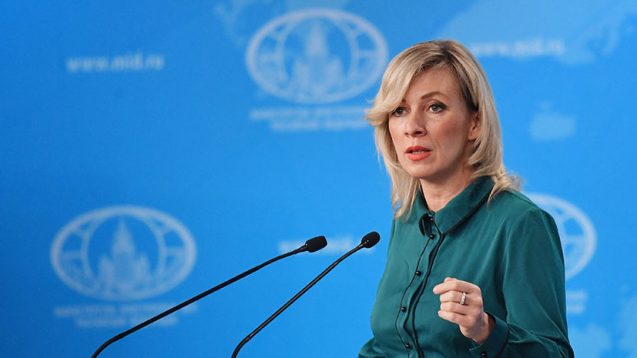
The Lithuanian parliament’s resolution branding Russia a “supporter of terrorism” amounts to “provocation, extremism and political hypocrisy,” Russian Foreign Ministry spokeswoman Maria Zakharova said.
Earlier this week, the Baltic country’s lawmakers unanimously passed a resolution stating that “the Russian Federation, whose military forces deliberately and systematically bomb civilian targets, is a state that supports and practices terrorism.”
Since the beginning of the conflict in late February, Ukraine and Russia have accused each other of shelling residential areas. Kiev denies that it targets civilians, while Moscow insists that it only hits military targets.
On her show on Sputnik radio on Wednesday, Zakharova said the three Baltic countries, all NATO members, have expressed “neither concern, condemnation nor at least bewilderment” over the actions of the alliance in Afghanistan, Iraq, and Yugoslavia, which led to “hundreds of thousands of casualties among the civilian population,” and to the “emergence of conflicts in places where they were not even contemplated.”
Because of this, Zakharova argued, there is no point in believing that the Lithuanian parliament’s resolution has anything to do with pacifism or with any desire “to resolve the extremely difficult situation in Ukraine.”
“This should be treated exactly as an element of provocation, extremism and political hypocrisy,” the foreign ministry spokeswoman said, adding: if Lithuania is truly concerned of the fate of Ukraine and of “its own European continent,” it should not have engaged in “provocative activities” over the last eight years, but instead care about the fate of people in Donbass and urge Kiev to observe the Minsk agreements.
If Lithuania is really concerned now, it would call for a ceasefire, oppose the supply of weapons to Kiev, and offer intermediary services, Zakharova said. “Instead, they are doing exactly the opposite.”
Russia attacked the neighboring state following Ukraine’s failure to implement the terms of the Minsk agreements, first signed in 2014, and Moscow’s eventual recognition of the Donbass republics of Donetsk and Lugansk. The German and French brokered protocols were designed to give the breakaway regions special status within the Ukrainian state.
The Kremlin has since demanded that Ukraine officially declare itself a neutral country that will never join the US-led NATO military bloc. Kiev insists that the Russian offensive was completely unprovoked and has denied claims it was planning to retake the two republics by force.
May 11, 2022
Posted by aletho |
Progressive Hypocrite | Lithuania, NATO, Russia |
Leave a comment
Lietuvos Gelezinkeliai (Lithuanian Railways, LTG) said on Thursday it is planning to lay off around 2,000 of its 9,000-plus employees, with around a quarter of the state-owned group’s managerial staff at various levels set to leave.
The company said in a press release that 6 million euros will be allocated for severance payments to employees.
The planned layoffs will affect around 1,200 workers in LTG Cargo, the group’s freight transportation subsidiary, about 500 in LTG Infra, the infrastructure subsidiary, and some 300 in LTG. The group currently has around 9,200 employees in total.
Both LTG and the Employment Service will provide assistance to the redundant workers, according to the press release.
The company has said earlier that it may lose some 150 million euros in revenue this year as freight volumes are forecast to halve, compared to last year, to around 26.5 million tons.
LTG has lost around 11 million tons in annual freight because of EU and US sanctions against Belarus’ potash giant Belaruskali, which will trim its annual revenue by 61 million euros.
The railway company is set to lose another 2.6 million tons of freight and 12.8 million euros in revenue due to EU sanctions on the [Russian] owner of Lithuania’s phosphate fertilizer producer Lifosa.
The EU’s sanctions on Russian coal and Poland’s refusal to buy it will result in a loss of 2.5 million tons of coal shipments and 12 million euros in revenue for LTG.
The railway group will lose another 1.4 million tons of freight and 17 million euros in revenue as a result of Belarus’ ban on the transit of oil and oil products and fertilizers from Lithuania. Ninety-five percent of these shipments were destined for Ukraine.
Lithuania’s draft revised 2022 budget, approved by the Cabinet, earmarks 155 million euros in additional financing for LTG.
April 28, 2022
Posted by aletho |
Economics, Malthusian Ideology, Phony Scarcity, Russophobia | Lithuania |
Leave a comment
By Paul Antonopoulos | October 26, 2020
Since the re-election of Belarussian President Alexander Lukashenko on August 9, deemed a rigged election by the West, protests have persisted for nearly three months. Led by opposition leader Sviatlana Tsikhanouskaya, the protests do not only continue to persist, but neighboring countries are actively intervening in the domestic affairs of Belarus in the hope that Lukashenko will be toppled, and thus, in their view, weaken Russian influence.
Just days after the election, a faction of the Homeland Union-Lithuanian Christian Democrats in the Seimas, the unicameral parliament of Lithuania, called for the immediate announcement of Lithuanian sanctions against 39 of the most influential representatives of the “Alexander Lukashenko regime,” as they termed it.
“Lithuania must clearly, quickly and unambiguously formulate and consolidate strategic provisions for the Belarusian regime at the European Union and transatlantic level, be an icebreaker in the fight for freedom and against tyranny. Sanctions must also send a signal to other influential members of the regime that continue to support Lukashenko, will mean a stalemate and further sanctions against a wider range of the current elite,” said leader of the Seimas opposition, Gabrielius Landsbergis.
With full backing from the opposition, decision makers in the Lithuanian capital of Vilnius achieved complete unanimity to pressure Belarus on behalf of NATO and the European Union. Taking on the so-called responsibility of dealing with the situation in Belarus, Lithuania developed a plan to challenge the legitimacy of Lukashenko by providing visas, housing and financial support to opposition figures; promoting Belarusian activists in Lithuanian universities, including awarding educational scholarships at the expense of the Lithuanian Ministry of Education, Science and Sports; simplified employment in the Lithuanian labor market; and, free medical services.
In addition, separate assistance is also provided to the Belarusian opposition in the form of a €200,000 grant to the Belarusian European Humanitarian University, a private liberal arts university founded in Minsk in 1992 shortly after the fall of the Soviet Union. It has however been operating in exile in Vilnius since 2004 after being shut down for “unsuitable classes,” but more likely for aggressively promoting liberal ideology.
While Vilnius may be proud of its role in the Belarusian conflict, Lithuanians are beginning to realize the economic consequences of such assistance, especially since a Ukraine-style color revolution was averted and Lukashenko’s position is consolidated and secure. Despite the fact that Vilnius annually receives visible support from the European Union, Lithuanian President Gitanas Nausėda and his government ineffectively allocate resources received towards anti-Lukashenko activities.
Social protection spending in Lithuania is among the lowest in the Europe Union while the poverty rate is among the highest. Lithuanian citizens do not have enough employment opportunities, which is why they seek for it in Western Europe. Many educated Lithuanians travel abroad for work opportunities but often end up doing mundane work, irrespective of their university qualifications. In the United Kingdom it is common to find Lithuanians doing construction, nannying or maid work. According to a statement by representatives of the Ministry of Social Security and Labor, the situation with unemployment in Lithuania is absolutely critical.
Belarusian migrant workers to the Baltic country are just worsening the situation, especially since 2,360 labor permits were issued since the beginning of the year, a significant amount considering Lithuania’s population is only about 2.7 million. This would be especially frustrating for Lithuanians considering unemployment in Belarus was 4.6% in 2019, lower than Lithuania’s 6.35%. Belarus is also capable of consistent GDP growth without having to rely on remittances unlike Lithuania which is experiencing a population decline due to immigration to the West because of the lack of employment opportunities.
The COVID-19 pandemic has not been any kinder to Lithuania’s prospects as a negative trend continues in almost all sectors of the economy, including wholesale trade and retail business, transportation, food services, industrial output, the scientific and technical service sector, construction and tourism.
Vilnius’ priority in favor of the Belarusian opposition instead of Lithuanian citizens has seen a degradation of living quality. In fact, crime is beginning to explode in Lithuania, partially because of the lack of opportunities. In all of the EU, Lithuania had the second highest number of intentional homicides in 2017. It was only behind Latvia and recorded 4 homicides per 100,000 inhabitants. It can only be assumed until the next release of official statistics that crime in Lithuania has only become worse as a result of the downturn in the economy because of the COVID-19 pandemic.
Primary care and public health measures in Lithuania are underfunded but there is no shortage for the defense sector, whose funding is steadily growing. While Lithuania spends 2.02% of their GDP on defense, parliamentary parties signed an agreement pledging to increase the country’s defense spending to 2.5% of the GDP by 2030. An increasing military budget and prioritized funding for the Belarusian opposition will only see more Lithuanians become dissatisfied with the domestic situation.
Lithuania claims its bloated military budget is part of their NATO responsibilities and is a deterrence against Russia. Although Lithuania cannot match Russia militarily, the justification of stalling the Russians long enough so that NATO can intervene in a hypothetical war is being actively used. Of course, Russia has no ambitions of conquering the Baltic States as they would try to have us believe, but this permanent paranoia cannot be shaken off. This paranoia and servitude to Atlantic-Euro interests drives Vilnius’ anti-Lukashenko policies.
Whereas Lukashenko is believed to be a Russian puppet, he was actually far more dynamic as he attempted to balance Moscow and the West. In fact, Lukashenko often prioritized relations with the West over Moscow. However, given Belarus’ recent negative experience with the West, largely spearheaded by Lithuania, it has only forced Lukashenko to return to Russia’s sphere of influence. Effectively, rather than pressuring Lukashenko into capitulation, Lithuania has only driven him back to Moscow, thus weakening their own geopolitical positioning and failed to strengthen it. While Lukashenko is secure in Minsk, Lithuanian citizens are increasingly impoverished as their government does everything it can to topple the Belarusian leader.
Paul Antonopoulos is an independent geopolitical analyst.
October 26, 2020
Posted by aletho |
Economics, Russophobia | Belarus, European Union, Lithuania, NATO |
Leave a comment
A new battalion of US military forces, equipped with tanks and other armored vehicles, is to be deployed to Lithuania in November and will remain there until next June, the country’s defense minister says.
Lithuania’s Defense Minister Raimundas Karoblis made the announcement on Tuesday, though he said the deployment was “not connected at all to the situation in Belarus.”
He said the new battalion would replace an American troop contingent that was stationed in the country near Belarus’ border earlier this month for a two-month tour.
NATO activity has picked up near the borders of Belarus, where there has been unrest after the re-election in August of President Alexander Lukashenko.
Lukashenko has said Western countries seek to destabilize Belarus and has put the country’s military on high alert and shut its borders with Poland and Lithuania.
The US battalion currently deployed in Lithuania arrived earlier and is staying longer than the government had indicated before the outbreak of protests in neighboring Belarus.
Belarusian Defense Minister Viktor Khrenin warned in a recent televised interview that an American armor battalion had redeployed its tanks to a location in Lithuania close to the Belarusian border.
Lukashenko also accused the US of organizing the post-election protests in Belarus through social media platforms. He said Americans, acting through centers in Poland and the Czech Republic, were controlling the social media platforms that are playing a leading role in the unrest.
Earlier this month, the Lithuanian Defense Ministry issued a statement saying that the US would deploy 500 troops to the country to engage in war games near the border with Belarus.
September 22, 2020
Posted by aletho |
Militarism | Belarus, Lithuania, NATO, United States |
Leave a comment
Lithuania’s decision to recognize Svetlana Tikhanovskaya as the leader of Belarus “violates the norms of international law,” according to a statement by the Council of the Republic, the upper house of parliament in Minsk.
Last week, the Lithuanian Seimas (parliament) adopted a resolution titled “On the Illegitimate Union Imposed by Russia on Belarus,” naming former presidential candidate Tikhanovskaya as the “elected leader” of the Belarusian people, and incumbent President Alexander Lukashenko as “illegitimate.”
“The decision of Lithuanian MPs to appoint a ‘leader of the people of Belarus’ is beyond the scope of common sense,” the Presidium of the Council of the Republic’s statement read. “Such actions are provocative and unacceptable, and violate the norms of international law.”
The statement also called Lithuania’s actions “blatant interference,” accusing the Seimas of “showing open disrespect for the sovereign right of the Belarusian people to choose their own leadership.”
Tikhanovskaya fled across Belarus’ northern border to Lithuania on August 11, two days after official election results suggested that she had come in a distant second place. Following the vote, thousands of Belarusians took to the streets throughout the country to protest over what they believe to have been a wholly rigged election. During days of demonstrations, police and internal troops used tear gas, stun grenades, and rubber bullets to disperse protesters, while strikes began at large factories.
Following her arrival in Lithuania, Tikhanovskaya formed a body called the Coordination Council, with the goal of organizing a peaceful transition of power away from President Lukashenko, and of holding new elections. The group, which includes Nobel Prize winner Svetlana Alexievich as part of its leadership, has been accused by the Belarusian authorities of “aiming to seize state power” and “harming national security.”
September 15, 2020
Posted by aletho |
Aletho News | Belarus, Lithuania |
Leave a comment
By Paul Antonopoulos | August 18, 2020
On August 9, presidential elections were held in Belarus with five candidates bidding to be head of state. According to the Central Election Commission, the incumbent president, Alexander Lukashenko, won in the first round with over 80% of the votes. Mass protests began in Belarus right after the announcement of the preliminary election results. People went to the streets, expressing their dissatisfaction with the results of the elections that they believe were unfair. Mass protests turned into riots and there were clashes between rioters and the police. Many people were detained and injured, and two protestors died.
Representatives of the European Union and the U.S. stated that they did not consider the presidential elections fair and appealed to the Belarusian authorities to have a second election. As both the EU and U.S. condemned Lukashenko’s re-election, it was therefore unsurprising that the deputy head of the Polish Ministry of Foreign Affairs, Paweł Jabłoński, stated that Poland did not want the EU to limit itself to only introducing sanctions against Belarus, as he claims it will push Belarus deeper into the sphere of Russian influence.
Tomorrow’s EU summit to discuss the situation in Belarus, and possibly pass sanctions, resulted from Warsaw’s call for prompt action, and above all, Prime Minister Mateusz Morawiecki who personally exerted pressure immediately after the Belarusian elections.
“We do not want the EU’s reaction to be limited only to presenting an idea for sanctions and adopting a joint statement, which is obviously needed, but to give Belarusians something more,” said Paweł Jabłoński in an interview with PAP. “The point is that we should present a real offer to resolve this conflict in a stable and lasting manner, and this is only possible if we, as the EU, offer Belarus a real perspective of cooperation if a solution based on dialogue is reached.”
Jałoński also pointed out that EU member states should jointly adopt a common position on the events in Belarus.
“We will want to send a signal that if Belarus begins the process of reforms leading to a system in which citizens decide on the direction of changes, the EU is ready for real cooperation with Belarus – primarily economic,” said Jabłoński, adding that “Belarusians should be able to choose their own development path and have a real choice here – our role is to propose this choice.”
This suggests that Warsaw’s main concern is to see the liberalization of the Belarusian economy to follow the same path as the other post-Soviet countries in Eastern Europe. The World Bank estimates that 75% of industrial output comes from state-owned companies, with the state sector employing about half of the Belarusian workforce. Because of this, unemployment in Belarus was at 4.6% in 2019, significantly lower than neighboring Ukraine (8.8%), Latvia (6.52%) and Lithuania (6.35%), with only Poland having a lower figure at 3.47%. Belarus is also capable of consistent GDP growth without having to rely on remittances like its neighboring countries which are also experiencing population decline due to emigration.
Effectively, what Lukashenko has done is protected the country from neo-liberal policies that spread throughout Eastern Europe after the Soviet Union collapsed in 1991, which resulted in many of the industries being shut down or privatized, impoverishing much of the population. Because of this action, Lukashenko earned the nom de guerre of “the last dictator of Europe” and Belarus the title of “mini-Soviet Union.”
Although Lukashenko has a complicated relationship with Moscow, one that can be cold at times, but generally speaking, Belarus, which gets its etymology from “White Rus(sia)”, has positive relations with its larger neighbor. Lukashenko, who at times panders towards the West, has amicable relations with Syria, Venezuela and other states that are targeted by the U.S. and Western Europe. Due to Lukashenko’s strong relations with these states and his sternness in preventing the liberalization of the economy, it is expected that when an opportunity is presented for the West, a Maidan-like event will begin in Belarus.
Although Poland is pushing for a Maidan-like event to occur, it is not the only neighbor of Belarus that wants this. A faction of the Homeland Union-Lithuanian Christian Democrats in the Seimas, the unicameral parliament of Lithuania, called for the immediate announcement of Lithuanian sanctions against the 39 most influential representatives of the “Alexander Lukashenko regime,” as they termed it.
“Lithuania must clearly, quickly and unambiguously formulate and consolidate strategic provisions for the Belarusian regime at the European Union and transatlantic level, be an icebreaker in the fight for freedom and against tyranny. Sanctions must also send a signal to other influential members of the regime that continued to support Lukashenko, will mean a stalemate and further sanctions against a wider range of the current elite,” said leader of the Seimas opposition, Gabrielius Landsbergis.
It was recently revealed that Lithuania had a key role in the Ukrainian Maidan events, and Poland’s involvements are also well noted. It is unsurprising that both countries are once again united in their demands to escalate tensions and hostilities with Belarus in their mad drive in what they perceive to be the de-Sovietizing and de-Russification of Eastern Europe. Perceiving that Russia and Belarus could be a threat to their security, both Warsaw and Vilnius have taken the opportunity to escalate the protests through rhetoric in the hope that a Maidan-like event will occur in Belarus, thereby further weakening Russian influence in Eastern Europe.
Paul Antonopoulos is an independent geopolitical analyst.
August 18, 2020
Posted by aletho |
Economics | Belarus, European Union, Lithuania, Poland |
Leave a comment
New scandalous information about the 2014 Maidan coup d’état in Ukraine has emerged that implicates Lithuania’s important role in instigating the violent events. David Zhvania, a former Member of the Ukrainian Parliament, revealed on his YouTube channel that the seizure of power in Ukraine was financed in “several ways.”
“One of the external sources was the Lithuanian embassy, through which money and weapons were transferred, and the internal channel was Diamantbank. I have documented evidence to support my words,” said the former ally of Petro Poroshenko, the previous president of Ukraine.
Zhvania called on Prosecutor General Irina Venediktova to initiate criminal proceedings and to summon him for questioning. According to the former MP, “Ukrainians should finally find out the truth” on who funded Maidan and who was bribed. He then admitted he was a member of a “criminal group that carried out a coup.”
“To help the conspirators, I used my political influence and my position as head of the State-Building Committee,” he said, adding that he would testify against himself, “but with one condition.”
“Please guarantee my security because I know who the people of Poroshenko are. They can easily order me to be removed,” he stressed.
Mass protests in Kiev began in November 2013 after preparations for the signing of an association agreement between Ukraine and the European Union were suspended. This set off mass anti-Russian hysteria and by the end of February 2014, a coup d’état took place in Ukraine, ousting President Viktor Yanukovych from power. This led to Petro Poroshenko becoming president and ultra-nationalists, including neo-Nazis, gained significant power in Ukraine and instigated a war with the Russian-speaking minority of Eastern Ukraine.
Although U.S. and Western European involvement in Maidan are well documented and known, Zhvania’s admissions are the first admittance of how a small Baltic country of under 3 million people played a key role in destabilizing Ukraine. Lithuania’s role was not only with financial support, but also with arms transfers. Although some may be sceptical that Lithuania played such a role, Zhvania is confident enough in his allegations that he announced he is willing to submit “documented evidence” to the Prosecutor General’s Office of Ukraine.
The question arises whether the Prosecutor’s Office will accept Zhvania’s testimony and evidence. Such a testimony and submission of evidence would further question the legitimacy of the Maidan events as a fight for freedom and democracy in Ukraine. If the legitimacy of Maidan is questioned, ultra-nationalists in Ukraine could become hysterical and instigate political destabilization to maintain and protect the powers they attained when Yanukovych was ousted. This is something the Prosecutor’s Office would be considering.
Lithuania was an active supporter of the 2004-2005 Orange Revolution that brought pro-Western President Viktor Yushchenko to power in Ukraine. Although Yushchenko was unconstitutionally brought to power, for Lithuania this was not a problem so long as Kiev had a pro-Western orientation. It is therefore not surprising that in 2014 it again supported reactionary forces in Ukraine. From the beginning of the conflict in Donbass, the eastern region of Ukraine where the majority of the Russian-speaking minority are, Lithuania started to provide official military support to Ukraine with armaments and advisers, and informally by recruiting and sending mercenaries.
As Lithuania has taken a pro-American position since the collapse of the Soviet Union in 1991, the country’s leadership has aggressively served Washington’s ambitions of limiting Russian influence and expanding American interests in the post-Soviet space. It is for this reason that Lithuania, Ukraine and Poland created the “Lublin Triangle,” a trilateral platform for these three countries to counter supposed “ongoing Russian aggression” and show their “firm support” for Western institutions. In their joint declaration published online, the Foreign Affairs Ministers of the three countries condemned Russia’s “ongoing aggression” and its “attempted annexation” of Crimea, while welcoming Ukraine’s “European choice.” Effectively the trilateral platform is a pillar for the three countries to enact Washington’s main foreign policy priorities in the region, that they call “Central Europe” instead of Eastern Europe. Claiming that Poland, Lithuania and Ukraine are in Central Europe instead of the geographical reality that they are in Eastern Europe, is an awkward attempt by these countries to disassociate themselves from Western orientalization that the East is primitive and/or backwards.
If Zhvania’s statements that Lithuania’s role in Maidan are confirmed to be true, it would certainly not come as a surprise, but as mentioned, they delegitimize the initial claims that the movement was a struggle for democracy and Western European values in Ukraine. It would also confirm that Lithuania interfered in the internal affairs of another state and participated in an unconstitutional coup. Effectively, if proven true, the supposed values of Western Europe that Maidan struggled for would prove to be a sham as it was not achieved through the will of the people, but rather through foreign funds and weapons, including those from seemingly insignificant states like Lithuania.
Paul Antonopoulos is an independent geopolitical analyst.
August 4, 2020
Posted by aletho |
Corruption, Deception, Timeless or most popular | European Union, Lithuania, Ukraine, United States |
Leave a comment
The Lithuanian Radio and Television Commission (LRTK) has banned the broadcasting of five RT channels in the country, following the example of neighbouring Latvia, commission chairman Mantas Martisius said on Wednesday.
“Yes, we can confirm this. The decision will come into force after being published on the LRTK website,” Martisius said.
The ban is applicable to RT, RT HD, RT Spanish, RT Documentary HD and RT Documentary, and will go into effect on Thursday, LRTK chairman explained.
Last week, Latvia banned the broadcasting of seven RT channels (namely RT, RT HD, RT Arabic, RT Spanish, RT Documentary HD, RT Documentary, RT TV), saying they are all owned by Rossiya Segodnya International Information Agency Director-General Dmitry Kiselev, who is under EU sanctions. Notably, Rossiya Segodnya and RT are two different legal entities, RT is not chaired by Kiselev, and RT Editor-in-Chief Margarita Simonyan is not under any EU sanctions.
The Russian Foreign Ministry’s spokeswoman, Maria Zakharova, has slammed Latvia’s decision to ban seven RT channels as a disgraceful and illegal move.
Estonian Foreign Minister Urmas Reinsalu said on Tuesday that the government was mulling the possibility to ban RT broadcasting in the country.
July 8, 2020
Posted by aletho |
Civil Liberties, Full Spectrum Dominance | Estonia, European Union, Latvia, Lithuania |
Leave a comment
By Lucas Leiroz | March 20, 2020
In 2017, RAND Corporation published in its associated media Small Wars Journal an article by the researchers Marta Kepe and Jan Osburg, outlining a strategic defense plan for the Baltic countries in the event of a Russian invasion. The authors claim that Estonia, Lithuania and Latvia will manage their weaknesses to face the Russians, overcoming their population and military deficit through the participation of civilians in the conflicts, working with the armed forces to create a “total defense” plan that would make the invasion too costly and laborious for Russia. Subsequently, the RAND Corporation article was mentioned in a paper by the National Interest magazine, authored by Michael Peck, in which the author studies the Baltic defense strategy, speculating about “total defense” and its efficiency in a possible case of Russian invasion. The researcher, finally, takes a pessimistic conclusion, stating that, despite all efforts, nothing will change the fact that Russia is a large country and the Baltic States are small and weak.
In March last year, the renowned American magazine Foreign Policy published an article by Mikheil Saakashvili, former president of Georgia, claiming that Russia’s next “targets” would be European nations. In the text, Saakashvili considers the possibility of a Russian attack on the Baltic countries, saying that President Vladimir Putin sees them as real threats because they are “functional democracies on the Russian border”. After developing his reasoning, the author comes to the conclusion that this invasion will not occur, pointing other countries as future “targets” of Russia. However, even though Saakashvili does not believe in the possibility of a Russian invasion, rumors about a Russian plan to invade and annex the Baltic nations have generated unfounded tensions in the region.
The height of media alarmism regarding relations between Russia and the Baltic countries was, however, an article published by the American expert Hall Brands on Japan Times website, whose title is “How Russia could force a nuclear war in the Baltics”. Referring again to the studies of the RAND Corporation, the author considers the possibility of a nuclear escalation on the frictions between Moscow and NATO in the Baltics, concluding that the geographic condition of these states would hinder rapid action by the West in the event of Russian action, raising the risks of forced annexation.
Apparently, media agencies aligned with the liberal establishment are working together to spread the idea that there is a Russian interest in invading and annexing the Baltics. For these agencies, the interest is so great that it would even justify a nuclear action. However, when we investigate the reasons for such despair, we found no concrete argument to justify such speculations. The great Western think tanks, such as the RAND Corporation, are spreading this myth with the specific purpose of instilling fear and tension in the Baltic States, so that, in the face of “Russian terror”, they will increasingly align themselves with Washington and NATO.
The concrete data indicate exactly the opposite of the rumors spread by RAND analysts. In January last year, Estonian Prime Minister Juri Ratas publicly expressed an interest in improving relations between his country and Russia, with a view to pacifying bilateral tensions and envisioning a future of peace and cooperation, despite divergent interests. Also, Latvia remains the only member country of the European Union that is totally dependent on Russian gas – a situation Lithuania has only recently withdrawn from. So why Moscow would be interested in invading and annexing such countries, when the threat they pose to the Russian political structure is absolutely nil? In a way, it is much more logical to think that for the Baltic countries it is more profitable and interesting to maintain good relations with Russia than to embark on unfounded conspiracies by Western experts who are extremely ideologically involved. However, there is a second hypothesis.
It is still likely that the Baltic States are simply acting in the interest of increasing their role on the international scene. Unable to form a solid political, military and economic force, even if united, capable of facing the great world powers, these States may be anchoring themselves in NATO’s military apparatus to seek the affirmation of their own interests in Europe and in the world. By this logic, Lithuania, Latvia and Estonia would be voluntarily adopting the alarmist discourse of the West and reaffirming it in order to, increase the western military presence on its borders, try to increase its regional and global influence, moving from being small European States to becoming potencies in the global geopolitical game.
Indeed, the Baltic countries are making a big mistake in adopting either of these two stances. Unlike Moscow, for whom the interest in “invading” the Baltic is nil, Washington has clear interests in occupying the region, so as to face Russia. That is the main reason for the presence of NATO troops in the Baltic expected for the Defender Europe 2020 drills – now canceled by the coronavirus pandemic.
The Baltic States are adhering to the discourse of Western think tanks, however, under no perspective can this opposition to Russia be profitable for them. Following the interests of Washington, Estonia, Latvia and Lithuania have too much to lose.
Lucas Leiroz is a research fellow in international law at the Federal University of Rio de Janeiro.
March 20, 2020
Posted by aletho |
Militarism | Estonia, Latvia, Lithuania, NATO |
Leave a comment
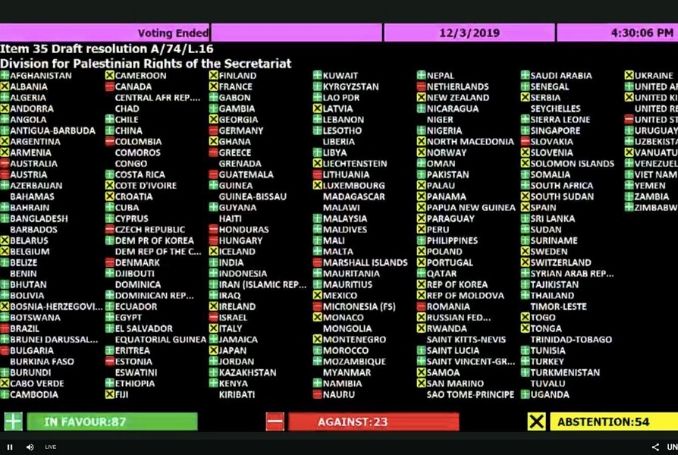
For the first time, 13 countries changed their longstanding positions and voted against a pro-Palestine measure at the United Nations on Tuesday.
Germany, the Czech Republic, Austria, Bulgaria, Denmark, Estonia, Greece, Lithuania, Netherlands, Romania, Slovakia, Brazil, and Colombia voted against the annual resolution regarding the “Division for Palestinian Rights of the Secretariat”, according to the Times of Israel.
They had previously abstained on the vote.
The resolution, which includes a call to halt to illegal Israeli settlements being constructed in the occupied West Bank, still passed with a large majority voting in favor.
The Palestinian representative told the council: “If you protect Israel, it will destroy you all.” He also said Israel’s character as a Jewish state is “shameless racism”.
The New York-based Division for Palestinian Rights oversees the Committee on the Exercise of the Inalienable Rights of the Palestinian People.
The resolution was co-sponsored by Comoros, Cuba, Indonesia, Jordan, Kuwait, Lao People’s Democratic Republic, Qatar, Saudi Arabia, Senegal, the United Arab Emirates, and Yemen.
The UK, France, and Spain abstained, as they do every year, allowing the resolution to pass with a vote of 87-54, with 21 other abstentions.
The General Assembly adopted five resolutions on the question of Palestine and the Middle East, including one calling on the Member States not to recognize any changes to the pre-1967 borders, including with regards to Jerusalem, other than those agreed by the parties through negotiations.
December 5, 2019
Posted by aletho |
Ethnic Cleansing, Racism, Zionism | Austria, Brazil, Bulgaria, Colombia, Czech Republic, Denmark, Estonia, Germany, Greece, Israel, Lithuania, Netherlands, Palestine, Romania, Slovakia, Zionism |
Leave a comment