The US Military-Industrial Complex’s Worst Nightmare: The S-300 May Destroy and Expose the F-35
By Federico Pieraccini | American Herald Tribune | September 30, 2018
The tragic episode that caused the death of 15 Russian air force personnel has had immediate repercussions on the situation in Syria and the Middle East. On September 24, Russian Defense Minister Sergei Shoigu informed allies and opponents that the delivery of the S-300 air-defense systems to the Syrian Arab Republic had been approved by President Vladimir Putin. The delivery had been delayed and then suspended as a result of Israeli pressure back in 2013.
In one sense, the delivery of S-300 batteries to Syria is cause for concern more for Washington than for Tel Aviv. Israel has several F-35 and has claimed to have used them in Syria to strike alleged Iranian weapons transfers to Hezbollah. With the S-300 systems deployed in an updated version and incorporated into the Russian command, control and communications (C3) system, there is a serious risk (for Washington) that Israel, now incapable of changing the course of events in Syria, could attempt a desperate maneuver.
It is no secret that Greece purchased S-300s from Russia years ago, and that NATO and Israel have trained numerous times against the Russian air-defense system. Senior IDF officials have often insisted that they are capable taking out the S-300s, having apparently discovered their weaknesses.
Tel Aviv’s warning that it will attack and destroy the S-300 battery should not be taken as an idle threat. It is enough to look at the recent downing of Russia’s Il-20 surveillance aircraft to understand how reckless a desperate Israel is prepared to be. Moreover, more than one IDF commander has over the years reiterated that a Syrian S-300 would be considered a legitimate target if threatening Israeli aircraft.
At this point, it is necessary to add some additional information and clarify some points. Greece’s S-300s are old, out of maintenance, and have not had their electronics updated. Such modern and complex systems as the S-300s and S-400s require maintenance, upgrades, and often replacement of parts to improve hardware. All this is missing from the Greek batteries. Secondly, it is the operator who uses the system (using radar, targeting, aiming, locking and so forth) that often makes the difference in terms of overall effectiveness. Furthermore, the system is fully integrated into the Russian C3 system, something that renders useless any previous experience gleaned from wargaming the Greek S-300s. No Western country knows the real capabilities and capacity of Syrian air defense when augmented and integrated with Russian systems. This is a secret that Damascus and Moscow will continue to keep well guarded. Yet two years ago, during the operations to free Aleppo, a senior Russian military officer warned (presumably alluding to fifth-generation stealth aircraft like the F-35 and F-22) that the range and effectiveness of the Russian systems may come as a surprise.
The following are the words of Russian defense minister Sergei Shoigu concerning the deployment of the S-300 to Syria and its integration with other Russian systems:
“Russia will jam satellite navigation, onboard radars and communication systems of combat aircraft, which attack targets in the Syrian territory, in the Mediterranean Sea bordering with Syria. We are convinced that the implementation of these measures will cool hotheads and prevent ill-considered actions threatening our servicemen. Otherwise, we will respond in line with the current situation. Syrian troops and military air defense units will be equipped with automatic control systems, which have been supplied to the Russian Armed Forces. This will ensure the centralized management of the Syrian air defense forces and facilities, monitoring the situation in the airspace and prompt target designation. Most importantly, it will be used to identify the Russian aircraft by the Syrian air defense forces.”
If the Israelis will follow through with their reckless attempts to eliminate the S-300 (if they can find them in the first place, given that they are mobile), they will risk their F-35s being brought down. The US military-industrial complex would suffer irreparable damage. This would also explain why Israel (and probably the US) has for more than five years put enormous pressure on Moscow not to deliver the S-300 to Syria and Iran. The US State Department’s reaction over the future purchase by Turkey and India of the S-400 confirms the anxiety that US senior officials as well as generals are experiencing over the prospect of allies opting for the Russian systems. This would allow for a comparison with weapons these allies purchased from the US, leading to the discovery of vulnerabilities and the realization of the US weapons’ relative inferiority.
Given Tel Aviv’s tendency to place its own interests above all others, it would not be surprising to find them using the possibility of attacking the S-300 with their F-35s as a weapon to blackmail Washington into getting more involved in the conflict. For the United States, there are two scenarios to avoid. The first is a direct involvement in the conflict with Russia in Syria, which is now unthinkable and impractical. The second – much more worrying for military planners – concerns the possibility of the F-35’s capabilities and secrets being compromised or even being shown not to be a match against air-defense systems nearly half a century old.
An illuminating example of how the United States operates its most advanced aircraft in the region was given in eastern Syria around Deir ez-Zor. In this part of Syria, there is no threat from any advanced air-defense systems, so the US is often free to employ its F-22 in certain circumstances. The Russian military has repeatedly shown radar evidence that unequivocally shows that when Russian Su-35s appear in the same skies as the F-22, the US Air Force simply avoids any confrontation and quickly withdraws such fifth-generation assets as the F-22. The F-35 is not even ready in its naval variant, and has yet to be deployed on a US aircraft carrier near the Middle Eastern theater or the Persian Gulf; nor is it present in any US military base in the region. The US simply does not even consider using the F-35 in Syria, nor would it risk its use against Russian air defenses. Israel is the only country that so far may have already used these aircraft in Syria; but this was before the S-300 came onto the scene.
The F-35 program has already cost hundreds of billions of dollars and will soon reach the exorbitant and surreal figure of over 1 trillion dollars. It has already been sold to dozens of countries bound by decades-long agreements. The F-35 has been developed as a multi-role fighter and is expected to be the future backbone of NATO and her allies. Its development began more than 10 years ago and, despite the countless problems that still exist, it is already airborne and combat-ready, as the Israelis insist. From the US point of view, its employment in operations is played down and otherwise concealed. The less data available to opponents, the better; though the real reason may lie in a strong fear of any revelation of potential weaknesses of the aircraft damaging future sales. At this time, the Pentagon’s marketing of the F-35 is based on the evaluations provided by Lockheed Martin, the manufacturer, and on the tests carried out by the military who commissioned it to Lockheed Martin. Obviously, both Lockheed Martin and the US Air Force have no interest in revealing any weaknesses or shortcomings, especially publicly. Corruption is a big thing in Washington, contrary to common assumptions.
The combination of Israel’s ego, its inability to change the course of events in Syria, coupled with the loss of its ability to fly throughout the Middle East with impunity due to Syria now being equipped with a superior air defense – all these factors could push Israel into acting desperately by using the F-35 to take out the S-300 battery. Washington finds itself in the unenviable position of probably having no leverage with Israel over the matter ever since losing any ability to steer events in Syria.
With the Russian air-defense systems potentially being spread out to the four corners of the world, including China, India, Saudi Arabia, Qatar, and who knows how many other countries waiting in the queue, Russia continues to increase its export capacity and military prestige as it demonstrates its control of most of the Syria’s skies. With the introduction of the the S-500 pending, one can imagine the sleepless nights being spent by those in the Pentagon and Lockheed Martin’s headquarters worrying about the possibility of an F-35 being taken down by an S-300 system manufactured in 1969.
US Stealth Aircraft Manufacturer to Open Preschools in Jerusalem – Reports
Sputnik – 25.05.2018
One of the biggest defense manufacturers in the United States is reportedly moving to invest in kindergarten education in Jerusalem.
Lockheed Martin is about to open several science-oriented preschools in the city of Jerusalem with the backing of the Israeli Ministry of Education, Haaretz reports.
According to the newspaper, the company that produces a wide array of ordnance and military aircraft, including the F-35 stealth fighter, is opening these preschools as part of a larger project called MadaKids.
Also, Lockheed Martin intends to fund robotics courses for first and second graders for children who graduate from these preschools.
The company’s representatives added that Lockheed Martin will only pay for the preschools’ science curriculum.
“We’re supporting them financially, but we don’t have teachers in the preschools and we’re not intervening in the programming or curriculum,” said Joshua Shani, CEO of Lockheed Martin Israel.
While Shani did admit that Lockheed Martin’s involvement in this preschool program “isn’t logical”, he argued that “the moment a commercial company wants to contribute to the community, it becomes worthwhile.”
“We could have set up a research institute on military aviation worldwide, but we went in the direction of education because that’s what fires us up,” he declared.
The Ministry of Education noted that it does not object to commercial enterprises setting up preschools as long as commercial content doesn’t get introduced into curriculum.
The commander of the Israeli Air Force Maj. Gen. Amikam Norkin earlier declared that Israel became the first country in the world to carry out an attack using the US-manufactured F-35 stealth fighter.
He claimed that Israel is “flying the F-35 all over the Middle East and have already attacked twice on two different fronts.”
Neutral and unbiased? Why ‘think tanks’ lobby for war in Syria
By Danielle Ryan | RT | April 17, 2018
When US President Donald Trump fired a barrage of Tomahawk missiles at Syrian government targets last week, it was a good day for defense contractors, at least.
In the aftermath of the strike, which Trump claimed was in retaliation for an alleged chemical attack by the Syrian government, stocks in Tomahawk missile manufacturer Raytheon surged. Raytheon stock has climbed more than 18 percent in 2018 so far. In fact, stocks in defense companies have been climbing in general since Trump entered office promising “historic” increases in military spending.
Almost a year ago to the day, Trump delivered another bump to the defense companies after attacking Syrian government positions for the first time – also in response to an alleged chemical attack, evidence for which remains in question.
After that strike Boeing, Lockheed Martin, Northrop Grumman and General Dynamics also rose, gaining nearly $5 billion in market value when trading began the next day, even as the wider market slumped.
Later, when Trump appointed the famously militaristic John Bolton as his national security adviser in March, guess what happened? Shares in US energy and defense companies surged yet again. It doesn’t take a rocket scientist to figure this one out: war is profitable. The more missiles Trump fires, the more money these companies make.
But where do the think tanks come in?
There is a pervasive myth that Washington DC ‘think tanks’ are neutral and unbiased players in foreign policy analysis. But where do these centers for foreign policy ‘analysis’ get their money from? You guessed it: defense companies.
There are a few think tanks which dominate in American foreign policy debates. They include the Center For European Policy Analysis (CEPA), the Atlantic Council, the German Marshall Fund (GMF), the Brookings Institution and the Heritage Foundation. All five of them receive generous donations from Lockheed Martin and Raytheon. Three of them also receive funding from the Boeing Company.
Corporations like Exxon Mobil, Northrop Grumman, BAE Systems, and Bell Helicopter are also big donors to think tanks. Bell Helicopter is a funder of CEPA, while Exxon funds Brookings, GMF and the Atlantic Council. BAE Systems donates to CEPA, while Northrop Grumman gives to the Atlantic Council. This is not to even mention the money they get directly from US government departments and NATO, which also helps explain their consistently anti-Russian analysis.
Nonetheless, these think tanks enjoy an undue air of independence. Experts who work for these defense contractor-funded institutes are quoted frequently in mainstream newspapers and invited on mainstream channels, where they are presented as independent voices. But those independent voices somehow always seem to be in favor of policies that benefit weapons manufacturers.
War profiteers are filling their coffers in return for ‘analysis’ which promotes military action and massively inflates the threat posed to America by countries like Russia, for example.
A glance at the Twitter feed of CEPA reveals almost obsession-like focus on the so-called threat from Russia. In 2016, the Lockheed and BAE Systems-funded think tank suggested in a report on information warfare that people who have “fallen victim to Kremlin propaganda” should be “deradicalized” in special programs.
The NATO-funded Atlantic Council has consistently lobbied for regime change in Syria. In the days surrounding Trump’s military actions against Syria last week, the Atlantic Council published multiple pieces of analysis and interviews with a single theme: that Trump did not or would not go far enough with one night of strikes. Earlier, when the alleged chemical attack took place, the think tank argued that Syrian President Bashar Assad was “indulging an addiction” and called on the US to take new military action against him. For some reason, diplomacy does not seem to be high on the Atlantic Council’s agenda.
It seems the more money defense contractors throw at think tanks, the more those think tanks will argue in favor of the military policies that will make those companies the most money. It’s a vicious cycle, but one which doesn’t take much think tank-style ‘analysis’ to figure out.
The sad thing for the think tank lobbyists, is that the money they make calling for war is nothing in comparison to the money Lockheed, Raytheon, Boeing and the rest make from it. Maybe they should ask for a raise.
Your guide to top anti-Russia think tanks in US & who funds them
By Bryan MacDonald | RT | February 6, 2018
Countering Russia has become a lucrative industry in Washington. In recent years, the think tank business has exploded. But who funds these organizations, who works for them and what are the real agendas at play?
From the start, let’s be clear, the term ‘think tank’ essentially amounts to a more polite way of saying ‘lobby group.’ Bar a few exceptions, they exist to serve – and promote – the agendas of their funders.
However, particularly in the United States, the field has become increasingly shady and disingenuous, with lobbyists being given faux academic titles like ‘Senior Non-Resident Fellow’ and ‘Junior Adjunct Fellow’ and the like. And this smokescreen usually serves to cloud the real goals of these operations.
Think tanks actually originate from the Europe of the Dark Ages. That’s 9th-century France, to be precise. But the modern American movement is modeled on British organizations from around a millennium later, many of which, such as ‘RUSI (1831)’, still exist today. The concept was possibly brought to America by the Scottish-born Andrew Carnegie. And his ‘Carnegie Endowment for International Peace’ (1910) is still going strong.
Yet, the real boom in the ‘think tank’ industry came with the era of globalization. With a 200-percent rise in numbers since 1970. And in recent years, they’ve become more transnational, with foreign states and individuals sponsoring them in order to gain curry favor in Washington.
One country that largely hasn’t bothered playing this game is Russia. Instead, mostly in the foreign policy and defense sectors, Moscow frequently serves as Enemy Number One for many advocacy groups. Here are some prominent outfits in the think tank racket, which focus on hyping up threats from Russia.
- The Atlantic Council
Founded: 1961
What is it? Essentially the academic wing of NATO. The Atlantic Council serves to link people useful to the organization’s agenda across Europe and North America. However, in recent years, its recruitment has increasingly focused on employees who directly attack Russia, especially on social media. Presumably, this is to give them a guaranteed income so they can continue their activities, without needing to worry about paying the bills.
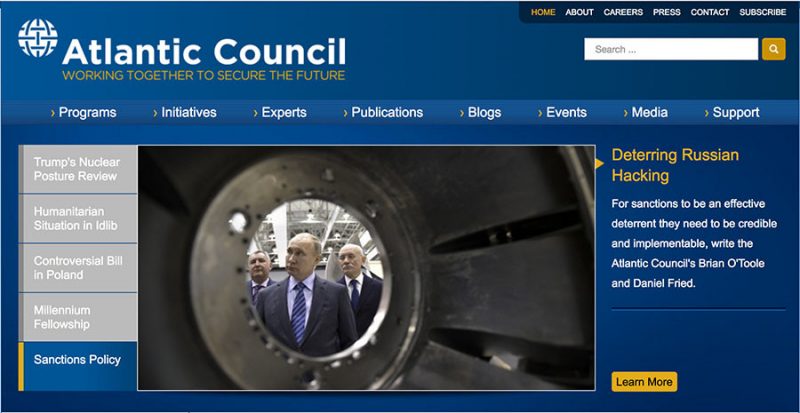
What does it do? Promotes the idea of Russia being an existential threat to Europe and the US, in order to justify NATO’s reason for being.
Who are its people? The Atlantic Council’s list of lobbyists (sorry, ‘Fellows’!) reads like a telephone directory of the Russia bashing world. For instance, Dmitri Alperovitch (of Crowdstrike, which conveniently alleges how Russia hacked the Democratic National Congress) is joined by the perennially- wrong Anders Aslund, who has predicted Russia’s impending collapse on a number of occasions and has, obviously, been off the mark. Then there’s Joe Biden’s “Russia hand,” Michael Carpenter and their recent co-authored Foreign Affairs piece suggests he actually knows very little about the country). Meanwhile, Evelyn Farkas, a fanatical Russophobe who served in Barack Obama’s administration has also found a home here. Another interesting Atlantic Council lobbyist is Eliot Higgins, a “geolocation expert” who has made a career out of spinning tales from the Ukraine and Syrian wars but is, naturally, mostly disinterested in covering Iraq and Yemen, where the US and its allies are involved, but Russia has no particular stake. Lastly, we can’t forget CNN’s Michael Weiss, the self-declared “Russia analyst” who, by all accounts, has never been to Russia and can’t speak Russian.
Who pays for it? The Atlantic Council has quite an eclectic bunch of patrons to serve. NATO itself is a big backer, along with military contractors Saab, Lockheed Martin and the Raytheon Company, all of which naturally benefit from increased tensions with Moscow. The UK Foreign Office also splashes the cash and is joined by the Ukrainian World Congress and the US Department of State. Other sugar daddies include the US military (via separate contributions from the Air Force, Navy, Army and Marine Corps), Northrop Grumman and Boeing.
- The Center for European Policy Analysis (CEPA)
Founded: 2005
What is it? Despite the name, CEPA is based in Washington, not the ‘old continent’, but it does have an outpost in Warsaw. This club specifically focusses on Central and Eastern Europe and promoting the US Army and foreign policy establishment’s agenda there. Or, in its own words, creating a “Central and Eastern Europe with close and enduring ties to the United States.”

screenshot from cepa.org
What does it do? CEPA amounts to a home for media figures who devote their careers to opposing Russia. It whips up tensions, even when they don’t really exist, presumably in order to drum up business for its sponsors, who are heavily drawn from the military industry. For example, it spent last year hyping up the ‘threat’ from Russia’s and Belarus’ joint ‘Zapad’ exercises, even running a sinister-looking countdown clock before the long-planned training commenced.
CEPA grossly overestimated the size of the event, saying it “could be the largest military exercise since the end of the Cold War” and dismissing basically all Moscow’s statements on its actual nature as “disinformation.”
Who are its people? Times of London columnist Edward Lucas has been part of CEPA for years.
Poland chooses Raytheon. Even if the missiles don’t work, America will defend its customers http://t.co/QwqrkCiosD
— Edward Lucas (@edwardlucas) April 21, 2015
The dedicated ‘Cold Warrior’ doesn’t appear to have spent much time in Russia for a long while and still seems to view the country through a prism which is very much rooted in the past. Thus, he’s more-or-less an out-of-touch dinosaur when it comes to Russia expertise. He will soon be joined by Brian Whitmore, who comes on board from RFE/RL and appears to be even more ill-informed than Lucas. His broadcasts for the US state broadcaster led to him being described as the “Lord Haw Haw of Prague,” where has been based for some years. CEPA is a pretty fluid organization and, until recently, Anne Applebaum and Peter Pomerantsev were also on its list of lobbyists. The former is a Polish-American Washington Post columnist who obsessively denigrates Russia and the latter has previously worked with the Atlantic Council’s Michael Weiss, which shows you how small and incestuous the Russia-bashing world is.
Who pays for it? While other think tanks at least try to make their funding look semi-organic, CEPA looks to have zero hang-ups about its role as a mouthpiece for defence contractors. Which is, at least, honest. FireEye, Lockheed Martin, Raytheon, Bell Helicopters and BAE systems pump funds in and they are joined by the US State Department and the Department of Defence. Another notable paymaster is the National Endowment for Democracy – ‘regime change’ experts who are surely interested in CEPA’s remit to also cover Belarus. The US Mission to NATO and NATO’s own Public Diplomacy Division also provide cash.
- German Marshall Fund of the United States
Founded: 1972
What is it? Don’t be fooled by the name, the German Marshall Fund (GMF) is a very American body these days with little input from Berlin. It was founded by a donation from Willy Brandt’s Bonn-government to celebrate the 25th anniversary of the Marshall Plan. Ironically, Brandt is today best remembered as the father of ‘Ostpolitik’, which sought a rapprochement between Germany and Russia.

What does it do? After the fall of the Soviet Union, the GMF transformed into a vehicle promoting US influence in Eastern Europe, with outreaches in Warsaw, Belgrade and Bucharest. However, in the past 12 months, it’s taken a very strange turn. Following the election of US President Donald Trump (ironically a German-American), the lobby group launched the Alliance for Securing Democracy (ASD) project. Its centerpiece is the ‘Hamilton 68 Dashboard’, which seems to classify social media users which reject the US liberal elite’s consensus as “Russian trolls.” The reaction has been highly critical, with even the secretly-funded Russian opposition website Meduza asking “how do you identify ‘pro-Russian amplifiers’ if… themes dovetail with alternative American political views?”
Who are its people? The GMF, especially through its new ASD plaything, has a high-profile bunch of lobbyists. They include Toomas Ilves, an American-raised son of Estonian emigrants who once headed the Estonian desk at erstwhile CIA cut-out Radio Free Europe and eventually became president of Estonia. Also on board is Bill Kristol, known as the ‘architect of the Iraq War’ and former CIA Director Michael Morrell. Former US Ambassador to Russia Michael McFaul, who recently announced he was partially abandoning his Russian scholarship and has “lost interest in maintaining my (sic) ability to speak/write Russian” is another team member.
And sorry that I am not responding in Russian. After being on the travel ban list to your country for 3 years, I have lost interest in maintaining my ability to speak/write Russian. You government seems to really fear me these days. странно и жалько https://t.co/8SRdSEvg5r
— Michael McFaul (@McFaul) January 20, 2018
After serving on Obama’s team, McFaul has re-invented himself as a network TV personality since 2016 with 280,000 Twitter followers, 106,000 of which are fake, according to Twitter audit.
Who pays for it? USAID are big backers, throwing in a seven-figure annual sum. This, of course, raises some questions about US taxpayers essentially funding the Hamilton 68 dashboard, which may be smearing Americans who don’t agree with their government’s policies as Russian agents. The State Department also ponies up capital, as does NATO and Latvia’s Defense Ministry. Other interesting paymasters are George Soros, Airbus and Google. While Boeing and the ubiquitous Raytheon are also involved.
- Institute for the Study of War
Founded: 2007
What is it? This lobby group could as easily be titled ‘The Institute for the Promotion of War’. Unlike the others, it doesn’t consider Russia its primary target, instead preferring to push for more conflict in the Middle East. However, Moscow’s increased influence in that region has brought the Kremlin into its crosshairs.
What does it do? The IFTSOW agitates for more and more American aggression. It supported the Iraq ‘surge’ and has encouraged more involvement in Afghanistan. IFTSOW also focuses on Syria, Libya and Iran. Just last week, one of its lobbyists, Jennifer Cafarella, called for the US military to take Damascus, which would bring Washington into direct conflict with Russia and Iran.
US occupation of Damascus – @TheStudyofWar seems to be calling for the US military to take Damascus and rebuild Syria. This seems the only “realistic” policy that could produce its demand to rid Syria of Assad’s government as well as Iranian and Russian influence. pic.twitter.com/nmSTkSzb5G
— Joshua Landis (@joshua_landis) February 3, 2018
Who are its people? Kimberly Kagan is the brains behind this operation. She’s married to Frederick Kagan, who was involved in the neocon ‘Project for the New American Century’ group along with his brother, Robert Kagan. Which makes Kimberly the sister-in-law of Victoria “f**k the EU” Nuland.
Another lobbyist is Ukrainian Natalia Bugayova, who was involved in Kiev’s 2014 EuroMaidan coup. She previously worked for the Kiev Post, a resolutely anti-Russian newspaper which promotes US interests in Ukraine. However, IFTSOW’s most notorious lobbyist was Elizabeth O’Bagy, who emerged as a ‘Syria expert’ in 2013 and called for American political leaders to send heavy weaponry to Syrian insurgent groups. She claimed to have a PhD from Georgetown University in Washington, DC, but this was fictional and once the media twigged to it, she was dismissed by the IFTSOW. Two weeks later, she was rewarded for her deception by falling up to a job with fanatical Russophobe Senator John McCain. O’Bagy has also collaborated with the Atlantic Council’s Michael Weiss, which is further evidence of how tight-knit the world of US neoconservative advocacy really is.
Who pays for it? Predictably, Raytheon has opened its wallet. Meanwhile, other US military contractors like General Dynamics and DynCorp are also involved. L3, which provides services to the US Department of Defense, Department of Homeland Security, and government intelligence agencies is another backer along with Vencore, CACI and Mantech.
Russia to deploy warplanes on Kuriles
By M K Bhadrakumar | Indian Punchline | February 3, 2018
A one-line decree signed by Russian Prime Minister Dmitry Medvedev on 30th January merely assigned a dual civilian-military role to the newly operational airport on the island of Iturop in the disputed Kurile chain. But its strategic content is unmistakable – Moscow is taking a big step forward in the militarization of the Kuriles by deploying warplanes, drones and command systems at the facility. The airport has a 2.3 milometer runway and can handle giant aircraft.
The Iturop island is one of four seized by Soviet forces in the final days of World War Two and is located off the north-east coast of Hokkaido, Japan’s biggest prefecture. The dispute over the islands (known as the Kuriles in Russia and the Northern Territories in Japan) has prevented the signing of a formal peace treaty between Russia and Japan to mark the end of the war.
Tokyo has lost no time to express concern over the Russian military deployment to Iturop. Japan’s Chief Cabinet Secretary Yoshihide Suga said, “We’ve conveyed through diplomatic channels that it goes against our country’s position. We’re gathering information on the Russian military’s behavior in the Northern Territories.”
Moscow’s decision can be seen in the context of the U.S.-built Aegis land-based missile defense system getting deployed in Japan. In December, Japanese government approved a record $46 billion defense budget and funds to survey potential sites for two Aegis ground interceptor batteries. A ship-based version of the Aegis system (made by Lockheed Martin) is already installed on Japanese warships. Japan is expected to deploy the Aegis Ashore system by 2023.
Moscow refused to accept the contention by Japan that the Aegis Ashore system is meant to defend against enemy missile attacks such as North Korean ballistic missiles. The Russian Foreign Ministry spokesperson Maria Zakharova said on December 28,
- The recent decision by the Japanese government to deploy US Aegis Ashore missile defence systems on its territory causes deep regret and serious concern. Whatever arguments and motives behind it, it is clear that the deployment of these systems is yet another step towards building a full-fledged Asian-Pacific regional segment of the global US missile defence system. It should be kept in mind that these systems are equipped with universal missile launchers capable of using strike weapons. In practice, it means another violation of the INF Treaty by the United States with Japan’s assistance.
- We consider Japan’s step as going against the efforts to establish peace and stability in the region. In addition, these actions by Tokyo directly contradict the priority task of fostering trust between Russia and Japan in the military-political area and will affect the general atmosphere of bilateral relations, including talks on a peace treaty.
Last November, Russian President Vladimir Putin had publicly voiced the expectation that Japan should review its alliance with the US as a condition for a peace treaty. Medvedev’s decree on January 30 is a snub to Japan, coming ahead of a scheduled meeting between the deputy foreign ministers of the two countries to discuss cooperation on the disputed territory of Kuriles. Russia seems to have given up hope since then that Japan can be encouraged to pursue independent foreign policies.
Meanwhile, the growing tensions over North Korea, the US military build-up in the Far East and the New Cold War between the US and Russia become added compulsions for Moscow to strengthen its defence lines in the Sakhalin Oblast. By the way, Moscow is also working on plans to create a new naval base in the region for submarines.
Clearly, under these circumstances, a Russo-Japanese peace treaty becomes an even more remote prospect. The ‘charm diplomacy’ by Japanese PM Shinzo Abe is not getting anywhere; Russia is not a pushover, as he’d have thought. This has serious implications for the power dynamic in East Asia in the near term, putting Japan at a disadvantage in the Russia-China-Japan triangular diplomacy.
US Army awards Sikorsky to supply 17 Black Hawk helicopters to Saudi
Press TV – January 13, 2018
The US Army has awarded Sikorsky, a leading American aircraft manufacturer based in Connecticut, a contract worth nearly $200 million to supply 17 Black Hawk helicopters to Saudi Arabia.
The terms of the “firm-fixed-price” agreement between the Sikorsky Aircraft Corporation, a Lockheed Martin company, and the army were announced Thursday by the Department of Defense.
Saudi Arabia is expected to receive eight UH-60Ms for the kingdom’s National Guard, while the other nine helicopters will go to the Royal special security forces.
The UH-60M Black Hawk, a medium-lift, rotary-wing helicopter, has been in use by military forces around the world since it was first introduced in 1979.
It has multi-mission capabilities and can be used in combat search-and-rescue, airborne assault, command-and-control, medical evacuation, search-and-rescue, disaster relief and fire-fighting.
Sikorsky will begin work under the $193.8 million deal to manufacture the helicopters with an estimated completion date of the end of 2022.
The deal comes as the US is under pressure to suspend its arms sales to the Saudi regime, which has been waging a deadly military aggression against Yemen since 2015.
At least 13,600 people have been killed since the start of the war.
During his first trip to Saudi Arabia last year, President Donald Trump signed a $110 billion arms deal with the Saudis, with options to sell up to $350 billion over a decade.
Facilitated by Trump’s son-in-law and senior adviser Jared Kushner, the massive package includes missiles, bombs, armored personnel carriers, combat ships, terminal high altitude area defense (THAAD) missile systems and munitions.
The announcement generated backlash in Congress, with Republican Senator Rand Paul promising to work to block at least parts of the package.
The Trump administration is looking to loosen restrictions on American arms sales to boost the country’s weapons industry.
The move seeks to ease export rules for military equipment “from fighter jets and drones to warships and artillery,” according to officials familiar with the plan.
Looming Hypersonic Arms Race: Unaddressed Problem
By Andrei AKULOV | Strategic Culture Foundation | 18.10.2017
The US programs to create hypervelocity strike systems in combination with ballistic missile defense plans are elements of strategic first strike capability, said Russian Defense Ministry spokesman Alexander Yemelyanov on October 12 during the Russian-Chinese briefing on the sidelines of the first committee of the UN General Assembly.
Prompt Global Strike (PGS) is a United States military effort to develop a system that can deliver a precision-guided conventional weapon airstrike anywhere in the world within one hour. Today, there is no such system in the US inventory but technological advancements have made the notion of gliders and air-breathing vehicles flying at Mach 5 or faster significantly viable. The effort includes the X-15 rocket plane, the Boeing X-51 scramjet, the Hypersonic open Technology Vehicle 2 (HTV-2) program, the Hypersonic Air-breathing Weapon Concept (HAWC), and the Tactical Boost Glide (TBG). In July, the US and Australia concluded secret hypersonic flight series, which involved a Mach-busting missile flying eight times the speed of sound.
According to The Drive, in May 2017, the Defense Advanced Research Projects Agency (DARPA) hired Boeing to build what will likely be a solely rocket-powered hypersonic, reusable spacecraft, known as the XS-1. The Pentagon wants to test this design as a way of rapidly putting satellites into orbit, with an eye toward other roles in the future. The US military’s goal is a space plane that can fly 10 missions in as many days while carrying a 3,000 pound load.
The military is pouring money into hypersonic research but the information is too scarce to make any conclusions about how efficient the programs are. The Trump administration requested $75 million for “hypersonic defense” in its fiscal 2018 budget as part of $7.9 billion overall funding plan for missile defenses. Capable both of maneuvering and of flying faster than 5,000 km/hr, hypersonic weapons could penetrate most missile defenses and to significantly compress the timelines for response by a nation under attack.
A landmark event took place in June. The unmanned subscale hypersonic SR-72 aircraft was reportedly spotted during flight tests in July. The follow-on step would be development of a full-scale, twin-engined SR-72. Program specifics are off limits as the development is a tightly-kept secret. There are few bits of open information that need to be pieced together to give at least the general picture of what it is.
The optionally piloted flight research vehicle (FRV) test is slated for 2018. Development of the FRV is expected to begin next year and first flights could occur as soon as 2020. The aircraft will roughly have the same proportions as its predecessor – the SR-71.
The proposed reconnaissance plane is expected to hit Mach 6 (7,400 kph) thanks to advanced new hypersonic technology. The SR-72 is to use a turbine-based combined cycle (TBCC) system to use a turbine engine at low speeds and a scramjet engine at high speeds. There is a breakthrough in the air-breathing side of hypersonics is the propulsion system to make it capable of outrunning missiles. With this speed, there is no need for stealth technology. The Skunk Works team in Palmdale, California, is doubling down on our commitment to speed,” said Orlando Carvalho, executive vice president of aeronautics at Lockheed Martin, speaking at the SAE International Aerotech Congress and Exhibition. “Simply put, I believe the United States is on the verge of a hypersonics revolution,” he added.
Besides spy missions, the SR-72 will have strike capability. The SR-72 flight testing follows the planned timeline for the hypersonic High Speed Strike Weapon.
To counter the threat, Russia applies efforts not to lag behind in hypervelocity capability. China does the same. Other nations are launching such programs. About 20 countries, including France, Australia, Japan and India, are already involved in the effort. The technology can be shared and exported. As in the case of nuclear weapons, the problem of proliferation comes to the fore.
The US is exploring the way to counter the hypersonic threat. For instance, the National Defense Authorization Act for Fiscal Year 2017 requires the Missile Defense Agency to “serve as executive agent for the Department of Defense for the development of a capability to counter hypersonic boost-glide vehicle capabilities and conventional prompt global strike capabilities that may be employed against the United States, the allies of the United States, and the deployed forces of the United States.” The problem is that air-breathing engine generates a very different signature from a rocket motor, meaning space-based surveillance assets might not be able to spot one as quickly or keep tracking it during flight, or even spot it at all for that matter. Super-fast flying cruise missiles or drones are extremely hard to counter as they are able to fly in more erratic ways well within the atmosphere, or even changing course in mid-flight.
The hypervelocity arms race is going on though very little attention is paid to the fact. The combination of hypersonic strike capability with a missile defense creates a temptation to deliver a first decapitating strike. An added danger is the potential marriage of hypersonic missiles with nuclear weapons. A weapon projectile flying at a hypersonic speed is too much for contemporary scanning surface- and airborne radars to track and process.
Once the technology is there, the race cannot be stopped but it can be controlled. The issue of hypersonic weapons control and non-proliferation is not included in the international agenda but it should be. As key players in the process, the United States, Russia, and China should launch discussions on the control of hypersonic technology capabilities. The existing arms control regime is gradually eroding, while new problems appear that should become a part of international security agenda but they are not. The overall deterioration of relations between the US and Russia, the US and China stands in the way of addressing burning arms control and non-proliferation issues. A looming hypersonic race is certainly one of them.
Nuclear cover-up: Failure of Trident ballistic missile test near US coast – report
RT | January 22, 2017
A Trident missile fired last year from a Royal Navy nuclear submarine off the Florida coast malfunctioned and headed to the mainland during a routine test, but Whitehall ordered a news blackout to avoid “severe panic,” the Sunday Times reported.
The Trident ballistic missile was set to be tested for the first time in four years by the HMS Vengeance last June off the Florida coast, according to the Sunday Times.
Vengeance, the fourth and final Vanguard-class nuclear-capable submarine of the Royal Navy, had undergone a refit in Devonport dockyard before heading out for a firing test to verify if the ship and her crew were ready for active service.
In June last year, the submarine docked at Port Canaveral in Florida, the US base employed by the Royal Navy for final checks, before launching an unarmed Trident missile into the so-called “Eastern firing range” off the west coast of Africa.
There have only been five firing tests by UK Vanguard-class submarines in the 21st century, the Sunday Times wrote, and the launches are usually big occasions for the Royal Navy, as the missiles cost 17 million pounds ($21 million) apiece.
No news reports followed the test, however, and no usual “successful test flight” announcement was made at that time.
A navy source told the newspaper that “something went wrong” after the Trident was fired from the submerged submarine. Details of the failure were not officially disclosed, but the source believes the missile might have veered off in the wrong direction toward the American mainland instead of heading across the Atlantic.
“There was severe panic that this test launch was not successful. Senior figures in military and government were keen that the information was not made public,” the source said. A malfunction of the ballistic missile – deemed the backbone of British strategic deterrent – could lead to terrifying casualties. It could also raise questions about the reliability of the Royal Navy’s nuclear arsenals.
“Ultimately, Downing Street decided to cover up the failed test,” the source added. “If the information was made public, they knew how damaging it would be to the credibility of our nuclear deterrent. The upcoming Trident vote made it all the more sensitive.”
UK Prime Minister Theresa May avoided any mention of the failed test to ensure that MPs approve spending of 40 billion pounds on new Trident submarines, in her first major speech before last July. Notably, more than 100 MPs voted against the proposal, including members of Scottish National Party (SNP) and the Labour Party, who argued that the money spent on nuclear arms could have been put to better use.
On Sunday, talking to the BBC, May again refused to say whether she knew about the reported failure or not. She said she had “absolute confidence” in the country’s nuclear deterrence system, but avoided giving a direct reply when asked to comment on The Times report.
The British government has not officially confirmed the newspaper’s report on the misfire, but The Times quoted the ministry of defense as saying that Vengeance “conducted a routine unarmed Trident missile test launch,” and that the submarine and her crew “were successfully tested and certified.” It declined to elaborate on the causes of the malfunction “for obvious national security reasons.”
Lockheed Martin, the Trident manufacturer, did not comment on the issue either.
In 2015, William McNeilly, a former Navy weapons engineer who allegedly served aboard the HMS Victorious, claimed that a number of security lapses and technical issues with the Trident-armed submarines exposed the UK nuclear deterrent to potential terrorist attacks.
According to open sources, Vanguard-class submarines carry 200 nuclear warheads as well as so-called ‘letters of last resort’ of the British prime minister that are to be used in the event of a national disaster or an incapacitating nuclear strike. Stored inside safes in the control room of each submarine, the letters are believed to include the orders: “Put yourself under the command of the US, if it is still there”; “Go to Australia”; “Retaliate”; or “Use your own judgment,” according to the Guardian.
Labour MP Kevan Jones, who is calling for an inquiry into the report with Defence Secretary Michael Fallon, is expected to be called to the House of Commons.
“The UK’s independent nuclear deterrent is a vital cornerstone for the nation’s defence,” Kevan said.
“If there are problems, they should not have been covered up in this ham-fisted way. Ministers should come clean if there are problems and there should be an urgent inquiry into what happened.
War Consciousness and the F-35
By Robert Koehler | CounterPunch | January 13, 2017
“The F-35 Lightning II Program (also known as the Joint Strike Fighter Program) is the Department of Defense’s focal point for defining affordable next generation strike aircraft weapon systems for the Navy, Air Force, Marines, and our allies. The F-35 will bring cutting-edge technologies to the battlespace of the future.”
Lurking behind this perky little PR blurb, from the F-35’s own website, is the void into which the soul of the human race has disappeared.
This is war consciousness: locked into place, awash in money. The deeply flawed F-35, the most expensive military weapons system in history, is ultimately projected to cost over $1 trillion, but no matter: “It will bring cutting-edge technologies to the battlespace of the future.”
What does that mean? It sounds like an ad for the next Star Trek movie, but it’s U.S. foreign policy — or, more accurately, the defining assumption of nationhood: We will always be at war with someone. It’s the quintessential self-fulfilling prophecy. When we spend trillions of dollars “preparing” for war, by God, we’ll find an enemy, as ever.
This is the consciousness we must transcend, and opposing Lockheed Martin’s way-over-budget, absolutely-unnecessary-for-national-security F-35 fighter jet, which is supposed to be ready to go by 2019, is certainly a good place to start.
“The F-35 is a weapon of offensive war, serving no defensive purpose,” reads the petition now in circulation, initiated by a dozen organizations. “It is planned to cost the U.S. $1.4 trillion over 50 years. Because starvation on earth could be ended for $30 billion and the lack of clean drinking water for $11 billion per year, it is first and foremost through the wasting of resources that this airplane will kill.
“Wars are endangering the United States and other participants rather than protecting them. Nonviolent tools of law, diplomacy, aid, crisis prevention, and verifiable nuclear disarmament should be substituted for continuing counterproductive wars. Therefore, we, as signers of this petition, call for the immediate cancellation of the F-35 program as a whole, and the immediate cancellation of plans to base any such dangerous and noisy jets near populated areas.”
At the local end of this travesty, the F-35s, which would be based in Burlington, Vermont, and Fairbanks, Alaska, are so dangerous they could render nearby residential areas uninhabitable. The extreme noise level could cause cognitive impairment in children, according to a World Health Organization report; and the planes’ high risk of crashing, combined with highly toxic materials used in their construction, put local residents at an unacceptable risk.
But the absurdity of subjecting people to such risks is magnified exponentially by the needlessness to do so. […]
Consider: “The Defense Department is designing robotic fighter jets that would fly into combat alongside manned aircraft,” the New York Times reported in October. “It has tested missiles that can decide what to attack, and it has built ships that can hunt for enemy submarines, stalking those it finds over thousands of miles, without any help from humans.
“Defense officials say the weapons are needed for the United States to maintain its military edge over China, Russia and other rivals, who are also pouring money into similar research (as are allies, such as Britain and Israel). The Pentagon’s latest budget outlined $18 billion to be spent over three years on technologies that included those needed for autonomous weapons.”
What a world we’re planning! I believe there’s still time to change directions, but the demand to do so must begin today.
Robert Koehler is a Chicago award-winning journalist and editor.
Featured Video
America Racing to Strategic Defeat in Iran
or go to
Aletho News Archives – Video-Images
From the Archives
Should Europeans ‘Thank’ the Americans for Destroying Nord Stream?
By Robert Bridge | Strategic Culture Foundation | September 29, 2022
With an investigation continuing into the destruction of the Nord Stream gas pipeline that provided energy supplies to Europe from Russia, there appears to be just one prime suspect, and that should surprise nobody.
Following the sabotage of the Nord Stream 1 and 2 gas pipelines, former Polish Foreign Minister Radoslaw Sikorski already seemed to know the identity of the perpetrator when he tweeted out: “Thank you, USA.”
At first glance, it seemed that Sikorski was speaking sarcastically, berating Washington for carrying out an attack that will have severe repercussions for the people of Europe. After all, how could anyone see any good coming from the termination of Europe’s primary source of gas reserves with winter just around the corner? It was Sikorski’s homeland of Poland, after all, that urged its citizens to collect firewood in the face of dwindling gas reserves.
In fact, the Polish diplomat was speaking one-hundred percent literally… continue
Blog Roll
 Aletho News
- Growing insecurity, soaring prices fuel protests in north as regime bans evacuation: Sources
- Iran denies responsibility for ‘depraved’ attack on Kuwait desalination plant
- Bring The Troops Back. End This War Now!
- Can we please stop calling Israel the ‘only democracy in the Middle East’ now?
- US should start removing its troops for Germany, proposes AfD co-leader Chrupalla
- Iran Red Crescent: 600 educational centers attacked in US-Israeli ‘war crimes’
- Russian Oil Tanker Arrives in Cuba Amid U.S. Blockade
- America Racing to Strategic Defeat in Iran: Lt Col Daniel Davis
- FTC Warns Visa, Mastercard, PayPal, Stripe Over Political Debanking
- Russian tanker approaches Cuba despite US oil blockade
- If Americans Knew
- Israeli police block Catholic cardinal from entering Church of the Holy Sepulchre on Palm Sunday
- Israel is assassinating journalists again, more than any other nation, anywhere, ever – Not a ceasefire Day 170
- Over 300 US service members wounded, majority have brain injuries – Not a ceasefire Day 169
- Researchers at Human Rights Watch Resign Over Blocked Report on Palestinian Refugee Return
- Jewish Groups Are Backing a War Americans Don’t Want
- Eric Fingerhut Thinks He’s the President of the Jews
- Top Jewish Philanthropists, Rabbis Urge Israeli President to Take Action Against ‘Jewish Extremists’
- Don’t Be Fooled. Zionist Leaders Have Always Wanted to Control Southern Lebanon
- Israel’s widespread use of torture is a core element of its genocide against the Palestinian people
- In Israel’s War on Iran, Many Middle East US Bases Rendered “All But Uninhabitable”
- No Tricks Zone
- New Study Finds Warming Saves Lives…Cold Temperatures 12 Times More Deadly Than Excess Heat
- German Science Blog Accuses PIK Climate Institute Of Hallucinating Climate Tipping Points
- Devastating Assessment Of Comirnaty Vaccine By Former Senior Pfizer Europe Toxicologist
- New Study: CO2 Is ‘Effectively Negligible’ As An Explanatory Climate Change Factor Since 2000
- Former Pfizer Toxicologist Dr. Helmut Sterz Tells Bundestag Hearing Pfizer Vaccine Should Have Never Been Approved
- Energy Expert: Germany’s Nuclear Phaseout Was A “500 Billion Euro Mistake”
- New Research: South Australia’s Mid-Holocene Sea Surface Temperatures Were 4°C Warmer Than Today
- Storing Green Energy To Last Germany 10 Days Would Require A 60-Million Tonne Battery
- New Studies: UK Sea Levels Were 4 Meters Higher Than Today During The Mid-Holocene
- Destructive Green New Deal: German Energy And Metal Group Warns Of Drastic Crisis
 Aletho News