US senators introduce bill to tighten sanctions on Iran
Press TV – March 23, 2017
A bipartisan group of US senators in Congress have introduced a bill that would impose tighter sanctions against Iran over its ballistic missile tests and other non-nuclear activities.
The bill was introduced on Thursday by 14 Democratic and Republican senators, including senior members of the Senate Foreign Relations Committee.
The legislation would set mandatory sanctions for anyone involved with Iran’s missile program and those who trade with them. It also would apply sanctions to the Islamic Revolution Guards Corps (IRGC).
Lawmakers were expected to roll out the new sanctions ahead of a conference by the American Israel Public Affairs Committee (AIPAC), which is scheduled to start Sunday.
Senators Bob Corker, Robert Menendez, Marco Rubio, Ben Cardin and Tom Cotton are among the bill’s sponsors.
Menendez, a Democrat from New Jersey, claimed that the new bill had been written not to interfere with the international nuclear accord reached with Tehran.
Iran and the five permanent members of the United Nations Security Council — the United States, France, Britain, Russia and China — plus Germany started implementing the nuclear agreement, dubbed the Joint Comprehensive Plan of Action (JCPOA), on January 16, 2016.
In February, US President Donald Trump undermined the multilateral deal by introducing a new round of sanctions against Iran following the country’s successful test-launch of a ballistic missile, which Washington said was a breach of the JCPOA.
The US Treasury Department said Washington had imposed sanctions on 13 individuals and 12 entities as part of an effort to ratchet up pressure on Iran over its missile program.
The United States claims that Iran’s recent missile test violated Resolution 2231 that endorsed the Iran nuclear agreement.
Tehran insists its missile tests do not breach any UN resolution because they are solely for defense purposes and not designed to carry nuclear warheads.
US Senators Seek New Anti-Iran Sanctions Over Use of Commercial Aircraft
Sputnik – 17.02.2017
US senators introduced a legislation to impose sanctions on Iran’s aircraft sector for the use of commercial aircraft to “support terrorism,” Senator Marco Rubio said in a press release on Friday.
The bill would require President Donald Trump’s administration to regularly report to Congress if Iran uses civilian aircraft for the purposes of transporting illicit cargo, such as weapons, troops, electronics or rocket or missile components.
“[Lawmakers] introduced the Iran Terror-Free Skies Act, legislation that would counter Iran’s use of commercial aircraft in support of international terrorism and state sponsors of terrorism,” the release stated. “The legislation would also require the Treasury Department’s Office of Foreign Assets Control to impose new sanctions against these designated Iranian commercial airlines.”
Additionally, the administration would have to report the use of commercial aircraft to support Iran’s Islamic Revolutionary Guard Corps, armed forces, Syrian President Bashar Assad’s government or any foreign terrorist organizations.
The US Treasury Department would have to impose new sanctions against Iranian commercial airliners if Trump determines they have engaged in illicit military activities after the Iran nuclear deal was implemented on January 16, 2016.
US officials of the new administration have labeled Iran as the biggest sponsor of terrorism in the world despite lacking evidence proving the claim.
Senate Dems Join Republican Attack on Palestinian Solidarity
teleSUR | February 10, 2017
On Tuesday, eight Democratic senators joined former Republican presidential hopeful Marco Rubio in introducing a Senate bill attacking the Boycott, Divestment, and Sanctions movement, BDS, which aims at ending the illegal occupation of Palestine and ongoing violations of human rights by Israeli authorities.
Rubio said the bill, titled The Combatting BDS Act of 2017, will “fight back” against the the growing BDS movement by “affirming the legal authority of state and local governments to take tangible actions to counter economic warfare against Israel.”
The bill would allow state and local governments to withdraw funding for any organization “engaged in BDS conduct,” thus giving them “an offensive capability against entities seeking to economically harm Israel,” according to Rubio’s statement announcing the legislation.
“This bipartisan legislation gives state and local governments a legal way to combat the shameful boycott, divestment and sanctions movement against Israel,” said Democratic senator for West Virginia Joe Manchin, a co-sponsor of the bill.
Rubio also explicitly stated that the proposed legislation is a response to the historic U.N. Security Council resolution calling on Israel to end its construction of illegal settlements in occupied East Jerusalem and the West Bank.
Rubio’s bill is the first attempt to make national several anti-Palestinian solidarity measures passed by state legislatures in Wyoming and New York. Similar to those attempts, however, this legislation will likely fail any constitutional test.
“The Rubio bill doesn’t solve the fundamental problem with these anti-BDS laws, which is that they violate the First Amendment,” said Rahul Saksena, a staff attorney with Palestine Legal, in an interview with The Electronic Intifada.
“Boycotts have been used throughout U.S. history ― from the Boston Tea Party, to the Civil Rights Movement, to the anti-South African ( Apartheid movement ― to challenge injustice and promote social change,” said Palestine Legal and the Center for Constitutional Rights in a statement responding to New York State’s so-called “blacklist” bill passed in December of last year.
Launched in 2005 by 170 Palestinian civil society organizations — including unions, refugee networks, women’s organizations and professional associations — and inspired by the anti-Apartheid movement, the BDS movement calls on individuals and organizations to pressure the Israeli government to end its illegal occupation of the West Bank and Gaza, recognize the right of return of Palestinian refugees and guarantee full civil and human rights to Arab-Palestinian citizens of the Israeli state.
Venezuela Faces Down Rebuke at UN, Possible New Sanctions
By Ryan Mallett-Outtrim | Venezuelanalysis | September 30, 2016
A group of 29 countries called for the Venezuelan government and opposition to engage in renewed national dialogue Thursday, amid calls for more US sanctions against the South American country.
Led by the right-wing government of Paraguay, the international group including the US and UK called on President Nicolas Maduro to “ensure the full respect of human rights, due process, the separation of powers and the consolidation of a representative democracy”.
Issued during a meeting of the UN Human Rights Council (UNHRC) in Geneva, the statement also called for the Venezuelan government to ensure the organisation of a presidential recall referendum.
Venezuela condemned the declaration as “interventionist”, while its regional allies drew support outweighing the Paraguayan statement.
A call from Cuba for respect for state sovereignty drew the support of 88 countries.
Maduro described the outcome of the UNHRC meeting as a “great victory” for Venezuela.
“To their 29 votes, we got 88,” he said.
The fiery session Thursday was the latest in a series of jabs at Venezuela over the course of the meeting. When the UNHRC forum began on September 13, UN High Commissioner for Human Rights Zeid Ra’ad al Hussein lashed out at Maduro’s government over “allegations of repression of opposition voices, arbitrary arrests and excessive use of force against peaceful protests”.
A major anti-government rally two days later drew thousands of opposition supporters to the streets of Caracas and other major Venezuelan cities, with no signs of widespread police crackdowns or repression. Another large rally is scheduled to take place on October 12.
More International Setbacks, Possible Sanctions
The controversy at the UNHRC followed weeks of bad news for Venezuela’s international relations. Earlier this month Venezuela was barred from its position as president of the South American trade bloc Mercosur, while Maduro’s hosting of a summit of the Non-Aligned Movement failed to draw more than a handful of international allies.
Then on Wednesday, US lawmakers issued renewed condemnation, and calls for new sanctions on Caracas.
On Tuesday, the US House of Representatives passed a resolution calling for the release of “political prisoners” in Venezuela.
“This resolution states in no uncertain terms that President Maduro’s shameful and rampant corruption in Venezuela must end,” said Florida Representative and former chairperson of the Democratic National Committee Debbie Wasserman Schultz.
Schultz herself faced allegations of corruption earlier this year, after whistle-blower website Wikileaks released documents that appeared to show Schultz and other leading party officials failed to maintain impartiality during the Democratic primaries.
CNE Head Targeted by Rubio
The day after the House issued its latest Venezuela resolution, long time anti-Venezuela campaigner Senator Marco Rubio called on President Barack Obama to authorise sanctions on government officials including the head of Venezuela’s National Electoral Council (CNE), Tibisay Lucena.
Rubio claimed Lucena and other top officials have “committed significant acts of violence or human rights abuses”.
Lucena herself has no oversight over Venezuela’s security forces, which have been accused of human rights abuses. Nor has she directly been involved in the arrest of opposition political figures such as Leopoldo Lopez, who was imprisoned in 2015 after a Venezuelan court found him guilty of inciting a wave of deadly violence.
As head of the CNE, Lucena has been criticised by opposition supporters, who say her organisation has dragged its feet on preparing for a presidential recall referendum, which could lead to Maduro being forced from power early. CNE officials have responded to the complaints by arguing the opposition itself has slowed the referendum by allegedly including bogus signatures in a preliminary petition that was required to prompt a recall vote.
Last week, the CNE confirmed the referendum would not be possible until next year, dashing opposition hopes of forcing new elections. The timing of the referendum is significant: if it takes place before January 10, 2017, Maduro could be forced from office, and snap elections held. If the referendum is held after this cut off point, Maduro will simply be replaced by his vice-president for the rest of the normal presidential term.
The CNE’s handling of the referendum has also been criticised by the US, prompting backlash from the Maduro administration.
In a bid to ease tensions, the US and Venezuela are expected to hold new diplomatic talks in the coming weeks.
According to a report from the Associated Press this week, the talks will include Venezuelan officials and a US Department of State official. The official was named as Thomas Shannon, the state department’s current undersecretary of state for political affairs.
No further details of the meeting have been released, though another recent meeting between Venezuelan officials and US Secretary of State John Kerry reportedly focused on the detention of Joshua Holt.
A US national, Holt was detained by the Venezuelan military in June, under allegations of stockpiling firearms in the home of his wife in Venezuela. Holt’s relatives have denied the allegations.
GOP senators introduce new Iran sanctions bill
Press TV – March 17, 2016
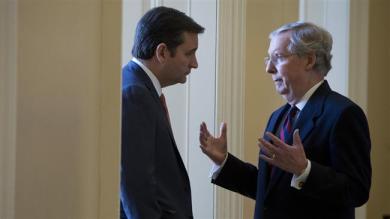
A group of US Republican senators has introduced legislation to impose new sanctions against Iran over what legislators have described as Tehran’s support for terrorism and human rights violations.
The legislation, which was introduced on Thursday by Senator Kelly Ayotte, aims to impose harsher sanctions on Iran’s economy.
The bill is sponsored by Senator Marco Rubio and Senators Mark Kirk, Dan Coats and Cory Gardner as well as Senate Majority Leader Mitch McConnell.
Several other Republican senators have also signed on the new bill, dubbed the “Iran Terrorism and Human Rights Sanctions Act of 2016.”
The bill’s co-sponsors include Senator Ted Cruz, a Republican presidential candidate, and Senators John Cornyn, Rob Portman, Pat Roberts, Ben Sasse, Tom Cotton, Jerry Moran, Johnny Isakson and Lisa Murkowski.
The senators have accused Iran of supporting terrorism in the Middle East and committing human rights abuses.
“I reject our current posture of willful ignorance and inaction towards Iran’s terrorist activities, illegal missile testing, funding Assad’s war, and human rights abuses,” said Kirk, a strong supporter of Israel and advocate of Iran sanctions.
“The Administration’s response cannot once again be it’s ‘not supposed to be doing that’ as Iran continues to walk all over US foreign policy and the international community,” he said.
The Obama administration has advised the Republican-dominated Senate not to impose more sanctions on Iran after the historic nuclear agreement between Tehran and the world powers.
With the Iran Sanctions Act expiring at the end of this year, GOP senators are trying their best to reauthorize and impose more sanctions on Tehran on the pretext of terrorism, human rights issues, and ballistic missile tests.
Iran and the five permanent members of the UN Security Council – the United States, Britain, Russia, China, France as well as Germany started implementation of the deal, dubbed the Joint Comprehensive Plan of Action, on January 16.
After JCPOA went into effect, all nuclear-related sanctions imposed on Iran by the European Union, the Security Council and the US were lifted.
Iran in return has put some limitations on its nuclear activities. The nuclear agreement was signed on July 14, 2015 following two and a half years of intensive talks.
Rubio Follows the Big Money
By Jonathan Marshall | Consortium News | November 1, 2015
On the morning of Halloween, the New York Times broke the scary news that Republican presidential contender Marco Rubio had won a big jackpot: the endorsement of billionaire hedge fund investor Paul Singer. But aside from citing Singer’s praise for Rubio’s “message of optimism” and “work on the Senate Foreign Relations Committee,” the story offered little explanation of what could prove to be a decisive turning point in the GOP primary race.
On the policy front, Rubio clearly meets Singer’s requirement for a candidate who favors lower taxes on the rich and, even more important, a blank check for Israel’s right-wing government. With his hawkish stands on the Middle East, including fervent opposition to the Iran nuclear deal, Rubio had already won over another leading Republican “bundler,” New York attorney Phil Rosen, former chairman of American Friends of Likud and a believer that Israel’s conflict with the Palestinians “was, and will always be, a holy war.”
Rubio is a protégé of Florida billionaire Norman Braman, who has contributed at least six figures to support the expansion of Jewish settlements in the occupied territories. Rubio reportedly leads the all-important “Adelson primary,” the race to tap the virtually unlimited cash box of gambling billionaire Sheldon Adelson, the single most prominent U.S. supporter of Israeli Prime Minister Benjamin Netanyahu.
All that is music to Singer’s ears, but Rubio’s “work on the Senate Foreign Relations Committee” is about something else altogether: his political support for Singer’s efforts to drain more than $1.5 billion dollars from Argentina in payments on old bonds that lost most of their value after the country defaulted in 2001.
Singer’s Elliott Management bought that debt several years ago for less than $50 million, and then successfully sued in U.S. court to demand full recovery of the face amount — in the face of opposition from the Obama administration, most other bondholders, and, above all, Argentina’s government, led by President Cristina Fernandez de Kirchner.
Singer, who is famous for his bare-knuckles tactics against foreign governments, has gone after Kirchner’s government on all fronts. Most strategically, he supported the highly questionable claims by an Argentine prosecutor that the Kirchner government tried to cover up the involvement of the Iranian government in the 1994 bombing of the Jewish community center in Buenos Aires, which killed 85 people.
The issue was perfect for a smear campaign: targeting alleged Iranian terrorism and government anti-Semitism, Singer could undercut the legitimacy of the one entity standing between him and huge profits on his speculative bond purchases.
Singer’s Elliot Management is a major backer of American Task Force Argentina, which advocates for full repayment of the Argentine bonds and has spent millions of dollars lobbying Congress. It also spends big bucks to blacken Argentina’s reputation.
As Huffington Post reported in 2013, the group “has launched a broad attack on Argentina in its PR campaign. … Politico ad, paid for by ATFA, slammed the country as a safe haven for narcotics traffickers. Another ATFA ad accuses Argentine President Cristina Kirchner of making a ‘pact with the Devil,’ pointing to a legal memo between her country and Iran involving Argentina’s effort to prosecute Iranian defendants in a terrorism case.”
As one of its lobbyists told Huffington Post, “We do whatever we can to get our government and media’s attention focused on what a bad actor Argentina is.”
An investigation by Charles Davis for Inter Press Service showed that employees of Singer’s Elliott Management contributed more than $95,000 to Sen. Mark Kirk, R-Illinois, who wrote a letter denouncing President Kirchner’s agreement with Iran to investigate the 1994 bombing.
Rep. Michael Grimm, R-NY, who received $38,000 from Elliott Management employees, co-sponsored legislation demanding that Argentina’s bondholders receive full compensation, and called for an investigation of Argentina’s ties with Iran. Other recipients of Singer’s largesse — including AIPAC, The Israel Project and the American Enterprise Institute — also hammered the Kirchner government, virtually accusing it of anti-Semitism.
Last year, another member of Congress got in on the act: Sen. Marco Rubio. While grilling President Obama’s nominee as U.S. ambassador to Argentina, Rubio complained that Buenos Aires “doesn’t pay bondholders, doesn’t work with our security operations. . . . These aren’t the actions of an ally.”
Adding a dig at President Kirchner, he added, “We have this trend in Latin America of people who get elected but then don’t govern democratically. Argentina is an example of this.” His speech triggered an angry response from Kirchner’s Foreign Minister Hector Timerman — an Argentine Jew — calling Rubio an “extremist.”
This May, Rubio introduced a resolution in the Senate suggesting that Kirchner conspired to “cover up Iranian involvement in the 1994 terrorist bombing.” Rubio declared that the issues in the case “extend well beyond Argentina and involve the international community, and more importantly, U.S. national security.”
As Eli Clifton noted, “It turns out that Singer’s hedge fund, Elliott Management, was Rubio’s second largest source of campaign contributions between 2009 and 2014, providing the presidential hopeful with $122,620, according to the nonpartisan Center for Responsive Politics.”
When Kirchner herself had the temerity this spring to link Singer to various neoconservative attacks on her policies, citing a “global modus operandi” to coerce foreign states, the reliably neoconservative editorial page of the Washington Post published an editorial reply titled, “Argentina’s President Resorts to Anti-Semitic Conspiracy Theories.”
To which Jim Lobe and Charles Davis, citing a long list of Singer connections to Kirchner’s critics, replied, “follow the money.” That advice, made famous in the movie version of Watergate’s Deep Throat, remains the best guide to understanding billionaire funding of candidates in the 2016 election.
Foreign Policy by Intimidation
GOP Candidates Show How It’s Done
By Philip Giraldi • Unz Review • September 22, 2015
The media are anointing former Hewlett-Packard Chief Executive Carly Fiorina as the winner of last Wednesday’s second Republican presidential-aspirant debate. They are saying that she was the best prepared and most convincing speaker, and, indeed, maybe she was. But what is being largely ignored is the actual content of the so-called debate, which was supposed to be focused on foreign policy. Presuming that all the potential candidates had been assiduously primed on the major issues by their advisers, what might have been informed opinion was instead pathetically ignorant and, more than that, dangerous.
Note for example what Fiorina had to say about her policy towards Russia: “Having met Vladimir Putin, I wouldn’t talk to him at all. We’ve talked way too much to him. What I would do, immediately, is begin rebuilding the Sixth Fleet, I would begin rebuilding the missile defense program in Poland. I would conduct regular, aggressive military exercises in the Baltic States. I’d probably send a few thousand more troops into Germany. Vladimir Putin would get the message.”
Yes, Carly would make sure that Putin would get the message that any possible cooperation with the United States would be a non-starter, even in places and situations where there might be common interests. Carly as president promises to take steps that directly threaten Russia on its own doorstep and would lead to a return to the Cold War. And possibly worse than that. Per Fiorina, it would also mean a new budget busting arms race to show how strong we are.
And Fiorina was not winging it alone. Senator Marco Rubio had a fantasy vision that saw him personally flying around the world directly confronting the bad guys. He pledged that “It [Air Force One] would also fly to China, not just to meet with our enemies, not just to meet with those adversaries of ours that are there, but also to meet with those that aspire to freedom and liberty within China. I would even invite them to my inauguration. We would also fly into Moscow and into Russia. And not just meet with the leaders of Russia, but also meet with those who aspire to freedom and liberty in Russia.”
How Rubio would obtain use of the presidential plane before his inauguration and arrange the logistics of flying into capitals of countries that he has labeled enemies to meet with dissidents was not quite clear. And the whole concept of cultivating opposition groups has a vaguely Democratic White House smell to it, a heavy dose of democracy promotion that leads to responsibility to protect, regime change and nation building. I thought Republicans had gone off the boil on that kind of stuff, but Rubio just might be getting bad advice from his posse of neocon advisers which includes Robert Kagan, Eric Edelman and Elliott Abrams.
But the evening’s biggest brouhaha concerned someone who was not even on the stage, GOP gadfly Ann Coulter, who responded to references to Israel by tweeting to her 600,000 fans “How many (expletive) Jews do these people think there are in the United States?” Coulter may have had a point in that American Jews are a small minority of the population who vote heavily Democratic in any event, but she would have been much more accurate if she had stated “Jew” rather than “Jews” as the comments by the potential candidates were really aimed at Sheldon Adelson, casino magnate of Law Vegas, who can literally pay for the entire GOP presidential campaign if he chooses to do so. For Adelson and his Democratic counterpart Haim Saban America’s presidential election is all about Israel.
Coulter understands that talking nice about Israel appeals to evangelical Christians, who many believe to be a sine qua non for any prospective GOP candidate who actually hopes to get nominated. But piqued by the Coulter outburst and out of curiosity I downloaded a transcript of the debate and went through it for any mention of Israel or Jews or even Benjamin Netanyahu. Contrary to Coulter’s assertion, Israel was only mentioned eleven times in the three hour debate and was not cited by Rand Paul, Ben Carson, Scott Walker or Donald Trump. Jews were not discussed at all and Netanyahu only named once, by Fiorina.
But the infrequency of the commentary on Israel should not be interpreted as a suggestion that the discussion of politics as related to the Middle East was any less Israel-centric or even somehow restrained or rational. Indeed, the potential candidates demonstrated an inability to connect with reality and scrupulously avoided basing U.S. policies overseas on actual interests and available resources.
This is Carly Fiorina’s plan for the Middle East and for pressuring reluctant allies in her own words: “You have not heard a plan about Iran from any politician up here, here is my plan. On day one in the Oval Office, I will make two phone calls, the first to my good friend to Bibi Netanyahu to reassure him we will stand with the state of Israel. The second, to the supreme leader, to tell him that unless and until he opens every military and every nuclear facility to real anytime, anywhere inspections by our people, not his, we, the United States of America, will make it as difficult as possible and move money around the global financial system. We can do that, we don’t need anyone’s cooperation to do it. And every ally and every adversary we have in this world will know that the United States in America is back in the leadership business, which is how we must stand with our allies.”
Fiorina does not seem to be aware that by giving her “good friend” Benjamin Netanyahu the ability to draw the United States into a war that he chooses to start she is outsourcing our sovereignty. But perhaps that doesn’t bother her just as she doesn’t seem concerned that baiting Iran will pit the U.S. against the entire world, to include nearly all of America’s allies.
Jeb Bush also focused on the centrality of Israel to contain Iran as part of his foreign policy vision, stating that “the first thing that we need to do is to establish our commitment to Israel which has been altered by this administration. And, make sure that they have the most sophisticated weapons to send a signal to Iran that we have Israel’s back. If we do that, it’s going to create a healthier deterrent effect than anything else I can think of.”
No Jeb, it will do the opposite. It will force Iran to actually develop a nuclear weapon to defend itself. And going far beyond Bush, Mike Huckabee presented a broader nightmarish and largely fantasized view of a clash of civilizations, stating “This is really about the survival of Western civilization. This is not just a little conflict with a Middle Eastern country that we’ve just now given over $100 billion to, the equivalent in U.S. terms is $5 trillion. This threatens Israel immediately, this threatens the entire Middle East, but it threatens the United States of America. And we can’t treat a nuclear Iranian government as if it is just some government that would like to have power. This is a government for 36 years has killed Americans, they kidnapped Americans, they have maimed Americans. They have sponsored terrorist groups, Hamas and Hezbollah, and they threaten the very essence of Western civilization. At the end of my presidency I would like to believe that the world would be a safe place, and there wouldn’t be the threats. Not only to the U.S., but to Israel and our allies, because we would have the most incredible well-trained, well-equipped, well- prepared military in the history of mankind. And they would know that the commander-in-chief would never send them to a mission without all the resources necessary, but people wouldn’t bully us anymore. Because they would know that that would be an invitation to their destruction.”
Huckabee, a former Baptist preacher, presumably would “destroy” bullies just as he destroyed English grammar in his statement. One might observe that if ending international bullying were even vaguely his objective he would start with Washington, which has been abusing the rest of the world since 9/11.
Huckabee’s fellow evangelical Senator Ted Cruz also had something to say, clearly on board with reordering the world in a more muscular Christian fashion, saying “… I also want to respond to several folks up here who said we should trust this Iranian deal, see if the Iranians will comply. Anyone who is paying attention to what Khamenei says knows that they will not comply. There is a reason Khamenei refers to Israel as the little Satan, and America as the great Satan. If I’m elected president our friends and allies across the globe will know that we stand with them. The bust of Winston Churchill will be back in the Oval Office, and the American embassy in Israel will be in Jerusalem.”
Normally semi-rational John Kasich came across as the moderate in the Iran discussion by virtue of not calling for immediate bombs away, stating “Secondly, nobody’s trusting Iran. They violate the deal, we put on the sanctions, and we have the high moral ground to talk to our allies in Europe to get them to go with us. If they don’t go with us, we slap the sanctions on anyway. If they fund these radical groups that threaten Israel and all of the West, then we should rip up the deal and put the sanctions back on.”
Senator Marco Rubio piled on with another complaint, “We are eviscerating our military. And we have a president that is more respectful to the ayatollah in Iran than he is to the prime minister of Israel.” And expanding on his plan to fly around and spread good will to our friends while confounding our enemies the peripatetic presidential wannabe added that “If I’m honored with the opportunity to be president, I hope that our Air Force One will fly, first and foremost, to our allies; in Israel, in South Korea, and Japan. They know we stand with them. That America can be counted on.”
Finally, New Jersey governor Chris Christie, who was clearly out of his depth even though the discussion was not exactly cerebral, iced the cake by concluding the foreign policy debate with “And I will tell you this, around the world, I will not shake hands with, I will not meet with, and I will not agree to anything with a country that says death to us and death to Israel and holds our hostages while we sign agreements with them. It will be an America that be strong and resolute, and will once again be able to stick out its chest and say, ‘we truly are the greatest nation in the world, because we live our lives that way, each and every day.’”
Christie’s rant was a fitting conclusion for the evening, underlining the essential Republican foreign policy message, which is that basically, as the esteemed George W. Bush put it, “you are either with us or against us.” We don’t have to talk to foreign leaders we don’t like and if they persist in the error of their ways we send in the cruise missiles. Only Senator Rand Paul and John Kasich indicated clearly that they would hesitate before the bombs start to drop.
GOP-think also has an underlying racist tone to it, with the presumption that those not quite Caucasian foreign people are not really like us, don’t think like us and can be shot or droned on sight when they fail to heed our advice. It’s not about Israel per se or about anything that would make sense to any disinterested observer. It is all about having a “security zone” that is global in reach and preempts the rights of anyone else. It is coupled with superpower hubris driven by an “exceptionalism”-derived unwillingness to treat people who are not Americans with any respect or consideration. Washington reflexively turns potential friends into enemies at every opportunity and perseveres in a foreign policy based on a whole basket of false premises that has been disastrous vis-à-vis any actual United States interests. Unfortunately for the American people the likely alternative to all this blatant and dangerous nonsense is Hillary.
The Neocon Foreign Policy Walmart

By Daniel McAdams | Ron Paul Institute | August 30, 2015
One of the most depressing things about watching — even from a distance — the quadrennial race for the White House is seeing what passes for debate on the one area where the president does have some Constitutional authority: foreign policy.
Candidates who have spent little or no time studying or traveling to the rest of the world, and, in the fashion of many Americans in the age of Empire, see the rest of the world as just a series of US colonial outposts, apparently consider foreign policy unworthy of serious consideration.
So little do Republican candidates care about foreign policy that most of them have “outsourced” their foreign policy to a single neocon-dominated foreign policy shop called the “John Hay Initiative.” If you wonder why most Republican candidates sound exactly the same on foreign policy, it’s because they are nearly all getting their advice from the same people.
When nearly all candidates look to someone like Eliot Cohen, a founding member of the Project for a New American Century (PNAC), to provide an off-the-shelf foreign policy, it should be no surprise that the “debate” in the Republican party is only over which country to attack first.
Any candidate who thinks so little about something so important as America’s place in the world should be automatically disqualified.
But the neocons love it! The “experts” who brought us the 2003 Iraq war and the Libya “liberation” are still in the driver’s seat when it comes to foreign policy.
“Jeb!” has John Hay Initiative members Michael Chertoff and Michael Hayden (remember those crooks?) on board as his advisors.
Marco Rubio reportedly draws from Hay Project member Roger Zakheim, the son of GW Bush administration “vulcan,” Dov Zakheim. Zakheim père, we remember, joined with his fellow neocons to lie the US into war with Iraq, enriching the military-industrial complex, before absconding to the “private sector” to make his millions from the same military-industrial complex. Zakheim quickly and quietly left his position as the Pentagon’s chief financial officer after a trillion dollars went missing and the Government Accountability Office was critical of his handling of matters.
Scott Walker, a soporific candidate who nevertheless still gives neocons like Bill Kristol the vapors, also shops the neocon Walmart of foreign policy, the John Hay Initiative. It should be no surprise, then, that at his big foreign policy coming out speech at the Citadel military college Friday, he unveiled an “aggressive” foreign policy — crying out “America will not be intimidated. And neither will I” — as he promised more war and vowed that “the retreat is over!”
Is this the retreat he is talking about?
Walker reportedly taps into the McCain Institute’s David Kramer, a John Hay member, for his foreign policy wisdom. Kramer is another PNAC alumni, also putting in time at the CIA-affiliated Freedom House and as director of the Bush State Department’s Office of Policy Planning. This must explain Walker’s obsession with taking out Iran. He vowed to “roll back the theocrats in Tehran,” but in fact unlike the US, Tehran has not invaded another country in hundreds of years. What’s to “roll back?”
If Walker actually paid any attention to the quality of advice he gets from his PNAC/John Hay gang he might call for his money back. Walker’s speech was peppered with macho language about “defeat[ing] the barbarians of ISIS,” while also vowing to destroy the two forces actually fighting ISIS — Syria and Iran! In fact, his vow to use the US military to overthrow the Syrian government would without question result in the greatest ISIS victory to date — control of Syria. One need not sympathize with Assad to recognize that he is literally the only thing keeping the whole of Syria out of the hands of ISIS.
John Hay Initiative “experts” also wrote the foreign policy speeches of candidates Carly Fiorina and Chris Christie. No doubt they were behind Fiorina’s astonishingly ignorant vow to make her first call as president to Israeli Prime Minister Netanyahu to “to reassure him that we stand with the state of Israel” and to make her second call to Iran to “to tell him that whatever the deal is that he signed with Obama, there’s a new deal and the new deal is this: Until you submit every facility [where] you have nuclear uranium enrichment to a full set of inspections, we’re going to make it as hard as possible for you to move money around the global financial system.”
Pure PNAC.
These neocons should be in jail, not still deeply ensconced in the Beltway foreign policy halls of power, dining in sumptuous splendor while the rest of America is impoverished by the destructive wars they push. Their lies have cost millions of innocent lives overseas as well. They are a cancer on the country. Any candidate who cares so little about the issues as to accept a “virtual staff” of foreign policy “experts” from those who have gotten every single major foreign policy issue of our time totally and catastrophically wrong has no business holding any elected office.
John Hay? I’d rather shop for a foreign policy expert at Walmart.
The Senate’s Excuses for Reauthorizing Section 215–and Why They’re Wrong
By Mark Jaycox | EFF | May 19, 2015
Three provisions of the Patriot Act expire on June 1 and Senate Majority Leader Mitch McConnell is trying to delay taking action on the issue by calling for a two month or 5-year reauthorization of Section 215—the provision of the Patriot Act the NSA relies on to collect millions of Americans call records.
Before June 1 we expect to see plenty of fear-mongering from intelligence officials and national security hawks. Last year, the Wall Street Journal began the foray with an op-ed by Former NSA Director General Mike Hayden and former Attorney General Michael Mukasey—key architects of many of the NSA’s unlawful activities. This time, the mongering started with op-eds by John Yoo, Senator Marco Rubio, and Senator Tom Cotton.
Here are the top excuses officials will use to continue spying on Americans calling records and why they’re wrong:
Congress Needs Time to Debate
“I don’t know how we have the kind of fulsome debate that is going to be required on NSA without passing a temporary extension,” —Sen. John Cornyn
Congress has had two full years to publicly debate the NSA’s use of Section 215. Indeed, the debate has been vigorous and thoughtful. While Congress didn’t create a separate investigative committee, it was still able to hold over a dozen hearings where Section 215 was discussed. The hearings, which called upon officials like the Attorney General, Director of National Intelligence, and Director of the NSA, included hours of testimony on the programs, what they collect, and their effectiveness.
Congress has also debated Section 215 via Senator Patrick Leahy and Jim Sensenbrenner’s reform bill called the USA Freedom Act. Last year, the House passed a gutted bill of the USA Freedom Act, but debated the legislation for days. This year, the House debated a stronger version of the USA Freedom Act and passed it 338 to 88.
The Senate has also debated the legislation. Last year, after two days of debate, the Senate failed to advance a stronger version of the USA Freedom Act by two votes. Congress has had more than enough time to discuss these authorities and must act.
The Section 215 Program is Effective
“This has been a very important part of our effort to defend the homeland since 9/11.” —Sen. Majority Leader Mitch McConnell
There’s one problem: there’s no evidence to support that. Two independent commissions concluded the calling records program was not effective and has not been used to stop a terrorist attack. The first, called the President’s Review Group on Signals Intelligence, concluded “Our review suggests that the information contributed to terrorist investigations by the use of section 215 telephony meta-data was not essential to preventing attacks.”
Like the President’s Review Group, the Privacy and Civil Liberties Oversight Board also concluded:
Based on the information provided to the Board, including classified briefings and documentation, we have not identified a single instance involving a threat to the United States in which the program made a concrete difference in the outcome of a counterterrorism investigation. Moreover, we are aware of no instance in which the program directly contributed to the discovery of a previously unknown terrorist plot or the disruption of a terrorist attack.
The quotes speak for themselves.
Fixing Section 215 Puts the Nation at Risk
“[The USA Freedom Act] would be rolling [the nation] back to exactly where we were pre-9/11. —Sen. Richard Burr
The Attorney General, Director of National Intelligence, and House Intelligence Chair and Ranking Members do not think reforming the Section 215 program will harm national security. Attorneys General Eric Holder and Loretta Lynch and Director of National Intelligence James Clapper wrote letters (.pdf) to Congress noting that Section 215 reform would preserve both “vital national security authorities” and “essential Intelligence Community capabilities.”
The Program is “Lawful”
“Contrary to irresponsible rumors, the [bulk surveillance] program is lawful, carefully monitored, and protects personal privacy. The program does not conduct mass surveillance of American citizens—or any surveillance at all.” —Sen. Cotton and Rep. Mike Pompeo
Apparently, one of the “irresponsible rumors” Sen. Tom Cotton and Rep. Mike Pompeo reference is a decision by the Second Circuit Court of Appeals. (The circuit courts are the federal courts directly below the Supreme Court). The Second Circuit held that the NSA’s telephone records program went far beyond what Congress authorized when it passed Section 215 of the Patriot Act in 2001. The court rejected the government’s secret reinterpretation of Section 215 that has served as the basis for the telephone records collection program. The Second Circuit’s opinion stands as a clear sign that the courts are ready to step in and rule that mass surveillance is illegal.
In addition, the program is “surveillance.” As we’ve repeatedly said: the collection of metadata matters. It reveals a host of information and context about a person’s habits, traits, and beliefs. The Circuit Court opinion explained that metadata is often a proxy for the content of the communication, and that phone records can “reveal a startling amount of detailed information” about callers. The court also recognized that aggregation of calling records matters because collection of large amounts of metadata plus the application of sophisticated data processing technologies gives the government access to even more revealing portraits of individuals and groups.
Congress Must Say No to a Short-Term Reauthorization
In the next few days, Congress will begin to debate whether or not they should vote for a short-term reauthorization of Section 215. The answer is clearly no. Join us now in telling your lawmaker to vote against any short-term reauthorization.
GOP presidential hopefuls woo big donors in Las Vegas
Press TV – April 25, 2015
US Republican presidential hopefuls and some other GOP lawmakers were in the state of Nevada on Saturday to attract big donors for their campaign funding.
Texas Senator Ted Cruz, Florida Senator Marco Rubio, Texas Governor Rick Perry, Senator Rob Portman (OH), Governor Mike Pence (IN), and Senator Lindsey Graham (SC), all Republicans, were in Las Vegas for the annual Republican Jewish Coalition’s spring meeting which began on Thursday.
The candidates wrapped up 3 days of lobbying for Israel to attract potentially billions of dollars in donations in the biggest gambling hub in the US.
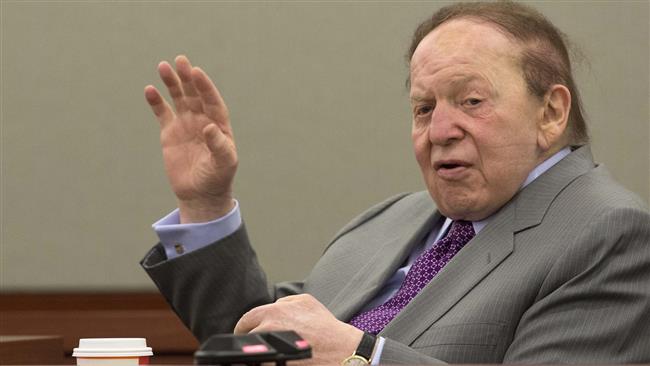
They were there to win big donations from casino tycoons, most notably Zionist Sheldon Adelson who is the largest campaign donor in the US.
As far as the GOP contenders in Las Vegas are concerned, the fight to win Adelson’s support and others in Las Vegas is all about showing support and solidarity for Tel Aviv.
Former Texas Governor Rick Perry said, “Ignoring the lessons of history, our president aims to sign an agreement with… the Islamic Republic of Iran.”
“Sadly, the American friendship and alliance with Israel has never been more imperiled than it is right now today under this administration,” said Ted Cruz, one of the Republican presidential candidates.
About 800 members of the summit enthusiastically cheered the consecutive slaps on Obama and on a potential nuclear agreement with Iran and promises of loyalty to Tel Aviv.
In fact, Adelson was not there on Saturday, according to local media, because that’s when the session was open to the media.
It is reported that Adelson has a favorite candidate so far, and that’s Senator Marco Rubio who the tycoon “speaks to once every 2 weeks.”
Adelson spent almost $150 million in the last presidential election in 2012 and he is set to throw in millions of more dollars behind his favorite contender in 2016.
Adelson, a Jewish American and the country’s eighth-wealthiest person, has said that he will not invest in the 2016 elections based on personal loyalty but on a more strategic aim.
He is a prominent supporter of Israel’s Likud Party, which is currently headed by Prime Minister Benjamin Netanyahu. He is also known for his anti-Iran rants.
During a speech at Yeshiva University in New York City in October 2014, Adelson said that the US should drop a nuclear bomb on Iran before beginning negotiations with Tehran over its nuclear program.
Featured Video
9/11 In Perspective
or go to
Aletho News Archives – Video-Images
From the Archives
Still No End in Sight of the Murder and Mayhem Wrought by the 9/11 Culprits
By Prof. Tony Hall | American Herald Tribune | July 17, 2016
The Kevin Barrett-Chomsky Dispute in Historical Perspective – Fourth part of the series titled “9/11 and the Zionist Question”
Back in 2006 all but a prescient few, such as Christopher Bollyn, perceived it as premature to try to identify and bring to justice the actual perpetrators of the 9/11 crimes. There was still some residue of confidence that responsible officials in government, law enforcement, media and the universities could and would respond in good faith to multiple revelations that great frauds had occurred in interpreting 9/11 for the public.
Accordingly, the main methodology of public intellectuals like Dr. Kevin Barrett or, for instance, Professors David Ray Griffin, Steven E. Jones, Peter Dale Scott, Graeme MacQueen, John McMurtry, Michael Keefer, Richard B. Lee, A.K. Dewdney, Nafeez Mossadeq Ahmed, and Michel Chossudovsky, was to marshal evidence demonstrating that the official narrative of 9/11 could not be true.
The marshaling of evidence was spurred on by observations coming from government insiders like Eckehardt Wertherbach, a former head of Germany’s intelligence service. In a meeting in Germany with Christopher Bollyn and Dr. Andreas von Bülow, Wertherbach pointed out that, “an attack of this magnitude and precision would have required years of planning. Such a sophisticated operation would require the fixed frame of a state intelligence organization, something not found in a loose group like the one led by the student Mohammed Atta in Hamburg.”
Andreas von Bülow was a German parliamentarian and Defense Ministry official. He confirmed this assessment in his book on the CIA and 9/11. In the text von Bülow remarked that the execution of the 9/11 plan “would have been unthinkable without backing from secret apparatuses of state and industry.” The author spoke of the “invented story of 19 Muslims working with Osama bin Laden in order the hide the truth” of the real perpetrators’ identity. … continue
Blog Roll
 Aletho News
- UK Government Plans to Use Delegated Powers to Undermine Encryption and Expand Online Surveillance
- Epstein Files Expose Israeli Occupation of America
- The Mandelson Molecule: Exposing the Architecture of Cross-Border Political Suppression
- The U.S. Sanctions Cuban Journalist For Reporting On The U.S. Blockade
- Israeli firms transform cars into intelligence devices: Reports
- Zionist-controlled companies to surveil British citizens
- THE CHILDREN GAMBIT
- A note on comment posting at Alethonews
- Trump stalls over Iran strike plan, Iran holds all the aces
- Zelensky’s Ceasefire for Elections is Strategic Gambit, Not Democratic Move
- If Americans Knew
- Why won’t Trump’s “Board of Peace” bring peace? – Not a ceasefire Day 131
- Help end the injustice against Shadi
- Israel’s Favorite American President
- Israel’s “Yellow Line” Is a Death Trap for Palestinians. We Drove Into It.
- Why Israel’s expanding occupation in Syria presents a critical legal test
- Gaza is not a natural disaster. It is the victim of genocide enabled by global inaction
- Netanyahu’s plan to “end” US aid to Israel is to give even more money under a different name
- Israel ceased firing on Gaza for just 15 days of the “ceasefire” – Not a ceasefire Day 130
- In Gaza, “rats run over our faces” – Not a ceasefire Day 129
- Israel-backed border guards, GHF-linked aid – Not a ceasefire Day 128
- No Tricks Zone
- New Study: A 4°C Warmer Beaufort Sea Had ‘No Sea Ice’ 11,700 – 8200 Years Ago
- Unfudging The Data: Dutch Meteorological Institute Reinstates Early 20th Centruy Heat Waves It Had Erased Earlier
- German Gas Crisis…Chancellor Merz Allegedly Bans Gas Debate Ahead of Elections!
- Pollen Reconstructions Show The Last Glacial’s Warming Events Were Global, 10x Greater Than Modern
- Germany’s Natural Gas Storage Level Dwindles To Just 28%… Increasingly Critical
- New Study Rebuts The Assumption That Anthropogenic CO2 Molecules Have ‘Special’ Properties
- Climate Scientist Who Predicted End Of “Heavy Frost And Snow” Now Refuses Media Inquiries
- Polar Bear Numbers Rising And Health Improving In Areas With The Most Rapid Sea Ice Decline
- One Reason Only For Germany’s Heating Gas Crisis: Its Hardcore-Dumbass Energy Policy
- 130 Years Later: The CO2 Greenhouse Effect Is Still Only An Imaginary-World Thought Experiment
 Aletho News