European Union Wages Cold War Against Russia – Marine Le Pen

© Sputnik/ Ramil Sitdikov
Sputnik – 23.03.2018
President of the National Front French political party Marine Le Pen has commented on the development of the situation around the poisoning of ex-Russia spy Sergei Skripal during a speech on the Franceinfo radio station.
“I think that something bigger is behind these actions — a strategy aimed at building a wall between the EU and Russia. Judging by my experience of working in the European Parliament, I know that the EU is waging a cold war against Russia, Le Pen, president of the National Front party, said.
Le Pen’s statement comes after a source told Sputnik that a number of European countries were considering expelling Russian diplomats or recalling their ambassadors from Moscow.
The move was prompted by UK Prime Minister Theresa May’s accusations against Russia of poisoning former intelligence officer Sergei Skripal and the expulsion of 23 Russian diplomats as a punitive measure.
Russia has strongly rejected the accusations and offered assistance in the investigation. However, Moscow’s request for samples of the chemical substance used to poison Skripal was denied. Moscow has also expelled UK diplomats and ordered the British Council to stop its activities in Russia in response to the UK expulsion of Russian diplomats.
Skripal and his daughter have been in hospital in a critical condition since March 4 and are being treated for exposure to what the UK experts believe to be the A234 nerve agent. The UK side claimed that this substance was related to the Novichok class nerve agents developed in the Soviet Union.
Le Pen’s Pro-Palestinian PM Choice
By Stephen Lendman | April 29, 2017
Ahead of the May 7 French presidential runoff, Marine Le Pen chose defeated Debout la France (Arise France) presidential candidate Nicolas Dupont-Aignan as her prime minister if elected.
He’s ideologically right-wing like herself. With him at a Saturday news conference, she said “(w)e will form a government of national unity that brings together people chosen for their competence and their love of France.”
Both support abandoning the euro, what Dupont-Aignan called a “racket,” and restoring the franc as France’s currency, regaining control over its monetary and fiscal policies from Brussels.
Former UK Independence Party leader Nigel Farage called him an “utterly respectable Eurosceptic.” Dupont-Aignan said “I am and remain a free man. I have dared before history to build a government agreement.”
Unlike establishment figures throughout Europe and America, Dupont-Aignan is pro-Palestinian.
In July 2014, during Israeli aggression on Gaza, Dupont-Aignan said the following:
“Gaza: Nicolas Dupont-Aignan deplores the inertia of France in the conflict.
After the bombing, ground fighting and unacceptable collateral damage of the deaths of hundreds of innocent civilians, men, women and children, the Israeli-Palestinian conflict entered last night in a new phase with the invasion of the gang Of Gaza by the Israeli army (with) complicit silence of the UN, the West and France. The disproportion of the forces involved is blatant.
Whatever the responsibilities of the irresponsible leaders of Hamas in the outbreak of this new confrontation, the path chosen by Israel only pushes it into an impasse.
It is not by accumulating the ruins and the dead that Mr. Netanyahu will appease the tensions, passions and hatreds in this region of the world.
In this bloody context, the inertia of France is perfectly scandalous. We expect our government to finally take the initiative for international action to impose Israel’s compliance with UN resolutions, that is, the withdrawal and dismantling of settlements illegally settled in the territories The recognition of the Palestinian state.
It is only under these conditions that we will avoid importing the conflict into our country, and that the new massacre in progress will be stopped.
It is only under these conditions that lasting peace can finally return to the Middle East. Letting aggravate and aggravate an unbearable situation is not only stupid but criminal.”
Fact: On July 8, 2014, Israel launched premeditated aggression on Gaza. Hamas had nothing to do with initiating it – planned by Israel, waged until August 26.
Thousands were killed or wounded. Defenseless civilians were willfully targeted. Entire neighborhoods were destroyed. Entire families were annihilated. Schools, hospitals, mosques and UN shelters were attacked.
So were clinics, ambulances, healthcare workers, journalists and human rights supporters. During the war, Israeli forces rampaged throughout the territories, invading over 3,000 homes, terrorizing families, traumatizing children, making mass arrests, including Palestinian parliamentarians.
Nearly three dozen were lawlessly imprisoned. Israeli aggression went way beyond attacking Hamas.
It was war on Palestine, vicious collective punishment, the highest of high crimes against peace. More Israeli aggression could happen anytime, likely worse than 2014 if launched.
Dupont-Aignan supports Palestinian self-determination. Le Pen said they share a “common project (they’ll) promote together.”
Macron backs continuity, dirty business as usual. Le Pen wants France out of US-dominated NATO and EU membership.
Macron is the choice of the “oligarchy,” she said. She wants French sovereign independence restored – free from control by Washington, Brussels and Berlin.
Stephen Lendman can be reached at lendmanstephen@sbcglobal.net. His new book is titled Flashpoint in Ukraine: How the US Drive for Hegemony Risks WW III.
The Main Issue in the French Presidential Election: National Sovereignty
By Diana Johnstone | CounterPunch | April 21, 2017
Paris – The 2017 French Presidential election marks a profound change in European political alignments. There is an ongoing shift from the traditional left-right rivalry to opposition between globalization, in the form of the European Union (EU), and national sovereignty.
Standard media treatment sticks to a simple left-right dualism: “racist” rejection of immigrants is the main issue and that what matters most is to “stop Marine Le Pen!” Going from there to here is like walking through Alice’s looking glass. Almost everything is turned around.
On this side of the glass, the left has turned into the right and part of the right is turning into the left.
Fifty years ago, it was “the left” whose most ardent cause was passionate support for Third World national liberation struggles. The left’s heroes were Ahmed Ben Bella, Sukarno, Amilcar Cabral, Patrice Lumumba, and above all Ho Chi Minh. What were these leaders fighting for? They were fighting to liberate their countries from Western imperialism. They were fighting for independence, for the right to determine their own way of life, preserve their own customs, decide their own future. They were fighting for national sovereignty, and the left supported that struggle.
Today, it is all turned around. “Sovereignty” has become a bad word in the mainstream left.
National sovereignty is an essentially defensive concept. It is about staying home and minding one’s own business. It is the opposite of the aggressive nationalism that inspired fascist Italy and Nazi Germany to conquer other countries, depriving them of their national sovereignty.
The confusion is due to the fact that most of what calls itself “the left” in the West has been totally won over to the current form of imperialism – aka “globalization”. It is an imperialism of a new type, centered on the use of military force and “soft” power to enable transnational finance to penetrate every corner of the earth and thus to reshape all societies in the endless quest for profitable return on capital investment. The left has been won over to this new imperialism because it advances under the banner of “human rights” and “antiracism” – abstractions which a whole generation has been indoctrinated to consider the central, if not the only, political issues of our times.
The fact that “sovereignism” is growing in Europe is interpreted by mainstream globalist media as proof that “Europe is moving to the right”– no doubt because Europeans are “racist”. This interpretation is biased and dangerous. People in more and more European nations are calling for national sovereignty precisely because they have lost it. They lost it to the European Union, and they want it back.
That is why the British voted to leave the European Union. Not because they are “racist”, but primarily because they cherish their historic tradition of self-rule.
The Socialist Party shipwreck
As his five-year presidency drew to its ignominious end, François Hollande was obliged by his drastic unpopularity to let his Parti Socialiste (PS) choose its 2017 presidential candidate by primary. In a surprising upset, the Socialist government’s natural candidate, prime minister Manuel Valls, lost to Benoit Hamon, an obscure member of the PS left wing who refused to vote for the unpopular, neo-liberal, anti-labor laws designed by Hollande’s economic advisor, Emmanuel Macron.
To escape from the unpopularity of the PS, Macron formed his own movement, “En Marche!” One after another, Valls, Hollande and other prominent PS leaders are tiptoeing away, leaving Hamon at the helm of the sinking ship. As Hamon justifiably protests against their betrayal, the party bigwigs pledge their support to Emmanuel Macron.
Macron ostentatiously hesitates to welcome his shopworn converts into the fold, fearing that their conversion makes it too obvious that his “En Marche!” is a clone of the right wing of the PS, on the way to becoming the French subsidiary of the U.S. Democratic Party in its Clintonian form. Macron proclaims that he is neither left nor right, as discredited politicians from both left and right jump on his bandwagon, to his embarrassment.
Hamon himself appears to be unaware that the basic cause of the Socialist Party’s shipwreck is its incompatible devotion to two contrary principles: traditional social democracy, and the European Union (EU). Macron, Hollande and their fellow turncoats at least have made their choice: the European Union.
The Twilight of the Traditional Right
The great advantage of Republican candidate François Fillon is that his policies are clear. Unlike Hollande, who tried to disguise his neoliberal policies as something else, and based his claim to be on the left on “societal” issues (gay marriage), Fillon is an unabashed conservative. His policies are designed to reduce the huge national debt. Whereas previous governments (including his own, when he was President Sarkozy’s Prime Minister) beat around the bush, Fillon won the Republican nomination by a program of sharp cutbacks in government spending. Fillon claims that his austerity measures will lead French capitalists to invest in France and thus save the country’s economy from being completely taken over by foreign corporations, American retirement funds and Qatar. This is highly doubtful, as there is nothing under EU rules to encourage French investors to invest in France rather than somewhere else.
Fillon departs from EU orthodoxy, however, by proposing a more independent foreign policy, notably by ending the “absurd” sanctions against Russian. He is more concerned about the fate of Middle East Christians than about overthrowing Assad.
The upshot is that Fillon’s coherent pro-capitalist policy is not exactly what the dominant globalizing elite prefers. The “center left” is their clear political choice since Tony Blair and Bill Clinton revised the agendas of their respective parties. The center left emphasis on human rights (especially in faraway countries targeted for regime change) and ethnic diversity at home fits the long-term globalist aims of erasing national borders, to allow unrestricted free movement of capital. Traditional patriotic conservatism, represented by Fillon, does not altogether correspond to the international adventurism of globalization.
The Schizophrenic Left
For a generation, the French left has made “the construction of Europe” the center of its world view. In the early 1980s, faced with opposition from what was then the European Community, French President François Mitterrand abandoned the socializing program on which he been elected. Mitterrand nursed the hope that France would politically dominate a united Europe, but the unification of Germany changed all that. So did EU expansion to Eastern Central nations within the German sphere of influence. Economic policy is now made in Germany.
As the traditional left goal of economic equality was abandoned, it was superseded by emphatic allegiance to “human rights”, which is now taught in school as a veritable religion. The vague notion of human rights was somehow associated with the “free movement” of everything and everybody. Indeed the official EU dogma is protection of “free movement”: free movement of goods, people, labor and (last but certainly not least) capital. These “four freedoms” in practice transform the nation from a political society into a financial market, an investment opportunity, run by a bureaucracy of supposed experts. In this way, the European Union has become the vanguard experiment in transforming the world into a single capitalist market.
The French left bought heavily into this ideal, partly because it deceptively echoed the old leftist ideal of “internationalism” (whereas capital has always been incomparably more “international” than workers), and partly due to the simplistic idea that “nationalism” is the sole cause of wars. More fundamental and complex causes of war are ignored.
For a long time, the left has complained about job loss, declining living standards, delocalization or closure of profitable industries, without recognizing that these unpopular results are caused by EU requirements. EU directives and regulations increasingly undermine the French model of redistribution through public services, and are now threatening to wipe them out altogether – either because “the government is bankrupt” or because of EU competition rules prohibit countries from taking measures to preserve their key industries or their agriculture. Rather than face reality, the left’s reaction has mostly been to repeat its worn-out demand for an impossible “Social Europe”.
Yet the dream of “social Europe” received what amounted to a fatal blow ten years ago. In 2005, a referendum was called to allow the French to approve a Constitution for united Europe. This led to an extraordinary popular discussion, with countless meetings of citizens examining every aspect of this lengthy document. Unlike normal constitutions, this document froze the member States in a single monetarist economic policy, with no possibility of change.
On May 29, 2005, French voters rejected the treaty by 55% to 45%.
What seemed to be a great victory for responsible democracy turned into its major failure. Essentially the same document, renamed the Lisbon Treaty, was ratified in December 2007, without a referendum. Global governance had put the people in their place. This produced widespread disillusion with politics as millions concluded that their votes didn’t matter, that politicians paid no attention to the will of the people.
Even so, Socialist politicians continued to pledge undying allegiance to the EU, always with the prospect that “Social Europe” might somehow be possible.
Meanwhile, it has become more and more obvious that EU monetarist policy based on the common currency, the euro, creates neither growth nor jobs as promised but destroys both. Unable to control its own currency, obliged to borrow from private banks, and to pay them interest, France is more and more in debt, its industry is disappearing and its farmers are committing suicide, on the average of one every other day. The left has ended up in an impossible position: unswervingly loyal to the EU while calling for policies that are impossible under EU rules governing competition, free movement, deregulation, budgetary restraints, and countless other regulations produced by an opaque bureaucracy and ratified by a virtually powerless European Parliament, all under the influence of an army of lobbyists.
Benoit Hamon remains firmly stuck on the horns of the left’s fatal dilemma: determination to be “socialist”, or rather, social democratic, and passionate loyalty to “Europe”. While insisting on social policies that cannot possibly be carried out with the euro as currency and according to EU rules, Hamon still proclaims loyalty to “Europe”. He parrots the EU’s made-in-Washington foreign policy, demanding that “Assad must go” and ranting against Putin and Russia.
Jean-Luc Mélenchon Grasps the Nettle
Not only is the drab, conformist Hamon abandoned by his party heavies, he is totally upstaged on the left by the flamboyant Jean-Luc Mélenchon, a maverick ready to break the rules. After years as a PS loyalist, Mélenchon broke away in 2005 to oppose the Constitutional Treaty, gaining prominence as a fiery orator. In 2007, he left the Socialist Party and founded the Parti de Gauche (Left Party). Allied with the much weakened Communist Party, he came in fourth in the first round of the 2012 Presidential election with 11% of the vote. This time he is running for President with his own new movement, La France Insoumise, which can be translated in a number of ways, including “the France that does not submit”.
Submit to what? Mainly, to the euro and to the antisocial, neoliberal policies of the European Union that are ruining France.
French flags and la Marseillaise have replaced the Internationale at Mélenchon rallies. “The Europe of our dreams is dead,” he acknowledges, vowing to “end the nightmare of dictatorship by banks and finance”.
Mélenchon calls for outright disobedience by violating EU treaties that are harmful to France. That is his Plan A. His Plan B is to leave the EU, in case Plan A fails to convince Germany (the current boss) and the others to agree to change the treaties. But at best, Plan B is an empty threat to strengthen his hand in theoretical negotiations. France is such a crucial member, he maintains, that a French threat to leave should be enough to force changes.
Threatening to leave the EU is just part of Mélenchon’s vast and complicated program which includes calling a national convention to draft a constitution for France’s “sixth Republic” as well as major ecological innovation. Completely changing both France and the European Union at the same time would require the nation to be in a revolutionary effervescence that is by no means visible. It would also require a unanimity among the EU’s 28 member States that is simply impossible.
But Mélenchon is canny enough to have recognized the basic problem: the enemy of jobs, prosperity and public services is the European Union. Mélenchon is by far the candidate that generates the most excitement. He has rapidly outdistanced Hamon and draws huge enthusiastic crowds to his rallies. His progress has changed the shape of the race: at this moment, he has become one of four front-runners who might get past the first round vote on April 23 into the finals on May 7: Le Pen, Macron, Fillon and himself.
The Opposites are (almost) the Same
A most remarkable feature of this campaign is great similarity between the two candidates said to represent “the far left”, Mélenchon, and “the far right”, Marine Le Pen. Both speak of leaving the euro. Both vow to negotiate with the EU to get better treaty terms for France. Both advocate social policies to benefit workers and low income people. Both want to normalize relations with Russia. Both want to leave NATO, or at least its military command. Both defend national sovereignty, and can thus be described as “sovereignists”.
The only big difference between them is on immigration, an issue that arouses so much emotion that it is hard to discuss sensibly. Those who oppose immigration are accused of “fascism”, those who favor immigration are accused of wanting to destroy the nation’s identity by flooding it with inassimilable foreigners.
In a country suffering from unemployment, without jobs or housing to accommodate mass immigration, and under the ongoing threat of Islamist terror attacks, the issue cannot be reasonably reduced to “racism” – unless Islamic terrorists constitute a “race”, for which there is no evidence. Le Pen insists that all French citizens deserve equal treatment regardless of their origins, race or religion. She is certain to get considerable support from recently nationalized immigrants, just as she now gets a majority of working class votes. If this is “fascism”, it has changed a lot in the past seventy years.
What is significant is that despite their differences, the two most charismatic candidates both speak of restoring national sovereignty. Both evoke the possibility of leaving the European Union, although in rather uncertain terms.
The globalist media are already preparing to blame the eventual election of a “sovereignist” candidate on Vladimir Putin. Public opinion in the West is being prepared for massive protests to break out against an undesired winner, and the “antifa” militants are ready to wreak havoc in the streets. Some people who like Marine Le Pen are afraid of voting for her, fearing the “color revolution” sure to be mounted against her. Mélenchon and even Fillon might face similar problems.
As a taste of things to come, on April 20, the EU Observer published an article entitled “Russia-linked fake news floods French social media”. Based on something called Bakamo, one of the newly established “fact-check” outfits meant to steer readers away from unofficial opinion, the article accused Russian-influenced web sites of favoring Marine Le Pen, Jean-Luc Mélenchon, François Fillon, Francois Asselineau, and Philippe Poutou. (They forgot to mention one of the most “sovereignist” candidates, Nicolas Dupont-Aignan, currently polling in sixth place.) Since a large majority of the eleven candidates, including three of the four front-runners, are strongly critical of the EU and of NATO and want to improve relations with Russia, it would seem that Putin wouldn’t have to make a great effort to get a more friendly French government next time around. On the other hand, the EU Observer article is only a small sample of blatant “interference in the French election” on the part of the globalists on behalf of their favorite, Emmanuel Macron, the most enthusiastic Europhile.
The Future of France
Among those listed as alleged Russian favorites, François Asselineau is by far the most thorough critic of the European Union. Systematically ignored by the media since he founded his anti-EU party, the Union Populaire Républicain (UPR), ten years ago, François Asselineau has thousands of ardent supporters who have plastered his poster all over the country. His tireless didactic speeches, reproduced on internet, have driven home several key points:
– there is no way to improve the EU from the inside, because any change would require unanimity among 27 member states who disagree on key issues.
– the only solution for France is to use Article 50 of the EU treaties to withdraw entirely, as the United Kingdom is currently doing.
– only by leaving the EU can France save its public services, its social benefits, its economy and its democracy.
– it is only by restoring its national sovereignty that genuine democratic life, with confrontation between a real “left” and “right”, can be possible.
– by leaving the EU, France, which has over 6,000 treaties with other countries, would not be isolated but would be joining the greater world.
Asselineau is a single issue candidate. He vows that as soon as elected, he would invoke Article 50 to leave the EU and immediately apply to Washington to withdraw from NATO. He emphasizes that none of the other critics of the EU propose such a clear exit within the rules.
Other candidates, including the more charismatic Mélenchon and Le Pen, echo some of Asselineau’s arguments. But they are not ready to go so far as to advocate a clear immediate break with the EU, if only because they realize that the French population, while increasingly critical of the euro and alienated from the “European dream”, is still fearful of actually leaving, due to dire warnings of disaster from the Europeists.
The first round campaign is an opportunity for Asselineau to present his ideas to a wider audience, preparing public opinion for a more coherent “Frexit” policy. By far the most fundamental emerging issue in this campaign is the conflict between the European Union and national sovereignty. It will probably not be settled in this election, but it won’t go away. This is the major issue of the future, because it determines whether any genuine political life is possible.
Diana Johnstone is the author of Fools’ Crusade: Yugoslavia, NATO, and Western Delusions. Her new book is Queen of Chaos: the Misadventures of Hillary Clinton. She can be reached at diana.johnstone@wanadoo.fr
Le Pen on Idlib: Placing Blame Before Inquiry ‘Blows Chances to Know the Truth’
Sputnik – April 20, 2017
PARIS – The UN Security Council (UNSC) resolution on the alleged chemical attack in Syria’s Idlib province should not blame any one party without first allowing an official investigation into the incident to be completed, France’s far-right presidential hopeful Marine Le Pen said Thursday.
On April 4, dozens of people were reportedly killed in the chemical incident in Idlib. Paris, Washington and London submitted a UNSC draft resolution condemning the alleged attack. Russia vetoed the document on April 12, pointing out that the draft implicated the Syrian authorities as the party to blame for the incident, despite no proper investigation was conducted.
“The resolution has been prepared in such a way that the responsibility was put on [Syrian President] Bashar Assad even before an investigation… It is necessary to hold an international inquiry [into the Idlib incident], and if I were in the UNSC, I would vote for such an investigation, but not for apportioning the blame even before the beginning of the inquiry, because it is the best way to blow the chances to know the truth,” Le Pen told the Europe 1 broadcaster.
After vetoing the resolution, Russia’s Deputy UN Ambassador Vladimir Safronkov said that Russia’s own draft resolution on the alleged attack would request on-site investigations from the Organization for the Prohibition of Chemical Weapons (OPCW) to ensure that “all possible sources and means have been exhausted” before making final conclusions.
On Wednesday, Russian Foreign Minister Sergei Lavrov called the chemical weapons incident in the Syrian province of Idlib a provocation as well as an attempt to undermine the ceasefire in the country. The incident was used as pretext for a US missile strike against the Ash Sha’irat airbase carried out late on April 6. US President Donald Trump characterized the strike as a response to the alleged use of chemical weapons by the Syrian government troops while Lavrov said it was a violation of the international law. Iranian Supreme Leader Ayatollah Ali Khamenei described the US missile strike against the Syrian airfield as a strategic mistake.
Marine Le Pen has exposed the hoax that is ‘Russiagate’ in one simple yet courageous move
By Adam Garrie | The Duran | March 24, 2107
Marine Le Pen has just proved that she is more clever than the thousands of anti-Russian politicians in the west, but also more astute than many of the western politicians who are sympathetic to Russia.
Where people like Nigel Farage, Francois Fillon and even to a lesser extent Donald Trump have often distanced themselves from or played down their lack of hatred towards Russia, Marine Le Pen has gone the opposite way, she had a public meeting with President Putin with the eyes of the world watching.
This is why Le Pen is an admirable woman, even for those who may not agree with her politics. There’s no better way to hush up a tired conspiracy than to expose the absurdity of the conspiracy theory.
Michael Flynn acted as though he wished that he’d never been in the same room with Russian vodka let alone a Russian man. Rex Tillerson pretended to have a more negative view of Russia before the Senate than he likely actually does.
By contrast, Marine Le Pen has done what many prominent opposition candidates on the likely verge of power do; she met with a representative of an important foreign power with whom she may be directly dealing with in the near future, in this case the possible next President of France met with the current President of Russia.
Her public meeting has demonstrated the gist of many private meetings held between sane western officials and Russian ones, namely a broad commitment to improve rather than to further destroy diplomatic relations.
When Nixon did it, it was called détente, but when people surrounding Donald Trump even attempted to do it, some call it treason.
I can scarcely think of anything more apropos than a French person re-educating the world as to the meaning of détente. Le Pen stated the obvious in her meeting. She explained that both Russia and the US are important superpowers and that the states of Europe such as France, could only benefit from having good relations with both the US and Russia. Furthermore, she said that she would be happy to work with both President Putin and President Trump if she got elected.
Only in the awkward world of post-modern western politics could such a statement be seen as controversial. She said that peace and good relations is preferable to the opposite and that she respects the leaders of two of the three global superpowers. In any other place and in any other generation, this would be considered a rather throw away statement, but the hysteria of the ideologically driven anti-Russian 21st century west, has elevated these simple remarks to the level of the profound.
Le Pen has encouraged other Europeans to admit that Crimea is Russia and she has also supported the anti-fascist struggle of the Donbass people. Is this why some in the European MSM call her a fascist? The twists of logic would be laughable if they weren’t tragic.
I believe that Le Pen is intelligent and understands the moral underpinnings of the struggle of the Donbass people to repel fascist aggression. I also feel that she truly understands and respects the will of the Crimean people as expressed in a democratic referendum.
But beyond this, Le Pen is pragmatic. It took Richard Nixon to set in motion the inevitable reality that the capital of China is Beijing and not Taipei. Even old right-wing Cold Warriors had to eventually admit which China was the China, no matter how much they would have preferred the other China.
Likewise, even western leaders of the far-right (or so-called liberals who are far right in all but name) who have sympathies with the neo-Nazi regime in Kiev, ought to admit that realistically, Crimea is a peaceful part of Russia, no matter how much they salivate at night over the thought of fascist banners flying over the beaches of Yalta. The sooner they come to terms with this, the better it will be for them.
Marine Le Pen has talked a lot of common sense and in going to Russia she has shown that the ‘Russian connections’ scandal is a big hoax. She didn’t do it by denying the fact that she wants to improve relations between Paris and Moscow, she did it by flying from Paris to Moscow and acting in a far more diplomatic and presidential manner than the current French President.
For the first time in several generations, France has a big ticket politician of whom the people can be proud.
Russia Rightfully Seeks Demilitarization of Central Europe – Le Pen
Sputnik – 13.03.2017
Russia strives for the demilitarization of Central Europe, stipulated in the agreement between the country and NATO, and Europe is able to ensure regional security if it follows its own obligations under the alliance, French National Front (FN) party leader and presidential hopeful Marine Le Pen said in an interview Monday.
“[Russia’s President Vladimir Putin] wants to turn Central Europe not so much into the Russian influence zone, as the neutral zone,” Le Pen told Polish newspaper Rzeczpospolita.
She noted that the agreement, which had been concluded with Russia and which stipulated that the territories would not be militarized, was violated.
“Putin just wants these territories to be demilitarized again,” Le Pen stressed.
Commenting on the strengthening of the NATO’s eastern flank, Le Pen added that, as the European member states have complied with the demilitarization obligation for dozens of years, there was no reason which would prevent them from respecting it in the future.
At the 2016 NATO Summit in Warsaw, the alliance agreed to deploy its international troops in Latvia, Lithuania, Estonia and Poland. Additionally, it was agreed that out military exercises would be carried out in the Black Sea area in 2017. The actions are aimed at deterring the alleged aggression from Russia. Moscow has repeatedly criticized the increased presence of NATO’s troops and military facilities near the Russian border.
In 1997, the Founding Act on Mutual Relations, Cooperation and Security between Russia and NATO, which aimed at strengthening mutual trust and building a stable, peaceful and undivided Europe, was concluded in Moscow.
Marine Le Pen: Crimea Was Never Ukrainian, I Will Recognize Crimea as Part of Russia

American Herald Tribune | January 18, 2017
The French presidential candidate Marine Le Pen has reiterated her support for Russia’s claim on Crimea in a newspaper interview in which she made another decisive tilt towards Moscow.
With three months before France goes to the polls, the Front National leader said she recognised Crimea as being part of Russia and if elected, she would push for a dropping of sanctions against Russia which France had backed simply because it was following German orders.
She told the Russian newspaper, Izvestia, that the referendum in the peninsula in 2014 to become part of Russia showed the “agreement of the people to join Russia”.
“Ukraine’s ownership of Crimea was just an administrative issue from Soviet times, the peninsula was never Ukrainian,” she said.
“I regret that the referendum, organised as a demonstration of the will of the people of the peninsula, was not recognised by the international community and the UN.”
Le Pen had made the comments about Crimea on French television earlier in January after which the Ukrainian security service SBU proposed banning her from entering the country for five years.
She described sanctions against Russia as “senseless” and “a pretty stupid method of diplomacy” and that “all countries should show respect for each other, to negotiate on equal terms and to accept a compromise solution acceptable to all”.
“We don’t have to have a situation whereby the major powers impose their policies on other states, behaving like stubborn children,” she told the paper.
( Image Credit: European Parliament/ flickr).
‘Clinton as president is danger to world peace’ – French National Front party leader
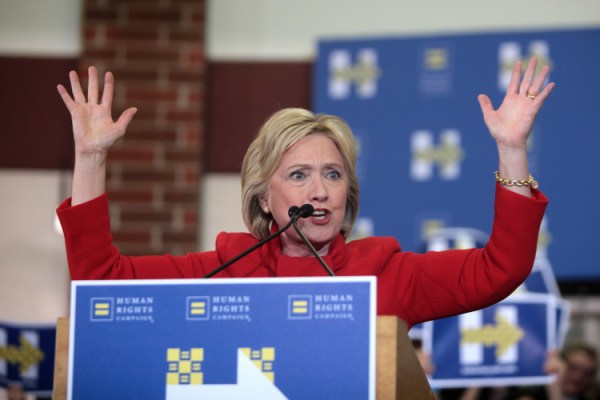
Photo credit – Gage Skidmore on Flickr
RT | May 20, 2016
Hillary Clinton winning the White House would constitute “a danger for the world peace,” as she would continue to drag Europe into her “destructive policy” of conflicts, Marine Le Pen, leader of the French National Front party, told RT.
While declining to endorse any of the US presidential front-runners, Le Pen said she believes there is one that would definitely not benefit France.
“There is a candidate who appears a lot more dangerous for France than the others – that’s Hillary Clinton,” the head of the National Front told RT France in an exclusive interview. “I’m not American so I don’t need to make a choice. But… in the interests of France, Hillary Clinton is probably the worst choice out there.”
Le Pen sees the Democratic frontrunner as being so “dangerous” because of Clinton’s career as US Secretary of State, in which she worked “hand in hand with the full spectrum of American decisions” that eventually “plunged the world objectively into chaos.”
“I think if she was elected she would continue this policy, a destructive policy, a policy of conflict, a policy of imprisonment of Europe in blinded Atlanticism,” Le Pen said. “I think it’s a danger for world peace.”
In December, Le Pen, who herself hopes to win France’s 2017 presidential elections, criticized Republican frontrunner Donald Trump for proposing to ban almost all Muslims from entering the United States.
“Seriously, have you ever heard me say something like that?” Le Pen said in one of her interviews, presumably in response to being compared with Trump. “I defend all the French people in France, regardless of their origin, regardless of their religion.”
The US media has repeatedly drawn comparisons between Marine Le Pen and Trump. The New York Times called the real estate mogul turned GOP frontrunner “America’s Marine Le Pen”. Bloomberg has also referred to Le Pen as “Europe’s own Donald Trump.”
While Marine Le Pen hasn’t explicitly named a “preferable” candidate for US president, her father has.
Jean-Marie Le Pen, retired long-time leader and founder of the French National Front, made headlines in February by endorsing Trump in a tweet, in which he said that if he was an American, he “would vote Donald Trump.”
Read more:
‘EU is in process of collapsing on itself’ – Marine Le Pen
RT | May 20, 2016
The EU is on the brink of collapse, as two of its main “pillars” are “crumbling” despite the billions of euros spent on keeping the structure from falling, far-right French leader Marine Le Pen told RT, adding that the union would fail if France left it.
“The two pillars on which it’s founded – Schengen and the euro – are in the process of crumbling,” Le Pen told Marie De Douhet of RT France in an exclusive interview. “So they’re in a sort of mad downward spiral in which they’re capable of anything today to try and keep this building standing.”
The leader of France’s hard-right Front National party believes the collapse is not a matter of “if” but “when,” saying the EU “shines from the light of a dead star” while its leaders are struggling to play for time “at the cost of billions trying to hold this structure up.”
As a “revealing” piece of evidence supporting her opinion, Le Pen cited one of Brussels’ recent punitive measures.
“The threat of condemnation of countries which do not accept migrants – a €250,000 fine for each migrant not taken in – is in itself revealing,” Le Pen said.
The European Commission unveiled plans earlier in May to impose a penalty of around €250,000 per rejected refugee on countries that refuse to share the burden of Europe’s migrant crisis.
For countries such as Poland, which is adamantly opposed to taking in refugees, the new compulsory measure would result in a fine of over €1 billion ($1.1 billion), given its existing quota of 6,500 people.
“The threats, the blackmail, now used systematically by the European Union is, above all, a gigantic problem of weakness,” Le Pen said.
Commenting on the migrant crisis, Le Pen said the EU is using immigrants as a tool to drive down labor costs across the 28-country bloc.
“That’s why the European Union supports tens of millions of immigrants in the coming years which will come onto the European Union labor market to push down wages,” she said. “So, in fact they have betrayed, if you like, the working class.”
Marine Le Pen has been a vocal supporter of the UK leaving the European Union, a move that the National Front hopes would inspire a similar “Frexit” campaign.
According to a March poll, 53 percent of French citizens surveyed would like to hold a Brexit-like referendum on France’s membership in the EU.
When asked if she feared any consequences for a “Frexit,” or Brussels’ retribution if it should go through, Le Pen said, “If France leaves the European Union, the European Union no longer exists.”
Addressing the EU’s foreign policy towards Russia, Le Pen stressed that her party has consistently opposed economic sanctions and find them “stupid.”
“From the very start when these sanctions were announced, we spoke out against them in the strongest possible terms… We find them to be completely stupid, obviously I can’t but welcome the National Assembly vote that has allowed the expression of refusal of these sanctions,” Le Pen said.
She expressed doubts that President Francois Hollande will “have the courage to go against the demands of the European Union” and scrap the sanctions, however.
Le Pen added that France’s recognition of Crimea as part of Russia is “quite clear and even quite credible possibility,” particularly if she wins the 2017 presidential election.
READ MORE:
Brexit poll: Almost half of Europeans want own vote on leaving EU
Human traffickers exploit EU migrant crisis to increase child smuggling – EU report
Recognize Crimea as Russian, lift harmful sanctions: Italy’s Veneto passes defiant resolution
‘Clinton as president is danger to world peace’ – far-right French leader Le Pen to RT
Featured Video

America Racing to Strategic Defeat in Iran
or go to
Aletho News Archives – Video-Images
From the Archives
Should Europeans ‘Thank’ the Americans for Destroying Nord Stream?
By Robert Bridge | Strategic Culture Foundation | September 29, 2022
With an investigation continuing into the destruction of the Nord Stream gas pipeline that provided energy supplies to Europe from Russia, there appears to be just one prime suspect, and that should surprise nobody.
Following the sabotage of the Nord Stream 1 and 2 gas pipelines, former Polish Foreign Minister Radoslaw Sikorski already seemed to know the identity of the perpetrator when he tweeted out: “Thank you, USA.”
At first glance, it seemed that Sikorski was speaking sarcastically, berating Washington for carrying out an attack that will have severe repercussions for the people of Europe. After all, how could anyone see any good coming from the termination of Europe’s primary source of gas reserves with winter just around the corner? It was Sikorski’s homeland of Poland, after all, that urged its citizens to collect firewood in the face of dwindling gas reserves.
In fact, the Polish diplomat was speaking one-hundred percent literally… continue
Blog Roll
 Aletho News
- Growing insecurity, soaring prices fuel protests in north as regime bans evacuation: Sources
- Iran denies responsibility for ‘depraved’ attack on Kuwait desalination plant
- Bring The Troops Back. End This War Now!
- Can we please stop calling Israel the ‘only democracy in the Middle East’ now?
- US should start removing its troops from Germany, proposes AfD co-leader Chrupalla
- Iran Red Crescent: 600 educational centers attacked in US-Israeli ‘war crimes’
- Russian Oil Tanker Arrives in Cuba Amid U.S. Blockade
- America Racing to Strategic Defeat in Iran: Lt Col Daniel Davis
- FTC Warns Visa, Mastercard, PayPal, Stripe Over Political Debanking
- Russian tanker approaches Cuba despite US oil blockade
- If Americans Knew
- Will Trump Go Kamikaze?
- Is the University of Florida Shutting Down College Republicans over Israel Criticism?
- Jewish extremist arrested over alleged plot to firebomb Palestinian activist Nerdeen Kiswani’s home
- More than half of Palestinian child detainees have no charges
- The More Murderous Israel Gets, The More We Hear About “Antisemitism”
- Land Day and the Palestinian struggle after 30 months of genocide
- The Iran War Is About Palestine
- Israeli soldiers echo settler ideology, talk of revenge after targeting Palestinians and detaining CNN crew in the West Bank
- Israeli Policies Threaten Future of Christian Schools in Jerusalem
- Former US soldiers argue Israeli policy is now guiding US interests
- No Tricks Zone
- New Study Finds Warming Saves Lives…Cold Temperatures 12 Times More Deadly Than Excess Heat
- German Science Blog Accuses PIK Climate Institute Of Hallucinating Climate Tipping Points
- Devastating Assessment Of Comirnaty Vaccine By Former Senior Pfizer Europe Toxicologist
- New Study: CO2 Is ‘Effectively Negligible’ As An Explanatory Climate Change Factor Since 2000
- Former Pfizer Toxicologist Dr. Helmut Sterz Tells Bundestag Hearing Pfizer Vaccine Should Have Never Been Approved
- Energy Expert: Germany’s Nuclear Phaseout Was A “500 Billion Euro Mistake”
- New Research: South Australia’s Mid-Holocene Sea Surface Temperatures Were 4°C Warmer Than Today
- Storing Green Energy To Last Germany 10 Days Would Require A 60-Million Tonne Battery
- New Studies: UK Sea Levels Were 4 Meters Higher Than Today During The Mid-Holocene
- Destructive Green New Deal: German Energy And Metal Group Warns Of Drastic Crisis
 Aletho News