British journalism hits rock bottom with latest shocking revelations
By Martin Jay | Strategic Culture Foundation | February 2, 2026
From the truth about who really killed Diana to the depraved world of government officials sexually abusing children and the subsequent cover-up, it is now clear that nearly all major stories are either blocked from publication or rewritten by Soviet-style propaganda agents working for the British deep state.
Virtually nothing you read in British newspapers about security, defense, and wars is honest journalism. Instead, it is propaganda crafted by a new secret UK military department tasked with rewriting journalists’ copy or, in some cases, simply ensuring their articles never see the light of day.
That is the shocking conclusion of a new investigation by The Grayzone, which obtained secret documents exchanged between the UK and Australian governments over Canberra’s plans to adopt Britain’s “off-the-shelf” operation and incorporate it into its own government practice for handling journalists.
The impressive reporting by Kit Klarenberg and William Evans reveals, in short, that the UK military has created its own censorship department. It either blocks journalists from exposing major stories of public interest or, more commonly, redrafts the thrust of journalists’ pieces to present a different version to the gullible public.
A trove of secret communications reveals how the secretive Defence and Security Media Advisory (DSMA) Committee censors the output of British journalists while categorizing independent media as “extremist” for publishing “embarrassing” stories. What sounds like an account of secret police operations in Eastern Europe during the Soviet era, the documents show that this army intelligence department regularly blocks journalists from continuing to investigate a subject through a formal system called “D Notices” – which, remarkably, journalists almost always respect.
“The DSMA imposes what are known as D-Notices, gag-orders systematically suppressing information available to the public,” The Grayzone report states.
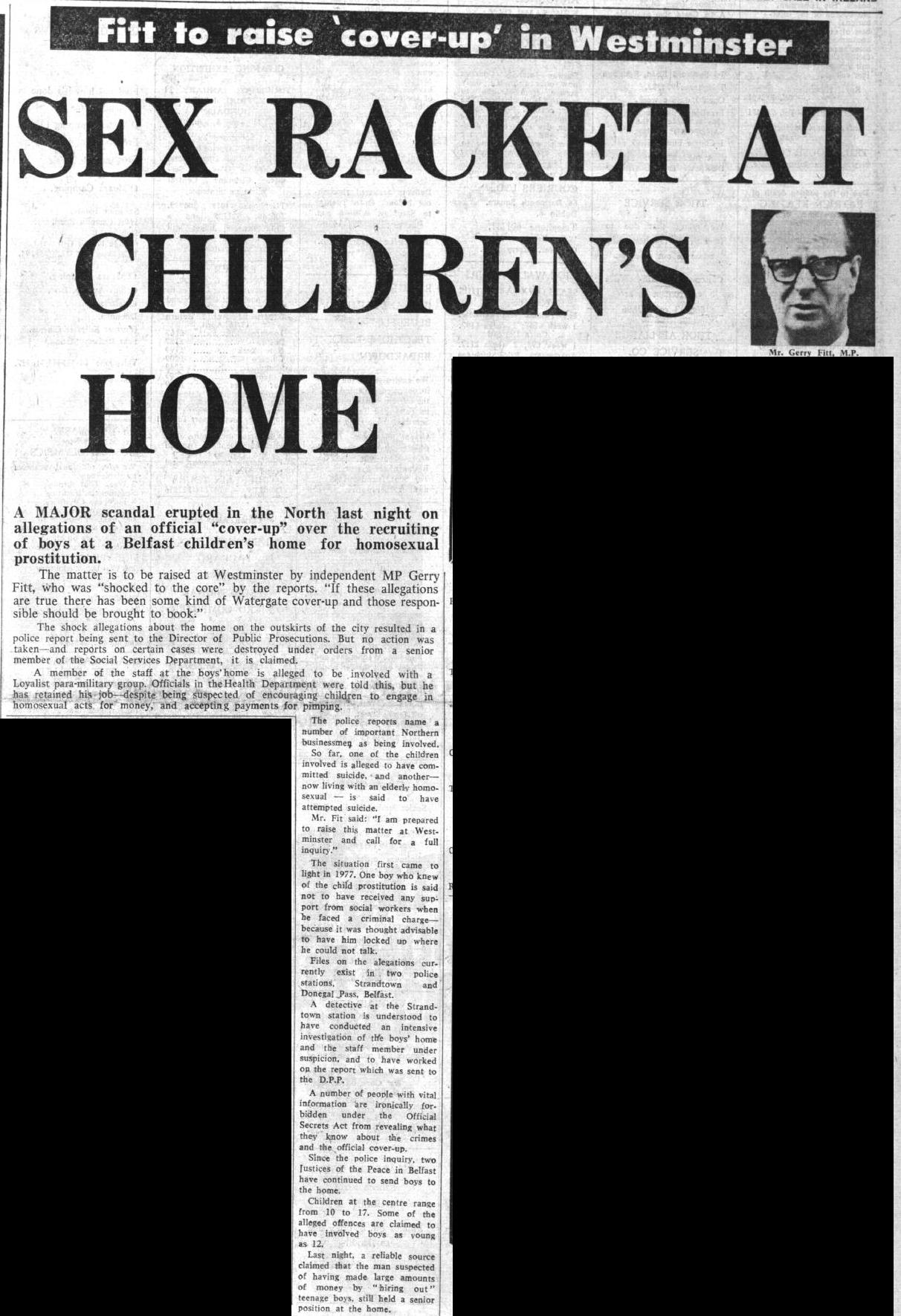
The files provide the clearest view to date of this underground committee’s inner workings, exposing which news items the state has sought to shape or keep from public view over the years. These include “the 2010 death of a GCHQ codebreaker, MI6 and British special forces activity in the Middle East and Africa, the sexual abuse of children by government officials, and the death of Princess Diana,” the report reveals.
British media, it seems, is in a crisis it never anticipated. Its journalists are, in reality, no longer working as journalists but as propaganda agents of the state. Under this system, which nearly all journalists sign up to, when a reporter wants to pursue a story, they must consult this department, which then effectively controls both the journalist and the story from that point forward. The absurd practice of ‘copy approval’ – where journalists send their final draft before submitting for publication – is routinely enforced.
This practice, a milestone in the death of British journalism, comes as no surprise to me. For decades, I have sent questions to the UK’s Foreign Office and Ministry of Defence, only to become a victim of the comical, if not pathetic, game that follows. A spokesperson asks for your deadline and then, mysteriously, 30 minutes before that time, you receive a “response” meant to serve as a quote from a senior official. It not only looks computer-generated but is often irrelevant to the subject. This is Britain – a country once seen by the whole world as a beacon of freedom and democracy, now operating like a cheap West African dictatorship, pumping out lies and manufacturing consent on an industrial scale.
That such a secret censorship department exists and flourishes should shock no one. In 2023, my own investigation discovered that UK and US weapons were being resold on the dark web. It wasn’t exactly a great scoop, but the hard work lay in substantiating the story with expert opinions and forensic analysis of photos and website postings. I was amazed as weeks passed while I badgered the Daily Mail’s absurdly young Defense Editor to run the story. He played every trick in the book to avoid it until finally he and others agreed to publish – but watered it down so much, removing all the top quotes from hardcore military and political experts that supported the story’s thrust. Clearly, he and others were under the control of these DSMA censor agents, who could not allow a piece alleging that shoulder-mounted rocket systems used by both the US and UK armies were being openly sold on the black market.
A second, much more detailed investigation – which supported the belief that barely a third of all UK military kit was actually reaching frontline Ukrainian soldiers – I didn’t bother sending to the Daily Mail but published on Patreon. One of its chief findings was that a senior Conservative MP admitted to me in a WhatsApp exchange that the UK had, in fact, installed tracking devices in some of the more expensive equipment, like Armoured Personnel Carriers (APCs), but at a certain point these devices were simply switched off and disappeared from the screens. It also revealed the bombastic stupidity of the then–UK Defence Minister, Ben Wallace, who conveniently chose to ignore a UN report identifying the influx of cheap Western-made assault rifles into the Libyan arms bazaar as a main reason for the spike in terrorism in the Sahel region – while insulting the Nigerian president who had made the claims, saying he “probably watches RT television.” When I suggested to Mr. Wallace that a simple way to verify these claims would be to send agents to Libya to conduct their own surveillance, his reply was, “Why don’t you do that?” before blocking me.
Wallace’s extraordinary rudeness shocked me at the time. But it was clear he was used to a much more servile, sycophantic manner from UK journalists who didn’t ask difficult questions – and that I was obviously breaking from tradition. Clearly, the DSMA department controls all those Westminster-based hacks, their stories, and even their story ideas, so it’s understandable that his rage boiled over.
The Grayzone’s findings make for depressing reading for anyone old enough to remember when British journalism was the finest in the world. But they also raise other questions, chiefly: Who is actually behind British titles? Or more specifically, who is funding them? Most UK newspapers don’t make any money, so it’s understandable that a new relationship with the deep state might help them remain relevant – especially now that the news is being baked for them, ready to be served. This has changed the role of the British journalist: no longer the baker, but relegated to the delivery boy on the moped.
Yet where the big titles get their revenue to stay in business remains a mystery. Is part of the same deal on censorship and copy control that the state funds them through surreptitious, murky channels – perhaps via companies with close links to the heart of power? Follow the money.
Epstein email reveals plan to pursue frozen Libyan assets with help from former MI6, Mossad figures
MEMO | January 31, 2026
Newly released documents tied to Jeffrey Epstein show the convicted sex offender and an associate discussed plans to pursue access to Libya’s frozen state assets, including potential support from former British and Israeli intelligence officials, according to an email included in the files, Anadolu reports.
The correspondence surfaced after the US Justice Department released an additional batch of documents Friday related to the Epstein investigation.
The newly highlighted material includes a July 2011 email sent to Epstein that outlines what the sender described as financial and legal opportunities linked to political and economic uncertainty in Libya at the time.
According to the email, about $80 billion in Libyan funds were believed to be frozen internationally, including roughly $32.4 billion in the US. The sender described “stolen and misappropriated” Libyan assets as potentially worth three to four times that amount.
The correspondence argued that identifying and recovering even a small portion of such funds could generate “billions of dollars” in gains.
It also referenced expectations that Libya would need to spend at least $100 billion in the future on reconstruction and economic recovery, describing the situation as a broader opportunity.
The email characterized Libya as a country with significant energy reserves and strong literacy rates, factors it said could be advantageous for financial and legal initiatives.
It also stated that discussions had been held with some international law firms about working on a contingency-fee basis.
The message said certain former members of Britain’s foreign intelligence service, MI6 and Israel’s external intelligence agency, Mossad, had expressed a willingness to assist in efforts to identify and recover assets described in the email as “stolen.”
The email emphasized that early involvement in such a process could represent a “significant opportunity.”
Here’s who really weaponizes children in the Russia-Ukraine conflict
By Eva Bartlett | RT | January 9, 2026
For the last three years, Ukraine and concerted legacy media campaigns have been screaming that Russia has abducted, or forcibly displaced, thousands of Ukrainian children – even up to 1.5 million!
The accusations resurged in December, with a UN General Assembly vote on a draft resolution on the return of Ukrainian children.
During the meeting, Ukraine’s Deputy Foreign Minister Mariana Betsa once again pushed claims that “at least 20,000 Ukrainian children have been deported to Russia,” in spite of the fact that months prior, during the June Istanbul talks, the Ukrainian side finally provided a list of the children it accuses Russia of abducting: 339 children, surprisingly far fewer than the number alleged for years.
The absence of over 19,500 on the list indeed leads to many questions, mainly: is Ukraine lying again? Recall that in 2022, the accusations by the (now former) Ukrainian ombudswoman, Lyudmila Denisova, about “sexual atrocities” allegedly committed by Russian soldiers, were revealed to be lies and propaganda. So much so that Denisova was sacked. But before her dismissal, legacy media and the UN all backed the lies.
Some recent accusations are that children were being sent to labor camps in Russia – “165 re-education camps where Ukrainian children are militarized and Russified” – or even of being sent to North Korea, as Katerina Rashevskaya of the Ukrainian Regional Center for Human Rights told the US Subcommittee on State, Foreign Operations, and Related Programs on December 3.
The footnotes of the claims made by Rashevskaya, instead of a source for the information, say “The Regional Human Rights Center can provide information upon request.” In other words, her sources are “trust me, bro.”
Regarding the North Korean camp in question, if two Russian teens were sent there, they’d potentially be made to enjoy water slides, basketball and volleyball courts, an arcade room, a rock climbing wall, art and performance halls, an archery range, a private beach, and hikes in the mountains.
Regarding the list of 339 children Ukraine says were abducted by Russia, Russian Foreign Ministry Spokeswoman Maria Zakharova remarked, “30 percent of the names on the list could not be verified, as most of those children were never in Russia, are now adults, or have already returned to their families. As for the Ukrainian children who are actually in our country, they are under state care in appropriate institutions. They are safe now; in many cases, their evacuation from combat zones saved their lives. Local children’s rights commissioners are now working to reunite them with their relatives.”
Just as legacy media has whitewashed the eight years of Ukraine’s war against Donbass civilians prior to Russia commencing its military operation in 2022, including the Ukrainian shelling which killed 250 children starting in 2014, media likewise ignore the children Russia says are missing.
During the talks in Istanbul, Zakharova noted, “the Russian side presented Ukraine with a list of 20 Russian children who are either currently in Ukraine or relocated from Ukraine to Western Europe, including to countries that endorsed this very statement. Now, the burden falls on these states to provide Russia with a substantive response regarding our ‘list of 20.’”
Over 500 Ukrainian orphans abused in Türkiye
Recently, Donbass-based journalist Christelle Néant wrote about a report published on a pro-Ukrainian website which broke the story of 510 Ukrainian children who had been evacuated by a Ukrainian oligarch in 2022 from Dnepropetrovsk to Türkiye, where the benevolent foundation which brought them there allegedly allowed its staff to beat the children, sexually assault them, and deny them food if they refused to perform on camera to raise funds for their lodging. These are just some of the reported violations of the orphans’ rights.
The details of the report show that the children suffered physically and psychologically. Additionally, two underage teens were impregnated by staff at the hotel they stayed in, with educators allegedly aware of the interactions.
According to Néant, the orphanage director’s response to the fact of one of the teens in her care becoming pregnant was to blame the girl: “This young girl comes from an asocial family. Well, this way of life is already inscribed in every cell, in the blood of these children.”
“In almost 10 years of work in Donbass,” Néant wrote, “I have conducted or filmed many humanitarian missions to orphanages in the region. And never ever have I heard a director make such vile remarks about one of the children in her care. Even the most difficult and recalcitrant were cared for with pedagogy, love, and patience.”
Ukraine hunting down children
In April 2023, Christelle Néant and I interviewed Artyomovsk civilians who had recently been rescued by Russian soldiers. In addition to being deliberately shelled by Ukrainian forces who knew they were sheltering in the basement of a residential building, the civilians we spoke to told us about Ukrainian military police hunting for children.
The evacuees told us some of these police went by the name ‘White Angels’, and were taking children away without their consent or that of their parents.
Around that time, more reports came out about these abductions or attempted abductions, including an 11-year-old girl who spoke of how White Angels, who introduced themselves as military police, came to the basement she was sheltering in with a photo of her, looking for her, and saying they needed to take her away, because “Russia killed her mother.” According to the girl, her mother was alive and with her.
Reports of these abductions also emerged in Avdeyevka, Kupyansk, Slavyansk, Chasov Yar and Konstantinovka, as well as in Ukrainsk and Zhelannoye.
Néant wrote of a July 2023 conference on Ukraine’s crimes against the Donbass children, in which Liliya and her daughter Kira from Schastye, in the Lugansk People’s Republic, spoke.
They gave evidence of how, “at the start of the special military operation (when Ukraine controlled Schastye), around ten children were taken from a school in Schastye to western Ukraine by the headmistress of the school, on orders from Kiev, without informing their parents.”
The children were even forbidden to call their parents, Néant wrote, “But Kira knew her mother’s telephone number by heart and managed to call her to let her know that they were in Lviv and then Khoust. Thanks to Liliya’s determination to find her daughter, we discovered how Kiev ‘exports’ the children it abducts.” Ukraine had forged a new “original” birth certificate for Kira. The girl said she and the other children were to be sent to Poland.
Former SBU officer Vasily Prozorov spoke at the same conference, where he explained, according to Néant, “that one of his investigations had revealed that some of the children abducted by Ukraine are sent to pedophile networks in Great Britain, via a whole network of Ukrainian and British officials or former officials who work together. On the British side, members of MI6 and the Foreign Office are involved.”
Prozorov, she wrote, spoke of “another of his investigations on organizations registered in EU countries involved in ‘exporting’ children from Ukraine under the pretext of providing them with shelter. These organizations take unaccompanied Ukrainian children out of Ukraine. What happens to them afterwards is unknown.”
Evacuees from Kherson reject ‘abduction’ claims
In November 2022, in the southern Russian seaside city Anapa, I met numerous people displaced from Kherson who were being lodged in hotels and apartments in the city.
The first site I visited was a few minutes by taxi outside of the city, one of many hotels along the coast. The hotel director showing me around said they don’t call them refugees, “we call them guests of the building,” and spoke affectionately of them, how grateful they were to be there, far from any shelling. Just under 500 refugees had been living there since October, she told me.
No guards monitored the entrance/exit; the refugees walked around tidy grounds. But in any case, I asked about their freedom of movement, or lack thereof.
“They move freely, of course. We don’t prohibit them from going out. Many aren’t here now because they’re in town, looking for jobs, getting documents. Children are at school.”
With my hired translator, I spoke with two Kherson women, a young mother and her own mother, to hear their stories.
“We were living with explosions at night, it was very scary, not only for myself, but for my children and for my grandchildren,” the older woman said. “When you go to bed, you don’t know if you will get out of bed in the morning. We were forced to leave.”
I asked who was shelling them. “Word of mouth transmits very clearly, and people around us spoke about it. We were bombed by the Armed Forces of Ukraine. Russian soldiers protected us.”
The younger woman said she used to speak with the Russian soldiers there. “They are friendly. We wanted to hug them, because we felt protected. They helped us, gave us humanitarian aid, brought it to the house.”
Some minutes’ taxi ride away, I visited an apartment complex that could have served tourists in summer. There, fifty buildings housed around 1,500 refugees who had also arrived in October, mostly from Kherson Region.
My translator and I walked around, passing playgrounds, a pharmacy, a library, a swimming pool, a gym, a small petting zoo with peacocks, and a kindergarten. Near a playground, I spoke with a mother sitting on a bench with two of her four children.
“In the early days, there was bombing. We spent two and a half weeks in the basement. It was unbearable, the children were very afraid.” One of her daughters became ill. “She had acute inflammation of the lower jaw, we think due to hypothermia. We took her to Simferopol and she had surgery.”
In Anapa, she said, her children had full medical examinations. “We were helped by the mayor of the city of Anapa. We are grateful for everything.”
I mentioned that according to Western media, she and her family were kidnapped by Russia. She replied that her husband’s parents had demanded to see the children, having been told that children were being separated from their parents in Russia.
“His mother called three days in a row, saying, ‘Where are the children?’ We answered, ‘They went to the cinema. They’re playing, etc.’ She said, ‘Show me the children, they say that they took your children from you.’”
Details matter
Whereas legacy media continue to push the “Evil Russia child kidnapper” narrative, there is ample evidence that Ukraine is guilty of doing precisely what it accuses Russia of. There is also a significant absence of evidence regarding the ‘20,000 kidnapped children’ claims still being pushed.
Will media investigate the reports of abuse of Ukrainian children in Türkiye? Surely not. It wouldn’t suit their scripted anti-Russia bias.
Eva Bartlett is a Canadian independent journalist. She has spent years on the ground covering conflict zones in the Middle East, especially in Syria and Palestine (where she lived for nearly four years).
How MI6 built Syria’s extremist police
By Kit Klarenberg | Al Mayadeen | October 16, 2025
On September 19th, in a speech marking the end of his five-year tenure as MI6 chief, Richard Moore hailed the achievements of Britain’s foreign spying agency under his watch. Key among the stated gains was “the end of 53 years of the Assads in Syria.” He openly admitted MI6 “forged a relationship” with HTS, Damascus’ Al-Qaeda and ISIS-tied presumptive rulers – “a year or two before they toppled Bashar.” Moore went on to boast:
“Syria is a good example of where, if you can get ahead of events, it really helps when they suddenly, unexpectedly move at a faster pace. This nimbleness is a fundamental requirement for MI6 – and I think we remain pretty good at it. John Ratcliffe, the CIA director, while discussing a piece of joint business, said to me recently: ‘You guys can really hustle.’”
Al Mayadeen English has previously exposed how HTS was groomed for power for years prior to its violent palace coup in December 2024 by Inter-Mediate, an MI6-adjacent consulting firm run by Jonathan Powell. A key architect of the criminal 2003 Anglo-American Iraq invasion, he now serves as British Prime Minister Keir Starmer’s national security adviser, coincidentally taking up the position mere days before HTS illegitimately proclaimed themselves Syria’s government. It’s been subsequently revealed that Inter-Mediate has maintained a dedicated office in Syria’s Presidential Palace ever since.
Moore’s fresh admissions, while vague, offer further confirmation that London’s foreign spying agency has a longstanding relationship with HTS, which remains a proscribed terrorist group under British law. A key, confirmed mechanism by which MI6 entrenched HTS’ power in north west Syria over the years before the extremist group’s seizure of power was by financing and managing, via cutouts, “moderate opposition service provision”. This took the form of entities including the infamous White Helmets, which supposedly provided “demonstrations of a credible alternative” to Bashar Assad’s government.
While the clandestine efforts were ostensibly intended to weaken HTS’ hold on power and push “moderate” groups, leaked documents indicate British spooks were well-aware these initiatives were cementing the group’s credibility as a governance actor, assisting its “growing influence”, and meant many Syrians regarded HTS as “synonymous with opposition to Assad.” Eerily, the same documents note the group and its armed affiliates – including Al-Qaeda – were “less likely to attack opposition entities that are receiving support” from British intelligence, such as the White Helmets.
We are now left to ponder whether British-run “service providers” were explicitly left alone because of MI6’s secret relationship with HTS. In this context, the earliest and most obvious indication of a dark alliance between London and Syria’s new rulers may date back to January 2019, when HTS took power outright in north west Syria. Almost instantly, the Free Syrian Police, a British-created “moderate opposition service” provider, was formally dissolved. Its members were then invited to continue their activities under HTS’ banner.
‘Revolutionary Entities’
Like the White Helmets, the FSP were components of a wider effort by London to establish a series of statelets across occupied Syria, complete with parallel governance structures staffed by locals trained and funded by Britain, the EU, and US. Western propaganda and media reporting – heavily influenced by MI6 – universally portrayed these breakaway colonies as “moderate” success stories. In reality, they were deeply chaotic and dangerous, run by murderous violent factions, often under obscenely strict interpretations of Sharia Law.
In March 2017, the BBC published a fawning profile of the FSP, noting its British funding, and claiming the group “demonstrates to Syrians that it is not necessary to carry weapons in order to administer law and order in the country.” The British state broadcaster repeatedly stressed, the FSP “does not co-operate with extremist groups.” However, nine months later, it was revealed that London’s “moderate” police force enjoyed intimate relationships with multiple extremist groups, including HTS forerunner Jabhat al-Nusra.
Several FSP stations were found to be closely linked to and take directions from extremist courts run by these militants, which executed citizens who violated local extremist legal codes. FSP operatives were also not only present when women were stoned to death for disobeying al-Nusra’s extreme codes, but even closed roads to allow executions to take place. Meanwhile, portions of sums sent to the FSP by its foreign sponsors were regularly handed over to extremist factions for “military and security support”.
While these disclosures caused a scandal, and British funding for the FSP was temporarily suspended, it was reinstated within mere weeks, sparking outcry among aid experts. Officials justified their decision on unstated “mitigating context” to the revelations, and the issues in question being “already known” by the Foreign Office. Indeed, leaked documents reviewed by Al Mayadeen English indicate close collaboration with extremist groups and courts was hardwired into the FSP from the group’s inception, and not concealed from donors.
The documents, submitted to the Foreign Office by ARK – founded by MI6 veteran Alistair Harris – noted the FSP were “revolutionary entities who share a general ideological affinity with the Syrian rebels,” conducting “rudimentary policing operations” in opposition-controlled territory. FSP stations varied significantly “in terms of their effectiveness, their mandate and their overall level of organisation” in the areas comprising their beat. “Their authority” was dependent on “several factors, the most important of which” were:
“The strength of the relationship between an FSP station and local armed groups; the centrality of an FSP station in the work of a local rebel court or other judicial structure; the sophistication and maturity of an FSP station’s overarching command structure.”
‘Direct Engagement’
The leaks further state, “FSP networks enjoy the strongest relations with more moderate Syrian rebel groups.” Yet, chief among “key armed groups that have established relationships with FSP stations” was Nur al-Din al-Zinki. The group was said to have greatly “empowered” FSP offices across occupied Aleppo, establishing the force “as primary policing bodies in towns in which it is strong.” In reality, Nur al-Din al-Zinki didn’t adhere to any meaningful definition of the term “moderate”.
During the initial years of the foreign-fomented Syrian civil war, the group committed countless horrendous atrocities, including beheading a Palestinian teenager in 2016. Its fighters subsequently joined HTS en masse. The readiness of ARK – and by extension British intelligence – to rub shoulders with dangerous armed elements is writ large in another leaked file, outlining potential risks to the project. If “armed actors” denied the FSP “operating space”, ARK would conduct “direct engagement” with the relevant militants to resolve the issue.
Other hazards included almost inevitable submission of “fraudulent invoices” by FSP operatives, and “significant physical risk” to them, “including possible assassination of police or justice actors.” Still, the British were so keen on the project, millions were pumped into the force over many years, with sophisticated communications equipment and vehicles provided. ARK also looked ahead to rebel groups increasing their “influence and territorial reach” in Syria, believing this would “[yield] benefits for the FSP” and expand its sphere of operations.
Fast forward to today, and courtesy of HTS, the British-created FSP is now Syria’s national police force. Ever since Assad’s fall, they have acted accordingly, brutally repressing internal dissent, while standing by as the new government’s militants massacre Alawites and other religious minorities in the country. Just as Inter-Mediate’s office in Damascus’ Presidential palace raises grave questions about the extent of London’s control over HTS, we must ask who all past beneficiaries of “moderate opposition service provision” in the country are truly working for.
As The National reported in February, the White Helmets have been formally invited by Syria’s HTS-run Health Ministry to “run the emergency services countrywide.” The creation of such groups years prior to Assad’s ouster is a palpable example of the ability of “hustlers” in British intelligence to “get ahead of events” in Moore’s phrase, and ensure MI6 has the people, organisations and structures in place to effectively take over countries if and when an enemy government falls.
How MI6 Fabricated Iran Nuke Fraud
By Kit Klarenberg | Global Delinquents | September 24, 2025
On September 19th, the UN Security Council voted to reimpose savage economic restrictions on Iran over its nuclear program. European leaders have in recent months repeatedly accused Tehran of refusing to abide by the 2015 Joint Comprehensive Plan of Action’s terms. A core, repeated claim is the Islamic Republic has collated a uranium stock over 40 times the level permitted under that deal. No supporting evidence for the charge has been provided, and the source of this information isn’t clear.
It may nonetheless be highly significant London has taken the lead in calling for the restoration of sanctions, independently imposed punitive measures on Iranian individuals and commercial entities, and employed relentlessly bellicose rhetoric about the Islamic Republic’s purported breaches of its JCPOA commitments. In August, then-Foreign Secretary David Lammy declared Tehran had “consistently failed to provide credible assurances on the nature of its nuclear programme.” In the wake of the UNSC vote, British ambassador Barbara Woodward proclaimed, “we urge [Iran] to act now.”
As this journalist has previously exposed, the JCPOA resulted from a long-running MI6 black propaganda campaign to falsely frame the Islamic Republic as possessing nuclear weapon ambitions, if not nukes outright. Under the Agreement’s terms, Tehran received sanctions relief in return for granting the International Atomic Energy Agency virtually unhindered access to its secret nuclear complexes. Despite the IAEA consistently certifying Iran’s compliance, the Trump administration shredded the Agreement in May 2018, and launched a “maximum pressure” campaign to cripple the country.
Information gathered by the IAEA under the Agreement appears to have assisted Israel’s criminal 12 Day War in June, raising the obvious question of whether the Agreement was always intended as an espionage operation, in preparation for future conflict with Tehran. This interpretation is amply reinforced by leaked documents, indicating the IAEA provided Zionist entity intelligence with names of Iranian nuclear scientists who were subsequently assassinated. Meanwhile, the papers show Agency chief Rafael Grossi enjoys an intimate, covert relationship with officials in Tel Aviv.
These disclosures understandably motivated Iranian lawmakers and President Masoud Pezeshkian to halt any and all cooperation with the Agency. The sanctions eased by the JCPOA being the product of an MI6 black propaganda effort, to falsely convince the West and its overseas proxies and puppets Tehran posed a global nuclear weapon threat, provides the Republic with even more urgent justification for ignoring the Agreement’s terms. Iran’s grounds for rejecting any accommodation with the same countries now seeking to sanction her are inarguable.
‘Supportive Relations’
At the centre of MI6’s black propaganda war on Iran was longtime British intelligence officer Nicholas Langman, a veteran dark arts specialist who has been repeatedly publicly exposed perpetrating the dirtiest imaginable deeds for London’s foreign spying agency the world over. He was for example intimately implicated in Britain’s contribution to the CIA’s global post-9/11 torture program. However, rather than being penalised or defenestrated for his actions and unmasking, he appears to have been richly rewarded, and consistently failed upwards.
A leaked CV shows 2006 – 2008, Langman led MI6’s Iran Department. Here, he oversaw a team seeking to “develop understanding” of Iran’s “nuclear program”. Then, 2010 – 2012, he led an “inter-agency” effort to infiltrate the IAEA, while “[building] highly effective and mutually supportive relations across government and with senior US, European, Middle and Far Eastern colleagues for strategy which enabled major diplomatic success [sic] of Iranian nuclear and sanctions agreement.”
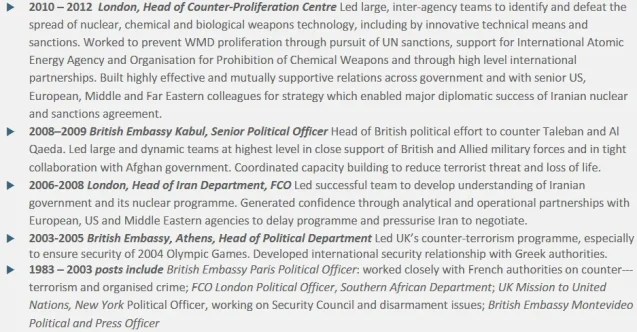
Nicholas Langman’s leaked CV
It was during the latter period that public and governmental attitudes across the West – and in vassal states – towards the Islamic Republic became highly belligerent, and negative. One by one, governments and international bodies – including the EU and UN – imposed ravaging sanctions against Tehran, devastating its economy, influence, and standing. MI6 journeyman Langman triumphed in his mission to foment concerted global hostility against Iran, based on the bogus spectre of the country posing a nuclear threat.
The question of whether British ‘intelligence’ on Iran’s nuclear program was the product of torture is an open and obvious one. Langman moved straight to leading MI6’s Iran Department from running the agency’s station in Athens, Greece. There, in late 2005, he was exposed by local media as having overseen an operation to abduct and ferociously mistreat 28 Pakistani guestworkers, wrongfully suspected of having had contact with individuals accused of perpetrating the 7/7 bombings in London in July that year.
That Langman wasn’t reprimanded over the incident strongly suggests he enjoyed a high level of protection, and London approved of his vicious intelligence-gathering methods – known to invariably produce false testimony from detainees. MI6 was not only an enthusiastic collaborator in the CIA’s global extraordinary rendition program, but led its own operations. Markedly, in at least one case, the British sought to sideline the CIA and ensure exclusive access to “intelligence” from a detainee in which Langley also had an interest.
The Obama administration was during its first year in office formally committed to non-interference in the Islamic Republic’s affairs, to the extent State Department apparatchik Jared Cohen was almost fired for publicly demanding Twitter halt planned maintenance during June 2009 protests in Iran, to ensure demonstrators could continue posting. It’s therefore unknown whether Washington was in on MI6’s Iran nuke con. If not, it wouldn’t be the first time British intelligence has misled the international community, with catastrophic results.
‘Possible Manipulation’
In July 2004, the Senate Intelligence Committee issued a scathing report on “the US intelligence community’s prewar intelligence assessments on Iraq.” It reserved particular disdain for how the CIA et al had “[relied] too heavily on foreign government services and third party reporting, thereby increasing the potential for manipulation of U.S. policy by foreign interests [emphasis added].” This was a reference to MI6’s central role in gathering – or concocting – intelligence on Baghdad’s purported WMD capabilities:
“Due to the lack of unilateral sources on Iraq’s links to terrorist groups like al-Qaida [redacted], the [US] Intelligence Community (IC) relied too heavily on foreign government service reporting and sources to whom it did not have direct access to determine the relationship between Iraq and [redacted] terrorist groups… The IC left itself open to possible manipulation by foreign governments and other parties interested in influencing US policy.”
As far back as the late 1990s, Britain’s foreign spying agency took the lead on sourcing dud ‘intelligence’ to manufacture consent for the against Baghdad. Under the auspices of a psychological warfare effort dubbed Operation Mass Appeal, MI6 black propaganda specialists circulated false information to foreign editors and reporters on its payroll “to help shape public opinion about Iraq and the threat posed by WMD,” which was then recycled by Western leaders and news outlets to reinforce its credibility.
In September 2002, then-MI6 chief Richard Dearlove personally approached British Prime Minister Tony Blair, claiming his agency had cultivated a source inside Iraq with “phenomenal access”, who could provide the “key to unlock” Iraq’s purported WMD program. Their assorted claims subsequently formed the basis of a dossier, which made a number of wild charges about Baghdad’s chemical and biological weapon capabilities. A prominently reported allegation was that Iraq could deploy WMD against Western countries within just 45 minutes. Its source was an Iraqi taxi driver.
This claim was repeated in a radio address by George W. Bush that month. In January the next year, as the invasion of Iraq rapidly loomed, the President declared in his State of the Union address, “the British government has learned that Saddam Hussein recently sought significant quantities of uranium from Africa.” That December, then-CIA chief George Tenet admitted this assertion was completely fallacious, and “these 16 words should never have been included in the text written for the President.”
The Zionist entity justified its unprovoked assault against Iran in June in large part on an intelligence dossier, which concluded the Islamic Republic had reached the “point of no return” in acquiring nukes. Its findings relied heavily on a May IAEA report that provided zero fresh information, but concluded Tehran supposedly maintained “undeclared nuclear material” until the early 2000s. While intended to trigger regime change, Tel Aviv’s broadside ended promptly in embarrassing failure, despite extensive foreign support, including US airstrikes.
Undeterred by the fiasco, Benjamin Netanyahu remains determined to crush the “Iranian axis”, while Trump has declared he would bomb Tehran “without a question” in response to indications the Islamic Republic has enriched uranium beyond agreed levels. We could be on the precipice of another war. As with the Iraq invasion, the perilous trail that brought us to this grave point could lead back to London. Yet again, MI6 may have taken the lead in concocting ‘intelligence’, justifying further US-Israeli aggression against the Islamic Republic.
Spying on Iran: How MI6 infiltrated the IAEA
Leaked confidential files indicate the IAEA was infiltrated by a veteran British spy who has claimed credit for sanctions on Iran
By Kit Klarenberg | The Grayzone | July 1, 2025
A notorious British MI6 agent infiltrated the International Atomic Energy Agency (IAEA) on London’s behalf, according to leaked documents reviewed by The Grayzone. The agent, Nicholas Langman, is a veteran intelligence operative who claims credit for helping engineer the West’s economic war on Iran.
Langman’s identity first surfaced in journalistic accounts of his role in deflecting accusations that British intelligence played a role in the death of Princess Diana. He was later accused by Greek authorities of overseeing the abduction and torture of Pakistani migrants in Athens.
In both cases, UK authorities issued censorship orders forbidding the press from publishing his name. But Greek media, which was under no such obligation, confirmed that Langman was one of the MI6 assets withdrawn from Britain’s embassy in Athens.
The Grayzone discovered the résumé of the journeyman British operative in a trove of leaked papers detailing the activities of Torchlight, a prolific British intelligence cutout. The bio of the longtime MI6 officer reveals he “led large, inter-agency teams to identify and defeat the spread of nuclear, chemical and biological weapons technology, including by innovative technical means and sanctions.”
In particular, the MI6 agent says he provided “support for the [IAEA] and Organization for the Prohibition of Chemical Weapons [OPCW] and through high level international partnerships.”
Langman’s CV credits him with playing a major role in organizing the sanctions regime on Iran by “[building] highly effective and mutually supportive relations across government and with senior US, European, Middle and Far Eastern colleagues for strategy” between 2010 and 2012. He boasts in his bio that this achievement “enabled [the] major diplomatic success of [the] Iranian nuclear and sanctions agreement.”
The influence Langman claimed to have exerted on the IAEA adds weight to Iranian allegations that the international nuclear regulation body colluded with the West and Israel to undermine its sovereignty. The Iranian government has alleged that the IAEA supplied the identities of its top nuclear scientists to Israeli intelligence, enabling their assassinations, and provided critical intelligence to the US and Israel on the nuclear facilities they bombed during their military assault this June.
This June 12, under the direction of its Secretary General Rafael Grossi, the IAEA issued a clearly politicized report recycling questionable past allegations to accuse Iran of violating the Non-Proliferation Treaty. Three days later, Israel attacked the country, assassinating nine nuclear scientists as well as numerous top military officials and hundreds of civilians.
Iranian former Vice President for Strategic Affairs Javad Zarif has since called for the IAEA’s Grossi to be sacked, accusing him of having “abetted the slaughter of innocents in the country.” This June 28, the Iranian government broke ties with the IAEA, refusing to allow its inspectors into the country.
While Iranian officials may have had no idea about the involvement of a shadowy figure like Langman in IAEA business, it would likely come as little surprise to Tehran that the supposedly multilateral agency had been compromised by a Western intelligence agency.

Langman’s name placed under official UK censorship order
In 2016, Langman was named a Companion of the Order of St Michael and St George, the same title bestowed on fictional British spy James Bond. By that point, the supposed secret agent held the dubious distinction of being publicly ‘burned’ as an MI6 operative on two separate occasions.
First, in 2001, journalist Stephen Dorril revealed that Langman had arrived in Paris weeks prior to Princess Diana’s fatal car crash in the city on August 31 1997, and was subsequently charged with conducting “information operations” to deflect widespread public speculation British intelligence was responsible for her death.
Then, in 2005, he was formally accused by Greek authorities of complicity in the abduction and torture of 28 Pakistanis in Athens. The Pakistanis, all migrant workers, were suspected of having had contact with individuals accused of perpetrating the 7/7 bombings in London, July 2005.
Brutally beaten and threatened with guns in their mouths, the victims “were convinced their interrogators were British.” When Greek media named Langman as the MI6 operative who oversaw the migrants’ torture, British news outlets universally complied with a government D-notice – an official censorship order – and kept his identity under wraps when reporting on the scandal.
London vehemently denied any British involvement in torturing the migrants, with then-Foreign Secretary Jack Straw dismissing the charge as “utter nonsense.” In January 2006 though, London admitted MI6 officers were indeed present during the Pakistanis’ torture, although officials insisted the operatives played no active part in their arrests, questioning or abuse.
Following his withdrawal from Athens, Langman returned to London to head the UK Foreign Office’s Iran Department, a shift which highlights his importance to MI6 and suggests the British government had no qualms about his allegedly brutal evidence gathering methods.
Britain’s Foreign Office collaborates closely with MI6, whose agents use it as cover just as the CIA does with State Department diplomatic postings.
MI6’s man on Iran takes credit for “maximum pressure” strategy
While leading the Foreign Office’s Iran Department from 2006 – 2008, Langman oversaw a team seeking to “develop understanding” of the Iranian government’s “nuclear program.”
It’s unclear exactly what that “understanding” entailed. But the document makes clear that Langman then “generated confidence” in that assessment among “European, US and Middle Eastern agencies” in order to “delay programme [sic] and pressurise Iran to negotiate.” The reference to “Middle Eastern agencies” strongly implied MI6 cooperation with Israel’s Mossad intelligence services.
In April 2006, Tehran announced it had successfully enriched uranium for the first time, although officials denied any intention to do so for military purposes. This development may have triggered Langman’s intervention.
The Islamic Republic has rejected any suggestion it harbors ambitions to possess nuclear weapons. Its denials were corroborated by a November 2007 US National Intelligence Estimate expressing “high confidence that in fall 2003, Tehran halted” any and all research into nuclear weapons. This assessment remained unchanged for several years, and was reportedly shared by the Mossad, despite Benjamin Netanyhau’s constant declarations that Iran was on the brink of developing a nuclear weapon.
Langman’s IAEA support work overlaps with Iran sanctions blitz
International governmental attitudes towards Iran changed abruptly between 2010 and ‘12. During this period, Western states and intergovernmental institutions initiated an array of harshly punitive measures against the country, while Israel ramped up its deadly covert operations against Iran’s nuclear scientists.
This period precisely overlapped with Langman’s tenure at the Counter-Proliferation Centre of the UK Foreign Office. His bio implies he used this position to influence the IAEA and other UN-affiliated organizations to foment a campaign of global hostility towards Iran.
In June 2010, the UN Security Council adopted Resolution 1929, which froze the Iranian Revolutionary Guard Corps’ assets, and banned overseas financial institutions from opening offices in Tehran. A month later, the Obama administration adopted the Comprehensive Iran Sanctions, Accountability, and Divestment Act. This set off a global chain of copycat sanctions by Washington’s vassals, who often imposed even more stringent measures than those levied by the UN and US.
In March 2012, the EU voted unanimously to cut Iranian banks out of the SWIFT international banking network. That October, the bloc imposed the harshest sanctions to date, restricting trade, financial services, energy and technology, along with bans on the provision of insurance to Iranian companies by European firms.
BBC reporting on the sanctions acknowledged European officials merely suspected Tehran of seeking to develop nuclear weapons, but lacked concrete proof. And behind the scenes, the MI6 operative Langman was claiming credit for helping legitimize the allegations against Iran.
Nuclear agreement lays foundations for war
Following the Western-led campaign isolation of Iran from 2010 – 2012, over its purported nuclear weapon program, the Obama administration negotiated a July 2015 agreement known as the Joint Comprehensive Plan of Action (JCPOA). Under the JCPOA’s terms, the Islamic Republic agreed to limit its nuclear research activities in return for sanctions relief. In the years that followed, the IAEA was granted virtually unlimited access to Tehran’s nuclear complexes, ostensibly to ensure the facilities were not used to develop nuclear weapons.
Along the way, IAEA inspectors collected vast amounts of information on the sites, including surveillance camera photos, measurement data, and documents. The Iranian government has since accused the Agency of furnishing the top secret profiles of its nuclear scientists to Israel. These include the godfather of Iran’s nuclear program, Mohsen Fakrizadeh, who was first publicly named in a menacing 2019 powerpoint presentation by Israeli Prime Minister Benjamin Netanyahu. The following year, the Mossad assassinated Fakrizadeh in broad daylight with a remote-controlled machine gun.
Internal IAEA documents leaked this June indicated that IAEA Secretary General Rafael Grossi has enjoyed a much closer relationship with Israeli officials than was previously known, and suggested he leveraged his cozy ties with Tel Aviv to secure his current position.
During a June 24 interview with Fox News’ war-crazed anchor Martha MacCallum, Grossi did not deny making the inflammatory claim that “900 pounds of potentially enriched uranium was taken to an ancient site near Isfahan.” Instead the IAEA director asserted, “We do not have any information on the whereabouts of this material.”
Well before Grossi rose to the top of the IAEA with Western and Israeli backing, the agency appears to have been penetrated by a British intelligence agent who took responsibility in his bio for engineering the West’s economic attack on Iran.
The IAEA has not responded to an email from The Grayzone seeking clarification on its relationship with Langman and the MI6.
Leaked files reveal the Steele Dossier was discredited in 2017 — but sold to the public anyway
By Kit KLARENBERG | MintPress News | April 8, 2025
On March 25, Donald Trump signed an executive order declassifying all documentation related to Crossfire Hurricane, the FBI’s 2016 investigation into alleged collusion between Russia and then-presidential candidate Donald Trump. The order has unexpectedly resurrected buried documents that cast new light on the Steele dossier — and when it was known to be false.
It is unclear what new information will be revealed, given substantial previous declassifications, two special counsel investigations, multiple congressional inquiries, several civil lawsuits, and a scathing Justice Department internal review. It has long been confirmed the FBI relied heavily on Steele’s discredited dossier to secure warrants against Trump aide Carter Page, despite grave internal concerns about its origins and reliability, and Steele’s sole “subsource” for all its lurid allegations openly admitted in interviews with the Bureau he could offer no corroboration for any of the dossier’s claims.
Such inconvenient facts and damning disclosures were nonetheless concealed from the public for several years following the dossier’s January 2017 publication by BuzzFeed News, now defunct. In the intervening time, it became the central component of the Russiagate narrative, a conspiracy theory that was a major rallying point for countless mainstream journalists, pundits, public figures, Western intelligence officials, and elected lawmakers. In the process, Steele attained mythological status. For example, NBC News dubbed the former MI6 operative “a real-life James Bond.”
Primetime news networks dedicated countless hours to the topic, while leading media outlets invested enormous time, energy and money into verifying the dossier’s claims without success. Undeterred, legacy reporters relied on a roster of mainstream “Russia experts,” including prominent British and U.S. military and intelligence veterans, and briefings from anonymous officials to reinforce Steele’s credibility and the likely veracity of his dossier. As award-winning investigative journalist Aaron Maté told MintPress News :
Media outlets served as unquestioning stenographers for Steele. If his dossier’s claims themselves weren’t sufficient to dismiss it with ridicule, another obvious marker should have set off alarms. Reading the dossier chronologically, a clear pattern emerges – many of its most explosive claims are influenced by contemporary media reporting. For instance, it was only after Wikileaks published the DNC emails in July 2016 that the dossier mentioned them. This is just one example demonstrating the dossier’s true sources were overactive imaginations and mainstream news outlets.”
Even more damningly, leaked documents reviewed by MintPress News reveal that while Western journalists were hard at work attempting to validate Steele’s dossier and elevating the MI6 spy to wholly undeserved pillars of probity, the now-defunct private investigations firm GPW Group was, in early 2017, secretly unearthing vast amounts of damaging material that fatally undermined the dossier’s content, and comprehensively dismantling Steele’s previously unimpeachable public persona. It remains speculative what impact the firm’s findings might have had if they had been released publicly at the time.
‘Financial Incentives’
“In order to build a profile of Christopher Steele… as well as the broader operations of both Orbis Business Intelligence and Fusion GPS,” which commissioned the dossier on behalf of Hillary Clinton’s presidential campaign and the Democratic National Committee, GPW consulted “a variety of sources.” This included “U.S. intelligence figures,” various journalists, “private intelligence subcontractors” who had previously worked with Steele and Orbis, and “contacts who knew the man from his time with [MI6]…and, in one instance, directly oversaw his work.”
The picture that emerged of Steele sharply contrasted with his mainstream portrayal as a “superstar.” One operative who “acted as Steele’s manager when he began working with [MI6] and later supervised him at two further points” described him as “average, middle of the road,” stating he had never “shined” in any of his postings. Another suggested Steele’s founding of Orbis “was the source of some incredulity” within MI6 due to his underwhelming professional history and perceived lack of “commercial nous.”
Yet another suggested Steele’s production of the dossier reflected his lack of “big picture judgment.” Sources consulted by GPW were even more critical of Fusion GPS chief Glenn Simpson. One journalist described him as a “hack” without “a license or the contacts to do… actual investigations,” instead outsourcing “all” work ostensibly conducted by his firm to others while skimming commissions. They also “openly admitted” to disliking Simpson, described by GPW as “not an uncommon attitude amongst those to whom we spoke.”
GPW also scrutinized “credibility and perceptions of the dossier in Russia,” specifically whether Steele‘s claims that high-ranking Kremlin-linked sources in Moscow provided him with information had any merit. The firm consulted “Western and Russian journalists, former officials from the FSB and the Russian security services more broadly, a former high-ranking official at the CIA who oversaw the agency’s Russian operations, and several private-sector intelligence practitioners operating in Moscow” for this purpose:
The prevailing sentiment from our contacts was one of extreme skepticism as to the accuracy of… the [dossier]. Most found it unimaginable… senior Russian officials would risk life imprisonment (or worse) by speaking to a former foreign intelligence official about such sensitive issues. At the very least… it would have cost Steele a great deal more… than he could afford… Former intelligence operatives (from both the U.S. and Russian services) seriously doubted Steele would have been able to retain Russian sources from his time in MI6.”
GPW also examined “possible sources for the dossier” that had been hypothesized in the media to date. Among them was former FSB General Oleg Erovinkin, who was found dead in his car in Moscow in December 2016. After the dossier’s release, the Daily Telegraph suggested his death was “mysterious” and could have resulted from providing information to Steele. A former high-ranking official in U.S. intelligence mockingly dismissed the proposition, noting that career security and intelligence officer Erovinkin was “unlikely to have needed the money.”
While conceding that financial incentives could encourage such a breach… [if] Steele had offered Erovinkin £100,000, the mooted budget for the entire project, ‘Erovinkin would have said he needed to see three more zeros before opening his mouth. It’s just a ridiculous proposition to think he would speak to a former intelligence officer from the UK, or anyone else for that matter, for such a paltry sum of money.’”
Overall, GPW concluded: “The quality and level of the sourcing was greatly exaggerated in order to give the dossier and its allegations more credibility.” This impression was reinforced by “informed sources from both government and the private sector” in Russia who were “very dismissive” of the dossier’s content. Many pointed to “woeful inaccuracies” contained therein “and its author’s general lack of understanding around Russian politics and business.” This “deficiency was particularly acute with respect to the dossier’s coverage of Alfa Bank.”
‘Reputational Damage’
GPW’s investigation also proved prescient in other areas. For example, several knowledgeable sources the company consulted — including former senior Russian and U.S. intelligence officials — suggested the dossier’s “most likely sources” were Russian émigrés, “providing… their own views.” They also noted the Steele dossier’s “hyperbole and inaccuracies” were “typical of the hyperactive imaginations of the subcontractors widely used in the business intelligence sector.” This was not confirmed until July 2020.
That month, the Senate Judiciary Committee released notes taken by FBI agents during February 2017 interviews with Igor Danchenko, Steele’s “subsource” and the dossier’s effective author. A Washington think tank journeyman jailed years earlier on multiple public intoxication and disorderly conduct charges and investigated by the FBI for potentially serving as a Kremlin agent, Danchenko admitted he had been fed much of the dossier’s salacious content by his Russian drinking buddies, who lacked any high-level access. Steele then embroidered their dud information further.
Other striking passages in the leaks refer to a conversation between GPW and “a source from within the business intelligence sector in London [who] knows Christopher Steele well, both socially and professionally, and is familiar with his company.” They relayed various details and “commentary” gleaned “directly from speaking to Steele.” For example, they noted that contrary to its self-description as a “leading corporate intelligence consultancy,” Orbis was “not a major operation” and seemed to employ just two junior analysts “who looked like recent graduates.”
The source revealed that “other, larger firms in the sector were approached before Steele and turned the work down before he took it on,” and the dossier was his solo project. “The rest of the company wasn’t involved at all, either to help on the research side of things or to look through the product before it went out,” and “Steele basically collated the information himself.” They further suggested the dossier’s sources let their imaginations run wild, believing their claims would never see the light of day:
I think they got carried away — they didn’t think the material would ever be made public because at that point it was very unlikely that Trump was going to get into power…Steele was rather naive about the whole thing. He didn’t think that it would get exposed in the way it did.”
In other investigative briefs, GPW noted it was unusual that “Steele would have permitted (or indeed facilitated) the distribution of such questionable material under his name,” given the dossier’s apparent falsity. The firm postulated that “in sharing the material with U.S. government figures,” the former MI6 operative “may have thought he was currying favor with them by doing so,” but ultimately, “he never intended for the dossier to be made public in the manner it was.”
One possible answer to this question is found in a defamation case brought against Orbis by Petr Aven, Mikhail Fridman, and German Khan in Britain in May 2018. In July 2020, a British court ruled that the dossier’s allegations against them and Alfa Bank were “inaccurate and misleading,” awarding damages “for the loss of autonomy, distress and reputational damage.” During the trial, Steele made a notable disclosure:
Fusion’s immediate client was law firm Perkins Coie… it engaged Fusion to obtain information necessary for Perkins Coie to provide legal advice on the potential impact of Russian involvement on the legal validity of the outcome of the 2016 U.S. Presidential election. Based on that advice, parties such as the Democratic National Committee and [“Hillary for America”] could consider steps they would be legally entitled to take to challenge the validity of the outcome of that election.”
In essence, the dossier was commissioned by Clinton’s campaign as a contingency in the event she lost the election. However, as GPW’s source close to Steele noted, when the MI6 operative took on the work, the prevailing perception was that “it was very unlikely” Trump would win. As a result, Steele may have had the motivation to fill the dossier with unverified material, believing it would never be used for its intended purpose. He also had a commercial incentive to exaggerate his high-level access. A serving CIA official told GPW:
Steele was known to have been ‘up and down the alley’ pitching for business – a reference to the major defense firms, such as Lockheed Martin, which are located close to one another in Arlington, Virginia. She did not know which firms Steele had worked for in particular, if any, but he has visited several of them in person at their headquarters.”
A core mystery at the heart of the Steele dossier saga has never been satisfactorily resolved — one that Trump’s latest declassification order could help illuminate. In his December 2019 report on Crossfire Hurricane, Justice Department Inspector General Michael Horowitz criticized the FBI’s use of the dossier to obtain warrants against Carter Page but insisted Steele’s assorted claims “played no role” in the bureau opening its investigation of Trump’s campaign, reportedly on July 31, 2016.
As extensively documented by Aaron Maté, this claim is difficult to reconcile with the numerous contacts and meetings between Steele and senior FBI and Justice Department officials in the weeks leading up to that date. The former MI6 officer provided material that would later comprise the dossier to senior U.S. government officials, including Victoria Nuland, prior to the official opening of Crossfire Hurricane. Nuland reportedly encouraged the bureau to investigate the contents.
According to the FBI’s electronic communications that initiated Crossfire Hurricane, the probe’s founding predicate was a vague tip provided to the bureau by Australian diplomat Alexander Downer. He claimed that low-level Trump campaign staffer George Papadopoulos had “suggested” to him over drinks in London that “the Trump team had received some kind of suggestion [emphasis added] from Russia that it could assist… with the anonymous release of information during the campaign that would be damaging” to Clinton. The EC further acknowledged that “It was unclear whether he or the Russians were referring to material acquired publicly or through other means. It was also unclear how Mr. Trump’s team reacted to the offer.”
As Maté told MintPress News, this was an “extraordinarily thin basis upon which to investigate an entire presidential campaign.” He added that “upon officially opening Crossfire Hurricane, FBI officials immediately took investigative steps that mirrored the claims in the Steele dossier, even though they were supposedly unaware of it.” The FBI’s first probes into individual Trump campaign figures — Carter Page, Michael Flynn, and Paul Manafort — began in August 2016. All are mentioned in the dossier. Maté concludes:
To accept the official timeline, one has to stipulate that the FBI investigated a Presidential campaign, and then a President, based on a low-level volunteer having ‘suggested’ Trump’s campaign had received ‘some kind of suggestion’ of assistance from Russia. One would also have to accept that the Bureau was not influenced by the far more detailed claims of direct Trump-Russia connections – an alleged conspiracy that would form the heart of the investigation – advanced in the widely-circulating Steele dossier.”
A Third Way to end the war in Ukraine
By M. K. BHADRAKUMAR | Indian Punchline | March 29, 2025
In an unguarded moment, perhaps, ex-UK Prime Minister Boris Johnson blurted out recently in an interview that the ultranationalist elements who rule the roost in Kiev are a formidable obstacle to ending the war in Ukraine. For Johnson, this might be a blame game to absolve himself of responsibility, given his own dubious role as then PM (in cahoots with President Joe Biden) in undermining the Istanbul agreement in April 2022 to rev up the simmering conflict and turn it to a full-fledged US-led proxy war against Russia.
What Johnson will not admit, though, is that the ascendance of the MI6, Britain’s intelligence agency, in the power structure in Kiev goes back by several years. MI6 was responsible for the personal security of President Zelensky. MI6 took advantage by positioning itself to choreograph the future trajectory of the war and subsequently in the planning and execution of major covert operations directed against the Russian forces — and ultimately to carry the war into Russian soil itself.
According to reports, the UK intends to establish a base in the Odessa region on the Black Sea coastline. See my article The Hundred Years War Donald Trump should know about, Deccan Herald, January 29, 2025.
So, indeed, the MI6’s unholy alliance with the notorious Azov militia units comprising Ukrainian ultra-nationalists fired up by neo-Nazi ideology who wield control of the power apparatus in Kiev even today, is a key factor in the war, which complicates the prospects for President Trump’s efforts to end the war. Suffice to say, Britain’s strategic defiance of Trump with PM Keir Starmer string up of an insurgency among Europeans to pre-empt any US-Russia rapprochement is a calculated strategy.
Hopefully, President Trump’s decision Tuesday to order the FBI to forthwith declassify files concerning Crossfire Hurricane investigation may throw some light on the so-called Steele dossier (named after an ex-MI6 officer) containing doctored ‘evidence’ that had formed the basis of Hillary Clinton’s fake allegation that the Trump campaign colluded with Russia to influence the 2016 US election cycle.
Reports had appeared, incidentally, that incumbent president Barack Obama and then vice-president Biden were very much in the loop on the Russia hoax.
The point is, the entrenched neo-Nazi groups in Kiev, with Zelensky as their frontman, are not in the least interested in budging from their maximalist demands on a total Russian withdrawal and so on for ending the war, which are backed by the Europeans unconditionally who would know fully well that such hopelessly unrealistic demands are deal breakers. The Kiev regime and European leaders are joined at the hips as interest groups in the war continuing.
Put differently, so long as the regime in Kiev remains in power (although Zelensky’s presidential term has expired), any forward movement in the peace process will remain a pipe dream.
The best course of action would be that Zelensky steps down on his own volition and a fresh election is allowed to be held under the supervision of the parliament speaker but all that is too much to expect. Given the massive scale of war profiteering, Zelensky holds a dream job.
The alternative will be Zelensky’s ouster through coercive means as the US once did to an equally corrupt proxy, Ngo Dinh Diem, in 1963 during the Vietnam War. But Trump is unlikely to do that. And in any case, the deep state is hostile towards Trump and Zelensky gets political support from Democrats.
Besides, Zelensky’s violent exit may only bring in another figure with neo-Nazi backing to power. In fact, the ex-army chief Valerii Zaluzhnyi, who also has MI6 support, is waiting in the wings in London serving as Ukraine’s envoy.
In such a dismal scenario, the only way out seems to be a Third Way. Russian President Vladimir Putin may have proposed just that in a speech in Mumansk on Thursday possibly to draw Trump’s attention, as the Riyadh talks are not getting anywhere and Zelensky shows no signs of interest in a ceasefire.
Putin said at the outset, “I would like to state – first and foremost – that, in my view, the newly elected President of the United States sincerely wishes to end this conflict for a number of reasons – I will not list them now, as they are numerous. But in my opinion, this aspiration is genuine.”
He then worked his way to the issue of the neo-Nazi formations who receive western weaponry and financial aid and have the resources to recruit new personnel, holding de facto power in Kiev and are effectively running the country. Putin stated: “This raises the question: how is it possible to conduct negotiations with them?”
Clearly, the Russians are sceptical of the outcome of the expert level talks in Riyadh last Monday. The European summit in Paris 3 days later had vowed not to relax the sanctions against Russia or to give Russian banks access to the SWIFT clearing system. In short, the exports of Russian agricultural products and fertilisers to the world market is not going to be feasible. Kiev has already raised objection to the US-Russian understanding in this regard.
Simply put, an important element in the so-called Black Sea initiative is not workable. How to cut the Gordian knot?
Taking stock of Kiev’s all-round resistance to ending the war, Putin said:
“In such situations, international practice follows a well-established path. Within the framework of the United Nations peacekeeping operations, there have been several cases of what is termed external governance or temporary administration. This occurred in East Timor, I believe in 1999, in parts of the former Yugoslavia, and in New Guinea. In short, such precedents exist.
“In principle, it would indeed be possible to discuss, under UN auspices with the United States and even European countries – and certainly with our partners and allies – the possibility of establishing a temporary administration in Ukraine. To what end? To conduct democratic elections, to bring to power a competent government that enjoys public trust, and only then to begin negotiations on a peace treaty and sign legitimate agreements that would be recognised worldwide as consistent and reliable.
“This is just one option; I do not claim that others do not exist. They certainly do. At present, there is no opportunity – and perhaps no possibility – to lay out every detail, as the situation is evolving rapidly. But this remains a viable option, and such precedents exist within UN practice…”
What Putin didn’t mention but is equally relevant is that the war in Ukraine will meet with sudden death the moment UN governance in Ukraine gets established. Indeed, let the UN decide the composition of any peacekeeping forces to be deployed in Ukraine for conducting elections. There won’t be any need for a ‘coalition of the willing’ of Europeans for deployment in Ukraine, either.
Of course, the big losers will be MI6 and the politicians in power in the EU countries who lined up behind Biden as his retinue to wage a doomed proxy war against Russia and eventually ended up bringing the roof down on Europe’s economy. These decrepit politicians need the war as a distraction since they will be held horribly accountable by their public for creating conditions under which the welfare state is no longer affordable.
The Chinese foreign minister Wang Yi is expected to visit Moscow next week on Tuesday. It is entirely conceivable that the topic of UN governance in Ukraine will figure in Wang Yi’s talks.
Stepan Bandera’s Sinister MI6 Alliance Exposed
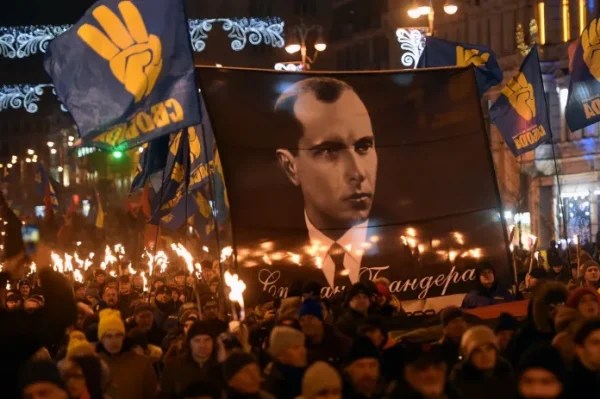
[Source: ar.inspiredpencil.com]
By Kit Klarenberg | Covert Action Magazine | March 20, 2025
October 15, 2024, marked the 65th anniversary of Organization of Ukrainian Nationalists (OUN-B) and Ukrainian Insurgent Army (UPA) founder Stepan Bandera’s assassination by the KGB in Munich, in then-West Germany.
The date passed without mention anywhere. This may reflect how prior public commemorations of the life and death of Nazi collaborator Bandera—widely credited as the father of Ukrainian nationalism—in Kyiv sparked significant controversy and condemnation across Central and Eastern Europe, particularly neighboring Poland.
The complicity of Bandera and the fascist movements he birthed during World War II is well-documented. His influence over modern-day ultranationalist and Neo-Nazi factions in Ukraine, such as the Azov Regiment, has also been acknowledged in the mainstream media.
Yet, Bandera’s secret Cold War bond with British intelligence has never been seriously explored by Western news outlets. Now, examination of little-known declassified CIA records by CovertAction Magazine exposes the malign contours of a long-running, ruthless conspiracy between Bandera and MI6 to destabilize the Soviet Union.
This dark handshake only expired because MI6’s fascist asset was resistant to joining forces with other Ukrainian anti-Communist forces, therefore jeopardizing plans by Washington and London for all-out war with the Soviets in Donbas. That plot, intended to ultimately collapse the entire USSR, has eerie, direct echoes of the current Ukraine proxy war. So too Britain’s willingness, then and now, to go even further than the U.S. in building alliances with the most reactionary, dangerous Ukrainian ultranationalist elements, in service of balkanizing Russia.
“Bandit Type”
MI6 first contacted Bandera while he was exiled in post-war West Germany in 1948, via Gerhard von Mende. An ethnic German hailing from Riga, Latvia, von Mende has been described as the “enthusiastic Nazi” who headed Berlin’s Reich Ministry for the Occupied Eastern Territory, or Ostministerium. Among other connivances, von Mende was charged with recruiting fifth columnists from the USSR’s Central Asian republics, to undermine and attack Communist authorities. He has been credited with influencing subsequent British and American support for Islamic extremists.

Per a declassified CIA biography, after Nazi Germany’s defeat, von Mende was “interned as a ‘guest’” at the Agency’s Camp King, where Nazi officials and soldiers were interrogated and tortured. In some cases, inmates were unwittingly dosed with LSD under PROJECT BLUEBIRD, a forerunner to the CIA’s notorious MK-ULTRA mind-control program. Subsequently, von Mende became an asset for West Germany’s Nazi-riddled BND, the CIA, and MI6, continuing his spy recruitment in the USSR via a front company.
Through this position, von Mende was kept abreast of UPA activities and capabilities, and maintained an intimate personal relationship with Bandera. The Ukrainian fascist ideologue’s thuggish West German network was by then hard at work killing hundreds of local citizens suspected by the CIA and MI6 of harboring Communist sympathies. While the OUN-B chief’s “ask” of British intelligence was initially judged too high, that perspective rapidly changed. By 1949, MI6 was helping Bandera airdrop his chaos agents into Ukraine.
A year later, Britain’s foreign spy agency began formally training these operatives to gather intelligence and carry out sabotage and assassinations on Soviet soil. This sinister compact was established despite stern CIA and State Department opposition. At this point, the Agency had identified a comparatively moderate alternative to Bandera’s murderous ultranationalist mob, the Ukrainian Supreme Liberation Council (UHVR). The group was led by Ukrainian-Greek Catholic priest Ivan Hrinioch, a “longtime CIA asset” and former high-ranking OUN-B operative Mykola Lebed.
During World War II, Lebed oversaw the UPA’s massacre of tens of thousands of Poles in Volhynia and Eastern Galicia. However, he subsequently disavowed this genocidal carnage, and led UHVR’s push to unite Ukrainian émigrés, who had fractured due to bloody, internecine squabbles toward the conflict’s end. Under the auspices of Operation AERODYNAMIC, for decades the Agency exploited the UHVR to foment “nationalist flare-ups” throughout the Soviet Union, “particularly” in Ukraine, and “encourage divisive manifestations among” the population, to “exert pressure on the Soviet regime.”
By this time, Bandera had fallen out of favor with many Ukrainian nationalists, and was even renounced by what remained of OUN-B’s Kiev-based leadership. This, his genocidal past, and overt anti-U.S. actions and statements due to Washington’s refusal to publicly advocate for Ukrainian independence, all deterred the CIA from employing him. However, MI6 was unperturbed and pushed ahead with its Bandera operations. This created a ludicrous situation, with London and Washington supporting bitterly antagonistic Ukrainian nationalist factions, which frequently undermined and attacked each other.
As a British intelligence memorandum on “the crisis over Bandera” noted, by 1950 Ukrainian nationalist leaders had “become aware of the fact that the British and Americans were backing rival groups,” putting the agencies’ joint anti-Soviet project at risk. It was decided to dispatch a co-signed message to UPA headquarters via Ukrainian CIA and MI6 agents parachuted into Lviv, calling for an end to “present disagreements” between opposing nationalist factions, which London and Washington professed to “deplore and earnestly hope may be resolved.”
It signed off with the now-infamous, Bandera-coined nationalist slogan, “Glory to Ukraine” (“Slava Ukraini”). The memo’s MI6 author, moreover, recalled an in-person meeting they had with Bandera in London. The spy described him thusly:
“Convincing and sincere… a professional underground worker with a terrorist background and ruthless notions about the rules of the game, acquired by hard experience, along with a thorough knowledge of the Ukrainian people… a bandit type if you like, with a burning patriotism which provides an ethical background and a justification for his banditry.”
The MI6 operative cheerfully added that genocidal mass murderer Bandera was “no better and no worse than others of his kind I have had dealings with in the past,” and “genuinely grateful for the help given to him” by British intelligence, “but at the same time is certainly trying to get all he can out of it.” The CIA begged to differ, however, commissioning a study of London and Washington’s conflicting positions on the “Ukrainian underground” and Bandera, and how to resolve this divergence.
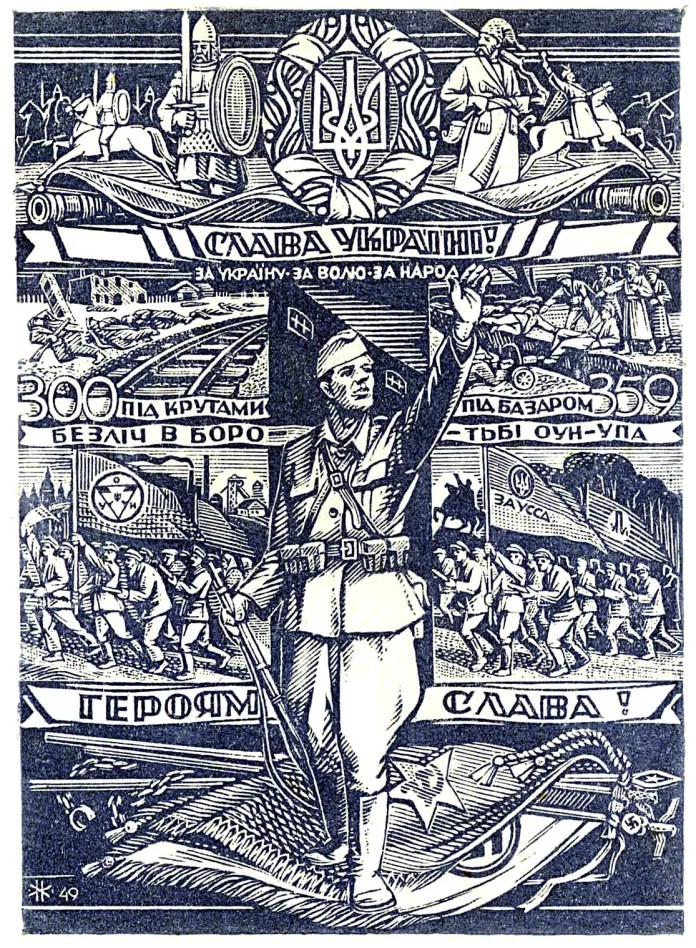
UPA poster from the 1940s. OUN/UPA’s formal greeting is written on two of the horizontal lines “Glory to Ukraine!” “Glory to the Heroes!” The soldier is standing on the banners of the Soviet Union and Nazi Germany. [Source: euromaidanpress.com]
“Political Overtones”
A subsequent appraisal repeatedly declared Bandera and OUN-B to be “completely unacceptable” to the CIA, “both from the political and the operational standpoints.” It proposed the Agency and MI6 take joint ownership of the UHVR and its anti-Soviet wrecking project in Ukraine, and “exchange political, operational and intelligence data resulting from these operations.” Meanwhile, the CIA would “take independent action to neutralize” OUN-B’s “present leadership,” including Bandera himself. It is unknown if this was pitched to MI6, although London’s steadfast opposition was inevitable.
The “British position,” as described in the study, was Bandera’s “importance” had been perennially “underestimated by the Americans, as a rallying symbol in the Ukraine, as leader of a large émigré group [and] as a leader favored by the homeland headquarters.” This did not conform to the reality on the ground as detected by the CIA, but MI6 had a vested interest in maintaining the fascist demagogue as an agent. An April 1951 Agency memo summarizing recent “talks” with British intelligence “on operations against the USSR” noted:
“[MI6 is] seeking progressively to assume control of Bandera’s lines… [MI6 argues] Bandera’s name still carried considerable weight in the Ukraine… [and OUN-B is] the strongest Ukrainian organization abroad, is deemed competent to train party cadres, [and] build a morally and politically healthy organization.”
By contrast, the CIA observed Soviet authorities “had been successful to a remarkable degree in transforming the mentality of the younger generation” of Ukrainians, resulting in them vehemently rejecting Bandera and his brand of rabid nationalism. While the Agency, therefore, favored “political neutralization of Bandera as an individual,” MI6 balked, as this “would lead to a drying up of recruits” and “disrupt British operations.” However, the declassified paper trail shows London eventually tired of their fascist asset.
In February 1954, a senior MI6 official who led liaison with OUN-B for two decades made a “final attempt to bring Bandera to reason” in London, due to the genocidaire’s refusal to reconcile and unite with opposing Ukrainian nationalist elements. The high-ranking British spook offered him “one last chance” to make amends with émigré leaders. Bandera “refused this suggestion with arrogant finality,” thus making “the break” between Bandera and MI6 “complete.”
All British intelligence-run Ukrainian agents who remained loyal to Bandera were duly jettisoned. MI6 informed other nationalist leaders the agency “would not resume” its relationship with him “under any circumstances.” Bandera remained exiled in Munich, West Germany, and continued to run belligerent cloak-and-dagger operations against the Soviet Union, while ratcheting up his anti-Western rhetoric. The CIA and MI6 viewed these activities as a significant problem, with no obvious solution.
As CIA records of a January 1955 “joint U.S.-UK conference” put it, despite the “unanimous desire” of British and American intelligence to “‘quiet’ Bandera,” it was equally vital the KGB was “not allowed to kidnap or kill him.” This could make Bandera “a martyr” among Ukrainian ultranationalists, a prospect to be avoided if at all possible. Hence, London and Washington kept him alive and well, while permitting West Germany’s BND to run him as an agent. Their old friend Gerhard von Mende was his handler.
West German authorities wished to punish Bandera and his in-country network for crimes including kidnapping, but von Mende consistently intervened to insulate his compatriot from prosecution. A July 1959 CIA report noted the BND’s use of Bandera was such a “closely held” secret within the agency, it was not even formally cleared with the West German government “due to political overtones.” Despite this omertà (code of silence), the BND moved to secure Bandera a U.S. visa.
It was hoped he would connect with Ukrainian émigrés Stateside, while ingratiating himself with the CIA and State Department. Per an October 5, 1959, Agency memo, the BND believed “it should be a simple matter” for the CIA “to influence the issuing of a visa” for Bandera, as “many less desirable and less ‘exploitable’ individuals” had already visited the country via Agency assistance. A formal request was submitted to Washington. Just ten days later, though, the KGB finally caught up with him.
Despite their mutual wish that Bandera not be “martyred” by Soviet intelligence, it is likely that the CIA and MI6 breathed a collective sigh of relief upon hearing of his death. The OUN-B and UPA founder’s destabilizing, disruptive influence within the Ukrainian anti-Communist underground was a significant impediment to Anglo-American spying agencies’ implementation of a far grander plan than has hitherto been tried. Namely, fomenting all-out war against the Soviet Union, using Ukrainian ultranationalists as foot soldiers.
This is the first instalment of a two-part investigation. Stay tuned.
Trump takes on the ‘collective west’
By M. K. BHADRAKUMAR | Indian Punchline | March 1, 2025
The dramatic scene in the Oval Office on Friday evening signals that President Donald Trump is decoupling the US from the ‘forever war’ in Ukraine that his predecessor Joe Biden left behind. The war is poised to end with a whimper, but its ‘butterfly effect’ on our incredibly complex, deeply interconnected world will define European and international security for decades to come.
The western media which is hostile toward Trump, have seized the opportunity to caricature him as an impulsive figure in a role reversal with Zelenskyy. In reality, though, Trump has been literally driven to this point by the Biden administration.
The highly charged emotional reaction by the European Commission president Ursula von der Leyen commiserating with President Zelensky speaks for itself: “Your dignity honours the bravery of the Ukrainian people. Be strong, be brave, be fearless. You are never alone, dear President.” Trump’s refusal to give Von der Leyen an appointment may partly explain her fury as a woman scorned. Truly, the ‘Collective West’ find themselves at a crossroads and do not know which road to take. Without US air cover and satellite inputs, western troop deployment in Ukraine will be impossible. Even French Emmanuel Macron would agree that his troops will be put through a meat grinder.
Both Von der Leyen and Macron had a whale of a time as cheerleaders of Biden’s war but any further adventures in Ukraine will be suicidal, to put it mildly. Ukraine’s military will collapse if Trump freezes support. None of the European powers will risk a collision with Russia.
Trump knows by now that the western narrative of Biden’s war is a load of bullshit peppered with falsehoods and outright lies, and that the war erupted only out of the diabolic western plot to poke the bear, which got provoked finally and hit out.
The CIA’s coup in Kiev in February 2014 was a watershed event paving the way for a NATO presence on Ukrainian soil. Indeed, terrible things happened, which have been shoved under the carpet — for instance, then German foreign minister (current president) Frank-Walter Steinmeier’s dubious links with the neo-Nazi Ukrainian groups who acted as storm troopers in the 2014 coup. Just think of the grotesqueness of it — a German social democrat patronising neo-Nazi groups!
Most certainly, Trump knows that the US deep state had set in motion an agenda to destabilise the Russian Federation and dismember it as the unfinished business no sooner than the Soviet Union was dissolved. The Chechen War has no other explanation. In fact, Putin has accused US agents of directly aiding the insurgents.
Again, the Bill Clinton administration floated the idea of NATO expansion as early as in 1994. It came out of the blue but was obviously a work in progress since the disbandment of the Soviet Union. By the mid-nineties, even Boris Yeltsin understood that he was played nicely. The return of Evgeny Primakov to the Kremlin and Yeltsin’s overture to Beijing were the surest signs of a course correction.
Those familiar with Soviet history had known all along that Ukraine would be the theatre where the US would try to seal the fate of Russia. If further confirmation was needed, it came with the CIA’s colour revolution in Ukraine in 2003 where the election was rigged (as is happening in Romania today) and carried to a third round till the proxy emerged victorious and surely, Viktor Yushchenko brought the NATO membership issue to the table. At the 2008 NATO summit in Bucharest, George W. Bush insisted that the alliance formally offered membership to Ukraine!
Today, Britain’s MI6 calls the shots in Kiev. Zelenskyy admitted recently that much of the money given by Biden simply ‘disappeared’. Sordid tales of massive kickbacks and corruption are galore. Biden ignored them. The Biden family’s involvement in Ukraine’s cesspools is widely known. Contrary to his pledge earlier not to do so, Biden felt constrained finally to grant a presidential pardon to son Hunter Biden so that he wouldn’t end up in jail.
Suffice to say, Zelensky’s ‘strategic defiance’ stems out of his quiet confidence that western leaders — starting with Boris Johnson and Biden — who have been fellow travellers in the gravy train during the past three years of the war are beholden to him till eternity.
The axis between Zelensky and his European Union supporters is cajoling Trump, pressuring him and flattering him in turn to get him on board the bandwagon so that the war rolls on for another four years. Last week alone, the presidents of France and Poland and the British prime minister descended on the White House one after another seeking assurance that the war in Ukraine will continue. But Trump has refused to oblige.
Zelensky and his European backers want a ‘forever war’ in the western border lands of Eurasia, the traditional invasion route to Russia. And last week Trump again ruled out NATO membership for Ukraine. He also pointed to the ongoing talks on “major economic development transactions which will take place between the United States and Russia.”
Trump repeated last week that the war could be ended “within weeks” and warned of the risk of escalation into a “third world war.” Basically, he realises that this is an unwinnable war, and is apprehensive that a prolonged war may transform into a quagmire sinking his presidency and derailing the grand bargain he hopes to strike with the two other superpowers, Russia and China, to create synergy for his ambitious MAGA project.
Trump has chalked up 2026, the Quarter Millennial of the United States Declaration of Independence, for hosting the leaders of Russia and China on American soil to celebrate the high noon of his quest for world peace. The European political elites weaned on the liberal-globalist ‘rules-based order’ cannot understand Trump’s deep-rooted convictions and his abhorrence of war.
The big question now is wether the unprecedented fracas in the White House yesterday could backfire on Zelensky, since Washington has significant leverage vis-a-vis Kiev and given the latter’s heavy dependence on the US for some of the critical elements of its defence.
Following the Oval Office argument, Zelenskyy has issued a lengthy statement admitting that it is “crucial” for Ukraine to have Trump’s support. A patch-up cannot be ruled out but the transatlantic system has received a big jolt, as the overwhelming majority of European countries have voiced support for Zelensky. In fact, there hasn’t been a solitary voice censuring Zelensky. Britain kept mum. Keir Starmer, UK prime minister is hosting a meeting of European leaders on Sunday which Zelensky is due to attend. It is unlikely that Europeans will push the envelope further
In this dismal scenario, the best hope is that Zelensky’s ouster, which seems probable, will not be a violent bloody event, considering the power rivalries within the regime in Kiev. At any rate, his replacement may not be a terrible thing to happen since it would necessitate holding the long overdue election and lead to the emergence of a legitimate leadership in Kiev, which has now become a dire necessity for what Trump would call ‘common sense’ to prevail.
Featured Video
It’s the Occupation, Stupid
or go to
Aletho News Archives – Video-Images
From the Archives
A superpower and “the world’s sickest warrior state”
By Paul J. Balles | March 8, 2010
Living through five or six major wars has hardened me to what I thought were the extremes of inhuman cruelty and brutality.
Two things made those extremes almost bearable: the brutality always revealed – at least according to the media coverage – the viciousness of the enemy. It was therefore quite understandable when our “brave men and women” pulverized the enemy.
Films of Japanese torturing captive Americans somehow justified holding Japanese Americans in internment camps during World War II; and only a small percentage of Americans found the bombing of Hiroshima and Nagasaki unreasonably vengeful at best, at worst, depraved.
The media giants in America portrayed the North Koreans as barbaric beasts with their captives, quite unlike their southern counterpoints – our allies during the Korean War. No one ever felt the need to explain how the South Koreans were a civilized breed while the North Koreans were absolute savages, at least according to the official line.
In Vietnam, our warriors justifiably (or so the media made us believe) dropped napalm on the North Vietnamese who had the gall to hide in villages and tunnels to ravage our invaders. At least it was accepted practice until some rogue photojournalist filmed a young girl screaming down a Vietnamese road in flames. … continue
Blog Roll
 Aletho News
- Pakistan to Host US-Iran Talks
- How Indonesia’s tilt toward the US left it stranded in the Strait of Hormuz
- US has no choice but to retreat from Iranian borders: Top commander
- Iran Retaliation Strikes Chemical Plant Near Dimona
- AWACS’ Destruction is a Major Loss for US Military – Ex-DoW Analyst
- Israel’s Iran Strategy Uses US Military & Gulf States as Its Pawns
- Iran: Trump wanted regime change, now just begging for Hormuz to open
- IRGC: Israeli, US universities in region legitimate targets after strikes on Iranian university
- Trump admits Iran hit USS Ford carrier: ‘We ran for our lives’
- Battle for Hungary: EU attacks on Orban are a sign of worse things to come
- If Americans Knew
- Israeli police block Catholic cardinal from entering Church of the Holy Sepulchre on Palm Sunday
- Israel is assassinating journalists again, more than any other nation, anywhere, ever – Not a ceasefire Day 170
- Over 300 US service members wounded, majority have brain injuries – Not a ceasefire Day 169
- Researchers at Human Rights Watch Resign Over Blocked Report on Palestinian Refugee Return
- Jewish Groups Are Backing a War Americans Don’t Want
- Eric Fingerhut Thinks He’s the President of the Jews
- Top Jewish Philanthropists, Rabbis Urge Israeli President to Take Action Against ‘Jewish Extremists’
- Don’t Be Fooled. Zionist Leaders Have Always Wanted to Control Southern Lebanon
- Israel’s widespread use of torture is a core element of its genocide against the Palestinian people
- In Israel’s War on Iran, Many Middle East US Bases Rendered “All But Uninhabitable”
- No Tricks Zone
- German Science Blog Accuses PIK Climate Institute Of Hallucinating Climate Tipping Points
- Devastating Assessment Of Comirnaty Vaccine By Former Senior Pfizer Europe Toxicologist
- New Study: CO2 Is ‘Effectively Negligible’ As An Explanatory Climate Change Factor Since 2000
- Former Pfizer Toxicologist Dr. Helmut Sterz Tells Bundestag Hearing Pfizer Vaccine Should Have Never Been Approved
- Energy Expert: Germany’s Nuclear Phaseout Was A “500 Billion Euro Mistake”
- New Research: South Australia’s Mid-Holocene Sea Surface Temperatures Were 4°C Warmer Than Today
- Storing Green Energy To Last Germany 10 Days Would Require A 60-Million Tonne Battery
- New Studies: UK Sea Levels Were 4 Meters Higher Than Today During The Mid-Holocene
- Destructive Green New Deal: German Energy And Metal Group Warns Of Drastic Crisis
- New Study Documents A 20-Year Pause In Arctic Sea Ice Decline – Driven By Internal Variability
 Aletho News