Iran To Target Military Industrial-Tech Complex That Facilitated Gaza Genocide
The Dissident | March 31, 2026
The Iranian IRCG has put out a statement threatening to target the facilities of companies in the Middle East which are part of America’s war profiteering machine, primarily the tech companies.
In a statement, the IRCG said, “Our repeated warnings about the necessity to stop terrorist operations were ignored, and today, following your terrorist attacks and those of your Israeli allies, several Iranian citizens were martyred” adding, “Since the main element in designing and tracking assassination targets are American ICT and AI companies, in response to these crimes, from now on the main and effective institutions involved in terrorist operations will be our legitimate targets” and “We advise the employees of these institutions to immediately leave their workplaces to preserve their lives. Also, residents of areas around these terrorist companies in all countries of the region, within a one-kilometre radius, should leave their homes and workplaces and seek safe places”.
The list of targeted companies included:
Cisco
HP
Intel
Oracle
Microsoft
Apple
Meta
IBM
Dell
Palantir
Nvidia
J.P. Morgan
Tesla
GE (General Electric)
Spire Solutions
G42
Boeing
All of these companies play an integral role in the U.S./Israeli war machine in the Middle East and have been needed to facilitate not only the war in Iran but the genocide in Gaza.
The United Nations’ Special Rapporteur for Palestine, Francesca Albanese, meticulously documented many of these companies’ crucial role in facilitating the U.S.-backed Israeli genocide in Gaza.
The following is the role each of these companies played in the genocide in Gaza as documented by Albanese.
HP
Albanese documented that, “Hewlett Packard Enterprises (HPE) maintained the database and its Israeli subsidiary is still providing servers. Hewlett Packard (HP) has long enabled the apartheid systems of Israel, supplying technology to the Coordination of Government Activities in the Territories (COGAT), the prison service and police.Since the 2015 split of the company into Hewlett Packard Enterprises and HP Inc., opaque business structures have obscured the roles of their seven remaining Israeli subsidiaries”.
Microsoft
Albanese documented that, “Microsoft has been active in Israel since 1991, developing its largest centre outside the United States. Its technologies are embedded in the prison service, police, universities and schools – including in colonies. Microsoft has been integrating its systems and civilian tech across the Israeli military since 2003, while acquiring Israeli cybersecurity and surveillance start-ups.”
She added that Microsoft, “grant Israel virtually government-wide access to their cloud and artificial intelligence technologies, enhancing data processing, decision-making and surveillance and analysis capacities” adding that, “Microsoft, with its Azure platform, and the Project Nimbus consortium stepped in with critical cloud and artificial intelligence infrastructure. Their Israel-located servers ensure data sovereignty and a shield from accountability, under favourable contracts offering minimal restrictions or oversight. In July 2024, an Israeli colonel described cloud tech as a weapon in every sense of the word”
Albanese documented that, “As Israeli apartheid, military and population-control systems generate increasing volumes of data, its reliance on cloud storage and computing has grown. In 2021, Israel awarded Alphabet Inc. (Google) … a $1.2 billion contract (Project Nimbus) largely funded through Ministry of Defense expenditure to provide core tech infrastructure.”
IBM
Albanese documented that, “IBM has operated in Israel since 1972, training military and intelligence personnel – especially from Unit 8200 – for the technology sector and start-up scene. Since 2019, IBM Israel has operated and upgraded the central database of the Population and Immigration Authority, enabling collection, storage and governmental use of biometric data on Palestinians, and supporting the discriminatory permit regime of Israel.”
Palantir
Albanese documented that, “The Israeli military has developed artificial intelligence systems, such as ‘Lavender’, ‘Gospel’ and ‘Where’s Daddy?’ to process data and generate lists of targets, reshaping modern warfare and illustrating the dual-use nature of artificial intelligence. Palantir Technologies Inc., whose tech collaboration with Israel long predates October 2023, expanded its support to the Israeli military post-October 2023. There are reasonable grounds to believe Palantir has provided automatic predictive policing technology, core defence infrastructure for rapid and scaled-up construction and deployment of military software, and its Artificial Intelligence Platform, which allows real-time battlefield data integration for automated decision-making. In January 2024, Palantir announced a new strategic partnership with Israel and held a board meeting in Tel Aviv ‘in solidarity’; in April 2025, Palantir’s Chief Executive Officer responded to accusations that Palantir had killed Palestinians in Gaza by saying, ‘mostly terrorists, that’s true’. Both incidents are indicative of executive-level knowledge and purpose vis-à-vis the unlawful use of force by Israel, and failure to prevent such acts or withdraw involvement.”
The biography “The Philosopher in the Valley: Alex Karp, Palantir, and the Rise of the Surveillance State” of Palantir’s co-founder Alex Karp revealed that “The company’s technology was deployed by the Israelis during military operations in Lebanon in 2024 that decimated Hezbollah’s top leadership” as well as “Operation Grim Beeper, in which hundreds of Hezbollah fighters were injured and maimed when their pagers and walkie-talkies exploded” adding that, “Its software was used by the Israeli military in several raids in Gaza”.
Other Companies Role In The Genocide
Other companies on Iran’s target list played an integral war in the Gaza genocide as well.
- Journalist Alan Macleod reported that , “While Oracle has signed multiple lucrative contracts with the Israeli national security state” its owner, Larry “Ellison himself has personally bankrolled the Israeli Defense Forces, giving tens of millions of dollars to the Friends of the IDF, an organization that purchases equipment for the Israeli military. This included a $16.6 million pledge (the largest single donation the group has received) to build a new training facility for soldiers defending what he called ‘our home.’” He added that, “Oracle sees itself as an activist organization, one whose goal is the advancement of the Israeli colonization project. Safra Catz, the company’s Israeli-American CEO, bluntly explained that any employees uncomfortable with supporting a genocide should simply quit.”
- Analyst Murad Jandali documented that , “Apple has close relations with ‘Israel’ and supports it on several levels, as Apple has its own research and development institution in the occupied Palestinian territories, specifically in northern Tel Aviv” adding, “It is noteworthy that last October, Google, Apple, and Waze had disabled live traffic updates for the areas of ‘Israel’ and the Gaza Strip at the request of the Israeli army, prior to the start of the military operation in the Strip, according to Bloomberg.”
- The Netherlands-based financial research group Profundo uncovered that “a small number of investment banks have played a crucial role in helping Israel meet the ‘significant funding needs’ arising from its war on Gaza by providing significant underwriting services to the Israeli state” and that “The research finds that Israel issued sovereign bonds between October 7th, 2023 and January 2025 with a total value of $19.4 billion and reveals the seven banks that underwrote these bonds for the Israeli state” one of which was JP Morgan Chase.
- Leaked documents from the Zionist Tony Blair Institute included plans to turn Gaza into an “‘Elon Musk Smart Manufacturing Zone’ on the Gaza-Israel border where US electric vehicle companies (like Tesla) would build cars for export to Europe” after the end of the Gaza genocide.
- In December of last year , “the U.S. government awarded Boeing a contract with a ceiling of $8.58 Billion for what the Pentagon describes as the ‘F-15 Israel Program.’ The contract covers the design, integration, instrumentation, test, production, and delivery of 25 new F-15IA aircraft for the Israeli Air Force, with an option for an additional 25 aircraft.”
- The BDS movement has noted that “Cisco’s complicity in Israel’s crimes of apartheid and genocide is well documented through its illegal operations in illegal settlements in the Occupied Palestinian Territory (OPT), discriminatory policies, long-standing partnership with the Israeli military, and serial acquisitions of Israeli companies complicit in human rights violations. Cisco knowingly provides Israel with technology that is deployed in its grave human rights violations, war crimes, and crimes against humanity.”
The tech companies have also been integral in the U.S. war on Iran. As Responsible Statecraft noted , “the U.S. military has employed Palantir’s Maven, which uses AI to classify targets and recommend weapons systems for strikes. Anthropic’s Claude is embedded in Maven’s system, helping prioritise targets and draft automated legal justifications for each strike.”
Through targeting the U.S. military industrial tech complex, Iran is not only responding against the infrastructure that fuels the Iran war, but the infrastructure fuelling the Israeli genocide in Gaza and repression of Palestinians across Gaza and the West Bank.
World’s largest pension fund demands Microsoft disclose its dealings with Israel
The Cradle | December 2, 2025
Norway’s $2-trillion sovereign wealth fund announced on 2 December that it is stepping up pressure on Microsoft over human rights concerns linked to the Israeli army’s actions in Gaza, backing a shareholder demand for greater transparency on the company’s global operations.
The sovereign wealth fund, the largest in the world, said it will vote in favor of a proposal calling on Microsoft to publish a report outlining human rights risks in countries where its products are used in contexts of “significant” rights abuses.
The proposal, submitted by the shareholder group EICO, will be presented at Microsoft’s annual general meeting on 5 December.
Its intervention follows reports that Microsoft’s software and cloud tools were deployed by the Israeli military in Gaza and the occupied West Bank, prompting renewed scrutiny of the company’s role in a war marked by widespread allegations of war crimes.
The fund said Microsoft must disclose how it identifies human rights dangers in sensitive markets, and explain whether its internal controls are effective. It stressed that boards cannot ignore the environmental and social impact of the products they approve.
Microsoft’s management has opposed the proposal and urged shareholders to vote it down.
Norway’s fund holds a 1.35 percent stake valued at $50 billion as of 30 June, making it Microsoft’s second-largest equity holding after Nvidia. LSEG data ranks the fund as Microsoft’s eighth-largest shareholder overall.
The fund also announced it will vote against CEO Satya Nadella’s reappointment as chair of the board, continuing its long-standing policy against one person holding both the CEO role and the board chair role.
It will oppose his compensation package as well, criticizing the scale of US executive pay and calling for remuneration to be weighted toward shares locked for five to 10 years regardless of whether executives step down or retire.
The “say-on-pay” vote is advisory and does not bind Microsoft’s leadership, even if a majority of shareholders oppose the package.
Norway’s fund, known for its ethical investment criteria, has previously rejected Elon Musk’s Tesla pay package and sold stakes in 13 Israeli companies on ethical grounds.
Its push at Microsoft highlights rising investor resistance to technology firms whose products are implicated in abuses, including those documented during Israel’s genocide of Palestinians in Gaza.
Investigations by +972 Magazine, Local Call, and The Guardian have detailed how Microsoft’s cloud infrastructure became embedded in Israeli military intelligence operations.
Leaked documents and interviews with current and former personnel show that Unit 8200 was granted a dedicated section of the Azure platform to store and analyze vast collections of intercepted Palestinian communications, a system intelligence officers say later informed airstrike planning in Gaza.
The reporting also describes mounting internal dissent at Microsoft, with employees accusing the company of supplying tools that enable Israel’s mass surveillance architecture.
Protests have pushed the company to open internal reviews, even as it denies its technology was used to identify targets. Documents cited by Bloomberg show Microsoft sought FBI assistance to track demonstrations by staff demanding the company sever its ties with Israel.
Microsoft employees removed from town hall for protesting AI contracts with Israeli military
MEMO | February 27, 2025
Microsoft shuts Palestinian accounts used to contact relatives in Gaza
MEMO | July 12, 2024
Microsoft has been accused of shutting down email accounts belonging to Palestinians using Skype to call Gaza, according to a BBC investigation.
The report found that several Palestinians living abroad had their Microsoft-owned voice and video chat accounts terminated without warning, “destroying their digital lives.”
Salah Elsadi, a Palestinian living in the US, told the BBC: “I’ve had this Hotmail account for 15 years. They banned me for no reason, saying I violated their terms — what terms? Tell me.”
The investigation revealed at least 20 cases where Palestinians had their accounts suspended without any explanation. Those impacted explained that a paid Skype subscription allowed them to make affordable mobile calls to Gaza, providing a vital service for many Palestinians during Internet outages.
In some cases, these email accounts were over 15 years old, leaving users unable to access emails, contacts, or memories. Moreover, some reported that their email accounts were connected to their work.
Eiad Hametto, who has been calling his family from Saudi Arabia, said: “We are civilians with no political background who just wanted to check on our families.”
“They’ve suspended my email account that I’ve had for nearly 20 years. It was connected to all my work. They killed my life online,” he added.
Another Palestinian, Khalid Obaied, told the BBC that he no longer trusted Microsoft. “I paid for a package to make phone calls, and then, after 10 days, they banned me for no reason,” he said. “It has to be because I’m a Palestinian calling Gaza.”
A Microsoft spokesperson clarified that the company does not block calls or ban users based on the calling region or destination. Adding: “Blocking in Skype can occur in response to suspected fraudulent activity.”
Facebook Rolls Out “Link History” Showing How it Tracks All The Websites Users Visit
By Cindy Harper | Reclaim The Net | January 3, 2024
Facebook, just like the rest of Big Tech, has historically made a great effort to track users across the internet, even when they are not logged into the platform, for data collecting and ultimately monetary reasons.
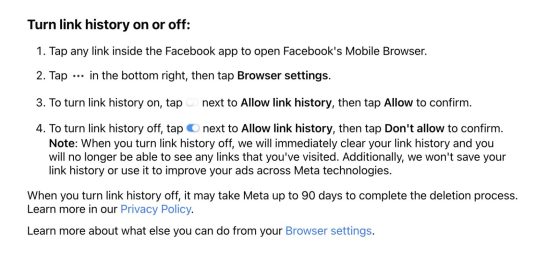
Now, reports say that a new way to achieve this has been recently launched by the giant, and notably, for the first time this type of tracking is made visible. Called Link History, the new feature is found in the Facebook app as essentially one of the permissions, and “documents” every link a user clicks while using the app.
Once again, fully in vein of what Google, Microsoft, etc., are doing, Facebook says the change – putting all links in one place – is there for better user experience, and again habitually, while the feature is not mandatory, it is there by default and “hiding” behind a pretty solid wall of an “opt-out.”
Whatever the case may be, most users don’t bother jumping over that wall, allowing corporations to at once offer a choice – and in most cases have it their way.
In order to deactivate this on their app, users first need to be aware Link History exists, and then navigate to the appropriate setting in order to “opt out.”
But there is no shortage of criticism of this latest move, from the privacy point of view (although mainstream tech press curiously chooses to single out Facebook while praising Google and Apple as some sort of “privacy warriors” now).
This should be viewed as part of the big (political) picture where keeping pressure on Facebook as still the most influential social media is especially important in an election year – while at the same time rightfully questioning Facebook’s (persistent) motivation for pursuing cross-site user tracking.
A classic example of two things getting to be true at the same time.
Facebook (Meta) doesn’t exactly pretend it is working solely to make sure users “never lose a link again” and enjoy other things that benefit them. A part of Link History’s announcement spells this out: “When you allow link history, we may use your information to improve your ads across Meta technologies.”
What the statement doesn’t clarify is if any of the well-known, ultra-invasive methods it uses to track users will actually change in any way with the introduction of Link History.
Every social media company censoring for government – Elon Musk
RT | December 27, 2022
All social media platforms work with the US government to censor content, Twitter CEO Elon Musk claimed on Tuesday. Documents released by Musk following his purchase of Twitter showed that the platform colluded with the FBI, CIA, Pentagon and other government agencies to suppress information on elections, Ukraine, and Covid-19.
“*Every* social media company is engaged in heavy censorship, with significant involvement of and, at times, explicit direction of the government,” Musk tweeted, adding that “Google frequently makes links disappear, for example.”
Musk was referring to internal Twitter communications published by journalist Matt Taibbi, which suggested that the platform’s senior executives held regular meetings with members of the FBI and CIA, during which the agencies gave them lists of “hundreds of problem accounts” to suspend in the runup to the 2020 election.
In addition to Twitter, the government was in contact “with virtually every major tech firm,” Taibbi claimed. “These included Facebook, Microsoft, Verizon, Reddit, even Pinterest.” CIA agents “nearly always” sat in on meetings of these firms with the FBI’s Foreign Influence Task Force, Taibbi claimed, explaining that although this task force was convened to fight alleged election interference by foreign states, it made “mountains of domestic moderation requests.”
A lawsuit filed earlier this year by the attorneys general of Missouri and Louisiana alleges that officials from no fewer than 12 government agencies met weekly with representatives of Twitter, Facebook, and other Big Tech firms in 2020 to decide which narratives and users to censor, with topics ranging from alleged election interference to Covid-19.
A self-described “free speech absolutist,” Musk purchased Twitter for $44 billion in October. He has since released batches of documents shedding light on the platform’s previously opaque censorship policies. Published by several independent journalists, these document dumps have shown how Twitter suppressed information damaging to Joe Biden’s election campaign, colluded with the FBI to remove content the agency wanted hidden, assisted the US military’s online influence campaigns, and censored “anti-Ukraine narratives” on behalf of multiple US intelligence agencies.
The FBI said last week that correspondence between its agents and Twitter staff “show nothing more than examples of our tradition [of] longstanding and ongoing federal government and private sector engagements.”
The White House has refused to answer allegations that the FBI directed Twitter to censor information damaging to Joe Biden’s 2020 campaign.
Russia makes move on foreign firms leaving the country
Samizdat | May 25, 2022
Lawmakers have approved a bill allowing Moscow to introduce control over foreign companies’ assets in Russia if their owners have ceased activities in the country “for no apparent economic reasons.” The legislation passed in the first reading in the Russian State Duma on Tuesday.
The bill applies to companies in which foreign equities account for 25% or more if they are of ‘major’ significance for the Russian economy. They could be the only supplier of ‘critically important industries’, produce goods of prime necessity, or be a local economic mainstay.
The legislation is primarily aimed at firms that have left Russia and decided to do so “based on the anti-Russian sentiments in Europe and the US,” a statement published by the State Duma says.
External control could only be imposed by a court for a period of up to 18 months, the bill says. The measure could then be lifted before the scheduled date if shareholders that together own more than 50% of the stock file a request with the Russian authorities and remove the causes that led to the court decision.
A court would be able to impose external control over a company’s assets for a number of reasons, including supply-side shocks, key supply chain breaches, as well as job slashing and “actions or inaction” that could lead to casualties or technogenic disasters.
Moscow has been mulling the seizure of foreign assets for months after many foreign companies halted operations in the country over the fighting in Ukraine. Consumer protection groups such as the Public Consumer Initiative (OPI) have been calling for the measure to be introduced against the likes of Apple, IKEA, Microsoft, IBM, Shell, McDonald’s, Volkswagen, Porsche, Toyota, H&M, and others.
Under the proposed bill, external management would not mean full nationalization. Foreign owners would have the opportunity to get their assets back and resume operations in Russia, or sell their shares.
Backed by Big Pharma, NewsGuard Brings ‘Fact Checking’ to Tens of Millions of Kids in Schools
By Michael Nevradakis, Ph.D. | The Defender | February 28, 2022
The American Federation of Teachers (AFT) is partnering with NewsGuard — a for-profit “fact-checking” company with deep ties to Big Pharma — to help students in U.S. classrooms “navigate a sea of online disinformation.”
AFT is the second-largest teachers’ union in the U.S. It’s also a staunch advocate of mandatory COVID vaccination and masks for schoolchildren.
Under a deal announced last month, AFT agreed to purchase NewsGuard licenses for its entire membership of teachers — 1.7 million in total — making the NewsGuard tool available to tens of millions of public school students and their families.
Teachers will receive licensed copies of NewsGuard’s internet browser extension, providing access to its “traffic light” ratings and “nutrition label” reviews evaluating the purported reliability of news and information websites when those sites are visited.
Announced during “News Literacy Week,” AFT touted the agreement as an opportunity for its member teachers to play a bigger role in helping their students “navigate a sea of online disinformation.”
AFT stated:
“For years, educators have fought battles against suspect sourcing, with their students often misled by dubious outlets and spam sites posing as ‘news’. NewsGuard offers a practical solution, alerting students and educators to those sites while also providing a valuable lesson in media literacy.
“Students and their teachers will be able to see how NewsGuard applies nine criteria of journalistic practice to thousands of websites and will get an immediate read on the truthfulness and rigor of the information they encounter when searching online.”
Randi Weingarten, president of AFT, added:
“We are constantly trying to help our students, particularly our middle, high school and post-secondary students, separate fact from fiction, as we help them develop their critical-thinking and analytical skills.
“NewsGuard is a great tool in this regard. It is a beacon of clarity to expose the dark depths of the internet and uplift those outlets committed to truth and honesty rather than falsehoods and fabrications. This historic deal will not only help us steer clear of increasingly fetid waters—it will provide a valuable lesson in media literacy and a discussion point for teachers in class on what can, and can’t, be trusted.
“The hallmark of good journalism is fair, richly sourced reporting that gives citizens an insight into how the world works. Sadly, the foundational role of the fourth estate is in danger of being poisoned by torrents of trash. NewsGuard reminds us of the importance of an independent press that students can rely on to form their own views and opinions so they can participate as active citizens in our democracy.”
Axios described the deal as one in which American schoolchildren are getting “an internet librarian,” adding that “[t]he hope is that students with the skills to spot disinformation will grow into more thoughtful and better-informed citizens and voters.”
Drawing on the library analogy, NewsGuard stated:
“Imagine you walked into a library, and there were a trillion pieces of paper flying around in the air, and you grabbed one, and you didn’t know anything about it, or where it came from or who’s financing it.
“That’s the internet, that’s your Facebook feed, that’s your Google search.”
Helping children become more media literate and better able to spot misinformation online appears, at face value, to be a noble goal.
However, a closer look at NewsGuard’s advisers, partners and investors reveals a web of interests closely linked to the military, intelligence, media and political establishments, as well as to the world of corporate marketing — including an advertising agency sued for illegally marketing opioids.
How does NewsGuard work?
Launched in March 2018 as an effort to “fight fake news,” NewsGuard maintains a database of news and information outlets, which are ranked for their supposed “trustworthiness.”
These rankings then become available to the public via extensions that are available for mainstream browsers such as Google Chrome, Firefox and Microsoft Edge.
Once installed, the browser extension displays green or red warning labels next to a ranked website’s address, indicating whether the site is considered to be “trustworthy” or not.
As of January 2022, NewsGuard had evaluated and ranked 7,466 domains which it claims covers 95% of online news engagement.
Algorithms alone are insufficient for identifying “fake news,” according to NewsGuard:
“Our goal isn’t necessarily to stop [fake news] but to arm people with some basic information when they’re about to read or share stuff,” Brill said. “We’re not trying to block anything.
“Our goal is to help solve this problem now by using human beings—trained, experienced journalists—who will operate under a transparent, accountable process to apply basic common sense to a growing scourge that clearly cannot be solved by algorithms.”
How does this evaluation process take place?
NewsGuard uses nine weighted criteria to rate and analyze news websites along two broad categories: credibility and transparency.
The following five criteria are incorporated into the “credibility” category, listed alongside their respective “weights”:
- Does not repeatedly publish false content (22 points).
- Gathers and presents information responsibly (18 points).
- Regularly corrects or clarifies errors (12.5 points).
- Handles the difference between news and opinion responsibly (12.5 points).
- Avoids deceptive headlines (10 points).
Under the “transparency” category are these four criteria:
- Discloses ownership and financing (7.5 points).
- Clearly labels advertising (7.5 points).
- Reveals who’s in charge, including possible conflicts of interest (5 points).
- Provides the names of content creators, along with either contact or biographical information (5 points).
It is unclear how the respective “weights” were determined and set, or how they are measured.
Connected to these nine criteria, NewsGuard implemented a “Nutrition Label” system, which it uses to rate news sites according to one of four categories: “Green,” “Red,” “Satire” or “Platform.” The corresponding icon then appears in browsers when a rated website is visited.
These categories are connected to the previously mentioned point system, such that sites with a “score” of 60 points or higher earn a “Green” label, while those below 60 points are given a “Red” label.
Specifically:
- A “Green” label indicates the website “generally adheres to basic standards of credibility and transparency.”
- A “Red” label indicates the website “generally fails to meet basic standards of credibility and transparency.”
- Α “Satire” (yellow) label indicates the website is “not a real news website.”
- A “Platform” (gray) label indicates the website “primarily hosts user-generated content that it does not vet” and the information on this site “may or may not be reliable.”
The “Nutrition Labels,” aside from the color-coded system indicated above, also include a more detailed analysis about each news site. As explained by NewsGuard:
“The labels will explain the history of the site, what it attempts to cover, who owns it, who edits it, and make transparent other relevant factors, such as financing, notable awards or missteps, whether the publisher participates in programs such as the Trust Project, which holds publishers to transparency standards, or has repeatedly been found at fault by one of the established programs that check individual articles.”
In other words, there is a direct connection between NewsGuard’s website-level rating system and the various “fact-checking” entities that evaluate the content of individual news stories.
Each website is initially “independently reviewed” by a NewsGuard analyst against the nine criteria. The analyst prepares the “Nutrition Label,” the website is contacted for comment, and then “at least one senior editor and NewsGuard’s co-CEOs review every Nutrition Label prior to publication to ensure that the rating is as fair and accurate as possible.”
In addition to its formal ratings process, a separate NewsGuard “SWAT Team” is “on call on a 24/7 basis to receive and act on alerts about sites that are suddenly trending, but that have not yet been rated — including because the site was just launched to promote a fictitious, sensational story.”
The “SWAT Team” then rates these websites in real time.
NewsGuard also works on social media platforms — specifically, on links to news articles on other websites that are posted on social media.
Additionally, NewsGuard maintains what it calls “advertiser inclusion lists.” As of January, these lists contained 4,247 so-called “quality news sites.” The lists are used to help online advertisers direct their advertising expenditures toward websites NewsGuard deems reliable.
NewsGuard, which received $6 million in seed funding from various investors and venture capitalists, is subscription-based.
A NewsGuard subscription costs $2.95 per month, which includes the browser extension and a mobile app for Android and iOS devices. (The browser extension is available for free on the Microsoft Edge browser, thanks to a licensing agreement with Microsoft).
AFT deal not first time NewsGuard has ventured into education arena
For some, fighting “fake news” on websites and social media isn’t enough — they believe the “battle” needs to reach educational institutions.
As stated in 2019 by Jonathan Anzalone, assistant director and lecturer at Stony Brook University’s Center for News Literacy:
“Our problems are much larger than identifying a bogus website or a piece of propaganda. It’s like we just invented fire, and we’re trying to learn how to deal with it. It will take more than a few tools, as valuable as they may be.”
As a solution, Anzalone recommended “large-scale educational intervention” and “constant reinforcement in class and at home that we have to be critical of the news.”
These calls for “educational intervention” in 2019 perhaps foreshadowed NewsGuard’s later turn toward educational institutions.
NewsGuard’s past educational collaborations may also provide more than a few hints as to the types of learning materials it will provide as part of its new agreement with AFT.
Prior to NewsGuard’s new agreement with AFT, it had maintained a collaboration with Turnitin, a tool commonly used in secondary and higher education to evaluate students’ written assignments and identify possible cases of plagiarism.
NewsGuard’s partnership with TurnItIn, announced May 4, 2020, was touted as an initiative “that will help many million students and teachers spot and avoid misinformation, improve their research abilities and develop critical media literacy skills.”
On its end, Turnitin promoted its collaboration with NewsGuard as a marriage between “academic integrity” and “digital literacy” that would enable students to “navigate 21st-century news with 21st-century skills” and to “imbue [their] work with integrity right from the source.”
Offering NewsGuard through the Turnitin service would allow “students and instructors, writers and researchers [to] confidently discern the legitimacy of digital news and information, using only the sources best suited for their needs.”
Commenting on this partnership in 2020, Crovitz described it as a “perfect match,” and stated:
“From the start, our mission has been to help people tell the difference between trustworthy sources and the many online sources that have hidden agendas, publish misinformation, or exist to promote hoaxes.
“We have heard from many teachers how valuable NewsGuard has been to help students in their research and writing find sources that publish with accuracy and integrity and to stay away from the others. To be able to provide that information to Turnitin’s millions of students and teachers is a tremendously important milestone in advancing that mission.”
Free access to NewsGuard via Turnitin appears to have ended with the conclusion of the 2020-2021 academic year. However, a series of NewsGuard learning materials developed as part of the partnership with Turnitin remain online, and provide a likely indication as to the nature and content of the resources NewsGuard will now make available to schools and teachers as part of its new collaboration with AFT.
These resources, which offer an eye-opening look at how students are instructed to identify so-called “misinformation,” include:
- A NewsGuard lesson plan on the COVID-19 “Infodemic.”
- A guide to Turnitin source credibility and how it can be aligned with NewsGuard lesson plans.
- An implementation guide for school administrators.
- A set of “best practices” for educators about using NewsGuard.
- A student guide for using NewsGuard.
- A complete collection of NewsGuard resources.
The lesson materials for the so-called COVID-19 “Infodemic,” which are targeted primarily to high school students, but also, middle school and university students, include the following statement:
“As misinformation about COVID-19 proliferates online, and as remote learning and social distancing cause students to spend even more of their time on social media and other platforms, media literacy skills have taken on greater importance.
“To address this need, NewsGuard has created a suite of plug-and-play resources for educators to teach a media literacy lesson through the lens of COVID-19 misinformation.”
A set of PowerPoint slides on “Coronavirus Conspiracies & Other Health Hoaxes,” includes a quiz wherein one of the questions asks students to identify which sources they would trust, out of the following list: Medicine-Today.net, MedicineNet.com, Vaccination.co.uk, Patient.info, HealthyChildren.org, and ChildrensHealthDefense.org (the ‘correct’ answers, we are told, are MedicineNet.com, Patient.Info, and HealthyChildren.org).
An accompanying “tip sheet” unironically advises students, educators, and parents to “be suspicious of requests for secrecy or pressure to take action quickly,” and to “teach yourself and your kids to ask the tough questions.”
In turn, the “best practices” recommended by NewsGuard and Turnitin include a suggestion that “students should reference NewsGuard throughout the semester/year,” whenever “they need to do research for a project or paper or any time they need to consult current events.”
As part of this, educators are advised to “have students annotate their bibliographies with explanations for why they selected each source, drawing from NewsGuard’s Nutrition Label reviews to provide evidence for why they deemed certain sources reliable.”
NewsGuard partnerships extend to businesses, ad agencies and the WHO
NewsGuard’s line of products extends beyond its browser extension, “Nutrition Labels,” and educational materials.
For example, it offers a product called “Misinformation Fingerprints,” a “catalog of all the top current hoaxes on the internet.”
According to NewsGuard, the product is “purpose-built for use by both human analysts and AI tools” which “provide a continuously updated view of the digital information environment — and a powerful way to track narratives that are emerging and spreading online,” specifically, the “top misinformation narratives spreading online.”
The users of “Misinformation FIngerprints” include the Pentagon’s Cyber Command and the U.S. State Department’s Global Engagement Center.
For businesses, an “Insights Dashboard” helps clients access NewsGuard’s news reliability ratings and misinformation fingerprints “through a powerful, searchable web interface purpose-built for use by businesses seeking to identify and mitigate risks from misinformation and disinformation.”
“BrandGuard” targets advertisers and advertising agencies. It is touted as “the only humanly generated, constantly updated solution” to help such companies “avoid advertising on misinformation sites while finding valuable new inventory on trustworthy news sites.”
Similarly, NewsGuard’s “HealthGuard” product targets the healthcare industry and global public health authorities.
Described as “a vaccine against medical information,” HealthGuard, we are told, “helps patients, healthcare workers and anyone involved in the medical field identify trustworthy sources of health information — and avoid dangerous misinformation.”
How does HealthGuard purport to accomplish this?
It maintains a set of ratings for more than 3,000 online health information sources, as well as a catalog of “false health narratives — from bogus cancer cures to COVID vaccine myths,” through which it “provides a solution to the “infodemic” of rampant online health misinformation.”
The WHO said it relies on NewsGuard “to fight health hoaxes. Andy Pattison, head of the WHO’s Digital Channels Team, said:
“Though health misinformation circulates online, it causes real life consequences. We must put tools in the hands of people everywhere so they can better assess the credibility of health information online in order to make informed health choices in their life.
“NewsGuard has been instrumental in helping WHO and partners keep people safe by identifying and combating online COVID-19 and vaccine misinformation.”
NewsGuard on Aug. 24, 2020, announced a partnership agreement, “to provide the WHO and the technology platforms that WHO advises on healthcare-related online safety with a variety of reports and data aimed at fighting online COVID-19 misinformation online.”
Dr. Sylvie Brand, director of the WHO’s infectious hazards management department, described the partnership with NewsGuard:
“WHO has been fighting an infodemic of misinformation on multiple fronts, working hand in hand with governments, the private sector and civil society.
“It is vital that people everywhere get the right information at the right time to protect themselves and their loved ones. That’s why we are looking forward to working with NewsGuard and other platforms to fight misinformation and disinformation.”
In turn, NewsGuard claims that, through the provisions of this agreement where it will provide information about health “hoaxes” to social media and search platforms, “digital platforms will finally be able to act before these new myths — whether it’s about a vaccine or another supposed source of the virus—spread on their platforms.”
As it turns out, NewsGuard since 2020 has filed at least 29 such reports with the WHO As described by NewsGuard, these reports have highlighted:
“… trending health hoaxes and conspiracies across Facebook, Instagram, and YouTube, which the WHO has been able to share with digital platforms to alert them to misinformation and hoaxes on their platforms.
“These reports identify large social media pages, accounts, and public and private groups that encourage the spread of false and often dangerous narratives about the virus and vaccines.”
One such report, dated Oct. 28, 2021, is titled “Despite NewsGuard’s prior warnings in reports to the WHO, Facebook and Instagram have allowed known anti-vaccine misinformation superspreaders to flourish on their platforms.
A June 22, 2021 report, “COVID-19 and Vaccine Misinformation Groups and Pages on Facebook” prominently features Children’s Health Defense (CHD), among other pages and groups.
NewsGuard included CHD on its list of websites that spread “vaccine myths,” lamenting that “[s]ome of the websites NewsGuard identified have become more popular online than trustworthy sources of information about COVID-19,” while specifically stating that CHD’s website “has received more engagement … than the CDC and the National Institutes of Health.”
A February 2021 NewsGuard interview with Robert F. Kennedy, Jr. was “annotated in italics in footnote form with fact checks debunking the dozens of arguments Kennedy employed to bolster his false claim that Pfizer and Moderna’s COVID-19 vaccines are dangerous.”
NewsGuard’s involvement in health-related matters also extends to the creation of a “COVID-19 Misinformation Tracking Center,” which “reports on fake news, rumors and bad actors related to the Coronavirus Pandemic.”
What constitutes a “bad actor” does not appear to be defined.
Via this “tracking center,” NewsGuard compiled a list of 53 supposed COVID myths. The list appears in a September 2021 NewsGuard “special report” on “Top COVID-19 vaccine myths.”
In addition to partnering with the WHO, NewsGuard’s HealthGuard partners with the Center for Countering Digital Hate (CCDH).
Described by Mercola as “a progressive cancel-culture leader,” CCDH has “extensive ties to government and global think tanks that has labeled questioning the COVID-19 injection as ‘threats to national security.’”
Who are the people behind NewsGuard?
NewsGuard was founded by two veterans of mainstream journalism: Steven Brill (who previously founded Court TV, the Yale Journalism Initiative and The American Lawyer), and Gordon Crovitz, former publisher of the Wall Street Journal.
When it launched, NewsGuard had a team of 25 professional journalists, purportedly to evaluate the reliability of news sources.
Two other key founding members of NewsGuard, who are still with the company, include James Warren and Eric Effron.
Brill and Crovitz are members of the U.S. Council on Foreign Relations, a highly influential U.S. foreign policy establishment think tank.
This stance is further reflected in the makeup of NewsGuard’s advisory board, which includes a who’s who of individuals from the political, intelligence, Big Tech and media establishments, including:
- Don Baer, who served as White House communications director during the administration of Bill Clinton
- Arne Duncan, who served as Secretary of Education during the administration of Barack Obama.
- (Ret.) General Michael Hayden, former director of the CIA, former director of the NSA, and former Principal Deputy Director of National Intelligence.
- Leo Hindery, Jr., the former chairman of the National Cable Television Association.
- Elise Jordan, a political analyst for NBC News and a former speechwriter for Secretary of State Condoleezza Rice, under the administration of George W. Bus.
- Kate O’Sullivan, general manager for digital diplomacy of Microsoft.
- Anders Fogh Rasmussen, former general secretary of NATO, former prime minister of Denmark, and founder of the Alliance of Democracies Foundation.
- Tom Ridge, the first Secretary of Homeland Security, under the administration of George W. Bush.
- Richard Stengel, former editor of Time Magazine and former Undersecretary of State for Public Diplomacy under the administration of Barack Obama. He is the author of “Information Wars: How We Lost the Global Battle Against Disinformation and What We Can Do About It.”
- Jimmy Wales, co-founder of Wikipedia.
NewsGuard says members of the advisory board play “no role in the determination of ratings or the Nutrition Label[s] … unless otherwise noted” and “have no role in the governance or management of the organization.”
However, members’ association with the military and intelligence community and their connections to major technology companies and media outlets that support COVID measures and mandatory vaccination cannot be overlooked.
Looking at NewsGuard’s team members, similar connections can be made to the media, political and intelligence establishments.
Two team members, Alex Cadier and Amy Westfeldt, have previous “fact-checking” experience. Cadier worked with Agence France-Presse’s AFP Fact Check Service since 2020, with a focus on “COVID-19 vaccine misinformation, 5G conspiracy theories and other myths.”
Westfeldt produced The Associated Press’ first fact checks, soon after the 2016 U.S. presidential election, in conjunction with Facebook. She also founded the “Not Real News” fixture.
Two other team members, Nerissa Beekharry and Cynthia Brill, were previously associated with Verified Identity Pass, operator of the Clear Pass for airport security checkpoints.
And at least two team members, Sam Howard and Sruthi Palaniappan, were involved in presidential campaigns: Howard with the Obama 2012 campaign and Palaniappan with Hillary Clinton’s campaign in 2016, the same year he was a delegate at the Democratic National Convention .
NewsGuard’s partnerships also reflect an affinity for entities associated with Big Tech, the military and intelligence establishments and government more broadly — even as a private initiative.
For example, NewsGuard partners include:
- Microsoft (including Microsoft Bing, Microsoft Edge, Microsoft Education and MSN).
- The WHO.
- The U.S. Department of Defense and the U.S. State Department.
- The U.S. National Security Innovation Network.
- The UK’s Department for Digital, Culture, Media and Sport.
- The News Media Alliance (a U.S.-Canada newspaper trade association).
- The German Marshall Fund of the United States.
- GumGum (a “contextual intelligence” company).
- Dartmouth University, Northeastern University and the University of Michigan.
- Advertising and marketing firms such as IPG, Peer39, TripleLift and the Publicis Groupe.
Backed by Big Pharma?
As mentioned above, NewsGuard received approximately $6 million in venture funds for its launch.
One of its major early investors was the Publicis Groupe, a multinational advertising agency and communications conglomerate.
Publicis, the third largest communications group in the world, divides its businesses into four “solutions hubs”: Publicis Communications, Publicis Media, Publicis Sapient and Publicis Health.
It is Publicis’ health division that has generated significant controversy. The company names “40 clients in the life sciences industry,” including “being a preferred partner with 13 of the top 20 global pharmaceutical companies.”
These clients include Pfizer, AstraZeneca, Merck, Bayer, Abbot, Allergan, Biogen, Eli Lilly, Genentech, Gilead, Sanofi and Purdue Pharma.
In October 2018, GlaxoSmithKline sent its $1.5 billion media account to the Publicis Group, then added an additional $400 million account — for its new portfolio of Pfizer Consumer Healthcare brands such as Advil, Caltrate, and Centrum, as part of a joint venture with Pfizer.
In August 2019, Publicis secured the account of another pharmaceutical giant, Novartis, worth $600 million.
However, it was its partnership with Purdue Pharma that directly generated controversy and legal trouble for the Publicis Groupe.
In May 2021, the Massachusetts attorney general’s office filed a lawsuit against Publicis Health, accusing it of helping Purdue Pharma develop deceptive marketing materials and advertising campaigns, used to mislead doctors into prescribing OxyContin, a widely-abused opioid.
According to the lawsuit:
“From 2010 until 2019, Publicis worked with opioid companies, particularly Purdue Pharma, to increase sales of dangerous opioids like OxyContin, including in Massachusetts, in ways that increased the risk to patients and the public of opioid use disorder, overdose, and death.
“Publicis devised and deployed unfair and deceptive marketing campaigns designed to push doctors to prescribe opioids to more patients, in higher doses, and for longer periods of time.”
So while NewsGuard purports to be fighting against online misinformation and deception pertaining to public health — it has no problem taking money from a major advertising and communications conglomerate that has itself been accused of deceptive practices relating to health care.
Maurice Lévy, chairman of the Publicis Group, made the following remarks on the occasion of NewsGuard’s launch:
“Advertisers are increasingly concerned about their brand safety and do not want to help finance and appear alongside fake news.
“NewsGuard will be able to publish and license ‘white lists’ of news sites our clients can use to support legitimate publishers while still protecting their brand reputations.”
As noted by Dr. Joseph Mercola:
“Seeing how Publicis represents most of the major pharmaceutical companies in the world and funded the creation of NewsGuard, it’s not far-fetched to assume Publicis might influence NewsGuard’s ratings of drug industry competitors, such as alternative health sites.
“Being a Google partner, Publicis also has the ability to bury undesirable views that might hurt its clientele.”
Publicis is a partner of the World Economic Forum (WEF) and, indeed, appears as a partner of the WEF’s “Great Reset” (as are pharmaceutical companies and COVID-19 vaccine manufacturers such as AstraZeneca, Johnson & Johnson, Moderna, and Pfizer).
What appears to be a common thread connecting NewsGuard employees, investors and partners is connections to organizations that have a vested interest in promoting COVID vaccination and pandemic countermeasures;
And now NewsGuard is coming to children’s schools.
Michael Nevradakis, Ph.D., is an independent journalist and researcher based in Athens, Greece.
© 2022 Children’s Health Defense, Inc. This work is reproduced and distributed with the permission of Children’s Health Defense, Inc. Want to learn more from Children’s Health Defense? Sign up for free news and updates from Robert F. Kennedy, Jr. and the Children’s Health Defense. Your donation will help to support us in our efforts.
Google, Amazon staff protest ties to Israel spy network
MEMO | October 13, 2021
Employees of the tech giants, Google and Amazon, have condemned the companies for their contract with the Israeli military to develop cloud-based cybersecurity services, and have called on their employers to cut their ties with the occupation forces.
As part of the major $1.2 billion contracts signed with the Israeli military in May, following a bid in which it beat other giants like Microsoft, Google and Amazon are to provide cloud services technology to Tel Aviv and its armed forces.
In an article published yesterday in the Guardian newspaper, however, hundreds of anonymous employees of the companies, who described themselves as “employees of conscience from diverse backgrounds”, condemned the program named ‘Project Nimbus.’
Referencing their belief “that the technology we build should work to serve and uplift people everywhere,” the employees stated that “we are morally obligated to speak out against violations of these core values.”
They wrote that “we are compelled to call on the leaders of Amazon and Google to pull out of Project Nimbus and cut all ties with the Israeli military,” revealing that the signatories of the letter-number over 90 at Google and over 300 at Amazon.
The employees, who confirmed that they “are anonymous because we fear retaliation,” acknowledged that “We cannot look the other way, as the products we build are used to deny Palestinians their basic rights, force Palestinians out of their homes, and attack Palestinians in the Gaza Strip.”
If Google and Amazon continue with the project which would “sell dangerous technology to the Israeli military and government”, then it would only enable the “further surveillance of and unlawful data collection on Palestinians, and facilitate the expansion of Israel’s illegal settlements on Palestinian land.”
Aside from urging the companies to abandon the project and their ties with Israel’s occupation forces, the employees also “call on global technology workers and the international community to join with us in building a world where technology promotes safety and dignity for all.”
Governments are using credit card purchase data as “contact tracing’ COVID surveillance
By Didi Rankovic | Reclaim the Net | July 16, 2021
The ongoing “war on cash” that far preceded the pandemic, whose goal is to steer people towards using traceable forms of payment, is coming in very handy in the COVID era precisely for the reason the policy is criticized in the first place – it makes it easy for authorities to keep tabs on individuals who use card transactions.
Reports now mention instances of Australian residents receiving a mandate to quarantine after using their credit card to pay at an establishment, where somebody known to be infected with the virus had stayed.
Credit card receipts led back to the person that was then forced to self-isolate (although they did not have coronavirus) – and apparently led the person to consider what, if anything, is left of their privacy in a world where more and more people leave long “data trails” behind them.
Stop-gap measures like switching to alternative browsers etc (while probably running it on Windows) aside – the takeaway is that the only way to regain some privacy in the world of mass surveillance and tracking is to turn to alternatives – but do it consistently, and be prepared to pay for the privilege of removing oneself from the closed ecosystems like those ruled with an iron fist by Google, Apple, or Microsoft.
As for using card transactions to do COVID contact tracing, Australia is far from being the only country that is doing it. In fact, those lauded as most successful in even getting their contact tracing efforts off the ground, like South Korea, pioneered the practice. Data surveillance, reports said, was used by authorities there to make sure that people who were either unable or unwilling to share their every move are eventually forced into doing it.
Australia has “distinguished” itself for being willing to jeopardize people’s privacy with a series of COVID surveillance and control measures over the past 18 months, and last November, the National Contact Tracing Review, whose chair is Australia’s Chief Scientist Alan Finkel, recommended using consumer credit card data for track and trace purposes.
But what about privacy? Privacy rules will apply – until they don’t, seems to be the gist of it.
“Privacy rules will apply,” the Review said, but then added, “and in some jurisdictions legislative change may be required.”
Featured Video

No Threat Can Force Iran’s Surrender /Trita Parsi & Lt Cl Daniel Davis
or go to
Aletho News Archives – Video-Images
From the Archives
An Expert Military Analysis of War with China
Actually, None is Necessary
By Fred Reed • Unz Review • December 13, 2020
The Correlation of Armed Forces: U.S. goods and services trade with China totaled an estimated $634.8 billion in 2019. Exports were $163.0 billion; imports were $471.8 billion. The U.S. goods and services trade deficit with China was $308.8 billion in 2019. Trade in services with China (exports and imports) totaled an estimated $76.7 billion in 2019. Services exports were $56.5 billion; services imports were $20.1 billion. The U.S. services trade surplus with China was $36.4 billion in 2019.
There is talk within the Washingtoniat of a possible war with China. Steve Bannon, who apparently was dropped on his head as a child, actually favors such a war. We hear the usual shoo-the-boobs alarm about how the Chinese are doing something terrible and we must gird our loins and American values and show them what for, bow wow, woof. The danger is that the current game of who-blinks-first in Asian waters might actually provoke a shooting war. You know the kind of thing: One warship refuses to get out of the way of another, a collision ensues, some retard lieutenant who signed up on waivers opens fire, and we’re off and running. It is not a good idea to let children play with matches.
The said war is discussed either in emotional terms by idiots or in purely naval terms by those familiar with such things, so we hear of the First Island Chain and the Second Island Chain and whose missiles against the other’s missiles and so on. This would be appropriate if we were fighting World War Two again. Which we aren’t. Let’s take a quick-and-dirty look at how such a war might go.
To begin the war, America would overestimate itself and underestimate China. This is doctrine in the Pentagon. … continue
Blog Roll
 Aletho News
- Iran To Target Military Industrial-Tech Complex That Facilitated Gaza Genocide
- Collapsing Empire: The Resistance Disarms ‘Israel’
- Suicide Should Not Be a Government Service
- Rethinking America’s greatest threat: Iran vs. Israel-Firsters
- Iran accuses adversaries of false flags to strain Turkey ties
- Poland rules out sending Patriot missiles to US/Israel amid war on Iran
- Tehran approves new Hormuz plan with major restrictions
- No Threat Can Force Iran’s Surrender /Trita Parsi & Lt Cl Daniel Davis
- UK’s New Pandemic Plan Would Turn Big Tech Into a Mass Location Tracking Network
- Growing insecurity, soaring prices fuel protests in north as regime bans evacuation: Sources
- If Americans Knew
- Ann Coulter Rips Into Fox News for Iran War Coverage, Compares to False Rigged 2020 Election Reporting
- Joe Kent Urges Americans To Call White House and Congress To Object To Sending Troops Into Iran
- DNC Resolution to Reject AIPAC Funding Puts Democratic Leaders in the Hot Seat
- Swedish foundation to build 400 schools as over 650,000 Gaza children remain without education for 2 years
- Israeli army admits photshopping image of slain Lebanese journalist
- This is how Israel is systematically killing health workers under the cover of war in Lebanon
- Carrying life under fire: Israeli invasion of Lebanon leaves pregnant women facing deadly risks
- Champagne all around for the new death penalty (for Palestinians) law – Not a ceasefire Day 172
- Why are Palestinian books struggling to be seen on Amazon?
- The Line Between Affinity and Conspiracy
- No Tricks Zone
- New Study Finds Warming Saves Lives…Cold Temperatures 12 Times More Deadly Than Excess Heat
- German Science Blog Accuses PIK Climate Institute Of Hallucinating Climate Tipping Points
- Devastating Assessment Of Comirnaty Vaccine By Former Senior Pfizer Europe Toxicologist
- New Study: CO2 Is ‘Effectively Negligible’ As An Explanatory Climate Change Factor Since 2000
- Former Pfizer Toxicologist Dr. Helmut Sterz Tells Bundestag Hearing Pfizer Vaccine Should Have Never Been Approved
- Energy Expert: Germany’s Nuclear Phaseout Was A “500 Billion Euro Mistake”
- New Research: South Australia’s Mid-Holocene Sea Surface Temperatures Were 4°C Warmer Than Today
- Storing Green Energy To Last Germany 10 Days Would Require A 60-Million Tonne Battery
- New Studies: UK Sea Levels Were 4 Meters Higher Than Today During The Mid-Holocene
- Destructive Green New Deal: German Energy And Metal Group Warns Of Drastic Crisis
 Aletho News