The Israel Lobby Wants Thomas Massie Gone. Will Voters Obey?
By Jose Alberto Nino | The Occidental Observer | September 29, 2025
The knives are out for Rep. Thomas Massie (R-KY), and his political survival could prove whether Congress still answers to American voters or to a foreign lobby with limitless cash.
Pro-Israel Republican megadonors recently set up the MAGA Kentucky super PAC with $2 million specifically to oust Massie. Paul Singer contributed $1 million, John Paulson added $250,000, and Miriam Adelson’s Preserve America PAC provided $750,000. The Republican Jewish Coalition has promised “unlimited” campaign spending if Massie runs for Senate, with CEO Matt Brooks declaring that “if Tom Massie chooses to enter the race for US Senate in Kentucky, the RJC campaign budget to ensure he is defeated will be unlimited.”
President Donald Trump has also jumped into the fray, branding Massie a “pathetic loser” who should be dropped “like the plague.” Overall, a constellation of pro-Zionist forces is mobilizing at full force to unseat Congress’s most principled non-interventionist politician since Ron Paul retired in 2013. In many respects, Massie has taken up Paul’s mantle of foreign policy restraint — a political agenda that has never sat well with organized Jewry. Massie’s legislative track record on foreign policy speaks for itself.
Massie’s Long Track Record of Voting Against Foreign Policy Interventionism
Throughout his congressional career, Massie has established himself as Congress’s most consistent opponent of the neoconservative/neoliberal foreign policy consensus. His principled opposition to endless wars and foreign entanglements has earned him the nickname “Mr. No” — similar to his predecessor Ron Paul — for frequently casting lone dissenting votes against military interventions.
In 2013, Massie introduced the War Powers Protection Act to “block unauthorized U.S. military aid to Syrian rebels.” He argued that “since our national security interests in Syria are unclear, we risk giving money and military assistance to our enemies.” When Obama sought to arm Syrian rebels in 2014, Massie voted against the plan, declaring it “immoral to use the threat of a government shutdown to pressure Members to vote for involvement in war, much less a civil war on the other side of the globe.”
Massie consistently opposed U.S. involvement in Yemen’s civil war, co-sponsoring multiple bipartisan resolutions to invoke the War Powers Resolution and “remove United States Armed Forces from unauthorized hostilities in the Republic of Yemen.” He stated that “Congress never authorized military action in Yemen as our Constitution requires, yet we continue to fund and assist Saudi Arabia in this tragic conflict.”
His opposition to NATO expansion proved equally consistent. In 2017, Massie was one of only four House members to vote against a pro-NATO resolution, explaining that “the move to expand NATO in Eastern Europe is unwise and unaffordable,” and such expansion contradicted Trump’s campaign assertion that “NATO is obsolete.”
Regarding the Russo-Ukrainian war, Massie maintained his non-interventionist stance, receiving an “F” grade from Republicans for Ukraine. He opposed the Ukraine Democracy Defense Lend-Lease Act, multiple aid packages, and efforts to strip Ukraine funding. Massie argued that supporting Ukraine aid was “economically illiterate and morally deficient,” declaring that “the American taxpayers have been conscripted into making welfare payments to this foreign government.”
Most recently, in June 2025, Massie introduced a bipartisan War Powers Resolution with Rep. Ro Khanna to “prohibit United States Armed Forces from unauthorized involvement” in the Israel-Iran conflict. After Trump’s strikes on Iranian nuclear facilities, Massie criticized the action as “not Constitutional,” remaining the only Republican co-sponsor of the war powers resolution.
Massie’s Anti-Zionist Streak
Massie’s most politically dangerous positions involve his consistent opposition to pro-Israel legislation, earning him the distinction of being the lone Republican opposing numerous Israel-related measures.
In July 2019, Massie cast the sole Republican vote against a resolution opposing the Boycott, Divestment, and Sanctions movement. The resolution passed 398-17, but Massie defended his position by stating he does not support “federal efforts to condemn any type of private boycott, regardless of whether or not a boycott is based upon bad motives” and that “these are matters that Congress should properly leave to the States and to the people to decide.”
In September 2021, Massie was the only Republican to vote against $1 billion in funding for Israel’s Iron Dome defense system. He explained that “my position of ‘no foreign aid’ might sound extreme to some, but I think it’s extreme to bankrupt our country and put future generations of Americans in hock to our debtors.” This vote prompted AIPAC to run Facebook ads stating “When Israel faced rocket attacks, Thomas Massie voted against Iron Dome.”
Perhaps most controversially, on May 18, 2022, Massie cast the lone vote against a resolution condemning antisemitism, which passed 420-1. The American Jewish Committee criticized him, stating that “while Democrats and Republicans united, Rep. Massie, who has also opposed bills on Holocaust education and Iron Dome funding, decided that combating rising hatred is not important.” Massie defended his vote by tweeting that “legitimate government exists, in part, to punish those who commit unprovoked violence against others, but government can’t legislate thought.”
In October 2023, Massie opposed a $14 billion aid package for Israel, proclaiming that “if Congress sends $14.5 billion to Israel, on average we’ll be taking about $100 from every working person in the United States. This will be extracted through inflation and taxes. I’m against it.” When AIPAC criticized him, Massie responded that “AIPAC always gets mad when I put America first. I won’t be voting for their $14+ billion shakedown of American taxpayers either.”
On October 25, 2023, Massie was the sole Republican to vote against a resolution affirming Israel’s right to defend itself following the October 7 Hamas attacks. A month later, on November 28, 2023, he became the only member of Congress to oppose a resolution affirming Israel’s right to exist and equating anti-Zionism with antisemitism, which passed 412-1.
The most explosive moment came in December 2023 when Massie posted a meme of the rapper Drake contrasting “American patriotism” with “Zionism,” implying Congress prioritized the latter. Senate Majority Leader Chuck Schumer called the post “antisemitic, disgusting, dangerous” and demanded he remove it. The White House labeled it “virulent antisemitism.” Republican Jewish Coalition CEO Matt Brooks condemned it, stating “Shame on you @RepThomasMassie. You’re a disgrace to the US Congress and to the Republican Party.”
Massie vs. Trump
Trump’s escalating attacks on Massie reveal the extent to which the sitting president serves pro-Israel interests rather than pursuing genuine ideological differences. The timing and intensity of Trump’s criticism align suspiciously with Massie’s most vocal challenges to Israeli influence in Congress.
In June 2025, after Massie criticized Trump’s Iran strikes as “not Constitutional,” Trump unleashed a scathing Truth Social response calling Massie “not MAGA” and declaring that “MAGA doesn’t want him, doesn’t know him, and doesn’t respect him.” Trump branded Massie a “simple-minded ‘grandstander’ who thinks it’s good politics for Iran to have the highest level Nuclear weapon” and concluded that “MAGA should drop this pathetic LOSER, Tom Massie, like the plague!”
This vitriol represents a dramatic shift from Trump’s 2022 endorsement, when he called Massie a “Conservative Warrior” and “first-rate Defender of the Constitution.” The transformation occurred precisely as Massie intensified his criticism of Israeli influence and foreign aid. Trump’s attacks escalated further after Massie’s explosive June 2024 Tucker Carlson interview where he revealed that “everybody but me has an AIPAC person. … It’s like your babysitter, your AIPAC babysitter who is always talking to you for AIPAC.”
Massie elaborated that “I have Republicans who come to me and say that’s wrong what AIPAC is doing to you, let me talk to my AIPAC person… I’ve had four members of Congress say I’ll talk to my AIPAC person and like it’s casually what we call them my AIPAC guy.” This revelation exposed the systematic nature of Israeli influence over Congress, prompting immediate backlash from pro-Israel organizations and likely contributing to increased donor funding against his re-election campaign.
The pattern makes clear that Trump’s hostility toward Massie stems less from policy disagreements than from his deference to powerful Jewish donors. Although he often claims to oppose “endless wars,” Trump’s attacks on Massie — the most consistent non-interventionist in Congress — expose where his true loyalties lie in advancing the agenda of Jewish supremacist interests rather than pursuing an independent foreign policy. House Speaker Mike Johnson has signaled that GOP leadership will abandon Massie, stating that “he is actively working against his team almost daily now and seems to enjoy that role. So he is, you know, deciding his own fate.”
AIPAC is on the Hunt
AIPAC’s 2024 electoral victories demonstrate the lobby’s willingness to spend unprecedented sums to eliminate critics of Israeli policy. The organization’s success in defeating progressive Democrats and protecting establishment Republicans reveals a coordinated strategy to purge Congress of independent voices. AIPAC will look to replicate its successes against the likes of Israel critics such as Massie.
Against Rep. Jamaal Bowman in New York’s 16th District, AIPAC’s United Democracy Project (UDP) spent $14.5 million opposing Bowman while also propping up challenger George Latimer. Independent media outlet Sludge reported that “the $14.5 million AIPAC’s super PAC has spent in the NY-16 Democratic primary is more than any outside group has ever spent on a single House of Representatives election race.”
The spending was fueled by Republican megadonors channeled through AIPAC, with WhatsApp founder Jan Koum donating $5 million to UDP. Responsible Statecraft noted that “AIPAC effectively acted to launder campaign funds for Republican megadonors into the Democratic primary, where the spending was generally identified in media as ‘pro-Israel,’ not ‘Republican.’” By election day, Latimer-aligned groups had outspent Bowman’s backers by over seven-to-one.
Against Rep. Cori Bush in Missouri’s 1st District, UDP spent over $8.5 million to attack her record on Israel and support her pro-Zionist challenger Wesley Bell. The Bush-Bell primary became one of the most expensive House primaries ever with over $18 million in total ad spending. Bush called it “the second most expensive congressional race in our nation’s history, $19 million and counting” funded by “mostly far-right-funded super PACs, against the interests of the people of St. Louis.”
Even in Republican primaries, AIPAC intervened to protect establishment allies. To defend moderate Rep. Tony Gonzales against challenger Brandon Herrera in Texas’s 23rd District, UDP spent $1 million opposing Herrera in a “two-week ad buy.” The Republican Jewish Coalition added $400,000 in attack ads against Herrera. Combined AIPAC and RJC spending totaled approximately $1.4-1.5 million, helping Gonzales narrowly defeat Herrera by just 354 votes with 50.6% to 49.4%.
These victories came as part of AIPAC’s broader $100+ million spending cycle, with Common Dreams noting that “AIPAC money has already made a significant impact, helping a pair of pro-Israel Democrats defeat progressive Reps. Jamaal Bowman (D-N.Y.) and Cori Bush (D-Mo.)—two of Congress’ most vocal critics of Israel’s assault on Gaza—in recent primary contests.”
How Massie’s Race Could Determine the Israel Lobby’s Actual Power
Massie’s 2026 primary represents the ultimate test of whether any politician can survive the full force of pro-Israel opposition. The Kentucky race will determine if AIPAC’s previous victories represent sustainable power or pyrrhic victories that expose the lobby’s long-term vulnerabilities.
Massie’s unique position may prove more defensible than Bowman’s or Bush’s urban districts. His rural Kentucky constituency shows less susceptibility to urban media campaigns and maintains stronger skepticism of foreign entanglements. Moreover, his local roots provide credibility that transcends typical political attacks. The Kentucky representative’s ability to frame opposition as foreign interference rather than domestic policy disagreements could resonate with voters increasingly suspicious of the pro-Israel establishment that dominates Washington’s political scene.
The financial strain of AIPAC’s previous victories may also constrain future spending. The organization’s $100+ million commitment across multiple races represents an unsustainable pace that could face donor fatigue. Each expensive victory exposes the lobby’s methods to greater scrutiny and potential backlash. Progressive groups increasingly highlight AIPAC’s role in primary defeats, potentially mobilizing opposition that limits future effectiveness.
Massie’s survival would demonstrate that principled politicians can withstand pro-Israel pressure through constituent loyalty and grassroots support. His defeat would confirm that no elected official can challenge Israeli interests regardless of their domestic support. The Kentucky race thus represents a pivotal moment in determining whether American foreign policy serves American interests or remains subordinate to foreign influence.
If Massie withstands the assault, it will mark the first crack in the façade of Zionist invulnerability; if he falls, it will prove that American politicians can be bought and buried by World Jewry’s limitless stockpiles of cash.
Why the US is so open about its intentions for Lebanese civil war
By Robert Inlakesh | Al Mayadeen | September 30, 2025
The United States is now openly admitting that it is arming the Lebanese military to fight its own people and that it won’t allow Lebanon to defend itself against the Israelis. This is no mistake and is instead part of a clear-cut strategy, designed to plunge the nation into chaos.
Although Lebanese Prime Minister Nawaf Salam has openly followed orders from his American allies, choosing to pursue the disarmament of Hezbollah without any national defense strategy, a move opposed by the majority of the Lebanese public, it seems that the US is still not impressed.
While some have been duped into believing the policy of pursuing disarmament depends on the willingness of the Lebanese military, this way of reading the current American plot is completely wrong. Disarming Hezbollah is just step one in a much more complex strategy.
Since the ceasefire on November 27, 2024, the Zionist regime has continuously bombarded Lebanese territory, anywhere and at any time. They have committed around 5,000 total violations, continuing to expand their military presence in the south of Lebanon, where the Zionist leadership vows to remain indefinitely.
It is crucial at this stage to ask why, especially since airstrikes, specifically those that kill civilians, only complicate the US-assigned tasks of the Lebanese government, bringing both shame and embarrassment, particularly to Nawaf Salam.
One way of looking at the airstrikes is that the Israelis are seeking to degrade the capabilities of Hezbollah and prevent them from rebuilding following the war. Yet, their strikes are simply not effective enough to make a significant dent in this regard, although they may be hitting some sensitive targets on occasion.
This leaves us with the obvious explanation: the ongoing military assault is part of a war of perception which Hezbollah should behave in a very calculated way to deal with. The Israelis achieve two objectives by carrying out more and more provocative violations of Lebanese sovereignty: they project an image of dominance and attempt to bait Hezbollah into responding.
Some would then ask: Why does Hezbollah not respond? A question sometimes asked rhetorically in order to infer that they are too weak to do so.
The answer is quite simple. Hezbollah has put up a limited military front for almost an entire year in support for Gaza, responding to each Israeli escalation in what it considered a calculated manner. Yet all this merely allowed “Israel” to hatch a plot which harmed not only Hezbollah, but Lebanon as a whole. Despite this, the Zionist regime failed to finish the job, and Hezbollah not only survived but fought a defensive war to a stalemate.
If Hezbollah decides to respond in a limited manner to Israeli aggressions, it would provide the perfect excuse for the occupying entity to launch a large-scale military operation which would significantly damage Lebanon. In return, if Hezbollah does not manage to achieve major and overt military victories in such a confrontation, it would be a devastating blow.
In other words, the next confrontation has to be on a much greater scale than anything seen before, a military campaign in which Hezbollah manages to shock not only the Israelis, but the world, and most importantly, the Lebanese people themselves.
The martyred Secretary General of Hezbollah, Seyyed Hassan Nasrallah, often spoke of the media war with the Zionist entity, treating it with great seriousness. This was because public perception shapes not only political outcomes, but also the course of battles on the ground through morale.
Prior to September 2024, the stock of Hezbollah was incredibly high. The public perception was that the Resistance was capable of defeating the Israelis by itself. This is why the end of the war and its results, the renewed occupation of Lebanese lands, brought shock. In reality, Hezbollah’s capabilities were never matching those of the Israelis, yet the tenacity of the Lebanese fighter and the Resistance’s planning created such an impression, especially following the 2006 war.
The perception of Hezbollah’s strength made the Israeli terrorist pager attack and assassination strikes against its leadership all the more devastating, because the public believed such attacks to be impossible.
This is something that the US has since weaponised, with figures like US envoy Morgan Ortagus even declaring that Hezbollah is over. This brings us to her fellow American envoy Tom Barrack’s recent interview with Sky News Arabia.
Barrack explicitly asserted that the US is supplying the Lebanese army to fight its own people, even laughing at the idea that this support is intended to confront “Israel”. While some analysts interpreted Barrack’s statements as ill-advised or mistaken, they couldn’t be further from the truth, there is a reason why he speaks with such confidence.
The U.S. Trump administration understands full-well that the Lebanese army is not capable of removing Hezbollah’s weapons by force alone. The Americans and their Israeli allies may be many things, but they are not naive on this issue. They understand that many strings must be pulled if Hezbollah is actually going to suffer a blow which will lead to significant military degradation.
Part of this strategy is to try and publicly humiliate not only Hezbollah, but also the Lebanese State and people as a whole. Meanwhile, the Israelis are performing their part in this plot and are escalating their provocative actions, now implementing tactics such as deliberately carrying out civilian massacres, like the one that occurred in Bint Jbeil recently. Also, they are now attempting to clear portions of southern Lebanon by issuing evacuation orders before bombing civilian buildings.
What the likes of Nawaf Salam don’t appear to understand is that they are totally disposable in this equation. Meaning that there is even a danger he could be assassinated by the Israelis or Americans in order to pin the blame on Hezbollah and its allies.
Right now, the US and “Israel” are plotting against Lebanon. They will seek to carry out actions which will be just as detrimental, if not more, than what we witnessed last September, and they are under no illusions about whether the Lebanese army could simply disarm Hezbollah for them.
The Israelis are openly seeking the so-called “Greater Israel”, as per their Prime Minister Benjamin Netanyahu’s own admission earlier this year. A common misconception about the “Greater Israel Project” is that it would mean occupying Lebanon, Syria, Jordan, parts of Iraq, Saudi Arabia, Egypt, and even Türkiye, in the same way it did in Palestinian occupied territories.
In fact, the man who first conceived the “Greater Israel” model, Oded Yinon, in his academic article back in 1982, advocated for an Israeli empire, under which the nations of the region would be broken down into sectarian regimes and ethno-states, all of which would be effectively demilitarized and under the de-facto control of the Zionist Entity.
When the Zionist regime occupied southern Lebanon following the 1982 invasion, during which 20,000 people were killed, it relied on the “South Lebanon Army” to carry out its agenda. A similar system was not set up in the occupied West Bank. There, the Zionists instead injected their population to build illegal settlements and Judaize the area, while collaborators managed the territory under Israeli rule.
Similarly, in Syria, the Zionists are not necessarily interested in settling Daraa, for instance, they would much rather demilitarize the entire south, except the collaborator regime they hope to implement in Sweida. Officials in Tel Aviv have also made it clear that they will never tolerate the rebuilding of the Syrian Arab Army; they will only allow a military force comparable to that of Lebanon.
All of this is to say that there is a psychological war being waged on the people of Lebanon and region at large. Hezbollah is still very much militarily capable of taking the fight to the Israelis, but how they do it is of great importance. We know well that the Resistance still possesses considerable capabilities, because we witnessed newly revealed weapons right up until the final days of the war, many of them in clear abundance.
One mistake that the US may be making, however, is that all its rhetoric about Hezbollah could well backfire.
Iran security chief backs Saudi-Hezbollah rapprochement from Beirut
The Cradle | September 27, 2025
Secretary of Iran’s Supreme National Security Council, Ali Larijani, stated on 27 September that Hezbollah is a “bulwark” against Israeli aggression, rapprochement with Saudi Arabia is to be welcomed, and that the Lebanese people do not need the US as a “guardian.”
Larijani made the statements after arriving in the Lebanese capital on Saturday to attend the anniversary ceremony of the assassination of Hezbollah leader Hassan Nasrallah.
During a press conference following his meeting with Parliament Speaker Nabih Berri in Ain al-Tineh, Larijani said Hezbollah “represents a solid barrier against the Israeli entity,” one year after Israel’s devastating war that killed 4,047 Lebanese, including fighters and civilians.
Despite Israel’s air superiority, Hezbollah fighters were able to prevent the invading Israeli forces from moving deep into Lebanese territory.
However, Israeli troops managed to occupy five points on Lebanese territory near the border that they continue to hold.
Since the end of the war, Israel has carried out thousands of airstrikes, including a drone strike on a family traveling by car as they reached their home in Tyre in southern Lebanon earlier this week.
The strike killed Shadi Charara, a car dealer, and three of his daughters. His wife and one of his daughters survived the strike. A man riding a motorcycle nearby was also killed.
“The resistance represents a significant asset for the Islamic nation,” Larijani stated, while praising Nasrallah for recognizing the danger posed by Israel decades ago and developing plans to confront it.
Larijani pointed out that Iran wants countries in the region to cooperate with each other in the face of the Israeli threat, despite previous disagreements. “They must put these aside and make cooperation the basis of their relations.”
As a result, he praised Hezbollah Secretary-General Sheikh Naim Qassem’s efforts to improve relations with Saudi Arabia.
“Saudi Arabia is a sister country to us, and there are ongoing consultations between us. Today is a day of cooperation in confronting a single enemy,” Larijani stressed.
Regarding the deep US influence in the country, Larijani stated that, “The Lebanese people are rational and do not need a guardian, nor do they need the Americans to appoint themselves as their guardians.”
He also addressed US Special Envoy Tom Barrack’s assertion that the US is arming the Lebanese army not to fight against Israel, but to fight Hezbollah.
Larijani said that Barrack is “stirring up discord, sowing division, and causing problems within the country and among its citizens, while the approach adopted by Iran is based on Lebanese officials addressing their internal issues through consensus.”
Regarding Israeli threats, he stressed that Iran is prepared for another war with Israel, but warned that it would be “stupidity” for Israel to launch such a war and that Iran’s response would be severe.
In June, Israel launched an unprovoked war against Iran, killing at least 935 people and targeting the Islamic Republic’s air defense and nuclear sites. Iran responded by hitting Israel with barrages of ballistic missiles and drone strikes.
After meeting with Speaker Berri, Larijani then headed to the Government Palace, where he met with Prime Minister Nawaf Salam.
The two reviewed the latest developments in the region and bilateral relations between the two countries.
Salam emphasized that Lebanese-Iranian relations “must be based on mutual respect for each party’s sovereignty and non-interference in internal affairs.”
Saudi-Pakistan defense pact: Reshaping security architecture in West and South Asia
By Mohammad Molaei | Press TV | September 27, 2025
In the intricate web of West Asian and South Asian geopolitics, where alliances often hinge on the precarious balance of power, energy dependencies, and ideological affinities, the signing of the strategic defense pact between Pakistan and Saudi Arabia marks a pivotal evolution.
This pact represents a calculated maneuver to fortify the alignment of defenses between the two Muslim-majority countries amid waning US commitments. Drawing from operational analyses of similar pacts, like the US-Japan security treaty or the erstwhile CENTO framework, this agreement integrates conventional military interoperability with implicit extended deterrence, potentially altering the calculus of regional power projection.
At its core, the agreement formalizes a mutual defense commitment, stipulating that an armed attack on either party constitutes an assault on both, triggering joint responses under Article 51 of the UN Charter for collective self-defense.
This language echoes NATO’s Article 5 but is tailored to the Persian Gulf’s hybrid threats, encompassing not just conventional invasions but also proxy warfare, cyber intrusions, and ballistic missile salvos. The pact builds on a 1982 protocol that already facilitated Pakistani troop deployments to Saudi Arabia—historically involving up to 20,000 personnel in advisory and training roles—but elevates it to a comprehensive framework for integrated operations.
Militarily, the agreement spans a spectrum of cooperation modalities. Joint exercises will intensify, drawing from existing bilateral drills like the Al-Samsam series, which have honed mechanized infantry maneuvers and anti-tank warfare using platforms such as Pakistan’s Al-Khalid main battle tanks (MBTs) and Saudi M1A2 Abrams variants.
Technology transfers are a cornerstone. Pakistan, with its robust defense-industrial base—including the production of JF-17 Thunder multirole fighters co-developed with China—will share expertise in low-cost unmanned aerial vehicles (UAVs) like the Burraq, equipped with laser-guided munitions for precision strikes.
In return, Saudi Arabia’s petrodollar-fueled arsenal offers access to advanced air defense systems, such as the THAAD (Terminal High Altitude Area Defense) interceptors, potentially integrating with Pakistan’s HQ-9/P (export variant of China’s FD-2000) to create layered anti-ballistic missile shields.
Arms procurement and co-production feature prominently, with provisions for joint ventures in missile technology—leveraging Pakistan’s Shaheen-III intermediate-range ballistic missiles (IRBMs) with a 2,750 km reach—and electronic warfare (EW) suites.
Intelligence sharing via secure datalinks will enhance situational awareness, focusing on various threats. Logistically, the pact enables forward basing: Pakistani Special Forces could embed with Saudi Rapid Intervention Forces for counterterrorism operations, while shared maintenance facilities for F-15SA Eagles and AH-64E Apache helicopters streamline sustainment in prolonged conflicts.
This blueprint for operational synergy mirrors how the Persian Gulf Cooperation Council (PGCC) integrates air assets under Peninsula Shield Force, but with Pakistan’s battle-hardened infantry adding asymmetric depth.
Saudi Arabia’s pursuit of this pact stems from a pragmatic recalibration of its security posture, driven by the kingdom’s Vision 2030 imperatives to reduce oil dependency. Riyadh views Pakistan as a Muslim-majority regional powerhouse with a professional army of over 650,000 active personnel, battle-tested in counterinsurgency campaigns against the Tehrik-i-Taliban Pakistan (TTP) and capable of rapid deployment via C-130J Super Hercules transports.
The kingdom’s goals are multifaceted: first, to hedge against US retrenchment, as evidenced by Washington’s equivocal responses to the 2019 Abqaiq attacks, which exposed vulnerabilities in Saudi Patriot PAC-3 batteries despite their 90 percent intercept rates against subsonic threats.
Second, the pact bolsters deterrence against Iran’s symmetrical arsenal, including medium-range ballistic missiles and tactical ballistic missiles, which have ranges covering the Arabian Peninsula. By aligning with Pakistan, Saudi Arabia gains indirect access to a nuclear-capable partner, complementing its own nascent uranium enrichment program under IAEA safeguards.
Economically, it secures preferential access to Pakistani manpower—over 2 million expatriates already remit billions annually—while channeling investments into Pakistan’s defense sector, such as upgrading the Heavy Industries Taxila (HIT) for co-producing Al-Zarrar tanks.
A critical flashpoint is whether the pact extends Pakistan’s nuclear umbrella to Saudi Arabia. Pakistan possesses an estimated 170 warheads, deliverable via Ghauri MRBMs (1,500 km range) or Ra’ad ALCMs (air-launched cruise missiles) from F-16C/D platforms, adhering to a “minimum credible deterrence” doctrine focused on India but adaptable to West Asian contingencies.
The agreement’s text maintains strategic ambiguity—no explicit mention of nuclear sharing—but statements from Pakistani government officials suggest availability “if needed,” implying extended deterrence similar to US commitments to NATO allies.
Analyses indicate this isn’t a formal nuclear-sharing arrangement like NATO’s B61 gravity bombs in Europe; rather, it’s a de facto assurance where Pakistani assets could be forward-deployed in extremis, perhaps via submarine-launched Babur-3 SLCMs from Agosta 90B-class boats.
Saudi funding has historically supported Pakistan’s program, per declassified US cables, but proliferation risks loom under the NPT, which Pakistan hasn’t signed. The pact stops short of a binding nuclear clause to avoid IAEA scrutiny, opting instead for “all necessary means” language that preserves deniability.
The pact’s ramifications cascade across the region, amplifying fault lines and complicating the Persian Gulf’s A2/AD dynamics. For the broader West Asia, it fortifies a new bloc, potentially integrating with the UAE’s Edge Group UAVs or Bahrain’s naval patrols under the Combined Maritime Forces (CMF). This could escalate proxy conflicts in Yemen, where Saudi-led coalitions already employ Pakistani advisors, or in Syria, straining Russian-mediated de-escalation zones.
However, the agreement does not pose any threat to the Islamic Republic, given Pakistan’s role as Iran’s most important security partner, underscored by recent bilateral agreements on border security, counterterrorism, and economic cooperation, including efforts to combat smuggling and joint patrols.
Iran has welcomed the pact as a step toward “comprehensive cooperation among Muslim nations,” reflecting shared interests in regional stability through frameworks like the SCO.
Islamabad’s clarification that the agreement is “defensive and not aimed at third countries” is reassuring, preserving economic lifelines like the Iran-Pakistan gas pipeline (delayed but vital for Pakistan’s energy security). Joint border patrols under the 2019 MoU persist, though the pact might divert Pakistani resources—e.g., diverting FC (Frontier Corps) units from anti-smuggling ops to Persian Gulf deployments.
Open-source indicators reveal keen interest from several nations in acceding to this framework, potentially evolving it into a multilateral shield. The UAE, with its Mirage 2000-9 fleet and ambitions for a “Persian Gulf NATO,” tops the list—Abu Dhabi’s prior defense MoUs with Pakistan (including pilot training) align seamlessly, and sources suggest imminent talks for integration.
Qatar, despite Al Udeid’s US basing, eyes the pact for diversified deterrence post-2022 blockade scars, with indications of exploratory discussions. Egypt emerges as a likely candidate: Cairo’s Sisi administration seeks Saudi funding for its T-90MS MBTs and could contribute expeditionary forces, as noted in geopolitical analyses.
Bahrain and Jordan, already in Saudi-led coalitions, have expressed interest via diplomatic channels, bolstering maritime interdiction in the Strait of Hormuz. Even Oman, traditionally neutral, monitors developments for selective engagement in counter-piracy ops.
Mohammad Molaei is a Tehran-based military affairs analyst.
Tucker Carlson Reveals What Shocked Him While Making 9/11 Docuseries
Glenn Greenwald | September 24, 2025
This is a clip from our show SYSTEM UPDATE, now airing every weeknight at 7pm ET on Rumble. You can watch the full episode for FREE here: https://rumble.com/v6zdjaw-system-upd…
Now available as a podcast! Find full episodes here: https://linktr.ee/systemupdate_
Join us LIVE on Rumble, weeknights at 7pm ET: https://rumble.com/c/GGreenwald
Become part of our Locals community: https://greenwald.locals.com/
‘Peace through diplomacy’ is an excuse for collaboration with the Israelis
By Robert Inlakesh | Al Mayadeen | September 23, 2025
Following what has been widely dubbed as the failure of a recent emergency Arab-Islamic Summit, following the Israeli attack in Doha, many Arab Nations and political actors continue to pursue the concept of “peace through diplomacy”. This is not only a failed strategy, but also disingenuous.
The recent emergency conference, convened as a supposed step towards imposing a price on the Israelis for violating Qatari sovereignty and striking Doha, in a failed assassination attempt against Hamas leaders, has largely been dubbed a failure. Immediately after the conclusion of this summit, the Zionists escalated their terror bombing of Gaza City, and Israeli media announced the beginning of their ground operation to occupy the area.
Similarly, following the United Nations General Assembly (UNGA)’s adoption of the so-called “New York Declaration” on Palestinian Statehood, which is a combined Saudi-French initiative that is bringing about greater Western recognition of Palestine, the Israelis took it as a greenlight to escalate in the occupied West Bank.
Meanwhile, the Lebanese government and a range of ministers have adopted a plan towards disarming Hezbollah. Lebanese Prime Minister, Nawaf Salam, has also publicly stated his desire to normalise ties with the Zionist regime in a CNN interview, while claiming that diplomacy will be a sufficient response to force the Israelis to stop attacking his country.
Perhaps more embarrassingly, Syria’s ruler, Ahmad al-Sharaa, who is being widely mocked for his weak 50-second speech at the recent Arab-Islamic Summit, has now been offered a normalisation agreement by the Zionist regime, according to a report from Axios. This normalisation agreement is being sold as a “security deal”, yet has been compared to the 1979 Egyptian-Israeli normalisation accord.
In Syria, this so-called diplomatic approach will lead only to greater Israeli domination of the fractured nation. The Zionist entity demands that all of Syria south of Damascus be demilitarised, while it remains in the occupied Golan Heights, including the territory they just captured late last year. The Israelis were also revealed by Reuters to be funding around 3,000 militants in the Druze majority area of Suweida.
The Israeli demands in Syria are that they be allowed to have total air dominance and a corridor that would allow direct access to strike Iran, while the authorities in Damascus escalate their efforts to crack down on the Palestinian Resistance and prevent weapons transfers to Hezbollah in Lebanon.
As for the Lebanese government’s approach, the Israelis send their high-ranking officials to tour southern occupied Lebanon and forcefully assert that they will not leave the south of the country. They have carried out over 5,000 violations of the ceasefire agreement over the past year, continue to murder and abduct civilians, while the US-backed rulers in Beirut twiddle their thumbs and complain about Iran allegedly violating their sovereignty.
What is currently taking place is a public humiliation ritual against the Arab leaders, who behave like battered wives who refuse to admit that their rich husbands are abusive narcissists.
The Zionist Entity has bombed Gaza, the West Bank, Lebanon, Syria, Iraq, Yemen, Egypt, Qatar, Tunisia, and Iran over the past two years. Israeli Prime Minister Benjamin Netanyahu openly states that he pursues the so-called “Greater Israel” project, as he occupies more territory in Lebanon and Syria, threatening to annex the occupied West Bank and portions of Gaza too. The Israelis are even now threatening Egypt.
The leaders of the Arab and Islamic countries know all this, yet they continue to speak to their populations as if they are intellectually inferior to them and can’t figure out what is going on. The military spokesperson for the al-Qassam Brigades, Abu Obeida, stated in his last speech that these Arabs and Muslims are the enemies of Gaza and will one day be held accountable. His condemnation didn’t come out of nowhere, as he asserted that the whole Muslim world has failed to even deliver food to the people of Gaza.
Last year, prior to his assassination in Beirut, Sayed Hassan Nasrallah warned the Arab leaders that their complicity will come back to bite them, that they too would fall victim to the Zionists they have been collaborating with, and that nobody will be spared.
Frontline leaders in the battle against the Zionist regime have warned the Arab nations of what is to come, yet all of them decided to ignore these calls. Now, the chickens have come home to roost.
Mohammad Marandi: Iran KILLS IAEA Deal — Cairo Agreement Wiped Out After SnapBack!
Dialogue Works | September 21, 2025
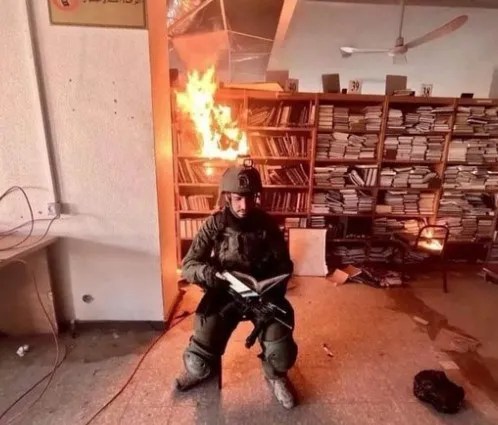
Imagine There Was A Violent Cult Committing Atrocities with Impunity
By Caitlin Johnstone | September 20, 2025
Imagine there was a violent cult that used scriptures from an ancient religion to convince its followers to do evil things.
Imagine the cult was given its own state.
Imagine the cult was given machine guns, tanks and war planes.
Imagine the cult obtained nuclear weapons.
Imagine the cult started committing genocide against the indigenous people who’d been living in the area where the cult’s state was established.
Imagine the cult had huge branches in the most powerful nation on earth, and the powerful nation defended the cult no matter what it did.
Imagine the cult flipped out and started relentlessly attacking and invading the surrounding nations.
Imagine the cult had so much influence and support in western society that western governments and institutions would censor, silence, fire, marginalize and deport anyone who criticized the cult’s actions.
Imagine the western media sympathized highly with the cult and spent the entire time framing its atrocities as entirely reasonable defensive actions, and framing critics of the cult as malicious bigots.
Imagine the cult kept getting crazier and crazier and more and more violent, but nobody could find a way to stop it because its actions were backed by this giant western power structure.
That’d suck, huh?
I think that’d be just about the most bat shit insane situation anyone could possibly imagine.
A nuclear-armed death cult just murdering and massacring mountains of human beings with total impunity, backed by the most powerful people on earth? That would be an unfathomable madness.
If someone made a movie about such a thing I’d stop watching halfway through, because I would find it too unbelievable.
I’d be like, come on man. Come up with a more realistic plot line. And come up with a more believable antagonist; nobody is that evil.
I’d be like come on Hollywood, you seriously expect me to maintain my suspension of disbelief when you’re putting out a movie about these cartoonishly evil bad guys who blow up hospitals and assassinate journalists and murder humanitarian workers and deliberately massacre starving civilians seeking food?
I’d be like, you really expect me to believe a violent cult could get all this power and do all these evil things and get away with it, just by lying about it all the time? Eventually people would stop believing their lies!
I’d be like, somebody would stop them. Not only does this movie have unbelievable antagonists, it also lacks any believable protagonists. Basic human decency would compel the world to stop all these atrocities being committed right out in the open. Where are the heroes in this story?
And then I’d storm out of the movie theater, glad to be outside that horrible fictional world where such freakish absurdities were taking place.
And then I’d stand in the parking lot and look up at the sky, and thank God I’m back in reality again.
Pakistan says ‘door open’ for more Arab states to join mutual-defense pact
The Cradle | September 20, 2025
Pakistan’s Defense Minister Khawaja Asif said on 18 September that “the doors are not closed” for other Arab states to join the new defense pact signed with Saudi Arabia.
Asif emphasized that there was no clause preventing Pakistan from extending similar arrangements to other nations.
The agreement was signed in Riyadh by Pakistani Prime Minister Shehbaz Sharif and Saudi Crown Prince Mohammed bin Salman (MbS) during Sharif’s day-long visit, and declares that aggression against one country will be considered aggression against both.
A joint statement said the deal “reflects the shared commitment of both nations to enhance their security and to achieve security and peace in the region and the world.”
Asif also confirmed that Pakistan’s nuclear arsenal is included within the framework of the pact, describing it as a joint shield that leaves “no doubt” either side would respond if attacked.
“What we have, our capabilities, will absolutely be available under this pact,” Asif told Pakistani broadcaster Geo News.
He stressed that Pakistan had always placed its nuclear facilities under inspection and had “never committed any violation.”
“This agreement will not be a hegemonic arrangement but a defensive arrangement,” Asif emphasized.
“We don’t have any plans to conquer territory or attack anyone. But our fundamental right can’t be denied to us and we exercised that yesterday,” he added.
The minister drew comparisons with NATO, saying Muslim states had the same right to collective defense. “I think it is a fundamental right of the countries and people here, particularly the Muslim population, to together defend their region, countries, and nations.”
Pakistan has long stationed troops and air force units in Saudi Arabia, training Saudi forces and providing advisory support.
“I think that relationship has been more defined now and that understanding has been given the form of a defense agreement,” Asif explained.
Pakistani External Affairs Ministry spokesperson Randhir Jaiswal said India would assess the implications for its national security, adding that the government remained committed to “ensuring comprehensive national security in all domains.”
Asif also tied the pact to Pakistan’s longstanding role in protecting Islamic holy sites in the kingdom, describing it as a “sacred duty.”
Trump Is Preparing a $6 Billion Arms Package for Israel
By Kyle Anzalone | The Libertarian Institute | September 19, 2025
The White House informed Congress that it is preparing a massive arms sale to Israel, including attack helicopters and military vehicles. The weapons will be paid for with US military aid.
According to the Wall Street Journal, the total value of the weapons deal is $6 billion. The sale is $3.8 billion for 30 AH-64 Apache helicopters and $1.9 billion deal for 3,250 infantry assault vehicles.
Washington will pay for the arms with foreign military financing. The US provides Israel with at least $3.8 billion in military aid annually. Washington boosted assistance to Tel Aviv following the October 7 Hamas attack. In the first year of the Israeli onslaught in Gaza, the US sent Israel nearly $18 billion in aid. The weapons will begin arriving in Israel in two to three years.
The report of the package follows Israel’s attempt to assassinate Hamas leadership in Qatar. The strikes angered Doha, a major non-NATO US ally. Qatar has also committed to investing $1 trillion in the US economy and gifted Trump a luxury aircraft.
Additionally, the assassination attempt prevented Trump from initiating talks to end the war in Gaza and free the Israeli hostages. The strike occurred as the Hamas leadership was meeting to discuss a proposal sent by Trump. Qatar said the attempted assassination ended any chances of reaching a hostage agreement.
The White House has pushed Congressional leadership to endorse the sale even after the Israeli strike in Qatar.
Israel is in the process of ethnically cleansing Palestinians from Gaza. The onslaught has primarily been conducted by Israel using American weapons. A large number of civilians have been killed by Israeli forces. Additionally, an Israeli siege of Gaza has created a famine, and hundreds of Palestinians have starved to death.
Since taking office, Trump has approved multiple arms sales to Israel, including a sale of $3 billion in bombs.
Israel Wants ‘Aerial Corridor’ Over Syria to Strike Iran
By Kyle Anzalone | The Libertarian Institute | September 17, 2025
Tel Aviv’s primary objective in discussions with Damascus is to establish an aerial corridor over Syria so Israel can restart its war against Iran.
Axios reports that Israel presented the Syrian government, led by Ahmed al-Sharaa, with a maximalist agreement that would establish a no-fly zone over Syria. Additionally, Tel Aviv wants a large swath of Syria, from the Israeli border to Damascus, to become a demilitarized zone.
An Israeli source told the outlet that an essential part of the agreement will be maintaining the ability to use Syrian airspace to attack Iran. “A central principle of the Israeli proposal is maintaining an aerial corridor to Iran via Syria, which would allow for potential future Israeli strikes in Iran,” they said.
Israeli Prime Minister Benjamin Netanyahu started an unprovoked war with Iran in June. Tel Aviv targeted leadership in Tehran, nuclear facilities, and scientists. President Donald Trump joined the war by striking three Iranian nuclear sites that Israel lacked the military capability to destroy.
Israeli forces currently occupy southern Syria. Israel promised to withdraw its troops from Syria if Damascus accepted the agreement. On Wednesday, Sharaa said a deal with Israel was possible “in the coming days.”
Tel Aviv made a similar agreement with Hezbollah, where Israeli soldiers were scheduled to withdraw from South Lebanon after Hezbollah moved its forces out of the region. However, after the Hezbollah withdrawal, Tel Aviv maintained its occupation. Israel is now demanding that Hezbollah entirely disarm.
The Israeli invasion of Syria began after President Bashar al-Assad was overthrown by al-Sharaa last year. Al-Sharaa, formerly Abu Mohammad al-Jolani, is the founder of al-Qaeda’s Syria affiliate. President Donald Trump has met with Sharaa and lifted some sanctions on Syria in a push to get Damascus to make a deal with Tel Aviv.
or go to
Aletho News Archives – Video-Images
From the Archives
Israel Would Have No Qualms About USS Liberty-Style FALSE FLAG If Iran Campaign Falters – Analysts
By Ilya Tsukanov – Sputnik – 18.06.2025
Donald Trump is mulling whether or not to join Israel’s aggression against Iran as Tel Aviv faces problems sustaining its defenses against growing counterstrikes, and apparently lacks a realistic game plan for an end to hostilities after failing to achieve its goals. Analysts told Sputnik how the US could be ‘nudged’ into the conflict.
“The US is already assisting Israel with supplies, intel, refueling support, etc. One of the many US posts in the region could be attacked for a casus belli,” former Pentagon analyst Karen Kwiatkowski explained.
“If Trump doesn’t comply with Israel’s demand” and join its aggression voluntarily, “a false flag may be needed” to drag the US in, Kwiatkowski, retired US Air Force Lt. Col.-turned Iraq War whistleblower, fears.
Netanyahu has a diverse array of options at his disposal, according to the observer, including:
- a false flag against US assets abroad blamed on Iran or one of its Axis of Resistance allies, like the Houthis
- a US domestic attack or assassination blamed on Iran
- Iranian air defenses ‘accidentally’ hitting a civilian jetliner carrying Americans
- use of a dirty bomb or nuclear contamination somewhere in the region blamed on Iran
- even blackmailing by threatening to use nukes against Iran if the US doesn’t join the fight
Kwiatkowski estimates that Israel probably has “enough blackmail power” against President Trump and Congress to avoid the necessity of a false flag operation, but a “USS Liberty-style” attack, targeting the soon-to-be-retired USS Nimitz supercarrier that’s heading to the Middle East, for example, nevertheless cannot be ruled out entirely, she says. … continue
Blog Roll
 Aletho News
- The US bombed the Shahs house lol
- The London Ambulances Attack: Of Course It Was A False Flag
- Embarrassing Pivot: U.S. considers dropping Iran oil sanctions amid war
- US has 2 months of rare earths left to replenish weapons amid Iran war: Report
- Strait Of Hormuz closure brings Empire to brink
- Iran controls Strait of Hormuz, dictates terms of war and peace as US excursion backfires
- Outlasting the Superpower: The Reasons Why Iran is Beating uhe US and Israel
- Top PMU commander, over a dozen fighters killed in new US strikes on Iraq
- Is Netanyahu’s war gamble threatening the future of ‘Israel’?: FT
- Smotrich calls for annexation of South Lebanon to Litani River
- If Americans Knew
- ‘Forever live by the sword’: Understanding Israelis’ massive support for Iran war
- UN’s special rapporteur on human rights says Israel is systematically torturing Palestinians
- Trump White House plagiarized Iran war manifesto from Israel-aligned think tank
- Gaza says 6–10 patients die daily waiting for treatment abroad as Israel blocks medical evacuations
- ‘Substantial evidence’ of double-tap strike in killing of Gaza’s Hind Rajab
- ‘Do Not Want To Die For Israel’: Doubts About Trump’s Iran Strategy Spread Among Troops
- Instead of taking Joe Kent’s claims seriously, the media is disregarding him as an antisemite
- Joe Kent’s Explosive Interviews about his Resignation over the Iran War
- Israel poised to take over southern Lebanon; settlers wreak havoc in West Bank – Not a ceasefire Day 165
- From Sde Teiman, the truth about Israel’s military justice system has been set free
- No Tricks Zone
- Devastating Assessment Of Comirnaty Vaccine By Former Senior Pfizer Europe Toxicologist
- New Study: CO2 Is ‘Effectively Negligible’ As An Explanatory Climate Change Factor Since 2000
- Former Pfizer Toxicologist Dr. Helmut Sterz Tells Bundestag Hearing Pfizer Vaccine Should Have Never Been Approved
- Energy Expert: Germany’s Nuclear Phaseout Was A “500 Billion Euro Mistake”
- New Research: South Australia’s Mid-Holocene Sea Surface Temperatures Were 4°C Warmer Than Today
- Storing Green Energy To Last Germany 10 Days Would Require A 60-Million Tonne Battery
- New Studies: UK Sea Levels Were 4 Meters Higher Than Today During The Mid-Holocene
- Destructive Green New Deal: German Energy And Metal Group Warns Of Drastic Crisis
- New Study Documents A 20-Year Pause In Arctic Sea Ice Decline – Driven By Internal Variability
- Wake-up Call: Survey Shows Majority Of Germans Now Favor Postponing Climate Targets!
 Aletho News