Col Douglas Macgregor: Pressure to REMOVE TRUMP FROM OFFICE Growing
Daniel Davis / Deep Dive – June 23, 2026
By Martin Jay | Strategic Culture Foundation | June 25, 2026
The unintended consequences of Trump’s Iran Deal are too many to list. Chief among them is that Trump’s own buffoonery has injected cash and power into the regime in Iran that it could only have previously dreamt of. But the “unconditional surrender” deal has also probably destroyed the petrodollar – leading, most likely, to a faster demise of the US as what was once called a “superpower”, or even sometimes the superpower. Trump’s idiotic outburst of “unconditional surrender” is, of course, the greatest irony of the entire fiasco, given that it is Trump who is on his knees and has given Iran so much simply to open the Straits of Hormuz, simply to bring down the global price of oil.
Yet what happens now in the region, both to Israel and the GCC countries? For Israel, many leading commentators like Alistair Crooke claim that its people are in a state of shock and that it will take some time before they wake up after the party the night before and realise that things got a little out of hand and that a certain process of cleaning up and repair needs to take place. Crooke and others even go further and believe that Israel can no longer continue to indulge itself in the delusional notion of ’Greater Israel’ – i.e. having regional ambitions of hegemony beyond its borders – and needs to recalibrate its goals, starting with the admission that it is not winning its war with Hezbollah in Lebanon. There is a general consensus among analysts that most Israelis are in a state of shock about how the war in Iran was lost, how America itself didn’t and couldn’t deliver on its military promises, and how even the IDF is no match for Hezbollah. This will take some time for them to sink in – that Israel has simply overstretched itself both politically and militarily, and that the reality is that it is in a deep hole and perhaps a solution might be to stop digging.
But a period of sombreness and solace is hardly what Netanyahu has in mind, and it is likely now that he will become a silent enemy of Trump, who needs him to stop fighting in Lebanon. This relationship between Washington and Israel will also come under strain and enter a new period of saliency, which might briefly mean Congress voting to withhold Israel’s funding, to remind Bibi and his coalition partners who really is the superpower (to coin Bill Clinton’s comment once in the White House when Bibi attended a press conference).
What is perhaps even more worrying is the region and how America now retreats. It is inconceivable that US forces will return to the dozen or so military bases in the Gulf, as it is unthinkable that those elites will keep the cash flowing into Wall Street. Indeed, a bundle of $3 trillion USD which Saudi Arabia and the UAE had earmarked for the US AI sector will now not make it, as those countries no longer have the cash flow in their economies, with hotels in Dubai only catering to about 10 percent capacity. Trump’s war literally sent missiles to these new economies, and the Donald cannot complain now that this cash will not make it to the US.
Yet remarkably, Trump is still dreaming. He is still delusional about who he is and what America currently is, and seems to be stuck with his own ideas which feel like they’re from the 1970s rather than 2026. What we are witnessing in the Middle East is the beginning of the end. The loss of the petrodollar and the GCC countries with their fast cash feels like the first domino falling for the old empire, while Trump obsesses with tiny minutiae details which take up time posting on social media late at night. In the last days of the Roman Empire, its emperor was said to have been concerned about “Rome” – but this was not a reference to a crumbling civilisation, but to his pet chicken of the same name. When we see the puerile, juvenile row between the diminutive Georgia Meloni and Trump, there is a sense of déjà vu with Rome. A row on X which Meloni keeps alive for days might be seen as incongruous to the bigger picture of the US and EU falling into the abyss, with the EU being such a dog’s breakfast that even bankrupt Britain wouldn’t even want to re-join it now, despite most Brits in polls conceding Brexit was a failure.
The recent comments by the Saudi foreign minister might signal that KSA and the UAE are looking for a completely different defence set-up which might actually bypass the US altogether. Other countries like Turkey, Pakistan and Egypt are stepping forward and taking on the challenge by themselves, while leading the anti-Israel doctrine. It is rumoured that Bibi complained to Trump recently about Turkey’s tough talking, but Trump told him to forget about even thinking about hitting the NATO country, as it is simply out of Israel’s league – or words to that effect. But Turkey is the new enemy of Israel. That ball has been rolling for some time.
Daniel Davis / Deep Dive – June 25, 2026
Press TV | June 25, 2026
The strategic calculus surrounding Iran’s ongoing negotiations with the United States within the framework of the memorandum of understanding (MoU) has reached a critical juncture.
Two concurrent developments demand a comprehensive and resolute response: Oman’s unilateral announcement of a separate shipping corridor through the Strait of Hormuz and President Donald Trump’s continued military threats against the Islamic Republic.
Taken together, these developments represent a concerted attempt to undermine Iran’s sovereignty over the Strait of Hormuz and weaken the fundamental security guarantees that give diplomatic engagement its meaning and value.
For Iran, the Strait of Hormuz is far more than a source of economic leverage; it constitutes a cornerstone of national security, a critical component of its deterrence posture, and a vital mechanism for preventing future acts of aggression.
The Strait of Hormuz: A matter of national sovereignty
The Strait of Hormuz represents one of the most strategically significant maritime chokepoints in the world, through which approximately 20 percent of global oil supplies transit. For Iran, control over this waterway is intrinsically linked to national security, economic sovereignty, and the capacity to deter any form of external aggression.
The recent visit of Iran’s parliament speaker and lead negotiator, Mohammad Baqer Qalibaf, to Muscat appears to have been exploited by Oman under US pressure to advance an agenda that directly contradicts Iran’s sovereign rights over the strategic waterway.
Oman’s unilateral announcement of a separate route requiring only coordination with the International Maritime Organization (IMO) constitutes a calculated maneuver to undermine Iran’s legal and legitimate authority over the Strait.
This action was taken without any coordination with Tehran and coincides with mine-clearing operations based on the memorandum signed between Iran and the United States.
The strategic logic suggests that by creating an alternative corridor, Oman has offered vessels a route that avoids Iran’s jurisdiction, effectively normalizing a system where Iran’s role in administering the Strait becomes irrelevant.
The timing is particularly significant. As mine-clearing operations proceed, Omani authorities have directed vessels toward this alternative corridor, whose route poses serious safety risks and is unacceptable, according to Iran’s Islamic Revolution Guards Corps Navy.
This effectively undermines one of Iran’s most significant bargaining chips – the ability to control access through the Strait and ensure compliance with its security requirements.
IRGC’s warning: An essential but insufficient first step
In response to this challenge, the IRGC Navy issued a timely warning that “the only authorized routes for vessels’ passage through the Strait of Hormuz are the ones announced by Iranian authorities.”
The statement emphasized that “vessel traffic outside these routes is prohibited and highly dangerous,” adding that “coordination with the IRGC Navy via Channel 16 is mandatory for passage through the Strait of Hormuz.”
This response demonstrates Iran’s readiness to protect its sovereignty and maintain its authoritative position over one of the most critical energy chokepoints in the world.
However, as a purely military response, it is insufficient to address the full scope of the challenge. The Omani initiative is fundamentally a political maneuver, and it requires a coordinated response that includes diplomatic, legal, and security dimensions.
The existential implications cannot be overstated. The threat to Iran’s national security, the assassination of the Leader of the Islamic Revolution, and the imposition of two illegal and unprovoked wars through the use of hostile American bases and the cooperation of Arab countries are not matters that can be ignored within diplomatic engagement.
The primary means of preventing their recurrence is firm control over the Strait of Hormuz. If Iran permits this condition to be eroded through political maneuvering, it risks losing a critical deterrent mechanism without receiving commensurate concessions in return.
Trump’s threats: A direct violation of clause 1
Concurrent with the challenge to Iran’s legal authority over the Strait, Trump has once again threatened that if Iran does not act according to his whims, he will impose war once again.
These statements go far beyond psychological warfare intended to weaken the morale of Iranian negotiators or serve domestic political purposes. They constitute a direct violation of Clause 1 of the memorandum signed by him and the Iranian president last week, which calls on signatories to “refrain from the threat or use of force against each other.”
Trump’s threat to “blow up the country, launch a full ground invasion to take it over, and assassinate Iranian negotiators” represents an explicit violation of the agreement.
When combined with the Zionist regime’s insistence on continuing its occupation of Lebanese territory – itself a clear violation of the memorandum’s provisions regarding the cessation of hostilities on all fronts – the pattern becomes unmistakable. The enemy is systematically testing the limits of Iran’s commitment to the negotiation process while violating its fundamental provisions.
The statement by US Treasury Secretary describing the $30 billion in frozen assets and sanctions relief as a “temporary carrot” that can be withdrawn whenever desired demonstrates that, from the enemy’s perspective, what it believes it will ultimately obtain from Iran far exceeds what it is offering during the negotiation process.
This perception must be neutralized through both the words and actions of Iranian officials.
The strategic importance of the Strait in the negotiations
The Strait of Hormuz’s importance extends beyond economic considerations. It serves as the primary mechanism for creating practical guarantees for the fulfillment of Iran’s conditions within the memorandum, similar to what occurred in Lebanon and immediately revealed its consequences. Control over the Strait enables Iran to compensate for war damages, provide security against future aggression, and prevent the passage of military and hostile vessels.
The memorandum commits Iran “to arrange for the safe passage of commercial vessels through the strait, with no charge for 60 days.” The subsequent joint statement with Oman “agreed to establish a joint working group to negotiate the future administration of navigation in the Strait of Hormuz.”
However, Oman’s unilateral action effectively preempts this negotiation process by establishing a separate corridor that bypasses Iranian authorization.
The implementation of what Oman has announced would constitute a clear example of the enemy achieving through the political process what it failed to achieve through military means during the Third Imposed War.
If realized, it would increase the enemy’s appetite to obtain through diplomacy what it was unable to secure through all-out military aggression, a precedent that would embolden further violations of Iran’s sovereignty.
Available responses and strategic options
Various measures exist for responding to this new challenge, each with its own implications:
First, suspending mine-clearing operations would signal that Iran’s commitment to safe passage is conditional on recognition of its authority over the Strait. This would maintain pressure on global shipping and demonstrate that Iran retains the capacity to disrupt traffic if its sovereignty is not respected.
Second, imposing restrictions on vessel passage that deviate from Iranian-designated routes would enforce Iran’s jurisdictional claims directly. The IRGC Navy has already warned that “ships’ movement through other routes is dangerous and prohibited,” establishing the basis for enforcement actions.
Third, military action against violating ships, while potentially escalatory, would demonstrate Iran’s determination to protect its sovereignty. The IRGC Navy has already stated that “any vessel found in violation will be subject to enforcement measures,” establishing a credible deterrent against hostile entities.
Fourth, announcing a halt to negotiations or postponing the next round would signal that these developments have fundamentally altered the basis for continued engagement. This would be particularly appropriate given that Trump’s threats directly violate Clause 1 of the memorandum.
Fifth, escalating the political response through diplomatic channels while the armed forces maintain their deterrent posture. As the points above indicate, the first response by the IRGC Navy is timely and appropriate but insufficient; political responses must be added within the framework of the diplomatic negotiation process.
The risk of precedent and the nature of the enemy
What is at stake extends beyond the immediate question of the Strait. If Oman’s unilateral action is permitted to stand, it would establish a precedent that Iran’s sovereignty can be circumvented through coordinated political maneuvering.
That would fundamentally alter the balance of power in the region, demonstrating that Iran’s strategic assets can be neutralized through diplomatic means rather than requiring military confrontation.
The enemy’s objective in these negotiations appears to be:
1. Gaining access to Iran’s 60-percent enriched material
2. Obtaining complete intelligence regarding the remaining nuclear infrastructure and facilities
3. Reopening the Strait of Hormuz on terms favorable to the United States and its allies
4. Securing economic breathing space for the world and the United States
5. Preserving the Republican Party’s position in the November midterm elections
In return, Iran is offered temporary concessions such as oil exports, lifting the naval blockade, and releasing some assets, whose total financial value of approximately $30 billion is of very limited significance when compared with the strategic importance of Iran’s tools and capabilities, especially the Strait of Hormuz and the unified Resistance Front.
The comparison with Lebanon is instructive. When Iran demonstrated commitment to the ceasefire, it was met with continued Israeli occupation and attacks, demonstrating that the enemy seeks to exploit Iranian goodwill rather than reciprocate it.
The inadequate response to these violations, alongside discussions about the return of IAEA inspectors and Iran’s failure to publish a fact sheet regarding the agreement, increases ambiguity in public opinion and leads to greater polarization.
A coherent strategy for the negotiations
Iran’s response to these challenges must be coordinated, multifaceted, and proportionate to the gravity of the developments. The armed forces’ response, while necessary, must be supplemented by political actions within the diplomatic framework.
Several principles should guide this approach:
First, Iran must maintain its position that control over the Strait of Hormuz is non-negotiable and essential for national security. Any arrangement that circumvents Iranian authority must be rejected absolutely.
Second, the perception that Iran can be pressured into abandoning its strategic assets through diplomatic engagement must be countered through concrete actions that demonstrate the costs of violating Iran’s sovereignty.
Third, the link between the negotiation process and the security situation, including the Strait of Hormuz and the Resistance Front, must be maintained. Concessions on one issue cannot be made in isolation from progress on others.
Fourth, Iran must articulate clearly that the threatening rhetoric by US officials constitutes violations of the memorandum and will be met with appropriate responses, including the possibility of suspension or postponement of the negotiations.
Fifth, Iran should leverage the extraordinary strategic importance of the Strait of Hormuz as the primary means of providing security guarantees and preventing future aggression. The existential threat against Iran’s national security demands that sovereignty over the Strait be maintained as a fundamental condition of any agreement.
The path forward requires rejecting the assumption that these challenges can be addressed through military responses alone.
The coordinated political and diplomatic maneuvering by the United States, its regional allies, and Oman demands a comprehensive response that integrates the armed forces’ capabilities with political diplomacy. Anything less would signal weakness and encourage further violations of Iran’s sovereignty and the terms of the memorandum.
Ultimately, Iran’s position must be clear: the Strait of Hormuz remains under Iranian authority, and any route that does not coordinate with Iran is unacceptable and will face appropriate measures.
The negotiations should not appear as an opportunity for the enemy to achieve through political means what it could not achieve through illegal war of aggression.
Iran’s strategic assets – the Strait of Hormuz, the Resistance Front, and its nuclear capabilities – are not negotiable items but fundamental components of the country’s national security that must be preserved.
The burden lies with the other parties to demonstrate their commitment to the agreement and respect for Iran’s sovereignty through their actions, not merely words.
Al Mayadeen | June 25, 2026
A rare House vote on US military assistance to “Israel” is expected to force lawmakers to publicly defend or reject continued funding for the Israeli military, amid growing domestic debate over Washington’s role in the region.
A report by Responsible Statecraft stated on Wednesday that the proposal, introduced by Representative Thomas Massie, would remove $3.3 billion allocated to the Israeli military from federal spending legislation. Although the amendment faces long odds in the Republican-controlled House, the vote is expected to serve as a measure of congressional willingness to reassess one of Washington’s longest-standing foreign aid commitments.
The amendment targets funding contained in the National Security, Department of State, and Related Programs Appropriations Act, which finances State Department operations, international assistance programs, and foreign military support.
Massie amendment reflects shifting political landscape
The vote comes amid increasing public scrutiny of unconditional US military support for “Israel”, particularly following the wars on Iran and Lebanon and Washington’s involvement in the negotiating process with Iran.
Tehran and Washington inked a series of ceasefire deals, which called for the total cessation of fighting across West Asia, but “Israel” continued to break the deals by continuing to launch attacks on Lebanon.
Supporters of the amendment argue that the measure reflects growing voter skepticism regarding the strategic costs and political consequences of continued military assistance.
According to the report, recent polling has indicated a notable shift in public attitudes toward US policy. Surveys have found increasing concern among both Democrats and younger Republicans regarding the scale of military aid provided to “Israel”, while criticism of Washington’s regional alignment has become more visible across the political spectrum.
The vote will provide one of the clearest indicators yet of whether these changing public attitudes are beginning to influence congressional decision-making.
Critics question strategic rationale for continued aid
Opponents of unconditional military assistance have increasingly challenged long-standing arguments used to justify the aid package.
Among the issues raised are concerns over the war on Gaza, attacks across the region, and the broader consequences of US support for Israeli military operations. Critics argue that continued assistance, regardless of regional developments, reduces Washington’s leverage and contributes to instability.
The report adds that questions have also been raised regarding the claim that “Israel” remains heavily dependent on US military support. The country has expanded its defense exports significantly in recent years, becoming one of the world’s largest arms exporters and reporting record defense sales.
Supporters of reducing aid contend that these developments undermine arguments that “Israel” requires substantial annual US military assistance to maintain its security capabilities.
Funding debate extends beyond current vote
The congressional battle over aid is taking place alongside a broader legislative effort that could alter how future military support is approved.
Lawmakers, including Massie and Representative Ro Khanna, have opposed provisions that would shift certain forms of military assistance away from direct appropriations and toward defense procurement mechanisms. Critics argue that such changes would reduce congressional oversight and make future funding less vulnerable to political opposition.
The dispute reflects growing concern among opponents of military aid that public opinion is moving faster than congressional policy, prompting efforts to insulate funding streams from future political challenges.
While the amendment is unlikely to secure enough votes for passage, observers view the vote itself as politically significant, particularly as lawmakers increasingly face questions from constituents regarding US military commitments abroad.
Press TV – June 25, 2026
The recent war imposed on the Islamic Republic of Iran by the United States and its Zionist ally was built around many sweeping and ambitious objectives, including “regime change,” dismantling of Iran’s nuclear program, destruction of its missile capabilities, and the containment of its regional influence.
Instead, Iran not only survived the most intense and no-holds-barred military onslaught in its modern history but emerged stronger, more cohesive, and more influential than ever before.
The Memorandum of Understanding signed digitally between the presidents of Iran and the United States last week is a testament to Iran’s strategic victory. Every clause reflects Tehran’s battlefield success and Washington’s battlefield failure.
Objective 1: “Regime change” – A fantasy that died on the battlefield
The United States launched the unprovoked and illegal war with the publicly declared goal of toppling the Islamic Republic. For decades, Washington had dreamed of a Tehran that would be compliant, pliable, and free of the ideological and strategic independence that has defined Iran since the 1979 Islamic Revolution led by Imam Khomeini.
The war was presented as the moment when that dream would finally become reality.
The strategy was classic American “regime-change” doctrine: all-out aerial bombardment, economic strangulation, psychological warfare, and the cultivation of a fifth column within Iranian society. The assumption was that sustained pressure would crack the system and trigger a popular uprising against the government.
Instead, the opposite occurred.
Iran’s leadership remained intact and unified. The assassination of the beloved Leader of the Islamic Revolution did not fracture the system but galvanized it.
The Iranian people, whom Western strategists had assumed would rise against their government under the pressure of war, instead poured into the streets by the millions.
Night after night, for over 110 consecutive days, Iranians have demonstrated in support of the country’s leadership and armed forces. The “Janfeda” (Self-Sacrifice) campaign became a nationwide phenomenon, with ordinary citizens expressing their unwavering commitment to the system governing the Islamic Republic and the armed forces.
The “regime-change” fantasy died not because of diplomatic maneuvering, but because it was never rooted in reality. The Iranian system proved resilient. Its institutions functioned under extreme duress. Its armed forces fought with cohesion and courage, maintaining operational effectiveness despite the loss of senior commanders.
And, most importantly, its people refused to betray their nation. The American intelligence community miscalculated catastrophically. They had assumed that economic pressure would translate into political discontent, but it translated into defiance. They had assumed that military strikes would break the people’s will, but they strengthened it.
The MoU contains no provision for “regime change” because the US simply could not achieve it. It is an admission from Washington that its project failed. The American dream of a post-Islamic Republic Iran is effectively dead, and the war proved it beyond any doubt.
Objective 2: Destruction of Iran’s nuclear program – A complete failure
The nuclear program was one of the primary justifications for the unprovoked war. Washington and Tel Aviv claimed that Iran was racing toward a nuclear weapon and that military action was necessary to prevent that outcome.
The strikes on Iran’s nuclear facilities – first in June last year and now during the Ramadan War – were intended to set the program back years, if not destroy it entirely. The goal was “zero enrichment” – a complete cessation of Iran’s uranium enrichment activities, the dismantling of its centrifuges, and the removal of all enriched uranium from Iranian soil.
Yet Iran’s nuclear infrastructure remains intact. The enrichment facilities continue to operate. The centrifuges continue to spin. The “zero enrichment” goal, so cherished by Israel and its American backers, has been effectively abandoned.
Iran’s nuclear scientists, despite being targets of assassination campaigns for years, have continued their work even amid the war. The underground nuclear sites survived the bombardment, and the country’s nuclear program demonstrated its resilience.
The MoU reflects this reality. There is no commitment from Iran to dismantle its nuclear program. There is no suspension of enrichment. There is no transfer of enriched uranium. The only nuclear-related commitment in the agreement is Iran’s reaffirmation of its NPT pledge not to produce nuclear weapons – a commitment Tehran has always maintained and which is fully consistent with its peaceful nuclear program.
The United States has been forced to accept that Iran’s nuclear rights are not negotiable.
This represents a complete reversal of American objectives. The US launched the war intending to end Iran’s nuclear program. It ended the war by accepting that the nuclear program is permanent.
Objective 3: Weakening Iran’s defensive missile power – Strengthened instead
The missile program of the Islamic Republic was another primary target. American and Israeli strategists believed that relentless bombardment would cripple Iran’s production capabilities, destroy its stockpiles, and degrade its ability to project power.
The goal was to leave Iran defenseless and unable to retaliate. A thousand airstrikes were launched against missile production facilities, storage sites, and launch pads. The objective was to destroy Iran’s ability to threaten its adversaries or defend itself.
Instead, Iran’s missile industry has been strengthened. The war provided a real-world testing ground for Iranian technology. The use of older ammunition and equipment paved the way for newer, more advanced systems.
Iran’s underground missile cities – carved deep into mountains – proved resilient to bunker-busting bombs. The production lines never stopped. In fact, they accelerated.
The strategic calculus of Iranian planners proved prescient. By distributing production facilities across the country, by situating them deep underground, and by maintaining redundant supply chains, Iran ensured that no single bombing campaign could cripple its missile industry. The US could destroy surface targets, but it could not reach the heart of Iran’s missile production.
The MoU makes no mention of Iran’s missile program. It was not discussed or negotiated. It is not even on the table. Even Pakistani Prime Minister Shehbaz Sharif admitted on Tuesday that it was not on the agenda during the Islamabad-mediated talks.
The US has been forced to accept that Iran’s missile capabilities are a fact they have to live with. The program that was supposed to be destroyed is now stronger than ever, and the United States has signed an agreement that does not even mention it.
Objective 4: Containment of Iran’s regional influence – Expanded instead
Washington and Tel Aviv had hoped to use the war to roll back Iran’s regional influence. They wanted to break the Axis of Resistance, isolate Tehran, and redraw the regional map in their favor. The strategy was to sever Iran from its allies in Lebanon, Palestine, Syria, and Yemen, and to create a new regional order that excluded Tehran.
Instead, Iran’s influence has significantly expanded. The Resistance Front is more cohesive and powerful than ever. The war demonstrated that Iran cannot be isolated, that its allies are strategic partners, and that any solution to regional security must include Iran.
Hezbollah, Ansarullah, Hamas, and Iraqi resistance groups fought alongside Iran’s military, coordinating their efforts and demonstrating the depth of the strategic relationship. This axis proved itself to be a genuine alliance, not a collection of clients.
The war also exposed the weakness of the American regional alliance system. The Persian Gulf states, having relied on the US security umbrella for decades, watched in horror as American bases were systematically targeted and American deterrence collapsed.
The “paper tiger” metaphor took on new meaning as Iranian missiles struck deep into the heart of US military infrastructure in the region. The Persian Gulf monarchies, facing the reality of Iranian military power, have been forced to recalibrate their regional calculations.
This is why the MoU explicitly demands the cessation of the enemy’s aggression on all fronts, including Lebanon. Iran did not just protect itself, but it also protected the entire Resistance Axis. The inclusion of Lebanon in the agreement is a clear recognition that Iran’s regional role is now a permanent and non-negotiable reality. The US has effectively acknowledged that it cannot eliminate Iran’s influence; it must accommodate it.
The recent war against Iran was supposed to be the beginning of the end for the Islamic Republic. Instead, it was the beginning of the end for American hegemony in the region.
By Justin K.P. | The Dissident | June 24, 2026
The failed U.S./Israeli war on Iran was not only a major loss for the United States and Israel and an Iranian victory, but it has also helped Iran’s status as a serious regional power.
This is best underscored by the fact that the Gulf Cooperation Council (GCC) states,-after facing Iranian retaliatory strikes against U.S. bases and assets during the war, is no longer relying on the United States for protection and is looking to form a security alliance with Iran.
Sheikh Mohammed bin Abdulrahman al-Thani, the Prime Minister of Qatar, told the Financial Times that “Part of what we are doing now, as regional countries, is to create this regional security framework between us and Iran, that will hopefully have economic co-operation in the future between all of us — to bring the region back to stability”.
He similarly told Al Jazeera, “Iran is a neighbouring country, and dialogue with it remains necessary to guarantee the security and stability of the region”.
This shows that the GCC no longer trust the United States to protect them, given that “Saudi Arabia, the UAE, Bahrain, Kuwait, and Qatar host US military bases and were attacked by Iran during the war. Washington struggled to supply its Gulf allies with enough interceptors to defend against Iranian missile attacks,” as journalist Kyle Anzalone noted.
As a result, the GCC states are seemingly deciding to stop relying on the United States for defence and make a security agreement with Iran, which has cemented itself as a serious regional power.
“They have to deal with Iran because it is not going anywhere”, Gawdat Bahgat, a professor of national security affairs at Washington’s National Defense University said referring to the Gulf nations new approach to Iran.
“Even while Iran attacked them, they kept diplomatic channels open because the day after, they and Iran have no choice but to live together” he noted.
“Our aim is that Iran flourishes and their economy grows; and our investment basically has always been purely on commercial decisions”, Sheikh Mohammed bin Abdulrahman al-Thani told the Financial Times.
This destroys the U.S./Israeli goal of isolating Iran, instead causing regional countries to forge closer ties to Iran for their own national security interests.
This is yet another way the U.S/Israeli war on Iran was a loss for the U.S. empire and a win for Iran and its influence as a serious regional power.
Al Mayadeen | June 25, 2026
Iran’s Islamic Revolution Guard Corps (IRGC) Navy has warned that safe passage through the Strait of Hormuz is only possible via routes announced by Iran, rejecting newly declared navigation lanes and insisting that vessels coordinate directly with Iranian naval authorities.
In a statement issued in the name of the IRGC Navy, Tehran said that “some authorities” had recently announced new shipping routes in the strategic waterway “without informing or coordinating with the Islamic Republic of Iran,” saying the move is “unacceptable and completely dangerous.”
The statement stressed that the only authorized passage routes through the Strait of Hormuz are those designated by Iran, warning that navigation outside these channels is “very dangerous and prohibited.”
“All vessels are warned to strictly avoid any navigation outside the notified routes,” the IRGC Navy said, adding that coordination via Channel 16 with Iranian naval forces is mandatory and that “violator vessels will be dealt with.”
The Strait of Hormuz, a narrow maritime chokepoint linking the Gulf to the Arabian Sea, remains one of the world’s most sensitive shipping corridors, with competing claims over navigation management and maritime safety procedures.
Regional diplomatic efforts underway
The warning comes amid renewed diplomatic activity involving Gulf states, Iran, and regional mediators aimed at reshaping maritime governance in the strait.
On Wednesday, Qatari Prime Minister Mohammed bin Abdulrahman al-Thani arrived in Muscat for talks with Omani officials on launching a new round of negotiations involving Iran, Iraq, and Gulf Arab states on the future management of the waterway, according to Reuters, citing a diplomat briefed on the discussions.
The proposed talks are reported to be separate from ongoing Iran-US negotiations and existing de-mining arrangements. According to the same source, Gulf states are expected to push for the removal of transit fees, while Iran may propose alternative charges linked to environmental, navigation, and security services.
The initiative is said to stem from a recent memorandum of understanding calling for structured discussions between Iran, Oman, Gulf states, and Iraq on maritime governance in the strait, with Pakistan floated as a potential mediator.
Separately, broader regional reconciliation talks are expected to be held in Riyadh involving Iran, Gulf Arab states, and other regional actors.
Oman announces new shipping lanes
Earlier on Wednesday, Oman announced the establishment of two temporary shipping routes in the Strait of Hormuz, positioned north and south of the existing lane, in coordination with the International Maritime Organization (IMO).
Under a phased operational plan, vessels will be grouped and contacted individually with navigation instructions, including designated routes and departure timings. Oman’s maritime authorities said shipmasters remain responsible for conducting independent risk assessments, and vessels are required to keep Automatic Identification Systems active while reporting hazards to the Oman Maritime Security Centre.
Oman also confirmed that no transit tolls would be imposed on ships passing through the strait, in line with understandings reached in recent Iran-US discussions.
Joint Iran-Oman framework
The developments follow earlier agreements between Iran and Oman to establish a joint committee tasked with discussing the future management of navigation in the Strait of Hormuz.
The committee is part of broader consultations between Tehran and Muscat aimed at enhancing maritime safety, coordinating navigation rules, and addressing associated services and costs in line with international law and sovereign rights of coastal states.
Both sides have previously reiterated their commitment to keeping the strait open for international navigation while maintaining sovereignty over territorial waters, underscoring the strategic importance of continued coordination to ensure stability in the waterway.
Mario Nawfal | June 23, 2026
Daniel Davis / Deep Dive – June 23, 2026
Daniel Davis / Deep Dive – June 23, 2026
By Larry C. Johnson | SONAR21 | June 23, 2026
While the US certainly suffered some reputational damage and significant economic costs from its unprovoked attack on Iran, the United Arab Emirates may really be the big loser. Let’s focus on Dubai.
Think of Dubai as the World’s most expensive adult theme park that has no emergency exit. For decades, Dubai sold itself to the world as what would happen if Las Vegas and Disney World had a child together, raised it on sovereign wealth, and sent it to finishing school in Monaco. The result was a city of genuinely staggering audacity — an indoor ski slope in the desert, a hotel shaped like a sail that awards itself seven stars because five simply wasn’t enough, palm-shaped islands visible from space that are slowly sinking back into the sea from which they were so expensively extracted. It was, by any measure, the greatest theme park ever built for people who found actual theme parks insufficiently gilded and too puritanical.
The supposed genius of the Dubai proposition was always its geographical logic: i.e., it sits at the crossroads of global trade, pumps enough oil to build the infrastructure, and then gradually replace the oil revenue with everything else — tourism, finance, real estate, the inscrutable business of being a place where very wealthy people park very large amounts of money while asking no inconvenient questions. Oh, did I mention money laundering and hookers?
The Burj Khalifa, the world’s tallest building, named after the ruler of Abu Dhabi because Dubai ran out of money halfway through construction and needed a bailout, stands as perhaps the most honest monument in human history: a gleaming advertisement for ambition funded by someone else. The formula worked brilliantly as long as one variable held constant: the Strait of Hormuz remained open. The US and Israeli attack on Iran turned this assumption inside out.
Disney World works because it controls its environment entirely. Inside the berm, reality is suspended. Outside the berm, Florida continues to be Florida, which, as I can testify, is its own form of unreality but in a less curated direction. Dubai’s version of the berm was always the strait — twenty-one miles of water that kept the global economy flowing through the neighborhood and made Dubai’s position as the region’s entrepôt, logistics hub, financial center, and luxury destination not merely plausible but geometrically inevitable.
When Iran mined the strait in March 2026, Dubai discovered that its berm had a gap in it roughly twenty-one miles wide.
The cruise ships left first — or rather, they tried to. Six of them were trapped inside the Gulf like very large, very expensive rubber ducks in a bathtub whose drain had been plugged by a theocracy. Fifteen thousand passengers discovered that the all-inclusive package they had purchased did not, in the fine print, include Iranian mine-clearance operations as an amenity. The ships eventually got out during a brief window in April when Iran and the US simultaneously claimed the strait was open, which gave the ships a brief opening to make a run to safety. The passengers disembarked elsewhere and appear to have decided that the Arabian Gulf cruise experience had delivered sufficient excitement for one lifetime.
Las Vegas, Dubai’s other spiritual progenitor, is built on the foundational promise that geography is irrelevant — that a city in the middle of a desert can become the center of the world through sheer force of neon and human appetite. Dubai took this lesson and applied it at sovereign scale. If Las Vegas could conjure a city from nothing in Nevada, Dubai could conjure a global financial center from nothing in a desert on the edge of a historically significant but economically peripheral body of water.
The difference is that Las Vegas sits in the middle of a continent. Its supply chains are inconvenienced by traffic on I-15, not Iranian frigates. When something goes wrong in Nevada, the problem is human-scale. When something goes wrong in the Strait of Hormuz, the problem is civilizational-scale, which is a somewhat different category of operational risk.
Dubai’s ports — Jebel Ali, the largest in the Middle East — discovered that being the region’s premier logistics hub is an extraordinary competitive advantage right up until the moment the region becomes inaccessible. The container ships stopped coming. The tankers that hadn’t already been stranded inside the Gulf diverted around Africa, adding two weeks to their journeys and entirely bypassing the hub that had been so carefully constructed to serve them. The cargo kept moving; it simply moved around Dubai rather than through it, in the manner of a river that encounters a spectacular dam and quietly reroutes rather than admiring the engineering.
What Dubai is experiencing is the particular agony of a city built for maximum throughput discovering that throughput has somewhere else to be. The restaurants remain excellent. The hotel pools remain temperature-controlled to a degree that can only be described as a philosophical statement about the relationship between mankind and climate. The brunches — Dubai’s most characteristically Dubai institution, a Friday afternoon event that begins at noon, ends somewhere around consciousness, and costs roughly what a semester of community college costs in Ohio — continue to be held, though with fewer attendees from the European finance sector, which is dealing with its own energy crisis and has temporarily reduced its appetite for unlimited wagyu and proximity to other people’s wealth.
The real estate market, which has spent twenty years as a reliable indicator of how much money the world needs to quietly relocate, is experiencing what agents describe as a period of recalibration and what everyone else describes as a crash. Property values in Dubai are denominated in confidence as much as dirhams, and confidence requires that the fundamental premise of Dubai — the crossroads theory, the inevitability of the location — remains legible. A crossroads from which one of the roads has been temporarily mined is a different proposition.
But the Hormuz crisis has stripped away, at least temporarily, the comfortable fiction that Dubai’s position was natural rather than constructed, inevitable rather than contingent. Las Vegas exists because Americans wanted somewhere to gamble without legal consequence. Disney World exists because Walt Disney wanted to control the parking. Dubai exists because the global economy needed a node at a specific geographic location, and someone had the audacity and the capital to build one there.
All three are, at their core, exercises in the proposition that if you build it extravagantly enough, they will come. Two of them don’t have to worry about what happens if someone mines the entrance.
But there also is a dark side to the UAE in general and Dubai in particular — it is a center for money laundering and foreign intelligence activities. A friend, who is a business/energy consultant in the Persian Gulf summarizes the situation as follows:
The UAE now operates as a Zionist/Israeli-linked Gulf security platform with annex-like and fledgling-colony characteristics. Zionist/Israeli and Israel-linked security, cyber, surveillance, defense, and intelligence-adjacent systems have permeated core state capability to the point of effective strategic control over key security and technology layers.
That penetration creates strategic exposure across the UAE military establishment, internal-security architecture, technology stack, logistics system, financial channels, and monetary confidence base.
The money-flow thesis has also changed. Dubai and the broader UAE have long served as high-liquidity routing environments for offshore capital, sanctions-sensitive money, criminal syndicate proceeds, and illicit flows connected to Africa, gold, real estate, trade, luxury assets, and corporate structuring. The war-risk and security-integration shock has damaged that flow. Capital that depends on opacity, stability, and uninterrupted confidence becomes unstable when the host jurisdiction is visibly embedded in a conflict architecture.
The state is assessed as structurally aligned with the US-Israel security architecture and operationally dependent on Israel-linked security and technology capabilities. The exposure is not merely diplomatic. The UAE security apparatus, technology apparatus, military establishment, cyber-defense layer, and monetary confidence system are assessed as deeply permeated by Zionist/Israeli and Israel-linked systems, vendors, intelligence-adjacent relationships, and defense cooperation. Money flows that used the UAE for opacity, liquidity, asset conversion, gold, corporate layering, luxury consumption, trade routing, and real-estate placement are now exposed to war-risk repricing, sanctions scrutiny, intelligence attention, and capital-flight pressure.
So guess whose uncle is a weekly visitor to the UAE carrying bags of cash? If you guessed Volodimir Zelensky you are correct. Zelensky’s uncle, according to my source, deposits the money in local banks. The money is then used to purchase property that it then subsequently sold. The proceeds from that sale are then sent to banks in Israel… All cleaned up. From there, some of the money makes its way back to members of the US Congress as a way of thanking them for their support of Ukraine.
Will the UAE return to its previous garish glory? Perhaps. One immediate consequence of the US/Israeli attack on Iran is that much of the big money stored in the UAE banks decided that Singapore was more secure, which produced a significant capital flight from Dubai. The de facto expulsion of the US from the Persian Gulf, coupled with Chinese and Russian initiatives to create a new security architecture in the Gulf, is causing the Emiratis to reassess their past relationships. It is not clear what path they will choose to follow going forward, but the UAE emirs did send a delegation to Tehran on June 9. Is Dubai considering a future without wealthy foreigners with an appetite for alcohol and prostitutes? Maybe.
By Junaid S. Ahmad | MEMO | June 22, 2026
In Switzerland, amid the alpine calm where empires go to perfume panic as diplomacy, Iran delivered another masterclass in the ancient art of refusing to kneel.
The Americans arrived with the usual imperial luggage: threats, ultimatums, sanctions theology, and that peculiar Washington habit of mistaking obedience for “peace.” Iran arrived with something far less fashionable and far more effective: leverage. Not the decorative leverage of think-tank seminars and cable-news generals, but the real kind — the kind that closes straits, terrifies markets, freezes war rooms, and forces the self-appointed masters of the universe to rediscover geography.
The spectacle would be hilarious if it were not so historically obscene.
For decades, Washington imagined Iran could be sanctioned into hunger, bombed into prudence, insulted into submission, and finally dragged into a room to sign its own humiliation.
Instead, the empire found itself bargaining with a country it had failed to break. The result was not Iranian capitulation. It was American improvisation — and improvisation by a declining empire always sounds the same: threats in public, panic in private, and a desperate attempt to rename retreat as strategy.
This is the deeper meaning of Switzerland. It is not merely a diplomatic episode. It is a theatre of reversal. The United States entered the crisis assuming Iran would negotiate like a wounded state. Iran is negotiating like a victorious one. It did not ask for mercy. It is demanding implementation. It did not plead for relief. It is presenting conditions. It did not enter the room as an accused party awaiting sentencing. It is entering as a power whose red lines have acquired consequences.
That is why the Strait of Hormuz matters. In the fantasy literature of American empire, waterways are lines on maps guarded by aircraft carriers and narrated by admirals. In reality, they are political arteries. When Iran demonstrated that it could interrupt the world’s most sensitive energy passage, it did more than create a shipping problem. It shattered a mythology. The empire discovered, rather late in its education, that the sea has neighbors — and that those neighbors have memories.
Washington’s response was pure imperial farce. Trump threatened, blustered, contradicted himself, and performed his usual routine: half Caesar, half casino promoter, with the emotional discipline of a man losing an argument to a mirror. One moment he wanted a deal; the next he wanted tribute.
One moment he spoke of peace; the next he threatened annihilation. This was not statecraft. It was strategic delirium dressed up as presidential resolve.
Yet beneath the orange thunder was the essential fact: America needed the strait open, the markets calm, the war contained, and the humiliation disguised. Iran understood this. More importantly, Iran acted on it.
Netanyahu, meanwhile, performed the role history has assigned him: arsonist in a fireman’s helmet. His political survival depends on permanent emergency. War is not merely his instrument; it is his oxygen. Defeat must be repackaged as deterrence, slaughter as security, occupation as necessity, and humiliation as a “strategic achievement.”
Israel’s problem is not that it miscalculates occasionally. Its problem is that it has built an entire political theology around impunity — and then acted shocked when impunity met resistance.
But this time the room for Israeli theatrics narrowed. Iran’s pressure, Hezbollah’s endurance, the strain on global markets, and Washington’s fear of economic catastrophe produced a rare collision between Israeli maximalism and American self-preservation. For once, unconditional support for Israel began to look expensive even to its underwriters. Let us not become sentimental: this was not morality awakening in Washington. It was arithmetic. But in imperial politics, arithmetic sometimes does what conscience is too cowardly to attempt.
Here lies the exquisite irony. The United States spent decades trying to teach Iran the meaning of pressure. Iran returned the lesson, corrected the grammar, and underlined the thesis. Pressure is not a press release. It is not a Lindsey Graham war fantasy delivered between television segments. It is not Netanyahu’s sweaty monologues about victory while the region watches his project rot from within. Pressure is the ability to alter the enemy’s choices. In Switzerland, Iran is proving it can do precisely that.
The Americans may still posture. Trump may still rage into the digital void. Netanyahu may still deliver speeches polished with self-pity and fraud. The professional warmongers may continue promising wars they will never fight, depressions they will never suffer, and corpses they will never count. But beneath the noise sits the brutal reality: Iran survived the siege, absorbed the blows, retained escalation dominance, defended its allies, protected its sovereignty, and forced the conversation onto terrain of its choosing.
That is the defeat Washington cannot confess and Israel cannot metabolize. Not merely that Iran endured, but that Iran emerged demanding compliance. Not merely that coercion failed, but that the coerced state exposed the coercer’s dependence. Not merely that the empire blinked, but that everyone saw it blink.
Switzerland, then, is not a peace summit in the ordinary sense. It is a mirror held up to American power. What stares back is not omnipotence, but exhaustion dressed as menace.
Iran’s message could not be clearer: no surrender, no submission, no confession of guilt to satisfy an empire addicted to obedience. If Washington wants de-escalation, it must pay in substance. If it wants open waterways, it must respect red lines. If it wants agreements, it must implement them. And if it insists on calling this diplomacy, it should begin with the only honest admission available: coercion failed, Iran stood, and the age of bullying Tehran into submission is over.
By Ron Paul | June 22, 2026
Against the odds, the Memorandum of Understanding signed by the US and Iran appears to be holding, after threats and counter-threats. It may collapse, but it has survived a first round of talks between the two sides in Switzerland over the weekend.
President Trump started a war on Iran against all sober guidance and in violation of the US Constitution’s requirement that only Congress can declare war. There must be a reckoning for our elected leaders who violate their oath of office, the Constitution, and simple common sense.
However, what is more telling is the reaction when President Trump finally took the correct move and attempted to end the war. The neocons who had hailed him as a great leader – Levin, Bolton, Pompeo, etc. – suddenly turned against him when he turned against further escalation of the war.
Even Trump’s top funder, Miriam Adelson, attacked Trump in her newspaper Israel Hayom. “You could have been the greatest president of all, but you failed,” the newspaper wrote in an editorial.
Not much gratitude from the Israel-first crowd, even if the war was started to benefit Israel.
And more telling even than this was the reaction of the “opposition” party in Congress, the Democrats. They attacked him harder for ending – or at least pausing – the war more than for starting the war in the first place! Sen. Adam Schiff (D-CA) called the MOU a “capitulation.” Sen Chris Murphy (D-CT) called the MOU an “embarrassing document.” Sen. Amy Klobuchar falsely claimed that President Trump was paying Iran $300 billion to re-open Hormuz.
This is more evidence – as if any is needed – that our foreign policy is run by the “uniparty.” When it comes to wars, there is no Republican Party nor is there a Democratic Party. There is only the “yes!” party.
Congress remains silent in the run-up to war. Congress remains silent when the President launches a war. Congress even remains silent when the war begins going badly. It is only on those rare occasions that a president takes steps to correct his mistake that Congress finds its voice.
Yes, there is plenty to criticize. After weekend talks, the US side, led by Vice President JD Vance, is celebrating as a “breakthrough” that the Strait of Hormuz is open again and that Iran has reportedly agreed to the return of UN inspectors. But the Strait was open before this war and UN inspectors were in Iran before President Trump unilaterally pulled out of the JCPOA “Iran Deal” in his first term.
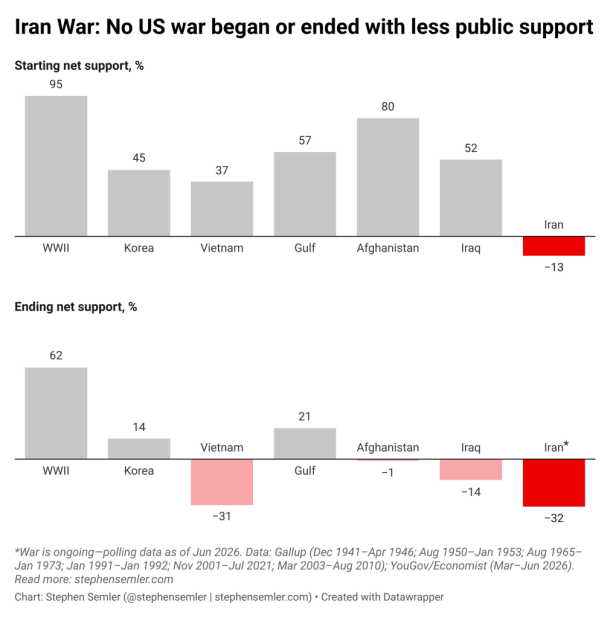
The only difference now is that we burned through likely several hundred billion dollars, we lost dozens of aircraft and other military equipment, and we likely lost more service members than the Pentagon is admitting.
It is a reminder of why the Founders intended to make sure that any war must be declared by the people’s Representatives before the first bullet is shot: it should be very hard to launch wars.
Nevertheless, those who are truly against the wars should, in my opinion, hold their fire for the time being in hope that a lasting resolution can be found. The President Is being attacked from all sides by the war party. Now may not be the best time for the peace party to join in.
or go to
Aletho News Archives – Video-Images

Global Times | October 25, 2026
By portraying Chinese characters as perpetrators of ruthless violence while casting Japanese Self-Defense Forces (SDF) intelligence operatives as defenders, the season 2 of the Japanese drama Vivant has recently drawn criticism from Chinese netizens, who argue that its depiction turns historical reality on its head while ignoring Japan’s wartime atrocities.
The TBS drama series – a spy suspense story in which an alleged unofficial intelligence unit of the SDF operates across the globe — has attracted a passionate fanbase. Its currently airing season 2 opened with a household rating of 18.8 percent, the highest for a TV drama this year, according toa commentary article by Japanese media Toyo Keizai.
What draws attention is the portrayal of the enemies in the series, the article noted. Scenes in which the Chinese organization subjects kidnapped members of the SDF unit to brutal torture are repeated with unrelenting intensity.
It is rare for Japanese TV dramas to explicitly portray a real-life country as the enemy, the article noted.
Japanese Prime Minister Sanae Takaichi also made a reference to the drama, saying that she has been recording Vivant and hopes to binge-watch it over the year-end and New Year holidays, according to Japanese media outlets.
China’s CCTV News report on Sunday revealed that the drama features scenes in which Chinese personnel cut off the fingers of and stab Japanese intelligence operatives in the abdomen. Such acts bear striking similarities to the torture inflicted on Chinese nationals by invading Japanese troops during the World War II.
The drama distorts the truth by attributing these atrocities to modern Chinese characters. Beneath the surface, it subtly glorifies Japan’s cross-border overseas operations, blurs the functional boundaries of the SDF and implicitly promotes an expansionist narrative, per CCTV News. … continue
 Aletho News If Americans Knew No Tricks Zone
