In 1959, Ingeborg Bachmann concluded that the truth is something people can be expected to handle, since they are quite capable of enduring it, no matter how uncomfortable it may be. Literature, she argued, should neither conceal nor gloss over the truth.
This is all the more true of the media, which for years have failed to fulfill their duty as the fourth estate. The world is heading toward a new world war, and the majority of humanity is unable to assess the risks and opportunities when the media distort the facts through their propaganda in such a way that the truth vanishes into an ever-thickening fog. The dumbing down has reached such a level that even politicians in the West believe the propaganda of their own media and act accordingly. The falsehoods that politicians spread are no longer perceived by them as lies; for the most part, their intellect is simply not sufficient for that. It must be stated that politicians have first and foremost become “ambassadors” of an ever-declining level of education—and continue to do so—and, as a result, have become victims of their own propaganda.
This article attempts to show that it is still possible to separate the wheat from the chaff, because the truth is hidden amid all the garbage in the news coverage.
Don’t Forget About Evil
In the article “Will Evil Prevail?,” I pondered who actually determines geopolitical events around the world. I discussed the “City of London” and the “Rothschilds” as examples of forces that steer the world from behind the scenes. They are thus also responsible for wars, coups, and other upheavals in our world. Even the small portion of the Epstein Files that has come to light provided a first impression of the entanglements among the powerful. See “Epstein – ‘Concierge of Evil’ – Dangerous Questions.” For example, the Rothschild family was dragged back into the public eye; the very family that has gone to great lengths to convince the world that it has exerted no influence since World War II and merely operates a few private banks, museums, and vineyards. It should come as no surprise that discussion of the contents of the Epstein Files—or their further releases—has completely vanished from the media; one might well wonder who controls the media.
Incidentally, the ‘deep state’ is not a concept peddled by a few crackpots. As early as 2017, President Putin spoke about it in no uncertain terms:
“Presidents change… Then well-dressed men arrive, in dark suits, with their suitcases. They start explaining how things really work… and everything changes instantly.”
Control is exercised either directly by shareholders or indirectly through political or economic influence—for example, by controlling advertising revenue, blacklisting, or manipulating view counts on YouTube channels. Control over the media in the Collective West is, de facto, complete—not a bad achievement.
Consider this: freedom of speech is championed very vocally by politicians and the media at every opportunity, whether appropriate or not. Practically “in tandem,” it is restricted in the very same breath by first denouncing the spread of “fake news” and “hate speech”—that is, the expression of genuine freedom of speech—just as loudly, and then defining and enforcing it as a criminal offense for one’s own political gain.
Ultimately, then, it is the state that defines what “fake news” and “hatespeech” mean. As a result, a right that is no longer absolute but has been relativized collapses under this restriction. In Germany, the desired political direction of judicial decisions is ensured through the political appointment of judges to the Federal Constitutional Court. The process for selecting judges to the European Court of Justice follows a similar procedure.
The consequences of this restriction are deliberate and obvious. Analysts who express even the most well-founded opinions that do not suit the tastes of those in power are stripped of their rights, dispossessed, and portrayed as criminals without due process. The method of choice is, for example, EU sanctions, which were originally enacted to target terrorists but are now—with the support of the general public—imposed on the most objective experts, such as the Swiss citizen (and thus non-EU citizen) Jacques Baud; see our coverage on this. The result of this targeted political influence is reporting in the traditional media that no longer has anything to do with the truth, but often turns it on its head.
All Geopolitical Crises Stem from a Single Source
All military conflicts around the world must be understood as a single package, a comprehensive strategy. The same people who are fueling the war against Iran and the violent creation of “Greater Israel” are also responsible for the conflict in Ukraine and the war between Europe and Russia that will likely unfold soon—and many other conflicts, such as those in Africa, which we have neglected in our blog, are likewise part of this strategy. Everything is interconnected, and it shows a lack of geopolitical understanding when journalists defend the war—waged with genocidal methods—against Iran, Lebanon, and Gaza, while simultaneously supporting Russia’s actions in Ukraine. The forces triggering and fueling these conflicts are identical. Understanding this is very helpful in grasping the overall geopolitical situation.
The overall picture is not hard to understand: After hundreds of years of colonial rule over the rest of the world, the Collective West has already lost the economic race against the Global South; more on this below. While wars over the past 500 years have been about who in the West would wield the scepter of hegemony over the colonial empire, today’s conflicts are about whether the Collective West can maintain its colonial empire. The odds are against it, as we have already outlined in our series “The War Between Two Worlds Has Begun.” At that time, we anticipated many individual conflicts spanning decades, but without a world war. This relatively optimistic thesis now seems to be faltering, as aggression between the world powers is escalating daily, the Collective West refuses to abandon the arrogance of the colonial master, and completely overestimates itself with spurious arguments.
The Defence Budget as a Measure of Military Strength Is a Fallacious Argument
For decades, the Americans have led the world to believe that they have the strongest armed forces in the world. This claim is backed up by an astronomical figure: the U.S. military budget of no less than 1.5 trillion U.S. dollars. That is 10 times more than the Russian military budget, or even 190 times more than Iran’s military budget, which amounted to 7.89 billion U.S. dollars in 2024. NATO, excluding the US, spent 608 million U.S. dollars.
Nevertheless, the US—along with Israel—suffered defeats in both the 12-Day War and the ongoing war, which has spiraled out of control. NATO, alongside the US, is suffering defeat in Ukraine. The massive budgets in the West are a clear indication that the military there is not designed to defend freedom, but rather to rake in as much money as possible. As a result, a weapons system in the West is considered successful if it can be sold—for as much money as possible—to its own armed forces or those of third countries. In 2024, we compared two combat helicopters that experts deemed equivalent: the Russian Kamov KA-52 and the American AH-64 Apache. The Apache costs 155 million U.S. dollars; the Kamov costs 16 million. On top of that, Western weapons systems are produced in virtually homeopathic doses, and it is impossible to increase production to a level capable of sustainably supporting a protracted conflict—it is too expensive, too complex, and combined with an industrial capacity that simply no longer exists.
In the medium term, the US will not be able to produce high-quality military equipment in sufficient quantities at reasonable costs, as it currently faces a multi-faceted problem: First, there is a lack of will, since profit is the primary goal of the military-industrial complex. Second, due to 30 years of deindustrialization, the US no longer has the industrial base necessary to produce weapons in quantities sufficient for wartime.
Rather, the focus is on making a profit. Objective observers should realize that such a strategy is bound to lead to disaster in a crisis—as has been demonstrated in the Middle East and Ukraine. According to various experts, the West has fallen at least a decade behind its competitors in both missile technology and drones in those regions.
Iran, for example, whose defense spending is about 200 times less than that of the US, possesses hypersonic missiles that are extremely difficult to intercept. In contrast, the Collective West still has no operational hypersonic weapons. Critics attribute this to a combination of profit-seeking, arrogance, and corruption within the military-industrial complex.
If the West wants to operate on an equal footing militarily in the future, it would have to fundamentally reform the military-industrial complex—a task that seems nearly impossible given the existing economic and political balance of power; this industry is controlled by the groups discussed above.
A Lack of Will to Fight in the West
How does the Collective West react to the wars it has lost? — It increases its military budgets without addressing the necessary structural issues. In the West, there is a mistaken belief that everything can be solved with money. In Russia, the defense industry is essentially state-owned, and therefore there is a strong interest in producing high-quality but affordable weapons.
Thus, there will only be a change in the US if the American pursuit of profit in weapons production were seriously called into question—and if society were able to attract the best minds to the defense industry in the interest of American society as a whole, which is not the case today. American missile physicists earn more as analysts at investment banks, and they have no motivation to serve their country, given the poor state of the will to defend the West. In Germany, for example, one figure dashes any hope for greater willingness to serve: out of 300,000 young Germans, 530 are willing to perform military service—that’s 0.17%! (Source: Süddeutsche Zeitung ). This figure stands in stark contrast to statements made by Boris Pistorius, the German Minister of Defense, who announced as early as 2024:
“We must be combat-ready by 2029,” the minister said. “We must provide a deterrent to prevent things from escalating to the extreme.”
The outlook for the Collective West to prepare its armed forces for war is thus bleak. Nevertheless, the Europeans and Americans seem to be charging headlong into a world war with outdated yet overpriced weapons systems and without the necessary will to defend themselves among the population. This not only seems insane—it is insane. The facts speak for themselves. Who would do such a thing? Corrupt politicians, like the ones we described at the beginning.
The Economy as an Indicator of Losing
If we look at the economic data, it is easy to see that the Collective West has already lost the economic race. History teaches us that, in such a situation, war is the only option left.
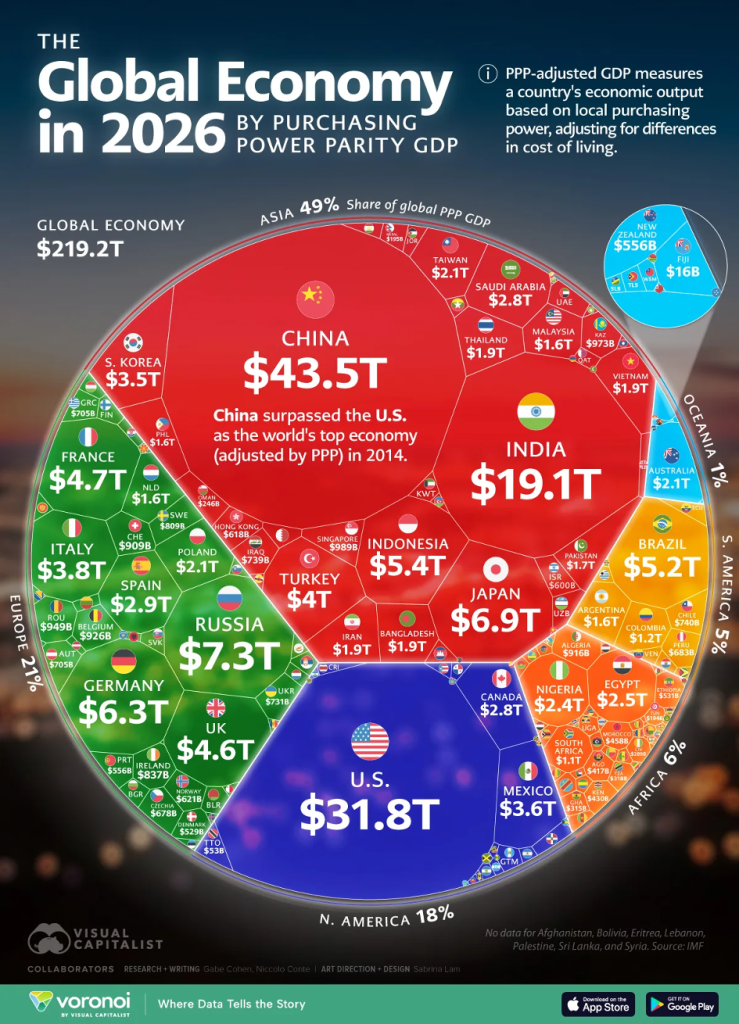
For years, I have been drawing attention to the devastating national debt and the grotesque valuations in the financial markets. On top of that, the Collective West also cheats when calculating economic power. All of this is done to maintain a narrative that allows the US to continue to be portrayed as number one. If you calculate GDP on a purchasing power parity basis—that is, taking into account the local purchasing power of individual countries—the US has already lost.
According to this calculation, China ranks ahead of the US, Russia ahead of Japan, and Germany.
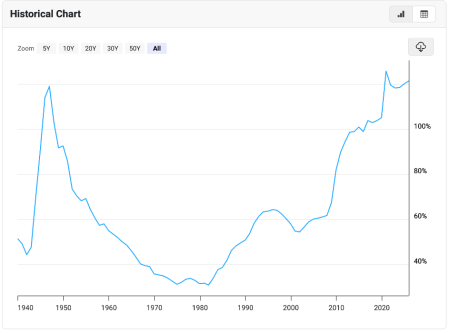
Furthermore, the Collective West, as the aggressor, finds itself in a domestic political and economic situation that does not allow for a military showdown with Russia, Iran, and China: US debt stands at over 121%—the last time this was the case was at the end of World War II, following an industrial war that brought the US global dominance. After 35 years, and under economic and political conditions that remained favorable to the US, this debt was reduced to below 40%.
In 1945, the Americans reached the height of their power. Together with the Soviet Union, they dominated the course of the war, held 22,000 metric tons of gold, and American industry produced 70% of the world’s manufactured goods. This is what true “full spectrum dominance” looks like: military dominance, industrial dominance, gold—because whoever has the gold sets the rules. Now the US is once again facing a world war, and the situation looks much like it did after the last war, with one major difference: China is at least the US’s economic equal, with far more favorable economic conditions.
These are not the conditions necessary for a military conflict on a global scale—neither financially, nor economically, nor, consequently, politically.
Middle East
It is clear from the text of the MOU that Iran has defeated both Israel and the US militarily; otherwise, the Americans would never have signed such a document. Israel cannot, without risking the collapse of its own delusions of great-power status, comply with the spirit of the document and end the war in Lebanon and Gaza. Therefore, there will be no peace.
Our comments on this topic: “Iran Defeats the US – Thoughts.” In Iran, voices are growing louder claiming that the president and foreign minister are not negotiating hard enough—public pressure in Iran is calling for a tougher stance toward the US and Israel. Iran’s Supreme Leader, Mojtaba Khamenei, has approved the memorandum of understanding (MoU) with the US to end the regional war under certain conditions. However, in a public statement, he said that he fundamentally held a “different view,” but had agreed to the agreement after receiving guarantees from President Masoud Pezeshkian that Iran’s national rights and the “Resistance Front” would be safeguarded. This is a clear indication that the Iranians are ultimately unwilling to make compromises at the expense of Lebanon and Gaza.
It is to be expected that the conflict in the Middle East will continue: Neither the US nor Israel is willing to accept defeat in the war and deal with its consequences. This stance maintains a state of limbo that could tip in one direction or the other at any moment. However, this strategy is countered by the fact that time is running out for the West because of Hormuz. The dwindling oil reserves were the main reason the US signed this MOU in its current form in the first place. The Americans are thus seeking a state of limbo that allows them to prepare their next military steps in peace; however, this state can only be maintained if the Strait of Hormuz remains open in the meantime. While approximately 130 ships passed through the Strait of Hormuz daily until February 28, 2026, these numbers dropped to practically zero, then stabilized at 5%–10% of pre-war levels, before surging to 70 ships on June 25, 2026. These figures should be treated with caution: It is said that the majority of these 70 ships were exporting oil from Iran after the US lifted the oil sanctions upon signing the agreement. If the Israelis do not withdraw from Lebanon and the Iranians remain steadfast—which is to be expected—then the Strait of Hormuz will remain a congested bottleneck: the time bomb for the West’s supply of raw materials continues to tick.
The Iranians can wait—the Americans cannot. When assessing the situation, one should simply disregard Donald Trump’s statements, because Trump speaks of peace one moment and war the next, changing his mind sometimes several times a day. He seems to believe that he can achieve something with the Iranians through this “New York-style deal-making” terror, but that is not the case, since he achieves only one thing: Americans are increasingly proving themselves to be agreement incapable, thereby threatening world peace.
War in Europe
The armed conflict in Ukraine, instigated by the West, began in 2014. Only those who do not classify Ukraine’s years-long artillery shelling of the Donbass as an act of war claim that the Russians started the war in February 2022. This is just one fact that is so obvious that one can only wonder at the West’s arguments that Russia is the aggressor.
Another fact is that this war has completely transformed the technology and tactics of warfare—the parties had to adapt to a new kind of war dominated by drones and missiles. Tank columns and troop concentrations are attacked by inexpensive drones as soon as they are detected—and they are detected very quickly. The warring parties had to undergo migration and learn this new art of warfare. The Russians, in particular, have done this successfully and now dominate the battlefield in a new way: through slow, efficient advances, because massed attacks produce only one thing—heavy casualties. Similar waves of technological advancement have occurred time and again. The machine gun, which was already in use before World War I but whose significance was underestimated at the time, brought an end to maneuver warfare as early as the first year of the war, when large columns of soldiers advanced toward the enemy and were wiped out. Toward the end of World War I, the tank brought some movement back to the front lines. However, comparing the frontline situation in Ukraine to that of World War I is a flawed analogy: Slow movements in small groups seem, so far, to be the only way to survive the drone barrage and maintain mobility.
Recently, Western media have been reporting that the Ukrainians have the upper hand in the war. However, this is fake news that has nothing to do with the reality on the ground. One must distinguish between the fighting on the front lines and NATO’s drone attacks in Russia. On the Donbass front, only a few fortified cities still stand in the Russians’ way; once those are taken, the Donbass will be liberated. Beyond that, there are no longer any fortifications worth taking seriously. Rather than going into details, I refer you to one of the best channels, Military Summary, which has been providing a twice-daily update on the situation at the front since the war began.
The West has not yet recognized the signs of the times. Its experts believe they will be successful in a war against Russia. However, they have not even defined their war aims in any way. Thus, they have no strategic plan against Russia other than to weaken it.
First and foremost, the Germans set the start of the war against Russia for 2030. However, it is now 2026, and the Germans apparently assume that, with Ukraine acting as their proxy, they can send drones and cruise missiles into Russia with impunity until 2030. Europe’s approach is, of course, coordinated with the US. The use of these weapons systems is not possible without American input. President Putin made this very clear a few days ago.
Many observers and experts both inside and outside Russia believe that President Putin will soon decide to launch a strike against targets in Europe—including those outside Ukraine.
There is a wide range of opinions on this topic. We have already published several articles on this subject: In “Will 1914 Repeat Itself? Will War Between Europe and Russia Finally Break Out?,” we also examined the Karaganov Doctrine, which advocates the use of nuclear weapons, and concluded that an attack is necessary, but not with nuclear weapons. Scott Ritter subsequently addressed the “Karaganov fallacy” and also spoke out clearly against the use of nuclear weapons.
Conclusion
In the Middle East, I see no realistic chance of ending the war, because that would mean, on the one hand, the withdrawal of American forces, and Israel would then be left alone as a small, genocidal aggressor. The Israelis are under pressure and are continuing their genocide in Gaza and Lebanon, paying no heed whatsoever to agreements between the US and Iran, because for Netanyahu personally, maintaining the war is the only way to survive politically.
In Russia, pressure is mounting on President Putin to adopt a more aggressive stance toward Europe, which is no longer even attempting to conceal its direct involvement in the war against Russia. Russia is intensifying its attacks on Ukraine, in part by destroying every gas station in eastern Ukraine to paralyze transportation logistics. Ground forces are making visible progress, and once the last fortified cities in the Donbas are liberated—which is likely to happen within the next few weeks—the path to the Dnieper will be clear.
President Putin is thus banking on a military solution in Ukraine and waiting for an energy crisis to unfold in Europe, where many flights are already being canceled under flimsy pretexts.
The concerted media coverage in the West claiming that the tide has turned in Ukraine finds not the slightest confirmation in the reality on the ground in Ukraine. The fuel shortage in Russia is also being exaggerated. In some regions, fuel is being rationed at gas stations. However, this is in no way sufficient to change Russia’s course of action.
Very occasionally, I have the opportunity to speak with someone who lives in Kyiv. According to this person, the situation is catastrophic, and over 90% of the population is against Zelensky. When I asked why the people weren’t rising up, the source replied that people were so intimidated by the terror of the security and intelligence services that the communication necessary for an uprising was impossible. Ukraine, which is portrayed by the West as a shining example of democracy, seems to be a time bomb whose ticking goes unheard out of fear.
My concerns that a war between Europe and Russia might break out—even though Europe has virtually no military power—have never been greater. President Putin will not be the one to take the first step toward a Third World War. Only he knows how much longer he will tolerate the West’s systematic provocations and how he will respond to them.
A cargo vessel ran aground in the Strait of Hormuz on Wednesday while traveling a route not approved by Iran’s naval authorities, Iran’s IRIB reports.
The ship was identified as a foreign container ship, but the report didn’t provide any further details on the matter.
IRIB’s report seems to underscore Iran’s geographical control over the strategic waterway, through which a fifth of all oil and gas passes.
According to HormuzTracker, the Strait of Hormuz remains severely disrupted, showing little to no passage through the key waterway.
This confirms a total halt in detected commercial navigation activity, with no crude oil tankers, LNG carriers, bulk carriers, or container ships recorded moving through the Strait.
Transit through the Strait fell sharply following waves of US aggression against Iran and subsequent hostile rhetoric from Washington. Trackers showed that between June 24 and June 28, vessels passing through the Strait of Hormuz fell from a high of 74 to 22.
The provisional surrender document signed by Donald Trump appeared to represent a triumph for Iran and indeed for the world; but neither the USA nor Israel has the slightest sense of honour and they cannot be trusted to negotiate in good faith.
Iran knows this – after all, the USA twice attacked Iran actually during peace negotiations, on each occasion killing key Iranian negotiators.
To understand the American position, it is important to realise two key points:
Greater Israel is an absolute priority
Opening the Strait of Hormuz is not a US priority
While the US/Israeli alliance were defeated in their attempt to impose regime change on Iran, and indeed have consolidated the popular support of the Iranian government, they have succeeded in expanding Greater Israel. Israel has ethnically cleared and devastated a vast swathe of Southern Lebanon, expanding its military footprint, and notably attempting to repeat its ploy from November 2024 of pushing forward its armour under cover of ceasefire.
Israeli withdrawal from Southern Lebanon has been a major negotiating point for the Iranian government and is a key – indeed the very first – point of the Iran/USA MOU. But in an extraordinary coup aimed at negating that deal, the USA has signed a deal with Israel and its puppet Aoun regime in Lebanon which seeks to legitimise Israeli occupation of Southern Lebanon through the agreement of the “Lebanese government”.
This is an astonishing development. I did not think I could have a lower opinion of the appalling bloated traitor “General” “President” Aoun but not even I – nor I think any commentator – believed he would make such a deal with Israel. The plan is that the Americans, Israelis and Lebanese Army will act together to forcibly eliminate Hezbollah, and only after that is certified – by the Israelis – will the Israelis withdraw from Southern Lebanon.
Here are the operative paragraphs. Note that they carefully do not say in terms that Israel will actually leave Lebanon.
“3. …The Government of Israel and the Government of Lebanon commit to a reciprocal, sequenced process, with clear conditions, whereby the LAF will restore effective sovereign authority over all Lebanese territory, pending the verified disarmament of non-state armed groups and dismantlement of associated infrastructure, enabling the Israel Defense Forces (IDF) to progressively redeploy out of the Lebanese territory.”
“5 . …The Government of Israel underscores that the termination of this threat, through the disarmament and dismantlement of such groups in all of Lebanon and additional security arrangements to be agreed upon between the two countries, will eliminate any future need for IDF military action or presence in Lebanon.”
This is plainly completely incompatible with the USA/Iran MOU, which states as Point 1:
“The United States of America and the Islamic Republic of Iran and their allies in the current war are signing this MOU to declare the immediate and permanent termination of military operations on all fronts, including in Lebanon, and undertake from now on not to initiate any war or any military operation against each other, and to refrain from the threat or use of force against each other, and ensuring the territorial integrity and sovereignty of Lebanon. The final deal will confirm the permanent termination of the war on all fronts, including in Lebanon and other provisions of this paragraph.”
Of course, everybody knows that Israel will never withdraw voluntarily, any more than they withdrew from the Golan Heights. Annexation is plainly the goal and expansion of Greater Israel at least to the Litani River and probably further.
It is important to realise that this is not only Aoun seeking the annihilation of the Shia population of Southern Lebanon; he is also betraying his own community. Aoun is himself a Southern Lebanese Christian, and Israel has been destroying the homes, churches, hospitals and families of Southern Lebanese Christians with as much glee as they attack Muslims.
The agreement names two “pilot zones” where the combined Israeli and Lebanese Army forces will eliminate Hezbollah, followed by Israeli withdrawal from those zones. But these are zones which Israel is not currently occupying – they are areas where Israel was defeated in fighting by Hezbollah and which have been since subject to relentless Israeli bombardment.
So Aoun has agreed to support militarily an IDF advance further into Lebanon, against an agreement that Israel will be able to withdraw once these key Hezbollah redoubts have been destroyed. Even if Aoun were stupid enough to believe the Israelis will withdraw after the operation, this is a level of treachery it is difficult to comprehend.
Greater Israel is not a concept. It is a reality being created before our very eyes.
Israel now occupies 70% of Gaza and plainly the entire “Board of Peace” mechanism is nothing but smoke and mirrors, pure fraud. It has zero effect on the continued tightening of the Gaza concentration camp into an ever-shrinking area. Israeli settlements in the West Bank expand daily and every night the skies are red with Palestinian homes and crops burning. In East Jerusalem Palestinians are continually evicted and replaced by fresh European or American arrivals. In Syria, Israel is building permanent fortifications and its armour creeps forward field by field, with the full cooperation of “President” al-Jolani.
Iran was able to resist the combined military might of the USA and Israel. That is cause for celebration. But do not allow it to blind your eyes to the continued hard reality of the expansion of Greater Israel.
There is no gain for the US in the US/Iran Memorandum of Understanding which the US did not already possess before starting the war. It is therefore very possible, and in many senses valid, to read it as the formalisation of US defeat: a surrender document. Which is why you should be sceptical about US commitment to the terms.
The Strait of Hormuz was fully open before the US started the war. Allowing the flow of oil to resume has become a short-term US priority due to high domestic retail prices and pending elections, but the MOU envisages more Iranian control – and potentially fees – in the Strait than existed before the war.
There is no indication of restrictions on the Iranian nuclear programme that were not already available in the peaceful negotiations. Crucially there are no limitations on Iran’s vital ballistic missile production. The proposed relaxation of sanctions and release of frozen assets is a triumph for Iran and long overdue, and the $300 billion in dollars in reparations, from unspecified sources, is stunning.
So stunning of course that anyone with their head screwed on will realise there is no long term American intention to keep faith with the deal.
Trump is not stupid. There are many ways of characterising his kind of cunning, but it is not stupidity. He was not, as the prevailing narrative seeks to state, the only person in the World who did not realise the Strait of Hormuz would be closed by the war. The USA is quite happy to see the Strait of Hormuz closed, or permanently made more difficult and expensive to transit.
The key to understanding Trump’s position is his famous love of tariffs. Trump is a mercantilist. For many years the world worked on the general basis of accepting the economics of Adam Smith – that freedom of trade promoted universal, reciprocal wealth creation. That was the founding basis of the World Trade organisation, and is the internal philosophy of big trading blocs like the EU.
Trump rejects this and returns to the philosophy that other nations are all competitors, not potential partners, and that success lies not only in increasing your own production, but in damaging your rivals’ production – which ultimately will increase domestic production further. Trump rejects the basic premise of free trade.
The long prevailing belief in the beneficial effects of free trade historically was, as logic demands, accompanied by the demand for freedom of navigation.
Sweeping away tariffs goes hand in hand with sweeping away the controls on shipping which carry the goods. Before the rise of liberal economics, almost all states had practised mercantilism, with controls on shipping being a major source of state revenue. The magnificence of Kronborg Castle in Helsingør, in which Hamlet is set, was constructed entirely from revenues from tolls on ships exiting the Baltic by passing the strait it overlooks, for example.
Freedom of navigation was initially enforced ultimately by the British, and later the American, Navy. States attempting to enforce customary passage fees, for example in the Malaccan Strait, were classified as “pirates” and freedom of navigation became a routine justification for imperialist aggression and/or colonial occupation. Freedom of navigation eventually became customary international law, ultimately codified in the UN Convention of the Law of the Sea.
The simple truth is this: in openly abandoning the principle of free trade, the Trump regime has also abandoned the logically linked principle of freedom of navigation. This is evident not just in their indifference to the closure of the Strait of Hormuz. It is evident in the naval blockades of Cuba and Venezuela and above all in the worldwide blockade of Russian hydrocarbon deliveries, including the effective end of free passage through the Strait of Dover, and a de facto naval blockade of the Arctic passages.
Following the shale boom, the United States is a net hydrocarbon exporter. The USA balance of trade benefits from high hydrocarbon prices. Trump is doing everything he can to increase US hydrocarbon production by slashing environmental and other controls. This is a core Trump policy.
The USA does not import hydrocarbons through the Strait of Hormuz. That fact is key to Trump’s thinking.
In this mercantilist view, closure of the Strait has two benefits for the USA.
It disadvantages rival hydrocarbon suppliers
It disadvantages rival industrial competitors in Europe and Asia who do get hydrocarbons through Hormuz.
This is exactly the same logic behind the destruction of Nord Stream 2. The same mercantilist system also explains the effective seizure through naval blockade and control of Venezuela’s oil production, and the blockade of Russian hydrocarbons through sanctions and the “shadow fleet” propaganda disguising another naval blockade.
The UK’s recent actions in the Dover strait indicate that the West, not just the United States has surrendered the principle of freedom of navigation in straits.
Trump believes, as he has repeatedly stated in public, that domestic fuel prices in the USA are a blip and will equalise as the USA increases its domestic fuel production and Venezuelan fuel production. However this was not happening in time for the mid-term elections which is why reopening the Strait of Hormuz became a temporary priority that occasioned the ceasefire and MOU with Iran.
None of this implies good faith negotiation or a real prospect for a lasting peace.
After an exchange of missiles and drones on Saturday, the US backed down and declined to continue striking Iran. Qatar reportedly intervened to broker a new ceasefire. The US and Iran, in response to Qatar’s intervention, agreed to halt attacks against each other and plan to meet in Doha on Tuesday for technical talks aimed at resolving their dispute over the Strait of Hormuz, according to Axios.
The US-Iran meeting was originally planned to take place in Switzerland on Monday and focus on Iran’s nuclear program. Now the talks will take place in Doha on Tuesday. Iran’s position is firm… Traffic through the Strait must be carried out in accordance with the PGSA protocols. The US boxed itself in a corner with the language of the MoU:
5. Upon the signing of this MoU, the Islamic Republic of Iran will make arrangements using its best efforts for the safe passage of commercial vessels, with no charge for 60 days only, from the Persian Gulf to the Sea of Oman, and vice versa. The traffic of commercial vessels will immediately start, and considering the need for removing the technical and military obstacles, and de-mining by the Islamic Republic of Iran, will be instated within 30 days. The Islamic Republic of Iran will conduct dialogue with the Sultanate of Oman, to define the future administration and maritime services in the Strait of Hormuz, in discussions with other Persian Gulf Littoral States, in line with applicable international law and the sovereign rights of coastal states of the Strait of Hormuz.
The MoU give Iran the sole responsibility for making arrangements for the “safe passage of commercial vessels” through the Strait of Hormuz. If the US had insisted on including Oman and the other Gulf nations in the MoU then Iran would be obligated to consult with them. But the US accepted Iran’s language and Iran will insist there is no compromise on its sovereign right to manage traffic flow through the Strait.
While the world markets remain fixated on oil passing through the Strait, they are ignoring the profound impact of the halt in the shipment of Helium, Sulfur and Urea. The global economy is already experiencing the pain of the reduction in the supply of these commodities and the world will experience a global inflationary shock. Let’s look at each one.
Helium
The structural problem: Roughly one-third of the world’s helium production is impacted by the crisis, due to both the disruption of LNG production in Qatar and the very time-sensitive nature of helium transportation.
The mechanism was twofold. On March 2, state-owned QatarEnergy halted all LNG and associated production at Ras Laffan Industrial City following Iranian drone and missile strikes. On March 4, QatarEnergy declared force majeure on affected contracts. The company’s CEO stated that production would not restart until the conflict ended, and that even then, normalisation of deliveries would require “weeks to months.” Iran then struck Ras Laffan again on March 18-19.
Price movement: The shock hit fast. “The spot price for helium has moved up pretty dramatically. I would say 70 to 100 percent in a week,” said Phil Kornbluth, president of Kornbluth Helium Consulting and a 30-year veteran of the industry. Bank of America put the initial surge at 40%, while other estimates put prices at between 70% and 100% higher in some cases within a little more than a week.
The situation had an additional physical complication that other commodities don’t face. Roughly one-third of the world’s cryogenic helium ISO containers were stranded in or around Qatar. Repositioning this equipment after the conflict would require a minimum of three months, creating a supply gap that outlasts the conflict itself. Liquefied helium evaporates within roughly 45 days, meaning stranded inventory cannot be held for later delivery. Ships rerouting via the Cape of Good Hope face an additional 3,500 nautical miles, extending transit times by 10 to 14 days, during which liquid helium experiences boil-off losses of 15–20% of cargo volume.
By June 20, prices remained substantially elevated with no clear return path, because the damage to Ras Laffan is physical, not merely logistical. Even after Iran and the United States announced a ceasefire, the Strait of Hormuz remained largely closed due to overlapping blockades, meaning that even if production restarted, Qatari helium had no viable sea route to market. The structural problem persists through the MOU period.
Given Helium’s critical role in the production of computer chips, the price of computers and smart phones is soaring. Apple, for example, recently announced significant price hikes for the iPhone 17 Pro Max (+$200) and the 16-inch MacBook Pro (+$300).
Sulfur
Pre-war baseline — already stressed: The sulfur price to Indonesia rose from $101 per metric ton in July 2024 to $554 per metric ton by January 2026 as high-pressure acid leaching (HPAL) expansion drove demand — a 440% increase before the Iran conflict added further pressure. The market was already at multi-year highs before February 28.
The geographic exposure: Ships moving through the strait carry 24% of the world’s sulfur, a feedstock for sulfuric acid used to make metals like nickel and copper, as well as fertilizer and household cleaning products. The Middle East accounts for roughly 24% of global sulfur production and approximately 50% of global seaborne sulfur trade, all of which transits the Strait of Hormuz.
Price movement: Since the start of Operation Epic Fury, the price of sulfur has nearly doubled. Gulf states typically provide 45% of the seaborne sulfur trade through the Strait of Hormuz, and Iran’s blockade caused a 30% price spike by halting half of the global supply, creating bottlenecks in mineral extraction. Sulfur shortages were already leading to 20–30% output reductions for critical mineral miners.
The downstream cascade was severe. The World Bank noted that sulfur prices had doubled since January by April 2026, and that China’s move to tighten exports — in response to its own domestic shortfall as Persian Gulf imports dried up — added upward pressure on DAP (diammonium phosphate) prices. China banned sulfuric acid exports, impacting among other things copper production in Chile, which imported sulfuric acid as a consumable.
By June 20, with the MOU in place but Hormuz only partially normalising and QatarEnergy yet to fully resume operations, sulfur prices remained substantially above pre-crisis levels. As of May 2026, prices remained elevated, with the global fertilizer index projected to rise over 30% for the year amid persistent supply risks and rerouting challenges.
Urea
Pre-war baseline: Before the war, the cost of FOB granular urea in Egypt — a bellwether of nitrogen fertilizers — was $400 to $490 per metric ton. US retail prices hovered in the same general range through mid-February.
The geographic exposure: The Arabian Gulf is the central hub for global agriculture, accounting for at least 20% of all seaborne fertiliser exports. The dependency is even more acute for urea, the world’s most widely used nitrogen fertiliser, with 46% of global trade originating from the region.
Phase 1 — initial shock (late February to March): Oxford Economics’ Alpine Macro said urea and ammonia prices had surged by around 50% and 20%, respectively, since the war began. By March 3, a contract was signed for the supply of urea from Algeria at $618 per ton on FOB terms — the highest figure since 2022.
Phase 2 — peak (April 2026): Nitrogen (urea) prices climbed above $850 per metric ton in April, up 80% since February and the highest level since the 2022 commodity spike. US retail: Urea had a national average as high as $826 per ton in early April surges, up 34–35% month-over-month in some periods, and urea prices FOB Middle East reached around $795 per ton due to regional disruptions.
Phase 3 — partial retreat (May–June 2026): The urea market was the fastest to respond to the MOU and the partial Hormuz normalisation, partly because it is more fungible than helium and partly because the ceasefire allowed some rerouting via land corridors. FAO forecast international urea prices to ease from June as fertiliser shipments resume from the Persian Gulf and China returns to export markets after issuing new export quotas. After the de-escalation of tensions and statements regarding a ceasefire, the market experienced an oversupply, which led to a significant price drop.
However, in light of the events of the past three days, the expectations that ships carrying urea will be exiting the Persian Gulf are overly optimistic and the price is likely to rise until there is a clear sign that ships will be passing the Strait in accordance with the PGSA protocols.
Israel has sold advanced defense systems to Qatar and Saudi Arabia, including sophisticated missile defense systems to protect the Qatari royal family and components for advanced fighter jets, Haaretzreported on 28 June.
Citing documents and photographs, the left-liberal Israeli paper revealed that Israeli Elbit Systems and Israel Aerospace Industries have sold hundreds of millions of shekels’ worth of missile defense systems and helmets for advanced F-15 fighter jets to Saudi Arabia and Qatar.
The sales occurred even though both Gulf monarchies have refrained from joining the Abraham Accords and have no formal diplomatic relations with Tel Aviv.
Haaretz writes that when Qatari ruler Tamim bin Hamad Al-Thani flew to Iran last year, his private jet was equipped with an air defense system manufactured by Israel-based Elbit Systems.
A photograph of the Qatari emir’s arrival in Algeria in March 2024 clearly showed an Elbit defense system installed on the underside of his aircraft.
The Qatari royal fleet consists of 11 aircraft, including two Boeing 747s and an Airbus A340-500, all equipped with Elbit’s C-MUSIC system, known in Israel as Magen Rakia.
The C-MUSIC system detects the launch of a heat-seeking surface-to-air missile and emits an infrared beam that disrupts the missile’s ability to lock on to the aircraft.
It is especially effective against shoulder-fired missiles known as MANPADS.
The cost of the deal with Qatar is unknown. However, it likely exceeds $200 million, given the value of similar deals with European countries and NATO.
Elbit and other Israeli companies also produce parts for Qatar’s US-supplied F-15 fighter jets.
According to a US Defense Department contract with Boeing, Israeli companies were awarded subcontracts worth $150 million to $250 million to supply advanced parts and systems for the Qatari F-15s.
Elbit subsidiaries, Elbit America and Cyclone, were awarded contracts, along with Collins Elbit Vision Systems, a joint venture with RTX.
Among the items provided by the Israeli weapons firms to Doha is the advanced JHMCS combat helmet, which projects flight data onto the visor, allowing the pilots to visually lock on to a target and fire a missile at it.
Elbit also supplied AN/AVS-9 night-vision goggles for Qatar’s F-15 warplanes.
Additional contracts to provide equipment for the Qatari F-15 program were awarded to Israel Aerospace Industries, TAT Technologies, and Beth-El Industries.
Official State Department documents and photographs also reveal that Saudi Arabia received 462 advanced JHMCS combat helmets and 462 AN/AVS-9 night-vision goggles produced by Israeli firms for its own F-15 warplanes.
Last I heard the US and Iran are supposed to meet in Switzerland starting Sunday, 28 June, to continue negotiations over the MoU. However, today’s exchange of missiles and drones in the Strait of Hormuz may have put a nail in the coffin of the MoU.
Today’s escalation was the most serious exchange since the June 17 MOU signing and represents a clear breach of the first paragraph of the MoU by the United States:
The Islamic Republic of Iran and the United States of America, and their allies in the current war, by signing this MoU, declare the immediate and permanent termination of military operations on all fronts, including in Lebanon, and undertake from now on not to initiate any war or any military operation against each other, and to refrain from the threat or use of force against each other, and ensuring the territorial integrity and sovereignty of Lebanon. The final Deal will confirm the permanent termination of the war on all fronts, including in Lebanon, and other provisions of this paragraph.
There was nothing in the MoU that prevented Iran from firing on a ship that ignored the Persian Gulf Strait Authority (PGSA) protocols. Under the PGSA system, shipowners receive verifiable guidance and can apply for transit permits directly through the PGSA’s formal process, creating a centralised mechanism for coordinating transit through the strait with the Islamic Revolutionary Guard Corps. The Ever Lovely tried to circumvent the PGSA by traveling along the Omani corridor. Iran fired on it, which resulted in the US attacking Iranian positions in the Strait… a clear violation of the MoU.
The situation escalated on Saturday. Here is the sequence as it developed.
The triggering incident — 4:30 AM ET
Iran launched a one-way attack drone that hit M/T Kiku this morning at 4:30 a.m. ET. The Panama-flagged tanker attempted to use the Omani route without notifying the IRGC in accordance with the PSAG protocol. It was carrying more than two million barrels of Qatari crude oil, and was headed to the port of Fujairah in the United Arab Emirates.
Second vessel struck
The United Kingdom Maritime Trade Operations Centre also reported another attack on a different commercial vessel Saturday, close to the coast of Oman. The vessel sustained damage to its bridge. All crew were reported safe and no environmental damage had been reported. The incident was reported at around 11:30 AM local time.
Iran strikes Bahrain
Following the second attempt by a commercial vessel to ignore the PGSA protocols, Iran launched a number of drones at the former Headquarter of the US Navy’s Fifth Fleet. Bahrain’s Foreign Ministry called it “a flagrant violation of its sovereignty, a flagrant threat to the security of citizens and residents, and a blatant breach of international norms.” Egypt and Kuwait swiftly condemned the attack. Saudi Arabia and Qatar also later condemned the drone strikes by Iran.
US retaliatory strikes — second wave
Late Friday night, and continuing into the early hours of Saturday, the US Central Command launched a second wave of retaliatory strikes on Iran, saying it attacked multiple targets in Iran at President Donald Trump’s direction. CENTCOM said US military aircraft targeted Iranian military surveillance infrastructure, communication systems, air defense sites, drone storage facilities, and minelayer capabilities. This was notably broader than Friday’s strikes, which had focused on missile and drone storage and coastal radar. Adding “minelayer capabilities” to the target set is a significant escalation in scope.
Trump, in another violation of the first paragraph of the MoU, said in a Truth Social post Saturday evening that US aircraft struck Iranian missile and drone storage locations and coastal radar sites “for violating the Cease Fire Agreement, AGAIN!” The president threatened that if Iran doesn’t “learn,” the US “will be forced to militarily complete the job that we successfully started” and that “the Islamic Republic of Iran will no longer exist.”
The strategic logic on each side is now fully exposed. Iran frames every ship using the Oman route as a “violating vessel” and every US strike as a ceasefire breach — positioning its own attacks as defensive enforcement. The US frames Iran’s drone attacks on commercial shipping as ceasefire violations that require retaliation. Ebrahim Azizi, the head of Iran’s parliamentary national security commission, wrote that “the failed US President has shown he has no commitment to the principles of negotiation or a ceasefire” and that “this reckless violation of the ceasefire will, as always, lead to retreat and regret on their part.”
The IRGC released the following statement early on the 28th:
‘Dear noble people of the Islamic Iran: Your brave sons in the Naval and Aerospace Forces of the Islamic Revolutionary Guard, during a joint missile and drone operation at 02:00-03:00 AM, targeted eight important U.S. targets, including Ali Al-Salem Airbase in Kuwait and the U.S. Navy’s 5th Fleet HQ in Bahrain.
The aggressor enemy, whose betrayal and violation of treaties are part of its nature, attacked early this morning five coastal sites in Iran under the pretext of confronting the IRGC Navy in response to seizing a vessel in the Strait of Hormuz.
According to the Islamabad MoU, regarding traffic arrangements in the Strait of Hormuz with the Islamic Republic, from now on, ships that violate Iran’s instructions will be confronted with a greater force than before.
Any potential new aggression by the enemy for any reason, even if it is similar to last night’s attacks on unimportant targets, will have a devastating response.
The enemy must know that violating the ceasefire is contrary to Paragraph 1 of the Islamabad Memorandum of Understanding and will lead to a complete halt in negotiations.’
Iran launched a significant combination of missile and drone strikes on the airbases in Kuwait and Bahrain. As I write this, the US has not responded. The ball is now in the court of Donald Trump… Will the US continue to encourage ships to circumvent the Iranian PGSA protocol or will it stand down? If the decision is the former then the MoU is finished and the likelihood of renewed US attacks on Iran is high. If it is the latter then the MoU, although on life support, may be salvaged. Let’s see what Sunday brings.
Iran’s Islamic Revolution Guard Corps (IRGC) Navy said it targeted US military sites across the region in response to American aggression against Iran’s coastline, warning that any further attacks would prompt a significantly broader retaliation.
In a statement, the IRGC said the strikes came after the United States allegedly carried out air assuaults against Iran’s coastal areas under the pretext of responding to incidents involving navigation in the Strait of Hormuz.
IRGC cites Strait of Hormuz and ceasefire commitments
The IRGC stressed that Washington violated its commitments under the Islamabad Memorandum of Understanding, arguing that Article 5 requires coordination with Iran on maritime monitoring and navigation through the Strait of Hormuz.
The statement also linked the latest developments to continued Israeli violations of the ceasefire in southern Lebanon.
Warning of wider retaliation
The IRGC said navy had delivered an “appropriate response” by targeting US military sites and warned that any repeat of American attacks would be met with a much broader military response.
The force stressed that it remains prepared to respond to future actions targeting Iranian territory or interests.
Earlier, US Central Command (CENTCOM) reported that it launched attacks on Iranian military targets after accusing Tehran of attacking a commercial vessel transiting the Strait of Hormuz, while Iranian media reported explosions near the southern port city of Sirik following warning fire directed at vessels in the strategic waterway.
By portraying Chinese characters as perpetrators of ruthless violence while casting Japanese Self-Defense Forces (SDF) intelligence operatives as defenders, the season 2 of the Japanese drama Vivant has recently drawn criticism from Chinese netizens, who argue that its depiction turns historical reality on its head while ignoring Japan’s wartime atrocities.
The TBS drama series – a spy suspense story in which an alleged unofficial intelligence unit of the SDF operates across the globe — has attracted a passionate fanbase. Its currently airing season 2 opened with a household rating of 18.8 percent, the highest for a TV drama this year, according toa commentary article by Japanese media Toyo Keizai.
What draws attention is the portrayal of the enemies in the series, the article noted. Scenes in which the Chinese organization subjects kidnapped members of the SDF unit to brutal torture are repeated with unrelenting intensity.
It is rare for Japanese TV dramas to explicitly portray a real-life country as the enemy, the article noted.
Japanese Prime Minister Sanae Takaichi also made a reference to the drama, saying that she has been recording Vivant and hopes to binge-watch it over the year-end and New Year holidays, according to Japanese media outlets.
China’s CCTV News report on Sunday revealed that the drama features scenes in which Chinese personnel cut off the fingers of and stab Japanese intelligence operatives in the abdomen. Such acts bear striking similarities to the torture inflicted on Chinese nationals by invading Japanese troops during the World War II.
The drama distorts the truth by attributing these atrocities to modern Chinese characters. Beneath the surface, it subtly glorifies Japan’s cross-border overseas operations, blurs the functional boundaries of the SDF and implicitly promotes an expansionist narrative, per CCTV News. … continue
This site is provided as a research and reference tool. Although we make every reasonable effort to ensure that the information and data provided at this site are useful, accurate, and current, we cannot guarantee that the information and data provided here will be error-free. By using this site, you assume all responsibility for and risk arising from your use of and reliance upon the contents of this site.
This site and the information available through it do not, and are not intended to constitute legal advice. Should you require legal advice, you should consult your own attorney.
Nothing within this site or linked to by this site constitutes investment advice or medical advice.
Materials accessible from or added to this site by third parties, such as comments posted, are strictly the responsibility of the third party who added such materials or made them accessible and we neither endorse nor undertake to control, monitor, edit or assume responsibility for any such third-party material.
The posting of stories, commentaries, reports, documents and links (embedded or otherwise) on this site does not in any way, shape or form, implied or otherwise, necessarily express or suggest endorsement or support of any of such posted material or parts therein.
The word “alleged” is deemed to occur before the word “fraud.” Since the rule of law still applies. To peasants, at least.
Fair Use
This site contains copyrighted material the use of which has not always been specifically authorized by the copyright owner. We are making such material available in our efforts to advance understanding of environmental, political, human rights, economic, democracy, scientific, and social justice issues, etc. We believe this constitutes a ‘fair use’ of any such copyrighted material as provided for in section 107 of the US Copyright Law. In accordance with Title 17 U.S.C. Section 107, the material on this site is distributed without profit to those who have expressed a prior interest in receiving the included information for research and educational purposes. For more info go to: http://www.law.cornell.edu/uscode/17/107.shtml. If you wish to use copyrighted material from this site for purposes of your own that go beyond ‘fair use’, you must obtain permission from the copyright owner.
DMCA Contact
This is information for anyone that wishes to challenge our “fair use” of copyrighted material.
If you are a legal copyright holder or a designated agent for such and you believe that content residing on or accessible through our website infringes a copyright and falls outside the boundaries of “Fair Use”, please send a notice of infringement by contacting atheonews@gmail.com.
We will respond and take necessary action immediately.
If notice is given of an alleged copyright violation we will act expeditiously to remove or disable access to the material(s) in question.
All 3rd party material posted on this website is copyright the respective owners / authors. Aletho News makes no claim of copyright on such material.
 Source: