Trump White House plagiarized Iran war manifesto from Israel-aligned think tank
By Wyatt Reed and Max Blumenthal | The Grayzone | March 20, 2026
The Trump White House plagiarized its justification for attacking Iran from the Foundation for the Defense of Democracies, the main DC outfit promoting war with Tehran. The think tank was originally founded to “enhance Israel’s image,” and partners closely with the Israeli government.
The Trump Administration appeared to plagiarize its official justification for its war on Iran, copying almost word-for-word a document originally produced by the Foundation for the Defense of Democracies (FDD), a pro-war think tank with close ties to Israeli intelligence which was originally founded to “enhance Israel’s image.”
The FDD document was authored by Tzvi Kahn, the former assistant director for policy and government affairs at the American Israel Public Affairs Committee (AIPAC).
A March 2, 2026 statement issued by the White House accusing Tehran of 44 instances of terrorism against American citizens is “virtually identical” to the list published by FDD in June 2025, analyst Stephen McIntyre noted Thursday.
While the White House did make superficial alterations to the text, they largely consisted of appending the label “Iran-backed” to every mention of groups like Hezbollah and Hamas. In the few instances where Trump administration officials bothered to make significant changes to the original FDD list, the edits were almost always made in service of “ratcheting up the underlying allegation,” McIntyre concluded.
Among the most egregious examples was a 1996 attack on the Khobar Towers in Saudi Arabia, which FDD originally said merely that Hezbollah al-Hejaz was “deemed responsible” for. In the White House version, however, the group’s responsibility was “asserted as factual,” explained McIntyre, noting that serious questions about the incident remain unanswered to this day. “Clinton’s Defense Secretary William Perry subsequently wondered (along with many others) whether Khobar Towers should have been attributed to Al Qaeda,” he wrote.
A 2009 investigation by journalist Gareth Porter based on interviews with over a dozen former CIA, FBI and Clinton administration officials demonstrated that the FBI’s inquiry into the Khobar Towers attack was precooked to blame Iran, when Al Qaeda was mostly like the culprit. Porter found that Shia citizens of Saudi Arabia had been tortured into confessing to the crime by Saudi secret police.
While the White House declined to join FDD in blaming Iran for the Sept. 11, 2001 terror attacks, it echoed the Israel-oriented organization in blaming Tehran for 603 military deaths in Iraq, which both documents attributed to “Iran-backed militias.” But there are major discrepancies with the figure, which amounts to 60% of the total US combatant deaths attributed to Iran. As McIntyre noted, such a claim is “not made in the State Department annual reports on Global Terrorism.”
At least four of the Americans the Trump administration claims were killed by Iran had served in Israel’s military. These included a US citizen who died while invading Lebanon in 2006 and two Americans in the IDF’s Golani brigade who were killed while invading Gaza in 2014. The fourth American, who was born in Israel and had also served in the Golani brigade, was killed amid violent reprisals against settlers in the West Bank in 2015.
A number of the claims are undermined by the very sources they cite, including a December 2019 incident in which the Trump administration insisted “Iran-backed Kataib Hezbollah terrorists killed an American civilian contractor and wounded several U.S. service members in a rocket attack at K1 Air Base in Kirkuk, Iraq.” But the Reuters article cited by the White House as proof that Iran was responsible made no such claim, explicitly cautioning that “no group has claimed responsibility for the attack.” In reality, Reuters suggested the attack was the work of “Islamic State militants operating in the area [who] have turned to insurgency-style tactics.”
Defense Secretary Lloyd Austin said at the time that “we don’t know” how operationally involved Iran was in the January 28 attack that killed three US troops, “but it really doesn’t matter.”
“We have FDD”: Israel’s favorite Washington cutout
In tax documents filed with the IRS upon its founding in 2001, FDD was originally named EMET, which is Hebrew for “truth.” The fledgling outfit described its mission as working to “enhance Israel’s image in North America and the public’s understanding of issues affecting Israeli-Arab relations.” It changed its name soon after, presumably to sound less overtly Israeli.
FDD has since emerged as the leading Washington-based think tank pushing the US toward war with Iran. During the first Trump administration, FDD participated in a $1.5 million dollar State Department initiative to attack critics of the policy of “maximum pressure” on Iran. At the time, FDD was openly promoting a military assault on Iran. The think tank’s staff are brought to testify before the House Foreign Affairs Committee more than those of any other think tank, invariably to advance conflict with Tehran.
During a 2017 conference of the Israeli American Council in Washington DC, then-Director General of Israel’s Ministry of Strategic Affairs Sima Vakhnin-Gil was recorded by undercover journalist James Kleinfeld during a private breakout session. The Israeli military-intelligence official named FDD as a partner in a covert campaign to spy on Americans involved in Palestine solidarity activity.
“This is something that only a country can do the best,” Vakhnin-Gil said. “We have FDD. We have others working on this.”
The Israeli American Council was sponsored by a billionaire who has also been a top donor to the FDD: the Sheldon and Miriam Adelson Foundation. Since the death of Sheldon Adelson, his Israeli widow, Miriam, has emerged as the top donor to Trump’s political campaigns. Having donated hundreds of millions to Trump and his allies, Adelson clearly expected him to wage war on Iran on behalf of Israel, according to conservative former Fox News host Megyn Kelly.
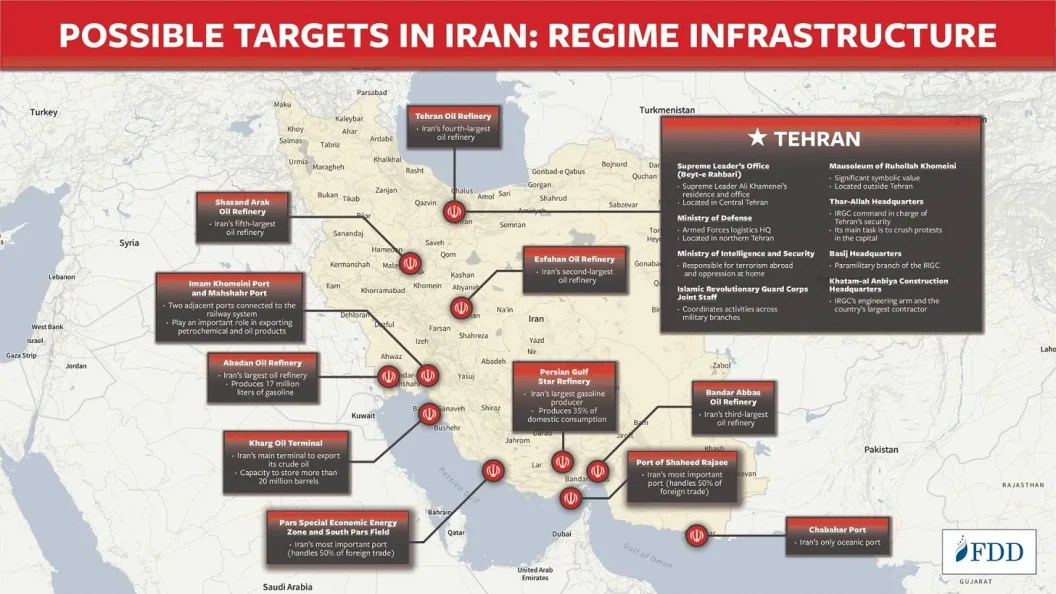
Since Trump thrilled his Israel-aligned donors by attacking Iran, FDD has provided the White House with more than talking points for justifying war on Iran. It has also proposed civilian targets in Iran for the US military to strike. These included the Tehran oil depot which Israel bombed on March 8, causing massive fires that shrouded the city of 9 million in toxic fumes.
After the strike triggered a wave of punishing retaliatory Iranian attacks on oil infrastructure in US-allied countries in the region, Trump advisors expressed regret. “We don’t think it was a good idea,” one told Axios. But by then, it was too late to avoid escalation. They had followed the FDD-authored, Israeli-designed script into a quagmire.
IRAN: The Three Islands Unmaking American Unipolar Sea Power in the Persian Gulf
By Freddie Ponton – 21st Century Wire – March 20, 2026
For half a century, the Strait of Hormuz has been sold as an American lake. “Freedom of navigation” meant US carrier groups on one side, pliant Gulf monarchies on the other, and anyone who challenged that arrangement cast as a rogue. That era is dying in real time, and three tiny islands at the mouth of the strait in the Persian Gulf explain why.
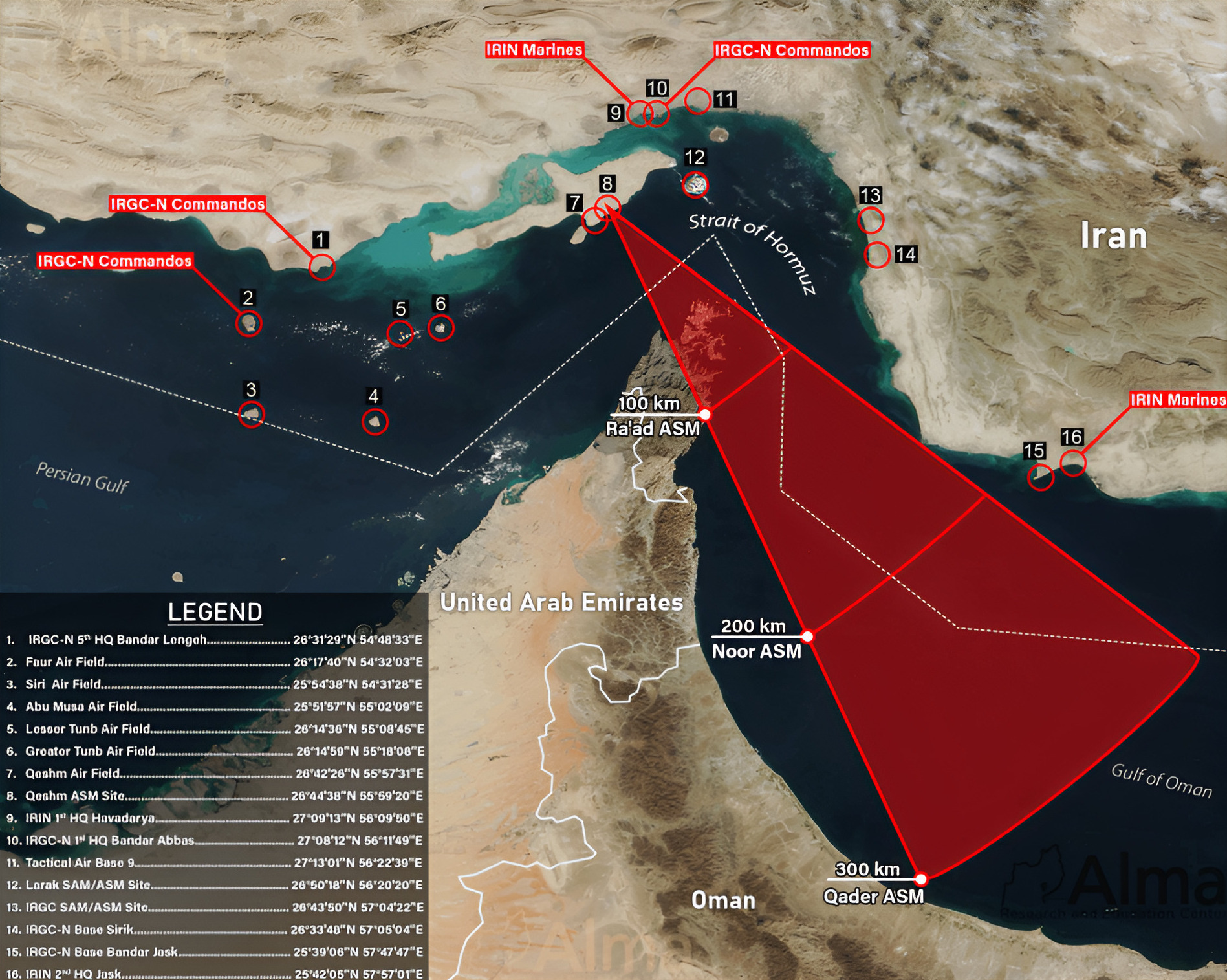
Abu Musa, Greater Tunb, Lesser Tunb. On most Western maps, they’re a footnote about an Iranian–UAE “dispute.” In the real world, they sit astride the deep‑water lanes that carry a huge share of the planet’s oil and gas. Whoever holds these islands doesn’t just watch the traffic; they sit on its windpipe. Iran controls them. And after US‑Israeli strikes on its territory, including reported HIMARS and missile attacks on Abu Musa and Kharg launched from Emirati soil in mid‑March, Tehran is no longer treating them as bargaining chips. It is fortifying them as unsinkable enforcement platforms and folding them into a new doctrine for Hormuz. Tehran’s doctrine is not American “open seas,” but Iranian‑managed passage under conditions set by Tehran as the state that actually lives on the coastline.
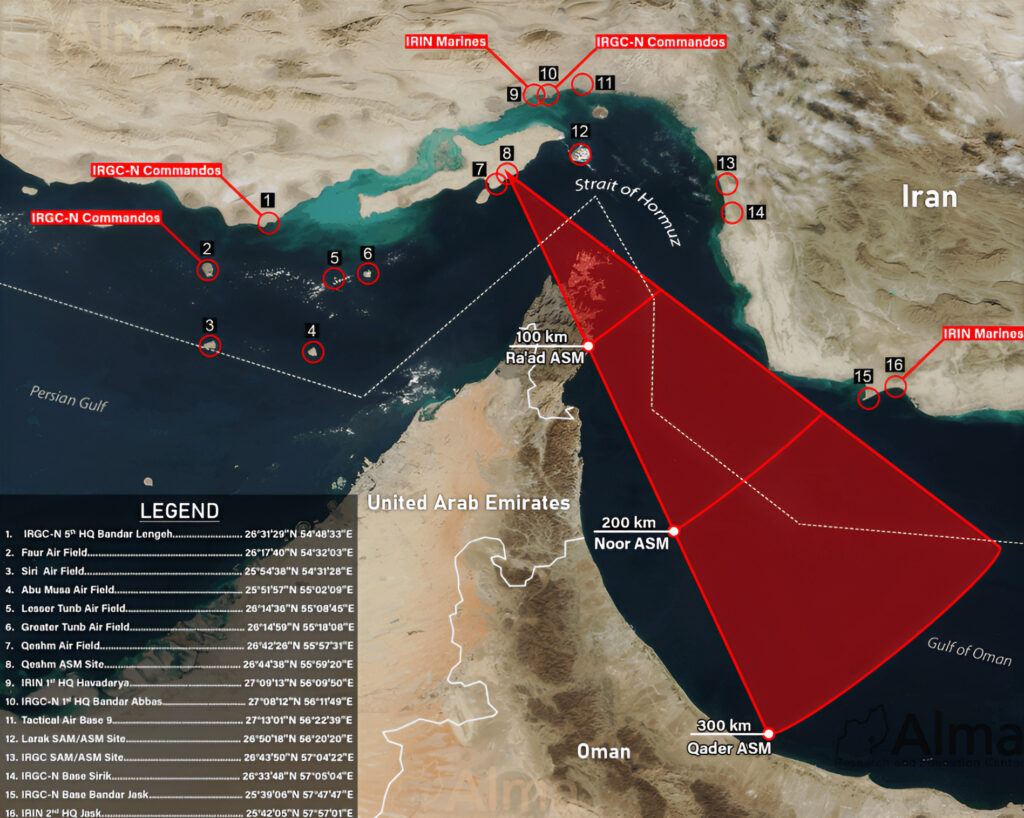
IMAGE: Abu Musa, Greater Tunb, Lesser Tunb, and Iranian forces positioned around the Strait of Hormuz (Source: Alma Research & Education Center)
The official Western question is still, “Is Hormuz closed?” and that’s a dodge. The real question is closed for whom, open for whom, and who gets to decide. Since the war phase began in late February, tanker traffic has collapsed, and commercial sailings have been rerouted or halted as war‑risk insurance is withdrawn. Where roughly a hundred tankers might normally cross in a comparable period, only about ninety have reportedly transited so far in March, with hundreds of other vessels backed up west of the strait and close to ninety percent of “normal” commercial passages gone. What still moves is a thin, carefully curated stream, including Iranian‑linked tonnage, a handful of politically vetted vessels that Tehran has agreed to let through via its own corridor, and tankers using intermittent AIS transmissions and complex ownership structures to move sanctioned or restricted oil toward Asia.
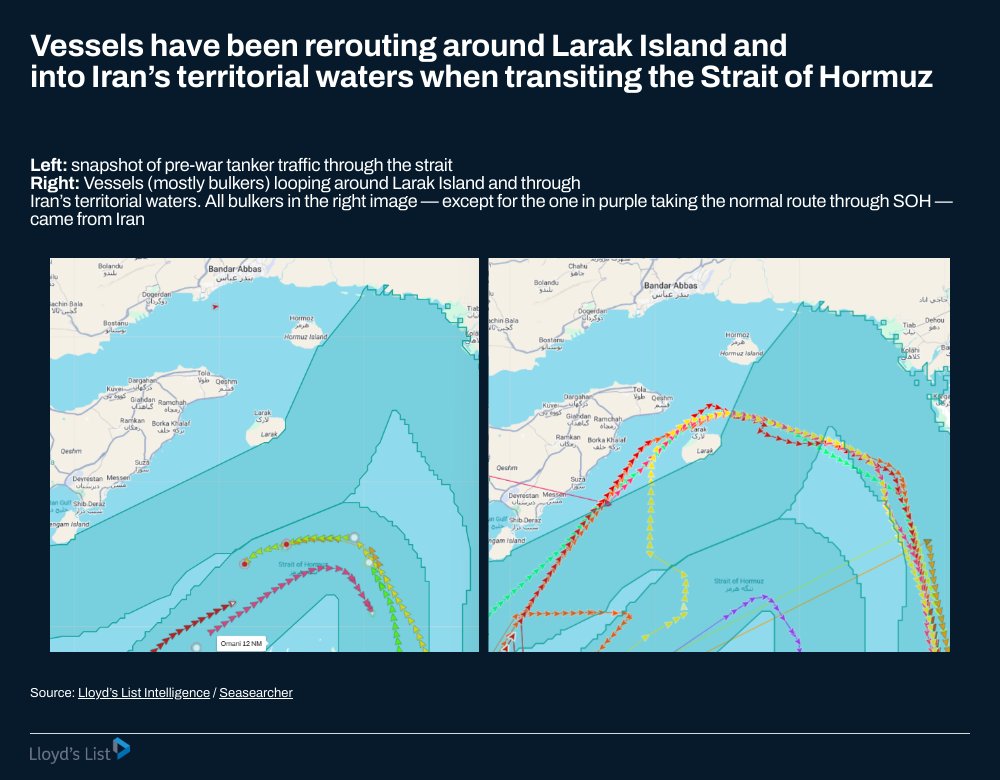
MAPS: Left – pre‑war tanker traffic through the Strait of Hormuz. Right – post‑war traffic, showing vessels (mainly bulk carriers) looping around Larak Island inside Iranian territorial waters. In the right‑hand map, every bulker except the purple one (which follows the old Strait route) has come from Iran (Source: Lloyd’s List Intelligence / Seasearcher | via Lloydslist)
Two India‑flagged gas carriers, namely the Shivalik and Nanda Devi, were tracked in mid‑March hugging the Iranian coastline and looping around Larak Island inside Iranian waters on their outbound run, an unusual detour that only makes sense if you understand that “safe passage” now means “Iran‑approved route.” At least one non‑Iranian tanker is reported to have paid a two-million-dollar fee for safe transit. This shouldn’t be seen as random, but more as the contour of a policy. Iran has built, in wartime, a selective corridor through its own waters—a route that non‑hostile states can use if they accept Iranian security conditions and that belligerent‑linked ships enter at their own risk. Vetting, advance disclosure of ownership and cargo, a narrow lane close to Iranian‑controlled islands, visual confirmation by IRGC units enforcing routing instructions, all of this adds up to a regional‑power‑managed maritime security framework.
For Washington, that’s intolerable, but for Tehran, it is common sense. An attacked coastal state asserts control over waters it must defend and refuses to guarantee safe passage to the very powers bombing its soil. The US dressed this principle up as “rules‑based order” when it applied to itself; Iran is now applying it at home.
Under Article 51 of the UN Charter, states have an “inherent right of individual or collective self‑defence”, especially when armed attack occurs. Under the Law of the Sea, coastal states retain sovereign rights in territorial waters and can regulate security‑related uses of those waters even where foreign ships enjoy transit passage in principle. Put bluntly, a state whose islands and infrastructure are under missile and drone fire is not obliged to offer safe, unconditional transit through adjacent straits to the forces attacking it. Iran’s position is that this legal language applies in the Gulf as much as it does off the coasts of NATO states. and not only when the flag on the defending warship is American.
This is why Abu Musa and the Tunbs can’t be treated as scenery. They are where law, geography and war intersect. Iran now openly says US rockets and missiles have hit Abu Musa and Kharg from launch sites in the UAE, and has warned that concealed US “hideouts” on Emirati soil could become targets. Tehran is stating, in plain language, that its islands are under attack from US forces using Gulf territory as a staging ground, and that any security regime in Hormuz must start from that reality. When Iran reinforces Abu Musa, Greater Tunb and Lesser Tunb with systems like the Khordad‑15 air‑defence network and integrated radar deployments and hardened garrisons, this is not random muscle‑flexing, but a military posture and a legal argument built together. These islands are Iranian territory; they have been directly targeted, and Iran claims the right and the obligation to control what passes under their guns.
Once you see that, the narrative of “Iran weaponising Hormuz” looks like what it is: projection. The unipolar maritime architecture is disintegrating. The old model rested on US naval dominance in the Gulf dressed up as “freedom of navigation”, Western insurers and P&I clubs underwriting risk, and a political fiction that all of this was neutral. All three pillars are failing at once. US warships can still fire missiles and intercept drones; however, they cannot restore normal traffic, and certainly have failed to convince owners, crews and insurers that sailing through a de facto war zone ringed by Iranian missiles, drones and fast boats is “safe” because the Pentagon says so. Iranian warnings are being enforced with fire and shrapnel on decks near the UAE. Owners and captains have diverted voyages or refused to enter the area altogether. Whatever carefully crafted talking points say, the calculus on the water has changed.
On the financial side, the retreat is even starker. Major mutuals like Gard and other big clubs have cancelled or sharply restricted war‑risk cover in Iranian and Gulf waters. Reinsurers have pulled back. War‑risk premia have surged, with brokers citing mark‑ups in the tens of percentage points over pre‑crisis levels. A US destroyer on the horizon is one thing; a captain whose vessel requires uninsured or state‑guaranteed passage is another. Once you understand that, the sudden enthusiasm in London and at the UN for “safe maritime corridors” to evacuate stranded ships and seafarers looks less like confident crisis management and more like a rear‑guard action. Institutions are scrambling to sketch out a neutral evacuation lane for stranded ships and tens of thousands of trapped seafarers, only after Iran has already imposed a functioning framework of selective passage.
Hormuz today is not an open‑or‑closed switch; it is a three‑tier system where the old, war‑risk‑insured, and the West‑governed traffic has largely fled. The vessels that still move under a veneer of normality are those that have obtained Iranian approval, accepted Iranian routing through Iranian waters and, in some cases, paid for the privilege. Beyond that are tankers often described in Western reporting as a ‘shadow fleet’ that move oil targeted by US and EU sanctions to Asia. The United States built the first tier and tried to pretend the other two were aberrations. The war has inverted that hierarchy as the US‑designed layer is barely functioning, and Iran’s own corridor, together with the parallel fleet of non‑Western‑insured tankers, now carries most of the barrels that still move.
That is why the question “who pays the bill” is not a technical afterthought. When major P&I clubs exit, when fringe insurers and state guarantees step in to keep some trade moving, when Turkish officials say openly that only governments can now provide adequate cover, we are watching the monetisation of geopolitics. The price of sailing through Hormuz is no longer set by neutral actuarial tables in London; it is set by political risk and Iranian veto power. The reported multimillion‑dollar “approval fee” is not just a one‑off toll. In the current context, it should be viewed as an early manifestation of a deeper shift from Western‑priced risk to regionally priced power.
For the Gulf monarchies, this is a nightmare written in their own geography. Officially, they repeat Washington’s language about Iranian aggression and the sanctity of free navigation. In practice, they sit under the shadow of Iranian missiles capable of striking across the Gulf, on top of US bases that make their territory a launchpad, with economies that cannot absorb a prolonged throttling of Hormuz. The strikes on Abu Musa and Kharg, allegedly from positions in the UAE, lay this contradiction bare.
The United Arab Emirates hosts US military assets that can be used to strike Iranian islands. Iran’s answer is blunt: if you turn your territory into a launchpad, you turn it into a battlefield. Tehran has already demonstrated this logic by hitting ports and energy infrastructure elsewhere around the Gulf with missiles and drones, and insurers have responded by treating Emirati lanes as anything but routine. Caught in the middle, Gulf rulers are squeezed from above by US and Israeli pressure to “hold the line,” from below by the basic fact that their economies depend on exports through Hormuz, and from the side by Iran’s ability to ratchet risk up or down via its island‑based enforcement grid and corridor approvals. They cannot acknowledge this publicly, but shipping patterns, quiet outreach to Tehran and renewed focus on bypass routes such as Iraqi lines to Ceyhan and the UAE’s Fujairah outlet, tell their own story. The era of outsourcing maritime security to an external hegemon is coming to an end, and the bill for that dependency has arrived.
For Washington and Tel Aviv, this is not just inconvenient; it is structurally humiliating. They can escalate strikes on Iranian soil and assets. They can float carrier groups and talk about keeping the lanes open. Nonetheless, the facts are brutal, as we witness the collapse of normal commercial traffic, key insurers walking away, and Iran still in a position to hit or detain ships that ignore its instructions. Every move now risks one of two outcomes, both bad from their point of view. Either they tacitly accept Iran as a gatekeeper, admitting that the local power they tried to isolate now decides who moves safely through the world’s most important energy chokepoint. Or they try to smash that gatekeeper, at the cost of a much wider war in waters Iran has spent decades preparing to fight in with anti‑ship missiles, mines and swarming boats, with a global economy built on the assumption that nobody would be reckless enough to test it. The mythology of neutral US maritime hegemony never allowed for this choice.
The real Gulf, anchored in islands like Abu Musa and the Tunbs, always did. Strip away the propaganda, and what remains is stark. Iran has been attacked by the US and Israel, including strikes on key islands and infrastructure, and has invoked its right to self‑defence. It controls strategic islands that command the Hormuz lanes. It uses that control to build a selective passage regime that rewards non‑belligerents, punishes or deters aggressors, and forces everyone else to choose. This is not irrational behaviour, it is not even chaos. It is what happens when a regional state that understands geography stops accepting US control of its maritime neighbourhood as a law of nature.
That is the story the Strait of Hormuz is telling now. This is not another abstract crisis in “global shipping.” It is an autopsy of the “open seas under US protection” fable and a close‑up of the Iranian alternative taking shape where it matters most: at the narrow throat of the Gulf, under the guns and radars of three small islands most of the world has never heard of, but soon will have to reckon with.
Trump’s dispatch of Marine Expeditionary Unit signals desperation for any symbolic success
By Samuel Geddes | Al Mayadeen | March 20, 2026
In mid-week, the 31st US Marine Expeditionary Unit aboard the USS Tripoli was sighted transiting the Straits of Malacca en route to the Gulf. Its crew and detachment, reportedly 2200 to 5000-strong, has been summoned from its station in Japan after President Trump’s dawning realization that the Islamic Republic of Iran would not meekly collapse after he assassinated its leader, Sayyed Ali Khamenei.
Given that he initiated the war by crossing the ultimate red line, Trump’s options for further escalation are vanishing quickly. He is caught between what he knows to be the universal unpopularity of the war among Americans, especially over its disastrous economic consequences, and the knowledge that if he washes his hands of the situation and walks away, Iran will almost certainly continue retaliating and end up in a vastly more powerful position than it had been in before the war.
These equal opposing forces, the need for an off-ramp and the need to demonstrate any kind of tangible success, have shifted the calculus to include US ground operations on Iranian soil. It is in this context that the Marine Corps’ dispatch to the region is widely interpreted.
What would 5000 US Marines, at most, realistically achieve in a ground operation in Iran?
The idea of a large-scale ground invasion of Iran was never seriously on the table to begin with. Besides the fact that the Trump administration has been uncharacteristically consistent that this will not happen, the entire active US military, 1.3 million personnel, would be required, along with at least as many conscripts, for such a thing to even be attempted. Iran is a 1.6 million square kilometer mountain fortress, holding more mountains, deserts, and over 90 million mobilized citizens within. The United States has never occupied or even attempted to occupy a country of this size. It is simply not happening.
With large-scale ground incursions eliminated, the one “boots-on-the-ground” scenario with at least some initial plausibility would be for the US to seize one or more of the Iranian islands in the Gulf, especially the Strait of Hormuz. These islands range from Hormuz and Qeshm in the east, westward to Kharg, where 90 percent of Iran’s oil exports originate.
Upon genuine examination, however, the force currently on its way is woefully insufficient even for this objective by several orders of magnitude. The closest analogue for such an operation, in scale and required manpower, would be the Volcano and Ryukyu islands campaign against Japan in World War II, the bloodiest theatre of the US war in the Pacific. In fact, Qeshm Island is only slightly larger than Okinawa, which required between 250,000 and 540,000 American soldiers to occupy. Success there came only at the cost of 12,500 Americans killed in action and 50,000 wounded. Taking the Island of Iwo Jima alone, famously the most intense engagement of the Pacific, required 110,000 troops and took the lives of 6,800, with 20,000 wounded. Iran’s smaller islands in the Strait, Hormuz, Larak, and Hengam are comparable in size (and presumably the density of their defenses) to the Japanese outer islands but compressed within a single theatre of only a few hundred kilometers across. Anyone seriously proposing such an operation would be looking at the most intensive and costly amphibious campaign since World War II, plausibly seeing US losses equaling those of the entire wars in Korea or Vietnam within a matter of weeks or months. Here too, the enormity of the operation places it far outside the US military’s current capacities. It is certainly outside the means of 5,000 American soldiers, assuming they are not being willfully sent to their deaths.
If the Marines on the USS Tripoli are insufficient to even take and hold a small island, the last remaining possibility is that they are intended to infiltrate Iranian territory to carry out some form of high-stakes, largely symbolic operation that Trump intends to publicize as him “winning” the war and unilaterally ceasing US involvement.
Other than standard acts of sabotage, it has been suggested that the Marines may be tasked with locating and capturing Tehran’s enriched uranium stockpile. Such an objective is almost certainly fanciful. There is no reason to assume the Americans have any idea where it is, or that even 5000 marines would be sufficient to seize it if they did. However, given this administration’s amply demonstrated detachment from reality, its utter lack of shame or respect for international law, Trump’s assertion alone that such a mission was successful, even if it failed or never occurred at all, might be the one “success” that the president could consider sufficient to end his part in this catastrophe. That such a “success” would be illusory and utterly devoid of any strategic value is at this point an entirely secondary consideration.
It may well be that when the expeditionary unit reaches the Strait of Hormuz within the next week, it will simply do nothing – its purpose being pure posturing. Whatever its true role, its size relative to the strength of the Islamic Republic all but guarantees that it will serve a solely symbolic function. Its real mission is to lessen the US president’s humiliation when he ultimately does, in the fashion of a mad Roman emperor, admit defeat to the Iranians.
Iran Proposes Creating Middle East Security Structure With All Regional States – President
Sputnik – 20.03.2026
TEHRAN – Iran proposes creating a Middle East security structure with the participation of regional countries, Iranian President Masoud Pezeshkian said on Friday.
“We are ready to resolve all problems with you. In order to ensure peace in the region, we propose to create a security structure in the Middle East, which will include Islamic countries, in order to ensure peace, stability and security,” Pezeshkian said in an address on the occasion of the Iranian New Year.
Middle Eastern countries do not need the presence of “outsiders,” the president said.
Pezeshkian said that the United States and Israel had no reason to assassinate late Iranian Supreme Leader Ali Khamenei.
“They killed our leader and our commanders without any reason or logic,” Pezeshkian said in a speech marking the upcoming Iranian New Year.
Iran’s weapons industry still churning out missiles despite war: IRGC
Al Mayadeen | March 20, 2026
Iran is producing more missiles amid the United States-Israeli war on the country, spokesperson for Iran’s Islamic Revolution Guard Corps (IRGC), Brigadier General Ali Mohammad Naeini, emphasized.
For Iran, ballistic missiles serve as the backbone of its deterrence and retaliatory doctrine, enabling it to offset conventional military asymmetries through highly survivable, mobile, and scalable systems capable of delivering significant damage to adversary assets. One of the main focuses of the aggression on Iran has been its missile program, which the US and “Israel” seek to “obliterate”.
After firing hundreds of ballistic and cruise missiles at US and Israeli targets in the occupied territories, the Gulf, and the wider region, Naeini underlined that there should be “no concern” over Iran’s missile industry or its stockpiles.
The IRGC spokesperson also promised Iran’s adversaries “surprises”, saying that Iran’s retaliation will be more “remarkable and increasingly complex.”
“Our people in the streets want the war to continue until the enemy is fully exhausted,” he said, adding, “The end of this war will come only when the specter of war is lifted from Iran.”
Complete destruction?
A major claim of the Israeli regime and the Pentagon is that their forces have destroyed Iran’s missile industry facilities. In one briefing, Secretary of War Pete Hegseth said that a primary goal of the US aggression is not just to target Iranian missiles but to ensure Iran “has no ability to make more.”
On March 10, Hegseth said that Iran’s ballistic missile production capacity had been “functionally defeated” and “destroyed”, including every company that builds missile components. By mid-March, Hegseth toned his statements down and described the Iranian defense industrial base as “nearing complete destruction.”
Meanwhile, Iran has substantially increased its rate of ballistic missile fire since Wednesday, when the US-Israeli regimes launched an aggression on vital gas infrastructure. Iran met the escalation with retaliation against energy targets in the Gulf and occupied Palestine, forcing US President Donald Trump to publicly deny any involvement in the attack on Iran’s gas fields.
It is worth noting that Iran possesses a broad and diversified arsenal of ballistic missile systems, deliberately varying types and capabilities to sustain a prolonged confrontation against technologically superior, nuclear-armed adversaries. Its inventory includes both liquid-fueled and solid-fuel missiles, offering flexibility in deployment and readiness. These systems are equipped with either unitary high-explosive warheads or submunition payloads designed to penetrate layered air defenses and maximize impact on strategic targets.
A central pillar of Iran’s missile industry is its emphasis on scalable production, cost-efficiency, and operational effectiveness. Despite sustained external pressure, the sector has achieved notable technological advances, with systems such as the Fattah hypersonic-class missiles and the Khorramshahr-4 reflecting progress in propulsion, guidance, and payload delivery. Tehran has also worked to diversify its supply chains while localizing the production of critical components, many of which are manufactured in fortified, deeply buried underground facilities to ensure continuity during wartime.
Washington approves billions in new arms sales to Gulf states as concerns grow over stocks of air defenses
The Cradle | March 20, 2026
Washington has approved around $7 billion in arms to the UAE – as part of a larger package for Gulf states hosting US bases and currently facing retaliatory Iranian strikes, the Wall Street Journal (WSJ) reported.
The US State Department is “not required” to announce the billions in arms to the UAE “under the rules governing U.S. arms exports, which use different modalities for different types of sales,” the report said.
“The Trump administration on Thursday moved forward with $23 billion in weapons sales to the UAE, Kuwait, and Jordan,” in order to “bolster those countries militarily during the conflict with Iran,” US officials told WSJ.
“The proposed weapons sales include more than $16 billion announced earlier on Thursday by the State Department, including air-defense systems, bombs, and radar for the UAE, and $8 billion in air-defense equipment for Kuwait,” the report added.
The officials said the deals include the sale of Patriot PAC-3 Missiles (worth $5.6 billion) and CH-47 Chinook helicopters (worth $1.32 billion) to the UAE.
“The US also approved $37 million in so-called Direct Commercial Sales of Predator XP drones and sustainment programs for light B-250/350 aircraft with an unspecified dollar value,” the officials went on to tell WSJ.
Washington has invoked an emergency clause in the US arms control law for the part of the sales to the UAE. As a result, deals can “bypass” the congressional review protocol, WSJ added.
The State Department said on 19 March that sales to the UAE will improve the Gulf state’s “capability to meet current and future threats.”
According to an Anadolu Agency (AA) report from early March, Gulf countries spent over $3 billion in the first four days of the war alone.
WSJ reported on 2 March that Washington’s Arab allies were in a “race against time” due to quickly depleting stockpiles of US-made interceptors.
“The intensity of interceptor usage that we have seen over the last couple of days can’t be maintained for more than another week – probably a couple of days at most, and then they will feel the pain of interceptor shortage,” Fabian Hoffmann, a missile expert at the University of Oslo, told the outlet at the time.
The report, citing another expert, stated that these countries will have to “ration” their defenses and “change tactics” to a “much more judicious use of those incredibly high-demand interceptors that are running low, and using them only against the highest-value targets, the ballistic missiles.”
The brutal US-Israeli war on Iran has reached the end of its third week.
Tehran has continued its massive and unprecedented campaign of retaliatory strikes on Israel as well as US military assets across the region. Iran closed the Strait of Hormuz to Washington and its allies, and is targeting vessels that attempt to cross in violation of its warnings.
The global price of oil has now shot up past $119.
Tehran struck several major energy facilities across the Gulf on Wednesday: the Ras Laffan site in Qatar, Habshan Gas Facility in the UAE, and SAMREF Refinery in Saudi Arabia.
An Iranian missile also struck Israel’s Haifa Oil Refinery on Thursday.
Israel had bombed Iran’s South Pars Gas Field earlier this week, with direct approval from US President Donald Trump.
Seven US allies endorse Hormuz ‘coalition,’ offer ‘no commitment’ for military action
The Cradle | March 20, 2026
The UK, France, Germany, Italy, the Netherlands, Japan, and Canada issued a joint statement on 20 March in support of a potential “coalition” to reopen the Strait of Hormuz, while specifying “no commitment” to a concrete military role.
“We express our readiness to contribute to appropriate efforts to ensure safe passage through the strait,” the close US allies announced.
The joint statement did not, however, touch on any military involvement or the commitment of any forces to the initiative.
One political reporter writing for Axios said the statement was “largely a gesture to placate [US] President [Donald] Trump, who has railed against allies for declining to help secure the strait and warned that a failure to do so could undermine the future of NATO.”
The allies condemned attacks on commercial vessels and energy infrastructure, citing “the de facto closure of the Strait of Hormuz by Iranian forces,” and called on Tehran to “cease immediately its threats, laying of mines, drone and missile attacks and other attempts to block the strait.”
Italian Prime Minister Giorgia Meloni said no state is considering “a military mission to forcibly break the Iranian blockade,” adding the EU favors “diplomacy and de-escalation.”
She clarified that any contribution would apply to a “post-conflict phase” and require agreement among all parties.
Other governments echoed this position, with Germany confirming “no military participation,” while France said its deployments remain strictly defensive.
The UK ruled out a NATO mission, focusing instead on negotiations, though it has sent planners to coordinate options.
Despite the political backing and global panic over soaring energy prices , maritime data shows the strait is only partially restricted, as roughly 90 vessels crossed in early March.
Iran has established a controlled “safe” shipping corridor through its territorial waters in the Strait of Hormuz, allowing only approved vessels – mainly from countries like India, Pakistan, China, Iraq, and Malaysia – to transit after IRGC vetting, while ships linked to the US or Israel are effectively excluded.
Access is currently negotiated on a case-by-case basis but is moving toward a formal system requiring detailed disclosures of ownership and cargo, often coordinated through intermediaries and, in at least one case, involving a reported $2-million payment.
So far, at least nine vessels have used the route, which passes near Larak Island for inspection, but traffic remains minimal.
The US remains largely the only country carrying out direct military operations, deploying forces and striking Iranian positions along the strait, as well as conducting offensive strikes inside Iran.
Earlier US-led efforts to secure regional shipping routes followed a similar trajectory, with coalitions struggling to gain meaningful participation as several allies refused or limited involvement, leaving only a small number of naval deployments.
Efforts to secure maritime routes during the Israeli genocide on Gaza in 2024 faced the same constraints, as US and EU resources proved insufficient to deter Yemeni strikes across the Red Sea.
Officials had warned that strikes on Yemen were “not contributing to the solution,” while Yemeni attacks on vessels continued, raising pressure on global trade routes.
Yemeni forces maintained their stance as a support front for Gaza, persisting with attacks until Washington ended its campaign under an Omani-brokered truce, with President Trump claiming Yemeni forces “don’t want to fight anymore.”
‘Safe’ corridor opening up through Strait of Hormuz: What we know so far
RT | March 20, 2026
Iran has signaled that it is ready to allow passage through the Strait of Hormuz to vessels from certain countries. Media reports and tracker data also suggest that a handful of pre-vetted tankers have already sailed smoothly through the “safe” corridor, with at least one shipping company allegedly paying Iran $2 million.
The development comes as more than 15 tankers have been hit by drones and projectiles in the strait since the US and Israel launched their war on Iran in late February.
As the Middle East escalation has roiled energy markets, the impact of a few tankers passing through has so far remained limited. Brent is still trading well above $100.
Here is what to know about the latest developments in the Strait of Hormuz.
Who is allowed to pass?
In short, not everyone and not everywhere.
Iranian Foreign Minister Abbas Araghchi stated that the strait is open to all except the US and Israel, while adding that some ships from “different countries” had already been allowed through. In practice, however, Western-linked vessels face significant hurdles in securing safe passage.
According to Lloyd’s List, India, Pakistan, China, Iraq, and Malaysia are discussing transit plans directly with Tehran, with officials in the first three countries as well as Türkiye confirming clearance.
The Financial Times reported, citing maritime data, that at least eight ships – including oil tankers and bulk carriers tied to India, Pakistan and Greece, as well as Iran’s own fleet – have sailed through the strait but used an unusual route around the island of Larak, which is close to the Iranian coast and where waters are much shallower than in the middle of the strait.
The actual number of ships – some of which may have turned off automatic tracking systems – could be higher, the report said.
According to the FT, at least nine Chinese oil and fuel tankers are also amassing in the Gulf, apparently preparing to traverse the Hormuz Strait.
Clearance is being granted on a case-by-case basis, Lloyd’s List reported, adding that the Iranian authorities are working on a “more formalized vessel approval process” expected in the coming days.
Is it free of charge?
On paper, international transit is not supposed to work like a toll road, but the current situation appears to be evolving under wartime conditions.
Lloyd’s List reported that at least one tanker operator paid about $2 million to transit, while saying it could not establish whether payments were made in other cases. It also remains unclear how such payments could be processed, given the sanctions on Iran.
In addition, several media reports indicated that Iran’s parliament was considering a bill aimed at taxing ships that cross the strait. The Wall Street Journal noted, however, that such a policy would “require a regional buy” from Iran’s Gulf neighbors.
What did Hormuz look like before the war?
Hormuz was one of the world’s busiest and consequential chokepoints, with an average of 20 million barrels a day of crude oil and oil products moved through in 2025, equal to around 25% of global seaborne oil trade. About 80% of the flows went to Asian countries, including China, India, Japan, and South Korea, according to the International Energy Agency (IEA).
About 93% of Qatar’s LNG exports and 96% of the UAE’s LNG exports also passed through Hormuz, representing roughly 19% of global LNG trade.
Before the war, around 138 vessels transited the strait daily; that figure has now dropped to roughly 3–5 ships per day, according to estimates.
The strait is just 29 nautical miles (54km) wide, with two-mile-wide inbound and outbound shipping lanes separated by a two-mile buffer. Ships using the Larak route must contend with shallower waters than in the central channel, though depths are still generally sufficient for most vessel types.
What impact is this having on energy prices?
The trickle of oil tankers is seemingly having a limited effect on the oil market, with Brent trading at $107 per barrel, down from a peak of almost $120. WTI crude slid from the $100 benchmark to $94.
European natural gas futures (TTF) slightly fell to €60 per MWh after spiking by more than 30% after Israel attacked Iran’s South Pars gas field, triggering a retaliation on energy infrastructure in Qatar.
What does Europe have to say on Hormuz safety?
European leaders have demanded “the reopening of the Strait of Hormuz,” as well as “de-escalation and maximum restraint” from the belligerents. European NATO members, however, have been reluctant to send their navies to the strait. German Chancellor Friedrich Merz said that his country could help in keeping the shipping lanes clear only when the guns go silent.
What impact on the US?
As oil prices skyrocketed, gasoline prices in the US also soared, reaching $3.90 per gallon on average. US President Donald Trump has sought to downplay the market panic, saying he thought that oil prices would be “much worse,” adding that they were certain to come down once the hostilities end.
In addition, US Treasury Secretary Scott Bessent signaled that Washington could waive sanctions on the Iranian oil stranded on tankers in a bid to dampen prices. Earlier this week, he also said that the US had been allowing Iranian tankers to transit the strait “to supply the rest of the world.”
Hormuz disruption exposes hidden strain on US military supply chains
Al Mayadeen | March 20, 2026
The disruption of maritime traffic through the Strait of Hormuz is beginning to reverberate far beyond energy markets, with new analysis warning that the effects could directly constrain the United States’ ability to sustain and replenish its military operations.
A report by the Modern War Institute, cited by The Guardian, describes the situation as a “paralyzing, real-time problem” for any attempt to expand US defense manufacturing, as well as for repairing equipment damaged in recent Iranian retaliations.
At the center of the concern is sulphur, a largely overlooked commodity that plays a foundational role in industrial production. According to the analysis, seaborne trade in sulphur passing through Hormuz, which accounts for roughly half of global shipments, has been nearly halted. Prices have already surged by around 25 percent since the start of the war, with year-on-year increases reaching 165 percent.
Sulphur’s hidden war role
While sulphur is widely associated with fertilizer production, its strategic importance lies deeper in the industrial chain. It is used to produce sulphuric acid, a critical component in extracting key minerals such as copper and cobalt from lower-grade ores.
These materials are indispensable to modern military systems. From microprocessors and communications hardware to jet engines and drone batteries, copper and cobalt underpin the infrastructure that enables both weapons production and operational capability.
The report argues that these inputs “dictate how fast things can be built and scaled under the pressure of an ongoing war,” warning that the consequences of a sudden disruption in supply have not previously been factored into military planning.
Jahara “Franky” Matisek, a US Air Force lieutenant colonel and nonresident fellow at the US Naval War College, described the situation as a compounding crisis. “It’s a cascading issue,” he told The Guardian, noting that replacement costs for damaged systems could rise sharply. “A knock-on effect of this war is that it may cost double or more than double to replace all these weapons because all the mineral demand is going to go way up.”
He added that supply constraints may go beyond pricing pressures. “Markets are not going to be able to provide the amount of minerals that are needed to replace all these radars that have been destroyed and all these munitions that have to be replaced. It’s a really precarious spot to be in right now.”
The Middle East accounts for roughly a quarter of global sulphur production, much of it generated as a byproduct of oil refining. With shipping routes now disrupted, the supply shock is already feeding into downstream sectors.
Sulphur shock, war strain
Beyond defense, the report notes that reduced sulphur availability could also affect agriculture, as farmers worldwide compete for fertilizer inputs. This raises the possibility of broader food supply pressures, particularly in lower-income countries.
However, the military implications remain the primary concern. The authors estimate that replacing just two major US radar systems destroyed in the early phase of the war would require more than 30,000 kilograms of copper, with additional thousands needed to restore other damaged communications and sensor systems across multiple regional bases.
“The current sulfur shock is becoming a copper problem, and that copper problem risks quickly becoming a readiness and resilience problem,” the report states.
The analysis frames the situation as a “prelogistical crisis”, arguing that conventional planning has largely ignored vulnerabilities in the upstream supply of raw materials. Rather than transportation or distribution bottlenecks, the issue lies in the availability of the inputs required to manufacture critical systems in the first place.
A separate study published in February, also co-authored by Matisek, found that only 6 percent of US defense contractors maintain fully transparent supply chains. The latest report suggests that this lack of visibility is now constraining operational capacity.
Industrial dependence
According to the authors, the US military is increasingly dependent on industrial systems it does not fully control, leaving it exposed to disruptions originating far beyond the battlefield.
What is emerging, they argue, is a structural limitation on combat endurance, where the pace of war is determined not only by strategy or firepower, but by access to the underlying materials needed to sustain it.
Iran War Is Accelerating the End of US Dominance
Prof. Glenn Diesen / Cyrus Janssen – March 18, 2026
We discuss how the conflict is being viewed across Europe, why many allies are losing trust in the United States, and how countries like Russia and China may ultimately benefit from the crisis.
US dragged by Israel into ‘unlawful war’ with Iran – Gulf state
RT | March 19, 2026
The US has been drawn by Israel into an “unlawful war” against Iran and needs help to disengage, Omani Foreign Minister Badr Albusaidi has said.
In an opinion piece published in The Economist on Wednesday, the Middle East nation’s top diplomat called on US allies in the region to “tell the truth” about the conflict and admit that Washington “has lost control” of its own foreign policy. “There are two parties to this war who have nothing to gain from it,” he wrote, referring to the US and Iran.
The US maintains close security and defense partnerships with six Gulf states – Saudi Arabia, Kuwait, the United Arab Emirates, Qatar, Bahrain, and Oman – and has a significant military presence in the region, including bases and naval facilities.
The escalation has had economic and security consequences for these states, with Iran retaliating against targets on their territory. Gulf officials have reportedly complained they were not consulted or warned before the US and Israel launched the campaign against Iran on February 28.
Albusaidi, who acted as a mediator in nuclear talks between Washington and Tehran, wrote that the parties had twice come close to a deal in nine months, noting that the airstrike campaign began immediately after the most substantive talks.
”Israel and America again launched an unlawful military strike against the peace that had briefly appeared really possible,” he wrote, adding that Iran’s retaliation was “inevitable.”
He argued that Washington’s greatest mistake was “entering a war that is not its own,” adding that Israel seeks regime change in Iran, while US interests lie in ending nuclear proliferation and securing energy supplies.
The US leadership must “decide where its national interests really lie, and act accordingly,” Albusaidi wrote. He acknowledged that while returning to talks may prove difficult for both sides, renewed negotiations, potentially mediated by the Gulf states, may provide a path forward.
Tehran has described the negotiations as a US-Israeli deception operation. Former US National Counterterrorism Center head Joe Kent said that Israel and allied media figures ran a “misinformation campaign” to push Washington toward war with Iran, according to his resignation letter published on Thursday.
Former Saudi intelligence chief, Prince Turki al-Faisal, also blamed the conflict on Israel, claiming that Israeli Prime Minister Benyamin Netanyahu “somehow convinced” US President Donald Trump “to support his views.”
Israel’s War on Iran’s Grid: How the South Pars Strike Turned Energy into a Weapon
By Freddie Ponton – 21st Century Wire – March 19, 2026
In the early hours of March 18, Israeli drones tore into four gas‑treatment plants in Assaluyeh on Iran’s southern coast, where sour gas from phases 3, 4, 5 and 6 of the South Pars field is cleaned, separated and turned into the fuel that keeps the country’s lights on, homes heated and factories supplied. Iranian officials ordered the plants offline to contain the fires, and industry analysts immediately warned that production from the offshore platforms feeding those trains would have to be cut back. Within an hour of the strike being reported, European gas prices and Brent crude jumped, because traders understood what most headlines did not. This was not a symbolic hit on an abstract “gas field,” but a deliberate attack on a conversion node at the heart of Iran’s domestic energy system and a critical pillar of the wider Gulf energy order.
At the same time, Donald Trump was on social media threatening that if Iran retaliated again against Qatar’s LNG hub at Ras Laffan, he would “blow up the entirety” of South Pars – the largest gas field on the planet, and interestingly, a reservoir Iran shares with Qatar. The man who joined Israel in authorising the first strikes on Iranian production facilities is now openly dangling the prospect of destroying the shared gas reservoir that keeps tens of millions of people warm, powered and employed. That is not deterrence, only a head of state experimenting in public with the language of total economic annihilation.
Trump’s own Truth Social post about the strike reads like a rambling attempt to distance Washington from the attack while threatening to “blow up the entirety” of South Pars if Iran hits Qatar again. The post deserves closer attention later in this story.
ASSALUYEH: WHERE GAS BECOMES POWER
To see what was attacked in Assaluyeh is to understand that the language matches the target. South Pars itself is the Iranian half of a single, giant reservoir under the Gulf, known as the North Field in Qatar, which together contain around a tenth of the world’s proven gas reserves. Iranian officials say South Pars covers 24 phases and provides between 70–75% of Iran’s gas production, feeding power plants, industry, petrochemical complexes and gasoline production. The gas that makes that possible must pass through places like Assaluyeh, where onshore plants strip out condensate, liquefied petroleum gases and natural gas liquids before returning dry gas to the grid and sending liquids on to refineries and export jetties. Over two decades, the South Pars Special Economic Energy Zone has grown into a dense cluster of processing trains and downstream plants with total gas‑processing capacity on the order of a billion cubic metres per day and around twenty‑one petrochemical units producing close to forty million tonnes per year of urea, methanol, polyethene, and other basic chemicals.
Israel did not attack the offshore reservoir. It attacked the pipes, columns and separators that turn raw gas into power, plastics, fertiliser and fuel. The four targeted plants process sour gas from phases 3, 4, 5 and 6, which are mature, are heavily integrated blocks that feed directly into Iran’s domestic grid and petrochemical system. Shutting those trains, even temporarily, forces operators to throttle back production on the linked platforms and starves downstream complexes of both dry gas and feedstock. In concrete terms, that means less gas available for electricity generation on a grid already prone to summer blackouts, less feed for petrochemical plants that supply everything from fertiliser to plastics, and less condensate flowing through the storage and export facilities that sit alongside the gas plants on the Persian Gulf shore.
Iranian reports speak of powerful explosions at several Assaluyeh facilities, fires around storage tanks and gas units, and workers being evacuated as emergency crews tried to contain the damage. From a planner’s point of view, this is a high‑leverage target: a handful of processing units at the convergence of offshore production and onshore consumption whose disruption sends shockwaves up the supply chain and down into the civilian economy. From the point of view of the people whose houses, factories and hospitals depend on those flows, it looks like something else entirely – an attack on the infrastructure of daily life.
That is the first truth this strike reveals: Israel has shifted from fighting Iran’s armed forces to fighting the country’s energy system, the circulation of fuel that keeps the state conscious.
This is not a one‑off aberration. During the twelve‑day war of June 2025, an earlier Israeli strike hit the Phase 14 processing plant at Assaluyeh, forcing a shutdown and firefighting operation before Iranian engineers brought the plant back online within two weeks. The March 2026 strikes returned to the same nerve centre but widened the cut: instead of Phase 14 alone, the drones went after four plants tied to phases 3–6, which together represent a much larger share of South Pars throughput and a deeper incision into Iran’s ability to turn offshore gas into usable energy. What is being tested here is not just Iran’s repair capacity. It is how much of its gas‑conversion system can be burned down before the political cost becomes untenable.
FROM MILITARY TARGETS TO CIVILIAN PUNISHMENT
The crucial point is that gas in Iran is not a luxury export commodity, but the country’s primary fuel for power generation, industrial heat and residential heating. Well over ninety per cent of the gas Iran produces is consumed domestically, not exported. It keeps homes warm in winter, feeds cement and steel plants, drives turbines in power stations and prevents rolling blackouts on a grid that is already fragile. When you hit Assaluyeh, you are not trimming a few cargoes of condensate to Asia. You are reaching into the core of a domestic energy system that supports nearly ninety million people – the apartment blocks in Tehran that already live with scheduled outages, the small factories in Isfahan that depend on steady voltage to keep lines moving, the provincial hospitals that cannot function when the generators sputter.
Even the outlets trying to normalise the strike cannot entirely avoid that reality. They call South Pars an “energy lifeline”, stress that it powers much of Iran’s electricity system and note that the onshore plants at Assaluyeh are central to separating condensate and LPG from the gas that then runs into Iranian networks. “Energy lifeline” is the language of necessity, not of optional revenue. To choose that target is to choose to tamper with the civilian infrastructure that stands between a functioning society and a rolling crisis of blackouts, shortages and industrial breakdown. “Collective punishment” is usually invoked in the context of bombs on apartment blocks or food embargoes. Here it is delivered through valves and turbines.
It is precisely at this point, when questions of necessity and legitimacy collide, that the recent behaviour of Washington’s own security establishment strips away the alibi that this was a war forced by urgent facts. In a few sentences at a Senate hearing, Director of National Intelligence Tulsi Gabbard told lawmakers that only the president can decide what is an “imminent threat” from Iran, even as senior aides were warning her that there was no evidence Iran had restarted enrichment or posed an immediate nuclear danger. Two days earlier, Joe Kent, the director of the National Counterterrorism Center, resigned, saying in his letter that he could not “in good conscience support the ongoing war in Iran,” that Iran posed “no imminent threat,” and that Israel had pressured the United States into the conflict. Those two moments do not need pages of commentary. Together they are enough: the official charged with guarding the integrity of U.S. intelligence rewrites “threat” as a presidential mood, and the official charged with synthesising terrorist threats walks out saying the war is manufactured.
In other words, while Israeli pilots and U.S. operators are hitting the infrastructure that keeps Iranian civilians alive, the people at the top of the American system are quietly admitting that the supposed emergency justifying those strikes does not exist in the way the public was told. The last line of defence, a reality defined by evidence rather than by political need, has been crossed, and it has been crossed at the exact moment the war shifted from military targets to the machinery of everyday survival.
Trump’s Truth Social statement makes that shift even starker. It is not a clarification, and reads more like a hostage note. South Pars is being turned into collateral for Qatar’s LNG security, and Trump denies U.S. prior knowledge of Israel’s first strike while claiming the right to decide if and when the entire shared field is destroyed. In one message, he signals that the energy backbone of Iran and Qatar is now a bargaining chip Washington is prepared to sacrifice to enforce its war.
That is the second truth of this episode: the war on Iran’s civilian infrastructure is being waged under a definition of “threat” that collapses into whatever the president needs it to be.
Once a president starts talking about “blowing up the entirety” of the field that keeps both Iran and Qatar running, the fiction that this is a contained war collapses.
Exporting the Energy Shock
By treating Iran’s South Pars complex and linked Gulf energy infrastructure as disposable targets, Israel and the United States have not just escalated a regional war; they have shifted the economic pain onto societies that never signed up for this fight, from Turkish households to European workers and Indian farmers now absorbing the fallout.
Turkey: forced into a rigged market
In Turkey, the cost of turning South Pars into a battlefield is already measurable. Analysts note that Iran supplies gas to Turkey by pipeline, and that any prolonged disruption would force buyers to look for replacement cargoes on the LNG market. That “elsewhere” is the spot market, where Asian demand has already begun pulling cargoes away from Europe as importers scramble to replace lost Gulf supply. In practice, a strike pitched as pressure on Iran becomes a higher import bill for a NATO member and another inflationary squeeze on households and industry.
Europe: dragged back toward 2022
In Europe, the impact showed up first on trading screens. After disruption to Qatari LNG output, benchmark gas prices on the Dutch TTF hub jumped by as much as 45%, reaching around €46 per megawatt-hour. Reuters then reported that Asian buyers scrambling for LNG replacement cargoes were already pulling shipments toward Asia, reinforcing the risk of another continental price shock. Europe’s dependence on LNG after cutting Russian pipeline supply means that attacks on South Pars-linked infrastructure in the Gulf do not stay regional for long.
India: paying for a war it did not choose
In India, the blowback is more than theoretical. Government sources told CNBC-TV18 that LPG supplies were already “feeling some heat” as the West Asia conflict disrupted shipping routes and pushed gas prices higher. The same report said Asian LNG prices had risen from about $6–8 per MMBtu to around $15 per MMBtu, while rerouting cargoes from alternative suppliers such as the United States or Norway would take longer. A later report said Indian LPG consumption fell 17.7% in the first half of March because of war-related supply disruption. That is what energy warfare looks like in human terms: shortages, higher costs and forced adjustment by people who had no role in launching the conflict.
China: tested, not insulated
China’s immediate exposure looks smaller on paper, but the same shock still hits Beijing’s energy calculus. Reuters reported that over 80% of Qatar’s LNG exports go to Asia, placing major buyers like China in the line of fire when Gulf supply is disrupted. Another report noted that China was among the key Asian markets exposed as the regional benchmark LNG price surged and traders sought replacement cargoes from farther afield. That leaves Beijing with more buffers than poorer importers, but not immunity from the price shock set off by attacks on Gulf gas infrastructure
WHEN A SHARED FIELD BECOMES A WAR ZONE
If the story stopped at Iran’s shoreline, it would already be devastating. But South Pars does not stop at Iran’s shoreline. The reservoir that feeds Assaluyeh stretches under the Gulf into Qatari waters, where it is known as the North Field and where it supplies Ras Laffan Industrial City, the most important LNG complex on Earth. Before the war, Ras Laffan’s trains exported around 77 million tonnes per year of liquefied natural gas, with plans underway to expand capacity towards 142 million tonnes by the end of the decade. Alongside LNG, Ras Laffan also produces Liquefied Petroleum Gas (LPG), ethane, condensate and sulphur, and hosts gas‑to‑liquids plants, power stations and desalination units. It is a central hinge in the global energy system, and on the day Iran’s missiles arrived, workers there were told to leave the plant that underwrites their families’ incomes because someone else had decided their shared field was expendable.
Qatar understood immediately what an attack on South Pars meant. Its foreign ministry condemned the strikes as “dangerous and irresponsible,” explicitly reminding the world that the field is geologically continuous with the North Field and warning that targeting infrastructure tied to that reservoir threatens global energy security. It has now gone further, calling Iran’s strike on Ras Laffan a “brutal targeting” of its gas hub, invoking Security Council resolutions and asserting its right to respond under Article 51 of the UN Charter. The United Arab Emirates, normally cautious about public criticism of Israel, issued its own statement that attacks on energy facilities linked to Pars risk catastrophic consequences. Those are not sentimental reactions. They are the reflex of states that suddenly realised the line between “hitting Iran” and “putting our own energy spine in the crosshairs” had effectively vanished.
Iran’s Revolutionary Guard then warned that key Gulf facilities had become “direct and legitimate targets” and urged workers to evacuate them before the strike. The list was specific: Ras Laffan; Mesaieed, Qatar’s original deep‑water export port and industrial hub, where gas and condensate are turned into NGLs, refined products, petrochemicals, aluminium and steel; Samref, a more‑than‑400,000‑barrels‑per‑day refinery in Yanbu on Saudi Arabia’s Red Sea coast with around 13 million barrels of storage; Jubail, the giant refinery‑petrochemical complex in eastern Saudi Arabia running at roughly 440,000 barrels per day and anchored by a 1.5‑million‑tonne‑per‑year ethylene cracker; and Al Hosn in the UAE, a sour‑gas project that processes about a billion cubic feet per day of raw gas, produces roughly half a billion cubic feet per day of sales gas for the Emirati grid and throws off tens of thousands of barrels of condensate and thousands of tonnes of sulphur every day.
In Kuwait, drones struck individual units at the Mina al‑Ahmadi refinery and Mina Abdullah refinery, triggering “limited” fires and forcing operators to temporarily halt parts of their output. Further east, Abu Dhabi’s Habshan gas facilities, already singled out in Iranian warnings, were shut down after debris from intercepted missiles fell on the site, underscoring that Tehran was willing to hit the very installations that underpin its rivals’ domestic energy security.
In other words, Tehran not only threatened but executed multiple strikes, and in the Ras Laffan’s case, it appears the Islamic Republic have struck the same class of conversion assets on Arab shores that Israel and the U.S. had just targeted at Assaluyeh, the plants where raw hydrocarbons become electricity, heating, industrial feedstock and exportable product.
It is crucial to understand that Ras Laffan’s LNG trains, Mesaieed’s NGL and refining complex, Samref’s crude units, Jubail’s crude‑to‑chemicals expansion and Al Hosn’s gas and sulphur trains are all parts of the same nervous system.
When one side authorises attacks on conversion nodes at South Pars, the other side’s answer is not to keep politely to its own coastline. It is to declare that the Gulf’s entire energy architecture is now part of the battlefield.
That is the third truth this strike exposes: by hitting a shared field, Israel and the U.S. have made their own allies’ energy spines part of the target set.
THE ENERGY WAR NOBODY CAN HONESTLY CALL ‘DEFENSE’
Seen from this angle, the Assaluyeh strikes were not a self‑contained tactical move. They were the opening of a new kind of war, a war on conversion infrastructure, that punishes civilians first and drags allies and markets along for the ride. Israel hit the plant that turns Iran’s gas wealth into heat, light and wages; Iran responded in kind by putting the plants that turn Qatar’s, Saudi Arabia’s and the UAE’s hydrocarbons into LNG, petrol and plastics in its sights. Trump then raised the stakes by threatening to “entirely blow up” the shared reservoir that makes all of this possible, as if the energy backbone of two states and a sizeable slice of Europe and Asia’s gas supply were a pawn to be removed from the board to prove a point.
At that stage, the legal and moral mask slips. A campaign that begins as “precision strikes” against military and command targets turns, almost in slow motion, into an assault on the infrastructure that keeps tens of millions of people from freezing, blacking out or losing their jobs, and into a form of extortion against the wider Gulf. In other words, people of Iran are being asked to accept that Iran’s energy lifeline can be bombed with impunity, or watch their own refineries and LNG terminals burn.
Iranian analysts now call this openly what it is, “economic warfare” centered on energy, and warn that destroyed or degraded capacity will worsen electricity shortages and deepen domestic hardship. When the same government waging that campaign has senior officials on record saying the “imminent threat” used to sell the war does not exist as advertised, it becomes very hard to sustain the fiction that this is self‑defense in any meaningful sense.
A war waged under those conditions cannot be sold as “precision.” It can barely, if at all, be sold as self‑defense. What they are doing, in the cold light of Assaluyeh’s burning stacks and Ras Laffan’s flares, looks like a campaign of collective punishment enforced through the energy system of an entire region, and once you see it that way, it becomes very hard to unsee.
Featured Video
Total War – Attacking Nuclear Plants, Desalination & Infrastructure
or go to
Aletho News Archives – Video-Images
From the Archives
Strike on Israel Shows US Bases Near Iran Are ‘Achilles Heel’
By Svetlana Ekimenko – Sputnik – 14.04.2024
Fears of a greater Middle East escalation were triggered after Iran launched a massive drone and missile attack against Israel, aided by Hezbollah and the Yemeni Houthis. Iran said the attack was in response to Israel’s bombing of the Iranian consulate in Damascus, Syria, which killed seven members of the elite Revolutionary Guard Corps.
Iran’s massive retaliatory attack on Israel from its own territory is a sign that the conflict could “escalate out of control.”
Michael Maloof, a former senior security analyst in the office of the US secretary of defense, told Sputnik that the first ever direct Iranian attack on Israel set a dangerous precedent.
“My concern is that this could easily escalate into something not only between Iran and Israel, but beyond the Middle East region,” he said.
Iran’s assault, which it stated was an act of “self-defense” after the Israeli strike on its consulate in Damascus, was originally intended to be a “limited” one, said Maloof.
Iran first sent in “swarms of drones with lights on as a sign of psychological warfare,” but sending in cruise and ballistic missiles by Tehran was a “distinct escalation,” said Maloof.
The scale of Iran’s attack on Israel suggests that Tehran was sending a message, demonstrating that it possesses “extraordinary capabilities,” said Maloof. … continue
Blog Roll
 Aletho News
- Pakistan PM backs Iran’s right to self-defense amid tensions
- Hungary blasts ‘fake’ EU accusation
- SAFE Debt Trap: Poland’s €43.7 Billion Bet on Unipolar Illusion
- War on Iran threatens global Gulf capital flows: FT analysis
- Mossad De Facto Admits To Inciting Riots In Iran
- Tehran: World grown thoroughly exhausted with US-Israeli ‘false flag storylines’
- Trump ‘stuck between a rock and a hard place’, lacks Iran war strategy: Ex-CIA chief
- Trump’s bombardment of fake news so far is working quite well. But where is it heading?
- Iran to Mine Sea Lanes in Persian Gulf in Case of Attack – Defense Council
- Barak blasts Netanyahu: ‘Stop lying – you can’t destroy Iran’s nuclear, missile capabilities’
- If Americans Knew
- From Sde Teiman, the truth about Israel’s military justice system has been set free
- Child denied life-saving bone marrow transplant by Israel ‘because he is from Gaza’
- Raffi Berg: BBC Middle East Editor Exposed as CIA, Mossad Collaborator
- Jerusalem Archbishop Rebukes Netanyahu’s Statements on Christianity
- US to embed Palantir AI across entire military: Report
- Israeli-US war on Iran to drag on “a few more weeks” – Not a ceasefire Day 164
- Lebanon deaths top 1,200; Palantir AI to be embedded across US military – Not a ceasefire Day 163
- Israel’s assassination game: Take all pragmatists off the board
- Food shortages return to Gaza as Israel tightens aid restrictions under the cover of its war on Iran
- Trump demands trillions in payments from Gulf countries, billions from Harvard – Not a ceasefire Day 162
- No Tricks Zone
- New Study: CO2 Is ‘Effectively Negligible’ As An Explanatory Climate Change Factor Since 2000
- Former Pfizer Toxicologist Dr. Helmut Sterz Tells Bundestag Hearing Pfizer Vaccine Should Have Never Been Approved
- Energy Expert: Germany’s Nuclear Phaseout Was A “500 Billion Euro Mistake”
- New Research: South Australia’s Mid-Holocene Sea Surface Temperatures Were 4°C Warmer Than Today
- Storing Green Energy To Last Germany 10 Days Would Require A 60-Million Tonne Battery
- New Studies: UK Sea Levels Were 4 Meters Higher Than Today During The Mid-Holocene
- Destructive Green New Deal: German Energy And Metal Group Warns Of Drastic Crisis
- New Study Documents A 20-Year Pause In Arctic Sea Ice Decline – Driven By Internal Variability
- Wake-up Call: Survey Shows Majority Of Germans Now Favor Postponing Climate Targets!
- Televised! Leading German Political Candidate Tells Schoolchildren CO2 Makes Sun Hotter!
 Aletho News