US House votes to repeal president’s Middle East war powers
Al Mayadeen | September 11, 2025
In a significant move to reclaim Congressional authority over military engagement, the US House of Representatives voted on Tuesday to repeal decades-old laws that authorized war in the Middle East.
The 261-167 vote represents a bipartisan push to rescind the 1991 and 2002 Authorizations for Use of Military Force (AUMFs), originally enacted ahead of the Gulf War and the 2003 invasion of Iraq.
The repeal was adopted as an amendment to the annual National Defense Authorization Act (NDAA) and is being hailed as a victory for war powers reform advocates, who argue that outdated authorizations enable unchecked presidential use of military force.
Long-awaited win for war powers reform advocates
The amendment was co-sponsored by Rep. Chip Roy (R-TX) and Rep. Gregory Meeks (D-NY) and garnered support from 49 Republicans and 212 Democrats. Advocates argue that keeping these authorizations in place enables future administrations to bypass Congress in deploying US military power.
“We don’t need to have Congress effectively modern-day declaring war and leaving it in place for a quarter of a freaking century, or in this case, 34 years,” said Roy.
Meeks added that he was “prepared to fight” in upcoming Senate negotiations to ensure the repeal becomes law.
Pushback from opponents
The proposal had an uncertain path to passage. Initially excluded from the package of amendments allowed for floor debate, the measure was added only after an unusual procedural win in the House Rules Committee. Republicans Ralph Norman (SC), Morgan Griffith (VA), and Chip Roy broke with their party to help Democrats force a debate on the amendment.
Not all lawmakers welcomed the repeal. Rep. Joe Wilson (R-FL) warned that revoking the war powers laws would “tie the president’s hands” in responding to regional threats, including resistance movements in Iraq.
Despite these concerns, the amendment passed with bipartisan backing, though deeper divisions remain over broader defense policies.
Wider debate over executive military power continues
While the vote represents a symbolic step toward limiting presidential war authority, critics note that the repeal will not affect recent military actions, including President Donald Trump’s alleged strike last week on a vessel in the Caribbean he claimed was for smuggling drugs.
The war powers repeal is expected to become a central issue in House-Senate negotiations over the final defense policy package. Although both chambers have voted in recent years to repeal the 2002 Iraq AUMF, no repeal legislation has yet been enacted into law.
Background on AUMFs
- 1991 AUMF: Authorized military force during the Gulf War under President George H. W. Bush;
- 2002 AUMF: Enabled the 2003 invasion of Iraq under President George W. Bush;
- 2014: Former President Barack Obama used the authorization to justify airstrikes in Iraq and Syria;
- 2020: US President Donald Trump used it in his first term to greenlight the airstrike that killed the IRGC’s Quds Force commander General Qassem Soleimani in Baghdad.
While former President Joe Biden never formally used the authorization, his administration argued it was important to keep it intact to respond to any future threats.
Qatar under Fire: Israel’s Expanding War Threatens Regional Peace
By Abbas Hashemite – New Eastern Outlook – September 10, 2025
In a shocking and fanatic move, the Zionist state targeted Hamas’ top leadership in Doha to disrupt the ceasefire process once again.
Israeli Aggression Spreads Across MENA Amid Mounting Civilian Toll
The recent Israeli attack on Qatar’s capital, Doha, marks its fifth attack in the last two days. Israel has attacked Gaza, Syria, Lebanon, Qatar, and the Sumud Flotilla on the Tunisian coast, further destabilizing the MENA region. Israel’s attack on Lebanon is a sheer violation of its ongoing ceasefire with the country. For decades, the Zionist state has been violating international law by invading the sovereignty of different Middle Eastern states. The Israeli Defense Forces (IDF) has been unleashing unprecedented violence and atrocities in Gaza and the West Bank since October 7, 2023, under the veneer of its operation against Hamas. According to some conservative reports, the IDF has killed more than 80000 Palestinians, the majority of whom comprise children and women, between October 7, 2023, and January 5, 2025. The true death toll is significantly higher than the reported figures, as scores of bodies are buried under rubble.
Israel’s indiscriminate bombing and ground operations in the Gaza Enclave have flattened the entire neighborhoods, turning them into rubble and wreckage-strewn piles. As per the Gaza Government Media Office, 90 percent of the Strip’s infrastructure has been destroyed by the IDF, inflicting a loss of around $68 billion. In addition, the office stated that, 2700 families have been wiped from the official records. The IDF has also killed 1670 medical personnel, 139 civil defense members, 248 journalists, and over 170 municipal employees since October 7, 2023. The IDF also targeted numerous mosques, churches, hospitals, and educational institutions over the past two years. The Zionist state has also blocked humanitarian aid, pushing 2.4 million Gazans, including more than 1 million children, to starvation and famine. Incidents of shooting civilians after luring them for aid have also been widely reported.
Netanyahu’s Ambition and the Greater Israel Project
The Netanyahu administration has consistently sought to expand the war into the entire region to achieve its ambitions. The Israeli Prime Minister Netanyahu seeks to perpetuate his rule by expanding the war. He also seeks to materialize the historic Zionist ambition of establishing “Greater Israel” by invading the territory of different regional countries. In a recent statement, he stated, “So if you’re asking if I have a sense of mission, historically and spiritually, the answer is yes.” He further stated, “You know, I often mention my father. My parents’ generation had to establish the state. And our generation, my generation, has to guarantee its continued existence. And I see that as a great mission.” These statements speak volumes about the real intention of his ongoing so-called operations against Hamas.
The Israeli government has always sought to expand the war to the whole region and beyond. Just like its Western allies, it blamed its opponents for initiating and fueling the war. However, in reality, the Israeli government has repeatedly disrupted all the peace negotiations. Recently, the US President Donald Trump proposed a peace plan to establish a ceasefire in Palestine. He asked for the immediate release of all the Israeli hostages. After proposing the peace deal, he issued his own threats to the people of Gaza and Hamas if a deal is not reached between the warring parties, implying that they have always obstructed a ceasefire. However, history suggests the reality is quite the contrary. Israel has repeatedly rejected all the proposals and holds a record of violating ceasefires.
The Zionist state’s recent attack on the Hamas leadership in Doha, Qatar – a lead negotiator in the US-led ceasefire negotiations – was also against international norms. These leaders were in Doha to discuss Trump’s peace proposal. However, the Israeli forces targeted them, disrupting another peace process and exposing the region to further instability and chaos. According to Hamas, its leadership survived the attack. However, six people, including the son and one of the aides of Hamas’ leader, Khalil al-Hayya, have been killed in these strikes. Hamas stated, “This once again reveals the criminal nature of the occupation and its desire to undermine any chances of reaching an agreement.” It declared the attack as “a heinous crime, a blatant aggression, and a flagrant violation of all international norms and laws”.
Qatar, Regional States Condemn Strike; US Denies Complicity
The Qatari government has also condemned the attack. Qatar’s Emir Sheikh Tamim bin Hammad Al Thani described the attack as a “reckless criminal attack”. He also stated that the attack is “a flagrant violation of its sovereignty and security, and a clear violation of the rules and principles of international law”. All the regional states, along with several extra-regional countries, have condemned the Israeli strikes in Qatar. Reports suggest that the Israeli government took the US into confidence before conducting the strikes. In an official statement, Washington has denied all such claims. It also stated that the US had notified Qatar before the Israeli attack. However, Qatar’s government has refuted the claims by stating that they are “completely false”.
These attacks reflect that the Israeli government does not want the war to end. On the contrary, it seeks to expand it to the whole region. In addition, it shows that the silence of the Arab states has emboldened the Zionist regime to violate their sovereignty and attack any country in the region. The event further suggests that in the coming weeks or months, Israel would attack more regional countries to materialize the ambition of Greater Israel. Moreover, it also illustrates that the US and Israel do not recognize any friends in the region. The only thing that matters to them is their regional interest. Although the Qatari government has not mentioned anything about retaliation till now, it needs to respond to Israeli aggression prudently to ensure its sovereignty. OIC must also play its role to exert diplomatic pressure on Israel. Otherwise, the Zionist state will continue to spread violence, terror, and chaos in all the regional countries, threatening regional and global peace.
Аbbas Hashemite – is a political observer and research analyst for regional and global geopolitical issues. He is currently working as an independent researcher and journalist
Israel’s Doha Strike Burns Bridges for Peace, Marks Dangerous Strategic Overstretch – Experts
Sputnik – 10.09.2025
Israel expanded the geography of countries it has bombed on Tuesday, targeting a delegation of Hamas officials involved in peace negotiations in Qatar. Sputnik asked a pair of regional experts how the aggression will impact Israel’s position in the region in the long term.
Israeli military operations in Gaza, Lebanon, Syria and now the Gulf signal an “overstretch” that won’t be left without serious diplomatic repercussions, Ankara-based security analyst Dr. Hasan Selim Ozertem has told Sputnik.
“Looking at Europe, looking at the US, looking at the Gulf, these countries have started to articulate their concerns about Israeli aggression, which was not the case before because of the leverage of the Israeli lobby, especially in US politics,” Ozertem explained.
With Qatar serving as mediator in the Gaza war, the Doha attack “also undermines Israel’s credibility” among the Gulf powers Tel Aviv wants to forge ties with through the Abraham Accords.
Israel’s aggression may even result in the creation of new regional pacts, Ozertem says.
“The Saudi Crown Prince said [Riyadh] will be supporting Qatar. In the past, we know that Qatar and Saudi Arabia had political problems. They managed to solve them. Now we are talking about a military alliance…an anti-Israeli opinion or bloc in the region among local actors… increasing the probability of potential confrontation between Israel and others.”
Burning Bridges
“By attacking Doha as peace negotiations for ending the Gaza genocide were in progress, Netanyahu once again demonstrated his disdain for negotiations and his preference for brute force as the ultimate solution,” says Mehran Kamrava, a professor of government at Georgetown University in Qatar.
Netanyahu’s strategy of “managed chaos” threatens to spiral out of control, and further isolate Israel “by making it a rogue, pariah state,” Kamrava said.
Besides Israel’s reputation, the attack promises to “cost the US much of its already diminished credibility in the Arab world,” the scholar says, emphasizing that unconditional US support for Israel is proving “extremely costly” as the Israeli government takes actions that make it seem increasingly “unhinged” and “devoid of all rationality.”
West Asia is lurching toward war
By M. K. BHADRAKUMAR | Indian Punchline | August 30, 2025
There is extremely alarming news about the situation around Iran. In consultations with the Trump administration — rather, in deference to the command from Washington — the E3 countries (Britain, France and Germany) who are the remaining western signatories of the 2015 Iran nuclear deal known as JCPOA, have initiated the process of triggering the so-called snapback mechanism with the aim to reimpose all UN sanctions against Iran on the plea that it has breached the terms of the ten-year old agreement.
A joint statement issued in the three European capitals on Thursday notified the UN Security Council that Tehran is “in significant non-performance of its commitments under the JCPOA” to give a 30-day notice “before the possible reestablishment of previously terminated United Nations Security Council resolutions.”
The E3 statement is patently an act of sophistry since it was the US which unilaterally abandoned the JCOPA in 2018 and the three European powers themselves have been remiss in ignoring their own commitments to lift the sanctions against Iran through the past 15-year period, which only had ultimately prompted Tehran to resume the uranium enrichment activity — although the Iranian side was ready to reinstate the JCOPA as recently as in December 2022.
A strange part of the E3 move is that they short-circuited the prescribed procedure in regard of the snapback mechanism with the intent to reduce the two other permanent member countries of the Security Council to be mere bystanders with no role whatsoever in the matter. Unsurprisingly, Russia and China have taken exception to this and in a lengthy statement on Friday, the Russian Foreign Ministry has demanded (with China’s backing) an extension of the time line by another six months by the Security Council as an interim measure so as to avoid a standoff with dangerous and tragic consequences.
Tehran has welcomed the Russia-China proposal as a “practical step.” Iran, of course, has explicitly warned that any such attempt by the E3 to reimpose the UN sanctions against it may compel it to reconsider its membership of the Nuclear Non-Proliferation Treaty.
It remains to be seen whether the E3 — or more precisely, the US-Israeli nexus which is the driving force behind the precipitate move — will be amenable to a compromise. All indications are that Israel with the full support of the Trump administration is spoiling for a fight with Iran and make a second attempt to force regime change in Tehran and the restoration of the erstwhile Pahlavi dynasty to replace the Islamic system that got established after the 1979 Islamic Revolution. Simply put, it is a make-or-break attempt by the US and Israel to bring about a geopolitical realignment in the West Asian region.
The US and Israel have drawn lessons out of the miserable failure of their first attempt in June to overthrow the Islamic system in Iran, and Israel suffered huge losses as Iran retaliated. This time around, the US and Israel seem to be preparing for a fight to the finish, although the outcome remains to be seen. Indeed, a protracted war may ensue. The US is rearming Israel with advanced weaponry. At some point, early enough in the war, a direct American intervention in some form can also be expected.
Unlike in June when the Trump administration in an elaborate ploy of deception lulled Tehran into a state of complacency when the Israeli attack began, this time around, Iran is on guard and has been strengthening its defenses. Make no mistake, Iran will fight back no matter what is takes. Iran is also getting help from Russia for beefing up its air defence system and there are reports that Russian advisors are helping Iran’s armed forces to augment their capability to resist the US-Israeli aggression.
Many western experts, including Alastair Crooke, have predicted that an Israeli attack on Iran can be expected sooner rather than later. The Israeli-American expectation could be that Russia’s military operations in Ukraine will have reached a climactic point by autumn which would almost certainly preclude any scope for Moscow to get involved in a West Asian conflict, and that, in turn, will give them a free hand to take the regime change agenda to its finish.
Besides, in a policy reversal, Iran has taken up the standing Russian offer to provide an integrated air defence system. Such a system will possibly be in position by the middle of next year or so and it is expected to be a force multiplier for Iran. Israel will most certainly try to attack Iran before the integrated system which is connected to Russian satellites becomes fully operational. It remains to be seen whether the Trump administration will be able to withstand Israeli pressure, given the Mossad’s alleged involvement in the Epstein scandal.
A West Asian war of titanic scale will be unprecedented. Apart from large scale loss of lives and destruction, the regional turmoil that ensues will also affect the surrounding regions — India in particular. The point is, an estimated 6 million Indians live in the Gulf region. Their safety and welfare will be in serious jeopardy if the Gulf states get sucked in to the war at some point.
The probability is high that Iran’s retaliation this time around may involve the blockade of the Strait of Hormuz through which tankers carry approximately 17 million barrels of oil each day, or 20 to 30 percent of the world’s total consumption. If that happens, oil price will sky rocket and India’s energy security, which is heavily dependent on oil imports, will be affected. India’s main sources of oil supplies are Russia (18-20%), Saudi Arabia (16-18%), UAE (8-10%) and the US (6-7%).
Clearly, if the oil supplies from the Gulf region get disrupted, India’s dependence on oil flows from Russia will only increase further. In fact, there will be a scramble for Russian oil and, paradoxically, Trump’s best-laid plans to hollow out “Putin’s war chest” will remain a pipe dream.
Significantly, according to Israel’s Kanal 13, Russia has evacuated its diplomatic personnel and their families in its embassy in Tel Aviv in anticipation of a “dramatic” change in the security situation and growing signs of an outbreak of hostilities between Israel and Iran.
These “Iran Bombings” in Australia Are a Setup for Further False Flags
By Andrew Anglin | Daily Stormer | August 26, 2025
As we get ready for the next round of the Iran war, Western governments need to come up with an explanation as to why we are going to war for Israel beyond “shielding Jews from blowback as a result of their genocide in Gaza.”
Enter: “Iranian backed terror.”
You have probably heard the claim in various Jewish media that Iran is a “state-backer of terrorism.” However, this claim, when dissected, does not refer to ISIS or al-Qeada style terrorism, but rather is a reference to Iran’s funding of various militias around the Middle East. For example, the media categorizes Iran’s support for Hezbollah and the Houthis as “backing terrorism.” Whatever you think of the militias Iran does back, this is something different than blowing up buildings or running people over with a big truck in Europe or America.
There have been some shaky claims of Iran sponsoring bombings in Saudi and Argentina in the 1990s, and in 2012, India said Iranians tried to kill an Israeli diplomat with a bomb. The same guy was accused of doing a bombing in Thailand, however, and after being extradited to Thailand from Malaysia, the Thai authorities refused to charge him and released him to Iran.
All of this is to say that this week’s accusations by the Australian Prime Minister that the Iranian government was behind the bombing of a synagogue and a Jewish deli in Australia are something different than we’ve seen before. The Melbourne synagogue was bombed on December 6th of last year. The Sydney deli, which burned up last October, was not even originally investigated as foul play by the cops. No one died in either “attack.”
As those who study the Jews are all too aware, Jewish very often commit hate crimes against themselves. Even before terrorism was a thing, Jews would regularly burn down their own properties to collect insurance money. The term “Jewish lightning” is in the lexicon to refer to anyone burning down their own property for the insurance, as Jews were so famous for this behavior (similarly to how a non-Jewish person viewed as greedy might be called “Shylock”).
It’s maybe worth noting that since the bombing, the rabbi from the synagogue in question has been on a donations tour, and with the announcement it was Iran, is on another tour asking for even more free money.
What’s more, if these were indeed intentional attacks from someone, their timing, in the middle of the Gaza genocide, could mean that literally anyone could be responsible. Although Moslems would probably be more likely, it is not hard to imagine a non-Moslem outraged at the scenes on TikTok doing something like this. On its face, blaming the Iranian Revolutionary Guard Corps for the bombing of a random deli and synagogue in Australia sounds ridiculous, and it seems they would be some of the last people on the list of suspects.
Even if you believe Iran was responsible for the attacks they were accused of in the 1990s and then the 2012 events, those were all political or military targets. The idea of a serious military organization ordering random restaurants and synagogues in a random country blown up is silly. Iran is capable of sending rockets at Israel, they are capable of cutting off Israel’s access to shipping lanes. It makes no sense they would sink to street level random acts of random violence, which would not need any central planning.
Further, the fact that the firebombing would not need to be centrally planned means that it would be impossible to trace it to Iranian authorities. What would even be the claim? That they found text messages from a general in the IRGC? And that it took them nearly a year to find these text messages?
The identities of the accused have not been revealed, but the claim by the government is that they are street criminals who also committed other crimes who the IRGC hired through their networks to carry out these very serious firebombings that had no political purpose and where no one even died.
Here’s the Thing
This announcement by the weasel Prime Minister Anthony Albanese that Iran ordered the bombing of these random civilian locations in a white, Western country has been a top news story all over the world. Although no one is likely to look too deeply into it, because again, literally no one died, this gets the idea that “Iran is funding terrorist attacks on civilians” into the minds of the masses of the people.
With the attacks on the World Trade Center in 2001, the FBI had previously coordinated an attempted bombing of the same buildings in 1993 as a kind of precursor. Then you had the second attack, with the airplanes, lead to an invasion of Afghanistan. Then, in the weeks and months after 9/11, someone was sending Anthrax all around to media and government people, which is when the media/government started talking about Iraq as working with the al-Qeada. In 2008, they then said it was actually some random white guy that did the anthrax. He was, conveniently, already dead.
This is the note that was with the Anthrax sent to Tom Brokaw:
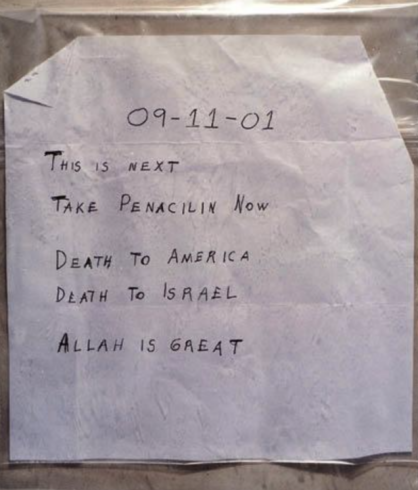
The FBI never really bothered to try to explain why a white guy would do that.
But refencing the Anthrax mailed around, Colin (pronuonced “Colon” for some reason) Powell brought white powder as a prop to his UN presentation on the need to. invade Iraq,
There was an ongoing triangle of disinformation and fake news passing from the New York Times, Dick Cheney, and Fox News. They were accusing Saddam of all kinds of things, just like they are with Iran right now, but the core of it was Cheney’s “Sinister Nexus of Terror.”
You still had the steam from 9/11 when they did the Iraq war less than two years later. But with Iran now, are we really supposed to do a massive war because of October 7th? Or is there going to need to be something more significant to motivate people?
I would very much expect that this Australian cafe and synagogue is the beginning of something bigger. With 9/11 and the Anthrax, when people were saying “oh they can’t be false flags, the government wouldn’t do that,” it was like “well, they started fake wars and killed like a million people, so why wouldn’t they blow up some buildings or send some powders?”
Looking back now, it feels like the “12 Day War” (the term they are using for the back and forth between Israel and Iran that involved Trump also dropping bombs on Iran) was a kind of probing event, where they wanted to see what Iran had. I think they were possibly a bit surprised at how capable Iran was. They were not the superpower capable of wiping Israel off the map that Scott Ritter had told everyone they were, but they were able to hit Israel and with missiles and cause real damage, and it was going to be impossible for Israel to keep going much longer before they were running out of their interceptor missiles.
Israel’s view on Iran has not changed, they are saying they are going to attack them again, and there is no way they can do it without the US, and involving the US on a large scale will probably take more than some all caps Trump tweets.
Obviously, at this point, huge numbers of people are going to be saying “false flag,” even if it is something on the scale of 9/11. So I don’t claim to know how this would work. If I was Donald Trump, I’d be worried the Mossad was going to assassinate me and blame Iran. That would get all the Trump supporters behind a war and it would leave leftists confused as to how they should feel, because if they said “false flag,” they might feel like they were defending Trump. Also, there has already been a “foreshadowing” event where Trump was allegedly scraped on the ear. And, I would add, that a personality like Trump getting shot would just generally be a bigger shock to the world than a bombing, which we’ve all already seen a lot of.
Or maybe I’m wrong and there is already enough noise and there doesn’t need to be some big event to justify further action in Iran. I guess the issue is that I don’t know really what it would take. If there needed to be an Iraq style invasion, then you would need some pretty big justification. But no one understands the logistics of this war. Like I said, I think the first thing was a test as much as anything.
But there are a lot of questions.
If there was large scale bombing of Tehran, could they do a “regime change” from the air? If so, could they keep shooting rockets without a “regime”? How stable is the domestic situation in the country? How do the Arabs, Azeris, and other minorities feel? (I think we know how the Kurds feel, lol. But the others, who knows? I don’t know. I do know that Persians are barely half the population.) Are there terrorists that can be moved in through Azerbaijan? What happened all those terrorists in Syria now that their guy is in charge? Can they be moved through Iraq and into Iran? It’s much more mountainous in Iran.
This is a lot different than when ISIS was able to just roll around wherever on the flats in the Iraqi/Syrian desert.
The mountains also provide a lot of cover for hydra-type break-off groups to operate if the government falls or is at least incapable of operating normally. I’m sure they have caves loaded up with drones and cheap missiles, and as we saw in the 12 Day War, the cost of shooting them down is too much for Israel to absorb. Even if they have infinity money from Big Daddy Donald, they can’t make that many interceptor missiles.
Those are some of the big questions. There are more questions. I’m sure the people within intelligence have better estimates than I would be able to come up with as to what the answers to these questions might be, but I think even US/Israeli intelligence can’t give definite answers regarding most of these factors.
What I do think is that slowly drilling away at it until the armor cracks like they did with Syria is not a potential strategy given that unlike Syria, Iran can hit Israel with missiles. So I’m sure what Bibi wants is the full force of the US military to be brought to bear in a full invasion type war. And for that to happen, it is most likely that something very extreme would have to precipitate it.
Syria, the Druze, and the Greater Israel project
By Gavin O’Reilly | Strategic Culture Foundation | August 25, 2025
On the 12th of August, media outlet Axios revealed that the United States and Israel were in discussions to establish a land corridor between the occupied Golan Heights and the southern Syrian city of Suwayda, ostensibly to protect the country’s Druze minority. The following Saturday, protests broke out in Suwayda calling for Druze self-determination, with many in attendance waving Israeli flags.
Last December, following a lightning offensive by insurgents based in the northwestern city of Idlib, the Syrian government of Bashar al-Assad collapsed in dramatic fashion. This marked the culmination of a thirteen-year effort by various powers to impose regime-change on the Arab Republic. One such power was Israel, who had provided arms to Salafist militants opposed to Assad’s secular rule. Syria, having acted as a conduit between Iran and Hezbollah, had long been in Tel Aviv’s crosshairs.
Within hours of Assad’s fall, Israel launched a ground invasion of southern Syria. Tel Aviv declared that this was in order to establish a buffer zone between Israel and Syria’s new Islamist government, in spite of the fact Damascus’ new rulers had effectively acted in Israel’s interests over the past decade. Israel also later stated that it intended to defend Syria’s Druze minority.
Syria, like Iraq and Libya before it, had subsequently fallen into bloody sectarian strife following Assad’s removal from power. In early March, government pogroms along Syria’s coast resulted in the deaths of more than 1,400 members of the Shi’a Alawite minority. Rather than any concern over sectarian bloodshed however, Israel’s interest in the Druze instead lies primarily in achieving a geostrategic goal that has been planned for decades.
In 1982, Oded Yinon, a senior official at the Israeli foreign ministry, penned a paper entitled A Strategy for Israel in the Nineteen Eighties. More commonly known as the Yinon Plan, the document was published by the World Zionist Organisation in the Hebrew journal KIVUNIM. In it, Yinon prioritised the dissolution of Iraq along ethnic and religious lines as a key long-term strategic goal for Israel.
Iraq, which subscribed to the pan-Arab Ba’athist ideology, had begun to emerge as Israel’s main regional rival following the Camp David Accords and the normalisation of ties between Egypt and Israel. In 1981, the Israeli Air Force had bombed the under-construction Osirak in eastern Iraq, after suspecting it would be used to develop nuclear weapons.
In early 1991, amidst the breakout of the Gulf War, Iraq launched dozens of scud missiles towards Israel. This was done in the hope that an Israeli response would galvanise Arabs across the region and undermine Gulf support for the U.S.-led coalition. Following pressure from the United States however, Israel would ultimately not respond to these strikes. By the end of February 1991, Iraqi forces had been defeated in Kuwait.
Though it subsequently emerged that the U.S. had gone to war on a fabricated account of Iraqi troops removing premature infants from incubators and leaving them to die on a hospital floor, Washington still maintained a belligerent stance towards Iraq. In April 1991, the U.S., Britain and France imposed a no-fly zone over northern Iraq, ostensibly to protect the Kurdish minority. The following year, a similar no-fly zone was put in place over the south of the country, this time under the pretext of protecting Shi’ite Muslims. Like Israel’s current interest in the Druze, this too had a strategic purpose.
The Yinon Plan outlined how in order to Balkanise Iraq, the country would have to be divided into three distinct sections. In the north of the country, a Kurdish separatist state based around the city of Mosul, in central Iraq, a Sunni region tied to the capital Baghdad, and in the south, a Shi’ite region centred around Basra. The United States’ no-fly zones effectively polarised Iraq along these lines.
Following the 9/11 attacks, a radical new U.S. foreign policy was put into place, beginning with the invasion of Afghanistan in October 2001. Eighteen months after September 11th, a U.S.-led coalition invaded Iraq, in spite of the fact no tangible evidence was ever produced to link Saddam Hussein to the attacks. Coalition forces quickly toppled the Iraqi government, and replaced it with a provisional authority. Its first executive order was to permanently ban all members of the Ba’ath Party from working in the public sector. Iraq subsequently plunged into sectarian bloodshed in the wake of the invasion.
Like Iraq, Ba’athist Syria was also identified by the Yinon Plan as a target for Balkanisation. The 1982 document envisaged a Sunni state in northern Syria centred on the city of Aleppo, an Alawite state along Syria’s Mediterranean coast, and another Sunni state, based around the southern capital of Damascus and hostile to its northern counterpart. Amidst this division, Yinon predicted the establishment of a separatist Druze state in the occupied Golan Heights and the Hauran region of southern Syria and northern Jordan.
Following the collapse of Bashar al-Assad’s government, such an arrangement has now effectively been put in place. Northwest Syria, where Aleppo is located, has become a stronghold of the Turkish-backed Syrian National Army. Hay’at Tahrir al-Sham, which led the offensive that ended Assad’s rule, is based in the capital Damascus. Its recent pogroms against the coastal Alawites polarising Syria along the same sectarian divisions outlined in the Yinon Plan. The recent Israeli-backed calls for Druze self-determination serve to even further fragment the former Arab Republic in line with the 1982 paper.
On the same day that Axios outlined U.S.-Israeli negotiations to establish a land corridor to Suwayda, Israeli Prime Minister Benjamin Netanyahu was interviewed by journalist and former Knesset member Sharon Gal for the Israeli outlet i24. When presented by Gal with an amulet containing ‘a map of the Promised Land’, Netanyahu stated that he felt a connection to a vision of ‘Greater Israel’. This is a historical Zionist term referring to an expansionist Israeli state that would incorporate the West Bank, Gaza Strip and Golan Heights at a minimum.
On Wednesday, Israel announced plans to construct 3,400 housing units in the West Bank between Jerusalem and the eastern settlement of Ma’ale Adumin. Such a move would effectively partition the territory between north and south. Bezalel Smotrich, the Israeli minister who announced the plan, declared that it would ‘bury the idea of a Palestinian state’.
Last year, Miriam Adelson, wife of casino magnate Sheldon Adelson, donated $100mn to Donald Trump’s presidential campaign. This was done on condition that the Republican candidate would endorse the formal Israeli annexation of the West Bank if elected. Sheldon Adelson, who died in 2021, had previously donated $20mn to Trump’s first presidential campaign in 2016. This too had a stipulation attached. That the U.S. Embassy would be moved from Tel Aviv to Jerusalem, a move that Trump subsequently followed through with in December 2017.
24 hours after Trump’s inauguration in January of this year, Israel launched Operation Iron Wall. Intended to destroy the Jenin refugee camp, Iron Wall has resulted in the largest mass-expulsion of Palestinians from the West Bank since 1967.
Since October 7th 2023, Israel has subjected the beleaguered Gaza Strip to a military onslaught in response to Hamas’ Operation Al-Aqsa Flood. This was the largest military incursion into Israel since the 1973 October War. Global media attention was drawn to the fact that the Supernova music festival was taking place on the Gaza border at the same time. However, less attention was paid to the revelation that the event had only been moved to that location two days beforehand. That there were no security or insurance concerns over holding a music festival in direct proximity to a location where clashes had taken place between Islamic Jihad and Israeli forces the previous summer, simply beggars belief.
Further questions arose when it emerged that Egypt, which acts as mediator between Hamas and Israel, had repeatedly warned Tel Aviv that ‘something big’ was coming in the run up to October 7th. This was corroborated by two media reports from The New York Times and CNN, which revealed that U.S. intelligence had also passed on similar warnings to Israel prior to Al-Aqsa Flood. By December 2023, it was revealed that Israel had known of Hamas’ attack plan over a year in advance.
Seven months prior to October 7th, Orit Strock, the Israeli minister responsible for the development of settlements in the West Bank, called Israel’s 2005 withdrawal from Gaza a ‘sin’. Strock was speaking upon the repeal of legislation that had ordered the dismantlement of four West Bank settlements. This was declared by Strock as a precursor to the eventual re-occupation of Gaza, a move that would ‘involve many casualties’.
Indeed, this sentiment was later echoed by Israeli security minister Yoav Gallant, who in the days following October 7th announced a blockade on Gaza, cutting off electricity and preventing food and fuel from entering the besieged strip. Gallant described Palestinians as ‘human animals’, language that couldn’t be described as anything less than genocidal.
In April 2024, a report by The Times of Israel revealed that an offer by Hamas to release all civilian captives in exchange for Israeli forces not entering the strip had been rejected by Tel Aviv. Three months later, a Haaretz report revealed that the Hannibal Directive had been applied on October 7th. This is an Israeli military directive in which a command is given to fire upon their own troops in order to prevent them being taken captive. Its use on October 7th was a significant contributory factor to the death toll on the day. Despite these damning revelations, the Israeli slaughter in Gaza has continued unabated for almost two years.
On Friday, the United Nations released a report officially acknowledging the presence of a man-made famine in Gaza. UN Human Rights Chief Volker Türk did not shy away from placing blame for the situation, and held Israel responsible for what is in reality, a genocide. Starvation is being used to ethnically cleanse the Gaza Strip in line with the Greater Israel project. A project that now also has designs on the Druze and southwestern Syria.
The CIA, Mossad, and Epstein: Unraveling the Intelligence Ties of the Maxwell Family
By Alan Macleod | MintPress News | August 22, 2025
With speculation mounting that Trump could pardon her, MintPress profiles the family of convicted sex trafficker Ghislaine Maxwell. From her media baron father, who acted as a high-level spy for Israel, her sister, working to push Tel Aviv’s interests in Silicon Valley, her brothers, who founded a dubious but highly influential anti-Islamic extremism think tank, and nephews in influential roles at the State Department and White House, the Maxwell clan have wide-ranging ties to U.S. and Israeli state power. This is their story.
Releasing Ghislaine, Burying the Epstein Files
Speculation is growing that Ghislaine Maxwell could soon be freed. Despite campaigning on the promise to release the Epstein Files, there are increasing signs that the Trump administration is considering pardoning the world’s most notorious convicted sex trafficker.
Last month, Trump (who contemplated the idea in his first term in office) repeatedly refused to rule out a pardon, stating to journalists that “I’m allowed to do it.” Just days later, Maxwell was transferred across states to a minimum-security facility in Bryan, Texas—a highly unusual practice. Neither women convicted of sex crimes nor those with more than 10 years remaining on their sentences are generally permitted to be transferred to such facilities. The move sparked equal measures of speculation and outrage.
The decision to relocate Maxwell came after somebody—potentially a source within her team itself—began leaking incriminating and embarrassing evidence linking Trump to Epstein. This included a birthday card Trump sent Epstein, featuring a hand-drawn nude woman, accompanied by the text: “Happy Birthday—and may every day be another wonderful secret.”
For years, Maxwell aided her partner Jeffrey Epstein in trafficking and raping girls and young women, creating a giant sex crime ring in the process. Epstein’s associates included billionaires, scientists, celebrities, and politicians, including President Trump, whom he considered his “closest friend.”
In 2021, two years after Epstein’s mysterious death in a Manhattan prison, Maxwell was found guilty of child sex trafficking offenses and was subsequently sentenced to 20 years in prison.
The news that Trump may soon free such an infamous criminal sent shockwaves through his base and drew charges of blatant corruption from the media. “Is there any reason to pardon Ghislaine Maxwell except to buy her silence?” ran the headline of one article in The Hill. Meanwhile, Tim Hogan, senior Democratic National Committee adviser, denounced what he claimed was a “government cover-up in real time.” “Donald Trump’s FBI, run by loyalist Kash Patel, redacted Trump’s name from the Epstein files—which have still not been released,” he said.
Robert Maxwell: Media Tycoon and Israeli Operative
While many of Ghislaine Maxwell’s crimes have come to light, less well-known are her family’s myriad connections to both the U.S. and Israeli national security states. Chief among these are those of her father, disgraced media baron and early tech entrepreneur, Robert Maxwell.
A Jewish refugee fleeing Hitler’s occupation of his native Czechoslovakia, Maxwell fought for Britain against Germany. After World War II, he used his Czech connections to help funnel arms to the nascent State of Israel, weapons that helped them win the 1948 war and carry out the Nakba, the ethnic cleansing of nearly 800,000 Palestinians.
Maxwell’s biographers, Gordon Thomas and Martin Dillon, write that he was first recruited by Israeli intelligence in the 1960s and began buying up Israeli tech corporations. Israel used these companies and their software to carry out spying and other clandestine operations around the globe.
Maxwell amassed a vast business empire of 350 companies, employing 16,000 people. He owned an array of newspapers, including The New York Daily News, Britain’s Daily Mirror, and Maariv of Israel, in addition to some of the world’s most influential book and scientific publishing houses.
With business power came political power. He was elected to the U.K. parliament in 1964 and counted U.S. Secretary of State Henry Kissinger and Soviet Premier Mikhail Gorbachev among his closest friends.
He used this influence to advance Israeli interests, selling Israeli intelligence-gathering software to Russia, the U.S., the U.K., and many other countries. This software included a secret Israeli backdoor that allowed the Israeli intelligence agency, Mossad, to tap into classified information gathered by governments and intelligence agencies around the world.
At the same time, it was expanding its espionage capabilities, Israel was developing a secret nuclear weapons program. This project was exposed by Israeli peace activist Mordechai Vanunu, who, in 1986, leaked evidence to the British press. Maxwell—one of Britain’s most powerful press barons—spied on Vanunu, passing photographs and other information to the Israeli Embassy—intelligence that led to Vanunu’s international abduction by Mossad, and his subsequent imprisonment.
His death was also surrounded by controversy, similar to Epstein’s. In 1991, his lifeless body was found in the ocean, in what authorities ruled a bizarre accident whereby the tycoon had fallen from his luxury yacht. To this day, his children are split on whether they think he was murdered.
The rumors that Maxwell had, for decades, been acting as an Israeli “superspy” were all but confirmed by the lavish state funeral he received in Jerusalem. His body was interred at the Mount of Olives, one of the holiest sites in Judaism, the spot from which Jesus is said to have ascended to heaven.
Virtually the entirety of elite Israeli society–both government and opposition–attended the event, including no fewer than six living heads of Israeli intelligence organizations. President Chaim Herzog himself performed the eulogy. Also speaking at the event was Prime Minister Yitzhak Shamir, who stated that “Robert Maxwell has done more for Israel than can today be said.”
In the United Kingdom, however, he is remembered less fondly. A man with a fearsome reputation, Maxwell ruled his media business with an iron fist, in a similar vein to Rupert Murdoch (another individual with extremely close links to Israel). After his death, it transpired that he had stolen more than $500 million from his employees’ pension fund to bail out other failing companies in his empire, leaving many of his workforce’s retirement plans in tatters. As the newspaper, The Scotsman, remarked ten years later in 2001:
If [Maxwell] was despised in life, he was hated in death when it emerged he had stolen 440 million [pounds] from the pension fund of Mirror Group Newspapers. He was, officially, the biggest thief in British criminal history.”
Isabel Maxwell: Israel’s Woman in Silicon Valley
Even before it had been published, Isabel Maxwell– Robert’s daughter and Ghislaine’s older sister– managed to obtain a copy of Thomas and Dillon’s biography. She immediately flew to Israel, The Times of London reported, where she showed it to a “family friend” and deputy director of Mossad, David Kimche. These actions did little to beat the book’s central allegation that her father was indeed a high-level Israeli “superspy.”
Isabel has enjoyed a long and successful career in the tech industry. In 1992, along with her twin sister, Christine, she founded a company that developed one of the internet’s first search engines.
After the pension scandal, however, she and her siblings shifted their focus to rebuilding every facet of their father’s collapsed business empire. The sisters sold the search engine, netting enormous profits.
As Israeli outlet Haaretz noted, in 2001, Isabel decided to dedicate her life to advancing the Jewish State’s interests, vowing to “work only on things involving Israel” as she “believes in Israel.” Described by former MintPress journalist and investigative reporter Whitney Webb as “Israel’s back door into Silicon Valley,” she has transformed herself into a key ambassador for the country in the tech world.
“Maxwell created a unique niche for herself in [tech] as a liaison between Israeli companies in the initial development stages and private angel investors in the U.S. At the same time, she helps U.S. companies interested in opening development centers in Israel,” wrote local business newspaper, Globes. “She lives intensively, including innumerable flights back and forth between Tel Aviv and San Francisco,” it added.
Israel is known to be the source of much of the world’s most controversial spyware and hacking tools, used by repressive governments the world over to surveil, harass, and even kill political opponents. This includes the notorious Pegasus software, used by the government of Saudi Arabia to track Washington Post journalist, Jamal Khashoggi, before assassinating him in Türkiye.
Isabel built on her father’s political connections. “My father was most influential in my life. He was a very accomplished man and achieved many of his goals during his life. I learned very much from him and have made many of his ways my own,” she said. This included developing intimate ties to a myriad of Israeli leaders, including Ehud Olmert and Ehud Barak, one of Jeffrey Epstein’s closest associates.
During the 2000s, she was a regular participant at the Herzliya Conference, an annual, closed-door gathering of the West’s most senior political, security and intelligence officials, in addition to being a “technology pioneer” at the World Economic Forum.
She was also placed on the board of the Israeli government-funded Shimon Peres Center for Peace and Innovation and the American Friends of the Yitzhak Rabin Center for Israel Studies, two organizations closely associated with those former Israeli prime ministers.
In 2001, she became the CEO of iCognito, taking the job, in her words, “because it [the company] is in Israel, and because of its technology.” The technology in question was aimed at keeping children safe online—highly ironic, given that her sister was actively trafficking and abusing minors throughout that period.
Isabel was a much more serious and accomplished individual than Ghislaine. As Haaretz noted:
While her younger sister, Ghislaine, makes the gossip columns after breakfasting with Bill Clinton or because of her ties with another close friend, Britain’s Prince Andrew, Isabel wants to show photos taken of herself with the grand mufti of Egypt, or with Bedouin in a tent, or of visits to a Gaza refugee camp.”
In 1997, Isabel was appointed president of the Israeli tech security firm, Commtouch. Thanks to her connections, Commtouch was able to secure investment from many of the most prominent players in Silicon Valley, including Bill Gates, a close associate of both the Maxwell family and Jeffrey Epstein himself.
Christine Maxwell: Funded by Israel?
Isabel’s twin sister, Christine, is no less accomplished. A veteran of the publishing and tech industries, she co-founded data analytics firm Chiliad. As CEO, she helped oversee the production of a massive “counterterrorism” database that the company sold to the FBI during the height of the War on Terror. The software helped the Bush administration crack down on Muslim Americans and tear down domestic civil liberties in the wake of 9/11 and the PATRIOT Act. Today, she is the leader and co-founder of another big data corporation, Techtonic Insight.
Like her sister and father, Christine has a close relationship with the State of Israel. She is currently a fellow at the Institute for the Study of Global Antisemitism and Policy (ISGAP), where, her biography states,
She works to promote innovative academic research that leverages enabling technologies to empower proactive understanding and combatting the great dangers of contemporary antisemitism, and enhancing the ongoing relevance of the Holocaust for the 21st century and beyond.”
ISGAP’s board is a who’s who of Israeli national security state officials. This includes Natan Sharansky, former Minister of Internal Affairs and Deputy Prime Minister of Israel, and Brigadier General Sima Vaknin-Gil, the former Chief Censor for the IDF and Director General of the Ministry of Strategic Affairs and Diplomacy. Also on the board is Jeffrey Epstein’s lawyer, Alan Dershowitz.
The think tank was a key player in the U.S. government’s decision to repress the 2024 Gaza protests on university campuses nationwide. The group produced reports linking student leaders with foreign terrorist organizations and promoted dubious claims about a wave of anti-Semitism washing over American colleges. It met frequently with both Democratic and Republican leaders, and urged them to “investigate” (i.e., repress) the leaders of the demonstrations.
ISGAP has continually warned of foreign influence on American campuses, producing reports and holding seminars detailing Qatar’s supposed stranglehold over the U.S. higher education system, and linking that with growing anti-Israel sentiment among America’s youth.
Yet if ISGAP wished to investigate other foreign government influence operations, it would not have to look far, as its own funds overwhelmingly come from a single source: the Israeli state. In 2018, an investigation found that Israel’s Ministry of Strategic Affairs (then headed by Brigadier General Vaknin-Gil herself) channeled $445,000 to ISGAP, a sum representing nearly 80% of its entire revenues for that year. ISGAP failed to disclose that information to either the public or the federal government.
At the height of the concern over foreign interference in American politics, the news barely registered. Since then, the Israeli government has continued to bankroll the group to the tune of millions. In 2019, for example, it approved a grant of over $1.3 million to ISGAP. Thus, in her role as a fellow at the organization, Christine Maxwell is the direct beneficiary of Israeli government cash.
Third Generation Maxwells: Working In the US Government
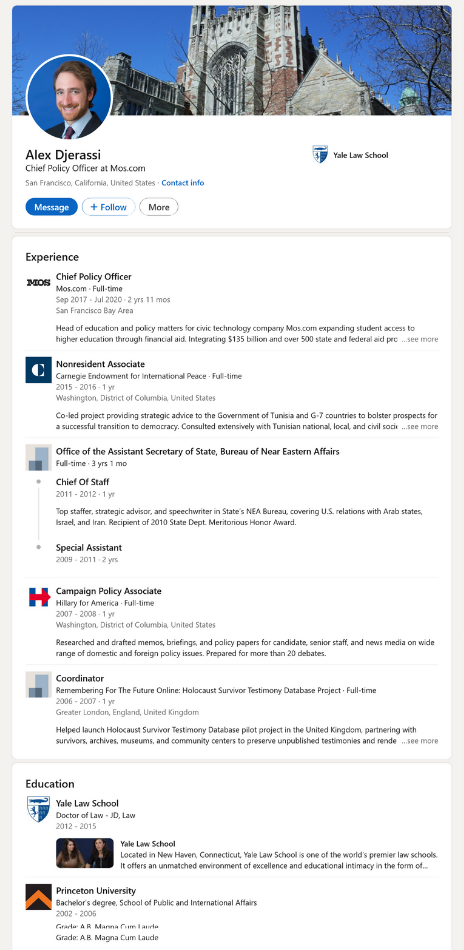
While Robert Maxwell’s daughters were close to state power, some of the family’s third generation have taken up positions within the U.S. government itself. Shortly after graduating from college, Alex Djerassi (Isabel Maxwell’s only son) was employed by Hillary Clinton on her 2007-2008 presidential campaign. Djerassi drafted memos, briefings, and policy papers for the Clinton team and helped prepare her for more than 20 debates.
The Clinton and Maxwell families are closely intertwined. Ghislaine vacationed with Hillary’s daughter, Chelsea, and appeared prominently at her wedding. Both she and Jeffrey Epstein were invited multiple times to the Clinton White House. Long after Epstein was jailed, President Bill Clinton invited Ghislaine to an intimate dinner with him at an exclusive Los Angeles restaurant.
Although she failed in her bid for the White House, President Obama named Hillary Clinton as his Secretary of State, and one of her first actions was to appoint Djerassi to her team. He quickly rose in the ranks, becoming Chief of Staff at the Office of the Assistant Secretary of State, Bureau of Near Eastern Affairs. In this role, he specialized in developing the United States’ policy towards Israel and Iran, although he also worked on the U.S. occupation of Iraq, and accompanied Clinton on visits to Israel and the Arab world.
While at the State Department, he served as the U.S. government representative to the Friends of Libya and the Friends of the Syrian People Conferences. These were two organizations of hardline, hawkish groups working towards the overthrow of those two governments, and their replacement with U.S.-friendly regimes. Washington got what it wanted. In 2011, Libyan leader Colonel Gaddafi was overthrown, killed and replaced by Islamist warlords. And last December, longtime Syrian President, Bashar al-Assad, fled to Russia and was replaced by the founder of al-Qaeda in Syria, Abu Mohammad al-Jolani.
Djerassi was later appointed an associate at the U.S.-government-funded think tank, the Carnegie Endowment for Peace. While there, he again specialized in Middle East policy, his bio noting that he “worked on matters relating to democratization and civil society in the Arab world, the Arab uprisings, and Israeli-Palestinian peace.” Today, he works in Silicon Valley.
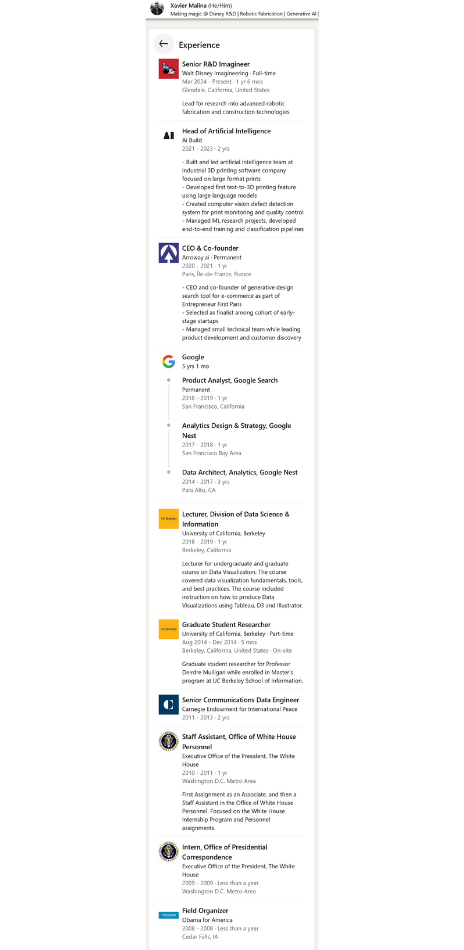
While Djerassi’s fortunes were tied to the Clinton faction of the Democratic Party, his cousin Xavier Malina (Christine Maxwell’s eldest son) backed the right horse, working on the Obama-Biden 2008 presidential run.
He was rewarded for his good work with a position in the White House itself, where he became a Staff Assistant at the Executive Office of the President. Like his cousin, once his time in office was over, Malina also secured a position at the Carnegie Endowment for Peace before pursuing a career in the tech world, working for many years at Google in the Bay Area. He currently works for Disney.
While the actions of parents and grandparents should not determine the careers of later generations, the fact that two individuals who come from a multi-generational family of unrepentant spies and operatives of a foreign power secured positions at the center of the U.S. State is at least worthy of note.
The Maxwell Brothers: From Bankruptcy to Counterterrorism
Much of the Maxwell clan is most influential in American and Israeli politics. However, brothers Ian and Kevin also hold considerable sway over affairs in their native Great Britain. Although being acquitted of charges over widespread allegations that they helped their father, Robert, plunder over $160 million from his employees’ pension fund, the brothers kept a low profile for many years. Kevin, in particular, was known for little more than being Britain’s largest-ever bankrupt, with debts exceeding half a billion dollars.
However, in 2018, they launched Combating Jihadist Terrorism and Extremism (CoJiT), a controversial think tank pushing for a far more invasive and heavy-handed government approach to the question of radical Islam.
In his organization’s book, “Jihadist Terror: New Threats, New Responses,” Ian writes that CoJiT was set up to play a “catalyzing role in the national conversation,” and to answer “difficult questions” arising from the issue. Judging by the content of the rest of the book, this means pushing for even more extensive surveillance of Muslim communities.
Within Britain, CoJiT was a highly influential organization. Its editorial board and contributors are a who’s who of high state officials. Individuals participating in its inaugural conference in London in 2018 included Sara Khan, the government’s Lead Commissioner for Countering Extremism, and Jonathan Evans, the former Director General of MI5, Britain’s domestic intelligence agency.
Like so many Maxwell projects, CoJiT appears to have wrapped up its affairs. The organization has not updated its website or posted anything on its social media channels since 2022.
In fairness, in the past few years, the brothers have had other priorities, leading the campaign to free their sister Ghislaine from prison, insisting that she is entirely innocent. In a manner reminiscent of Robert Maxwell, however, it appears that Kevin may have failed to pay the defense team; in 2022, Maxwell’s lawyers sued him, seeking unpaid fees of nearly $900,000.
The Infamous Mr. Epstein
For years, Ghislaine Maxwell and Jeffrey Epstein ran a sex trafficking ring that exploited hundreds of girls and young women. They were also connected to vast networks of the global elite, including billionaire business owners, royalty, star academics, and foreign leaders, among their closest acquaintances, leading to intense speculation about the extent of their involvement in their many crimes.
It is still unclear when Epstein first met with the Maxwells, with some alleging that he was recruited into Israeli intelligence by Robert Maxwell. Others state the relationship only began after Robert’s death, when he saved the family from penury following its financial problems.
Only one month after his 2019 arrest, Epstein was found dead in his New York City prison cell. His death was officially ruled a suicide, although his family has rejected this interpretation.
Perhaps the two most powerful individuals in Epstein’s circle of confidants were Presidents Bill Clinton and Donald Trump. Clinton, already infamous for the numerous accusations of sexual misconduct against him, is known to have flown at least 17 times on Epstein’s private jet, nicknamed the “Lolita Express,” and was accused by Epstein victim, Virginia Giuffre, of visiting Little St. James Island, the multimillionaire’s private Caribbean residence, where many of his worst crimes took place.
Trump, arguably, was even closer to the disgraced financier. “I’ve known Jeff for fifteen years. Terrific guy,” he said in 2002, “He’s a lot of fun to be with. It is even said that he likes beautiful women as much as I do, and many of them are on the younger side. No doubt about it.” Like Clinton, Trump flew on the Lolita Express. Epstein attended his wedding to Marla Maples in 1993, and claimed to have introduced him to his third wife, Melania.
Unfortunately, while Epstein’s ties incriminate the entire political spectrum, coverage has often been framed as a partisan issue. A MintPress study of over one year of Epstein coverage on MSNBC and Fox News found that each network downplayed his connections to their preferred president, while emphasizing and highlighting the links to the leader of the other major party. As a result, many in the United States see the affair as an indictment of their political rivals, rather than of the political system as a whole.
There also remains the question of Epstein’s links to intelligence, something that has been openly speculated about in the media for decades, even years before any allegations against him were made public. Throughout the 1990s, Epstein’s biographer Julie K. Brown noted, he openly boasted about working for both the CIA and Mossad, although the veracity of his claims remains in doubt. As Britain’s Sunday Times wrote in 2000, “He’s Mr. Enigmatic. Nobody knows whether he’s a concert pianist, property developer, a CIA agent, a math teacher or a member of Mossad.” It is possible that there is at least a grain of truth to all of these identities.
Epstein met with U.S. Deputy Secretary of State William Burns three times in 2014. Burns would later be named director of the CIA. Burns’ proximity to Epstein, however, pales in comparison to that of former Israeli Prime Minister, Foreign Minister, and Defense Minister Ehud Barak. Between 2013 and 2017 alone, Barak is known to have traveled to New York City and met with the convicted criminal at least 30 times, sometimes arriving at his Manhattan mansion incognito or wearing a mask to hide his identity.
Numerous sources have commented on Epstein’s connections to Israeli intelligence. A previous girlfriend and victim of his, referred in court documents as Jane Doe 200 to hide her identity, testified that Epstein boasted about being a Mossad operative and that, after he raped her, she could not go to the police because his position as a spy made her fear for her life.
“Doe genuinely believed that any reporting of the rape by what she believed to be a Mossad agent with some of the most unique connections in the world would result in significant bodily harm or death to her,” reads the court filing.
Ari Ben-Menashe, a former senior official in Israel’s Military Intelligence Directorate, claimed that Epstein was a spy and that he and Ghislaine Maxwell were running a honeytrap operation on behalf of Israel. Four (anonymous) sources told Rolling Stone that Epstein had directly worked with the Israeli government.
Unlike much of the Maxwell family, however, his Israel and intelligence connections are based largely on testimony and unverified accounts. His only known trip to the country was in April 2008, just before his sentencing, a move that sparked fears he would seek refuge there.
Nevertheless, there has been intense public speculation that he could have been working for Tel Aviv. At the Turning Points USA Student Action Summit 2025, former Fox News host Tucker Carlson stated that there is nothing wrong, hateful or anti-Semitic about asking questions about Epstein’s foreign connections. “No one’s allowed to say that the foreign government is Israel, because we’ve been somehow cowed into thinking that that’s naughty,” he said, before expressing his exasperation about the media’s silence on the issue.
What the hell is this? You have the former Israeli prime minister living in your house, you have had all this contact with a foreign government, were you working on behalf of the Mossad? Were you running a blackmail operation on behalf of a foreign government?”
Carlson’s comments drew harsh condemnation from former Israeli Prime Minister Naftali Bennett. “The accusation that Jeffrey Epstein somehow worked for Israel or the Mossad running a blackmail ring is categorically and totally false. Epstein’s conduct, both the criminal and the merely despicable, had nothing whatsoever to do with the Mossad or the State of Israel,” he wrote.
“This accusation is a lie being peddled by prominent online personalities such as Tucker Carlson pretending they know things they don’t,” he added, concluding that Israel was under attack from a “vicious wave of slander and lies.”
Whatever the truth about Epstein, it is indisputable that the powerful Maxwell family holds wide-ranging connections to U.S., British and Israeli state power. It is also beyond doubt that if the full story of their activities were ever to reach the public, it would incriminate a significant number of the world’s most powerful people and organizations. Perhaps that is why Trump has, in short order, gone from promising to release the Epstein Files to potentially releasing his accomplice.
Iraqi FM warns PMU, Lebanese Hezbollah cannot be disarmed by force
The Cradle | August 18, 2025
Iraqi Foreign Minister Fuad Hussein stated on 18 August that efforts to pass a new law in the parliament to regulate the status of the Popular Mobilization Units (PMU) are coming at the wrong time, while at the same time emphasizing the government’s inability to disarm the resistance factions comprising the PMU by force.
“The timing of introducing the Popular Mobilization Forces law was wrong, and I was the only minister who expressed this within the cabinet before the draft law was sent to parliament, especially in light of the tense regional and international situation and the Iranian–American conflict,” Hussein said in an interview on Iraqi TV.
The new law would update an existing law regulating the PMU, transforming it into a fully independent security institution directly under the prime minister and bypassing the Defense and Interior Ministries.
The PMU was created in 2014 to recruit volunteers to fight against ISIS, which had just taken over Mosul, Iraq’s second-largest city, with covert support from the US and Peshmerga forces loyal to Iraqi Kurdish leader Masoud Barzani.
The PMU, which was comprised of multiple Shia armed factions, was incorporated into Iraq’s security forces with the passage of the first PMU law in 2016. The group was later expanded to include other ethnic groups, including Sunnis, Yezidis, Shabaks, and Christians.
The Coordination Framework coalition, a Shia political bloc supported by Iran, is pushing for the Iraqi parliament to include a vote on the new PMU law in its upcoming sessions.
In contrast, Foreign Minister Hussein argued that the PMU should be disarmed, but through dialogue rather than force.
“We need a rational dialogue with the factions to disarm, and this cannot be done by force, as this could lead to internal strife. Before the national dialogue, we need an inter-Shia dialogue between the Shia parties and leaders, but unfortunately, so far, there has been no dialogue in this regard,” Hussein added.
The US has also reportedly pushed for the PMU to be disarmed.
Hussein, who also serves as deputy prime minister, compared the issue of the PMU in Iraq to that of Hezbollah in Lebanon. The US is also pressuring the Lebanese government to disarm Hezbollah, which defended the country from Israel’s invasion last year.
“Hezbollah’s weapons in Lebanon cannot be disarmed except through dialogue, and the Iraqis cannot disarm the Popular Mobilization Forces by force. Centralization of decision-making is the problem in Syria, and decentralization may be the solution.”
The minister accused Iran of interfering in Iraqi affairs by promoting the law. “Most neighboring countries interfere in political, security, and military affairs, including Iran, which has significant influence,” he stated.
Hussein’s statements come amid interference from Washington, which seeks to block the law’s passage.
The US has warned Iraq against passing the new law, arguing it would entrench Iranian influence and empower armed groups “undermining Iraq’s sovereignty.”
US Chargé d’Affaires Steven Fagin and US Secretary of State Marco Rubio both raised these concerns in meetings and calls with Iraqi officials, pressuring parliament to halt the vote despite the bill already completing its second reading in July.
Iraq’s parliament has since avoided including the law on its agenda, facing opposition from Sunni and Kurdish blocs, while pro-Iran factions continue to push for its passage.
Shafaq News wrote on Monday that according to Iraqi MP Thaer Mokheef, “the real obstacle lies in US opposition, warning that Washington seeks to block the legislation and may attempt to reassert influence in Iraq.”
Among the groups represented in the PMU are Kataib Hezbollah, Asaib Ahl al-Haq, and the Al-Nujaba Movement – Iran-linked resistance factions involved in the attacks on US bases in Iraq and Syria, which began after the start of the Gaza war and ended months later with the help of Iraqi government pressure.
Last year, the US launched heavy strikes on Kataib Hezbollah sites in Iraq in response to the killing of three soldiers in a drone strike on a US military base on the Syria–Jordan border.
Normalisation is death of Arab sovereignty, Syria is the best example
By Robert Inlakesh | Al Mayadeen | August 14, 2025
We have reached the stage where it can no longer be denied that the Syrian leadership is at the complete mercy of the US and its allies. Its normalisation drive, whereby its officials meet with their Israeli counterparts, are not negotiations but discussions aimed at achieving the best implementation of Tel Aviv’s orders.
When Arab states make the decision to capitulate to the Israeli-US normalisation and neo-liberal economic model, they set themselves up for a loss of sovereignty and to become at best a tool for policy makers in Washington.
If we look at the Jordanian and Egyptian models, we see that their agreements have not saved them from growing instability and economic decline, particularly in Egypt’s case. Once, it had become a big deal when President Hosni Mubarak began selling gas to the Israelis, now, Cairo purchases gas through its own pipelines that have reversed the flow.
Turning our focus to the current predicament of Syria, it is not even correct to assess it is based upon the Egypt model. In fact, despite some similarities, it is in even worse a predicament than Sudan.
The Sudanese state, following the fall of its former leader Omar Bashir, went into a transitional phase whereby the Army and Rapid Support Forces (RSF) militia agreed upon a power-sharing phase. During this time, the Zionist Entity swept in to take advantage of the situation, fostering relations with both sides, but particularly with notorious goldmine owning war-lord Hemedti’s RSF.
Sudan, working closely with US President Donald Trump’s administration at the time, managed to get sanctions lifted, remove itself from the State Sponsors of Terrorism List, receive sanctions relief and aid, while almost paving the way to adopt a neo-liberal economic model; seeking IMF and World Bank loans.
Khartoum had pledged that in exchange for these “gifts” from the US, they would join the so-called “Abraham Accords” and began negotiations behind closed doors with the Israelis.
Is this starting to sound familiar?
Then, in April of 2023, the Civil War erupted, and the Israelis swept in to back both sides, after having covertly provided the RSF with military capabilities that enabled it to balance the power on the battlefield in the first place. While the Mossad supported the RSF, the Israeli Foreign Ministry leaned towards the Sudanese Army.
In Syria, almost the exact same process has occurred. Yet most pretend as if we haven’t seen this same story before.
The key difference, however, is that the new Syrian government of Ahmad al-Sharaa has less control than when the RSF and Sudanese Army ran an interim unity government. The recent sectarian bloodshed in Sweida proved this without a shadow of a doubt.
There are now separatist militias in Sweida who actually coordinated with Israeli-Druze army forces who had set up a joint communications room to help locate targets during the latest round of bloodshed. Meanwhile, the Syrian security forces had coordinated the entry of tanks into Sweida with the Israelis, yet were bombed anyway, leading to as many as 700 dead amongst their ranks.
While the majority of the Syrian Druze and wider Syrian public oppose ties with the Israelis, the Zionist Entity finds inroads with both sides and watches on as they slaughter each other, all in the interest of further weakening the country.
Ahmad al-Sharaa was basically non-existent, as it appeared for over a week that Syria was heading towards another civil war, only offering brief statements before the US envoy announced a bizarre arrangement, claiming that Damascus and Tel Aviv had agreed to a truce.
It was especially strange because the announcement didn’t initially come from the Syrians themselves, but also due to the fact that there was no Syrian-Israeli war. What was happening was that Syrian forces were getting blown to pieces and ordered to stand down. The only relevance the Syrian government forces had was in their failed role inside Sweida, where they went out of control and participated in civilian massacres, alongside Bedouin tribal forces.
Never in the known history of war has a nation been invaded, occupied, its capital repeatedly bombed and hundreds of its soldiers blown to pieces, and the country being attacked did not respond in any way. Not only have Ahmad al-Sharaa’s forces failed to fire a single bullet towards their occupiers, they have not even threatened the use of force.
Even worse, rather than respond, they give the Israelis gifts like infamous spy Eli Cohen’s belongings, cracking down on the Palestinian Resistance forces, and declaring fellow Muslims and Arabs their enemies, despite them being the only ones willing to stand up for Syria.
Meanwhile, every minority group in the country is isolated, and every community feels the need to bear arms and protect themselves, as nobody trusts the ill-trained, unprofessional security forces.
This is what capitulation looks like, a leadership which exists more so on Facebook, X, and Instagram than it does in real life. A sectarian bloodbath, with no stability, no national unity, no sovereignty, and whose leaders are collaborating with the genocidal entity, in violation of all the regional, national, cultural, and religious moral obligations.
This is normalisation. This is capitulation. This is what happens when you worship at the feet of your occupiers. Syria is the worst case of all, because there is no longer even a united nation or cause that it embodies, which has, for the current moment, died.
Only through a unified resistance front will Syria liberate itself. It may take time, but this is the only path, and historically, the Syrian people had resisted the Ottomans, the French, and even got themselves back on their feet after the CIA overthrew their government in 1949. It can happen, but it will take the Syrian people coming together in order to overcome their predicament.
There is no example of where normalisation with the Zionist regime, or total capitulation to the US, saves a nation in turmoil. Even in the cases where the US poured trillions into attempts to set up new regimes, like what happened with Iraq and Afghanistan. The only examples of where a regime has not yet declined or sacrificed its security predicament due to normalisation, are in the cases of the UAE and Bahrain, but both were already immensely rich, and nothing much changed upon normalisation.
However, even in the cases of the UAE and Bahrain, their positioning themselves as part of the Israeli-US regional anti-Iran alliance puts them in the firing line and could risk national stability in the event of a broader war.
The positions of the current regime in Syria are indefensible. Not even from a selfish materialist perspective could you argue their case without engaging in mental gymnastics. There is no strategic depth, nor a demonstration of competent governance in the direction we see the nation going, and at a time when unity is needed the most.
Netanyahu Says Pursuing Historic, Spiritual Mission for “Greater Israel” Plan
Al-Manar | August 13, 2025
Israeli Prime Minister Benjamin Netanyahu has said he is on a “historic and spiritual mission” and feels “very” attached to the vision of so-called ‘Greater Israel’, which includes territories earmarked for the Palestinian state and parts of Jordan, Lebanon, Syria and Egypt.
In an interview with Israeli broadcaster i24NEWS on Tuesday, conducted as his government prepares to expand its carnage into the remaining parts of Gaza, Netanyahu described his mission as one “of generations,” saying: “There are generations of Jews that dreamt of coming here and generations of Jews who will come after us.”
Asked if he felt connected to the vision, Netanyahu responded: “Very much.”
Some analysts view the ongoing genocide in Gaza as an accelerated attempt to implement this plan, with the government’s approach described by critics as seeking “maximum land, minimum Arabs.”
Gaza Ministry of Health reported on Wednesday that hospitals received 123 martyrs and 437 wounded in the past 24 hours, raising the total victims since October 7, 2023, to 61,722 martyrs and 154,525 wounded.
The US-Israeli plot to partition Syria’s West
By Abdullah Suleiman Ali | The Cradle | August 13, 2025
“When you look at the map of Syria, I mean, it looks like a flat Rubik’s cube because of the way that the country is divided up, and what we are talking about is mainly the governance of the western part of the country.”– Senator James Risch during a Senate Foreign Relations Committee hearing on 13 February
It began with a seemingly offhand statement by US Senator James Risch, chair of the Senate Foreign Relations Committee, just weeks ahead of the March coastal massacres in Syria against the Alawite minority.
“My idea,” he expounded, “is we need to focus on this western part and continue to look at the others. But the first objective is if you do not get a handle on this you are not going to get a handle on the rest of the country.”
Testifying before the Committee on US policy post-former Syrian President Bashar al-Assad, managing director of the Washington Institute for Near East Policy, Michael Singh, responded:
“I think that we can focus on what is happening in western Syria, deal with the government there, while also trying to encourage and maybe facilitate this process of coming together among these groups.”
But these remarks have since crystallized into a structured, multi-front operation now moving steadily toward execution. The “Western Syria” project has now shed any ambiguity, emerging as a concrete blueprint that fuses sectarian engineering with foreign military coordination, aimed at carving out new realities on both sides of the Syrian–Lebanese border – under Tel Aviv’s supervision.
A plan spanning Syria and Lebanon
The scheme extends deep into Lebanon, where an orchestrated campaign against Hezbollah is intended to disarm the resistance movement while redeploying armed Syrian factions from Lebanon to the coastal strip. The right-wing Israeli government, acting as both sponsor and chief architect, directs the plan through two named coordinators –General “Yael” and Captain “Robert.”
Marketed publicly as a mission to safeguard minorities, especially Christians, the plan’s hidden mechanism is to stage attacks on churches, monasteries, and heritage landmarks across the coast. These provocations are designed to inflame sectarian tensions, creating the pretext for an Israeli-led intervention.
One of the earliest signs emerged in Tartous, where internal security announced the arrest of a cell accused of plotting to attack the Mar Elias Maronite Church in Safita, not to be confused with the suicide bombing of the Mar Elias Greek Orthodox Church in Damascus in June. The revelation – delayed by three weeks – sparked suspicions of Israeli infiltration of Syrian security structures.
Internal Security Forces Chief in Tartous, Abdelal Mohammad Abdelal, said the plot was foiled in a “high-level security operation” after extensive surveillance and was based on “precise intelligence indicating that an outlaw group affiliated with remnants of the deposed regime was surveilling Mar Elias Maronite Church in the village of Khreibet, in the Safita countryside.”
However, many saw it as a calculated move to unsettle Christian communities and justify external involvement.
Two days before that announcement, partisan media channels circulated an unverified statement claiming the formation of a so-called “Christian Military Council” under the name Elias Saab – a figure absent from any credible public record.
The declaration spoke of organizing Christian fighters who had defended their communities against extremist factions like Hayat Tahrir al-Sham (HTS), who are now integrated into the state’s security forces.
It called for uniting fighters from Mhardeh, Al-Suqaylabiyah, Sadad, Maaloula, and Tartous under one legal and military umbrella, documenting crimes against Christians for presentation to international bodies, ensuring their representation in any political settlement, and opposing partition while defending a unified, secular Syria.
While this narrative has circulated in partisan outlets, there is no independent verification of its authenticity or the council’s existence. Its sudden appearance, timed just before heightened tensions in the coastal region, has fueled speculation about its role as a manufactured proxy front to justify foreign involvement under the guise of ‘minority protection.’
The US-Israeli scheme takes shape
On 5 August, in the US capital, the government relations and strategic advisory firm Tiger Hill Partners announced it would serve as the official representative of the “Foundation for the Development of Western Syria.”
Specializing in government relations and strategic lobbying, Tiger Hill pledged to advocate for Christians, Druze, Alawites, Kurds, and “moderate Sunnis” while working with US policymakers to shape Syria’s political transition. The one-year contract, valued at roughly $1 million, was filed publicly and framed as a mission to ensure minority rights remain central to Washington’s Syria policy.
In late July, a coastal faction calling itself “Men of Light – Saraya al-Jawad” made its debut. The group’s statement attacked Abu Mohammad al-Julani (Ahmad al-Sharaa), Qatar’s emir, and Turkiye’s president, while offering thanks to Egypt, Israeli journalist Eddy Cohen, and notable expatriate Alawite, Druze, and Christian figures – including Sheikh Hikmat al-Hijri, Mazloum Abdi, and Patriarch John al-Yaziji. Although ridiculed for its unusual tone, its appearance dovetailed with coordinated moves behind the scenes.
That coordination became more visible on the 17 July, when the Tel Aviva Hotel in Israel hosted a closed meeting between government officials, Syrian Alawites, and Syrian Druze figures. The attendees included seven long-exiled Alawites and Druze linked to Sheikh Muwafaq Tarif’s circle – the Druze leader in Israel – both Syrian and Israeli nationals. A second meeting followed on the 21st–22nd, just before Saraya al-Jawad’s unveiling and the release of its operational footage.
An Alawite–Druze alliance
On 6 August, Eddy Cohen, an Israeli journalist and commentator on Arab affairs, announced on his Arabic-language Facebook page the preparation of an Alawite–Druze alliance in the US. Observers have paired this with an alleged leaked audio recording of a Syrian woman – said to be related to a former senior officer with Israeli ties – speaking to another participant in the Tel Aviv meetings.
In the recording, she reportedly described coordination between a secular Syrian expatriate network and Israeli intermediaries, noting specifically that one of the councils involved held shares in Tiger Hill. The recording also alleged plans to covertly deploy some 2,500 foreign fighters into Syria, dispersing them across Homs and the coastal region.
Despite the project’s determined momentum, domestic and external actors are moving to block it, even offering intelligence support to the Sharaa administration despite disputing its legitimacy. This counter-effort has already thwarted the Safita church attack and prevented a major bombing in Damascus.
A partition map in the making
As one credible regional security source informs The Cradle:
“Israel seeks to exploit Syria’s sectarian and ethnic divisions to use minorities as political and military tools, serving its plan to partition the country and open two strategic corridors: an eastern one linking Suwayda to Hasakah, and a western one running from Syria’s coast to Afrin, securing multi-front influence and encircling the Turkish axis from within.”
“Western Syria” may remain in the shadows or step fully into the open, but its trajectory is unmistakable: a deliberate dismantling of Syria’s territorial cohesion, draped in the language of minority protection and enforced through foreign-backed militias and political fronts.
For Damascus, Beirut, and the wider region, this is no distant or hypothetical threat, but an active campaign already reshaping the map to the advantage of outside powers.
Featured Video

More Iran War fallout: Maritime insurance industry shifts from London to China
or go to
Aletho News Archives – Video-Images
From the Archives
Allies Don’t Need Lobbies
By Jay Knott | Dissident Voice | September 24, 2013
In a recent article on Counterpunch, Rob Urie defended the traditional Marxist analysis of US policy in the Middle East. He argues that support for Israel is driven primarily by economic interest, not the Jewish lobby.
He starts by paying tribute to the idea that Western societies are uniquely racist. He says that the “Western narrative” claims there is an “Arab character”, and that this is “antique racist blather”. He gives no definition of these terms. Further, he establishes his credentials as part of the dominant current in the American left by claiming that “over a million people in Iraq died so ‘we’ in the West can drive SUVs.”1
When he tries to criticize bourgeois economics, he makes it clear he doesn’t understand the developments it has made since Marx’s day, using the mathematical discipline known as “game theory”. He dismisses the basic abstraction of economic theory, the idea of the rational individual, on the grounds that it is “devoid of history, culture and political context”. But abstractions are always devoid of something.
He defends a more concrete economic theory, mostly Marxist, with some input from another theorist of capitalist crisis, Hyman Minsky. This concrete theory leads him to the view that US activity in the Middle East is primarily driven by rational capitalist motives, the need to secure a supply of oil.
“Taking the totality of circumstance — former oil company executives launching war on an oil rich nation on a pretext they publicly proclaimed they didn’t believe shortly before taking office — and that upon launching their war proved to be non-existent, requires a willingness to overlook the obvious — that the war on Iraq was for oil, that is difficult to support.”1
Perhaps I’ve misunderstood him, but based on what he says in the rest of the article, this convoluted sentence seems to argue that, because president Bush and vice-president Cheney attacked Iraq on false premises, and they also said it was all about oil, and they are former oil executives, and Iraq has a lot of oil, it’s difficult to deny US attacks on Iraq are all about oil.
In fact, it’s not hard at all. As Urie points out, at times Bush and co. said that attacking Iraq was “protecting the world’s supply of oil.”1 But, as he also points out, they are congenital liars. Why should we believe them when they say they are trying to “protect” the oil supply? Protect it against what? When politicians “admit” attacks on Middle Eastern countries are wars for oil, they are parroting the neo-con party line, feeding the public, both left and right, with a plausible-sounding pretext. For right-wingers, “it’s a war for oil” is a reason to support war, and for leftists, it’s a way to feel better by complaining impotently about corporate greed. Both approaches help the war drive. … continue
Blog Roll
 Aletho News
- More Iran War fallout: Maritime insurance industry shifts from London to China
- US-Israeli aggression on Iran triggers review of GCC countries’ investment pledges to Washington
- Russia slams UK plan to seize tankers suspected of carrying its oil
- Pakistan ramps up food exports to Persian Gulf nations as war deepens food insecurity
- Iran submits response to US plan, sets terms for war’s end: Tasnim
- US vs Iran: Kharg Island Talk — Bluff or Escalation? Ex-Military Officer Weighs In
- Zelensky unnecessarily involves Ukraine in the Middle East crisis
- Turkish tanker blacklisted by Ukraine hit in drone attack – media
- Canada, the U.S., and NATO: the inescapable trap
- Villains of Judea: Leonid Radvinsky
- If Americans Knew
- ‘No Innocent Children’: Far-right Israeli Lawmaker Defends Killing of Palestinian Family
- Mossad’s promises helped Netanyahu convince Trump that Iran could be toppled
- US Arms Control Official Refuses To Comment When Asked If Israel Has Nuclear Weapons
- Veterans warn US landing could be ‘more Gallipoli than Vietnam’
- Israel may be committing war crimes in Lebanon – Not a ceasefire Day 167
- In the West Bank, life is a constant battle – 3 articles
- Jacob Reses, one of the most powerful pro-Israel operatives in Trump’s Washington
- Israeli-US assaults kill or injure 87 children a day – Not a ceasefire Day 166
- ‘Forever live by the sword’: Understanding Israelis’ massive support for Iran war
- UN’s special rapporteur on human rights says Israel is systematically torturing Palestinians
- No Tricks Zone
- Devastating Assessment Of Comirnaty Vaccine By Former Senior Pfizer Europe Toxicologist
- New Study: CO2 Is ‘Effectively Negligible’ As An Explanatory Climate Change Factor Since 2000
- Former Pfizer Toxicologist Dr. Helmut Sterz Tells Bundestag Hearing Pfizer Vaccine Should Have Never Been Approved
- Energy Expert: Germany’s Nuclear Phaseout Was A “500 Billion Euro Mistake”
- New Research: South Australia’s Mid-Holocene Sea Surface Temperatures Were 4°C Warmer Than Today
- Storing Green Energy To Last Germany 10 Days Would Require A 60-Million Tonne Battery
- New Studies: UK Sea Levels Were 4 Meters Higher Than Today During The Mid-Holocene
- Destructive Green New Deal: German Energy And Metal Group Warns Of Drastic Crisis
- New Study Documents A 20-Year Pause In Arctic Sea Ice Decline – Driven By Internal Variability
- Wake-up Call: Survey Shows Majority Of Germans Now Favor Postponing Climate Targets!
 Aletho News