What Explains Washington’s and Israel’s Opposition to Questioning Ghislaine Maxwell?
By Paul Craig Roberts | Institute for Political Economy | July 24, 2025
Attorney Alan Dershowitz allegedly is on the Epstein client list, but he calls for the release of the Epstein files and for the release of Ghislaine Maxwell under “use immunity,” which compels her to testify. In other words Dershowitz wants to clear his name by getting to the bottom of the Epstein Saga.
The saga is that Epstein was a Mossad spy financed by Israel out of the billions of dollars that Israel extracts from American pocketbooks each year. Epstein’s job was to implicate the American ruling establishment in sex crimes that enabled Israel to blackmail Washington into conforming US Middle East policy with Israel’s policy.
That done, Washington destroyed at the expense of American lives, money and reputation five counties for Israel.
Now Netanyahu wants Americans to destroy Iran for Israel. Can Washington refuse when Netanyahu has the blackmail information accumulated by Epstein for Mossad?
The problem is that neither Washington nor Netanyahu want Ghislaine to testify.
How long will it be before we hear that Ghislaine has committed suicide in her suicide proof prison cell?
West Doubles Down on Failed Wars in Ukraine & Middle East
Glenn Diesen | July 22, 2025
Larry Johnson is a former intelligence analyst at the CIA, who also worked at the US State Department’s Office of Counterterrorism. Johnson discusses why the West is doubling down on the failed wars in Ukraine and the Middle East.
Al-Tanf and the Yinon Plan for Syria: Israel’s Fortress of Fragmentation
21st Century Wire | July 21, 2025
Oded Yinon, author of the 1982 paper “A Strategy for Israel in the 1980s,” is often cited regarding Israel’s aim to divide neighboring Arab and Muslim areas into ethnic mini-states. Yinon was a former advisor to Ariel Sharon, a former senior official with the Israeli Foreign Ministry, and a journalist for The Jerusalem Post. Although Yinon downplays the paper’s direct relevance to current geopolitics, its ideas have arguably become foundational to Zionist policy; balkanization was crucial for Israel’s establishment and continues to be a strategy for its military dominance in the Middle East, especially in Syria. His paper is commonly known as the “Yinon Plan.” Within it, you can read:
“The dissolution of Syria and Iraq later on into ethnically or religiously unqiue areas such as in Lebanon, is Israel’s primary target on the Eastern front in the long run, while the dissolution of the military power of those states serves as the primary short term target. Syria will fall apart, in accordance with its ethnic and religious structure, into several states such as in present day Lebanon, so that there will be a Shi’ite Alawi state along its coast, a Sunni state in the Aleppo area, another Sunni state in Damascus hostile to its northern neighbor, and the Druzes who will set up a state, maybe even in our Golan, and certainly in the Hauran and in northern Jordan. This state of affairs will be the guarantee for peace and security in the area in the long run, and that aim is already within our reach today.”
The fragmentation of Syria was always an integral part of the Yinon plan, with its operational headquarters not in Tel Aviv but at the US Al-Tanf base, located at the tri-border area between Syria, Jordan, and Iraq, and along one of the main highways between Baghdad and Damascus.
Syrian journalist and TV presenter, Haidar Mustafa, wrote for The Cradle on December 2, 2024, about the importance of the Al-Tanf base, one of the most strategic military garrisons for the US occupation in Syria, which acted as a launching platform for countless Israeli overt and covert operations:
“The US coalition’s mission against the Islamic State quickly evolved into a broader strategy of occupying parts of Syria, with the Al-Tanf base crucial to securing its influence and supporting Israeli interests amid growing local resistance.”
In a recent post on X, Lebanese analyst Ibrahim Majed articulated several points about the Al-Tanf base and the immense role the American base has played in advancing Israel’s Yinon Plan, describing it as a “Strategic Outpost for Greater Israel and Israel’s Fortress of Fragmentation.” His post inspired the title of our post today.
Recently, we covered the “David’s Corridor”, a land route in Israel that extends from the occupied Golan Heights through southern Syria to the Euphrates. This route represents Israel’s most crucial foothold in the centre of West Asia, which ultimately benefits from the protection provided by the Al-Tanf base. Should Israel manage to gain control over the southern provinces of Syria, it will be considerably closer to connecting with the territories held by the U.S.-backed Syrian Democratic Forces (SDF) in the east, through the American Al-Tanf base located near the Iraqi border, achieving several goals including the non-negligible control of the corridor, the fragementation of Syria and in time the replacement of the “Shiite Crescent” by an “Israeli Crescent”. Israel aims to establish a secure route that begins in the Golan Heights, traverses through the Suwayda province, continues across the eastern Syrian desert where the US base at Al-Tanf is situated, and extends to the Kurdish-controlled area of Hasakah, ultimately reaching Iraqi Kurdistan along the Iranian border. This explains the continued US military presence in north-east Syria and why last week, on two occasions, a large CIA delegation found itself at the Qasrak base in Al-Hasakah. This is how Israel intends to permanently cut off the Tehran-Beirut road.
Regarding the Druze community in Syria, Israel uses them primarily as a geographic instrument, a human “Maginot Line” of some sort, where the demographic acts as a human shield that, on one hand, hinders Sunnis’ expansion, while simultaneously stopping the Shiites from consolidating on the other. Local groups like Druze, Kurds and Bedouin tribes are all supported directly or indirectly with Western and Israeli logistics and intelligence, and it will remain so, as long as their presence helps Israel fill the vacuum.
The situation in Syria is no longer up for debate—it is laid bare, with each chapter shedding light on the Greater Israel Plan, or the so-called Yinon Plan. This plan provides neither peace nor solutions, nor does it reflect any sense of humanity; instead, it ensures chaos for geopolitical and financial profit, leading to the downfall of a nation we once recognised as Syria. Lebanon is undoubtedly next on Israel’s fragmentation map, and it is with great concern that one must anticipate Israel’s next move…
Darrin Waller writes Fountainbridge Substack…
Understanding the Yinon Plan: Syria is Gone — Is Lebanon Next?
The fall of Syria marks the beginning of a new era of Levantine chaos.
As I wrote when Assad fell, Syria ceased to exist. Fourteen years of sectarian carnage — unleashed by a Salafist proxy terrorist militia, trained by the US, UK, Israel, and Turkey in camps across Jordan and Turkey, and funded by Persian Gulf petrodollar monarchies to the tune of three trillion dollars — extinguished the last secular Levantine nation in December 2024.
As Hassan Nasrallah warned:
“If Syria were to fall into the hands of these groups, its present and future would spiral into chaos… a scene of endless infighting among factions devoid of reason or culture, drowning in extremism, bloodshed, sectarian rivalries…”
It is done. Sold to us as a revolution. A popular uprising.
Another regime change operation — brutally executed over 14 years — culminated in the installation of a mercenary leader: the Saudi-born takfiri Jolani, now styling himself as President Ahmed al-Sharaa.
What we are seeing is the prosecution of the Yinon Plan — a 1982 geopolitical blueprint calling for Israeli regional dominance through the fragmentation of Iraq, Syria, Lebanon, and Egypt along ethnic, sectarian, and tribal lines.
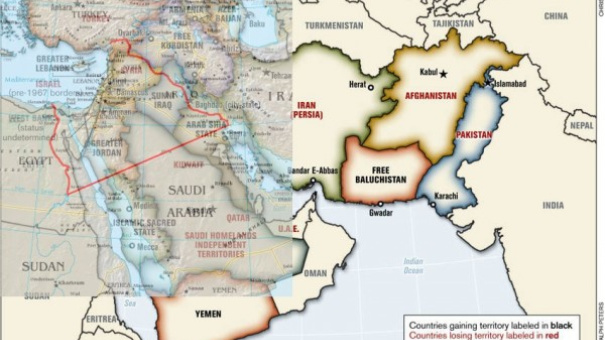
IMAGE: Project Balkanisation: Oded Yinon and an Enduring Plank of Israeli Foreign Policy (Source: Katehon)
It argues that Israel’s long-term survival hinges on one core premise: “The dissolution of all existing Arab states into small units.”
On the surface, the geopolitical win by the US-UK-Israel military-intelligence trifecta — backed by Turkey and the Persian Gulf monarchies — appears seismic. A Shīʿī-led country now falls under Sunni Salafism, severing the contiguous Shīʿī-controlled corridor linking Tehran to Hezbollah in Lebanon.
Another barrier to China’s Silk Road ambitions into the Mediterranean has been firmly set in place. Any revival of the ancient Via Maris — a trade corridor that once ran the Levantine coast, linking Asia to Europe and North Africa — remains a pipe dream.
Severed by the establishment of Israel and now buried beneath the rubble of Syria’s destruction, it ensures that any vision of unity from the Maghreb to the Arabian Peninsula remains just that — a vision.
But perhaps of greater immediate import — Israel’s ethno-supremacists and their vision of a ‘Greater Israel’ have just taken a giant leap forward. Southern Syria — and crucially, Mount Hermon, which overlooks Damascus and the Bekaa Valley in Lebanon, granting strategic military dominance over both — is now firmly under Israeli control. As is the tri-border area between Syria, Jordan, and Iraq — Al Tanf.
Yet there’s more. Israel now moves to establish its self-styled ‘David’s Corridor’ — a contiguous land route stretching from the occupied Golan Heights through southern Syria to the Euphrates. It cuts through the governorates of Deraa, Suwayda, Al-Tanf, and Deir Ezzor, reaching the Iraqi-Syrian border at Albu Kamal — granting Israel a strategic foothold deep in the heart of West Asia.
The corridor was already partially activated during the 12-day war with Iran, enabling standoff air strikes deep into Iranian territory.
With a direct land route to Iraq now viable, expect covert destabilisation efforts within the Shīʿī heartlands of Karbalāʾ and Najaf, alongside renewed backing for Kurdish separatists in both Iraq and Syria. Further vicious sectarian conflict across the region is now being baked in.
Whilst Israel’s bombing of the Defence Ministry and the Presidential Palace in Damascus was supposedly to protect the Druze community from Jolani’s Salafist mercenaries, no such protection was afforded to the Alawites, Armenians, Assyrians, or any of Syria’s other religious or ethnic minorities, who were left to be slaughtered.
The strikes on the Defence Ministry and Presidential Palace were telegraphed well in advance — and were thus performative. A warning to Jolani — Southern Syria is now firmly under Israel’s purview. No Syrian military forces will be allowed.
Meaning: Jolani and his hired guns are expendable, especially now that they’ve completed their task — extinguishing Syria’s sovereignty. As Hadi Nasrallah ruefully put it:
“You mean to tell me the very ones armed by Israel, treated in Israeli hospitals, coordinating with the IOF, shaking Netanyahu’s hand and thanking him for bombing Lebanon — are now being bombed by Israel after serving their purpose? Who would’ve thought?”
And yet, it remains far from clear if Jolani has outlived his usefulness, or if he still has his uses, at least from a US perspective.
Only days ago, whilst Jolani was in Baku, Syrian and Israeli officials were reportedly in talks. Rumours even swirled of a deal wherein Syria would launch attacks against Lebanon’s Shiʿī communities — either independently or in coordination with Israel.
Little wonder, then, that US envoy Tom Barrack warned Lebanon to ‘disarm Hezbollah or risk Syrian occupation’ — signalling that Lebanon, too, is likely slated for division and balkanisation.
The port of Tripoli and the Bekaʿa Valley, Lebanon’s agricultural heartland and a Shīʿī stronghold, are now in play. The only question is whether Ankara or West Jerusalem will seize them first, come to blows over Lebanon’s spoils, or quietly divide them, with Turkey taking the port and Israel the Bekaʿa.
But full control may yet require the chaos of full-on civil war. Syria and Lebanon edge closer — division and balkanisation becoming ever easier to enforce, until little remains but manageable fragments. The Yinon Plan made manifest.
“The attack on Lebanon is going to happen without a doubt… the question is when, and the other question is how. Is Israel going to do a ground invasion at the same time or just attack from the air?” (Ibrahim Majed)
Doubtless, the architects of today’s chaos are already patting themselves on the back, expecting handsome dividends to roll in. More division. More balkanisation. A weaker, fractured Arab world — and a stronger, more dominant Israel.
This is what Netanyahu means when he talks about “redrawing the Middle East”.
Yet the US and Israel are unravelling at an accelerating pace. Their seeming victory over the Levant is no triumph of providence — it courts the abyss and beckons the judgment to come.
Iran never pursued war, regional insecurity: Pezeshkian
Al Mayadeen | July 19, 2025
Iran does not pursue conflict or instability and has consistently contributed to promoting peace and security in the region, said Iranian President Masoud Pezeshkian on Saturday.
During a phone conversation with Armenian Prime Minister Nikol Pashinyan, Pezeshkian affirmed that Iran, in line with its fundamental principles, has consistently backed initiatives aimed at promoting peace and security.
“Throughout history, Iran has never sought war and insecurity and has always played an important and effective role in establishing peace and stability in the region,” Pezeshkian stated, adding that despite ongoing talks and negotiations, the Israeli entity launched an attack in violation of international norms and laws, after which the US, acting in complete coordination with the regime, carried out airstrikes on Iran’s lawful nuclear facilities.
Pezeshkian further condemned the hypocritical stance of certain nations regarding the Israeli entity’s acts of warmongering, violence, and unprovoked aggression.
“What is happening to the oppressed and defenseless people of Gaza today such as the killing of women and children and genocide and the cutting access to water, food and medicine, is not compatible with any of the international legal, moral, and humanitarian standards,” he said.
The Iranian president went on to characterize the longstanding ties between Iran and Armenia as historically rooted, amicable, and mutually beneficial, while reaffirming Tehran’s commitment to fostering positive engagement with all regional neighbors based on the principle of respecting territorial sovereignty. He stressed the importance of enhancing bilateral cooperation and dialogue between the two nations.
Pashinyan, likewise, highlighted Armenia’s strong desire to deepen ties with Iran, expressing eagerness for the Iranian president’s upcoming visit to Yerevan as an opportunity to hold discussions on strengthening bilateral cooperation and exploring new avenues for enhanced partnership between the two nations.
We reject ‘Israeli protection’: Druze spiritual leader
Press TV – July 18, 2025
The spiritual leader of the Druze ethnic minority in Lebanon says the community rejects the Israeli regime’s request to supposedly “protect” the minority.
Sheikh Sami Abi al-Muna made the remarks at a gathering of Druze officials in the Lebanese capital Beirut on Friday.
He was referring to the regime’s repeated deadly and destructive violations of the Syrian territory, which it has undertaken under the supposed pretext of “protecting” the Druze, who also form a minority in Syria.
The request on the part of Tel Aviv “is harmful to our history and identity,” al-Muna added.
Observers rated the remarks as a warning to the regime against its trying to associate itself with the minority in order to advance its expansionist regional goals.
‘Don’t provide Israel with an excuse’
The spiritual leader, meanwhile, addressed the recent clashes in southern Syria between members of the Druze community and Bedouin tribes that had so far claimed the lives of hundreds of people.
He cautioned that the sectarian clashes “give an excuse for Israeli intervention and for blowing up the situation in the region.”
The regime has intensified its assaults on Syria since last year, claiming it seeks to prevent an outpouring of violence from the Arab country into the occupied territories.
On Wednesday, the escalation took a significantly more violent turn, when the regime hit various parts of Syria, including the capital Damascus, with intense airstrikes.
The attacks came amid the deadly fighting between the Druze and the Bedouins, fueling fears that the Israeli involvement under the pretext of supporting the Druze was aimed at intensifying the confrontations and further destabilizing Syria.
Amid the situation, al-Muna called for all parties to rather resort to national dialogue to address the issues among different communities in Syria.
Lebanese Druze leader Walid Joumblatt addressed the same gathering, calling for formation of an investigative committee to probe violations against both Druze and Bedouins in the Arab country.
A day earlier, he had also warned in remarks to France’s RFI radio station that “Israel is using the Druze to tear Syria apart.”
He said “Israel’s intent to divide the country” was visible from the clashes that had erupted between the dual communities in Syria.
Seyed M. Marandi: Israel Attacks Syria – Prelude to Balkanization
Glenn Diesen | July 18, 2025
Seyed Mohammad Marandi is a professor at Tehran University and a former advisor to Iran’s Nuclear Negotiation Team. Prof. Marandi discusses Israel’s efforts to Balkanise Syria. Follow Prof. Glenn Diesen: Substack: https://glenndiesen.substack.com/
X/Twitter: https://x.com/Glenn_DiesenPatreon:  / glenndiesen
Support the channel: PayPal: https://www.paypal.com/paypalme/glenn…
Buy me a Coffee: buymeacoffee.com/gdieseng
Go Fund Me: https://gofund.me/09ea012f
China Ready to Work With SCO Countries to Restore Peace in Middle East
Sputnik – 17.07.2025
China is ready to cooperate with the Shanghai Cooperation Organization (SCO) member countries and the international community to promote a political settlement and the speedy restoration of peace in the Middle East, the Chinese Foreign Ministry told Sputnik on Thursday.
On Tuesday, Iranian Foreign Minister Abbas Araghchi asked the SCO to promptly consider the situation with Israel’s aggression against the Islamic Republic, as well as to provide Tehran with political support in light of the June conflict with the Jewish state.
“The peoples of China and Iran are bound by traditional friendship. China is committed to maintaining friendly cooperation with Iran in order to benefit the peoples of both countries and bring positive factors to maintaining peace and stability in the Middle East,” the ministry said when asked to comment on Iran’s request to the SCO.
The ministry noted that “the situation in the region currently remains complex and sensitive.”
“China is ready to cooperate with members of the Shanghai Cooperation Organization and the international community to uphold peace, promote a political settlement and quickly restore peace and stability in the Middle East, which meets the common interests of the countries in the region and the international community,” the ministry added.
Tucker escalates war with neocons over Iran
By Jack Hunter | Responsible Statecraft | June 6, 2025
Five months into President Donald Trump’s second term, spring is looking like winter for the neoconservatives.
This might be best gauged right now looking at the back and forth war between conservative media giants, Tucker Carlson and Mark Levin.
When Trump’s special envoy to the Middle East Steve Witkoff said in an interview in May that, “the neocon element believes that war is the only way to solve things,” Levin took offense. The reliably neoconservative talk host blasted Witkoff and added, “By the way, neocon is a pejorative for Jew. Unbelievable.”
Carlson was perplexed by this statement. In an interview with comedian and libertarian activist Dave Smith, Carlson said, “So you have Mark Levin calling Steve Witkoff an anti-Semite. We’ve reached peak crazy, I mean, I think Witkoff is Jewish, right?”
That made Levin even more mad. On Thursday, Carlson shared a lengthy post on X that read, “Mark Levin was at the White House today, lobbying for war with Iran. To be clear, Levin has no plans to fight in this or any other war. He’s demanding that American troops do it. We need to stop Iran from building nuclear weapons, he and likeminded ideologues in Washington are now arguing. They’re just weeks away.”
Carlson reminded his audience what a farce this was.
“If this sounds familiar, it’s because the same people have been making the same claim since at least the 1990s. It’s a lie,” Carlson wrote. “In fact, there is zero credible intelligence that suggests Iran is anywhere near building a bomb, or has plans to. None. Anyone who claims otherwise is ignorant or dishonest.”
A ten paragraph essay followed, dismantling some of the usual arguments neoconservatives make to push for war with Iran, with Carlson using Levin in particular to make his points.
On enrichment, Carlson observed, “[M]any Americans would die during a war with Iran. People like Mark Levin don’t seem to care about this. It’s not relevant to them. Instead they insist that Iran give up all uranium enrichment, regardless of its purpose. They know perfectly well that Iran will never accept that demand. They’ll fight first. And of course that’s the whole point of pushing for it: to box the Trump administration into a regime change war in Iran.”
The Quincy Institute’s Executive Vice President Trita Parsi shared Carlson’s post and echoed the importance of his enrichment comments.
“The most crucial part of Tucker’s tweet is on enrichment,” Parsi noted. “He doesn’t just issue a generic warning against war. He addresses the impasse of the talks: The neocon red line of zero enrichment.”
Parsi added, “At a crucial moment, Tucker wisely advises Trump to drop this deal-killing demand. Huge!”
Democratic Congressman Ro Khanna (Calif.) also shared Carlson’s X post, writing, “No war with Iran. The war in Iraq was the biggest foreign policy blunder of the 21st century. Americans — right and left — do not want more dumb wars.”
Former Republican congressman Matt Gaetz (Fla.) shared Carlson’s post, adding a 100 percent emoji.
Senior Editor of The American Conservative Andrew Day shared and highlighted the dangerousness of having Levin around Trump at this moment. Carlson said from the beginning of his post that he believed Levin was at the White House to agitate for war.
“Mark Levin is the last person who should be whispering in Trump’s ear at this stage of negotiations,” Day wrote. “I hope Vance and Gabbard are actively exerting a counter-influence.”
Vice President JD Vance and Director of National Intelligence Tulsi Gabbard have been against a U.S. war with Iran.
Carlson finished his post, writing, “The one thing that people like Mark Levin don’t want is a peaceful solution to the problem of Iran, despite the obvious benefits to the United States. They denounce anyone who advocates for a deal as a traitor and a bigot. They tell us with a straight face that Long Island native Steve Witkoff is a secret tool of Islamic monarchies. They’ll say or do whatever it takes. They have no limits”
“These are scary people,” he concluded. “Pray that Donald Trump ignores them.”
I noted in an essay in late May that established neoconservative media voices on the right were beginning to be outshined by new conservative, libertarian and independent influencers, almost all of them antiwar.
Carlson is the largest figure on the American right this side of Donald Trump right now and he has been consistently against America’s involvement in any new wars, the mirror opposite of Levin.
As of this writing, Carlson’s Levin-Iran X post has over 5.4 million views.
Mark Levin has used his large platforms on talk radio and Fox News to promote neoconservative foreign policy for many years. Now Tucker Carlson appears to be using his arguably even larger platform on social media to shut that down.
Good.
Turkiye backs extremists in Lebanon as ‘blackmail’ over Cyprus ties
The Cradle | July 14, 2025
Turkiye has expressed “deep concern” over Lebanese President Joseph Aoun’s recent visit to Cyprus and has plans to “blackmail” Beirut if it chooses to counter Ankara’s influence in the Mediterranean, a senior Lebanese source told The Cradle on 14 July.
“Ankara expressed deep concern over Aoun’s visit to the Cypriot capital, Nicosia, and viewed it as a worrying sign of Beirut’s potential openness to Mediterranean and European partnerships that are inconsistent with its agenda in the Eastern Mediterranean,” the source said.
“Northern Lebanon is witnessing a worrying increase in the number of displaced Syrians with complex security backgrounds,” the source added, noting an increase in cross-border [weapons] smuggling operations which are taking place “under the direct sponsorship and cover of Syrian and Turkish security agencies.”
According to the Lebanese source, Aoun’s visit to Cyprus “revealed files of political and security blackmail prepared by Turkiye for use later if Beirut decides to pursue strategic options that conflict with Ankara’s interests in Lebanon and the region.”
The source went on to say that Ankara “considers northern Lebanon as its traditional area of influence and will not tolerate any new official positioning by Beirut that threatens its geopolitical position in the Mediterranean.”
Turkiye invaded Cyprus in 1974 and controls the northern part of the island. Ankara views Greek Cyprus as a main regional and geopolitical rival.
The Cradle’s Malik Khoury wrote that Ankara is unlikely to take kindly to an improvement of Lebanese–Cypriot ties, and has strong ambitions for northern Lebanon.
“Turkiye has long-standing historical ties to northern Lebanon,” he said. Citing Lebanese sources, he noted Ankara’s “interest in the port of Tripoli.” Geographically and maritime-wise, this is the largest port in the Mediterranean in terms of potential. “If rehabilitated, it could rival the Israeli port of Haifa. Ankara also has its eye on the Qlayaat Airport, near the Syrian border, as well as large areas of the Akkar Plain, rich in minerals and natural resources,” he added.
Thousands of extremist Islamist prisoners, including Syrians linked to the groups now affiliated with authorities in Damascus, are held in Lebanon’s Roumieh prison.
Reports from after the fall of former Syrian president Bashar al-Assad’s government said that Syria was planning to request their repatriation.
A day after Aoun’s visit to Cyprus last week, a source quoted by Syria TV threatened to revive the issue of Syrian prisoners in Lebanon, while hinting at the potential closure of the Syrian–Lebanese border. The report said Damascus is unhappy with Beirut’s “handling” of the situation and is planning a political and diplomatic escalation if the issue is not resolved.
“If you want to breathe air via Cyprus, you will suffocate by land from Damascus,” the source said.
The information provided by the Lebanese source to The Cradle comes as there has been growing concern about potential ambitions by Syria’s extremist-dominated military to take over swathes of northern Lebanon.
There have been reports recently that extremist fighters from Syria have been infiltrating Lebanon.
The Lebanese Armed Forces (LAF) denied these reports on Sunday and said they are working to ensure the security of the border.
Ten people, including two foreign nationals, were detained during an LAF operation in the town of Btebyat in Metn in the Mount Lebanon governorate, according to an army statement Sunday evening. The suspects’ nationalities were not specified.
Initial findings indicated that the individuals were not linked to any extremist organizations. The army’s statement did not acknowledge circulating reports of attempts to stockpile weapons across the country in preparation for attacks.
A report by Israel’s i24 in early July claimed Syria is demanding control over the northern Lebanese city of Tripoli during ongoing talks between Damascus and Tel Aviv.
The concern caused by this report and others like it was compounded on Friday, when US envoy Tom Barrack warned that Lebanon is “going to be Bilad al-Sham (historical name for Greater Syria) again” if Hezbollah does not surrender its arms.
“Syrians say Lebanon is our beach resort,” Barrack added.
The threat of extremist factions, which now make up the bulk of the Syrian state, is not new to Lebanon.
The Syrian army is predominantly made up of what used to be known as Hayat Tahrir al-Sham (HTS), an extremist Al-Qaeda-linked organization which was headed by Syria’s new President Ahmad al-Sharaa (known back then as Abu Mohammad al-Julani).
HTS was formerly known as the Nusra Front – Al-Qaeda’s official branch in Syria. The organization, responsible for deadly suicide attacks inside Lebanon, took over large swathes of the Syrian–Lebanese border in the first few years of the war in Syria, including the barrens of Arsal and Ras Baalbek.
The organization was eventually fully repelled by Hezbollah and the Lebanese army in 2017 in what is referred to as “The Second Liberation.”
HTS and the other groups, which have been incorporated into the Syrian Defense Ministry, have long operated under the direct tutelage of Turkish intelligence.
‘Global War on Terror’ is Over. Terror Won.
By Daniel McAdams | Ron Paul Institute | July 10, 2025
On Sept. 16, 2001, five days after the attacks on New York and Washington, DC, President George W. Bush declared, “This crusade – this war on terrorism – is going to take a while. And the American people must be patient. I’m going to be patient. But I can assure the American people I am determined.”
Four days after that, President Bush declared the “war on terror” to be primarily against al-Qaeda. “Our war on terror begins with al Qaeda,” he said in an address to Congress and the nation, “but it does not end there. It will not end until every terrorist group of global reach has been found, stopped and defeated.”
He described the enemy thus:
This group and its leader — a person named Osama bin Laden — are linked to many other organizations in different countries, including the Egyptian Islamic Jihad and the Islamic Movement of Uzbekistan. There are thousands of these terrorists in more than 60 countries.
Bush was correct in his assessment of the group.
One of those countries into which al-Qaeda jihadists implanted themselves was Syria, where from 2011 – with the support of the Obama Administration – they attempted to overthrow the secular leader, Bashar al-Assad, using terrorist tactics they had been well-trained in.
They soon changed their name – but not their stripes – and became the Al-Nusra Front, headed up by an experienced jihadist who fought against US troops in Iraq by the name of Abu Mohammad al-Jolani. His group was known for chopping off heads. Perhaps even American heads.
Last December Jolani’s jihadists – with support from the US, Turkey, and Israel – finally brought down the Assad government and quicker than you can say “Washington PR makeover” he clipped his beard, switched out his tactical military watch for a $90,000 Patek Philippe World Time Chronograph, and declared himself president.
The “civilized world” cheered the re-emergence of democracy in Syria!
At their first meeting earlier this year in Saudi Arabia, President Trump praised jihadist Jolani as “a young, attractive fellow” and “a tough guy, a fighter, with a very strong background. He has a lot of potential, he’s a real leader.”
This was a US-designated global terrorist with a $10 million bounty placed on his head by the US authorities. His “wanted” poster STILL remains on the X account of the US Embassy in Syria!
This week, President Trump “removed sanctions on Jolani’s Syria at (Israeli Prime Minister) Netanyahu’s request,” and just yesterday Secretary of State removed Jolani’s old al-Qaeda affiliate (which had gone from al-Nusra to HTS over the years) from the US terrorist list.
As one observer on X quipped:
The history of the GWOT (Global War on Terror) began in 2001 with the US invading Afghanistan to dig out Al Qaeda. It ends twenty-four years later with the US recognizing an AQ affiliate as the new ruler of Syria.
According to Brown University’s Cost of War Project, the “Global War on Terror” cost the American people at least eight trillion dollars. It also took the lives of perhaps a million people.
And what did we get for all this blood and treasure? In Afghanistan, the Taliban were after 20 years of US military action replaced by the Taliban, and in Syria a fierce opponent of al-Qaeda was replaced by…al-Qaeda!
As Jake Sullivan, then right hand to Secretary of State Hillary Clinton, wrote to the Secretary in 2012, “al-Qaeda is on our side in Syria.” He wasn’t joking!
That was the shot…here’s the chaser:
In the same week the United States removed sanctions on al-Qaeda ruled Syria, it placed sanctions on…UN Special Rapporteur on the occupied Palestinian territories Francesca Albanese!
Who is Albanese? She is the fearless defender of human life in a Gaza where it is slowly being extinguished by Israel with the backing (and weapons) of the US government.
In hitting UN human rights defender Albanese with sanctions, US Secretary of State Marco Rubio wrote:
Today I am imposing sanctions on UN Human Rights Council Special Rapporteur Francesca Albanese for her illegitimate and shameful efforts to prompt @IntlCrimCourt action against U.S. and Israeli officials, companies, and executives.
Albanese’s campaign of political and economic warfare against the United States and Israel will no longer be tolerated. We will always stand by our partners in their right to self-defense.
The United States will continue to take whatever actions we deem necessary to respond to lawfare and protect our sovereignty and that of our allies. (emphasis added)
What might those “whatever actions” be? Clearly it is a physical threat against Albanese for speaking out against a mass murder happening in real time, observable for all who wish to do so on our own computer screens.
So that is it. The “Global War on Terror” is over. Terrorists have been elevated by the US government to be heads of state and those who speak out against state terrorism are threatened with “whatever actions we deem necessary” to shut them up.
US Will Spend Over $1 Billion Building Military Bases for Israel
By Kyle Anzalone | The Libertarian Institute | July 7, 2025
The US is spending hundreds of millions of dollars to upgrade and build new military bases for Israel. The total cost of the facilities could exceed $1 billion.
Haaretz reports, “The US military aid construction program for Israel includes ongoing projects valued at more than $250 million, with future projects expected to exceed $1 billion.” The new bases will accommodate refueling aircraft and helicopters.
An additional project is building a new headquarters for an Israeli naval commando unit.
Washington provides Tel Aviv with a massive amount of military assistance. The US government has an agreement to send Israel $3.8 billion in security aid every year. Since October 7, 2023, Washington has provided Tel Aviv with an additional $18 billion in assistance.
The US military has also spent billions on operations to benefit Israel. The US fought a war against Ansar Allah in Yemen in an attempt to break the Red Sea blockade on Israeli-linked shipping. Washington has also spent billions of dollars on interceptors to shoot down Iranian missiles.
The military support for Israel has given Tel Aviv a blank check for genocide, multiple invasions, and provoking aggressive wars. Washington’s weapons, diplomatic support at the UN, and the US military shooting down Iranian missiles have insulated Israel from almost all conquest of its attacks on Gaza, the West Bank, Syria, Lebanon, Yemen, and Iran.
Riyadh realigns: Tehran over Tel Aviv
The Cradle | July 8, 2025
The recent confrontation between Iran and Israel marked a decisive shift in regional power equations, particularly in the Persian Gulf. Iran’s direct and calibrated military response – executed through the Islamic Revolutionary Guard Corps (IRGC) – exposed the strategic vulnerabilities of Tel Aviv and forced Gulf capitals, chiefly Riyadh, to reassess long-standing assumptions about regional security.
The Saudi-led recalibration did not emerge in isolation. Years of cumulative political, military, and diplomatic failures under the umbrella of US-Israeli tutelage have pushed Persian Gulf states to seek more viable, non-confrontational security arrangements. What we are witnessing is the slow dismantling of obsolete alliances and the opening of pragmatic, interest-driven channels with Tehran.
Iran’s war strategy resets Gulf expectations
Tehran’s handling of the latest military clash – with its reliance on precision strikes, regional alliances, and calibrated escalation – demonstrated a new level of deterrence. Using its regional networks, missile bases, and sophisticated drones, Tehran managed the confrontation very carefully, avoiding being drawn into all-out war, but at the same time sending clear messages to the enemy about its ability to deter and expand engagement if necessary.
The message to the Gulf was clear: Iran is neither isolated nor vulnerable. It is capable of shaping outcomes across multiple fronts without falling into full-scale war.
Speaking to The Cradle, a well-informed Arab diplomat says:
“This war was a turning point in the Saudi thinking. Riyadh now understands Iran is a mature military power, immune to coercion. Traditional pressure no longer works. Saudi security now depends on direct engagement with Iran – not on Israel, and certainly not under the receding American security umbrella.”
At the heart of Saudi discontent lies Tel Aviv’s escalating aggression against the Palestinians and its outright dismissal of Arab peace initiatives, including the Riyadh-led 2002 Arab Peace Initiative. Israeli Prime Minister Benjamin Netanyahu’s intransigence – particularly the aggressive expansion of settlements in Jerusalem and the occupied West Bank – has alarmed the Saudis.
These provocations not only sabotage diplomatic efforts but strike at the kingdom’s pan-Islamic legitimacy, forcing a reassessment of Israel’s utility as a strategic partner. As the diplomatic source notes:
“This Israeli political stalemate pushes Saudi Arabia to reconsider its regional bets and view Iran as a regional power factor that cannot be ignored.”
Riyadh turns to Tehran: containment over confrontation
Behind closed doors, Saudi Arabia is advancing a strategy of “positive containment” with Iran. This marks a clear departure from the era of proxy wars and ideological hostility. Riyadh is no longer seeking confrontation – it is seeking coordination, particularly on issues of regional security and energy.
Diplomatic sources inform The Cradle that the reopening of embassies and stepped-up security coordination are not mere side effects of Chinese mediation. They reflect a deeper Saudi conviction: that normalization with Israel yields no meaningful security dividends, especially after Tel Aviv’s exposed vulnerabilities in the last war.
Riyadh’s new path also signals its growing appetite for regional solutions away from Washington – a position increasingly shared by other Persian Gulf states.
For its part, the Islamic Republic is moving swiftly to convert military leverage into political capital. Beyond showcasing its missile and drone capabilities, Iran is now actively courting Arab states of the Persian Gulf with proposals for economic cooperation, regional integration, and the construction of an indigenous security architecture.
Informed sources reveal to The Cradle that Iran is pursuing comprehensive engagement with Saudi Arabia, the UAE, Qatar, and Oman. This includes economic partnerships and alignment on key regional files, from Yemen to Syria and Iraq.
Tehran’s position is consistent with its long-stated view: The Persian Gulf’s security must be decided by its littoral states and peoples – not by foreign agendas.
A new Gulf alliance is taking shape
This is no longer a Saudi story alone. The UAE is expanding economic cooperation with Tehran, while maintaining open security channels. Qatar sustains a solid diplomatic line with Iran, using its credibility to broker key regional talks. Oman remains the region’s trusted bridge and discreet mediator.
An Arab diplomat briefed on recent developments tells The Cradle :
“Upcoming Gulf–Iran meetings will address navigation in the Strait of Hormuz, energy coordination, and broader regional files. There is consensus building that understanding with Iran [will] open the door to a more stable phase in the Gulf.”
Amid these realignments, Israel finds itself regionally sidelined – its project to forge an anti-Iran axis has crumbled. The US-brokered Abraham Accords – once trumpeted as a strategic triumph – now elicit little more than polite disinterest across the Gulf, with even existing Arab signatories walking back their engagement.
Riyadh’s political elite now openly question the utility of normalization. As Tel Aviv continues its war on Gaza, Gulf populations grow more vocal and Saudi leaders more cautious.
The Saudi position is unspoken but unmistakable: Tel Aviv can no longer guarantee security, nor can it be viewed as the gatekeeper to regional stability any longer.
Pragmatism trumps ideology
This Saudi–Iranian thaw is not ideological – it is hard-nosed realpolitik. As another senior Arab diplomat tells The Cradle :
“Riyadh is discarding illusions. Dialogue with neighbors – not alliance with Washington and Tel Aviv – is now the route to safeguarding Saudi interests. This is now about facts, not old loyalties. Iran is now a fixed component of the Gulf’s security equation.”
The binary of “Gulf versus Iran” is fading. The last war accelerated a trend long in motion: the collapse of Pax Americana and the emergence of multipolar regionalism. The Gulf is charting a new course – one less beholden to US-Israeli diktats.
Today, Saudi Arabia sees Tehran not as a threat to be neutralized, but as a power to be engaged. Regional security frameworks are being built from within. Israel, meanwhile, despite its many pontifications about a Tel Aviv-led, Arab-aligned “Middle East,” is struggling to stay relevant.
If these dynamics hold, we are on the cusp of a historic transition – one that may finally allow the Persian Gulf to define its own security and sovereignty, on its own terms.
This is not an ideal future. But it is a strategic upgrade from decades of subservience. Saudi Arabia is turning toward Iran – not out of love, but out of logic.
Featured Video

More Iran War fallout: Maritime insurance industry shifts from London to China
or go to
Aletho News Archives – Video-Images
From the Archives
The Biggest Threat to Peace in Middle East
By Dr. Elias Akleh* | Sabbah Report | May 24, 2010
A build up of heightened tension in the Middle East is escalating in the last few weeks. American and Israeli postures towards Lebanon, Syria, and Iran have become more threatening. Listening to speeches of political leaders one hears talks only about war not peace. Iranians and Israelis are continuously training hard for a possible showdown. Both sides are conducting extensive war games every month. This led Syrians to claim that Israel is preparing for a soon-to-come another war. The Jordanians also are warning that current stalemate of the peace process is an indication of a war breaking out this summer. The Russian President and his army chief hinted, a few months ago, that the US and Israel were planning for an attack on Iran.
Indeed Iran is, as it has been for last few years, the target of most of the threats and accusations of supporting terrorism. Escalating incitement against Iran the American Defense Department sent last month (April) to Congress a report on Iran’s military claiming Iran could develop intercontinental ballistic missiles capable of reaching the US by 2015.
Ignoring the fact that N. Korea, India, Pakistan, and Israel are proven to have nuclear weapons while Iran does not, the US Secretary of State Hillary Clinton chose in her speech, to the nuclear Non-Proliferation Treaty review conference at the UN, to focus on Iran’s alleged nuclear ambitions putting the whole world at risk as she put it. According to Clinton Iran’s acquisition of nuclear weapons, rather than Israel’s more than 200 nuclear bombs, is destabilizing the Middle East. She called on the world’s nations to rally around US efforts to hold Iran, not other nuclear countries, to account.
The accusation that Usama Bin Laden is living comfortably in Iran had received a boost after the broadcast of a documentary called “Feathered Cocaine”. This echoed the June 2003 claims of the Italian newspaper Corre de la Sierra that Bin Laden was in Iran according to some intelligence report, and according to Richard Miniter’s book “Shadow War”. … continue
Blog Roll
 Aletho News
- More Iran War fallout: Maritime insurance industry shifts from London to China
- US-Israeli aggression on Iran triggers review of GCC countries’ investment pledges to Washington
- Russia slams UK plan to seize tankers suspected of carrying its oil
- Pakistan ramps up food exports to Persian Gulf nations as war deepens food insecurity
- Iran submits response to US plan, sets terms for war’s end: Tasnim
- US vs Iran: Kharg Island Talk — Bluff or Escalation? Ex-Military Officer Weighs In
- Zelensky unnecessarily involves Ukraine in the Middle East crisis
- Turkish tanker blacklisted by Ukraine hit in drone attack – media
- Canada, the U.S., and NATO: the inescapable trap
- Villains of Judea: Leonid Radvinsky
- If Americans Knew
- ‘No Innocent Children’: Far-right Israeli Lawmaker Defends Killing of Palestinian Family
- Mossad’s promises helped Netanyahu convince Trump that Iran could be toppled
- US Arms Control Official Refuses To Comment When Asked If Israel Has Nuclear Weapons
- Veterans warn US landing could be ‘more Gallipoli than Vietnam’
- Israel may be committing war crimes in Lebanon – Not a ceasefire Day 167
- In the West Bank, life is a constant battle – 3 articles
- Jacob Reses, one of the most powerful pro-Israel operatives in Trump’s Washington
- Israeli-US assaults kill or injure 87 children a day – Not a ceasefire Day 166
- ‘Forever live by the sword’: Understanding Israelis’ massive support for Iran war
- UN’s special rapporteur on human rights says Israel is systematically torturing Palestinians
- No Tricks Zone
- Devastating Assessment Of Comirnaty Vaccine By Former Senior Pfizer Europe Toxicologist
- New Study: CO2 Is ‘Effectively Negligible’ As An Explanatory Climate Change Factor Since 2000
- Former Pfizer Toxicologist Dr. Helmut Sterz Tells Bundestag Hearing Pfizer Vaccine Should Have Never Been Approved
- Energy Expert: Germany’s Nuclear Phaseout Was A “500 Billion Euro Mistake”
- New Research: South Australia’s Mid-Holocene Sea Surface Temperatures Were 4°C Warmer Than Today
- Storing Green Energy To Last Germany 10 Days Would Require A 60-Million Tonne Battery
- New Studies: UK Sea Levels Were 4 Meters Higher Than Today During The Mid-Holocene
- Destructive Green New Deal: German Energy And Metal Group Warns Of Drastic Crisis
- New Study Documents A 20-Year Pause In Arctic Sea Ice Decline – Driven By Internal Variability
- Wake-up Call: Survey Shows Majority Of Germans Now Favor Postponing Climate Targets!
 Aletho News