Seven Reasons Not to Bomb Iran
By Ted Snider | The Libertarian Institute | April 23, 2025
“There are two ways Iran can be handled,” U.S. President Donald Trump has said, “militarily, or you make a deal.” National Security Adviser Mike Waltz advocated for the military solution; Director of National Intelligence Tulsi Gabbard and Vice President JD Vance advocated for diplomacy. Trump has opted for diplomacy. But all options are still on the table, and if the diplomatic path fails, Trump says “the other will solve the problem.”
But there are several reasons why all options should not be on the table and why bombing Iran to prevent it from acquiring a nuclear bomb would be absurd.
Most importantly, and the only one that really needs to be said, is that Iran is not pursuing a nuclear bomb. In 2003, Ayatollah Ali Khamenei, the supreme leader of Iran, issued a fatwa, an official religious ruling, that declared nuclear weapons to be forbidden by Islam. The 2025 Annual Threat Assessment, which “reflects the collective insights of the Intelligence Community,” clearly states that U.S. intelligence “continue[s] to assess Iran is not building a nuclear weapon and that [Ayatollah] Khamenei has not reauthorized the nuclear weapons program he suspended in 2003.” That assessment maintains the 2022 U.S. Department of Defense Nuclear Posture Review that concludes that “Iran does not today possess a nuclear weapon and we currently believe it is not pursuing one.” The most absurd reason for bombing Iran to prevent them from pursuing a nuclear bomb is that the U.S. knows Iran is not pursuing a nuclear bomb.
Since Iran is not pursuing a nuclear weapons program, the second reason why it is absurd to bomb Iran is that it has every legal right to its civilian nuclear program. As a signatory to the Nuclear Non-Proliferation Treaty, Iran has “the inalienable right to a civilian program that uses “nuclear energy for peaceful purposes.” The United States does not believe Iran has an illegal nuclear weapons program, and it would be absurd to bomb them for having a legal civilian nuclear program.
Thirdly, Iran has already demonstrated that a military solution is not necessary for the Trump administration to achieve its goal of ensuring that Iran does not enrich uranium to weapon grade levels. America’s concerns, well-founded or not, can be satisfied by establishing verifiable limits on Iran’s levels of enrichment. Iran demonstrated its willingness to comply with this nonmilitary solution when it agreed to those verifiable limitations in the 2015 Joint Comprehensive Program of Action (JCPOA) nuclear agreement. Eleven consecutive International Atomic Energy Agency reports verified that Iran was completely and consistently in compliance with the commitments made under that agreement. A military solution to America’s concerns about Iran’s civilian nuclear program is absurd because the U.S. has historical evidence that the nonmilitary solution works.
The military solution is not only absurd because it is unnecessary, it is even more absurd because it risks, not only war with Iran, but a wider, regional war. The United States has begun moving military equipment into the region, including aircraft carriers, bombers, and air defense systems. While presented as preparation for the possibility of intensified war with the Houthis, American officials have privately said “that the weaponry was also part of the planning” for a potential “conflict with Iran.” Even just that “buildup of American weaponry,” according to a new intelligence assessment provided by Tulsi Gabbard, “could potentially spark a wider conflict with Iran that the United States did not want.” Iran has stated that U.S. military action against its civilian nuclear program will elicit a military response from Iran against U.S. bases in the region. Iran’s Parliamentary Speaker, Mohammad-Baqer Qalibaf, said, “If they threaten Islamic Iran, then, like powder kegs, America’s allies in the region and U.S. bases will be made unsafe.” A military solution risks a war with Iran and, potentially, even a wider, regional war.
The fifth reason is that, for all the risk of war with Iran and, perhaps, even a wider regional war, the assessed benefit is not worth it. In a striking line that has received little attention, The New York Times reported that the goal of military plans to bomb Iran’s civilian nuclear sites being discussed by the United States and Israel “was to set back Tehran’s ability to develop a nuclear weapon by a year or more.” Absurd is an understatement for risking war with Iran, and even a wider Middle East war, to set Iran’s nuclear program—a nuclear program the U.S. knows Iran does not have—to set the program back by only a year.
All of this calculation of costs and benefits and risks of war is absurd because we know that the diplomatic path can work. We know it can work because it did ten years ago with the successful solution of the JCPOA nuclear agreement. There is reason to hope that, a decade later, it can work again. In the first round of talks in Oman on April 12, Iran insisted that future direct talks would be contingent on the success of the current indirect talks. At the end of that first round, Iran’s foreign minister Abbas Araghchi and U.S. chief negotiator Steve Witkoff, met directly, not momentarily as first reported, but for forty-five minutes. The first round in Oman successfully led to a second round in Rome, and the second round has now led to a third round because the second round was constructive.
And, finally, talk of a military solution by the nation that claims leadership of a world order based on international law is absurd because a pre-emptive strike on Iran without Security Council approval would be a violation of international law.
Diplomacy has a real chance of defusing the long and volatile standoff between the United States and Iran. Threats of war are not only unnecessary, they contribute only to making the diplomacy more difficult.
Seyed Mohammad Marandi: Israel Pressures US Toward War With Iran
Glenn Diesen | April 22, 2025
Seyed Mohammad Marandi is a professor, an analyst and an advisor to Iran’s nuclear negotiation team. Prof. Marandi argues that Iran is ready for war, as the US and Israel disagree over attacking Iran.
Follow Prof. Glenn Diesen:
Substack: https://glenndiesen.substack.com/
Support the channel: PayPal: https://www.paypal.com/paypalme/glenn…
Buy me a Coffee: buymeacoffee.com/gdieseng Go Fund Me: https://gofund.me/09ea012f
Trump’s NSC Director for Israel and Iran Previously Worked for Israeli Ministry of Defense
By Ryan Grim and Saagar Enjeti | Drop Site News | April 21, 2025
The American official overseeing White House policy toward both Israel and Iran inside the National Security Council formerly worked for the Israeli Ministry of Defense, Drop Site News has learned. Merav Ceren’s appointment as Director for Israel and Iran at the NSC has not previously been reported, but her work with Israel’s MoD is well known among GOP circles.
Ceren’s appointment gives Israel an unusual advantage in internal policy discussions just as the Israeli government has launched a new campaign to pressure the American government to start a war with Iran rather than continue with negotiations toward a nuclear deal.
NSC spokesperson Brian Hughes confirmed that Ceren is now an official at the NSC and defended her as “a patriotic American.”
“Merav is a patriotic American who has served in the United States government for years, including for President Trump, Senator Ted Cruz, and Congressman James Comer,” said Hughes. “We are thrilled to have her expertise in the NSC, where she carries out the President’s agenda on a range of Middle East issues.”
Ceren includes her time with Israel’s Ministry of Defense in her bio at the pro-Israel think tank Foundation for Defense of Democracies (FDD).
The Israeli campaign has forced the issue into the top echelons of government. At a high-level meeting reported on recently by the New York Times, Vice President J.D. Vance, Director of National Intelligence Tulsi Gabbard, and Defense Secretary Pete Hegseth all pushed back against Israel’s plan for a major strike on Iran’s nuclear facilities. They were even joined by NSC Director Michael Waltz, who warned that Israel’s effort would not succeed without ample U.S. support. Waltz and CENTCOM commander, Gen. Michael Kurilla, the Times reported, had previously been open to entertaining the Israeli idea and were briefed by Israeli military officials on a range of plans.
It’s rare for a foreign country to be able to pitch American policymakers on a joint war effort and look across the table to see a former member of their own Ministry of Defense working for the Americans. As Trump debates his tariff policy, for instance, there are no high-level officials who previously worked for the Chinese Communist Party present.
Ceren’s FDD bio says that while working for the Israeli military she participated in negotiations in the West Bank between Israel’s Coordinator for Government Activities in the Territories (COGAT) and the Palestinian Authority. COGAT is the Israeli agency now refusing entry of humanitarian aid into Gaza, sparking a humanitarian crisis of unspeakable proportions. Ceren is the sister of Omri Ceren, a bellicose neoconservative and longtime foreign policy adviser to Sen. Ted Cruz.
In 2021, she authored the article “The Moral Case for High-Tech Weapons” for The New Atlantis, a long-form style publication that seeks to “understand the core anxiety about tech as the threat of dehumanization.”
Will Yemen turn its missiles on the UAE and Saudi Arabia?
By Bandar Hetar | The Cradle | April 16, 2025
The US war on Yemen, now in its second round, has passed the one-month mark with no clear gains and no timeline for success. What is emerging instead is the growing risk of escalation – one that could force regional players, particularly Saudi Arabia and the UAE, into direct confrontation.
Still, several factors may delay or even prevent such a scenario, much like what played out last year. Understanding where this war may be headed requires a clear grasp of the terrain: how Yemen views the conflict, how its Persian Gulf neighbors are reacting, and what could trigger a wider eruption or a negotiated backtrack.
Sanaa ties its military strategy to Gaza’s resistance
Even in western circles, there’s little dispute that the war on Yemen is now deeply intertwined with Israel’s brutal war on Gaza. Washington tried, under former US president Joe Biden, to separate the two. But the reality on the ground tells a different story – one where Sanaa’s military operations were in lockstep with events in Palestine.
That link became even clearer after the January 2025 ceasefire between Hamas and Israel, which prompted a pause in Yemen’s attacks – until Tel Aviv predictably walked back its commitments. US President Donald Trump’s return to the White House brought with it a resumption of strikes on Yemen, under the pretext of defending international shipping.
Yet those attacks would not have taken place had the US not already committed to shielding Israeli vessels. The new administration, unlike the last, makes no real attempt to disguise the overlap between the two fronts.
Yemen’s strategy has been clear from the outset: Its military activity is calibrated with the resistance in Gaza. Palestinian factions determine the pace of escalation or calm, while Yemen remains prepared to absorb the fallout.
Sanaa has paid a steep price for this stance. Washington has moved to freeze economic negotiations between Yemen and Saudi Arabia, effectively punishing the former for refusing to abandon its military support for Gaza. The US has dangled economic incentives in exchange for neutrality – offers readily accepted by Arab states across the region – but Sanaa has refused to fold.
Faced with a binary choice – either maintain its support for Palestine and accept a freeze on domestic arrangements, or open a second front with Riyadh and Abu Dhabi – Yemen chose to stay the course.
That decision was rooted in three core beliefs: that Palestine must be supported unconditionally, even if it means sacrificing urgent national interests; that Ansarallah’s political identity is grounded in opposition to Israeli hegemony and thus incompatible with any alignment with Persian Gulf normalization; and that Yemen must deny Washington and Tel Aviv the opportunity to distract it with side wars designed to weaken its strategic focus.
Gulf frustration builds over Yemen’s defiance
Arab coalition partners Saudi Arabia and the UAE have not taken kindly to Yemen’s decision. Both countries have used the moment to begin backpedaling on the April 2022 truce and to impose punitive costs on Sanaa for throwing its weight behind Gaza.
The optics have not favored either of the Gulf monarchies. Abu Dhabi is fully normalized with Israel, while Riyadh is edging ever closer. Yemen, meanwhile – still scarred from years of Saudi–Emirati aggression – has moved swiftly to back the Palestinian cause. The contrast could not be more stark: The Arab state most brutalized by Riyadh and Abu Dhabi is now standing up for Palestine while the aggressors look away.
Yemen’s stance also clashes with the broader geopolitical alignment of both Persian Gulf states, which remain deeply embedded in Washington’s orbit. But their frustration has remained mostly rhetorical.
Despite their roles in the so-called “Prosperity Guardian” alliance, neither Saudi Arabia nor the UAE has made major military moves against Yemen since the new round of US airstrikes began. Initially, Riyadh attempted to tie Yemen’s maritime operations in the Red Sea to the Gaza war, but that framing soon gave way to vague talk of threats to commercial shipping – code for backpedaling.
Saudi political messaging shifted sharply in January when it refused to take part in joint US–UK bombing raids. Its defense ministry moved quickly to deny reports that Saudi airspace had been opened for US strikes, and later distanced itself from any Israeli involvement. The message from Riyadh was clear: It does not want to be dragged into another full-scale war with Yemen – not now.
Yemen counters with a policy of containment
Despite Saudi Arabia’s retreat from its prior commitments, Yemen has actively encouraged Riyadh and Abu Dhabi to maintain a posture of neutrality. This is not out of optimism but pragmatism: Avoiding a wider war with the Persian Gulf would prevent a dangerous regional blowout. Sanaa’s goal has been to steer Saudi and Emirati decision-making away from military confrontation, proxy mobilization, or economic escalation.
That last point nearly tipped the balance in July 2024, when Riyadh instructed its puppet government in Aden to relocate Yemen’s central banks from Sanaa. It was a clear economic provocation – and a red line.
Within days, Ansarallah leader Abdul Malik al-Houthi delivered a sharp warning, framing the Saudi move as part of an Israeli–American playbook.
“The Americans are trying to entangle you [Saudi Arabia], and if you want that, then try it … The move towards aggressive escalation against our country is something we can never accept,” he revealed in a 7 July 2024 speech.
He warned Riyadh that falling for this trap would be “a terrible mistake and a great failure, and it is our natural right to counter any aggressive step.”
Sanaa responded with an unmistakable deterrent equation: “banks for banks, Riyadh Airport for Sanaa Airport, ports for ports.”
The Saudi maneuver may have been a test of Yemen’s resolve, possibly based on the assumption that Sanaa was too overextended – facing down a US-led coalition and spiraling domestic hardships – to respond decisively.
If so, Riyadh miscalculated. Houthi’s reply was blunt:
“This is not a matter of allowing you to destroy this people and push it to complete collapse so that no problems arise. Let a thousand problems arise. Let matters escalate as far as they may.”
No appetite in Riyadh or Abu Dhabi for a war without guarantees
The day after Houthi’s warning, massive protests erupted across Yemen. Millions marched in condemnation of Saudi provocations, offering the clearest signal yet that public opinion was firmly aligned behind the resistance – and willing to escalate.
Riyadh knows this. Even before the latest crisis, much of Yemeni society held Saudi Arabia and the UAE responsible for what even the UN called the world’s worst humanitarian disaster. Any new conflict would only deepen that anger.
Faced with the threat of direct retaliation, Riyadh backed off its banking gambit. The memory of past Yemeni strikes on Saudi oil facilities – particularly those between 2019 and 2021 –still haunts the Saudi leadership.
Today, Yemen’s capabilities have expanded. It now possesses hypersonic missiles and increasingly sophisticated drone technologies. And it is precisely because of these advances that Washington has failed to strong-arm the Gulf into renewed warfare. There are no meaningful US security guarantees on the table – nothing that would shield Saudi oil fields, critical infrastructure, or commercial shipping lanes from blowback.
The failures are already evident. The “Prosperity Guardian” coalition has done little to stop Yemeni strikes on Israeli-linked vessels, and US–UK airstrikes have failed to stem Yemen’s ability to hit deep inside Israel. These battlefield realities have changed the calculus in Riyadh and Abu Dhabi. Escalation, for now, is off the table.
Yemen’s red lines are expanding
That does not mean Washington has stopped trying to drag Saudi Arabia and the UAE into the fight. The Biden administration failed to do so. The Trump team, however, is seen as more aggressive and more likely to provide advanced weapons systems that might tempt Riyadh and Abu Dhabi to take the plunge.
There is also the perception among Gulf elites that this is a strategic opening: Syria’s collapse, Hezbollah’s supposed decline, and shifting regional dynamics may provide a rare window to redraw the map.
But for the Saudis, Yemen remains the central concern. A liberated, ideologically defiant state on their southern border is an existential threat – not only to security, but to the cultural rebranding project that the Kingdom has invested so heavily in. The UAE shares similar anxieties. A rising Yemeni Resistance Axis threatens its carefully curated image as a regional player in sync with Israeli and western interests.
That is why Sanaa has placed its forces on high alert. Ansarallah is monitoring every move by Riyadh, Abu Dhabi, and their local proxies – many of whom are eager to join the war. These groups have signaled readiness to participate in an international coalition to “protect shipping,” and have already held direct meetings with US military and political officials.
But the Sanaa government knows these factions would not act without orders. If they are mobilized for a broad ground offensive, Yemen will respond by targeting the powers behind them. Any ground war will be seen as a Saudi–Emirati initiative, not a local one. The same logic applies to renewed airstrikes or deeper economic war. These are Sanaa’s red lines.
A warning to the Axis of Normalization
Abdul Malik al-Houthi laid it out clearly during a 4 April address:
“I advise you all [Arab states neighboring Yemen], and we warn you at the same time: Do not get involved with the Americans in supporting the Israelis. The American enemy is in aggression against our country in support of the Israeli enemy. The battle is between us and the Israeli enemy.
The Americans support it, protect it, and back it. Do not get involved in supporting the Israeli enemy … any cooperation with the Americans in aggression against our country, in any form, is support for the Israeli enemy, it is cooperation with the Israeli enemy, it is conspiracy against the Palestinian cause.”
He went further:
“If you cooperate with the Americans: Either by allowing him to attack us from bases in your countries. Or with financial support. Or logistical support. Or information support. It is support for the Israeli enemy, advocacy for the Israeli enemy, and backing for the Israeli enemy.”
This was not just a warning. It was a strategic declaration. Any country crossing these lines will be treated as an active participant in the war – and subject to retaliation.
The message is aimed not just at Riyadh and Abu Dhabi, but at other Arab and African states that might be tempted to join the fray under the guise of “protecting international navigation.”
Yemen is preparing for all scenarios. It will not be caught off guard. And this time, it won’t be fighting alone.
Below the radar: Is the Trump-Netanyahu ‘unthinkable’ about to happen?
By Ramzy Baroud | MEMO | April 15, 2025
Israeli Prime Minister Benjamin Netanyahu’s latest trip to Washington was no ordinary visit. The consensus among Israeli analysts, barring a few remaining loyalists, is that Netanyahu was not invited; he was summoned by US President Donald Trump.
All of the evidence supports this assertion. Netanyahu rarely travels to the US without extensive Israeli media fanfare, leveraging his touted relationships with various US administrations as a “hasbara” opportunity to reinforce his image as Israel’s strongman.
This time, there was no room for such propaganda.
Netanyahu was informed of Trump’s summons while on an official trip to Hungary, where he was received by Hungarian President Viktor Orban with exaggerated diplomatic accolades. This was a signal of defiance against international condemnation of Netanyahu, an alleged war criminal wanted by the International Criminal Court (ICC). Orban’s open arms welcome portrayed him as anything but an isolated leader of an increasingly pariah state.
The capstone of Netanyahu’s short-lived Hungarian victory lap was Orban’s announcement of Hungary’s withdrawal from the ICC, a move with profoundly unsettling implications.
It would have been convenient for Netanyahu to use his Washington visit to divert attention from his failed war in Gaza and internal strife in Israel. However, as the Arabic saying goes, “The wind often blows contrary to the ship’s desires.”
The notion that Netanyahu was summoned by Trump rather than invited, is corroborated by Israeli media reports that he attempted to postpone the visit under various pretexts. He failed, and flew to Washington on the date determined by the White House. Initially, reports circulated that no press conference would be held, denying Netanyahu the platform to tout for Washington’s unwavering support for his military actions and to expound on the “special relationship” between the two countries.
A press conference was held, although it was dominated largely by Trump’s contradictory messages and typical rhetoric. Netanyahu spoke briefly, attempting to project the same confident body language observed during his previous Washington visit, where he sat straight-backed with legs splayed out, as if he was in full command of all around him.
This time, though, Netanyahu’s body language betrayed him.
His eyes shifted nervously, and he appeared stiff and surprised, particularly when Trump announced that the US and Iran were about to begin direct talks in Oman.
Trump also mentioned the need to end the war in Gaza, but the Iran announcement clearly shocked Netanyahu. He desperately tried to align his discourse with Trump’s, referencing Libya’s disarmament under Muammar Gaddafi. But that was never part of Israel’s official regional plan. Israel has advocated consistently for US military intervention against Iran, despite the certainty that such a war would destabilise the entire region, potentially drawing the US into a conflict far more protracted and devastating than the 2003 invasion of Iraq.
Further evidence of the US divergence of views from Israel’s regional ambitions — which are centred on perpetual war, territorial expansion and geopolitical dominance — lies in the fact that key political and intellectual figures within the Trump administration recognise the futility of such conflicts. In leaked exchanges on the encrypted messaging platform Signal, Vice President JD Vance protested that escalating the war in Yemen benefits Europe, not the US, a continent with which the US is increasingly decoupling, if not actually engaging in a trade war.
The Yemen war, like a potential conflict with Iran, is perceived widely as being waged on Israel’s behalf.
Figures like Tucker Carlson, a prominent commentator, articulated the growing frustration among right-wing intellectuals in the US, tweeting that, “Anyone advocating for conflict with Iran is not an ally of the United States, but an enemy.”
Trump’s willingness to challenge Netanyahu’s policies openly remains unclear. His conflicting statements, such as calling for an end to the Gaza war while simultaneously advocating for the expulsion of Palestinians, add to the ambiguity. However, recent reports suggest a determined US intention to end the war in Gaza as part of a broader strategy, linking Gaza to Yemen, Lebanon and Iran. This aligns with Washington’s need to stabilise the region as it prepares for a new phase of competition with China, requiring comprehensive economic, political and military readiness.
Should Trump prove capable of doing what others could not, will Netanyahu finally submit to American pressure?
In 2015, the Israeli leader demonstrated Israel’s unparalleled influence on US foreign and domestic policy when he addressed both chambers of Congress. Despite a few insignificant protests, Republican and Democratic policymakers applauded enthusiastically as Netanyahu criticised the then President Barack Obama, who did not attend and appeared to be isolated by his own political class.
However, if Netanyahu believes that he can replicate that moment, he is mistaken. Those years are long gone. Trump is a populist leader who is not beholden to political balances in Congress. Now in his second and final term, he could, in theory, abandon America’s ingrained reliance on the approval of Israel and its aggressively influential lobby in Washington.
Moreover, Netanyahu’s political standing is diminished. He is perceived as a failed political leader and military strategist, unable to secure decisive victories or extract political concessions from his adversaries. He is a leader without a clear plan, grappling with a legitimacy crisis unlike any faced by his predecessors.
Ultimately, the outcome hinges on Trump’s willingness to confront Netanyahu. If he does, and sustains the pressure, Netanyahu could find himself in an unenviable position, marking a rare instance in modern history where the US dictates the terms, and Israel listens. Is the unthinkable about to happen? Let’s wait and see.
The US and Iran: March to war – or a backroom deal?
The Cradle | April 14, 2025
The rhetoric surrounding a potential US–Israeli strike on Iran has intensified, fueled by veiled threats, media leaks, and what appeared to be an unofficial ultimatum from the Trump administration to Tehran. While no concrete consequences were outlined, the implication of direct military action looms large.
Since the 1979 Islamic Revolution – and especially after the Iran–Iraq War – Iran has lived under constant threat of US-led military intervention. These threats have fluctuated depending on regional dynamics and shifting US priorities.
In the aftermath of the illegal US invasion of Iraq in 2003, Iran and Syria appeared to be next in line for American-style regime-change. But the protracted insurgency in Iraq and the cost of occupation deterred further US military adventures – particularly against a civilization-state like Iran, whose size and geography pose significant challenges.
Republican leaders, and especially US President Donald Trump, have typically leaned toward employing open threats and economic strangulation policies against perceived US adversaries, rather than pursuing quiet diplomatic solutions. Today, they sense a unique opportunity to strike a deadly blow against Tehran given the recent weakening of Iran’s allies, particularly Hezbollah in Lebanon and the Syrian state, both of which have faced military setbacks and political isolation under western pressure and US-backed Israeli aggression.
Hezbollah, long viewed as Iran’s forward line of defense, now faces internal Lebanese constraints and sustained Israeli aggression, limiting its capacity to act preemptively should Iran be targeted. Meanwhile, Syria’s logistical value to the Axis of Resistance has diminished under sanctions, military exhaustion, and the toppling of former president Bashar al-Assad’s government by foreign-backed extremists under its self-appointed Al Qaeda-linked President Ahmad al-Sharaa.
Exploiting the regional moment
With the Axis of Resistance on the defensive, Washington and Tel Aviv see a fleeting opportunity to consolidate their gains. Yet despite their saber-rattling, Iran retains significant deterrence capabilities and appears prepared to retaliate if provoked.
Trump’s strategy, it must also be noted, extends well beyond Iran and its indigenous nuclear program. These foreign policy postures are part of a broader bid to isolate China, reset regional conflicts, distance Beijing from Moscow, and redirect global energy flows and prices, all while propping up Israel as Washington’s local enforcer.
In this context, West Asia becomes both a proving ground and a potential quagmire. Trump seeks to finalize the so-called “normalization” process between Israel and Arab states, neutralize Palestinian resistance, and pressure Iran to concede its regional role.
While he casts himself as a pragmatist open to deals, this posture serves a dual purpose: securing domestic political capital and forging a regional alliance rooted in US dependency.
Still, for such a deal to materialize, Iran would have to abandon core ideological and strategic pillars – namely, its regional alliances and missile deterrence. This is unlikely. Iran knows that surrendering these elements would strip the Islamic Republic not only of its ideological foundation but of any meaningful regional influence.
Iran’s multi-layered deterrence
Tehran’s defense strategy rests on several pillars. First is its alliance network stretching from Iraq to Yemen and Lebanon, forming a buffer against western hegemony. Second is its growing arsenal of precision missiles, drones, and domestically developed air defense systems. Third is geography: Iran’s control over key chokepoints in the Persian Gulf and its capacity to disrupt global oil supply grants it substantial leverage.
The final line of defense remains Iran’s nuclear program. While officially peaceful, there have been sporadic signals that suggest Tehran may recalibrate its doctrine in response to a major direct attack. Iran’s nuclear infrastructure, particularly at Fordow – a fortified facility deep beneath a mountain – underscores this strategic depth.
Despite recent blows, Hezbollah is unlikely to remain passive if Iran faces an existential threat. Likewise, US interests in Iraq and bases in the region, particularly Djibouti, could become targets for retaliatory strikes from Yemen’s Ansarallah movement.
Iran’s weapons development program has made extraordinary strides post-2011, with multiple lines of ballistic missiles like the Khyber Shakan and Fattah series, and more basic but highly producible systems like Imad and Radwan.
Meanwhile, Iran’s drones have proven effective in theaters from Ukraine to the Red Sea, while its layered air defenses – Khordad, Power-373, and Majid systems – make sustained air campaigns costly for adversaries. Its naval strategy hinges on asymmetric warfare and control of the Strait of Hormuz, a lifeline for global energy trade.
American options – and constraints
The US maintains around 60,000 troops across West Asia, mainly in Persian Gulf bases, and has shifted assets – including aircraft carriers and Patriot systems – from the Pacific to the region. Washington can certainly initiate a campaign to damage Iran’s infrastructure, but sustaining it would be difficult.
All regional US bases are within range of Iranian missiles, meaning any engagement could mark the first conventional war for the US with real counter-fire in decades.
Expect Washington to lean heavily on cyberwarfare and covert operations targeting civilian and military infrastructure alike to sow chaos inside Iran. Yet, a limited strike risks triggering a protracted conflict – something Iran is arguably more prepared for.
Iran’s strategy of attrition suits its asymmetric strengths and the fragility of US supply chains for munitions such as Patriots, SM-series interceptors, and cruise missiles.
The ongoing engagement in the Red Sea has already strained American resources. US aircraft carriers are operating from positions well beyond effective range, and stockpiles of precision munitions are running low – many earmarked for future conflict with China.
Manufacturing limitations, not cost, are the real bottleneck in sustaining a prolonged campaign. Despite these constraints, the US could still inflict serious initial damage. But sustaining such an operation, especially in the face of regional retaliation, would exact a high political and economic cost.
Between brinkmanship and bargaining
Both sides have much to lose – and much to bargain with. For Washington, a limited conflict could serve immediate strategic aims. For Tehran, dragging the US into a drawn-out war could shift pressure back onto American decision-makers already grappling with economic turbulence at home.
While the rhetoric of war dominates headlines, the path to direct conflict remains uncertain. Much depends on the outcome of indirect negotiations, particularly the recent round of indirect talks in Muscat, Oman.
Trump’s theatrics – threats, military build-up, and erratic messaging – are better understood as negotiating tactics than a clear march to war. Notably, Trump’s insistence that the occupation state should take the lead in any war on Iran reveals his reluctance to entangle the US in yet another West Asian quagmire.
His preference remains a deal, on his terms, allowing him to parade a foreign policy ‘win’ without bloodshed. In sum, war is neither inevitable nor necessarily decisive. The US needs a strategic pause in West Asia to refocus on other global priorities.
Iran, meanwhile, seeks time to rebuild internally and block Israel from exploiting current momentum. The coming weeks may decide whether this standoff ends in confrontation, or compromise.
Standing at the Edge of the Iran War Cliff
By Ron Paul | April 14, 2025
Millions of people around the world were at the edge of their seats over the weekend, waiting to hear whether Trump special envoy Steve Witkoff’s indirect talks with the Iranian foreign minister would ratchet down tensions or would break down and bring on a major Middle East war.
If it seems bizarre that the outcome of a meeting between a US president’s designated negotiator and a foreign government minister could determine whether we plunge into possibly our biggest war since World War II, that’s because it is bizarre. In fact, this is an excellent example of why our Founders were so determined to keep warmaking authority out of the Executive Branch of government. No one person – much less his aide – should have the power to take this country to war.
That is why the Constitution places the authority to go to war firmly and exclusively in the hands of the representatives of the people: the US Congress. After all, it is the US people who will be expected to fight the wars and to pay for the wars and to bear the burden of the outcome of the wars. When that incredible power is placed in the hands of one individual – even if that individual is elected – the temptation to use it is far too great. Our Founders recognized this weakness in the system they were rebelling against – the British monarchy – so they wisely corrected it when they drafted our Constitution.
Unless the US is under direct attack or is facing imminent direct attack, the Constitution requires Congress to deliberate, discuss, and decide whether a conflict or potential conflict is worth bringing the weight of the US military to bear. They wanted it harder, not easier, to take us to war.
When wars can be started by presidents with no authority granted by Congress, the results can be the kinds of endless military engagements with ever-shifting, unachievable objectives such as we’ve seen in Afghanistan and Iraq.
We are currently seeing another such endless conflict brewing with President Trump’s decision to start bombing Yemen last month. The stated objectives– to end Houthi interference with Israeli Red Sea shipping – are not being achieved so, as usually happens, the bombing expands and creates more death and destruction for the civilian population. In the last week or so, US bombs have struck the water supply facilities for 50,000 civilians and have apparently blown up a civilian tribal gathering.
Starting a war with Iran was the furthest thing from the minds of American voters last November, and certainly those who voted for Donald Trump were at least partly motivated by his promise to end current wars and start no new wars. However, there is a strange logic that to fulfill the promise of no new wars, the US must saber rattle around the world to intimidate others from crossing the White House. This is what the recycled phrase “peace through strength” seems to have come to mean. But the real strength that it takes to make and keep peace is the strength to just walk away. It is the strength to stop meddling in conflicts that have nothing to do with the United States.
That is where Congress comes in. Except they are not coming in. They are nowhere to be found. And that is not a good thing.
Gulf-backed genocide: How Arab monarchies fuel Israel’s war machine
By Mawadda Iskandar | The Cradle | April 10, 2025
The Persian Gulf states’ silence – and in many cases, complicity – during Israel’s ongoing war on Gaza has not come as a shock. These governments, long detached from the Palestinian struggle, have for years cultivated warm, if discreet, ties with Tel Aviv.
While Bahrain and the UAE made normalization of ties with Tel Aviv official through the US-brokered 2020 Abraham Accords, other states like Saudi Arabia and Qatar have played quieter but equally pivotal roles. Riyadh, often described as the architect behind normalization, and Doha, hiding behind its “mediator” label, have each aided the occupation state in crucial ways.
Though much of this assistance remains behind the scenes, it has been repeatedly acknowledged by US and Israeli officials. During his first term, US President Donald Trump once warned that “Israel would be in big trouble without Saudi Arabia,” while Israeli Prime Minister Benjamin Netanyahu has said that Arab leaders now view Israel “not as their enemy, but their greatest ally,” adding that they “want to see us defeat Hamas.”
Such statements offer a glimpse into the vast, opaque network of regional cooperation propping up the occupation state’s war machine.
Economic complicity
Despite overwhelming popular support throughout the Arab world for Palestine, and growing calls for grassroots boycotts, Persian Gulf–Israeli trade has only surged. The UAE now ranks as Israel’s top Arab trade partner, while Bahrain’s commerce with Tel Aviv spiked by a staggering 950 percent during the first 10 months of the Gaza war.
Even amid war and boycott efforts, “kosher-certified” goods from Arab countries continue to enter Israeli markets. UAE-based brands like Al Barakah Dates and Hunter Foods, along with Saudi Arabia’s Durra (a sugar supplier), have maintained trade channels.
Qatar has exported crude materials for plastics used in Israeli industries. Bahrain went so far as to officially recognize goods produced in illegal West Bank settlements as Israeli in origin.
More insidiously, Persian Gulf investments are directly fueling Israeli settlement expansion. Saudi Arabia, the UAE, and Qatar have funneled money into Avenue Partners, a firm chaired by Trump’s son-in-law Jared Kushner, who remains involved in advising the Trump administration from afar.
That money flows into Phoenix Holdings, which finances key banks involved in settlement construction – Leumi, Hapoalim, and Discount Bank – as well as telecom firms like Cellcom and Partner, and construction companies like Electra and Shapir, all of which operate inside occupied Palestinian territory.
When Yemen’s blockade disrupted shipping lanes for Israeli-linked cargo in the Red Sea, cutting off 70 percent of Tel Aviv’s food imports, it was the Persian Gulf states that rushed to patch the breach. The UAE created an overland logistics corridor from Dubai to Tel Aviv via Saudi Arabia and Jordan, and Bahrain repurposed its ports to serve as alternate shipping hubs for Israeli goods arriving from India and China.
Military ties beneath the surface
From the earliest days of Israel’s onslaught on Gaza, the UAE has doubled down on its strategic military relationship with the occupation state. In 2024, Balkan Insight revealed that a UAE-linked firm, Yugoimport-SDPR, exported $17.1 million worth of weapons to Israel via military aircraft directly involved in bombing Gaza.
But the arms trade is only part of this treacherous picture. The UAE’s state-owned defense giant EDGE holds shares in Israeli military contractors like Rafael and Israel Aerospace Industries (IAI), companies that retrofit Emirati planes into military freighters. Abu Dhabi has also welcomed offices from Israeli weapons manufacturers like Bayt Systems and Third Eye Systems, and proudly hosted 34 Israeli defense firms at IDEX 2025 – a major arms expo used to secure deals with the occupation army.
Though not formally normalized, Saudi Arabia is militarizing its ties with Israel through indirect channels. One method: purchasing Israeli systems like the TOW missile through US-based subsidiaries of Elbit Systems. Another: acquiring surveillance drones from South Africa, which are disassembled and reassembled in the kingdom to mask their Israeli origins.
A recent anti-drone system – suspected to be designed by Israeli firm RADA – was spotted at the Royal Saudi Air Defense base in Tabuk, near King Faisal Air Base.
Meanwhile, Qatar has quietly boosted its military coordination with Tel Aviv. Doha continues to source spare parts for tanks, armored vehicles, and aerial tankers from Israeli suppliers, and its military has participated in joint drills involving Israel and other Persian Gulf states – including exercises in Greece held just over a week ago.
Logistical lifelines to Tel Aviv
Beyond military and economic ties, Persian Gulf states have facilitated the flow of weapons to Israel through logistical support channels. As the US ramped up its “unprecedented airlift” of tens of thousands of missiles, munitions, and Iron Dome components, the Gulf’s airspace and bases became critical.
US arms shipments passed through Saudi Arabia, Bahrain, Jordan, and especially Qatar, where the Al-Udeid Air Base – home to US Central Command – served as a hub for at least 18 documented transfers. Several were routed through Cyprus to avoid direct flight tracking.
In the UAE, Dubai International Airport became a waypoint for Israeli reservists flying in from Asia. Coordinated through the Israeli consulate in Dubai, these flights funneled soldiers into the war in Gaza. Emirati authorities also arranged leisure retreats for Israeli troops between deployments and allowed Jewish organizations in Dubai to send care packages to the occupation military.
Pipeline diplomacy and energy normalization
Earlier this month, as Trump prepared to visit Saudi Arabia seeking investment in US infrastructure, Israeli Energy Minister Eli Cohen unveiled plans for a regional oil pipeline stretching from Ashkelon to Saudi Arabia via Eilat.
The project falls under the India-Middle East-Europe Economic Corridor (IMEC), a US-backed alternative to China’s Belt and Road Initiative (BRI), with links running through the UAE, Jordan, and occupied Palestinian lands.
In a related move, Nasser bin Hamad Al Khalifa – son of the Bahraini king and chair of Bapco Energy – announced the sale of a pipeline stake to BlackRock, the US investment giant notorious for its financial ties to Israeli settlements. This deal cannot be separated from the broader normalization agenda.
Spycraft and surveillance
In one of the clearest signs of deepening security cooperation, Axios revealed a secret 2024 meeting in Bahrain between Israeli army chief Herzi Halevi and senior military officials from Bahrain, Saudi Arabia, the UAE, Jordan, and Egypt.
Overseen by US Central Command, the summit focused on countering Iranian retaliation and disrupting weapons flows to Gaza from resistance forces in Iraq and Yemen – operations that often transit through Persian Gulf-controlled airspace.
Bahrain’s role was particularly overt: Nasser bin Hamad openly declared his country’s commitment to disrupting Iranian response operations in coordination with the US Fifth Fleet stationed in Manama. Analysts now speculate that Tel Aviv could be granted permanent naval access to strategic Gulf waters.
This growing security convergence has also opened the door for Israeli tech to penetrate Persian Gulf infrastructure. Bahrain now relies on Israeli firms for anti-drone systems, satellite surveillance, and cybersecurity. One notable collaboration involves Bahraini company Crescent Technologies and Israeli cyber defense powerhouse CyberArk.
The UAE is pushing the envelope even further. Emirati firms have signed deals with XM Cyber – co-founded by a former Mossad chief – to secure national energy infrastructure. XM Cyber works in tandem with Rafael and other elite Israeli military firms as part of a consortium targeting sensitive Gulf markets, including oil, energy, and data. Meanwhile, Orpak Systems, another Israeli company, has quietly entered Arab oil sectors under nondescript branding to avoid detection.
Despite their public posturing and periodic statements of support for Palestine, the Persian Gulf states have quietly entrenched themselves in Tel Aviv’s war effort. Through investment flows, arms deals, intelligence cooperation, and energy infrastructure, they have become vital enablers of the genocide in Gaza.
This alliance – crafted in backrooms and sealed with economic interests – has allowed Israel to prosecute its war on Gaza with Gulf assistance at every logistical and financial juncture.
Far from being passive actors, these states are now active partners in a conflict that has devastated an entire people.
Iraqi Kataib Hezbollah denies Reuters’ report citing ‘commander’
Al Mayadeen | April 7, 2025
Iraqi Kataib Hezbollah stated that the remarks attributed by Reuters to an individual described as a “Kataib Hezbollah commander” do not reflect the group’s principles or positions.
The brigades emphasized that all official media statements are made solely by their official and military spokespersons.
Any claims made in the name of Kataib Hezbollah by individuals other than these spokespersons are considered false and defamatory, it stressed.
Reuters had reported that Iraqi armed groups are ready to dismantle amid fears of a Trump strike, citing senior Iraqi commanders and officials.
Kataib Hezbollah, a group active under the umbrella of the Islamic Resistance in Iraq, took part in the military operations against Israeli targets in response to “Israel’s” war on the Gaza Strip.
US-Iran war would set entire region ablaze: Iraqi official
Last week, the Secretary-General of Iraq’s Badr Organization, Hadi al-Amiri, cautioned that a war between Iran and the United States would not be a “walk in the park” or a simple affair but would set the entire region on fire.
“The outbreak of war with Iran does not mean it will be a walk in the park; rather, it will set the entire region ablaze,” al-Amiri warned during a meeting with tribal leaders and dignitaries from Diyala province at the headquarters of the Popular Mobilization Forces’ Diyala Operations Command.
The Iraqi politician stressed that “no one should assume that we and other countries of the region will stand idly by if war breaks out between Iran and the US.”
His remarks come two days after US President Donald Trump threatened to bomb Iran if no agreement was reached on its nuclear program.
Ali Larijani, senior advisor to the Leader of the Islamic Revolution Sayyed Ali Khamenei, warned that any US or Israeli attack on Iran under the pretext of its nuclear program would force Tehran to move toward producing a nuclear bomb.
Iranian officials have also rejected negotiations under pressure or threats, affirming Tehran’s readiness to respond firmly to any attack.
Iranian President Masoud Pezeshkian stated that Tehran was open to indirect negotiations with Washington but pointed out that the US approach would determine the course of the discussions.
‘Break-a-Leg’ (that old Mafia warning) – Trump has threatened Iran over an ultimatum that likely cannot be met
By Alastair Crooke | Strategic Culture Foundation | April 7, 2025
Trump’s ultimatum to Iran? Colonel Doug Macgregor compares the Trump ultimatum to Iran to that which Austria-Hungary delivered to Serbia in 1914: An offer, in short, that ‘could not be refused’. Serbia accepted nine out of the ten demands. But it refused one – and Austria-Hungary immediately declared war.
On 4 February, shortly after his Inauguration, President Trump signed a National Security Presidential Memorandum (NSPM); that is to say, a legally binding directive requiring government agencies to carry out the specified actions precisely.
The demands are that Iran should be denied a nuclear weapon; denied inter-continental missiles, and denied too other asymmetric and conventional weapons capabilities. All these demands go beyond the NPT and the existing JCPOA. To this end, the NSPM directs maximum economic pressure be imposed; that the U.S. Treasury act to drive Iran’s oil exports to zero; that the U.S. work to trigger JCPOA Snapback of sanctions; and that Iran’s “malign influence abroad” – its “proxies” – be neutralised.
The UN sanctions snapback expires in October, so time is short to fulfil the procedural requirements to Snapback. All this suggests why Trump and Israeli officials give Spring as the deadline to a negotiated agreement.
Trump’s ultimatum to Iran appears to be moving the U.S. down a path to where war is the only outcome, as occurred in 1914 – an outcome which ultimately triggered WW1.
Might this just be Trump bluster? Possibly, but it does sound as if Trump is issuing legally binding demands such that he must expect cannot be met. Acceptance of Trump’s demands would leave Iran neutered and stripped of its sovereignty, at the very least. There is an implicit ‘tone’ to these demands too, that is one of threatening and expecting regime change in Iran as its outcome.
It may be Trump bluster, but the President has ‘form’ (past convictions) on this issue. He has unabashedly hewed to the Netanyahu line on Iran that the JCPOA (or any deal with Iran) was ‘bad’. In May 2014, Trump withdrew the U.S. from the JCPOA at Netanyahu’s behest and instead issued a new set of 12 demands to Iran – including permanently and verifiably abandoning its nuclear programme in perpetuity and ceasing all uranium enrichment.
What is the difference between those earlier Trump demands and those of this February? Essentially they are the same, except today he says: If Iran “doesn’t make a deal, there will be bombing. It will be bombing the likes of which they have never seen before”.
Thus, there is both history, and the fact that Trump is surrounded – on this issue at least – by a hostile cabal of Israeli Firsters and Super Hawks. Witkoff is there, but is poorly grounded on the issues. Trump too, has shown himself virtually totalitarian in terms of any and all criticism of Israel in American Academia. And in Gaza, Lebanon and Syria, he is fully supportive of Netanyahu’s far-right provocative and expansionist agenda.
These present demands regarding Iran also run counter to the 25 March 2025 latest annual U.S. Intelligence Threat Assessment that Iran is NOT building a nuclear weapon. This Intelligence Assessment is effectively disregarded. A few days before its release, Trump’s National Security Adviser, Mike Waltz clearly stated that the Trump Administration is seeking the “full dismantlement” of Iran’s nuclear energy program: “Iran has to give up its program in a way that the entire world can see”, Waltz said. “It is time for Iran to walk away completely from its desire to have a nuclear weapon”.
On the one hand, it seems that behind these ultimata stands a President made “pissed off and angry” at his inability to end the Ukraine war almost immediately – as he first mooted – together with pressures from a bitterly fractured Israel and a volatile Netanyahu to compress the timeline for the speedy ‘finishing off’ of the Iranian ‘regime’ (which, it is claimed, has never been weaker). All so that Israel can normalise with Lebanon –and even Syria. And with Iran supposedly ‘disabled’, pursue implementation of the Greater Israel project to be normalised across the Middle East.
Which, on the other hand, will enable Trump to pursue the ‘long-overdue’ grand pivot to China. (And China is energy-vulnerable – regime change in Tehran would be a calamity, from the Chinese perspective).
To be plain, Trump’s China strategy needs to be in place too, in order to advance Trump’s financial system re-balancing plans. For, should China feel itself besieged, it could well act as a spoiler to Trump’s re-working of the American and global financial system.
The Washington Post reports on a ‘secret’ Pentagon memo from Hegseth that “China [now] is the Department’s sole pacing threat, [together] with denial of a Chinese fait accompli seizure of Taiwan — while simultaneously defending the U.S. homeland”.
The ‘force planning construct’ (a concept of how the Pentagon will build and resource the armed services to take on perceived threats) will only consider conflict with Beijing when planning contingencies for a major power war, the Pentagon memo says, leaving the threat from Moscow largely to be attended by European allies.
Trump wants to be powerful enough credibly to threaten China militarily, and therefore wants Putin to agree speedily to a ceasefire in Ukraine, so that military resources can quickly be moved to the China theatre.
On his flight back to Washington last Sunday evening, Trump reiterated his annoyance toward Putin, but added “I don’t think he’s going to go back on his word, I’ve known him for a long time. We’ve always gotten along well”. Asked when he wanted Russia to agree to a ceasefire, Trump said there was a “psychological deadline” – “If I think they’re tapping us along, I will not be happy about it”.
Trump’s venting against Russia may, perhaps, have an element of reality-TV to it. For his domestic audience, he needs to be perceived as bringing ‘peace through strength’ – to keep up the Alpha-Male appearance, lest the truth of his lack of leverage over Putin becomes all too apparent for the American public and to the world.
Part of the reason for Trump’s frustration too, may be his cultural formation as a New York businessman; that a deal is about first dominating the negotiations, and then quickly ‘splitting the difference’. This, however, is not how diplomacy works. The transactional approach also reflects deep conceptual flaws.
The Ukraine ceasefire process is stalled, not because of Russian intransigence, but rather because Team Trump has determined that achieving a settlement in Ukraine comes firstly through insisting on a unilateral and immediate ceasefire – without introducing temporary governance to enable elections in Ukraine, nor addressing the root causes of the conflict. And secondly, because Trump rushed in, without listening to what the Russians were saying, and/or without hearing it.
Now that initial pleasantries are over, and Russia is saying flatly that current ‘ceasefire’ proposals simply are inadequate and unacceptable, Trump becomes angry and lashes out at Putin, saying that 25% tariffs on Russian oil could happen ANY moment.
Putin and Iran are both now under ‘deadlines’ (a ‘psychological’ one in Putin’s case), so as to enable Trump to proceed with credibly threatening China to come to a ‘deal’ soon – as the global economy is already wobbling.
Trump fumes and spits fire. He tries to hurry matters along by making a big show of bombing the Houthis, boasting that they have been hit hard, with many Houthi leaders killed. Yet, such callousness towards Yemeni civilian deaths sits awkwardly with his claimed heart-rendering empathy for the thousands of ‘handsome’ Ukrainian young men needlessly dying on the front lines.
It all becomes reality-TV.
Trump threatens Iran with “bombing [the] likes of which they have never seen before” over an ultimatum that likely cannot be met. Simply put, this threat (which includes the possible use of nuclear weapons) is not given because Iran poses a threat to the U.S. It does not. But it is given as an option. A plan; a ‘thing’ placed calmly on the geo-political table and intended to spread fear. “Cities full of children, women, and the elderly to be killed: Not morally wrong. Not a war crime”.
No. Just the ‘reality’ that Trump takes the Iranian nuclear programme to be an existential threat to Israel. And that the U.S. is committed to using military force to eliminate existential threats to Israel.
This is the heart to Trump’s ultimatum. It owes to the fact that it is Israel – not America, and not the U.S. intelligence community – that views Iran as an existential threat. Professor Hudson, speaking with direct knowledge of the background policy (see here and here) says, “it’s NOT just that Israel as we know it – must be safe and secure and free from terrorism”. That’s Trump and his Team’s ‘line’; that’s the Israeli and its supporters narrative too. “But the mentality [behind it] is different”, Hudson says.
There are some 2-3 million Israelis who see themselves as destined to control all of what we now call the Middle East, the Levant, what some call West Asia – and others call “Greater Israel”. These Zionists believe that they are mandated by God to take this land – and that all who oppose them are Amalek. They believe the Amalek to be consumed with an overwhelming desire to kill Jews, and who therefore should be annihilated.
The Torah records the story of Amalek: Parshat Ki Teitzei, when the Torah states, machoh timcheh et zecher Amalek—that we must erase Amalek’s memory. “Every year we [Jews] are obligated to read – not how God will destroy Amalek – but how we should destroy Amalek”. (Though many Jews puzzle how to reconcile this mitzvah with their ingrained contrarian values of compassion and mercy).
This commandment in the Torah is in fact one of the key factors that lies at the root of Israel’s obsession with Iran. Israelis perceive Iran as an Amalek tribe plotting to kill Jews. No deal, no compromise therefore is possible. It is also, of course, about Iran’s strategic challenge (albeit secular) to the Israeli state.
And what has made the Trump ultimatum so pressing in Washington’s view – apart from the China-pivot considerations – was the assassination of Sayyed Hassan Nasrallah. That assassination marked a big shift in U.S. thinking, because, before that, we inhabited an era of careful calculation; incremental moves up an escalator ladder. What is understood now is that ‘we’re no longer playing chess’. There are no rules anymore.
Israel (Netanyahu) is going hell-for-leather on all fronts to mitigate the divisions and turmoil at home in Israel through igniting the Iranian front – even though this course might well threaten Israel’s destruction.
This latter prospect marks the reddest of ‘red lines’ to ingrained Deep State structures.
David’s Corridor: Israel’s shadow project to redraw the Levant
Through ‘David’s Corridor,’ Israel aims to forge a geopolitical artery stretching from occupied Golan to Iraqi Kurdistan, reshaping West Asia
By Mahdi Yaghi | The Cradle | April 4, 2025
In recent years, the Zionist idea of “David’s Corridor” has surfaced in Tel Aviv’s strategic and political discourse on the reshaping of its geopolitical influence in the Levant. Though the Israelis have made no official announcement, analysts have pointed to this corridor as a covert project aimed at linking Kurdish-controlled northern Syria – backed by the US – to Israel via a continuous land route.
The so-called David’s Corridor refers to an alleged Israeli project to establish a land corridor stretching from the occupied Syrian Golan Heights through southern Syria to the Euphrates River. This hypothetical route would traverse the governorates of Deraa, Suwayda, Al-Tanf, Deir Ezzor, and the Iraqi–Syrian border area of Albu Kamal, providing the occupation state with a strategic overland channel into the heart of West Asia.
A biblical blueprint
Ideologically, the project is rooted in the vision of “Greater Israel,” an expansionist concept attributed to Zionism’s founder, Theodor Herzl. The vision draws on a biblical map extending from Egypt’s Nile to Iraq’s Euphrates.
Dr Leila Nicola, professor of international relations at the Lebanese University, tells The Cradle that David’s Corridor embodies a theological vision requiring Israeli control over Syria, Iraq, and Egypt – a triad central to both biblical lore and regional dominance. Regional affairs scholar Dr Talal Atrissi echoes this view, believing that developments in Syria have lent new geopolitical realism to Israel’s historical ambitions.
Unsurprisingly, the proposed corridor is a lightning rod for controversy, seen by many as a strategic bid to expand Israeli hegemony. Yet significant barriers stand in its way. As Atrissi notes, the corridor cuts through volatile terrain, where actors like Iraq’s Popular Mobilization Forces (PMF) remain formidable spoilers. Even a minor act of sabotage could disrupt the project, particularly given the absence of a stable regional environment needed to sustain such a sensitive and expansive route.
Strategically, David’s Corridor aligns with Israel’s enduring policy of cultivating ties with regional minorities – Kurds, Druze, and others – to offset hostility from Arab states. This decades-old “peripheral alliance” strategy has underpinned Israeli support for Kurdish autonomy since the 1960s. The project’s biblical symbolism of expanding “Israel” to the Euphrates, and its strategic calculus, combine to make the corridor both a mythological promise and a geopolitical asset.
Nicola further contextualizes this within the framework of the “ocean doctrine,” a policy Israel pursued by courting non-Arab or peripheral powers like the Shah’s Iran and Turkiye, and forging alliances with ethnic and sectarian minorities in neighboring states.
The doctrine aimed to pierce the Arab wall encircling Israel and extend its geopolitical reach. David’s Corridor fits snugly within this paradigm, drawing on both spiritual mythology and strategic necessity.
Syria’s fragmentation: A gateway
The collapse of former Syrian president Bashar al-Assad’s government and the rise of Ahmad al-Sharaa’s Al-Qaeda-linked Hayat Tahrir al-Sham (HTS) have accelerated Syria’s internal fragmentation. Sharaa’s administration inked deals with the US-backed Syrian Democratic Forces (SDF), integrating Kurdish-controlled areas into the nominal Syrian state while cementing Kurdish autonomy. In Suwayda, a separate agreement preserved Druze administrative independence in exchange for nominal state integration.
But Atrissi warns that such sectarian autonomy, even if pragmatic for containing tensions in the short term, risks entrenching divisions and inviting foreign meddling. He notes that the trauma of massacres on Syria’s coast has left minorities, especially the Alawites, deeply skeptical of the central authority in Damascus, pushing them toward local power arrangements. Israel, with its historical penchant for minority alliances, sees an opportunity to entrench its influence under the guise of protection.
Israel’s longstanding partnership with Iraqi Kurdistan is a case in point – a strategic relationship that offers a blueprint for replication in Syria. David’s Corridor, in this reading, is less a logistical imperative and more a political ambition. Should conditions allow, the occupation state may leverage the corridor to encircle Iran and redraw regional fault lines.
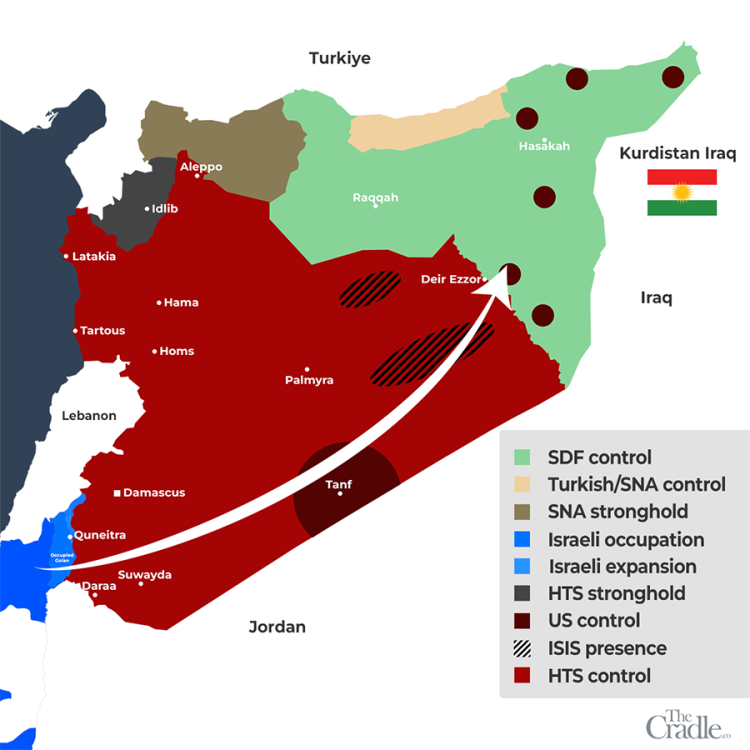
A map of the proposed David’s Corridor
A corridor of influence, not infrastructure
From Tel Aviv’s perspective, southern Syria is now a strategic vacuum: Syria’s army is weakened, Turkiye is entangled in its own Kurdish dilemmas, and Iran is overstretched. This power void offers fertile ground for Israel to assert dominance, particularly if regional dynamics continue to favor decentralized, weak governance.
Despite Washington’s reduced military footprint, the US remains committed to containing Iran. Key outposts like the Al-Tanf base on the Syrian–Iraqi border are instrumental in severing the so-called Iranian land bridge from Tehran to Beirut.
Nicola argues that while David’s Corridor is not an explicit US policy, Washington is likely to support Israeli initiatives that align with American strategic goals:
“The United States does not mind Israel implementing the project if it serves its interests, even though it is not part of its immediate strategy. It focuses on reducing Iran’s influence and dismantling its nuclear program, while supporting the path of regional normalization with Tel Aviv.”
The 2020 Abraham Accords, by easing Israel’s diplomatic isolation, have created additional maneuvering space. David’s Corridor – once a fantasy – now appears more plausible amid the regional flux.
Israeli leaders have sent unmistakable signals. On 23 February, Israeli Prime Minister Benjamin Netanyahu rejected any Syrian military presence south of Damascus, insisting on demilitarized zones in Quneitra, Deraa, and Suwayda under the pretext of protecting Syria’s Druze minority.
Israeli Foreign Minister Gideon Saar openly advocated for a federal Syria – a euphemism for fragmentation. Defense Minister Israel Katz vowed that Israeli troops would remain indefinitely in Mount Hermon and the Golan, and called for the dismantling of Syria into federal entities. Media leaks of corridor maps have only fueled speculation.
These moves have triggered outrage in southern Syria, with protests erupting in Khan Arnaba, Quneitra, Nawa, Busra al-Sham, and Suwayda. Yet, as Nicola notes, the new Syrian leadership appears remarkably disinterested in confronting Israel, and Arab states remain largely indifferent, even as the project edges toward realization. Turkiye, by contrast, stands firmly opposed to any Kurdish-led partition of Syria.
Geopolitical stakes and final frontiers
Ultimately, David’s Corridor signals a broader Israeli project to reengineer Syria’s geopolitics: isolate the south militarily, bind the Kurds in alliance, shift the balance of power, and carve a corridor of influence through fractured terrain.
Israel’s objectives are layered. Militarily, the corridor provides strategic depth and disrupts Iran’s land routes to Hezbollah. It enables the flow of arms and intelligence support to allies, especially Kurdish forces.
Economically, it opens a potential oil pipeline from Kirkuk or Erbil – Kurdish-majority, oil-rich areas – to Haifa, bypassing Turkish routes and maritime threats from actors like Yemen’s Ansarallah-allied army. Politically, it solidifies Israeli–Kurdish ties, undermines Syrian and Iraqi sovereignty, and advances the vision of Greater Israel, with the Euphrates as a symbolic frontier.
Yet the corridor is not without risk. It threatens to deepen the region’s instability, antagonize Syria, Turkiye, Iran, and Iraq, and trigger new fronts of resistance. Whether Israel can realize this project depends on the fluid regional calculus and its ability to maneuver within it.
David’s Corridor may still be a project in the shadows – but its implications are already casting a long one across the region.
Featured Video

More Iran War fallout: Maritime insurance industry shifts from London to China
or go to
Aletho News Archives – Video-Images
From the Archives
The Biggest Threat to Peace in Middle East
By Dr. Elias Akleh* | Sabbah Report | May 24, 2010
A build up of heightened tension in the Middle East is escalating in the last few weeks. American and Israeli postures towards Lebanon, Syria, and Iran have become more threatening. Listening to speeches of political leaders one hears talks only about war not peace. Iranians and Israelis are continuously training hard for a possible showdown. Both sides are conducting extensive war games every month. This led Syrians to claim that Israel is preparing for a soon-to-come another war. The Jordanians also are warning that current stalemate of the peace process is an indication of a war breaking out this summer. The Russian President and his army chief hinted, a few months ago, that the US and Israel were planning for an attack on Iran.
Indeed Iran is, as it has been for last few years, the target of most of the threats and accusations of supporting terrorism. Escalating incitement against Iran the American Defense Department sent last month (April) to Congress a report on Iran’s military claiming Iran could develop intercontinental ballistic missiles capable of reaching the US by 2015.
Ignoring the fact that N. Korea, India, Pakistan, and Israel are proven to have nuclear weapons while Iran does not, the US Secretary of State Hillary Clinton chose in her speech, to the nuclear Non-Proliferation Treaty review conference at the UN, to focus on Iran’s alleged nuclear ambitions putting the whole world at risk as she put it. According to Clinton Iran’s acquisition of nuclear weapons, rather than Israel’s more than 200 nuclear bombs, is destabilizing the Middle East. She called on the world’s nations to rally around US efforts to hold Iran, not other nuclear countries, to account.
The accusation that Usama Bin Laden is living comfortably in Iran had received a boost after the broadcast of a documentary called “Feathered Cocaine”. This echoed the June 2003 claims of the Italian newspaper Corre de la Sierra that Bin Laden was in Iran according to some intelligence report, and according to Richard Miniter’s book “Shadow War”. … continue
Blog Roll
 Aletho News
- Why could Gaza enter the regional war?
- Hamas official rejects Mladenov Plan linking disarmament to Gaza reconstruction
- Two Primary Elections for the Soul of ‘America First’
- Japan Clings to US Vassalage Despite Energy Crunch Caused By Iran War
- US Seeks Control Over Global Energy Infrastructure – Kremlin
- US senators target Orban government for standing up to Zelensky
- The deep-rooted culture of corruption in Ukraine
- Iran mobilizing one million soldiers to ‘create hell’ for any US ground assault: Report
- The coming military and psychological unravelling?
- Iran has the last laugh
- If Americans Knew
- Researchers at Human Rights Watch Resign Over Blocked Report on Palestinian Refugee Return
- Jewish Groups Are Backing a War Americans Don’t Want
- Eric Fingerhut Thinks He’s the President of the Jews
- Top Jewish Philanthropists, Rabbis Urge Israeli President to Take Action Against ‘Jewish Extremists’
- Don’t Be Fooled. Zionist Leaders Have Always Wanted to Control Southern Lebanon
- Israel’s widespread use of torture is a core element of its genocide against the Palestinian people
- In Israel’s War on Iran, Many Middle East US Bases Rendered “All But Uninhabitable”
- ‘Burn the lawn’: Israel pursues ‘Rafah model’ in southern Lebanon
- A genocide here, an amputation there
- Reports: Iran mobilizing 1M fighters, Israel-US run low on ammo, Israeli army faces shortage – Not a ceasefire Day 168
- No Tricks Zone
- Devastating Assessment Of Comirnaty Vaccine By Former Senior Pfizer Europe Toxicologist
- New Study: CO2 Is ‘Effectively Negligible’ As An Explanatory Climate Change Factor Since 2000
- Former Pfizer Toxicologist Dr. Helmut Sterz Tells Bundestag Hearing Pfizer Vaccine Should Have Never Been Approved
- Energy Expert: Germany’s Nuclear Phaseout Was A “500 Billion Euro Mistake”
- New Research: South Australia’s Mid-Holocene Sea Surface Temperatures Were 4°C Warmer Than Today
- Storing Green Energy To Last Germany 10 Days Would Require A 60-Million Tonne Battery
- New Studies: UK Sea Levels Were 4 Meters Higher Than Today During The Mid-Holocene
- Destructive Green New Deal: German Energy And Metal Group Warns Of Drastic Crisis
- New Study Documents A 20-Year Pause In Arctic Sea Ice Decline – Driven By Internal Variability
- Wake-up Call: Survey Shows Majority Of Germans Now Favor Postponing Climate Targets!
 Aletho News