Bypassing the UK parliament; the royal prerogative; and bombing Yemen
By Binoy Kampmark | MEMO | January 16, 2024
There is something distinctly revolting and authoritarian about the royal prerogative. It reeks of clandestine assumption, unwarranted self-confidence and, most of all, a blithe indifference to accountability before elected representatives. That prerogative, in other words, is the last reminder of divine right, the fiction that a ruler can have powers vested by an unsubstantiated deity, the invisible God, and a punishing force beyond the reach of human control. And that such powers can in turn be vested in the government of the day. It is anathema to democracy, a stain on republican models of government, a joke on any political system that has some claim on representing what might be called the broader citizenry.
The UK government, in league with the US and with support from a number of other countries, attacked Houthi positions in Yemen on 11 January. The decision was made without recourse to parliament and was justified by reference to Article 51 of the UN Charter as “limited, necessary and proportionate in self-defence”.
In his statement on the attacks, Prime Minister Rishi Sunak pointed to the Houthi’s role in staging “a series of dangerous and destabilising attacks against commercial shipping in the Red Sea, threatening UK and other international ships, causing major disruption to a vital trade route and driving up commodity prices.” He made no mention of the Houthis’ own justification for the attacks as necessary measures to disrupt Israeli shipping and interests in response to their systematic, bloodcurdling razing of the Gaza Strip.
Lip service has been paid by the executive within Westminster to parliament’s importance in deciding whether the country commits to military action or not.
The stark problem is that the action is always decided upon in advance, and no dissent among parliamentarians will necessarily sway the issue. Motions can be proposed and rejected but remain non-binding on the executive emboldened by the royal prerogative.
The British decision to commit to the egregious invasion of Iraq in 2003 was already a foregone conclusion, despite preliminary debates in the House of Commons and huge public protests against the measure. On 18 March, 2011, the then British Prime Minister David Cameron informed the Commons of his intention to attack Libya, leading to a government motion on 21 March that the chamber “supports Her Majesty’s Government… in the taking of all necessary measures to protect civilians and civilian-protected measures.”
That same year, the then Conservative-Liberal Democrat coalition government in the UK acknowledged that a convention had crystallised in parliament that the House of Commons should be availed of “an opportunity to debate the matter [of committing troops] and said that it proposed to observe that convention except when there was an emergency and such action would not be appropriate.”
The broadly worded nature of the caveats – in cases of emergency or when it would not be appropriate – have made something of a nonsense of the convention. In April 2016, Defence Secretary Michael Fallon made much of the “exception”, arguing that it was “important to ensure that this and future Governments can use their judgment about how best to protect the security and interests of the UK.”
Parliament, in short, should be put in its place when necessary. Governments, it is reasoned, know best when it comes to matters of national security; parliamentarians less so. “In observing the Convention,” Fallon goes on to explain, “we must ensure that the ability of our Armed Forces is to act quickly and decisively, and to maintain the security of their operations, is not compromised.” In such cases, matters could be dealt with retrospectively, with the government of the day subsequently informing parliament after the fact.
An example of this absurd policy was played out in the decision by the UK government in April 2018 to target the Assad regime’s chemical weapons facilities in Syria. Hiding behind the weasel claim of humanitarianism, the explanation for avoiding parliament was shoddy and leaden. “It was necessary,” came the explanation from the PM’s office, “to strike with speed so we could allow our Armed Forces to act decisively, maintain the vital security of their operations, and protect the security and interests of the UK.”
The Yemen strikes eschew humanitarianism (the humanitarian justifications advanced by the Houthis in protecting Palestinian civilians has been rejected), but, in any case, shipping interests take priority. Armed Forces Minister James Heappey, apparently, was satisfied that an exception to the convention to consult parliament had presented itself. “The prime minister,” the minister parroted, “needs to make decisions such as these based on the military, strategic and operational requirements. That led to the timing.”
With the horse having bolted merrily out of the stable, Heappey remarked with all due condescension that parliament would, in time, be able to respond to the decision to strike Yemen. An “opportunity” would be made available “when parliament returns for these things to be fully discussed and debated.” The sheer redundancy of parliament’s role in matters of state, and that of MPs, could thereby be affirmed.
Much agitated by this state of affairs, former Shadow Chancellor John McDonnell opined that no military action should take place without parliament’s approval. “If we have learnt anything in recent years it’s that military intervention in the Middle East always has dangerous and often unforeseen consequences,” said McDonnell. “There is a risk of setting the region alight.”
Liberal Democrat Foreign Affairs spokesperson Layla Moran was of the view that parliament should not be bypassed in matters of war, yet opted for the rather fatuous formula arising out of the 2011 convention. “Rishi Sunak must announce a retrospective vote in the House of Commons on these strikes, and recall parliament this weekend,” she said.
The use of the royal prerogative in authorising military action remains one of those British perversions that makes for good common room conversation but offends the sensibilities of the democratically minded elector. A far better practice would be to make the PM of the day accountable to that most essential body of all: parliament. That same principle would be extended to other constitutional monarchies, which are similarly weighed down by the all too liberal use of the prerogative when shedding blood. If a country’s citizens are to go to war to kill and be killed, surely their elected representatives should have a say in that most vital of decisions?
China Slams US, Issues Statement With Arab League Calling for Gaza Ceasefire
Sputnik – 16.01.2024
“The US, which is pouring fuel on the fire in the Israel-Palestine conflict, also wants to play the role of fireman,” read an article in Chinese media criticizing America’s “unconditional support for Israel.”
China released a joint statement with Arab League nations Sunday urging a ceasefire in Gaza and advocating a two-state solution to resolve the long running Palestine-Israel conflict.
The resolution emerged after Chinese Foreign Minister Wang Yi met Arab League Secretary-General Ahmed Aboul-Gheit in Cairo, Egypt.
The statement called for dialogue with Palestinian groups and a global peace conference to move towards implementing a two-state solution, advocating a “government of Palestine for the Palestinians.” The leaders urged the full implementation of resolutions passed by the United Nations which have long criticized the Israeli occupation of internationally-recognized Palestinian territory. The United States typically uses its influence and position on the UN Security Council to block and undermine resolutions criticizing Israel’s conduct.
The leaders also promoted the resumption of direct peace talks between the Israeli and Palestinian sides.
The statement then touched on recent US and UK-backed airstrikes against the Houthi movement in Yemen, which Chinese media criticized as an “escalation” of the situation and an attempt to distract from the broader conflict. Chinese media called for the respect of the “sovereignty and territorial integrity of Yemen,” a critique of the airstrikes that it noted lacked authorization by the UN.
Finally, China called for the sending of humanitarian aid to Palestinians, which it labeled an “imperative moral responsibility.” China insisted that the only way to ultimately safeguard commercial interests in the Red Sea is to achieve “a just settlement of the Palestinian issue.”
“We have a common responsibility to ensure the security of the Red Sea, and we will not be deceived by the US to fuel such tensions,” said Li Weijian, a researcher at the Shanghai Institutes for International Studies.
China and Arab League countries also vowed to move forward on economic cooperation via China’s Belt and Road initiative during the meeting.
US to send 1,500 troops to Syria and Iraq

The Cradle | January 15, 2024
The US is set to send 1,500 soldiers to Syria and Iraq, ostensibly in order to join the fight against ISIS, CBS Philadelphia reports on 14 January.
The soldiers will be sent from the New Jersey Army National Guard in its largest deployment of soldiers to the area since 2008.
“We have the people we need. We have the training that we need. We have the equipment that we need to fight and win,” Lt Colonel Omar Minott, who is among the 1,500 to be deployed, said.
The deployment of troops to Syria and Iraq falls under Operation Inherent Resolve, the US military campaign against the Islamic State across Iraq, Libya, and Syria, which calls for combating ISIS and defending US bases against resistance groups in the region.
The military operation caused a large number of US personnel deployments to the region this year.
Within the latter half of 2023, the US sent a wave of 2,500 soldiers to Syria and deployed over 900 soldiers to Iraq on two separate occasions. The deployment of these soldiers was to protect US interests against “Iran-affiliated forces.”
According to Axios, the US military presence in the region reached about 45,400 as of October 2023. The majority is in Kuwait, with 13,500; followed by Bahrain at 9,000; and Qatar at 8,000.
The US deployment into Syria and Iraq to combat ISIS raises questions. According to the US State Department, ISIS attacks in Syria have decreased by 68 percent and 80 percent in Iraq when comparing 2023 to 2022.
The Cradle’s Robert Inlakesh has said that this push by the US is to keep hold of its dominance in the region.
“To maintain the dominance of the collective west over the region, the immediate hurdle is overcoming the influences of Iran and Russia. This is why the occupation of roughly a third of Syrian territory by the US and its proxies, along with the imposition of deadly sanctions on Damascus, has become crucial in undermining the strength of its adversaries,” Inlakesh said.
Iranian and Russian forces in Syria have been coordinating with the specific aim of forcing Washington’s troops to eventually withdraw from the country.
Meanwhile, various Iraqi resistance forces have said they will continue to fight the US until they withdraw from their nation’s borders.
Kataib Hezbollah spokesman Abu Ali al-Askari has previously said that the group’s operations against the US occupation will continue until the last soldier is removed from Iraq.
UNSC has not authorized force against Yemen; China urges all parties concerned to abide by international law
Global Times | January 13, 2024
China opposes any forcible transfer of the Palestinian people from the Gaza Strip, and all measures must be taken to alleviate the humanitarian catastrophe and make a cease-fire the most urgent task of the moment, China’s permanent representative to the UN Zhang Jun said during a UN Security Council conference on Friday local time.
An immediate ceasefire has become the overwhelming call of the international community, but a permanent member of UN Security Council (UNSC) has vetoed the consensus reached by the UNSC in this regard on various grounds, which is a blatant defiance of international fairness, justice and the authority of UNSC, Zhang said.
The UNSC failed to adopt a draft resolution on December 8, 2023 that would have demanded an immediate humanitarian ceasefire in Gaza due to a veto cast by the US. Many countries expressed disappointment over the US veto of the Gaza-related draft.
It is a blatant double standard for some people to talk about the protection of human rights and the prevention of genocide while pretending to be deaf and dumb, covering up and diverting attention from the tragic situation in Gaza, Zhang remarked, “We must remove all interference and take vigorous action to quell the war, save lives and restore peace.”
In addition, Zhang stressed that that any forcible transfer of the Palestinian people must be firmly rejected.
Over the past three months, millions of Palestinian people have been forced to relocate repeatedly and were under constant threat to their lives, said Zhang, noting that China is gravely concerned about the “voluntary emigration” of Gaza people, which has been advocated by some Israeli politicians.
The horrific idea of displacing two million people from Gaza and turning it into a “safe zone” devoid of human habitation, if implemented, would constitute a grave crime under international law and completely destroy prospects for the “Two-State solution,” Zhang remarked.
The Chinese envoy called for all measures to be taken to alleviate the humanitarian catastrophe in the Gaza Strip.
Zhang said it was totally unacceptable for Israel to accuse the UN of not having the will and capacity to provide humanitarian relief when it was clear that Israel was accountable for the continued bombing and striking in Gaza and setting obstacles to the entry of humanitarian supplies.
He urged Israel to immediately cease its indiscriminate military attacks and destruction of Gaza.
UNSC resolutions 2712 and 2720 must be fully implemented, and Israel must fulfil its obligations as the occupying party to guarantee the safety of humanitarian workers and provide full cooperation with humanitarian relief efforts, Zhang said.
The envoy reiterated that a ceasefire must be implemented with the utmost urgency. “Only a ceasefire can prevent greater civilian casualties and humanitarian disasters and create conditions for the early release of all hostages; only a ceasefire can prevent the complete destruction of the basis of the Two-State solution; and only a ceasefire can prevent the entire Middle East region from being drawn into a catastrophe.”
Regarding the recent attacks launched by US and UK on Yemen against the Houthi rebels, which targeted Israeli-linked ships in the Red Sea, Zhang expressed concerns about the spillover effects of the Gaza crisis.
Zhang said at a UNSC emergency conference on the Red Sea situation on the same day that the UNSC has never authorized any country to use force against Yemen. The military action taken by the related countries runs counter to the UN resolution 2722, which the Security Council has just adopted.
The envoy warned that the Middle East region is on the brink of extreme danger, and what should be avoided now is reckless military adventurism. He added that what is needed most of all is calm and restraint to prevent further expansion of the conflict.
China urges all parties concerned, especially the influential powers, to abide by the Charter of the UN and international law, adhere to the direction of dialogue and consultation, and make practical efforts to maintain peace and stability in the Red Sea and the Middle East region, Zhang said.
The US carried out further strikes against Houthi targets in Yemen on Friday night a day after launching a coordinated multi-nation attack on nearly 30 Houthi locations.
Henry Kissinger and his legacy as a war criminal

Press TV – January 11, 2024
Henry Kissinger was one of the most influential US statesmen of the 20th century, who shamelessly used his position to manipulate the United States into providing unequivocal support to Israel.
As a hardcore Zionist, Kissinger was incredibly Machiavellian, but unlike his modern-day equivalents, he was not stupid and he certainly was not demented. Kissinger was also the architect of some of the 20th century’s worst human rights abuses and war crimes.
Henry Kissinger, his life and legacy
The passing of a war criminal, the death of Henry Kissinger at 100 years old marks the end of a bloody life.
Kissinger is well known for his role in engineering the coup that brought General Pinochet to power in Chile and overthrowing the democratically elected leader, Salvador Allende.
Kissinger’s fingerprints were all over the wars from Vietnam to Cambodia to East Timor to Bangladesh.
Less well known though, is Kissinger’s role in the neutralization of Egypt as an effective actor in the struggle against Zionism and the marginalization of Palestinians by regional allies.
It’s fair to say you would not have the same level of Egyptian complicity that you have today, including the genocidal blockade on Gaza at the Rafah crossing, without Kissinger’s work to subvert the powerful Arab state.
As Secretary of State under Richard Nixon, Kissinger was intimately involved in saving Israel in the 1973 war of attrition fought by Syria, Egypt, and Libya against the settler entity.
When the Zionists suffered consecutive losses, Kissinger and Nixon organized the emergency supply of weapons to the entity in a move known as Operation Nickel Grass.
The operation consisted of the US Air Force Military Airlift Command, delivering 22,325 tons of tanks, ammunition, and military equipment, over 32 days, directly to the battlefield.
Following the war, Egyptian leader Anwar Sadat sent a secret message to Zionist Prime Minister Golda Meir: “When I threatened war, I meant it; when I talk of peace now, I mean it. We have never had contact before, We now have the services of Dr. Kissinger. Let us use him and talk to each other through him”, asserted Sadat.
It was Kissinger who took Sadat under his wing and convinced him of the benefit of normalizing with the temporary entity. This work culminated with the visit of the Egyptian leader to the Israeli parliament, where he addressed the Israeli political elite, stating his desire for peace with the entity.
The infrastructure of collaboration that was set up during his time remains in place. When marking the death of Kissinger, Israeli President, Isaac Herzog, credited the former US Secretary of State with laying the cornerstone of the peace agreement between Egypt and the Zionist entity.
Israel lobbyist and former US ambassador to Israel, Martin Indyk, wrote a book about Kissinger’s political career with a special concentration on his services to Israel in 1981.
In reference to his diplomatic work in the Middle East, Kissinger asserted that his main objective was to isolate the Palestinians.
The truth is that Palestinians are not isolated, and support for them has outlived Henry Kissinger.
Palestine: EU’s Borrell bats for US
BY M. K. BHADRAKUMAR | INDIAN PUNCHLINE | JANUARY 11, 2024
The diplomatic arena of the Middle East was dominated in the past week by the US Secretary of State Antony Blinken’s regional tour to Türkiye, Jordan, Qatar, the UAE, Saudi Arabia, Israel, the West Bank and Egypt. It was a ‘road show’ to rally the leaders of the Arab countries behind the US but culminated in an acrimonious meeting in the West Bank between Blinken and the Palestine President Mahmoud Abbas marred by “quarrels and arguments,” according to Sky News Arabia.
The region is gripped by angst that Israel may provoke a fateful expansion of the conflict in the Gaza Strip to Lebanon and Iran after the assassination of a number of senior military figures from Hamas and Hezbollah in the recent days, which overlapped Blinken’s presence in the region and underscored Tel Aviv’s disdain toward diplomatic niceties. Two videos from the West Bank showed Israeli troops shooting a 17-year-old boy and repeatedly running over the dead body of a man they had shot last Friday.
The US fears the expansion of the conflict in the Middle East. Yet, Blinken was burdened with the contradiction that the rhetoric of Washington’s continued support for the Israeli operation is so visibly at odds with the words of President Joe Biden last week that he was doing “quiet” work with the Israeli government “to get them to significantly reduce their presence and largely withdraw from the Gaza Strip.”
Blinken claimed that “the (Arab) countries agreed to work together to help the Gaza Strip stabilise, chart a political path for the Palestinians and work towards long-term peace, security and stability in the region.” At the same time, he conceded that to do this, it is necessary to end the conflict in Gaza and identify a concrete path to the creation of a Palestinian state. Blinken flagged that the countries of the region are still interested in normalising relations with Israel, but only on the terms of a settlement of the Palestinian-Israeli conflict. Arguably, these could be incipient signs of a road map emerging.
The killing of senior Hamas and Hezbollah officials indicates that Israel is not making significant progress on the battlefield and the leadership is under compulsion to gather ‘trophies’ and claim ‘victory’. In a hybrid war, such killings will not significantly weaken the resistance movement. An effective leader was appointed overnight to head the IRGC’S Quds Force when the legendary Iranian general Qassem Soleimani was assassinated in 2020.
That said, the probability of a direct conflict between Israel and Hezbollah should not be overestimated, since the latter is well aware that an outbreak of hostilities is precisely what suits Tel Aviv. Iran also sizes up Israel’s calculus to drag the US into the war. According to reports, Iran has supplied cruise missiles to Hezbollah.
Against such a tumultuous backdrop, in a carefully choreographed sideshow, the European Union’s foreign policy chief Josep Borrell also appeared in the region at the same time as Blinken. Borrell’s destinations were Lebanon and Saudi Arabia. The EU announcement said that Borrell’s mission “will be an occasion to discuss all aspects of the situation in and around Gaza, including its impact on the region, especially the situation at the Israeli-Lebanese border, as well as the importance of avoiding regional escalation and of sustaining the flow of humanitarian assistance to civilians.”
While speaking to the media in Beirut, Borrell was highly critical of Israel’s war in Gaza and called for a pause “that could become a permanent one.” He also said, “It is imperative to avoid a regional escalation. It is absolutely necessary to avoid Lebanon being dragged into a regional conflict.” Borrell saw his mission as one to take stock of the situation and “to contribute to a way out of the crisis.”
Borrell met with the Head of Mission and Force Commander of the United Nations Interim Force in Lebanon (UNIFIL) General Aroldo Lazaro, a compatriot from Spain. Indeed, there has been some talk of deploying a peacekeeping force on Israel’s northern border with Lebanon.
Meanwhile, Al Jazeera reported, citing a government source in Beirut, that Borrell also had an unpublicised meeting with a delegation from Hezbollah led by Mohammad Raad, a member of the Lebanese legislature. Conceivably, this might have been a key item on his itinerary in Beirut.
While the US and several European countries, including Germany, the UK, Czech Republic, Austria, among others, regard Hezbollah as a terrorist organisation, the EU restricted itself to merely adding Hezbollah’s so-called “military wing” to its terror list, leaving the door open to interact with the movement’s political leadership if need arises.
That came in the wake of the group’s alleged 2012 suicide bus bombing in Burgas, Bulgaria, which killed five Israeli tourists and a Bulgarian driver. During a debate on the crisis situation in Lebanon last July, the European Parliament, for the first time, adopted a resolution calling for the EU to add the whole of Hezbollah to its list of banned terrorist organisations, but that hasn’t yet been acted upon.
Borrell’s meeting with the Hezbollah delegation would only have been with the knowledge of the Biden administration — it could even be providing a thinkable (and actionable) leitmotif of Borrell’s trip to Lebanon. BBC had reported a week ago on secret contacts between Israel and Hezbollah as well.
At any rate, by a coincidence, Borrell happened to be in Saudi Arabia when Blinken arrived there, and the two of them had a meeting. Later, in a prepared statement to the media after talks in Saudi Arabia with foreign minister Prince Faisal, Borrell also took a nuanced stance apropos Hamas, saying,
“And now we have to stop the killing of civilians in Gaza. We have to stop this great number of casualties. Hamas has to be eradicated. But Hamas is an idea, it represents an idea, and you cannot kill an idea. The only way of killing an idea –- a bad idea — is to propose a better one, to give a horizon to the Palestinian people, to their dignity, to their freedom, to their security, which has to go hand in hand with the security of Israel.”
Clearly, Borrell strove to break the ice by engaging with Hezbollah. Considering that the EU has been the US’ junior partner on major international issues, Borrell’s mission can be considered as substantive aimed at opening a diplomatic track to ease the Israel-Lebanon border tensions.
Equally, Borrell and Prince Faisal rekindled the so-called Peace Day Effort launched in September last year jointly by the EU with Saudi Arabia, the League of Arab States, Egypt and Jordan as an initiative “to reinvigorate the peace process in the Middle East.”
A joint statement issued at that time on the sidelines of the 78th session of the UN General Assembly, in the presence of almost fifty Foreign Ministers from around the world sought “to produce a “Peace Supporting Package” that will maximise peace dividends for the Palestinians and Israelis once they reach a peace agreement, … thus incentivising earnest efforts to reach it.”
As EU foreign policy chief, Borrell navigated international turbulence and divisions within the 28-member bloc to make Europe more united and turn it into a diplomatic heavyweight, but with patchy success. Of course, Ukraine spoiled the party. Palestine could well be Borrell’s last waltz. Borrell’s five-year term in Brussels ends in December.
Blinken’s window dressing tour of Arab capitals

BY M. K. BHADRAKUMAR | INDIAN PUNCHLINE | JANUARY 9, 2024
The expectation raised by the United States in allowing a UN Security Council resolution on Gaza pass through on December 22, 2023 without having to exercise its veto — albeit a watered-down one that stopped short of calling for ceasefire — was that the manifest international isolation facing Washington and Tel Aviv would inevitably impact Israel’s options going forward.
However, there are contrarian trends. Israel started the new year by ordering the withdrawal of part of its military forces from Gaza, but the spokesman of the IDF Daniel Hagari emphasised that the war will continue in 2024 and called this withdrawal in line with the renewal of forces and new organisation of Israeli army. Speaking on New Year’s Eve, Hagari said, “Tonight, 2024 begins and our goals require a long war, and we are preparing ourselves accordingly. We have a smart plan to manage our deployments, taking into account reserves, the economy, families, and resupply, as well as the continuation of combat and training.”
Hagari’s ambivalent hint that the military has wrapped up major combat in northern Gaza was buttressed with the claim that the forces would “continue to deepen the achievement” in northern Gaza, strengthen defences along the Israel-Gaza border fence and focus on the central and southern parts of the territory.
On Thursday, Israeli Defense Minister Yoav Gallant also presented a plan of a shift toward less intense military operations. The minister’s office said in a statement, “In the northern region of the Gaza strip, we will transition to a new combat approach in accordance with military achievements on the ground.” But Gallant added, “It will continue for as long as is deemed necessary.” Under Gallant’s plan, the war in Gaza will continue until all of the hostages are released and remaining military threats are neutralised.
Basically, Hagari’s remarks and Gallant’s plan can be seen as a nod to the US Secretary of State Antony Blinken who is expected in Israel later this week after visiting Turkey, Jordan, Qatar, UAE and Saudi Arabia. At the same time, Israel has, typically, also ratcheted up tensions by a series of belligerent acts in the recent days.
There has been a new escalation of cross-border fighting between Israel and Hezbollah. Besides, the targeted killing of a top Hamas political leader Saleh al-Arouri in a Hezbollah stronghold of Beirut last week; the killing of a senior IRGC commander and four others in the suburbs of Damascus; terrorist attacks in Kerman (Iran); killing of the commander of the elite Radwan forces of Hezbollah; — all these within the space of the past week are attributable to Israeli intelligence one way or another.
These events in turn have added to the resurgent fears lately that an Israel-Hamas war could erupt into a broader conflict. Earlier today, Hezbollah deputy leader Naim Qassem, said in a televised speech his group did not want to expand the war from Lebanon, “but if Israel expands, the response is inevitable to the maximum extent required to deter Israel.”
The pattern of Israeli behaviour needs to be understood from different angles. This is an incredibly complicated matrix. First and foremost, the Israeli operation in Gaza so far has been a failure. It turned the world opinion, especially in the Global South, heavily against Israel — South Africa’s petition to the International Criminal Court over war crimes in Gaza being the most telling evidence of it — while the Israeli military came a cropper in terms of its agenda to decimate Hamas.
Tel Aviv has reached none of its stated goals in the Gaza war, which are annihilation of Hamas or disarming of Hamas and release of captives held by Palestinians in Gaza. That brings the security and military establishment in Tel Aviv, whose reputation has been seriously dented following the October 7 attack, under immense pressure. On the other hand, there has been a cover-up of the heavy casualties suffered by Israeli troops in the Gaza operation. The Kerman terrorist attack and the killing of Saleh al-Arouri actually betray a high level of frustration.
In political terms, there is a convergence between the security and military establishment and Prime Minister Benjamin Netanyahu (whose political future hangs by a thread) and the ultra-rightist fascist forces aligned with him, whose interests lie in an extended war.
The only external force capable of pressuring Israel is of course the US administration. But it is too much to expect President Biden to draw the ‘red line’ to Israel — that is, even assuming that he has the political will to do so — given the Israel Lobby’s control of the Congress and its seamless capacity for making or destroying the careers of US politicians.
Washington has not changed the intensity of Israeli military operations. On the other hand, the US has shipped to Israel 10,000 tons of arms to Israel in the recent period alone. In fact, it cannot be a coincidence that every single Blinken visit to the region since October 7 has witnessed a particularly brutal Israeli attack to up the ante. In effect, the US is broadly in support of the Israeli policy and a commitment to the destruction of Hamas, in particular.
Therefore, Biden’s interest narrows down to prevent the war from spreading in the region lest direct American military intervention becomes necessary. The US rhetoric and diplomatic posturing largely aims at damage control in Washington’s relations with its erstwhile allies in the region. Quintessentially, Blinken’s mission comes down to cheap window dressing — viz., to bringing the regional states to the same page that Israel is facing an existential crisis. But it does not take into account that the region has changed radically.
What truly distinguishes the present crisis is that the Arab world is profoundly concerned and feels outraged by the barbaric Israeli behaviour toward hapless Palestinians — ‘animals,’ as Israeli politicians have described them. The Arab psyche is convinced that an enduring final settlement of the Palestine problem cannot be postponed indefinitely. Something has fundamentally changed even for Saudi Arabia which had clandestine dealings with Israel for decades and was inching toward establishing formal relations with it.
A Saudi statement said that while receiving Blinken in Al ‘Ula on Monday, Crown Prince Mohammed bin Salman “stressed the importance of stopping military operations, intensifying humanitarian action, and working to create conditions for restoring stability and for a peace process that ensures that the Palestinian people gain their legitimate rights and achieve a just and lasting peace.” The Saudi statement is at sharp variance with the readout by the US state department.
Interestingly, an article in the Saudi daily Asharq Al-Awsat focused on Blinken’s forthcoming visit highlighted fundamental differences between Riyadh and Washington on a range of issues — ceasefire in Gaza (“not just a humanitarian truce or exchange of prisoners, but rather a comprehensive halt”); security of the Red Sea (“the responsibility for security in the Red Sea lies with the riparian countries first, and with a UN-international responsibility in the second place”); Israel’s culpability for “expanding the scope of the war”; futility of “talk about post-war phase” at this point.
The article ended on a sombre note: “If the American administration wants Blinken’s visit to Saudi Arabia and the region to succeed, and if it wants to maintain its partnerships in the region, and preserve its role as a sponsor of peace in the Middle East at a time when international forces hostile to Washington are searching for a foothold in the region, it must adhere to neutrality, and not use the region’s interests and future as a card in the upcoming American elections. It must deal with the disease and not with the symptom as it is doing now.”
Israel about to engage in two-front war
By Lucas Leiroz | January 9, 2024
In recent days there has been a major escalation in the Middle Eastern conflict. Israel has launched a series of attacks against targets outside Palestine, including Lebanon, resulting in the deaths of key members of anti-Zionist organizations. Israel’s targeted assassinations have been seen as an affront to Lebanese national sovereignty, increasing the risks of an open war between the Zionist state and Hezbollah.
Israel has been bombing its neighboring countries since the war began in October. However, the frequency and brutality of these raids has grown significantly in recent weeks. Lebanon has become one of the main targets of Israeli attacks, especially in strikes targeting strategic public figures. In one of these operations, Wissam al-Tawil, deputy head of the Radwan group, a special unit of the Shiite militia, was murdered. Al-Tawil was a high-ranking member of Hezbollah, which means there will certainly be a retaliation.
A few days earlier, a brutal Israeli attack in Beirut had left six high-ranking Hamas members dead, including the Palestinian organization’s deputy head, Saleh al-Arouri. At the time members of Hezbollah were not targeted, and the strike was aimed at killing Hamas militants gathered in Beirut. However, the fact that the attack was carried out on Lebanese soil obviously generated outrage among members of the Shiite militia, who promised retaliation for the violation of Lebanese sovereignty.
Hassan Nasrallah, general secretary of Hezbollah, made two statements about these events. According to him, Hezbollah is already fighting Israel, but is using only a small percentage of its combat potential. The militia’s involvement is “limited”, being focused on neutralizing Israeli intelligence targets on the border. For now, the objectives of these operations are, according to Nasrallah, to generate military pressure against Israel and help the Palestinians by eliminating IDF’s resources. However, Nasrallah made it clear that if Israel continues to violate Lebanese sovereignty, the group will launch a “war without restrictions”, using full power against Zionist troops.
Apparently, Israel is not interested in de-escalation. The attacks on Lebanon have continued even after Nasrallah’s warnings – and more targeted killings of Hezbollah members could happen at any time. In fact, Tel Aviv is currently in a complicated military situation. The war in Gaza has become “unwinnable”, as the debris from the bombings have severely damaged the IDF itself, preventing the flow of armored vehicles and creating a network of hiding places and barricades that favor Hamas.
There is currently a guerrilla war in Gaza, with members of the Palestinian Resistance having the advantage, as they know the terrain better and are skilled at carrying out surprise attacks and hiding among the debris of buildings and tunnel networks. Although Israel has managed to destroy the physical structure of Gaza, the consequences of its attacks have mainly affected civilian people and have not been extremely effective in neutralizing Hamas and other Palestinian militias. The result is an uncomfortable situation, with Israel involved in a permanent war of attrition.
Given this, Israel is betting on the internationalization of the conflict as a way of “winning” the war. Since it is not being successful in Gaza, the Israeli government hopes to generate new outbreaks of hostilities by launching attacks against Lebanon and Syria. The aim is to bring new actors into the war, creating a situation of total regional conflict that makes intervention by Israel’s Western partners “inevitable”.
The main problem with this Israeli “strategy” is that the consequences could be devastating. It will not be easy to garner Western support and justify an intervention in the conflict, as global public opinion is outraged by Israeli genocidal actions in Gaza. Furthermore, Hezbollah is showing patience and strategic mentality by avoiding symmetrical responses to Israeli attacks. The group is trying not to engage in an all-out war, as the IDF is already in a delicate situation and there is no need to open a new front. Hezbollah’s focus appears to be to launch surgical strikes across the border, delaying more involvement as long as possible.
To get a strong reaction from Hezbollah, Israel will have to further increase the brutality of its raids against Lebanon. And this will be a serious problem in the Zionist strategy, since by doing this Tel Aviv will be justifying Hezbollah’s reactions, and there will therefore be no legal arguments for the West to mobilize collectively to support Israel. In fact, without full Western support, Israel will not be able to fight a two-front war, being a real catastrophe for the IDF itself.
This is further evidence of how Israel took wrong actions at the beginning of the conflict. Instead of only responding to Hamas’ “Operation Al Aqsa Flood”, Tel Aviv chose to launch a campaign of genocide and territorial expansion, sinking into a prolonged war that will not be won so easily.
Lucas Leiroz is a journalist, researcher at the Center for Geostrategic Studies, geopolitical consultant.
You can follow Lucas on X (former Twitter) and Telegram.
Haifa missile strike by Iraqi resistance shows how fragile Israeli regime is
By Wesam Bahrani | Press TV | January 8, 2024
In yet another significant act of solidarity with the people of Gaza, the Islamic Resistance in Iraq on Sunday struck “a vital target in occupied Haifa” with an advanced long-range cruise missile, grabbing headlines and taking the embattled regime in Tel Aviv by another surprise.
In a statement, the Iraqi resistance emphasized that the operation was carried out because of “our ongoing support for people in Gaza,” who have been reeling under the Israeli aggression since Oct. 7.
The statement added that the operation was “in response to the massacres committed by the usurping entity against Palestinian civilians, including children, women, and the elderly.”
The Iraqi resistance, which has in recent months launched a string of attacks on US military bases in Iraq and Syria, said it will continue to hit enemy strongholds, warning that “more is yet to come”.
The concluding part of the statement was the most attention-grabbing.
Such is the stringent Israeli media censorship of the occupying regime’s war on the besieged Gaza Strip; it is difficult to speculate what vital infrastructure has been hit.
The Iraqi resistance struck Haifa with a long-range cruise missile, named al-Arqab, from Iraqi territory. The distance from Baghdad to Haifa is almost 1,000 kilometers.
According to sources, the launch of the missile took place closer to the Western Iraqi deserts. That is still roughly 600 kilometers away, or perhaps more, depending on the launch site.
It essentially means that Haifa, which is located in the northern part of the occupied territories, can expect attacks again from the Iraqi soil, the timing of which will be decided by the resistance.
More importantly, the long-range cruise missile traveled the same distance that can put Tel Aviv and all other Israeli-occupied Palestinian territories within the range of Iraqi fire.
On Monday, Iraq’s Harakat al-Nujaba resistance movement claimed responsibility for the strike, warning that Israel should await more crippling attacks in retaliation for its bloody war on Gaza.
“The Axis of Resistance is determined to disrupt US scenarios in the region and thwart the occupying Israeli regime’s schemes in Gaza,” Hussein al-Moussawi, spokesman for the group, said.
Should we be surprised that the Popular Mobilization Units (PMU), under which the Islamic Resistance in Iraq operates, possesses such world-class military technology?
The short answer is no.
The Iraqi government itself armed the PMU with the most capable military equipment from Baghdad’s weapons depots because it plays the most fundamental role of all the Iraqi armed forces.
The attack on Haifa points to the start of a new chapter by the Islamic Resistance in Iraq, in what is expected to be an even stronger show of support for the Palestinian resistance in Gaza and its people.
In this latest phase, we must expect an escalation in attacks on crucial Israeli infrastructure inside the occupied Palestinian territories, facilitated by the utilization of sophisticated long-range cruise missiles.
The Islamic Resistance in Iraq has made no secret of its iron-clad support and solidarity with the oppressed people of Gaza amid the Israeli regime’s indiscriminate bombings and inhumane siege.
It had also made no secret of its military operations against the Zionist regime and its Western backers, which has been completely evident in the past few weeks.
Shortly after the Israeli regime launched its war on Gaza on October 7, the Islamic Resistance in Iraq carried out a number of operations against Israeli interests and its main backer, the United States.
In late December, the Iraqi Resistance struck a vital target in the Eli-ad settlement, in the southern Israeli-occupied Syrian Golan Heights with drones.
Before targeting Eli-ad, the resistance also pounded the regime’s main offshore (occupied) Karish gas field in the eastern Mediterranean Sea with a direct hit, inflicting heavy damage.
That came after the Iraqi resistance struck a target in occupied Umm al-Rashrash (Eilat) with appropriate weapons and released images of the operation for the public.
The regime evacuated the settlers of Eilat, transforming the area into a military garrison. It made the site an ideal target for Iraq as well as Yemen, another Arab country that has upped the ante recently.
Yemen, Iraq and Lebanon’s Hezbollah resistance movement have carried out a series of operations against Israeli interests with a barrage of long-range drones and missiles.
At times, the goal has simply been to fire a barrage of missiles and drones to preoccupy the Israeli Iron Dome and Patriot Missiles. These calculated efforts have proven successful.
They effectively ease the pressure on the Palestinian resistance while at the same time drain out Israeli military resources, which have in recent months become extremely depleted.
The regime has killed more than 22,000 Palestinians since Oct. 7, the majority of whom have been women and children. Thousands more are missing, presumably dead under the rubble.
Among the countries and movements taking the lead in militarily pressuring the U.S. and its apartheid regime to end its inhumane attacks on Gaza, Iraqis have played a courageous role.
In Iraq, the resistance has targeted illegal American military bases on its territory as well as in Syria more than 110 times since the Israeli war against Gaza began three months ago.
Rockets, mortar shells, drones, and short and long-range ballistic missiles have all been used in these operations, leading to scores of casualties among US troops and collateral damage.
Now, the question that everyone is asking is: Why has the Iraqi resistance opened a new chapter?
Lately, the illegal US military occupation on Iraqi soil made a costly mistake by attacking sites belonging to the PMU, which means Washington and Tel Aviv have to pay the price.
Recent US attacks against affiliates of the PMU, including Kataib Hezbollah, and the recent deadly strike on the headquarters of Harakat al-Nujaba, which led to the assassination of one of its leaders in Baghdad, Haj Mishtaq, means the time is ripe for the resistance to expand its operations.
For context: In the eyes of the Iraqi resistance, there is no difference between the US military occupation of Iraqi soil and the Israeli occupation of Palestine. The liberation of the Palestinian territories begins with the expulsion of American troops from Iraq and the rest of the region.
While the Israeli regime commits horrendous crimes against humanity in Gaza, America is shielding, arming, funding and facilitating this madness of death and destruction campaign in the coastal strip.
Taking a closer look at the events unfolding in Gaza, it is, in essence, an American war on Gaza.
This direct complicity means that Washington has to pay the same price as the Israeli regime is paying for its massacres of civilians in Gaza. They are two sides of the same coin.
Whilst illegal US bases in Iraq and Syria are closer to the line of fire for the resistance, the indiscriminate Israeli attacks against women and children in Gaza have seen the PMU increasingly target the Israeli regime, the latest being Haifa.
What the Al-Aqsa Storm (or Al-Aqsa Flood) operation provided was an opportunity for the Iraqi resistance to strike at Israeli interests for the first time in history.
As pressure grows on the Iraqi government of Prime Minister Mohammad Shia’ al-Sudani to expel the illegal US forces, it has also opened a new window for the PMU to end the American occupation and avenge Washington’s assassination of its deputy leader Abu Mehdi al-Muhandis.
For the moment, the main goal of the resistance is to expand its scope of attacks against the Israeli regime in order to mount pressure on the apartheid occupation as well as the US.
And, as the Iraqi resistance warned after the Haifa attack, “more is yet to come”.
Wesam Bahrani is an Iraqi journalist and commentator.
Biden Regime Can Force Israel to Stop Fighting in Gaza But Will Not Do It
Sputnik – 06.01.2024
Three months after the escalation of the Israeli-Palestinian conflict sparked by the October 7 attack by Hamas militants on Israeli territories, Tel Aviv appears intent to continue its invasion of the Gaza Strip — seemingly oblivious to the number of Palestinian civilians killed in its quest to punish Hamas.
US Secretary of State Antony Blinken has undertaken yet another voyage to the Middle East, meeting Turkiye’s President Recep Tayyip Erdogan to discuss the ongoing hostilities in the Gaza Strip.
While media reports this week suggested that Blinken will try facilitate the return of Palestinians displaced by the fighting back to their homes and to urge Israel to increase aid to Palestinians, American human rights lawyer Francis Anthony Boyle argues that the US state secretary is “up to no good.”
In an interview with Sputnik, Boyle, a professor of international law at the University of Illinois’ College of Law, suggested that Blinken headed to the Middle East to “better coordinate the escalation of conflict” there instead of trying to put an end to bloodshed.
“In fact, the Biden administration just needs to order Israel to cease fire immediately, and they will have to do it. But of course, Blinken is not going to do that. He is a diehard Zionist. He is in on the plot over there with Netanyahu to inflict outright genocide on the Palestinians,” Boyle said.
According to him, the US appears to be “just backing whatever Israel wants to do,” which currently appears to be attempting to displace over 2 million Palestinians from the Gaza Strip.
“If you look at the countries Blinken is going to, he is going to try to neutralize any opposition to this plan by Israel and see if they can pull it off,” Boyle remarked.
He also argued that the Biden administration is “complicit in Israeli genocide against the Palestinians” by supplying Israel with military hardware and munitions and by providing Tel Aviv with political support.
Iraqi PM says plans underway for withdrawal of US-led coalition
The Cradle | January 5, 2024
Iraqi Prime Minister Mohammed Shia al-Sudani announced on 5 January that the Iraq-US bilateral committee, established late last year, has started the process of scheduling the withdrawal of the US-led “international coalition” from the country.
“We are in the process of setting a date for the start of the dialogue through the bilateral committee that was formed to determine the arrangements for the [withdrawal of foreign troops,” Sudani said during a ceremony commemorating the fourth anniversary of the US assassination of the Deputy Chairman of the Popular Mobilization Units (PMU), Abu Mahdi Al-Muhandis, and Iranian Quds Force Commander General Qassem Soleimani.
“We affirm our firm and principled commitment to ending the presence of the international coalition as the justifications for its existence have ended,” the Iraqi head of state stressed, referring to Washington’s allegations of keeping troops and heavy weapons in Iraq to help the country “fight ISIS.”
“[This] is a commitment that the government will not back down from, and we will not neglect anything that would complete national sovereignty over Iraq’s land, sky, and waters,” Sudani added.
The premier also lambasted the US for launching a drone strike on the Baghdad headquarters of the PMU, located meters away from the Interior Ministry complex, killing a top leader of the Nujaba Movement.
“Iraq has a strategic partnership agreement and diplomatic relations with the US, and in this way, the main principles of international relations and what was stipulated in the UN Charter regarding equality of sovereignty between countries and the prohibition of the use of force in international relations were violated,” Sudani said.
He then highlighted that the PMU – also known as the Hashd al-Shaabi – represents “an official presence affiliated with the state, subject to it, and an integral part of our armed forces.”
“We have repeatedly emphasized that in the event of a violation or transgression by any Iraqi party, or if Iraqi law is violated, the Iraqi government is the only party with the right to follow up on the merits of these violations … The government is the body authorized to impose the law, and everyone must work through it, and no one has the right to infringe on Iraq’s sovereignty,” the prime minister stressed.
The PMU was formed in 2014 in response to the ISIS invasion of northwest Iraq, including Mosul. Ali Sistani, the top Shia cleric in Iraq, called for the establishment of the PMU to protect Baghdad and defeat the US-proxy terror group in Mosul.
The PMU was established with support from Iran, most notably General Soleimani, and was later incorporated into the Iraqi government as part of its armed forces.
Following the 2020 assassination of Soleimani and Muhandis, the Iraqi parliament voted on a law to withdraw permission for the US to operate on Iraqi soil.
US troops first entered Iraq in 2003 to topple the government of Saddam Hussein under false pretenses. Washington initially withdrew its forces in 2011 when the White House failed to secure a new Status of Forces (SOFA) agreement with former Iraqi Prime Minister Nouri al-Maliki.
However, US troops returned to the Ain al-Asad base under the pretext of training Iraqis to fight ISIS six months after the extremist group invaded and occupied Mosul, Iraq’s second-largest city, in June 2014.
On 18 December 2021, the Iraqi government announced that “no combat forces of the international coalition or NATO” remained inside the Ain al-Assad base. However, at least 2,500 US troops remain in the country – many at the Ain al-Asad base – in a “training and advisory role.”
Their continued presence is part of an agreement reached between Washington and Baghdad in July 2021 that was meant to see the complete withdrawal of US troops – similar to their exit from Afghanistan.
Gaza destroys western divide-and-rule narratives
By Sharmine Narwani | The Cradle | January 4, 2024
It could be a clean sweep. Decades of western-led narratives crafted to exploit differences throughout West Asia, create strife amid the region’s myriad communities, and advance western foreign policy objectives over the heads of bickering natives are now in ruins.
The war in Gaza, it transpires, has blown a mile-wide hole in the falsehoods and fairytales that have kept West Asia distracted with internecine conflicts since at least the 1979 Islamic Revolution in Iran.
Shia versus Sunni, Iran versus Arabs, secular versus Islamist: these are three of the west’s most nefarious narrative ploys that sought to control and redirect the region and its populations, and have even drawn Arab rulers into an ungodly alliance with Israel.
Facts are destroying the fiction
It took a rare conflict – uncooked and uncontrolled by Washington – to liberate West Asian masses from their narrative trance. Israel’s genocidal assault on Gaza also brought instant clarity to the question of which Arabs and Muslims actually support Palestinian liberation – and which do not.
Iran, Hezbollah, Iraqi resistance factions, and Yemen’s Ansarallah – maligned by these western narratives – are now visibly the only regional players prepared to buttress the Gaza frontline, whether through funds, weapons, or armed clashes that aim to dilute and disperse Israeli military resources.
The so-called ‘moderate Arabs,’ a misnomer for the western-centric, authoritarian Arab dictatorships subservient to Washington’s interests, have offered little more than lip service to the carnage in Gaza.
The Saudis called for support by hosting Arab and Islamic summits that were allowed to do and say nothing. The Emiratis and Jordanians trucked supplies to Israel that Ansarallah blockaded by sea. The mighty Egypt hosted delegations when all it needed to have done was to open the Rafah Crossing so Palestinians can eat. Qatar – once a major Hamas donor – now negotiates for the freedom of Israeli captives, while hosting Hamas ‘moderates,’ who are at odds with Gaza’s freedom fighters. And Turkiye’s trade with the Israeli occupation state continues to skyrocket (exports increased 35 percent from November to December 2023).
Palestine, for the pro-west ‘moderate Arabs,’ is a carefully handled flag they occasionally wave publicly, but sabotage privately. So, they watch, transfixed and horrified today, at what social media and tens of millions of protesters have made crystal clear: Palestine remains the essential Arab and Muslim cause; it may ebb and flow, but nothing has the power to inflame the region’s masses like this particular fight between right and wrong.
The shift toward resistance
It is early days yet in the battle unfolding between the region’s Axis of Resistance and Israel’s alliances, but the polls already show a notable shift in public sentiment toward the former.
An Arab barometer poll taken over a six-week period – three weeks before and three weeks after the Al-Aqsa Flood operation – provides the first indication of shifting Arab perceptions. Although the survey was restricted to Tunisia, the pollsters argue that the country is “as close to a bellwether as one could imagine” and that it represents views similar to other Arab countries:
“Analysts and officials can safely assume that people’s views elsewhere in the region have shifted in ways similar to the recent changes that have taken place in Tunisia.”
The survey results should be of paramount concern to meddling western policymakers: “Since October 7, every country in the survey with positive or warming relations with Israel saw its favorability ratings decline among Tunisians.”
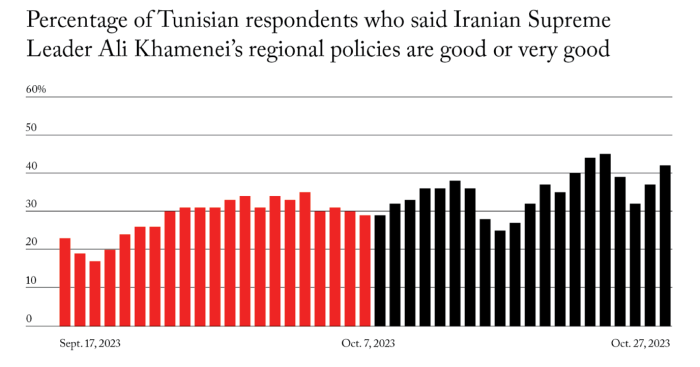
The US saw its favorability numbers plummet the most, followed by West Asian allies that have normalized relations with Israel. Russia and China, both neutral states, experienced little change, but Iran’s leadership saw its favorability figures rise. According to the Arab barometer:
“Three weeks after the attacks, Iranian Supreme Leader Ali Khamenei has approval ratings that matched or even exceeded those of Saudi Crown Prince Mohammed bin Salman and Emirati President Mohammed bin Zayed.”
Before 7 October, just 29 percent of Tunisians held a favorable view of Khamenei’s foreign policies. This figure rose to 41 percent according to the conclusion of the survey, with Tunisian support most notable in the days following the Iranian leader’s 17 October reference to Israel’s actions in Gaza as a “genocide.”

The Saudi shift
Prior to the 7 October operation by the Palestinian resistance to destroy the Israeli army’s Gaza Division and take captives as leverage for a mass prisoner swap, the region’s main geopolitical focus was on the prospects of a groundbreaking Saudi normalization deal with Tel Aviv. The administration of US President Joe Biden flogged this horse at every opportunity; it was seen as a golden ticket for his upcoming presidential election.
But Operation Al-Aqsa Flood ruined any chance for Saudi Arabia – home to Islam’s holiest sites – to seal that political deal. And with Israeli airstrikes raining down daily on Palestinian civilians in Gaza, Riyadh’s options continue to shrink.
A Washington Institute poll conducted between 14 November and 6 December measures the seismic shift in Saudi public sentiment:
A whopping 96 percent agree with the statement that “Arab countries should immediately break all diplomatic, political, economic, and any other contacts with Israel, in protest against its military action in Gaza.”
Meanwhile, 91 percent believe that “despite the destruction and loss of life, this war in Gaza is a win for Palestinians, Arabs, and Muslims.” This is a shockingly unifying statement for a country that has adhered closely to western narratives that seek to divide Palestinians from Arabs, Arabs among themselves, and Muslims along sectarian lines – geographically, culturally, and politically.
Although Saudi Arabia constitutes one of the few Arab states to have designated Hamas as a terrorist organization, favorable views of Hamas have increased by 30 percent, from 10 percent in August to 40 percent in November, while most – 95 percent – do not believe the Palestinian resistance group killed civilians on 7 October.
Meanwhile, 87 percent of Saudis agree with the idea that “recent events show that Israel is so weak and internally divided that it can be defeated some day.” Ironically, this is a long-stated Resistance Axis refrain. Hezbollah Secretary General Hassan Nasrallah was famously quoted as saying “Israel is weaker than a spider’s web,” upon its defeat by the Lebanese resistance on 25 May, 2000.
Prior to 7 October, Saudis had strongly favored economic ties with Israel, but even that number dropped dramatically from 47 percent last year to 17 percent today. And while Saudi attitudes toward the Resistance Axis remain negative – Saudi Arabia, after all, has been the regional epicenter for anti-Iran and anti-Shia propaganda since the 1979 revolution – that may be largely because their media is heavily controlled.
Contrary to the observations of the Arab masses, 81 percent of Saudis still believe that the Axis is “reluctant to help Palestinians.”
The Palestinian shift
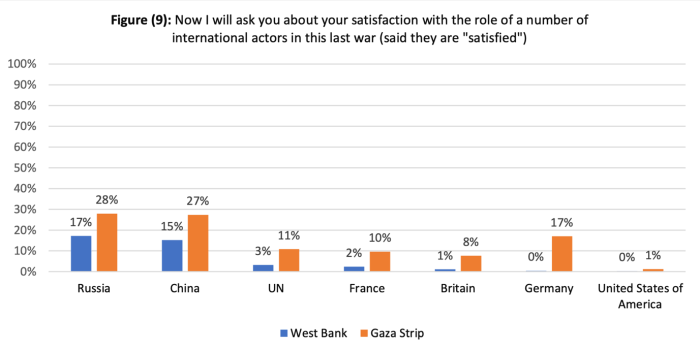
Equally important to the discussion of Arab perceptions is the shift seen among Palestinians themselves since 7 October. A poll conducted by the Palestinian Center for Policy and Survey Research (PSR) in both the occupied West Bank and Gaza Strip between 22 November and 2 December mirrors Arab views, but with some nuances.
Gazan respondents, understandably, displayed more skepticism for the ‘correctness’ of Hamas’ Operation Al-Aqsa Flood, which triggered Israel’s genocidal assault on the Strip in which over 22,000 civilians – mostly women and children – have so far been brutally killed. While support for Hamas increased only slightly in the Gaza Strip, it tripled in the West Bank, with both Palestinian territories expressing near equal disdain for the western-backed Palestinian Authority (PA), which governs from Ramallah.
Support for acting PA President Mahmoud Abbas and his Fatah party was hit hard. Demands for his resignation are at nearly 90 percent, while almost 60 percent (the highest number recorded in a PSR poll to date in relation to this matter) of those surveyed want a dissolution of the PA.
Over 60 percent of Palestinians polled (closer to 70 percent in the West Bank) believe armed struggle is the best means to end the occupation, with 72 percent agreeing with the statement that Hamas made a correct decision to launch its 7 October operation, and 70 percent agreeing that Israel will fail to eradicate the Palestinian resistance in Gaza.
Palestinians have strong views about regional and international players, who they largely feel have left Gaza unprotected from Israel’s unprecedented violations of international law.
By far the country most supported by respondents is Yemen, with approval ratings of 80 percent, followed by Qatar (56 percent), Hezbollah (49 percent), Iran (35 percent), Turkiye (34 percent), Jordan (24 percent), Egypt (23 percent), the UAE (8 percent), and Saudi Arabia (5 percent).

In this poll, the region’s Axis of Resistance dominates the favorability ratings, while pro-US Arab and Muslim nations with some degree of relations with Israel, fare poorly. It is notable that of the four most favorable countries and groups for mostly-Sunni Palestinians, three are core members of the “Shia” Axis, while five Sunni-led states rank lowest.
This Palestinian view extends to non-regional international states, with respondents most satisfied with Resistance Axis allies Russia (22 percent) and China (20 percent), while Israeli allies Germany (7 percent), France (5 percent), the UK (4 percent), and the US (1 percent) struggle to maintain traction among Palestinians.
The numbers depend on the war ahead
Three separate polls show that Arab perceptions have shifted dramatically over Israel’s war on Gaza, with popular sentiment gravitating to those states and actors perceived to be actively supporting Palestinian goals, and away from those who are perceived to support Israel.
The new year starts with two major events. The first is the drawdown of Israeli reservists from Gaza, whether because Washington demands it, or due to unsustainable loss of life and injury to occupation troops. The second is the shocking assassination of Hamas leader Saleh al-Arouri and six others in Beirut, Lebanon, on 2 January.
All indications are that Israel’s war will not only continue, but will expand regionally. The new US maritime construct in the Red Sea has drawn other international actors into the mix, and Tel Aviv has provoked Lebanon’s Hezbollah in a major way.
But if the confrontation between the two axes escalates, Arab perceptions will almost certainly continue to tilt away from the old hegemons toward those who are willing to resist this US-Israeli assault on the region.
There will be no relief for Washington and its allies as the war expands. The more they work to defeat Hamas and destroy Gaza, and the more they lob missiles at Yemen, Iraq, and Syria, and besiege the Resistance Axis, the more likely Arab populations are to shrug off the Sunni-versus-Shia, Iran-versus-Arab, and secular-versus-Islamist narratives that have kept the region divided and at odds for decades.
The swell of support that is mobilizing due to a righteous confrontation against the region’s biggest oppressors is unstoppable. Western decline is now a given in the region, but western discourse has been the first casualty of this war.
Featured Video

Bombing Hitler’s Hometown
or go to
Aletho News Archives – Video-Images
From the Archives
‘Conspiracy Theory’ Now Fact: Greater Israel Has Arrived
By Kit Klarenberg | Mint Press News | January 28, 2025
Ever since Tel Aviv’s 1948 creation, much has been said and written about ‘Greater Israel’ – the notion Zionism’s ultimate end goal is the forcible annexation and ethnic cleansing of vast swaths of Arab and Muslim lands for Jewish settlement, based on Biblical claims this territory was promised to Jews by God. The mainstream media typically dismisses this concept as antisemitic conspiracy theory, or at most the fringe fantasy of a minuscule handful of extremist Israelis.
In reality … continue
Blog Roll
 Aletho News
- Trump admits Iran hit USS Ford carrier: ‘We ran for our lives’
- Battle for Hungary: EU attacks on Orban are a sign of worse things to come
- Iraqi resistance conducts drone strike on US-run base in Syria
- Failing to Defeat Hezbollah, Israel & US Pressure Syria’s Ahmed al-Sharaa to Join War
- US-Israeli war on Iran drives global fertilizer prices up 40%
- Hezbollah’s Surprise Weapons Redefine Ground Battle with Israel
- Yemen joins fight against US, Israel by firing missiles at occupied territories
- Seizing the Kharg: Washington’s path to defeat in the Persian Gulf
- Iran reports 500 US casualties in strikes on covert US military sites
- Pro-Israel terrorist arrested before assassination of pro-Palestinian activist
- If Americans Knew
- Over 300 US service members wounded, majority have brain injuries – Not a ceasefire Day 169
- Researchers at Human Rights Watch Resign Over Blocked Report on Palestinian Refugee Return
- Jewish Groups Are Backing a War Americans Don’t Want
- Eric Fingerhut Thinks He’s the President of the Jews
- Top Jewish Philanthropists, Rabbis Urge Israeli President to Take Action Against ‘Jewish Extremists’
- Don’t Be Fooled. Zionist Leaders Have Always Wanted to Control Southern Lebanon
- Israel’s widespread use of torture is a core element of its genocide against the Palestinian people
- In Israel’s War on Iran, Many Middle East US Bases Rendered “All But Uninhabitable”
- ‘Burn the lawn’: Israel pursues ‘Rafah model’ in southern Lebanon
- A genocide here, an amputation there
- No Tricks Zone
- Devastating Assessment Of Comirnaty Vaccine By Former Senior Pfizer Europe Toxicologist
- New Study: CO2 Is ‘Effectively Negligible’ As An Explanatory Climate Change Factor Since 2000
- Former Pfizer Toxicologist Dr. Helmut Sterz Tells Bundestag Hearing Pfizer Vaccine Should Have Never Been Approved
- Energy Expert: Germany’s Nuclear Phaseout Was A “500 Billion Euro Mistake”
- New Research: South Australia’s Mid-Holocene Sea Surface Temperatures Were 4°C Warmer Than Today
- Storing Green Energy To Last Germany 10 Days Would Require A 60-Million Tonne Battery
- New Studies: UK Sea Levels Were 4 Meters Higher Than Today During The Mid-Holocene
- Destructive Green New Deal: German Energy And Metal Group Warns Of Drastic Crisis
- New Study Documents A 20-Year Pause In Arctic Sea Ice Decline – Driven By Internal Variability
- Wake-up Call: Survey Shows Majority Of Germans Now Favor Postponing Climate Targets!
 Aletho News