US and Israel are to Blame for a Real Risk of a Catastrophic War in the Middle East
By Vladimir Odintsov – New Eastern Outlook – 23.05.2022
Amid growing uncertainty about Iran’s return to the 2015 nuclear deal, and in light of protracted negotiations with the United States, the Israeli Army, with Washington’s direct support, has stepped up efforts to create a real military threat to Iran and unleash a large-scale war in the Middle East.
To this end, the Israeli military has begun practicing a large-scale strike against Iran during its largest military exercise, “Chariots of Fire,” officially set to kick off on May 29. They will largely take place over the Mediterranean Sea, in the vicinity of Cyprus, The Times of Israel reports.
In addition to simulating an attack on Iran’s nuclear and military facilities, these exercises will simulate a regional conflict involving many fronts, including Hezbollah in northern Israel. Israeli state television KAN announced that among the IDF’s goals could be the elimination of Hamas’ leaders. Referring to senior military sources, whose names were not mentioned, it said that “the Israeli Army could eliminate Yahya al-Sinwar, the Hamas leader in Gaza, and Mohammed al-Daif, the commander of the Izzeddin al-Qassam brigade, the military wing of the movement.” Even in the Israeli media, it is recognized that such actions will lead to an inevitable escalation. In addition to developing the actions of the Israel Defense Forces against Iranian targets, measures are also being envisaged after them – in response to Iranian and allied retaliatory strikes. Almost all units of the Israeli military will be involved in the exercises.
On May 15, the Israeli Navy had already begun a snap exercise as part of the large-scale “Chariots of Fire” exercise, according to the Israeli media.
On May 16, Israel’s rear command also began conducting civil defense exercises in a number of regions around the country, in the event of an armed aggravation with Iran.
Iranian President Ebrahim Raisi said that Israel’s military preparations for war were being closely monitored, IRNA reported. At the same time, Tehran emphasizes that, in case of threats to Iranian citizens from Israel, Iran will strike at the very heart of the Jewish state.
Many business circles have already begun to react to the approaching pre-war situation in the region. According to Arab media reports, teams of Egyptian engineers and builders employed in projects to rebuild Gaza recently left the Palestinian enclave without warning.
The Israeli media began writing about Israel’s detailed planning of strikes against Iran’s nuclear facilities as early as last fall, announcing the probable start of a series of such operations in 2022. The Israeli government announced its readiness to allocate separate funding in the amount of many billions of shekels for these missions, and an air force training plan was drawn up. At the same time, it was reported that some aspects of the Israeli Air Force strike plan could be ready within a short period of time, but others would require more thorough preparation. It was explained that Tel Aviv would not only have to strike at Iran’s military and nuclear facilities, which are located deep underground, but also find a way to overcome the Iranian air defense system. The Israeli Army will additionally need to prepare for a retaliatory strike against Israel by Iran and its allies throughout the region by strengthening “their military allies” for this.
It was precisely this circumstance that has caused increased activity by Tel Aviv in recent months, in developing and intensifying ties and cooperation with a number of Arab states in the region to “pull them away” from possible support for Iran in the looming armed conflict. The role and place of the United States in this matter can be clearly seen by Washington’s decision to transfer Israel to the zone of responsibility of the US Central Command (CENTCOM) “after the normalization of relations between Israel and a number of Arab countries, in order to expand partnerships in the region.” It is for this purpose that in February of this year, Israel for the first time publicly participated in the US-led International Maritime Exercise (IMX 22) in the Middle East, joining Oman and Saudi Arabia, with which it has no diplomatic relations but who are critical of Tehran’s policies. Israel normalized relations with the Gulf States, the UAE and Bahrain in 2020, and held joint naval exercises with the two countries for the first time in November 2021.
Due to the Israeli media it is already known that the United States will take part in the IDF exercises to practice strikes against Iran. The US Air Force will refuel Israeli aircraft mid-air during the IAF’s maneuvers involving dozens of fighters.
Apparently in order to jointly coordinate such actions, the commander of US Central Command (CENTCOM), General Michael Kurilla, recently completed his first official visit to Israel since taking office. According to the Israeli media, he was presented with an intelligence review, and there was an operational discussion about many issues, including those related to the joint challenges facing the US and Israeli armed forces, including the threat of the Iranian nuclear program and Iranian proxy forces throughout the Middle East. Additionally, key reports were presented on the operational activities of the IDF on the northern border, in Judea and Samaria, in Gaza, with a focus on innovations in fire and attack capabilities, intelligence, and communications. Michael Kurilla was briefed on the “Chariots of Fire” exercise.
Today, many politicians point to the increased risk of a catastrophic war in the Middle East and the responsibility in resolving this situation on the part of the United States and Israel. “US President Joe Biden should intensify efforts to restart the nuclear deal with Iran, otherwise a new catastrophic war could begin in the Middle East,” former NATO Secretary General Javier Solana and former Swedish Prime Minister Carl Bildt said in an article for The Washington Post. “Biden must seriously consider the costs of his passivity vis-a-vis Iran and find a way forward — or we may find ourselves in another conflict that no one asked for,” concluded Solana and Bildt.
US setting up military bases in eastern Yemen cashing in on UN-brokered truce: Ansarullah
Press TV – May 20, 2022
The leader of Yemen’s popular Ansarullah resistance movement says the United States, with the help of its allied Takfiri militant groups, is building several military bases in the country’s eastern provinces of Hadhramaut and al-Mahrah as well as on the Red Sea coast.
Addressing a delegation of tribal leaders from the western Yemeni province of Ibb on Thursday evening, Abdul-Malik al-Houthi said Washington is setting up military installations in eastern Yemen and the country’s southern coastal city of Aden.
He asserted that the Yemeni nation cannot accept Washington’s diktats, warning that the enemies are hell-bent on sowing the seeds of discord and division among people by hook or by crook.
“We must work for security and social stability in Ibb province through compromise and cooperation among local authorities,” the top Yemeni resistance leader told the delegation.
He said the “enemies” have begun to mobilize military reinforcements by taking advantage of the UN-brokered ceasefire, which clearly shows their orientation towards the next stage of the war, and bears testimony to their failure in the previous phase.
“Enemies, having become fairly frustrated with attempts to impose their diktats through ousted Yemeni president Abdrabbuh Mansur Hadi, have decided to remove him in a humiliating matter,” Houthi said.
“They brought a bunch of criminals, traitors, and thieves to power, and declared them as the leaders of the Yemeni nation. They are actually the picks of outsiders, not Yemenis.”
The leader of the Ansarullah movement further asserted that the Yemeni nation will never accept being under the ominous specter of the United States.
“It is the traitors and mercenaries who would like to prove their servitude to Saudi or Emirati officers,” he said, calling for an immediate end to foreign domination of the Arab country.
Normalization deals with Israel
In other remarks, Houthi pointed to the controversial normalization agreements between the Israeli regime and some Arab countries, describing the process as an opening for the Tel Aviv regime to flex its clout in the Middle East region.
“The parties displaying animosity and military aggression against our nation are the ones that are pushing for the normalization of ties with the Israeli enemy. The enemies’ main goal is to shatter the Yemeni nation’s unity and solidarity, and easily dominate it,” the Ansarullah leader said.
“Yemeni people will continue to tread the path of independence and freedom, and will prevent foreigners from interfering in their domestic affairs.”
Saudi Arabia launched the devastating war on Yemen in March 2015 in collaboration with its Arab allies and with arms and logistics support from the US and other Western states.
The objective was to reinstall the Riyadh-friendly regime of Abd Rabbuh Mansur Hadi and crush the Ansarullah resistance movement, which has been running state affairs in the absence of a functional government in Yemen.
While the Saudi-led coalition has failed to meet any of its objectives, the war has killed hundreds of thousands of Yemenis and spawned the world’s worst humanitarian crisis.
Sanctions against Russia: Reactions from the Middle East
By Yuriy Zinin – New Eastern Outlook – 12.05.2022
The Middle East media have not stopped commenting on recent developments in Ukraine through the prism of their perception in the region. Particular attention is paid to the topic of the sanctions imposed on Moscow and their resonance in the Arab world.
As can be seen, attitudes towards these measures are negative in the region. After all, a number of Arab countries that refused to follow the dictates of the US and the West in their policies have been subjected to sanctions. Their inhumane nature has damaged the economy, led to the death and suffering of civilians, but has not caused the fall of regimes in Libya, Iraq, Syria. However, Arab lawyers remind that in the case of both the Arabs and Russia, the sanctions are unilateral and contrary to the letter and the spirit of the UN Charter.
Observers see duplicity in the authors of these coercive measures under the pretext of “taking over” Ukraine. They are annoyed that action of this kind has not been taken against Israel in many decades of occupation of Arab lands. They note that the media and politicians immediately rushed to condemn Russia in relation to Ukraine, but have been silent for 19 years on the US-British aggression in Iraq and the results of the disaster it has brought to its people. Those results include the destruction of the infrastructure of that country, the economic and humanitarian losses, the distress and impoverishment of the population, etc.
The headlines in the media – “Why is the world paying the price?”, “The conflict in Ukraine and its impact on our weak peoples”, “Will the Arabs starve?” and others – are telling. Their authors do not hide their concern about the possible consequences of sanctions against Russia, the shadow of which is being cast over the political landscape in the region and wider world.
The rise in inflation that has plagued Europe is somehow being transferred to the Middle East region, pushing up consumer prices for the population. This exacerbates the external debt of a number of countries, especially where it is high: Egypt and Tunisia.
This year, according to the World Bank, global food prices are at their highest level since they began to be formally recorded 60 years ago. At the same time, the cost of grain has risen by 42% this year and that of sunflower oil by 30%, while energy prices have grown by 50%.
Arab countries are major importers of cereals and food products. Here Egypt leads the way (13 million tonnes per year). These countries meet 63% of their needs for grain, 65% for sugar, 55% for vegetable oil, etc. through imports. Meanwhile, they meet 42% of their grain needs from the Russian Federation and 40% from Ukraine.
Russia is also at the forefront of fertilizer production, especially in nitrogen. Fertilizer prices were already at an all-time high before the conflict erupted, affecting overall food security.
The effects, the Arab Monetary Fund suggests, will affect the Arabs in varying degrees. For example, the region’s oil-producing countries will earn more from the energy they sell in 2022 due to a surge in energy prices following the escalation of events in Ukraine. But they will have to increase the cost of importing foodstuffs, especially grain, as well as industrial products and equipment. Those members of the Arab world that import hydrocarbons will be more affected.
Media reports and analysts have sounded the alarm about supply chain disruptions, failures in the supply of some goods, especially foodstuffs. General tensions could affect the tourism sector, a source of important foreign exchange earnings in a number of Arab countries. All this has the potential for food shortages, the threat of hunger, volatility due to possible outbreaks of discontent, etc.
A number of local analysts are outraged as to why the region should somehow “pay the bills of hatred” of the West towards Russia. Sanctions are designed to bleed Russia white and set it back, but they also make the world pay the price for the US to remain on the throne as the planet’s sole ruler, even if its allies suffer as a result.
Given the impact of the possible detrimental effects of the anti-Russian sanctions, local experts urge the authorities to monitor the situation and act wisely for the sake of their national interests.
In general, it is not in the interest of the Middle East and its individual states to spoil relations with Moscow, as each country has its own ties to Russia. One way or another, countries in the Middle East interact with the Kremlin and therefore need it, Al-Quds stresses.
Observers refer to the fact that their mutual trade has been growing markedly in recent years. They conclude that the Arabs should move in two directions: increasing trade with Moscow, which exceeded $18 billion in 2021, and following India and China in switching to local currencies. In addition, they advise to take advantage of the departure of American and European companies that are investing in the Russian market. Arab capital has great opportunities to take their place and compete successfully in this Russian market.
Russia is a strategic partner of the Gulf countries when it comes to oil and security issues. In these countries, as partners in the OPEC+ agreement, everyone has an interest in the stability of oil prices on world markets. Therefore, a win for one side at the expense of the other would not serve the interest of the balance sought in the hydrocarbon market, but would only risk increasing chaos in the field.
American politicians should understand, commentators argue, that Russia is an organic part of the OPEC+ alliance which will not oppose Moscow or take any part of its oil exports from the market. The Russian Federation will remain in OPEC even after the Ukrainian crisis is over.
Western attempts to press oil-producing countries to increase hydrocarbon production and exports must be seen in the context of the economic diversification policies implemented by a number of Arabian monarchies. They envisage a shift away from oil and gas dependence, innovation in everyday life, etc.
In recent years, Gulf countries have been implementing modernization programs called Qatar National Vision 2030, Saudi Arabia Vision 2030, and Oman Vision 2040, etc. They are dictated by pragmatic considerations and economic benefits that are emerging in the light of new realities.
Arab countries have been victims of the unipolar world since the end of the Cold War, when the era was marked by the US turning their region into a battle and rivalry field, a Jordanian political scientist believes.
Today, in light of the crisis in Ukraine and the accompanying changes looming, they have a chance to make things right. It is a matter of local players using their large financial, economic and natural resources to diversify politics and international relations more actively. So that as they shift their political navigation towards Russia and China, they can have their own say.
Yury Zinin is a senior researcher at the Center for Middle Eastern Studies of Moscow State Institute of International Relations of the Ministry of Foreign Affairs (MGIMO).
Nasrallah: Those pushing for disarmament of Hezbollah want to sell Lebanon to US

Press TV – May 9, 2022
The secretary general of the Lebanese Hezbollah resistance movement, Sayyed Hassan Nasrallah, speaks in a televised speech broadcast live from the Lebanese capital city of Beirut on May 9, 2022.
The secretary-general of the Lebanese Hezbollah resistance movement has denounced calls by some political parties for the disarmament of the movement in the run-up to next week’s parliamentary elections, saying the demand comes amid those parties’ utter disregard for the worsening economic crisis in the country.
“I want the entire Lebanese nation to know that those who are calling for the disarmament of the resistance are unaware of what the southerners went through since 1948,” Sayyed Hassan Nasrallah said in a televised speech broadcast live from the Lebanese capital city of Beirut on Monday evening.
“Some political forces have unfortunately turned Hezbollah’s disarmament into the main topic of their electoral campaigns,” Nasrallah said, stressing that the parties that are “pushing for the handover of Hezbollah’s weapons want to sell Lebanon to US and make it susceptible in face of Israel.”
“Those who are calling for Hezbollah’s disarmament disregard its achievements as to liberation of the occupied Lebanese territories and freedom of prisoners” from Israeli detention centers, Nasrallah said.
“Does Israel dare bomb any area in Lebanon today?” Nasrallah asked, attributing the deterrence to the presence of Hezbollah forces.
“We respect the army. It has a national creed as well as competent officers and soldiers. The Lebanese army, however, cannot shoulder the responsibility on its own at the moment, and cannot confront the Israeli enemy alone,” the Hezbollah leader said.
Nasrallah went on to emphasize that his movement is ready to discuss a national defense strategy, because it has “reason and evidence.”
He added that those making demands for Hezbollah’s disarmament have not yet offered “an alternative” in the face of Israeli acts of aggression.
“Who will protect southern Lebanon if the resistance abandons its duties? Hezbollah is the strong force protecting Lebanon today,” Nasrallah said.
He went on to lament that some Lebanese politicians “do not view Israel as an enemy” and do not believe that “the regime has ambitious plans for Lebanon’s territorial waters and gas reserves.”
Nasrallah highlighted that the May 15 parliamentary elections will be a “political war” and that Hezbollah “will practice political resistance in the polls.”
“Those who want to defend Lebanon, extract its oil resources and protect its waters must vote for the resistance and its allies,” he pointed out.
“Some people are saying that they won’t vote for the resistance due to the economic crisis. We tell that the resistance will guarantee extraction of natural gas and crude oil from Lebanon’s territorial waters in order to resolve the crisis,” Nasrallah added.
“Hundreds of billions of dollars are present in our waters,” Nasrallah said of Lebanon’s potential oil and gas reserves.
The Ansarullah chief went on to call on the Lebanese government to start investment in the country’s offshore oil reserves.
Nasrallah said the United States wants Lebanon to recognize Israel, and naturalize the Palestinian and Syrian refugees.
He finally made a reference to the Israeli military’s drills near the border with Lebanon, emphasizing that Hezbollah resistance fighters will not hesitate to respond to any aggression against their homeland.
“We are not afraid of your drills and your deployment. We are the ones who coined the expression ‘Israel is weaker than a spider web’ more than 20 years ago,” Nasrallah concluded.
IRGC chief: Resistance sole way to liberation of Palestine
Press TV – April 28, 2022
Chief Commander of Iran’s Islamic Revolution Guards Corps (IRGC) Major General Hossein Salami says negotiations and accords brokered by the United States only aim to buy time for Israel, and weaken the Palestinian resistance front.
The senior commander made the remarks in a televised address to a ceremony in Gaza City on Thursday, on the eve of International Quds Day.
“The so-called peace treaties like the Camp David Accords, the Oslo Accords, the Sharm El Sheikh Memorandum etc have never been and will never be able to result in the liberation of Palestine.
“All such accords, which former US presidents, [former Israeli prime ministers Ehud] Olmert, [Benjamin] Netanyahu, Yitzhak Shamir and Yitzhak Rabin tried to seal, as well as the deal of century are nothing but deception and a conspiracy to marginalize jihad, weaken the resistance front, buy time and obliterate the awareness of the nations,” he stated.
He underscored that Palestinian people have come to realize that they will not achieve their goals except through resistance and struggle in the path of God (jihad).
Salami described the recent developments in the occupied Palestinian territories as a sign of the Israeli regime’s brutality and the strength of resistance groups, stressing that Palestinian resistance fighters have reinforced the Muslim Ummah and changed the balance of power in the region.
The IRGC chief hailed International Quds Day as a gift from Imam Khomeini, the late founder of the Islamic Republic in Iran, stating that the designation of the last Friday of the holy month of Ramadan for the event made Palestine a top priority for the entire Muslim world.
“Palestinian people are close to victory as the Zionist enemy is growing weaker. Weakness inside the Zionist entity is evident in its politics, economy and security apparatus, he said.
“All Muslims around the world are united with Palestinians in the struggle against the Israeli regime. Al-Quds and al-Aqsa Mosque are symbols of unity among Muslims in support of Palestinians,” Salami pointed out.
IRGC: Events herald Israel’s imminent end
Earlier, the IRGC said current developments in the occupied Palestinian territories show that the demise of Israel is imminent and the regime is doomed to end very soon.
“Recent developments, particularly the fact that the flames of Intifada (uprising) have passed through the inner walls of the regime, suggest that the Tel Aviv regime’s days are numbered and occupiers of holy al-Quds are quickly nearing their end,” the force said in a statement released on the eve of International Quds Day.
It lauded the decision by Imam Khomeini to designate the last Friday of the holy month of Ramadan as International Quds Day, describing the prudent initiative and historic move as a novel phenomenon and a source of pride for the Iranian nation to play an effective role in supporting the oppressed Palestinian nation.
The IRGC underlined that free and justice-seeking nations have joined forces more than ever to support the oppressed Palestinians, the Palestinian cause and the liberation of al-Quds.
“Zionists thought they could consign the Palestinian issue and the cause of al-Quds to oblivion by following satanic schemes such as the so-called ‘Deal of the Century’ and normalization of ties with some Arab countries. They were, however, wrong and their dream of sustainable and permanent security has now been broken,” the statement read.
The statement further stressed that the discourse of resistance and support for Palestine states that an end to the Israeli occupation, expulsion of occupiers, return of Palestinian refugees and free elections are the only solution to the Palestinian issue.
The IRGC went on to term any concession, including normalization of ties with the child-killing regime of Israel as an act of treason, emphasizing such bids are doomed to failure.
Hamas official: Normalization with Israel a crime
Meanwhile, a high-ranking official from the Palestinian Hamas resistance movement said the Arab states that have normalized diplomatic ties with the Israeli regime have not only committed a grave crime against Palestinians but also their own peoples.
Khalil al-Hayya, a member of the Hamas political bureau and the deputy chief in the Gaza Strip, made the remarks in an exclusive interview with Iran’s English-language Press TV television news network on Thursday ahead of International Quds Day.
Hayya slammed normalization with Israel as the regime kills Palestinian civilians, including women and children, in cold blood.
He stressed that establishment of relations with Israel only serves the best interests of the United States and the Tel Aviv regime.
The senior Hamas official said Palestinians are a nation under occupation and reserve the right to defend themselves against Israeli occupiers.
Hayya also condemned Israeli forces’ attacks against Palestinian worshippers at the al-Aqsa Mosque compound in the occupied Old City of al-Quds.
He said Palestinians are always ready to defend the holy place, warning that Israeli officials are seeking to alter its true image by preventing Palestinians from entering the site.
Russian airlines told to prepare to fly without GPS
Samizdat | April 22, 2022
Russia’s air traffic regulator has told carriers to learn to fly their planes without relying on the American Global Positioning System (GPS) satellite-based-navigation facility, newspaper Izvestia reported on Friday.
According to the letter from the regulator, Rosaviatsia, which was seen by the paper, it has instructed national airlines to prepare to cope without GPS after a March report by the European Union Aviation Safety Agency (EASA), which warned of increased cases of jamming and spoofing of the system’s signal after February 24 – the day Russia started its military offensive in Ukraine.
These were apparently registered in such areas as Russia’s western enclave, the Kaliningrad Region, the Baltics, eastern Finland, the Black Sea, the eastern Mediterranean, Israel, Cyprus, Lebanon, Syria, Turkey and northern Iran.
The interference has led to some planes changing their course or destination as the pilots were unable to perform a safe landing without the GPS, EASA has reportedly said.
According to Rosaviatsia, carriers should evaluate the risks of GPS malfunction and provide additional training to its pilots on how to act in such situations. The crews have also reportedly been told to instantly inform traffic control about any problems with a satellite navigation system.
The letter from the agency should be treated as a recommendation only and doesn’t constitute a ban on the use of GPS by the Russian airlines, the paper clarified.
Several Russian carriers, including major ones like Aeroflot and S7, have confirmed receiving a relevant message from the traffic regulator. However, they insisted that they didn’t encounter any problems with GPS over the past two months.
Rosaviatsia later clarified that “disconnection from GPS or its disruption won’t affect flight safety in Russia.”
The GPS signal isn’t the only source of information about the location of a plane at any given moment. Crews can also rely on the aircraft’s inertial navigation system, as well as ground-based navigation and landing systems, the agency said.
Last month, Dmitry Rogozin, head of the Russian space agency Roscosmos, warned that Washington may well disconnect the country from GPS as part of draconian sanctions imposed on it over the conflict in Ukraine.
On Friday, Rogozin took to Telegram to propose switching all of the country’s commercial planes from GPS to its Russian counterpart, Glonass.
However, it might be a complicated thing to do as Boeing and Airbus planes, mainly used by the country’s carriers, are designed to solely support the GPS technology.
World food prices hit new high – UN
Samizdat | April 10, 2022
Global food prices surged to a historic high last month on grain and edible oil supply woes brought about by the conflict in Ukraine, the UN Food and Agriculture Organization (FAO) said on Friday.
“World food commodity prices made a significant leap in March to reach their highest levels ever, as war in the Black Sea region spread shocks through markets for staple grains and vegetable oils,” the FAO said in a statement.
The FAO’s food price index rose by 12.6% to a record 159.3 points in March against February’s high of 141.4 points, “making a giant leap to a new highest level since its inception in 1990.” The index represents a measure of the monthly change in international prices of a basket of food commodities.
The current surge includes new all-time highs for vegetable oils, cereals, and meats, the agency said, noting that prices of sugar and dairy products “also rose significantly.”
The FAO also recently warned that food and feed prices could further jump by up to 20% as a result of the Russian-Ukrainian conflict and lead to a surge in global malnourishment.
Russia and Ukraine are the globe’s largest exporters of wheat, corn, barley, and sunflower oil. Ukrainian exports have been stalled, and sanctions placed on Russia may affect its own deliveries as Black Sea ports used to ship grain remain blocked. Industry analysts fear the planting season in Ukraine may also be affected by the current crisis.
The situation could lead to famine and food rioting in poor countries, especially in Africa, the head of the World Trade Organization (WTO), Ngozi Okonjo-Iweala, warned earlier this month. She specified that food imports from the Black Sea region were crucial for the survival of 35 African nations.
Meanwhile, the FAO also lowered the projection of global wheat production in 2022 to 784 million tons from last month’s forecast of 790 million, citing the possibility that at least 20% of Ukraine’s winter crop area would not be harvested. It also cut its forecast of global cereals trade in the current marketing year due to disruptions in Black Sea exports. The agency noted, however, that larger exports from India, the EU, Argentina and the US could somewhat offset the trend.
UK plans to designate Yemen’s Houthis as terrorists risk disaster warns aid agencies
MEMO | April 3, 2022
The British government’s plans to designate Yemen’s Houthi movement as a terrorist group risk worsening the humanitarian crisis in the country, leading aid agencies have warned in a letter to cabinet ministers.
According to a report yesterday by The Guardian, 11 British aid agencies, including Save the Children, Care, the International Rescue Committee and Islamic Relief sent the letter upon being informed that Home Secretary Priti Patel was pushing for the designation under the Terrorism Act as part of a review of British policy in Yemen.
There are fears that the move, described as a “blunt tool” could hamper aid efforts in the country, already on the brink of famine, as international banks and companies that import food, medicines and fuel could be impacted by terrorism laws, especially as the Houthi-led, de-facto government based in Sanaa control the most densely populated areas in the north.
“The likely ‘chilling effect’ on banks and other commercial actors could prove catastrophic for the millions of Yemenis already at risk from hunger, conflict and disease,” the letter stated.
“Grain importers and banks told humanitarian agencies they are unsure if they will be able to continue supplying Yemen if the UK proceeds with proscription of Ansar Allah,” the aid agencies explained, referring to the formal name of the Houthi group.
“[If] banks were to refuse transfers because of UK proscription, this would likely have a serious impact on remittances, which are a lifeline for 500,000 Yemeni families. Up to one in 10 Yemenis rely on remittances to meet their essential needs. They are the biggest source of foreign exchange into the country, making up 20% of the country’s GDP. More than 100,000 Yemenis living in the UK would no longer be able to support their loved ones.”
However, the plans have received the support of some of the Gulf states, especially Saudi Arabia and the UAE who have been hit by cross-border attacks by the Houthis. Both are joint-leaders of the Arab coalition which militarily intervened in the country in 2015 at the request of the internationally-recognised Yemeni government following the fall of Sanaa to the Houthi forces and their military allies the year before.
Last year the Houthis were listed as a Foreign Terrorist Organisation towards the end of former US President Donald Trump’s administration, which was condemned by human rights groups at the time who warned it could further exacerbate the humanitarian crisis. However, President Joe Biden formally delisted the movement amid announcements that the US would end its support for the Saudi-led war. Earlier this year, Biden said he would consider relisting the Houthis as a terrorist group and it has become a source of tensions between Washington and its Gulf allies, Saudi and the UAE.
Israel to send military attache to Bahrain soon, says envoy after Negev summit with Arab states
Press TV – March 29, 2022
Israel will “soon” appoint a military attache to the US Navy’s Fifth Fleet headquarters in Bahrain, says the Israeli ambassador to Manama, as diplomats from the Persian Gulf country and three other Arab states attend a meeting in the Negev desert in occupied Palestine.
“This will happen soon – an attache to the fleet,” Eitan Naeh told Israel’s Army Radio. “It is in the midst of various bureaucratic processes. I reckon that, by the summer, we will have a fuller staff, along with other officials who will join the embassy.”
Last month, the Israeli minister of military affairs, Benny Gantz, visited the US fleet in Bahrain and met with its commander, Vice Admiral Brad Cooper, and Bahraini naval commanders.
Bahrain, a tiny island in the Persian Gulf and a former Iranian province, is some 300 kilometers to the south of the coastal Iranian province of Bushehr, which hosts a key nuclear power plant.
In Tehran, an Israeli presence so close to the Bushehr nuclear site is deemed a threat to the country’s national security, as the regime in Tel Aviv has in the past covertly carried out acts of sabotage against Iran’s nuclear facilities and assassinated Iranian scientists while overtly threatening to launch attacks on Iran’s nuclear program.
On Sunday, top diplomats from the United Arab Emirates (UAE), Morocco, Bahrain, Egypt, the United States, and Israel met in the Negev desert to press ahead with a US-brokered normalization of relations between the Arab states and the Israeli regime.
Egypt was the first Arab country to have diplomatic ties with Tel Aviv, while the UAE and Bahrain reached normalization agreements with Israel in 2020 through the mediation of former US President Donald Trump’s administration.
Morocco and Sudan later reached similar US-brokered deals, which have been roundly condemned by Palestinians as a brazen betrayal of their cause.
US, Israel launch naval exercise
Also on Sunday, the US Navy’s Fifth Fleet and the Israeli Navy launched a 10-day maritime exercise in the Red Sea.
The drill, dubbed Intrinsic Defender, focuses on maritime security operations, explosive ordnance disposal, health topics, and unmanned systems integration.
Over 300 American personnel as well as US Navy guided-missile destroyer USS Cole (DDG 67), dry cargo ship USNS Wally Schirra (T-AKE 8), and various unmanned vessels are also scheduled to participate in the exercise.
The drill comes amid Washington’s diminishing role in the region, including its withdrawal from Afghanistan and a change in its role in Iraq from military to advisory under the pressure of Iraqi resistance groups.
The US military is also expected to be expelled from Syria, where it has retained an illegal military presence throughout a foreign-sponsored conflict that began in 2011.
Observers believe Washington is scaling down its presence in the Middle East to focus on a large-scale confrontation with China, which is poised to soon overtake the US economically.
US resets the containment of Iran
BY M. K. BHADRAKUMAR | INDIAN PUNCHLINE | MARCH 28, 2022
The summit of Arab diplomats on March 27-28 hosted by Israeli Foreign Minister Yair Lapid in the southern Negev Desert is doubtless a landmark event. The UAE’s Abdullah bin Zayed Al Nahyan, Bahrain’s Abdullatif bin Rashid Al-Zayani, Morocco’s Nasser Bourita, and Egypt’s Sameh Shoukry are the Arab participants, while the visiting US Secretary of State Antony Blinken becomes the sole “extra-regional” participant.
The expectation that more West Asian countries would join the Abraham Accords failed to materialise, but the security and military ties between Israel, UAE, Bahrain — and Saudi Arabia behind the curtain — have deepened. Egypt also joins the nascent partnership.
There is much symbolism surrounding the venue of the Arab-Israeli summit: Israel’s first prime minister, David Ben-Gurion, lived at Sde Boker and he is buried there, overlooking the Zin wilderness. Lapid hopes to take his guests to visit the gravesite.
To be sure, wherever Blinken goes, the agenda would include Ukraine conflict and he is sure to make a pitch for isolating Russia and urge his Arab interlocutors to join Western efforts in support of Ukraine, but it has had limited success even with his Israeli hosts, much less so with the US’ Arab allies.
For a variety of reasons, Israel is wary of antagonising Russia (although under US pressure it set up a field hospital inside Ukrainian territory to treat those injured by Russian forces and has also sent several shipments of humanitarian supplies to the war zone.) Israel has refused repeated requests from Kiev for weapons.
Israel also opted out of imposing sanctions against Russian oligarchs. This rankles the Biden administration. The acerbic tongue of US Under Secretary of State for Political Affairs Victoria Nuland lashed out during a Channel 12 interview, “You (Israel) don’t want to become the last haven for dirty money that’s fuelling Putin’s wars.”
Israel ignored her barb. Israel sought a mediatory role in the conflict initially but lately stepped back, and, at any rate , Russia does not really need mediators to bring this conflict to an end once its special operation is successfully concluded. On the whole, Israel tries to walk a tightrope to maintain good relations with both Ukraine and Russia.
As for Gulf states, they do not even pretend to take a neutral stance. None of them has rallied to the western call to impose sanctions against Russia. The foreign ministers of Qatar and the UAE visited Moscow recently to discuss expansion of bilateral relations.
The crux of the matter is that the major oil producing countries of the Gulf would have congruence of interests with Russia to preserve OPEC+ not only to maintain their present income level, but also are in anticipation of the lifting of US sanctions against Iran leading to full flow of Iranian crude back into the global oil markets.
The point is, Iran remains a great oil power, with an estimated 157 billion barrels of proven crude oil reserves, nearly 10 percent of the world’s total and 13 percent of those held by the OPEC. Its habitation within the OPEC+ is an absolute must for all oil producing countries. Now, Russia has a major role to play to leverage both short-term and longer-term bearish effects of Iran’s entry on global oil prices.
Experts estimate that Iran could see an 80 percent recovery of full oil production within six months and a 100 percent recovery within 12 months, and in the immediate terms, once sanctions are lifted, its overnight impact may already manifest as a 5-10 percent fall in the oil prices.
Nonetheless, Ukraine conflict aside, the real significance of the Israel-Arab diplomatic summit in the Negev Desert should be sought somewhere else. Prima facie, it is a diplomatic coup for Israel, as its efforts to integrate into the Arab family are making progress. What lends enchantment to the view is that this bucks the overall trend of the US’ regional influence in West Asia.
Prime Minister Naftali Bennett’s accent on diplomacy to win friends and influence neighbours is proving productive and Israel is no longer depending on the US to cut new paths for it to navigate as a regional state. This is a paradigm shift.
Principally, Israel taps into the angst in the Arab world that Iran is poised to surge as a regional power very shortly and the future trajectory of Iranian policies remain unclear. In fact, this is the leitmotif of the diplomatic event in the Negev Desert.
In immediate terms, Israel and the Arab states believe that the intensifying drone attacks by the Houthis lately is only possible with the help and even participation by Iran’s Islamic Revolutionary Guard Corps, which provides missiles, rockets, drones, intelligence equipment and training. They apprehend that Iran’s resistance politics are signalling a new cutting edge, as the recent missile strike on alleged Israeli assets in Erbil in northern Iraq showed.
Saudi Arabia, Bahrain and the UAE have been depending on US-made anti-missile defences, mainly the Patriot systems, but their performance so far has been less than satisfactory. Thus, a stunning idea has taken shape lately in the nature of building an architecture of “joint air defences” between Israel, the UAE, Bahrain and Saudi Arabia.
After all, Israel has the expertise in developing a multi-layered air defence system devolving upon the famous Iron Dome, David’s Sling systems (which can intercept missiles up to 200km away) and Arrow batteries, which are capable of intercepting and destroying long-range missiles at ranges of up to 2,000km, including ballistic missiles. The three layers of Israeli systems are integrated and assisted by advanced radars and other early warnings equipment.
Interestingly, coincidence or not, the Israeli air defences are also linked to a powerful American radar, stationed in the Negev Desert which is where the Arab diplomats from Egypt, Bahrain and the UAE have gathered for the 2-day event.
Blinken’s mission at the summit is principally to get the regional allies accustomed to the imminent conclusion of the negotiations at Vienna leading to the removal of US sanctions against Iran. The Biden administration is yet to take the plunge on lifting the designation of the IRGC as a “Foreign Terrorist Organisation”. The US’s regional allies, especially Israel, have opposed such a move tooth and nail.
But the US has a sense of urgency about Iran’s increased oil output entering the world market. That said, however, Washington’s containment policy against Iran is not going to be mothballed. Rather, it will continue in a newer form. In fact, the lifting of sanctions without any reciprocal assurances from Tehran as regards its regional policies necessitates that the containment strategy will have to remain as the US’ geopolitical tool for the foreseeable future.
The Arab-Israeli summit with Blinken’s participation underscores that the US-Iran entanglement is being reset. There is no question that the JCPOA is of vital importance to check Iran’s nuclear programme. Israel also tends to go along with that thinking lately. The Abraham Accords is providing the foundation for a new US-backed security architecture in West Asia to counter Iran.
Featured Video
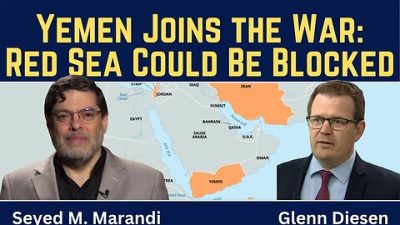
Yemen joins the war – Red Sea could be blocked next – Saudi regime at risk
or go to
Aletho News Archives – Video-Images
From the Archives
A superpower and “the world’s sickest warrior state”
By Paul J. Balles | March 8, 2010
Living through five or six major wars has hardened me to what I thought were the extremes of inhuman cruelty and brutality.
Two things made those extremes almost bearable: the brutality always revealed – at least according to the media coverage – the viciousness of the enemy. It was therefore quite understandable when our “brave men and women” pulverized the enemy.
Films of Japanese torturing captive Americans somehow justified holding Japanese Americans in internment camps during World War II; and only a small percentage of Americans found the bombing of Hiroshima and Nagasaki unreasonably vengeful at best, at worst, depraved.
The media giants in America portrayed the North Koreans as barbaric beasts with their captives, quite unlike their southern counterpoints – our allies during the Korean War. No one ever felt the need to explain how the South Koreans were a civilized breed while the North Koreans were absolute savages, at least according to the official line.
In Vietnam, our warriors justifiably (or so the media made us believe) dropped napalm on the North Vietnamese who had the gall to hide in villages and tunnels to ravage our invaders. At least it was accepted practice until some rogue photojournalist filmed a young girl screaming down a Vietnamese road in flames. … continue
Blog Roll
 Aletho News
- America Racing to Strategic Defeat in Iran: Lt Col Daniel Davis
- FTC Warns Visa, Mastercard, PayPal, Stripe Over Political Debanking
- Russian tanker approaches Cuba despite US oil blockade
- Marandi: Yemen joins the war – Red Sea could be blocked next – Saudi regime at risk
- Pro-Palestinian French member of European Parliament denied entry to Canada
- Pakistan to Host US-Iran Talks
- How Indonesia’s tilt toward the US left it stranded in the Strait of Hormuz
- US has no choice but to retreat from Iranian borders: Top commander
- Iran Retaliation Strikes Chemical Plant Near Dimona
- AWACS’ Destruction is a Major Loss for US Military – Ex-DoW Analyst
- If Americans Knew
- Israeli police block Catholic cardinal from entering Church of the Holy Sepulchre on Palm Sunday
- Israel is assassinating journalists again, more than any other nation, anywhere, ever – Not a ceasefire Day 170
- Over 300 US service members wounded, majority have brain injuries – Not a ceasefire Day 169
- Researchers at Human Rights Watch Resign Over Blocked Report on Palestinian Refugee Return
- Jewish Groups Are Backing a War Americans Don’t Want
- Eric Fingerhut Thinks He’s the President of the Jews
- Top Jewish Philanthropists, Rabbis Urge Israeli President to Take Action Against ‘Jewish Extremists’
- Don’t Be Fooled. Zionist Leaders Have Always Wanted to Control Southern Lebanon
- Israel’s widespread use of torture is a core element of its genocide against the Palestinian people
- In Israel’s War on Iran, Many Middle East US Bases Rendered “All But Uninhabitable”
- No Tricks Zone
- New Study Finds Warming Saves Lives…Cold Temperatures 12 Times More Deadly Than Excess Heat
- German Science Blog Accuses PIK Climate Institute Of Hallucinating Climate Tipping Points
- Devastating Assessment Of Comirnaty Vaccine By Former Senior Pfizer Europe Toxicologist
- New Study: CO2 Is ‘Effectively Negligible’ As An Explanatory Climate Change Factor Since 2000
- Former Pfizer Toxicologist Dr. Helmut Sterz Tells Bundestag Hearing Pfizer Vaccine Should Have Never Been Approved
- Energy Expert: Germany’s Nuclear Phaseout Was A “500 Billion Euro Mistake”
- New Research: South Australia’s Mid-Holocene Sea Surface Temperatures Were 4°C Warmer Than Today
- Storing Green Energy To Last Germany 10 Days Would Require A 60-Million Tonne Battery
- New Studies: UK Sea Levels Were 4 Meters Higher Than Today During The Mid-Holocene
- Destructive Green New Deal: German Energy And Metal Group Warns Of Drastic Crisis
 Aletho News