Israel’s balancing act in Ukraine is likely to backfire
By Ramzy Baroud | MEMO | March 24, 2022
Israel’s balancing act in the Russia-Ukraine war is likely to falter soon, simply because the resulting NATO-Russia conflict is expected to last for years, not weeks or months. Eventually, Israel would have to make a choice. Alas, whatever that choice may be, Israel will stand to lose.
From the first day of the war, Israel somehow became involved. Top Israeli officials, including the country’s Prime Minister Naftali Bennett, began calling their Ukrainian and Russian counterparts. Initially, some in the media surmised that Israel is concerned because of the large Jewish populations in both Ukraine and Russia.
However, the headlines quickly moved on, with terms such as ‘Israeli oligarchs‘, ‘Jewish oligarchs‘, and other combinations of Israel-friendly oligarchs dominating the news. Business interests quickly began replacing the supposed concern over the safety and welfare of ordinary Ukrainians.
The latter fact was demonstrated in a most tragic way when Israeli Channel 12 reported, on 10 March, that many Ukrainian refugees were “stuck at Ben Gurion Airport, facing cold and callous treatment”.
Israeli hypocrisy reared its ugly head once more on 26 February, when Israeli Minister of Aliyah and Integration, Pnina Tamano-Shata, said in a statement, “We call on the Jews of Ukraine to immigrate to Israel – your home.”
It is obvious that Israel does not care about the welfare of Ukrainians or, frankly, Ukrainian Jews either. After all, these newcomers to Israel would eventually be incorporated into the country’s illegal settlement enterprises. We know this from history and particularly from the history of the migration of Russian Jews to Israel, who arrived in their hundreds of thousands in the early 1990s. Not only do many of them now reside in illegal Jewish settlements, but to some extent, they also represent the backbone of some of Israel’s far-right political parties, the likes of Avigdor Lieberman‘s Yisrael Beiteinu.
Aside from the fact that a country moving its residents to an occupied territory is a stark violation of international law, it is also a violation of the rights of these vulnerable refugees, who will be expected to live in another war zone in the service of Israel’s Zionist ideology.
It is unfortunate, but typical that Israel finds opportunities to bolster its settler colonial model in occupied Palestine by exploiting the tragedies of other societies to its advantage. It has done so many times in the past: in Ethiopia, following the famine in 1984, in Russia, following the collapse of the Soviet Union, and in France, following the Paris terrorist attacks in 2015.
While France was still trying to fathom the enormity of its tragedy when 130 people were killed in broad daylight on 13 November, 2015, then Israeli Prime Minister Benjamin Netanyahu called on French Jews to move to Israel. “Of course, Jews deserve protection in every country, but we say to Jews, to our brothers and sisters: Israel is your home,” he said.
Shamelessly, Israel finds tragedies as political opportunities worth exploiting. While this quality is not unique to Israel – the Russia-Ukraine war has also exposed the opportunism of other countries around the world – Israel’s exploitation is doubly shameful as it hopes that war-torn Ukraine would help it sustain its own war waged against the Palestinian people.
However, serious cracks in the Israeli balancing acts are already on display. On 11 March, US Under-Secretary of State for Political Affairs, Victoria Nuland called on Israel to join sanctions against Russia. “We’re asking as many countries as we can to join us. We’re asking that of Israel as well,” she said.
Understandably, much of that pressure is coming from the Ukrainian government itself. Volodymyr Zelensky has repeatedly called on Israel to reciprocate for the Ukrainian support of Israel during its genocidal wars on the Palestinians. Indeed, Zelensky has taken every opportunity to express his solidarity with Israel in the past, even though Palestinians were the ones dying in their thousands.
“The sky of Israel is strewn with missiles. Some cities are on fire. There are victims. Many wounded. Many human tragedies,” the Ukrainian President tweeted on 12 May, 2021. Even during his inauguration speech in May 2019, Zelensky did not forget to bring Israel into his budding political discourse. “We must become Icelanders in soccer, Israelis in defending our land, Japanese in technology,” he said.
Still, aside from the occasional lip service, Israel insisted on remaining largely neutral. Analysts have explained the Israeli position in terms of Israel’s concern over Russia’s possible retaliation in Syria, for example, by allowing Iran greater geopolitical access to Syria that may compromise Israel’s ‘security.’ Others cited Israel’s deep financial interests, especially through the aforementioned oligarchs. Whatever the reasons may be, pressure is mounting on Israel to completely abandon its interests in Russia in favour of fully supporting Ukraine.
On 20 March, Zelensky upped the ante when he gave a speech at the Israeli Knesset. Not only did the Ukrainian President ask for Israel to provide Ukraine with an Iron Dome similar to the one that Tel Aviv uses to intercept Palestinian resistance rockets, he went much further, by infusing the Holocaust, an extremely sensitive discourse that only Israeli officials are allowed to use – and, indeed, manipulate – to silence any criticism of Israel internationally.
“The Nazis called this ‘the final solution to the Jewish question,'” Zelensky said. “And now, in Moscow, (…) they’re using those words, ‘the final solution’. But now, it’s directed against us and the Ukrainian question.”
For the Ukrainian President, although himself Jewish, to dare strike such a historical parallel to serve his country’s interests outraged many Israelis. “I admire the Ukraine president and support the Ukrainian people in heart and deed, but the terrible history of the Holocaust cannot be rewritten,” Israeli Communications Minister, Yoaz Hendel, tweeted. Many others joined in, in Israel and the US, attacking Zelenky’s supposed audacity.
Aside from its fear that injecting the Holocuast as part of Ukraine’s anti-Russian discourse could deprive Israel from its monopoly over the use and misuse of that historic tragedy, the Israeli official response to Zelensky also further exposed Israel’s stance on the war as defensive, suspicious and uncertain.
As the war rages on, Israel’s balancing act is becoming increasingly unsustainable. By allying fully with Ukraine, Israel could find itself at risk of losing Russia’s somewhat tolerant position pertaining to Israel’s ‘security’ in Syria and throughout the Middle East. Israel could also likely find itself at odds with Russia’s allies and semi-allies in China, India and other Asian countries. However, taking Russia’s side, a less likely scenario, means a break up of Israel’s historic alliance with its main benefactors in Washington and other European capitals.
As the world is likely to splinter among various power camps, Israel will find itself torn between its interests in the West, on the one hand, and the massive, emerging markets in the East, on the other. Though the West’s margin for tolerance when it comes to Israel by far exceeds its patience with other countries, it is only a matter of time before Israel will be expected to make a clean break from Russia and its economic, political and military interests that are tied to Moscow. When that happens, the geopolitical balance of power in the Middle East will likely shift against Israel, a scenario that would become even more difficult for Tel Aviv, if Iran manages to negotiate a return to the nuclear deal with the US and its western allies.
Though from the onset, Israel attempted to exploit the Russia-Ukraine war to its advantage, future scenarios are quite bleak for Tel Aviv.
Russian FM: We never betray friends, Iran very close to us
Press TV – March 20, 2022
Russian Foreign Minister Sergei Lavrov says his country, unlike the US, is not seeking “selfish interests” by the restoration of the 2015 Iran nuclear deal.
Lavrov made the remarks on Saturday when he was asked whether the revival of the Joint Comprehensive Plan of Action (JCPOA) was advantageous to Moscow, given that it could lead to the resumption of Iran’s oil supply to the global market.
“We never betray our friends in politics. Venezuela is our friend, and Iran is a state that is very close to us. Secondly, we do not pursue selfish interests, unlike the Americans,” he told reporters.
“You can see what they [the Americans] are actually doing, trying to spite Russia and teach it a lesson. Ah, well, let the regime in Caracas be. Let Iran be, let us reinstate the program as soon as we can just to punish Russians.”
Earlier this month, US President Joe Biden announced a ban on all Russian oil, gas and energy imports over the military operation in Ukraine.
The measure sent the already skyrocketing oil and gasoline prices ever higher, with reports saying that Washington is potentially looking at Iran and Venezuela for oil talks
Biden also tried to contact Persian Gulf Arab countries to seek help amid rising energy prices.
“So, the Americans have been contacting Saudi Arabia, the Emirates and Qatar regarding oil and gas. All of those countries, just like Venezuela and Iran, clearly said: when we discuss issues pertaining to the appearance of new actors in the oil market, all of us are committed to the OPEC+ format, where quotas for every actor are discussed and agreed upon by consensus,” Lavrov said.
“For now, I see no reason to believe that this mechanism may somehow be dismantled. No one is interested in that.”
Ireland says JCPOA revival can ease oil prices
In another development on Saturday, Irish foreign minister Simon Coveney said a revival of the JCPOA could help ease global oil prices by bringing a major producer back into the market.
“Certainly having a big new player in the market, if you like, Iranian crude oil coming back into the market with the removal of sanctions, would be a very attractive prospect in terms of reducing pressure on oil prices, because of sanctions on Russia, which are likely, I think, to remain for quite some time,” he said.
“I think that is an added incentive to try to get a deal done now.”
Earlier this month, the talks in Vienna, aimed at resurrecting the JCPOA, were paused for an undetermined period of time despite reports suggesting that they were in final stages.
Iranian officials have repeatedly said the United States should remove all illegal sanctions against the Islamic Republic in a verifiable manner and guarantee that a new US administration would not breach the JCPOA once again.
Former US president Donald Trump unilaterally left the JCPOA in May 2018 and re-imposed the anti-Iran sanctions that the deal had lifted. He also placed additional sanctions on Iran under other pretexts not related to the nuclear case as part of his “maximum pressure” campaign.
In May 2019, following a year of strategic patience, Iran decided to let go of some of the restrictions on its nuclear energy program, resorting to its legal rights under the JCPOA, which grants a party the right to suspend its contractual commitments in case of non-compliance by the other side.
The Biden administration says it is willing to compensate for Trump’s mistake and rejoin the deal, but it has retained the sanctions as leverage.
US to remove IRGC from terror blacklist
BY M. K. BHADRAKUMAR | INDIAN PUNCHLINE | MARCH 19, 2022
Axios reported earlier this week citing Israeli officials and US sources that the Biden administration is considering the removal of Iran’s Islamic Revolutionary Guard Corps [IRGC] from its terror blacklist, in return for a ‘public commitment from Tehran to de-escalation in the region.’
It is improbable that Tehran will give any such ‘public commitment’. But, a ‘private commitment’? Well, that may be possible. Indeed, the Axios report acknowledged that ‘The IRGC designation is not directly related to the nuclear deal, and any decision would take the form of a separate bilateral understanding between the US and Iran.’
No doubt, the lifting of the US sanctions is incompatible with the ban on the IRGC. The IRGC is deeply incorporated into the country’s economy and business. According to some estimates, up to 60% of Iran’s economy — including both state and private companies — is controlled by individuals and entities linked to the IRGC.
And the IRGC is well represented in the organs of the state. Executing a nuclear deal at Vienna while excluding the IRGC elites from plucking its low-hanging fruits is simply unrealistic. Arguably, even Americans wouldn’t want that to happen.
It is entirely conceivable that they too are eagerly looking forward to doing business with the IRGC top brass. After all, it’s best to do business with those who matter most in Tehran.
On balance, therefore, the Biden administration will concede Iran’s demand to drop the designation of the IRGC as a terrorist organisation. The crux of the matter is that the US is desperate to normalise with Iran since they also see potential to erode Iran’s friendly ties with Russia. The immediate goal of the Biden administration is to release Iran’s oil reserves. The amount of Iranian oil that may enter the market once sanctions are lifted is estimated at over two million barrels a day!
That said, even a US-Iran ‘bilateral understanding’ over the activities of the IRGC is not easy to achieve. The IRGC functions directly under the Supreme Leader’s supervision. Clearly, while from the American side, it is rather a formality requiring an executive order by the state department to legitimise IRGC, from the Iranian part, there is an ‘operational angle’ to it — namely, a commitment to end Iran’s expansion in the so-called Shiite Crescent of Syria, Lebanon and Iraq.
That involves the jettisoning of Quds Force’s ‘resistance’ and settling for peaceful co-existence with Israel. Does that look simple?
But then, when it comes to Iran, nothing is simple, because nothing is iron-cast. Didn’t Iran help in the US invasion of Afghanistan and the creation of a puppet government in Kabul? Resistance politics too was the child of difficult times when the country was besieged. With the lifting of sanctions, Iran is unbound for the first time after the 1979 revolution.
To be sure, there is a growing uneasiness among regional states — and, possibly, even in Moscow — about Iran’s future trajectory. The Raisi government now proclaims a ‘balanced foreign policy’ — ‘neither with the West nor the East.’ The framing of the paradigm in this suggests that Tehran anticipates the world community to queue up on the road to Tehran.
Iran’s few steadfast friends in the region may begin to wonder what lies in the womb of time. Syrian President Assad’s visit to the UAE on Friday hints at realignments. Assad hopes to create more space for himself by rejoining the Arab family. Now, he has never been an acolyte of ‘resistance’ and is well aware that the UAE is Israel’s closest regional ally in West Asia.
The bottom line is that Iran will certainly seek integration with the industrial world, which will help it get the best that money can buy in technology or goods and services. But Iran also harbours ambitions that it will not be a junior partner of the West.
This is going to be a trapeze act. Integration into the world economy will require the freeing of market forces, which, in turn, carries attendant risks, as the pent-up social and economic discontent within the country seeks political expression and the genie gets out of the bottle. Colour revolution can take many forms, as current history shows. When George Soros and company move in, nothing is impossible!
Iran, of course, will be in doubts about the US’ intentions, too. Presently, Washington needs an accommodation with Iran devolving upon its capacity to pump more oil. But the US’ male-fide intentions are yet to be exorcised. And the crimes it has committed to the Iranian nation are no secret, either.
Above all, there is never any consistency in the US policies. Its self-interests come first and last. Iran doesn’t have to look far to see in the next-door Gulf region the debris of the US’ discarded Arab alliances once their purpose was served.
Zelensky and the Zionist Plot To Provoke Russia
NAUMAN SADIQ | BLACKLISTED NEWS | MARCH 15, 2022
Ukrainian President Volodymyr Zelensky took to Twitter [1] Sunday to express heartfelt gratitude to Facebook owner Mark Zuckerberg for taking a clear stand on the Ukraine crisis and letting users violate rules against hate speech: “War is not only a military opposition on UA land. It is also a fierce battle in the informational space. I want to thank @Meta and other platforms that have an active position that help and stand side by side with the Ukrainians.”
“As a result of the Russian invasion of Ukraine we have temporarily made allowances for forms of political expression that would normally violate our rules like violent speech such as ‘death to the Russian invaders.’ We still won’t allow credible calls for violence against Russian civilians,” a Meta spokesperson said in a statement [2] March 11.
It naturally piques the curiosity why the social media behemoth is bending over backwards to violate its own longstanding regulations against hate speech to let Zelensky win the propaganda war in “the informational space” unless one takes into account the obvious fact that both Zuckerberg and Zelensky are Zionist Jews and take orders from Israel’s clandestine security agencies.
Born to Oleksandr Zelensky and Rymma Zelenska, both Russian-speaking Jews, in Jan. 1978, Volodymyr Zelensky was groomed by covert Mossad operatives in Ukraine since his student life while he was studying law at the Kryvyi Rih National University.
Instead of pursuing legal career, he chose acting as a profession at the behest of his influential patrons to gain nationwide publicity, particularly through the comedy television series “Servant of the People” in which Zelensky “prophetically played” the role of the Ukrainian president.
In fact, his production company Kvartal 95, which produces films, cartoons and television shows, was generously funded by deep pockets of Zionist billionaires. Comically exposing corruption and sleazy dealings of Ukraine’s politicians and oligarchs, the series “Servant of the People” aired from 2015 to 2019 and struck a chord with Ukrainian masses.
Riding on the wave of media publicity, Zelensky won a landslide presidential election in 2019. Later, his political party, which he “coincidentally” named “Servant of the People,” won an overwhelming victory in a snap legislative election held shortly after his inauguration as president.
In the 2001 census, a third of Ukraine’s over 40 million population registered Russian as their first language. In fact, Russian speakers constitute a majority in urban areas of industrialized eastern Ukraine and socio-culturally identify with Russia. Ukrainian speakers are mainly found in sparsely populated western Ukraine and in rural areas of east Ukraine.
Russian, Belarusian and Ukrainian together belong to the East Slavic family of languages and share a degree of mutual intelligibility. Thus, Russians, Byelorussians and Ukrainians are one nation and one country whose shared history and culture goes all the way back to the golden period of 10th century Kyivan Rus’.
What do Ukrainians have in common with NATO powers, their newfound patrons, besides the fact that humanitarian imperialists are attempting to douse fire by pouring gasoline on Ukraine’s proxy war by providing caches of lethal weapons to militant forces holding disenfranchised Ukrainian masses hostage.
Russians and Ukrainians share Byzantine heritage and their longstanding dispute with Zionist Jews goes back to the medieval era. Byzantine emperors regarded Jewish subjects as gentiles and were particularly wary of wealthy Jewish merchants maintaining a stranglehold over banking and commerce sectors of the empire.
In addition, Russians and Ukrainians together belong to the Greek Orthodox Church, one of the oldest Christian denominations whose history goes all the way back to Christ and his apostles. Protestantism and Catholicism are products of the second millennium after a Roman bishop of the Byzantine Empire declared himself pope following the 1054 schism between the Orthodox and Catholic Churches.
Since 2019, after being elected president through questionable methods, Zelensky has surreptitiously been working on a clandestine project to foment a crisis with Russia on a flimsy pretext. Any other political leader with an iota of rational faculties, even somebody as rogue as his predecessor Petro Poroshenko, would promptly have agreed to the Kremlin’s reasonable proposal that Kyiv must give a solemn pledge it won’t join the transatlantic NATO military alliance.
Not only did he scornfully rebuff the Russian proposal but he also let Ukraine’s security forces stage joint military exercises and naval drills alongside NATO forces in the Black Sea right under Russia’s nose. His reckless disregard for the suffering of Ukrainian masses with whom he does not identify being a Zionist himself and suicidally provoking Russia into an armed confrontation aside, he is merely a pawn in the grand scheme of things.
Israel’s Zionist regime, to whom not only Ukrainian but also American presidents bow, has a score to settle with Russia. Donald Trump literally forced four Arab states, the UAE, Bahrain, Sudan and Morocco, to sign so-called Abraham Accords lending official recognition to Israel at the coaxing of his Jewish son-in-law Jared Kushner and in order to canvass Zionist lobbies for support in the run-up to Nov. 2020 presidential elections.
Washington’s principal objective in Syria’s proxy war was ensuring Israel’s regional security. The United States Defense Intelligence Agency’s declassified report [3] of 2012 clearly spelled out the imminent rise of a Salafist principality in northeastern Syria – in Raqqa and Deir al-Zor which were occupied by the Islamic State from 2014 to October 2017 – in the event of an outbreak of a civil war in Syria.
Under pressure from the Zionist lobbies in Washington, however, the Obama administration deliberately suppressed the report and also overlooked the view in general that a proxy war in Syria would give birth to radical Islamic jihadists.
The hawks in Washington were fully aware of the consequences of their actions in Syria, but they kept pursuing the ill-fated policy of nurturing militants in the training camps located in Syria’s border regions with Turkey and Jordan in order to weaken the anti-Zionist Bashar al-Assad government.
The single biggest threat to Israel’s regional security was posed by the Iranian resistance axis, comprising Iran, Syria and Lebanon-based Hezbollah. During the course of the 2006 Lebanon War, Hezbollah fired hundreds of rockets into northern Israel and Israel’s defense community realized for the first time the nature of threat that Hezbollah posed to Israel’s regional security.
Those were only unguided rockets but it was a wakeup call for Israel’s military strategists that what would happen if Iran passed the guided missile technology to Hezbollah whose area of operations lies very close to the northern borders of Israel.
Therefore, the Zionist lobbies in Washington persuaded the Obama administration to orchestrate a proxy war against Damascus and Lebanon-based Hezbollah in order to dismantle the Iranian resistance axis against Israel.
But following the beginning of the Ukraine crisis in 2014 after Russia occupied the Crimean peninsula and Washington imposed sanctions on Russia, the Kremlin’s immediate response to the escalation by Washington was that it jumped into the fray in Syria in September 2015, after a clandestine visit to Moscow by General Qassem Soleimani, the slain commander of the IRGC’s Quds Force who was assassinated in an American airstrike on a tip-off from the Israeli intelligence at the Baghdad airport on January 3, 2020.
When Russia deployed its forces and military hardware to Syria in September 2015, the militant proxies of Washington, the Zionist regime and their regional clients were on the verge of driving a wedge between Damascus and the Alawite heartland of coastal Latakia, which could have led to the imminent downfall of the Bashar al-Assad government.
With the help of Russia’s air power and long-range artillery, the Syrian government has since reclaimed most of Syria’s territory from the insurgents, excluding Idlib in the northwest occupied by Turkish-backed militants and Deir al-Zor and the Kurdish-held areas in the east, thus inflicting a humiliating defeat on Washington, the Zionist regime and their regional allies, Turkey, Jordan and the Gulf States.
Over the years, Israel has not only provided material support to militant groups battling Damascus – particularly to various factions of the Free Syria Army (FSA) and al-Qaeda’s Syrian affiliate al-Nusra Front in Daraa and Quneitra bordering the Israel-occupied Golan Heights – but Israel’s air force has virtually played the role of the air force of the terrorists and mounted hundreds of airstrikes in Syria during the decade-long conflict.
In an interview to the New York Times [4] in January 2019, Israel’s former Chief of Staff Lt. General Gadi Eisenkot confessed that the Netanyahu government approved his recommendations in January 2017 to step up airstrikes in Syria. Consequently, more than 200 Israeli airstrikes were launched on the Syrian targets in 2017 and 2018, as revealed [5] by Israeli Intelligence Minister Israel Katz in September 2018.
In 2018 alone, Israel’s air force dropped 2,000 bombs in Syria. The purported rationale of the Israeli airstrikes in Syria has been to degrade Iran’s guided missile technology provided to Damascus and Lebanon-based Hezbollah, which poses an existential threat to Israel’s regional security. However, after Russia provided S-300 air defense system to the Syrian military after a Russian surveillance aircraft was shot down by Syrian air defenses during an Israeli incursion into the Syrian airspace on September 2018, killing 15 Russians onboard, Israeli airstrikes in Syria have been significantly scaled down.
Following the friendly-fire incident, though Israel has mounted occasional airstrikes at the capital Damascus, in Daraa and Quneitra in southern Syria and Deir al-Zor in eastern Syria, Israeli airstrikes in northwest Syria, including Aleppo, Hamah and Homs, which is within the range of advanced missile defense systems deployed at Khmeimim Air Base near coastal Latakia, have almost entirely ceased.
Last month, the Kremlin issued an unequivocal condemnation [6] of recent Israeli airstrikes in Syria as “crude violation” of Syria’s sovereignty that up until now were reluctantly tolerated by the Russian forces based in Syria’s Tartus naval base and Khmeimim airbase southeast of Latakia, and also pledged that the Russian Air Force would conduct joint air patrols alongside the Syrian Air Force that would pre-empt the likelihood of further Israeli airstrikes.
“Israel’s continuing strikes against targets inside Syria cause deep concern,” Russian Foreign Ministry spokeswoman Maria Zakharova said. “They are a crude violation of Syria’s sovereignty and may trigger a sharp escalation of tensions. Also, such actions pose serious risks to international passenger flights.”
Although Israel claims its air campaign in Syria is meant to target Iran-backed militias, the airstrikes often kill Syrian soldiers. Syrian state media said one soldier was killed and five more were wounded in one of the latest Israeli attacks at Damascus, which occurred on Feb. 9.
Russia has held talks with Israel on Syria, and said last month it would begin joint air patrols with Syria. The patrols will include areas near the Golan Heights in southern Syria bordering Israel, a frequent site of the Israeli airstrikes, and Israel is said to be considering discontinuing the strikes altogether or slowing them down significantly.
The Times of Israel noted that this marked a momentous change in policy for Russia: “Following the patrol, Ynet reported that Israeli military officials were holding talks with Russian army officers to calm tensions.”
The report added, “Israeli officials were struggling to understand why Russia, which announced that such joint patrols were expected to be a regular occurrence moving forward, had apparently changed its policy toward Israel.” The report claimed that Israel might limit its air campaign in Syria as a result of Russia’s inexplicable policy reversal in Syria.
In conclusion, it favored Israel’s strategic objectives to escalate the conflict in Ukraine in order to divert Russia’s attention and military resources to Eastern Europe, as the Zionist regime would then get a free hand to mount airstrikes in Syria and Lebanon with impunity, and might even attempt to rekindle the decade-long proxy war alongside its Gulf Arab, Turkish and Jordanian allies in order to eliminate the security threat posed by the Iran-led resistance axis comprising Syria and Lebanon-based Hezbollah once and for all.
Citations:
[1] Zelensky tweet thanking Facebook for allowing hate speech:
[2] Facebook allows posts urging violence against Russian invaders:
[3] US Defense Intelligence Agency’s declassified report of 2012:
[4] An interview with Lt. Gen. Gadi Eisenkot, Israel’s chief of staff:
[5] Israel Katz: Israel conducted 200 airstrikes in Syria in 2017 and 2018:
[6] Russia cites ‘deep concern’ over ongoing Israeli strikes in Syria:
Nauman Sadiq is an Islamabad-based geopolitical and national security analyst focused on geo-strategic affairs and hybrid warfare in the Af-Pak and Middle East regions. His domains of expertise include neocolonialism, military-industrial complex and petro-imperialism. He is a regular contributor of diligently researched investigative reports to alternative news media.
IRGC warns Israel after missile strike on Mossad bases in Erbil
Press TV – March 13, 2022
Iran’s Islamic Revolution Guards Corps (IRGC) has issued a stern warning to Israel following a retaliatory missile strike on the “strategic center of Zionist conspiracy and evil” in the northern Iraqi Kurdistan city of Erbil.
In a statement issued Sunday, the IRGC indicated that the operation was in response to an Israeli airstrike on the Syrian capital of Damascus last Monday, in which two IRGC officers were killed.
“Following the recent crimes of the fake Zionist regime and the previous announcement that the crimes and evils of this infamous regime will not go unanswered, the strategic center for conspiracy and evil of the Zionists was targeted by powerful and pinpoint missiles of the Islamic Revolution Guards Corps,” it said.
A dozen ballistic missiles hit secret Mossad bases in Erbil, reportedly leaving several Israeli operatives dead.
Citing security sources, Iraq’s Sabereen News reported that two Mossad training centers were targeted by ballistic missiles in the early hours of Sunday.
Al-Mayadeen said a Mossad base on the Masif-Saladin street in Erbil was “fully razed to the ground and a number of Israeli mercenaries were killed or injured”.
Last week, IRGC identified the two slain officers as colonels Ehsan Karbalaipour and Morteza Saeidnejad, warning that Israel would “pay for this crime”.
On Thursday, Iran’s permanent mission to the United Nations had written to the UN secretary general and the Security Council, saying Tehran “reserves its inherent right to self-defense, under Article 51 of the United Nations Charter, to respond to such criminal act whenever it deems appropriate”.
Iran “recognizes that the Israeli regime is fully responsible for all the consequences of these criminal acts, and seriously warns the regime about taking further adventuristic and malevolent measures,” it said.
The Sunday statement by the IRGC said, “Once again, we warn the criminal Zionist regime that the repetition of any evil will face harsh, decisive and destructive responses.”
“We also assure the great nation of Iran that the security and peace of the Islamic homeland is the red line of the armed forces of the Islamic Republic of Iran and they will not allow anyone to threaten or attack it.”
Iraq, Russia, Syria and Iran discuss counter-terrorism
MEMO | February 25, 2022
Iraqi National Security Adviser, Qassem Al-Araji, yesterday met the ambassadors of Russia, Syria and Iran as part of the Quartet Centre for Information Exchange in Iraq’s capital city, Baghdad, to discuss counter-terrorism.
Local media reported that the meeting had discussed recent developments along the Iraqi-Syrian border, as well as the latest security developments in the region.
Al-Araji said that cooperation and joint action with the three countries had led to “strong and deterrent blows to terrorism and its leaders,” adding that the Centre was playing a “role in informing and resolving many issues.”
He pointed out that his country would not allow the presence of terrorist groups along its borders, stressing that Baghdad would only deal with “legitimate, sovereign states and governments.”
He reiterated that the Centre was strengthening the “close relationship between the countries that participated in this Centre in difficult and sensitive circumstances, and Iraq will respect those who stood by it during the difficult days.”
“There is a concern that there is a plan for the return of terrorists and their spread in the region, which could lead to instability,” he said.
New textbook to be published without ‘undue influence of pro-Israel groups’
MEMO | February 22, 2022
UK Publisher, Pearson, has given assurances that UK lobby groups supporting the State of Israel will no longer play a role in their editorial decision-making process in the soon to be released textbook covering the Middle East.
Pearson, a major international education company, which oversees national exams for 14- to 16-year-olds in the UK, came under the spotlight over two of its GCSE school textbooks, after revelations last year that they had been significantly altered following pressure from pro-Israel groups. GCSEs are the academic qualifications studied for by UK high school students to the age of 16.
Details of the extensive “biased” and “misleading” alterations were exposed by a report, by Professors John Chalcraft and James Dickins, Middle East specialists in History and in Arabic, respectively, and members of the British Committee for the Universities of Palestine (BRICUP).
Their eight-page report uncovered “dangerously misleading” changes to the books published by Pearson, titled “Conflict in the Middle East” and “The Middle East: Conflict, Crisis and Change”, both by author Hilary Brash, which are read by hundreds of thousands of GCSE students annually.
The alterations were made following intervention by the Board of Deputies of British Jews (BoD), working together with UK Lawyers for Israel (UKLFI). Both are amongst the most vocal pro-Israeli groups in the UK.
Pearson finally withdrew the textbooks in June. The publisher confirmed earlier this month that it is partnering with specialist educational charity, Parallel Histories, to develop new educational materials on the topic.
Writing in the Times Higher Education recently, Chalcraft urged academics to keep an eye out for bias in school textbooks. Recounting what he called the “undue influence of pro-Israel groups on a history textbook”, Chalcraft stressed the value of engagement to avoid a similar interference in the future.
Commenting on the report Chalcraft co-authored with Dickins, he said that the modified textbook “read to [me] as though it had been reworked by lawyers acting as if for a client (Israel), rather than by historians acting to educate schoolchildren about a complex history”.
Equally problematic, warned Chalcraft, was the discovery “that the pro-Israeli lobby groups had been invited into the editorial process, and had collaborated with Pearson over many months”. He revealed that no pro-Palestinian groups had been invited to the table and that “something” had gone “dangerously wrong”.
Chalcraft said that he and Dickins had been reassured by Pearson that no lobby groups are involved in the production of new materials on the topic.
NATO is trying to create irresolvable confrontation with Russia – Lavrov
By Ailis Halligan | RT | February 21, 2022
The West is attempting to incite an unavoidable confrontation with Russia over Ukraine, Russian Foreign Minister Sergey Lavrov said on Monday.
Speaking to his Syrian counterpart, Faisal Mekdad, Lavrov lamented that Russia is unable to focus its efforts on its relationship with the Middle Eastern country, blaming Western attempts to fan the flames of conflict in Ukraine, allegedly with the goal of encouraging war between Russia and NATO.
“The situation in the world is developing rapidly. This also applies to northern Africa and the Middle East, including Syria,” Lavrov said. “Unfortunately, our efforts with you … are affected by the atmosphere that is now being escalated our Western colleagues.”
According to Lavrov, the “Western alliance” is trying to create an “almost insurmountable confrontation” with Russia.
According to the foreign minister, Moscow wants to focus its efforts on working towards a ceasefire and political settlement in Syria.
The Russian presence in the country, at the invitation of President Bashar Assad, has been ongoing since 2015, and is aimed at aiding Damascus’ fight against extremist Islamist terrorism.
The minister also stressed that NATO attempts to spoil Russia’s reputation due to its presence in Syria would be fruitless.
“We certainly will not allow such attempts to undermine our ability to achieve concrete results,” he noted, stressing that Russia would work to strengthen Syria’s “sovereignty, territorial integrity, and political independence.”
In response, Mekdad revealed Syria’s support and gratitude for Russia’s efforts and echoed Lavrov’s attack on NATO.
“The campaign of hypocrisy, lies, and deception waged by the West is the same as the campaign it launched against Syria,” Mekdad said.
Lavrov is due to meet with US Secretary of State Antony Blinken in Europe on Thursday to discuss options for diffusing rapidly growing tensions surrounding Ukraine. Many NATO members, including the US, have made allegations that Russia is preparing for an imminent invasion of its neighbor. The Kremlin has denied this.
US Mulls to bolster Mideast Operations with Israeli-made Vessels
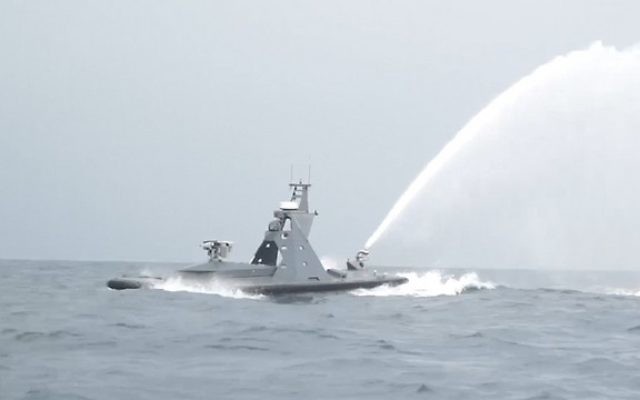
An unmanned Israeli navy vessel test fires missile off Ashkelon
Al-Manar | February 16, 2022
The US Navy is examining the possibility of bolstering its joint operations in the Middle East with Israeli-made unmanned vessels, a US official told the Reuters news agency on Tuesday.
The report did not specify who would be operating the boats, but noted that additional Israeli military involvement in the Gulf region could anger Iran.
The unnamed official said the US military was examining a number of options, including using Israeli unmanned vessels during current Gulf exercises.
The Zionist entity is a participant in a massive US-led naval exercise focusing on unmanned naval systems and the use of artificial intelligence. The International Maritime Exercise, known by its acronym IMX, kicked off last month and is set to end on Thursday.
The Israeli navy has a fleet of unmanned ships that are used to complement its manned patrol boats around the occupied Palestinian coastal waters.
The Reuters report said the US was showing interest in Israeli-made surface drones that can be deployed in tandem with air and underwater UAVs.
“The Israelis are definitely vested in leveraging this technology,” the unnamed official said, adding that a US fleet commander had made a recent trip to Haifa to examine the surface drones.
The comments by the US official were made during a trip by Prime Minister Naftali Bennett to Bahrain, the first official visit by an Israeli premier to the Gulf kingdom, Israeli media reported.
Israel offers Arab state the opportunity to tackle Iran together
RT | February 15, 2022
Since Israel and Bahrain both view Iran as a threat, they could team up and counter Tehran together, Israeli prime minister Naftali Bennett said on his landmark visit to the Gulf monarchy.
“We will fight Iran and its followers in the region night and day. We will aid our friends in strengthening peace, security, and stability, whenever we are asked to do so,” Bennett pledged in an interview with the Bahraini state-linked Al-Ayyam outlet on Tuesday.
The PM blamed Tehran of striving to “destroy moderate states” in the Gulf region in order to replace them with “bloodthirsty terrorist groups.”
When asked about the possibility of creating an alliance to resist Iranian influence, which could include Israel, Bahrain, and some other Arab nations, he gave a positive response: “We all understand that we face the same challenges, so why not work together to tackle them?”
Bennet, who became the first Israeli prime minister ever to visit Bahrain, assured the journalists that “Israel is a strong and reliable country.”
The idea of such a block was first floated by Israeli general Tal Kelman last year. According to Kelman, who heads the IDF’s Strategy and Third Circle Directorate, “the moderate axis” of Israel, Bahrain, the UAE, Jordan, Egypt and others should resist “the radical axis” of Iran and what he called its “proxies” in Lebanon, Syria, Yemen, and Iraq.
Israel and Bahrain normalized relations in late 2020 as part of the so-called Abraham Accords, a US-backed drive to improve ties between the Jewish state and some Arab countries after decades of strife.
Bahrain is a small island nation of around 1.5 million. The majority of its population is Shia Muslims, but the country is being run by a Sunni monarchy. The rulers in Manama have been concerned by Tehran’s activities as Iran, which is located less than 800 kilometers (497 miles) away, often faces accusations from its rivals of supporting Shia groups in other countries.
Threat of War between Syria and Israel is getting More Real
By Vladimir Platov – New Eastern Outlook – 14.02.2022
On February 9, Israel launched yet another series of strikes on targets near Damascus, which resulted in one Syrian killed and five injured, which has aggravated the threat of war between Syria and Israel.
According to the Syrian Arab News Agency (SANA), on February 9, four Israeli F-16s, without crossing the state border of Syria, launched another guided missile attack on facilities near Al-Kiswah, a village south of Damascus. One of the anti-aircraft missiles of the Syrian army exploded over the occupied Golan Heights, after which the IDF fired from the area occupied by Israeli troops in the Syrian Golan Heights ten surface-to-surface missiles at the positions of the Syrian air defense forces. Some missiles were brought down by Syrian air defenses. Nevertheless, the attack still caused significant damage to some buildings in the city of Qudsaya, destroying dozens of houses and cars. To repel the attack, Syrian troops utilized Russian-made air defense systems, which shot down eight missiles.
According to an IDF statement, in response to an intercepted missile fired from Syria into northern Israel, Israel attacked targets in Syria, including the “Syrian radar and anti-aircraft batteries that launched missiles at Israeli Air Force aircraft.” However, it is obvious that the missile chosen by the IDF as the reason for retaliation was the anti-aircraft missile that exploded in the air and was launched by Syrian air defenses as a measure of protection against earlier Israeli missile attacks launched from Lebanon.
In the message the Syrian Foreign Ministry sent to the UN Security Council regarding the aforementioned act of aggression by Tel Aviv, the Syrian government denounces the dangerous consequences the Israeli attacks on the SAR territory may have for stability in the Middle East and the entire world. “Syria reserves the right to use all legal means to respond to the treacherous strikes carried out by Israel on the outskirts of Damascus from Lebanese airspace and from the occupied Golan Heights,” the document says. The Syrian Foreign Ministry drew attention to the fact that “the United States, which patronizes Israel, encourages it to continue attacks and paralyzes possible measures by the UN Security Council to deter the aggressor, which undermines the prestige of the international community.”
Initially, Israel planned to launch two strikes simultaneously on February 9 – one on the outskirts of Damascus, and the other on Latakia. However, after encountering two Su-35s scrambled in response, the IAF fighters flew back without attacking the Syrian port. At the same time, almost all of the missiles allegedly aimed at Iranian facilities in the Rif Dimashq Governorate were shot down by Russian-made Syrian air defense systems. The attack was carried out from Lebanese airspace, which is another gross violation of international law.
Israeli Air Force regularly strikes targets in Syria without entering the airspace of the Arab Republic, and mainly operates from the airspace of Lebanon – in violation of international norms, or from the Mediterranean Sea. Since 2013, the IDF has been carrying out hundreds of airstrikes on the territory of a neighboring country primarily targeting pro-Iranian forces in the SAR. This year, there have already been two such attacks by Israel. The first one was took place on January 31 at targets near Damascus, namely Hezbollah facilities and warehouses in the vicinity of Al-Qutayfah. In 2021, there were 55 attacks:
– 3 missile strikes in December (on December 7, 16 and 28, mainly in the area of the port of Latakia, one Syrian soldier was killed, and significant damage was caused). It is noteworthy that on December 28, not for the first time, two F-16s of the Israeli Air Force launched four guided missiles at facilities on the territory of the port of Latakia without crossing the Syrian border (from the Mediterranean Sea). The Syrian air defense forces did not engage in a battle to repel the IAF raid on the port of Latakia, since a landing Russian Air Force transport plane could be in the affected area;
– 4 missile strikes in November (on November 3, 8, 17 and 28, mainly on targets near the city of Homs, which resulted in four people killed, including two civilians, several people wounded and significant material damage);
– 4 missile strikes in October (on October 8, 13, 25 and 30, strikes were carried out on the outskirts of Damascus, the outskirts of al-Ba’ath and the village of Al-Krum in the Quneitra Governorate in southern Syria, and the city of Abu Kamal, as a result of which more than ten Hezbollah militants and a Syrian soldier were killed, and significant damage was caused);
– 3 missile strikes in September (on September 3, 14 and 27, South from the village of Mayadin in the Deir ez-Zor Governorate in Eastern Syria, near the Iraqi border, with many people being wounded);
– 2 missile strikes in August (on August 17 and 19); 3 missile attacks from May to July (on May 5, June 8 and July 19); 9 missile strikes from January to April, with dozens of people dead and wounded;
– 39 missile attacks and air raids were carried out in 2020.
Israel explains its attacks with the desire to prevent modern weapons from falling into the hands of it enemies. Enemy No. 1 in this regard is the Lebanese Hezbollah movement, which is fighting on the side of Syrian President Bashar al-Assad and is controlled by Tehran. After the first Israeli airstrikes, Moscow invited all interested parties to meet and talk about disentangling their interests in order to avoid armed conflicts and civilian casualties. However, these calls of Russia have not been heeded.
Israel, despite repeated statements by official Syrian authorities to the UN, continues regular airstrikes on Syrian civilian targets, using, among other things, provocative air attacks by its fighters “under the cover” of civilian aircraft. Thus, in addition to the attack of December 28, on the night of October 13, 2021, four IAF F-16s once again entered the Syrian airspace in the area of the US-occupied Al-Tanf zone in the Homs Governorate and, under the cover of civilian aircraft flying at the same time, carried out an airstrike on a phosphate ore processing plant in the Palmyra area. It is noteworthy that this is not the first time such air attacks have been carried out from the area of the US-occupied zone in the Homs Governorate, which clearly indicates the coordinated actions of the IAF with the US military.
Such provocative tactics of the Israeli Air Force can lead to a serious aggravation of the situation, and it will by the IAF’s fault if the Syrian air defenses in their anti-missile actions shoot down a civilian aircraft of any country, under whose cover Tel Aviv carries out its airstrikes. And such an incident has already occurred in 2018 when Israeli planes bombed Syria from the air zone where the Russian reconnaissance plane was located, and the Syrian air defense shot down this plane by mistake. Russian service members were killed and a big scandal broke out, which was extinguished, and an armed conflict with Israel prevented, only thanks to complex diplomatic efforts.
The Syrian leadership has repeatedly demanded that the UN Security Council put pressure on Israel to stop attacks on the territory of the republic, since such actions violate its sovereignty and lead to increasing tensions in the region. The Syrian Foreign Ministry has previously repeatedly stated that the republic can use “all legal means” to respond to Israeli airstrikes on the Syrian territory. Therefore, by continuing such provocative attacks, Israel is openly tempting its fate, which could turn into a serious armed conflict at any time.
Featured Video
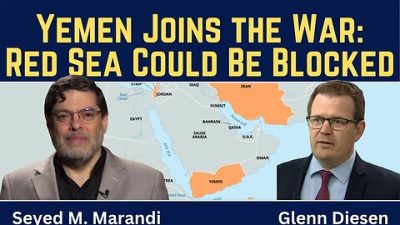
Yemen joins the war – Red Sea could be blocked next – Saudi regime at risk
or go to
Aletho News Archives – Video-Images
From the Archives
Should Europeans ‘Thank’ the Americans for Destroying Nord Stream?
By Robert Bridge | Strategic Culture Foundation | September 29, 2022
With an investigation continuing into the destruction of the Nord Stream gas pipeline that provided energy supplies to Europe from Russia, there appears to be just one prime suspect, and that should surprise nobody.
Following the sabotage of the Nord Stream 1 and 2 gas pipelines, former Polish Foreign Minister Radoslaw Sikorski already seemed to know the identity of the perpetrator when he tweeted out: “Thank you, USA.”
At first glance, it seemed that Sikorski was speaking sarcastically, berating Washington for carrying out an attack that will have severe repercussions for the people of Europe. After all, how could anyone see any good coming from the termination of Europe’s primary source of gas reserves with winter just around the corner? It was Sikorski’s homeland of Poland, after all, that urged its citizens to collect firewood in the face of dwindling gas reserves.
In fact, the Polish diplomat was speaking one-hundred percent literally… continue
Blog Roll
 Aletho News
- America Racing to Strategic Defeat in Iran: Lt Col Daniel Davis
- FTC Warns Visa, Mastercard, PayPal, Stripe Over Political Debanking
- Russian tanker approaches Cuba despite US oil blockade
- Marandi: Yemen joins the war – Red Sea could be blocked next – Saudi regime at risk
- Pro-Palestinian French member of European Parliament denied entry to Canada
- Pakistan to Host US-Iran Talks
- How Indonesia’s tilt toward the US left it stranded in the Strait of Hormuz
- US has no choice but to retreat from Iranian borders: Top commander
- Iran Retaliation Strikes Chemical Plant Near Dimona
- AWACS’ Destruction is a Major Loss for US Military – Ex-DoW Analyst
- If Americans Knew
- Israeli police block Catholic cardinal from entering Church of the Holy Sepulchre on Palm Sunday
- Israel is assassinating journalists again, more than any other nation, anywhere, ever – Not a ceasefire Day 170
- Over 300 US service members wounded, majority have brain injuries – Not a ceasefire Day 169
- Researchers at Human Rights Watch Resign Over Blocked Report on Palestinian Refugee Return
- Jewish Groups Are Backing a War Americans Don’t Want
- Eric Fingerhut Thinks He’s the President of the Jews
- Top Jewish Philanthropists, Rabbis Urge Israeli President to Take Action Against ‘Jewish Extremists’
- Don’t Be Fooled. Zionist Leaders Have Always Wanted to Control Southern Lebanon
- Israel’s widespread use of torture is a core element of its genocide against the Palestinian people
- In Israel’s War on Iran, Many Middle East US Bases Rendered “All But Uninhabitable”
- No Tricks Zone
- New Study Finds Warming Saves Lives…Cold Temperatures 12 Times More Deadly Than Excess Heat
- German Science Blog Accuses PIK Climate Institute Of Hallucinating Climate Tipping Points
- Devastating Assessment Of Comirnaty Vaccine By Former Senior Pfizer Europe Toxicologist
- New Study: CO2 Is ‘Effectively Negligible’ As An Explanatory Climate Change Factor Since 2000
- Former Pfizer Toxicologist Dr. Helmut Sterz Tells Bundestag Hearing Pfizer Vaccine Should Have Never Been Approved
- Energy Expert: Germany’s Nuclear Phaseout Was A “500 Billion Euro Mistake”
- New Research: South Australia’s Mid-Holocene Sea Surface Temperatures Were 4°C Warmer Than Today
- Storing Green Energy To Last Germany 10 Days Would Require A 60-Million Tonne Battery
- New Studies: UK Sea Levels Were 4 Meters Higher Than Today During The Mid-Holocene
- Destructive Green New Deal: German Energy And Metal Group Warns Of Drastic Crisis
 Aletho News