Iran ready to play leading role in Syria reconstruction/ Shalamcheh-Basra-Latakia railway; The most important economic joint project
Mideast Discourse | November 6, 2020
Steven Sahiounie, a Syrian-American journalist, believes that while Western and European sanctions prevent the import of replacement parts needed by Syria in infrastructure projects, the ability of Iranian industrial engineers to build what is needed could be a vital path around and behind Western sanctions.
Sahiounie tells the Bazaar in an exclusive interview that the prospects for continuing bilateral relations between Iran and Syria are good.
“They both share the same dedication to peaceful relations with countries in the Middle East region while holding firmly to the ideal of resistance to the occupation of Palestine, and demanding that the rights of the Palestinian people be restored without delay”, he said.
Steven Sahiounie is an award-winning journalist, and chief editor of MidEastDiscourse. He has appeared on RT, PressTV, Syrian News, as well as international TV and radio programs. As a Syrian-American journalist and political commentator, he is often sought out concerning currents events facing Syria and the region.
Following is the text of the interview:
Bazaar: How do you predict the prospects for bilateral relations between Iran and Syria?
Sahiounie: The prospects for continuing bilateral relations between Iran and Syria are good. They both share the same dedication to peaceful relations with countries in the Middle East region while holding firmly to the ideal of resistance to the occupation of Palestine, and demanding that the rights of the Palestinian people be restored without delay.
Bazaar: What are the current economic relations and volume of trade between Iran and Syria?
Sahiounie: The trade officials of both Syria and Iran have worked toward establishing industrial and economic free trade zones jointly, with an emphasis on the private sector.
Iran and Syria are slated to boost bilateral trade volume from $500 million to $1 billion within the next year.
Bazaar: What is the major part of Syrian exports?
Sahiounie: The top exports of Syria are Pure Olive Oil, Spice Seeds, Other Nuts, Apples, Pears, and Calcium Phosphates.
Syria shipped an estimated $462 million worth of goods around the globe in 2019. That amount reflects a -46% decrease since 2015 and a -36.2% drop from 2018 to 2019.
The US-NATO attack on Syria beginning in 2011 has devastated lives, the infrastructure, and the economy. The continuing sanctions by the US and EU are designed to keep the war against the Syrian people going, even though the battlefields are silent, except for Idlib, which is under the military occupation of Al Qaeda.
The data from 2010 shows that 81.1% of products exported from Syria were bought by importers in Iraq, Italy, Germany, Turkey, Saudi Arabia, France, Lebanon, Jordan, United States, Netherlands, Egypt, and Spain. Due to the US-EU sanctions against Syria and the Arab monarchies of the Persian Gulf region boycotts, the markets for Syrian goods were closed due to political ideology. Iraq, Lebanon, and Jordan have maintained some trade with Syria in defiance of the western bullies.
The Syrian government is working with a comprehensive plan for agricultural development and expansion of agricultural and food industries to enhance the Syrian economy in the face of the sanctions and the unfair siege on the livelihood of the Syrian people.
Bazaar: What is the most important economic project of the two countries at this present?
Sahiounie: The project to build a railroad connecting Iran’s Shalamcheh border crossing, to the Iraqi port of Basra, and finally to reach Syria’s Mediterranean port city of Latakia is the most important economic project between Syria and Iran.
The project has been on the drawing board for years and is now in the beginning stages. The mammoth railroad line will be linked to the New Silk Road, also known as China’s Belt and Road Initiative, which in turn is also linked to the Russian railroad system. Once completed, western sanctions on Syria and Iran will be thwarted.
Bazaar: What is the most important tool to protect the continuation of bilateral economic relations?
Sahiounie: The most important tool for Iran and Syria to use to protect their continuing bilateral economic relations is in supporting the two countries’ private sectors, both in trade and industry, for the benefit of investment opportunities in the free zones. The bartering system of exchanging goods and services without the use of currency is another tool that can be effective.
Bazaar: The trade between the two countries is set to reach $ 1 billion by next year. What are the plans for expanding bilateral trade? What ?is your opinion?
Sahiounie: Plans to expand bilateral trade include mechanisms to enhance commercial exchange and develop cooperation in the field of research laboratories and medical equipment and infrastructure projects, development, and investment.
The agreement is known as “long-term strategic economic cooperation”, which includes industrial, trade, and agricultural cooperation. Education, housing, public works, railroads, and investments are covered in other agreements.
An important banking agreement between Iran and Syria has been reached, which sends a message to the international community about the depth of Syrian-Iranian cooperation and will benefit Iranian companies wishing to invest in Syria and participate in reconstruction.
Syria and Iran signed several agreements worth $142.5 million, involving Iranian companies involved in the restoration of more than 2,000 MegaWatts of power production capacity, and additional projects by the dozens in the oil and agricultural sectors.
Bazaar: What is your opinion about the impact of Caesar’s law and resulting US sanctions on Iran-Syria trade?
Sahiounie: The impact of Caesar’s sanctions is psychological. To instill fear into the minds of all Syrian people, as well as all countries which would conduct business with Syria.
Layer, after layer of sanctions, has been applied to Syria, to destroy the Syrian government, and installing a US puppet to be the ultimate ‘yes-man’ to Washington.
As Syria and the entire world grapple with the COVID-19 pandemic, the imposition of such inhumane sanctions has increased the suffering of the Syrian people. Instead of coming to the aid of people inside Syria with medical supplies to cope with the pandemic, the sanctions prevent medical companies abroad from doing business with merchants in Syria in the medical supplies industry, for fear of being tracked down and fined by the US Treasury Department.
Horror stories have been heard of companies in Europe who sent medicines and supplies to Syria, only to be tracked down in their own offices in Europe by US authorities enforcing the sanctions against anyone who would dare to throw a lifeline to anyone in Syria.
Bazaar: What is your assessment about Iran’s role in Syria`s reconstruction?
Sahiounie: Since 2017, Iranian companies have participated in rebuilding expos in Syria, and in 2019, the Syrian–Iranian Joint Chamber of Commerce held its first meeting. Iran is poised to play a leading role in the reconstruction of Syria. Projects include residential buildings, power stations, agriculture, telecommunications, oil, and mining.
In 2018, Iran signed a Memorandum of Understanding with Syria to construct 200,000 housing units near Damascus alongside other large projects. Iranian companies are participating in several major projects in Syria’s energy industry, including a gas-fired power plant project in Aleppo. Iran’s largest energy construction company, MAPNA Group, is engaged in the construction of the 540-MegaWatt combined-cycle power plant in Latakia.
Over 95 percent of the power plant equipment and much of the equipment in the Iranian electricity and water industry are domestically manufactured and can repair steam, natural gas, combined-cycle, incineration, and turbines of generators, as well as make strategic parts for power plants.
While the US-EU sanctions prevent Syria from importing much-needed replacement parts for infrastructure projects, the ability of the Iranian industrial engineers to manufacture what is needed can be a vital path around and behind the back of the western sanctions.
Sorry, Google and World Bank, but Middle Eastern Crops Keep Thriving
By H. Sterling Burnett | ClimateRealism | November 4, 2020
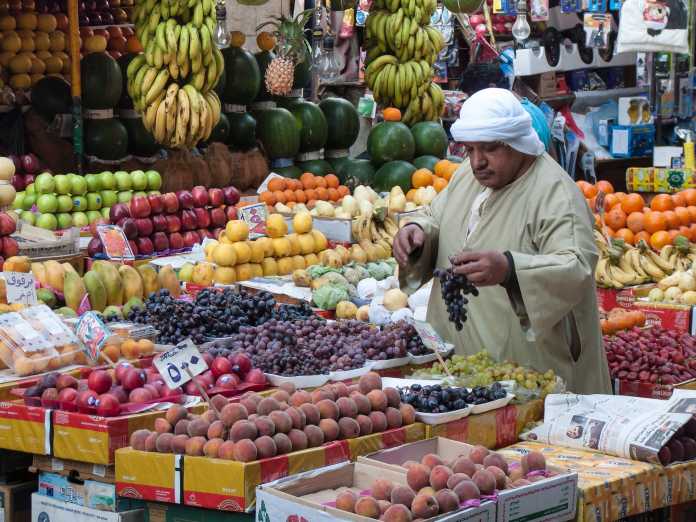
Google News today is promoting articles (see the Google-promoted PhysOrg article here, for example) about a speculative World Bank “study” claiming climate change is threatening crop production in the Middle East. The World Bank study is full of speculation but short on facts. Real-world data show crop yields per acre and total crop production are consistently and dramatically rising in each of the Middle East countries examined by the World Bank study.
In its study, titled “Water in the Balance,” the World Bank says, “[w]hile information about water scarcity at present and in the future is available there is little knowledge of what this increasing scarcity means for Middle Eastern … food security. Agriculture will suffer because of climate change and water scarcity….”
In particular the World Bank asserts water scarcity caused by climate change will reduce farm production in Iran, Iraq, Jordan, Lebanon, Syria, and Turkey. The available evidence strongly suggests that will not happen.
Had the study’s authors examined real-world data concerning crop production in the Middle Eastern countries, they would have found, even amidst substantial strife in the region, crop yields and overall production have increased dramatically. More food is being produced even as thousands of acres of agricultural lands have been abandoned during regional conflicts.
Data from the U.N. Food and Agriculture Organization show during the period of modest warming since 1989:
- Cereal crop production in Iraq increased 91 percent, even as the acreage being harvested fell 5 percent.
- Cereal crop production in Iran increased 187 percent, while the acreage harvested increased by just 2.6 percent.
- Cereal Crop production in Jordan increased 15 percent, even as the acreage harvested declined 30 percent.
- Cereal Crop production in Lebanon increased 115 percent, while acreage harvested increased 30 percent.
- Cereal Crop production in Syria increased 22 percent, even as acreage harvested declined 66 percent.
- Cereal Crop production in Turkey increased 46 percent, even though acreage harvested declined 19 percent.
It is clearly good news – and not a climate crisis – that Middle Eastern countries have increased crop production despite the fact that many of them have been embroiled in internal political strife, outright civil warfare, and external conflicts. That good news is ignored in the World Bank’s doom-and-gloom report.
Global warming lengthens growing seasons, reduces frost events, and makes more land suitable for crop production. Also, carbon dioxide is an aerial fertilizer for plant life. In addition, crops also use water more efficiently under conditions of higher carbon dioxide, losing less water to transpiration. The latter fact should have allayed the World Bank’s concern about climate change induced water shortages leading to crop failure.
The benefits of more atmospheric carbon dioxide and a modestly warming world have resulted in 17 percent more food being available per person today than there was 30 years ago, even as the number of people has grown by billions. Indeed, the last 20 years have seen the largest decline in hunger, malnutrition, and starvation in human history.
Sorry, World Bank, Google, and PhysOrg, but that does not equate to a climate crisis.
H. Sterling Burnett, Ph.D. is managing editor of Environment & Climate News and a research fellow for environment and energy policy at The Heartland Institute. Burnett worked at the National Center for Policy Analysis for 18 years, most recently as a senior fellow in charge of NCPA’s environmental policy program. He has held various positions in professional and public policy organizations, including serving as a member of the Environment and Natural Resources Task Force in the Texas Comptroller’s e-Texas commission.
Israel Wins U.S. Election
Congress and White House work together to reward the Jewish state
By Philip Giraldi • Unz Review • November 3, 2020
The U.S. election will end today, more or less, and we Americans will suffer another four years of putting up with serial nonsense out of a White House and Congress that could care less about us no matter who is elected. Whether the party where everything changes or the party where everything remains the same wins the inevitable result will be further aggrandizement of authoritarian power combined with increased distancing of government from the people who are ruled.
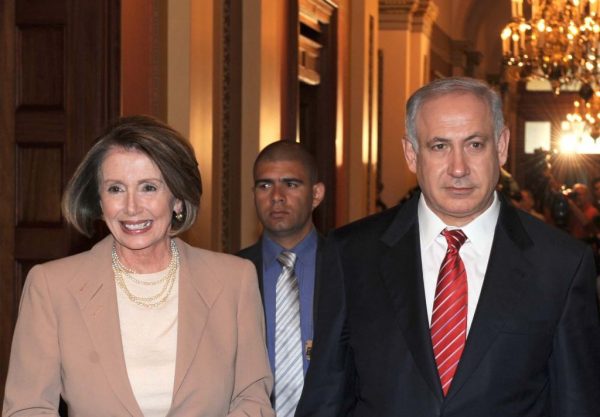
Amidst all the gloom, however, there is one great success story. That is the tale of how Israel and its friends in politics and financial circles have been able to screw every possible advantage out of both major parties simultaneously and apparently effortlessly. Israel might be the true undisputed winner in the 2020 election even though it was not on the ballot and was hardly mentioned at all during the campaign.
Jewish billionaires with close ties to Israel have been courted by the two major parties, both to come up with contributions and to urge their friends in the oligarch club and media to also respond favorably. The Democrats’ largest single donor is entertainment mogul Haim Saban while the Republicans rely on casino multi-billionaire Sheldon Adelson. It is estimated that 60% of the political contributions for the Democrats comes from Jewish sources and Saban is the single largest contributor. He is also an Israeli holding dual citizenship. Adelson, who may also hold dual citizenship and is married to an Israeli, is the major supporter of the Republicans, having coughed up more than $100 million in recent elections.
Both Saban and Adelson have not been shy about supporting Israel as their first priority. Saban is on record as supporting Joe Biden “because of his track record on supporting Israel and its alliance with the United States.” Adelson, who was drafted into the U.S. Army in the 1950s, has said that he would much rather have served in the Israel Defense Force. Saban and Adelson are joined in their love fest with Israel by a number of Israel-firsters in Congress and the Administration, all eager to shower unlimited political support, money and weapons on the Jewish state.
In the latest manifestation of noblesse oblige, Secretary of Defense Mark Esper stopped off in Israel last week to present his counterparts with a significant bit of assistance, all funded by the American taxpayer, of course. According to sources in Washington and Jerusalem, the U.S. “will grant Israel direct access to highly classified satellites such as the missile detection birds known as SBIRS and ensure Israel gets critical defense platforms in a very short time by using production slots planned for the U.S armed forces.” Israel will also be given “deeper access to the core avionic systems” of the new F-35 fighter that it has been obtaining from Washington.
The claimed rationale for the upgrade is the Congressionally mandated requirement for the U.S. to maintain Israel’s “qualitative military edge” in light of the impending sale of the F-35 to Arab states that have recently established diplomatic relations with Israel. At the time, Israeli sources were suggesting that the Jewish state might need $8 billion in new military hardware upgrades to maintain its advantage over its neighbors. It is presumed that the American taxpayer will foot the bill, even though there is a serious financial crisis going on in the U.S.
The satellite detection system operates from aerial platforms that are deployed on helicopters. The astute reader will notice that no U.S. security interest is involved in the latest giveaway to Israel. On the contrary, Israel will be receiving material from “production slots planned for the U.S. armed forces,” reducing America’s own ability to detect incoming missiles. And there will also be considerable damage to American defense interests in that Israel will inevitably steal the advanced F-35 technology that they will be given access to, re-engineer it for their own defense industries and sell it to clients in Asia, Africa, and Latin America. They have done so before, selling U.S. developed missile technology to China.
Congress is also doing its bit. A bill, the so-called “U.S.-Israel Common Defense Authorization Act,” is making its way through the House of Representatives and will authorize the provision of U.S. manufactured bunker buster bombs to Israel. As the bombs would only be useful in Israel’s neighborhood to bomb hardened sites in Iran, the message being sent is obvious. The Massive Ordnance Penetrator weighs 30,000 pounds and is capable of destroying targets located deep underground. Oddly, Israel doesn’t have a plane capable of carrying that weight so the presumption is that the White House will also have to provide the bomber. The bill is co-sponsored by two leading Israel firsters in Congress Democrat Josh Gottheimer of New Jersey and Republican Brian Mast of Florida.
Israel is also seeking an upgrade of some of its other fighter aircraft. It reportedly has approached the Pentagon seeking to buy the Lockheed Martin F-22 Raptor, a single-seat, twin-engine, all-weather stealth tactical fighter aircraft that was originally developed for the United States Air Force (USAF). Its stealth capability, top speed, maneuverability combined with advanced air-to-air and air-to-ground weapon systems, makes it the best air superiority fighter in the world.
Unfortunately for Israel, the F-22 is not currently available and is only operated by the USAF. Current U.S. federal law prohibits the export of the plane to anyone to protect its top secret advanced stealth technology as well as a number of advances in weaponry and situational awareness. But if deference to Israel’s wishes is anything to go by, one might safely bet that the Jewish state will have received approval to acquire the plane by inauguration day in January. And it is a safe bet that Israeli defense contractors will have reverse engineered the stealth and other features soon thereafter.
The U.S. government has been pandering to Israel in other ways, to include labeling, and sanctioning, prominent human rights groups that have criticized the Jewish state as anti-Semitic. It has also strengthened existing sanctions against Iranian financial institutions, reportedly in an attempt to make it more difficult for a President Biden to reinstate the suspended Joint Comprehensive Plan of Action (JCPOA) that sought to monitor the Iranian nuclear program. The sanctions come on top of other moves to destroy the Iranian economy, to include “… that the U.S., along with Israel, has in recent months carried out sabotage attacks inside Iran, destroying power plants, aluminum and chemical factories, a medical clinic and 7 ships at the port of Bushehr…”
Other recent developments favoring Israel include Congress’s legislating Israeli government veto authority over U.S. sales of weapons to any other Middle Eastern nation. The bill is called “Guaranteeing Israel’s QME [Qualitative Military Edge] Act of 2020” (H.R. 8494). There has also been the expansion by Executive Order of U.S. funded illegal West Bank Jewish settlements’ science development projects that will eventually compete with American companies.
In truth, the United States has become Israel’s bitch and there is hardly a politician or journalist who has the courage to say so. Congress and the media have been so corrupted by money emanating from the Israeli lobby that they cannot do enough to satisfy America’s rulers in Jerusalem. And for those who do not succumb to the money there is always intimidation, career-ending weaponized accusations of holocaust-denial and anti-Semitism. It is all designed to produce one result: whoever wins in American elections doesn’t matter as long as Israel gets what it wants. And it almost always gets what it wants.
Philip M. Giraldi, Ph.D., is Executive Director of the Council for the National Interest, a 501(c)3 tax deductible educational foundation (Federal ID Number #52-1739023) that seeks a more interests-based U.S. foreign policy in the Middle East. Website is https://councilforthenationalinterest.org, address is P.O. Box 2157, Purcellville VA 20134 and its email is inform@cnionline.org.
At Israel’s behest, Twitter blocks dozens of Palestinian accounts
Palestine Information Center – October 31, 2020
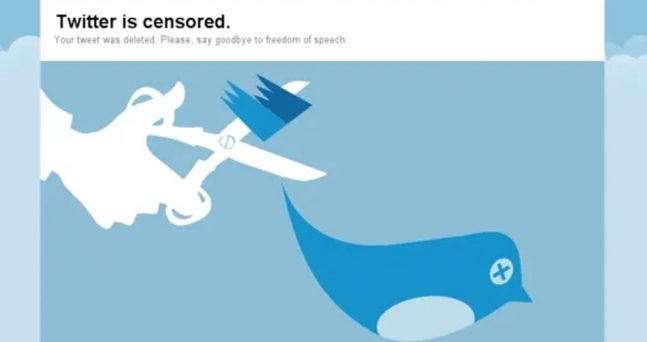
OCCUPIED JERUSALEM – Palestinian media NGOs have accused Twitter of suspending dozens of Palestinian accounts that actively posted tweets against normalization of Arab relations with Israel.
Sada Social Center, a Palestinian group defending rights of social media users, said it had noticed during the past few days that Twitter blocked dozens of accounts belonging to Palestinian figures and social media activists.
Sada Social told Anadolu news agency that the blocked Twitter accounts contained tweets that expressed opinions against normalization of Arab ties with Israel and Israel’s annexation plans in the occupied West Bank.
Sada Social said that it had sent a letter signed by different civil society institutions to Twitter administration to protest such measure and urge it to reverse it.
For its part, the Forum of Palestinian Journalists (FPJ) said that Twitter’s decision to disable Palestinian accounts was in response to Israeli pressures.
FPJ added that Israel recently asked Twitter to block 128 accounts of Palestinian activists and figures after they had highlighted issues against Israel’s annexation plans and its normalization deals with Arab regimes.
FPJ called on Twitter to refrain from blocking Palestinian accounts and to respect users’ rights to freedoms of opinion and expression.
Leaked papers: UK ran secret training & PR op for Syrian militants costing millions, despite knowing risks
By Kit Klarenberg | RT | October 27, 2020
A swath of what appear to be secret Foreign & Commonwealth Office documents outline a multimillion-pound British effort to train rebel fighters in Syria via private companies, knowing but brushing off the risk of jihadist hijack.
The documents released by the hacktivist collective Anonymous appear to expose a variety of covert actions undertaken by the UK government against the Syrian state over many years.
The overriding objective behind them all, the papers suggest, was to destabilise the government of Bashar Assad, convince Syrians, Western citizens, foreign governments, and international bodies that the Free Syrian Army (FSA) was a legitimate alternative, and flood media the world over with pro-opposition propaganda.
The dimensions of the assorted information warfare operations implied in the papers, some of which have been detailed by the Grayzone Project, were vast. In a representative example, “social enterprise” firm ARK, founded by veteran Foreign & Commonwealth Office (FCO) operative Alistair Harris, “rebranded” the Syrian Military Council, “softening the Free Syrian Army’s image” in order to “distinguish it from extremist armed opposition groups and establish the image of a functioning, inclusive, disciplined and professional military body.”
Training ‘credible and effective’ militants
At least one cog in this cloak and dagger connivance was overtly militant in nature. From August 2016, a consortium of private contractors ran a programme for the FCO, through which “training, equipment, and other forms of support” was provided to the FSA’s ‘Southern Front’ coalition, to “foster a negotiated political transition, support moderate structures and groups in opposition held areas of Syria, counter violent extremism and prevent the establishment of a terrorist safe-haven.”
Under its clandestine auspices, up to 600 belligerents were trained every year the operation ran, an indeterminate total – the endeavour was dubbed MAO B-FOR (Moderate Armed Opposition Border Force Capability Project), and forecast to cost the FCO £15,767,599.
B-FOR’s ‘statement of requirements’ document sets out in succinct detail Whitehall’s objectives in pursuing the project.
“The aim… is to generate pressure on the Assad regime and on extremists, in the south the country… If MAO border groups are better able to secure and maintain control of specific areas of responsibility across liberated near-border communities along Syria’s southern border with Jordan… the MAO will demonstrate its tangible value to the local and international community as an effective security actor… This will reinforce perceptions that there is a credible and effective moderate opposition able to provide support for an alternative pathway to political transition,” the project tender states.
In practical terms, fighters in “international borders under MAO control” and “areas bordering MAO control under the control of another entity or under no control” – the Jordan-Syria border being the FCO’s “current priority area” – were intended to be “better able to control their AOR [areas of responsibility] through effective use of relevant tactics, operations, equipment, infrastructure, and ability to react to a changing tactical situation.”
To this end, the UK government provided a “dedicated training site” in Jordan “at no cost” to project contractors. The site is situated 45 minutes from the Jordanian capital, Amman, according to an annotated Google Earth snapshot found among the leaked papers. The 600-acre expanse comprised “accommodation, ablution, dining, classrooms, driving track, outside rural environment areas, and open space for equipment storage solutions.” In particular, trainees were to be tutored in the effective use of AK-47s, PK machine guns, and pistols, with 175 fighters able to be accommodated on-site at a time, four weeks the maximum period they could be tutored there continuously.
Contractors were also asked to ensure the project took into account, among other things, Whitehall’s “policy toward gender” – a reflection, just like the tender’s references to “reinforcing perceptions,” of B-FOR’s strong psychological component.
‘Kill, Burn and Loot’
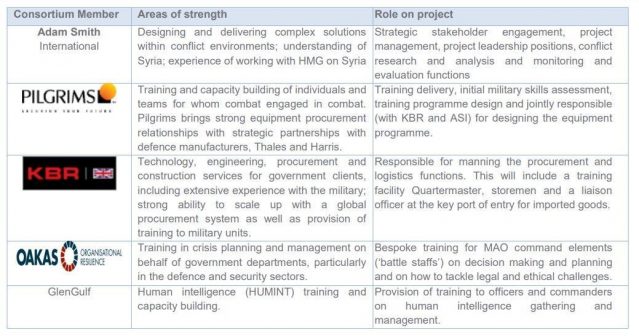
In response, global advisory firm Adam Smith International (ASI) apparently submitted an extensive proposal to the department, offering to head a consortium of contractors, comprised of Pilgrims Group, Kellogg Brown & Root (KBR), Oakas, and GlenGulf.
We have reached out to the companies for comment.
In terms of project roles, ASI – which according to the proposal had been operating in Syria since early 2013, and boasted “well over” 100 field staff in the country – was to provide “strategic stakeholder engagement, project management, project leadership positions, conflict research and analysis and monitoring and evaluation functions.” Pilgrims Group – said to have “supported a large number of media organisations operating in Ukraine” – was tasked with “training delivery, initial military skills assessment, training programme design.”
KBR – which has reaped untold millions from a variety of US conflicts, been embroiled in numerous high-profile scandals, and was reportedly nicknamed “Kill, Burn & Loot” by US marines during the Iraq War – had responsibility for “manning procurement and logistics functions,” including providing the facility’s “quartermaster, storemen and a liaison officer at the key port of entry for imported goods.” Oakas was to offer “bespoke training for MAO command elements (‘battle staffs’) on decision making and planning,” and GlenGulf the “provision of training to officers and commanders on human intelligence gathering and management.”
Excerpt from alleged ASI document
Accompanying project staff CVs reveal many individuals involved in B-FOR were senior UK military veterans, who all received sizeable three-figure per diem fees for their participation. For instance, its ranks included a former senior British military advisor to US Central Command, experience ASI claims granted him “in-depth knowledge” of the Syrian “context.”
US-backed rebel front collapses
Part of that context at the time would’ve been the virtual collapse of Southern Front as a serious fighting force. Formed in February 2014 at the behest of the US Military Operations Command (MOC) in Jordan, the Front was a coalition of 50-60 rebel groups. As ASI’s proposal notes, its constituent factions were “given various types of support from the MOC,” including “small arms, artillery, anti-tank guided missiles, ammunition, vehicles, communications equipment, and uniforms,” the Command also paying fighters’ salaries.
Washington’s largesse was fundamental in the Front scoring a series of victories over government forces throughout 2014 and the first half of the next year. In the process, it became the largest rebel umbrella organization in southern Syria, comprising 25-30,000 fighters, and challenging the political and military dominance of Salafist Al-Nusra, the region’s then-largest jihadist group. The mainstream media widely promoted the Front as Western leaders’ best hope of achieving a “moderate” Syrian “revolution” – despite many of its units frequently cooperating and collaborating with Al-Nusra.
However, an over-ambitious attempt by the Front to wrest the city of Deraa’s northern and eastern districts from government control in June 2015 ended in embarrassing failure. The cataclysm led to almost total cessation of MOC support, which in turn meant the Front lost much of its operational capabilities and many of its fighters, who defected in droves to other rebel groups offering salaries. Saudi Arabia subsequently stepped in to provide weapons and fresh funding to the ailing force – B-FOR represented London’s illicit contribution to keeping it functional, and ASI’s proposal makes clear the consortium well-understood the many risks attached to the project.
Risks known, responsibility offloaded
A lengthy section of ASI’s proposal – ‘oversight and management of threats and risks’ – details some of these myriad hazards, along with their likelihood and impact. It was considered highly probable, for instance, groups such as Al-Nusra and ISIS would interfere in the program, “due to perceptions of an ‘international political agenda’” – as a result, extremists “may seek to prevent trainees from joining or inhibit them from fulfilling their functions once trained via kidnap, assault and theft of equipment.”
The possibility that the consortium’s curated fighters may choose or be forced to join other, non-border force Southern Front operations, in turn “[leading] to a weakening of the border capability and perception of UK support to active military operations,” was rated as “medium.” Border force trainees collaborating with extremist actors and/or committing human rights abuses, in the process compromising “the legal and reputational viability of the programme,” was likewise considered of “medium” likelihood and impact.
ASI’s proposed method of dealing with these and other dangers was almost invariably to simply “transfer” responsibility for “owning and managing” the problem to the FCO itself, even suggesting the UK government must simply “tolerate” failings such as the loss of equipment “to a reasonable degree.”
It seems the FCO either acquiesced to shouldering the inherent burdens, or was intensely relaxed about such issues, for the consortium was duly awarded the B-FOR contract, judging by other papers found in the leak.
Non-Disclosure Agreements signed June 10, 2016 by the firms involved indicate they were obliged to adhere to the stringent confidentiality requirements of the 1911 and 1989 Official Secrets Acts, forbidding them from “disseminating any information related to the project to any third party.” Meticulous instructions for disposing of ‘secret’, ‘restricted’, and ‘confidential’ FCO communications were also included.
‘Jihadis You Pay For’
It’s uncertain how many years, or perhaps months, B-FOR endured. Its ‘statement of requirements’ forecast the project would “cover a period until 31st March 2019 with a clause for a breakpoint at the end of each financial year.”
However, in February 2017, a report by Parliament’s international development committee found ASI staff had submitted fake testimonials from aid recipients to a House of Commons inquiry into its activities, set up in response to allegations the firm had been seeking improper financial benefit from UK aid spending.
In response, DfID blocked the company from bidding on future government contracts, and the next month, ASI’s three founding executives resigned. Even more damningly, in December that year, a BBC Panorama documentary (Jihadis You Pay For) exposed how FCO cash ASI distributed in Syria had ended up in extremists’ pockets.
The investigation focused on the FCO’s Access to Justice and Community Security (AJACS) program, under which ASI funded and trained the Free Syria Police, an unarmed civilian force set up to re-establish law and order in opposition-controlled areas.
It found ASI had identified links between several FSP stations and sharia courts run by Al-Nusra and not ended its funding of the stations, or compelled them to sever all connections with the courts – FSP officers in theoretical receipt of FCO funds via ASI had also been present when women were stoned to death. Troublingly, ASI’s B-FOR pitch states its “experience and knowledge” of running AJACS will be “leveraged” to ensure optimal delivery of the border project.
Whether B-FOR was quietly shelved or simply handed over to other contractors in response to these damaging exposures is unknown. In any event, in July 2018, the Front was comprehensively crushed by pro-government forces, its surrendering fighters either agreeing to reconciliation deals or fleeing to Idlib.
It’s also unknown how many fighters trained via the program went on to join jihadist groups, and how much equipment was “lost” over the course of its operation, ending up in the hands of extremists and used to slaughter and maim innocent civilians. The companies running the operation, much less the UK government, certainly weren’t keeping count.
Kit Klarenberg is an investigative journalist exploring the role of intelligence services in shaping politics and perceptions. Follow Kit on Twitter @KitKlarenberg
Insisting on insult, Macron opens floodgates for Muslim backlash
Press TV | October 26, 2020
Numerous Muslim states and peoples have denounced French President Emanuel Macron’s persisting support for blasphemy in his country against Prophet Muhammad (PBUH).
“We will not give in, ever,” Macron tweeted on Sunday. The tweet served to back up his earlier support for a French teacher’s displaying of cartoons insulting of the Prophet of Islam in his class under the pretext of “freedom of speech.”
“France will never renounce caricatures,” Macron had declared on Wednesday, defending the teacher for “promoting freedom.”
The teacher Samuel Paty was murdered by an 18-year-old Chechen assailant. Commenting on the attack, Macron described Islam as a religion “in crisis” worldwide, trying to suggest that the assailant had been motivated to kill the teacher by the faith rather than radicalism.
The comments have raised controversy and provoked a wave of criticism from the Muslim world.
On Sunday, the Persian Gulf Cooperation Council (GCC) described Macron’s position as “irresponsible,” and said it was aimed at spreading a culture of hatred among peoples.
Turkish President Recep Tayyip Erdogan, who had called on Macron to have his mental status examined for defending blasphemy, repeated the call on Sunday. Macron “is a case and therefore he really needs to have [mental] checks,” Erdogan said.
In a statement, Kuwait’s Foreign Ministry warned that attempts at linking Islam to terrorism “represents a falsification of reality, insults the teachings of Islam, and offends the feelings of Muslims around the world.”
Pakistani Prime Minister Imran Khan also hit out at Macron for “attacking Islam clearly without having any understanding of it.”
He urged the French president to rather address the marginalization and polarization that is being committed against minorities in France that “inevitably leads to radicalization.”
The Pakistani head of state also wrote to Facebook, asking the social media network to clamp down on Islamophobic content in the same way that it purges content aimed at skewing or denying the Holocaust.
He warned about a “growing” trend of Islamophobia throughout the platform among elsewhere, pleading with Facebook CEO Mark Zuckerberg, “I would ask you to place a similar ban on Islamophobia and hate against Islam for Facebook that you have put in place for the Holocaust.”
“One cannot send a message that while hate messages against some are unacceptable, these are acceptable against others,” Khan said, adding that this attitude was “reflective of prejudice and bias….”
Pakistan also summoned France’s ambassador and notified him about Islamabad’s protest at “systematic Islamophobic campaign under the garb of freedom of expression.”
Jordan’s Islamic Affairs Minister Mohammed al-Khalayleh said “insulting” prophets is “not an issue of personal freedom but a crime…,” and Morocco’s Ministry of Foreign Affairs said continuing publication of such “offensive” is an act of provocation.
Hamas and Hezbollah, respectively Palestinian and Lebanese resistance movements, have also condemned Macron’s position.
Hamas spokesman Sami Abu Zuhri said on Saturday that publishing the cartoons was “provocative to the feelings of the Islamic nation and an aggression on its religion and beliefs,” while Hezbollah said blasphemy did not categorize as “freedom of speech.”
Protests were, meanwhile, reported in the Gaza Strip, Syria, and Libya as well as elsewhere throughout the Muslim world.
Boycott spree
Many Muslim companies and associations, meanwhile, have stopped handling or serving French items in protest.
These have included the Al-Naeem Cooperative Society and the Dahiyat al-Thuhr association in Kuwait as well as the Wajbah Dairy firm and Al Meera Consumer Goods Company in Qatar. The Qatar University has also postponed a French cultural week.
Hashtags such as the #BoycottFrenchProducts in English and the Arabic #ExceptGodsMessenger trended across many countries, including Kuwait, Qatar, Palestine, Egypt, Algeria, Jordan, Saudi Arabia, and Turkey.
The French Foreign Ministry, however, reacted angrily to the bans.
“The calls for a boycott are groundless and must be stopped immediately, like all attacks against our country committed by a radical minority,” it alleged, trying to associate the protests with “radicalism.”
Anti-normalization Protests Erupt in Bahrain despite Security Restrictions

MEMO | October 24, 2020
Anti-normalisation protests erupted in the streets of the Bahraini capital of Manama after Friday prayer yesterday.
Protesters held up banners denouncing normalisation, with the unified slogan “Anti-normalisation Friday”, along with a photo of a masked Palestinian militant.
Bahrain’s normalisation agreement with Israel was met with widespread anger, despite tight security restrictions, as well as the summoning of the demonstration organisers and participants, forcing them to sign an order to stay off the streets and not to engage in disruptive activities.
The protesters expressed their rejection of normalisation by carrying banners with the slogans: “Normalisation is treason”, “We reject submission, humiliation and surrender to the instructions of the US and Britain” and “Israel is a cancer that must be eradicated, and we will”. Other slogans stated: “We will never surrender” and “Normalisation is shameful, it is a betrayal”.
After Bahrain announced normalising relations with Israel, the hashtag “Bahrainis against normalisation” was widely circulated by Bahraini activists on Twitter.
The Emirati and Bahraini normalisation agreements with Israel were categorically rejected by the Palestinian authorities and factions, who considered the decision as a betrayal of Al-Aqsa mosque, Jerusalem and the Palestinian cause.
US, Western intelligence services behind creation of Takfiri terrorist groups: Yemen leader
Press TV – October 19, 2020
The leader of Yemen’s Houthi Ansarullah movement has held the United States and Western intelligence services responsible for the creation of Takfiri terrorist groups, saying France’s external intelligence agency plays a significant role in this regard.
“Takfiris are supported by the US, France and Western countries. They are the parties that have stood by Takfiris to target Muslims as they massacre them. The United States and its allies in Syria, Yemen, and other countries are supporting Takfiris, because they are using the extremists to tarnish the image of Islam. Western intelligence agencies, including the one in France, are involved in monitoring and supporting them,” Abdul-Malik al-Houthi said at a televised speech broadcast live from the Yemeni capital of Sana’a on Monday evening.
Houthi also warned that distortion and misinterpretation of Islamic teachings have created a deep rift among Muslims and posed serious problems to them.
“Enemies have used such deviation to insult the Holy Qur’an and Islam. There is no mercy or sympathy whatsoever in the Western civilization. They trample on [the rights of] human societies, deprive people of their freedom, plunder their wealth and occupy their lands, and then lecture others on human rights,” he highlighted.
The Ansarullah chief then questioned Western states’ respect for human rights in Yemen, Palestine and other Arab and Muslim countries, saying US President Donald “Trump is proud that he is ready to give Arab lands to the [Israeli] enemy and expropriate them as he did in the Syrian Golan Heights. What sort of civilization is this?”
Houthi went on to say that insulting Islam is allowed while criticizing Zionists is prohibited in France and whoever does so will be brought to trial.
“In the West, on the other hand, you are allowed to insult Islam and prophets, become atheists and insult God. But you are not permitted to insult Zionists and stand up to them,” the Yemeni Ansarullah leader pointed out.
“In the world, there is a blatant and insulting attack on the Prophet [Muhammad (PBUH)], Islam and Muslims, and the campaign seeks to target our faith with the goal of cultural dominance,” Houthi noted.
The Ansarullah leader stressed that efforts are being made to turn Muslim nations into subordinates of the US, Western states and the Israeli regime.
“Plots aimed at enslaving and distancing us from our religious teachings and identity must not be accepted at all,” he said.
He then denounced French President Emmanuel Macron’s recent anti-Islam remarks as a form of hostility toward the Muslim world.
“France and the West are insulting Islam and the Prophet Muhammad (PBUH). At the same time, they are caring for Zionists and don’t stand any insults directed at them,” he said.
The Ansarullah leader finally held arrogant powers, led by the US and the Israeli regime, accountable for the sufferings of nations worldwide.
95% of Bahrainis against normalization deal with Israel: Opposition tells UN
Press TV – October 18, 2020
Bahrain’s largest opposition group calls on the United Nations to intervene in the kingdom’s unbridled push to deepen its relations with the Israeli regime, saying the move falls short of the general population’s consent.
The Al-Wefaq National Islamic Society released the statement on Sunday, as the two sides are expected to sign a “joint communique on establishing peaceful and diplomatic relations” during a visit by Israeli and US delegations to the Bahraini capital Manama.
The move marks a major step forward in formalizing Manama and Tel Aviv’s ties after a September 15 event at the White House during which Bahrain and the United Arab Emirates signed “normalization” deals with the occupying regime.
All the Palestinian factions besides countless independent Muslim figures and bodies have unanimously blasted the détente as a stab in the back of the Palestinian nation and a US-facilitated attempt at betraying the Palestinian cause of ending the Israeli occupation and aggression.
The opponents of the rapprochement say the move that has been taken by a handful of unelected authorities in Manama and Abu Dhabi never qualifies to represent the opinion of the world’s millions-strong Arab and Muslim community.
“More than 95% are against the agreement and the normalization with the Zionists and the absence of any authority representing the people” in the push towards cementing the détente, al-Wefaq said, addressing UN Secretary-General Antonio Guterres.
“We call on the secretary-general and the international community to ask the Bahraini regime to allow Bahrainis to give their final word on the agreement between the Bahraini regime and the Zionist occupation,” it added.
“The people of Bahrain need to express their opinion about this illegal agreement,” the statement read, calling the deal unconstitutional and contrary to “patriotic and national values.”
The movement said another reason for the agreement’s illegality was that Manama was going ahead with it while stifling all instances of opposition at home.
Since 2011, Bahrain has been witnessing near-daily peaceful rallies against Manama’s routine practice of heavily discriminating against its Shia Muslim majority. The state has come down hard on the protests, killing scores of people and jailing hundreds of others.
UAE official accuses Palestinians of ‘ungratefulness’ after criticism of Israel ties
Press TV | October 14, 2020
A high-ranking United Arab Emirates (UAE) official has accused Palestinians of “ingratitude” and “lack of loyalty” after Ramallah’s envoy to France harshly criticized the Persian Gulf state and Bahrain over signing normalization agreements with the Israeli regime.
“I was not surprised by the statements made by the Palestinian Ambassador to Paris [Salman El Herfi], and his ungrateful discussion of the Emirates,” Anwar Gargash, the UAE’s minister of state for foreign affairs, wrote in Arabic on his Twitter account.
“We have grown accustomed to the lack of loyalty and the ingratitude. We proceed toward the future confident in all our actions and beliefs,” he added.
Earlier, El Herfi told French magazine Le Point in an interview that UAE and Bahrain “have become more Israeli than Israel” itself and are violating the Charter of the United Nations.
‘UAE dictator playing with fire’
The Palestinian diplomat said that the UAE had long abandoned the Palestinian cause and that he wasn’t surprised by Abu Dhabi’s decision to normalize with Tel Aviv.
“The only new thing was the formalization of this relationship. I thank them (UAE officials) for having revealed their true face,” he said.
“The truth is that the Emirates were never at the Palestinians’ side,” El Herfi went on, noting that the UAE froze aid for the Palestine Liberation Organization (PLO) back in 1985.
Abu Dhabi Crown Prince Mohammed bin Zayed Al Nahyan is merely “a little dictator who wants to become known, and he’s playing with fire,” the veteran Palestinian diplomat said.
The UAE’s de facto leader “surrendered to Israel without a fight,” El Herfi added.
He said the UAE and Bahrain violated a long list of Arab League and UN resolutions by normalizing ties with Israel.
The Palestinian ambassador also denounced the two deals as “pure propaganda,” saying they had neither parliamentary approval nor public support.
“And with all due respect, how many Emiratis are there in the world, 800 thousand? And Bahrainis, 500 thousand? There are 340 million Arabs,” he said.
“In fact, these two countries have come more Israeli than the Israelis. But we have full confidence in the fact that their people will not accept this over the long term,” El Herfi pointed out.
Relations between the UAE and the Palestinians have soured ever since the Emirates and Israel agreed as part of a US-brokered deal to establish formal relations on August 13.
Emirati officials have described the normalization deal with the Tel Aviv regime as a means to stave off annexation and save the so-called two-state solution to the Israeli-Palestinian conflict.
The Palestinians, however, dismiss the claims, saying the deal had long been in the works in the course of secret contacts between Abu Dhabi and Tel Aviv.
Israeli leaders have lined up to reject the UAE’s bluff that Israel’s annexation plans were off the table. Netanyahu has underlined that annexation is not off the table, but has simply been delayed.
Palestinians, who seek an independent state in the occupied West Bank and Gaza, with East Jerusalem al-Quds as its capital, view the deals as a betrayal of their cause and say they run counter to a long-standing Arab consensus over a “two-state solution” along the 1967 borders.
Palestinian President Mahmoud Abbas has said the agreements will be fruitless as long as the United States and the Israeli regime do not recognize the rights of the Palestinian nation and refuse to resolve the issue of Palestinian refugees.
Britain selling arms to Saudi Arabia at unprecedented rate

Activists march with replica missiles bearing the message ‘Made in Britain’ in London, UK on March 2016
MEMO | October 12, 2020
Britain is issuing arms licences to Saudi Arabia at an unprecedented rate of almost one a day, making up for months of lost time after the appeal court banned the sale of arms to the Kingdom over allegations that British made weapons are used to target civilian populations.
Official figures released last week revealed Britain’s growing role in the dangerous flow of arms across the globe. The UK is holding its position as the second highest exporter of arms, despite last year’s ruling. Now more details have been uncovered about the trade, prompting allegations of British “complicity” in the humanitarian catastrophe unfolding in Yemen.
“By arming the brutal Saudi dictatorship the UK is making itself complicit in the atrocities and abuses inflicted on Yemen,” said Andrew Smith of Campaign Against the Arms Trade (CAAT). “A return to business as usual will only increase the suffering.” The war in Yemen is only possible because of military support provided by Britain and other governments, he added.
Eighty-seven export licences were granted between 20 June 2019 and last month. However, only 19 licences were issued in 11 of those months, for £15 million worth of “defensive” military equipment such as body armour and navigation systems. This means that most of the licences were issued in just 12 weeks.
Saudi Arabia tops the global table in terms of military expenditure as a proportion of GDP. The Kingdom reportedly has twice as many British-made warplanes as the Royal Air Force.
Featured Video

America Racing to Strategic Defeat in Iran
or go to
Aletho News Archives – Video-Images
From the Archives
Should Europeans ‘Thank’ the Americans for Destroying Nord Stream?
By Robert Bridge | Strategic Culture Foundation | September 29, 2022
With an investigation continuing into the destruction of the Nord Stream gas pipeline that provided energy supplies to Europe from Russia, there appears to be just one prime suspect, and that should surprise nobody.
Following the sabotage of the Nord Stream 1 and 2 gas pipelines, former Polish Foreign Minister Radoslaw Sikorski already seemed to know the identity of the perpetrator when he tweeted out: “Thank you, USA.”
At first glance, it seemed that Sikorski was speaking sarcastically, berating Washington for carrying out an attack that will have severe repercussions for the people of Europe. After all, how could anyone see any good coming from the termination of Europe’s primary source of gas reserves with winter just around the corner? It was Sikorski’s homeland of Poland, after all, that urged its citizens to collect firewood in the face of dwindling gas reserves.
In fact, the Polish diplomat was speaking one-hundred percent literally… continue
Blog Roll
 Aletho News
- Growing insecurity, soaring prices fuel protests in north as regime bans evacuation: Sources
- Iran denies responsibility for ‘depraved’ attack on Kuwait desalination plant
- Bring The Troops Back. End This War Now!
- Can we please stop calling Israel the ‘only democracy in the Middle East’ now?
- US should start removing its troops from Germany, proposes AfD co-leader Chrupalla
- Iran Red Crescent: 600 educational centers attacked in US-Israeli ‘war crimes’
- Russian Oil Tanker Arrives in Cuba Amid U.S. Blockade
- America Racing to Strategic Defeat in Iran: Lt Col Daniel Davis
- FTC Warns Visa, Mastercard, PayPal, Stripe Over Political Debanking
- Russian tanker approaches Cuba despite US oil blockade
- If Americans Knew
- As Iran targets US military bases, will they be relocated to Israel? Not a ceasefire Day 171
- Will Trump Go Kamikaze?
- Is the University of Florida Shutting Down College Republicans over Israel Criticism?
- Jewish extremist arrested over alleged plot to firebomb Palestinian activist Nerdeen Kiswani’s home
- More than half of Palestinian child detainees have no charges
- The More Murderous Israel Gets, The More We Hear About “Antisemitism”
- Land Day and the Palestinian struggle after 30 months of genocide
- The Iran War Is About Palestine
- Israeli soldiers echo settler ideology, talk of revenge after targeting Palestinians and detaining CNN crew in the West Bank
- Israeli Policies Threaten Future of Christian Schools in Jerusalem
- No Tricks Zone
- New Study Finds Warming Saves Lives…Cold Temperatures 12 Times More Deadly Than Excess Heat
- German Science Blog Accuses PIK Climate Institute Of Hallucinating Climate Tipping Points
- Devastating Assessment Of Comirnaty Vaccine By Former Senior Pfizer Europe Toxicologist
- New Study: CO2 Is ‘Effectively Negligible’ As An Explanatory Climate Change Factor Since 2000
- Former Pfizer Toxicologist Dr. Helmut Sterz Tells Bundestag Hearing Pfizer Vaccine Should Have Never Been Approved
- Energy Expert: Germany’s Nuclear Phaseout Was A “500 Billion Euro Mistake”
- New Research: South Australia’s Mid-Holocene Sea Surface Temperatures Were 4°C Warmer Than Today
- Storing Green Energy To Last Germany 10 Days Would Require A 60-Million Tonne Battery
- New Studies: UK Sea Levels Were 4 Meters Higher Than Today During The Mid-Holocene
- Destructive Green New Deal: German Energy And Metal Group Warns Of Drastic Crisis
 Aletho News