Nasrallah: Syria triumphs, Israel is waging an imaginary war
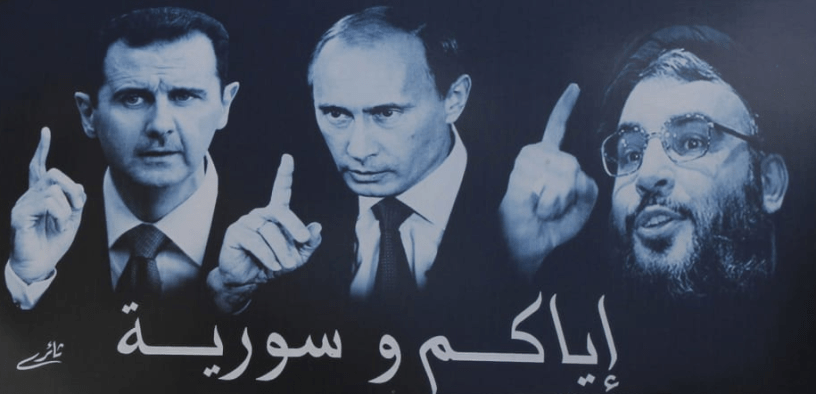
Speech by Hezbollah Secretary General Sayed Hassan Nasrallah on May 13, 2020, in commemoration of the martyrdom of Hezbollah Commander Mostapha Badreddine, killed in Syria in May 2016.
Summary:
- Syria has already won the war, even if there are still some minor battles to be fought
- Having failed militarily, the enemies of Syria strive doubly hard in their diplomatic, economic and psychological warfare
- There is no dissension between the allies of Damascus, nor a struggle for influence between Iran and Russia
- News of Bashar al-Assad being sidelined is just propaganda
- There are no Iranian armed forces in Syria, just military cadres and advisers
- Having bet everything on the terrorists, Israel sees its defeat and fears the recovery of Syria and the threat it will pose to the occupation of the Golan and the very existence of the Zionist entity
- The so-called Israeli campaign against the Iranian presence in Syria is nothing but window dressing aimed at reassuring Israeli opinion and providing cover for attacks on the Syrian ballistic power
- Israel presents as a victory a simple redeployment of forces due to successive victories over almost the entire Syrian territory, and a reduction in air movements between Iran and Syria due to the coronavirus
- Iran, Hezbollah and other Resistance movements will never leave Syria
- Israeli incursions into Syria are caused by worry, fear and adventurism, but can lead to uncontrolled escalation and regional war
This video only subtitles the last section of the transcript below, ‘Israel in Syria‘
Transcript:
Syria won the world war against it
[…] Today we can say that Syria won this war. In previous battles, when great achievements were made, such as after the liberation of Homs, Damascus, the South and even Aleppo, it was said that Syria had won the war, and analysts and specialists in strategic issues said no: Syria had won one (or more) battles, but had not (yet) won the war. Because a war is made of many battles: you can win a battle, lose another, win a third, lose the fourth, but all that does not (necessarily) mean that the whole war is won, or that the whole war is lost.
Today, in all simplicity, and via an objective and genuine assessment (of the situation), whoever goes to Syria and travels there —except for the politicized Arab (and Western) media—, whoever goes to Syria, in its provinces, in its cities, in its villages and boroughs, in all the regions currently in the hands of the State, anyone who observes the overall situation in Syria can easily affirm that Syria won the war, although there are still some battles going on. It should not be said that Syria has won one, two or three battles, and has lost one or two others, and that the war is still going on, without it being clear whether Syria will win it or not, no. The fair and accurate strategic assessment is that the Syrian leaders, the Syrian army, the Syrian State and the great majority of the Syrian people who stood firm in this struggle won this war.
Of course, there are still a few battles left, military or political, which require persistence and continuity of action, whether in Idlib, East of the Euphrates or certain areas North of Syria, but this is only a partial, limited and circumscribed part (of Syria). Syria has triumphed over partition projects, Syria has won this war, and suffice it to say that the objectives of this world war (against Syria) for which, according to their own admission, hundreds of billions of Arabian dollars have been spent —the dollar is American, but it is the Arab (countries) that have paid the bills; if this money had been spent for the good of the Arab peoples of our region, they would have extricated them from ignorance, poverty, misery, illiteracy, diseases, and the said funding countries (Saudi Arabia, etc. ) would not face financial incapacity in the face of the economic consequences of the Covid-19 pandemic as they do now—, thousands of tons of weapons and ammunition, tens of thousands of terrorists and takfiris who were brought from all over the world, dozens of international conferences, etc., etc., etc. They have deployed everything, done everything, absolutely everything, to achieve their objective in Syria: sectarian or political slogans, incitement (to racial or religious hatred), everything that the front of Arrogance (imperialism) and its instruments were able to mobilize in terms of resources and ideology, everything they could do against Syria, they did. And Syria, through the perseverance of its leaders, its army, its people and the State, and thanks to the presence and perseverance of its allies by its side, managed to win this war.
And that is why today, when we talk about our martyr leader, Sayed Mustapha Badreddine, and our other martyrs in Syria, we feel, in addition to the consequences for their afterlife and their (eminent) position close to God the Most High and the Exalted as martyrs, we have the feeling that their blood has borne fruit and enabled these results to be achieved, and that the objective for which they went to fight and for which they sacrificed their blood, their peace and their life, and for which they made unremitting efforts night and day, this goal was achieved and it is before our eyes today.
Economic, diplomatic & psychological warfare
I will now raise some points (concerning Syria). The first point is that naturally, what (the enemies of Syria) have been unable to achieve militarily, they have been trying for the past few years to obtain it politically, through political pressure on the Syrian leaders, on the allies of Syria, on Iran, on Russia, on those who stand alongside Syria, through international relations, through the UN Security Council, through intimidation, threats and tempting promises, so that the allies of Damascus will abandon Syria. But all of this has failed so far. And we know that sometimes the political battle is just as intense as the armed struggle. And sometimes its dangers are even greater, and require all of our vigilance and attention. Syria is still plunged into political war and is facing political pressures which, so far, have failed to achieve any of their goals.
Naturally, and I come to the second point, after the failure of the military war and the impotence and the ineffectiveness of the political war and the political pressures in achieving any objective at all, the front of Arrogance (imperialism), the American despots and their Allies resorted to other means, namely psychological warfare on the one hand, and sanctions and blockade on the other. With regard to psychological warfare, a very broad front has been open for years against Syria, and lately there has been an intensification of psychological warfare, some aspects of which I will touch on in a moment. Likewise, the sanctions and the state of siege against Syria are increasing, and they are betting on the economic consequences (which they hope will become unbearable for Syria and its allies). The coronavirus has added to these pressures, but this pandemic is not specific to Syria: the pressures of the coronavirus are weighing on the whole world. Today, those who besiege Iran, Syria, Venezuela and other countries, Gaza, Yemen, etc., are starting to suffer the economic consequences of the coronavirus themselves. We have all seen the catastrophe hitting the United States, the countries of Western Europe, as well as certain countries in our region (Saudi Arabia, etc.). In any event, it is also a means of attacking Syria, namely economic pressures, sanctions, the state of siege against Syria.
With regard to the sanctions and the blockade, we place our hopes on the endurance of the Syrian leaders, the Syrian State and the Syrian people, just as they persevered in the face of the military and political war. What gives us hope is that Syria is a country endowed with human capital and colossal possibilities; the Syrian people are full of liveliness, the wealth and innate means of Syria are many and huge. Before the crisis, Syria was not a debt-ridden or weak country, nor was it a country brimming with wealth, but its economy was entirely viable. In some Arab countries, millions of people live in cemeteries, but no family lived in a cemetery in Syria. Anyway, in the economic battle, the livelihood battle, the financial battle, we have good hope in the endurance and initiative of Syria, just as we trust Syria to succeed against the psychological battle.
Tensions between Syria’s allies ?
With regard to the psychological battle, I would like to give an example, before addressing my last point concerning Syria. Part of the psychological battle concerns the situation of the allies, and we often hear that the allies of Damascus have started to abandon Syria. (According to these rumors), Iran would be entangled in its internal situation and would prepare to abandon Syria. Russia, because of the pressures, its internal situation, such pressures or such problems or I don’t know what other rubbish, would abandon Syria. All these words express only dreams and hopes that we have been hearing for years, and some have been disseminated as if they were information, etc., but they were only aspirations (US / Israeli / Saudi wishful thinking).
Among the talking points of the current psychological warfare, let us quote again the recurrent remarks that we find in the media of the Gulf and certain Western media —the Western media are more reluctant to diffuse these reports, because they try to preserve the (little) credibility they still have— about an Iranian-Russian power struggle in Syria. There is no hint of truth in it. I said at the beginning of my speech that I was going to talk about Iran again. In the two points that remain for me to address (on Syria), I will clearly point out certain sensitive points which concern the Islamic Republic of Iran.
Neither the Islamic Republic of Iran, nor Hezbollah, nor the Resistance factions from different countries —Iraq, Afghanistan, Pakistan, etc. ; yes, Resistance movements came from these countries and fought in Syria alongside the Syrian Arab Army, the Syrian people and the Syrian popular forces, and are still present there… The Islamic Republic of Iran is not fighting for influence against anyone in Syria. Neither against Russia —regardless of what Russia is doing— nor against anyone. The position of the Islamic Republic in Syria was clear from the beginning: its (only) goal was to prevent the fall of Syria under American-Israeli control, and under the control of the instruments of Arrogance (imperialism), our common enemy. This was Iran’s goal, and nothing else. The Islamic Republic does not seek any influence in Syria, it has no aims and no greed in Syria, and has no desire to interfere in the internal affairs of Syria. Iranian interference in Syria has never existed, does not exist and will never exist with regard to internal Syrian issues, whether in the form of the regime, government, laws, the State… Iran will never do anything that some other States (especially the imperialist and neo-colonialist West) do, in any case. All that mattered and still matters for the Islamic Republic of Iran is that Syria remains in its (pro-) Arab, (pro-) Islamic, (pro-) Resistance position, that it preserves its identity, its independence, its sovereignty, its unity, that Syria remains a noble and dignified, persevering fortress, does not submit to American and Zionist hegemony, and does not compromise on its rights (over the Golan). This is all that Iran wants in Syria, no more no less. And that does not enter into any struggle for influence with anyone.
Certainly, to be completely frank and sincere, there may be differences between the allies as regards the definition of certain military or ground priorities, political questions, at the level of negotiations, etc. But this in no way leads to a struggle for influence, because the decisions of the Islamic Republic are categorical as regards the position alongside the Syrian leaders (who have the final say on all matters), Iran complying with what they determine and accept. The Islamic Republic has a position of support towards the endurance, the persistence, the maintenance and the independence of Syria, and its resilience in the face of projects of hegemony and control over it, and of liquidation of the Axis of Resistance in the region. In this regard, I would therefore like to reassure the masses & supporters of the Resistance in the Arab-Islamic world: in Syria, there is no struggle for influence between Iran and Russia. So could we say that the front of the allies and supporters of Damascus is plagued by internal strife or is in withdrawal? This is absolutely not true.
Israel in Syria
The other point I also wanted to talk about concerning Syria and Iran in Syria, and the Israeli enemy in Syria, is the Israeli aggression and the Israeli project in Syria. Especially in the past few weeks, the Zionist Israeli Minister of War (Naftali Bennett) is trying to brag and present (false victories) to the Israeli masses, lying to them and misleading them, and also to the public opinion in the Arab-Muslim world —and there are also Arab media that spread these lies and falsifications—, in order to highlight the imaginary victories and achievements of Israel in Syria at the expense of Syria, the Islamic Republic of Iran and the Axis of Resistance. I want to talk about it a bit, and it may be the first time that I do it in such a frank and detailed way, even if it will be synthetic.
During the first years (of the war in Syria), from 2011, Israel bet on the (terrorist) armed groups. The relations of the armed groups —especially in the south of Syria— with Israel are absolutely undeniable: exchange of information, financing, supplies, medical care, aid and support of all kinds, up to transit, all this is well known and obvious. Israel has been active in the war in Syria since 2011, and has counted & invested heavily on those who fight the regime in Syria. Israel had a whole set of objectives, the highest of which was the fall of the regime and the liquidation of the current administration (of Bashar al-Assad). But there were several other lesser goals.
When this war against Syria failed, and the Zionists understood that their instruments and the horse on which they had bet had failed in Syria, and that they had lost the war… They are still fighting in Syria, but they lost the war, as I just explained. The proof is that all of southern Syria, the vast majority of which was under the control of armed groups, which cooperated with Israel, was assisted by Israel and were Israel’s allies both openly and secretly, they all left, and some left Syria via the Zionist entity. We don’t forget their buses at night.
The Israelis therefore understood that their objective (to bring down the regime) had failed. They therefore aimed at a new objective, namely to fight against a new danger which appears to them, new dangers which will emanate from the situation and the victory in Syria. What are these new dangers? Some reside in the Syrian Arab forces themselves, in the Syrian army and in the Syrian military capabilities, especially with regard to ballistic capability and the manufacture of precision missiles. And that’s why we see that Israel is attacking everything related to the production of missiles in Syria, because he considers that the ballistic capacity and the manufacture of missiles constitute a (enormous) force for Syria, and obviously also for the Axis of Resistance.
Israel therefore considers Syria as a future threat, Syria which has stood firm during all these years in the face of a universal war waged against it: if Damascus regains its strength and regains its health, and develops its military, human and material capabilities, this will give Syria prevalence in the region and in the Arab-Israeli struggle. Therefore, Israel considers Syria as a threat, a future threat: Syria may not be a current threat, because it remains entangled in its internal situation and the few battles that remain to be fought. Likewise, Israel views the presence of Iran and Resistance factions in Syria as a threat. Israel is worried about Syria, Israel is afraid. Israel is terrified of what the future holds for it in Syria. This is the true description of the situation.
So look at the way Israeli officials express themselves about the Golan Heights, claiming that in southern Syria, for example, Hezbollah has a certain presence and a certain activity, and is trying to create a structure (of Resistance), with the help, silence or complicity of the Syrian authorities, cooperating with young Syrians (combatants) in order to recover the Golan and attack the Israeli occupation in the Golan. And all this while nothing important has happened yet. But this simple assumption, this simple fact created an atmosphere of terror within the Zionist entity, and sometimes pushes it to escalation measures which can lead to unforeseen and dramatic consequences (an open regional war). This indicates that Israel behaves towards Syria from a position of worry, fear and terror in the face of the consequences of the great victory in Syria. You have to keep that in mind in the first place.
Israel has therefore announced a goal in Syria. He cannot declare that he strikes Syria and the Syrian army, even if that is what he is doing concretely. Israel has therefore announced a goal linked to the Iranian presence in Syria, and the presence of Hezbollah, even if he insists above all on the Iranian presence. So they launched a campaign under the slogan “We want to expel Iran from Syria.” And their stupidity is such that it prompted the Israeli Minister of War, Naftali Bennett, to go so far as to set a timetable, promising that before the end of 2020, he would have ended the Iranian presence in Syria. So remember this deadline and count the months that we have before the end of the year to see what will happen to the promise of this stupid minister.
Israel has therefore worked to achieve this goal. What did they do, apart from the international, regional and domestic incitement, and the attempt to present the Iranian presence in Syria —which I will describe in detail— as having gone from a factor of assistance to a burden for Syria, which is a gross lie? They began with airstrikes and air operations which occasionally hit means of transport, warehouses or certain locations in Syria. This has been happening for years, and I never talked about it (in detail).
What is new? The new thing is that Israel goes astray, tricks its people and deceives the opinion in our region (and in the world) —and we are always fighting this battle to raise public awareness by revealing the truth—, trying to present certain details like the proofs of his victory in Syria and the beginning of the defeat of the Axis of Resistance or the Islamic Republic of Iran, the beginning of our exit and withdrawal (from Syria).
What are the clues and evidence that Israel puts forward? For several weeks, certain Israeli officials, media and analysts have been propagating these statements, even if other Israeli analysts say that these statements are inaccurate and just for show —and the latter are the ones who are right. Israel has spoken of several points (put forward as evidence of an Iranian withdrawal from Syria):
1/ the number of troops: the “Iranian (armed) forces”, to use their expression, would have greatly decreased in Syria;
2/ certain bases that have been evacuated, returned (to the Syrian authorities) or abandoned;
3/ the concentration of efforts on eastern Syria and the presence in the region of al-Boukamal, Deir Ezzor, etc.
The conclusion of all of this, (if we are to believe the Zionist enemy), is that the result of intelligence operations, military actions and aerial bombardments carried out by Israel, have largely fulfilled their objectives: Iran would leave Syria, the Iranians would be in full withdrawal, Hezbollah would retreat, and this moron (Bennett) believes he achieved an historic exploit which he trumpets at every occasion, predicting the full achievement of this objective before the end of 2020. Just see how he spreads these lies and fools public opinion.
Let me show you the real situation. First, regarding the situation on the ground, Israel keeps talking about the presence of “Iranian (armed) forces”, but in Syria there have only been Iranian military advisers and experts since 2011. I would like to say that they were present even before 2011 alongside the Syrian Arab Army and alongside the Resistance in Lebanon (Hezbollah), and after 2011, they remained, and due to the events, their number increased. But there are no Iranian military forces in Syria. When we talk about Iranian military forces, we mean one or more battalions, one or more units, legions, etc. That is what we are referring to when we talk about the armed forces.
There are a number of military advisers and experts in Syria, the number of which has increased with the events (since 2011). They had and still have a very important role:
1/ providing support and advice to the Syrian armed forces;
2/ managing groups of Syrian, Arab and Islamic popular forces which they train, arm and lead in the various battles in progress;
3/ coordinating operations with Resistance movements, including Hezbollah;
4/ coordinating the logistical support operations provided by the Iranian defense ministry to the Syrian defense ministry.
These Iranian advisers are not Iranian (armed) forces. It is not an Iranian armed presence.
You see, the Israelis announced a nonexistent, illusory, imaginary goal, similar to the objective of successive American administrations to prevent Iran from manufacturing nuclear weapons, while the Iranians do not have nuclear weapons and do not want to obtain nuclear weapons. In Syria, Israel is waging an imaginary battle to prevent Iranian forces from being present in Syria. While in Syria there are only Iranian military advisers and military experts. Despite all the difficulties, the situation in Syria in no way requires the arrival of Iranian (armed) forces in Syria.
To be frank and honest, at one point, a real discussion took place on this subject with the Iranian leaders, and at one point, for a few months, certain Iranian armed forces came to Aleppo, for 2 or 3 months. But apart from this exceptional case, there have never been Iranian forces in Syria, and I say and repeat that there are only advisers, in the number required by the situation: there may be more or less according to the needs of the field, and many of them fell martyrs —some could put forward this argument as proof of an armed presence; but it’s because these advisers were on the front lines alongside the Syrian Arab Army and Resistance factions, fighting and participating in battles, in the manner of the school of their commander of the al-Quds Forces, the martyr Qassem Soleimani, may God the Most High be pleased with him. This is therefore the real and precise description of the situation.
Secondly, naturally, as the battles were won, whether for the Iranians or the factions of the Resistance, and sometimes even for the Syrian army, when the battle or the threat ended in a region, there was no longer any reason to maintain a presence of combatants or military bases, nor our positions on combat axes and front lines. At one time, the fighting was taking place (simultaneously) in Homs, in the rif of Damascus, in Damascus, in the East of Homs, in the suburbs of Aleppo and in Aleppo itself, in Idlib, in the south of Syria, Badiya, al-Boukamal, Deir Ezzor, etc. It was therefore natural to have a presence (of the armed forces) in all these regions. While on the coast, there were no battles, and there was therefore no reason to have this presence.
When the province of Homs was liberated, this presence ceased. Same thing when the battles in Damascus and in the rif of Hama ended, as well as in southern Syria, in Palmyra and in the Badiya. If the Syrian army, of which it is the country, wanted to maintain a certain presence in certain barracks, to take the necessary precautions (to face a possible resurgence of the terrorists), that made sense; but as for the auxiliary forces, whether Iranians, Hezbollah or other factions of the Resistance, it is quite natural that they left this region, maintaining only the minimum of personnel, of combatants and of material there as a precaution. There would have been no reason to maintain the same number of forces, the same bases, etc.
For about two years, when this victory became clear, especially after the liberation of the Badiya and the opening of the highway to Aleppo, and the end of the battle in Damascus, in the rif of Damascus and in the south, the (Syrian & allied) forces gathered (in the last places of activity of the terrorists). The presence of many Iranian advisers was no longer required, and so they returned to Iran. Likewise for a number of Hezbollah fighters and cadres in Syria, whose presence was no longer useful, so they returned to Lebanon. Many of our Iraqi brothers and other nationalities were no longer required, so they returned home.
The situation in Syria having become very good, (what would have been the point of maintaining all this presence)? Some bases and barracks have always remained empty, and had been prepared in case there was a need for additional manpower. Many bases and barracks were no longer useful because there were no more fights, and were therefore abandoned. It all started two years ago or more, and has nothing to do with Israeli operations and attacks in Syria. It has nothing to do with the Israeli strikes in Syria. And that has nothing to do with the martyrdom of brother commander Hajj Qassem Soleimani. It started under his leadership, and the current leadership of the Al-Quds Forces (IRGC) continues the same program it began operating over two years ago.
Likewise, Hezbollah and the rest of the factions of the Resistance have started to do the same for more than two years, namely to decrease the troops, decrease the number of (active) bases, decrease the presence, because Syria begins to recover, Syria has won, the Syrian Arab Army has won, many frontlines no longer exist, the battles having been definitively won there. This is the truth.
Today, when anyone talks about a downsizing of foreign forces in Syria… Let me give you an example for Lebanon. At some point I announced that on the whole axis of Qalamoun, we ended our presence (that used to be massive), keeping only one or two positions. Same thing for the whole axis of Zabadani. All was done in coordination with the Syrian army. Is this an Israeli success? Or is this fact explained because the Syrian army and the Resistance won all the battles in these regions, as well as in the rif of Damascus, in the rif of Homs, etc. What would be the point, once the fighting is over, of staying on the mountains, in the cold, in the heat, what good is it to mobilize and use resources, etc. All that would be useless, it would be a waste of material and human resources. When the fighting is over, all we have to do is pack up and return to our main front, namely southern Lebanon (facing Israel).
The pseudo-evidence put forward by Israel today, namely the issue of the reduction of troops in Syria, the total or partial evacuation of certain places, bases or positions, this is only due to the fact that the presence there would no longer make any sense, as for example in Damascus or around Damascus, where the fighting has stopped. It is quite natural that the military presence should go to al-Boukamal, Deir Ezzor, Aleppo, Idlib, because the front lines are there, and there is no more fighting elsewhere. The remaining battles are there, so those who want to help must go there and not sit (arms crossed) in Damascus.
The pseudo-evidence advanced by Israel in no way proves Israeli successes, but proves the victory of Syria, the victory of the Islamic Republic of Iran, the victory of Hezbollah, the victory of the Axis of Resistance in Syria. This victory in the war involves, as with any army and any military force in the world, a redeployment of forces in accordance with new responsibilities and new challenges, in the light of our achievements and victories.
More so, a sign of the imbecility and lies of the Israeli media is that they have tried to explain the fact that for example, lately, the movements between Syria and Iran have decreased somewhat —air freight, the movement of airplanes—, and this has also been put forward as evidence of the Israeli military successes in Syria, while these claims are nothing but lies and falsifications. The cause is the coronavirus. The covid-19 which impacted the US military, European armies, and even the army of the Israeli enemy itself, which canceled maneuvers, training, and large military parades planned to celebrate the anniversary of the victory of 1945, and it is only natural that the pandemic also affects Syria, the Islamic Republic, ourselves and everyone.
To summarize this point, by way of synthesis before evoking the internal situation in Lebanon in the minutes that I have left, I would like to address the Israeli public to invite them to check their information and not to believe the lies of their leaders, who put forward imaginary victories in Syria, whether against Syria or against Iran. Admittedly, Syria suffers prejudice, just as Iranian advisers, Hezbollah and the Resistance in Syria are affected by the Israeli aggressions, which the Syrian, Iranian and Resistance leaders consider as they should —I don’t have time to speak in detail about our point of view on the issue, I will do it another time if necessary—, but the Israelis need to know that what their leaders are saying is only lies, deception and illusions, purely imaginary achievements. And if Israel continues on this path, they can make a mistake or a blunder that would blow up the whole region.
As for the announced objective, namely to expel the Iranian presence —the military advisers, and not the pseudo Iranian forces, as I explained— or even to expel Hezbollah and the Resistance from Syria, this objective will never be achieved, o Zionists. This objective will never be achieved. These advisers are present following a joint decision by Syria and Iran, and the Resistance movements are present at the request of the Syrian leaders and in accordance with the will of the Resistance movements themselves, and all those who, since 2011 to date, have sacrificed thousands of martyrs and suffered thousands of injuries, will not be defeated or deterred by an air strike or an assassination here and there. They will remain firmly on their positions, and will not abandon the battlefield or the place under any circumstances. This goal is unachievable.
These are just illusions that you live in your imagination; you are engaging in sheer adventurism, and at any moment, you can make a serious error in Syria that you will regret bitterly. […]
Source: https://video.moqawama.org/details.php?cid=1&linkid=2112
Translation: resistancenews.org
New York: 16-Term Israeli Warmonger Defeated By Black Leftist In Democratic Congressional Primary
By Eric Striker | National Justice | June 24, 2020
Eliot Engel, a Zionist warmonger who has been in Congress since 1989, has been crushed at the ballot box by Bernie Sanders and Ilhan Omar endorsed black leftist Jamaal Bowman in New York’s majority non-white 16th District.
The outcome is a stunning blow for the Zionist lobby. The Israeli Engel is the chairman of the House Foreign Affairs Committee who voted for the Iraq war and advocates extreme neo-conservative policies. While Engel is a Democrat, he is considered to be an important AIPAC asset in Washington.
Engel touted high powered endorsements from Hillary Clinton, Nancy Pelosi, Chuck Schumer, and even the bought out Congressional Black Caucus over his black insurgent opponent.
Nevertheless, Bowman’s unexpected momentum prompted a massive avalanche of Jewish money to Engel, including from Republican Party Super PACs, in an attempt to try and save his seat.
While Engel and his Super PACs outspent the underdog many times over, Bowman is currently leading him by 25 points with 670 of 732 precincts reporting.
Bowman, who is supported by the Justice Democrats, was able to win an endorsement from the New York Times after moderating his tone and coming out as a supporter of Israel and opponent of BDS, but with the caveat that he does not believe aid to Israel should be unconditional or BDS should be illegal.
Bowman’s campaign made a simple pitch to constituents: spend more on the Bronx, less on foreign wars. This has drawn ire from leaders in the Jewish community, who have chastised him for not being sufficiently concerned with the well-being of Israel.
Like Alexandria Ocasio-Cortez, Bowman is an anti-white demagogue who supports a number of culturally destructive policies. Yet, on this question, Rep. Engel was significantly worse.
In 2018, Engel and fellow Jew Ileana Ros-Lehtinen led efforts to extradite and imprison Julian Assange for the crime of journalism.
In March 2019, Engel used his position at the House Foreign Affairs Committee to compel the State Department to begin arbitrarily classifying nationalist groups around the world as “White Nationalist International Terrorists.” This absurd new policy uses measures meant to fight ISIS and Al Qaeda to open up any American citizen who has knowingly or unknowingly contacted legitimate political organizations like the Russian Imperial Movement to terrorism charges.
It goes without saying that a black man from Yonkers ranting about how the white man is the devil is less dangerous to our rights and freedoms than an asset of the state of Israel with the power and connections to do innocent people harm.
Engel’s departure is welcome news.
Bolton claims Iran had yellowcake uranium, echoing bogus claims that led to Iraq war
RT | June 22, 2020
Former US National Security Advisor John Bolton has claimed Israeli agents found “yellowcake uranium” in Iran in 2018, channeling the discredited intelligence used by the George W. Bush administration to justify invading Iraq.
Israel’s Mossad retrieved “human-processed uranium” that was “perhaps yellowcake (uranium oxide in solid form)” during a “daring raid on Iran’s nuclear archives” in 2018, the mustachioed warmonger declared in his controversial Trump administration memoir, ‘The Room Where It Happened’. The discovery, Bolton alleged, was substantiated when the International Atomic Energy Agency subsequently conducted an inspection of Iran’s Turquzabad site. Israeli media trumpeted the vague, unverified claim over the weekend, publishing selected quotes from the book.
Bolton insisted the discovery “could well be evidence that Iran kept alive its ‘Amad plan’ for nuclear weapons after it was supposedly ended in 2004.” However, despite the wild claims leveled against Tehran by Israeli PM Benjamin Netanyahu in his theatrical speech following the raid, the IAEA denied Tel Aviv had uncovered any evidence that would change the international understanding of Iran’s nuclear activities. Iranian foreign minister Javad Zarif, meanwhile, accused Netanyahu of deliberately tailoring his speech to give the Trump administration a rationale for withdrawing from the JCPOA nuclear deal – which it did, much to Bolton’s delight.
While the Trump administration has thus far stopped short of bombing Iran, hope springs eternal – Bolton has pushed for war with the Islamic Republic for years. So has Netanyahu, who has claimed since 1992 that Iran’s nuclear bomb was right around the corner and has been trying to convince the US to share his view ever since.
The former Trump official’s yellowcake claims – tellingly couched in qualifying words like “perhaps” and “could be” – carry disturbing echoes of the phony intelligence used by Bush’s administration to justify the disastrous invasion of Iraq in 2003. Bolton himself had pushed to have unsubstantiated allegations that Iraqi leader Saddam Hussein was trying to purchase yellowcake uranium from Niger as part of a top-secret nuclear weapons program included in a ‘fact sheet’ on Iraq’s “weapons of mass destruction” drafted by the administration in 2002. Even after US diplomat Joseph Wilson traveled to the African nation and found no factual basis for the yellowcake claims – a conclusion backed by French intelligence, the CIA, and the US Embassy in Niger – the neoconservative core of the Bush administration, including Bolton, clung to the yellowcake story. No WMDs were found after the US invaded Iraq the following year – not that Bolton ever apologized.
The Iraqi yellowcake story is widely agreed to have been the result of a skilled forgery pushed by regime-change enthusiasts who wanted Iraq’s government toppled and didn’t care how much they had to mangle the truth to get it. Neocon hawks like Bolton and fellow Bush administration heavyweights Donald Rumsfeld, Paul Wolfowitz, and Richard Perle had been championing war with Iraq for over a decade, repeatedly and unsuccessfully pushing then-president Bill Clinton to invade before they finally got their wish with Bush in 2003.
As CIA analysts at the time explained, refining yellowcake into the material used in nuclear bombs requires extensive processing and sophisticated technology Iraq did not have – never mind the logistical difficulties inherent in moving the 500 tons Hussein was supposedly purchasing out of Niger. Additionally, Iraq was already sitting on over 550 tons of uranium oxide. So why, they wondered, would Baghdad risk arousing international suspicions by buying more if it was embarking on a clandestine nuclear program? But Bolton and his cohort were known for their persistence; “Stick that baby in there 47 times, and on the 47th time it will stay” was how the Pentagon’s Larry Wilkerson described their modus operandi to Vanity Fair. Even after the IAEA itself declared the Niger documents to be forgeries, the Bush administration plunged ahead with the war that has turned the Middle East into a chaotic quagmire of political instability, terrorism, and human suffering.
Iran’s compliance with the JCPOA deal has been repeatedly certified, even as Bolton and his fellow hawks attempted to discredit the inspection process. With the ink on the deal scarcely dry in 2015, Bolton was already claiming Iran was operating “secret nuclear facilities” and calling for the Obama administration to bomb the country. He then spent much of his time as Trump’s national security advisor advocating for a military response to any perceived slight – especially after the US exited the JCPOA. At the same time, Israel continues to push “bombshell” reports alleging violations of the deal, with the most recent coming earlier this month and based on data Tehran claims was supplied by Mossad.
Bolton has been industriously milking his 15 minutes of fame, heralded by the media as a #Resistance hero ever since his book skewering the Trump administration was copiously leaked to mainstream outlets, over the president’s protestations. The tome contains a number of questionable revelations, including that Trump thought Venezuela was “really part of the US” and invading it would be “cool” until Russian President Vladimir Putin bent his ear, discouraging the idea. Trump slammed the book as the fictional musings of a “sick puppy.”
Topple the Statues, But Ignore the Modern-Day Oppressors?
By Gavin O’Reilly | American Herald Tribune | June 21, 2020
Following last month’s murder in the United States of George Floyd, an unarmed black man suffocated by Minnesota police officer Derek Chauvin during what should have been a routine stop, what would initially begin as protests against police brutality and systemic racism in the US state of Minneapolis would soon spread nationwide before developing into an international phenomenon.
Major cities across the United States and Europe all found themselves taking part in solidarity protests as a result of Floyd’s death, with each protest receiving extensive coverage by the mainstream Western media, and the public support of figures from the highest level of sport, media, entertainment and business.
One of the most distinguishing features of these protests so far however, has been the targeting of statues and monuments by anti-racist activists of historical figures who engaged in colonialism and slavery.
In the British city of Bristol, a statue of 17th century slave trader Edward Colston was toppled by protesters before being thrown into the town’s harbour, while in the United States a similar fate would befell statues of 19th century Confederate figures, Charles Linn and Robert E. Lee. The phrase ‘Churchill is a racist’ was also painted upon a statue of the early-20th century British Prime Minister in London, owing to his white supremacist and Imperialist views.
However, while the anti-racist and anti-Imperialist sentiment behind such actions is surely one that must be applauded, it also begs the question of why a similar ire isn’t reserved for the modern day oppressors and Imperialists; in this case, it being the military industrial complex and war lobbies of both the United States and Britain.
With both nations being the world’s leading exporters of arms, it has been this exact military industrial complex which has played an integral role in the world’s current foremost humanitarian crisis; Western-allied Saudi Arabia’s now five year long war on Yemen, one in which upwards of 85,000 Yemeni children have now lost their lives as a result of the US and British-made bombs.
Military advisors from both countries are also on hand to help direct Riyadh on where to direct its air strikes, with the agricultural sector of the impoverished Arab nation being a favoured target in particular of the Royal Saudi Air Force, resulting in widespread famine in what is already the poorest country in the Arab Peninsula.
Elsewhere in the Middle East, US and British occupation forces still remain in northern Syria and Iraq; with the air forces of both countries on hand to help carve out a Kurdish ethnostate in line with the 1982 Tel Aviv-authored Oded Yinon plan, intended to balkanise Arab states hostile to Israel.
Closer to home, the neo-Nazi junta of Ukraine has also received political and military support from the US and Britain since the 2014 coup seen the government of Victor Yanukovich ousted over his rejection of an EU-trade deal in favour of closer ties with Russia; similar to the situation in Yemen, military advisors from both countries have also been on hand to assist Kiev forces in their war on the breakaway pro-Russian republics of Donetsk and Luhansk, and the Trump administration has approved the sale of heavy arms to Ukraine since 2018.
However, despite the litany of war crimes this modern-day imperialist foreign policy has resulted in, from the Donbass to the Middle East, the Pentagon, the Ministry of Defence and the factories of Lockheed Martin, Raytheon and BAE Systems have so far remained untouched by the current protesters – their anger seemingly reserved for imperialists and oppressors who passed away generations ago instead.
Barbaric U.S. Sanctions on Syria Are Futile Extension of Failed Regime-Change War
Strategic Culture Foundation | June 19, 2020
A total blockade of war-torn Syria is the desired effect of sweeping new sanctions imposed this week by the United States. The purpose is to prevent the Arab nation from achieving reconstruction and international normalization after suffering nearly a decade of war.
Washington’s objective is to make regime change in Damascus inevitable by making social conditions in the country as unbearable for the population as it possibly can.
With cruel Orwellian irony, the American sanctions implemented this week bear the words “Syria Civilian Protection Act”.
The U.S. legislation was passed by both parties in the Congress last year and signed off by President Donald Trump. Syria was already under American sanctions, but the latest round of restrictions aim to choke off all international investment and trade with the country.
It should be remarked too that the European Union renewed its own sanctions on Syria last month. Such partnering with the U.S. is a reprehensible sign of the EU’s political and moral bankruptcy.
Kelly Craft, America’s ambassador to the UN, informed the Security Council that the sanctions would prevent the Syrian government from “securing military victory”.
The move was denounced by Russia, China and Iran as “inhumane”. Syria’s envoy to the UN, Bashar al-Ja’afari, said the American plan for embargo showed a “new face of terrorism”.
Washington’s admission that the restrictions are aimed at preventing military victory are telling. It shows that the U.S. is livid from the failure of its regime-change campaign over the past decade in which Washington and other NATO powers covertly sponsored foreign aggression against Syria. That nefarious plot was defeated by the courage of the Syrian people and their armed forces, along with the crucial support of Russia, Iran, Iraq and Lebanon’s Hezbollah. Having failed on the battle field, Washington is now pursuing its criminal regime-change war objective through economic aggression.
All of this, it should be said, is in flagrant violation of international law and the UN Charter. The U.S. conduct is tantamount to the Nuremberg-standard designating crimes of state-sponsored terrorism.
The sanctions unveiled this week are but the opening of a new front for assault on Syria.
“We anticipate many more sanctions,” stated U.S. Secretary of State Mike Pompeo who went on to say for risible propaganda effect, “and we will not stop until Assad and his regime stop their needless, brutal war against the Syrian people and the Syrian government agrees to a political solution to the conflict.”
The “political solution” that Pompeo is referring to is the one dictated by Washington which means Syrian President Bashar al-Assad stepping down, to be replaced by an American puppet regime.
It is notable that the new sanctions also target the Assad family, including the president’s wife, Asma, as well as the wider national economy. Pompeo vilified Asma al-Assad as a “notorious war profiteer”. Such personal attack on a foreign leader and his family shows a new low in Washington’s gutter tactics. It is no doubt a sign of the frustration and vindictiveness seething in the waning U.S. imperium that it is resorting to such sordid gouging.
The latest U.S. sanctions are a despicable act of barbarity by Washington. If there was any prevailing justice, Washington should be paying massive reparations to Syria for orchestrating a war of aggression. Not only the U.S., but all those other accomplices in the criminality: Britain, France, Turkey, Saudi Arabia, Qatar and Israel.
However, the renewed aggression will backfire. America’s international image is descending rapidly into a cesspool of its own making. At a time of global pandemic from the coronavirus, Washington is seen as an unrelenting degenerate ramping up sanctions against several nations, including Syria, Iran, Venezuela, Russia and China, as well as Cuba and North Korea.
Whatever moral and political authority the U.S. may have had in the past, it is now squandering at a startling pace. The corrosive effect from this degeneracy on U.S. power and its financial privileges from the dollar as international reserve currency is very real and underway.
The attempts to block Syria’s reconstruction will only galvanize other nations to redouble their efforts to solidify an alternative to the U.S.-dominated financial system. Iran has vowed to ignore American sanctions on Syria. So too will Russia, China, Venezuela and others.
Washington failed to subjugate the Syrian nation despite inflicting unspeakable terrorism on it by enlisting jihadi gangs from all over the world to do its dirty work. The war’s death toll stands at near 400,000 with millions of more lives ruined through displacement. Reconstruction costs may run into trillions of dollars. But the new phase of American economic aggression will also fail. Because of international solidarity with Syria.
Washington’s tyranny is inadvertently creating a portal to a new global geopolitical realignment, one which will see the final demise of U.S. imperial power.
Caesar Tries to Suffocate 17 Million Syrians
By Rick Sterling | Dissident Voice | June 19, 2020
Since 2011, the US and allies have promoted, trained and supplied militants trying to bring about “regime change” in Damascus. Having failed in that effort, they have tried to strangle Syria economically. The goal has always been the same: to force Syria to change politically. This month, June 2020, the aggression reaches a new level with extreme sanctions known as the Caesar Syria Civilian Protection Act.
The new law is fraudulent on two counts. It is called “Caesar” in reference to a 2014 propaganda stunt involving an anonymous Syrian who was alleged to be a military photographer. He claimed to have 55,000 photos showing about eleven thousand victims of Syrian government torture. As the Christian Science Monitor said at the time, the “Caesar” report was “A well-timed propaganda exercise funded by Qatar.” A 30 page analysis later confirmed that the “Caesar” report was a fraud with nearly half the photos showing the OPPOSITE of what was claimed: they documented dead Syrian soldiers and civilian victims of “rebel” car bombs and attacks.
The Caesar Syrian Civilian Protection Act is also fraudulent by claiming to “protect civilians.” In reality, it punishes and hurts the vast majority of the 17 million persons living in Syria. It will result in thousands of civilians suffering and dying needlessly.
Pre-Existing Sanctions
The US has been hostile to Syria for many decades. Unlike Anwar Sadat of Egypt, Syria under Hafez al Assad refused to make a peace treaty with Israel. Syria was designated a “state sponsor of terrorism” and first sanctioned by the U.S. in 1979.
After the US invasion and occupation of Iraq in 2003, Syria accepted about one million Iraqi refugees and supported the Iraqi resistance in various ways. In retaliation, the US escalated punishing sanctions in 2004.
In 2010, US Secretary of State Hillary Clinton pressured Syria to change their foreign policy and be more friendly to Israel. Syrian President Bashar al Assad pointedly declined. Twelve months later, when protests and violence began in Syria in 2011, the US, Europe and Gulf monarchies (Qatar, Saudi Arabia, United Arab Emirates) quickly supported the opposition and imposed more sanctions.
In 2016, after five years of crisis and war, a report on the humanitarian impact of sanctions on Syria was prepared for the United Nations Economic and Social Commission for Western Asia. It noted that “U.S. and E.U. sanctions on Syria are some of the most complicated and far-reaching sanctions regimes ever imposed.” The 30 page report went on document with case studies how humanitarian aid which is supposed to be permitted is effectively stopped. The sanction regulations, licenses, and penalties make it so difficult and risky that humanitarian aid is effectively prevented. The report concluded with thirteen specific recommendations to allow humanitarian and development aid.
But there was not relaxation or changes in the maze of rules and sanctions to allow humanitarian relief. On the contrary, as the Syrian government was expelling terrorists from east Aleppo, southern Damascus, and Deir Ezzor, the US and EU blocked all aid for reconstruction. The US and allies were intent to NOT allow Syria to rebuild and reconstruct.
In 2018, the United Nations Special Rapporteur, Idriss Jazairy, prepared a report on the negative impact of unilateral coercive measures on human rights in Syria. He noted, “Unilateral coercive measures on agricultural inputs and outputs, medicines, on many dual use items related to water and sanitation, public electricity and transportation, and eventually on rebuilding schools, hospitals and other public buildings and services, are increasingly difficult to justify, if they ever were justifiable.”
Before 2011, 90% of pharmaceutical needs were filled by Syrian factories. Those factories which remain have trouble getting raw materials and cannot get replacement parts for equipment. For example an expensive dialysis machine or MRI machine from Siemens or General Electric is rendered useless because Syria cannot import the spare part or software. On paper, they can purchase this but in reality they cannot.
Over 500,000 civilians returned to Aleppo after the terrorists were expelled at end of 2016. But reconstruction aid is prohibited by US sanctions and UN rules. They can receive “shelter kits” with plastic but rebuilding with glass and cement walls is not allowed because “reconstruction” is prohibited. This article describes numerous case examples from war torn Aleppo.
The author had a personal experience with the impact of sanctions. A Syrian friend could not get hearing aid batteries for a youth who was hard of hearing. Sanctions prevented him from being able to order the item because financial transactions and delivery is prohibited without a special license. A stockpile of the specialized batteries was easy to purchase in the USA but took almost a year to get to the destination in Syria.
US Economic Bullying and Terrorism
The Caesar Act extends the sanctions from applying to US nationals and companies to any individuals and corporations. It claims the supra-national prerogative to apply US laws to anyone. “Sanctions with respect to foreign persons” include blocking and seizing the property and assets of a person or company deemed to have violated the US law. This is compounded by a fiscal penalty which can be huge. In 2014, one of the largest international banks, BNP Paribas, was fined $9 Billion for violating US sanctions against Cuba, Iran and Sudan.
The Caesar Act claims the Syria Central Bank is a “primary money laundering” institution and thus in a special category. It aims to make it impossible for Syrian companies to export and import from Lebanon. It will make it extremely difficult or impossible for Syrians abroad to transfer money to support family members in Syria.
In addition to these extraordinary attacks, the US is undermining and destabilizing the Syrian currency. In October 2019, the Syrian currency was trading at about 650 Syrian pounds to one US dollar. Now, just 8 months later, the rate is 2,600 to the US dollar. Part of the reason is because of the threat of Caesar sanctions.
Another reason is because of US pressure on the main trading partner, Lebanon. Traditionally, Lebanon is the main partner for both imports and exports. In spring 2019 US Secretary of State, Mike Pompeo, threatened Lebanon if they did not change their policies. It was blatant interference in Lebanese internal affairs. In Fall 2019 street protests began, and the Lebanese and Syrian banking crisis also began.
With the devaluation of their currency, prices of many items have risen dramatically. Agricultural, medical, industrial and other raw materials and finished goods are almost impossible to acquire.
The shortage of food is compounded because wheat fields in North East Syria, the bread basket of Syria, have been intentionally set on fire. In the past week, sectarian groups in Lebanon have blocked World Food Program trucks carrying food aid to Syria. Meanwhile, in eastern Syria, the US and its proxy militia control and profit from the oil fields while the Syrian government and civilians struggle with a severe shortage oil and gas.
James Jeffrey and US Policy
In a June 7 webinar, the Special Representative for Syria Engagement, Ambassador James Jeffrey, brazenly stated the US policy. The US seeks to prevent Syria from rebuilding. He said, “We threw everything but the kitchen sink …. into the Caesar Act.”
The exception to punishing sanctions are 1) Idlib province in the North West, controlled by Al Qaeda extremists and Turkish invading forces and 2) north east Syria controlled by US troops and the proxy separatists known as the “Syrian Democratic Forces”. The US has designated $50 million to support “humanitarian aid” to these areas. Other US allies will pump in hundreds of millions more in aid and “investments.” US dollars and Turkish lira are being pumped into these areas in another tactic to undermine the Syrian currency and sovereignty.
In contrast, the vast majority of Syrians — about 17 million – are being- suffocated and hurt by the extreme sanctions.
The US has multiple goals. One goal is to prevent Syria from recovering. Another goal is to prolong the conflict and damage those countries who have assisted Syria. With consummate cynicism and amorality, the US Envoy for Syria James Jeffrey described his task: “My job is to make it a quagmire for the Russians.” Evidently there has been no significant change in foreign policy assumptions and goals since the US and Saudi Arabia began interfering in Afghanistan in 1979.
In his 2018 “End of Mission” statement the United Nations Special Rapporteur was diplomatic but clear about the use of unilateral coercive sanctions against Syria: “the use of such measures may be contrary to international law, international humanitarian law, the UN Charter and the norms and principles governing peaceful relations among States.”
Caesar and the Democrats
The economic and other attacks on Syria have been promoted by right wing hawks, especially fervent supporters of Israel. Eliot Engel, chairman of the Congressional Foreign Affairs Committee, pushed to get the Caesar Act into law for years. This was finally done by embedding it in the humongous 2020 National Defense Authorization Act.
In a hopeful sign that times may be changing, a progressive candidate named Jamaal Bowman may unseat Engel as the Democratic candidate in the upcoming election. Eliot Engel is supported by Hillary Clinton and other foreign policy hawks. Jamaal Bowman is supported by Bernie Sanders.
While this may offer hope for the future, the vast majority of Syrians continue as victims of US foreign policy delusions, hypocrisy, cynicism and cruelty.
Rick Sterling is an investigative journalist who has visited Syria several times since 2014. He lives in the SF Bay Area and can be reached at rsterling1@gmail.com.
After the West Bank When (How Soon) Will the East Follow?

By Jeremy Salt | American Herald Tribune | June 17, 2020
Whatever percentage of the West Bank Israel begins to annex in July, it will eventually annex the rest. Will it then turn to the east bank of the Jordan river?
Since the 19th century, the Zionist project was based on the seizure of all Palestine, including territory east of the Jordan. The map of ‘Israel’ presented to the Paris peace conference in 1919 extended northwards into what is now Lebanon and included the city of Sidon; in the northeast, all the Golan Heights and Syria almost as far as Damascus; in the southeast the entire Jordan River valley, with the territory it desired extending almost to the town limits of Amman.
Water was integral to Zionist calculations from the beginning. In the imperial carve-up between Britain and France, however, the headwaters of the Jordan on Mt Hermon, fed by the Hasbani and Baniyas rivers, stayed within the French mandate for Syria (later divided into Lebanon and Syria). The water flows into the Sea of Galilee, from where it feeds the Jordan River before emptying into the Dead Sea.
In the 1950s and 60s the Zionists made repeated attempts to divert the waters of the Golan, apart from bombing Syrian attempts to make better use of the water by building pumping stations. In its 1967 attack on Egypt and Syria, Israel seized two-thirds of the Golan, ensuring the flow of its waters south into Lake Galilee. About 100,000 Syrians fled or were expelled, along with several thousand Palestinians. About 100 of their villages were demolished and their land given to the 22,000 settlers who now live on the heights. An entire city, Quneitra, was also reduced to rubble by Israeli army sappers.
Currently, Israel takes about 60 percent of its fresh water needs from Lake Galilee and the West Bank. From the Galilee the water is pumped south to feed the Naqab, while 80 percent of the West Bank’s aquifers is drained so Israeli needs can be met and the settlers (about 450,000 excluding occupied East Jerusalem) can water their lawns and fill their swimming pools. By comparison, the Palestinians (2.2 million are allowed scarcely enough for domestic use, they have to endure frequent cuts and they have been prevented from drilling new wells since 1967 despite population growth.
With the Dead Sea dying and the Sea of Galilee drying up, falling to its lowest level for a century in 2018, Israel is increasingly dependent on desalinated water. In 2018, in an attempt to revive the Sea of Galilee, the government approved a plan for it to be refilled with desalinated water. The drought of 2018 forced a reduction in the water pumped from the Sea of Galilee from an annual 400 million cubic meters to 30-40 million. With a growing population and a diminishing supply of fresh water, control of both banks of the Jordan river is bound to be a critical element in zionist forward planning once the latest stage of expansion – the annexation of the West Bank – has been completed.
A false dichotomy
The mainstream Zionists, led by Chaim Weizmann and David Ben-Gurion, attached themselves to British imperial designs like a limpet, promising to be faithful to British interests in the Middle East. They were rewarded with key positions in the civilian administration (control of ‘immigration’ and the attorney-generalship) as well as military and police protection for their purchase and settlement of land, and the ejection of the Palestinian farmers which followed.
In the history of the Zionist movement a false dichotomy has been created between the mainstream ‘practicals’ and Vladimir Jabotinsky’s Revisionist stream of ‘politicals.’ Jabotinsky – “your fascist” as Mussolini described him to a Zionist delegation – was indifferent to the rights, needs and aspirations of the Palestinians but open about his intentions. The Palestine he intended to take in its entirety extended not just from the sea to the Jordan river but to the other side of the river, originally placed within the mandate but removed by Britain in 1922 and converted into the puppet state of Transjordan.
Jabotinsky knew ‘the Arabs’ of Palestine would resist the seizure of their land, and thus intended to build an ‘iron wall’ of military force to overcome them. Once defeated, having been forced to see reason, as Jabotinsky put it, peace could be established between the two peoples.
The ‘practicals’ projected an entirely different image. They reviled Jabotinsky’s fascistic Revisionists. They were socialists, so they declared, irrespective of the fact that their kibbutzes, their moshavs, their labor unions and their peak union body, the Histadrut, were for Jews only. They intended no harm to ‘the Arabs’. All they wanted was to work the land to the benefit of everyone and live in peace with their neighbors. They were happy to share irrespective of another fact, that Palestine was not theirs to share in the first place. When partition was first suggested in 1937 they accepted it and they accepted it again in 1947. It was ‘Arab’ obstructionism that was blocking the road to peace.
The diaries of their senior figures told the real story behind the dissimulation. Only there did they reveal their true intentions, to take the land and get rid of the people. The ‘practicals’ knew as well as the Revisionists that an ‘iron wall’ would have to be built against ‘the Arabs.’ An ‘Eretz Israel’ which included the other side of the Jordan was their map as well. The differences between themselves and the Revisionists were no more than tribal infighting over power. Tactics differed but the strategic end objective – the seizure of all of Palestine as delineated on the 1919 map – was the same.

Having served its purpose, the UN partition plan was dumped almost immediately. The Zionist leadership never had any intention of abiding by UN resolutions or international law. It could do neither, if Israel was to be established as a Jewish state. As Ben-Gurion made clear, war would give the Zionists what they wanted, all of Palestine, not just the 54 percent allocated in the partition plan and but for international intervention in 1948-9, they might well have succeeded. Partition was accepted by the Zionists only because at that stage they could go no further.
Having seized 78 percent of Palestine, Israel was admitted to UN membership only on the condition that it comply with General Assembly resolution 194 of 1948, giving expelled Palestinians the right of repatriation or compensation.
As it has never complied with this resolution and never had any intention of doing so, there is a clear legal reason to regard Israel’s membership of the world body as null and void. Another distinctive characteristic of Israel’s UN membership is that it remains a state without declared borders. This is not just because of the state of war that still exists between itself and two adjoining Arab states (Lebanon and Syria) but because Israel does not want to declare its borders. This seemingly anomalous situation is deliberate, allowing Israel to continue its expansionist drive towards the borders of the ‘national home’ as inked on the map in 1919.
Annexation of the West Bank takes it a further step in this direction. Netanyahu is a Revisionist. His Arab-hating father was for some time Jabotinsky’s secretary. Since the election of Menachem Begin in 1977, Revisionists have been in government for more than 40 years, with even more extreme extremists (Naftali Bennett and Ayelet Shaked) now taking center stage. In the Zionist context they almost make Netanyahu seem a moderate.
No one should doubt that beyond his lies and deceit, Netanyahu remains faithful to his Revisionist roots. In his 1993 book A Place Among the Nations: Israel and the World Netanyahu reaffirmed the “right” of the Jewish “people” to the entire ‘land of Israel.’
There should be no confusion about this. The ‘land of Israel’ is not (not yet) synonymous with the state of Israel.
The land is there only for Jews, not to be shared with anyone else, a principle pursued since the beginning of Zionist colonization and a commitment which Netanyahu took a step further with the nation-state law of 2018 and has now taken another step further with his declaration that the Palestinians of the annexed West Bank will not be citizens but “subjects”, a term usually applied to the subjects of a king or emperor. Again, this is consistent with the long-term view held along the political spectrum that Israel is the state of the Jewish ‘people’, and not of its citizens.
Last September Netanyahu pledged to annex the West Bank if re-elected. He now rules Israel under a power-sharing arrangement with Benny Gantz, army chief of staff during the 2014 onslaught on Gaza that killed 2200 people, including 1492 civilians (551 of them children). The Israeli military also shelled UNRWA shelters, killing civilians there as well as in the streets and their apartments. Annexation of the West Bank was part of the unity deal between these two unindicted war criminals.
How much will be annexed in the first stage won’t be known until Netanyahu issues the first decree but it will definitely include a 100-km long stretch of the Jordan River valley between the Hussein and Karameh (formerly Allenby) bridges. Violence will follow as surely as night follows day, the Zionists using resistance, as they always do, as a pretext to take more land and further tighten their grip.
There may well be a third intifada on the West Bank and it would take only a few shots across the river for Israel to have the ‘security’ pretext (the protection of its 11,000 illegal settlers in the Jordan valley) for crossing the water and establishing itself on the east bank. An immediate acquisition would be King Abdullah (formerly the East Ghor) canal on the east bank, from which is pumped 90 million cubic meters of fresh water a year to the residents of Amman.
On the basis of all past Zionist practice, the steady expansion into and settlement of Jordanian territory would soon follow, over the futile objections of the ‘international community.’ This is hardly far-fetched. Zionism is an opportunistic ideology and where opportunities have not arisen fortuitously to seize more of Palestine over the past seven decades, Israel has created them.
Those beating their breasts because annexation will mean an end to the ‘peace process’ and the two-state solution are delusional. The Zionists never intended there to be a two-state solution in Palestine and the ‘peace process’ died long ago, if it was ever intended to live. In reality, it was no more than a cost-effective war process fought behind closed doors at Camp David and giving Israel time to consolidate its hold on the West Bank.
Once the annexation of the West Bank begins the Palestinian Authority will collapse. Mahmud Abbas has already severed links with Israel and the US, not that this counts for anything at this stage. King Abdullah has already warned of the “massive crisis” that will follow once the West Bank is annexed but there is little he can do to stop it. The king can respond by sending the Israeli ambassador home and he can suspend the 1994 ‘peace’ treaty in whole or part but he cannot stop annexation any more than King Canute could stop the incoming tide.
The ‘international community’ is already reacting negatively but is likely to do little in practice. The US is giving Israel a free hand and the lobby will ensure King Abdullah stays in line. He is dependent on the US, where pressure is already being exerted through Congress for the extradition of Ahlam al Tamimi, implicated in the bombing of a Jerusalem pizzeria in 2001, and released in 2011 as part of a Hamas-Israel prisoner exchange. As US nationals died in the bombing, Al Tamimi is wanted for prosecution in the US. Refusal or delay by Jordan in handing her over would completely play into Israel’s hands. It is the “child killer” – Israel of course never kills children – that would capture the US media headlines and not the annexation of occupied Palestinian territory.
Israel’s ‘peace treaty’ with Jordan is no more than a tactical tool, just as the ‘peace process’ was, to be tossed aside when it has outlived its usefulness. The Israel army is already stationed on the West Bank of the Jordan. No one should expect it to stay there once the annexation of the West Bank has been completed. The east bank of the Jordan River is as much a part of the 1919 map as the Golan Heights or southern Lebanon, where only the resistance of Hizbullah has held the Zionists at bay. Almost certainly Israel is going to cross the Jordan river one day.
*(Top image: Three members of the Beit Ommar National Committee against the Wall and Settlements were injured on May 7, 2011, in a demonstration near the Israeli Karmei Tsur settlement. Yousef Abu Marya, age 36, had his wrist broken in two places by Israeli soldiers, while Ahmed Abu Hashem, age 42, and Mousa Abu Marya, 33, sustained leg injuries. Credit: Palestine Solidarity Project/ Flickr)
Jeremy Salt has taught at the University of Melbourne, Bosporus University (Istanbul) and Bilkent University (Ankara), specialising in the modern history of the Middle East. His publications include “The Unmaking of the Middle East. A History of Western Disorder in Arab Lands” (Berkeley: University of California Press, 2008.) His latest book is “The Last Ottoman Wars. The Human Cost 1877-1923” (Salt Lake City: University of Utah Press, 2019).
Jacob Cohen: “The Zionists Have Become Masters in The Art of Propaganda”
Interview realized by Mohsen Abdelmoumen | American Herald Tribune | June 12, 2020
Mohsen Abdelmoumen: What is your analysis of the annexation of the West Bank this July 1?
Jacob Cohen: The Zionist regime is not crazy enough to annex the entire West Bank, because then it would have to naturalize all Palestinians. It only wants to annex the “useful” West Bank, i.e. the Jordan Valley, thus preventing a possible Palestinian State to control its own borders and the large Jewish settlement blocs. It would thus continue to have a submissive and cheap labor force at its disposal, and the cooperation of a docile Palestinian police force to maintain colonial order.
It is not sure that this annexation will take place on July 1. Zionists are pragmatic people and know how to step back to jump better.
But in any case, annexation or not, the Zionists will never give up these territories they claim. The Jordan Valley is already implicitly recognized to them by all the great powers, even Russia, to ensure “the security of Israel”. And no one can imagine that the Zionist regime would bring 700,000 settlers below the Green Line.
These are the main lines of a possible Israeli-Palestinian agreement, and the Palestinian Authority pretends to believe, madly or stupidly, that it could recover the whole of the West Bank.
How do you explain that twenty ministers of the Israeli government are of Moroccan origin? Israeli security and defense companies are based in Morocco. How do you analyze these facts? Is not Morocco a real launching pad for the normalization policy advocated by the Zionist entity of Israel?
Only ten ministers have a distant connection with Morocco, which they do not care about. It is the Judeo-Zionist lobby in Morocco, led by the “sayan” (Mossad agent) André Azoulay, advisor to the monarchy for forty years, who does everything to maintain the illusion of perfect understanding between Morocco and its former Jewish citizens. Everything is done in Morocco to rekindle an almost extinguished flame. This to allow the visit of Israelis to Morocco, tourists, artists, businessmen, to push towards an official normalization of Israeli-Moroccan relations.
It is true that Morocco, since the installation of Mossad in that country in the 1950s to send Moroccan Jews to Israel, and the agreement obtained from Hassan II in 1961 for this purpose, is Israel’s de facto ally and support for its legitimization in the Arab world. In 1986, in the middle of the Intifada, the King received with great pomp the Israeli leaders Rabin and Peres.
Furthermore Morocco, on the other hand, which needs American diplomatic support to ensure its stranglehold on Western Sahara, does everything possible to please Israel, whose influence on American institutions is known.
How do you explain the strategic redeployment of the Zionist entity of Israel throughout Africa?
This redeployment had begun in the fields of construction and agriculture as early as the 1960s, after African independences. A redeployment stopped by the June 1967 war and the military occupation of vast Arab territories. The non-aligned movement at the time was still very influential.
The Oslo Accords restored some good repute to the Zionist regime, because it was assumed that it would give a State to the Palestinians in the long run.
Africa from the 1990s was no longer this non-aligned bloc sensitive to a form of international justice. It had joined the globalist circuit and security issues had become paramount.
Israel had become an important and feared partner. Did it not contribute to the amputation of the southern part of Sudan? Its networks in East Africa are very active and their strike force is well known.
Finally, little by little, the Zionist regime has managed, something inconceivable 20 years ago, to win the diplomatic support of many African countries in crucial votes in international institutions.
Algeria is one of the few countries that does not recognize Israel. Doesn’t Algeria still remain a permanent target of the Zionist entity of Israel?
All Arab countries are a permanent target of the Zionist entity. Even countries that submit are not definitively spared. Thus, even Morocco is not immune to Mossad’s attempts to stir up separatism in the Berber areas. If for no other reason than to keep the pressure on this country and make it understand that it has an interest in keeping its nose clean.
Let us remember the fate of Iraq and Syria, which the Zionist regime contributed to destroying.
Algeria will not escape the Zionist vindictiveness, which will try to reach it in one way or another. But this country is far away, not very sensitive to foreign influence, sitting on a large income, with a long history of national resistance, and a strong sense of patriotism. This is what makes it one of the few countries to stand up to the Zionist entity. And because of its geographical position and size, it is a country that is essential to regional security and therefore preserved.
We know the weight of the Zionist lobby in the United States through AIPAC. What is the weight of the Zionist lobby in Europe?
No difference except from a formal point of view. In the United States, the Zionist lobby has a legal existence, with its recognized networks of influence, its buildings in Washington and elsewhere, its congresses, where any candidate for an important post, be it senator or president, must appear and express his support to Israel.
Whereas in Europe, the lobby is more discreet but no less effective. Practically all European countries have banned the BDS movement, and adopted the definition of anti-Semitism proposed by a Jewish organization fighting against the “Shoah”. With this in particular that any criticism of Israel is equated with anti-Semitism. European countries have not even been able to implement their resolution to label products that come from the Zionist settlements in the West Bank.
In France, at the CRIF (note: Representative Council of Jewish Institutions in France) dinner, the entire establishment of the French Republic, including the President, bowed down and received instructions from the Judeo-Zionist lobby.
The European Union has set up a body to combat anti-Semitism headed by the German Katharina Von Schnurbein. How do you explain the fact that the European Union is setting up a body to defend Israel’s interests with European taxpayers’ money and that there is no hesitation in condemning all those who are against the criminal and fascist policies of Israel by calling them anti-Semites?
“Antisemitism” has been an extraordinary discovery of the Judeo-Zionist lobby in Europe. Of course, we know the history of the Second World War. But for the past 30 years or so, this lobby has been working hard to make it the greatest scourge of the 21st century. A few arranged or staged attacks, a few so-called verbal aggressions, a few desecrations that come in at the right time, a swastika lost here or there, and all the media networks are being used to make it look like there’s a resurgence of anti-Semitism. European governments are under pressure. They cannot afford any weakness.
But from criticism of Israel, we move on to anti-Semitism. The argument is fallacious, but it works. When you criticize Israel, you stir up “hatred” against that country and European Jewish citizens, and thus anti-Semitic aggression. Therefore, Israel should not be criticized. Anti-Zionism becomes an offense because it is equated with anti-Semitism. Pro-Palestinian demonstrations are banned because they lead to anti-Semitism.
Anti-Semitism has become a kind of blank cheque given to the Zionists to do whatever they like in Palestine without being worried, condemned or criticized.
You are a great anti-Zionist activist and a defender of the just cause of the Palestinian people. In your book “Le printemps des Sayanim” (The Spring of the Sayanim), you talk about the role of the sayanim in the world. Can you explain to our readership what sayanim are and what exactly is their role?
The “sayanim”, in Hebrew “those who help”, are Jews who live outside Israel and who, by Zionist patriotism, collaborate with the Mossad in their fields of activity.
They were created as early as 1959 by the Mossad chief at the time, Méir Amit. They’re probably between 40,000 and 50,000. Victor Ostrovsky, a former Mossad agent and refugee in Canada, talks about it for certain cases. He estimated that in the 1980s, in London alone, there were 3,000 sayanim.
What is their utility? Mossad recruits sayanim who work voluntarily in all major areas. For example, the media: these Jewish journalists or press bosses around the world will orient information in such a way as to favor Israel at the expense of Arabs.
In the United States, the Jewish power in the film industry is well known. Just an example. In 1961, Hollywood produced the film “Exodus” with Paul Newman, which tells the story of the birth of Israel in 1948 from a Zionist point of view. This film has shaped Western consciousness for at least a generation.
The same could be said for the financial institutions based in New York and dominated by Judeo-Zionists.
In France, advertising, publishing, the press, television, university, etc. are more or less controlled by “sayanim”.
It is therefore easy to understand the Zionist lobby’s strike force, a strike force that remains moreover invisible.
Isn’t Zionism, which is the direct product of the Talmud and the Jewish Kabbalah, an ideology that is both racist and fascist?
If we take Zionism in its political sense, that is, in the nationalist vision of the political movements of the 19th century, it was a secular and progressive ideology. It had seduced tens of thousands of activists, particularly in Russia and Poland, who sought to realize their revolutionary ideal outside the progressive movements of the time. They wanted to transform the Jewish people, to make it “normal”.
Despite these characteristics, these activists, upon arriving in Palestine, had excluded the Arabs from their national project from the outset. The seeds of racism were already planted. The Arabs had to be expelled or got rid of somehow. Even the kibbutzim, the flagships of “Zionist socialism”, did not admit Arabs within them.
Wars and conquests, especially of the “biblical” cities in the West Bank, have plunged Israeli society into a messianic fascism and racism that is no longer even hidden. The latest “Law on the Nation of the Jewish People” clearly establishes racist elements, such as the possibility for a Jewish municipality to refuse Arab inhabitants, even though they have Israeli nationality.
Doesn’t the just cause of the Palestinian people need a more intense mobilization in the face of the criminal offensives of the fascist Israeli colonial army? Don’t you think that the role of BDS is very important to counter Israeli fascism?
For the reasons I mentioned earlier, the Zionist regime has managed to stifle, at least in part, the legitimate demands of the Palestinian people. As far as the media and relations with the governments of the major powers are concerned, the balance is tipped in favor of Zionism. That’s a fact. Even the majority of Arab countries, for reasons that cannot be confessed, are turning away from it.
BDS is an extraordinary weapon, but as I said, it is increasingly banned in the West because it is considered as an ” anti-Semitic ” movement. It’s absurd, sure, but it’s so. Example: Germany withdrew a European prize from a woman writer because she had tweeted pro-BDS a few months before.
How do you explain that at a time when freedom-loving Westerners support BDS, Arab countries such as Saudi Arabia, Emirates, Qatar, etc. are normalizing their relations with the Zionist entity of Israel as part of the “deal of the century” spearheaded by Jared Kushner?
Historically, these monarchies have never supported the Palestinians, or at least with lip service, because they feared the revolutionary potential of the Palestinian movements in the 60s and 70s. The Arab world was then divided between “conservatives” and “progressives”. Following the example of Hassan II mentioned above, these monarchies were just waiting for the historic opportunity to normalize their relations with the Zionist regime. It is in their interest, the interest of the castes in power. We have seen what could happen to nationalist or progressive Arab regimes (Iraq, Syria, Libya). They were given a choice: fall in line and collaborate with Israel or some “Daesh” or separatist movements will drop on them. These monarchs do not have the suicidal instinct for a Palestine that has become an increasingly evanescent myth.
What is your opinion about the infamous blockade that the Palestinian people are suffering in Gaza while the world is in the midst of the Covid-19 pandemic?
The Zionist regime is submitting the people of Gaza to a concentration camp quasi-regime. Why quasi? Because the Zionist conqueror remains just below, cynically and intelligently, the level that could no longer leave the world indifferent. The blockade is not hermetic, allowing to pass through it in dribs and drabs at the occupant’s discretion, just enough to not sink. The fishing area is reduced or increased so as to keep this sword of Damocles on any fisherman who dares to go out. Electricity is limited to a few hours a day. Information from the inside is reduced, travels are limited. Israel even took the liberty about two years ago of banning European parliamentarians from entering the Gaza Strip. All the more so as Egypt’s complicity makes it possible to maintain this situation, and the Palestinian Authority withhold all payments to officials in Gaza. The world is given the impression that the Gazans are struggling, indeed, but that they had something to do with it, because they launch a few rockets from time to time and Hamas is considered a “terrorist” organization. The Zionists have become masters in the art of propaganda, with the complicity of Western governments. And Gaza is paying a terrible price.
You have been threatened and attacked on several occasions, including by the LDJ (Jewish Defense League), for supporting the cause of the Palestinian people and for being anti-Zionist. How do you explain the fact that in France, a country that prides itself on being a State governed by the rule of law and which is a champion of human rights and freedom of speech, fascist militias like Betar (note: radical Zionist Jewish youth movement), LDJ, CRIF, which defend the interests of Israel can act with impunity?
First there is the history of the Second World War and the Vichy regime, which leaves a sense of guilt, a feeling cleverly exploited by the Judeo-Zionist lobby with the multiplication of films on the Shoah which are shown over and over again on French channels.
Then there is the action of the “sayanim” very presents in the media and other institutions, and who terrorize, the word is not too strong, all those who deviate even a little. Take Dieudonné (note: French humorist, actor and political activist), he has been made the devil to such an extent that he can be assassinated with impunity. On the other hand, saying two or three wrong words to Eric Zemmour (note: French political journalist, writer, essayist and polemicist) in the street, and the President of the Republic calls him on the phone for 40 minutes.
Finally, there is great cowardice on the part of French intellectuals, journalists and politicians who do not say what they think. The fear of the CRIF is paralyzing them. Remember Etienne Chouard, a very famous intellectual who became well known during the referendum on Europe in 2005 and for his support for Yellow Vests. He was summoned to explain himself about the gas chambers on the site “Le Média“. The unfortunate man tried to clear out. He’s been bombarded with insults. He went to apologize on “Sud Radio“. He has since lost all credibility.
How do you explain the fact that all the media remain silent about the crimes of the Zionist entity of Israel and do not give voice to people like you? Where is the freedom of speech those western countries brag about? In your opinion, doesn’t the mass media serve an oligarchy?
Modern media are not supposed to track down the truth and proclaim it. See the way they treated covid19 and big-pharma. See also the coverage of Presidents Trump and Putin by these media, or the Syrian case. The major media belong either to the State (public radio and television) or to the financial oligarchies, all of which are, as I have shown, close to the interests of the Zionist lobby. So, when they boast about being free and promoting freedom of speech, they’re just self-promotion by brazenly lying. Moreover, the tendency in the name of this “freedom to inform” is to track down the so-called fake news, in fact the information that don’t fit the mould. And as long as this balance of power lasts, the crimes of the Zionist entity will be silenced or diminished, and the rights of the Palestinian people will be ignored.
In your opinion, weren’t the Oslo Accords a big scam that harmed the Palestinians by depriving them of their rights?
The Oslo Accords were one of the finest diplomatic scams of the century. With the Palestinians’ consent. In a SM (sadomasochistic) relationship, the master and the slave freely assume their role. The Zionist master found in Arafat the ideal slave to play the role.
I say this with great sadness and rage. But the reality is there. Arafat disappeared from the international scene in 1992. When Rabin beckons him, he no longer holds back. He was about to come back into the limelight.
It’s Rabbi’s stroke of genius. Israel was in a very difficult, let’s say catastrophic situation. The Intifada showed an over-armed and brutal army of occupation in the face of stone-throwing kids. The Palestinian cause was at the top. If Rabin had contacted Barghouti, the leader of the Intifada, the latter would have had strict and inflexible demands: Independence or nothing.
Arafat has given up everything. On all the sensitive issues, the refugees, Jerusalem, the settlements, the borders, the independent State, Rabin told him: “we will see later”. And Arafat agreed.
And furthermore, he delivered 60 % of the West Bank under the total sovereignty of Israel. This is the Zone C, on which the major cities of occupation are built.
Ultimately, Arafat could have realized after 2 or 3 years that he had been manipulated, that the Zionists will never give him a State, and slam the door, and put the occupier back in front of his responsibilities. But no, he continued until his death and Mahmoud Abbas is continuing along the same path, which lead to the progressive strangulation of what remained of Palestine.
But for Rabin, and the Zionist regime, the gain was fantastic. Israel was no longer the occupant. The whole world was pretending to proclaim the need for 2 States. It was just a matter of being patient and negotiating. The Zionist regime has thus restored much of its international credibility and legitimacy.
We saw the United States and the whole world shocked by the way George Floyd was murdered by a police officer. However, Palestinians suffer the same abuses on a daily basis, as this hold (a technique known as strangulation) is often used by the Israeli army, Tsahal. How do you explain the fact that nobody protests this? The world was rightly moved by the murder of George Floyd, why does it not react when Palestinians are murdered?
We keep coming back to the same problem. It is the media that make the news. And who controls the media? The Palestinians do not have a voice for the reasons mentioned above. Because when the media decides to inflate a problem, they do.
Who is Jacob Cohen?
 Jacob Cohen is a writer and lecturer born in 1944. Polyglot and traveler, anti-Zionist activist, he was a translator and teacher at the Faculty of Law in Casablanca. He obtained a law degree from the Faculty of Casablanca and then joined Science-Po in Paris where he obtained his degree in Science-Po as well as a postgraduate degree (DES) in public law. He lived in Montreal and then Berlin. In 1978, he returned to Morocco where he became an assistant lecturer at the Faculty of Law in Casablanca until 1987. He then moved to Paris where he now focuses on writing. He has published several books, including « Le commando de Hébron » (2014), « Dieu ne repasse pas à Bethléem » (2013), « Le printemps des Sayanim » (2010), « L’espionne et le journaliste » (2008), « Moi, Latifa S. » (2002).
He has a blog and performs on YouTube where he discusses various topics.
Mohsen Abdelmoumen is an independent Algerian journalist. He has written for several Algerian newspapers such as Alger Républicain and in different sites of the alternative press.
Time to End Israeli Tyranny over Western Halls of Power: Zarif
Al-Manar | June 12, 2020
 Iranian Foreign Minister Mohammad Javad Zarif lashed out at the Zionist lobbies for “poisoning” US politics, saying the time has come to end Israeli influence on the Western decision-making bodies.
In a post on his Twitter account on Thursday, the top Iranian diplomat pointed to an article published in the Jewish Telegraphic Agency about Israel’s influence over the US Congress, saying, “If there were ever any question of WHO dictates US—& Western—policy in the Mid East, this headline screams it loud & clear.”
“AIPAC has poisoned US politics for years, overtly giving instructions to Congress,” Zarif added.
“Time to end #APARTHEID Israel’s tyranny over Western halls of power,” the top Iranian diplomat wrote in the message.
Zarif has also attached a picture to his post, showing the title of an article published in the Jewish Telegraphic Agency.
The article has admitted that AIPAC “the leading pro-Israel lobby in the United States is telling lawmakers that they are free to criticize Israel’s looming annexation plans.”
Saudi Arabia exempts Western arms purchases from austerity plan: FT
Press TV – June 7, 2020
Saudi Arabia is reportedly continuing to import weapons from Western countries, especially the United States, despite austerity measures taken recently to handle the kingdom’s worst financial crisis in decades.
Saudi Arabia posted a $9 billion budget deficit in the first quarter of 2020 due to plummeting oil prices and the novel coronavirus (COVID-19) pandemic.
Riyadh announced last month that it will suspend the cost of living allowance for state workers and raise the value added tax threefold in a bid to boost state finances.
However, the Financial Times reported on Sunday that the kingdom’s military expenditure emerged unscathed from the tough austerity measures, citing military contracts signed with American arms giants.
A Western arms industry executive based in the Persian Gulf quoted top Saudi officials as saying that there would be no military cuts.
“I was fully expecting there to be a cut, but the information from very senior levels and princes is ‘no, we’re not going to do it. In fact, don’t come and ask me if your program is going to slip, keep working hard at it, because we are just carrying ahead,’” the executive said.
“We’ve got a large number of requirements popping in through the door.”
The report cited the Pentagon’s contracts worth more than $2.6 billion for the delivery of more than 1,000 air-to-surface and anti-ship missiles to Saudi Arabia.
The US arms manufacturer Lockheed Martin, which supplies THAAD missiles to Riyadh, also told the Financial Times that it had “not seen a backing off of expenditures on defense” by any of its main Middle Eastern customers.
Robert Harward, chief executive of Lockheed’s Middle East unit, said although it was too early to judge, he expected that customers, including Saudi Arabia, “will continue with their procurement”.
“Regional threats are not receding and are more unpredictable than ever,” he said. “Countries will have to make choices on budgets, as countries always have to do.”
Another Persian Gulf-based military executive confirmed that his company had not witnessed “any shift in attitudes from the customers,” but suggested that it could still change, the FT added.
Meanwhile, the Saudi Finance Ministry stressed that the kingdom would “continue to support our military needs.”
The ministry said it had been working to rationalize spending to ensure the country got military equipment “for the right cost for the right quantity with the right specification”.
Saudi Arabia was the world’s largest weapons importer in 2015–19, according to the Stockholm International Peace Research Institute (SIPRI). The regime’s imports of major arms increased by 130 percent compared with the previous five-year period.
The kingdom is stuck in a costly war on Yemen it launched in March 2015 in a bid to reinstall the former Saudi-backed regime and crush the popular Houthi Ansarullah movement.
However, over five years into the Western-sponsored war, Saudi Arabia has achieved neither of its objectives and instead plunged Yemen into what the UN says is the world’s worst humanitarian crisis.
Riyadh is the largest buyer of American-made weaponry. US President Donald Trump signed an arms deal worth $110 billion with Saudi Arabia in May 2017 on his first foreign trip since becoming president.
Before his presidency, he had described the kingdom as “a milk cow” which would be slaughtered when its milk ran out.
Tony Blair: Ties between Gulf and Israel are ‘game changer’
MEMO | June 3, 2020
Tony Blair has cast doubt over the chance of a Palestinian state ever emerging in an interview with a Rabbi from the United Synagogue, a union of British Orthodox Jewish synagogues, representing the central Orthodox movement in Judaism.
During the online interview reported in the Jewish Chronicle the former British prime minister spoke gushingly about relations between Israel and the Gulf states. “That is the single biggest game-changer for the Middle East”, Blair is reported saying while describing the relationship as ”the biggest reason for hope in the Middle East.”
His optimistic reading of the region’s future however did not extend to the Palestinians. Blair, who was appointed special envoy of the Quartet – a foursome of nations and international and supranational entities involved in mediating the Israeli-Palestinian peace process – all but gave up on any hope of a Palestinian state emerging with Israel’s ongoing annexation.
”It was very difficult to see how a Palestinian state survives that,” said Blair in reference to Israel’s planned annexation of the occupied West Bank and the Jordan Valley in contravention of international law.
During the interview Blair said that he had spent the last few years working on strengthening ties between Israel and the Gulf states, which he said was not purely a “security relationship”.
“Yes it’s true they both have security interests in common. They are both worried about Iran,” said Blair before explaining a new, emerging leadership in the region found common alliance with Israel. “That is the single biggest game-changer for the Middle East,” Blair argued.
Blair’s term as the Middle East envoy has been heavily criticised, and this latest remark is likely to be further confirmation that the former prime minister, who many consider to be a war criminal over his role in the invasion of Iraq, was never interested in seeking justice for the Palestinians.
Critics accuse Blair of constantly pandering to the wishes of Israel. In one instance Palestinian officials said: “Tony Blair shouldn’t take it personally, but he should pack up his desk at the Office of the Quartet Representative in Jerusalem and go home,” adding his job, and the body he represents, are “useless, useless, useless”.
Featured Video

No Threat Can Force Iran’s Surrender /Trita Parsi & Lt Cl Daniel Davis
or go to
Aletho News Archives – Video-Images
From the Archives
An Expert Military Analysis of War with China
Actually, None is Necessary
By Fred Reed • Unz Review • December 13, 2020
The Correlation of Armed Forces: U.S. goods and services trade with China totaled an estimated $634.8 billion in 2019. Exports were $163.0 billion; imports were $471.8 billion. The U.S. goods and services trade deficit with China was $308.8 billion in 2019. Trade in services with China (exports and imports) totaled an estimated $76.7 billion in 2019. Services exports were $56.5 billion; services imports were $20.1 billion. The U.S. services trade surplus with China was $36.4 billion in 2019.
There is talk within the Washingtoniat of a possible war with China. Steve Bannon, who apparently was dropped on his head as a child, actually favors such a war. We hear the usual shoo-the-boobs alarm about how the Chinese are doing something terrible and we must gird our loins and American values and show them what for, bow wow, woof. The danger is that the current game of who-blinks-first in Asian waters might actually provoke a shooting war. You know the kind of thing: One warship refuses to get out of the way of another, a collision ensues, some retard lieutenant who signed up on waivers opens fire, and we’re off and running. It is not a good idea to let children play with matches.
The said war is discussed either in emotional terms by idiots or in purely naval terms by those familiar with such things, so we hear of the First Island Chain and the Second Island Chain and whose missiles against the other’s missiles and so on. This would be appropriate if we were fighting World War Two again. Which we aren’t. Let’s take a quick-and-dirty look at how such a war might go.
To begin the war, America would overestimate itself and underestimate China. This is doctrine in the Pentagon. … continue
Blog Roll
 Aletho News
- Theodore Postol: Iran’s Missiles & Drones Were Underestimated
- Iran To Target Military Industrial-Tech Complex That Facilitated Gaza Genocide
- Collapsing Empire: The Resistance Disarms ‘Israel’
- Suicide Should Not Be a Government Service
- Rethinking America’s greatest threat: Iran vs. Israel-Firsters
- Iran accuses adversaries of false flags to strain Turkey ties
- Poland rules out sending Patriot missiles to US/Israel amid war on Iran
- Tehran approves new Hormuz plan with major restrictions
- No Threat Can Force Iran’s Surrender /Trita Parsi & Lt Cl Daniel Davis
- UK’s New Pandemic Plan Would Turn Big Tech Into a Mass Location Tracking Network
- If Americans Knew
- Ann Coulter Rips Into Fox News for Iran War Coverage, Compares to False Rigged 2020 Election Reporting
- Joe Kent Urges Americans To Call White House and Congress To Object To Sending Troops Into Iran
- DNC Resolution to Reject AIPAC Funding Puts Democratic Leaders in the Hot Seat
- Swedish foundation to build 400 schools as over 650,000 Gaza children remain without education for 2 years
- Israeli army admits photshopping image of slain Lebanese journalist
- This is how Israel is systematically killing health workers under the cover of war in Lebanon
- Carrying life under fire: Israeli invasion of Lebanon leaves pregnant women facing deadly risks
- Champagne all around for the new death penalty (for Palestinians) law – Not a ceasefire Day 172
- Why are Palestinian books struggling to be seen on Amazon?
- The Line Between Affinity and Conspiracy
- No Tricks Zone
- New Study Finds Warming Saves Lives…Cold Temperatures 12 Times More Deadly Than Excess Heat
- German Science Blog Accuses PIK Climate Institute Of Hallucinating Climate Tipping Points
- Devastating Assessment Of Comirnaty Vaccine By Former Senior Pfizer Europe Toxicologist
- New Study: CO2 Is ‘Effectively Negligible’ As An Explanatory Climate Change Factor Since 2000
- Former Pfizer Toxicologist Dr. Helmut Sterz Tells Bundestag Hearing Pfizer Vaccine Should Have Never Been Approved
- Energy Expert: Germany’s Nuclear Phaseout Was A “500 Billion Euro Mistake”
- New Research: South Australia’s Mid-Holocene Sea Surface Temperatures Were 4°C Warmer Than Today
- Storing Green Energy To Last Germany 10 Days Would Require A 60-Million Tonne Battery
- New Studies: UK Sea Levels Were 4 Meters Higher Than Today During The Mid-Holocene
- Destructive Green New Deal: German Energy And Metal Group Warns Of Drastic Crisis
 Aletho News