Russia asks UN Security Council for ‘immediate’ ceasefire in Gaza, Israel
Press TV – October 15, 2023
Russia has asked the United Nations Security Council to vote Monday on a draft resolution that called for an “immediate” ceasefire in the Gaza Strip and Israel, blaming the United States for the unfolding situation in the Middle East.
On Saturday, Dmitry Polyanskiy, Russia’s Deputy UN Ambassador, said no changes had been made to the text since it was given to the council on Friday and that he expected the vote to be scheduled for 3 p.m. EDT (1900 GMT) on Monday.
Russian Ambassador to the United Nations Vassily Nebenzia presented the draft resolution which also demands the secure release of all hostages, and “strongly condemns all violence and hostilities directed against civilians and all acts of terrorism.”
The draft resolution, given to the 15-member council during a closed-door meeting on the situation in Gaza, also calls for humanitarian aid access and the safe evacuation of civilians in need.
“We’re convinced that the Security Council must act to put an end to the bloodshed and restart peace negotiations with a view to establishing a Palestinian state as it was supposed to do so long ago,” Nebenzia said on Friday.
He also blamed the United States for bearing “responsibility for the looming war in the Middle East,” and criticized European Commission head Ursula von der Leyen for “turning a blind eye to the Israeli air force attacks on civilian infrastructure in the Gaza Strip.”
According to Nebenzia, there were positive responses to the draft resolution among some member states.
Meanwhile, Chinese Ambassador to the UN Zhang Jun said that “there is an emerging consensus on the humanitarian concerns,” adding “We are open to all efforts which will help cease the fire, help de-escalate the tension.”
A UNSC resolution needs at least nine votes in favor and no vetoes by the US, Britain, France, China, or Russia. The United States has traditionally shielded its ally Israel from any Security Council action.
Palestinian resistance movement Hamas launched Operation Al-Aqsa Storm last Saturday, penetrating deep into the territories occupied by the Israel regime, by carrying out large-scale air, land, and sea strikes.
The operation was a reaction to the recurring desecration of the al-Aqsa Mosque in occupied al-Quds as well as intensified Israeli atrocities against Palestinians in the occupied West Bank.
Following the surprise operation, some 1,300 were killed and more than 3,400 wounded in Israel. Hundreds of others, including senior Israeli military officials, are held as war prisoners in Gaza.
Israel also responded with intensive air strikes on civilian targets in the Gaza Strip, killing at least 2,329 Palestinians in Gaza and wounding 9,714 others, according to the territory’s health ministry.
The regime has also laid a siege to Gaza, leaving the city, home to more than 2.3 million Palestinians, without water, electricity, and internet.
Tel Aviv is making preparations to launch a ground invasion of the Gaza Strip, after telling Palestinians living in the densely populated territory to move out of the area, something the UN had called “impossible.”
More than 420,000 people have been displaced within the Gaza Strip. A total of 270,374 out of 423,378 internally displaced people are now in UN shelters and schools while at least 15 hospitals have been damaged by Israeli shelling and airstrikes.
So far, several Western countries have refrained from calling for an outright ceasefire, claiming that Israel has “a right to defend itself” after the Hamas operation.
Iran warns Israel of regional ‘earthquake’
RT | October 15, 2023
Iranian Foreign Minister Hossein Amir-Abdollahian has urged Israel to end its airstrikes on Gaza, warning that the conflict with Hamas could spread across the region if Israel sends ground forces into the enclave, and the Lebanese militant group Hezbollah enters the fray.
“I know about the scenarios that Hezbollah has put in place,” Amir-Abdollahian said in a briefing with reporters in Beirut on Saturday. “Any step the resistance will take will cause a huge earthquake for Israel.”
According to two diplomatic sources cited by Axios, Iran is trying to prevent the war from spreading, and seeking to help Israeli civilian hostages being held in Gaza – but if the military operation continues and Israel goes ahead with a ground offensive, Iran will have to respond.
“There is still a political opportunity to prevent a widespread crisis in the region,” the minister noted, but “maybe, in the next few hours, it will be too late.”
This week, the top Iranian diplomat visited Iraq, Syria and Lebanon, where he met with Hezbollah leader Sayyed Hassan Nasrallah, as well as senior Lebanese officials, to discuss the “potential outcome” and the “positions that must be taken” in light of the war.
In a meeting with Lebanese Foreign Minister, Abdallah Bou Habib, Amir-Abdollahian accused Israel of “war crimes” against the people of Gaza and repeated his warning that if Israel does not stop, “any possibility is conceivable.” Bou Habib backed his counterpart, saying that Lebanon “has never wanted or sought war” and warning that further escalation “will ignite the region and threaten security and peace in it”.
“We are in solidarity with our Palestinian brothers and call for the end of the siege and the delivery of aid to Gaza,” Bou Habib stressed.
Hezbollah fighters are on full alert along the Lebanon border, and have been exchanging sporadic fire with Israel since last Saturday’s Hamas incursion that left at least 1,300 Israeli civilians and soldiers dead.
The Iran-backed group is considered a major threat to Israel, as it possesses some 150,000 rockets and missiles, including precision-guided missiles that can reach anywhere in Israel, as well as thousands of battle-hardened fighters and various types of military drones.
The top Iranian diplomat also met with a senior political leader of Hamas, Ismail Haniyeh, in Qatar on Saturday evening, but details of the meeting have yet to be disclosed.
Peculiarities of Russian television reporting on the Hamas-Israeli war
By Gilbert Doctorow | October 11, 2023
A couple of days ago, I mentioned how Russian state television news was providing viewers with information about aspects of the ongoing armed conflict between Hamas and Israeli armed forces that you would not find in Western media during the first days of reporting. In particular, it was immediately evident from the news briefings on Vesti that Russian emphasis was on the military side rather than on the humanitarian catastrophe side.
BBC, Euronews, CNN have all focused attention on the slaughtered Israeli citizens and the apparent savagery of the Hamas fighters including today’s revelations about the hundred or more men, women and children who were killed in a Hamas raid on a kibbutz in the South of Israel. Russian news from day one showed pictures of the latest generation Israeli tank destroyed by a grenade dropped by a drone and of Hamas fighters approaching Israeli shores from the sea on paragliders. On two successive Evening with Vladimir Solovyov shows, images of the destruction to Israel’s billion dollar wall around Gaza and similar engineering feats by the insurgents as they moved deep into Israel proper. Solovyov’s panelists also provided expert analysis of the military threats Israel faces from the neighborhood if the war in Gaza escalates.
Why is this difference in what is reported important? Because coverage of the slaughter of civilians by Hamas fighters and interviews with relatives of those taken captive to Gaza as hostages plays into the hands of the Hamas strategists: it places enormous pressure on Israeli Prime Minister Netanyahu to proceed with a land invasion of Gaza which will result in many thousands of deaths among Israeli Defense Force soldiers as well as deaths of civilians in Gaza that may be an order of magnitude higher. The violence of an Israeli invasion may be so shocking as to justify outside Palestinian forces, namely Hezbollah in Lebanon and Arab fighters in Syria, in Iraq, in Yemen to send contingents of armed men to join the battle on the side of Hamas in Gaza.
The Western reporting has provided a wealth of material for those who would denounce the Hamas fighters as “sub-human.” However, considering the great sophistication of the Hamas methods to overcome Israeli technical devices at the border and the wall itself intended to prevent such a raid from the enclave, considering the 5,000 or more missiles sent by Hamas into Israel that overwhelmed the “Iron Dome” Israeli defenses, it is unreasonable to speak of the executions and hostage taking as spontaneous or expressions of raw anger by Arab youths. No, it had to be planned in advance and handed over to disciplined fighters for implementation with a certain military objective in mind: namely to provoke the Israeli government and draw it into the lair of urban, guerilla warfare in Gaza.
A couple of days ago, in my geopolitical analysis of the conflict, I mentioned that the dispatch of a U.S. naval force led by the aircraft carrier Gerald Ford to the waters adjacent to Israel was likely intended to intimidate Iran and possibly to prepare for an American attack on Iran under accusations that Teheran had aided and guided the Hamas attack. However, the Biden administration has now stated clearly that it has no evidence Iran was involved in preparing the Hamas action. This confirms what the supreme religious leader of Iran said yesterday in a public speech, namely that the Palestinians themselves are fiercely independent and that they alone prepared the assault on Israel. He insisted that in the West people under-appreciate the skills and determination of Palestinians. It is only individual American politicians like would-be Republican candidate for the presidency Nikki Haley and the ever saber rattling Republican Senator Lindsey Graham who are calling for Iran to be attacked now.
Based on the information about the military capabilities of pro-Hamas forces in the neighborhood aired on the Solovyov show last night by first quality Russian experts, it is far more likely that the United States military presence is intended for use against Hezbollah in Lebanon than against Iran. This organization is now said to be the strongest pro-Palestinian force in the region with tens of thousands of fighters, with advanced military equipment including perhaps one hundred thousand missiles ready for use against Israel at any time. Israel’s last incursion into Lebanon to crush Hezbollah in 2006 ran into serious difficulties when enemy strength surprised them. Some fifty Israeli tanks were said to have been destroyed then. There is no question that Hezbollah has become more powerful since. Its war hardened forces received battlefield experience very relevant to the present Hamas-Israel conflict when they fought in the civil war in Syria.
One of the Russian experts who spoke at length about the situation in Israel on Sunday night was Yevgeny Satanovsky, who is a professor attached to two centers of Near East studies in Moscow. He appeared in the past on Russian television talk shows when the subject was Russian-Turkish relations but his core specialty is in fact Israeli politics and the economy. It was difficult to follow Satanovsky’s remarks in detail because he was speaking as if to academic friends over a cup of coffee and there was a lot of jargon. But his appraisal of the Israeli military’s degraded state was clear enough. The deplorable discipline within their army compounded the initial problems from the intelligence failures of Mossad. The common denominator both in intelligence and in military command was hubris, undeserved self-confidence, lulled by technological superiority over the enemy. But just as Hamas outfoxed Israeli intelligence by returning to 19th century methods of communications, couriers and face to face meetings in place of electronic means that Israel can intercept, so fairly rudimentary bulldozers were sufficient to break through the Israeli wall and a combination of firearms and drones neutralized the sensors and cameras protecting Israel from Gaza raids.
Said Satanovsky, the Israeli military has suffered an additional debilitating flaw, namely the succession of second quality generals who rose to the premiership of Israel over the past thirty years and the politicization of military ranks. He blamed in particular the 2005 decision by then prime minister Ariel Sharon to withdraw all Israeli presence from inside Gaza and to secure the enclave from its perimeter.
For those who want to know more about who Satanovsky is, he has a large entry in the Russian language edition of Wikipedia. Suffice it here to say that he calls himself an atheist as well as a “Russian Jew,” and for several years at the start of the new millennium he helped to create the Russian Jewish Congress and served as its president for three years. He has a teaching affiliation with the International Center of University Instruction on Jewish Civilization in the Jewish University of Jerusalem.
I mention this aspect of the man’s past and present because it brings us to the special relationship that Russia has with Israel. More than one million Soviet and Russian Federation Jews emigrated to Israel. These included people from every walk of life, including some scandalously wealthy crooks who evaded Russian justice for crimes including murder and are not extradited. Since the start of the Special Military Operation, their numbers have risen with the arrival in Israel of Russia’s ‘fifth column’ personalities in the entertainment industry, in finance, in government. With the Hamas attack some of those, like the billionaire banker Mikhail Fridman, took the first plane out of Israel for Moscow this past Sunday, as reported in a feature article of The Financial Times. The scoundrel who assisted Yeltsin’s fraudulent election in 1996 and then stayed on in power to enrich himself, serving in a succession of high positions, Anatoly Chubais, also slithered out of Israel the same day, but not to Moscow, where he would face arrest. Their compatriots in Russia snigger over the cowardice and selfishness of these high visibility characters.
Of course the vast majority of Russian settlers in Israel are normal, hard working folks and it is they to whom the Vesti journalists turn now for first-hand accounts of the impact of the Hamas attack. They can be doctors receiving the wounded at hospitals or officials in the mayor’s office of one or another Israeli city. You will not see them on CNN.
On the other side of the coin, Russia has and needs excellent relations with the Arab world. Fifteen per cent of the Russian population is Muslim, with their cultural and religious center in Kazan, some 860 km southeast of Moscow, in a wealthy oil-producing region. Chechnya is also a Muslim center in the Russian Federation and its leader Ramzan Kadyrov is well known in the Middle East. More to the point, Russia is a highly valuable partner of Saudi Arabia in Opec+ in which they jointly set production targets and price targets for the global oil industry. And Russia has close relations with the United Arab Emirates, particularly financial arrangements. The UAE dirham is now used as a currency for settling import-export transactions by Russia. Of course, Russia is closely aligned with Iran as a fellow member of the Shanghai Cooperation Organization and, as from 1 January 2024, BRICS. The close ties to Syria need no explanation, since Russia singlehandedly saved the government of Bashar Assad from the radical fundamentalist fighters that Washington was arming. The closeness of Russian ties with Iraq was in full evidence yesterday during the state visit of the Iraqi prime minister to Moscow. Russian companies Lukoil, Gazpromneft and others have already invested $16 billion in production assets in Iraq.
The official position with respect to the war now raging between Israel and Hamas was stated yesterday on television by President Putin: it can be solved only with implementation of the UN resolution on creation of a fully sovereign Palestine state, i.e. the “two state solution” that has been so long discussed but never brought to fruition. However, what will follow the creation of such a state is equally important and remains terra incognita: which world powers will guarantee the security of these two states?
©Gilbert Doctorow, 2023
Unfounded US accusations against Iran could escalate war in the Middle East

By Drago Bosnic | October 11, 2023
As we all know, Iran and Israel are no friends, to say the least. Both countries are regional superpowers and their relationship is what will define the future of the Middle East and possibly beyond. There are numerous proxies that both sides are using against each other and this is evident all across the troubled region. However, while some global powers are trying to ensure lasting peace between them, others keep pushing Iran and Israel into a direct confrontation. Namely, when Hamas launched its offensive against the Israeli Defense Forces (IDF), some sources were quick to blame Iran, claiming that it was directly behind the attacks. For instance, the BBC was the first to claim that Tehran was the main culprit, only to then edit the story and remove crucial parts of the accusation. Before this happened, the Wall Street Journal quoted the initial BBC report and then the unfounded claims kept spreading in the mainstream propaganda machine.
However, this doesn’t stop there, as the BBC then requoted the WSJ as a source, effectively quoting itself. Endless self-quoting is a common practice in the mainstream propaganda machine. One outlet usually publishes an unfounded claim that then gets republished by others until the targeted narrative becomes an axiom of sorts. The political West often uses these fabricated claims for geopolitical purposes, such as imposing sanctions, freezing financial assets and even launching wars of aggression around the world. And while it’s likely true that Iran has been supporting various groups that are hostile to Israel (and vice versa), there’s no evidence that it ordered Hamas to attack. Even high-ranking Israeli officials and IDF officers stated the same. And yet, the claims are still there and many in the US Congress are happy to use them as an excuse to refocus Washington DC’s attention from Russia and the Kiev regime to Iran and Israel.
Namely, members of the US Congress have been investing in war stocks. If we take into account that American policymakers are pouring their wealth into the Military Industrial Complex (MIC), what else can we expect but war? All this is being done in a very calculated manner. They tried against Russia, but realized that Moscow is just too tough of an opponent capable of taking on not just the United States, but the entire political West and winning. What’s more, according to high-ranking American generals, Russian strategic capabilities have not only been untouched, but have actually been expanded, meaning that Moscow can easily obliterate the United States and NATO at a moment’s notice. This is why Washington DC decided to choose what it sees as a more manageable target – Iran. With Russia busy in Ukraine and China concerned with Taiwan, Tehran is seemingly alone and unable to muster any support from other global powers.
However, Iran is anything but powerless. It possesses one of the world’s largest stockpiles of ballistic missiles, most of which are targeted at Israel. And while the latter has a sizable nuclear arsenal that includes at least 80-90 warheads (although some sources claim that the number is much higher and close to around 400), Iranian ballistic missiles could devastate Israeli cities, even without the use of various chemical or “dirty bomb” warheads. Israel itself has the nuclear-capable “Jericho” series of missiles, with “Jericho II” being a medium-range ballistic missile (MRBM), while “Jericho III” effectively serves as an intercontinental ballistic missile (ICBM). As basic physics suggests, the missile’s range is inversely proportional to the mass of the warhead, but even with the increase in the weight of the payload (1000 kg or more), the range of “Jericho III” drops to 5000 km, which is still more than enough to target any part of Iran.
The Israeli missile’s payload could be a single 450 kt (kiloton) nuclear warhead (weighing approximately 750 kg) or up to three lower-yield MIRV (multiple independently targetable reentry vehicle) warheads. Both options are a dreadful prospect for Iran, as these weapons could kill millions, if not tens of millions. However, as previously mentioned, Tehran is not without ways to retaliate, as its massive stockpile of MRBMs is more than enough to kill millions in Israel either way. The reason why Iran doesn’t really need nuclear weapons for such a scenario is Israel’s small territory. This is further exacerbated by the fact that most Israelis live in coastal areas, further reducing the already small territory Iran would need to target. Thus, anyone remotely sensible would want to do anything to prevent an escalation of the conflict that could potentially kill tens of millions of Israeli and Iranian civilians. However, there’s sensible and then there’s the US.
Unfortunately, we can’t have both. Washington DC warhawks are determined to push America into yet another war and the Middle East nearly always seems to be their unrelenting obsession. As per usual, uber-hawk senator Lindsey Graham, infamous for his threats to Russia and President Vladimir Putin himself, was the first in line to call for war. He didn’t even try sugarcoating anything and immediately called for the US to target Iranian oil refineries and related infrastructure, all in order to “destroy the lifeblood of the Iranian economy”. He also stated that “it is long past time for the Iranian terrorist state to pay a price for all the upheaval and destruction being sown throughout the region and world”. If we didn’t know the context, we’d probably think he’s talking about the US. Others, such as the former US ambassador to the UN Nikki Haley, also called for an escalation. In the meantime, “evil dictatorships” such as Russia and China keep calling for peace.
Drago Bosnic is an independent geopolitical and military analyst.
The Caucasus and West Asia are joined at the hips
BY M. K. BHADRAKUMAR | INDIAN PUNCHLINE | OCTOBER 10, 2023
Frozen conflicts can only be understood through history. That is why the ‘erasure’ of Nagorno-Karabakh from the map by Azerbaijan is an incredibly tumultuous development for Transcaucasia and its surrounding regions.
The backdrop is the breakup of the Soviet Union, which left us with a rather odd map. Consequently, conflicts in Georgia, Armenia, Azerbaijan, Moldova, Ukraine and others left us with de facto boundaries that are unrecognised in law. There is an imperative need for a peace treaty that reflects the new facts on the ground.
At issue is the status of Nakhchivan, which still remains the landlocked exclave of Azerbaijan located near the Turkish border. Azerbaijan, emboldened by its annexation of Nagorno-Karabakh last month, is on the lookout for a direct land link to Nakhchivan, which Baku regards as unfinished business.
To attain this audacious objective, Azerbaijan — once again, with Turkey’s support — hopes to seize control of a hefty slice of Armenia’s territory, which is also that country’s borderland with Iran to the south. Unsurprisingly, both Yerevan and Tehran oppose any such move, which would otherwise mean that Armenia and Iran cease to be neighbours and get encircled by the Azeri-Turkish strategic axis.
Through dialogue and negotiations a mutually acceptable formula must be found for any land link — known as “Zangezur Corridor” — guaranteed under international law, which preserves Armenia’s territorial integrity and its border with Iran, even while providing Baku with free access to Nakhchivan.
What complicates matters is the geopolitics, involving the 3 immediate stakeholders — Armenia, Azerbaijan and Iran — and two other regional states — Russia, Turkey — as well as certain intrusive extra-regional powers and entities — the United States, European Union and NATO.
While Russia and Iran are also stakeholders, the same cannot be said for the extra-regional powers and entities who are meddling in a highly competitive regional environment. The “butterfly effect” of the Zangezur Corridor will be profoundly consequential to the Black Sea and Caspian regions and could impact the Middle East and Central Asia as well.
Among the regional states, Iran stands out for its anti-revisionist approach. During separate meetings last Wednesday in Tehran with visiting Armenian and Azerbaijani officials, Iranian President Ebrahim Raeisi reiterated amid persisting tensions over the Karabakh region Iran’s opposition to the opening of the Zangezur Corridor, saying Tehran is against geopolitical changes in the region.
Raesi reportedly stated that the Zangezur corridor would be “a NATO foothold, a national security threat for countries, and is thus resolutely opposed by Iran,” as his political chief of staff Mohammad Jamshidi put it. Tehran cannot but factor in that Israel has a strong intelligence presence in Azerbaijan.
Speculation is rife that Azerbaijan might use force to open the Zangezur Corridor, Iran’s opposition notwithstanding. Turkey, the region’s number one revisionist power is a mentor and ally of Azerbaijan with whom it claims ethnic affinities. Turkey harbours grand visions of expanding its economic reach and political influence through a land route that extends from its European border in Eastern Thrace to the Caspian Sea and over to its ancestral lands of Central Asia that border China.
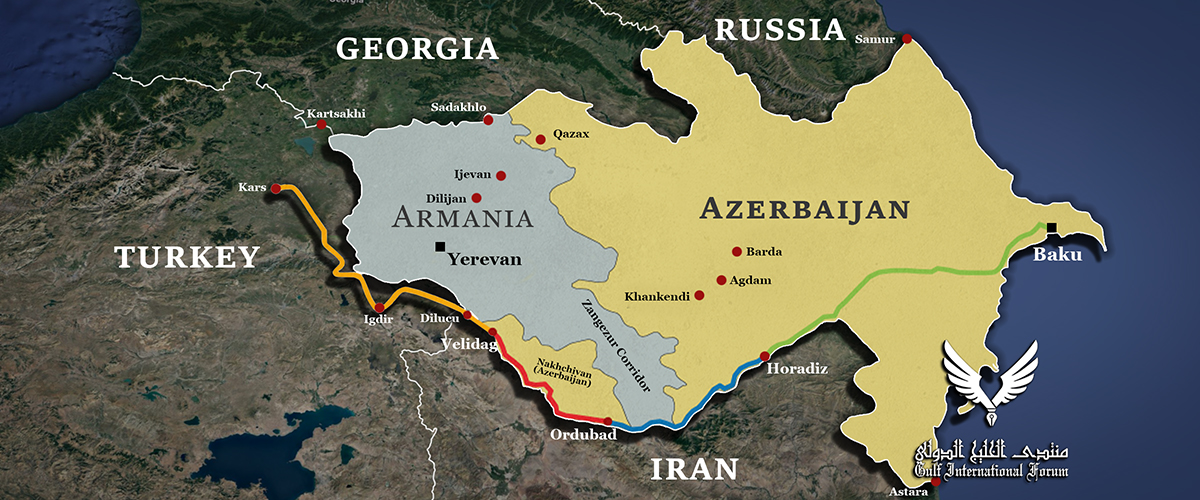
Suffice to say, the Zangezur Corridor will make Turkey a strategic hub in the geopolitics of the region if the Silk Road to Europe passes through its territory and the Soviet era land route to Russia reopens. Russia has separately promised to make Turkey an energy hub for export of its gas as well.
Much to Iran’s discomfiture, Turkey is exploiting Moscow’s dependence on Ankara in the conditions under western sanctions and the Ukraine conflict — Turkey controls the straits leading to the Black Sea from the Mediterranean— to muscle its way into the Caucasus and the Caspian, which has been traditionally Russia’s sphere of influence.
Meanwhile, Russia’s influence in the Caucasus suffered a setback as Armenia’s gradual drift toward Western benefactors following the colour revolution and regime change in Yerevan in 2018 has dramatically accelerated lately and taken an overt form. The Western powers are encouraging Armenia’s current leadership to leave the CSTO and seek the closure of the Russian bases on its soil where 5000 troops are garrisoned.
However, Armenia cannot do without Russia’s help. And Russia has strategic reserves to play itself back into the centre stage of the Caucasian chessboard. Of course, an optimal Russian comeback in the Caucasus will have to wait for its victory over the US and NATO in Ukraine, possibly by next year. Thus, Moscow seems confident that its pre-eminence in the Caucasus is a given.
Russia’s trump card, ultimately, is that much as the US and/or EU may try to get a toehold in the Caucasus, they are faraway powers and pretty much exhausted today with economic anxieties and growing war fatigue in Ukraine, amidst signs of disunity within the EU itself.
Indeed, a summit gathering close to 50 European leaders, dozens of aides and legions of journalists in Grenada, Spain, on October 5, which was billed as an opportunity to broker peace between Armenia and Azerbaijan, ended as a damp squib when Azerbaijan’s Ilham Aliyev and Turkey’s Tayyip Erdogan decided to skip the gathering and Azerbaijan accused France of bias in negotiations.
The bottom line is that in the power dynamic in the Caucasus, Iran is Russia’s natural ally and the two regional powers can be a factor of regional security and stability. This is important, since all sorts of dangers are lurking in the shade in the geopolitics of the Black Sea and Eastern mediterranean and Central Asia, and the darkening horizon presages storms ahead.
To flag a few ominous signs, the US has seized Israel’s escalating confrontation with Hamas and Hezbollah to resort to a major show of force in the Eastern Mediterranean — as if it is preordained. Such force projection cannot be an end in itself. Can it be coincidental that US-trained jihadi groups are also stirring up the Syrian pot lately?
Again, last week, a series of Ukrainian attacks in the Black Sea with Western-supplied cruise missiles forced Russian vessels to relocate from their main base in Sevastopol to the port of Novorossiisk 300 km to the east. British Defence Minister James Heappey promptly called it the “functional defeat of the Black Sea Fleet.”
Moscow is now reportedly planning to build a permanent naval base on the Black Sea coast in the breakaway Georgian region of Abkhazia.
Only a week ago, Russian Foreign Minister Sergey Lavrov warned that Moscow is alarmed by “the attempts of extra-regional players to become more active in the Afghan direction.”
Make no mistake, the US has not reconciled to the ascendance of Russian and Chinese influence in the Middle East or the Iran-Saudi rapprochement that led to an overall easing of tensions, especially Syria’s normalisation with its Arab neighbours, all of which which has drained America’s regional influence and weakened Israel.
Equally, with the spectre of a humiliating defeat in Ukraine haunting the Biden Administration, the temptation must be there to assert American hegemony. A confrontation with Iran is just what may suit Washington as ramp to cover its retreat from Ukraine’s battlefields.
Fundamentally, the US strategy is to get Russia bogged down on multiple fronts and prevent it from advancing Syria’s stabilisation optimally or consolidate its alliances with North African states — Egypt, Libya and Algeria — and expand its presence in the Sahel region which effectively thwarts NATO’s expansion plans in Africa.
Similarly, Iran’s surge as regional power has been to the detriment of Israel’s regional supremacy. Success of the US-Israeli strategy depends on piling pressure on Iran and Hezbollah, who were game changers in the Syrian conflict, and eroding the Russian-Iranian axis in West Asia, the Caucasus and the Caspian.
Armenia’s defection from the Russian orbit and the conflict situation currently developing in Gaza (and Lebanon) provide a window of opportunity to challenge Russia and Iran in the Levant. A vast armada of US warships is approaching the Eastern Mediterranean to intimidate Iran.
Meanwhile, the US hopes to undermine Saudi Arabia’s normalisation process with Iran and create contradictions within BRICS and OPEC Plus.
In sum, like in the famous play by the German modernist playwright Bertolt Brecht, The Caucasian Chalk Circle, we are currently witnessing a play within a play in the great game in Transcaucasia — an extraordinary blend of high theatricality, folk storytelling, music and even dialectical inquiry.
US Support for Israel May Set Off Total Middle East Upheaval – Former US Envoy
Sputnik – 10.10.2023
WASHINGTON – The United States will support Israel in all actions it takes against Hamas in Gaza after the killing of over 1,000 Israelis in Saturday’s incursion, but this will set off an anti-US wave across the Middle East and the wider Muslim world, former US Ambassador to Saudi Arabia Chas Freeman told Sputnik.
Israel formally declared a state of war on Sunday, a day after Hamas invaded Israeli territory and committed the greatest slaughter of civilians in the 75 year history of the Jewish state. On Monday, Israel put the Gaza Strip under full blockade, with no food, gas or electricity supplies. Both Israel and Palestine have so far reported hundreds of dead and thousands of injured as a result of the escalation.
“The United States will support Israel reflexively but this will set off a much wider anti-US reaction across the Middle East and the wider Muslim world,” Freeman, who also served as assistant secretary of defense for international security affairs in the Clinton administration, said in an interview.
The crisis is unlikely to be confined to Israel and Gaza and will metastasize to other neighboring countries, Freeman warned.
“The geopolitical dangers could very well rapidly spread to Lebanon and Syria,” he said.
The Israeli-US “pipedream” fostered by Prime Minister Benjamin Netanyahu that relations with Saudi Arabia are going to normalize is now also “gone” for the foreseeable future, Freeman believes.
The Biden administration itself appears to have been caught off guard by the ferocious suddenness and success of Hamas’ invasion, Freeman suggested.
“National Security Adviser Jake Sullivan last week made the truly idiotic claim that the Middle East region had reached a reassuring level of stability,” he said.
The Israel-Palestine war is Washington’s fault
By Robert Inlakesh | RT | October 10, 2023
The administration of US President Joe Biden and decades of failed American policy decisions in West Asia set the stage for the eruption of the horrifying violence we see today in Palestine and Israel. Through sidelining the Palestinian cause for statehood and instead seeking a symbolic normalization deal between Israel and Saudi Arabia, Washington overlooked its own regional strategy.
In the early hours of Saturday morning, the armed wing of Hamas, the Qassam Brigades, launched an unprecedented military operation against Israel. Scenes instantly flooded social media of Palestinian fighters gunning down Israelis in cities such as Ashkelon, blowing up military vehicles, and killing and capturing hundreds of Israeli soldiers. It was a surprise offensive the likes of which hadn’t been seen in over 50 years. It also represented a colossal failure for the Israeli government, military, and intelligence and security services, causing Prime Minister Benjamin Netanyahu to declare war on the Gaza Strip.
In the US, condemnation from politicians of the attack was unanimous and bipartisan, as elected officials expressed their outrage at the loss of Israeli life. However, in all of these statements, not a single one recognized their own government’s role in the attack. Washington, along with most of the collective West, has been imposing sanctions on the Palestinian Authority (PA) for nearly 17 years. The peace process between Israelis and Palestinians – aimed at reaching a ‘two-state solution’ whereby Israel and Palestine would exist side by side as independent, mutually-recognized states – has been effectively dead for around two decades, with the last failed attempt to pressure the Israeli government to negotiate coming under former US President Barack Obama.
In 2006, the legislative elections held in the Occupied Palestinian Territories (OPT) resulted in a landslide victory for Hamas. Failed US presidential candidate Hillary Clinton was recorded as having stated at the time that “we [the US] should have made sure that we did something to determine who was going to win.” While the US did not interfere, the American government decided it would sanction Gaza and cut off the flow of aid to the PA after the elections did not favor the Fatah Party it was financing.
Former US President Jimmy Carter, who brokered the 1979 Camp David Accords, an agreement that normalized relations between Egypt and Israel, said the following about the approach of the US government at the time: “If you sponsor an election or promote democracy and freedom around the world, then when people make their own decision about their leaders, I think that all the governments should recognize that administration and let them form their government.”
Not only did Washington actively oppose the democratic elections in the OPT, it went a step further and provided arms to Palestinians from the Fatah Party, plotting a coup that would use them to overthrow the Hamas government that was formed inside Gaza. The plan failed dramatically and Hamas kicked Fatah out of Gaza after a bloody civil war, completely taking over the territory, to which the Israeli government responded by imposing an all-inclusive military blockade.
Unlike other global powers such as Russia and China, the US never entertained the idea of giving Hamas the chance to govern as Carter had suggested. Instead, every American government has refused to engage with Hamas, deeming it a terrorist organization, but then ignoring the Palestinian political party completely and not formulating any solution to the situation that has been ongoing inside Gaza. In fact, the US government considers every single major Palestinian political party or movement as a terrorist organization, other than the mainstream branch of Fatah that partially controls the West Bank.
The Declaration of Principles, the first agreement in the Oslo Accords, was signed on the White House lawn over 30 years ago. The accords were supposed to solve the conflict in a span of five years, but failed due to America’s inability to function as a truly neutral peace broker. During the administration of US President Donald Trump, Washington abandoned the two-state solution altogether, through the pursuance of normalization deals between Arab nations and Israel. The issue of Palestinian statehood, which the UN agrees should be solved through a two-state solution, was sidelined as a non-issue and the one bargaining chip possessed by the Palestinians, Arab-Israeli normalization, began to be taken off of the table.
How did the Palestinian political parties respond to normalization in 2018? They overwhelmingly chose non-violent struggle, including in Gaza, where Hamas endorsed the ‘Great March of Return’, a mass protest movement which lasted around a year. Most of the protesters were peaceful, but it was the relatively small groups of Palestinians committing sabotage and anti-Israeli aggression at the border fence that made the news. In response, Israeli forces killed hundreds of Palestinians and injured almost 10,000. On the Israeli side, there was not a single dead soldier or civilian, while Israeli snipers targeted women, children, journalists, disabled people, and medical workers, according to a UN human rights report on the demonstrations. How did the US react to hundreds of thousands of unarmed Palestinian protesters marching on the separation fence between Gaza and Israel? It ignored them and continued to pursue Arab-Israeli normalization.
Under the Biden administration, the two-state solution was also sidelined and the plight of Palestinians was ignored as insignificant. Instead of seeking a solution to the violence which has been steadily escalating to levels not seen in 20 years, during the course of the past two years – especially in the West Bank – Biden has chosen to look the other way and has pursued Saudi-Israeli normalization instead. A deal between Saudi Arabia and Israel would also have the potential to collapse the Iranian-Saudi rapprochement, brokered earlier this year by China, in addition to potentially dragging Washington into an open confrontation with Yemen. Instead of seeking to fulfill the foreign policy pledges made at the start of his term in office, Biden has abandoned the idea of reviving the Iran nuclear deal and of ending the war in Yemen. He also decided to try and inflict a death blow on the Palestinian cause for statehood.
What Hamas just did from Gaza would never have happened if the US had pursued a somewhat rational approach to the region. It could even have been prevented if the US had presented a political plan to de-escalate rising tensions in the occupied territories. Instead, the American government decided to overlook the armed groups in Gaza while attempting to completely dismantle their cause. And all of this for what? A fancy photo op that Biden can use to steer the Democratic Party to victory in the presidential election in 2024, by claiming that he brought peace to the Middle East. Due to the current conflict, normalization doesn’t seem to be on the table anytime soon anyway, which would mean Hamas’ offensive has not only dealt a blow to Israel, but also to the US.
Now that Israel is at war with Gaza, what is the US doing? It is condemning one side, while arming Israel and greenlighting any action it takes. Initially, Washington even refused to urge a ceasefire, in contrast to the push for one from Moscow and Beijing. The White House refuses to acknowledge its role in creating the current violence and carries on with the exact same rhetoric and policy decisions that led to the horrifying war we see today.
Robert Inlakesh is a political analyst, journalist and documentary filmmaker currently based in London, UK. He has reported from and lived in the Palestinian territories and currently works with Quds News. Director of ‘Steal of the Century: Trump’s Palestine-Israel Catastrophe’.
Who Do Middle Eastern Countries Support in Israel-Hamas Conflict?
© AFP 2023 / Mahmud Hams
By Christina Malyk – Sputnik – 09.10.2023
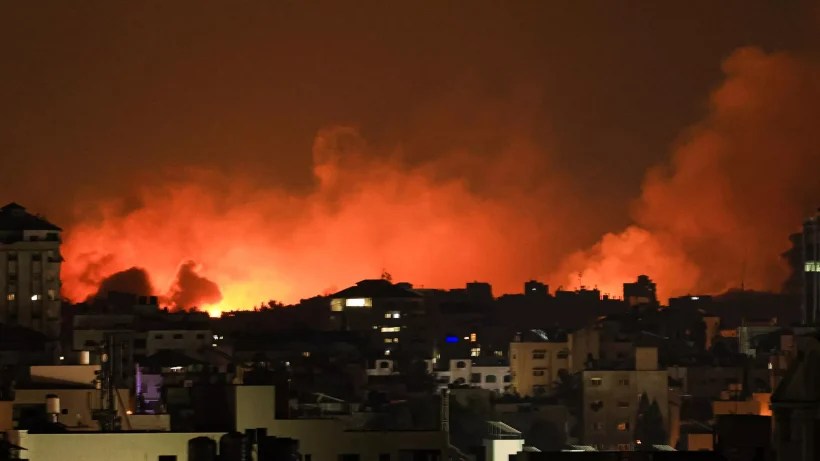
Hostilities have been raging around the Gaza Strip after Hamas units’ invasion to surrounding lands. The current escalation is projected to become one of the largest in the history of the Palestinian-Israeli conflict.
Both Israel and the Gaza Strip have found themselves in the middle of a complex conflict, in which different countries support different sides.
For his part, US Secretary of State Antony Blinken has reportedly spoken to several foreign ministers from Arab countries, asking them to condemn the Hamas actions.
The majority of Arab countries, especially the monarchies of Persian Gulf, have close political and financial ties with the US.
In September, Blinken and foreign ministers of the Gulf Cooperation Council agreed to strengthen ties in defense and security. The US and Gulf foreign ministers also reaffirmed their “commitment to free navigation and maritime security in the Gulf region” in a move against what Washington believes to be an “Iranian threat” in the region.
Sputnik tracked how regional countries have reacted to the latest developments in Israel and Palestine, and whether this connects with its US relations.
UAE
The UAE became the first Arab country to condemn Hamas’ actions.
“The [Foreign] Ministry stressed that attacks by Hamas against Israeli towns and villages near the Gaza strip, including the firing of thousands of rockets at population centers, are a serious and grave escalation. The Ministry is appalled by reports that Israeli civilians have been abducted as hostages from their homes. Civilians on both sides must always have full protection under international humanitarian law and must never be a target of conflict,” wrote the official ministry press release.
It also noted, “The Ministry deeply mourns the loss of Israeli and Palestinian lives as a result of the outbreak of violence, and calls on both parties to de-escalate and avoid an expansion of the heinous violence with tragic consequences affecting civilian lives and facilities.”
The statement was announced right after UAE Foreign Minister Sheikh Abdullah bin Zayed Al Nahyan’s call with Blinken.
Bahrain
An official statement made by Bahrain stressed the need for de-escalation between Palestinians and Israelis. The Ministry of Foreign Affairs of Bahrain is “supporting the peace process and establishing the Palestinian state according to the two-state solution and other international legitimacy resolutions.”
“The Kingdom of Bahrain is closely following the developments taking place between Palestinian groups and Israeli forces, leading to an increase in violence and armed attacks that claimed the lives of a number of people and injured others,” noted the Foreign Ministry.
Saudi Arabia
The Saudi Arabia Ministry of Foreign Affairs through an official statement on Twitter “calls for an immediate halt to the escalation between the two sides, the protection of civilians, and restraint.” Nevertheless, the Saudi Foreign Ministry reminded “the deprivation of the Palestinian people and their legitimate rights.” But Saudi Arabia did not blame Israel for the escalation.
On Saturday, in a phone call with Saudi Foreign Minister Prince Faisal bin Farhan, Blinken said the Kingdom should clearly condemn the attack, State Department officially said.
Nevertheless, the Saudi Foreign Ministry did not include any criticism of the attack or of Hamas. So, Saudi officials appear to be taking a wait-and-see stance.
Qatar
The Qatari Ministry of Foreign Affairs officially stated that Israel is “solely responsible for the ongoing escalation due to its ongoing violations of the rights of the Palestinian people.” Doha also expressed deep concern over the developments in the region and called for de-escalation as quickly as possible.
Earlier on Monday, Western outlets reported that Doha is mediating talks to swap Hamas-held hostages in coordination with the United States. But neither Israel, Qatar nor Palestine has confirmed this information. Later in the day, Hamas spokesman Husam Badran denied to Sputnik that any negotiations with Israel on prisoners exchange are taking place.
Kuwait
Kuwait officially expressed its “grave concern” over developments between Israel and the Palestinians, blaming Israel for what it called its “blatant attacks.”
Its Ministry of Foreign Affairs called for the international community, especially the Security Council, “to take responsibility and stop the ongoing violence, protect the Palestinian people and put an end to the provocative actions of the occupation authorities.”
Kuwait is one of the countries that strictly denies any contact with Israel.
Oman
The Ministry of Foreign Affairs of Oman called on Palestinians and Israelis to exercise restraint. Oman also highlighted “strategic necessity to find a just, comprehensive and lasting solution to the Palestinian cause on the basis of the two-state solution.”
Yemen
The Ministry of Foreign Affairs of Yemen officially blamed Israel for the current escalation. The ministry “called for the protection of civilians and an end to the provocations of the Israeli occupation forces and their repeated attacks on the Palestinian people and their sanctities.”
Iraq
Iraqi Foreign Minister Fuad Hussein expressed his full support for the Palestinian people “to act against the aggressive actions of the Zionist regime” during telephone conversation with his Iranian counterpart Hossein Amirabdollahian on Sunday.
However, the Foreign Ministry of Iraq has not issued any official statement yet. This may be connected with close ties with both the US and Iran at the same time.
Syria
Syria’s Foreign Ministry issued an official statement expressing support for the Palestinian people and the forces “fighting against Zionist terrorism.”
Moreover, Damascus described Hamas’ actions as “honourable achievement that proves the only way for Palestinians to obtain their legitimate rights is resistance in all its forms.”
Lebanon
The Lebanon’s Foreign Ministry issued no official statements on the Israeli-Hamas conflict. That said, Lebanon’s Hezbollah, which operates on Southern Lebanon near the Israeli border, praised Hamas for its “heroic operation” in a statement. Hezbollah also claimed responsibility for shelling Israeli territory during the escalation.
Jordan
Jordan’s King Abdullah said on Sunday there was a need to intensify diplomatic efforts to prevent escalating Israel-Palestinian violence with “dangerous repercussions” for the region’s security.
He also called for “urgent international action to avoid an escalation and prevent the region from the consequences of a new round of violence.”
In turn, Jordan’s Foreign Minister Ayman Safadi warned both Palestinian and Israeli sides of the “volatility”’ of the escalation.
Egypt
Egypt warned of the “severe dangers” posed by current escalation between the Gaza Strip and Israel.
“Egypt calls for international actors involved in backing the efforts of resuming the peace process to intervene immediately to halt the ongoing escalation,” Egypt’s Foreign Ministry noted.
Egypt has always been a peace process mediator between Israel and Hamas, working with the US. According to media outlets, both Western and local, Egypt tried to bring the parties to the negotiating table, but did not manage to do it.
Iran
Iran’s Foreign Ministry has strongly condemned “the usurping Zionist regime’s attacks against civilian targets in southern Lebanon and the Gaza Strip.” Foreign Ministry spokesperson Nasser Kanaani also stated that Hamas’ attacks showed increased confidence by the Palestinians against Israel.
Iran regards both Israel and the US as its own enemy.
Palestinian operation puts Netanyahu between rock and hard place: Ex-diplomat
By Alireza Hashemi | Press TV | October 9, 2023
The military operation by the Palestinian resistance movement Hamas has placed the embattled Israeli premier Benjamin Netanyahu in a dilemma of whether to save his own political future or the illegitimate regime itself, says a former Iranian diplomat.
In an interview with the Press TV website, Abolfazl Zohrevand, a former Iranian ambassador to Afghanistan and Italy, said the Al-Aqsa Storm (also known as Al-Aqsa Flood) operation has put Netanyahu and his far-right cabinet between a rock and a hard place.
Hamas stunned the regime in Tel Aviv with a multi-pronged attack early Saturday, launching thousands of missiles into the occupied territories within a span of 20 minutes and at the same time launching a ground attack against Israeli settlements and military bases near the coastal strip.
The Israeli death toll is staggering, with some reports putting it at above 1,000, besides hundreds of others – soldiers and settlers – who are held as prisoners of war by Hamas in the Gaza Strip.
Zohrevand said the Israeli regime can opt for a very tough response to the Palestinian resistance operation but such a response might lead to an existential threat to the regime.
“Israel can’t do much to punish the Palestinians through air strikes. Such strikes usually fail to hit Hamas’s underground infrastructure and only leave high civilian casualties,” he stated.
“Netanyahu has to start a ground invasion of Gaza, like what he did recently with the Jenin camp in the occupied West Bank,” the former diplomat said, referring to the July Israeli raid into the Jenin camp.
However, he hastened to add that such an operation could end in a humiliating defeat for the regime.
“If Israel decides to engage in a major operation, we should expect weeks-long clashes in the region. Israel isn’t made for long battles. Also, its military is not well prepared as the whole regime is in a state of chaos. The fact that it was caught completely off guard by the operation is a testimony to this,” Zohrevand stressed in a conversation with the Press TV website.
“On the other hand, Palestinians are prepared for such an invasion and they hold the upper hand as Gaza is their home. Palestinians are now sending a message that enough is enough. They’re highly motivated to fight the regime. So the odds for Israel’s success are not high.”
He said the Israeli military action would put the existence of the regime at risk.
“This war can easily spread to the West Bank and other regions. Also, there’s a real possibility that the regime might face a major operation by Lebanon’s Hezbollah. It’s really hard for the regime to handle two fronts. I personally believe the regime won’t start such an operation,” Zohrevand said.
Hamas has already said the operation will be extended to the West Bank.
The Lebanese movement Hezbollah has also staged attacks in solidarity with Palestinians, firing artillery shells and guided missiles at Israeli positions in the occupied Shebaa farms on Sunday.
The former Iranian diplomat noted that Netanyahu might want to accept mediation efforts by Turkey or Egypt and halt its ongoing operation, but that will put his political future in real danger.
“If he decides to stop the Israeli operation, his cabinet won’t last long as it is filled with extremist elements that came to power on a promise of crushing Palestinian resistance and annexing all the Palestinian lands once and forever,” he remarked.
“For Netanyahu, it boils down to a decision whether to save the regime or save his own cabinet or save the regime. He’s in a no-win situation.”
Debunking The Conspiracy Theory That Netanyahu Wanted Last Weekend’s Attacks To Happen
BY ANDREW KORYBKO | OCTOBER 9, 2023
Hamas’ sneak attack on Israel over the weekend prompted speculation among some on social media that the latter knew about these plans in advance but allegedly had an interest in letting them happen. According to proponents of this conspiracy theory, embattled Prime Minister Netanyahu wanted to unite his politically divided people and/or establish the pretext for destroying Hamas, ergo why he supposedly let these attacks unfold. That doesn’t make much sense though if one really thinks about it.
It’s fashionable nowadays to claim that leaders sometimes provoke foreign conflicts to distract from domestic political problems, but that’s arguably not the case with the latest Israeli-Hamas war. In fact, Netanyahu was pursuing the exact opposite approach up until last weekend as suggested by credible reports over the months that he was engaged in secret talks with Saudi Arabia over recognizing Israel. This was aimed at uniting Israelis around him and unlocking their country’s geo-economic potential.
Had these efforts borne fruit, then not only would his fiercest opponents have been forced to praise him for this diplomatic achievement, but Israel could then have profited from its central role in the India-Middle East-Europe Economic Corridor (IMEC) that was unveiled last month. Both goals required Saudi recognition of Israel, which Netanyahu hoped to obtain without recognizing Palestine’s independence, but that’s now in doubt since Riyadh might freeze these talks after Israel’s bombing of Gaza.
Those who claim that he knew about Hamas’ plans in advance but still let them happen are either unaware of his secret talks with Saudi Arabia, downplay their grand strategic importance, or think that they were all a ruse in preparation of this convoluted plot to establish the pretext for destroying Hamas. About that dimension of their conspiracy theory, it’s difficult to imagine that security-obsessed Netanyahu would let his country’s enemies inflict such unprecedented damage to Israel for that purpose.
He could always have simply exploited comparatively minor rocket fire to justify a disproportionate bombing campaign against that group without having to first lose literally hundreds of civilians and soldiers. Hamas’ breaching of the border barrier was also a strong blow to the Israeli psyche from which its people might never recover after having assumed that its construction would forever protect them. The same goes for that group doubling the territory under its control during the climax of its attacks.
Observers can still be opposed to the border barrier in particular, Israeli policy towards Palestine in general, and Netanyahu personally while also acknowledging that he’s such a security-obsessed leader that it doesn’t make sense to claim that he’d let Hamas powerfully undermine all three for any reason. He looks extremely weak after what happened, Israeli policy towards Palestine is now questioned from both sides like never before, and the border barrier is no longer deemed to be a credible defense.
These three outcomes represent the sum of Netanyahu’s worst nightmares, not to mention the likely failure of his plans to obtain Saudi recognition of Israel that would in turn unlock his country’s geo-economic potential via IMEC, all of which indisputably contradict Israeli interests. It remains unclear exactly how all of Israel’s security systems failed at the same time during last weekend’s attacks, nor has anyone explained the intelligence failures up until then either, but that’s indeed what happened.
The conspiracy theory speculating that Netanyahu knew about all this in advance but still let it happen doesn’t stand up to scrutiny as proven in this piece and is pretty much only predicated on the false perception that Israel’s intelligence services are omnipotent. They’re run by humans though and are therefore naturally imperfect, yet those who claim otherwise impart godlike power to the Mossad. This gives Israel too much credit while denying Hamas’ independent ability to organize attacks of this scale.
Hamas Attacks, What Does It Mean?
By Ian Welsh | October 7, 2023
For once I was taken by surprise. I didn’t expect this attack and despite my low opinion of the Israeli military, would not have expected it to be so successful.
Hamas actually captured the Israeli southern command base briefly. It was retaken with massive air strikes (meaning Israel was willing to hit its own people.) In the initial 12 hours or so they wiped the floor with local Israeli forces.
This is the most successful Palestinian military operation I can think of.
Hamas could not, of course, hold the ground it took and is retreating to Gaza. Israel has declared war and stated that they will invade Gaza.
A ground invasion will be extremely bloody, Gaza is one of the most densely populated places on Earth, and Hamas has had plenty of time to prepare. Bombing and shelling urban areas does not make invasion significantly easier.
Let’s draw out some specific points:
Complete Mossad Intelligence Failure
Mossad, the Israeli intelligence agency, has a fearsome reputation, but they either wanted the attack to happen (which is unlikely) or they were caught completely by surprise. This is an embarrassment, to vastly understate the case.
Israeli Military Weakness
As I have said repeatedly, and as the last war with Hezbollah showed, the Israeli army, no matter how many weapons or men or planes it has, is weak and incompetent. This is not the military of 1967 or even 1980, when the legend of Israeli military brilliance was created.
This is due to serving primarily as an occupation army. All occupation armies, fighting against the weak, become weak, brutal bullies incompetent at fighting real opposition.
The Israeli army was slow to respond, a general was captured and a command base. This is, again, humiliating.
Humiliation
Humiliation is the word of the day. Just as a bully whose victim manages to get in a few good punches has to be brutal in response, so Israel will lash out massively.
Context
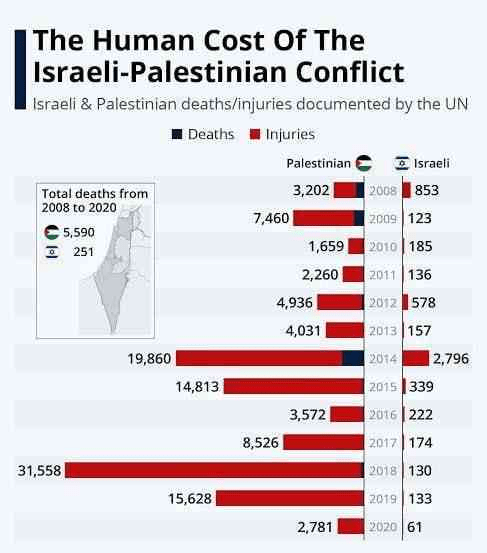
This is one reason why Hamas lashed out. No one could be expected to endure this, year on year, and not want to strike back. It is also why, while I have sympathy for anyone hurt or killed, I have no patience with crocodile tears from Israeli supporters, acting as if they haven’t been doing worse to Palestinians for years.
The Hezbollah Question
is whether they’ll attack. The answer seems to be “probably” as Hezbollah has said that if there is a ground invasion of Gaza, they will declare war. Hezbollah is no joke, they are battle hardened, have between 40K and 150K missiles, a drone force, and their own private comms system.
Israel is moving forces to the Lebanese border as we speak. Militarily speaking, if I were Hezbollah, I might attack sooner rather than later.
The Iran Question
Iran is Hamas and Hezbollah’s sponsor. It is VERY unlikely Hamas did this without Iranian greenlighting and if that’s so, the plan isn’t “do one attack, then get hammered.”
The “Iron” Dome
Israel’s missile defenses cracked under Hamas’s missile barrage. There is no question, if Hezbollah attacks, the Iron Dome will not shoot down most missiles. This time it won’t be Lebanon’s heartland being bombed mercilessly while Tel Aviv is spared, there will be carnage in both homelands.
Nukes
In some ways this is the bottom line. Israel has nukes. If they did not, I would expect Iran to join in and if I were Egypt, I might invade. Israel is weak and humiliated. But as long as they have nukes, other countries will shy off from direct war unless they think they have a way of taking out those nukes.
Diplomatic Damage
Israeli-Saudi Arabia negotiations are dead for the time being and other Arab allies will not be able to do anything but condemn Israel. There are massive demonstrations in support of Hamas in Turkey, Egypt and many other Muslim countries.
Ethnic Cleansing and Occupation
Israel has a huge problem, in that it has a massive population of non-citizens, and those non-citizens are out-breeding the citizenry, except for the ultra-orthodox Jews who do not serve in the military. This is an ulcer, and many Israeli politicians have been clear they want to just get rid of the Palestinians. They can’t genocide them, because it would destroy the Holocaust trump card, but many would love ethnic cleanse them. This may be an opportunity.
This is also an issue because if Israel wants to directly run Gaza, the occupation will be a bloody guerilla war, an endless bleeding ulcer.
If they don’t want to run it, they have to find a friendly quisling force, like the Palestinian authority, to do it for them, and at least right now, there’s no one to take that role. Hamas are more moderate than the other main Gaza factions.
The Ukraine Connection
Of significant amusement is that it appears that much of the weaponry used by Hamas is from stockpiles sent to Ukraine and sold on the black market. This spread of weaponry was predicted and lo.
Imperial Overstretch
Usually when Israel is in trouble the US airlifts in massive arms and munitions to help them, as they did in the 2006 war. But right now the shelves are almost bare because of Ukraine.
Balance of Forces
Hamas is obviously still the massive underdog. They are praying for Hezbollah to join in, and perhaps they want Israel to invade so they can fight a ground war against Israel on their own ground. The smart money is still on Israel.
But do not underestimate Hezbollah, and don’t underestimate how nasty this could get if Hezbollah does intervene. As noted above, they will be able to strike Israel’s heartland. If Israel attacks into Lebanon in response, with ground assets, my money is Hezbollah and if I were Hezbollah I would want that. Defeat the attack, then counter-attack into Israel.
If Hezbollah has to attack on the ground because Israel won’t oblige them I honestly don’t know how it will go.
But, while smaller and less well equipped, Hezbollah is the superior military with higher morale. If I were Israeli, I would not be sanguine.
Concluding Remarks
I won’t cavil, I think Hamas is justified in this attack. I also think the argument that settlers are civilians is weak (though by settlers I do not mean all Israelis.) Israel is an apartheid religious-ethnic state which stole another people’s land and continues to brutalize them.
The only humane solution, one which allows Israel to continue to exist, is a single state with everyone as full citizens.
Alas, that is not on the table.
In the long run, Israel as an ethic religious state, like the Crusader States, is doomed.
The only question is how many people have to suffer before Israel becomes a nation whose very basis is not completely unjust.
(Oh, and if Iran joins in.)
Featured Video

ARE PATIENTS BEING PROPERLY INFORMED ABOUT OZEMPIC?
or go to
Aletho News Archives – Video-Images
New Book
Breast Cancer: Before You Consent
A new Unbekoming paperback
Lies are Unbekoming | September 18, 2026
Peter Gøtzsche reviewed every randomised mammography screening trial ever conducted for the Cochrane Collaboration. Cochrane’s headline is that, assuming a 15% mortality reduction, one woman in 2000 avoids dying of breast cancer over ten years. Ten are overdiagnosed and treated. Two hundred experience false alarms.
But that headline assumes the reduction. When Gøtzsche looked only at the trials with adequate randomisation — the higher-quality ones — the reduction disappeared. No effect on breast cancer mortality. No effect on all-cause mortality.
This is the Cochrane finding, published in the establishment’s own database of systematic reviews.
No woman being asked to consent to a mammogram this week knows it.
That is why the new Unbekoming paperback exists. … continue
Blog Roll
 Aletho News
- The Truth About the Trump Shootings with Ken Silva
- ARE PATIENTS BEING PROPERLY INFORMED ABOUT OZEMPIC?
- US lawmaker blocks $2.8 billion weapons sale to Israel: Report
- Yemeni army claims responsibility for strikes on sensitive sites in Saudi capital, Aramco facilities in Yanbu
- Iran Judiciary issues indictments against 159 US, Israeli officials for assassination of Leader, commanders
- Turkiye revokes Iranian bank license under US sanctions campaign
- US-Denmark Agreement on Greenland Is ‘PR Stunt’ Ahead of Midterms
- Araghchi: Military intervention cannot create security; coercion cannot bring peace
- Fraud Squared
- Breast Cancer: Before You Consent
- If Americans Knew
- Inside Gaza’s death trap of collapsing, bombed-out buildings
- The everyday items Israel bans from Gaza every day
- Inside the siege, the ruined buildings of Gaza – Daily Update
- Debunking The Claim That Macklemore Has A “History Of Antisemitism”
- CPJ demands release of arrested Palestinian-US journalist near Bethlehem
- Robert Kraft: The Billionaire Friend of Netanyahu Pulling The Strings Behind the Macklemore/Ed Sheeran Blow Up
- Columbia Administered Fund Gives Big Money to Pro-Israel Groups
- Deportation Case of Palestinian Activist Salah Sarsour Tests First Amendment
- ‘We Will Not Forget’: Palestinians Mark 44 Years since Sabra and Shatila
- Why do we let Zionists decide what we can and can’t say?
- No Tricks Zone
- New Study: ‘Global Drought Shows No Detectable Recent Acceleration Under Climate Warming’
- Economic Masterminds: German Socialists Suggest Taxing Productivity Gains Stemming From Using AI
- The South China Sea Has Not Been Cooperating With The Climate Change Narrative
- Energy Crisis: Germany Enters Heating Season With Historically Low Gas Reserve Fill Levels
- New Study: The Antarctic Ice Sheet Gained Mass From 2020-2024 Due To Staggering Snow And Ice Accumulation
- Study: Ocean Heating Rates From Thousands Of Years Ago ‘Dwarf’ Modern Ocean Heating Rates
- Climate Extremists Target, Attack Large-Scale Power Grid Infrastructure In Germany!
- New Study: Antarctic Ice Melt Has Contributed Less Than 1 Centimeter To Sea Level Rise In The Last 30 Years
- Fear Of Debate: Alarmist German Climate Scientist Calls On Mainstream Media To Discredit Skeptic Voices
- End-Of-August Arctic Sea Ice Extent Hasn’t Fallen In 20 Years, Official Data Show!
 Aletho News