Deconstructing the election to Iran’s Majlis
By M. K. BHADRAKUMAR | Indian Punchline | February 24, 2020
Iran’s parliamentary election on Friday took place in extraordinary circumstances. The pandemic fear over coronavirus significantly impacted the voter turnout, which is estimated to be around 42% (as compared to 62% in the 2016 election to the Majlis). A dozen people have died so far in Iran and a few dozen diagnosed with the virus outbreak. There are conflicting reports. Turkey, Pakistan, Afghanistan, Iraq and Armenia have closed their border with Iran.
The election presages a robust comeback by the conservative faction known as the Principalists. In the 2016 election, the reformists, conservatives and independents won 41%, 29% and 28% of the vote respectively. But this time around, the reformists have been marginalised and the Principalists will dominate the 290-member Majlis with a commanding majority. The Principalists won all 30 seats from Tehran, which is traditionally a key battleground.
There are many underlying factors behind the popular discontent that the election results reflect — in particular, the anger at the 2015 nuclear deal’s failure to bring jobs and social improvements (as promised by President Hassan Rouhani), corruption, mounting social inequality, inflation and poverty rates, water shortages, spiralling cost of living and high unemployment. Strikes and protests among teachers and the working class became frequent in the recent years.
The US sanctions have devastated social conditions, driving up inflation and poverty rates. A report last year by the Iranian parliament’s research office acknowledged that some 57 million of Iran’s 80 million population would live in poverty.
Having established control over the Majlis, the Principalists will most certainly make a determined bid to capture the presidency in the August 2021 election when Rouhani completes the second term in office and must step down as stipulated by the constitution. A politically surcharged climate will prevail in the coming 18-month period.
Rouhani’s capacity to manoeuvre will be severely restricted and as a weakened president, he will have to depend on cooperation of the Principalists, which may not be forthcoming.
One peculiarity of the struggle is that it is also a reflection of differences over foreign policies, especially the standoff with the US. Broadly, the Principalists are hardliners in regard of Iran’s relations with the West, while the reformists have keenly (but vainly) sought Iran’s integration into the world economy by improving the country’s relations with the West.
Thus, the “big picture” is that the Trump administration’s maximum pressure approach has pushed Iran to the right. The assassination of the iconic IRGC general Qasem Soleimani in a US drone attack in January set in motion long-term shifts in Iran’s domestic politics.
Soleimani’s killing prompted the regime to resort to extreme measures to disqualify a broad swathe of moderate and centrist candidates from running in the parliamentary elections.
If Trump’s unilateral withdrawal from the 2015 nuclear deal dealt a mortal blow to Rouhani’s prestige and created a mass perception that the US is an undependable interlocutor with whom constructive engagement is simply not feasible, the killing of Soleimani has totally discredited Rouhani’s approach towards the US, which eschewed confrontation and placed the accent on diplomacy.
Put differently, the regime is circling the wagons, as it were, sensing an existential threat to the Velayat-e faqih — or guardianship of the Islamic jurist — which is the Shia Islamist system of governance since the country’s 1979 Islamic Revolution, built on the rule of the clergy over the state.
Several western analysts had warned that the Trump administration’s policies would inevitably discredit the reformists and shift Iran’s political calculus toward the right, with negative consequences for regional security. But such warnings fell on deaf ears.
It almost seems now as if the hardliners in the Trump administration preferred to have the Principalists at the helm of affairs in Tehran. Indeed, no sooner than the conservative surge in the Majlis election appeared, the US Secretary of State Mike Pompeo has floated an inflammatory idea, during a visit to Saudi Arabia this week, that in the coming months, he and Trump will make a major decision about whether to petition the UN to invoke what is known as “snapback” on a set of international sanctions on Iran that were lifted as part of the 2015 nuclear accord.
Such a move has been rumoured for some time but this is the first acknowledgement by the Trump administration. The idea is to “to deal a deathblow to the nuclear deal” and to provoke Tehran to react.
Tehran has already warned that any move to reimpose blanket UN sanctions on Iran will compel it to expel the IAEA inspectors and resume its pre-2015 nuclear programme. Iran may even quit the NPT (as North Korea did.)
In sum, as two well-known American experts Julia Masterson and Samuel M. Hickey wrote recently in an essay in the Bulletin of the Atomic Scientists titled The US has a backup plan to kill the Iran nuclear deal. It could spark a crisis at the UN :
“A snapping back of UN sanctions on Iran could also lead Iran to kick out international nuclear inspectors, resume additional nuclear activities, and threaten a regional war involving great powers, historic adversaries, and non-state actors across the Middle East. In short, it would manufacture a crisis that the world can ill afford.”
A reconciliation with the West seems all but out of the question for the foreseeable future. The ascendance of the conservatives will likely see Iran’s withdrawal from previous commitment to the 2015 nuclear deal. Free of international control, Tehran can redefine its stance as it wishes.
A concerted effort by Tehran to broaden and deepen relations with China and Russia can be expected. Iran will rely on China and Russia for investment and technology transfers in line with the pivot to “resistance economy”, dispensing with imported goods.
Bahrain and Palestine: At the Heart and Front of the Struggle Against US and Zionist Occupation
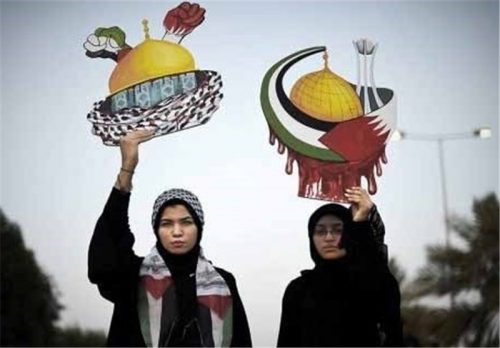
By Julia Kassem | American Herald Tribune | February 18, 2020
Nine years ago, on February 14 of 2011 to the date, massive anti-government protests swept Bahrain.
Yet the common narrative of Bahrain’s uprising as on the backburner of the failed Egyptian movement downplayed the real significance of Bahrain in struggle. Rather than writing it off as a failed after effect of the 2010-2011 Arab Spring protests, Bahrain should be recognized as a struggle of liberation against Western imperialism and occupation on par with the Palestinian struggle.
With a long, established root in history, and as the Resistance Axis scales up the regional call to expel US occupation following the assassination of IRGC General Qassem Soleimani, Bahrain deserves increasing attention.
Bahrain is a Persian Gulf island under the monarchist rule of the Al-Khalifa clan that had ruled Bahrain over two centuries, soon receiving the support of Britain following an 1820 treaty with the Al-Khalifa monarchs.
Post-Cold War, the United States would eclipse Britain as the main imperialist backer of Bahrain’s monarchy in the Middle East. As Britain tightened its relationship with Bahrain in 1919, it had also carved out the blueprint for the occupation of Palestine in 1917 under the Balfour Declaration.
The movement in Bahrain was brutally suppressed not just because of its uprising against one monarchy, but because of the unrelenting popular consensus by demonstrators for a government that is anti-Zionist, anti-American, and democratic. These calls were met with a brutal crackdown by Saudi-backed authorities that intervened a month later to quell the popular revolt.
Western media narratives had cast Bahrain’s uprising in the shadow of Egypt’s failed ‘revolution,’ relegating it to the backburner of a co-opted Arab “Sting.”
Bahrain may not have the highest number of American troops occupying the tiny island, with just neighboring Kuwait and Qatar hosting up to 13,000 US occupying forces each. Yet the tiny island, packs over 7,000 US troops, stationed, as of January 2020, in a tiny 765 km2 area.
It also has been made home to a US naval base since 1947, the oldest of its kind in the Middle East, established one year before the 1948 Nakba, the year the illegal Zionist occupation was made legitimate in the eyes of the so-called “international community.”
The United States’ Navy 5th Fleet, established in Bahrain in 1944 as the largest combat fleet in the world was only reestablished in 1995 after being inactive for 48 years. Yet it has situated itself as the useful output of US regional hegemony in the Persian Gulf, where the “area of responsibility for American fleets shuttling aircraft carriers and destroyers include pretty much every West Asian nation along the Red Sea, Gulf of Oman, Persian Gulf, and some of the Indian Ocean.
Poised for the US to have an easier shot at a number of nations under its threat, occupation, or watch, from Afghanistan, Lebanon, Syria, Iran, or Yemen, to a station to safeguard its the regimes it backs, like Jordan, Saudi Arabia, Bahrain, Egypt, and the UAE, its positionality is becoming even more critical in light of the US’s assaults, sea and land alike, against Iran.
History: Previous uprisings
To understand the reason behind the Western/Gulf insecurity behind popular uprisings in Bahrain, historically, one must draw upon the history of resistance against the monarchist elite in Bahrain.
An approximately 5-year uprising that began in 1994, the “uprising of dignity” by a coalition of both Shia and leftist factions against the ruling regime.
In 2006, the Al Bandar report revealed Saudi plans of sowing the seeds of sectarian tension in Bahrain, where a nearly $3 million financing of secret cells in the Bahraini government and its intelligence apparatuses, government-operated cover-NGOs, and sectarian propaganda was aimed at an intentional targeting of Bahrain’s more than 70% Shia majority.
That same year, Sheikh Abdul Amir al-Jamiri, a main spiritual leader of Bahrain’s Shia, passed away after decades of commitment and leadership to bringing justice to Bahrain. Al-Jamiri, the main leader of the mid-90s uprising, was credited for bringing secular leftist and Shia factions together in a unified call against a regime that, in its monarchy, was in service of capitalism, imperialism, and Zionism.
Yet al-Jamiri’s passing would later inspire the unified call for reform and revolt 17 years later. Unfortunately, Bahrain’s opposition coalition would accept the concessions put forth by the then-new emir Hamad al-Khalifa, enshrined in Bahrain’s 2001 National Action Charter.
Like the many agreements and negotiations handed to the Palestinians, this agreement, while bringing the country back to some provisions in the previous constitutional rule the monarchy clan stamped out in 1975, had the effect of doing little to curtail the economic and political supremacy of the monarchy and its systematic oppression of its majority population.
The Bahrain-Palestine connection
Both the oppressed of Bahrain and occupied Palestine have suffered for decades under the US’s ambitions to use their lands as military bases, supporting and backing neo-colonial regimes to help instill their political, economic, and military hegemony.
The illegitimate governments of both countries continue to US hegemony by, obviously, their military role as US-military bases but also for their benefits for US-dominated capitalism. For example, the Zionist entity’s tech sector has found its footing and high dependency on the U.S. economy. According to a December 2019 report by the ‘Israeli’ Ministry of Finance, US investments accounted for 35% of those in ‘Israeli’ tech in 2018, with the total amount of Israeli investors being lower at 30%. In Bahrain, the royal family has amassed at least $40 billion alone from 2000 to 2010 from land-grabbing schemes for development, both buying properties from the UK and brokering free-trade agreements with the US.
The result, in taking the lion’s share of land available for people’s commerce and trade, has caused a hike up in land and property prices, compounding the existing and intentional economic conditions of high native unemployment (at 35%) that afflicts the local youth. The Bahraini regime has accomplished essentially what the Israeli regime has in its occupation of Palestine: the weaponization of land grabbing as a regime-building tool as well as flooding the country with cheap, foreign labor effectively barring the native underclass from any economic agency or access.
More significant is the tactic and prevalence of arbitrary and forced detention endemic to the preservation of both US-backed regimes. Bahrain is the top country globally for political prisoners, with over 14,000 cases of arbitrary detention between 2011 and 2019 alone. This includes the detention of over 1,700 children. The Zionist entity, similarly, replicates this tactic and these projections: since 1967, the occupation has arrested over 800,000 Palestinians, including 50,000 children, with over 1,250 minors under arbitrary detention between 2011 and 2018 alone.
Characteristic of the Zionist and Bahraini regimes, in addition to their routine arbitrary detention of civilians and children, is their brutal imprisonment and torture of movement leaders and dissidents; especially those that have played vital roles in uniting the opposition.
This is exemplified by the detention of Marwan Barghouti or Khalida Jarrar in occupied Palestine or Ayatollah al-Qassem and Ebtisam el Sayegh in Bahrain. These are just a few of the hundreds of thousands of leaders and activists that have endured torture, repeated arrests, in order to quell the rich ideological leadership committed to resistance to occupation and oppression in both the Bahraini and Palestinian nations.
Both the Deal of the Century and the recent uptick in torture against Bahraini prisoners of conscience can give their thanks to the acceleration of support and reinforcement from the United States under the Trump administration.
The Obama administration did no more than offer a trickle of lip-service criticism against the Zionist and Bahraini regimes in his time in office, countered anyway by his first-term Secretary of State Hillary Clinton’s warm embrace of both: Clinton has always considered herself a “strong supporter” of the Occupying Entity as she did commend Bahrain’s king.
While the US’s arms sales to Bahrain had somewhat halted under Obama’s term, which had otherwise undergone the steady increase of bombings and drone warfare in the Middle East, due to human rights concerns, the Trump administration had carried out $5 billion in sales of Lockheed’s F-35 fighter jets to the monarchy in 2017.
In 2009, the Bahraini government had planned to spend a billion on security and defense in the country, looking to several Saudi and American defense contractors, including Lockheed Martin, for its purchases.
Just as Trump unveiled and greenlit his development-oriented “Deal” for Palestine, he had also, greenlit massive torture, along with arms sales, to the Zionist, Saudi, and Bahraini regimes.
As one torturer famously said to el Sayegh: “Do you know that we have a green light from Trump?”
Similar to how the Zionist entity employs its handsome security packages–a 2018 gift of $38 billion over 10 years–towards brutal neighborhood raids in the West Bank, its next site of total mass expulsion thanks in part to the Deal, Bahrain too has put Trump’s generous donations and pledges to mass raids.
Like the Zionist entity, the Bahraini regime regularly engages in mass-raids. Shortly after the 2011 uprising, over 430 members of the opposition Al-Wifaq party, also teachers, clinicians, and day-laborers were violently arrested in night raids.
The largest and most brutal case came shortly after Trump’s May 2017 “green light.” Bahrain’s security forces raided Sheikh al-Qassem’s home, shot and killing five demonstrators and arrested 286.
As Sondoss Al Assad, a Lebanese journalist who focuses especially on Bahrain wrote in a recent article for American Herald Tribune:
“Blessed by Trump’s Green Light, Manama has intensified its brutal measures, which also met out collective reprisal against scores of peaceful opposition figures and human rights advocates.”
Just last June, the convening to pass the Zionist-American “Deal of the Century” was hosted in Bahrain, signifying the tight-knit connection both the Zionist and Bahraini regimes have in extending their influence in the Levant and Persian Gulf fronts, transforming the lands they occupy into development enterprises as well as American military bases.
A Bahraini man Monday was sentenced three years for burning the flag of the illegal Zionist entity at an anti-’Israel’ demonstration last May. Bahrain, through history and in its present, is truly emblematic of, as Sayyed Hassan Nasrallah said in a February 16th speech, ‘a treachery platform conspiring against the Palestinian cause.”
For this reason, it is imperative that both Bahrain and occupied Palestine be at the heart of the Middle East’s liberation struggle. It is expected that the Deal will ignite an intifada and regional rejection that has been consistently brewing in occupied Palestine. At the same time, a regional consensus amongst the resistance axis to expel American presence and forces from all Arab and Muslim soil, particularly in Iraq, will be crucial in Bahrain, and draw the curtains of occupation on both these two birth-sites of US and British imperialism in the region.
Sayyed Nasrallah: Trump’s Two Recent Crimes Usher Direct Confrontation with Resistance Forces
By Mohammad Salami – Al-Manar – February 16, 2020
Hezbollah Secretary General Sayyed Hasan Nasrallah stressed Sunday that the United States of America has recently committed two major crimes, the assassination of the head of IRGC’s Al-Quds Force general Qasem Suleimani as well as the deputy chief of Iraq’s Hashd Shaabi Abu Mahdi Al-Muhandis and the announcement of Trump’s Mideast plan.
Sayyed Nasrallah stressed that those two crimes had ushered a direct confrontation with the axis of resistance in Lebanon, calling for forming a comprehensive resistance front against the United States all over the world.
Delivering a speech during Hezbollah’s “Martyrdom & Insight” Ceremony which marks the anniversary of the martyrs Sheikh Ragheb Harb, Sayyed Abbas Al-Moussawi and Hajj Imad Mughniyeh and the 40th day after the martyrdom of General Suleimani and Hajj Al-Muhandis, Sayyed Nasrallah emphasized that in this confrontation with the United States, we have to trust God’s help, keep hopeful for a bright future and challenge our fear.
Sayyed Nasrallah pointed out that the so-called “deal of the century” cannot be described as a ‘deal’ because it refers merely to the plan of the US president Donald Trump’s plan to eradicate the Palestinian cause.
All the Palestinian forces have rejected and may never approve Trump’s scheme, according to Sayyed Nasrallah who considered that this is basic in frustrating the US plan.
Sayyed Nasrallah noted that consistency of stances which reject Trump’s plan is required to frustrate it, adding that the US will is not an inevitable destiny and citing previous cases of Washington’s failure when opposed by resistance.
No one approved the US plan except Trump and Netanyahu, according to Sayyed Nasrallah who underscored the Palestinian, Arab and international rejection of the scheme.
The Hezbollah leader hailed the consensus of the Lebanese political parties which have rejected Trump’s plan, attributing this attitude to the recognition of the dangers of the scheme to Lebanon and the entire region.
Sayyed Nasrallah noted that Trump’s plan affects Lebanon because it grants the occupied Shebaa Farms, Kfar Shuba hills and the Lebanese part of Al-Ghajar town to the Zionist entity, stipulates naturalizing the Palestinian refugees and impacts the border demarcation.
“The spirit of Trump’s plan will be decisive in the issue of demarcating the land and sea borders with occupied Palestine and will affect Lebanon’s oil wealth.”
Sayyed Nasrallah pointed out that what reassures the Lebanese about the rejection of the naturalization of the Palestinian refugees is the consensual attitude of all the parties in this regard, calling for respecting certain groups’ fears related to this issue.
Israeli delegation visits Saudi Arabia for first time
Press TV – February 14, 2020
A high-ranking Israeli delegation from an umbrella US Jewish group has visited Saudi Arabia this week, a sign of increasing warmness between Tel Aviv and Riyadh as the two sides look to forge closer informal ties and expedite normalization efforts.
Israel’s English-language broadsheet newspaper The Jerusalem Post reported on Friday that members of the Conference of Presidents of Major American Jewish Organizations visited Saudi Arabia this week, a move believed to be the first official visit to the kingdom by an American Jewish organization since the Oslo peace process in 1993.
The Jewish Telegraphic Agency said the visit, which took place from Monday to Thursday, included meetings with senior Saudi officials as well as with Sheikh Muhammad bin Abdul Karim bin Abdulaziz al-Issa, the secretary general of the Muslim World League.
Issa is regarded as a close associate of Saudi Crown, Prince Mohammed bin Salman.
The New York-based news agency said the focus of the talks between the Conference constituents and Saudi officials was on countering terrorism and the instability in the Middle East region.
The Conference’s leadership, executive vice president Malcolm Hoenlein, and CEO William Daroff, are expected to have been present during the visit.
Saudi Arabia has expanded secret ties with Israel under the crown prince, the son of King Salman, who is viewed by many as the Kingdom’s de facto ruler. The young prince has made it clear that he and the Israelis stand on the same front to counter Iran and its growing influence in the Middle East.
Back in 2018, Saudi Arabia opened its airspace for a commercial flight to Israel with the start of a new Air India route between India and Israel, although El Al Israel Airlines might not use Saudi airspace for eastward flights.
Critics say Saudi Arabia’s flirtation with Israel would undermine global efforts to isolate Tel Aviv and affect the Palestinian cause in general. They say Riyadh has gone too far in its cooperation with the Israelis as a way of deterring Iran as an influential player in the region.
Israel has full diplomatic relations with only two Arab states, Egypt and Jordan, but the latest reports suggest the regime is working behind the scenes to establish formal contacts with Persian Gulf Arab states such as Saudi Arabia, the United Arab Emirates and Bahrain.
In another sign of warming ties between the regimes of Israel and Saudi Arabia, last month Tel Aviv officially allowed Israelis to travel to Saudi Arabia for the first time.
The move comes against the backdrop of a so-called peace plan unveiled by US President, Donald Trump, that supposedly aims to resolve the decades-long Israeli-Palestinian conflict.
Trump unveiled the scheme’s outlines on January 28. The plan features the recognition of Jerusalem, al-Quds, as Israel’s “capital,” although Palestinians want the city’s eastern part as the capital of their future state.
The US president also said that under the plan, Israel would be annexing the settlements that it has been building in the West Bank since occupying the Palestinian territory in 1967.
This is while all previous foreign-mediated draft agreements between the Palestinians and Israelis as well as repeated United Nations resolutions have mandated Tel Aviv to withdraw behind the 1967 borders.
Palestinian leaders, who severed all ties with Washington in late 2017 after Trump controversially, recognized Jerusalem, al-Quds, as the capital of the Israeli regime, immediately rejected the plan, with President Mahmoud Abbas saying it “belongs to the dustbin of history.”
Palestinian leaders also said the deal is a colonial plan to unilaterally control historic Palestine in its entirety and remove Palestinians from their homeland, adding that it heavily favors Israel and would deny them a viable independent state.
Meanwhile, senior Arab diplomatic sources said last week that the Saudi crown prince might meet Netanyahu on the sidelines of a potential summit in Cairo as the Israeli premier was seeking talks.
Saudi Foreign Minister, Prince Faisal bin Farhan, however, asserted on Thursday that there are no plans for a meeting between Salman and Netanyahu.
Speaking to al-Arabiya English, he also claimed that Saudi Arabia’s policy toward Palestine remained “firm.”
This is while Riyadh has welcomed Trump’s plan, saying “the Kingdom appreciates the efforts made by President Trump’s administration to develop a comprehensive Palestinian-Israeli peace plan.”
It has urged “direct peace negotiations between the sides under US sponsorship, in which any dispute regarding details of the plan will be settled.”
Saudi government media have also urged the Palestinians not to miss “this opportunity” and to approach the so-called US “deal of the century” with a positive mindset.
Israel sets up new Iran command for action against Iran: Report
Press TV – February 14, 2020
The Israeli military has set up a new “Iran command” amid Tel Aviv’s anti-Tehran confrontational rhetoric, according to Israeli media.
According to The Jerusalem Post, the multiyear “momentum plan” was presented by Israeli chief of staff lieutenant general Aviv Kochavi to all military commanders on Thursday.
The plan, despite awaiting an official approval by the Israeli cabinet, has been endorsed by military affairs minister Naftali Bennett and presented to prime minister Benjamin Netanyahu.
The new “Iran command” will be led by a major general and will seek to “bolster” the “attack capabilities” and “intelligence gathering on the Islamic Republic”, including by means of cyber and satellite operations.
The plan will also set up a new “rapid-maneuvering” infantry division to “penetrate enemy territory”.
Among other provisions in the plan, Israel will seek to double the number of its precision weapons and further increase the number of its missile interceptor systems across the occupied territories.
According to the report, the creation of an “Iran command” comes as the Israeli military is worried that its opponents are gradually growing stronger, with the “gap” between them “closing quickly”.
Tel Aviv has adopted an open policy of provocative military action against Iran and certain regional states allied with Tehran.
Following the defeat of foreign-backed terrorist groups in Syria and Iraq, Israel has stepped up its military aggression against the two countries in fear of an emerging Iran-led alliance against terrorism and foreign occupation forces.
On Saturday, Bennett said that Tel Aviv and Washington had divided up the fight “against Iran” in Syria and Iraq respectively.
In October, Kochavi said that despite knowing that its enemies are not interested in war, the Israeli military has “increased its pace of preparations” for confrontation.
‘Searching for an excuse to level Tel Aviv’
Iran’s support, provided chiefly under the command of top Iranian general Qassem Soleimani, had had a major role in empowering Syria and Iraq to fight against foreign-backed terrorists and foreign occupation in their countries.
Anti-terror commander, Lt. Gen. Soleimani was assassinated by US forces in early January while on an official visit to Iraq at Baghdad International Airport.
According to recent remarks by Major General Mohsen Rezaei, a top IRGC general and the secretary of Iran’s Expediency Council, Israel had a direct role in the assassination by informing Washington of Soleimani’s flight to Baghdad International Airport.
“We were searching for the Americans to give us an excuse to hit Tel Aviv just as we hit Ain al-Assad,” Rezaei said. “We would have leveled Tel Aviv no doubt,” he added.
Speaking on Thursday, Chief Commander of the Islamic Revolutionary Guards Corps Major General Hossein Salami responded to Bennett’s remarks about dividing roles with the US against Iran.
“We tell them that you are making a mistake, as always,” he said, adding that “if you make the slightest error, we will hit both of you”.
“We have told them repeatedly; do not rely on the United States, they may not able to help you,” he said. “If you want a reliable plan, look towards the sea as it is your final resting place,” he added.
The IRGC chief made the remarks during a ceremony marking the 40th day since the assassination of General Soleimani.
During the ceremony, Salami said that Soleimani’s efforts had greatly emboldened Palestinian resistance against Israel.
“When he entered the battlefield against the Zionists, the Palestinians were fighting with stones, but due to Soleimani’s efforts, Gaza, the West Bank and north of Palestine have become fields of fire against the Zionists,” Salami said.
“They have consequently concealed themselves behind walls; Soleimani put the Zionists in prison,” he added.
Salami added that Soleimani had defeated Washington’s plans for a “new Middle East”, noting that due to the general’s efforts, a multi-national force has emerged in the region to resist US and Israeli plans.
“General Soleimani generated so much power that if the Zionists only listen slightly next to the their borders, they can hear the languages of Pakistanis, Iranians, Hijazis, Lebanese…,” he said.
The IRGC chief lauded Soleimani’s legacy of defending “the downtrodden, wherever they were”, adding that the “deserts knew him more than the streets”.
“The Hindu Kush ranges, the Bamiyan and Panjshir valleys in Afghanistan knew him better than the Afghans,” Salami added.
Salami concluded his remarks saying that “the final and ultimate slap will continue until the last American soldier leaves the Muslims land” despite Iran’s military retaliation against Washington following the assassination of Soleimani.
Iran fired a volley of ballistic missiles at the Ain al-Asad airbase and another US-occupied outpost in Erbil, the capital of the semi-autonomous Iraqi Kurdistan on January 8, a few days following the assassination.
Despite the Trump administration initially denying any casualties, the Pentagon has since gradually revealed that at least over 100 US soldiers have suffered from “brain injuries” in the operation.
Speaking on Thursday, IRGC spokesman Brigadier General Ramezan Sharif said that Washington has sought to conceal the number of its killed soldiers by using the term “brain injury” to describe casualties.
Sharif added that the assassination of Soleimani and Abu Mahdi al-Muhandis – who was the second-in-command of Iraq’s Popular Mobilization Units – “marked the beginning of the end of US presence in the region” and that it will lead to the liberation of Jerusalem al-Quds.
Gen. Soleimani assassinated to sabotage Iran’s talks with Saudis, UAE following Israeli briefing: NYT
Press TV – February 14, 2020
Washington ordered the assassination of top Iranian General Qassem Soleimani to sabotage de-escalation talks between Iran, Saudi Arabia and the United Arab Emirates following a report by Israel’s Mossad spy agency, according to the New York Times.
The paper reported on Thursday that General Soleimani had been arranging talks in Saudi Arabia and United Arab Emirates in order to de-escalate tensions with Tehran.
The Times wrote that the talks happened after Saudi Arabia and the UAE, which are central to the Trump administration’s so-called regional alliance seeking to pressure Iran, began to question the efficiency of Washington’s anti-Iran campaign.
According to the report, one such meeting took place last September in Abu Dhabi, the capital of the United Arab Emirates where a plane carrying “senior Iranian officials” landed for talks.
News of the meeting, which reached Washington only after it was notified by reports from American spy agencies, “set off alarms inside the White House”, according to the report.
The report added that a similar mediation attempt, also arranged by Gen. Soleimani, was underway between Tehran and Riyadh using Iraqi and Pakistani intermediaries.
The report wrote that the developments had greatly concerned Israel, which had been trying to push the Trump administration to exert more pressure on Tehran.
According to the Times, US Secretary of State Mike Pompeo met Mossad chief Yossi Cohen on October during a trip to Israel where he was briefed on Iran’s attempted de-escalation talks with Saudi Arabia and the UAE.
Cohen warned Pompeo that Tehran was effectively on the verge of achieving its “primary goal” of breaking up the so-called “anti-Iran” alliance.
A few months later in early January, General Soleimani was assassinated by Washington’s order while on a formal visit to Baghdad.
According to former Iraqi prime minister Adel Abdul-Mahdi, General Soleimani was due to formally meet the Iraqi premier during the trip and was carrying Tehran’s response to a message from Riyadh regarding the de-escalation talks.
Following the attack, the Trump Administration claimed that the assassination had taken place after a reported rocket attack on a US base in Iraq killed a “US civilian contractor” and that Gen. Soleimani was an “imminent threat” to US citizens.
Many US political figures have rejected the claims and have questioned why the Trump administration has failed to provide any evidence backing its actions.
The New York Times’ Thursday report, however, reveals that entirely different considerations, such as Israel’s push to undermine Iran’s attempts at peace with its regional neighbors, were behind the assassination.
‘Months of miscalculations’
According to the report, the assassination marks yet another miscalculation by the Trump administration which has failed to bend Iran through its “maximum pressure” campaign.
Following its unilateral withdrawal from the 2015 Iran nuclear deal in 2018, the US imposed unilateral sanctions against Tehran in a bid to goad Tehran to accept new terms dictated by Washington.
The Times, however, reported that a recent analysis conducted by the Central Intelligence Agency (CIA) shows that the sanctions have had little effect in fulfilling Washington’s goals.
The US has also sought to pressure Iran militarily by deploying troops to the region and creating a regional anti-Iran alliance in the region as part of if its anti-Iran campaign.
Washington called for the formation of a naval coalition in the region following a string of suspicious attacks on oil tankers in the Persian Gulf.
Iran has vehemently denied the accusations, saying the incidents appear to be false flag operations meant to frame the Islamic Republic and push US interests.
Citing instances such as the major Yemeni attack on Saudi oil facilities last September and Iran’s downing of a US Global Hawk spy craft in June, the New York Times report said stepped-up US military presence also failed to achieve its objectives.
Witnessing the Trump administration’s faltering policy in the Middle East, Saudi Arabia and the UAE were convinced to open direct talks with Tehran, the report noted.
The Zionist War without End

By Jeremy Salt | Palestine Chronicle | February 12, 2020
A reiteration of the war on Palestine, on the Arab world, on the Muslim world, on international law and human rights. There is no other way to describe the Trump-Kushner-Netanyahu ‘deal.’
Media comment centers on the last opportunity for the Palestinians. Will they take the scraps they are offered, or will they miss yet another opportunity to have something taken away from them?
This was the line used over decades by the glib Irish-born Zionist ‘foreign minister,’ Aubrey (Abba) Eban. The Palestinians never miss an opportunity to miss an opportunity, he said many times.
In fact, if anyone has never missed an opportunity to miss an opportunity it is the Zionists. They could have chosen to live with the Palestinians instead. They could have accepted their return after 1948. They could have handed back the land they seized in 1967. They could have honestly engaged with the so-called ‘peace process.’ They could have ended the blockade of Gaza. They could have stopped seizing and settling the land of another people. They could have agreed to share Al Quds. They could have stopped their murders and assassination.
What they could have done they never did. Instead, they headed in the opposite direction, financed, armed, protected and encouraged by the most powerful nation in the world.
A vulgarian property developer who once made ads for Pizza Hut has now told his zionist settler sidekick that he can have Palestine with the lot. Nothing is missed out, not Jerusalem, not the Jordan Valley and not the illegal settlements – the ‘outposts’ – as well as the legal ones, so says Netanyahu. All are completely illegal, of course, as is the presence of every settler on occupied land.
This demented agreement was put together by the plastic-faced Jared Kushner, who said, seriously apparently, that he read all of 25 books to get a handle on the situation. By comparison, Trump is unlikely to have read one so no wonder that he thinks his son-in-law is a genius.
This ‘deal’ – a deal without wheels – is being taken seriously in the mainstream media. In a way, of course, it has to be taken seriously as the Zionists have the weaponry to do whatever they want, no matter how mad, rapacious or destructive of their own interests in the long term.
And this is something the media seems to have missed. For whom, really, is this plan the last opportunity? The assumption is that it is the Palestinians but have Trump and Kushner noticed that while the Palestinians do not have the weapons, they have the numbers, that already the Muslim-Christian population of Palestine between the Mediterranean and the Jordan river is already greater than the Jewish population.
Silly to ask, but have either of these two taken into account the Muslim hinterland, the Muslim population of the Middle East and North Africa (close to 600 million) and the world Muslim population (about 1.8 billion)?
By comparison, the Jewish population of occupied Palestine is less than seven million. Far from trying to settle into the Muslim world, over more than seven decades it has done nothing but antagonize it. Like a spoilt child, it then complains that no one likes it, that the real reason for Muslim loathing of the Zionist state is anti-semitism, and not its racist, murderous and thieving behavior.
This is the game played endlessly by the Zionist lobby around the world. It hides behind the symbols of the religion it has hijacked. The Star of David flies from the pennants of the tanks that shell apartment buildings in Gaza and is inscribed on the wings of the planes that destroy entire families with missiles.
It is scrawled triumphantly on the walls of the West Bank. This is the Israel that the lobbyists and the rabbis defended behind their accusations against Jeremy Corbyn. It is he who wanted to end these horrors and they, behind their lies and false accusations of antisemitism against Corbyn and the entire Labor Party wanted to leave the Zionist state free to continue them. It is they who are the racists and anti-Arab Semites, not Jeremy Corbyn.
Palestine remains part of Arab and Islamic history and identity and remains an Arab and Muslim cause whatever the exasperation felt at Arab governments and the bungled and/or collaborationist policies of the Palestinian leadership.
By themselves, the Palestinians had no hope of resisting the Zionist takeover of their land. Zionism was an imperial project and the Zionist state was sequentially backed by the two mightiest empires on the planet, first Britain and then the United States. No small group of people anywhere would have been able to resist their power.
The greater danger to Israel always lay in the surrounding Arab and Muslim world. George Habash, the founder of the PFLP (Popular Front for the Liberation of Palestine) was writing in the 1950s that the road to the liberation of Palestine ran through the Arab world and this remains as true today as it was then, although the statement has to be qualified by adding “and the Muslim world.”
Israel understood this just as well as George Habash and knew that if it were to survive in the long term, the Arab world had to be fragmented, subverted, dominated and kept off balance permanently. This was the sine qua non of Israel’s existence. The ties that bound states together, that bound the region together and connected it with the wider Islamic world had to be broken.
It was not just armies and states that had to be broken but the Arab national idea and the Arab world as a presence in history and a place on the map. It would have to be what Israel and the US wanted it to be. It would have to be remade.
Towards this end, the zionists were looking for weak links in the chain of Arab states even in the 1930s. They thought they had found the weakest in Lebanon, where they hoped to set up a puppet Christian government. Not only did this not work but since the rise of Hezb0llah, the weakest link in the chain has turned into one of the strongest.
The Yinon Plan of the 1980s set out the strategy in full. All Middle Eastern states were to be subjected to ethnoreligious or tribal division. This broad script was fine-tuned by Netanyahu and the Zionists inside the US administration in the 1990s.
Iraq was the first of seven states targeted for destruction. The destruction through two wars and a decade of sanctions was enormous but the political strategy failed. The Kurdish state-in-being, planned by the US and Israel as a new center for strategic operations in the Middle East, has collapsed. The Shia-dominated government in Baghdad maintains good relations with Iran and following the assassination of Qasim Soleimani the Iraqi parliament demanded the complete withdrawal of US forces. Millions of people marched through the streets of Iraq’s cities as they did in Iran to mourn the murder of this outstanding military commander. Anti-American feeling in Iraq is at an all-time high.
The war in Syria was designed to bring down the axis of resistance (Iran, Syria, and Hezbollah) at its central arch but that has failed, too. Syria, its people, and its military have resisted the most determined attempt ever made to destroy an Arab government.
Always popular, Bashar al Assad is now more popular than ever, as the army, backed by Russian airpower, drives the takfiri terrorists from their last redoubt in Idlib province. Syrian cities have been shattered, perhaps half a million people have been killed but the US-Israeli political strategy in Syria has failed too.
For anyone who has been watching closely enough, the wheel of history, once turning in Israel’s favor, has been slowly turning against it for decades. Israel came close to defeat in the first week of the 1973 war. It drove the PLO out of Lebanon only to awaken a far more powerful enemy, Hezbollah. In every war it has fought or operation it has launched, the remorseless use of airpower has been critical. Nevertheless, even with air cover its foot soldiers were driven out of southern Lebanon in 2000 and, outfought by Hezbollah’s part-time soldiers, humiliated again when they returned in 2006.
Hezbollah and Iran have been working for decades on how to neutralize Israel’s air power. If – or once – they succeed in doing this, Israel is going to be in deep trouble on the battlefield.
Threatened repeatedly with destruction by the US and Israel, Iran has had to develop a new range of missiles capable of causing devastation to US bases, aircraft and warships in the region. The retaliation which followed the murder of Qasim Soleimani was an example. The Americans failed to stop even one of the Iranian missiles directed against two of its bases in Iraq.
Aircraft were destroyed in their hangars and while no soldiers were killed – so the US government says – dozens suffered severe brain injuries, apparently from concussion, with a number being flown to Germany for emergency treatment. Iran says the casualties were far greater than the US is prepared to admit.
Hezbollah has its own stocks of missiles, far greater in number and sophistication than in 2006, and has its targets already worked out for when the next war comes. As Israel’s military commanders are making clear, the next war is a question of ‘when’ and not ‘if.’ They are warning the civilian population to be prepared for the unprecedented scale of the casualties they are going to suffer.
So, for whom is the bell really tolling now, the Palestinians or the Zionists? Gideon Levy writes that the Kushner-Trump deal is likely to trigger a third nakba. This is incorrect, as there has only been one nakba, continuing now for more than seven decades.
David Hearst, writing in Middle East Eye, thinks all the Palestinians have to sit tight, because, between the Mediterranean and the Jordan River, they are going to win the war of numbers, if they haven’t won it already. By implication, once the war of numbers is won, the war itself is won. The Zionist state will see reason and turn itself into the secular democratic state the Palestinians always wanted, with equal rights for all. Given that they would be the majority, they would have to be the dominant element in any freely-elected government. The Zionist dream-nightmare would be over.
This is not likely to happen. Zionism is an extreme ideology and the politicians running the Zionist state now are the most extreme since its foundation. They are not going to surrender because of demographics. They will simply try harder to overcome the problem. They still want all the Palestinians out of Palestine or at the very least reduced to an inconsequential ethnic remnant. Between the apartheid state and the democratic state, this is their preferred solution.
What they need is another war enabling them to strike down their external enemies and simultaneously solve the ‘Palestine problem’ once and for all. If (or rather when) such a war does break out, Hezbollah will swamp the Zionist state with missiles in such numbers as to overwhelm its defense systems.
The Palestinians will be determined to stay put but in the fog of war, while the world is looking elsewhere, at missile attacks on US bases and soaring oil prices following the closure of the Strait of Hormuz, perhaps they can again be terrorized into leaving. Even the most steadfast Palestinians have families to protect and if they won’t go then the level of terror only has to be increased until they do. This is the evil calculus applied before and likely to be applied again once the opportunity arises or, more accurately, can be created.
Who wants such a war? Not the Palestinians, and not Hezbollah or Iran although they have had no option but to prepare for it. Who has set up the conditions for such a war, decade after decade to the point where it has to be regarded as inevitable unless ‘the Arabs’ and the Muslims really are the useless orientals of the western imagination, there to be kicked around endlessly? Israel has, by its disgraceful behavior.
So has the US and so has the ‘west’ in general, its governments, its media and its institutions (where has the UN Secretary-General, the moral guardian of peace in the world, been during the eight atrocious years of war on Syria? Hiding in a cupboard?). It is ‘the west’ generically which created Israel, and has allowed it to get away with wars, ethnic cleansing, massacres, assassination and occupation generation after generation.
Perhaps a shattering setback is all that will bring this utterly dangerous state to its senses. Of course, there is always the possibility that it will go completely off the edge and use its nuclear weapons, turning the central lands of the Middle East into a wasteland but at least taking its enemies down with it in the most pyrrhic of victories. These are grim possibilities but they have to be taken seriously.
– Jeremy Salt taught at the University of Melbourne, at Bosporus University in Istanbul and Bilkent University in Ankara for many years, specializing in the modern history of the Middle East. Among his recent publications is his 2008 book, The Unmaking of the Middle East. A History of Western Disorder in Arab Lands (University of California Press).
Russia rejects Turkish narrative on Syria
By M. K. BHADRAKUMAR | Indian Punchline | February 7, 2020
The Russian reaction to Turkey’s latest military moves in the northwestern Syrian province of Idlib has appeared in the form of a lengthy interview with the government daily Rossiyskaya Gazeta by Foreign Minister Sergey Lavrov on February 4, which has since been followed by a formal statement by the foreign ministry on Thursday.
Moscow has underscored that the current Syrian operation in Idlib is about vanquishing the al-Qaeda affiliates supported by Turkey and the western countries.
Lavrov dwelt on the backdrop to the so-called Astana format, which resulted from the collapse of the regime change project of “our Western and other foreign partners” in Syria following the Russian intervention in 2015.
He outlined how the Astana process led to the “de-escalation zone” in Idlib where “terrorist groups herded together”. Russia and Turkey reached specific written agreements spelling out their commitments to oversee Idlib. However, to quote Lavrov,
“Regrettably, so far, Turkey has failed to fulfil a couple of its key commitments that were designed to resolve the core of the Idlib problem. It was necessary to separate the armed opposition that cooperates with Turkey and is ready for a dialogue with the government in the political process, from the terrorists of Jabhat al-Nusra, which became Hayat Tahrir al-Sham. Both are blacklisted as terrorist groups by the UN Security Council, so neither Jabhat al-Nusra nor the latest version, Hayat Tahrir al-Sham, has anything to do in Idlib.”
Even after repeated reminders from Russia, Turkey didn’t act. Equally, Lavrov repeated that the recent Turkish military deployments to Idlib were undertaken without any advance intimation to the Russian side. He said, “We urge them (Turkey) to strictly comply with the 2018 and 2019 Sochi accords on Idlib.”
The Russian Foreign Ministry statement of February 6, as reported by Tass news agency, disclosed that there have been Russian casualties due to the “increasing terrorist activities.” It justified the operations of the Syrian government forces as reaction to “the unacceptable rise in terrorist activities.”
Through the month of December, “over 1,400 militant attacks involving tanks, machine guns, infantry fighting vehicles, mortars and artillery took place.” During the past fortnight alone, “more than 1,000 attacks have been recorded” and hundreds of Syrian troops and civilians have been killed and wounded and the Russian base at Hmeymim came under attack repeatedly.
The foreign ministry statement says, “all this points to an unacceptable increase in terrorist strength in Idlib, where militants have complete impunity and free hands” which left the Syrian government with no alternative but to “react to these developments.”
In a rebuff to Turkish President Recep Erdogan’s demand that the Syrian government should terminate the military operations in Idlib and withdraw, the Russian statement said, “A thing to note is that the Syrian army is fighting on its own soil against those designated as terrorists by the UN Security Council. There can be no interpretations. It is the Syrian government’s right and responsibility to combat terrorists in the country.”
Curiously, both Lavrov’s interview as well as the Foreign Ministry statement drew attention to the transfer of terror groups from Idlib to northeastern Syria and from there to Libya in the recent weeks. The implication is clear — Ankara continues to deploy terrorist groups as tools of regional strategies in Syria (and Libya).
Russia has contacts with all parties in Libya, including Khalifa Haftar. The implicit warning here is that Erdogan will have a high price to pay in Libya where he cannot count on Russian empathy. Turkey is already under withering criticism from EU, France, Italy, Greece, Cyprus, Israel, UAE and Saudi Arabia for its military intervention in Libya, especially by deploying its proxy groups from Syria. Turkey’s regional isolation over Libya is now complete.
The Russian Foreign Ministry statement concluded saying, “We reaffirm our commitment to the agreements reached at the Astana talks, which envisage fighting terrorist groups in Syria on the condition of respect for the sovereignty and territorial integrity of the country. We will maintain close coordination with our Turkish and Iranian partners for the sake of achieving lasting stability and security on the ground.”
It is highly significant that the Foreign Ministry statement singled out the “Iranian partners” for reference. On February 5, while receiving the new Iranian ambassador to Moscow, President Putin also said Russia and Iran were “key powerful players” in the fight against global terrorism and will continue their cooperation. Putin added, “(Russia’s) cooperation with Iran within the Astana framework has played an effective role in the settlement of the Syria conflict.”
What emerges is that Moscow senses that behind Turkish president Erdogan’s mercurial behaviour, there is the old pattern of Turkey using terror groups as proxies, with covert support from western powers. Moscow cannot but be aware that the US is making overtures to Erdogan with a view to shift the military balance against Russia and Iran on the Syrian-Iraqi chessboard in the downstream of the killing of General Qassem Soleimani.
Curiously, on Monday, a US appeals court agreed to “pause” a case alleging that Turkey’s state-owned HalkBank evaded US sanctions on Iran. The US Senate Finance Committee member Ron Wyden, a Democrat, has since addressed a letter to the US Attorney General William Barr asking if President Trump had tried to intervene on behalf of Halkbank!
A Reuters report said Senator Wyden asked Barr to detail his interactions with Trump, President Tayyip Erdogan and Turkish Finance Minister Berat Albayrak (who is also Erdogan’s son-in-law).
The HalkBank scandal implicates Erdogan and family members and an adverse court verdict can be highly damaging politically to the president and his son-in-law who is groomed as a potential successor. (A commentary on the scandal featured in the Foundation for Defense of Democracies authored by a former Turkish member of parliament is here.) The HalkBank case hangs like the sword of Damocles over Erdogan. Washington is adept at using such pressure tactics against recalcitrant interlocutors abroad.
On the other hand, if Trump has done a favour to Erdogan (or anyone for that matter), he’d expect a quid pro quo. And it is to be expected that the Trump administration would visualise that Erdogan’s cooperation can be a game changer in the geopolitics of Syria and Iraq. However, Moscow has kept the line open to Ankara.
To be sure, it is with deliberation that Moscow has highlighted the salience of the Russian-Iranian alliance in Syria where Washington is escalating tensions lately as part of its “maximum pressure” approach threatening Tehran with a region-wide war.
Syrian Army captured Saraqib. Netanyahu and Erdogan come to the rescue
South Front | February 06, 2020
In Greater Idlib the defences of Hayat Tahrir al-Sham and other favorites of the foreign powers supporting ‘Syrian democracy’ are collapsing.
On February 5, the Syrian Army, supported by Russian airpower, took control of a number of villages in southeastern Idlib and southwestern Aleppo including Resafa, al-Dhahabiyah, Ajlas, Talafih and Judiydat Talafih. They besieged a Turkish observation post established near Tal Toqan and reached another one, near al-Sheikh Mansur.
Late on the same day, the army’s Tiger Forces captured the eastern entrance to Saraqib and established fire control over the open roads leading from the town. According to local sources, Hayat Tahrir al-Sham and other al-Qaeda so-called freedom fighters started fleeing the town. The Turkish Army had stuck several observation posts right in the area, but these apparently did not help.
Early on February 6, pro-government forces seized the area of Duwayr, cutting off the M5 highway north of Saraqib. Thus, the road through Saramin remained the only way to flee for militants remaining in the town. However, it is under the fire control of the Syrian Army.
Several hours after this government forces took full control of Saraqib.
Saraqib Nahiyah is the largest subdistrict of the Idlib district of the province. The subdistrict is located on the crossroad of the M4 and M5 highways. Its pre-war population was approximately 88,000. The fall of Saraqib into the hands of Damascus and its allies will allow government troops to continue the operation clearing the entire M5 highway and open the road to Idlib city itself.
Right on cue, while the Syrian Army was storming Saraqib, the Israeli Air Force delivered a wide-scale strike on targets in the countryside of the Syrian capital, Damascus, and in the province of Daraa. The Al-Kiswa area, Marj al-Sultan, Baghdad Bridge and the area south of Izraa were among the confirmed targets of the attack.
Syria’s State media claimed that the Syrian Air Defense shot down most of the Israeli missiles before they were able to reach their targets. Pro-Israeli sources claim that the strikes successfully hit Iran-related targets destroying weapon depots and HQs of Iranian-backed forces. The Israeli leadership once again officially confirmed its participation in the club of terrorism supporters in Syria.
Another member of the al-Qaeda Rescue Rangers is Mr Recep Tayyip Erdogan.
On February 5, he vowed that Turkey would deploy locally made air-defense systems along the border with Syria. The President did not provide many details on the matter, but the aforementioned systems were likely the HISAR-A low-altitude air-defense system which will be deployed along the border with Idlib.
Additionally, Erdogan delivered an ultimatum to Syria claiming that “if the Syrian regime will not retreat from Turkish observation posts in Idlib in February, Turkey itself will be obliged to make this happen.” In other words, the Turkish president threatened to declare war on Syria if the Syrian Army does not withdraw from the territory it liberated from terrorists.
US uneasy as Iraq gets new prime minister
By M. K. BHADRAKUMAR | Indian Punchline | February 5, 2020
In happier times, Washington and Tehran might well have zeroed in on Mohammed Tawfik Allawi as their consensus candidate for the post of Iraq’s prime minister.
Why not? He was opposed to Saddam Hussein’s dictatorship — although, unlike most Shia politicians who fled from Saddam’s tyranny, he never lived in Iran but chose UK.
However, unlike his famous (notorious) cousin Iyad Allawi who also lived in exile in the UK and whom the US handpicked to head the first government during its occupation (2004-2005), Mohammed Allawi didn’t work for the western intelligence.
Even detractors dare not say that he ever was on Tehran’s payroll. In fact, he wasn’t — unlike another famous relative Ahmed Chalabi.
Yet, although part of Iraqi Shia aristocracy, he was sensible enough as an aspiring Iraqi politician to have good rapport with Iran.
Mohammed Allawi is said to be deeply religious and yet is secular-minded. He twice resigned from former Prime Minister Nouri al-Maliki’s cabinet protesting against the latter’s “sectarian agenda and political interference”.
There is no conceivable reason why the US cannot be happy that Iran has failed at this crucial juncture in regional politics to insert an ‘yes man’ as the head of the new government in Baghdad.
But prioritising Iraq’s stability more than anything else, Tehran welcomed Mohammed Allawai’s appointment. On the contrary, even after five days since President Barham Salih gave him the appointment letter, Washington is holding back.
American think tankers wired into the US establishment have run down Mohammed Allawi as a mere frontman of Moqtada Al Sadr’s Sairoon coalition and its rival, the Fatah alliance led by Hadi Al Amiri. They anticipate that he is doomed to fail.
The heart of the matter is that there is much angst in the American mind that Mohammed Allawi, once confirmed as prime minister by the Iraqi parliament, may not only restructure US-Iraqi relations, but eventually take the winds out of the sails of the so-called protests whom Washington and its regional allies have inserted since October into the Iraqi body polity as an extra-constitutional centre.
Today, the US’ capacity to influence the Iraqi political elite — a vast unwieldy network of politicians, Shia political parties, security forces, militias, and religious figures that make up Iraq’s muhasasa (sectarian power-sharing) political system — stands much diminished. Clawing its way back up the greasy pole is difficult.
Thus, the protest movement in Iraq, which is now entering its fourth month, has come to be the principal instrument for Washington (and its Saudi and Emirati allies) to surreptiously advance the broader geopolitical confrontation with Iran that is being played out within the country.
The Iraqi protest movement bears striking similarity with Hong Kong’s, which too had brought the local government down on its knees. In Iraq too, it is a remarkably young movement made up almost entirely of adolescents or youth below the age of 25 and a significant female participation.
The movement has an inchoate programme that keeps mutating — ranging from electoral reforms to eradication of corruption — amidst the artistic graffiti, rap videos, and citizen journalism as modes of political activism and civic engagement.
The Iraqi protest movement too has no unified leadership and yet through its abstract calls for the removal of the current political elite it has worked to insert itself as a factor in the decision-making over the prime minister’s nomination. Some hidden forces are evidently pulling the strings from behind, as in Hong Kong.
The outgoing Iraqi prime minister Adel Abdul-Mahdi bitterly complained in the Iraqi parliament on January 5 that in two telephone conversations, the US President Donald Trump had threatened him with precisely such protests to overthrow him if he didn’t comply with US demands.
POTUS allegedly threatened to position US marine snipers “atop the highest buildings,” who will target and kill protesters and security forces alike in an attempt to pressure the Prime Minister.
Therefore, it is hugely significant that the Iraqi protestors have rejected Mohammed Allawi’s appointment. Iraq is now at a political impasse. In essence, Washington will do everything in its power to prevent the new government from settling in.
In Hong Kong, the turmoil began subsiding once the US-China trade deal was signed. In Iraq, everything depends on the negotiation of the terms of engagement with the US. The amorphous nature of the protest movement means that it may meet with sudden death as well.
The Trump administration hopes to salvage relations with Baghdad and smother the Iraqi demand for American troop withdrawal. The top US commander in the Middle East Gen. Frank McKenzie visited Baghdad on Tuesday to set the ball rolling.
In a longer perspective, US hopes that the Sadrists could be exploited as a powerful driver of placing the Iran-backed Popular Mobilisation Force (PMF) structure under real controls of the government.
But there’s a caveat. As a seasoned American analyst puts it, “Moqtada also believes he has a role to play as a ‘guide’ focused on ‘social justice’… While unlikely to be a ruler in the mould of Iran’s Supreme Leader Ayatollah Ali Khamenei, Moqtada is also unlikely to be a ‘quietist’ cleric in the style of Sistani. Something in-between is more likely, raising parallels with Hezbollah’s Hassan Nasrallah. This is not a comparison that should reassure (Washington).”
In fact, on Tuesday, Sadr supporters took control of the iconic Tahir Square building in Baghdad and evicted the protestors ensconced there.
The bottom line is that although the level of emotion in the Sadrist discourse about American forces in Iraq is no more acute as it used to be a decade ago, it still remains a deeply held conviction of the movement, from Moqtada himself to the militant cadres, that the presence of foreign military forces should not become a proforma reality of Iraqi life.
Featured Video

No Threat Can Force Iran’s Surrender /Trita Parsi & Lt Cl Daniel Davis
or go to
Aletho News Archives – Video-Images
From the Archives
What is the Israeli Lobby in Australia Doing in Interfaith Dialogue?
By Ali Kazak | Dissident Voice | October 11, 2015
For years Israel and its lobby around the world have been trying to normalise their relations with Arabs and Muslims without solving the Palestine Question.
One of the methods they resorted to in the last few years is using human rights and community organizations such as interfaith dialogue and Multiculturalism to achieve this objective and to: isolate the Palestinians, marginalise the Palestine question, end Israel’s isolation, and prevent criticism of Israel, knowing that these organisations will be the first to stand against Israel’s violations, racial and religious discrimination.
The group responsible for this task in Australia is The Australia/Israel & Jewish Affairs Council (AIJAC); its Director of International & Community Affairs, Jeremy Jones is in charge of lobbying religious community organizations, specifically Muslims and Christians. Consequently he convened the Faith Communities for Reconciliation, founding participant in the Australian Partnership of Religious Organisations and the Australian National Dialogue of Christians, Muslims & Jews.
AIJAC is a private political propaganda group. It is recognised as the main Israeli lobby in Australia. It coordinates its activities and works intimately with the Israeli embassy in Canberra and different institutions in Israel. It is privately funded by some Jewish businessmen. It monitors closely Australian politicians, the media, ethnic and religious groups, (especially Arabs and Muslims), unions and academics on their stands towards Israel and the Palestine question. … continue
Blog Roll
 Aletho News
- Theodore Postol: Iran’s Missiles & Drones Were Underestimated
- Iran To Target Military Industrial-Tech Complex That Facilitated Gaza Genocide
- Collapsing Empire: The Resistance Disarms ‘Israel’
- Suicide Should Not Be a Government Service
- Rethinking America’s greatest threat: Iran vs. Israel-Firsters
- Iran accuses adversaries of false flags to strain Turkey ties
- Poland rules out sending Patriot missiles to US/Israel amid war on Iran
- Tehran approves new Hormuz plan with major restrictions
- No Threat Can Force Iran’s Surrender /Trita Parsi & Lt Cl Daniel Davis
- UK’s New Pandemic Plan Would Turn Big Tech Into a Mass Location Tracking Network
- If Americans Knew
- Ann Coulter Rips Into Fox News for Iran War Coverage, Compares to False Rigged 2020 Election Reporting
- Joe Kent Urges Americans To Call White House and Congress To Object To Sending Troops Into Iran
- DNC Resolution to Reject AIPAC Funding Puts Democratic Leaders in the Hot Seat
- Swedish foundation to build 400 schools as over 650,000 Gaza children remain without education for 2 years
- Israeli army admits photshopping image of slain Lebanese journalist
- This is how Israel is systematically killing health workers under the cover of war in Lebanon
- Carrying life under fire: Israeli invasion of Lebanon leaves pregnant women facing deadly risks
- Champagne all around for the new death penalty (for Palestinians) law – Not a ceasefire Day 172
- Why are Palestinian books struggling to be seen on Amazon?
- The Line Between Affinity and Conspiracy
- No Tricks Zone
- New Study Finds Warming Saves Lives…Cold Temperatures 12 Times More Deadly Than Excess Heat
- German Science Blog Accuses PIK Climate Institute Of Hallucinating Climate Tipping Points
- Devastating Assessment Of Comirnaty Vaccine By Former Senior Pfizer Europe Toxicologist
- New Study: CO2 Is ‘Effectively Negligible’ As An Explanatory Climate Change Factor Since 2000
- Former Pfizer Toxicologist Dr. Helmut Sterz Tells Bundestag Hearing Pfizer Vaccine Should Have Never Been Approved
- Energy Expert: Germany’s Nuclear Phaseout Was A “500 Billion Euro Mistake”
- New Research: South Australia’s Mid-Holocene Sea Surface Temperatures Were 4°C Warmer Than Today
- Storing Green Energy To Last Germany 10 Days Would Require A 60-Million Tonne Battery
- New Studies: UK Sea Levels Were 4 Meters Higher Than Today During The Mid-Holocene
- Destructive Green New Deal: German Energy And Metal Group Warns Of Drastic Crisis
 Aletho News