Russia and Iran sign defense deal, ‘may resolve’ S300 missile delivery issue
RT | January 20, 2015
Moscow and Tehran have signed military cooperation deal that implies wider collaboration in personnel training and counter-terrorism activities. It may also resolve the situation concerning the delivery of Russian S300 missiles, Iranian media reported.
Russia’s Defense Minister Sergey Shoigu and his Iranian counterpart Brigadier General Hossein Dehghan, signed the document during a visit by Russia’s top brass to Iran’s capital on Tuesday.
Under the new agreement, the broadened cooperation will include military personnel training exchanges, increased counter-terrorism cooperation and enhanced capabilities for both countries’ Navies to use each other’s ports more frequently.
According to the Iranian news agency FARS, the two sides have also resolved problems concerning the delivery of Russia’s S300 missile defense systems to Iran. However, Moscow is yet to make an official comment regarding the defense system.
The $800 million contract to deliver S300 air defense missile systems to Iran was cancelled in 2010 by then Russian President Dmitry Medvedev, to fall in line with UN sanctions imposed on Iran due to its disputed nuclear program. In turn, Tehran has filed a currently pending $4 billion lawsuit against Russia to Geneva’s arbitration court.
“The two countries have decided to settle the S300 issue,” Iran’s Defense Ministry said, as cited by the Interfax news agency. No further details have been provided.
The possible renewal of talks concerning missile sales has been confirmed by a former head of the Defense Ministry department of international cooperation, according to the RIA Novosti news agency.
“A step has been taken in the direction of economic and military technologies cooperation, at least such defensive systems as the S300 and S400 we would probably be delivering,” Colonel General Leonid Ivashov, who is also the president of the International Center for Geopolitical Analysis, said, which was reported by RIA. Sanctions from the West have brought the two countries’ positions on defense cooperation closer, Ivashov added.
The new agreement is aimed at creating a “long-term and multifaceted” military relationship with Iran, Russia’s Defense Minister Shoigu said, stressing that “a theoretical basis for cooperation in the military field has been created.”
The Iranian side believe, “durable impacts on regional peace and security” can be provided by the deal, FARS reported. “As two neighbors, Iran and Russia have common viewpoints towards political, regional and global issues,” Dehghan said, as cited by AP.
For Iran, the deal to boost military cooperation could also mean support in opposing American ambitions in the Middle East, with the two countries to “jointly contribute to the strengthening of international security and regional stability.”
“Iran and Russia are able to confront the expansionist intervention and greed of the United States through cooperation, synergy and activating strategic potential capacities,” Iran’s Defense Minister said, which was reported by AP.
Moscow has maintained close ties with Tehran for years, particularly in the field of nuclear power. The first Iranian nuclear power plant in Bushehr became operational, with control of the station having been handed over to Iranian specialists in September 2013. Last autumn, a deal to build more reactors in Iran was signed.
Anti-nuclear MPs debate Trident, call renewal ‘waste of money’
RT | January 20, 2015
The future of Britain’s nuclear deterrent was debated in Parliament on Tuesday, hours after a Scottish opinion poll found nearly half of Scots oppose renewing the Trident program.
Parliament’s debate on Trident comes weeks after the Ministry of Defence (MoD) published a report revealing the cost of the program’s “assessment phase” will increase by an additional £261 million this year.
Renewal of Trident, which is based just 25 miles west of Glasgow, is expected to cost £20 billion.
The cost of the overall program over the next 25 years, however, is estimated to be £80 billion.
Tuesday’s debate was called by the Scottish National Party (SNP), Green Party, and Welsh national party Plaid Cymru, with the intention of demonstrating “opposition to Trident renewal in Westminster.”
It was boycotted by most members of the Labour Party, which officially supports Trident renewal.
Tuesday’s poll, conducted by Survation and commissioned by SNP, found that 47 percent of Scots oppose Trident renewal, 32 percent support it, and 21 percent “don’t know.”
The results, along with revelations of Trident’s rising costs, will boost SNP confidence, as the party pledges to oppose nuclear weapons ahead of May’s general election.
Angus Robertson MP, a member of the SNP, opened the debate in the House of Commons.
“Today’s debate is an opportunity to show there is opposition to Trident renewal in Westminster,” he said.
Robertson emphasized the ethical case for scrapping nuclear weapons.
“Each warhead [on Trident submarines] has an explosion eight times the power of the atomic bomb dropped on Hiroshima in 1945,” he said.
He also cited recent debates on austerity and food banks, saying “there is an alternative.”
In a press statement, the SNP criticized Labour’s boycott of the debate given the party’s support for austerity.
“Labour’s refusal to take part in the debate on Trident comes less than one week after the party voted along with the Tories for a further £30 billion of austerity cuts,” the SNP said.
“That Scottish Labour MPs support wasting another £100 billion on weapons of mass destruction while foodbank use is rocketing, and more and more children are being pushed into poverty, is simply indefensible,” they added.
A handful of Labour MPs did attend the debate, however. Speaking to the Commons, rogue Labour MP Dame Joan Ruddock supported scrapping Trident.
The former chair of the Campaign for Nuclear Disarmament (CND) asked how Britain can justify trident renewal “when we cannot raise millions out of poverty or fund our precious National Health Service.”
Ruddock described proponents of Trident renewal as being stuck in “Cold War thinking.”
“The threats that were part of the Cold War scenario are very different from the threats we face today,” she said.
“Real security lies in nuclear disarmament,” she added.
Her comments echo those of current CND General Secretary Kate Hudson.
“[Trident] is the wrong answer to the security challenges facing the UK. And when that wrong answer comes with a £100 billion price-tag, it’s no wonder it’s deeply unpopular with the British public,” Hudson said.
“[Prime Minister] David Cameron claims it’s the ultimate insurance policy – but even the former head of the Armed Forces has conceded that it is ‘completely useless’ to [sic] the threats we face.”
“It’s time the government recognized the colossal waste of money that Trident constitutes, and committed instead to investing the money in health, jobs and education,” she added.
Defence Secretary Michael Fallon defended the planned renewal of Britain’s nuclear weapons program, calling it “the ultimate guarantor of our freedom and independence.”
“Whether we like it or not, there remain approximately 17,000 nuclear weapons globally,” he said.
“We cannot gamble with our country’s national security, we have to plan for a major, direct nuclear threat to this country or to our NATO allies,” he added.
Fallon cited Russia, North Korea and Iran as potential nuclear threats given their desire to build or maintain nuclear weapons programs.
Parliament will vote on whether to upgrade Britain’s nuclear weapons program in 2016.
A mass demonstration against replacing Trident will take place in London on Saturday, January 24.
Organized by CND, the protest will begin at 12pm outside the Ministry of Defence on Horseguards Avenue.
READ MORE:
Nuclear ultimatum: Scottish National Party challenges Labour on Trident
‘Ticking time bomb’: Watchdogs slam UK nuclear weapons maker over safety practices
Ukraine to participate in 11 NATO war games in 2015
RT | January 12, 2015
The Ukrainian army will take part in 11 international military drills this year to bolster NATO standards in troops. Despite economic crisis, Kiev will still use 5.2 percent of its 2015 budget on the army.
Ukrainian servicemen will appear at seven military drills in Europe, while four maneuvers will be hosted in Ukraine, the Ukrainian defense minister assistant, Viktoria Kushnir, said on Monday.
“These exercises are going to finalize a stage of combat training to boost NATO standards in our troops,” Kushnir said.
The largest drills will be the Ukrainian-US Rapid Trident maneuvers for ground troops and Sea Breeze, a naval exercise in Ukraine. This exercise was held as recently as last September, when NATO dispatched 700 weapons units and 50 vehicles. The US sent 200 servicemen.
Naval Trident Juncture exercises will happen outside Ukraine, said Kushnir.
The Ukrainian Navy will also take part in a number of other drills, with American warships in the Black Sea.
The Ukrainian parliament has to give permission for maneuvers in the country. President Petro Poroshenko is expected to submit a draft to the parliament to get formal approval for this.
Since September, there have been a number of reports saying NATO member states had started supplying non-lethal military aid to Kiev.
There have also been unconfirmed reports of lethal aid being supplied to Ukrainian troops conducting operations against anti-Kiev militia in the east of the country.
In December 2014, President Petro Poroshenko signed a law cancelling the country’s non-bloc status and promised to hold a national referendum on NATO accession in the next 5 to 6 years.
The latest news about NATO supplies to Ukraine came last weekend when a cargo ship with 42 containers, loaded with allegedly non-lethal military supplies, docked at the Ukrainian port of Odessa in the Black Sea.
Also last December, Canada sent a small contingent of its military police to Ukraine to help the Ukrainian government and security forces protect territorial integrity.
NATO members start supplying weapons to Kiev – Ukrainian Defense Minister
US plans to deploy armored brigade to Europe ‘pre-date’ Ukraine hostilities
By Robert Bridge | RT | December 31, 2014
By the end of next year, Washington plans to station about 150 tanks and armored vehicles in Europe, according to a US military commander, who said the decision was made before the Ukrainian crisis strained Russia-US relations.
Although no official announcement has been made as to where the armored tanks and vehicles will be stationed, possible locations include Poland, Romania or the Baltic States, Lieutenant-General Ben Hodges, commander of the US Army in Europe, told Reuters.
Hodges confirmed that around 150 pieces of assorted US military armor would be permanently stationed in Europe.
“By the end of … 2015, we will have gotten all the equipment for a heavy brigade, that means three battalions plus a reconnaissance squadron, the artillery headquarters, engineers, and it will stay in Europe,” Hodges said.
“You are talking about 150-ish, maybe 160 M1 tanks, M2 Bradley fighting vehicles, 24 self-propelled Howitzers.”
Hodges, who said he believes renewed hostilities will occur between pro-Kiev and rebel forces in the east of the country, said plans to send an armored brigade to Europe was first proposed two years ago, before the Ukrainian crisis erupted in January 2014.
Russia has firmly rejected Western accusations that it has sponsored military activities in Ukraine.
The move on the part of Washington will certainly provoke a reaction from Moscow, which has just agreed on a new military doctrine that lists the 28-member North Atlantic Treaty, which has been steadily encroaching on Russia’s borders since the collapse of the Soviet Union, and the United States, which has undertaken a series of military offensives deemed unconstitutional even by its own people, as “major foreign threats.”
The doctrine lists among major foreign military threats “the creation and deployment of global strategic anti-ballistic missile systems that undermines the established global stability and balance of power in nuclear missile capabilities, the implementation of the ‘prompt strike’ concept, intent to deploy weapons in space and deployment of strategic conventional precision weapons.”
Hodges said he expected the deployment of US armored vehicles to Europe to continue throughout 2015 and into 2016.
At least one-third of the armored vehicles will be stationed at US military bases in Germany, the US commander said.
The United States, despite recent breakdowns in its relations with its European allies – including a spy scandal that revealed the National Security Agency was tapping the personal mobile phone of German Chancellor Angela Merkel, as well as other high-ranking EU officials – continues to field some 30,000 Army troops on European soil, and about the same number of Air Force, Navy and Marine personnel, Hodges said.
The US commander said he hoped the number of US soldiers and military bases based in Europe – despite budgetary pressures from home – would stay at their current levels.
READ MORE: There to stay: US troops keep Poland, Baltic deployment for 2015
Nuclear ultimatum: Scottish National Party challenges Labour on Trident
RT | December 16, 2014
The Scottish National Party (SNP) will only support a Labour government in a hung parliament after the May 2015 general election if they agree to scrap Britain’s nuclear weapons program, Scottish First Minister Nicola Sturgeon said.
Sturgeon ruled out a formal coalition with Labour, but suggested the SNP would support the party if they agreed to some “hard conditions.”
A recent YouGov poll highlights the SNP’s growing popularity in Scotland following September’s independence referendum, while Labour support in its historic heartland appears to be dwindling.
While the SNP currently have only five MPs in the House of Commons in Westminster, the party’s surge in support could see them playing a key role in making or breaking a government if no party gains a majority in the May election.
Sturgeon was speaking at a press conference on Monday following face-to-face talks with Prime Minister David Cameron. During the talks Cameron agreed to allow the Scottish Parliament to lower the voting age to 16 in time for the election.
Sturgeon told assembled press she remains staunchly opposed to nuclear weapons on principle, but also argues it makes no economic sense to pursue Trident in the future.
“You add into that at the moment this economic lunacy at a time when services are under pressure, you’re facing the extent and scale of public sector cuts over the next few years, to be spending £100 billion on a new generation of nuclear weapons that even many military experts now say are not required.”
Speaking alongside the leaders of the Green Party and Welsh nationalists Plaid Cymru, Sturgeon also attacked the Westminster parties for continuing austerity policies which hit the vulnerable hardest.
“But despite the deeply damaging impacts of failed austerity, the Tories and Labour have made crystal clear their determination to carry on regardless.
“And after four years propping up the Tories, the Lib Dems have no credibility. It is time for a new approach to UK politics – and for our parties to use our influence to bring about progressive change at Westminster,” she said.
Sturgeon was elected SNP leader and First Minister in November following Alex Salmond’s resignation. During the build up to the independence referendum Sturgeon served as Deputy First Minister and has served as an SNP member of the Scottish Parliament since 1999.
The SNP ultimatum will be an added challenge for Scottish Labour’s new leader Jim Murphy, who was elected to the position on 13 December. Increasing support for the SNP means Murphy’s own seat could be vulnerable, SNP Deputy Leader Stewart Hosie told STV News.
“Mr Murphy spent two years campaigning side by side with the Tories in Scotland, and in that sense he is part of Labour’s problem in Scotland, not the solution,” Hosie said.
With Labour unlikely to abandon Trident as a condition of a shared power arrangement, the party faces an uphill battle to secure seats in a nation which appears to be turning its back on them.
Moscow to Sweden: Alleged ‘colliding’ jet 70km from civil route, used NATO tactics
RT | December 14, 2014
Russia’s Defense Ministry has dismissed Sweden’s accusation that an unresponsive Russian military aircraft nearly collided with a passenger plane over the Baltic Sea. The ministry added that NATO planes in the area also have their transponders turned off.
The Russian aircraft in question was 70 kilometers away from the flight path of a passenger jet taking off from Copenhagen, and thus there were “no prerequisites” for collision between the two, Defense Ministry spokesman Major General Igor Konashenkov said in a statement. He also denied allegations that the military jet was flying right above southern Sweden, breaching its airspace.
“The flight was in strict accordance with international laws on the use of airspace and did not violate state borders while remaining at a safe distance from the routes of civil aircrafts,” Konashenkov said.
Earlier on Saturday, Swedish Defense Minister Peter Hultqvist told local radio that the Russian jet had its transponders turned off so it could fly undetected, and claimed that it nearly crashed into a passenger plane over Sweden.
“This is serious. This is inappropriate. This is outright dangerous when you turn off the transponder,” Hultqvist said.
Konashenkov called Hultqvist’s assessment of the Russian jet being invisible – and thus dangerous – a “deception,” pointing out that none of NATO’s spy and patrol jets operating in the region have their transponders turned on. That, however, does not prevent Russia from detecting them.
“I want to particularly stress that the flights of NATO military planes in the international space on Russia’s borders – which have intensified more than threefold over the last months – are always conducted with disabled transponders. But that does not mean that the Russian airspace control are not able to detect them,” the spokesman stressed.
As recently as December 12, the country’s detection system spotted a NATO RC-135 reconnaissance aircraft in the same area where the supposed “incident” with the Russian jet took place – only closer to the civilian aircraft route, Konashenkov revealed.
NATO has recently stepped up its military flights in the region, due to a perceived Russian threat and the need to reassure the allied Baltic states. It comes against the backdrop of tensions over Ukraine.
Meanwhile, the defense minister of the non-NATO Sweden announced that the nation is planning to retrain about 7,500 reservists who have served in the Swedish army since 2004.
“The armed forces will be able to carry out fully-manned war preparations which will result in increased operational capacity,” Hultqvist explained, justifying the plans.
Peace activist Jan Oberg told RT that the move is in line with the anti-Russian mood in the country’s media and politics, triggered by the Ukraine crisis.
“The whole thing comes from the Ukrainian crisis – and that was predominantly not created by Russia, but by the West,” Oberg said. “It could be very much to show that we are doing something. You have to follow up on the fact that the Swedish media and political debate in this country are very anti-Russian and that the interpretation what happened in Ukraine has not been very balanced.”
“There is a very uniform media structure in this country. I am sad to say that it is the case. It has become worse over time.”
Back in October, Swedish media went on a wild goose chase for a phantom submarine, alleged to be Russian – even though the knowledge of identity was later denied by the Swedish military.
It all started with a blurry image. A week of searches led to nothing, but cost the Swedish taxpayers almost $3 million dollars.
NATO’s reach
NATO has recently launched a massive military build-up of troops in the Baltic states and other Eastern European NATO member states, following the crisis in Ukraine.
The alliance argues that the expansion is needed to show support and assure that NATO members are protected from a possible attack by Russia.
The US-led alliance has also been boosting its presence through military exercises held on a regular basis.
NATO’s new chief, Jens Stoltenberg, boasted of the bloc’s successes in December.
“We have already boosted our presence in the eastern part of our alliance. We have five times more planes in the air. Our forces start an exercise every two days. And we have also increased the number of ships in the Baltic and the Black Seas,” Stoltenberg told reporters.
One of the most recent war games included servicemen from nine NATO member states participating in nearly two weeks of military exercises in Lithuania.
However, Moscow sees NATO expansion towards its borders as an aggressive move, and a violation of post-Cold War agreements.
In early December, Russia’s deputy foreign minister Sergey Ryabkov called the build-up of NATO forces in Eastern Europe hostile and destabilizing to the Baltic, once the safest region in Europe.
In November, Moscow said that NATO exercises next to Russian borders have “a clearly anti-Russian nature,” and will scarcely contribute to European safety.
READ MORE:
Retraining reservists and rearming! Baltic countries got bellicose over ‘Russian threat’
Mistaken identity: French plane entered Swedish air space – not Russian as reported
Sweden confirms mysterious foreign vessel entered its waters back in October
Iron Sword 2014: NATO stages massive military drill in Lithuania
NATO destabilizing Baltic by stationing nuke-capable aircraft – Moscow
Syrian government, opposition to meet for talks in Moscow – Assad’s aid
RT | December 6, 2014
Syria’s government and opposition will hold talks in Moscow on the resolution of the Syrian crisis, advisor to the Syrian president Bouthaina Shaaban told RT Arabic.
Syria and Russia agreed that the “intra-Syrian dialogue will begin in Moscow,” Shaaban told RT Arabic during an interview in Damascus on Thursday.
She elaborated that Damascus has been in consultations with Moscow regarding “the starting point of this dialogue, its objectives, and mechanisms for its implementation, as well as the composition of its participants”.
Prospects for using Moscow as a venue for contacts between the two sides of the Syrian conflict were a focus of talks between Russian Foreign Minister Sergey Lavrov and UN Secretary General’s special envoy for Syria Staffan de Mistura on Thursday, according to the Russian Foreign Ministry. During the meeting which took place in Basel, Switzerland the two parties agreed that anti-terrorism efforts are the top priority in the intra-Syrian talks.
Last month Russia’s President Vladimir Putin met with Syrian Foreign Minister Walid al-Moualem for the first top level talks between the two countries since the start of Syrian civil war in 2011. The two discussed “bilateral relations” behind closed doors in the Black city resort of Sochi on November 26, said Kremlin spokesman Dmitry Peskov.
“The timing of the visit plays an important role. It was the first meeting with President Putin since the beginning of the crisis in Syria. This visit was symbolic and at the same time very productive,” stressed Shaaban.
The president’s political and media advisor explained that during the consultations, Moscow and Damascus agreed on the “principle approaches of stopping this war waged against us.”
“Both parties understand that for the revival of Syria it must put an end to terrorism,” she elaborated.
The social and humanitarian situation in the Arab Republic is “complex”, the Syrian top official noted. She expressed regret that some Arab and regional forces as well as those of “international terrorism” have joined against Syria in the war she believes is “inequitable.”
‘US want twenty years of war to eliminate ISIS? ’
Shaaban criticized the US for its move to create a coalition “outside the UN Security Council and outside the boundaries of international law”. She reiterated Syria’s stance on the US-led airstrike targeting IS militant positions in the Arab nation – that they are an illegal intervention and do not respect the sovereignty of Syria.
She cited President Bashar Assad’s statement that these air strikes fail to provide any tangible result, while the main fight against the terrorists is carried out on the ground.
IS militants – formerly ISIS, also known by the Arabic acronym Daʿish –have “covert international support that enables to transfer weapons and give financial aid to terrorists,” Shaaban admitted.
High-level experts work for these terrorists she stated questioning from where they came.
“Therefore, in dealing with IS militants we will rely on our own capabilities, a new coalition that is being created between Russia, Syria, and countries” that stick to their statements and promises.
“At the same time, the West, in my personal opinion, pursues other objectives, participating in the [US-led] coalition. The West, above all, is trying to save the US military industry, attracting finances of the Gulf Arab countries in order to save relevant US companies,” she said.
The top official explained that this is the reason “they say that it will take ten or even twenty years to destroy IS militants.”
“… to destroy 30,000 IS militants the US needs twenty years of war?” she questioned.
Syria which has a history amounting to 10,000 years has seen many conflicts and wars, but it will stand, while IS militants and other terrorist groups are bound to fall, Shaaban said.
West’s action in Libya in 2011 was a ‘mistake’ – Italy’s foreign ministry
RT | December 5, 2014
Western countries made a ‘mistake’ three years ago, when they intervened in Libya to overthrow the Gaddafi regime, according to Italian Minister of Foreign Affairs. The statement came amid reports of the US discussing airstrikes on Libya’s territory.
“Three years ago we might have made a mistake, when international forces interfered without thinking through the scenario, what will happen afterwards. Italian voice was too weak,” Italy’s Minister of Foreign Affairs Paolo Gentiloni said in a TV interview with national broadcaster RAI, as quoted by Tass news agency.
While meeting international journalists on Friday, the minister said that stabilizing the situation in Libya – which at the moment is an uncontrollable land of “chaos” – and in the whole Mediterranean region was a key priority of Italy’s foreign policy.
Meanwhile, the US has plans to expand its anti Islamic State military campaign to Libya, The Times reported on Friday. Amid western countries’ concerns over Libya’s political instability, that could possibly be used by the IS terrorists in their favor, a top US general has confirmed the Islamic State runs jihadist training camps in eastern Libya.
Now “an American commander has acknowledged that discussions are under way in Washington about broadening the anti-Isis campaign to Libya,” The Times wrote.
The fall of Muammar Gaddafi’s regime back in 2011 and the turmoil that followed it has provided a fertile ground for extremism. Since August, Libya’s capital of Tripoli has been in the hands of Libya Dawn – a coalition of Islamist-backed militias who appointed their own administration, while the internationally-recognized government and parliament have been pushed a thousand kilometers away to Tobruk.
The UN has condemned the recent fighting – the worst since 2011. An international contact group, which gathered in Addis Ababa earlier this week to discuss the Libyan crisis, has rejected the use of force to solve it. But the country’s officials have ruled out peace talks after Libya Dawn allied itself with jihadi groups.
“We cannot continue with two governments, two parliaments, so Libya Dawn should end or we are going to arrest them all,” Libya’s military commander, General Khalifa Hiftar told RT.
Moscow has said only neighboring countries in the region should participate in stabilizing the situation in Libya, while others stay put. When meeting his Sudanese counterpart earlier in the week, Russian Foreign Minister Sergey Lavrov said that “interference from overseas assuming a leading role in settling sovereignty issues” that has been witnessed in Iraq and Libya, and now is being attempted in Syria, leads to tragedy and a state’s breakup.
READ MORE: France urges new Libya intervention, calls it ‘terrorist hub’ on Europe’s doorstep
Anti-US military base candidate wins Okinawa governor race
RT | November 16, 2014
The fate of a contentious US military base, slated to be relocated on the Japanese prefecture of Okinawa, is now in doubt after exit polls showed a gubernatorial candidate deeply opposed to the plan emerged victorious in the election.
The national broadcaster NHK, news agency Kyodo, Jiji Press and private broadcaster Nippon Television all projected victory for Takeshi Onaga after polls closed on Sunday night. Going into the election, opinion polls put Onaga, the former mayor of Naha, Okinawa’s capital city, firmly ahead of incumbent Okinawa Governor Hirokazu Nakaima.
Nakaima had supported the relocation of US Marine Corps Air Station Futenma from Ginowan, a densely populated town in the island’s south. US military bases of various stripes currently occupy 38 percent of the town.
Onaga, who said his position was not anti-American, but rather about the people’s will, put the base’s future at the center of his political platform.
“We must not allow the construction (of the new base). Let’s show that the people of Okinawa Prefecture will not waver even if the governor and some other politicians are wavering,” Japan’s Asahi Shimbun daily cites projected victor Takeshi Onaga as saying on Saturday, during a last minute campaign speech.
Why should the burden fall on our shoulders?
The fifth gubernatorial held since the Japanese and US governments decided to relocate the base in December 1996, the Futenma relocation plan clearly dominated the election this time around.
Onaga had campaigned on moving the base outside Okinawa, forcing other parts of Japan to pull their weight in maintaining the security alliance between Japan and the US.
He further demanded the island house no new MV-22 Ospreys, a loud tilt-rotor aircraft that locals view as dangerous.
“Okinawa has suffered a lot. Why do we have to suffer more,” Onaga told The Washington Post before the election.
Last December, Nakaima green-lighted the transfer of the base to the city of Noga, in the island’s north. As part of the transfer, he approved the central government’s late-2013 application to reclaim the sea area off Nago’s Henoko Bay, sparking protests from those opposed to the relocation.
The move followed reports Japanese Prime Minister Shinzo Abe had pledged 348 billion yen (roughly 3 billion US) in financial assistance to Okinawa, which has Japan’s highest poverty rate.
“I’d like to convey the message to the governments of Japan and the United States… that the wishes of the people here are different from the administrative action in December last year,” AFP cites Onaga as telling reporters.
According to Jiji Press, Onaga said he would “act with determination” to rescind approval for the plan and preparatory work was already underway.
Will the election change anything?
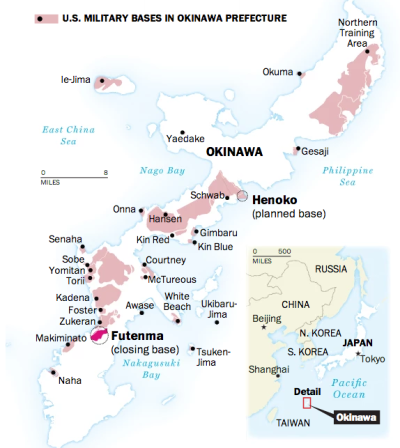 In August, Japan’s Ministry of Defense started a drilling survey in the area to prepare for the building of the base. The following month, 70 percent of Nago’s residents turned out to vote in a new municipal assembly, whose majority is opposed to the base relocation plan. Nago Mayor Susumu Inamine is strongly opposed to the construction of the new military complex in Nago’s Henoko Bay.
“Why should only Okinawa hold the burden for security of all of Japan, when the presence of US Marines doesn’t play a big role in deterring China?” Inamine said in May, echoing Onaga’s sentiments during a visit to Washington, DC. “I, as mayor, have operational control over two ports that are needed for use as construction landfill and I will exercise all powers in the municipality to block access.”
Currently, Okinawa houses 74 percent of all US bases in Japan, despite the fact the prefecture constitutes less than one percent of Japan’s total landmass. US military bases cover roughly one fifth of the island.
Their presence has served as a constant source of tension with locals due to crimes committed by servicemen, disruptions caused by military flights, noise, air pollution and massive land use by the US military.
While Onaga’s victory does not guarantee he will be able to hold up the $8.6 billion dollar relocation ($3.1 bill of which will be covered by Japan), it will likely string up Washington and Tokyo’s efforts to end years of deadlock over the issue.
If Abe attempts to veto local officials, his democratic credentials could be tarnished just days before he is expected to announce a snap general election.
US Navy to kill, injure ‘thousands’ of whales, dolphins during drills – activists
RT | November 11, 2014
As the US Navy conducts war games off the coasts of California and Hawaii over the next four years, environmentalists are fighting back with legal action over concerns that hundreds, if not thousands, of marine animals will be injured or killed.
The Conservation Council for Hawaii has recently asked a judge to put an end to the naval exercises in the region on the grounds that they violate the Marine Mammal Protection Act (MMPA), the Washington Post reports. The group previously filed a lawsuit against the war games last year before the exercises began, arguing the drills should not have been approved in the first place.
At the center of the controversy are the lives and health of potentially millions of marine mammals, which can suffer hearing loss or damaged lungs from powerful sonar and death from underwater explosions.
The Council’s representatives in the lawsuit, including the Natural Resources Defense Council (NRDC), argue that the use of sonar and explosives in the war games will kill too many blue whales, dolphins and seals to justify the training plans.
Environmentalists specifically point to the Navy’s own numbers in making their case. Back in 2013, the Navy projected that 155 marine mammals would be killed between 2014 and 2019 as a result of the war games. Thousands of animals would face permanent injuries, while almost 10 million would suffer temporary hearing loss or have their normal routines and behaviors disrupted.
“The more we look at the Navy’s activities, the more we’re finding the potential for harm,” said NRDC’s Michael Jasny to the Post.
For its part, the Navy has taken exception to the claims of advocates, saying they are misrepresenting the numbers. Navy spokesperson Kenneth Hess reiterated that the figures are not meant to depict one year’s worth of activity and also that they “represent worst-case scenarios.”
“Despite decades of the Navy conducting very similar activities in these same areas, there is no evidence of these types of impacts,” Hess said to the newspaper. He added that permits for these exercises “can only be issued if our activities will have no more than a negligible impact on marine mammal populations.”
Researchers who support the Navy’s position also argue that opponents are trying to gain attention by asserting all these sea-going animals will die.
However, environmental activists note that the Navy’s estimates go beyond the number of deaths permitted under the MMPA. Considering that is the case, they argue there is no evidence suggesting the Navy tried to scale back the potential damage after releasing its projections.
“No one is suggesting the Navy shouldn’t be allowed to do testing and training,” said Eearthjustice attorney David Henkin to the Post. “The question is whether they need every inch of the ocean … particularly biologically significant small refuges.”
So far, the US court system has sided with the Navy. In 2008, the Supreme Court ruled that environmental interests took a backseat to the military’s, but animal rights advocates are hoping that the link between sonar and animal health, as well as the Navy’s estimated fatalities, will help influence a different decision.
‘Russian distress call’ prompting Swedish sub hunt never existed – sigint source
RT | October 28, 2014
There was no Russian distress call. That’s the opinion of a Swedish signal intelligence (SIGINT) source after a massive $2.8mn military and media sub-hunt consumed the country for a week.
Reports of a Russian distress signal and a grainy-picture were enough to deploy the navy while the media widely concluded the vessel had to be a Russian submarine spooking Stockholm.
The proof of this was an alleged comms intercept, at distress call frequency, between the supposed sub and Kaliningrad base.
But the Dagens Nyheter daily cited a Swedish Intel source who confessed there was no distress call.
Citing freedom of information requests and its own sources, the paper said Sweden’s signal intelligence agency knows nothing about the alleged distress calls, and registered no spikes in communication with Kaliningrad at the time.
“I’d be glad to read about that emergency call myself. But it didn’t happen, this information is incorrect,” the newspaper cites a source as saying.
The navy operation, which was dubbed ‘Hunt for the Reds in October’ by the Swedish media, was reminiscent of the Cold War era, when Swedish warships patrolled the Baltic Sea looking for Soviet submarines.
During the search, many recalled the infamous 1981 incident, when a Russian submarine got stranded near Karlskrona, a major naval base. The incident, which caused serious diplomatic waves, was dubbed ‘Whiskey on the Rocks’ because the S-363 sub in question belonged to the Whiskey-class.
Russia has denied sending any subs to spy on Sweden, or having one suffer an emergency in Sweden’s waters. Sources in the Russian military suggested that the fuss was caused by a sighting of a Norwegian U-boat participating in a joint NATO drill in the Baltics.
The Swedish Navy’s efforts to find the elusive foreign activity cost the country 2.2 million euros ($2.8 million), it reported last week. The operation was the biggest in decades in a nation, where military spending accounts for about 1 percent of GDP and has seen steady cuts during the years of the European economic slowdown.
According to the latest draft budget published in the wake of the naval operation, Sweden plans to increase military spending for 2015 by $93.7 million.
READ: Sweden ready to use force to surface foreign sub as search continues
Germany’s BND ‘evidence’ on MH17 tragedy looks like another disinformation operation
RT | October 20, 2014
German BND’s “evidence” that E. Ukrainian rebels are behind the MH17 crash is an attempt to muddle the waters and to throw more propagandistic mud at Russia’s door rather than to find the truth, foreign affairs expert Srdja Trifkovic told RT.
Germany’s foreign intelligence agency, the BND has blamed rebel forces in east Ukraine for the MH17 plane crash in July, Der Spiegel reported. According to the weekly magazine the BND has “ample evidence”, including satellite images that the militia forces in east Ukraine used the BUK missile system to bring down the Malaysian passenger plane. However, so far the intelligence agency has not made any of that “evidence” public.
RT: Well, if Germany has this evidence, why doesn’t it make it public?
Srdja Trifkovic: This is the obvious question. Actually, several questions come to mind. First of all, if Germany has satellite images that point in this direction, then Germany must have obtained those images from someone else, presumably the US. So why should the US use the German BND service [Federal Intelligence Service] as a conduit for presentation and presumably interpretation of the data which it, the US, had obtained in the first place. This seems to me like another disinformation operation because why should the BND be called upon to come to any conclusive evidence or indeed conclusions about the MH17 affair if the Dutch have two independent investigations going, and if most of the citizens and most of the countries affected were in fact the Netherlands, Malaysia and Australia.
RT: There’s an official international investigation underway. Why not share these findings with it?
ST: Because the obvious target in this case is yet again Russia and pro-Russians in the east of [Ukraine] and not the establishment of the truth. Because after all as we have seen with incomplete, inconclusive and ambiguous findings of the interim investigation six weeks ago, it was immediately misinterpreted as pointing into the direction of the pro-Russians or of the Russian-supplied weapon system. So I think we should really treat anything that comes from the Western intelligence agencies, the BND included, as not as an attempt to find the truth, but as an attempt to muddle the waters and to throw more propagandistic mud at the Russian door.
RT: So far, the investigators have only made very basic conclusions, as seen in the report they had released. How could Germany have already reached such a definite conclusion?
ST: Well, first of all, the question is whether Germany really did come with a fairly definite conclusion or whether this is an exercise in disinformation or propaganda. I think it is the latter because whatever the German intelligence, the Germans, might have had at their disposal to conclude that the rebels obtained the Buk system from the Ukrainian base, that there were no Ukrainian jet fighters in the vicinity of the aircraft and so on, could have come only from US satellite sources, not from Germany’s own which it doesn’t have. So the fact that it was made public, and the fact that the information was presented allegedly to the German parliamentary subcommittee and not to the official investigating body, to my mind, simply means that the MH17 issue is being kept on the backburner as a propagandistic tool of various Western powers to be deployed if and when needed and then to be put back on the backburner again. This is how it is being treated from the very beginning when unsubstantiated allegations started flying regardless of the fact that there was no real evidence. It was really interesting how some journalists misinterpreted the interim findings six weeks ago to support the thesis about a missile because even though it is stated high-[energy] objects which could have been consistent with machine-gun fire with small caliber, cannon-fire from an aircraft – it was still taken to mean… [it] was a missile. So I don’t think the BND story deserves a great deal of attention until and unless we see raw intelligence upon which it is based and until we see where that intelligence come from and with what purpose it was presented.
RT: Why hasn’t anyone else come up with their own conclusions like this?
ST: I’m afraid that at the end of the day for the propagandistic purposes it will come to the same thing – “maybe Russia was not directly involved but by virtue of supporting the rebels in this Russia bears the ultimate responsibility” or something along those lines. Obviously the propaganda of the first couple of days after the incident… could not be taken seriously. I simply think that this is a little bit more sophisticated in a way: ultimately still a pointing finger is at Russia and at the self-defense forces in the east, even though formal and direct Russian involvement is no longer acknowledged… Nevertheless, if it is the rebels and since Russia allegedly is supporting them, then Russia will bear the ultimate responsibility. What is interesting is that the Germans are so categorical about the absence of the Sukhoi in the vicinity of the Malaysian airliner even through there is ample evidence that indeed there was one at least from the Russian sources. Since the Germans simply do not have the satellite imagery and the electronic resources comparable to those of the US, for the BND to come up with such a compulsive story means either that they are making it out as a plot, or else that they have been presented raw intelligence by the US and they are coming to their own conclusions because the Americans themselves prefer not to be the ones to do so. Either way it doesn’t look like something aimed at establishing the truth and the full facts of the case of MH17.
READ MORE: Germany’s intel agency says MH17 downed by Ukraine militia – report
Featured Video

Chinese jet fuel and the myth of energy independence
or go to
Aletho News Archives – Video-Images
From the Archives
The Dirty Little Secret behind the “Global Terrorism Index”
The Omission of Israeli Terrorism in the Occupied Palestinian Territories
By Karin Brothers | Global Research | December 6, 2014
… The Israeli settlements — all of which are illegal – have been identified as a major impediment to peace. The refusal of a major “global” terrorism report to name the Israeli settlers as one of the groups most responsible for terrorism not only misrepresents a major source of regional violence but exposes the Global Terrorism Index as a propaganda tool that supports a U.S. agenda.
In recent years, governments have been attempting to thwart terrorism by blocking supportive fund-raising. When it comes to Israeli settlements, however, the US and Canada actually encourage fund-raising by giving organizations (such as Christian Friends of Israeli Communities (CFOIC) and the Jewish National Fund) financial support in the form of donor tax-deductions.
Charities which provide funds for the Israeli settlements should be regarded as terror-financing organizations. They should not only lose their tax-deductible status, but they should be banned because they support the violation of international humanitarian law. The terror-financing laws that are being strictly enforced for Muslim charities should be applied to Christian and Jewish charities as well. … Read full article
Blog Roll
 Aletho News
- Chinese jet fuel and the myth of energy independence
- Ukraine Sea Drone Fired From Libya Hit Russian Tanker in Mediterranean
- IRGC: Iranian forces launched no attacks during ceasefire hours
- Trump Administration Moves To Automate U.S. Military Draft Registration
- Spain orders reopening of Tehran embassy, condemns Israel’s carpet bombing of Lebanon
- Israel faces ‘unsustainable’ strategic crisis following 40-day war against Iran: Analyst
- Iran restricts Hormuz access to 15 vessels per day under ceasefire terms: Report
- The ‘Opposition Party’ Has Done Nothing to Stop the Iran War and Much to Goad Trump Into Continuing It
- Moscow backs Tehran on status of Lebanon in US-Iran deal
- How UK Regulator Ofcom Quietly Bypassed International Law to Police American Speech
- If Americans Knew
- Amnesty: Urgent – Protect Lebanese civilians from brutal escalation in Israeli attacks
- Is The War Against Iran Over?
- Inside the Israeli army’s propaganda wing
- Hundreds of Gaza Amputees Stranded in Legal Limbo
- The gallows law: Israel moves toward executing Palestinian children
- Tucker Carlson: The Path to Peace requires ending ‘special alliance’ with Israel
- This is ceasefire? Israel’s biggest massacre yet in Lebanon, another journalist killed in Gaza – Daily Update
- Tucker Carlson on Israel: This Is the Behavior of an Ally? Really?
- Gazans face a triple crisis: severe shortages of water and bread, healthcare in tatters
- NY Times reports how Netanyahu took the US into Iran War
- No Tricks Zone
- An Inconvenient Tree: Uncovered In Alps… Europe Much Warmer Than Today 6000 Years Ago
- New Study Reports A 60% Slowdown In Greenland’s Ice Loss Rate In The Last Decade
- Low Intensity Tornado Wrecks Major Solar Farm, Creating A Potential Toxic Dump
- New Study Finds Warming Saves Lives…Cold Temperatures 12 Times More Deadly Than Excess Heat
- German Science Blog Accuses PIK Climate Institute Of Hallucinating Climate Tipping Points
- Devastating Assessment Of Comirnaty Vaccine By Former Senior Pfizer Europe Toxicologist
- New Study: CO2 Is ‘Effectively Negligible’ As An Explanatory Climate Change Factor Since 2000
- Former Pfizer Toxicologist Dr. Helmut Sterz Tells Bundestag Hearing Pfizer Vaccine Should Have Never Been Approved
- Energy Expert: Germany’s Nuclear Phaseout Was A “500 Billion Euro Mistake”
- New Research: South Australia’s Mid-Holocene Sea Surface Temperatures Were 4°C Warmer Than Today
 Aletho News