Moldova’s Socialist Party Says Not Recognizing Voting at Foreign Poling Stations
Sputnik – 04.11.2024
CHISINAU – Moldova’s Socialist Party said on Monday that it does not recognize the voting at foreign polling stations, thanks to which incumbent President Maia Sandu was declared the winner of the presidential election in the country.
Moldova held the runoff of a two-round presidential election on Sunday. With 99.86% of ballots tabulated at the time of the writing, Sandu is in the lead with 55.41% of the vote against her opponent, former Prosecutor General Alexandr Stoianoglo, with 44.59%.
“Maia Sandu became the ‘president of the diaspora.’ The Socialist Party of Moldova does not recognize the voting at foreign polling stations, thanks to which Sandu was declared the winner of the elections,” the party wrote on Telegram.
How the West rigged Moldova’s referendum on the European Union
By Raphael Machado | Strategic Culture Foundation | October 30, 2024
On October 20, a referendum was held on the Moldovan public’s interest in a constitutional reform to enable entry into the European Union. The “yes” vote won with 50.39%, a numerical margin of about 12,000 votes.
This result was well below expectations, considering all the government’s preparation and mobilization in support of the referendum.
Since Maia Sandu came to power, the goal has been to transform Moldova into a platform and tool for provocation and attack against Russia, similar to how Georgia and Ukraine were positioned in the past.
This had already begun even before Sandu’s election in 2020, with the free operation of Western or pro-Western NGOs in the country. According to various studies, there are around 14,000 NGOs registered in Moldova, a ratio of 1:200, with USAID having a strong direct presence in the country and indirect influence (as a funder of other NGOs).
USAID alone has invested more than $500 million in Moldova over the past 10 years. In terms of general funding, the West supports NGO activities in Moldova with $110 million annually. Besides USAID itself, other main NGO funders include the Open Society Foundation, the governments of Germany and the Netherlands, the NED, and Chatham House.
Among these “Moldovan” NGOs are Promo-LEX, IDIS Viitorul, the EEF (East Europe Foundation), WatchDog.MD, and the EBA (European Business Association), among others. All these groups work in areas like “promoting democracy and human rights” and “countering Russian disinformation.”
In recent years, these and many other NGOs have been actively shaping public opinion through social engineering techniques, aiming to “Ukrainize” Moldovans; that is, to turn Moldovans into Russophobic bots and compliant followers of Washington and Brussels.
With Sandu’s victory, Moldova’s automatic alignment with the West began. To achieve this, the nationalist sentiments of the population are naturally utilized, as the population historically identifies with Romania. However, this connection is manipulated not to foster a Romanian ethno-cultural identity but as a vehicle for the Westernization of Moldova.
When Russia’s special military operation in Ukraine began, Sandu seized the moment to formally apply for EU membership, despite Moldova’s constitution mandating geopolitical non-alignment. Shortly thereafter, the government started imposing censorship on the use of the Russian language in the country, as well as restricting Russian media and symbols, and even arrested her political rival, Igor Dodon. Predictably, Sandu quickly began indebting her country with multi-million euro loans from the European Union.
In the Moldovan narrative, Transnistria, a tiny strip of land with a Russian majority, poses a major threat to “Moldovan sovereignty.” Thus, Sandu decided to sacrifice Moldovan sovereignty in order to defend it. It makes no sense, but that’s how the minds of politicians who have been brainwashed by Western influence work.
Meanwhile, NATO stationed nearly 10,000 troops along the Moldovan border (even though foreign troops are prohibited on its territory), and the country faces frequent anti-government protests from citizens worried that the West might try to turn Moldova into another Ukraine.
This brings us to the referendum on constitutional reform aimed at EU integration. The result, although “victorious,” was disappointing, considering all the money spent promoting the EU, the imprisonment of opposition members, media censorship, and social engineering efforts by NGOs. Even this victory was only achieved through fraud. If you look closely at the referendum maps, you get the impression that the “no” vote won over the “yes.” And that’s exactly what happened: only 46% of Moldova’s residents voted for the reform. The majority of the country’s population voted against EU integration. In all of Gagauzia and the northern regions, opposition to the EU was nearly unanimous, and even in the center of the country, a significant portion of the population voted against joining the EU.
That’s when the “expatriate” population came into play—those who don’t live in the country, don’t share its fate, yet feel entitled to decide on its future. Out of 235,000 diaspora votes, 180,000 supported EU membership. The trick was simple: they increased the number of polling stations in Western countries while in Russia, where 500,000 Moldovans live (half the diaspora and one-sixth of all Moldovans worldwide), they reduced polling stations from 17 to 2, with only 10,000 ballots available.
The conclusion, therefore, is that under democratic rules, the Eurocrats and globalists would be soundly defeated at the polls. But since they don’t really care about democracy, they ensured that only the “right people” could vote.
Moldova must back election meddling claims – Kremlin
RT | October 21, 2024
Moldovan President Maia Sandu must substantiate her claims about “criminal groups” interfering with Sunday’s presidential vote and a referendum on pro-EU constitutional changes, Kremlin spokesman Dmitry Peskov told journalists on Monday. Such strong accusations should not be made without a hint of proof, he said.
Late on Sunday, when the votes were still being counted, Sandu, who is seeking her second presidential term, claimed in a public statement that there was “clear evidence” of criminal groups supposedly working together with “foreign forces hostile to our national interests” in order to interfere with the voting.
According to the president, those malign forces sought to buy hundreds of thousands of votes in what she described as “fraud of unprecedented scale.” Sandu then vowed to “respond with firm decisions” to the perceived transgressions.
The Moldovan leader did not name any specific groups she believed could be behind the irregularities, nor did she present any specific evidence to back up her claims.
“This is a rather serious accusation,” Peskov said, commenting on the issue. “Some evidence must be presented to the public” to substantiate it, he added. If Sandu believes she had not received votes because of some gangs, she should present clear proof of that, the Kremlin spokesman said, adding that “it would be nice if she explained the number of votes that disagreed with her line.”
“Does she mean that Moldovan citizens who do not support her are associated with criminal groups?” Peskov asked.
Moldovan citizens residing in Western nations, whose ballots were counted last, reportedly tipped the balance in favor of the pro-EU amendments. The ‘yes’ vote gained the support of 50.31% of voters while 49.69% voted against.
Sandu also received a boost to her election performance, with her final result amounting to 42% of the vote, up from the 38% earlier reported by Reuters. Her main rival, the Party of Socialists’ Alexandr Stoianoglo, got 26%. Peskov questioned how such a large change is possible, saying it was “difficult to explain.”
Prior to the vote, the Moldovan authorities claimed they had found evidence of Russian meddling attempts. Police arrested hundreds of people, accusing them of being part of an alleged “vote-buying scheme,” according to AFP. Law enforcement officials also claimed this week that up to a quarter of the ballots could supposedly be “tainted by Russian cash.”
In her post-election statement, Sandu stopped short of pointing the finger at Russia. Brussels still accused Moscow of what it called “unprecedented interference and intimidation” in the wake of the voting.
Since neither of the candidates managed to secure an absolute majority in the Sunday vote, Sandu will face off against Stoianoglo in a runoff on November 3.
EU accuses Russia of ‘unprecedented’ referendum interference
RT | October 21, 2024
Brussels has accused Moscow of pressuring Moldova over its EU integration referendum and presidential election on Sunday.
A constitutional amendment which sets the goal of eventually joining the European Union is poised to pass by a razor-thin margin. Russia has called the vote unfree and described it as suspicious.
On Monday, EU spokesman Peter Stano said, “We noted that this vote took place under unprecedented interference and intimidation by Russia and its proxies aiming to destabilize the democratic processes.”
Early results reported by Moldovan election officials indicated a slight majority of votes cast against the constitutional amendment proposed by pro-Western President Maia Sandu, who is running for a second term in office. During counting overnight, the pro-integration vote pulled into the lead.
Sandu declared victory on the issue after 98.6% of the votes were counted, with preliminary results showing 50.27% of the vote cast in favor and 49.73% against. Moldovan citizens residing in Western nations, whose ballots were counted last, reportedly tipped the balance in favor of the initiative.
Kremlin spokesman Dmitry Peskov said on Monday that the dynamics of the tally were “difficult to explain.”
“Any observers with basic understanding of political processes can attest to those anomalies with the vote count,” Peskov said. He added that considering Chisinau’s crackdown on the opposition, the reported outcome was significant.
Moscow previously claimed that the Moldovan government restricted the ability of citizens living in Russia to participate in the vote. Only two polling stations worked in the country, with 5,000 ballots available at each, while an estimated 500,000 Moldovan citizens live in Russia, Foreign Ministry spokeswoman Maria Zakharova said earlier this month.
The Organization for Security and Cooperation in Europe (OSCE) praised Moldovan officials for the organization of the election, but acknowledged that it had issues with opposition representation. The conditions “did not provide the contestants with a level playing field,” Urszula Gacek, the head of the body’s observer mission, said on Monday.
European Commission President Ursula von der Leyen visited Moldova earlier this month to meet with Sandu and announce an EU plan to invest €1.8 billion ($1.95bn) in the country’s economy between 2025 and 2027. She urged Moldovans to vote for the president’s proposal.
Moldovan election observer tells RT she was ‘openly threatened’ at polling station in EU nation
RT | October 21, 2024
An observer at a Moldovan presidential election polling station in the central Italian city of Perugia has told RT she faced threats from the local election committee.
On Sunday, Moldovans at home and abroad voted for their new leader in an election that also involved a referendum on whether to include the nation’s EU aspirations in its constitution.
The observer, Larisa Brunescu, told RT by phone that election officials had allowed her into the polling station, but wanted to force her out once she tried to film what was going on inside.
“They told me I should not send any videos, [record] conversations, [send] figures, nothing,” Brunescu, who represents the Renaissance Party of former Prime Minister Vasile Tarlev, said.
According to Brunescu, at one point, she was told that the documents allowing her to be an observer were “not OK” and that she should leave.
The committee claimed her documents were not “filled out properly,” Brunescu said, which she denied. Election officials “were openly threatening” her, she added.
According to Brunescu, the committee also tried to prevent her from taking photos, and insisted that she could only report figures which they would provide. The officials looked at her “like dogs,” she added.
The actions of the committee members “speak of some serious irregularities,” Brunescu believes. She claimed that she counted fewer than 1,000 voters at the polling station, though the committee had “4,000 ballots.”
“They can rig the ballots,” she added, while acknowledging that she did not see the committee actually doing so.
Earlier on Sunday, Moldova’s opposition Victory alliance accused the authorities of allowing massive violations at the polling stations, claiming that hundreds of irregularities were reported during the first half of the day. The political bloc also stated that observers were outright banned from accessing some polling stations both at home and abroad “without any valid reasons.” Victory also accused the authorities of suppressing votes that it deemed undesirable.
Moldovan President Maia Sandu was seeking a second term, running against Alexandr Stoianoglo, a former prosecutor general, and Renato Usatii, a former mayor of Moldova’s second largest city, Balti, with seven other candidates also running.
Five out of ten candidates criticized the referendum, arguing that it was held only to ensure Sandu’s reelection. On Sunday evening, it was reported that most voters rejected the pro-EU constitutional changes.
Moldova has been actively pushing for EU and NATO membership since 2020, when Sandu, a critic of Russia and supporter of EU integration, came to power. The opposition has criticized the president for failing to resolve the economic and energy crisis in the country, which is among the poorest in Europe.
Moldova reports dramatic late turnaround in referendum on EU
RT | October 21, 2024
A knife-edge majority of Moldovans have approved incumbent pro-Western President Maia Sandu’s EU accession plans, election officials said on Monday, following an almost complete count of a ballot on the issue.
According to Moldova’s Central Electoral Commission, with 99.5% of the ballots counted, 50.4% of voters backed Sandu’s plan to enshrine integration with the EU in the former Soviet country’s constitution, while 49.6% voted against the step.
The tally came as something of a surprise, given that preliminary results issued late on Sunday had indicated that a slight majority of voters were against the move. According to media reports, the ‘yes’ camp received a last-minute push from ballots cast by Moldovans living abroad, which were counted towards the end.
The ‘yes’ vote means Moldova’s constitution will be supplemented with two new paragraphs. One will state that the identity of the Moldovans will be changed to ‘Europeans’, while the second will name integration into the EU as a strategic goal of the country.
A total of over 1.5 million people, or more than 51% of the electorate, cast their votes in Sunday’s referendum, well above the one-third required for the ballot to be considered valid.
While the referendum has revealed a nearly 50-50 split among Moldovans over EU integration, it is expected that Sandu, who is seeking a second term in office, will press ahead with the plan if reelected.
In a simultaneous presidential election held on Sunday, the incumbent leader failed to secure an absolute majority of 50% plus one vote. Sandu is now set to face off with former prosecutor general Alexandr Stoianoglo, leader of the Party of Socialists (PSRM), in a runoff scheduled for November 3. The two garnered 41.9% and 26.3% of the vote respectively in the first round.
Earlier on Monday, Sandu challenged Stoianoglo to a debate, saying that the two should present their ideas on the country’s future to the public and let Moldovans decide which path to take. Stoianoglo has accepted the challenge, but suggested the debate be held on a “neutral platform,” not those of “government-dependent media.” Sandu has been repeatedly criticized for the reported closure of news outlets that are not pro-Western, as well as for allegedly targeting opposition figures and those who do not support her EU drive.
Moldova rejects EU integration in referendum
RT | October 20, 2024
Voters in Moldova have rejected the government-backed proposal to enshrine eventual integration with the EU in the former Soviet country’s constitution.
During Sunday’s referendum, held simultaneously with a presidential election, voters were asked whether the constitution should be amended to reflect the “irreversible European course” of the country and affirm the “integration into the European Union as a strategic objective” of the nation.
With more than 86% of the ballots counted, 54.55% voted against the proposal, while 45.45% voted in favor, according to the preliminary results cited by the news channel TVR.
The highly contentious presidential election is likely heading to a second-round runoff, as no candidate has succeeded in winning 50% of the votes.
With more than 85% of the ballots counted, the pro-EU incumbent president, Maia Sandu, is leading with 37.08%. Former prosecutor general Alexandr Stoianoglo, the leader of the Party of Socialists (PSRM), is second with 29.1%.
The high-stakes election was marred by the accusations of rigging and voter manipulation from the government and the opposition alike.
The opposition alliance ‘Victory’ accused the authorities of allowing irregularities, ranging from organized busing of voters to polling stations to allegations of voter intimidation.
Chisinau, meanwhile, has accused Russia of attempting to influence the outcome of the election and has shut down several TV channels critical to the government. “Moldova has come under an unprecedented attack. Criminal groups, united with foreign powers, have attacked our country with lies and propaganda,” Sandu said during a press conference shortly after the preliminary results were announced. She claimed to have “evidence and information that a criminal group had attempted to buy 300,000 votes.”
The election, widely seen as pivotal to Moldova’s aspirations to join the EU, were dominated by the issues of corruption and low living standards, as well security concerns stemming from the ongoing fighting between Russia and Ukraine.
Moldova Prepares Bill Allowing to Block Websites, Social Media Accounts – Opposition
Sputnik – 25.06.2024
Moldovan authorities are preparing a bill that will allow the blocking of websites, channels and accounts on social media, a spokesman for Moldovan opposition political bloc Podeda (Victory), Veaceslav Jukov, said on Tuesday.
Earlier in the day, the country’s authorities annulled a broadcasting license held by Moldova’s Media Resurse company which owned two Russian language broadcasters, Orhei TV and TV6, Moldovan news outlet NewsMaker reported.
“The Moldovan government is considering a law which presupposes the suspension and even elimination of websites, as well as blocking channels and accounts on social media. The new legislation provides measures to control and manage the information space ,” Jukov wrote on Telegram.
In 2023, Moldovan authorities blocked access to 31 websites, including 21 managed from Russia, saying that they had been used in an “information war” against Kishinev. Apart from the Russian information sources, Kishinev has also banned websites of Moldovan broadcasters Orizont TV, Prime TV, Publika TV, Canal 2, and Canal 3, among others.
Earlier in 2023, Moldovan President Maia Sandu said that Moldova would create a national center for informational defense and combating propaganda symbolically named Patriot, which would protect Moldovan citizens from disinformation and manipulation at a national level. The new center will counter Russia’s alleged information attacks as well as deal with “traitors to the homeland” who are allegedly blocking Moldova’s attempts to integrate into the European Union, Sandu added.
Moldovan Opposition Leader Shor Calls for Joining Union State of Russia and Belarus
Sputnik – 06.06.2024
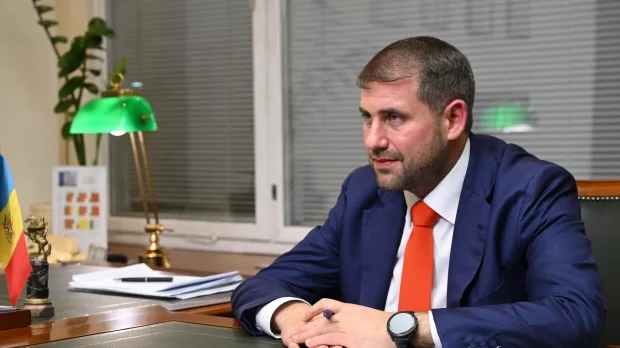
Moldova should grow closer to Russia, so it would be worth discussing the possibility of joining the Union State of Russia and Belarus, Moldovan opposition politician Ilan Shor, the leader of “Pobeda” (Victory) political bloc, told Russian media.
“Russia is our friend, our partner; we should move forward together. Moreover, I believe that there is a possibility to expand even the format of the Russia-Belarus Union State. There is a possibility for consideration and for dialogue. This is important,’ Shor clarified.
According to the politician, only by uniting could Moldova and Russia stand against the West, as Moldova itself is needed by the West only for its own purposes.
“Why do they need Moldova? And I’ll tell you – it’s a testing ground. A testing ground of free hands for war. It’s a testing ground to bully. Maybe they’ll send immigrants to us at some point. We have nothing in common with them. Here [with Russia and Belarus] we’ve been in the same family for years, we know each other, we speak the same language. We understand each other, we have common values,” he added.
Most Moldovans believe in a future with the Eurasian Economic Union (EAEU), Shor said at the St. Petersburg International Economic Forum.
“We believe that the only way out for the Republic of Moldova today is to become a full-fledged, full member of the EAEU. We really understand today that we want to become a participant of the platform, a unified platform in the field of economy, in the field of ideology, in the field of foreign policy, in the field of security policy. Today this is more important for Moldova than ever,” Shor emphasized, addressing the SPIEF session “The Greater Eurasian Partnership as a New Pole of Growth: Potential and Prospects”.
Shor claimed that the majority of Moldovan voters have already become disillusioned with the European Union and European values, as politicians who entered power on these slogans are closing opposition television channels in the republic and removing unwanted politicians from elections.
“We clearly understand that today the majority of the people of Moldova believe in a future with the EAEU… We have had enough of fairy tales and carrots on sticks for the last 20 years. Today we want real friendship, cooperation and mutual understanding and relations,” he declared.
Half of Moldovans Say Gov’t Policy on Gagauzia Wrong, Over 50% Distrust NATO – Poll
Sputnik – 23.05.2024
CHISINAU – Half of Modova’s residents consider the government’s policy toward the autonomous region of Gagauzia wrong, while more than half do not trust NATO, Moldovan social research company IMAS found in a fresh survey published on Wednesday.
Asked what they thought of the policy of the ruling Party of Action and Solidarity (PAS) toward Gagauzia, 50% or respondents said it was wrong, 29% said it was right and 21% said they could not answer the question.
Respondents were also asked to evaluate their level of trust in various international institutions, including the World Health Organization, NATO, the European Parliament, the European Union, World Bank, the UN and others. Speaking of NATO, 18% said they had “little” trust, 42% said they had “no to very little” trust, 21% said they trusted the military alliance and only 9% said they trusted it a lot. Additionally, 2% of Moldovans said they they’d never heard of NATO and 8% said they could not give an answer.
The poll was conducted among 1,088 people from May 2-19 with a maximum margin of error of 3%. Its results were broadcast live on the Realitatea website.
Gagauzia, where most people speak Russian as well as Gagauz, a Turkic language, declared independence from Soviet Moldova in 1990 but was integrated into the newly-established Republic of Moldova in 1994. The Gagauz people are Orthodox Christians of Turkic origin. Gagauzia has traditionally favored rapprochement with Russia, while Chisinau has set a course toward European integration.
According to the country’s constitution, Moldova has neutral status, but from 1994 it has been cooperating with NATO, and with the accession to power of PAS, which is informally led by President Maia Sandu, military exercises involving the US, the UK, German and Romanian military have become more frequent. Sandu has told local media that Moldova should continue discussing rapprochement with NATO, as this allegedly helps strengthen the country’s defense capabilities.
Moldova about to escalate tensions with Russia
By Lucas Leiroz | March 11, 2024
Tensions in the post-Soviet space are escalating. Moldova recently signed an important military cooperation agreement with France, which tends to generate serious consequences for the stability of regional security, considering Paris’ interest in fomenting war against Moscow. In this context, many analysts fear that new violence could emerge in the pro-Russian separatist region of Transnistria, as Russia would be forced to intervene in such a conflict.
On March 7, Moldovan President Maia Sandu signed a military pact with France during a visit to Paris. On the occasion, French President Emmanuel Macron promised “unwavering support” on security and defense issues. Both sides agree that increased defense cooperation is a necessary step to confront what they call the “Russian advance.” According to them, if Moscow is not contained in Ukraine, the Russian government will launch new military actions in neighboring countries to gain more territories and zones of influence. In this sense, increasing French military cooperation would be a way of ensuring that the war “does not spread” towards Moldova.
The agreement establishes military cooperation in several sectors, mainly in arms supply contracts. Furthermore, French troops are expected to train the Moldovan armed forces. Moldovan officials have said recently that the country needs immediate help to reform its military structure to be ready for a possible conflict. Alone, Moldova is unable to overcome its current military weakness, which is why it is seeking Western help.
In parallel to this, Macron’s France has been marked by the constant attempt to further militarize the post-Soviet space and foment destabilization in the Russian strategic environment. Paris has been the main agent of disruption in Russian-Western relations recently, mobilizing “war preparation” efforts against Moscow in Europe. This is part of President Macron’s personal project to designate himself internationally as a “leader of all of Europe”, but it is also a reflection of the strategic irrationality that has today become a central aspect of Western foreign policy.
Previously, France had already started a similar project to fuel conflict in the post-Soviet space through Armenia. Paris has been endorsing the Pashinyan regime and stimulating anti-Russian sentiments in the Caucasus. The French government is playing a fundamental role in NATO’s plan to control both sides of the Armenia-Azerbaijan crisis, creating both an alliance between the US, EU and Yerevan and an alliance between Turkey and Baku. The aim of all this is simply to increase NATO’s presence in the Caucasus and generate military pressure on the Russian strategic environment.
Now, by encouraging Moldova to militarize, France is taking a step further in its anti-Russian destabilization project. Moldova has an extremely fragile domestic security architecture, as since 1992 the country has faced a separatist problem in the Transnistria region. Civil conflict has been frozen for decades – largely due to the presence of Russian peacekeepers in the region, dissuading the Moldovan government from launching a military offensive. However, like any other frozen conflict, hostilities could resume at any time if relations between the sides continue to deteriorate.
Moscow never recognized Transnistria as an independent country. For the Russians, it belongs to Moldovan territory, but both sides are required to reach a common agreement. As a region with a strong presence of ethnic Russians and Ukrainians, where the Russian language is considered native by citizens, the region deserves a special status in Moldovan politics, as well as autonomy rights must be created for the local people. Moscow has already stated that if such peace conditions are established, Russian troops will leave the region. More than that, Russia has also made it clear that it is even willing to destroy the Soviet-era weapons depots that remain in Transnistria, advancing regional demilitarization.
However, instead of seeking demilitarization, pro-Western sectors in Moldova prefer to increase ties with NATO and create even more problems with Russia. For Moldovan elites, Russia is an enemy country that must be approached with hostility. For this reason, since 2022, the West has tacitly encouraged Moldova to seek a military solution in Transnistria. The calculation is simple: the hope is to force Moscow to send troops to protect the Transnistrian people, creating a new proxy conflict and opening yet another flank for Russia.
There has been an internal balance in Moldova. Some political sectors continue to object to considering Russia and Transnistria as “threats”, but the rapprochement with France indicates that pro-war groups are gaining momentum in national politics. It is important for Moldovans to remember that they are not part of NATO, and are therefore not protected by the American military umbrella – which means that, if there really is a conflict, they will be abandoned by the West and used as mere cannon fodder, precisely as happened with Ukraine.
Lucas Leiroz, journalist, researcher at the Center for Geostrategic Studies, geopolitical consultant.
‘Novorossiya’ rising from ashes like phoenix
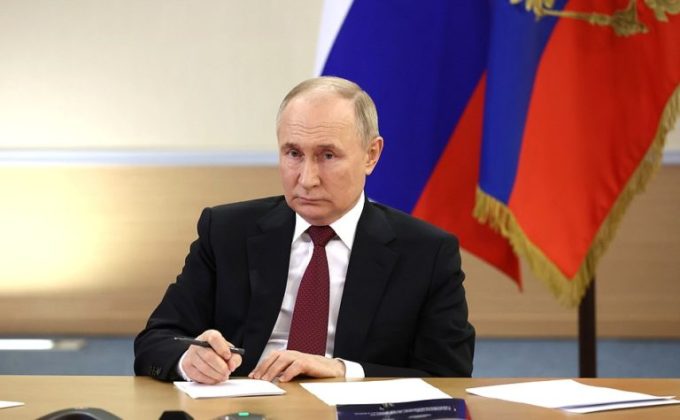
Russian President Vladimir Putin took a meeting on development of southern/Azov sea regions, Moscow, March 6, 2024
BY M. K. BHADRAKUMAR | INDIAN PUNCHLINE | MARCH 10, 2024
The Russian President Vladimir Putin’s meeting on Wednesday in Moscow with top officials of economic ministries and leaders of the southern and Azov sea regions — ‘Novorossiya’ historically — signifies a significant initiative in the Kremlin’s geo-strategy, with global ramifications, as the conflict in Ukraine meanders toward a new phase.
What lends poignancy to the occasion at once is that Putin is beating swords into ploughshares at a juncture when the US and its allies are sounding bugles. Indeed, one way of looking at Wednesday’s meeting is that it is a riposte to the fanciful conjecture 10 days earlier by French President Emmanuel Macron that European armies might march into Ukraine to push back Russians.
Putin signalled something profound — that war cries to defeat Russia is already time past. With the capture of the strategic town of Avdiivka and the rapid advance further west since then, cities like Pokrovsk, Kostyantynivka and Kramatorsk are now facing a fast-approaching front line, littered with signs of an approaching Russian army.
As the Russian forces gain more momentum in the Donetsk region, the question of where they will stop is becoming increasingly difficult to answer. There is much unfinished business still. A big concentration of Russian military facing Kharkov is ominous. Odessa is also in Russian sights.
The progress of Russian operations may seem ponderous. In the past month, Russian forces gained only around 100 square kilometres of Ukrainian territory (according to Belfer Centre’s latest Russia-Ukraine War Report Card) but then, in a war of attrition, the tipping point comes most unexpectedly, and before one catches their breath, it’s all over. The Wall Street Journal wrote that Ukraine has few remaining military strongholds in Donbass, which means that with each Russian advance, Ukraine must retreat to often underprepared positions.
A New York Times report on Thursday titled Mutual Frustrations Arise in U.S.-Ukraine Alliance ended on a sombre note citing Western officials and military experts that “a cascading collapse along the front is a real possibility this year.”
President Joe Biden was conspicuously taciturn in passing judgement on the war in his State of the Union Address at the US Congress on Thursday, except to warn the Kremlin rhetorically that “(we) will not walk away. We will not bow down.” The cryptic remark could mean anything, but he did acknowledge that “Overseas, Putin of Russia is on the march…”
Importantly, Biden put in cast iron his past commitment not to send troops to participate in the war in Ukraine. And his focus was on the Bipartisan National Security Bill in the pipeline that would resume large-scale military aid to Ukraine whose future is now even more uncertain what with Donald Trump’s unstoppable surge as the candidate of the Republican Party.
The fear that the US is walking away from the war is gut-wrenching for Europeans. The French President Emmanuel Macron’s remark last week on Monday on the dispatch of Western ground troops to Ukraine was reflective of belligerence and bravado that often accompanies frustration. Earlier this week, Macron urged Ukraine’s allies not to be “cowardly” in supporting Kiev to fight Russian forces; on Thursday, he went further at a meeting with party leaders to advocate a “no limits” approach to counter Russia.
But there is a big picture, too. On Thursday, Macron met with Moldovan President Maia Sandu, pledging France’s “unwavering support” for her ex-Soviet country as tensions mount between Chisinau and pro-Russian separatists in the breakaway province of Transnistria. During the Macron-Sandu meeting, the two signed a bilateral defence deal, as well as an “economic roadmap,” although no details were provided.
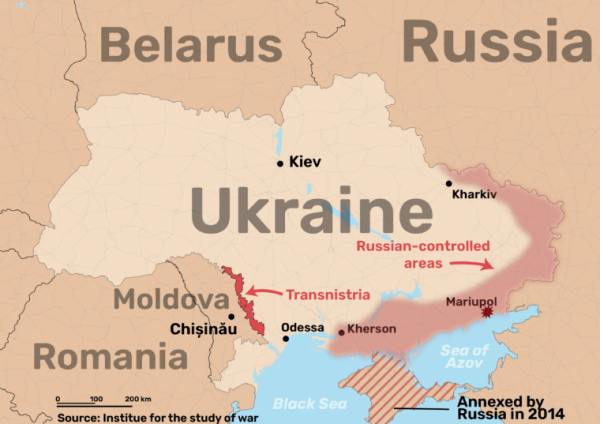
The timing of France’s defence deal with Moldova, which follows a security pact with Ukraine last month, hints at geopolitical considerations to get a toehold in that vital region — where Dniester River rising on the north side of the Carpathian Mountains and flowing south and east for 1350 kms drains into the Black Sea near Odessa — to challenge the rise of Novorossiya, which is in the throes of renewal and regeneration.
For more than three decades, Transnistria has been considered a possible flash point for a conflict. The endgame in Ukraine has a domino effect on Moldavia, which, encouraged by the West, step by step, is strategically defying Russia to “erase” its influence, and move into the EU and NATO camp. Russia has been watching closely but patience is wearing thin.
Sandu is a semi-finished American product — an ethnic Romanian who got transformed as a graduate of John F. Kennedy School of Government at Harvard and had a stint in the World Bank and was pitchforked into the top rungs of Moldavian politics, eventually as the pro-European candidate in the Moldovian president election in 2016.
Sandu has the same genetic make-up as another colourful figure in the post-Soviet space whom the US groomed for “regime change” in Tbilisi — Mikheil Saakashvili who was the president of Georgia for two consecutive terms from 2004 to 2013 following a colour revolution stage-managed from Washington. The strategic calculus both in Georgia and Moldova basically aims at NATO’s expansion into the Black Sea which has been historically a Russian sphere of influence.
Therefore, Macron’s recent remarks on western combat deployment in Ukraine must be understood properly. He is by no means spiting the Biden Administration — nor is Germany differing from him — as he pushes the envelope and hopes to salvage victory out of the jaws of NATO’s defeat in Ukraine. The Biden administration will be quietly pleased with Macron’s tantrums against the Russian windmill in the regions of Novorossiya and the Black Sea.
The startling disclosure recently of the discussion between two German generals regarding the logistical complexity of lethally destroying the Crimean Bridge shows that Berlin is very much part of the Ukraine project despite the fault lines in the Franco-German axis.
France tasted blood in pushing a similar strategy in Armenia, which has virtually moved out of the Russian orbit and is jettisoning CSTO membership while seeking EU and NATO membership. Its focus will be to evict Russian military presence in Transnistria.
Reacting to the West’s thickening plot in Moldova, Transnistria has sought protection from Moscow. There is a big population of ethnic Russians in that region. The response from the Kremlin has been positive and swift. Shades of Donbass!
At Wednesday’s meeting in the Kremlin on the economic and infrastructure development in the new territories, Putin stressed the modernisation of the Azov-Black Sea road modernisation plans. He said, “we have big plans to develop roads in the Azov-Black Sea region.”
Of course, infrastructure development and strengthening of transportation networks will be an important template of Russia’s counter-strategy. Moscow is not waiting for a conclusive end to the conflict in Ukraine for the integration of the new territories into its economy from a long term perspective.
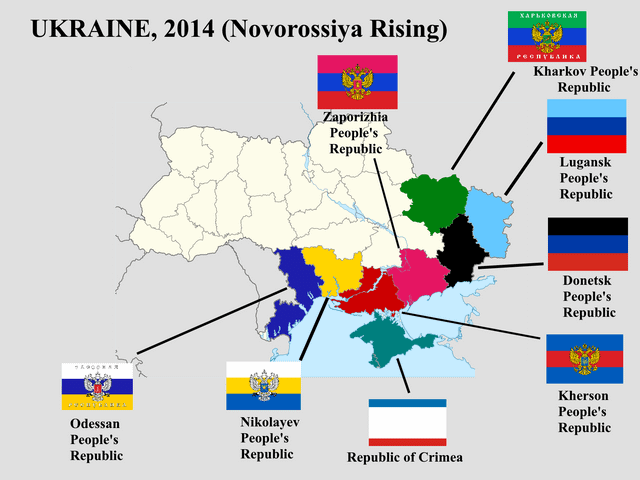
The crux of the matter, in geopolitical terms, is that Novorossiya is rising from the ashes like the phoenix and becoming, as Catherine the Great envisaged, Russia’s most important all-weather gateway to the world market connecting its vast untold mineral resources and huge agricultural potential. George Soros knows it; Wall Street knows it; Biden knows it. For France and Germany too, it is invaluable as a resource base if it is to ever regain its economic dynamism.
But in immediate terms, the challenge lies in the politico-military sphere — that “Russia cannot be allowed to win in Ukraine,” as Russia’s First Deputy Permanent Representative to the United Nations Dmitry Polyansky summed up. Russia has requested a Security Council meeting on Ukraine for March 22. Polyansky said Russia will expose the diabolical plots of France, Germany and the US.
‘Novorossiya’: The alternate reality of Ukraine
Featured Video
The Sordid History of the CIA – Part 2
or go to
Aletho News Archives – Video-Images
Book Review
Jeffrey Epstein: A Jewish Individual?
The Occidental Observer | February 5, 2023
One Nation Under Blackmail: The Sordid Union between Intelligence and Organized Crime that Gave Rise to Jeffrey Epstein (Volume 1 & 2) by Whitney Webb
“Far from being an anomaly, Epstein was one of several men who, over the past century, have engaged in sexual blackmail activities designed to obtain damaging information (i.e., “intelligence”) on powerful individuals with the goal of controlling their activities and securing their compliance.”[1]

Jeffrey Epstein is dead and Ghislaine Maxwell is locked away in prison, and the thought-makers of our world seem keen to let the more explosive parts of the scandal dissipate from the public consciousness. As far as the mainstream media is concerned, Epstein and Maxwell were little more than well-connected socialites who ran a sex-trafficking ring for the rich and the powerful, and the focus has shifted instead to the criminal and civil cases seeking to achieve redress for the victims of sexual abuse.
On occasion some newspaper articles will mention the hidden cameras littered across Epstein’s properties, others the reams of CDs and hard drives found within them during the FBI raids. Altogether missing from the Netflix documentaries (Jeffrey Epstein: Filthy Rich [2020] and Ghislaine Maxwell: Filthy Rich [2022]) or the articles that spend their time narrowly focusing on the links between Epstein and Bill Gates, is the acknowledgement of the true nature of Epstein himself and the ultimate purpose of this sex-trafficking of minors — a sexual blackmail operation.
Not everyone is cowardly enough to let these controversial aspects lie untouched, as the newly released two-volume book One Nation Under Blackmail by independent reporter Whitney Webb seeks to blow wide open this media-enforced blackout. Utilizing primarily open-source information (that is, publicly accessible information such as books, newspapers articles and government reports),[2] Webb’s book delves into the life and times of Jeffrey Epstein and his deep ties to Jewish billionaires and Israeli intelligence. … continue
Blog Roll
Recent Comments


 Aletho News
- Europe creates a ‘Russian government-in-exile’, consisting of a bunch of losers
- Munich, 2007: The Day the West Was Told No
- At The Munich Security Conference, AOC Gets It Wrong On Foreign Policy
- Europe Decided to Go to War With Russia by 2030, Already Preparing – Orban
- Russia and China Are Expanding Their Cooperation to Counter US Efforts to Bully Iran and Cuba
- NATO plotting maritime blockade of Russia – Moscow
- Jeffrey Epstein’s sinister shadow over West Asia
- The Sordid History of the CIA – Part 2
- French FM under fire over ‘false’ claims about UN rapporteur
- Israel Wants ISIS-Linked Militias To Control Rafah Crossing — The New Order in Gaza
- If Americans Knew
- Israel battles Palestinian right of return, one Palestinian at a time – Not a ceasefire Day 127
- Noor’s short life of unimaginable suffering
- Israel Destroyed Gaza’s Hospitals. Now It’s Banning Doctors Without Borders.
- Is Spite of What Zionists Say, It’s a Good Thing to Criticize Governments
- Palestinian mother, daughter recount strip searches, harsh conditions in Israeli detention
- Israel used weapons in Gaza that made thousands of Palestinians evaporate
- ADL’s Stats Twist Israel’s Critics Into Antisemites
- Why Is the World Silent When the Gaza Genocide Is Not Over?
- In Gaza: 8,000 bodies under rubble, 3,000 missing – Not a ceasefire Day 126
- AZAPAC, the new PAC opposing Israeli domination of U.S policies
- No Tricks Zone
- Unfudging The Data: Dutch Meteorological Institute Reinstates Early 20th Centruy Heat Waves It Had Erased Earlier
- German Gas Crisis…Chancellor Merz Allegedly Bans Gas Debate Ahead of Elections!
- Pollen Reconstructions Show The Last Glacial’s Warming Events Were Global, 10x Greater Than Modern
- Germany’s Natural Gas Storage Level Dwindles To Just 28%… Increasingly Critical
- New Study Rebuts The Assumption That Anthropogenic CO2 Molecules Have ‘Special’ Properties
- Climate Scientist Who Predicted End Of “Heavy Frost And Snow” Now Refuses Media Inquiries
- Polar Bear Numbers Rising And Health Improving In Areas With The Most Rapid Sea Ice Decline
- One Reason Only For Germany’s Heating Gas Crisis: Its Hardcore-Dumbass Energy Policy
- 130 Years Later: The CO2 Greenhouse Effect Is Still Only An Imaginary-World Thought Experiment
- New Study Affirms Rising CO2’s Greening Impact Across India – A Region With No Net Warming In 75 Years
 Aletho News