Transnistria Seeks Russia’s Help in Wake of Economic Blockade by Moldova
Sputnik – 28.02.2024
Predominantly Russian-speaking Transnistria, 60 percent of whose ethnic population are Russians and Ukrainians, declared its independence from Moldova during the collapse of the Soviet Union.
Transnistrian lawmakers have asked Russia for assistance over mounting economic pressure from Moldova.
The legislators put forward a request to both the Federation Council and State Duma of Russia, urging them to implement measures to safeguard Transnistria, especially in light of Moldova’s growing pressure. This request is backed up by the fact that over 220,000 Russian citizens reside in Transnistria.
The bill’s authors pointed to the unique and positive experience of Russia’s peacekeeping work in the region and highlighted that Moscow has served as a mediator in negotiations.
“The critical situation requires urgent and maximum active international intervention in order to prevent an escalation of tensions and not allow the situation to develop into a crisis,” the document says.
As of January 1, 2024, Moldova launched a compulsory customs duty on goods imported to Transnistria. In reality, this amounts to multimillion-dollar losses for export-import companies operating in Transnistria, since they are required to pay a double tax: one to Transnistria and the other to the Moldovan budget.
EU-aspiring president to punish opposition-controlled cities
RT | December 9, 2023
Moldovan municipalities controlled by “anti-European” forces will be deprived of funds provided by the EU, the country’s President Maia Sandu has said.
The president issued the threat on Saturday while speaking at a forum in Chisinau that brought together some 500 mayors, although the gathering was boycotted by certain opposition parties.
“Regarding European money, I want to ask you: those mayors who are against the EU, do you think that the European Union should give you money if you do not support the EU? Where is the logic here?” Sandu stated.
All municipalities will receive “state funds,” yet only those supporting Moldova’s EU aspirations and “European values’’ will be provided with money coming from “from the EU and taxpayers of EU countries,” the president explained. Sandu also accused Eurosceptic politicians of populism, stating that some of them use “anti-European rhetoric to collect votes,” while a “simple analysis shows that Moldova has survived and even begun to develop only thanks to the support of our external partners.”
In recent weeks, the Moldovan president has repeatedly threatened to slash funding to opposition-controlled municipalities. The hostile rhetoric comes in the aftermath of local elections held in early November when 898 mayoral positions were contested across the country.
Sandu’s ruling Party of Action and Solidarity (PAS) failed to score a decisive victory, winning 291 races, with the main opposition force, the Party of Socialists, led by ex-President Igor Dodon taking 144. The rest were taken by either minor parties or independents. PAS suffered losses in key localities, including the country’s capital of Chisinau and the second-largest city of Balti.
Earlier, Dodon dismissed Sandu’s threats to slash funding to opposition controlled municipalities as “absurd,” stating that the external support to the country has not exactly been coming for free.
“The loans that the government is now actively taking from EU countries, in an attempt to plug the holes that have emerged due to the failures in the country’s governance, will have to be paid back by all citizens of the republic, including those who, according to Sandu and members of her party, voted incorrectly,” Dodon stated.
Europe worries about the rise of “populism”, but real specter haunting EU is “maidanization”
By Uriel Araujo | November 27, 2023
In the Netherlands, the PVV (Freedom Party), led by controversial politician Geert Wilders, often described as “far-right” and “populist”, won about 37 of the 150 seats in the Dutch parliament. While talks have started to form the new government, Wilders and his party are now in a leading position. Predictably, much is being written now about the rise of “populism” in Europe, while Western discourses try to link it to far-right Nazi-Fascism.
Whether one likes the “populist” wave or not, this being an umbrella term for a variety of movements, it would be simply inaccurate to equate all such groups with Fascism in general. The supposed connection to Russia in turn only appears “sinister”, thanks to a wave of Russophobia, if one suffers from memory loss: as recently as 2021, the (now gone) Nord Stream 2 German-Russian pipelines project was being completed to deliver Russian gas directly to Western Europe. It had been opposed from the very start by Washington, while Berlin resisted American pressures all the way to almost completion – and then pipelines got blown up in a sabotage explosion, just as US President Joe Biden himself on February 7 had promised would happen, when he said: “If Russia invades (…) there will be no longer a Nord Stream 2. We will bring an end to it.”
According to Pulitzer Prize-winning journalist Seymour Hersh, the sabotage was indeed carried out by Washington. However, thus far, the only voices that vehemently demand an active investigation about such an act of terrorism come from the populist camp, such as the Die Linke and the Alternative für Deutschland (AfD) political parties in Germany. It is no wonder then that populism is on the rise in the continent.
Notwithstanding any valid criticism one may have of the current Russian military campaign in Ukraine, the roots of today’s conflict lie on this energy angle and American interests – as much as they also lie on US geopolitical goals pertaining to “encircling” Russia and to NATO’s enlargement for the sake of maintaining unipolarity.
This month Moldova, a country which is trying to join the European Union (EU), banned a “pro-Russian” party (the Chance Party) from taking part in local elections, two days before the vote, on the basis of “national security” concerns. The measure is in line with the latest European trend, which can only be described as Neo-Mccarthyism: in France, Marine Le Pen, who vowed to pull Paris out of NATO’s military command last year, was questioned for four hours, on June, during what was described as a witch trial, and her Rassemblement National party was described as a “communication channel” for Russia by a report published by the French government.
The same month, Poland’s President Andrzej Duda signed a law allowing Warsaw to conduct political repression against the opposition, the justification being, of course, “to investigate Russian influence on Polish politics”. The commission created for that purpose can ban people from public office for a decade. Such measures, as I wrote, mirror post-Maidan Ukraine’s own anti-Russian initiatives pertaining to banning vaguely defined “pro-Russian” political parties (at least 11 thus far) and the opposition. The Ukrainian President Volodymyr Zelensky has also been advancing moves to outlaw (Russian) Orthodox communities, something which even the head of the Ukrainian Catholic Church, Archbishop Sviatoslav Shevchuk of Kyiv-Halych, has denounced.
France, particularly, had always boasted of being the land of demonstrations, but that has changed. Last month, the country’s Interior Ministry banned all pro-Palestinian rallies nation-wide. Violent clashes between police and defiant protesters ensued, and organizing such demonstrations can now lead to arrest. Similarly, protests have also been banned or restricted in Germany, the United Kingdom, Switzerland, Hungary, Poland, and Austria, among other European nations. Esther Major, Amnesty International’s Deputy Director for Research in Europe voiced the organization’s concern, stating, on October 20, that “in many European countries, the authorities are unlawfully restricting the right to protest (…) In some cases, protests have been banned altogether.”
According to Julia Hall, Amnesty International’s expert on counter-terrorism and human rights (in Europe), “what people can say and do is narrowing by the day”, with France proposing to “criminalize people who criticize Israel”, which is “something new”. She adds that “free speech in Europe has been narrowed in record time. It is leaving victims without any voices. I do not think this will be a one-off.” The United Nations (UN) rapporteur Clement Voule has also voiced his concern about such “disproportionate and arbitrary” blanket bans on protests and the like setting “a very worrying precedent that could have a great impact on the exercise of our fundamental rights and freedoms” because in times of crisis people should have “space to raise their voices, grievances and solidarity, and calls for peace, justice and security.”
All such measures clearly violate human rights in Europe in Europe’s own terms, in accordance with article 11 of the European convention on human rights, by stigmatizing minorities such as Muslims and others, and by violating the freedom of peaceful assembly and the freedom of expression. The thing is this trend has not started now with the issue of Palestine at all: in fact, this year Germany banned Russian and Soviet flags during its “World War II commemorations” on Victory Day, this being the very day when the Soviet Union defeated Nazi Germany.
While European Establishment voices may try to demonize populism, we are witnessing in fact the “Maidanization” of the continent, with rising anti-Russian neo-McCarthyism, talks about banning political parties and demonstrations, the Western mainstreamization of the far-right and even Nazism (as long as it is not “pro-Russian”) plus Europe agreeing with Kyiv on “no Russian minority” in Ukraine. Rather than expecting Ukraine to adapt to European norms and values, it would seem Europe is changing in such a way that post-Maidan Ukraine will just feel at home if its accession ever materializes.
EU tells Moldova to sanction Russia
RT | November 14, 2023
The European Union expects Moldova to fully implement sanctions against Russia in order to demonstrate “European values,” the bloc’s ambassador in the former Soviet republic said on Tuesday.
If Chisinau truly wants to join the EU some day, it needs to implement all of the bloc’s laws, rules and regulations – as well as foreign policy, Ambassador Janis Mazeiks said in an interview for the Moldovan channel TV8.
“Sanctions are not introduced just like that. For each of them, there was a reason why it was introduced,” the Latvian diplomat who represents Brussels told host Anatoly Golya in the Russian-language broadcast. “Therefore, we expect those countries that want to join the EU to gradually increase their adherence to sanctions.”
Mazeiks was addressing Golya’s claim that Moldova was already 78% in compliance with the bloc’s embargo on Russia, introduced to support Kiev in the Ukraine conflict.
“I hope this percentage will increase, as we look at the Republic of Moldova as a future EU member,” the diplomat said, adding that it was important for Brussels to see the implementation of all EU laws and regulations, “including joining the EU sanctions, since this is also a manifestation of our values.”
Moldova, which is located between Romania and Ukraine, became an independent state in 1991. Its government has been pushing for EU and NATO membership since 2020, going so far as to ban critics and ask Brussels to sanction those opposed.
The policies of President Maia Sandu defy the wishes of the Moldovan people, Russian Security Council Secretary Nikolay Patrushev warned last week, accusing the government in Chisinau of “Romanianization, rejection of sovereignty and national identity,” and making Moldova “a new victim of the Western colonialist policy.”
Sandu’s Party of Action and Solidarity (PAS) faced backlash in the local elections earlier this month, losing almost all major cities and Chisinau itself. The party’s deputy chairman insisted that the “pro-European choice has won confidently across the whole country,” however.
Hungary issues ultimatum to Ukraine
RT | September 25, 2023
Hungary will not support Ukraine “on any issue” until Kiev restores the rights of ethnic Hungarians on its territory, Prime Minister Viktor Orban said in parliament on Monday. Budapest’s backing is vital to Ukraine’s bid to join the EU.
“We will not support Ukraine on any issue in international life until it restores the laws that guaranteed the rights of Transcarpathian Hungarians,” Orban said, adding that “for years [the Ukrainians] have been tormenting” Hungarian schools.
Since 2017, successive laws mandating the use of the Ukrainian language have resulted in the closure of around 100 Hungarian schools in Ukraine. These laws have been harshly criticized by the Council of Europe and by human rights organizations.
According to Orban, the situation has deteriorated with the beginning of a new school year, with management at a school in the city of Munkacs forbidding the singing of the Hungarian national anthem or the wearing of Hungarian national colors on the first day back in the classroom.
Around 156,000 ethnic Hungarians live in Ukraine, most of them in the region of Transcarpathia. Once a part of the Austro-Hungarian Empire, this region fell under Soviet control after World War II. It remained in Kiev’s hands when the Ukrainian SSR became modern Ukraine after the fall of the USSR. Ukraine is also home to around 150,000 ethnic Romanians and more than 250,000 Moldovans, and Bucharest has joined Budapest in demanding that the language laws be revised.
Foreign Minister Peter Szijjarto warned in March that Budapest would not support Kiev’s applications to join the EU and NATO until these issues are resolved.
Hungary does not provide any military aid to Ukraine or allow weapons to enter the country via its territory. However, Hungary will have veto power over whether Ukraine can join the EU and NATO due to both bodies requiring the unanimous consent of existing members before admitting new states. The dispute over language rights is just one of several points of contention between Budapest and Kiev.
Orban’s government has also condemned the Ukrainian military’s efforts to conscript ethnic Hungarians into military service and blocked EU military aid to Ukraine over Kiev’s sanctioning of one of its banks due to its lending activities in Russia. More recently, Hungary has blocked the import of Ukrainian grain to protect its farmers from being undercut, prompting Ukraine to threaten a lawsuit at the World Trade Organization.
Is a new conflict brewing near Ukraine? Clampdown on anti-NATO opposition figures has raised tensions
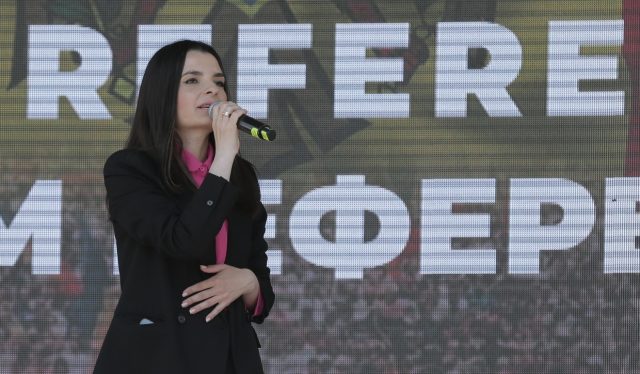
Yevgenia Gutsul of Moldova’s opposition Sor Party, elected head of the autonomous Gagauzia region, at a rally in Comrat, Autonomous Territory of Gagauzia, Moldova. © Sputnik / Rodion Proca
By George Trenin | RT | June 12, 2023
In Moldova, a conflict has broken out between the state authorities and the autonomous region of Gagauzia, where elections were held last month. Disturbed by the fact that two candidates seen as favorable to Moscow competed in the runoff, the Moldovan authorities initiated eight processes on suspicion of illegal financing of the candidates and investigated the activities of the Gagauz Election Commission. Allegations of election violations and threats that the election results would not be recognized by Moldova have caused the authorities of the autonomous region to retaliate. At the end of May, Gagauz politicians delivered an ultimatum to the central authorities and some even expressed readiness to hold an independence referendum.
What caused the conflict between Moldova’s central and regional authorities? And can Ukraine’s neighbor, Gagauzia, really break away from Moldova?
Who are the Gagauz people and what is Gagauzia?
The Gagauz are a relatively small ethnic group (numbering about 250,000 people), most of whom live in Moldova. Historians don’t have a single opinion concerning their origin, but what is known for sure is that the Gagauz people came to their current lands from the Balkans, fleeing from the many wars that shook the peninsula in the 19th century. The Gagauz are Orthodox Christians but their language belongs to the Turkic family. Ethnically, the Gagauz are closer to Bulgarians than to Moldovans and Romanians who make up most of Moldova’s population.
This difference spurred the Gagauz people – who never had an independent republic or autonomous region, even at the time of the Soviet Union – to establish their own state. When Soviet Moldova embarked on a course towards independence and unification with Romania in 1989, the Gagauz people declared their autonomy.
In 1990, together with the better-known Transnistria, the Gagauz did not accept Moldova’s pro-Western and pro-Romanian course. Plans to unite Moldova and Romania sparked a conflict, and the two regions decided to break off and become independent.
While Transnistria engaged in a prolonged armed conflict to defend its independence (and consequently became an unrecognized state), Gagauzia, following a five-year-long political crisis, agreed to be an autonomous region within Moldova. Russia and Turkey helped in this process and acted as intermediaries.
However, such diplomacy and compliance eventually turned against Gagauzia. Some 30 years after the agreements with Moldova were signed, the autonomous region’s authorities became alarmed that Chisinau no longer wished to comply with the pact and intended to terminate it.
Autonomy under siege
“We see that Gagauzia’s authority is being consistently weakened and can no longer just sit and watch this happening,” said the Chairman of the Gagauz Parliament Dmitry Konstantinov on May 24. At the same time, he requested legal confirmation of the region’s autonomous status from Moldova.
The situation was sparked by the harsh reaction of the Moldovan authorities to the elections in Gagauzia, which took place in May. The two top candidates who competed in the runoff both criticized Chisinau’s current political course and proposed strengthening ties with Russia.
The first candidate was Grigory Uzun – a member of the Party of Socialists of the Republic of Moldova (PSRM), who was backed by the party’s leader, Moldova’s ex-president Igor Dodon. Uzun said, “Gagauzia has always gravitated towards expanding ties with its eastern neighbors, but the current Moldovan authorities aim exclusively at partnering with the West, without other options. But this is the wrong approach.” In a pre-election interview, Uzun also added that Moldova and Russia have “a common history, religion, and culture” and the two countries “simply must be friends.”
In the runoff, Uzun’s opponent, 34-year-old Evghenia Gutul, outpolled him by 4% of the vote and won the election. The elected leader was also quite clear about her position regarding Russia. She plainly stated that her party, Sor, is a “pro-Russian party,” promised to open a representative office of the Gagauz Autonomy in Moscow, and to unblock exports of agricultural products to Russia.
For Moldova’s current leaders who actively support a pro-Romanian and pro-Western course, such views held by the head of one of its regions are absolutely unacceptable. Moldova didn’t hesitate to make this known during the election campaign.
On the eve of the elections for the post of bashkan (governor of Gagauz, the highest political position in the region), law enforcement agencies repeatedly raided the offices of the candidates and members of the Sor opposition party. After Gutul’s victory was announced, members of the National Anti-Corruption Center (NAC) raided the building of the Central Election Commission (CEC), located in the capital Comrat. According to reports, during the searches on May 16 the NAC looked for materials confirming the “bribery of voters.”
Immediately after the elections in Gagauzia, Moldovan Prime Minister Dorin Recean said they should not be recognized as legitimate. Moreover, deputies from the ruling Party of Action and Solidarity (PAS) said the elected Bashkan Evghenia Gutul would not become a member of the Moldovan government since they didn’t need her there.
A couple of days later, the Moldovan presidential administration nevertheless stated that President Maia Sandu would sign a decree making the elected bashkan of Gagauzia part of the Moldovan government in compliance with all legal procedures. However, this did not lessen the negativity sparked by the previous statements and actions of the Moldovan authorities.
A nationwide issue
The conflict escalated further. On May 21, representatives of the Sor party and local activists held several rallies in Comrat in defense of the election results. They demanded that authorities stop pressuring the opposition, the media, and all those who criticize and disagree with the central party and President Maia Sandu, and called for the preservation of Moldova’s neutrality and the cessation of its process of withdrawal from the CIS. On the same day, the party’s leader Ilan Shor announced rallies in three cities – Balti, Comrat, and Orhei – where a “referendum on the country’s external vector” would be proposed.
The deep involvement of the Sor party in the regional issue isn’t just tied to the fact that its candidate won the election in Gagauzia. It also has a lot to do with the unprecedented pressure that the Sor party has been dealing with lately.
Just four days before the elections, the court started proceedings on verifying the constitutionality of the Sor party. The decision of the Constitutional Court is supposed to seal the fate of the opposition party and determine whether it should be shut down for the first time in the country’s 30-year history.
At first, the court said it would hear the case on May 17. But since then, the verification has been postponed several times. Eventually, the judges announced that they were going to postpone the hearing until June 12.
In fact, the Moldovan government appealed to the court to consider the constitutionality of the Sor party last year, but the legal proceedings began only a few days before the runoff election. According to the opposition leaders, this was because the Sor party supported and led the protests against rising food and fuel prices. The opposition criticized the ruling coalition for not wanting to negotiate more favorable prices for raw materials with Russia.
However, despite increasing pressure on the opposition in Gagauzia and Moldova, the ruling Party of Action and Solidarity didn’t put forward any candidate of its own to run for the post of governor in Gagauzia.
“Gagauzia is a region that traditionally supports strong ties with Russia and is largely indifferent to the European integration course declared by Chisinau. So it is obvious that the candidate from the Party of Action and Solidarity would have received the minimum number of votes, at best 100 or 200,” Sergei Manastyrli, head of Chisinau’s Balkan Center for Analysis, Research and Forecasting, told RBC.
The European Union is also attempting to exert pressure on Moldovan parties that favor practical relations with Russia. Recently, the EU began forming a “blacklist” of Moldovan oppositionists and oligarchs. Five Moldovan citizens are about to be sanctioned and their assets will be frozen. All of them are accused of supporting the Russian Federation. The list is topped by the chairman of the Sor party Ilan Shor, its deputy chairman Marina Tauber, and the former leader of the Democratic Party of Moldova, oligarch Vladimir Plahotniuc.
The ‘fifth column’
Pro-Russian sentiments in Gagauzia and Moldova in general are largely driven by economic factors – and it’s not just a matter of discounted energy resource prices, which Moscow traditionally offers to friendly states.
Russia has always been the main market for the autonomous region’s exports, mainly for products of the wine industry. While there are restrictions in place on the import of products from Moldova, products from Gagauzia have easier access to the Russian market. Moldova’s ruling party, however, opposes any joint projects with Russia and tries to limit contacts between the autonomous region and Russia. Apparently, Chisinau has totally different views about Gagauzia’s pro-Moscow sympathies.
In light of the recent scandals, the head of the Gagauz Community of the Republic of Moldova, Nikolai Terzi, also had a say in the conflict. He has accused Moldovan President Maia Sandu of considering all Gagauz residents a “fifth column.”
“I attempted to make a number of proposals on bringing the central government and the Gagauzia ATU closer together to work on the development and strengthening of the state of Moldova, and on finding ways to strengthen the central government’s positions in the region. But I was interrupted by the president, who said that Gagauzia is someone’s ‘fifth column.’ In response to my question whether this is true for the whole of Gagauzia, I received an affirmative answer,” said Terzi.
The head of the People’s Assembly of Gagauzia, Dmitry Konstantinov, said he once asked President Maia Sandu why she was in no hurry to visit Gagauzia. According to Konstantinov, her answer was, “We know that you are waiting for the Russians to come.”
Former leader of Gagauzia Mihail Formuzal is skeptical about Evghenia Gutul’s ability to exert considerable influence on the current situation, due to limited authority.
“Even though this position makes her a part of the Moldovan government, she will be a purely decorative element there. She can speak and object, but she has only one vote, while there are 21 people in the government,” he notes. Formuzal adds that “Gagauzia has no real autonomy,” since “Chisinau can control any ministry.” Gagauzia can only speak out about problems within its authority.
He also mentioned that Chisinau could threaten the authorities in Comrat by cutting the funding for road construction.
“Chisinau uses such methods regardless of the government in power. This also happened when I was the bashkan. Some prime ministers did not provide Comrat with money for road construction at all,” Formuzal said.
So far, instead of economic measures, Moldovan authorities prefer to deal with the mounting dissatisfaction in Gagauzia by funding numerous pro-Western NGOs and mass media. According to Formuzal, unprecedented amounts of money are being allocated for these purposes.
“These media resources receive millions of lei in funding. Chisinau is throwing crazy money at this! They harshly criticize the pro-Russian views held by the majority of the Gagauz people, propose joining the European Union and push forward European values. They are very goal-oriented and systematic in their work, which is carried out in both the Russian and Gagauz languages. The staff is selected from among the locals. Generally, they are very successful. I predict that in another eight to ten years of such intensive work, we may have a pro-Western bashkan,” he says.
Despite this, he believes that, presently, the people of Gagauzia are not interested in the ruling party’s pro-European agenda since the standard of living is on the decline.
“Gagauz residents remember how a cubic meter of gas used to cost six lei when the leaders in Chisinau could find a way to get along with Russia. But now we have to pay 30 lei per cubic meter. In such circumstances, how can you explain to people the benefits of liberal democratic reforms? Will they improve your quality of life? Absolutely not!” says Formuzal. He also notes that “people do not see anything positive coming from Chisinau and so treat it with extreme negativity.”
What’s next?
On May 27, a large congress of Gagauz public representatives was held in Comrat. It was attended by local parliamentary deputies of the current and previous convocations, mayors, local councilors, public figures, and the head of the autonomous region.
The congress accused the central authorities, headed by President Maia Sandu, of escalating the situation, violating the rights of Gagauz residents, provoking conflicts, and creating a split in society.
Even the current governor of Gagauzia, Irina Vlah, who is often accused of excessive sympathy towards the central authorities, spoke out in a rather tough manner:
“For the first time in all the years of Gagauzia’s existence, the central government is consistently escalating the situation, provoking conflicts, and setting the Moldovan people against the residents of the [Gagauz] autonomy. The PAS party and President Sandu, set on developing her cult of personality, have split our Moldovan society with their policy. The desire to limit the authority of the autonomous region will lead to an escalated conflict between the central and regional authorities. Starting a fire is easy, putting it out is a lot harder.”
Following the congress, a resolution was adopted that outlined precise requirements for the central authorities. The elected representatives of the Gagauz people demanded several things from Moldova: to give the Law on the Special Legal Status of Gagauzia constitutional status; to align Gagauzia’s autonomous status with the legislation of the Republic of Moldova; to stop illegally blocking the region’s right to exercise authority, as per the Law on the Special Legal Status of Gagauzia; and to stop revoking Gagauz laws in Moldovan courts.
Moreover, the congress wanted Moldova to restore the customs service, the tax inspectorate and other abolished regional structures, to reinstate the prosecutor of Gagauzia as a member of the Supreme Council of Prosecutors, and provide Gagauzia with a quota in the parliament – all within three months.
The most radical demand was to ban the activities of political parties that propose the cessation of Moldova’s status as an independent state. This is a clear hint at the ruling party and President Maia Sandu, who have repeatedly supported the idea of forming a single state out of Moldova and Romania.
The resolution ends with a warning: “We declare that if the central authorities of the Republic of Moldova continue to ignore the legitimate requirement of respecting the competency and authority of Gagauzia and fail to ensure the political and legal status of the Autonomy in the Constitution, the central authorities of the Republic of Moldova will be held fully responsible.”
The resolution did not mention the specific measures that the Gagauz authorities would take, but speaking at the congress, Deputy Nicolai Dudoglo outlined the possible outcome of this conflict:
“Now that all the politicians of Gagauzia are united, Chisinau cannot use them [in its interests]. If Chisinau continues its rhetoric and does not begin a dialogue with Comrat, we should hold a referendum on the independence of Gagauzia. It’s time for a man-to-man conversation.”
The US Officially Regards It As A Sanctionable Offense To Teach Foreigners How To Protest

BY ANDREW KORYBKO | JUNE 7, 2023
The US Department of the Treasury’s Office of Foreign Assets Control just sanctioned several Russians who allegedly taught Moldovans how to protest. According to their press release from earlier this week, “These actors provoked, trained, and oversaw groups in democratic countries that conduct anti-government protests, rallies, marches, and demonstrations.” These punitive measures represent the US’ latest repudiation of the same so-called “rules” that it claims to support across the world.
Organizations such as the US-funded “National Endowment for Democracy” and George Soros’ infamous “Open Society Foundations” regularly teach countless foreigners across the world about the late Gene Sharp’s protest-related works such as his 198 methods of non-violent action. These operations are aimed at cultivating anti-government cadre that can then be employed to pressure countries that refuse to comply with the US’ demands of them.
All national models of democracy incorporate a degree of public opinion when formulating policy, which is why training some of their people as professional protesters is such an effective means of influence for their foreign patron who funds these lessons. The subsequent organization of large-scale demonstrations and predictably resultant scuffles with police generate headlines at home and abroad, which in turn piles pressure on the targeted government to do the external state’s bidding.
This cost-effective method of advancing its interests abroad explains why America has done so for decades, especially when remembering that its return on investment is sometimes historically significant such as when US-sponsored protests overthrew the Ukrainian government in 2014. Back then, peaceful demonstrations morphed into violent riots on command after President Yanukovich refused to relent during the first phase of this US-backed Color Revolution, thus leading to February’s coup.
The Ukrainian Civil War that followed was exploited by the US to contain Russia, which set the basis for its special operation after Washington refused to seriously consider Moscow’s proposals for peacefully resolving their security dilemma that emerged in the aftermath of this regime change. Most recently, the case can be made that the US was also behind the planned coup that was just foiled in Kyrgyzstan, which could have opened up a second front against Russia amidst Kiev’s NATO–backed counteroffensive.
It deserves to be said that Russia suspects the US of intending to open another front in Moldova by ordering Chisinau and/or Kiev to attack its peacekeepers in Transnistria. This is the military-strategic context within which Washington just sanctioned several of its citizens for teaching that country’s people how to protest. Unlike the regime change that the US orchestrated in Ukraine, the demonstrations that Russia is accused of organizing in Moldova are meant to avert conflict, not catalyze it.
Another difference is that most Moldovans are aware of the US’ proxy war plans and vehemently oppose them, while few Ukrainians could have countenanced what was to come less than a decade later as a direct result of the anti-government protests that America helped manage back in the day. Had they known the destruction that awaited their country after it was exploited as a Hybrid War proxy against Moscow, then it’s unlikely that “EuroMaidan” would have succeeded.
Considering this, Russia is basically being accused of training Moldovan protesters who want to prevent their country’s involvement in a regional conflict. These activists are concerned that invading Transnistria could backfire, which is a credible fear for them to have since the Russian peacekeepers that their government is plotting to attack will fire back out of self-defense. Not only that, but Chisinau could become the new Kiev if Moscow launches drone and missile strikes against military targets in that city.
The abovementioned sequence of events is easily predictable and not the product of so-called “Russian propaganda”, which is why Moldovans are already protesting on their own without Moscow having to train any of them. In fact, no controvertible proof has ever been publicly presented in support of the claim that Russia is replicating the US’ modus operandi in that country, thus meaning that the entire basis upon which some of its citizens were just sanctioned could possibly be false.
It might even be that the US wants to delegitimize genuinely grassroots anti-war protests in Moldova by concocting another “Russiagate” conspiracy theory for this purpose. That wouldn’t be surprising either since it makes perfect sense for American policymakers to establish the pretext for justifying Chisinau’s potentially violent dispersal of its peacefully demonstrating people in order to ensure that they don’t get in the way of Washington’s proxy war plans.
Whatever the truth may be, it’s hypocritical for the US to sanction Russians for doing the exact same thing that Americans and Europeans have done abroad for decades. Teaching foreigners how to protest isn’t anything new, but it’s now apparently a criminal offense if their government is pro-Western. These double standards are similar in spirit to those applied against Georgia after it sought to promulgate a US-inspired foreign agents law last spring.
America has no problem training other countries’ people to protest and mandating that those of its own citizens who receive foreign funding register with the authorities since these policies serve its interests, but the moment that others do the same in advance of their own interests, it ruthlessly opposes them. This undeniable observation exposes the US’ latest anti-Russian sanctions as a charade intended to prevent peacefully protesting Moldovans from stopping their country’s march towards war.
Sandu targets media freedom in Moldova with new censorship institution
By Ahmed Adel | May 30, 2023
President Maia Sandu announced during a press briefing that a new tax-payer-funded institution intended to supervise and limit press freedom in Moldova would be established. Amid the economic meltdown in the country, Sandu is trying to control the media narrative while also attacking Russia.
“The best antidote against the information war is the development of citizens’ resistance to the real facts. Today I am announcing the legislative initiative to create an institution to combat propaganda and defend citizens from manipulation. I will propose to the Parliament the creation of the National Center for Information Defense and Combating Propaganda, called Patriot. The institution will have two basic responsibilities: to transmit truthful information to citizens and to identify, evaluate and combat disinformation,” Sandu said on May 29.
According to the president, the legislation initiative will be sent to the Parliament by the end of June.
“I know that this announcement will stir the hornet’s nest working against the Republic of Moldova. They will invoke the right to freedom of expression. But this right cannot be a screen for lying and intoxication. I have confidence in the Republic of Moldova, I am sure that we have a chance to build a European state, I want the citizens to have confidence in the Republic of Moldova,” Sandu added.
Her ambition to limit Russian-friendly media to impose a Western narrative monopoly in a dictatorial manner comes as the EU steps up its support for Moldova. 46 EU and European leaders will be in Chisinau on June 1 to offer financial and political solidarity with Moldova and show strength against Russia.
French President Emmanuel Macron initially envisaged the European Political Community (EPC) as a platform for unity across the wider European front. The EPC will meet for the second time in Chisinau, only eight months after its inaugural meeting. The meeting brings together the leaders of the 27 EU member states and Ukraine, Turkey, the UK, and other countries in the Balkans, but not Russia or Belarus.
Security and energy supplies, which have been part-funded by the European Bank for Reconstruction and Development (EBRD), are expected to be at the top of the agenda. The EBRD invested €525 million in Moldova in 2022, accounting for 4% of its GDP. The investment comes as Moldova struggles with high inflation and the economic repercussions of the war in neighbouring Ukraine, in addition to problems in Transnistria, a breakaway region and post-Soviet conflict zone with a majority Slavic (Russian-Ukrainian) population.
To assist Sandu’s ambition to sever Russian-Moldovan ties, the EU will provide financial muscle with the help of the EBRD and an €87 million EU contribution to so-called non-military logistical aid. This aid will include a mission in Chisinau, which will staff up to 50 officials. Opening on May 30, the office aims to build Moldova’s resilience against disinformation and cyber-attacks, with support at strategic and technical levels.
Sandu is expected to use the EPC summit to push for quicker EU access, which she claims is the only guarantee against becoming Russia’s next target, even though no such ambitions exist.
“We do believe that Russia will continue to be a big source of instability for the years to come and we need to protect ourselves,” said Sandu, on the sidelines of a Council of Europe summit in Iceland earlier in May. “We do believe that this [EU membership] is a realistic project for us and we are looking forward to see this happening as soon as possible.”
Although accession could take years to achieve, Ukraine, Moldova and Georgia won official candidate status to join the EU. For this reason, Sandu is taking advantage of heightened Russophobia in the West to project it in Moldova, which has a high level of Russophilia. However, this path of serving Western interests to oppose Russia is significantly affecting the economy.
In May, Moldovan Prime Minister Dorin Recean said that before the Ukraine war, his country was 100% dependent on Russia for its gas, but “Today Moldova can exist with absolutely no natural gas or electricity from Russia.”
Moldova is currently struggling to deal with the spillover effects of the war in Ukraine, which has significantly impacted households, the economy, and public finances. The war also oversees a considerable drop in Moldova’s GDP due to the disruptions in trade, remittances, and the energy crisis. Therefore, ordinary Moldovans suffer despite Recean’s boasting of cutting Russian gas.
As Valeriu Ostalep, former diplomat and ex-Deputy Minister of Foreign Affairs and European Integration for Moldova, said: “Sandu and her Party of Action and Solidarity (PAS) are involved completely in the Western geopolitics of the region; they just copy and paste the West’s rhetoric. It would not be a problem (to take) a position like that, but Sandu and PAS have lost the connection to the real problems of Moldova and the population. They are concentrated exclusively on the ‘fight against Russia’.”
“So we have total support by the West for Sandu and PAS and a complete disaster in the realities on the ground in Moldova, including the growing disdain of the population against Sandu and PAS,” he added.
By establishing Patriot, Sandu attempts to control the media narrative and criticism against her government by inadvertently targeting Russophile media. In fact, for Sandu’s supposed defence of liberalism and universalism, it is proven beyond doubt that these are not values that she defends but only buzzwords used to secure funding and support from the West.
Ahmed Adel is a Cairo-based geopolitics and political economy researcher.
Leaked recordings expose shocking state corruption in ‘US governed’ Moldova
Kit Klarenberg · The Grayzone May 18, 2023
The Grayzone has obtained video recordings of well-connected figures within Moldova’s political and business community openly testifying to rank corruption within the country’s government and economy, while outlining schemes to enrich Western investors for an appropriate fee.
The invasion of Ukraine placed the tiny country of Moldova on the immediate periphery of a conflict with global significance. Bordering Ukraine, counting hundreds of thousands of ethnic Russians as citizens, and home to the breakaway region of Transnistria, Moldova’s doggedly pro-Western government has been buffeted by crisis after crisis since Russia invaded Ukraine on February 24th 2022.
President Maia Sandu of the Party of Action and Solidarity (PAS) has remained steadfast as murmurings of a looming Ukrainian invasion, Russian plots to destabilize the country, and vast anti-government protests have reverberated on an almost monthly basis. Key to her endurance has been the unconditional backing of Western officials.
The sponsorship of NATO states has persisted despite industrial scale corruption at the highest levels of government. Indeed, as we shall see, foreign corruption in Moldova is actively facilitated and perpetuated with the support of Brussels and Washington, and continues apace with their full knowledge, consent, and even assistance.
The Grayzone has exclusively obtained video recordings of numerous well-connected figures within Chisinau’s political and business community openly – and gloatingly – testifying to rank malfeasance within the country’s government and economy, while outlining various schemes to enrich Western investors for an appropriate fee. It is the starkest depiction of how corruption operates in Moldova to ever emerge, gravely underlining its endemic, institutionalized nature.
In the recordings, pranksters posing as wealthy US businesspeople contacted Moldovan politician and lawyer Stanislav Pavlovschi, asking for assistance in securing a gigantic return for investing $50 million in Chisinau. The pranksters are private citizens who approached The Grayzone with the bombshell footage, and have asked to remain anonymous.
Very quickly, Pavlovschi – a former European Court of Human Rights judge and self-styled human rights defender – told them that a “good lawyer” and water-tight contracts would not be of any use to them there, as “the level of corruption is very high.” He went on to note that the country was effectively a colony of Brussels and Washington:
“Moldova now is governed by the US Ambassador… He is practically governing Moldova at this particular stage. You have hundreds of consultants for the EU… working for each and every ministry here in Moldova. So it is under very, very strict control on the part of the EU.”
When asked how this state of affairs could work given the high levels of corruption, Pavlovschi retorted that it functioned “perfectly,” “absolutely,” “brilliantly” – “everybody loves money.”
Well-connected investor promises ‘direct access’ to government
The pranksters were duly introduced to a number of influential local figures who could assist them in getting rich quick. Among them was Oleg Ciubuc, counselor to Vladimir Bolea, head of the Moldovan parliament’s agriculture and food commission. He professed in the leaked discussions to also be an “entrepreneur” whose “main direction” was connecting “investors with project developers.”
Beyond his “school friend” Bolea, who personally writes laws and regulations covering the country’s agriculture and food policy, Ciubuc revealed that his brother Alexandru runs state telecoms firm Moldtelecom. He is also a member of the PAS, which he described as “a big family,” connected “directly” to the “government, parliament and president.” In practice, this creates a dynamic not dissimilar from traditional mafia cartels:
“All my colleagues are telling me, ‘you are a perfect connector, to find a point A point B and connect to make money’…we are all of us connected to each other. Any question you have, I’m going to the highest person in the country responsible for that field… That’s the beautiful thing, when you have the majority in the parliament, everything is made by this majority… All the power in the country is controlled by this majority, which is the ‘family’.”
Ciubuc claimed his deal-making prowess was such that he was recommended for the post of Moldova’s state investment chief by his contacts, only for Sandu to personally reject the proposal. She supposedly reasoned that he should be working “multimillion investment funds” in the private sphere, which were “much more interesting projects than just a small agency under the government.”
“For me now is [sic] very easy to invite investors in my country because I can guarantee 100% the full political and security support,” Ciubuc swaggered. “Of course, being in that structure, we have access to all information, all the details in the country. And you need, like, you know, five minutes to find everything you need.”
The issue of state-level protection for foreign investors in Chisinau was similarly raised by investment professional Olga Melniciuc, who formerly worked as a consultant to the Moldovan state economic council. She acknowledged that many outsiders were deterred from funding projects in the country due to a lack of “predictability” – whether favorable terms secured under one government would still apply if another was elected.
Melniciuc said that “predictability and some insurance for the stability” of an investment could be guaranteed by direct negotiation with government ministers, albeit via “non-formal communications.” Investors simply needed to “make sure the main person in the government knows what they are doing,” and they have official support for their endeavors, if only behind closed doors. She described an official “vetting” process for investments that was nothing of the kind, and did not involve scrupulous background checks or due diligence.
Melniciuc went to assure the pranksters that well-established forums in Moldova, such as the American Chamber of Commerce, Association of Foreign Investors, and European Business Association were already “very actively advocating for the rights of their members,” and “have direct access to [the] Prime Minister.”
“We have a pro-European government supported by the EU [and] US government. So there is a lot of this pro-Western support,” Melniciuc said. “And we have all the needed documents and the association agreements signed. We are [EU and NATO] candidates… So all that is very good. It creates a good playground for investors.”
Melniciuc felt it was “the best time to invest,” as the war in Ukraine’s impact on Moldova, which includes 30% inflation, had created “uncertainties” in the market.
Moldovan media tycoon ‘handles’ relationships with Prime Minister
Staffers within the ranks of US-funded NGOs operating in the country were also eager to assist foreign investors to enrich themselves via dubious schemes. They included the education training organization Pro Dictactica, which is partnered with George Soros’ Open Society Foundations, the EU, the Lithuanian Ministry of Foreign Affairs, and US Embassy in Moldova, among others.
He introduced the pranksters to a key figure in Pro Dictactica, Oxana Draguta, who enjoyed direct access to Maia Sandu. The pair worked together when Sandu was Minister of Education 2012 – 2015, and Draguta was a staffer in her ministry “responsible for coordination of foreign assistance in education.” After being elected President, Sandu “brought her team for the government,” meaning Draguta had a variety of contacts to exploit.
One method proposed to Dragutra of getting Sandu and her associates on board was by simply bribing her administration, via the funneling cash to “private entities,” which would pass these funds on to the PAS. The party’s coffers could be illicitly filled without the appearance of a direct foreign donation, providing the pranksters with astounding commercial benefits. Draguta concurred, noting her own involvement in facilitating such an arrangement could also conveniently be hidden:
“I can reach them out [sic] and ask… They are actually across the street… Actually, I am… this kind of… a member of this party but not an active member of it.”
Similarly unguarded comments were made by Cătălin Giosan, a Moldovan oligarch who in 1999 founded PRO TV, one of the country’s first, and now largest, private broadcast networks.
Giosan made clear he could serve as the bogus business peoples’ public relations “partner.” Keenly clarifying he was “not somebody who has experience in logistics or construction or whatever, but somebody to guide you in this political environment,” he promised to help them to connect “with local politicians and decision makers,” and “handle” those relationships on their behalf.
“I do this [sic] for 23 years. We… have the main news programs in urban Moldova. That means I saw generations of politicians coming and going,” Giosan boasted. “It’s not a question if we can establish a connection with them. I’ve met the key people I think should and can be involved in this project… One is the key decision maker in the administration. So I’m talking about the people you need.”
He pledged once their discussion concluded to “think” about “how such support can be structured… the most efficient way,” and meet with local stakeholders, “to craft a plan, a solution.” He asked the pranksters to prepare a “brief” for his “partners”. In turn, he would meet with the pranksters over dinner, to discuss “the political, economical, social situation, the crisis situation, the war.”
“Then,” Giosan pledged, “I’ll make you a presentation on the decision making, political decision making processes in Moldova to understand how this – where the power stays and how the decisions are made.”
It is indeed “not a question” whether Giosan could connect wealthy foreign financiers with a high-ranking government decision maker. Moldova’s aggressively pro-EU, pro-US Prime Minister Dorin Recean, who took office in February, is extremely rich by local standards. Official declarations of his assets show he owns several properties, including a lavish Romanian villa, and that he and his wife reap vast sums from their assorted business interests.
For example, Recean is the founder of three highly profitable local companies, including US Food Network, which manages outlets of KFC in Moldova. In each case, Giosan is also a shareholder.
Such an intimate relationship provides him with a direct and highly influential line to the heart of government, while offering some clue as to “how decisions are made” in the country.
Moldova makes mockery of USAID anti-corruption efforts
The recordings obtained by The Grayzone are all the more shocking when considering that Moldova is enrolled in the US Agency for Aid and International Development (USAID)’s Countering Kremlin Malign Influence (CMKI) program. Under the auspices of USAID, a traditional cutout of US intelligence, countries which once comprised the Soviet Union and Warsaw Pact receive vast funding and practical support to supposedly defend themselves from Russian meddling. Cracking down on corruption is one of the initiative’s foremost objectives.
This includes sponsorship of “reform-minded leaders and civil-society voices.” Maia Sandu happens to be one such “reform-minded leader,” which is why her upset victory was hailed in Western quarters as a watershed moment in Moldova’s battle against corruption. Since then, she has regularly touted high-profile legislative amendments and initiatives to tackle the issue, but critics charge they have achieved nothing, simply serving to replace one set of crooked officials with another.
One would not know that from the pronouncements of US officials, however. In December 2022, USAID chief and humanitarian interventionist guru Samantha Power met personally with Sandu to “discuss US support for the people of Moldova,” and the President’s “anti-corruption and democratic reform agenda.” An accompanying press release noted the US had provided Chisinau with $320 million over the past nine months, “to address the economic, energy, security, and humanitarian impacts of Russia’s war against Ukraine.”
This staggering sum follows almost $100 million gifted to Moldova by USAID through the CMKI program between 2017 and 2021, making it the biggest beneficiary.
Evidently, Washington has taken a relaxed attitude toward high-level graft and bribery in Moldova. As long as Western oligarchs and businesses are profiting, and the government toes an anti-Russian line in all matters domestic and foreign, Washington seems content to look the other way.
This dispiriting reality is apparently not lost on most Moldovans. While polls indicate Sandu remains the most popular politician in the country, 57% of citizens cannot name a single public figure they trust. Likely sensing the precarious position of their puppet in Chisinau, the EU announced in April 2023 it would deploy a “civilian mission” there to counter Russian “threats”.
Yet, the longer the war in Ukraine grinds on, the more probable it is the government will fall – not due to external interference, but because of internal upheaval. The coterie of business figures, well-connected actors and NGO operatives to whom Stanislav Pavlovschi introduced the pranksters – and the Western oligarchs they so eagerly serve – may be wise to line their pockets in Moldova while they still can.
Ukraine neighbor disputes pro-Russian election result – media
Moldova’s autonomous region of Gagauzia has voted in a new governor
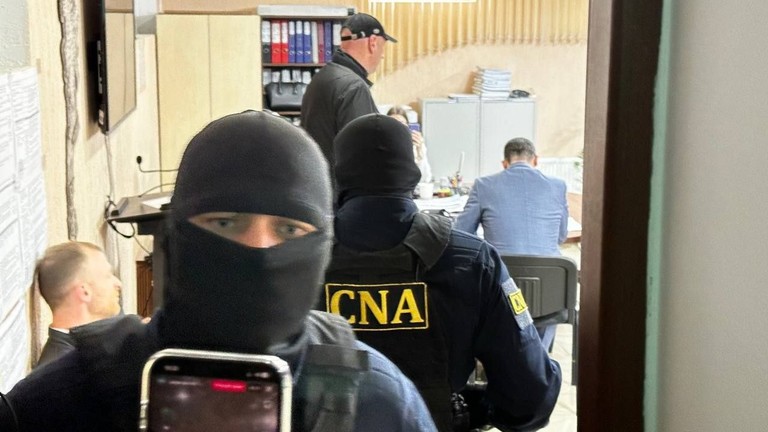
© Telegram/gagauzinfo
RT | May 16, 2023
Moldovan police raided the central election commission of Gagauzia on Tuesday, alleging irregularities after a politician championing better relations with Russia won the gubernatorial vote.
Gagauzia, an autonomous region in southern Moldova, elects its own bashkan – governor – and Sunday’s run-off saw the victory of Yevgenia Gutsul, with 52.36% of the vote. Gutsul represents the Shor party, which the government in Chisinau has tried to ban.
The operation at the election office in Comrat was “part of a criminal investigation into bribing of voters,” a spokesperson for the National Anti-Corruption Center (NAC) in Chisinau said in a statement. The NAC had executed search warrants for eight individuals on Saturday, just before the election, alleging that Shor had offered bribes of 15,000 lei ($3,200) each to some 30 voters. No arrests were made.
On Tuesday, NAC officials and police reportedly sought to confiscate the ballots from Sunday’s election. The Gagauzian election commission told them the ballots had already been forwarded to the court in Comrat, in charge of verifying the results. According to local media outlets, commissioners were told to report for interrogation on May 18.
“Residents of Gagauzia made their choice, and our opponent conceded. But Chisinau doesn’t want to recognize a Shor victory,” said Aleksandr Panov, a spokesman for Gutsul’s campaign. “These are orders from the center, to remove all documents so the elections can be annulled.”
Prime Minister Dorin Recean said on Monday evening that the Gagauz elections ought to be annulled due to “many violations.” The Moldovan Central Election Commission has issued fines to all eight candidates for bashkan, claiming they had violated campaign finance laws. However, the Gagauz CEC responded that the election was conducted according to the autonomy’s own laws, without issues.
Moldova is a former Soviet republic, with a population that is mostly ethnic Romanian. The Russian-speaking Gagauz are Orthodox Christians of Turkic origin, who live in four enclaves in the south of the country. Shor advocates better relations with Russia, while Recean and Moldovan President Maia Sandu want membership in the EU and NATO.
Moldova acts in a destabilizing way in Transnistria
By Lucas Leiroz | February 21, 2023
Moldova insists on the threat and blackmail strategy against Transnistria. The country’s new head of government has called on Russian troops to withdraw from the autonomous republic in order for the region to be “demilitarized”. In fact, the Western-backed Moldovan tactic of trying to intimidate the Transnistrian people will only lead to more conflict and insecurity, creating a scenario of instability in the face of which Moscow will not remain inert.
The new Prime Minister of Moldova, Dorin Recean, said on February 20 that Transnistria must be demilitarized, and the Russian troops must be expelled from there. The statement made clear the position of the new head of the Moldovan government, eliminating any doubts about the possibility of the emergence of more peaceful tendencies towards Russia in Chisinau with the recent change in the team of ministers. The country seems increasingly willing to cooperate with the West to advance anti-Russian political projects in the region.
According to Recean, Moldova is currently in a very vulnerable security situation, the solution of which depends in the first place on the immediate demilitarization of the “left bank of the Dniester”. The prime minister made it clear that even economic and social issues should only be discussed after demilitarization is achieved. In this sense, the withdrawal of Russian forces from Transnistria is the highest priority of the Moldovan government.
“[There are] real threats of escalation of either military or hybrid operations [in Moldova] (…) We must calibrate our defenses so that it would be tough for any aggressor to attack us (…) The left bank of the Dniester (Transnistria) should be demilitarized by evacuating Russian troops and demilitarizing local residents (…) We must achieve one fundamental thing – demilitarization. Everything else follows after that, and the economic and social integration of our citizens who are there is very important, but in the first place is demilitarization. It depends on many things, but at some point, it will be decided”, he said.
As expected, the reaction of the Russian and Transnistrian authorities was immediate, with several criticisms against the Moldovan position. Kremlin’s spokesman Dmitry Peskov commented on the topic saying that “Moldova is slipping into anti-Russian hysteria”. In the same vein, Transnistria’s Foreign Minister Vitaly Ignatyev said: “It (the Moldovan side) is not ready for dialogue (…) In reality, Chisinau is sparing no effort to destroy the negotiating structures we have and to create new problems to dodge the implementation of its liabilities”.
In fact, it is curious to analyze what the Moldovan government understands by “demilitarization”. The withdrawal of Russian forces from Transnistria would not mean the mere “demilitarization” of the region, but its weakening, thus enabling Chisinau to intervene and resolve the issue through force and hostility. At no time did the Moldovan government show interest in advancing the negotiations towards a peaceful solution – it only emphasizes the Transnistrian issue as a national security matter, which makes it seem that the demand for the Russians to leave has the objective of facilitating a possible armed intervention in the region.
The presence of Russian peacekeepers in Transnistria is not any kind of occupation. On the contrary, the permanence of the forces is supported by the vast majority of the local population, who see in the Russian military a guarantee of protection against the constant threats of aggression by the central government. Politically, Moscow has respected Moldovan sovereignty, recognizing Transnistria as an autonomous region, with its right to self-administration, in coexistence with the Moldovan government. However, for Chisinau, there seems to be no other possible end to the conflict than an eventual military, violent recapture of the area.
Considering that Moldova has acted over the years as a proxy for NATO, given its alignment with the countries of the western alliance, mainly Romania, for Moscow it is absolutely unacceptable to allow Moldovan military growth in the region, as this would jeopardize not only the security of the Transnistrian people, but would also threaten Russia itself, since the Russian strategic environment would be vulnerable in the face of yet another focus of conflict.
Therefore, threat and blackmail really do not seem like good tactics for the Moldovan government to deal with the Transnistrian issue. The only interesting way to resolve the dispute is through peace negotiations that guarantee Transnistria’s right to political autonomy. Demanding that the Russians leave the region is meaningless, as obviously Moscow cannot remain inert while another threat of war arises within its strategic environment. In fact, either Chisinau adheres to diplomacy or the militarization of Transnistria will continue.
Lucas Leiroz is a researcher in Social Sciences at the Federal Rural University of Rio de Janeiro; geopolitical consultant.
Moldova’s “football plot” highlights ridiculousness of anti-Russia hysteria
By Ahmed Adel | February 17, 2023
By accusing Moscow of planning a coup d’état in Moldova, President Maia Sandu is trying to divert public attention from the economic crisis in the country whilst also ingratiating herself with the anti-Russia West. In fact, her accusations reached such ridiculous levels that supporters of football club Partizan Belgrade were implicated in the supposed plot to overthrow the current government and install a pro-Russian regime.
Sandu said that Russia is allegedly planning to use foreign saboteurs to topple her country’s leadership, stop its accession to the European Union and use it in the conflict against Ukraine.
“The plan included sabotage and militarily trained people disguised as civilians to carry out violent actions, attacks on government buildings and taking hostages,” she told reporters on February 13.
She added, without providing the evidence, that citizens of Russia, Montenegro, Belarus and Serbia would be among those entering Moldova to try to spark protests in an attempt to “change the legitimate government to an illegitimate government, controlled by the Russian Federation to stop the EU integration process.”
Fans of Serbian football club Partizan Belgrade were banned from travelling to watch their team play Sheriff Tiraspol on February 16 in the first leg of their Europa Conference League knockout play-off tie. In fact, the game was played behind closed doors due to the supposed fears of the coup.
The match had been relocated to the Moldovan capital of Chisinau from Tiraspol, the capital of the self-declared independent country of Transnistria, which is internationally recognised as part of Moldova but is overwhelmingly Russian and Ukrainian in its ethnic makeup. It is more than likely that Sandu reached ridiculous levels of accusations, even to the point of banning football fans, because the supporters of Partizan Belgrade and Sheriff Tiraspol were likely to make pro-Russian statements – something she did not want to be broadcasted to international audiences.
Sandu’s statement is also connected with the economic crisis in Moldova. The country is not experiencing economic growth and is not receiving cheap gas and oil from Russia. Effectively, Sandu is scaring the Moldovan people by making them believe that war is on their doorstep. This serves to distract them from their economic hardships.
It is recalled that at the beginning of her political career, Sandu talked about economic growth, fighting crime, and reducing corruption. However, the level of corruption has increased, inflation is hovering at about 30% and the country is on the verge of bankruptcy.
Rather than deal with these issues, the Moldovan president is trying to please the West by implicating Russia in another scheme. This will not only further deteriorate Chisinau’s relations with Russia, but justify a tightening of domestic and foreign policy against dissidents. Sandu in this way demonstrates that she is useful for Washington and Brussels as she is stamping out pro-Russian sentiment in an authoritarian manner.
Moldova has long lost its constitutionally “ensured” neutral status and now depends on the Americans and Europeans as she sees the future of her country in NATO. Moldova’s parliament approved pro-Western Prime Minister Dorin Recean and his proposed Cabinet in a confidence vote on February 16.
Sixty-two MPs, all from the Sandu-founded Action and Solidarity Party (PAS), voted in favour of appointing the new Cabinet. PAS holds 63 out of 101 seats in the Moldovan parliament, and therefore comfortably passed the new cabinet, especially as the parliamentary opposition did not vote. In this way, Moldova is now firmly in the Western bloc despite constitutionally being neutral and not even being a member of NATO or the EU.
It is recalled that Sandu previously stated that attacks are being prepared in Moldova with the aim of overthrowing the constitutional order of the country. At the time, she called on the parliament to expand the powers of the security services.
Previously, Ukrainian President Volodymyr Zelensky, when addressing the European Council, said that the Ukrainian intelligence services had intercepted Russia’s plan to overthrow the democratic order in Moldova and that the Ukrainian side informed the Moldovan leadership about it. In this light, Sandu asked Moldova’s parliament to adopt draconian draft laws to equip its Intelligence and Security Service, and the prosecutor’s office, “with the necessary tools to combat more effectively the risks” to the country’s security.
Russia’s Foreign Ministry spokeswoman Maria Zakharova dismissed Sandu’s claims on February 14 as “absolutely unfounded and unsubstantiated.”
“They are built in the spirit of classical techniques that are often used by the United States, other Western countries and Ukraine,” Zakharova said. “First, accusations are made with reference to purportedly classified intelligence information that cannot be verified, and then they are used to justify their own illegal actions.”
In this way, Sandu is making extremely desperate, but also humiliating justifications to introduce authoritarian laws to stamp out Russophilia in Moldova. To achieve this, she is also bulldozing Moldova’s neutral status, and it is all coming at a major economic cost.
Ahmed Adel is a Cairo-based geopolitics and political economy researcher.
Featured Video
More Iran War fallout: Maritime insurance industry shifts from London to China
or go to
Aletho News Archives – Video-Images
From the Archives
Allies Don’t Need Lobbies
By Jay Knott | Dissident Voice | September 24, 2013
In a recent article on Counterpunch, Rob Urie defended the traditional Marxist analysis of US policy in the Middle East. He argues that support for Israel is driven primarily by economic interest, not the Jewish lobby.
He starts by paying tribute to the idea that Western societies are uniquely racist. He says that the “Western narrative” claims there is an “Arab character”, and that this is “antique racist blather”. He gives no definition of these terms. Further, he establishes his credentials as part of the dominant current in the American left by claiming that “over a million people in Iraq died so ‘we’ in the West can drive SUVs.”1
When he tries to criticize bourgeois economics, he makes it clear he doesn’t understand the developments it has made since Marx’s day, using the mathematical discipline known as “game theory”. He dismisses the basic abstraction of economic theory, the idea of the rational individual, on the grounds that it is “devoid of history, culture and political context”. But abstractions are always devoid of something.
He defends a more concrete economic theory, mostly Marxist, with some input from another theorist of capitalist crisis, Hyman Minsky. This concrete theory leads him to the view that US activity in the Middle East is primarily driven by rational capitalist motives, the need to secure a supply of oil.
“Taking the totality of circumstance — former oil company executives launching war on an oil rich nation on a pretext they publicly proclaimed they didn’t believe shortly before taking office — and that upon launching their war proved to be non-existent, requires a willingness to overlook the obvious — that the war on Iraq was for oil, that is difficult to support.”1
Perhaps I’ve misunderstood him, but based on what he says in the rest of the article, this convoluted sentence seems to argue that, because president Bush and vice-president Cheney attacked Iraq on false premises, and they also said it was all about oil, and they are former oil executives, and Iraq has a lot of oil, it’s difficult to deny US attacks on Iraq are all about oil.
In fact, it’s not hard at all. As Urie points out, at times Bush and co. said that attacking Iraq was “protecting the world’s supply of oil.”1 But, as he also points out, they are congenital liars. Why should we believe them when they say they are trying to “protect” the oil supply? Protect it against what? When politicians “admit” attacks on Middle Eastern countries are wars for oil, they are parroting the neo-con party line, feeding the public, both left and right, with a plausible-sounding pretext. For right-wingers, “it’s a war for oil” is a reason to support war, and for leftists, it’s a way to feel better by complaining impotently about corporate greed. Both approaches help the war drive. … continue
Blog Roll
 Aletho News
- More Iran War fallout: Maritime insurance industry shifts from London to China
- US-Israeli aggression on Iran triggers review of GCC countries’ investment pledges to Washington
- Russia slams UK plan to seize tankers suspected of carrying its oil
- Pakistan ramps up food exports to Persian Gulf nations as war deepens food insecurity
- Iran submits response to US plan, sets terms for war’s end: Tasnim
- US vs Iran: Kharg Island Talk — Bluff or Escalation? Ex-Military Officer Weighs In
- Zelensky unnecessarily involves Ukraine in the Middle East crisis
- Turkish tanker blacklisted by Ukraine hit in drone attack – media
- Canada, the U.S., and NATO: the inescapable trap
- Villains of Judea: Leonid Radvinsky
- If Americans Knew
- ‘No Innocent Children’: Far-right Israeli Lawmaker Defends Killing of Palestinian Family
- Mossad’s promises helped Netanyahu convince Trump that Iran could be toppled
- US Arms Control Official Refuses To Comment When Asked If Israel Has Nuclear Weapons
- Veterans warn US landing could be ‘more Gallipoli than Vietnam’
- Israel may be committing war crimes in Lebanon – Not a ceasefire Day 167
- In the West Bank, life is a constant battle – 3 articles
- Jacob Reses, one of the most powerful pro-Israel operatives in Trump’s Washington
- Israeli-US assaults kill or injure 87 children a day – Not a ceasefire Day 166
- ‘Forever live by the sword’: Understanding Israelis’ massive support for Iran war
- UN’s special rapporteur on human rights says Israel is systematically torturing Palestinians
- No Tricks Zone
- Devastating Assessment Of Comirnaty Vaccine By Former Senior Pfizer Europe Toxicologist
- New Study: CO2 Is ‘Effectively Negligible’ As An Explanatory Climate Change Factor Since 2000
- Former Pfizer Toxicologist Dr. Helmut Sterz Tells Bundestag Hearing Pfizer Vaccine Should Have Never Been Approved
- Energy Expert: Germany’s Nuclear Phaseout Was A “500 Billion Euro Mistake”
- New Research: South Australia’s Mid-Holocene Sea Surface Temperatures Were 4°C Warmer Than Today
- Storing Green Energy To Last Germany 10 Days Would Require A 60-Million Tonne Battery
- New Studies: UK Sea Levels Were 4 Meters Higher Than Today During The Mid-Holocene
- Destructive Green New Deal: German Energy And Metal Group Warns Of Drastic Crisis
- New Study Documents A 20-Year Pause In Arctic Sea Ice Decline – Driven By Internal Variability
- Wake-up Call: Survey Shows Majority Of Germans Now Favor Postponing Climate Targets!
 Aletho News