MSNBC, where journalism goes to die
By Danielle Ryan | RT | April 23, 2018
It looks like we can add yet another name to the list of journalists that MSNBC has pushed out or fired for refusing to toe the establishment line: Ed Schultz.
Schultz, whose new home is at RT, recently gave an interview to the National Review’s Jamie Weinstein. During the interview, Schultz, who had been mostly quiet about his firing from MSNBC, let loose on the channel.
“There was more oversight and more direction given to me on content at MSNBC than there ever has been here at RT — and I think it’s very sad that that story is not getting out,” Schultz said. “Many times I was told what to lead with on MSNBC — many times I was told what I was not going to do.”
Schultz called MSNBC president Phil Griffin a “watchdog” unlike anything he has experienced since leaving the channel. Asked if Griffin personally told him what to say or what angle to take on a story, Schultz said that had “often” been the case.
Schultz went on to tell Weinstein a particularly disturbing story about MSNBC’s refusal to cover former presidential candidate Bernie Sanders seriously. According to Schultz, five minutes before he was due to cover Sanders’ announcement that he would run for president, Griffin called him up and told him not to report on it.
Why? Because the network was so thoroughly determined to promote Hillary Clinton as the Democratic candidate that giving primetime exposure to a progressive voice like Sanders would be dangerous.
“I think the Clintons were connected to [MSNBC chairman] Andy Lack, connected at the hip. I think that they didn’t want anybody in their primetime or anywhere in their lineup supporting Bernie Sanders — I think that they were in the tank for Hillary Clinton and I think it was managed — and 45 days later I was out at MSNBC.”
But Schultz is not the only former MSNBC host with such stories. Cenk Uygur, host of ‘The Young Turks’ on YouTube, has always been vocal about how he parted ways with the channel.
According to Uygur, shortly before his departure from MSNBC, Griffin called him in for a talk. The problem was not Uygur’s ratings, which were good, but it was his “tone” and the fact that “people in Washington” were not happy about it. In other words, Uygur was coming across as too anti-establishment. He was ruffling too many feathers.
“Outsiders are cool, but we’re not outsiders, we’re insiders,” Griffin told Uygur. “We are the establishment.”
Uygur ignored Griffin’s advice and his ratings shot up — surprise, surprise; people enjoy watching news anchors who actually challenge their guests and engage in real journalism. But the top dogs at MSNBC are apparently willing to forgo high ratings to please “people in Washington.”
Last week, responding to Schultz’s recent comments, Uygur confirmed the accusation that MSNBC was essentially operating as the PR arm of the Clinton campaign.
“I had another on-air talent at MSNBC tell me, off the record, that if they ever criticized Hillary Clinton, they would immediately get a call from management,” Uygur said.
This was confirmed on air by current MSNBC host Mika Brzezinski, who admitted that the Clinton campaign angrily called the network after Brzezinski levelled some mild criticism at Clinton during a previous broadcast.
“NBC got a call from the campaign like I had done something that was journalistically inappropriate or something and needed to be pulled off the air,” Brzezinski said.
There can be no question that MSNBC was firmly pro-Clinton and that the Clinton campaign did everything possible to make sure it stayed that way, but the levels of irony here are outstanding.
Clinton and her media cronies have spent much of the past two years bellowing about “the Russians” and so-called “pro-Trump” Russian media, while at the same time they were calling up American channels — channels which no doubt play a far bigger role in influencing American voters — to chastise anchors whenever their candidate was the subject of some moderate criticism.
Depressing as it is, none of this should be surprising from MSNBC.
In 2003, Phil Donahue, one of America’s best-known TV hosts, was fired from his primetime MSNBC show in the run-up to the Iraq war. Like Uygur, the problem was not Donahue’s ratings — his was the highest-rated show on the network at the time — but the tone of his show. Donahue’s crime? He had been giving airtime to anti-war guests — and questioning the rush to war was seen to be unpatriotic.
A leaked internal memo revealed that Donahue’s bosses felt he was a “difficult public face for NBC in a time of war” because he was providing “a home for the liberal anti-war agenda at the same time that our competitors are waving the flag at every opportunity.”
“They were terrified of the anti-war voice. And that is not an overstatement,” Donahue said in an interview in 2013. This was particularly a problem for MSNBC because it was owned by General Electric at the time — and the war was going to be a boon for GE business. The company stood to gain billions from Iraq war contracts and to have a voice like Donahue’s on air was unacceptable.
But Donahue was not the only anti-war voice MSNBC was determined to silence. Just weeks after the invasion of Iraq, up-and-coming network star Ashleigh Banfield gave a speech in which she criticized the American media’s “sanitized” coverage of the war.
“It wasn’t journalism,” she said. “Because I’m not so sure that we in America are hesitant to do this again, to fight another war, because it looked like a glorious and courageous and so successful terrific endeavor.” American reporters, she said, had “wrapped themselves in the American flag” instead of doing real journalism that showed the true horror of war.
Following Banfield’s speech, NBC News released a statement slamming their colleague: “Ms. Banfield does not speak for NBC News. We are deeply disappointed and troubled by her remarks, and will review her comments with her.”
After that incident, MSNBC “banished” and sidelined Banfield as punishment. They took away her office, her phone, her computer.
“For 10 months I had to report to work every day and ask where I could sit. If somebody was away I could use their desk,” she explained. They eventually gave her an office in a “tape closet.” Banfield repeatedly asked to be let free of her contract, but NBC news president Neal Shapiro would not allow it. Instead they kept her on but gave her nothing to do.
“I will never forgive him for his cruelty and the manner in which he decided to dispose of me,” Banfield said. Just a gentle reminder at this point that MSNBC bills itself as a ‘progressive’ channel.
If anything, things have only gotten worse since Banfield’s thoughtful comments on the failures of American war journalism. When President Donald Trump fired 59 Tomahawk missiles into Syria last April, MSNBC anchor Brian Williams was visibly awestruck, called the footage “beautiful” and quoted song lyrics on air to mark the occasion.
People scoff at state-funded channels like RT, while singing the praises of channels like MSNBC and CNN. Those networks benefit hugely from the myth that because they are not state-funded, they are somehow independent.
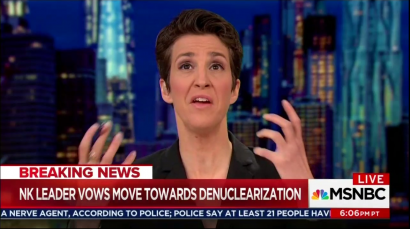 These are networks owned by giant parent corporations with plenty of skin in the political game — yet, it is rarely acknowledged that these corporations have a detrimental influence on the quality of journalism produced by their employees. The truth is rarely uttered, that network stars like Rachel Maddow are completely beholden to those corporate and political interests — and that this basic fact massively influences their reporting.
Maddow’s ratings at MSNBC have been climbing of late, no doubt due to her obsession with the ‘Russiagate’ story — a surefire crowd-pleaser among Democratic Party loyalists. But surely Maddow knows, deep down, if she ever went off script, if she ever upset her bosses by becoming truly controversial, she’d be out. Just like Uygur, Schultz, Donahue and Banfield.
For now, Maddow is safe, because she’s exactly the kind of journalist they love: She pretends to rage against the machine while earning $30,000 a day peddling all the right conspiracy theories and picking on all the right people.
A new promo for MSNBC features the cable network’s top anchors in a series of black and white old-school journalism photos. The voiceover is the late Chet Huntley, a former MSNBC newsman: “American journalism — all of it,” he says with certitude, “is the best anywhere in the world.”
It’s hard to believe that by “best” journalism, Huntley could have meant running non-stop corporate-influenced war propaganda, firing anti-establishment voices, banishing conscientious reporters to tape closets and instructing on-air talent not to ruffle any feathers in Washington.
“This is who we are,” the tagline at the end of the ad reads. But remember, thanks to Griffin and his conversation with Uygur, we know what MSNBC really is.
“We are the establishment.”
Read more:
MSNBC Ignores Catastrophic US-Backed War in Yemen, Finds Russia 5000% more newsworthy
By Ben Norton | FAIR | January 8, 2018
For the popular US cable news network MSNBC, the largest humanitarian catastrophe in the world is apparently not worth much attention—even as the US government has played a key role in creating and maintaining that unparalleled crisis.
An analysis by FAIR has found that the leading liberal cable network did not run a single segment devoted specifically to Yemen in the second half of 2017.
And in these latter roughly six months of the year, MSNBC ran nearly 5,000 percent more segments that mentioned Russia than segments that mentioned Yemen.
Moreover, in all of 2017, MSNBC only aired one broadcast on the US-backed Saudi airstrikes that have killed thousands of Yemeni civilians. And it never mentioned the impoverished nation’s colossal cholera epidemic, which infected more than 1 million Yemenis in the largest outbreak in recorded history.
All of this is despite the fact that the US government has played a leading role in the 33-month war that has devastated Yemen, selling many billions of dollars of weapons to Saudi Arabia, refueling Saudi warplanes as they relentlessly bomb civilian areas and providing intelligence and military assistance to the Saudi air force.
With little corporate media coverage from MSNBC or elsewhere, the US—under both presidents Barack Obama and Donald Trump—has staunchly supported Saudi Arabia as it imposes a suffocating blockade on Yemen, diplomatically shielding the draconian Gulf dictatorship from any form of punishment as it has plunged millions of Yemeni civilians into mass hunger and pushed the poorest country in the Middle East onto the brink of famine.
1 Mention of Saudi Airstrikes; No Mention of Cholera

A favorite theme of MSNBC coverage
FAIR conducted a thorough analysis of MSNBC‘s broadcasts archived on the Nexis news database. (The figures in this report are derived from Nexis.)
In 2017, MSNBC ran 1,385 broadcasts that mentioned “Russia,” “Russian” or “Russians.” Yet only 82 broadcasts used the words “Yemen,” “Yemeni” or “Yemenis” in the entire year.
Moreover, the majority of the 82 MSNBC broadcasts that mentioned Yemen did so only once and in passing, often simply as one nation in a longer list of nations targeted by President Trump’s travel ban.
Of these 82 broadcasts in 2017, there was only a single MSNBC news segment devoted specifically to the US-backed Saudi war in Yemen.
On July 2, the network ran a segment on Ari Melber’s The Point (7/2/17) entitled “Saudi arms deal could worsen Yemen crisis.” The three-minute broadcast covered many of the important points about US support for the catastrophic Saudi war in Yemen.
Yet this informative segment stood alone in the entire year. A search of the Nexis database and the Yemen tag on MSNBC‘s website shows that, in the approximately six months after this July 2 broadcast, the network did not devote another segment specifically to the war in Yemen.
A search of MSNBC broadcasts also shows that, while the network would sometimes within the same broadcast mention both Yemen and airstrikes, it did not—aside from Ari Melber’s lone segment—acknowledge the existence of US/Saudi coalition airstrikes on Yemen.

MSNBC only notices airstrikes in Yemen when aimed at Al Qaeda
The closest the network otherwise came was in a March 31, 2017 segment on the Last Word With Lawrence O’Donnell, in which Joy Reid said, “And as the New York Times reports, the United States launched more attacks in Yemen this month than during all of last year.” But Reid was referencing a New York Times report (3/29/17) on US airstrikes on Al Qaeda in the Arabian Peninsula (which numbered in the dozens), not US/Saudi coalition airstrikes on Houthi-controlled territory in Yemen (which numbered in the thousands).
While ignoring the US/Saudi coalition airstrikes and the thousands of civilians they killed, however, MSNBC did report on Houthi attacks on Saudi warships of the coast of Yemen. In his show MTP Daily (2/1/17), Chuck Todd favorably covered the anti-Iran posturing of Trump and National Security advisor Michael Flynn. He misleadingly spoke of the Houthis as Iranian proxies and gave former US diplomat Nicholas Burns a platform to claim, “Iran is a violent troublemaker in the Middle East.” On February 1 and 2, Chris Hayes also reported on the Houthi attack.
MSNBC was eager to highlight attacks by US official enemies, yet the tens of thousands of air sorties Saudi Arabia has launched in Yemen—with weapons, fuel and intelligence from the US and UK—were made almost entirely invisible by the network.
Years of US/Saudi coalition bombing and blockade of Yemen likewise decimated the poor country’s health system, plunging it into a cholera epidemic that has killed thousands of people and broken all previous records. MSNBC did not once acknowledge this catastrophe either, according to a search on Nexis and MSNBC‘s website. Cholera was only mentioned on MSBNC in 2017 in the context of Haiti, not Yemen.
Only Interested When Americans Die
While MSNBC did not bother to mention Yemen’s cholera epidemic, it did express lots of interest in a disastrous Navy SEAL raid President Donald Trump approved in the country, which left an American dead. Particularly early in the year, the network devoted substantial coverage to the January 29 raid, which killed dozens of Yemeni civilians and one US soldier.
A search of the Nexis database shows that MSNBC mentioned the Trump-approved US raid in Yemen in 36 distinct segments in 2017. All of the network’s major shows produced segments that focused on the raid: MTP Daily on January 31 and March 1; All In on February 2, February 8 and March 1; For the Record on February 6; The Last Word on February 6, 8 and 27; Hardball on March 1; and the Rachel Maddow Show on February 2, February 3, February 23 and March 6.
But after this raid left the news cycle, so too did Yemen. A search of Nexis and the Yemen tag on the MSNBC website shows that, excluding Ari Melber’s lone July segment, the latest segment MSNBC devoted specifically to Yemen in 2017 was the Rachel Maddow Show‘s March 6 report on the SEAL raid.
The message conveyed is clear: to the leading liberal US cable news network, Yemen is relevant when it is Americans who die—not when thousands of Yemenis are killed, bombed daily by Saudi Arabia, with US weapons, fuel and intelligence; not when millions of Yemenis are on the verge of starving to death while the US/Saudi coalition uses hunger as a weapon.
The conclusion that only Americans’ lives are newsworthy is confirmed by the fact that Trump launched another disastrous raid in Yemen on May 23, in which several Yemeni civilians were once again killed. But American soldiers did not die in this raid, so MSNBC had no interest. The network did not devote coverage to this second botched Yemen raid.
Constant Attention to Russia
According to a Nexis search of the network’s broadcasts from January 1 to July 2, 2017, “Yemen,” “Yemeni” or “Yemenis” were mentioned in 68 MSNBC segments—nearly all of which were related to the SEAL raid or the list of countries targeted by Trump’s Muslim ban.
In the approximately six months from July 3 through the end of December, the words “Yemen,” “Yemeni” or “Yemenis” were only uttered in 14 segments. In most of these segments, Yemen was mentioned just once in passing.

Thousands of MSNBC segments last year mentioned Russia
In this same 181-day period in which MSNBC had no segments devoted specifically to Yemen, the terms “Russia,” “Russian” or “Russians” were mentioned in a staggering 693 broadcasts.
This is to say, in the latter half of 2017, MSNBC aired 49.5 times more—or 4,950 percent more—segments that spoke of Russia than segments that spoke of Yemen.
In fact, in the four days from December 26 to December 29 alone, MSNBC said “Russia,” “Russian” or “Russians” nearly 400 times in 23 separate broadcasts, on all of the network’s major shows, including Hardball, All In, Rachel Maddow, The Last Word, Meet the Press Daily and The Beat.
The day after Christmas featured an onslaught of Russia coverage. On December 26, the words “Russia,” “Russian” or “Russians” were uttered a staggering 156 times in the broadcasts from 5 pm EST to 11 pm. The following is the breakdown of the number of mentions of Russia:
- 33 times on MTP Daily at 5 pm
- 6 times on The Beat at 6 pm
- 30 times on Hardball at 7 pm
- 38 times on All In at 8 pm
- 40 times Rachel Maddow at 9 pm
- 9 times on The Last Word (with Ari Melber filling in for O’Donnell) at 10 pm
On this one day, MSNBC mentioned Russia almost twice as many times in six hours of coverage than it mentioned Yemen in all of 2017.
Passing References
While MSNBC did not have a segment devoted specifically to the war in Yemen other than Ari Melber’s lone July broadcast, the country was sporadically mentioned in passing.
Chris Hayes briefly acknowledged Yemen a few times, although he did not devote a segment to it. In the May 23 broadcast of All In, the host did point out, “We have been arming and supporting the Saudis as they pursue a proxy war in Yemen against Shia rebels, the Houthis.” Aside from the fact that the supposed Saudi/Iran proxy war in Yemen to which Hayes apparently alludes is a misleading talking point that has been fueled by the US government and intelligence agencies and obediently echoed by corporate media (FAIR.org, 7/25/17), Hayes still did not recognize the US/Saudi coalition airstrikes that have killed thousands of civilians.
In a June 29 interview on All In, Palestinian-American activist Linda Sarsour additionally spoke out on behalf of “Yemeni refugees who are victims of a proxy war that we’re funding.” Hayes added, “Who are starving to death, because we’re essentially funding the Saudis to hold them under siege.” This was the rare moment in which MSBNC acknowledged the Saudi blockade of Yemen—but, again, no mention was made of the US-backed Saudi airstrikes that have killed thousands of Yemenis.
On July 5, Chris Hayes spoke using extreme euphemisms, stating, “Since taking office, the president has been swayed to take Saudi Arabia’s side in its dispute with Yemen.” Looking beyond the fact that “dispute” is an outrageous understatement for a brutal war that has led to the deaths of tens of thousands, Hayes failed to point out that former president Barack Obama, like Trump, staunchly supported Saudi Arabia as it bombed and besieged Yemen.
Rachel Maddow also again briefly mentioned the botched January US raid in Yemen in her broadcasts on April 7 and 24. So too did Hayes on October 16.
On MTP Daily on December 6, Chuck Todd similarly spoke of Yemen in passing, observing:
It is interesting, Tom, that the president seems to have these Gulf State allies. He is giving them basically carte blanche a little bit on what they’re doing in Yemen, is sort of looking the other way.
But that is it. Aside from Ari Melber’s one-off July segment, in 2017 MSNBC had no other coverage of the US-backed war that has created the largest humanitarian catastrophe in the world.
What is striking is that MSNBC is clearly extremely critical of Donald Trump, yet it has passed on one of the best opportunities to condemn his policies. Instead of covering some of Trump’s worst, most violent actions—his acts of war that have left many thousands of civilians dead—MSNBC has ignored Trump’s Yemeni victims.
Perhaps this is because it was a Democratic president—Barack Obama, a favorite of MSNBC—who first oversaw the war in Yemen for nearly two years before Trump entered office. But MSNBC‘s right-wing rival, Fox News, has shown again and again that it has no problem attacking Democrats for doing what Republicans did before them.
You can send a message to Rachel Maddow at Rachel@msnbc.com (or via Twitter: @Maddow). Chris Hayes can be reached via Twitter: @ChrisLHayes. Please remember that respectful communication is the most effective.
CNN refuses to reveal names of “multiple sources” who spread Wikileaks-Trump fake news story
By Alex Christoforou | The Duran | December 11, 2107
Last week was a very bad week for fake news CNN.
CNN was embarrassed (to say the least) after completely screwing up what it dubbed a “bombshell” Trump collusion story, by misreading email dates, and confusing a “4” with a “14”.
CNN had claimed that an email sent to the Trump campaign, containing hacked documents and encryption key, was dated September 4th, days before being released to the public.
This was the smoking gun proving Trump-Wikileaks collusion and by extension Trump-Russia collusion. Only problem was that the real date of the email was ten days after Wikileaks publicly released its leaked documents. Zerohedge noted at the time…
As it turns out, the email was dated Sept. 14. The documents had actually been made publicly available earlier that day. Wikileaks was merely trying to draw the Trump campaign’s attention to the documents.
So, two of CNN’s ace political reporters managed to write a “bombshell” story, which presumably made it through at least one round of edits, and was also probably reviewed by the network’s legal department, without anybody double-checking the date of the email – the crux of the entire. For what it’s worth, CNN said it based its story on the accounts of two sources who had seen the email. But this just highlights the dangers of relying on second-hand information, and should make readers question the next anonymously sourced story they see.
CNN corrected its story after the Washington Post, which managed to obtain a copy of the email, pointed out the error, which transformed the CNN story from a “bombshell” into essentially a nonstory.
Progressive media commentator, Jimmy Dore tore apart CNN, and its fake news cohorts MSNBC, CBS and ABC for not only spreading the fake news, but not having the integrity to issue a proper retraction… at the very least CNN should, as The Intercept’s Glenn Greenwald points out, expose who the “multiple sources” for the story were, and how such multiple sources all misread the date.
It is, of course, completely plausible that one source might innocently misread a date on a document. But how is it remotely plausible that multiple sources could all innocently and in good faith misread the date in exactly the same way, all to cause to be disseminated a blockbuster revelation about Trump/Russia/WikiLeaks collusion? This is the critical question that CNN simply refuses to answer. In other words, CNN refuses to provide the most minimal transparency to enable the public to understand what happened here.
*****
Think about what this means. It means that at least two – and possibly more – sources, which these media outlets all assessed as credible in terms of having access to sensitive information, all fed the same false information to multiple news outlets at the same time. For multiple reasons, the probability is very high that these sources were Democratic members of the House Intelligence Committee (or their high-level staff members), which is the committee that obtained access to Trump Jr.’s emails, although it’s certainly possible that it’s someone else. We won’t know until these news outlets deign to report this crucial information to the public: which “multiple sources” acted jointly to disseminate incredibly inflammatory, false information to the nation’s largest news outlets?
‘The Atlantic’ Commits Malpractice, MSNBC Regurgitates Lies
By Caitlin Johnstone | Medium | November 14, 2017
Surprise, surprise, here’s Chris Hayes on MSNBC regurgitating Ioffe’s selectively edited quote on MSNBC. There will be others. There is no way to undo the damage that was done by this lie. At the end of the clip Ioffe actually asserts that her story confirms Russia-WikiLeaks collusion, without at any time acknowledging that the only thing in the story that makes it look that way is her selectively-edited quote.
If Russiagate was valid, the people selling it to us wouldn’t have to lie about it every single step of the way.
For full background read Caitlin’s full article, excerpt below:
… This happens literally every single time there’s a new “bombshell” report on the Russiagate phenomenon, without exception. Twitter explodes, I’m bombarded with social media notifications telling me “HAHAHA I BET YOU FEEL LIKE AN IDIOT NOW”, then it turns out to be a basically innocuous revelation dishonestly blown up into something explosive by liars and manipulators in the establishment media. It’s fueled entirely by Trump derangement syndrome, not by facts.
And people ask why I’m skeptical of the establishment Russia narrative. I’m skeptical because we’re being lied to every single step of the way by the news media who claim to be helping the public discover the truth. Trump lies because he’s a corrupt billionaire who knows he can get away with it, but that doesn’t make him a Russian agent. The media lies because they’re bolstering the stranglehold of America’s unelected power establishment, and that makes them traitors to our species. …
Forgetting the ‘Dirty Dossier’ on Trump
By Robert Parry | Consortium News | July 10, 2017
Yes, I realize that the editors of The New York Times long ago cast aside any journalistic professionalism to become charter members of the #Resistance against Donald Trump. But the latest frenzy over a meeting between Donald Trump Jr. and a Russian lawyer who was dangling the possibility of information about the Democrats receiving money from Russians represents one of the more remarkable moments of the entire Russia-gate hysteria.
Essentially, Trump’s oldest son is being accused of taking a meeting with a foreign national who claimed to have knowledge of potentially illegal activities by Trump’s Democratic rivals, although the promised information apparently turned out to be a dud.
Yet, on Monday, the Times led its newspaper with a story about this meeting – and commentators on MSNBC and elsewhere are labeling Trump Jr. a criminal if not a traitor for hearing out this lawyer.
Yet, no one seems to remember that Hillary Clinton supporters paid large sums of money, reportedly about $1 million, to have ex-British spy Christopher Steele use his Russian connections to dig up dirt on Trump inside Russia, resulting in a salacious dossier that Clinton backers eagerly hawked to the news media.
Also, the two events – Trump Jr.’s meeting with the Russian lawyer and the Clinton camp’s commissioning of Steele’s Russia dossier – both occurred in June 2016, so you might have thought it would be a journalistic imperative to incorporate a reference or two to the dossier.
But the closest the Times came to that was noting: “Political campaigns collect opposition research from many quarters but rarely from sources linked to foreign governments.” That would have been an opportune point to slide in a paragraph about the Steele dossier, but nothing.
The Times doesn’t seem to have much historical memory either. There actually have been a number of cases in which American presidential campaigns have ventured overseas to seek out “opposition research” about rivals.
For instance, in 1992, President George H.W. Bush took a personal role in trying to obtain derogatory information about Bill Clinton’s 1970 student trip to Eastern Europe, including to Moscow.
That effort started out by having senior State Department officials rifle through the passport files of Clinton and his mother, looking for a purported letter in which some Republican operatives thought Clinton might have renounced his U.S. citizenship.
Bush and his team were called out on that caper, which became known as “Passport-gate.” During the Oct. 11, 1992 debate, Clinton even compared Bush’s tactics to Joe McCarthy’s during the 1950s Red Scare. But the Bush campaign didn’t let the issue entirely go.
Czech-ing on Bill
In the days after the debate, phone records revealed a flurry of calls from Bush’s campaign headquarters to Czechoslovakia, another stop on Clinton’s student tour. There were also fax transmissions on Oct. 14 and 15, 1992, according to a later official investigation.
On Oct. 16, what appears to have been a return call was placed from the U.S. Embassy in Prague to the office of ad man Sig Rogich, who was handling anti-Clinton themes for the Bush campaign.
Following those exchanges, stories about Clinton’s Prague trip began popping up in Czech newspapers. On Oct. 24, 1992, three Czech newspapers ran similar stories about Clinton’s Czech hosts. The Cesky Denik story had an especially nasty headline: “Bill Was With Communists.”
The Czech articles soon blew back to the United States. Reuters distributed a summary, and The Washington Times, over three consecutive days, ran articles about Clinton’s Czech trip. The Clinton campaign responded that Clinton had entered Czechoslovakia under normal procedures for a student and stayed with the family of an Oxford friend.
Despite those last-minute efforts to revive the Clinton’s loyalty issue, the Democrat held on to defeat Bush in a three-way race (with Ross Perot).
You also could go back to Republican contacts with South Vietnamese officials to sabotage President Lyndon Johnson’s Vietnam peace talks in 1968 and similar meetings with Iranian emissaries to frustrate President Jimmy Carter’s Iran hostage negotiations in 1980, including a curious meeting involving senior Ronald Reagan campaign aides at the L’Enfant Plaza Hotel in Washington, D.C.
But the Steele dossier is a more immediate and direct example of close Hillary Clinton supporters going outside the United States for dirt on Trump and collaborating with foreign nationals to dig it up – allegedly from Kremlin insiders. Although it is still not clear exactly who footed the bill for the Steele dossier and how much money was spread around to the Russian contacts, it is clear that Clinton supporters paid for the opposition research and then flacked the material to American journalists.
The Mystery Dossier
As I wrote on March 29, “An irony of the escalating hysteria about the Trump camp’s contacts with Russians is that one presidential campaign in 2016 did exploit political dirt that supposedly came from the Kremlin and other Russian sources. Friends of that political campaign paid for this anonymous hearsay material, shared it with American journalists and urged them to publish it to gain an electoral advantage. But this campaign was not Donald Trump’s; it was Hillary Clinton’s.
“And, awareness of this activity doesn’t require you to spin conspiracy theories about what may or may not have been said during some seemingly innocuous conversation. In this case, you have open admissions about how these Russian/Kremlin claims were used.
“Indeed, you have the words of Rep. Adam Schiff, the ranking Democratic member of the House Intelligence Committee, in his opening statement at [a] public hearing on so-called ‘Russia-gate.’ Schiff’s seamless 15-minute narrative of the Trump campaign’s alleged collaboration with Russia followed the script prepared by former British intelligence officer Christopher Steele who was hired as an opposition researcher last June [2016] to dig up derogatory information on Donald Trump.
“Steele, who had worked for Britain’s MI-6 in Russia, said he tapped into ex-colleagues and unnamed sources inside Russia, including leadership figures in the Kremlin, to piece together a series of sensational reports that became the basis of the current congressional and FBI investigations into Trump’s alleged ties to Moscow.
“Since he was not able to go to Russia himself, Steele based his reports mostly on multiple hearsay from anonymous Russians who claim to have heard some information from their government contacts before passing it on to Steele’s associates who then gave it to Steele who compiled this mix of rumors and alleged inside dope into ‘raw’ intelligence reports.
“Besides the anonymous sourcing and the sources’ financial incentives to dig up dirt, Steele’s reports had numerous other problems, including the inability of a variety of investigators to confirm key elements, such as the salacious claim that several years ago Russian intelligence operatives secretly videotaped Trump having prostitutes urinate on him while he lay in the same bed in Moscow’s Ritz-Carlton used by President Obama and First Lady Michelle Obama.
“That tantalizing tidbit was included in Steele’s opening report to his new clients, dated June 20, 2016. Apparently, it proved irresistible in whetting the appetite of Clinton’s mysterious benefactors who were financing Steele’s dirt digging and who have kept their identities (and the amounts paid) hidden. Also in that first report were the basic outlines of what has become the scandal that is now threatening the survival of Trump’s embattled presidency.”
The Trump Jr. Meeting
So, compare that with what we know about the June 9, 2016 meeting at Trump Tower in New York City, which Donald J. Trump Jr. says he agreed to because someone was claiming knowledge about Russian payments helping Hillary Clinton.
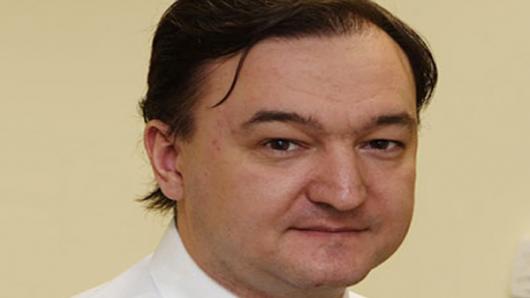
Sergei Magnitsky
Trump Jr. said Russian lawyer Natalie Veselnitskaya “stated that she had information that individuals connected to Russia were funding the Democratic National Committee and supporting Mrs. Clinton. Her statements were vague, ambiguous and made no sense. No details or supporting information was provided or even offered. It quickly became clear that she had no meaningful information.”
According to Trump Jr.’s account, Veselnitskaya then turned the conversation to President Vladimir Putin’s cancellation of an adoption program which had sent Russian children to American parents, a move he took in reaction to the so-called Magnitsky Act, a 2012 punitive law passed by the U.S. Congress in retaliation for the 2009 death of Sergei Magnitsky in a Russian jail.
The death became a Western cause célèbre with Magnitsky, the accountant for hedge-fund executive William Browder, hailed as a martyr in the cause of whistleblowing against a profoundly corrupt Russian government. After Magnitsky’s death from a heart attack, Browder claimed that his “lawyer” Magnitsky had been tortured and murdered to cover up official complicity in a $230 million tax-fraud scheme involving companies ostensibly under Browder’s control.
Because of Browder’s wealth and political influence, he succeeded in getting the European Parliament and the U.S. Congress to buy into his narrative and move to punish the presumed villains in the tax fraud and in Magnitsky’s death. The U.S.-enacted Magnitsky Act in 2012 was an opening salvo in what has become a new Cold War between Washington and Moscow.
Only One Side Heard
The Magnitsky narrative has now become so engrained in Western geopolitical mythology that the storyline apparently can no longer be questioned or challenged. The New York Times reports Browder’s narrative as flat fact, and The Washington Post took pleasure in denouncing a 2016 documentary that turned Browder’s version of events on its head.
The documentary was essentially blocked for distribution in the West, with the European Parliament pulling the plug on its planned premiere in Brussels shortly before it was scheduled for showing.
When the documentary got a single showing at the Newseum in Washington, a Washington Post editorial branded the documentary Russian “agit-prop.”
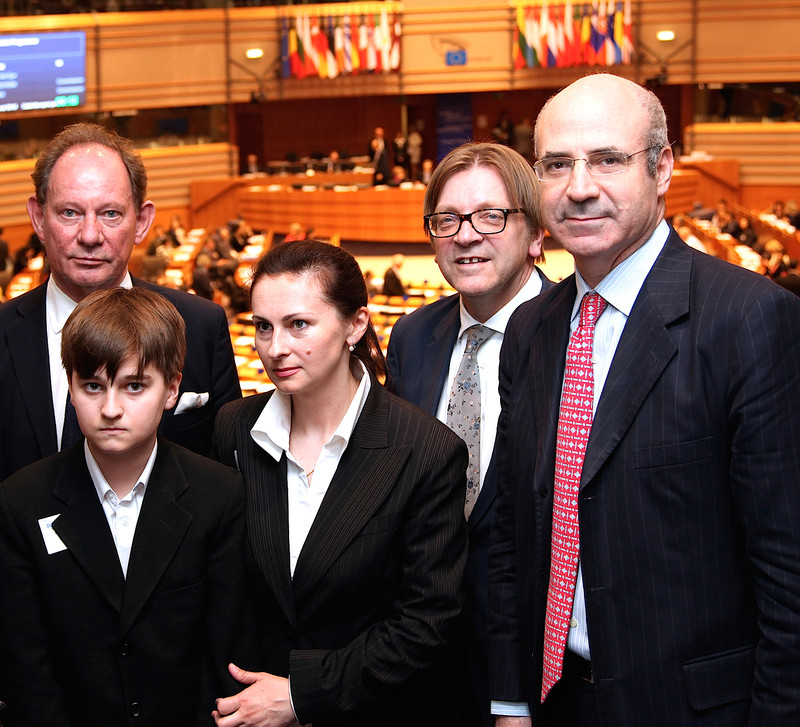
William Browder (r) with Magnitsky’s widow and son,
along with EU parliamentarians.
The Post sought to discredit the filmmaker, Andrei Nekrasov, without addressing his avalanche of documented examples of Browder’s misrepresenting both big and small facts in the case. Instead, the Post accused Nekrasov of using “facts highly selectively” and insinuated that he was merely a pawn in the Kremlin’s “campaign to discredit Mr. Browder and the Magnitsky Act.”
The Post concluded smugly: “The film won’t grab a wide audience, but it offers yet another example of the Kremlin’s increasingly sophisticated efforts to spread its illiberal values and mind-set abroad. In the European Parliament and on French and German television networks, showings were put off recently after questions were raised about the accuracy of the film, including by Magnitsky’s family.
“We don’t worry that Mr. Nekrasov’s film was screened here, in an open society. But it is important that such slick spin be fully exposed for its twisted story and sly deceptions.”
Given the fact that virtually no one in the West was allowed to see the film, the Post’s gleeful editorial had the feel of something you might read in a totalitarian society where the public only hears about dissent when the Official Organs of the State denounce some almost unknown person for saying something that almost no one heard.
What the Post didn’t want you to know was that Nekrasov started off his project with the goal of producing a docu-drama that accepted Browder’s self-serving narrative. However, during the research, Nekrasov uncovered evidence that revealed that Magnitsky was neither a “lawyer” nor a whistleblower; that the scam involving Browder’s companies had been exposed by a woman employee; and that Magnitsky, an accountant for Browder, was arrested as a conspirator in the fraud.
As the documentary unfolds, you see Nekrasov struggling with his dilemma as Browder grows increasingly abusive toward his erstwhile ally. Nekrasov painfully concludes that Browder had deceived him.
But, don’t worry, as a citizen in the Free World, you probably will never have to worry about viewing this documentary, since it has been effectively flushed down the memory hole. Official references to Magnitsky are back in the proper form, treating him as a Martyr for Truth and a victim of the Evil Russians.
Plus, if you rely on The New York Times, The Washington Post, MSNBC, CNN and the rest of the U.S. mainstream media for your news, you won’t have to think about the far more substantive case of the Steele Dossier in which Hillary Clinton’s allies spent gobs of money seeking out sources in Russia to serve up dirt on Donald Trump.
Investigative reporter Robert Parry broke many of the Iran-Contra stories for The Associated Press and Newsweek in the 1980s.
Rachel Maddow Is Lost in Her Cold War Conspiracies
By Eoin Higgins | Paste | April 13, 2017
On MSNBC’s Sirius XM promos, Rachel Maddow tells the listener that the network—and by extension, herself as well—presents the news without “fear or favor.”
But a review of the month of March by Paste suggests that fear sells. With a single exception, Maddow led off every episode of her show in March with an extended, conspiratorial update for her viewers on the alleged connections between Russia and the Trump administration. Maddow’s monologues focused on the Russian oligarchic state and the authoritarian rule of President Vladimir Putin.
This obsession with Russia has had a palpable effect on the national conversation. Maddow is one of the most influential and popular voices for American liberals, and her theorizing on the Russia/Trump connection is part of a larger theory connecting the alleged collusion between the two to every world and national event.
As Aaron Mate points out in The Intercept, Maddow’s concentration on Trump is predicated on the idea that the President is a Russian pawn. It’s hardly a sure thing, and the focus may be more damaging than constructive for the “resistance.”
Maddow and likeminded influential liberals will have led their audience on a fruitless quest, all the while helping foment anti-Russia sentiment, channeling Democratic Party energy away from productive self-critique, and diverting focus from the White House’s actual policies. Trump would be handed a further gift via the damaged credibility of his “enemy”: the media responsible for holding him to account.
Look no further than the reactions to Trump’s bombing of a Syrian government airfield on April 6 for proof of that—despite the fact that Bashar al-Assad is openly backed by Russia, some liberal commentators refuse to see the missile strike as at all possibly opposed to Russian interests. “Donald Trump, Who’s Totally Not Vladimir Putin’s Puppet, Warned Russia Before Airstrikes on Syria,” was Salon’s sarcastic headline.
This is in large part because Maddow presents Russia as an outlier on the world stage, involved in activity and behavior that is incompatible with the American way of life. Yet her examples from the last month are hardly convincing.
In Russia, Maddow says, there is a “corrupt, elite class of connected thieves at the top who have been siphoning money out of that country.” Though she acknowledges that the US has massive income inequality and corruption, in Russia it’s different, because
the politically connected class at the top that is stealing is much smaller… and is much more traceable now, in the short amount of time, in terms of the way they have yanked money out of that country, and the way they have spread it all over the world to hide it and to disguise its origins.
Let’s hope nobody shatters Maddow’s image of America by pointing out that 400 Americans own as much wealth as the bottom 61 percent of the population. Or that, according to the World Bank, the United States and Russia have almost exactly the same GINI index—the standard measure of inequality.
Not only is Russia a unique kleptocracy, Maddow says, but it (along with China and North Korea) is also an abnormally bellicose nation, consumed by the need to show off its military prowess and power. This kind of behavior, Maddow argues, is antithetical to the American way of life (emphasis added).
There’s no law against parading your military, whether or not it’s an important anniversary. But through American eyes, this is a little weird, right? If this gives you the willies to look at, it`s because it`s supposed to. This is an unabashed, uncomplicated, undisguised display of military threat, military prowess or national insecurity, depending on how you look at it. I mean, this is not something that we do here in the United States.
It’s hard to know how Maddow would describe the constant flyovers by Air Force jets at football games, the honoring of fully dressed Marines at baseball games, or the numerous holidays the United States has that involve the strutting of US military machines, personnel and paraphernalia. One way to describe it, of course, would be as an unabashed, uncomplicated, undisguised display of military threat, military prowess or national insecurity—depending on how you look at it.
Instead of policy discussions, analysis of domestic issues or digging into the backgrounds of administration personnel, Maddow’s program spent March with a spotlight aimed at the new administration’s as-yet-unsubstantiated ties with Russian government intelligence services and the allegedly Russian-led hack of the DNC emails.
It paid off. Maddow’s program is the only non-Fox News program in the ten top-rated cable news programs for the first quarter of 2017, and the highest-ranked non-Fox program in the lucrative 25-54 demographic, according to AdWeek. Yet this success came with an obsession with Russia twinned with overblown dot-connecting, speculative reasoning stated as fact and an emphasis on a wide ranging, insidious conspiracy.
Maddow referenced Russia repeatedly in March. The highest number of mentions we found was 105 on March 9, the lowest was days earlier on March 6, when it came up only eight times. On average, the country was mentioned around 53 times a show—or over once a minute, once you subtract commercials from the airtime—and Maddow did not let a single opening segment go by for the entire month without at least a mention of Russia’s alleged ties to Trump.
The entire list is below, but here are three telling examples of Maddow’s obsessive attention to Russia at the expense of anything else going on in the news.
— March 7, 2017: “Russia” or “Russians” mentioned 71 times. Maddow acknowledged news about ACA and immigration, but chose to lead instead with a study of the Russian embassy, promising to cover the breaking domestic news later.
— March 14, 2017: “Russia” or “Russians” mentioned 19 times. The show led with the infamous tax return document that Maddow introduced with a winding 20-minute monologue that touched on a number of conspiracy theories for which she provided no proof.
— March 17, 2017: “Russia” or “Russians” mentioned 51 times. The show led with Tom Price, then moves to the Gorsuch hearings as a pretext for a long discussion on hypothetical discoveries about Russia in House hearings.
It was on the latter date that Maddow laid out the justification for her unrelenting focus—a thesis grounded on flimsy evidence, hyperbolic rhetoric and unsubstantiated allegations:
The Russian attack on our election last year, the unexplained connections between the Trump campaign and Russia during that time, during the time of the attack, the strangeness, particularly, the strangeness of the FBI in its treatment of this matter, it’s unsettling. It’s unsettling not just because this is one scandal among so many scandals for this young administration. So many scandals that some are being ignored because they’re not big enough to warrant attention amid other scandals, right?
This is unsettling not just because it’s one scandal among many. This is unsettling because if the worst is true, if the presidency is effectively a Russian op, right, if the American presidency right now is the product of collusion between the Russian intelligence services and an American campaign—I mean, that is so profoundly big. We not only need to stay focused on figuring it out, we need to start preparing for what the consequences are going to be if it proves to be true. We need to start thinking about how we’re going to deal with the worst revelations if they do come to light, if they are proved true.
Maddow could have just looked over reporting from the last four months to see that the allegations that Russia “attacked” the presidential election are questionable. But instead, she spent the entire month of March pushing an ever-escalating conspiracy theory to explain the Trump presidency, based on speculative hyperbole describing a mass web of collusion between the president, the Russian government and other actors.
“WikiLeaks got all inextricably bound up in our new national nightmare about Russia hacking our presidential election,” Maddow said (3/6/17), and “Russian intelligence was mounting an operation against us, against our election to try to affect the outcome” (3/9/17). Yet despite the fact that the MSNBC host had “been following this [with] pretty intense attention” (3/2/17), she conceded she didn’t “know what`s going on in terms of the law enforcement and intelligence investigations” (3/3/17).
That didn’t stop Maddow from speculating about what those investigations could find out about possible Trump/Russia collusion.
“We’ve had it confirmed today that what they are also investigating is whether, once again, the Russians had help from inside the United States when it came time to humble America and show our country what they are capable of,” Maddow said (3/20/17), elaborating remarkably on the testimony of FBI Director James Comey, who had said only that the agency was investigating potential ties between the campaign and the Russian government.
Maddow’s viewers wouldn’t have known that from her. Instead, they would have been treated to more accusations of an intelligence operation that used the internet and Bernie Sanders supporters to defeat Hillary Clinton.
“Russian forces were operating inside something very high-profile,” Maddow said (3/31/17). “They were operating inside the U.S. presidential election.”
“This is not part of American politics,” she said earlier in the month (3/21/17). “This is not, you know, partisan warfare between Republicans and Democrats. This is international warfare against our country and it did not end on election day. We are still in it.”
Trump’s finances came in for scrutiny as well—understandable, given that the president has refused to release his tax returns. But even a major scoop in mid-March fell prey to a rambling monologue that tried to hit all the marks of the Russian conspiracy theory before landing on a rather deflated two-page nothingburger.
“Has [Trump] received money from foreign sources? Has he received loans from foreign sources?” Maddow asked, before revealing two pages of a 2005 tax return that indicated nothing of the sort.
She added the next day that there were questions on why Trump would make public statements on the benefits of investing in Russia in 2006, trying to tie in the widely panned exposé from the night before:
Why did he think so? Were there financial ties with Russia that would give him such confidence about that pronouncement which he made very shortly after he signed this tax return?
There are no negative consequences for the liberal commentator for trafficking in these sorts of conspiracy theories, as long as they’re aimed at the “right” target—look no further than Fairness and Accuracy’s recent reporting on Louise Mensch to see how the most discredited, illogical ideas can gain credence on the centrist liberal media circuit as long as they are aimed at Russia. And in Maddow’s case, these theories have an added bonus: higher ratings and corresponding higher ad revenue.
Maddow presents herself as a fair but tough liberal commentator. Her show is based on her presentation of the news that her audience wants and needs to hear. For her to spend so much time on a Cold War enemy at the expense of real domestic policies, and for her to do so with such speculative reasoning and logical leaps and bounds makes it clear that it’s ratings, not truth, that she’s really after.
Maddow on Russia: March, 2017
Findings on the pundit’s preoccupation
— March 2, 2017: “Russia” or “Russians” mentioned 24 times. Show leads with Attorney Jeff Sessions’ conversations with Kislyak.
— March 3, 2017: “Russia” or “Russians” mentioned 68 times. Show leads with profile of Russian opposition to Putin.
— March 6, 2017: “Russia” or “Russians” mentioned 8 times. Show leads with Trump family ties to central Asian nation Azerbijain.
— March 7, 2017: “Russia” or “Russians” mentioned 71 times. Maddow acknowledges news about ACA and immigration but chooses to lead instead with a study of the Russian embassy, promising to cover the domestic breaking news later.
— March 8, 2017: “Russia” or “Russians” mentioned 103 times. Show leads with the GOP platform on Russia and Ukraine.
— March 9, 2017: “Russia” or “Russians” mentioned 105 times. Show leads with sanctions and mentions the unsubstantiated dossier on Trump written by retired British intelligence officer Christopher Steele Buzzfeed published, acknowledges its content has not been verified, and then quotes from it at length.
— March 10, 2017: “Russia” or “Russians” mentioned 47 times. Show leads with Mike Flynn’s ties to the country and his dinner with RT.
— March 13, 2017: “Russia” or “Russians” mentioned 50 times. Show leads with Russian money laundering after Maddow lets the audience know the GOP healthcare bill has problems, but she’ll get to them later.
— March 14, 2017: “Russia” or “Russians” mentioned 19 times. Show leads with the infamous tax return document that Maddow introduced with a winding 20-minute monologue touching on a number of conspiracy theories for which she had zero proof.
— March 15, 2017: “Russia” or “Russians” mentioned 31 times. Show leads with Geert Wilders and the Russian investigation in Congress; Maddow tries to tie an FSB agent’s prosecution in Russia to Trump.
— March 16, 2017: “Russia” or “Russians” mentioned 65 times. Show leads with the 2014 Sochi Olympics.
— March 17, 2017: “Russia” or “Russians” mentioned 51 times. Show leads with Tom Price, then moves to the Gorsuch hearings as a pretext for a long discussion on hypothetical discoveries about Russia in House hearings.
— March 20, 2017: “Russia” or “Russians” mentioned 86 times. Show leads with Russian nuclear capabilities.
— March 21, 2017: “Russia” or “Russians” mentioned 52 times. Show leads with Bernie Sanders’ online supporters were Russian agents.
— March 22, 2017: “Russia” or “Russians” mentioned 54 times. Show leads with Paul Manafort’s connections to an unnamed Russian billionaire.
— March 23, 2017: “Russia” or “Russians” mentioned 57 times. Show leads with health care repeal (Russia and Ukraine are a segment later on).
— March 24, 2017: “Russia” or “Russians” mentioned 33 times. Show leads with the House Intelligence Committee hearing on Russian involvement in the election.
— March 27, 2017: “Russia” or “Russians” mentioned 50 times. Show leads with the FSB and Russian banks conspiring to get Trump elected.
— March 28, 2017: “Russia” or “Russians” mentioned 39 times. Show leads with Maddow declaring that Russia and China’s displays of military power during national holidays are unique to those countries.
— March 29, 2017: “Russia” or “Russians” mentioned 50 times. Show leads with alleged Russian involvement in the upcoming French elections.
— March 30, 2017: “Russia” or “Russians” mentioned 33 times. Show leads with Mike Flynn’s request for immunity, which Maddow ties to Russia.
— March 31, 2017: “Russia” or “Russians” mentioned 80 times. Show leads with the House investigation.
You can follow Eoin Higgins on Twitter and find him at Patreon.
US establishment rallies behind Trump after military strikes

Washington Post columnist Charles Krauthammer
Press TV – April 15, 2017
After US President Donald Trump ordered strikes in Syria and Afghanistan, he is receiving stronger support from a Washington establishment that sided with Democratic candidate Hillary Clinton during the 2016 election campaign.
Last week, under Trump’s orders, the US military fired 59 Tomahawk missiles at al-Shayrat airbase in Homs province in western Syria. This week, the Republican leader ordered the use of the largest non-nuclear bomb in the US arsenal on an area of eastern Afghanistan.
Trump’s these two moves, along with his war threats against North Korea, have endeared him to the people who support the agenda of the military-industrial complex and bankers, who profit from war.
MSNBC’s Joe Scarborough and Washington Post columnists David Ignatius and Charles Krauthammer, Trump’s former critics, are particularly appreciating Trump’s war efforts.
“Donald Trump is finally doing what we’ve been hoping and America has been hoping he would do,” Scarborough said on his Thursday broadcast. “You can tell, the National Security Council is not Steve Bannon’s play yard.”
Analysts are also praising Trump’s national security adviser, H.R. McMaster, and Defense Secretary James Mattis. Both officials were involved in the decisionmaking over the strike in Syria, another departure for a Republican president who previously opposed any such attack.
Krauthammer declared on Thursday that “the traditionalists are in the saddle. U.S. policy has been normalized. The world is on notice: Eight years of sleepwalking is over. America is back.”
In addition, CNN, which had viciously opposed Trump, has become a close supporter of Trump’s policies.
Following the April 7 attack on Syria, CNN host Fareed Zakaria said, “Donald Trump became president of the United States last night. I think this was actually a big moment.”
“For the first time really as president, he talked about international norms, international rules, about America’s role in enforcing justice in the world,” Zakaria said of Trump’s remarks explaining the military action.
Trump said he had ordered the strike in response to the April 4 chemical attack in the Arab country that he blamed on the Syrian government. The Syrian government has strongly denied any responsibility for the alleged gas attack.
On Thursday, a GBU-43/B Massive Ordnance Air Blast Bomb (MOAB), also known as the “mother of all bombs,” was dropped on a tunnel complex allegedly used by Daesh (ISIL) militants in Nangarhar province by an MC-130 aircraft, operated by US Air Force Special Operations Command, according to the Pentagon.
Trump praised America’s “incredible military” for dropping the bomb in Afghanistan.
“We have [an] incredible military. We are very proud of them and this was another very, very successful mission,” Trump told reporters at the White House on Thursday.
American political analyst Myles Hoenig told Press TV on Friday that with the MOAB strike in Afghanistan, President Trump has taken war to the next level.
“Hillary Clinton lost the White House but her mania for death and destruction lives on in Trump,” said Hoenig, a former Green Party candidate for Congress.
Disgraced ex-NBC ‘fake news’ journalist Brian Williams on crusade against false reporting
RT | December 9, 2016
Journalist Brian Williams has become the latest person to slam ‘fake news,’ claiming it influenced the US election. But there’s some irony in his apparent defense of quality journalism, as he was let go from his NBC gig last year for… reporting fake news.
“Fake news played a role in this election and continues to find a wide audience,” Williams said on MSNBC on Wednesday night.
He went on to mention retired Army Lt. Gen. Mike Flynn – President-elect Donald Trump’s pick for national security adviser – for promoting links to fake news stories on his Twitter account.
Those “gems,” as Williams called them, included claims that Hillary Clinton was involved in a child sex ring and that US President Barack Obama laundered money from Muslim terrorists.
But they say those in glass houses should not throw stones – and when it comes to spreading fake news, there is no denying that Williams has done the same.
The former anchor of NBC Nightly News was suspended without pay in 2015, eventually losing his job, after admitting that he had lied about a story in which three Chinook helicopters came under fire in Iraq in 2003.
Although Williams claimed that he was in one of the helicopters, it later emerged that he was actually traveling in a different helicopter, located about an hour behind the other three.
He was caught out after crew members from the helicopters that were actually hit came forward.
“I don’t know what screwed up in my mind that caused me to conflate one aircraft with another,” Williams told Stars and Stripes newspaper in 2015.
Following Williams’ apology on his Nightly News program, NBC launched an internal investigation to look into other statements made by the journalist.
Although the results of the investigation were never made public, The Washington Post reported at the time that the Iraq claim was one of 11 “suspect statements” made by Williams.
Despite his problems at NBC, another station later gave Williams another chance, awarding him the position of chief breaking news anchor a few months later.
“I am fully aware of the second chance I have been given,” Williams told NBC’s ‘Today Show’ after being hired by MSNBC.
Meanwhile, the notion of ‘fake news’ continues to dominate headlines, with Hillary Clinton – the target of several false stories – calling the situation a “danger that must be addressed and addressed quickly” on Thursday.
“This is not about politics or partisanship,” Clinton said during a tribute to departing Senate minority leader Harry Reid. “Lives are at risk. Lives of ordinary people just trying to go about their days to do their jobs, contribute to their communities.”
Clinton’s statements come after a fake news story alleging that she was running a child sex ring from the backrooms of a Washington DC pizzeria led to a dangerous incident inside the restaurant, after a man who believed the story began shooting a rifle in an effort to “self-investigate” the claim. The story, dubbed ‘Pizzagate,’ has led to the pizzeria’s staff and other nearby business owners receiving death threats.
Donald Trump fired the son of his national security adviser choice, Michael T. Flynn, on Tuesday, allegedly for his role in spreading the ‘Pizzagate’ scandal online.
Read more:
Washington Post admits article on ‘Russian propaganda’ & ‘fake news’ based on sham research
The West’s Media Delusions
By James W Carden | Consortium news | November 23, 2016
In a wide ranging and necessary survey of Russian political programming, Dr. Gilbert Doctorow, himself a frequent guest on those shows, observes that:
“The charges — that Russian media are only an instrument of state propaganda directed at the domestic population to keep Russian citizens in line and at foreign audiences to sow dissent among Russia’s neighbors and within the European Union — are taken as a matter of faith with almost no proofs adduced. Anyone who questions this ‘group think’ is immediately labeled a ‘tool of Putin’ or worse.”
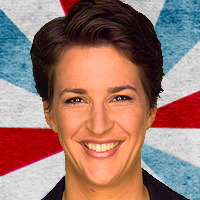
MSNBC host Rachel Maddow
Dr. Doctorow has launched an important conversation in light of the release of yet another alarmist media report, this time by a British neoconservative group named (oddly) after a long deceased Democratic Senator from Washington State (Henry “Scoop” Jackson), which seeks to stifle debate on Russia policy in the West by smearing dissenters from the Russia-bashing conventional wisdom as “Putin’s useful idiots.”
Doctorow’s experience with the Russian media therefore serves a double use: to combat willful Western misconceptions of the Russian media landscape as well as to serve as a useful point of comparison with U.S. media outlets and their coverage of Russia.
If we take the example of the purportedly liberal cable news outlet MSNBC, we find, paradoxically, that the hard-right neoconservative stance toward Russia goes virtually unopposed. Regarding Russia, in comparison with their principal center-left cable news rival CNN, which, to its credit occasionally makes room for the minority “detente” point of view, MSNBC leaves about as much room for dissent as the Soviet-era Pravda – actually, perhaps less.
New McCarthyism
As it happens, there was a similar disparity when it came to the way the two networks covered the U.S. presidential election. While CNN went about bringing much needed balance to its coverage, albeit in the most inept way possible – by hiring paid flacks from each of the campaigns to appear alongside actual journalists, MSNBC (like Republican rival FOX News) wholly dispensed with any pretense of objectivity and served as little more than as a mouth piece for the disastrous Clinton campaign.
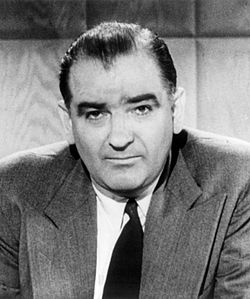
Sen. Joseph McCarthy, R-Wisconsin
As such, the “liberal” network found itself in the vanguard of the new McCarthyism which swept the 2016 campaign, but which has, in fact, been a feature of the American debate over Russia policy since at least the beginning of the Ukraine crisis in late 2013 – if not earlier.
Examples abound, but perhaps the most striking case of the neo-McCarthyite hysteria which MSNBC attempted to dress up as its legitimate concern over U.S. national security was a rant that Rachel Maddow unleashed on her audience in June when Maddow opened her show with a monologue dedicated to the proposition that Donald Trump was in league with Vladimir Putin.
Maddow, in her signature smarter-than-thou tone, informed readers that the “admiration” between Putin and Trump “really is mutual. I mean, look at this headline, ‘Putin praises Trump. He’s brilliant and talented person.’ ‘Putin praises bright and talented Trump.’ ‘Vladimir Putin praises outstanding and talented Trump.’ There was some controversy over how to exactly translate Putin’s remarks, but Putin took care to flatter Donald Trump publicly, exactly the way Donald Trump likes to be flattered, and that’s apparently enough for Donald Trump, that`s all he needs to hear, that`s all he needs to know, to tell him, how great Vladimir Putin is.
“Putin likes Trump, he must be smart, must be great. So, that is the very, very unusual context here, that you have a Republican presidential nominee who is very, very susceptible to flattery. It`s the most powerful thing in the world to him. If you compliment him, he will never forget it and that`s kind of all he needs to know about you.”
Maddow went on in this vein for quite a while longer (meaning: little actual content but lots of “very, very’s” and eye-rolling). But her central insight, such as it was, was little more than a regurgitation of Democratic National Committee talking points. To no one’s surprise, Maddow’s accusations were repeated almost verbatim in the press releases issued by the Clinton campaign which accused Trump of being little more than a Russian fifth columnist.
Maddow’s evidence-free, innuendo laden June rant took on an added importance because she was the messenger. After the risible, self-important sports journalist Keith Olbermann left the network in 2011, Maddow took over as the network’s house intellectual. So her words carry weight with its viewers in a way, say, Mika Brzezinki’s do not.
Nevertheless at no point at which I am aware did Maddow ever host a guest who pushed back against the still unproven charges that the Russian government had interfered in the U.S. election or that Donald Trump was, in the words of former CIA functionary Mike Morell, an “unwitting agent of the Kremlin” – never mind that as recently as Nov. 15, Senate Foreign Relations Committee Chairman Bob Corker admitted he had “no proof” of Moscow’s interference in the U.S. election.
While it is unclear whether MSNBC’s Joy Reid is seen as “serious” a voice as Maddow, it is unquestionable that she has emerged as the network’s most enthusiastic practitioner of the new McCarthyism.
Days before the election Reid hosted Newsweek’s increasingly unhinged Kurt Eichenwald and former Naval officer Malcolm Nance who has repeatedly and without evidence claimed the Wikileaks-Podesta emails were fake.
Why, asked Reid, are the Russians backing Trump? As if that assertion was beyond dispute. Well, said Eichenwald, “They hate Hillary Clinton…” Oh. Reid then went on to wonder why the FBI is down-playing the intelligence community’s allegedly deep concern that Russia was interfering in the election.
Putin-Bashing
Days later, right after the election, Reid re-assembled a panel featuring Nance, the reliable Putin critic Nina Khrushcheva and Esquire’s Charles Pierce to reinforce the message that MSNBC had been pushing since the summer: that the Russian government had its hand on the scale of the U.S. election. Pierce, in particular, was apoplectic.
That Reid’s roundtable featured Pierce made a good deal of sense. Throughout the campaign, Pierce has been determined to draw a direct link between the Trump campaign and Putin. A sample of his output helps tell the tale. On July 24, Pierce published “Donald Trump’s and Vladimir Putin’s Shared Agenda Should Alarm Anyone Concerned About Democracy” in which Pierce speculated that “Trump seems increasingly dependent on money from Russia and from the former Soviet republics within its increasingly active sphere of influence.”
In his offering of Sept. 9, Pierce protested that “It’s not ‘red-baiting’ to be concerned about Russian interference in our elections.” Pierce, perhaps moved to madness by The Nation editorial “Against Neo-McCarthyism,” sounded as though he were channeling the ghost of James Jesus Angleton, asking, “Are we supposed to believe that Donald Trump really went on RT television by accident? That nobody on his staff knew that the Russian government’s American network picks up Larry King’s podcast?”
About a month before the election, on Oct. 11, Pierce informed readers of the once-great Esquire, “Vladimir Putin Is Determined to See Trump in the Oval Office.” Still worse, according to Pierce, “There is little question now that Vladimir Putin is playing monkey-mischief with the 2016 presidential election, and that the Trump campaign is the primary beneficiary of that.”
All of the aforementioned is to demonstrate that the American media’s much touted pluralism is little more than a fiction when it comes to reporting on Russia. The diversity of Left-Right voices on the political spectrum that Doctorow has encountered in Moscow indicates that the widespread perception that Moscow’s political culture is monolithic compared to that of the Washington’s is, at the very least, challengeable.
James W Carden is a contributing writer for The Nation and editor of The American Committee for East-West Accord’s eastwestaccord.com. He previously served as an advisor on Russia to the Special Representative for Global Inter-governmental Affairs at the US State Department.
Anti-Putin Hysteria in Service to Hillary
By Margaret Kimberley | Black Agenda Report | September 21, 2016
Putin Derangement Syndrome is the imperialist gift that keeps on giving. It was created in the American war party laboratory because Vladimir Putin made it clear he would not be the next target for regime change. That logic of self-preservation is problematic when dealing with the United States. The act of protecting a nation’s sovereign rights has placed many a world leader in America’s cross hairs.
Of course Putin fought back when the American-allied government of Georgia attacked the South Ossetia region in 2008. When the United States overthrew the Ukrainian president in 2014 Putin reacted by annexing Crimea, where a Russian naval base was in need of protection from United States and NATO adventurism.
Putin has been a useful foil ever since and the corporate media happily carry Barack Obama’s water whenever he wants to evoke the bogeyman image in pursuit of his ulterior motives. Putin has been accused of murdering a London based Russian exile who was in fact targeted by oligarchs, shooting down an airliner over Ukraine even though there is no proof of Russian involvement and now scheming to rig the upcoming presidential election.
It would all be amusing if it weren’t so dangerous. Only the reviled Donald Trump asked a simple and reasonable question about United States/Russian relations: Why must the two countries be enemies? A much needed reconsideration of foreign policy orthodoxy has gone unaddressed because facts don’t suit the imperialist cause beloved by both sides of the duopoly.
Now the full court press of Putin-bashing is serving another purpose: assuring victory for Hillary Clinton. Her surrogates are eagerly using Russophobia to demonize Putin and Trump, lest voters take a look at her dismal record and dubious activities. When emails from the Democratic National Committee proved that party’s allegiance to Hillary’s candidacy and not the needs of the of rank and file, Putin was accused of hacking. Suddenly, words like “Russian digital fingerprints” appeared in the media and were readily accepted as being valid. The New York Times, Washington Post, MSNBC and their cohorts went into overdrive mode, making sure that the substance of the revelations was ignored. They repeated the fable of a Romanian hacker who suddenly became Russian and not just any Russian but one in Putin’s employ.
Julian Assange and Wikileaks have also been targeted in order to protect the Clinton candidacy from unknown shoes dropping. Only Russia benefits when western secrets are revealed, at least according to hyperventilation from the New York Times. Joy Ann Reid at MSNBC is so eager to please that she forgets the Soviet Union collapsed 25 years ago and ranted endlessly on twitter about “communist Russia.” Even the National Geographic channel has strayed from nature photography to present an hour long anti-Putin screed.
The press hysteria gives credence to every official lie. Despite the double talk of “isolating Putin” the Obama administration is in fact talking to Russian government representatives on a regular basis. The high school clique at the G8 group of nations may have kicked Russia out of their cool kids clubhouse, but Putin and Obama always end up talking when they are in the same place. The world is fortunate to have at least one leader who does his job despite being constantly insulted by an erratic and violent country. In a sane nation the fact of Putin’s relevance would silence foolish posturing.
The risks of American obstruction and pursuit of hegemony are already evident. It was bad enough that the United States killed Syrian soldiers as part of that ongoing regime change effort. Obama’s United Nations ambassador Samantha Power then went into full attack mode which made America’s culpability obvious. She offended her Russian counterpart, calling his demand for a Security Council meeting a stunt. She shrieked that Russia was to blame for its ally being the victim of American aggression. Without a hint of irony the New York Times then complained that the Russians and Syrians used the incident for propaganda purposes.
Despite nonsense about the media “normalizing” Donald Trump, it is the awful Barack Obama and his even worse would be successor who are being given a pass. Endless war has been normalized. Revival of the cold war has been normalized. The corporate media behaving like an arm of the government is normalized. Vladimir Putin is being used to normalize imperialism and to get Hillary in the oval office. Two birds dead with one stone.
The real loser is democracy, or rather what is left of it. Hillary’s campaign and its big tent of the ruling elites exposes the true nature of American politics. The Russians aren’t even in the same league.
Margaret Kimberley can be reached via e-Mail at Margaret.Kimberley(at)BlackAgendaReport.com.
Red lines and dollar signs: the business of the Syrian War
The Rant Foundry | January 23, 2016
A damning report on the conflict of interests in the Syrian Crisis debate identified numerous corporate and defense industry ties of experts and think tanks who commented on potential military intervention. Much of the debate over Syria got underway in 2013, when not only were the conflicts-of-interest and military-industrial complex ties of these “consultants” and “experts” rarely disclosed, but the ideas they expressed were mere permutations of an ideologically narrow spectrum of U.S. and Western neo-conservative interventionism.
As US official sources are now claiming that ISIS is developing chemical weapons those same experts and think tanks are back with a vengeance.
The conflict-of-interest report by the Public Accountability Initiative (http://public-accountability.org) offers a new look at an issue raised by David Barstow’s 2008 Pulitzer Prize-winning New York Times series on the role military analysts played in promoting the Bush Administration’s narrative on Iraq. In addition to exposing coordination with the Pentagon, Barstow found that many cable news analysts had industry ties that were not disclosed on air.
During the public debate around the question of whether to attack Syria, Stephen Hadley, former national security adviser to George W. Bush, made a series of high-profile media appearances. Hadley argued strenuously for military intervention in appearances on CNN, MSNBC, Fox News, and Bloomberg TV, and authored a Washington Post op-ed headlined “To stop Iran, Obama must enforce red lines with Assad.” The phrase “red line” has been used numerous times in reference to Syria and its President Bashar al-Assad, particularly in attempt to establish the legal intervention of Russian forces in Syria as a crossing of those lines. It was also used in 2014 by those in favor of forcible ‘regime change’ in Syria when rockets with sarin filled warheads landed in rebel-held residential areas in Ghouta, Syria, killing hundreds and injuring thousands. Each side naturally blamed the other, with western intelligence agencies providing evidence supporting the opposition, and Russian intelligence supporting the regime. Both sides issued biased reports with cherry-picked evidence, only adding to the confusion. An analysis of all evidence relating to the August 21st chemical attack indicate it was carried out by opposition forces. According to the most likely scenario, they used looted incendiary rockets, refilled them with sarin they manufactured themselves, and launched them from a rebel-held territory 2 km north of Zamalka.
Stephen Hadley’s television audiences were never informed that he serves as a director of Raytheon, the weapons manufacturer that makes the Tomahawk cruise missiles that were widely cited as a weapon of choice in a potential strike against Syria. Hadley earns $128,500 in annual cash compensation from the company and chairs its public affairs committee. He also owns 11,477 shares of Raytheon stock, which traded at all-time highs during the Syria debate ($77.65 on August 23, making Hadley’s share’s worth $891,189). Despite this critically important financial stake, Hadley was presented to his audience as an experienced, independent national security expert.
Though Hadley’s undisclosed conflict is particularly egregious, it is not unique. The following report documents the industry ties of Hadley, 21 other media commentators, and seven think tanks that participated in the media debate around Syria. Like Hadley, these individuals and organizations have strong ties to defense contractors and other defense- and foreign policy-focused firms with a vested interest in the Syria debate, but they were presented to their audiences with a veneer of expertise and independence, as former military officials, retired diplomats, and independent think tanks.

A pentagonal network: think tank-defense industry ties [image via public-accountability.org]
If the recent debate around Syria is any guide, media outlets have done very little to address the gaps in disclosure and abuses of the public trust that Barstow exposed. Some analysts have stayed the same, others are new, and the issues and range of opinion are different. But the media continues to present former military and government officials as venerated experts without informing the public of their industry ties – the personal financial interests that may be shaping their opinions of what is in the national interest. This report details these ties, in addition to documenting the industry backing of think tanks that played a prominent role in the Syria debate. It reveals the extent to which the public discourse around Syria was corrupted by the pervasive influence of the defense industry, to the point where many of the so-called experts appearing on American television screens were actually representatives of companies that profit from heightened US military activity abroad. The threat of war with Syria may or may not have passed, but the threat that these conflicts of interest pose to public discourse – and democracy – is still very real.
Featured Video
America Racing to Strategic Defeat in Iran
or go to
Aletho News Archives – Video-Images
From the Archives
An Expert Military Analysis of War with China
Actually, None is Necessary
By Fred Reed • Unz Review • December 13, 2020
The Correlation of Armed Forces: U.S. goods and services trade with China totaled an estimated $634.8 billion in 2019. Exports were $163.0 billion; imports were $471.8 billion. The U.S. goods and services trade deficit with China was $308.8 billion in 2019. Trade in services with China (exports and imports) totaled an estimated $76.7 billion in 2019. Services exports were $56.5 billion; services imports were $20.1 billion. The U.S. services trade surplus with China was $36.4 billion in 2019.
There is talk within the Washingtoniat of a possible war with China. Steve Bannon, who apparently was dropped on his head as a child, actually favors such a war. We hear the usual shoo-the-boobs alarm about how the Chinese are doing something terrible and we must gird our loins and American values and show them what for, bow wow, woof. The danger is that the current game of who-blinks-first in Asian waters might actually provoke a shooting war. You know the kind of thing: One warship refuses to get out of the way of another, a collision ensues, some retard lieutenant who signed up on waivers opens fire, and we’re off and running. It is not a good idea to let children play with matches.
The said war is discussed either in emotional terms by idiots or in purely naval terms by those familiar with such things, so we hear of the First Island Chain and the Second Island Chain and whose missiles against the other’s missiles and so on. This would be appropriate if we were fighting World War Two again. Which we aren’t. Let’s take a quick-and-dirty look at how such a war might go.
To begin the war, America would overestimate itself and underestimate China. This is doctrine in the Pentagon. … continue
Blog Roll
 Aletho News
- Suicide Should Not Be a Government Service
- Rethinking America’s greatest threat: Iran vs. Israel-Firsters
- Iran accuses adversaries of false flags to strain Turkey ties
- Poland rules out sending Patriot missiles to US/Israel amid war on Iran
- Tehran approves new Hormuz plan with major restrictions
- No Threat Can Force Iran’s Surrender /Trita Parsi & Lt Cl Daniel Davis
- UK’s New Pandemic Plan Would Turn Big Tech Into a Mass Location Tracking Network
- Growing insecurity, soaring prices fuel protests in north as regime bans evacuation: Sources
- Iran denies responsibility for ‘depraved’ attack on Kuwait desalination plant
- Bring The Troops Back. End This War Now!
- If Americans Knew
- Carrying life under fire: Israeli invasion of Lebanon leaves pregnant women facing deadly risks
- Champagne all around for the new death penalty (for Palestinians) law – Not a ceasefire Day 172
- Why are Palestinian books struggling to be seen on Amazon?
- The Line Between Affinity and Conspiracy
- As Iran targets US military bases, will they be relocated to Israel? Not a ceasefire Day 171
- Will Trump Go Kamikaze?
- Is the University of Florida Shutting Down College Republicans over Israel Criticism?
- Jewish extremist arrested over alleged plot to firebomb Palestinian activist Nerdeen Kiswani’s home
- More than half of Palestinian child detainees have no charges
- The More Murderous Israel Gets, The More We Hear About “Antisemitism”
- No Tricks Zone
- New Study Finds Warming Saves Lives…Cold Temperatures 12 Times More Deadly Than Excess Heat
- German Science Blog Accuses PIK Climate Institute Of Hallucinating Climate Tipping Points
- Devastating Assessment Of Comirnaty Vaccine By Former Senior Pfizer Europe Toxicologist
- New Study: CO2 Is ‘Effectively Negligible’ As An Explanatory Climate Change Factor Since 2000
- Former Pfizer Toxicologist Dr. Helmut Sterz Tells Bundestag Hearing Pfizer Vaccine Should Have Never Been Approved
- Energy Expert: Germany’s Nuclear Phaseout Was A “500 Billion Euro Mistake”
- New Research: South Australia’s Mid-Holocene Sea Surface Temperatures Were 4°C Warmer Than Today
- Storing Green Energy To Last Germany 10 Days Would Require A 60-Million Tonne Battery
- New Studies: UK Sea Levels Were 4 Meters Higher Than Today During The Mid-Holocene
- Destructive Green New Deal: German Energy And Metal Group Warns Of Drastic Crisis
 Aletho News