Dismantling Civil Society in Bahrain
By Rannie Amiri | CounterPunch | June 3, 2016
Like a vise which first grips its object and then slowly, deliberately and inexorably crushes it, the al-Khalifa regime has done similarly to civil society in Bahrain. It did not stop when peaceful, pro-democracy, reform protests erupted in 2011 and were violently put down by government forces aided by an invasion of Saudi troops in March of that year. Indeed, the vise continues to close and relentlessly so.
Nationalities have been revoked, mosques razed, citizens deported, human rights activists imprisoned on flimsy charges of insulting the monarchy at the least or plotting its overthrow at worst, and the most perfunctory of dialogues with the opposition abandoned. By smothering the figures and institutions who dare challenge the authority of the ruling dynasty in the most benign of fashions – a tweet, waving the country’s flag, tearing up a photo or merely questioning the tenure of the world’s longest serving prime minister – the Bahraini regime and its Gulf allies would like to believe monarchal rule has been preserved. Such desperate measures however, only speak to its precarity.
The stalwart activist Zainab al-Khawaja was given a sentence of three years and one month in Dec. 2014 for (again) tearing up a picture of King Hamad. She refused to be separated from her infant son whom she took with her to prison. Al-Khawaja has just been released on “humanitarian” grounds after serving 15 months in jail.
Her father though, Abdulhadi al-Khawaja, remains imprisoned serving a life sentence on trumped-up charges of attempting to topple the government. While authorities may have set Zainab al-Khawaja free, they simultaneously doubled the sentence of Sheikh Ali Salman, head of al-Wefaq, an opposition political party. Initially given a term of four years incarceration for alleged incitement against the regime, it was increased to nine years on appeal. The unflinching President of the Bahrain Center for Human Rights (BCHR) and founding Director of the Gulf Centre for Human Rights Nabeel Rajab, remains banned from leaving the country despite the need to secure medical treatment for his wife.
Busy highlighting the nation’s cordial relations with the United Kingdom and United States, the latter of which headquarters its Navy’s Fifth Fleet in the capital Manama, the Western media has largely ignored the plight of Bahrain’s ordinary citizens. The arrest and torture of disabled youth has now been documented by the BCHR. Indeed, for more than a decade, the Center has meticulously chronicled the dismantling of Bahrain’s civil society in all its forms by the al-Khalifa regime.
Most recently, with the passage of a law preventing any religious figure from joining political societies or engaging in political activities, the BCHR issued a statement condemning, “… the Bahraini parliament and Shura Council’s passage of amendments to the Political Societies Law, which places a ban on participation in political decision-making based on discriminatory religious grounds. In defense of this draft amendment, lawmakers supporting this motion argued it would prevent religious acts from being politicized. This decision restricts people’s ability to freely engage in religious practices, as those members willing to join political activities pertinent to the legislative process in Bahrain would now need to refrain from any activities carrying religious connotations.”
In the face of widespread and open abuses in civil society, lack of proportional parliamentary representation, curfews, detentions, and imprisonment and torture of those who dissent, these practices have nonetheless failed to adversely impact the ties enjoyed between Bahrain and the United States. But when a regime becomes alienated from those whom it rules and for example, gives lengthy jail sentences for tweets it finds offensive, it speaks to a tenuous reign.
The pillars of civil advocacy in Bahrain – Nabeel Rajab, Abdulhadi al-Khawaja, Maryam and Zainab al-Khawaja, Abduljalil al-Singace (sentenced to life in prison for participating in pro-democracy protests), Naji Fateel, Hussain Jawad and countless others both named and unnamed – have consistently engaged in purely secular, non-sectarian activism. Unlike the practice of the regime, the designations Sunni and Shia need not be applied when discussing the ongoing struggle for legal, political and socioeconomic rights in Bahrain. The people have waited too long for the West to recognize their demands are not based on sect, but on equity.
Despite an oppressive regime and the long shadow cast by the U.S. Fifth Fleet, resilient Bahrainis remain unintimidated.
Rannie Amiri is an independent commentator on Middle East affairs.
Bahraini government ‘blocks’ activist from traveling home to Gulf kingdom
RT | August 10, 2013
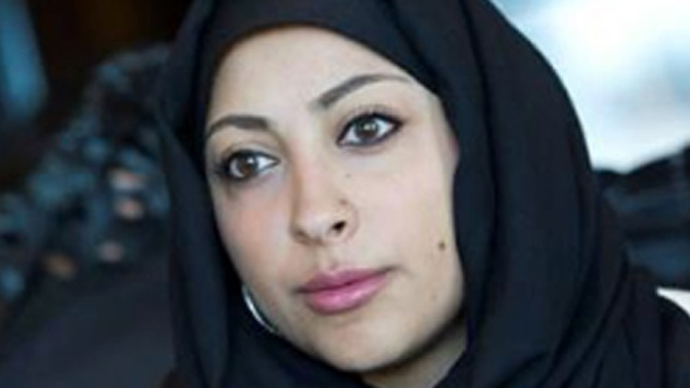
Maryam al-Khawaja (Image from twitter.com)
A prominent Bahraini activist was prevented from boarding a British Airways flight from Denmark ahead of major protests expected to occur in her home country next Wednesday. She says the Bahraini government denied her from traveling.
“I was blocked at the boarding and told to check with the counter because there was a problem. The lady called the office in London who told her that there was a denied boarding message as a decision from the Bahraini government,” Maryam Al-Khwaja told the International Business Times.
“Like all airlines, we are required to comply with requests from individual government authorities,” a BA spokesperson told the news website.
The activist asked the airline to explain why the ban had been issued, but was not initially given a reason.
“I’ve put in a request and they’re going to get back to me. I told them to move as fast as possible because if I don’t receive a response I’ll be consulting a lawyer on the possibility of going to court,” she said.
Mass protests are scheduled to take place in Bahrain on August 14 – the country’s Independence Day.
King Hamad, whose Gulf kingdom has been rocked by Shiite-led protests since 2011, banned protests in Manama on Wednesday in anticipation of the rallies.
The royal decree modifies the law to “ban organizing protests, rallies, gatherings or sit-ins in Manama, with the exception of sit-ins outside [offices of] international organizations” which have been approved by police.
Al-Khwaja said that Bahrain’s government wants “no witnesses to its current and anticipated future violations,” according to a statement from the Bahrain Center for Human Rights (BHCR).
She later tweeted, “What I want to know is what the regime is so afraid of that they [would] issue a ban preventing me from traveling to Bahrain.”
The activist was due to visit her father and her sister, who are currently imprisoned in Bahrain for their roles in pro-democracy protests.
Al-Khawaja, who holds dual Bahraini-Danish citizenship but has not renewed her Bahraini passport, is acting president of the BHCR.
Her predecessor Nabeel Rajab, the organization’s official president and prominent human rights activist, is currently serving a prison sentence. He was initially arrested for criticizing the prime minister on Twitter in 2012 and was later convicted of disturbing public order, calling for marches without giving prior notification, and participating in illegal gatherings.
Bahrain, which hosts the US Fifth fleet, has made a record 221 entry-denials since February 14, 2011, according to Bahrain Watch. Those barred from entering the country include foreign journalists, NGO members, trade unionists, politicians, aid workers, and activists.
Related articles
Prominent Bahraini activist Nabeel Rajab goes missing
Al-Akhbar | May 16, 2013
Prominent Bahraini human rights defender Nabeel Rajab has been removed from his cell to an unknown location, losing all contact with his family and lawyer, the Bahrain Center for Human Rights reported Wednesday.
In an appeal sent out by the human rights group, Rajab had reportedly witnessed prisoners at the central Jaw prison being tortured.
Rajab’s wife had received a phonecall from Rajab testifying on what he had witnessed in the prison. Shortly after, Rajab’s wife was told that her husband had been removed from his prison cell.
His lawyer, family and fellow activists have not been in contact with him since.
On Wednesday, six Bahraini tweeters were sentenced to one year in jail each for insulting the King and “misusing the right of free expression.”
Torture in Bahraini prisons is very commonly used to force prisoners to sign confessions. In February of last year, leading political prisoners began refusing food after reporting systematic abuses in Bahrain’s jails, including beatings, torture and the use of tear gas.
Nabeel Rajab, who founded the Bahrain Center for Human Rights in 2002, has been in custody since June 6 on charges of “public insults against plaintiffs,” the prosecution said in a statement at the time of his rearrest in June 2012.
The avid Twitter user has been charged with insulting the security forces, posting comments on Twitter deemed insulting to a government body and organizing peaceful protests.
His activism has given him the largest Twitter following in Bahrain, and the fourth largest in the Arab world.
The BHCR appeal calls for the immediate release of Rajab “as it is believed that he has been targeted solely due to his legitimate and peaceful work in the defense of human rights.”
Related article
Featured Video

Yemen joins the war – Red Sea could be blocked next – Saudi regime at risk
or go to
Aletho News Archives – Video-Images
From the Archives
A superpower and “the world’s sickest warrior state”
By Paul J. Balles | March 8, 2010
Living through five or six major wars has hardened me to what I thought were the extremes of inhuman cruelty and brutality.
Two things made those extremes almost bearable: the brutality always revealed – at least according to the media coverage – the viciousness of the enemy. It was therefore quite understandable when our “brave men and women” pulverized the enemy.
Films of Japanese torturing captive Americans somehow justified holding Japanese Americans in internment camps during World War II; and only a small percentage of Americans found the bombing of Hiroshima and Nagasaki unreasonably vengeful at best, at worst, depraved.
The media giants in America portrayed the North Koreans as barbaric beasts with their captives, quite unlike their southern counterpoints – our allies during the Korean War. No one ever felt the need to explain how the South Koreans were a civilized breed while the North Koreans were absolute savages, at least according to the official line.
In Vietnam, our warriors justifiably (or so the media made us believe) dropped napalm on the North Vietnamese who had the gall to hide in villages and tunnels to ravage our invaders. At least it was accepted practice until some rogue photojournalist filmed a young girl screaming down a Vietnamese road in flames. … continue
Blog Roll
 Aletho News
- America Racing to Strategic Defeat in Iran: Lt Col Daniel Davis
- FTC Warns Visa, Mastercard, PayPal, Stripe Over Political Debanking
- Russian tanker approaches Cuba despite US oil blockade
- Marandi: Yemen joins the war – Red Sea could be blocked next – Saudi regime at risk
- Pro-Palestinian French member of European Parliament denied entry to Canada
- Pakistan to Host US-Iran Talks
- How Indonesia’s tilt toward the US left it stranded in the Strait of Hormuz
- US has no choice but to retreat from Iranian borders: Top commander
- Iran Retaliation Strikes Chemical Plant Near Dimona
- AWACS’ Destruction is a Major Loss for US Military – Ex-DoW Analyst
- If Americans Knew
- Israeli police block Catholic cardinal from entering Church of the Holy Sepulchre on Palm Sunday
- Israel is assassinating journalists again, more than any other nation, anywhere, ever – Not a ceasefire Day 170
- Over 300 US service members wounded, majority have brain injuries – Not a ceasefire Day 169
- Researchers at Human Rights Watch Resign Over Blocked Report on Palestinian Refugee Return
- Jewish Groups Are Backing a War Americans Don’t Want
- Eric Fingerhut Thinks He’s the President of the Jews
- Top Jewish Philanthropists, Rabbis Urge Israeli President to Take Action Against ‘Jewish Extremists’
- Don’t Be Fooled. Zionist Leaders Have Always Wanted to Control Southern Lebanon
- Israel’s widespread use of torture is a core element of its genocide against the Palestinian people
- In Israel’s War on Iran, Many Middle East US Bases Rendered “All But Uninhabitable”
- No Tricks Zone
- New Study Finds Warming Saves Lives…Cold Temperatures 12 Times More Deadly Than Excess Heat
- German Science Blog Accuses PIK Climate Institute Of Hallucinating Climate Tipping Points
- Devastating Assessment Of Comirnaty Vaccine By Former Senior Pfizer Europe Toxicologist
- New Study: CO2 Is ‘Effectively Negligible’ As An Explanatory Climate Change Factor Since 2000
- Former Pfizer Toxicologist Dr. Helmut Sterz Tells Bundestag Hearing Pfizer Vaccine Should Have Never Been Approved
- Energy Expert: Germany’s Nuclear Phaseout Was A “500 Billion Euro Mistake”
- New Research: South Australia’s Mid-Holocene Sea Surface Temperatures Were 4°C Warmer Than Today
- Storing Green Energy To Last Germany 10 Days Would Require A 60-Million Tonne Battery
- New Studies: UK Sea Levels Were 4 Meters Higher Than Today During The Mid-Holocene
- Destructive Green New Deal: German Energy And Metal Group Warns Of Drastic Crisis
 Aletho News