NSA Scandal: How Leaks Advance Liberty and Resist Tyranny
Using technology to keep the government in check
By Jerry Brito | Reason | June 18, 2013
We now know what we have long suspected: that the National Security Agency is collecting the phone call records of all Americans. And we are now justified in suspecting what we have long feared: that it is also keeping a permanent backup copy of everything that happens on the Internet, ready to be rewound and replayed in the future. Such a massive surveillance apparatus is a threat not only to privacy, but also to liberty. So what hope do we have that such power can be kept in check, and that we don’t succumb to ever greater tyranny?
If the secret surveillance itself is any indication, then the separation of powers is not up to the task. According to President Obama, domestic surveillance programs are “under very strict supervision by all three branches of government.” Yet it doesn’t seem very strict when more than half of the Senate couldn’t be bothered to show up last week for a major briefing by the government’s top intelligence officials.
“Strict supervision” also doesn’t seem very meaningful when you consider that the FISA Court is a hand-picked non-adversarial specialist court that approved every surveillance request it got last year. Experience suggests that specialist courts tend to get captured by their bar, and in the case of the FISA Court, that means just the government.
More to the point, a secret court issuing secret orders based on secret interpretations of the law makes any debate or commentary impossible. Even when there is a will on the part of some lawmakers to carry out oversight, executive branch officials will apparently lie under oath. So if not on the Constitution and its institutions, on what can we rely to keep government power in check?
Technology might be the answer, but not in the way you might think.
Yes, we can encrypt our communications by using PGP, Tor, and OTR chat, and we can transact using Bitcoin. These are invaluable tools of resistance to censorship and oppression. Ultimately, though, most people won’t use them because they won’t see any immediate benefit to justify the effort. And in a world where few use these tools, those who do will perversely draw attention to themselves.
Instead, technology might help keep government power in check the same way it helps it grow: by making it impossible for anyone to keep secrets—including the government itself.
When Daniel Ellsberg decided to leak the Pentagon Papers in 1969, he spent a year sneaking out the 7,000 classified pages one briefcaseful at a time. He spent countless hours each evening in front of a primitive photocopier, and he spent thousands of dollars on the endeavor. In contrast, Bradley Manning and Edward Snowden’s leaks of considerably more data were relative cakewalks. The same digital technology that makes it possible to capture and store vast quantities of surveillance information also makes it possible for the first time in history to copy and release hundreds of thousands of pages of classified information.
A surveillance state as big as the one that’s now coming into view necessarily means that there are more secrets and more people with access to those secrets than ever before. More than 92 million documents were classified in 2011, up from 76 million the year before, and 23 million when President Obama took office. All of that data is digital, and therefore eminently reproducible.
There are also over 4.2 million persons with security clearances, and over a million of those can access top secret documents. Contractors, like Snowden, are an indispensable part of the system, and there are almost 2,000 private companies working for the government on programs related to homeland security and intelligence.
There simply has to be that many documents and that many people with access in order to build and run such a massive edifice. The larger it grows, however, the more untenable it becomes. As Julian Assange pointed out in a pre-Wikileaks essay, an organization keeps secrets because if what it’s doing is revealed, it will induce opposition. A small criminal conspiracy may be able to keep its secrets by limiting its numbers and not writing anything down. A large conspiracy, on the other hand, can’t function unless it systematizes its activities, and that involves a long paper trail and lots of confidants, which makes it more difficult to prevent leaks.
“The more secretive or unjust an organization is, the more leaks induce fear and paranoia in its leadership and planning coterie,” Assange wrote. To cope, such an organization can shrink and do less, he wrote, or introduce more security and controls and thus inefficiency. Either way, the organization’s power will contract.
We’re already witnessing such a reaction to Snowden’s leaks. On Thursday Sen. Dianne Feinstein (D-Calif.) said that Congress plans to draft legislation limiting private contractor access to secret documents. “We will certainly have legislation which will limit [or] prevent contractors from handling highly classified data,” she said. Today NSA director Gen. Keith Alexander announced that the agency will implement a “two-person rule” that would require anyone copying data to do so with another person present—a buddy system that potentially halves the NSA’s efficiency.
In attempting to limit leaks, such legislation would also effectively limit government’s power. That’s the happy dilemma the technology introduces. Digital communications makes achieving and exploiting “total information awareness” possible, but it also makes it almost impossible to keep the resulting corruption under wraps. Secrecy just doesn’t scale.
Related articles
- Leaked: NSA’s Talking Points Defending NSA Surveillance (alethonews.wordpress.com)
- Obama Speaks with Forked Tongue on Surveillance (alethonews.wordpress.com)
- Spying on the World From Domestic Soil (alethonews.wordpress.com)
- Steve Chapman on Why the NSA Leaks Aren’t Putting Americans at Risk (reason.com)
Bulgarian scholars call for end to plutocracy
Press TV – June 24, 2013
Sixty prominent Bulgarian intellectuals have issued a special declaration against ‘plutocracy’ in the country, calling for an end to rule by the wealthy and a return to democracy.
The so-called charter for disbanding the plutocratic model of the Bulgarian state was issued on Sunday amid the ongoing protests by Bulgarians to oust the three-week-old government.
“The protests of tens of thousands of people across the country were motivated by the desperate concern about the state system in Bulgaria. Beyond doubt, we are in a deep crisis of the social contract and a total discreditation of the state institutions,” the declaration read.
The protests began on June 14 after the appointment of controversial and inexperienced media mogul Delyan Peevski as chief of Bulgaria’s National Security Agency (DANS).
The declaration called Peevski’s career and public image “a synthesis of all pathological processes that led to the current degrading and seemingly dead-end situation.”
“The Peevski case laid bare the growing seizure of the political system, media, justice, security and banking sectors by a network of hidden dependencies that does not respect the rule of law and separation of powers, empties the institutions from democratic legitimacy and substitutes public interest [with] corruption and moral degradation,” the declaration stated.
The new Socialist-backed Prime Minister Plamen Oresharski withdrew Peevski’s nomination immediately after the protests erupted.
However, the move failed to appease both the protesters and President Rosen Plevneliev, who said he had lost confidence in the government and demanded an immediate review of the controversial appointment.
In addition, the declaration addressed a number of other instances over the past years that proved “the adhesion of oligarchy and power,” urging the public to launch a process to clearly define the problems in the functioning of Bulgaria’s democracy and to draft reforms to abolish them.
It also listed some of the most striking problems, including alienated institutions, easily swayed by corruption, nepotism and weakened judiciary, police and media.
The sixty scholars behind the declaration include lawyers, journalists, political analysts, sociologists and human rights activists.
New Snowden leak reveals US hacked Chinese cell companies, accessed millions of sms – report
RT | June 23, 2013
US government has been hacking Chinese mobile operator networks to intercept millions of text messages, as well as the operator of region’s fibre optic cable network, South China Morning Post writes citing Edward Snowden.
More information on National Security Agency activity in China and Hong Kong has been revealed by SCMP on Sunday, shedding light on statements Snowden made in an interview on June 12.
“The NSA does all kinds of things like hack Chinese cell phone companies to steal all of your SMS data,” Snowden was quoted as saying on the SCMP website.
In a series of reports the paper claims Snowden has provided proof of extensive US hacking activity in the region.
The former CIA technician and NSA contractor reportedly provided to the paper the documents detailing specific attacks on computers over a four-year period, including internet protocol (IP) addresses, dates of attacks and whether a computer was still being monitored remotely. SCMP however did not reveal any supporting documents.
The US government has been accused of a security breach at the Hong Kong headquarters of the operator of the largest regional fibre optic cable network operator, Pacnet. Back in 2009, the company’s computers were hacked by the NSA but since then the operation has been shut down, according to the documents the paper claims to have seen.
Pacnet’s network spans across Hong Kong, China, Korea, Japan, Taiwan, the Philippines and Singapore and provides connections to 16 data centers for telecom companies, corporations and governments across the region.
The whistleblower has also allegedly revealed the US had viewed millions of text messages by hacking Chinese mobile phone companies. That is a significant claim since the Chinese sent almost billion text messages in 2012 and China Mobile is the world’s largest mobile network carrier.
In his very first leak to the media, Snowden had already exposed the scale of the American government spying operation on its domestic mobile network operators. He later revealed that the US and the UK possessed technology to access the Blackberry phones of delegates at two G20 summit meetings in London in 2009.
In a third article, SCMP claims that the US on a regular basis has been attacking the servers at Tsinghua University, one of country’s biggest research institutions. The whistleblower said that information obtained pointed to hacking activities, because it contained such details as external and internal IP addresses in the University’s network, which could only have been retrieved by a security breach.
Tsinghua University is host to one of Chinas’ six major backbone networks, the China Education and Research Network (CERNET) containing data about millions of Chinese citizens.
Bush’s Foiled NSA Blackmail Scheme
By Dennis J Bernstein | Consortium News | June 21, 2013
In early 2003, as the U.S. and British governments were seeking international acquiescence to their aggressive war on Iraq, an unexpected cog thrown into the propaganda machine was the disclosure that the National Security Agency was spying on UN Security Council members in search of blackmail material.
The revelation received little attention in the mainstream U.S. news media, which was almost fully on board the pro-war bandwagon, but the disclosure received wide international attention and stopped the blackmail scheme. U.S. President George W. Bush and British Prime Minister Tony Blair were forced to abandon a UN resolution and invade Iraq with a ragtag “coalition of the willing.”

Former British Prime Minister Tony Blair.
Several months later, the identity of the leaker was revealed, a young woman named Katharine Gun who worked as a linguist at the NSA’s UK counterpart, British Government Communications Headquarters. Gun lost her job and was charged under British secrecy laws, but the case was dropped because the court would have required the Blair government to disclose that it also had twisted the arms of legal advisers to extract an opinion endorsing the invasion.
Now, a decade later, Edward Snowden, a young American systems analyst working for the NSA, has leaked documents revealing a global surveillance network and prompted another international debate – about government spying vs. personal privacy. Katharine Gun joined Pacifica’s “Flashpoints” host Dennis J Bernstein to discuss both cases.
DB: What exactly was your position when you decided to leak a certain document?
KG: My title was linguist analyst. I was a Mandarin Chinese speaker. We translated interceptions and produced reports for the various customers of GCHQ, which are normally the Foreign Office or MI-5 and MI-6.
DB: Can you explain the document you released and the significance of the timing?
KG: It was released at the end of January 2003, just before the invasion of Iraq. I saw an email that had been sent from the NSA to GCHQ. It was a request for GCHQ to help the NSA intercept the communications of six nations that sat on the Security Council at that time. It was to intercept their domestic and office telecoms in order to obtain all the information we could about the delegates, which the U.S. could then use to achieve goals favorable to U.S. interests. They called for the whole gamut of information, which made me think they would potentially use the information to blackmail or bribe the U.N. delegates.
DB: This bugging took place at the United Nations?
KG: Presumably, yes. Or it could involve the United Nations headquarters or also their domestic residence.
DB: The idea was to get the necessary information one way or the other to influence the key members to support the U.S. quest for war in Iraq?
KG: Yes. At the time, if you were not working for the intelligence services or the foreign offices of the U.S. or U.K. you would probably assume that the goal of [President George W.] Bush and [Prime Minister Tony] Blair at that time was to work diplomatically to reach a solution. But we now know, after several leaks over the years about the run-up to the war in Iraq, that war was the agenda all along. When I saw the email it made me think, “This is evidence that war is the agenda.” That’s why I decided the public needed to know.
DB: GCHQ is the British Government Communications Headquarters, the equivalent to the NSA [National Security Agency]. You were working there in the lead-up to the Iraq War. Can you remind us what governments were bugged?
KG: Six nations, smallish countries: Angola, Cameroon, and Pakistan, I think. Mexico was mentioned, and possibly Chile as well. They were countries that are generally not known for their big powerful positions at the U.N.
DB: What went through your mind leading up to the decision to leak this information? This big decision changed history a bit. How did you make this courageous decision that also changed your own life?
KG: I was very concerned. I had informed myself about the realities of Iraq and the situation there because I grew up during the first Gulf War and the following years of sanctions. It was in the back of my mind that Iraq was a country that was virtually destroyed, and that the people were living in impoverished conditions. It made me think that another attack on them would not be fair and justified because there was nothing about Iraq that was a threat to either the U.S. or the U.K.
So when I saw the email and realized what was going on behind closed doors was an attempt to get the U.N. to authorize what would then have become a pre-emptive strike on a country, I thought the public should know about this because it angered me.
DB: What happened after you made this information available? What happened with your position? Were you intimidated, attacked?
KG: Initially I tried to remain anonymous, but when I realized the information revealed in the newspaper at the time was identifiable to GCHQ, I decided I didn’t want to lead a double life at GCHQ and pretend I had nothing to do with it. I confided to my line-manager and said it was my leak. Then I was arrested under suspicion of breaking the Official Secrets Act, questioned, and released on bail for eight months.
In November 2003, much to our surprise, they decided to charge me, despite having waited so long. After discussions with my legal team, which included Liberty, an organization very similar to the U.S. ACLU, we decided I would plead non-guilty, because I personally felt that although I did the act, I didn’t feel guilt, because I didn’t feel I had done anything wrong. Our defense would have been to establish the defense of necessity, which is not yet tested in a court of law. My legal team then asked for all the legal advice leading up the war, and at that point, the prosecution decided to drop all charges against me.
DB: What do you think made them decide to prosecute you, and what information made them drop the charges? Were they trying to backpedal? Were they trying to make sure no other folks in positions like you would do it again?
KG: It’s speculation on my part because obviously they haven’t disclosed. I suspect one of the reasons they charged me was to make an example of my actions to try to deter people from it. On the other hand, when they dropped the charges, I suspect there may have been a variety of reasons. When we asked for the legal advice from the then-Attorney General, at that time his legal advice had not been fully disclosed.
During the run-up to the war, Blair asked for legal advice, obviously. The first draft was about 13 pages long. The language was very cautious – it didn’t say there was a definite reason for war. There were many legal terms of caution, but at some point Blair was told the legal advice was not good enough. He needed a watertight case. The Attorney General then re-drafted his advice, and condensed it to a single page that was then issued to the House of Commons.
That is what persuaded all the MPs in the House of Commons to vote for Britain’s involvement in the war. Eventually information came out, not from myself, but from other means and it became apparent that the legal advice had not been at all watertight to start with.
DB: Daniel Ellsberg said your most important and courageous leak is the only one made in time to avert an imminent possible war. Was your desire to avert war?
KG: Yes, I was hoping the British ministers would see the truth and question the actions of Blair and the secret negotiations he was having with Bush at the time. I wanted more transparency on the issue. I wanted people to question what was going on and to generally challenge this bandwagon for a preemptive strike against a country that was already very impoverished and no threat to anybody whatsoever.
DB: Did you ever hear from folks who based on your revelations, learned they were bugged?
KG: No.
DB: So there were no thank yous coming across from that part of the world?
KG: No. At the time of the leak, my name didn’t come out. Eight months later my name was made public.
DB: Did it change your life?
KG: I lost my job. The secure, full-time, long-term employment was no longer possible. That has made an impact, primarily financially, on my life and my family’s life.
DB: We are now seeing extraordinary NSA leaks from Edward Snowden in the British Guardian. What are your thoughts on this?
KG: I think Snowden is probably is a lot more clued-up than I was at the time. My leak was a single issue. Snowden has had a long period of time working within the U.S. intelligence services. He’s obviously a very technically savvy professional. I admire him for taking this tremendous step, which he thought out very carefully and methodically. He has made some very good points. These kinds of issues should be in the public domain because it involves innocent members of the public. We, the public, should be able to have a measure of a say in these matters.
DB: We hear that people like you, who were leaking before the war, and Snowden now, are putting people’s lives in jeopardy, endangering the people. We hear that secrecy is necessary to prevent terrorist attacks, and that many have been prevented by this kind of secrecy, investigation, wiretapping and bugging that’s going on now.
KG: There is absolutely no evidence that my leaks in any way endangered anybody else.
DB: But you were accused of that.
KG: Yes, they love to throw accusations around, there’s no doubt about that. But in my case, the majority of views supported my actions. In Snowden’s case, people who have a fair and just understanding of the issues at-large are supportive of his actions, as they would be of Private Manning, who is currently on trial.
DB: Did you lose any friends or associates, over this?
KG: Ironically, not really. Many of my friends and colleagues from GCHQ have also left GCHQ, partly to progress in their professions. They didn’t see much chance for their linguistic skills progressing much further within GCHQ and I continue to be in touch with them.
DB: If you had it all to do over again, would you?
KG: That’s a difficult question. Now I’m married and have a child. I would hope that I would still do it, but perhaps I would be more savvy about how I did it. Snowden was very clued-up and seems to know exactly what he should be doing – how to stay safe and keep out of the way of being unjustly arrested and tried without due process of law.
DB: Your language skills. Are you using them now?
KG: Not now. I’m only fluent in Mandarin Chinese. I speak some Japanese and am now trying to learn Turkish.
DB: That may in handy in the next decade or so. Thank you for talking to us.
~
Dennis J Bernstein is a host of “Flashpoints” on the Pacifica radio network and the author of Special Ed: Voices from a Hidden Classroom. You can access the audio archives at www.flashpoints.net.
Related articles
- A British Precursor to Snowden Case (consortiumnews.com)
- British spy agency has access to global communications, shares info with NSA (alethonews.wordpress.com)
Spying on the World From Domestic Soil
By Katitza Rodriguez | EFF | June 21, 2013
The world is still reeling from the series of revelations about NSA and FBI surveillance. Over the past two weeks the emerging details paint a picture of pervasive, cross-border spying programs of unprecedented reach and scope: the U.S. has now admitted using domestic networks to spy on Internet users both domestically and worldwide. The people now know that foreign intelligence can spy on their communications if they travel through U.S. networks or are stored in U.S. servers.
While international public outrage has justifiably decried the scope and reach of these revelations, carte blanche foreign intelligence surveillance powers over foreigners are far from new. In the U.S., foreign intelligence has always had nearly limitless legal capacity to surveil foreigners because domestic laws and protections simply don’t reach that surveillance activity.
This legal framework, with no protection for foreigners and little oversight besides, has been exacerbated by the growth in individuals now living their lives online, who conduct their most intimate communications in cloud services that are hosted in the U.S. and across different jurisdictions. To make matters worse, the vast amount of Internet traffic globally is routed through the U.S. Last but not least, logistical barriers to powerful, mass surveillance have lowered and the application of existing legal principles in new technological contexts has become unclear and shrouded in secrecy, especially in a extra-territorial surveillance context. The US government’s FISA powers, which in 2008 opened the door to broad surveillance of communications where one side is an American and the other side is a foreigner, represent just an example of an increasing state capacity to conduct nearly limitless invasive extra-territorial surveillance from domestic soil.
International Backlash
On June 18, Germans rallied at a well-known Berlin Wall crossing point called Checkpoint Charlie. Under the motto: “Yes We Scan!” German activists protested against PRISM and NSA surveillance in response to President Barack Obama’s Berlin visit. Pictures of the rally show protest signs claiming that the Obama administration has become “Stasi 2.0” with the quote “All your data belong to us”.
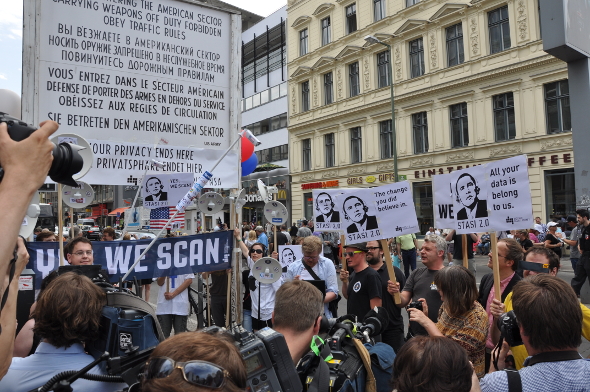
The Stasi 2.0 campaign was originally designed in 2007 to fight Germany’s mandatory data-retention law, a law implementing an EU Directive that force ISPs and telecom providers to continuously collect and store records documenting the online activities of millions of ordinary Europeans. Roughly 34,000 citizens filed a lawsuit against the mandatory data retention in protest. The campaign was successful and in March 2010 a German court declared the law unconstitutional and ordered the deletion of the collected data. Now, the Stasi 2.0 campaign has shifted focus on calling upon their government to protect them against overreach scope of NSA foreign surveillance practices, Sandra Mamitzsch from Digitale Gesellschaft told EFF.
Germany has also increased its capacity to conduct sweeping and invasive extra-territorial surveillance from its domestic soil. As we noted, the German government has leveraged its ability to remotely compromise computer systems in order to spy on its citizens. The government has used commercial malware to hack private data. While there has been no confirmation that Germany is deploying these investigative techniques against persons outside German territories, extra-territorial surveillance is feasible because infection occurs via email and other Internet transmissions.
Campaigns against the NSA spying overreach are now being planned for July 6 all around Australia. Australians can get involved here: http://ourprivacy.org.au/
Micheal Vonn, policy director at the B.C. Civil Liberties Association in Canada, told to the Global News in Canada: “[w]e fully intend to get some pointed questions to the Canadian government about knowledge, complicity, alliance with this program. And whether, in fact, very, very quietly, the Canadian security establishment has been harvesting the fruits of this program for some time.”
EFF is demanding Internet companies to join our cause and protect the privacy of their international customers calling on Congress to create a committee to uncover the truth about the NSA alarming allegations. You can take action here. Current foreign intelligence surveillance targetting foreigners must be challenged to ensure strong human rights safeguards, transparency and accountability across the world. A global dialogue on extra-territorial foreign intelligence surveillance among all nations is much needed.
EFF will continue blogging about the impact of the NSA leaks on Internet users abroad in our Spies Without Borders series. Next, we will examine what implications the government’s use of these FISA powers has for Internet users abroad, with an eye to other jurisdictions and the requirements of international law.
This is the 5th article of our Spies Without Borders series. The series are looking into how the information disclosed in the NSA leaks affect Internet users around the world whose private information is stored in U.S. servers, or whose data travels across U.S. networks.
Image: Digitale Gesellschaft, licensed under a Creative Commons BY SA 3.0 license.
Related article
Reassured by NSA’s Internal Procedures? Don’t Be. They Still Don’t Tell the Whole Story.
By Kurt Opsahl and Mark Rumold | EFF | June 21, 2013
Yesterday, the Guardian released two previously-classified documents describing the internal “minimization” and “targeting” procedures used by the NSA to conduct surveillance under Section 702. These procedures are approved by the Foreign Intelligence Surveillance Court (FISC) on an annual basis and are supposed to serve as the bulwark between the NSA’s vast surveillance capabilities and the private communications of Americans. As we noted earlier today, the procedures, themselves, aren’t reassuring: far too much discretion is retained by NSA analysts, the procedures frequently resolve doubt in favor of collection, and information is obtained that could otherwise never be obtained without a warrant.
Which would be bad enough, if it were the end of the story. But it’s not.
The targeting and minimization documents released yesterday are dated a few months after the first publicly known scandal over the new FAA procedures: In April 2009, the New York Times reported that Section 702 surveillance had “intercepted the private e-mail messages and phone calls of Americans . . . on a scale that went beyond the broad legal limits established by Congress.” In June 2009, the Times reported that members of Congress were saying NSA’s “recent intercepts of the private telephone calls and e-mail messages of Americans are broader than previously acknowledged.” Rep. Rush Holt described the problems as “so flagrant that they can’t be accidental.”
Presumably, following these “flagrant” abuses (and likely in response to the Congressional criticism of the original procedures), the government refined the procedures. The documents released yesterday are the “improved” targeting and minimization procedures, which appear to have been reused the following year, in 2010, in the FISC’s annual certification.
But these amended procedures still didn’t stop illegal spying under Section 702.
Unless the government substantially changed the procedures between August 2010 and October 2011, these are the very procedures that the FISC eventually found resulted in illegal and unconstitutional surveillance. In October 2011, the FISC issued an 86-page opinion finding that collection carried out under the NSA’s classified minimization procedures was unconstitutional. The opinion remains secret, but it is very likely that yesterday’s leaked NSA documents show the very minimization procedures the Director of National Intelligence admitted the FISC had found resulted in surveillance that was “unreasonable under the Fourth Amendment” and “circumvented the spirit of the law.”
And for good reason: the procedures are unconstitutional. They allow for the government to obtain and keep huge amounts of information it could never Constitutionally get without a warrant based on probable cause. As we explained, the procedures are designed such that the NSA will routinely fail to exclude or remove United States persons’ communications, and the removal of those communications are wholly entrusted to the “reasonable discretion” of an analyst.
EFF has been litigating to uncover this critical FISC opinion through the Freedom of Information Act and to uncover the “secret law” the government has been hiding from the American public. And EFF isn’t alone in fighting for the release of these documents. A bipartisan coalition of Senators just announced legislation that would require the Attorney General to declassify significant FISC opinions, a move they say would help put an end to precisely this kind of “secret law.”
When the government, and others, claim these procedures ensure your privacy is respected, know this: they’re only telling you half the story.
Take action now — to put an end to secret law, to demand the American public gets the full story, and to finally put an end to the NSA’s domestic spying program.
Related articles
- FISA Court Rejects Catch-22 Secrecy Argument in FOIA Case (eff.org)
- Government Says Secret Court Opinion on Law Underlying PRISM Program Needs to Stay Secret (alethonews.wordpress.com)
British spy agency has access to global communications, shares info with NSA
RT | June 21, 2013
The British spy agency GCHQ has access to the global network of communications, storing calls, Facebook posts and internet histories – and shares this data with the NSA, Edward Snowden has revealed to the Guardian in a new leak.
GCHQ’s network of cables is able to process massive quantities of information from both specific targets and completely innocent people, including recording phone calls and reading email messages, it was revealed on Friday.
“It’s not just a US problem. The UK has a huge dog in this fight,” Snowden told the Guardian. “They [GCHQ] are worse than the US.”
The Government Communications Headquarters agency has two different programs, aimed at carrying out this online and telephone monitoring – categorized under ‘Mastering the Internet’ and ‘Global Telecoms Exploitation.’ Both have been conducted in the absence of any public knowledge, reports the Guardian.
“If you remember, even the NSA said that they did not record phone calls, but according to these latest revelations by Edward Snowden, that up to ‘600 million’ telephone events last year were recorded a day by the GCHQ,” said RT’s Tesa Arcilla from London.
“There’s no doubt as to what the objectives of these programs were, having put them in place,” she said, emphasizing the titles.
The agency is able to store the volumes of data it amasses from fiber-optic cables for up to 30 days in an operation codenamed Tempora. The practice has been going on for around 18 months.
GCHQ which was handling 600m telephone ‘events’ a day, according to the documents, had tapped into over 200 fiber-optic cables and had the capacity to analyze data from over 46 of them at a time.
The cables used by GCHQ can carry data at 10 gigabits per second, which in theory, means they could deliver up to 21petabytes of information per day. The program is continuing to develop on a daily basis with the agency aiming to expand to the point it is able to process terabits (thousands of gigabits) of data at once.
By May last year, some 300 GCHQ-assigned analysts and 250 from the NSA had been specially allocated large quantities of data to trawl through as a result of the operations.
The Guardian reports that 850,000 NSA and outside contractors had potential access to the databases. However, the paper does not explain how it came to such an enormous figure
“These revelations reveal the scale of and the scope of cooperation between UK and US intelligence services,” said RT’s Gayane Chichakyan from Washington. “From these revelations we learned how dramatically it has expanded over the years.”
“The document shows the FISA court lets the NSA use data snagged ‘inadvertently.’ They basically give a warrant to target suspects,” she said, recalling Lieutenant General Keith Alexander’s quote after a 2008 visit to the Menwith RAF base in England: “Why can’t we collect all the signals all the time? Sounds like a good summer project for Menwith,” he had said.
The GCHQ project was first trialed in 2008. The intelligence organization has been labeled an ‘intelligence superpower’ on account of its technical capabilities, which by 2010 gave it the strongest access to internet communications out of the ‘Five Eyes’ – an international intelligence sharing alliance, including Australia, Canada, New Zealand, the UK and US, brought into existence in 1946.
The mass-surveillance has seen the interception of data from transatlantic cables that also carry data to western Europe through ‘intercept partners’ commercial companies that had entered into private agreements with GCHQ. Many have been paid off for their cooperation.
GCHQ feared that exposure of the names of the companies involved could lead to “high-level political fallout,” and took measures to ensure names were kept secret. Warrants had reportedly been issued to compel the companies to cooperate so that GCHQ could engage in spying through them.
“They have no choice,” said a Guardian intelligence source.
Snowden previously warned that he would be releasing further information pertaining to mass security operations carried out on the unwary public, stating in a previous Q & A with the Guardian that the “truth is coming, and it cannot be stopped.”
Corporatizing National Security: What It Means
By Ralph Nader | June 20, 2013
Privacy is a sacred word to many Americans, as demonstrated by the recent uproar over the brazen invasion of it by the Patriot Act-enabled National Security Agency (NSA). The information about dragnet data-collecting of telephone and internet records leaked by Edward Snowden has opened the door to another pressing conversation—one about privatization, or corporatization of this governmental function.
In addition to potentially having access to the private electronic correspondence of American citizens, what does it mean that Mr. Snowden—a low-level contractor—had access to critical national security information not available to the general public? Author James Bamford, an expert on intelligence agencies, recently wrote: “The Snowden case demonstrates the potential risks involved when the nation turns its spying and eavesdropping over to companies with lax security and inadequate personnel policies. The risks increase exponentially when those same people must make critical decisions involving choices that may lead to war, cyber or otherwise.”
This is a stark example of the blurring of the line between corporate and governmental functions. Booz Allen Hamilton, the company that employed Mr. Snowden, earned over $5 billion in revenues in the last fiscal year, according to The Washington Post. The Carlyle Group, the majority owner of Booz Allen Hamilton, has made nearly $2 billion on its $910 million investment in “government consulting.” It is clear that “national security” is big business.
Given the value and importance of privacy to American ideals, it is disturbing how the terms “privatization” and “private sector” are deceptively used. Many Americans have been led to believe that corporations can and will do a better job handling certain vital tasks than the government can. Such is the ideology of privatization. But in practice, there is very little evidence to prove this notion. Instead, the term “privatization” has become a clever euphemism to draw attention away from a harsh truth. Public functions are being handed over to corporations in sweetheart deals while publicly owned assets such as minerals on public lands and research development breakthroughs are being given away at bargain basement prices.
These functions and assets—which belong to or are the responsibility of the taxpayers—are being used to make an increasingly small pool of top corporate executives very wealthy. And taxpayers are left footing the cleanup bill when corporate greed does not align with the public need.
With this in mind, let us not mince words. “Privatization” is a soft term. Let us call the practice what it really is—corporatization.
There’s big money to be made in moving government-owned functions and assets into corporate hands. Public highways, prisons, drinking water systems, school management, trash collection, libraries, the military and now even national security matters are all being outsourced to corporations. But what happens when such vital government functions are performed for big profit rather than the public good?
Look to the many reports of waste, fraud, and abuse that arose out of the over-use of corporate contractors in Iraq. At one point, there were more contractors in Iraq and Afghanistan than U.S. soldiers. Look to the private prisons, which make their money by incarcerating as many people as they can for as long as they can. Look to privatized water systems, the majority of which deliver poorer service at higher costs than public utility alternatives. Visit privatizationwatch.org for many more examples of the perils, pitfalls and excesses of rampant, unaccountable corporatization.
In short, corporatizing public functions does not work well for the public, consumers and taxpayers who are paying through the nose.
Some right-wing critics might view government providing essential public services as “socialism,” but as it now stands, we live in a nation increasingly comprised of corporate socialism. There is great value in having public assets and functions that are already owned by the people, to be performed for the public benefit, and not at high profit margins and prices for big corporations. By allowing corporate entities to assume control of such functions, it makes profiteering the central determinant in what, how, and why vital services are rendered.
Just look at the price of medicines given to drug companies by taxpayer-funded government agencies that discovered them.
(Autographed copies of my new book Told You So: The Big Book of Weekly Columns are available from Politics and Prose, an independent book store in Washington D.C.)
Snowden: Don’t mention the I-Word!
By Steve Sailer | June 18, 2013
The New York Times’ “public editor” writes a little piece that asks an interesting question in the title:
Following Up on the N.S.A. Revelations: Were They Really ‘Confirmations’?
By MARGARET SULLIVAN
She lists various articles over the last eight years that recounted much of what Edward Snowden said. For example, James Bamford has been covering the NSA since his 1982 book The Puzzle Palace. Bamford regularly discloses interesting information in Wired, such as the revelations of the more central NSA whistleblower William Binney.
And there were plenty of disclosures about telephone metadata snooping going back to Carl Cameron’s four-part Fox series in 2001.
No doubt there are lots of reason Snowden got so much publicity, but let me mention a subtle one. Unlike Bamford, Binney, Cameron and many others who have looked into snooping in America, Snowden, as far as I can tell, has never mentioned the I-Word: Israel.
Generally, anybody who looks into NSA questions pretty quickly notices that the NSA outsourced some spying on Americans to Israelis, and that, by now, the question of which country is the dog and which country is the tail has gotten murky. For example, here’s a 2012 Wired article by Bamford:
Shady Companies With Ties to Israel Wiretap the U.S. for the NSA
But that’s not the kind of thing that the media or, to be frank, the great majority of the American public wants to think about. We’ve all been socialized to shut our brains off when it comes to this tail wagging the dog question. Cameron got to keep his job at Fox, for example, but his series got erased from the official record.
Snowden, in contrast, has kept things nice and neat for people. Everybody seems to have a nice strong opinion about Snowden in part because he hasn’t set off the mental shutdown process that the I-Word provokes in well-trained Americans.
Time to Raise Political Asylum Quotas for Americans?
US Should Top the List of the International Quota for Political Refugees
By Sybel Edmonds | Boiling Frogs Post | June 17, 2013
I don’t know how you feel about surveys, ranking or indexes, but whether you follow them or not, you must be aware of how we’ve been falling steadily as a nation. Those of you who follow lists-surveys and global indexes, let’s admit it- as a nation we have not been going up on most global ranking lists – in fact, just the opposite.
We have been going down on the list of the World’s Least Corruption Nations-way down. We have been dropping continuously when it comes to our ranking in the education arena. We have been dropping royally when it comes to Healthcare Systems. When it comes to World Press Freedom, we are embarrassingly low, behind Cape Verde, Cyprus, and even trailing Mali, Tanzania, El Salvador, Botswana and Comoros!! We didn’t even make it onto the ridiculous list of the top ten nations’ national happiness index.
All these competitive areas aside, there is one list we should be climbing steadily and rapidly. Even if you don’t care about all those other global lists you must care about this particular one; for your own good and even your survival. I am talking about a list pertaining to a nation’s status as to its need for acceptance of its political refugees by the global community.
 Please don’t laugh or shrug off this suggestion. Instead, pause and think about our whistleblowers in jail or those awaiting the results of their prosecutions. Remember the journalists and reporters being targeted and investigated by our national police. Recall our new laws recently put in place to secretly and indefinitely detain any American citizen (that is you and me)-without any warrant or even having to show any justification. Think about the still-growing national no-fly list. Remind yourself of torture as our government’s common practice; abroad and here at home. Take a look at your land line, cell, laptop, fax and I-Pad as tools used by our government to illegally-secretly-continuously spy on you.
Now you see what I am talking about.
If you still find the notion difficult to accept, then think of the dozens of Hollywood movie classics on the Stasi and KGB. Remember how people climbed the wall or crawled through tunnels to escape the constant surveillance and arbitrary detentions of their national police. Their national police cited national security and unity. Now consider how the NSA and dozens of mega-corporations have you under surveillance illegally; around the clock. Our national police have been citing national security.
How do you think our camps for our citizens to be detained under our new national law, NDAA, would be different than those set up by the Stasi, KGB and the like?
You remember how other western nations received the lucky escapees from the fascistic or communist regimes with open arms? Well, now they should be receiving us, our escapees; with open arms.
They have to. They must. Not doing it would be in violation of their laws and their international pledge:
Asylum is granted to people fleeing persecution or serious harm in their own country and therefore in need of international protection. Asylum is a fundamental right; granting it is an international obligation, first recognized in the 1951 Geneva Convention on the protection of refugees. In the EU, an area of open borders and freedom of movement, countries share the same fundamental values and States need to have a joint approach to guarantee high standards of protection for refugees. Procedures must at the same time be fair and effective throughout the EU and impervious to abuse. With this in mind, the EU States have committed to establishing a Common European Asylum System.
…
And here is the international law describing who qualifies for international protection-Based on UN Convention & Protocols[Emphasis Mine]:
Grounded in Article 14 of the Universal Declaration of human rights 1948, which recognizes the right of persons to seek asylum from persecution in other countries, the United Nations Convention relating to the Status of Refugees, adopted in 1951, is the centerpiece of international refugee protection today.(1)
A refugee, according to the Convention, is someone who is unable or unwilling to return to their country of origin owing to a well-founded fear of being persecuted for reasons of race, religion, nationality, membership of a particular social group, or political opinion.
…
Today, we, the citizens of the United States of America, face prosecution, persecution, torture, and possible assassination for engaging in certain journalistic or even Good Samaritan reporting of illegal-criminal-unconstitutional activities by those trusted with our nation’s health, wealth, and security.
Our government has been engaged in ongoing torture and human rights violations at home and abroad. Whether it is the globally recognized USA halls-of-shame in Guantanamo, Bagram and Abu Ghraib, or, secretly carried out atrocities in our government’s black cites around the globe, or, tortures inflicted on a citizen here at home who is guilty of exposing government criminalities, our government is now recognized and acknowledged as a Supreme Torturer.
This situation now is being extended to those of us who may have read or disseminated information originally gathered and distributed by others. Today our whistleblowers-truth tellers-Good Samaritans are thrown behind bars, while our criminals who engage in robbing our taxpayers of billions of dollars, or those who engage in torture and murder, are highly protected and handsomely awarded by our rulers.
We United States Citizens have been deprived of expressing collective dissent even through the most peaceful means and in the most pacifist manner. Our participation or membership in social groups or gatherings that challenge illegal wars or anti humanitarian practices land us on our government’s never-defined ‘enemy & terrorist’ list, with consequences ranging from being prohibited from traveling , to having our homes raided and families intimidated by armed government militia, to being persecuted and thrown before a federal grand jury to face possible incarceration for our beliefs.
We Americans, every single one of us, are treated as potential terrorists, are considered guilty with no way to prove otherwise. We all are subjected to round the clock warrantless-illegal surveillance , and degrading violation-probing-groping searches as mandatory requirements for our travel.
I believe, and you should as well, that we have more than enough cases of recorded atrocities, criminalities and violations inflicted upon us by our very own government to expect a substantial increase in our nation’s status-ranking for acceptance of our political refugees.
I know, and you do too, that there are many nations with governmental practices worse than ours. However, our bad government is much bigger than their bad governments, with much higher capabilities. When you have a huge government like ours, with incredible technological and weaponry capabilities as ours does, you risk far graver atrocities than with smaller bad governments with limited capabilities. That’s a fact. Our big bad government is far worse than their small bad government. And that should increase and elevate our nation’s ranking in the international community’s political refugee quota-status.
As for the so-called liberal nations: we urge you to remember the Stasi and the suffocating repression suffered by the East Germans, and then, go ahead and multiply that by a six-digit number of your choice. Any number will do, that is, as long as it has six digits. Our technology-enabled Stasis can tap, record, analyze and save billions of communications. Our rulers’ mega corporate collaborators can pull the plug on millions of us with no recourse available or even imaginable. Our mega military’s ferocious drones can pinpoint and turn us into ashes with a secret order issued on a simple letterhead.
We implore the international community to grant us, the Citizens of the United States of America, ‘High Priority Political Asylum’ status. At least consider a swapping arrangement whereby the international community’s highest-level criminals, con artists, professional swindlers, and or psychotic serial torturers are sent here where they can find an agreeable working-practicing environment and unlimited government protection and rewards, in exchange for those of us in search of peace, a reasonable degree of freedom and justice.
Sibel Edmonds is the Publisher & Editor of Boiling Frogs Post and the author of the Memoir Classified Woman: The Sibel Edmonds Story. She is the recipient of the 2006 PEN Newman’s Own First Amendment Award for her “commitment to preserving the free flow of information in the United States in a time of growing international isolation and increasing government secrecy”
Related article
Featured Video
Chinese jet fuel and the myth of energy independence
or go to
Aletho News Archives – Video-Images
Book Review
Former Insiders Criticize Iran Policy as U.S. Hegemony
By GARETH PORTER | CounterPunch | February 27, 2013
“Going to Tehran” arguably represents the most important work on the subject of U.S.-Iran relations to be published thus far.
Flynt Leverett and Hillary Mann Leverett tackle not only U.S. policy toward Iran but the broader context of Middle East policy with a systematic analytical perspective informed by personal experience, as well as very extensive documentation.
More importantly, however, their exposé required a degree of courage that may be unparalleled in the writing of former U.S. national security officials about issues on which they worked. They have chosen not just to criticise U.S. policy toward Iran but to analyse that policy as a problem of U.S. hegemony. … continue
Blog Roll
 Aletho News
- Iran war will leave long-term ‘scar’ on Wall Street, investors warn
- How Iran decimated US power projection in West Asia: Military lessons of 40-day war
- Iran’s report details US-Israeli war crimes in targeting schools, hospitals, livelihoods
- NATO’s Slow Fracture: How Trump’s Iran War Exposed the Instrument of Hegemony
- Chinese jet fuel and the myth of energy independence
- Ukraine Sea Drone Fired From Libya Hit Russian Tanker in Mediterranean
- IRGC: Iranian forces launched no attacks during ceasefire hours
- Trump Administration Moves To Automate U.S. Military Draft Registration
- Spain orders reopening of Tehran embassy, condemns Israel’s carpet bombing of Lebanon
- Israel faces ‘unsustainable’ strategic crisis following 40-day war against Iran: Analyst
- If Americans Knew
- TCN: Is Israel Blackmailing President Trump?
- Israel killed at least 303 Lebanese yesterday – who were they? Daily Update
- Amnesty: Urgent – Protect Lebanese civilians from brutal escalation in Israeli attacks
- Is The War Against Iran Over?
- Inside the Israeli army’s propaganda wing
- Hundreds of Gaza Amputees Stranded in Legal Limbo
- The gallows law: Israel moves toward executing Palestinian children
- Tucker Carlson: The Path to Peace requires ending ‘special alliance’ with Israel
- This is ceasefire? Israel’s biggest massacre yet in Lebanon, another journalist killed in Gaza – Daily Update
- Tucker Carlson on Israel: This Is the Behavior of an Ally? Really?
- No Tricks Zone
- An Inconvenient Tree: Uncovered In Alps… Europe Much Warmer Than Today 6000 Years Ago
- New Study Reports A 60% Slowdown In Greenland’s Ice Loss Rate In The Last Decade
- Low Intensity Tornado Wrecks Major Solar Farm, Creating A Potential Toxic Dump
- New Study Finds Warming Saves Lives…Cold Temperatures 12 Times More Deadly Than Excess Heat
- German Science Blog Accuses PIK Climate Institute Of Hallucinating Climate Tipping Points
- Devastating Assessment Of Comirnaty Vaccine By Former Senior Pfizer Europe Toxicologist
- New Study: CO2 Is ‘Effectively Negligible’ As An Explanatory Climate Change Factor Since 2000
- Former Pfizer Toxicologist Dr. Helmut Sterz Tells Bundestag Hearing Pfizer Vaccine Should Have Never Been Approved
- Energy Expert: Germany’s Nuclear Phaseout Was A “500 Billion Euro Mistake”
- New Research: South Australia’s Mid-Holocene Sea Surface Temperatures Were 4°C Warmer Than Today
 Aletho News